
Life, 1892-04-21 · page 6 of 18
Life — April 21, 1892 — page 6: what you’re looking at
What you’re looking at
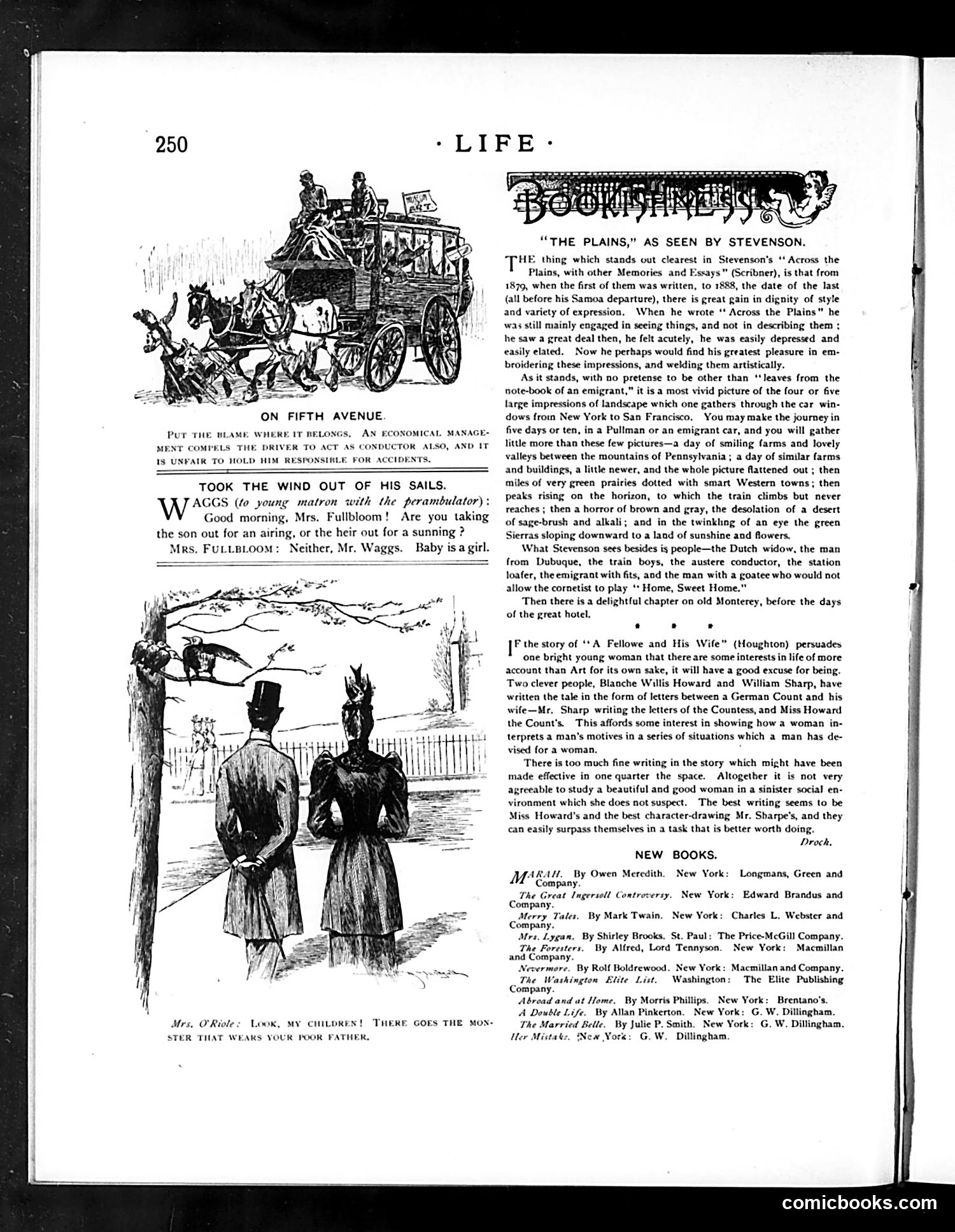
This page contains **two separate satirical cartoons** unrelated to each other. **Top cartoon ("On Fifth Avenue")**: A driver operates a horse-drawn carriage while passengers ride atop. The caption critiques incompetent management, suggesting the driver should also act as conductor—satirizing inefficient organizational structures of the era. **Bottom cartoon**: Two well-dressed women encounter each other on a street. Mrs. O'Brien's comment—"Look, my children! There goes the monster that wears your poor father"—appears to satirize marital infidelity or a rival woman, using "monster" mockingly. The remaining content is a **book review section** discussing Stevenson's travel writing and contemporary novels. These cartoons employ the genteel humor typical of Life magazine's social satire from this period.
📄 Transcribed text from this page (OCR, searchable)
Machine-transcribed from the original scan — historical spelling and the odd misread are preserved.
ON FIFTH AVENUE PUT THE BLAME WHERE IT BELONGS, AN MENT COMPELS THE DRIVER TO ACT AS CONDUCTOR ALSO, AND IT $ UNFMR TO HOLD HIM RESPONSIBLE FOR ACCIDENTS. = TOOK THE WIND OUT OF HIS SAILS. Wweess (to young matron with the perambulator) : Good morning, Mrs. Fullbloom! Are you taking the son out for an airing, or the heir out for a sunning ? Neither, Mr. Waggs. FULLBLOOM: Baby isa girl. Mrs, O'Riole; Look, MY CHILDREN! STER THAT WEARS YOUR POOR FATHER. THERE GOES THE MON- “THE PLAINS,” AS SEEN BY STEVENSON. THE thing which stands out clearest in Stevenson's ‘* Across the Plains, with other Memories and Essays" (Scribner), is that from 1879, when the first of them was written, to 1888, the date of the last (all before his Samoa departure), there is great gain in dignity of style and variety of expression. When he wrote ‘* Across the Plains” he was still mainly engaged in seeing things, and not in describing them : he saw a great deal then, he felt acutely, he was easily depressed and easily elated. Now he perhaps would find his greatest pleasure in em- broidering these impressions, and welding them artistically. As it stands, with no pretense to be other than ‘leaves from the note-book of an emigrant,” it is a most vivid picture of the four or five large impressions of landscape wnich one gathers through the car win- dows frown New York to San Francisco. You may make the journey in five days or ten, in a Pullman or an emigrant car, and you will gather little more than these few pictures—a day of smiling farms and lovely valleys between the mountains of Pennsylvania ; a day of similar farms and buildings, a little newer, and the whole picture flattened out ; then miles of very green prairies dotted with smart Western towns; then peaks rising on the horizon, to which the train climbs but never reaches ; then a horror of brown and gray, the desolation of a desert of sage-brush and alkali; and in the twinkling of an eye the green Sierras sloping downward to a land of sunshine and flowers, What Stevenson sees besides is people—the Dutch widow, the man from Dubuque, the train boys, the austere conductor, the station loafer, theemigrant with fits, and the man with a goatee who would not allow the cornetist to play ‘* Home, Sweet Home." ‘Then there is a delightful chapter on old Monterey, before the days of the great hotel. * . . [F the story of “°A Fellowe and His Wife” (Houghton) persuades one bright young woman that there are some interests in life of more account than Art for its own sake, it will have a good excuse for being. Two clever people, Blanche Willis Howard and William Sharp, have written the tale in the form of letters between a German Count and his wife—Mr, Sharp writing the letters of the Countess, and Miss Howard the Count’s. This affords some interest in showing how a woman in- terprets a man’s motives in a series of situations which a man has de- vised for a woman, There is too much fine writing in the story which might have been made effective in one quarter the space. Altogether it is not very agreeable to study a beautiful and good woman in a sinister social en- vironment which she does not suspect. The best writing seems to be Miss Howard's and the best character-drawing Mr. Sharpe's, and they can easily surpass themselves in a task that is better worth doing. Droch, NEW BOOKS. ARAH. By Owen Meredith. Company. The Great Ingersoll Controversy. New York: Edward Brandus and Company. Merry Tales. Company. Mrs, Lygan, By Shirley Brooks. St. Paul: The Price-McGill Company. The Foresters. By Allred, Lord Tennyson. New York: Macmillan and Company. Nevermore. By Rolf Boldrewood. New York: Macmillan and Company. The Washington Elite List, Washington: The Elite Publishing Company. Abroad and at Home. By Morris Phillips. New York: Brentano's A Dowble Life. By Allan Pinkerton, New York: G. W. Dillingham. The Married Belle, By Julie P, Smith. New York: G, W. Dillingham, Her Mistake, New Nore: G.W. Dillingham New York: Longmans, Green and By Mark Twain. New York: Charles L, Webster and comicbooks.com