
A complete issue · 18 pages · 1892
Life — April 7, 1892
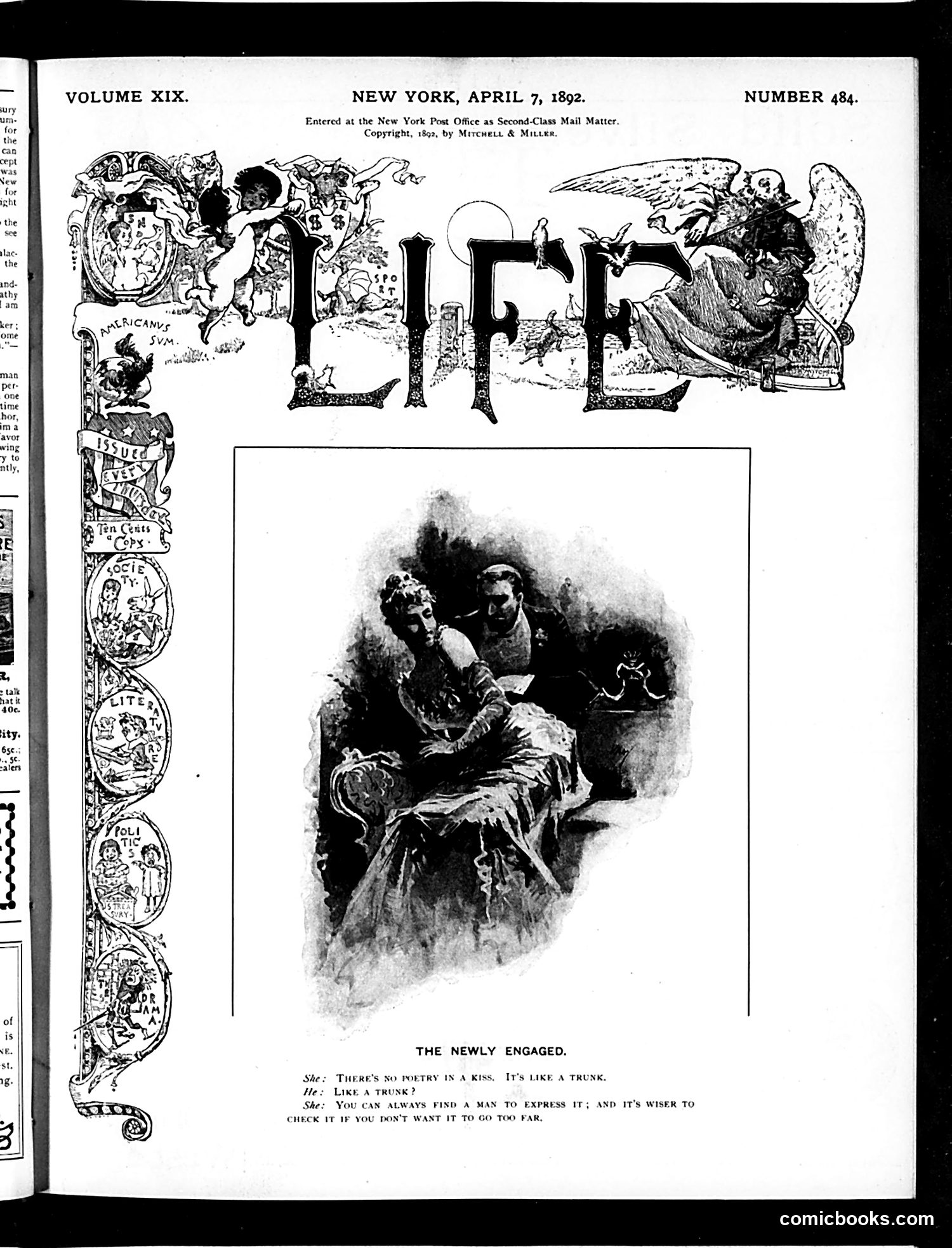
This is a romantic comedy sketch about engagement etiquette. The illustration shows a newly engaged couple in an intimate moment. The dialogue jokes about expressing affection: the woman protests there's "no poetry in a kiss" and compares it to "a trunk" (luggage). The man responds that one can always find a man to express feelings better, and it's "wiser to check it if you don't want it to go too far." The humor plays on Victorian courtship conventions—the tension between romantic idealism and practical restraint. The woman's complaint that kissing lacks poetry, contrasted with the man's pragmatic warning about checking excessive displays of affection, satirizes the era's formal approach to engagement and physical intimacy between couples.
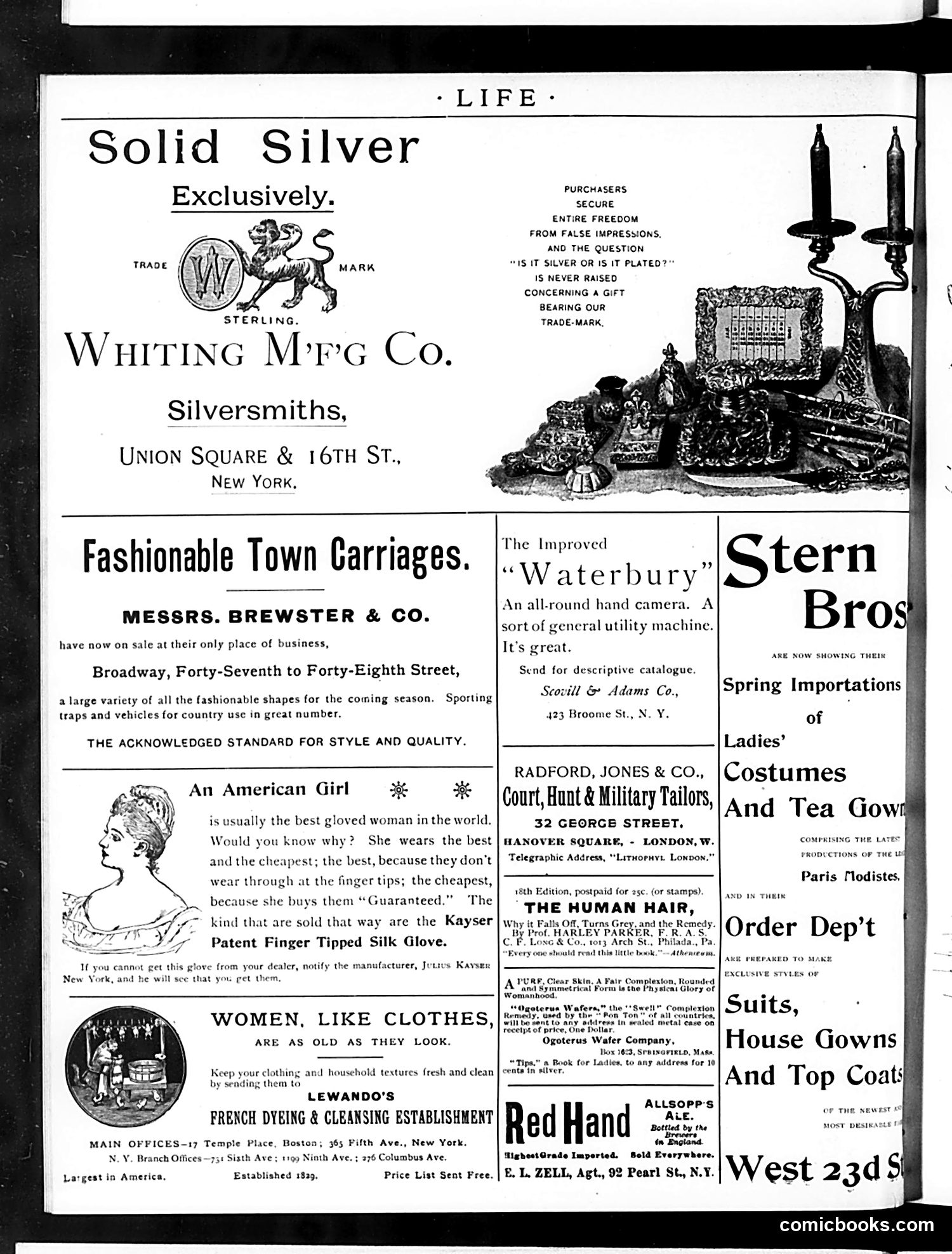
This page is primarily **advertising content** rather than political satire or comics. It contains multiple commercial advertisements from the late 19th or early 20th century, including: - **Whiting M'FG Co.** (solid silver goods) - **Brewster & Co.** (fashionable carriages) - **Lewando's** (French dyeing and cleaning) - **Stern Bros.** (ladies' clothing imports) - **Radford, Jones & Co.** (London tailors) The only satirical content is a brief illustrated piece titled "An American Girl," which humorously celebrates American women's practical approach to gloves—specifically praising them for buying "guaranteed" gloves that don't wear through at fingertips. This is gentle, lifestyle-focused humor rather than political commentary. The page reflects **consumer culture** of its era, targeting affluent readers.
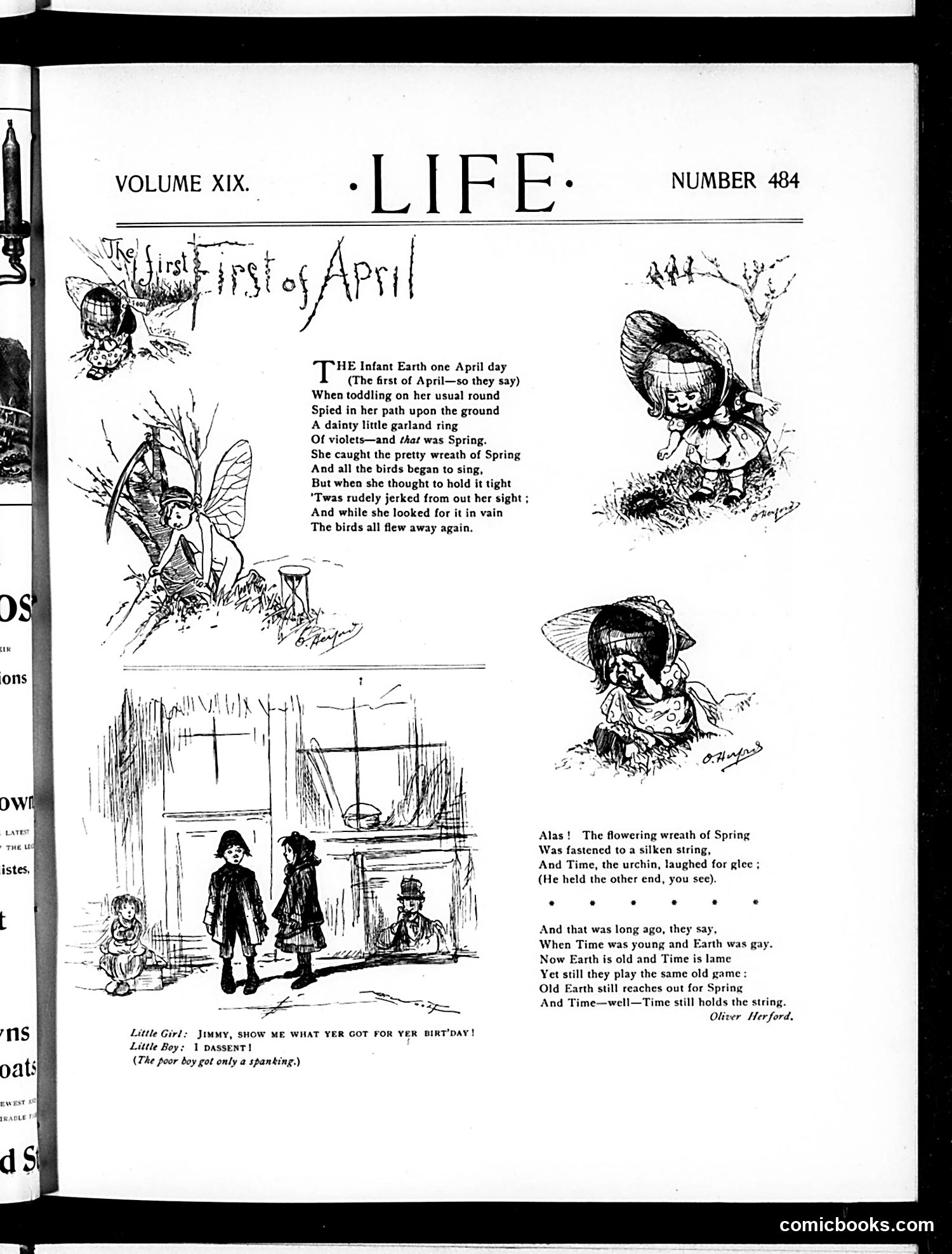
This is a whimsical spring-themed poem and illustration page, not political satire. The content celebrates April 1st and springtime through: **Main image**: Children discovering a garland of violets, with the poem describing how the "Infant Earth" catches spring's beauty, only to lose it when birds fly away with the wreath. **Bottom cartoon**: Shows children in a doorway with the caption about "Little Girl" and "Little Boy" discussing "what yer got for yer birt'day"—the poor boy has "only a sparking," suggesting economic class differences, though gently rendered for family humor. **Right-side illustrations**: Small sketches of cherubic figures associated with spring. The final poem by Oliver Herford reflects on time's passage and spring's eternal return. This appears to be family-friendly, seasonal content rather than political commentary.
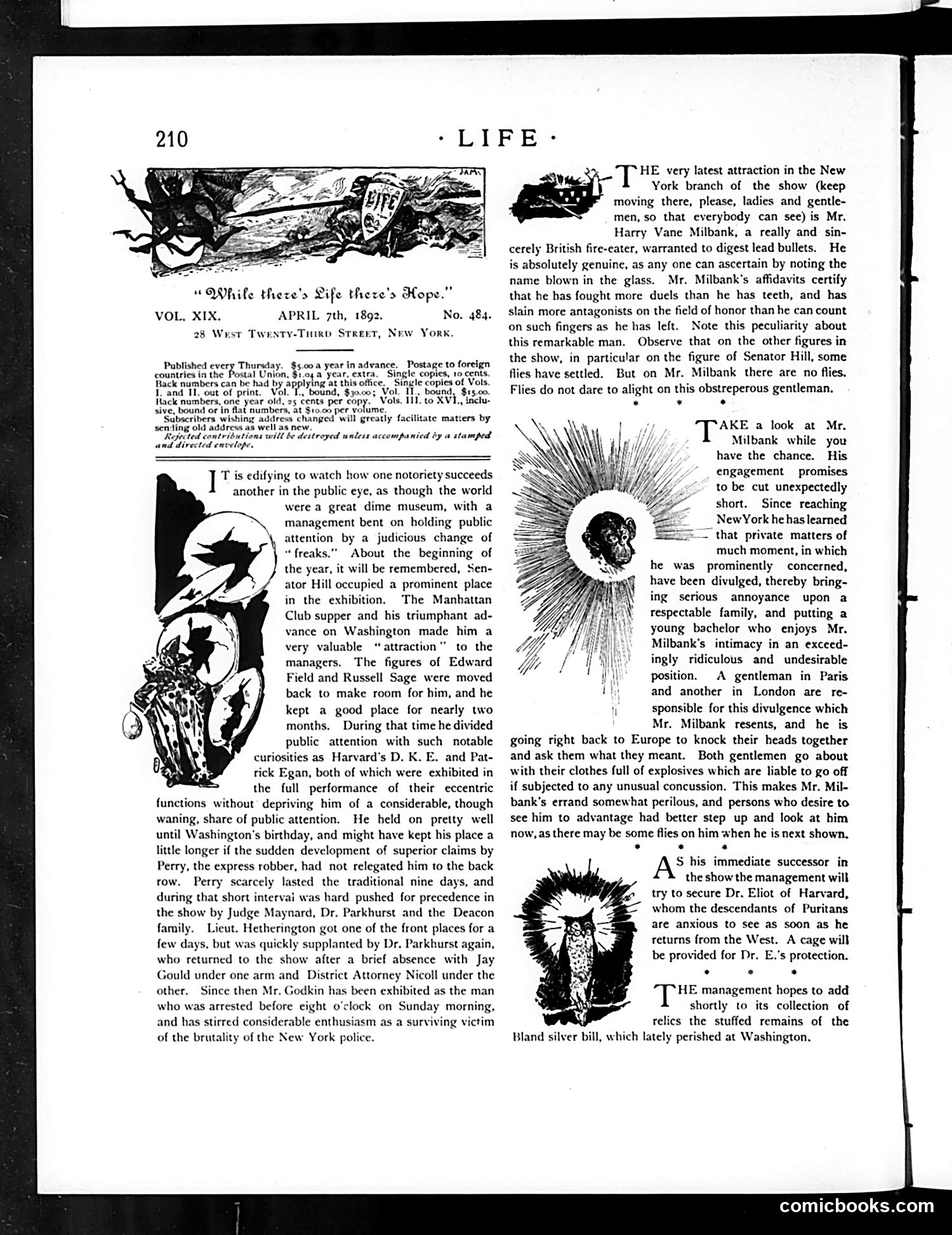
This page features articles about **Harry Vane Milbank**, a British marksman/sharpshooter performing at the New York branch of a traveling show. The text emphasizes his credentials as a genuine firearms expert who has killed numerous antagonists in combat. The accompanying illustrations (with radiating lines suggesting dramatic emphasis) appear to be portraits of Milbank, highlighting his notoriety as a public performer. The article discusses his engagement being "cut unexpectedly short" due to private matters—apparently involving romantic complications with a respectable family and a "ridiculous" rival suitor in Paris and London. The satire mocks the melodramatic nature of his sudden departure and the scandalous entanglement that forced him to leave New York.
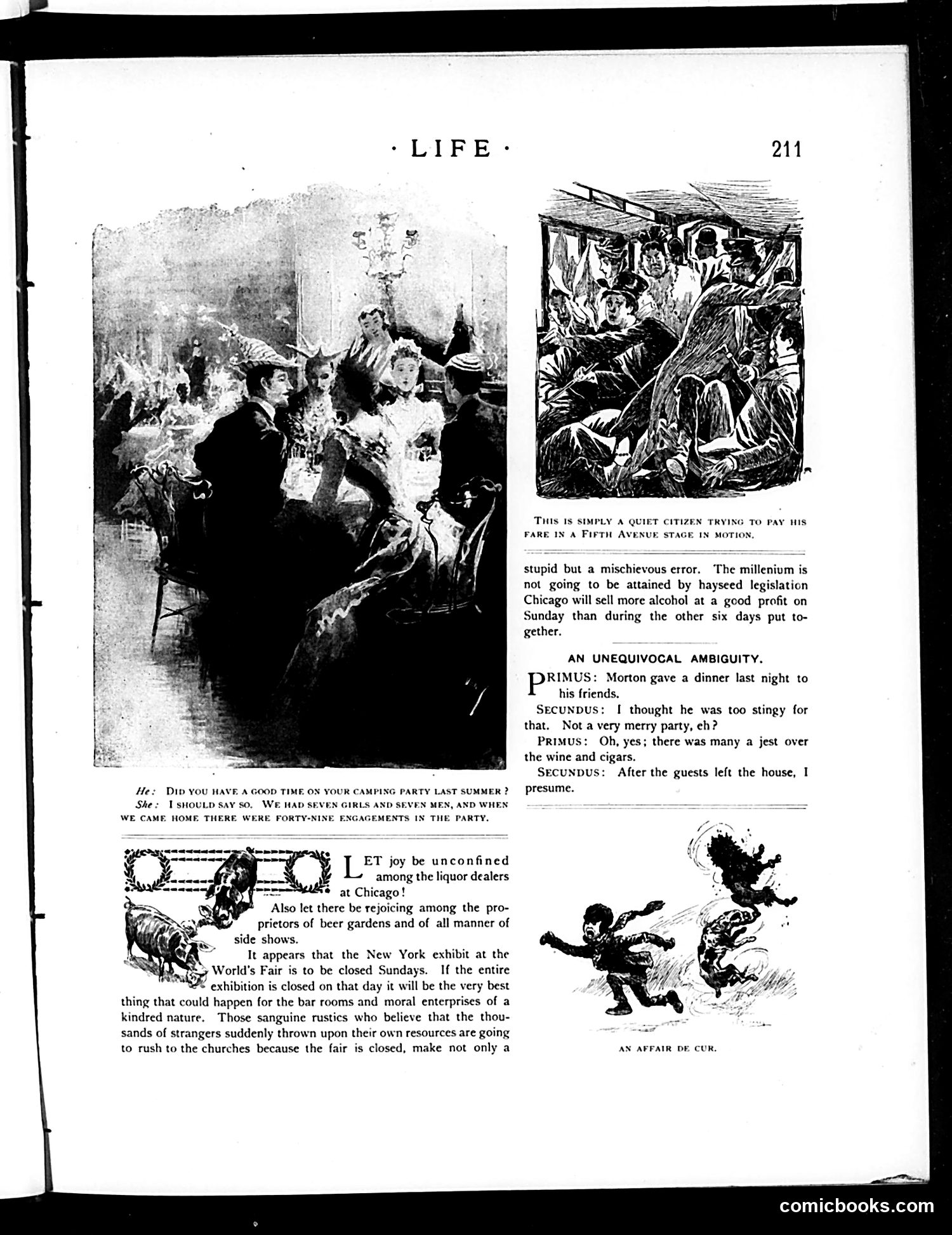
This page satirizes early 20th-century Chicago alcohol prohibition debates. The main text mocks predictions that a "millenium" will arrive through hasty legislation banning Sunday alcohol sales, while allowing sales the other six days—an obvious logical contradiction the writer finds absurd. The section titled "An Unequivocal Ambiguity" presents a humorous dialogue between Primus and Secundus debating whether Morton's recent dinner party was lavish or stingy, playing on ambiguous language. The bottom section celebrates that New York's World's Fair will close on Sundays, sarcastically suggesting this will somehow reform morality. It mocks "sanguine rustics" who believe closing the fair will drive crowds to churches rather than bars. The small illustration labeled "An Affair de Cur" (a pun on *cur*, meaning dog) appears to depict a comic mishap.
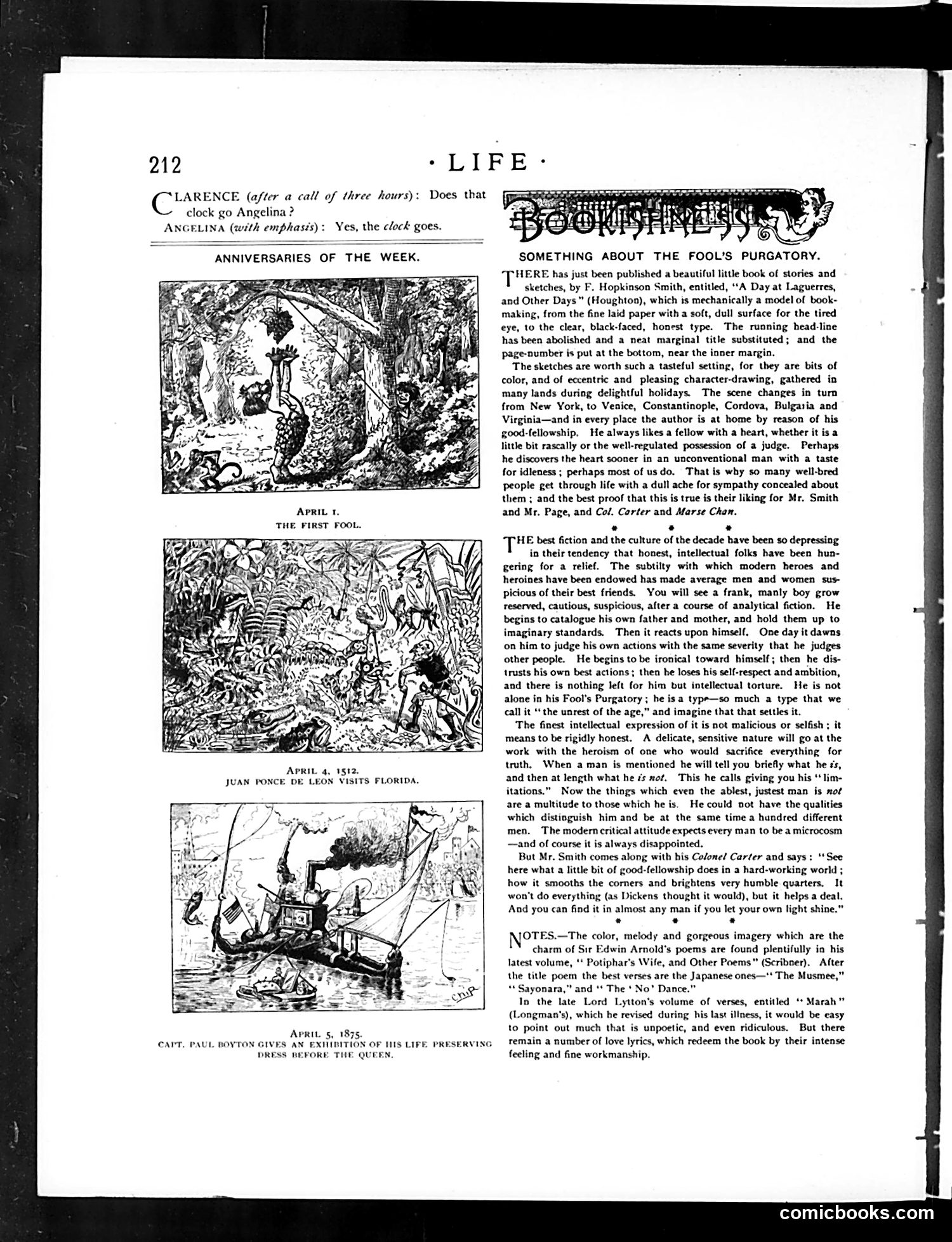
This page contains three historical illustrations under "Anniversaries of the Week," celebrating events from April 1st through 5th spanning centuries (1512-1852). The images depict: 1. **April 1**: An unidentified religious or medieval scene 2. **April 4, 1512**: Juan Ponce de Leon's expedition to Florida 3. **April 5, 1852**: Captain Paul Boyton demonstrating a life-preserving dress to the Queen The right column reviews "A Day at Lagueres" by F. Hopkinson Smith, discussing literary merit and character development in fiction. Rather than satire, this page functions as historical commemoration—a common Life magazine feature celebrating anniversaries of noteworthy events. The illustrations document exploration, maritime safety innovations, and cultural history rather than offering political commentary or social satire.
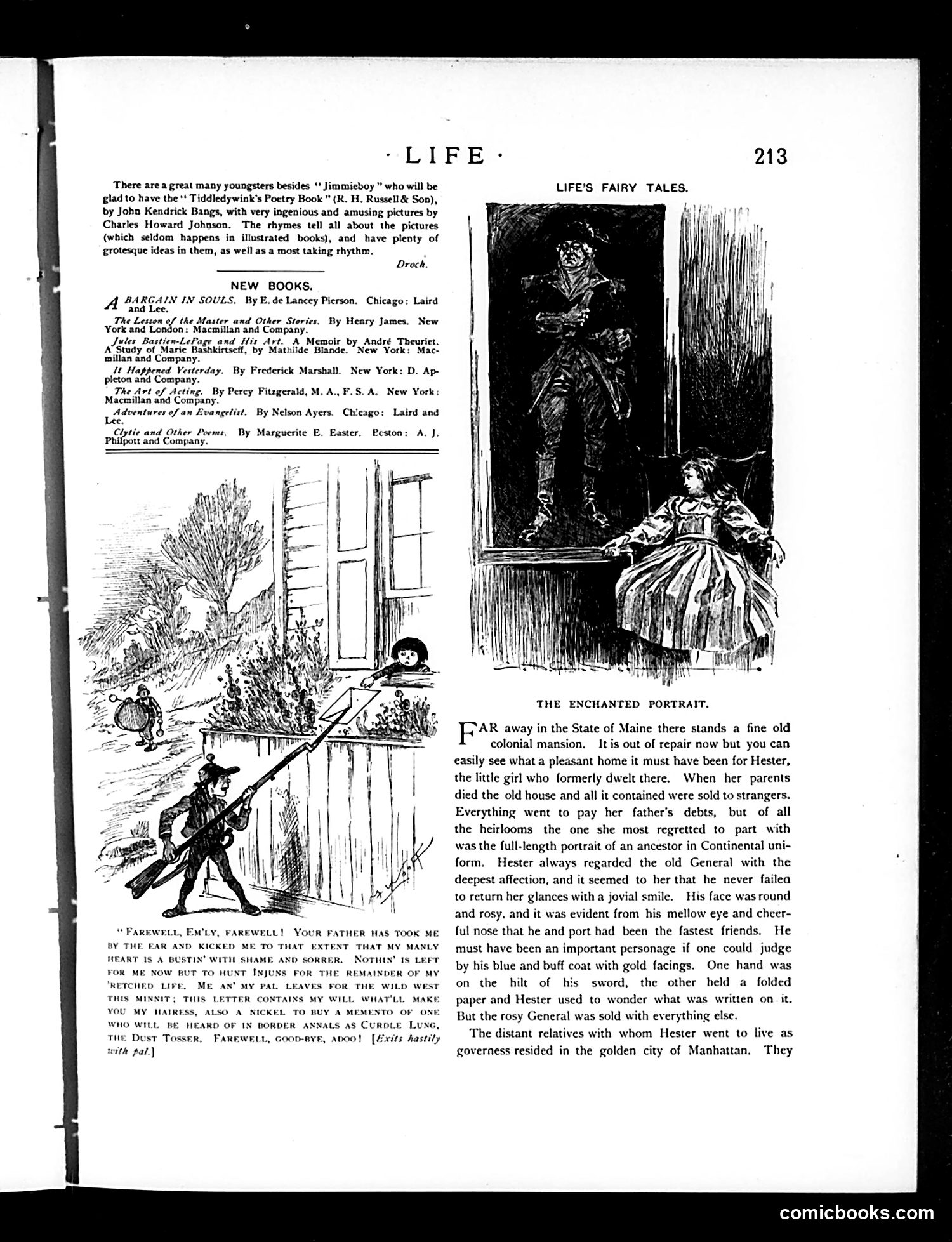
This page contains two distinct elements: **Left side:** A small cartoon accompanying a farewell letter from someone heading to the American West. The figure appears to be a prospector or adventurer with a rifle, depicted in a comedic style typical of late 19th/early 20th-century Life magazine humor. The accompanying letter references debts, the "wild west," and leaving for new opportunity—reflecting period themes of westward migration and escape from financial troubles. **Right side:** "The Enchanted Portrait," a fairy tale illustration and story opening. It depicts a girl gazing at a portrait of an old gentleman in Continental uniform, set in a decaying Maine mansion. This appears to be serialized fiction rather than satire or political commentary. The page primarily features entertainment content rather than political satire.
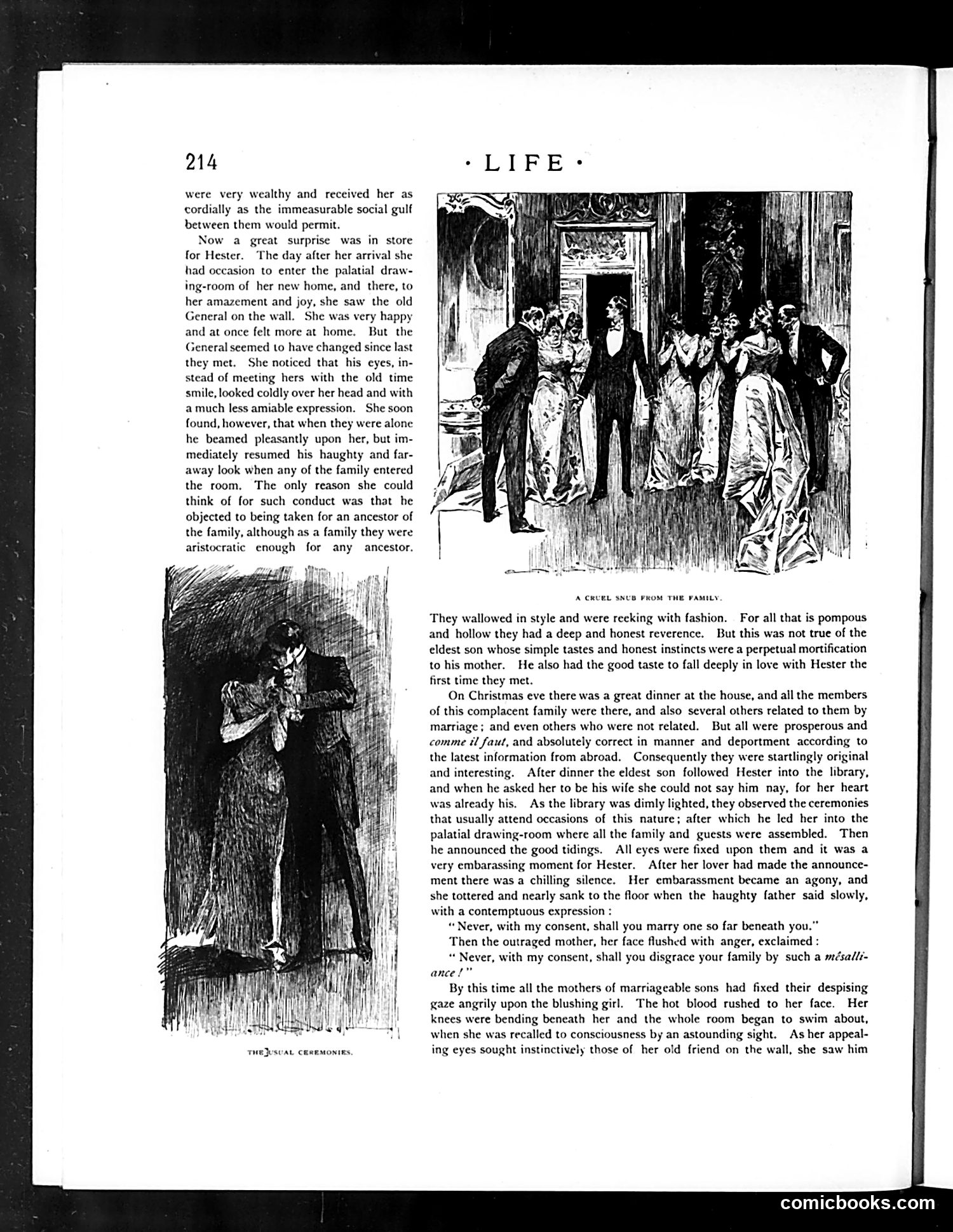
This page illustrates a narrative from what appears to be a serialized story in *Life* magazine. The two engravings depict dramatic social scenes: **Upper illustration** ("A CRUEL SNUB FROM THE FAMILY"): Shows a formal family gathering where a woman appears distressed—she's been publicly rejected or humiliated by family members during an announcement of her engagement to Hester. **Lower illustration** ("THE USUAL CEREMONIES"): Depicts what the caption ironically calls "usual ceremonies"—likely showing the woman fainting or collapsing from shame after the father's cruel rejection quoted in the text: "Never, with my consent, shall you marry one so far beneath you." The satire targets aristocratic snobbery and rigid class prejudices. The "cruel snub" represents the family's rejection of a suitor they deem socially inferior, despite his virtues. The ironic caption "usual ceremonies" mocks how predictable and routine such heartless family cruelties were in Victorian society.
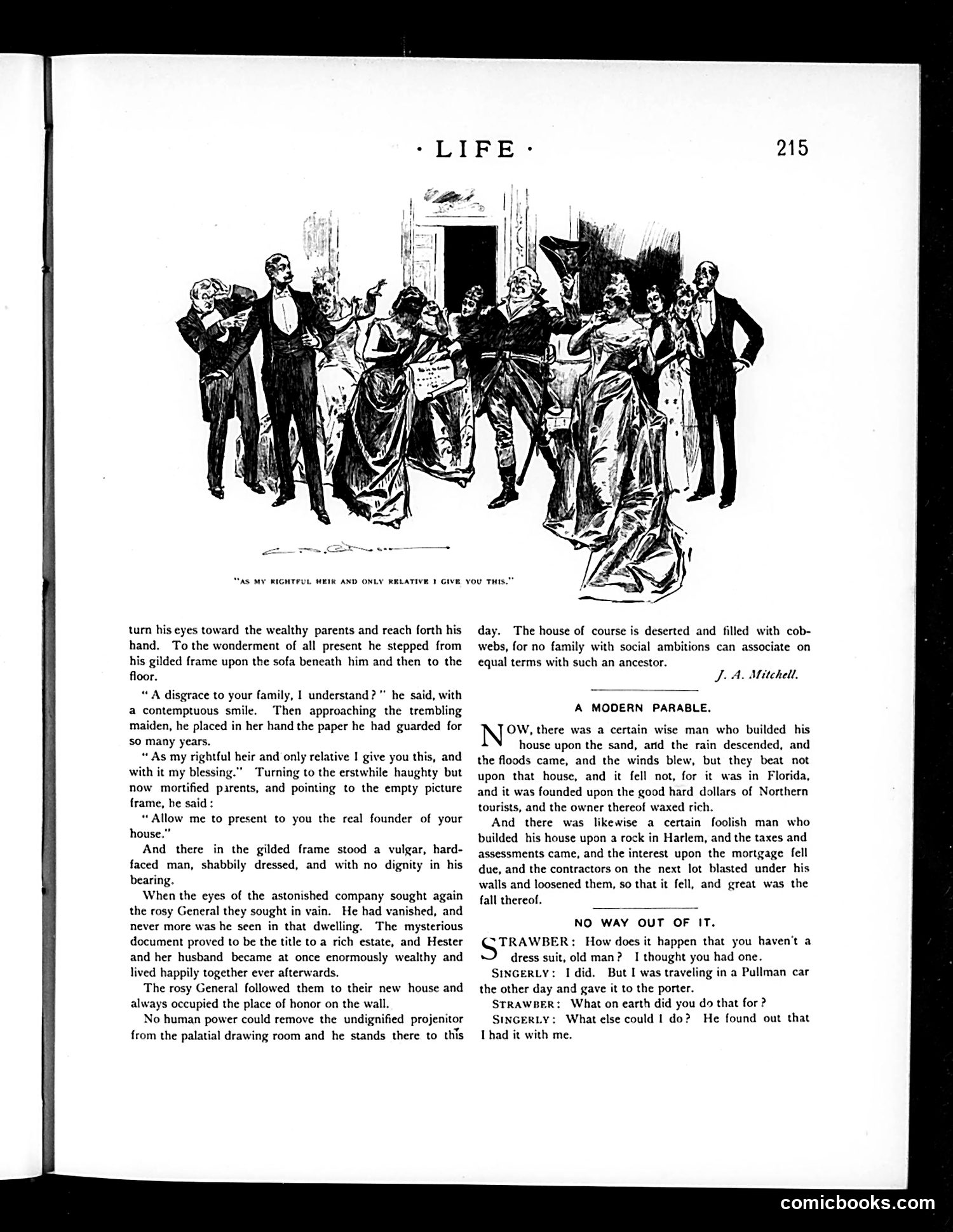
The top illustration depicts a social scene with well-dressed figures presenting a document, captioned "As my rightful heir and only relative I give you this." The accompanying text describes a wealthy man transferring his fortune to an undigified, poorly-dressed figure who had been hidden away—revealing this person as the "real founder" of the family wealth, though previously disgraced. This appears to be satirizing class pretension and hidden family secrets among the wealthy. The joke targets the gap between families' public respectability and their actual origins, suggesting that proper genealogy often masks embarrassing truths about how fortunes were truly made or inherited. The page's second section, "A Modern Parable," presents a dialogue between characters called "Strawber" and "Singerly" about a lost dress suit in a Pullman car—a separate humorous anecdote about travel mishaps.
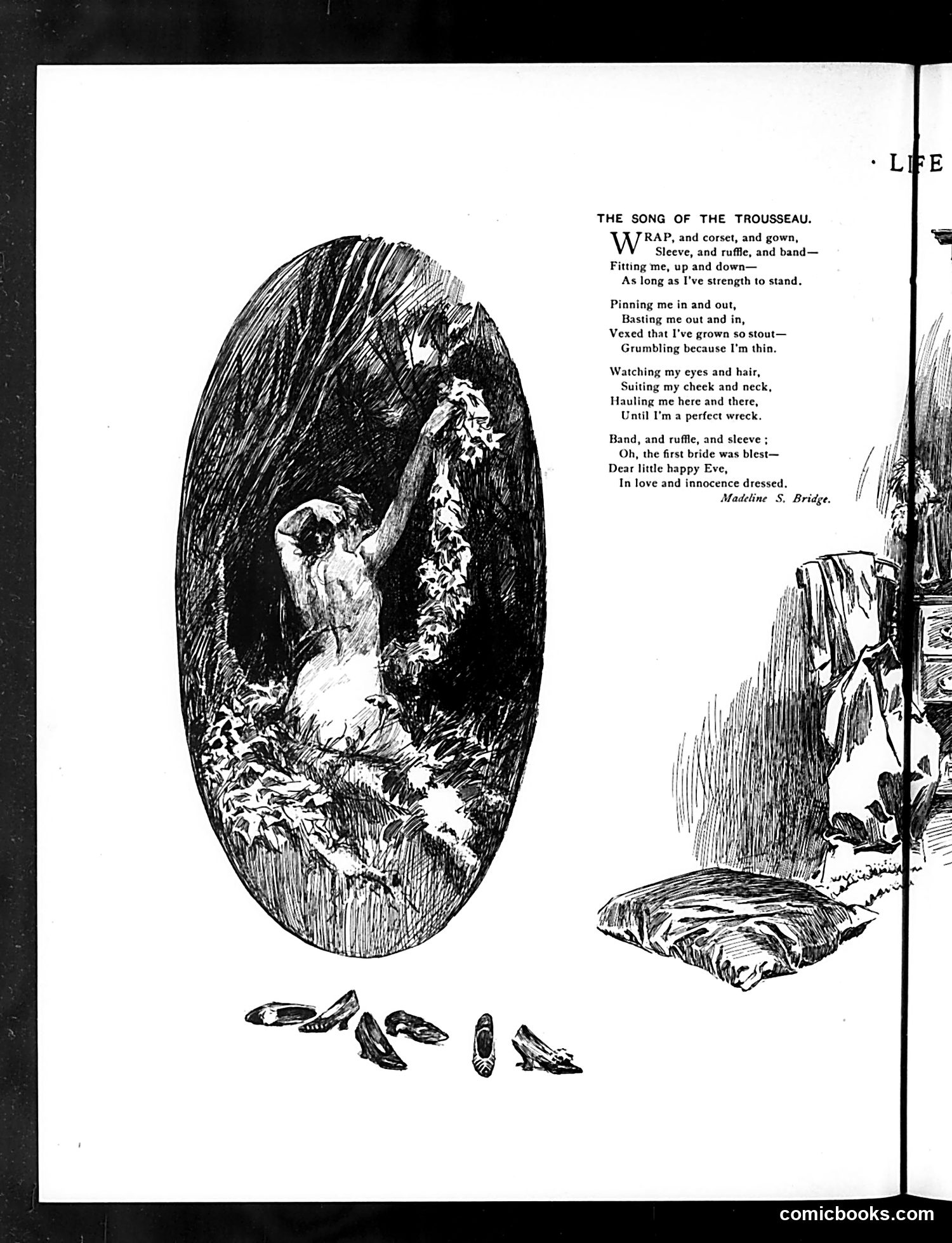
This page satirizes the elaborate, restrictive nature of women's wedding preparations and clothing. The central illustration depicts a woman trapped within or emerging from an oval frame—possibly representing a mirror or the constraining corset itself—surrounded by the garments and accessories required for marriage: wraps, corsets, gowns, sleeves, ruffles, and bands. The accompanying poem by Madeline S. Bridge presents the woman's perspective as she endures this uncomfortable "dressing" process, complaining of being pinned, basted, hauled about, and made into a "perfect wreck" by her trousseau. The shoes displayed below emphasize the physical toll. The satire critiques how Victorian marriage transforms women into ornamental objects, sacrificing comfort and autonomy for appearance and social expectation.
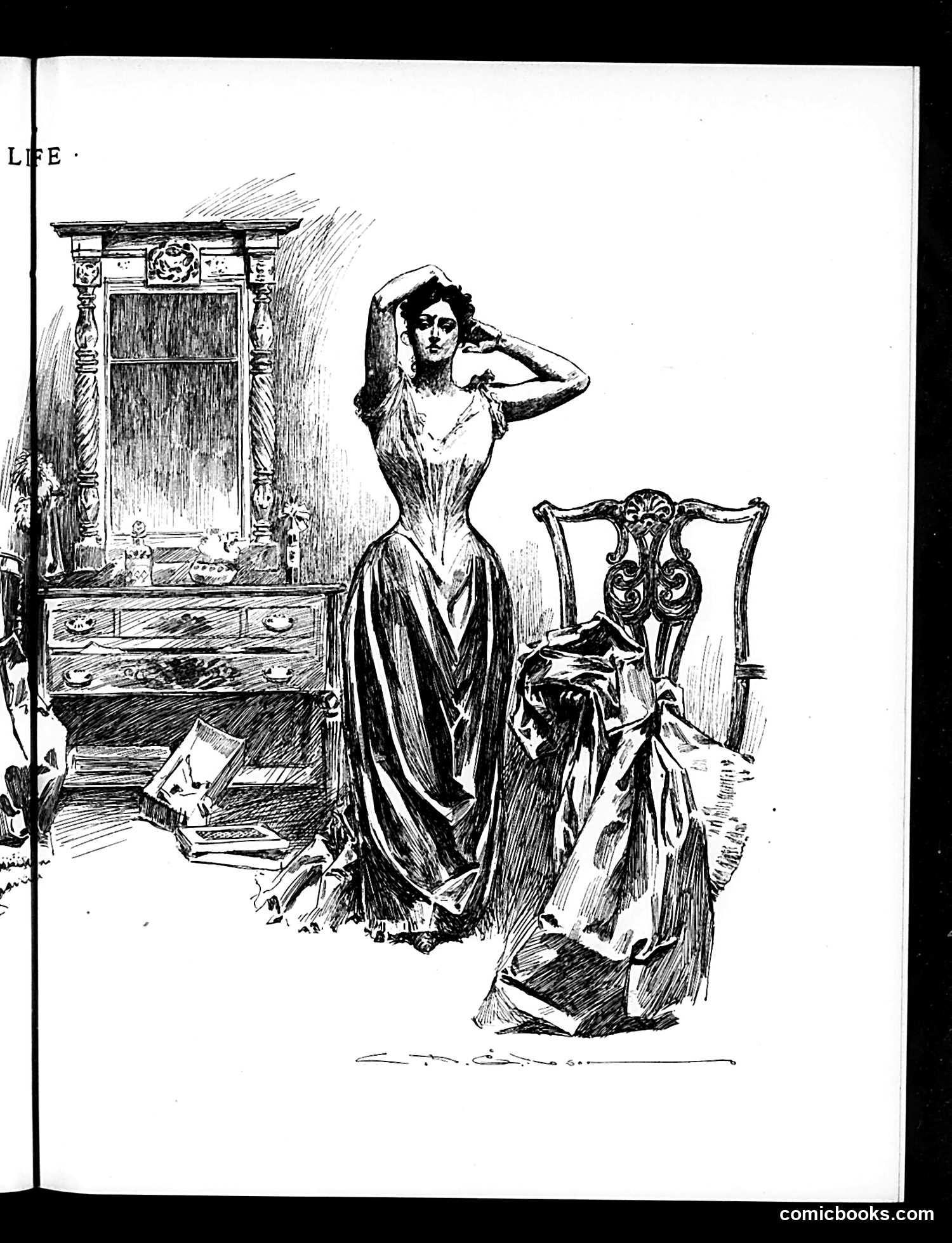
This page from *Life* magazine shows a pen-and-ink illustration of a woman in an elegant, flowing negligée adjusting her hair while seated at an ornate vanity mirror. The sketch appears to be a fashion or lifestyle illustration rather than political satire. The image depicts domestic leisure and personal grooming—themes common in *Life*'s satirical commentary on upper-class American life. The detailed rendering of expensive furniture (the decorative mirror, elaborate chair) and the woman's refined posture suggest commentary on vanity, materialism, or the leisure pursuits of wealthy women. Without accompanying text visible on this page, the specific satirical target remains unclear, though the composition likely critiques societal attitudes toward women's roles or consumerism.
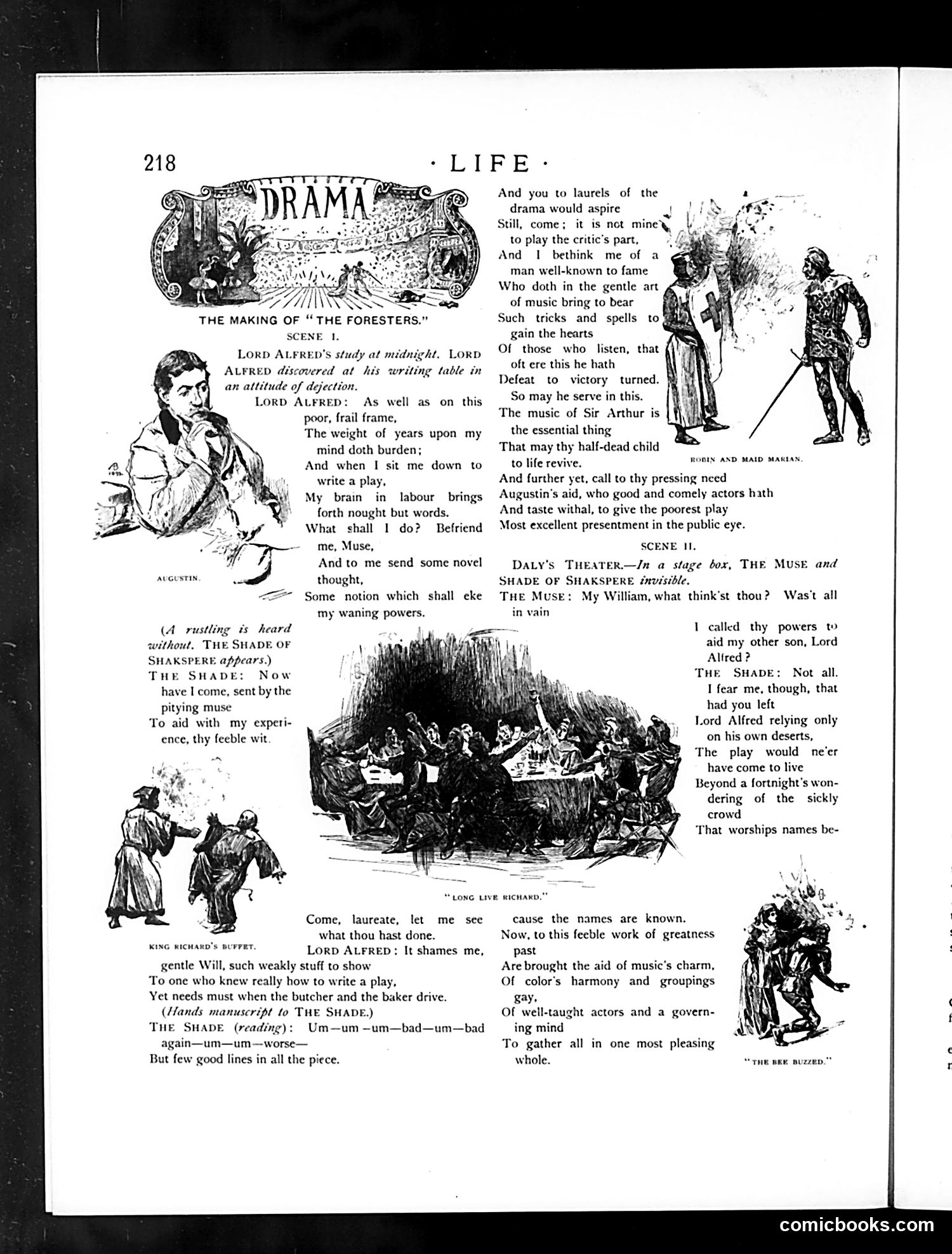
This satirical sketch mocks Lord Alfred Tennyson's play *The Foresters*, which premiered in 1892. The cartoon depicts Tennyson ("Lord Alfred") struggling to write, visited by Shakespeare's ghost who advises that the play's success depends not on the writing itself, but on Sir Arthur Sullivan's music, skilled actors, and theatrical spectacle. The satire's point: Tennyson's dramatic work is weak ("few good lines in all the piece"), yet will succeed commercially through production values and famous names rather than literary merit. The ghost of Shakespeare—history's greatest dramatist—underscores this irony by essentially saying the play needs everything *except* good writing to fool audiences into attending. This reflects contemporary skepticism about Tennyson's venture into drama and broader Victorian concerns about theater prioritizing spectacle over substance.
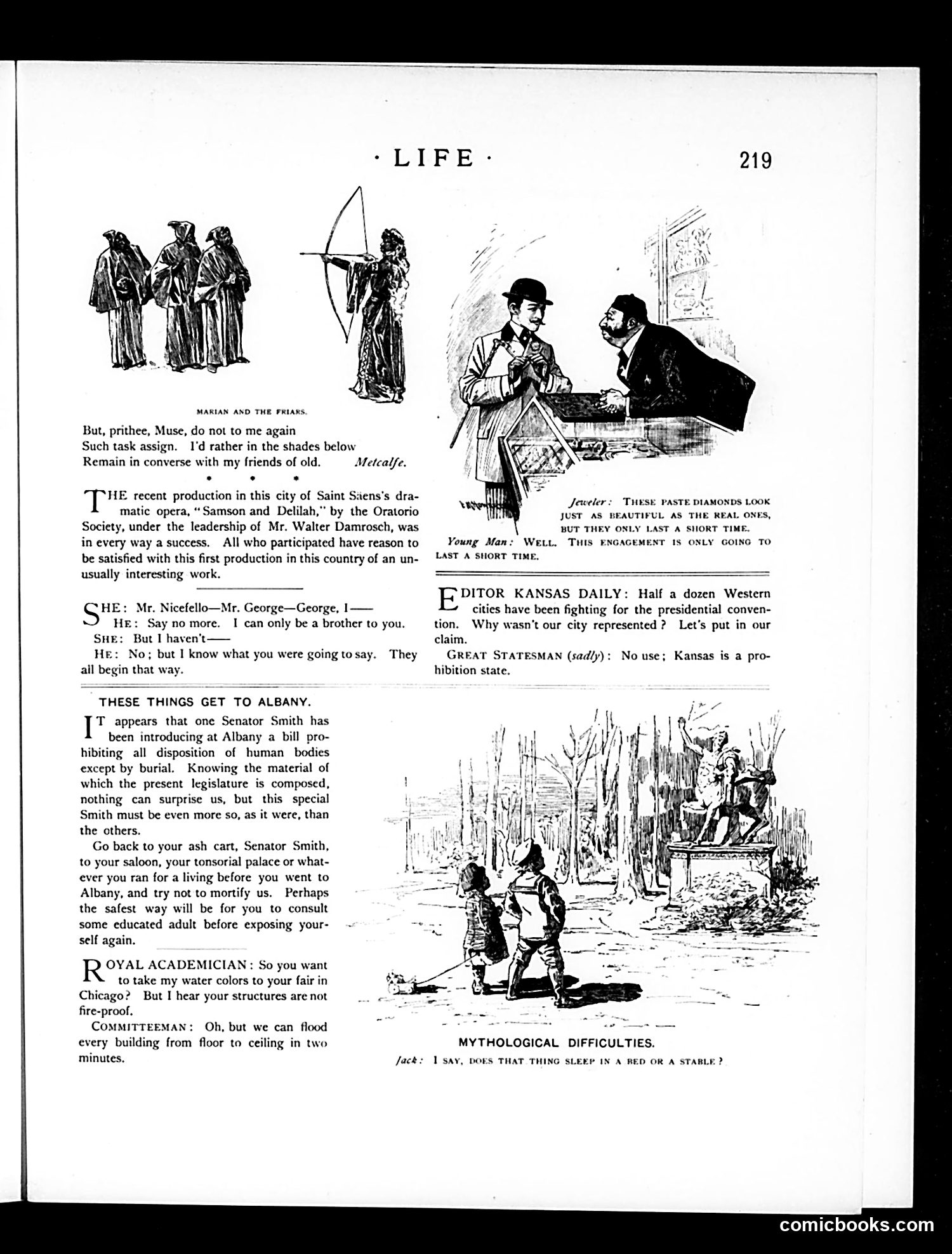
This page contains several unrelated satirical jokes typical of Life's humor: **Top sketches** mock pretentious or foolish figures: a senator (Smith) introducing absurd burial legislation at Albany is mocked for lacking education; an "Royal Academician" boasts about artwork while a committeeman reveals Chicago's buildings lack fire safety. **Center cartoon** shows a jeweler selling fake diamonds to a naive young man—the joke being the engagement will be as short-lived as the paste gems. **"Editor Kansas Daily" joke** satirizes Kansas's prohibition laws, suggesting the state's temperance stance makes it undesirable for hosting the presidential convention. **Bottom illustration** titled "Mythological Difficulties" appears to be a classical reference joke, though the specific meaning is unclear from context alone. The page reflects early 20th-century American concerns: legislative incompetence, class pretension, consumer fraud, and prohibition politics.
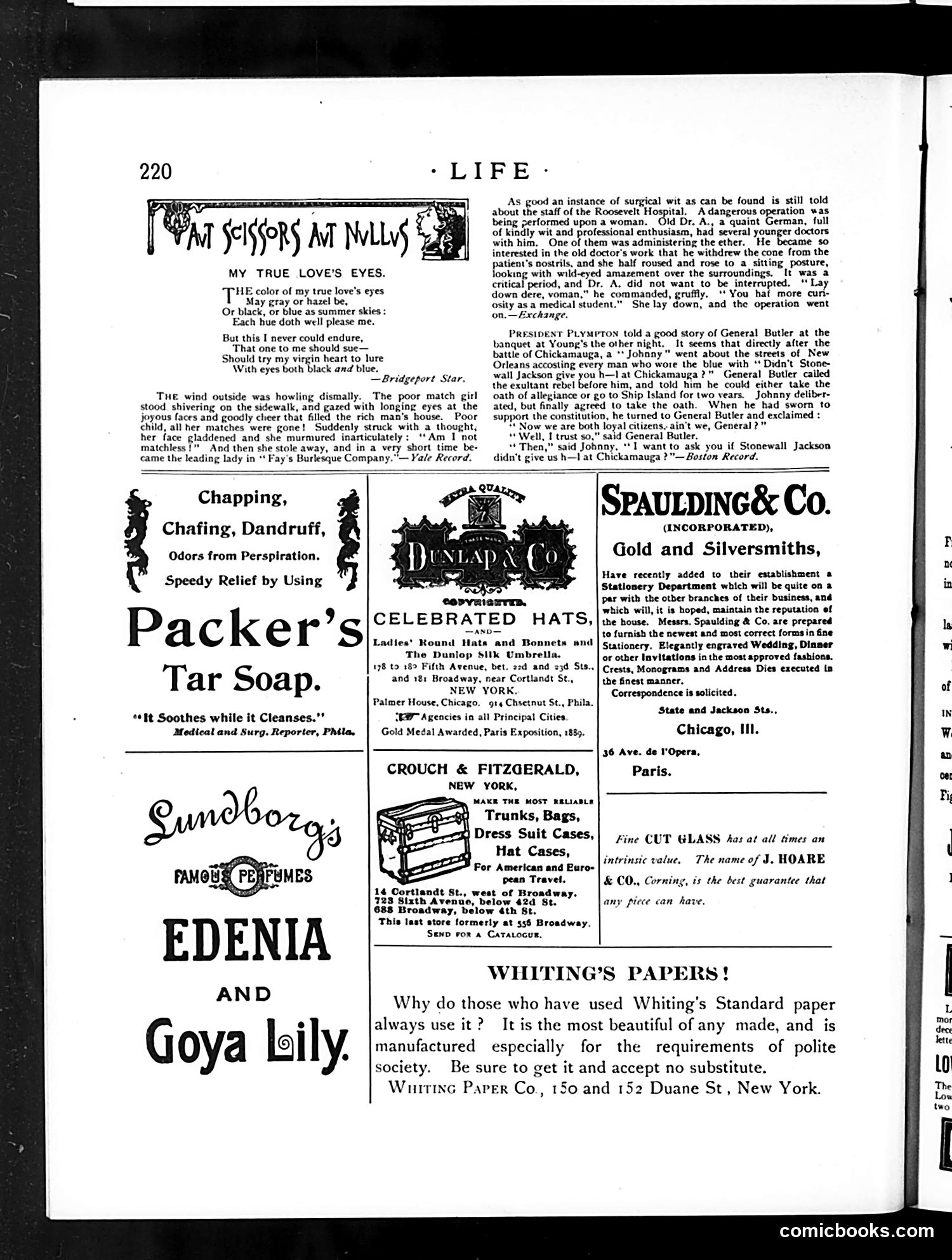
This page is primarily **advertisements and light humor pieces** rather than political satire. The content includes: **Humorous anecdotes:** - A poem about a lover with "black and blue" eyes (bruises)—implying domestic violence played for laughs - A match girl joke with wordplay ("matchless") - A surgical anecdote from Roosevelt Hospital about an ether-addled patient - A General Butler story: post-Civil War New Orleans, where a Confederate sympathizer repeatedly asks Union General Butler if Stonewall Jackson defeated him at Chickamauga. After Butler forces him to swear loyalty, the man immediately asks the same question again—suggesting the oath means nothing to unreconstructed rebels. **The Butler anecdote** is the closest to social commentary, satirizing Southern resistance to Reconstruction and the futility of forcing political loyalty. The remainder is **period advertising** for hats, soap, perfumes, luggage, stationery, and glassware—typical of Life's mixed editorial/commercial format.
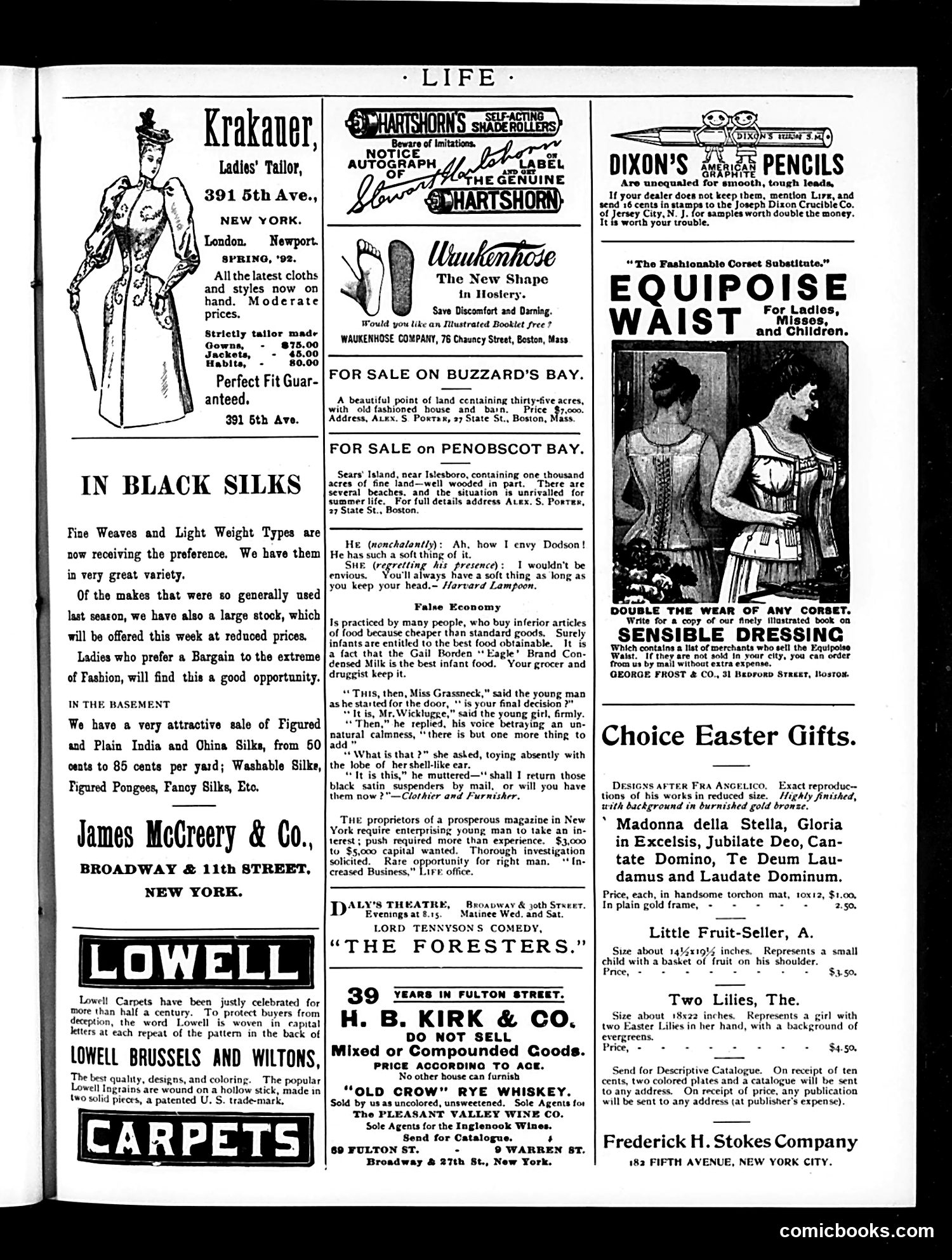
This page is **primarily advertisements** with minimal editorial cartoon content. The notable satirical piece is a brief **Harvard Lampoon dialogue** between a man and woman: The man envies "Dodson" for having "such a soft thing of it" (an easy life). The woman responds that he'll always have comfort "as long as you keep your head"—a joke implying he should stay obedient/submissive to maintain domestic peace. This reflects Victorian-era gender dynamics where wives were expected to manage household comfort in exchange for male compliance. The surrounding ads for silks, carpets, whiskey, and real estate are standard period marketing. One ad humorously depicts a breakup where a rejected suitor's final concern is retrieving "black satin suspenders"—treating the romantic rejection as secondary to practical wardrobe recovery. The page offers little political satire; it's a snapshot of 1892 consumer culture and domestic humor rather than commentary on major events.
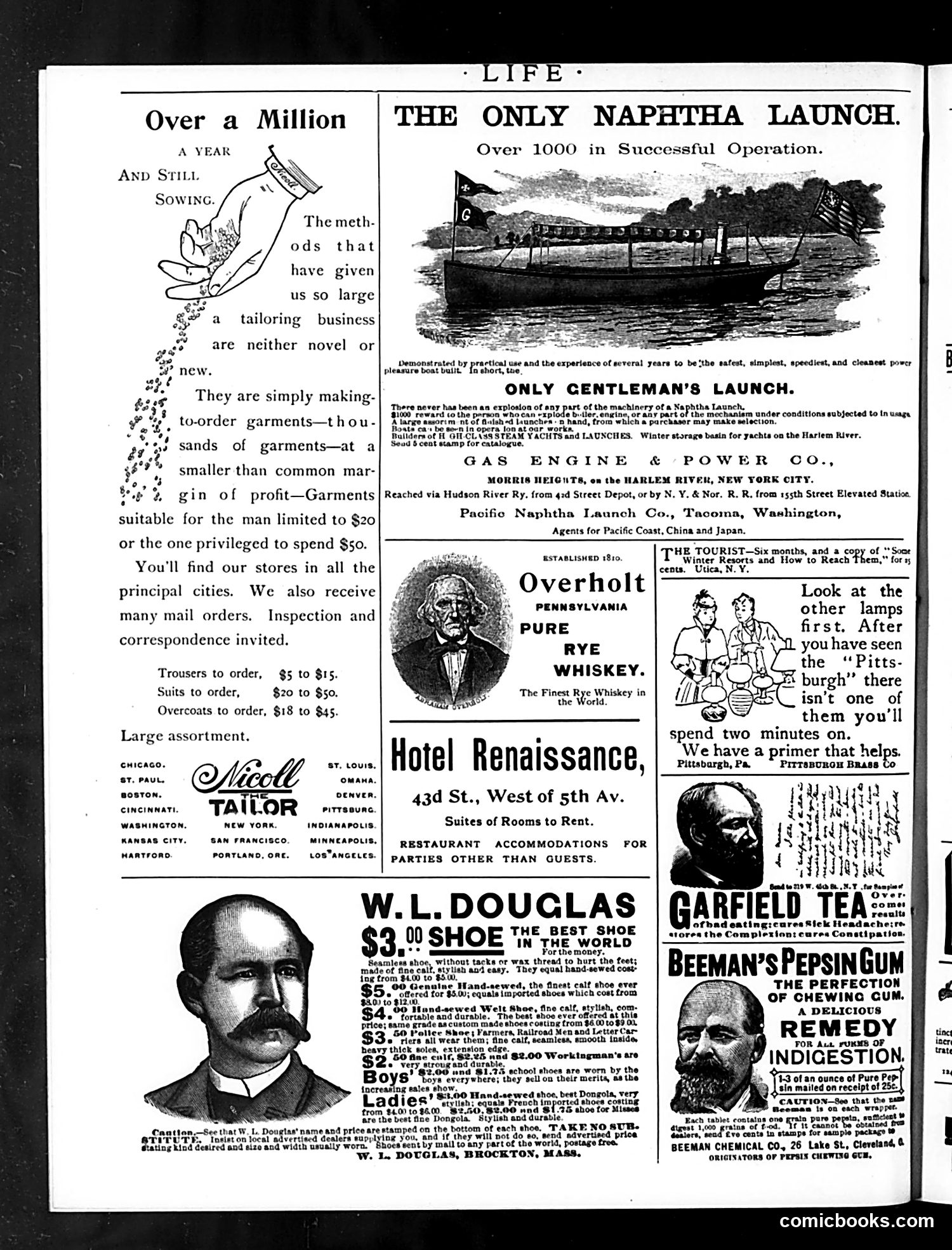
This is primarily an **advertising page** with no political cartoon. The page features period product advertisements typical of early 1900s Life magazine. Notable ads include: - **Nicoll Tailor**: A made-to-order clothing service offering suits and trousers at affordable prices ($5-$50 range), positioned as accessible luxury for working men - **W.L. Douglas Shoes** ($3 shoe): Features Douglas's portrait and emphasizes quality craftsmanship and durability at competitive prices—a major brand of the era - **Overholt Rye Whiskey**: Premium liquor advertisement - **Naphtha Launch**: An early motorboat technology claiming safety and reliability - **Hotel Renaissance**: NYC lodging - **Beeman's Pepsin Gum**: Patent medicine-style digestive aid The page reflects **Gilded Age consumer culture**—emphasizing mass production meeting middle-class demand, new technologies (motorboats), and branded products marketed through detailed specifications and testimonials. No satire is evident; this is straight commercial content.
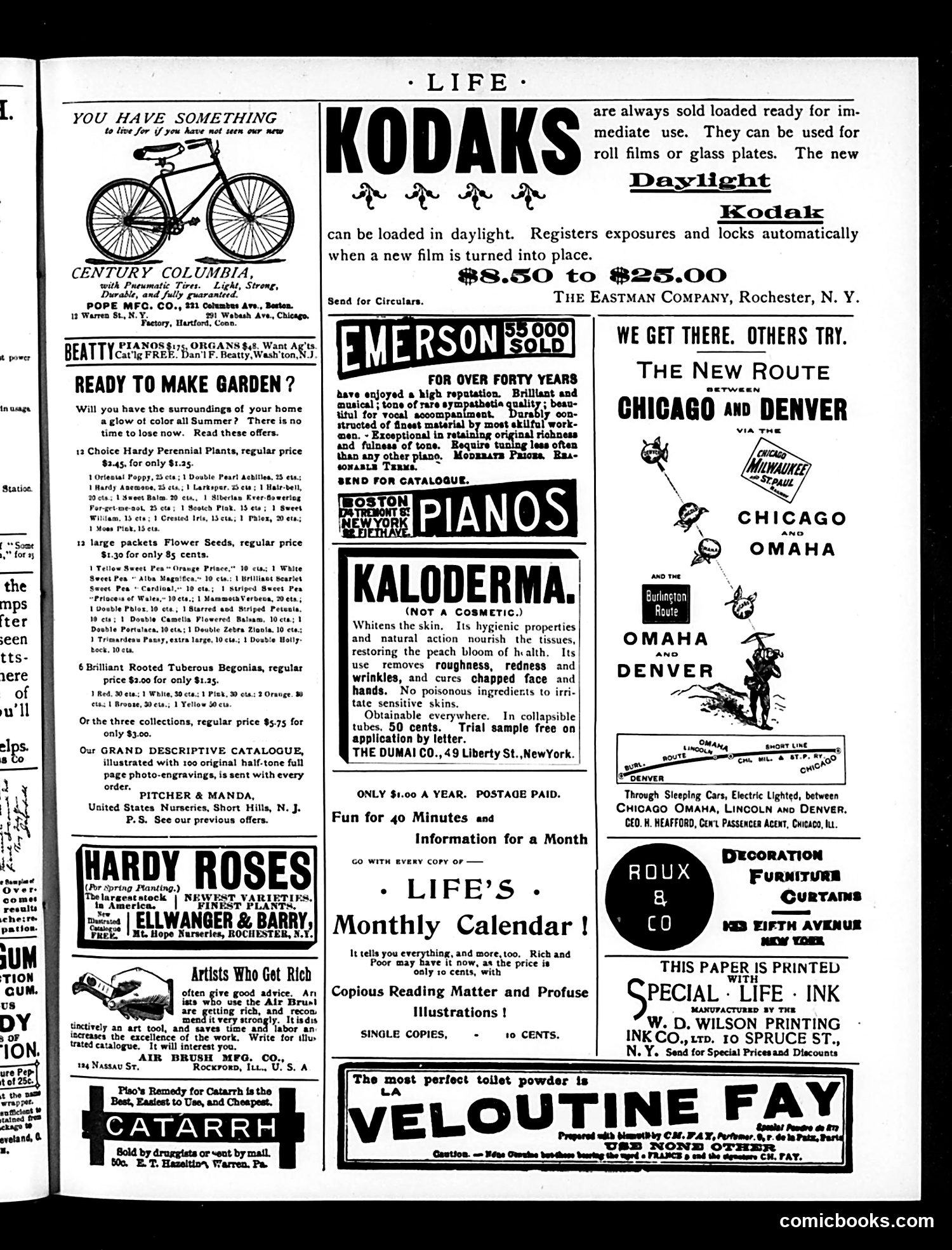
This is primarily an **advertising page** from Life magazine, not a political cartoon. The page contains numerous commercial advertisements typical of early 20th-century print media. **Key advertisements include:** - **Kodak cameras** ($8.50-$25.00) — promoting the new "Daylight Kodak" that loads film automatically - **Century Columbia bicycles** — positioning bikes as essential consumer goods - **Pianos and organs** — luxury items for middle-class homes - **Garden seeds and plants** — encouraging home beautification - **Kaloderma skincare** — promoting a "natural" skin treatment (notably emphasizing whitening, reflecting period beauty standards) - **Chicago & Denver railroad route** — advertising the Burlington Route's new service with sleeping cars - **Veloutine powder** — a toilet powder product The page reflects **late 19th/early 20th-century consumer culture**, targeting affluent readers with products representing modern convenience (photography, transportation) and domestic aspiration (gardens, pianos, beauty products). No political satire is evident here.
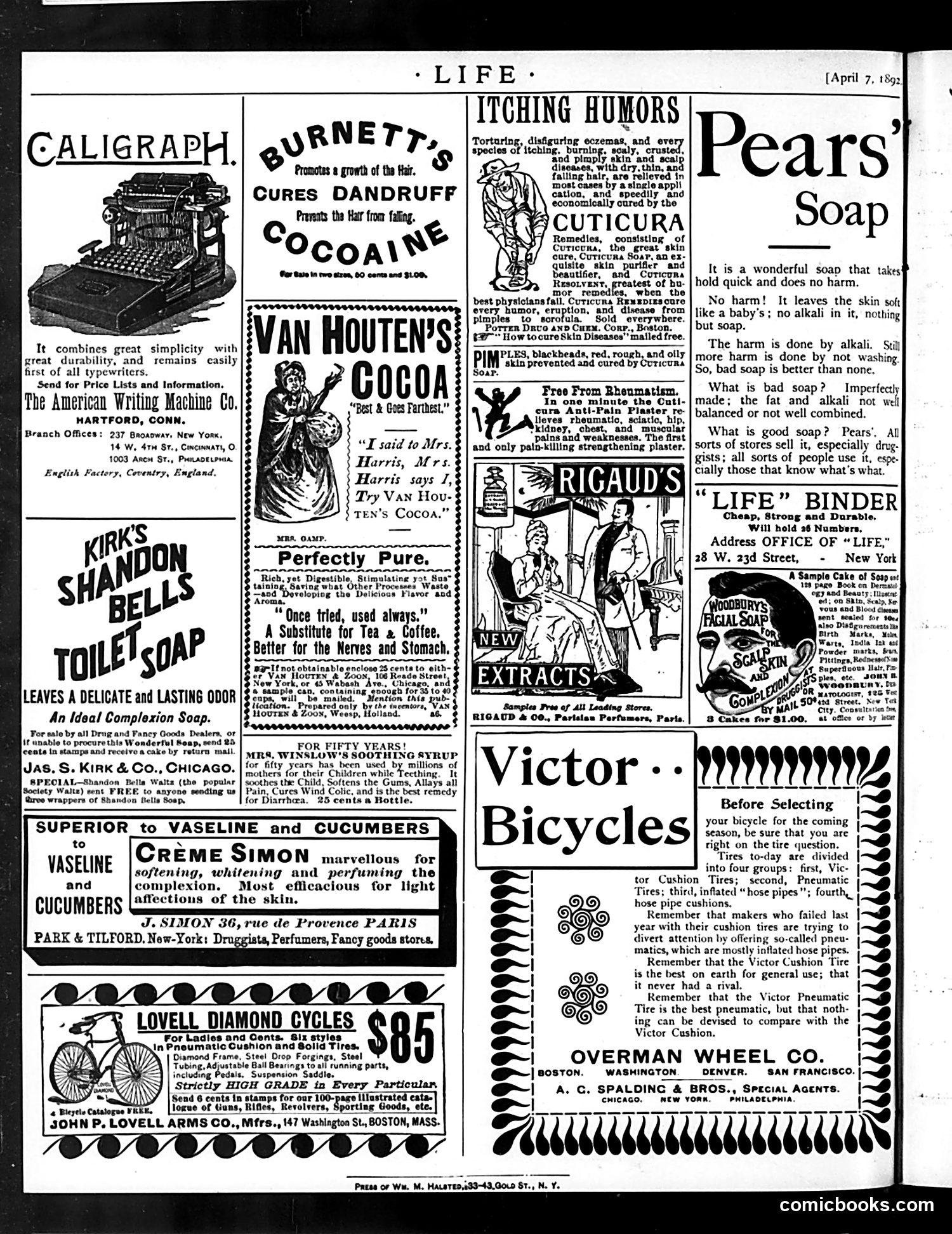
This page is **primarily advertising**, not satire or political commentary. It's a typical late-19th-century magazine advertisement section featuring patent medicines and consumer products popular in 1892. Key advertisements include: - **Cuticura Remedies**: Claims to cure skin diseases, eczemas, and "itching humors"—typical exaggerated medical claims of the era - **Mrs. Winslow's Soothing Syrup**: A "remedy" for teething children (historically contained opiates) - **Pears' Soap**: Emphasizes purity and lack of alkali harm - **Bicycles**: Victor and Lovell Diamond models, reflecting the 1890s bicycle craze - **Typewriters and consumer goods**: Caligraph typewriters, cocoa, tooth soap The satirical magazine *Life* ran advertisements to fund operations. These ads reflect what modern readers would recognize as **dubious medical claims and misleading marketing**—selling untested remedies as cure-alls. The ads are notable mainly for historical documentation of late-Victorian consumer culture and the lack of FDA regulation. No specific political figures or events are referenced.