
Life, 1892-04-07 · page 6 of 18
Life — April 7, 1892 — page 6: what you’re looking at
What you’re looking at
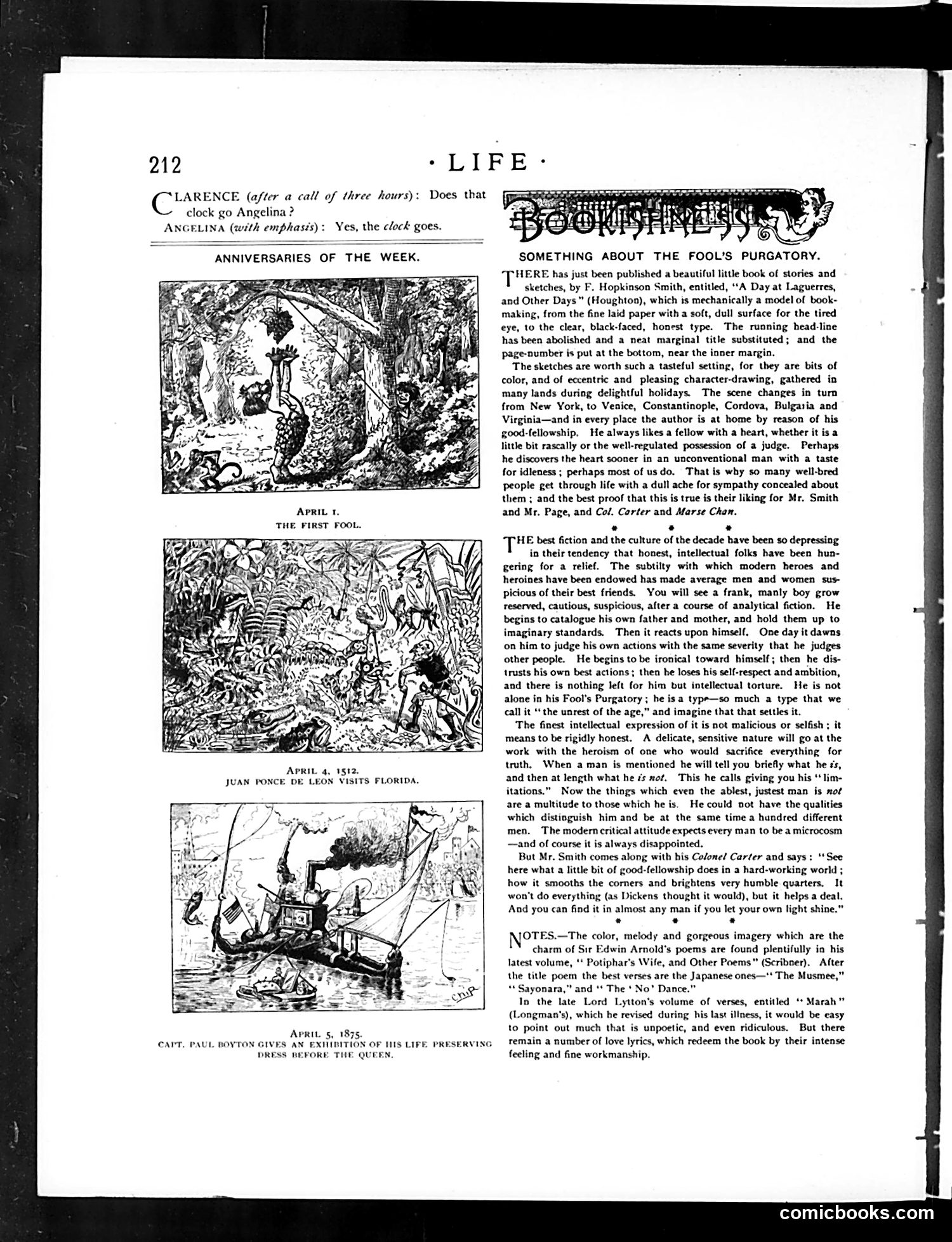
This page contains three historical illustrations under "Anniversaries of the Week," celebrating events from April 1st through 5th spanning centuries (1512-1852). The images depict: 1. **April 1**: An unidentified religious or medieval scene 2. **April 4, 1512**: Juan Ponce de Leon's expedition to Florida 3. **April 5, 1852**: Captain Paul Boyton demonstrating a life-preserving dress to the Queen The right column reviews "A Day at Lagueres" by F. Hopkinson Smith, discussing literary merit and character development in fiction. Rather than satire, this page functions as historical commemoration—a common Life magazine feature celebrating anniversaries of noteworthy events. The illustrations document exploration, maritime safety innovations, and cultural history rather than offering political commentary or social satire.
📄 Transcribed text from this page (OCR, searchable)
Machine-transcribed from the original scan — historical spelling and the odd misread are preserved.
n12 - LIFE = C ARENCE (after a call of three hours): Does that clock go Angelina ? ANGELINA (with emphasis): Yes, the clock goes. ANNIVERSARIES OF THE WEEK. SOMETHING ABOUT THE FOOL’S PURGATORY. “THERE has just been published a beautiful litle book of stories and sketches, by F. Hopkinson Smith, entitled, ‘A Day at Laguerres, and Other Days” (Houghton), which is mechanically a model of book- making, from the fine laid paper with a soft, dull surface for the tired eye, to the clear, black-faced, honest type. The running head-line has been abolished and a neat marginal title substituted; and the page-number is put at the bottom, near the inner margin. The sketches are worth such a tasteful setting, for they are bits of color, and of eccentric and pleasing character-drawing, gathered in many lands during delightful holidays. The scene changes in turn from New York, to Venice, Constantinople, Cordova, Bulgaria and Virginia—and in every place the author is at home by reason of his good-fellowship, He always likes a fellow with a heart, whether it is a little bit rascally or the well-regulated possession of a judge. Perhaps he discovers the heart sooner in an unconventional man with a taste for idleness ; perhaps most of us do. That is why so many well-bred people get through life with a dull ache for sympathy concealed about them ; and the best proof that this is true is their liking for Mr. Smith APRIL 1. and Mr. Page, and Coé. Corter and Marse Chan. THE FIRST FOOL. * . . THe best fiction and the culture of the decade have been so depressing in their tendency that honest, intellectual folks have been hun- gering for a relief. The subtilty with which modern heroes and heroines have been endowed has made average men and women sus- picious of their best friends. You will see a frank, manly boy grow reserved, cautious, suspicious, after a course of analytical fiction. He begins to catalogue his own father and mother, and hold them up to imaginary standards. Then it reacts upon himself. One day it dawns on him to judge his own actions with the same severity that he judges other people. He begins to be ironical toward himself; then he dis- trusts his own best actions; then he loses his self-respect and ambition, and there is nothing left for him but intellectual torture. He is not alone in his Fool's Purgatory ; he isa type—so much a type that we call it “the unrest of the age,” and imagine that that settles it. ‘The finest intellectual expression of it is not malicious or selfish ; it means to be rigidly honest. A delicate, sensitive nature will go at the work with the heroism of one who would sacrifice everything for APRIL 4, 1512. truth, When aman is mentioned he will tell you briefly what he ss, JUAN PONCE DE LEON VISITS FLORIDA, and then at length what he és not, This he calls giving you his ‘lim- itations.” Now the things which even the ablest, justest man is not are a multitude to those which he is. He could not have the qualities which distinguish him and be at the same time a hundred different men. The modern critical attitude expects every man to be a microcosm —and of course it is always disappointed. But Mr. Smith comes along with bis Colonel Carter and says: ‘See here what a little bit of good-fellowship does in a hard-working world ; how it smooths the comers and brightens very humble quarters. It won't do everything (as Dickens thought it would), but it helps a deal. And you can find it in almost any man if you let your own light shine.” * * * NOTES.—The color, melody and gorgeous imagery which are the charm of Sir Edwin Arnold's poems are found plentifully in his latest volume, ‘* Potiphar's Wife, and Other Poems" (Scribner). After the title poem the best verses are the Japanese ones—"* The Musmee," ** Sayonara,” and ** The * No' Dance.” In the late Lord Lytton's volume of verses, entitled ‘ Marah” (Longman’s), which he revised during his last illness, it would be easy to point out much that is unpoetic, and even ridiculous. But there IIs LIFE PRESERVING — Temain a number of love lyrics, which redeem the book by their intense DRESS REFORE THE QUEEN. feeling and fine workmanship. comicbooks.com