
A complete issue · 14 pages · 1892
Life — March 10, 1892
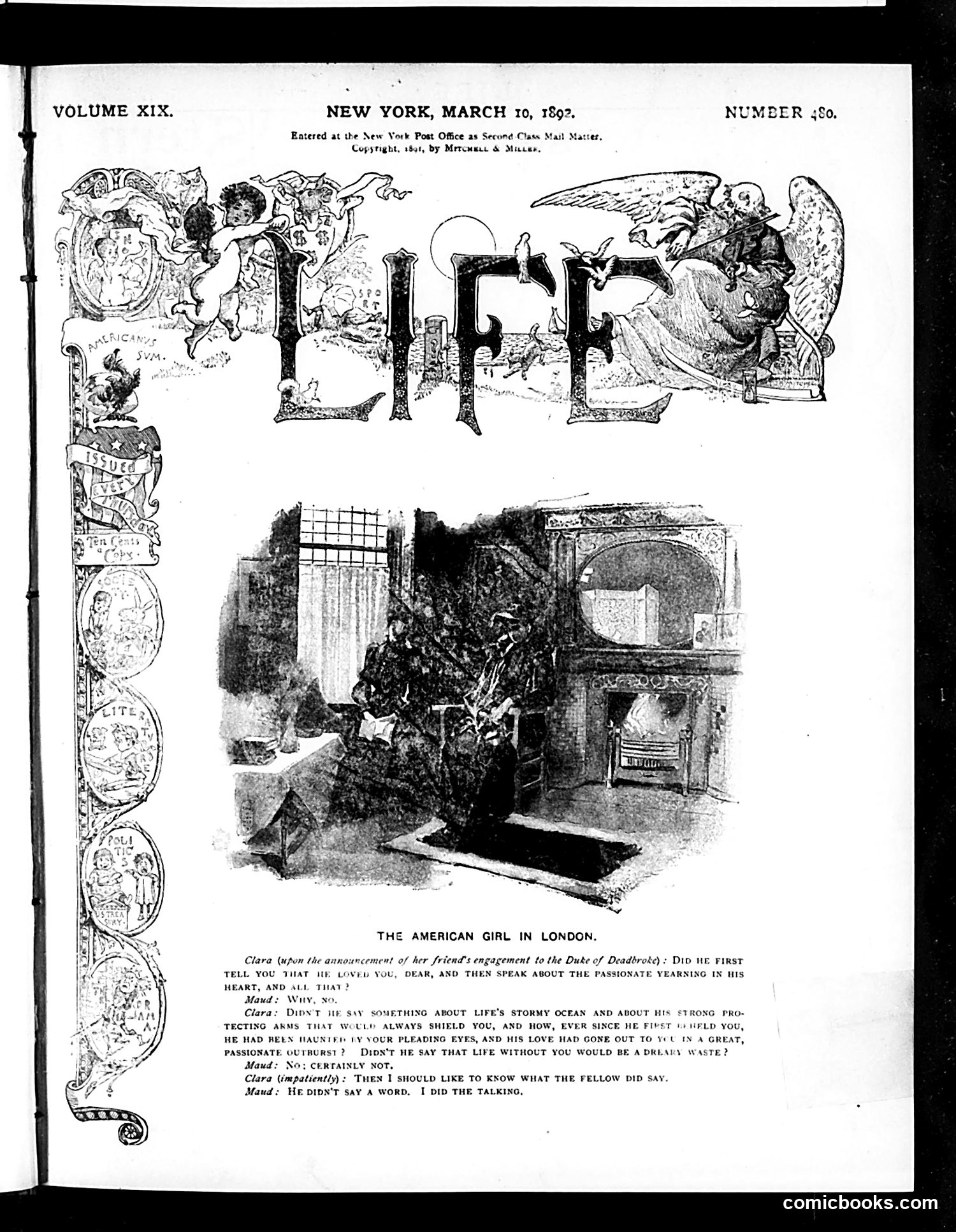
This satirical piece depicts a common social scenario from the Gilded Age: an American woman abroad announcing her engagement to a British aristocrat (specifically a Duke of Doncaster, per the text). The humor centers on American women's perceived social ambitions and their tendency to marry titled European nobles for prestige. The dialogue shows the stereotypical American woman (Clara) eagerly relaying romantic details, while her more reserved British friend (Maud) offers dry, matter-of-fact responses—mocking American emotional excess versus British restraint. The ornate decorative border and theatrical illustration style emphasize the melodramatic nature of such transatlantic romantic pursuits, which were frequent occurrences among wealthy American families seeking social elevation through European titles.
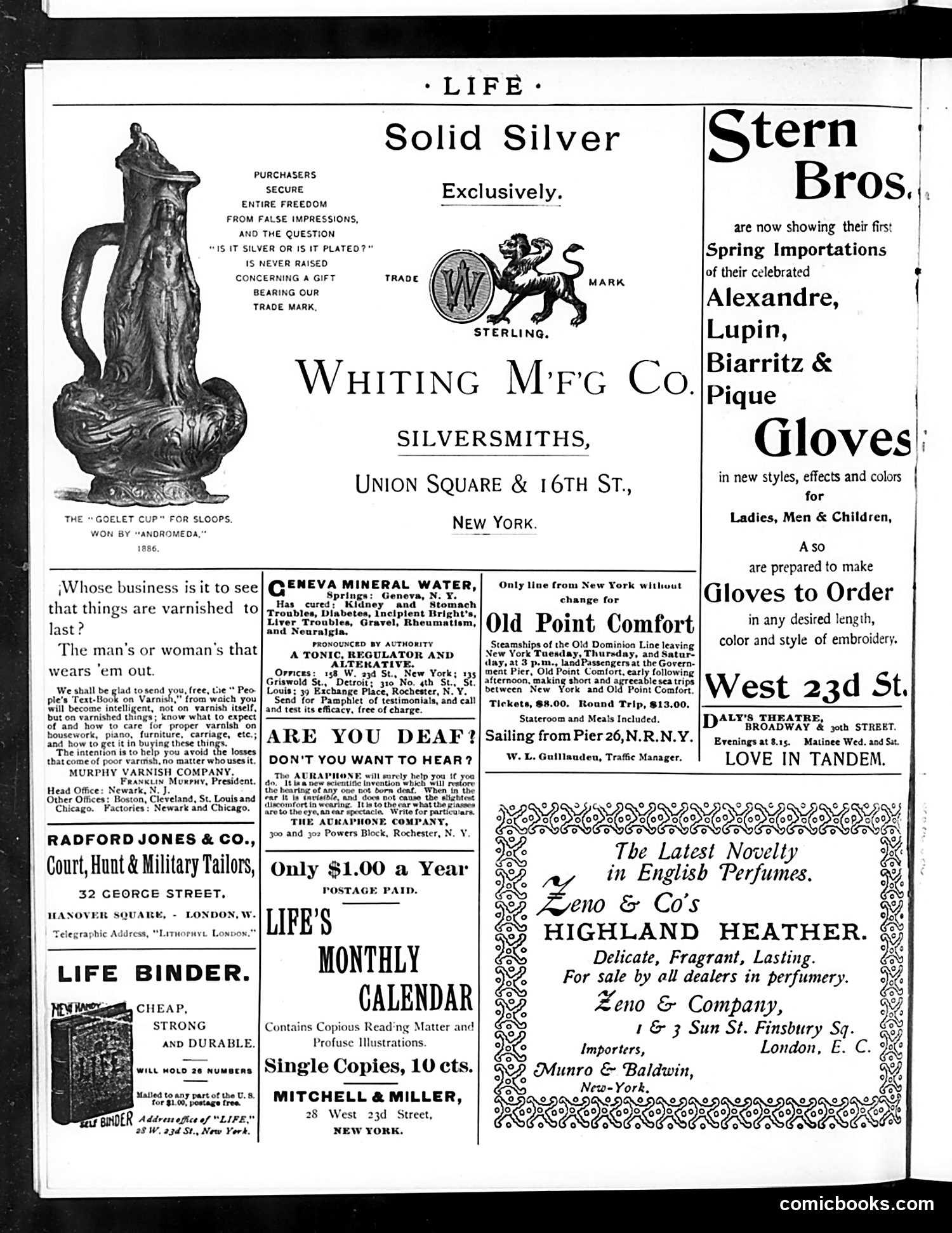
This page is primarily **advertising** rather than editorial content or political cartoons. The main advertisements include: - **Whiting M'fg Co.**: A silversmith company showcasing solid silver goods, including "The Goglet Cup for Sloops, Won by 'Andromeda'" (1886) - **Stern Bros.**: Advertising imported gloves and custom glove-making services - **Life's Monthly Calendar**: A subscription offer for 10 cents - **Zeno & Co.**: Promoting Highland Heather perfume - Various other commercial notices (hearing aids, tailors, mineral water, steamship services) The only illustration with potential satirical content is the ornate silver pitcher/ewer at top left, but it serves primarily as a product showcase rather than commentary. The page reflects late-19th century consumer culture aimed at affluent readers.
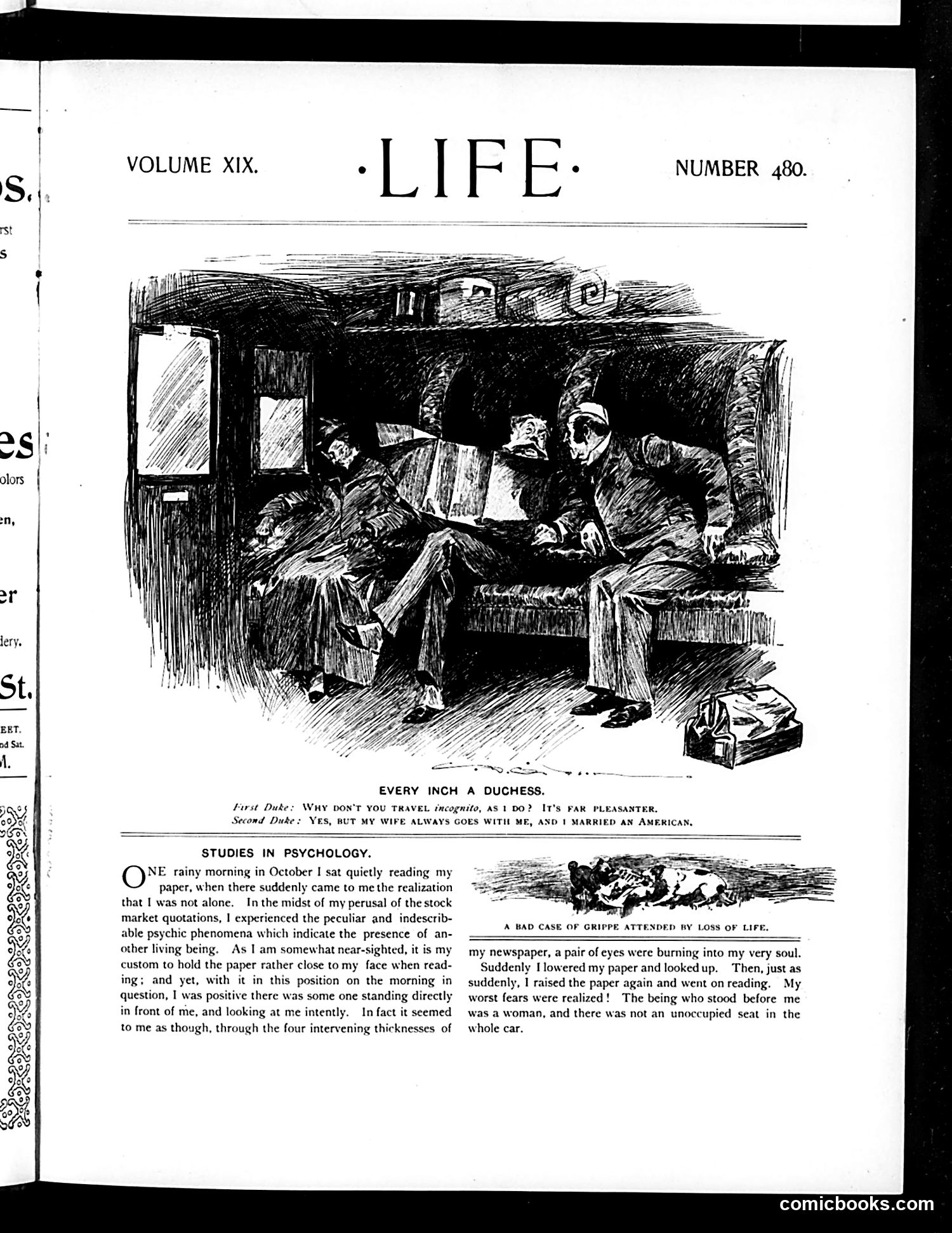
The top cartoon titled "Every Inch a Duchess" depicts two men on a train discussing travel. The first duke asks why the second doesn't travel incognito; the second responds that his wife always accompanies him because "I married an American." The satire targets the social ambitions of wealthy American women who married into European aristocracy during the Gilded Age. The joke suggests American wives refuse to hide their titles—they want public recognition of their elevated status through marriage. The cartoon mocks both the vanity of these women and the implication that Americans lacked the refined discretion expected of European nobility. Below begins "Studies in Psychology," describing an unsettling encounter on a train with an intense stranger who provokes the narrator's anxiety—likely social commentary on urban anonymity and psychological unease.
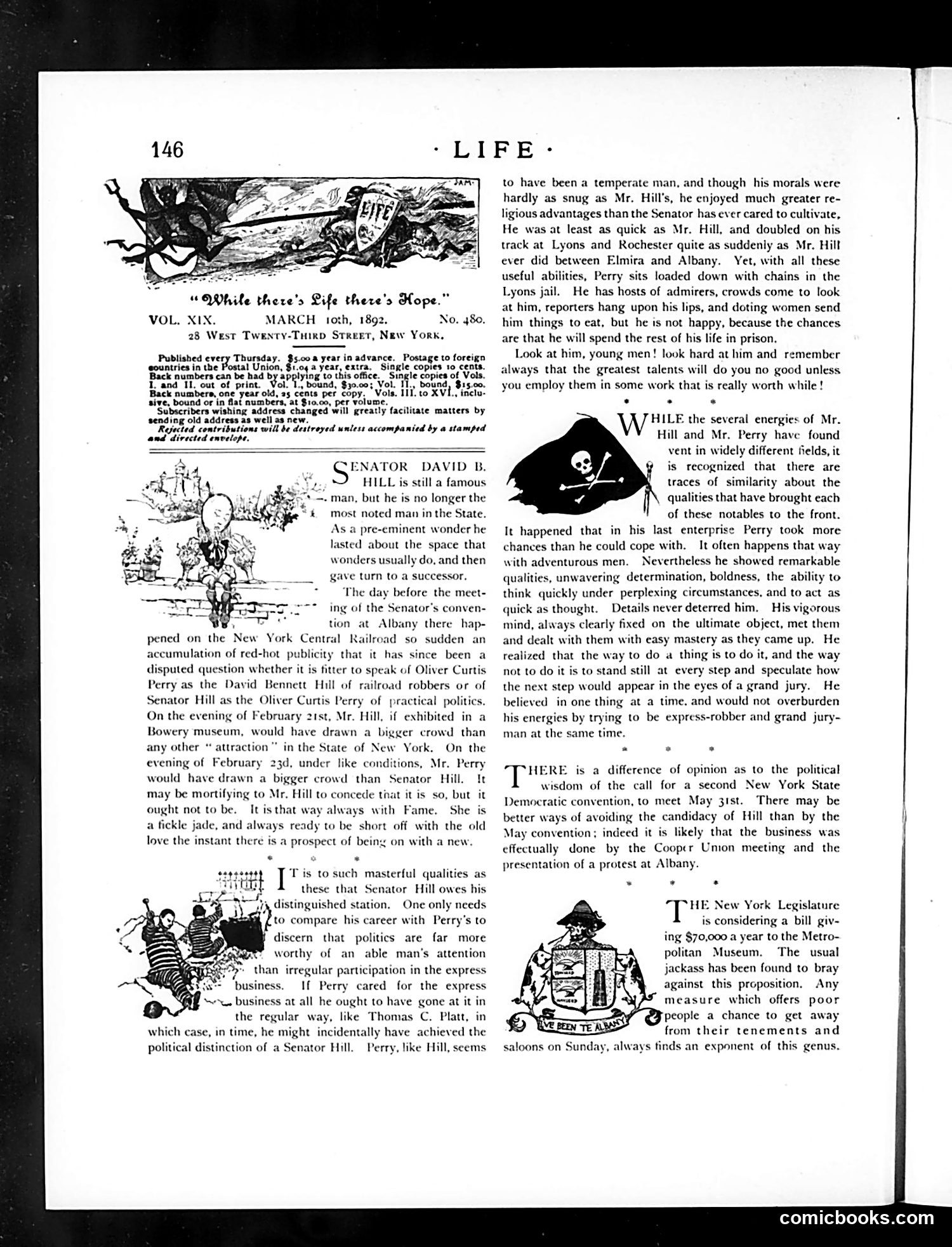
This page satirizes **Senator David B. Hill** of New York, a prominent but controversial Democrat. The text compares Hill unfavorably to a rival politician named Perry, suggesting Hill is less talented despite his fame. The key cartoon (skull and crossbones image) appears to reference Hill's reputation for ruthlessness in politics—he's portrayed as a pirate-like figure, implying cutthroat tactics. The satire mocks Hill's political ambitions while acknowledging his considerable abilities. It suggests that despite his undeniable skills and popularity (crowds follow him, reporters hang on his words), his methods and character make him unsuitable for higher office—a cautionary tale that even talented politicians can be morally compromised. The piece criticizes his practical, cynical approach to politics.
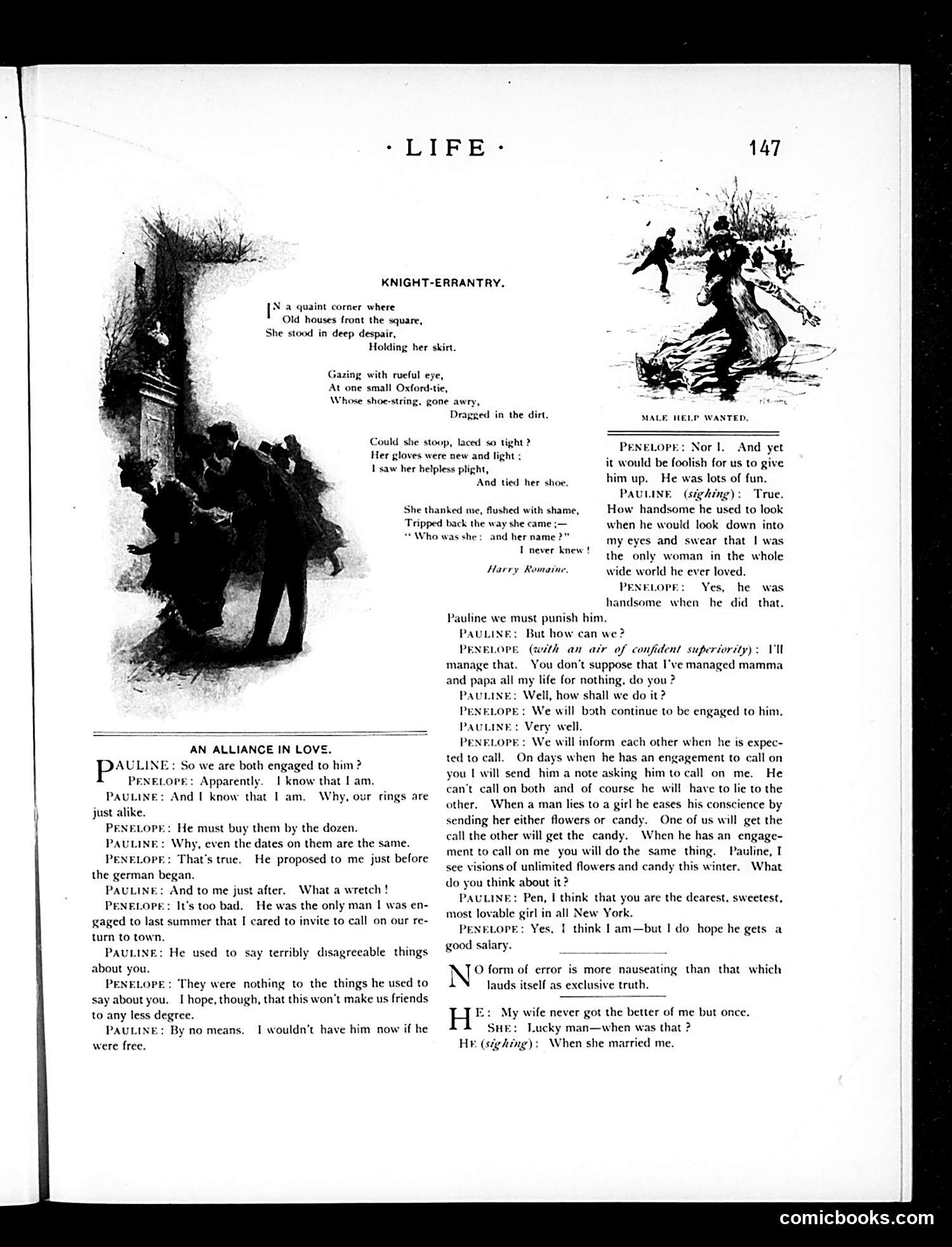
This page contains two unrelated satirical pieces: **"Knight-Errantry"** (left): A poem with accompanying sketch mocking chivalrous behavior. It depicts a man helping a woman whose shoe came loose, establishing an ironic contrast between outdated romantic ideals and modern reality. **"Male Help Wanted"** (right): An illustrated scene showing a woman chasing or attacking a man, accompanying a dialogue between characters named Penelope and Pauline. The satire appears to mock courtship conventions and women's agency—specifically, the women discuss managing their male suitors through deception (alternating engagement calls, sending flowers/candy) and strategic manipulation. The overall theme ridicules both outdated chivalry and the emerging "modern woman" who actively controls romantic relationships through cunning rather than passivity.
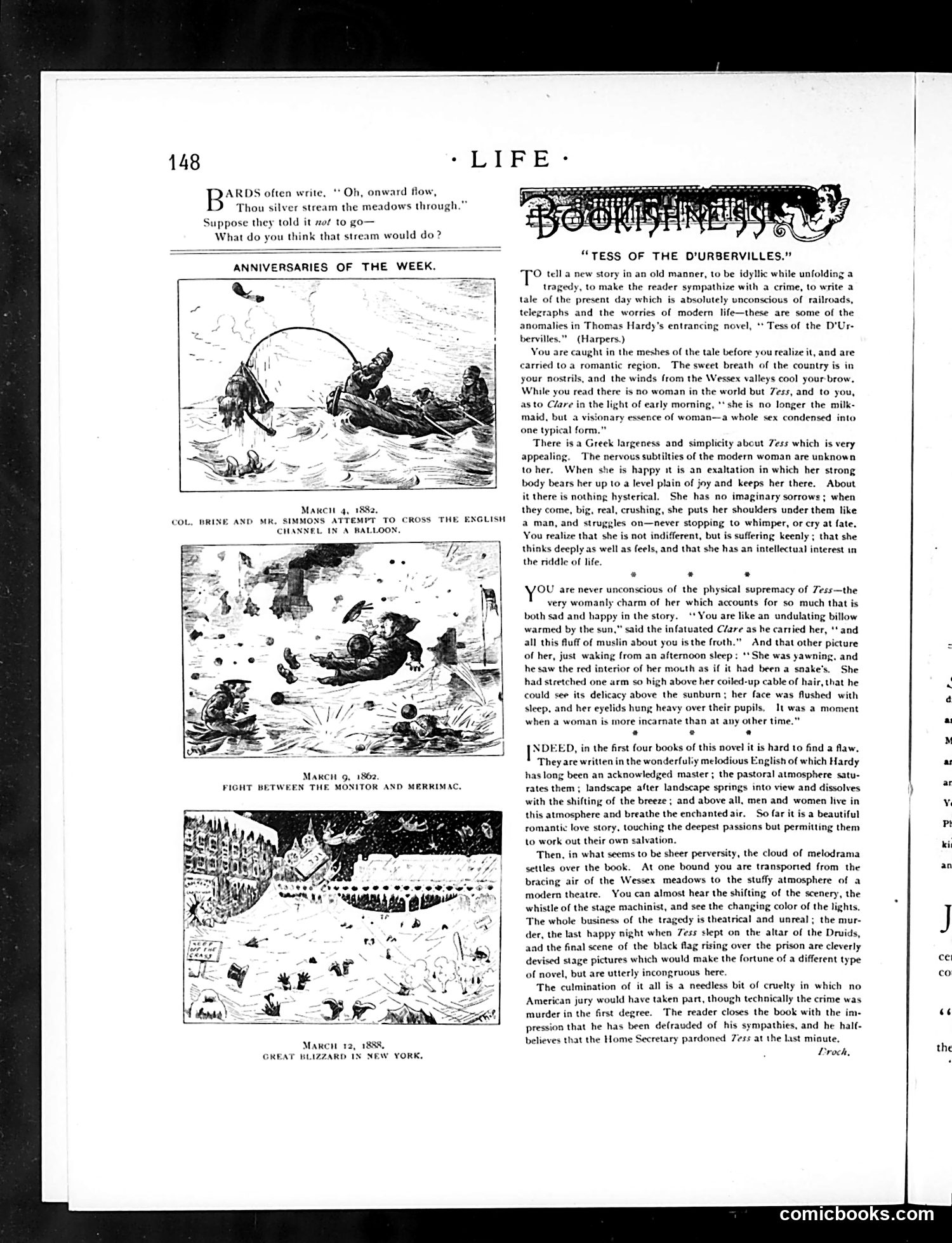
This page discusses Thomas Hardy's novel "Tess of the d'Urbervilles," with three historical illustration engravings occupying the left column: 1. **March 4, 1882**: Col. Brine and Mr. Simmons attempting to cross the English Channel in a balloon 2. **March 9, 1882**: A fight between the Monitor and Merrimac (Civil War naval battle) 3. **March 12, 1888**: The Great Blizzard in New York The right column contains a literary review praising Hardy's novel for its romantic atmosphere and psychological depth, particularly regarding the protagonist Tess. The review criticizes the ending as cruel but acknowledges Hardy's mastery of the English language and landscape description. The "Anniversaries of the Week" section juxtaposes significant historical events with the novel's discussion, likely to contextualize contemporary cultural moments.
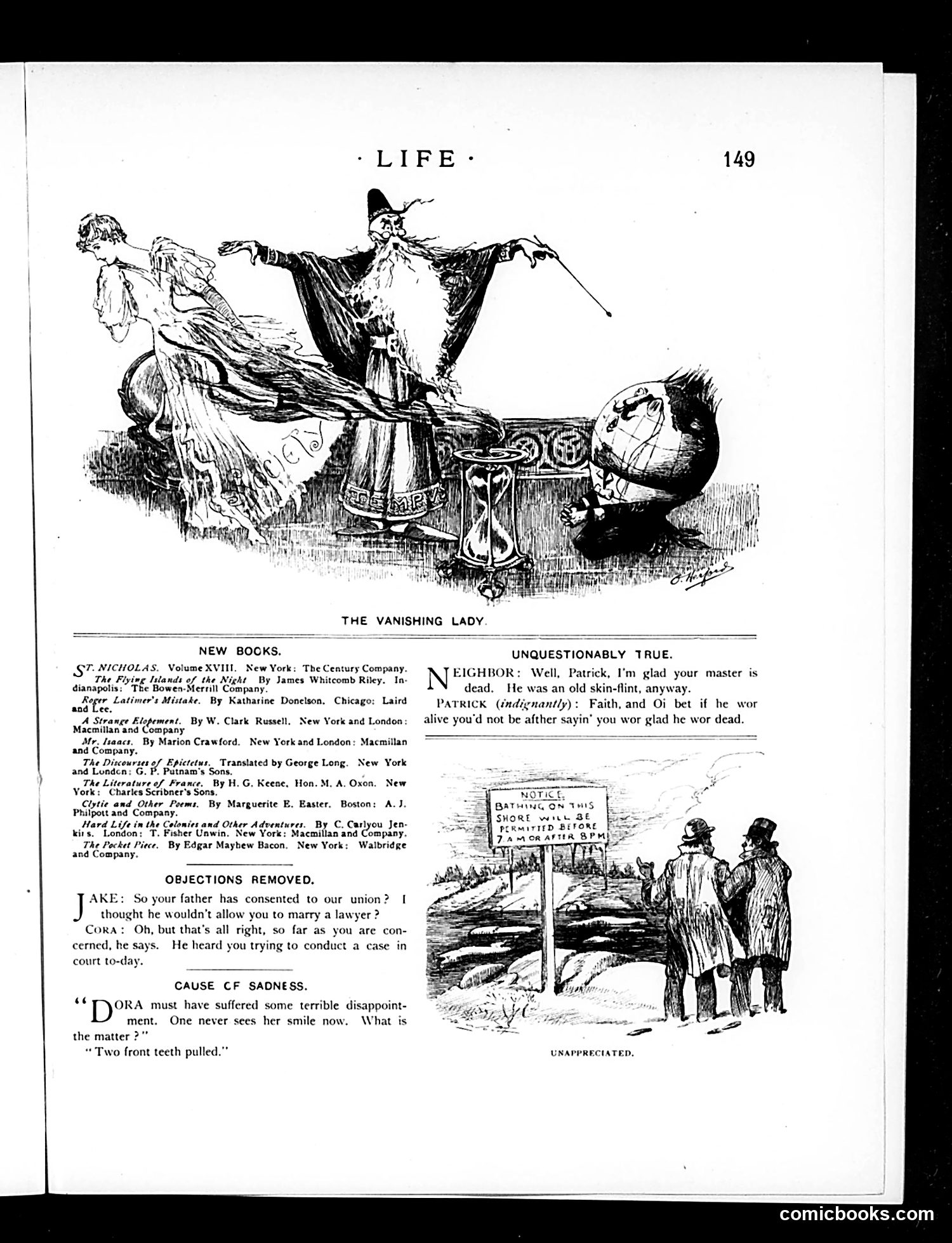
This page contains three distinct humorous pieces typical of early 20th-century Life magazine: 1. **"The Vanishing Lady"** (top illustration): A magician or conjurer manipulates a woman's figure while controlling a globe, suggesting satirical commentary on how women or world affairs are "managed" or made to disappear from view. 2. **"Unquestionably True"** (dialogue): A brief comedic exchange where Patrick expresses relief his master is dead, and his neighbor finds this darkly funny—satirizing servant-master relationships and loyalty. 3. **"Objections Removed"** and **"Cause of Sadness"** (bottom): Short joke pieces about marriage consent and dental problems. The **"Unappreciated"** cartoon (lower right) shows two men at a bathing notice, likely satirizing lack of appreciation for warnings or rules. These represent typical Life magazine humor: social satire, wordplay, and domestic comedy.
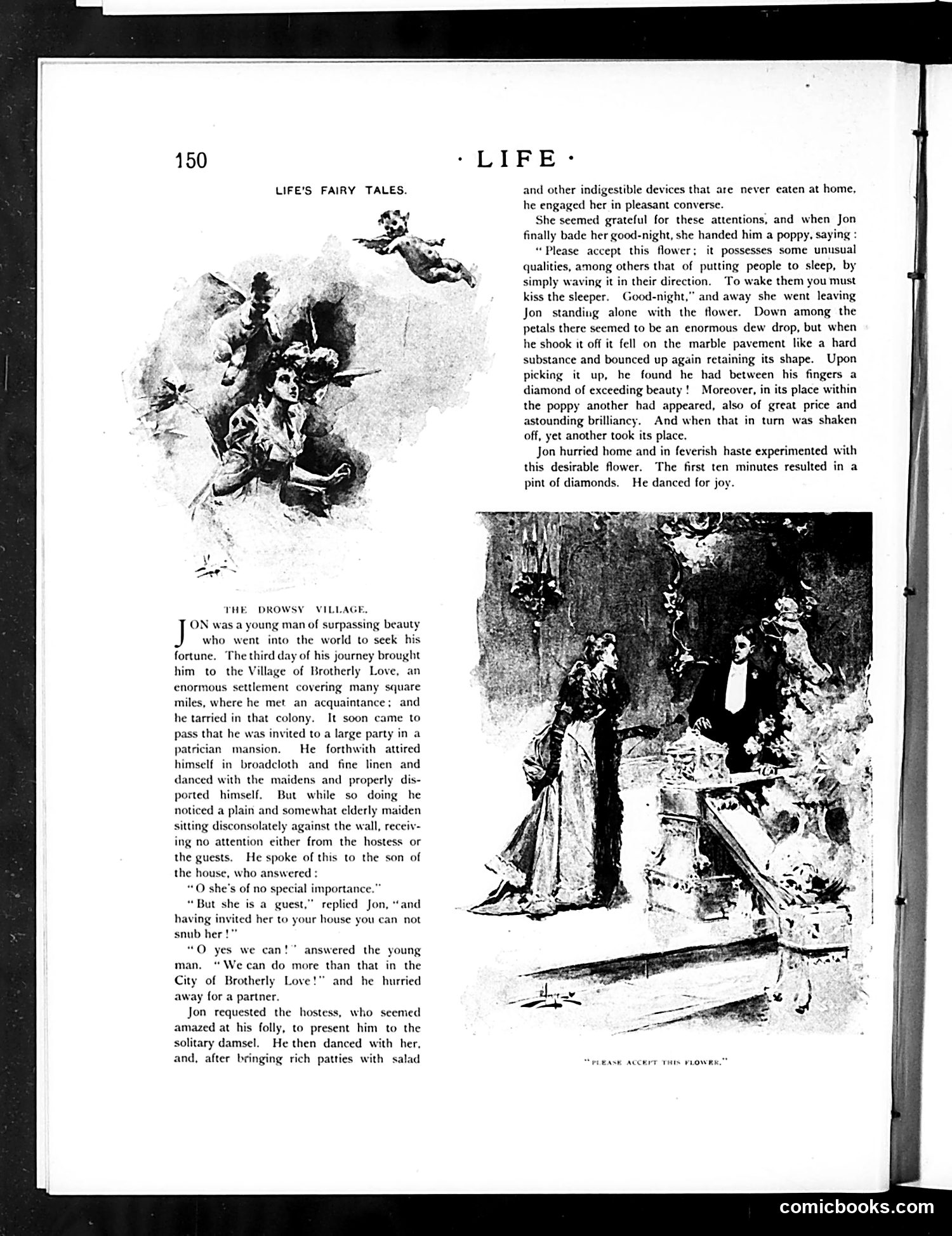
This page contains **"Life's Fairy Tales,"** a fictional story rather than political satire. The narrative describes Jon, a young man of exceptional beauty, who travels to the Village of Brotherly Love (Philadelphia) seeking fortune. At a patrician mansion party, he notices an elderly maiden ignored by guests. He dances with her—an act of kindness that transforms her into a beautiful woman who gifts him a magical poppy flower. The flower produces diamonds when shaken, bringing Jon wealth and joy. **The satire here is social, not political**: it mocks superficial aristocratic society that ignores overlooked individuals, while rewarding kindness with magical fortune. The story employs fairy-tale conventions to critique class pretension and celebrate virtue—typical moralizing content for Life magazine's educated readership.
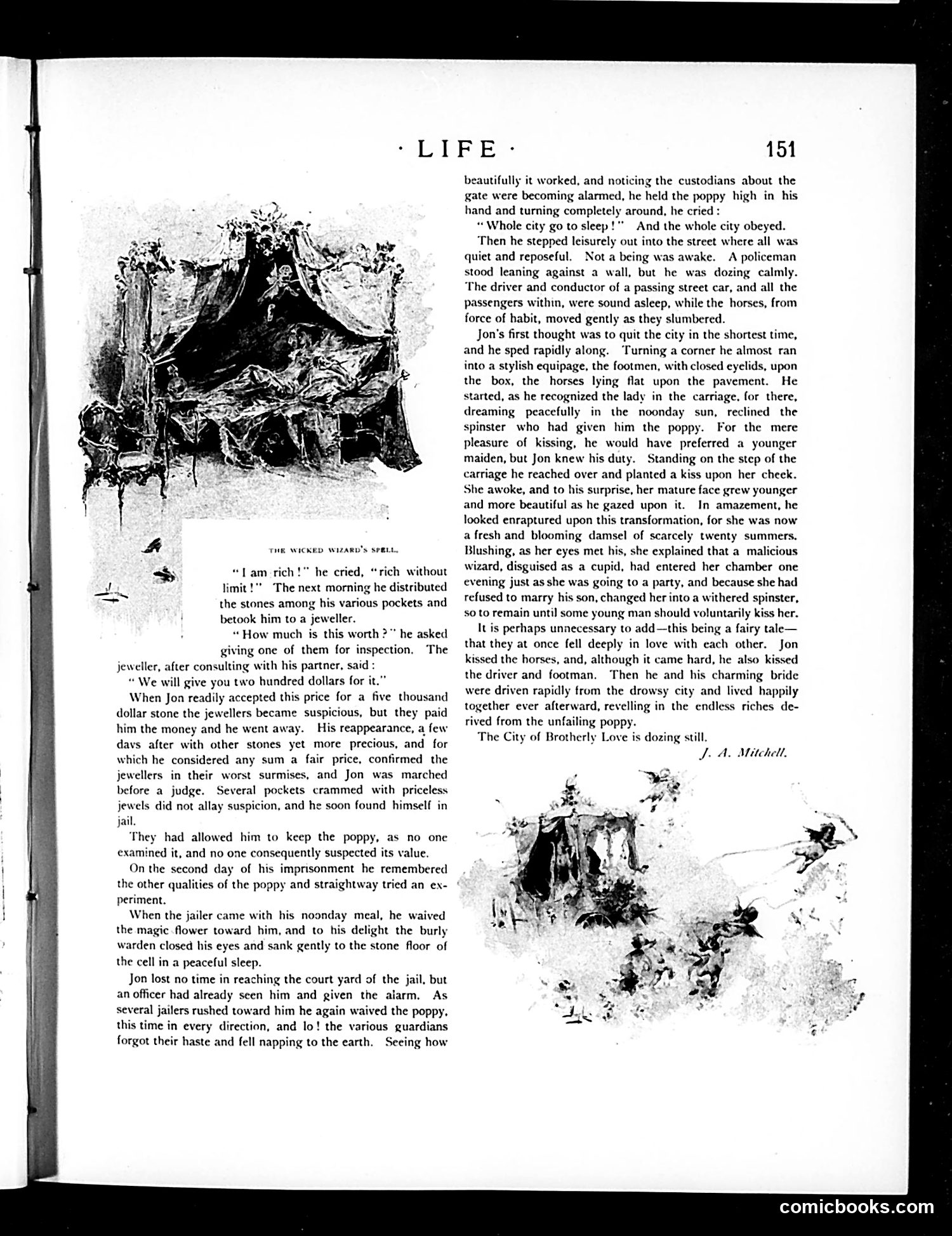
This page contains a serialized story titled "The Wicked Wizard's Spell" by J. A. Mitchell, illustrated with two black-and-white engravings. The narrative appears to be a fantastical tale involving a magical poppy flower that transforms a young woman into a spinster as punishment for refusing to marry the wizard's son. The story emphasizes romantic themes typical of late 19th/early 20th-century fiction—including magical intervention, transformation, and ultimate redemption through true love. The detailed engravings and literary style reflect Life magazine's role as a venue for serialized fiction alongside its satirical content. Without additional context about the magazine's date or the author's intentions, the specific satirical targets remain unclear, though the fantastic narrative appears to be entertainment rather than direct social commentary.
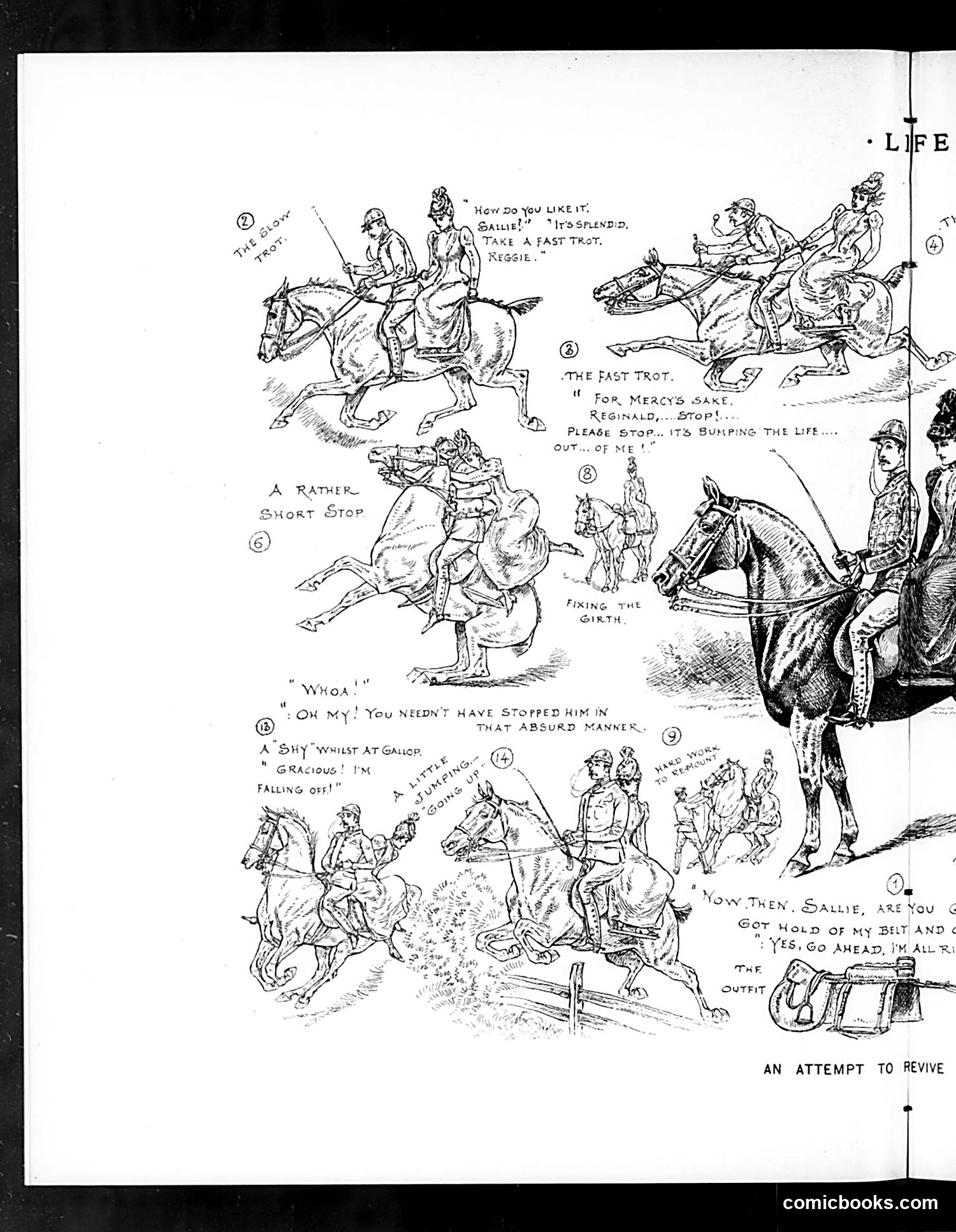
This multi-panel comic satirizes fox hunting, a leisure activity among the wealthy British upper classes. The sequence follows "Sallie" and "Reginald" attempting various horse-riding gaits—"the slow trot," "the fast trot," and "a rather short stop"—with increasingly chaotic results. The humor derives from the riders' incompetence: horses buck, riders lose control, and the activity devolves into absurdity. The satire targets the pretensions of amateur equestrians who participate in fashionable fox hunts without actual skill. The title "An Attempt to Revive" likely mocks efforts to maintain or restore this traditional aristocratic pastime, suggesting it's moribund and ridiculous when practiced by incompetent participants. The comic punctures the dignity associated with upper-class sporting pursuits.
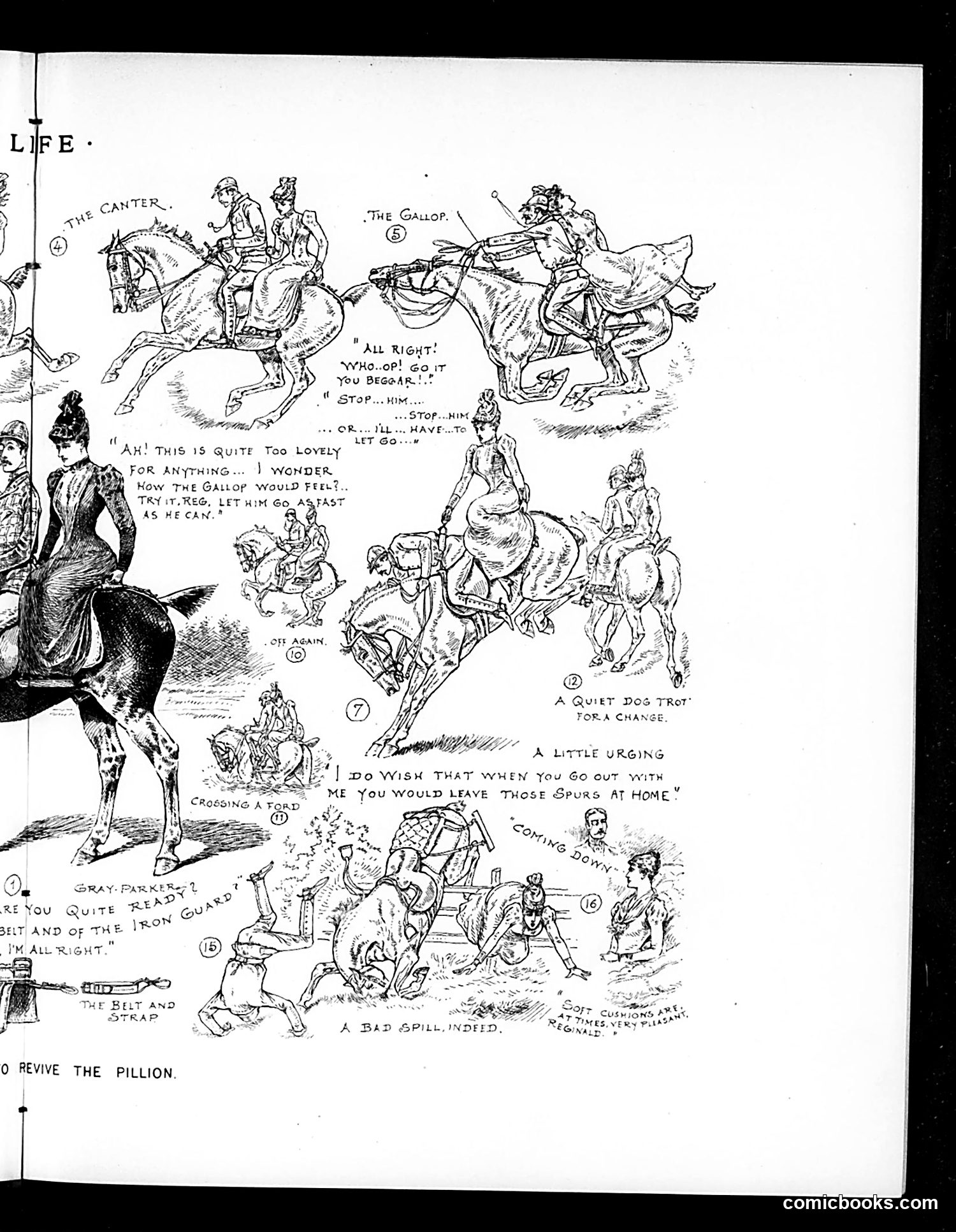
This page depicts a satirical equestrian sequence mocking poor horseback riding technique and control. The numbered panels (2-18) illustrate progressive mishaps: "The Canter" and "The Gallop" show riders struggling with unruly horses, with dialogue like "All right! Who—op! Go it you beggar!" and "Stop...him...Stop...him." The humor centers on incompetent riders losing command of spirited horses, culminating in disasters like "A Bad Spill Indeed" and "Coming Down." One panel includes commentary: "I do wish that when you go out with me you would leave those spurs at home"—suggesting the rider's excessive spurs agitate the horse. This appears to be gentle satire on amateur or overconfident equestrians, a common subject in Victorian/Edwardian era humor when horseback riding was a regular social activity among the gentry.
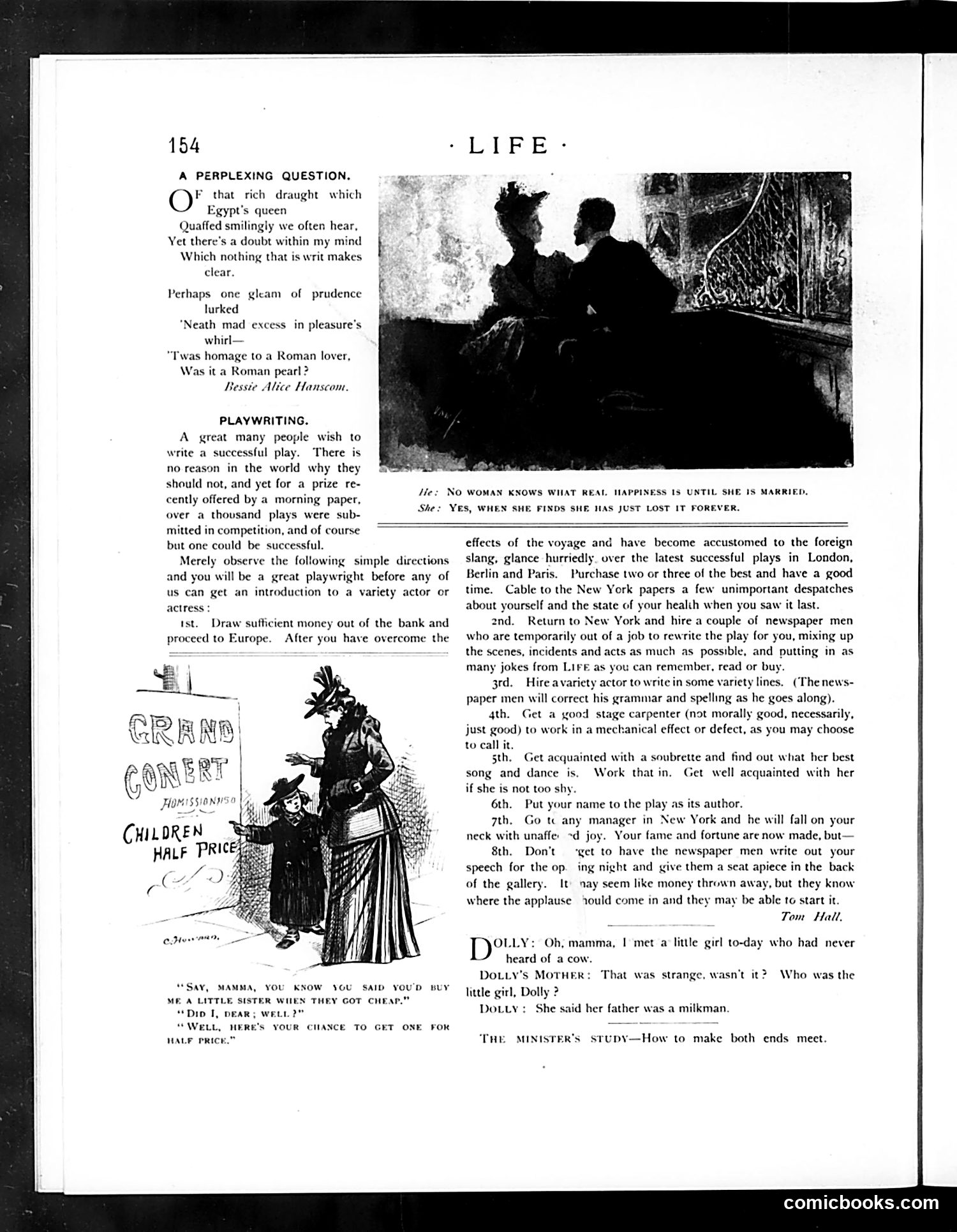
This page contains three distinct pieces of satirical humor: **"A Perplexing Question"** (top left): A poem questioning whether a woman's romantic indulgence represented prudent behavior or excess, framed around classical references to Roman lovers and pearls—likely satirizing Victorian anxieties about female morality and romance. **"Playwriting" (main text)**: A mock instructional guide sarcastically advising aspiring playwrights on how to succeed. The "8-step" process ridicules theatrical plagiarism and shortcuts: steal European plays, hire newspaper writers to rewrite scenes, add variety acts, insert *Life* magazine jokes, hire actors and stagehands—essentially prescribing wholesale theft and assembly-line mediocrity. It's satirizing both the proliferation of derivative Broadway plays and the commercial theater industry's cynical practices. **The cartoons** include a "Grand Concert" ad for children at half price (mocking cheap entertainment), and a domestic exchange about buying a "little sister" cheap, plus a final joke about a minister making "both ends meet"—likely financial wordplay about clerical poverty. The page satirizes early 20th-century theatrical commercialism, marriage skepticism, and consumer culture.
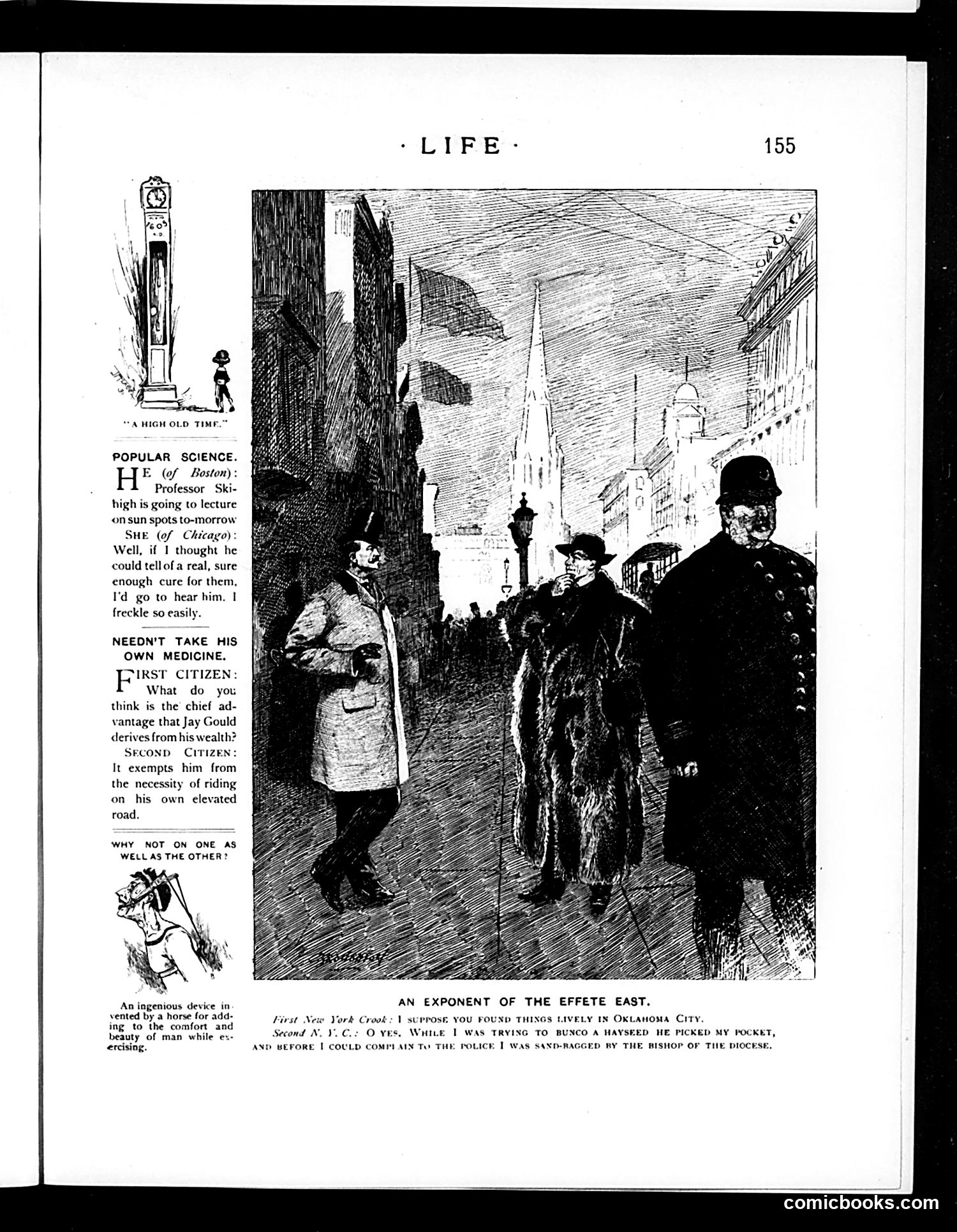
This page contains several unrelated satirical jokes typical of Life's humor: 1. **"Popular Science"**: A woman from Chicago jokes that she'd attend a lecture on sun spots only if it promised to cure her freckles—satirizing both pseudo-scientific lecturing and vanity. 2. **"Needn't Take His Own Medicine"**: References Jay Gould, the wealthy railroad magnate. The joke: Gould's wealth exempts him from using his own elevated railroad, mocking the hypocrisy of wealthy industrialists who don't patronize their own enterprises. 3. **"Why Not On One As Well As The Other?"**: A brief visual joke about a horse contraption for riders' comfort. 4. **"An Exponent of the Effete East"**: A New York socialite recounts being mugged in Oklahoma City, then beaten by "the bishop of the diocese"—satirizing both Eastern pretension and Wild West lawlessness, implying even clergy are corrupt or violent in the frontier. The page reflects Gilded Age concerns: scientific humbug, railroad monopolies, and regional cultural divisions.
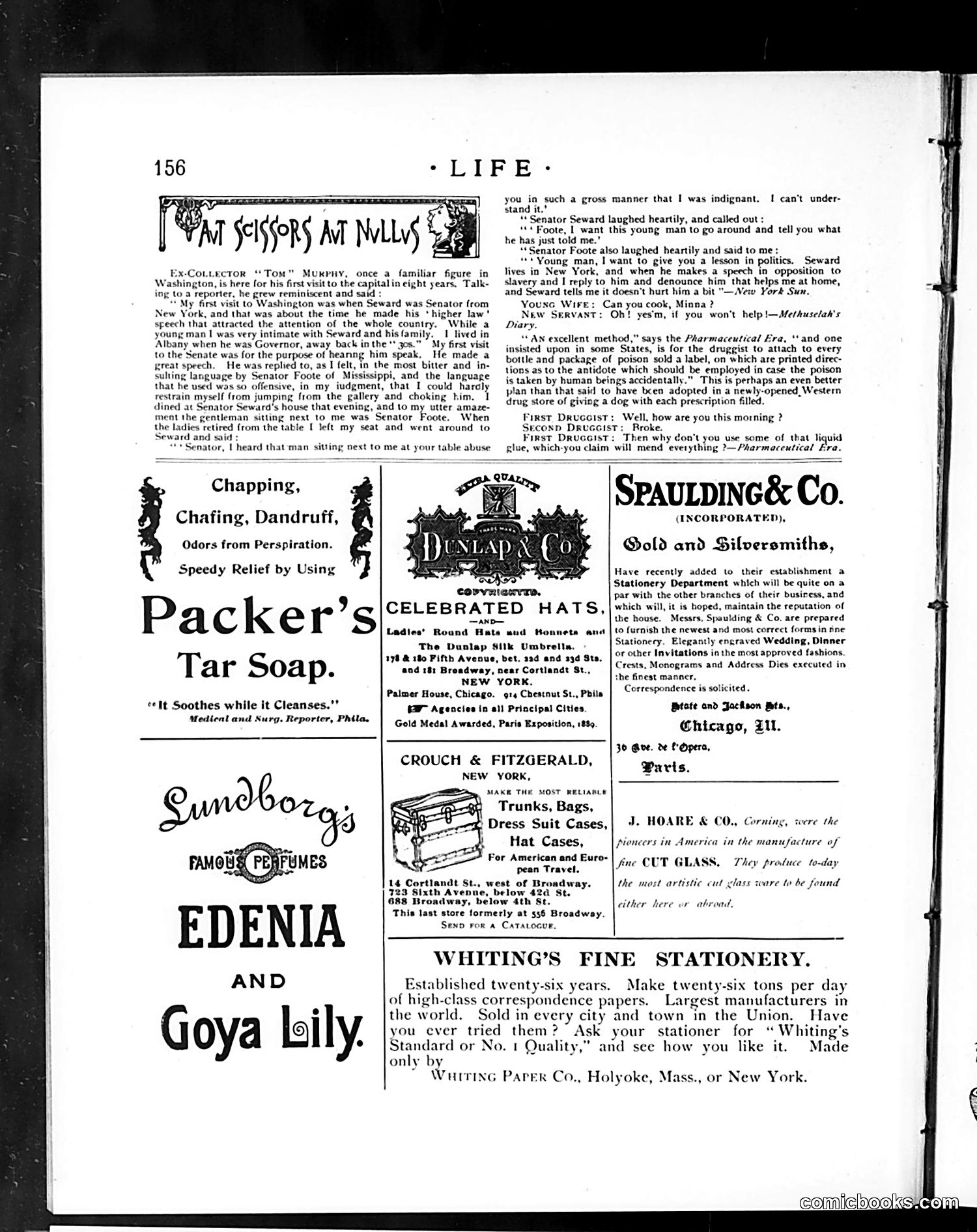
This page is predominantly **advertisements** rather than political cartoons. The main content is a brief anecdote titled "AM SCISSORS AM NULLS" recounting ex-collector Tom Murphy's reminiscence about Senator William Seward in the 1830s-40s. The story illustrates an antebellum political rivalry: Senator Foote of Mississippi allegedly verbally attacked Seward (who opposed slavery) in the Senate, yet they later dined together civilly. Murphy expected conflict but Seward dismisses it, with Foote explaining that their public enmity actually **helps him politically back home**—a commentary on sectional divisions and strategic political posturing before the Civil War. The page's remaining content consists entirely of product advertisements: Packer's Tar Soap, Simborg Perfumes, Edenia, Goya Lily, Dunlap hats, Crouch & Fitzgerald luggage, Spaulding & Co. silverware, Hoare cut glass, and Whiting's stationery.