
Life, 1892-03-10 · page 6 of 14
Life — March 10, 1892 — page 6: what you’re looking at
What you’re looking at
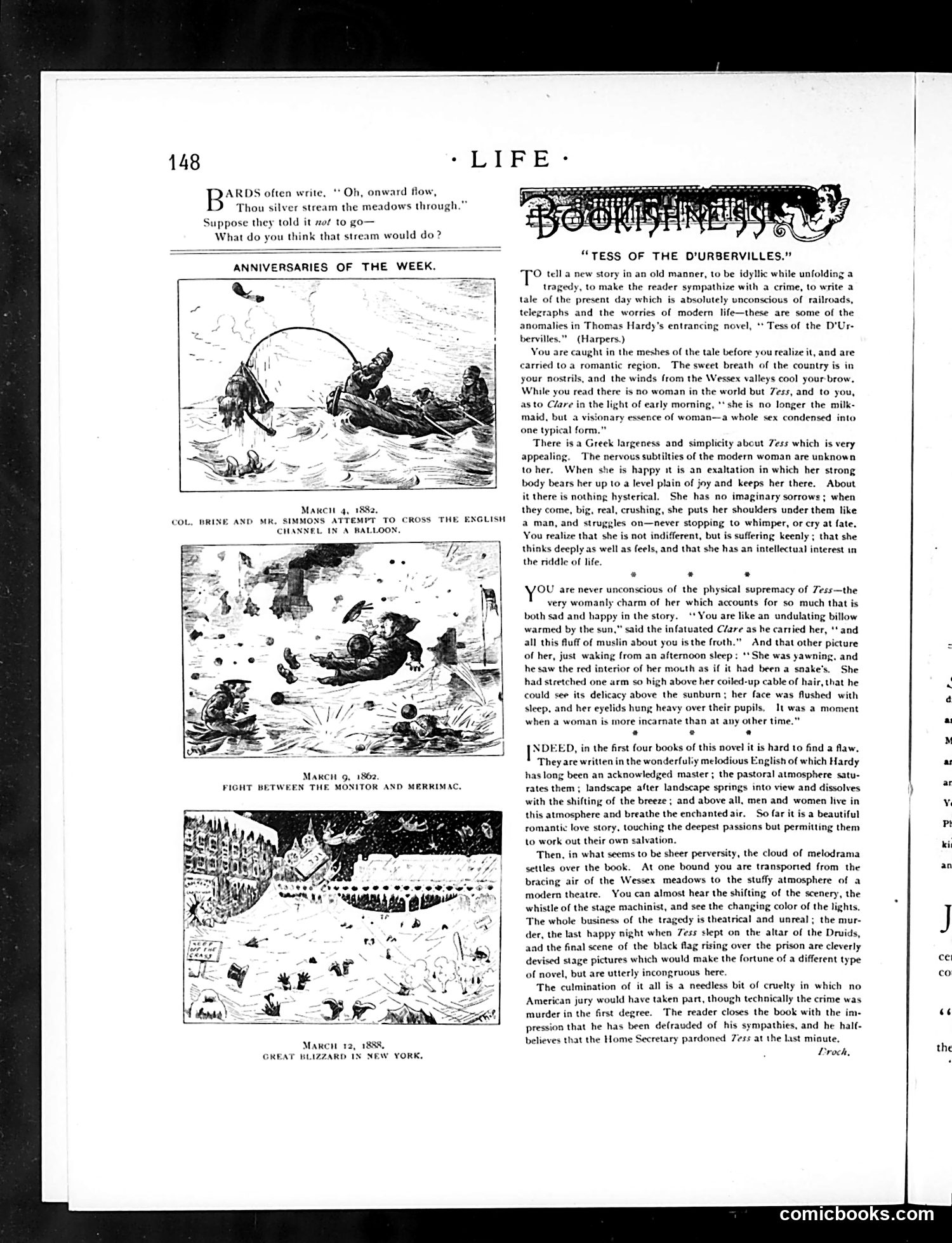
This page discusses Thomas Hardy's novel "Tess of the d'Urbervilles," with three historical illustration engravings occupying the left column: 1. **March 4, 1882**: Col. Brine and Mr. Simmons attempting to cross the English Channel in a balloon 2. **March 9, 1882**: A fight between the Monitor and Merrimac (Civil War naval battle) 3. **March 12, 1888**: The Great Blizzard in New York The right column contains a literary review praising Hardy's novel for its romantic atmosphere and psychological depth, particularly regarding the protagonist Tess. The review criticizes the ending as cruel but acknowledges Hardy's mastery of the English language and landscape description. The "Anniversaries of the Week" section juxtaposes significant historical events with the novel's discussion, likely to contextualize contemporary cultural moments.
📄 Transcribed text from this page (OCR, searchable)
Machine-transcribed from the original scan — historical spelling and the odd misread are preserved.
Brees often write, Oh, onward flow, Thou silver stream the meadows through.” Suppose they told it not to go— What do you think that stream would do? ANNIVERSARIES OF THE WEEK. Mancnt 4, 1882. MMONS ATTEMPT TO CROSS THE ENGLISH HANNEL IN A BALLOON. COL, BRINE AND MR Maxcn 9, 1862. FIGHT BETWEEN THE MONITOR AND MERRIMAC. MaKcHt 12, 1888, GREAT BLIZZARD IN NEW YORK, “TESS OF THE D’'URBERVILLES.” TO tela new story in an old manner, to be idyllic while unfolding a tragedy, to make the reader sympathize with a crime, to write a tale of the present day which is absolutely unconscious of railroads, telegraphs and the worries of modern life—these are some of the anomalies in Thomas Hardy's entrancing novel, ** Tess of the D'Ur- bervilles.” (Harpers.) You are caught in the meshes of the tale before you realize it, and are carried to a romantic region, The sweet breath of the country is in your nostrils, and the winds from the Wessex valleys cool your brow. While you read there is no woman in the world but Zess, and to you, asto Clare in the light of early morning, ** she is no longer the milk- maid, but a visionary essence of woman—a whole sex condensed into one typical form.” There isa Greek largeness and simplicity about 7ess which is very appealing. The nervous subtilties of the modern woman are unknown to her. When she is happy it is an exaltation in which her strong body bears her up to a level plain of joy and keeps her there. About it there is nothing hysterical. She has no imaginary sorrows ; when they come, big, real, crushing, she puts her shoulders under them like a man, and struggles on—never stopping to whimper, or cry at fate. You realize that she is not indifferent, but is suffering keenly ; that she thinks deeply as well as feels, and that she has an intellectual interest in the riddle of life. ° . * YOU are never unconscious of the physical supremacy of Zess—the very womanly charm of her which accounts for so much that is both sad and happy in the story. ‘You are like an undulating billow warmed by the sun," said the infatuated Clare as he carried her, ** and all this fluff of muslin about you isthe froth.” And that other picture of her, just waking from an afternoon sleep: ‘She was yawning, and he saw the red interior of her mouth as if it had been a snake's. She had stretched one arm so high above her coiled-up cable of hair, that he could see its delicacy above the sunburn; her face was flushed with sleep, and her eyelids hung heavy over their pupils, It was a moment when a woman is more incarnate than at any other time. . e * NDEED, in the first four books of this novel it is hard to find a flaw. They are written in the wonderfuliy melodious English of which Hardy has long been an acknowledged master ; the pastoral atmosphere satu- rates them ; landscape after landscape springs into view and dissolves with the shifting of the breeze; and above all, men and women live in this atmosphere and breathe the enchanted air. So far it is a beautiful romantic love story, touching the deepest passions but permitting them to work out their own salvation, Then, in what seems to be sheer perversity, the cloud of melodrama settles over the book. At one bound you are transported from the bracing air of the Wessex meadows to the stuffy atmosphere of a modern theatre. You can almost hear the shifting of the scenery, the whistle of the stage machinist, and see the changing color of the lights. The whole business of the tragedy is theatrical and unreal; the mur- der, the last happy night when Zess slept on the altar of the Druids, aad the final scene of the black flag rising over the prison are cleverly devised stage pictures which would make the fortune of a different type of novel, but are utterly incongruous here. ‘The culmination of it all is a needless bit of cruelty in which no American jury would have taken part, though technically the crime was murder in the first degree. The reader closes the book with the im- pression that he has been defrauded of his sympathies, and he half- believes that the Home Secretary pardoned 7ess at the last miaute. Loch, comicbooks.com ce co “cs the