
A complete issue · 18 pages · 1892
Life — January 21, 1892
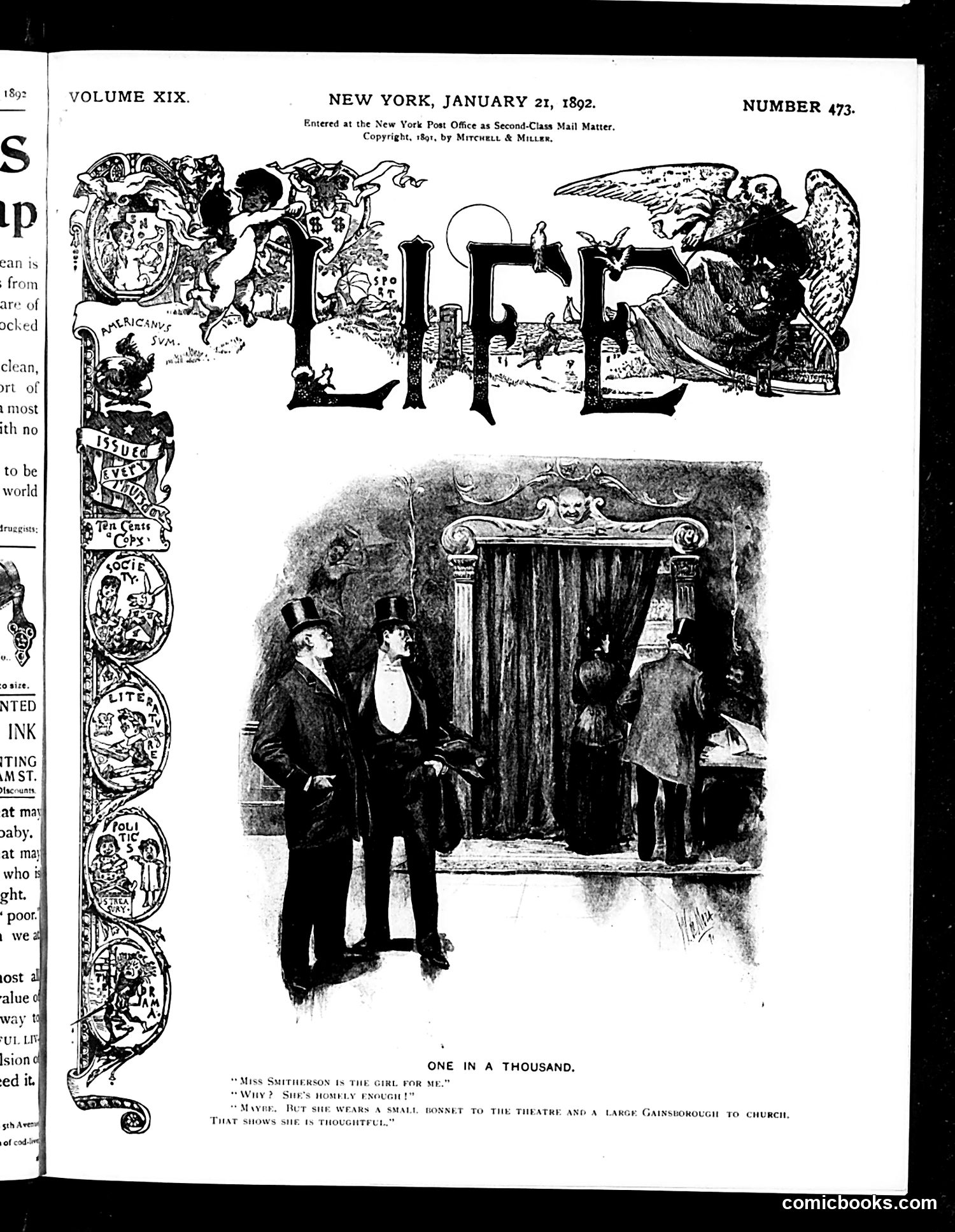
This page from Life magazine (January 21, 1892) features a satirical cartoon titled "One in a Thousand." The image shows two well-dressed men in top hats observing a theatrical scene through curtains. The caption quotes suggest the cartoon satirizes gender and social expectations: "Miss Smitherson is the girl for me," "Why? She's homely enough!" and "Maybe. But she wears a small bonnet to the theatre and a large Gainsborough to church. That shows she is thoughtful." The joke mocks the superficiality of courtship rituals and social pretense among the upper classes. A woman's choice of fashionable bonnets and hats—seemingly small details—becomes the measure of her suitability as a wife. The satire suggests men value women's adherence to social conventions and fashion over genuine personal qualities, making such "thoughtful" women rare ("one in a thousand").
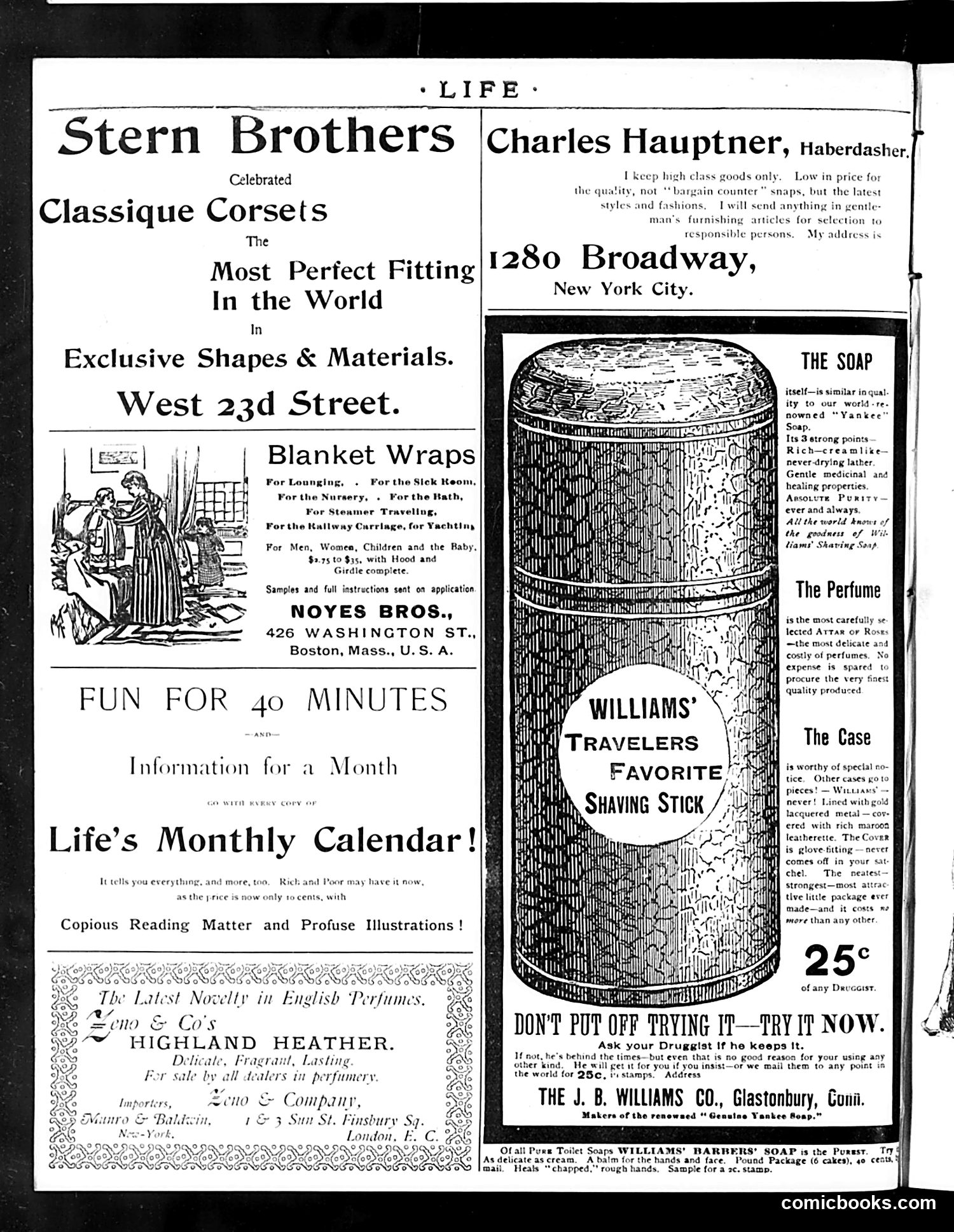
This page is **primarily advertising**, not satire or political commentary. It contains multiple product advertisements from the early 20th century: 1. **Stern Brothers** corsets (West 23rd Street, NYC) 2. **Noyes Bros.** blanket wraps (Boston) 3. **Life's Monthly Calendar** subscription promotion 4. **Lemo & Co's** perfume (Highland Heather scent) 5. **Charles Hauptner** haberdashery (1280 Broadway, NYC) 6. **J.B. Williams Co.** shaving stick (prominently featured) The only illustrative content is a small domestic scene accompanying the blanket wraps ad. There is no discernible political cartoon, satire, or social commentary on this page—it's a straightforward commercial layout typical of Life magazine's advertising sections during this era.
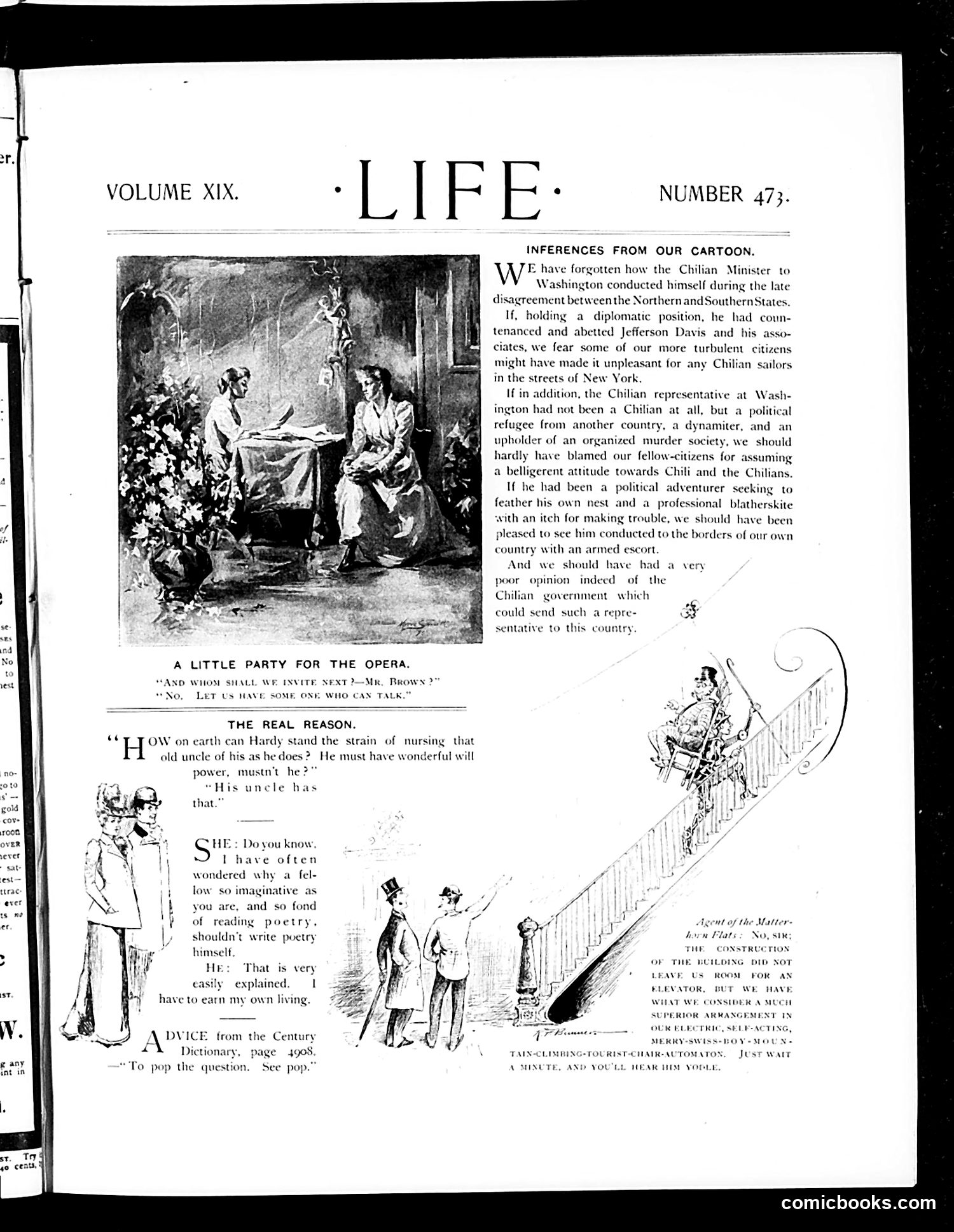
**"Inferences from Our Cartoon"** (top article) critiques a Chilean diplomatic representative's visit to Washington during U.S. North-South tensions. The piece sarcastically suggests that if he were a genuine political agitator rather than a diplomat, his expulsion would be justified—but as an official representative, the U.S. should maintain diplomatic courtesy, however awkwardly. **Lower cartoons** address social humor: one features dialogue about why someone reads poetry despite lacking imagination; another depicts what appears to be a self-operating elevator or mechanical innovation, with humorous commentary about technological advancement. The page mixes political satire with lighthearted domestic humor typical of Life's satirical approach to current events and social customs.
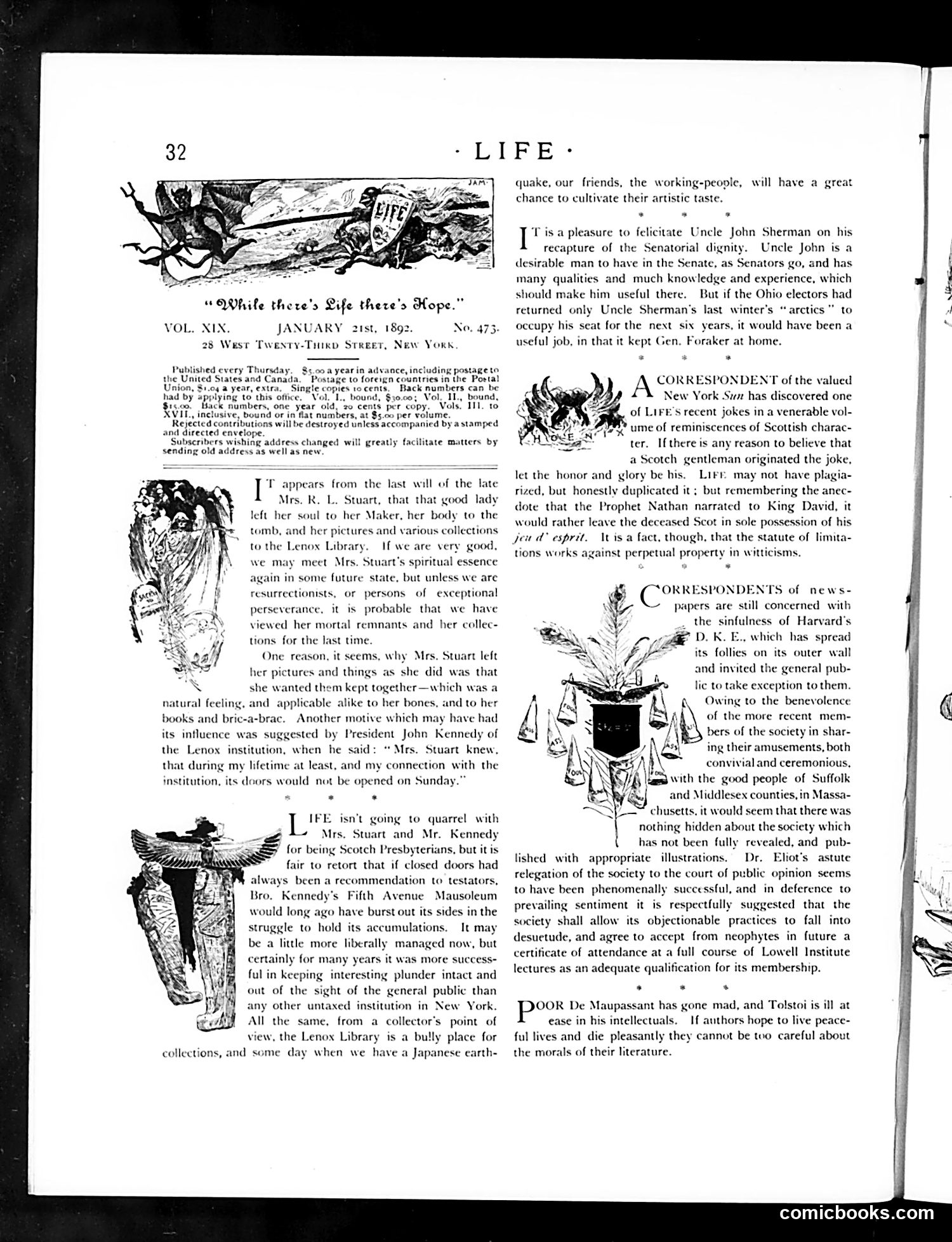
This page contains editorial commentary rather than political cartoons. The visible illustrations are decorative vignettes (a classical urn, an eagle, a botanical plant) typical of period magazine design. The text discusses several topics: felicitations to Uncle John Sherman on his Senate appointment; commentary on Mrs. E. L. Stuart's bequest to the Lenox Library; and criticism of Harvard's "D.K.E." society for its exclusionary practices. The magazine also defends the Lenox Library against accusations it's poorly managed, argues Scottish Presbyterian churches shouldn't quarrel with Presbyterians generally, and critiques De Maupassant's moral writings. The content is primarily social and institutional commentary rather than political satire.
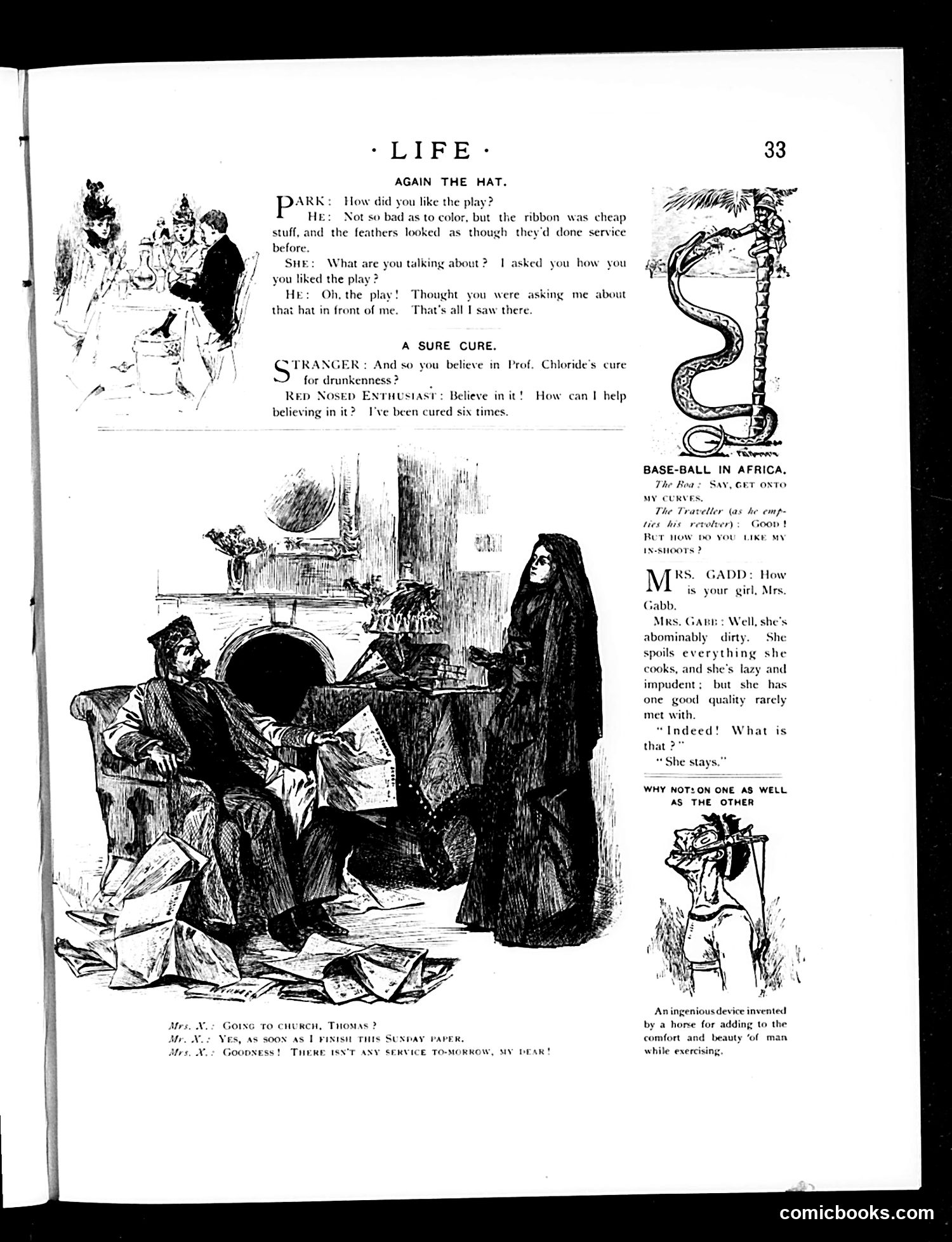
This page contains three satirical sketches with accompanying dialogue: 1. **"Again the Hat"** - Mocks a theater-goer's complaint about a woman's hat blocking the view, then feigning ignorance about what was asked. 2. **"A Sure Cure"** - Features a red-nosed man claiming Professor Chloride's cure for drunkenness works, having been "cured six times"—the joke being that repeated relapses undermine the cure's credibility. 3. **"Base-Ball in Africa"** - Depicts a Boa constrictor joining a baseball game, with commentary on the snake's physical attributes (curves). 4. **"Why Not One as Well as the Other"** - Shows a contraption invented by a horse to aid human comfort while exercising. The page primarily offers light domestic and absurdist humor rather than political commentary.
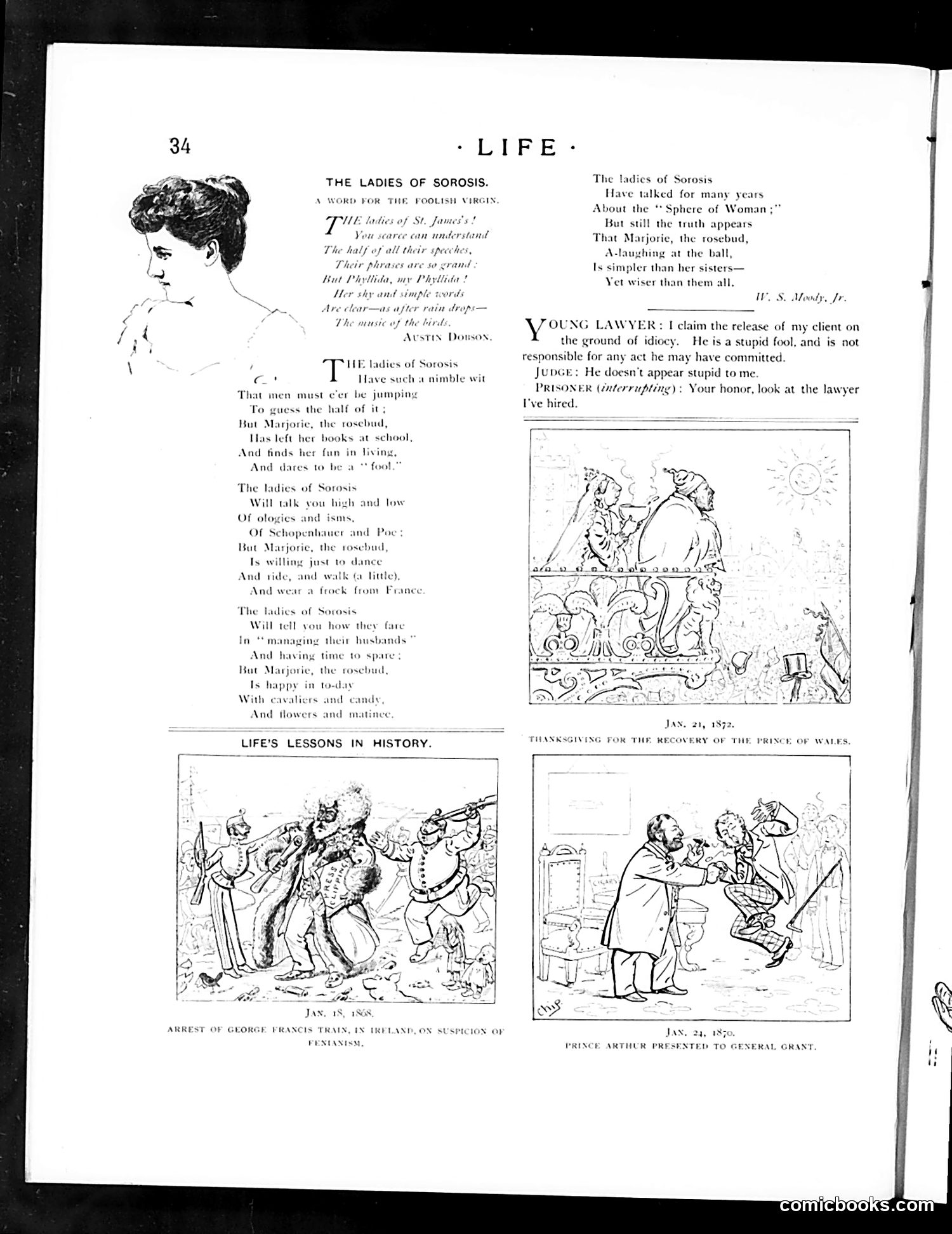
This page contains three distinct satirical pieces: **"The Ladies of Sorosis"** mocks a women's club (Sorosis, a real 1868 organization), portraying its members as pretentious intellectuals who discuss obscure topics while neglecting practical concerns. The satire suggests women's intellectual aspirations are ridiculous. **The courtroom dialogue** jokes about a lawyer's apparent stupidity, with the judge sarcastically commenting on his incompetence. **"Life's Lessons in History"** (Jan. 18, 1868) depicts the arrest of George Francis Train in Ireland on suspicion of Fenianism (Irish republicanism). **"Thanksgiving for the Recovery of the Prince of Wales"** (Jan. 21, 1870) shows Prince Arthur being presented to General Grant, celebrating the heir's recovery from illness. The page reflects 1870s American attitudes toward women's rights, Irish nationalism, and British royalty.
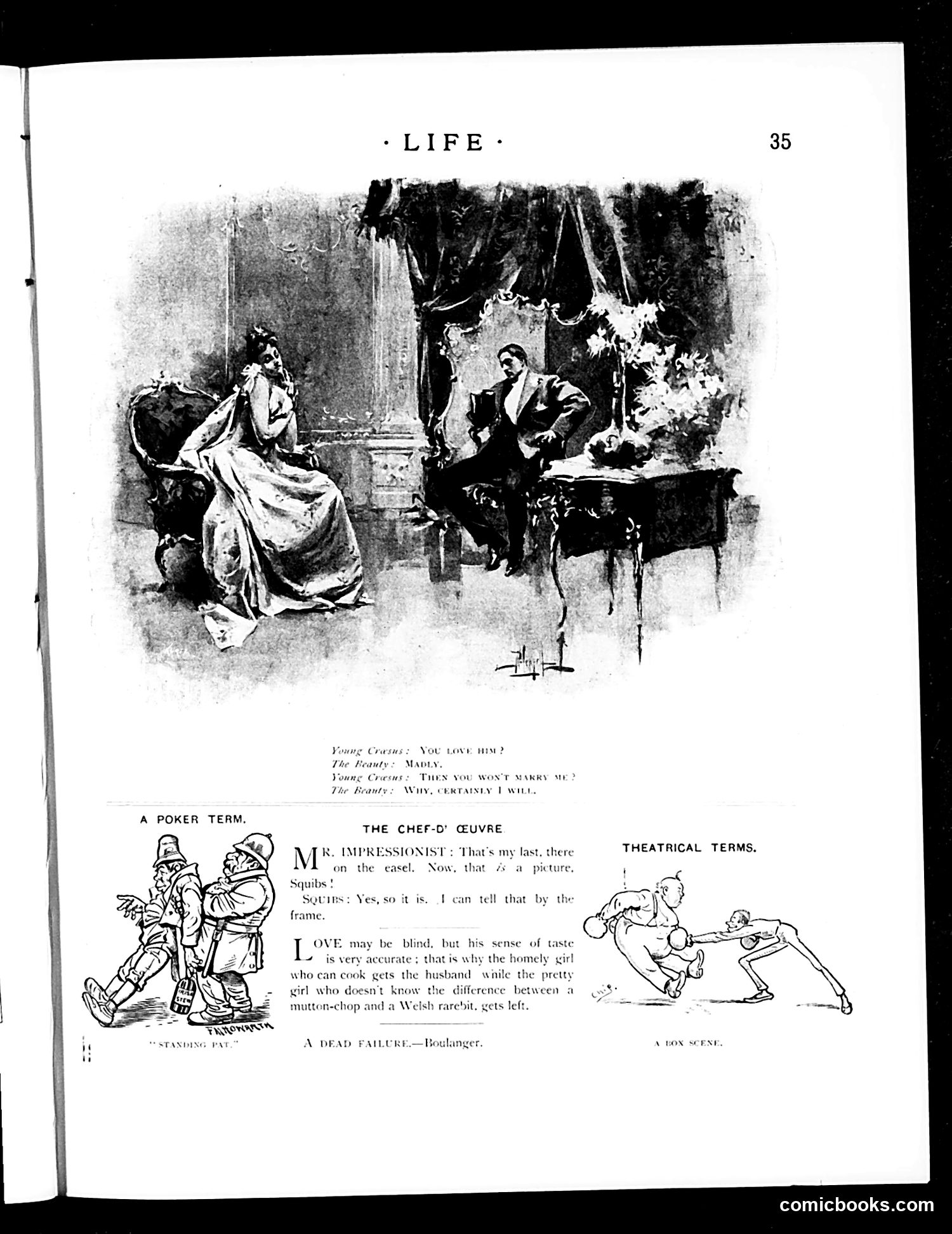
This page contains three separate satirical items typical of early Life magazine's humor: **Top illustration**: A romantic scene with dialogue suggesting a young couple's marriage negotiations. The "beauty" (woman) agrees to marry the young man, establishing a domestic satire about courtship. **"A Poker Term"**: Two rotund figures in a cartoon titled "Standing Pat"—a poker reference suggesting stubborn inflexibility, likely commenting on some contemporary political figure's refusal to compromise. **"The Chef-d'Oeuvre"**: A dialogue between an impressionist painter and a squib about artistic pretension versus practical reality—the painter claims his work is meaningful, but observers see only a picture on an easel. **"Theatrical Terms"**: A small cartoon labeled "A Box Scene" showing theatrical performers. The page reflects Life's characteristic blend of social commentary on marriage, politics, art, and theater through wordplay and visual humor.
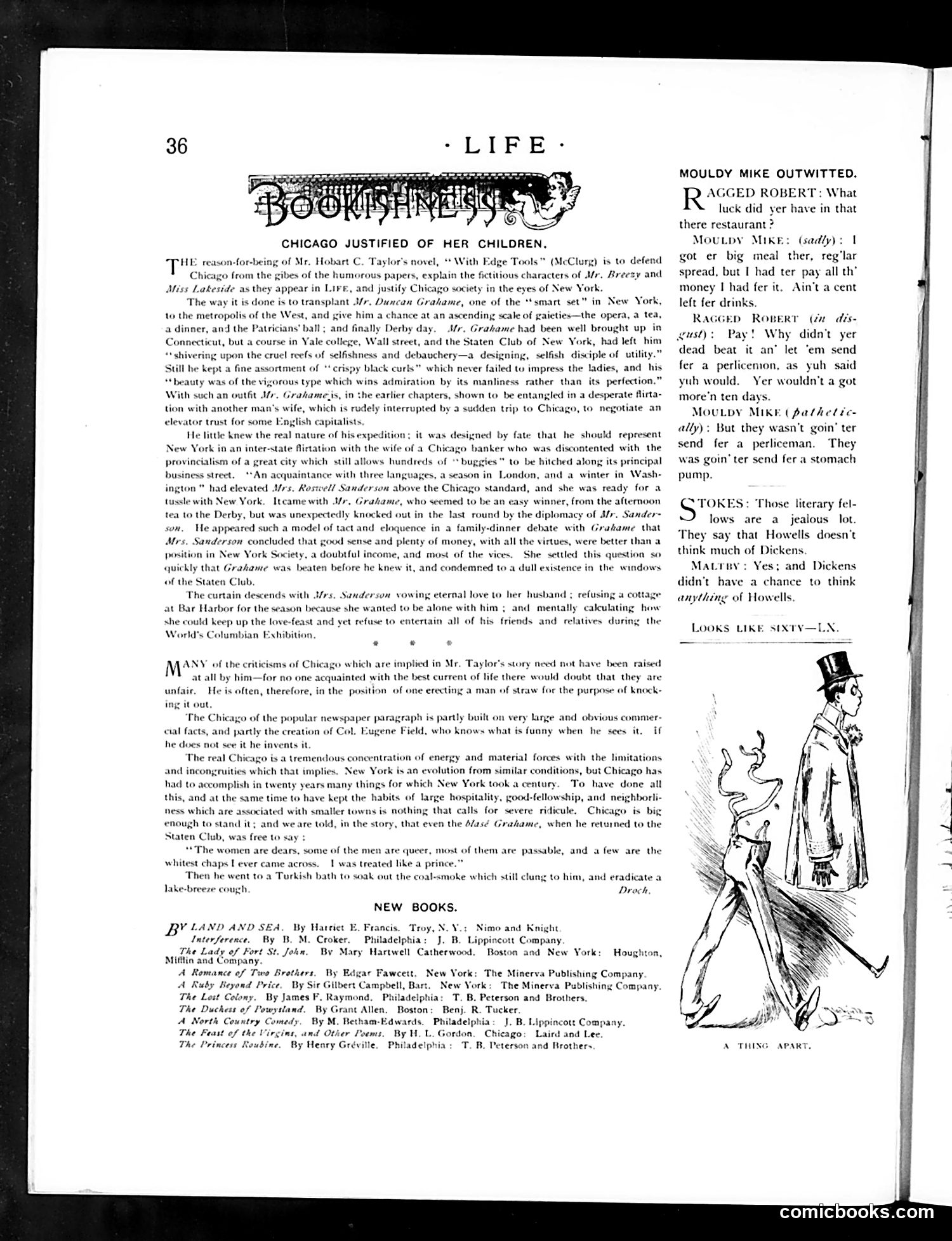
This page contains a book review column titled "Bookishness" discussing Hobart C. Taylor's novel *With Edge Tools*, which defends Chicago society against New York literary criticism. The main text critiques how Taylor portrays Chicago characters (*Mr. Breezy* and *Miss Lakeside*) to a New York audience. The right side features a dialogue ("Mouldy Mike Outwitted") mocking pretentious literary references, where characters debate whether Howells or Dickens discussed chicken dishes—apparently a joke about affected intellectualism. The small cartoon shows a well-dressed man in a top hat labeled "A Thing Apart," likely satirizing Chicago's self-conscious attempts to establish cultural sophistication comparable to Eastern cities. The page reflects early 20th-century East Coast/Midwest cultural rivalry.
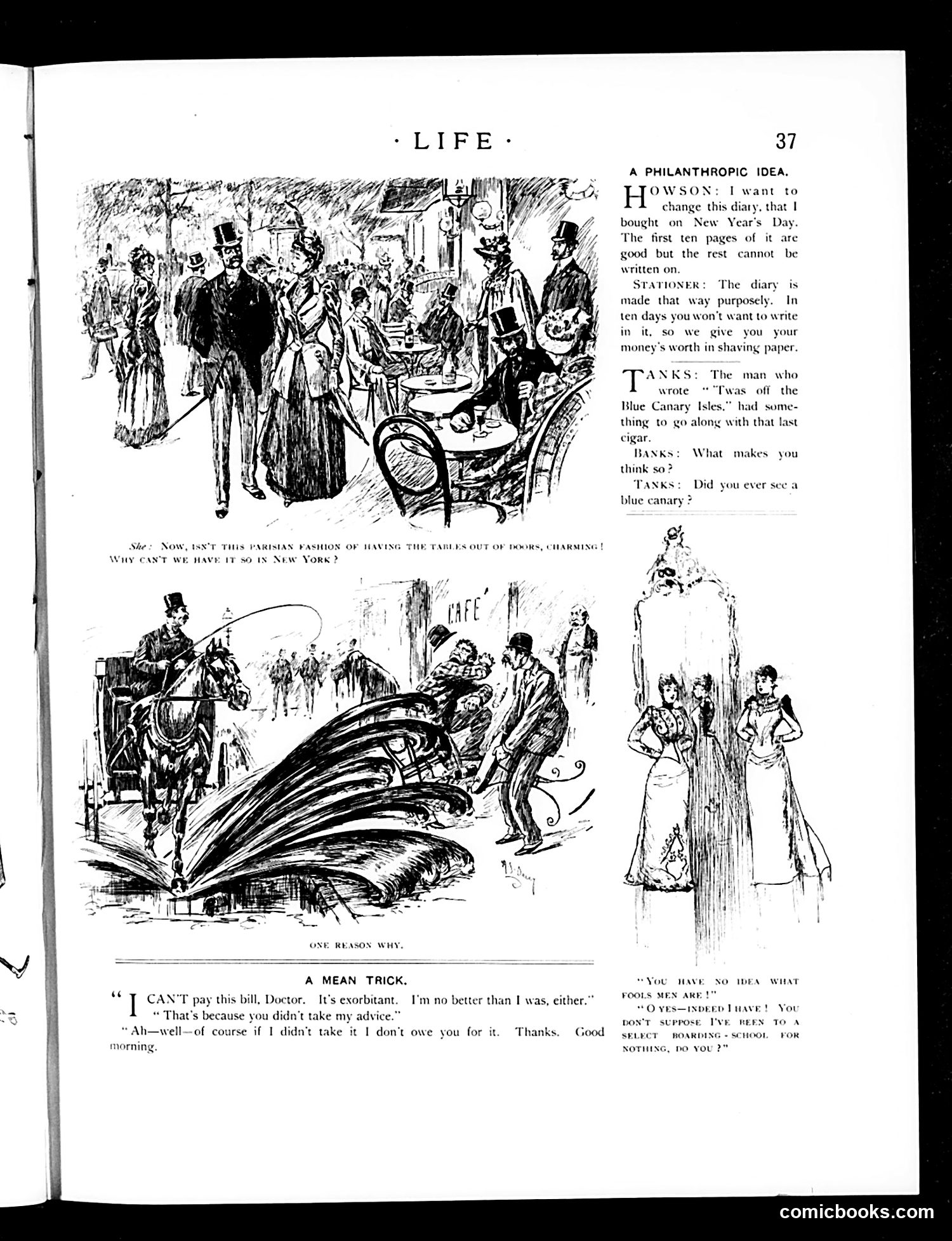
This page contains three separate humorous cartoons satirizing New York social customs and etiquette. **"A Philanthropic Idea"** (top): Dialogue between characters debating the usefulness of a New Year's Day diary—the stationer notes it's designed so poorly people won't want to write in it, making blank pages worth more than filled ones. **"One Reason Why"** (middle): A large open book lies in a city street, blocking pedestrians and a horse-drawn carriage. The satire appears to mock the impracticality of outdoor "Parisian fashion" dining/socializing in New York. **"A Mean Trick"** (bottom): A doctor refuses payment, claiming the patient is "no better than I was"—implying the patient shouldn't owe money for unsuccessful treatment. These pieces target urban social pretension and practical absurdities of city life.
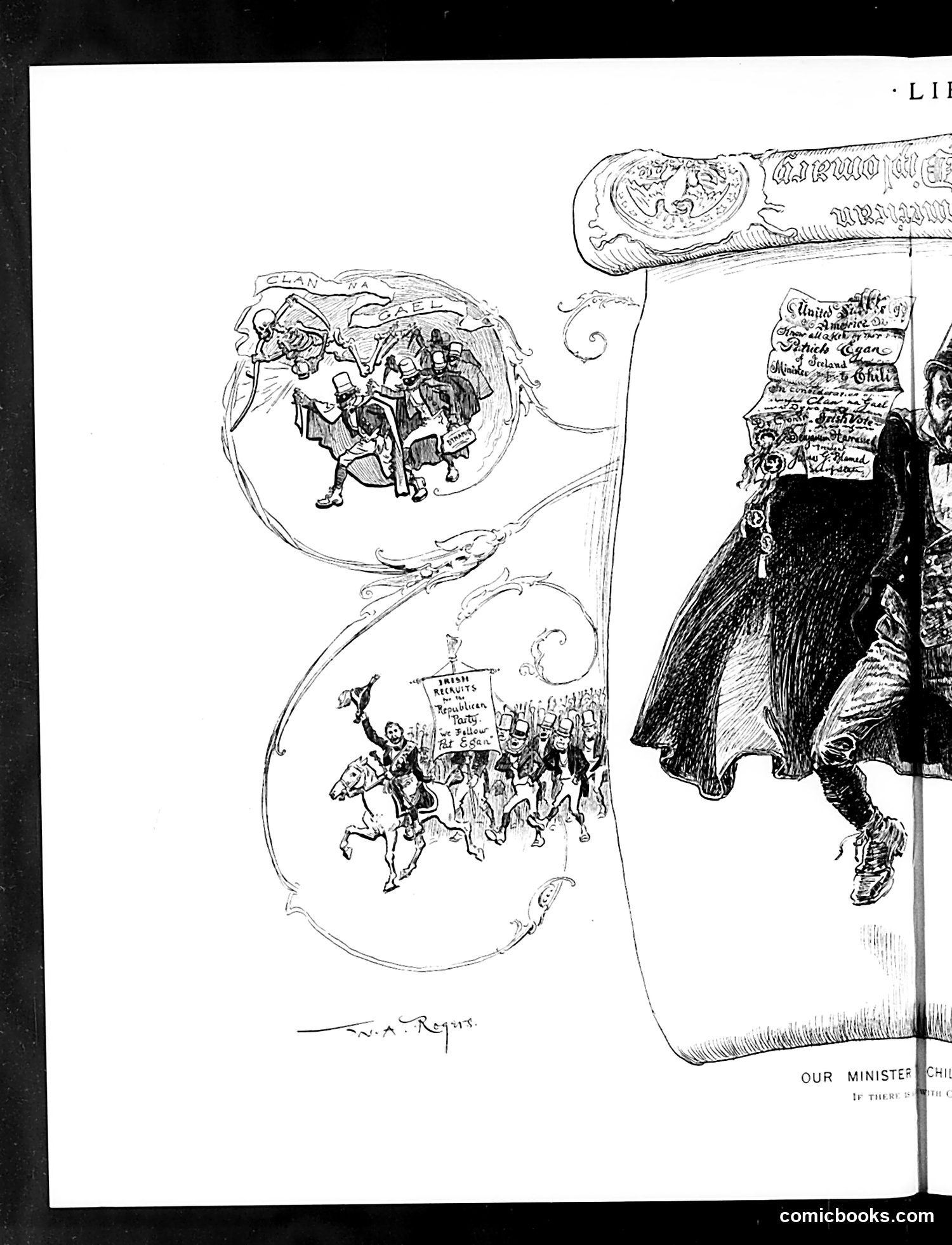
This page contains two circular vignette illustrations signed by W.A. Rogers, a prominent Life magazine cartoonist. The cartoons appear to satirize political or military matters, though the specific references are unclear from this reproduction. The upper circle depicts figures in what appears to be a formal or diplomatic setting. The lower circle shows a mounted horseman leading a procession of marching figures carrying banners or signs. On the right side is a partial illustration of a figure in a cape or cloak, with text mentioning "OUR MINISTER" (partially visible), suggesting diplomatic or governmental subject matter. Without clearer text visibility or additional context, the precise political events or figures being lampooned cannot be definitively identified. The style is consistent with early-20th-century American political satire.
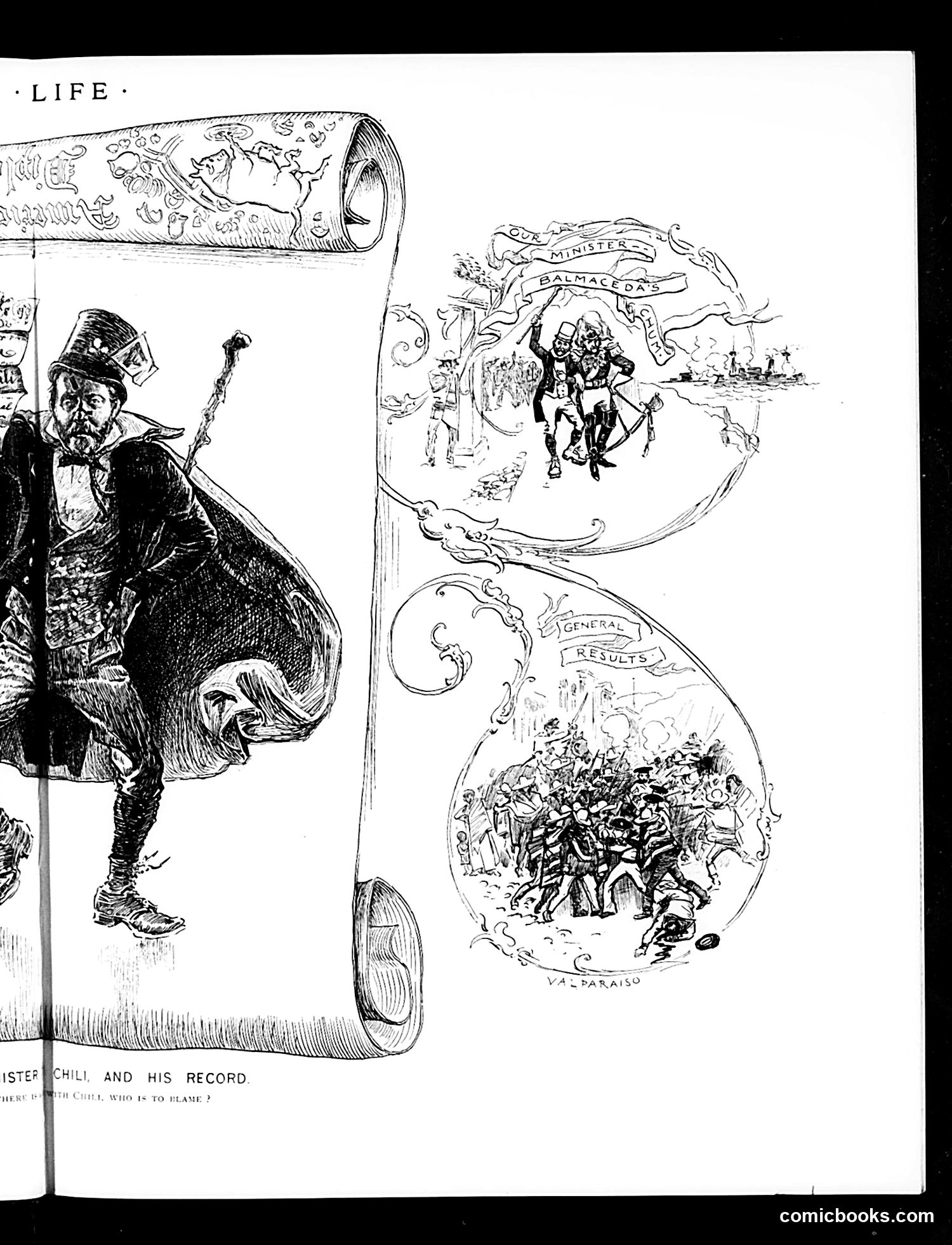
This page from *Life* magazine satirizes "Minister Chili and His Record." The left panel shows a figure in formal dress (top hat, cape) holding a staff—appearing to be a political caricature labeled as "Chili" (likely referring to a politician or public figure). The right side contains two vignettes within decorative frames labeled "Minister Balmaceda's" and "General Results" / "Valparaiso," suggesting references to Chilean politics. The imagery depicts military conflict and civilian casualties. The satire appears to critique a political leader's (possibly Balmaceda's) military record and governance, using the theatrical "Minister Chili" character to mock his authority while the vignettes document violent consequences of his policies. Without knowing the specific historical moment, the overall point seems to be holding a leader accountable for bloodshed.
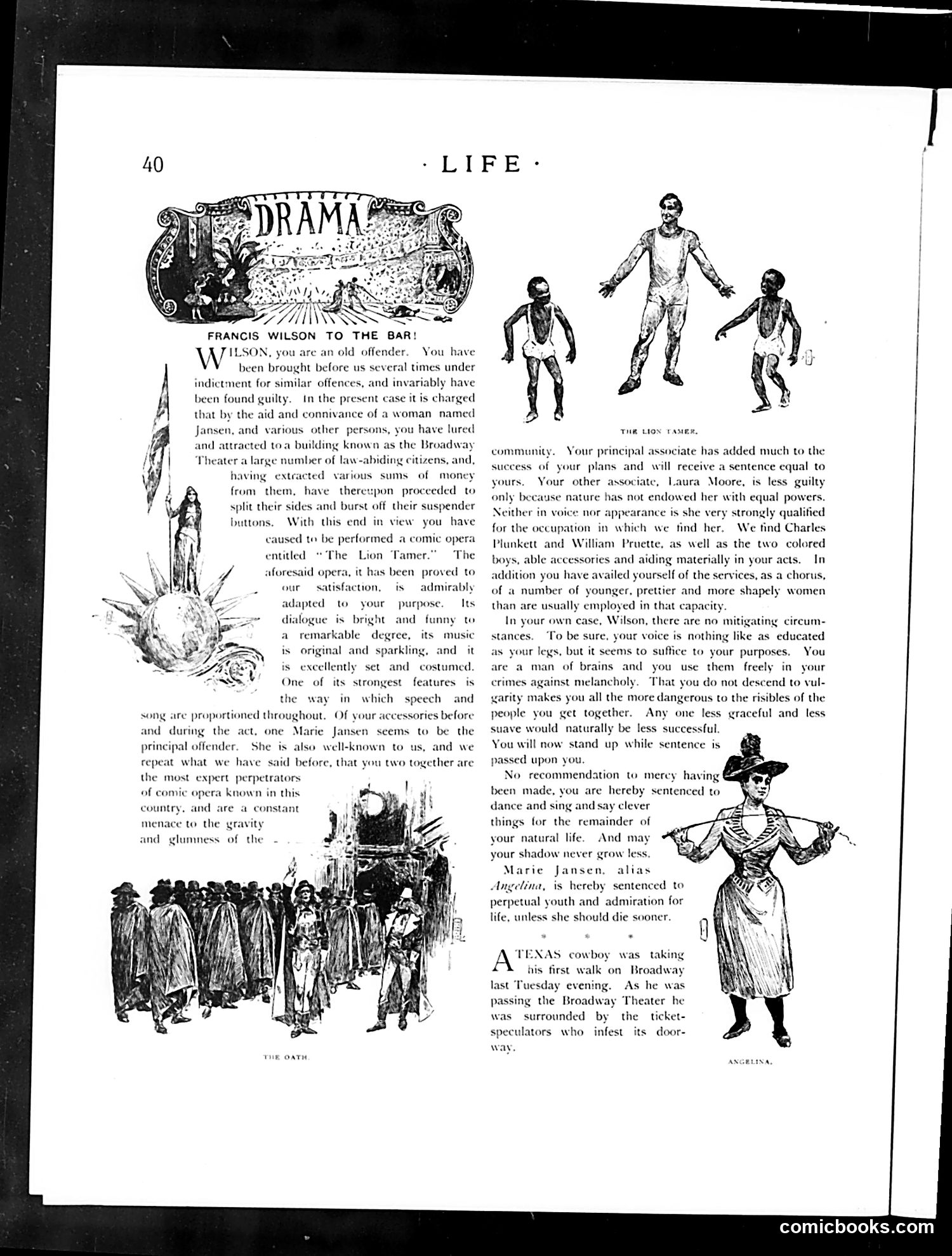
This page satirizes actor **Francis Wilson** and his comic opera *The Lion Tamer*, performed at Broadway's Theater. The "trial" is a mock legal proceeding sentencing Wilson and his cast for "crimes" against public decency—specifically, extracting money from law-abiding citizens by luring them to see the show. The satire identifies: - **Marie Jansen** (alias Angelina) as the "principal offender" - **Laura Moore** as less culpable due to limited talents - **Charles Plunkett** and **William Pruette** as accomplices - The show's bright dialogue and music as dangerously effective tools of persuasion The joke: Wilson's theatrical success is treated as criminal conspiracy. His "sentence" is ironic—condemned to perform forever. A secondary anecdote mocks a naive Texas cowboy encountering Broadway ticket scalpers, contrasting rural innocence with urban theater-district sleaze. This reflects Life's satirical stance on popular entertainment and urban culture.
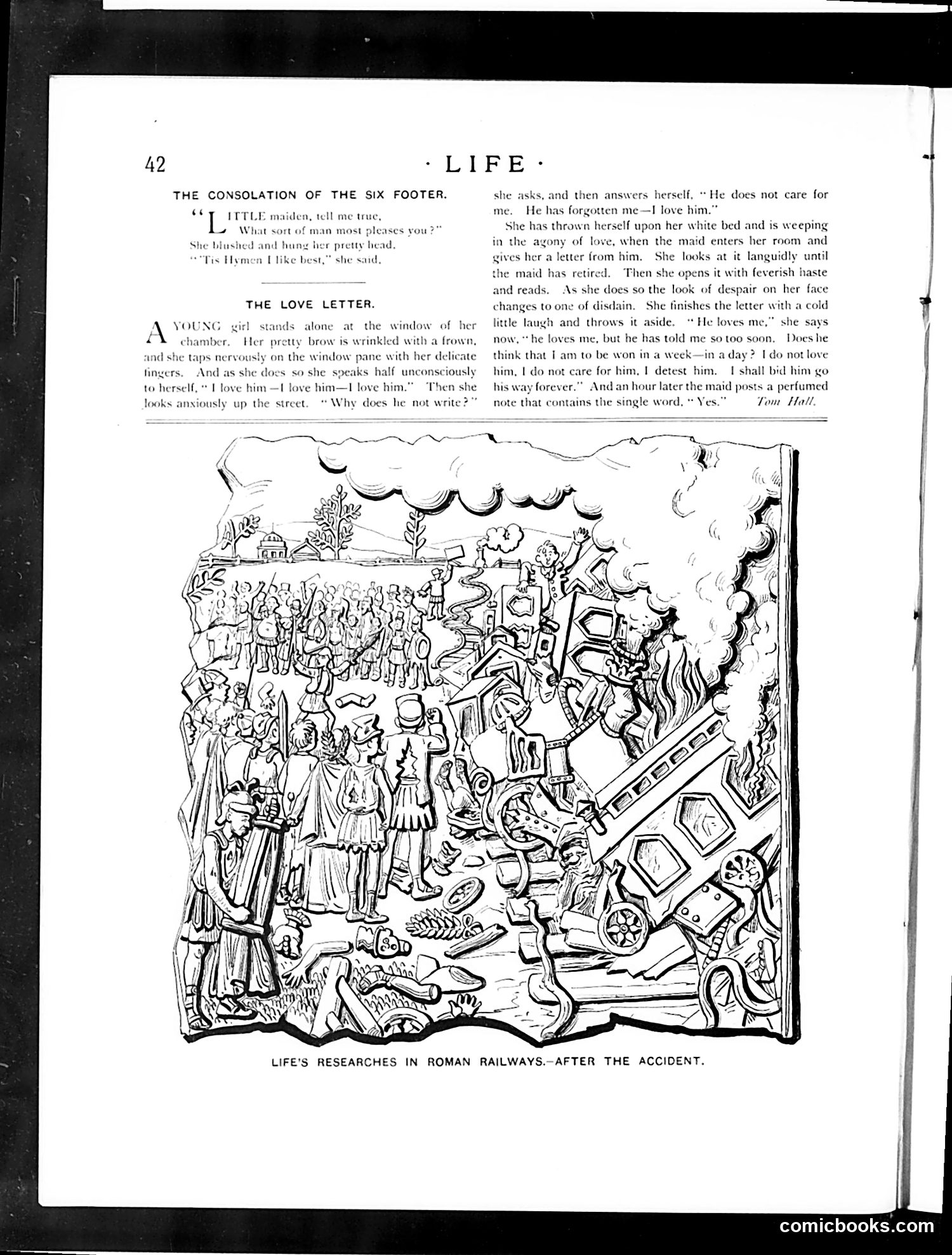
This page contains two separate pieces of satirical content: **"The Consolation of the Six Footer"** and **"The Love Letter"** are short romantic comedy sketches poking fun at courtship and female psychology. "The Love Letter" depicts a woman's emotional rollercoaster—from lovesick desperation to cold rejection of her suitor's confession, simply because he declared his feelings "too soon." The satire mocks women's capricious romantic standards and their ability to flip from longing to disdain instantly. **"Life's Researches in Roman Railways—After the Accident"** is a crowded, chaotic illustration satirizing investigative journalism or bureaucratic inquiries into disasters. The elaborate scene depicts officials, crowds, and wreckage in absurdist detail, likely mocking either overly-thorough accident investigations or sensationalist press coverage of such events. The title's reference to "Roman Railways" suggests this may also be satirizing historical exaggeration or implausible narratives about ancient Rome.
This page is primarily **advertisements** with small anecdotal humor pieces at the top. The titled cartoon "At Scissors at Nully's" appears to be a brief comedic exchange (the full text is partially obscured) involving a barber or tailor shop scenario, likely playing on a pun or misunderstanding. The surrounding text contains Victorian-era social humor anecdotes about bishops, conductors, and mistaken identity—typical of *Life* magazine's satirical content from this period. One story describes a bishop's thigh-pinching incident at dinner; another involves conductor Hans von Bülow disciplining a choir. The remainder consists entirely of period advertisements: breakfast foods, wedding attire, hats, bicycles, ales, and theatrical notices—reflecting late-19th-century consumer culture. **Without clearer visibility of the cartoon's illustration itself, the specific satire remains unclear**, though the setup suggests wordplay or social embarrassment typical of *Life*'s humor style.
This page is primarily **advertising**, not political satire. It contains commercial notices for high-end retailers and services aimed at wealthy readers. The largest content is a humorous dialogue between "Mr. Upholsterer" and a customer about an uncomfortable chair—a gentle joke about sacrificing comfort for appearances. The upholsterer explains the chair is "made for callers," implying visitors should be discouraged from lingering. Other notable advertisements include: - **Redfern** (luxury fashion, Washington D.C. and Fifth Avenue locations) - **Hotel Vendome** (Boston) - **Garfield Tea** (patent medicine) - **James McCreery & Co.** (department store, New York) - **Vose & Sons Pianos** (Boston) The page reflects **Gilded Age consumer culture**—advertising aspirational goods to the affluent. Products like patent medicines (Garfield Tea, Piso's Remedy for Catarrh) were common in period magazines. The modest humor about uncomfortable furniture for callers represents genteel, domestic comedy typical of Life's satirical approach.
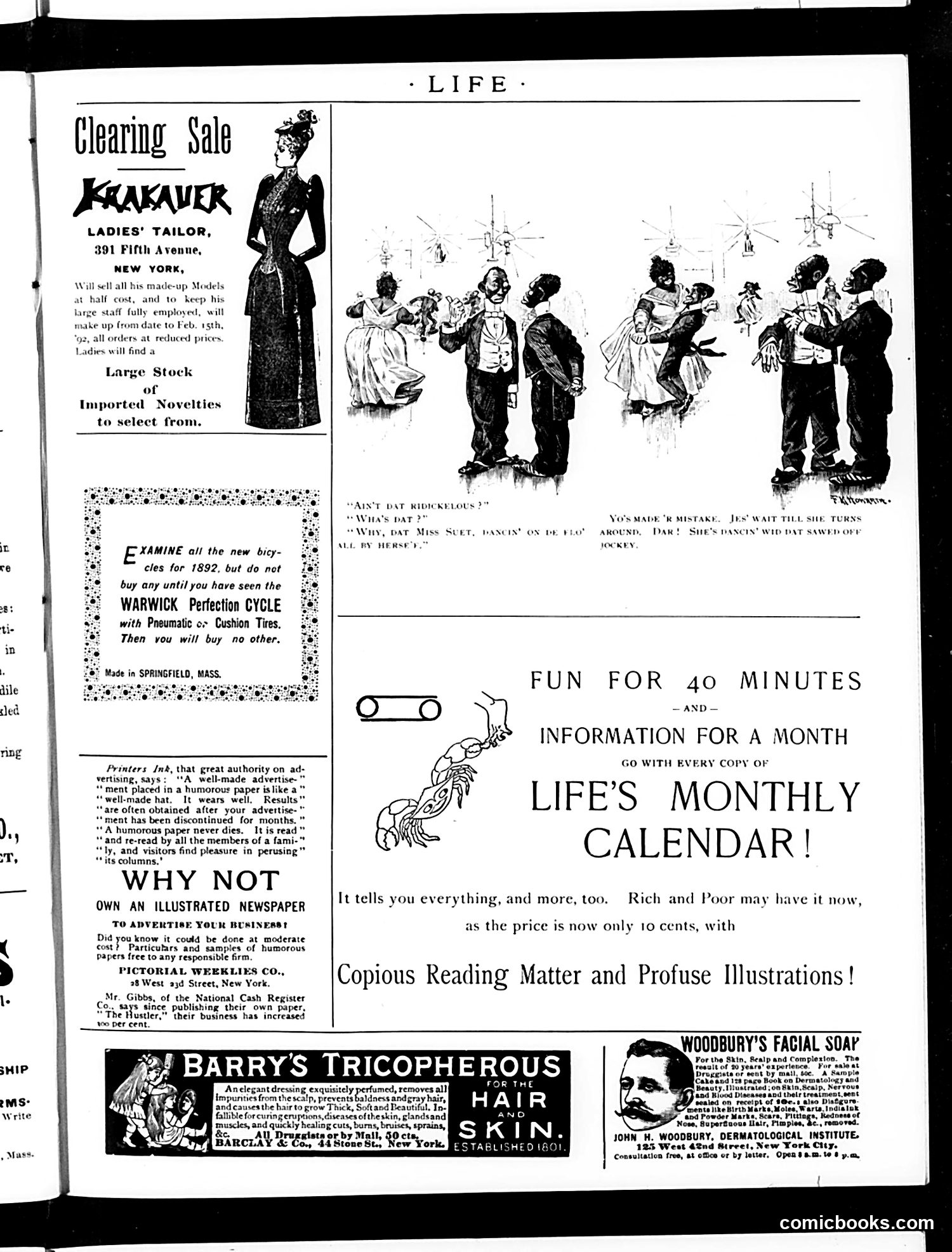
This page contains mostly **advertisements and promotional content** rather than political cartoons requiring historical context. The main visual content is a **cartoon strip** (top right) depicting what appears to be a social dancing scene. The dialogue uses **heavily stereotyped dialect** ("Ain't dat ridickelous?" "Dancin' wid dat sawed off jockey"), which modern readers should recognize as racist caricature reflecting the era's offensive entertainment conventions. The joke appears to involve height disparity and mocking speech patterns. The rest of the page is commercial advertising: a ladies' tailor clearing sale, bicycle advertisements (Warwick Perfection Cycle), Barry's Tricopherous hair product, and Woodbury's Facial Soap. There's also promotion for **Life's Monthly Calendar** (10 cents) and an advertisement encouraging businesses to use illustrated newspapers for advertising. The page reflects 1890s consumer culture and advertising practices rather than political satire.
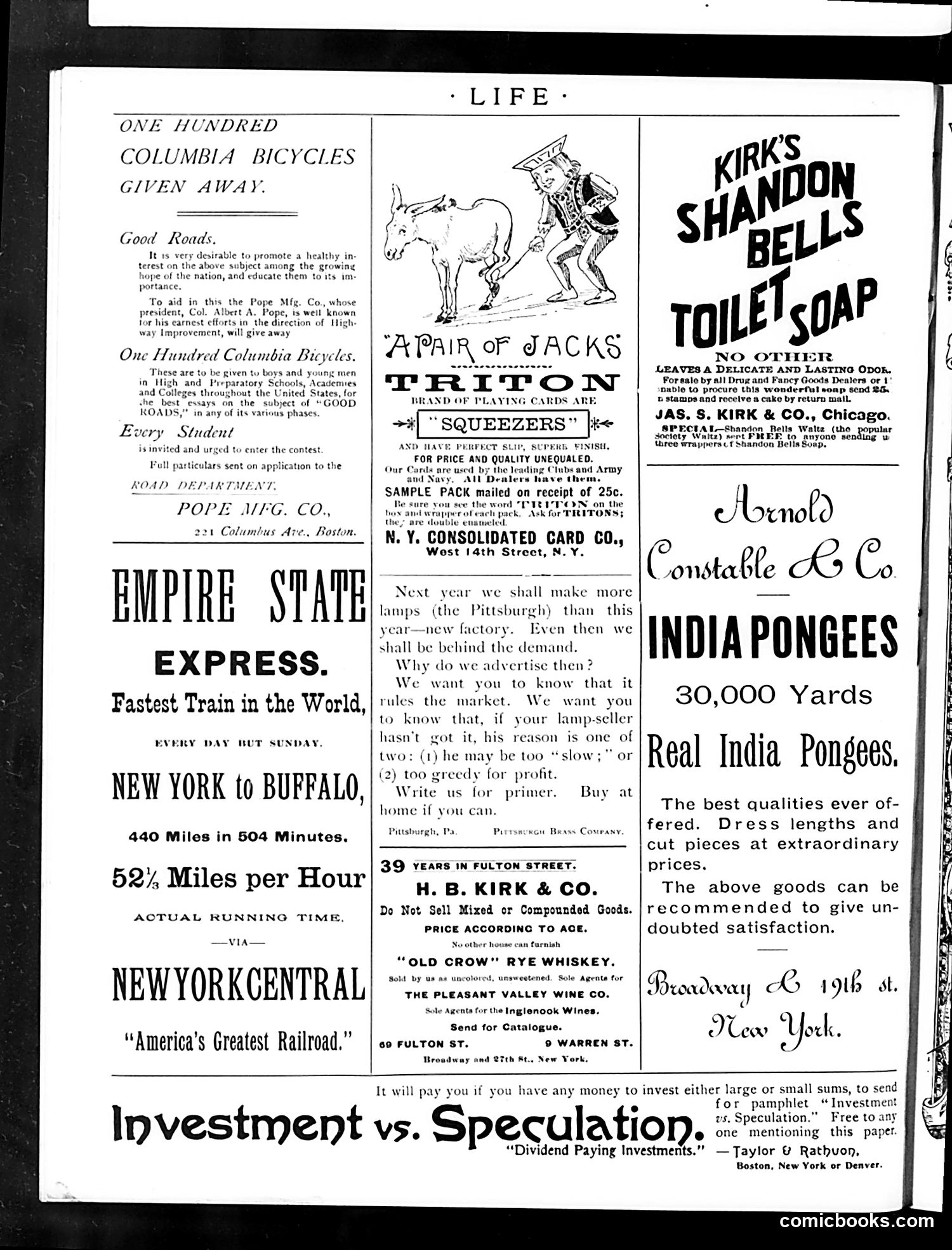
This page is primarily **advertising**, not satirical content. The main cartoon—"A Pair of Jacks"—depicts a man being kicked by a donkey, illustrating a pun about playing cards called "Squeezers" (jacks being face cards). The substantive content consists of multiple commercial advertisements: - **Pope Mfg. Co.** offers 100 Columbia bicycles to promote "Good Roads" and encourage students to support road improvement - **New York Central Railroad** advertises the "Empire State Express," claiming the fastest train service (52½ mph) - Various product ads for playing cards, whiskey, soap, fabric, and investment services The page reflects **late-19th-century American commerce**: emphasis on new transportation technology (bicycles, rail), patent medicines/beauty products, and financial speculation. The investment ad at bottom suggests this era's aggressive stock-market promotion to ordinary readers. No political satire is evident; this is a commercial publication showcasing consumer goods and services available to affluent readers.