
Life, 1892-01-21 · page 8 of 18
Life — January 21, 1892 — page 8: what you’re looking at
What you’re looking at
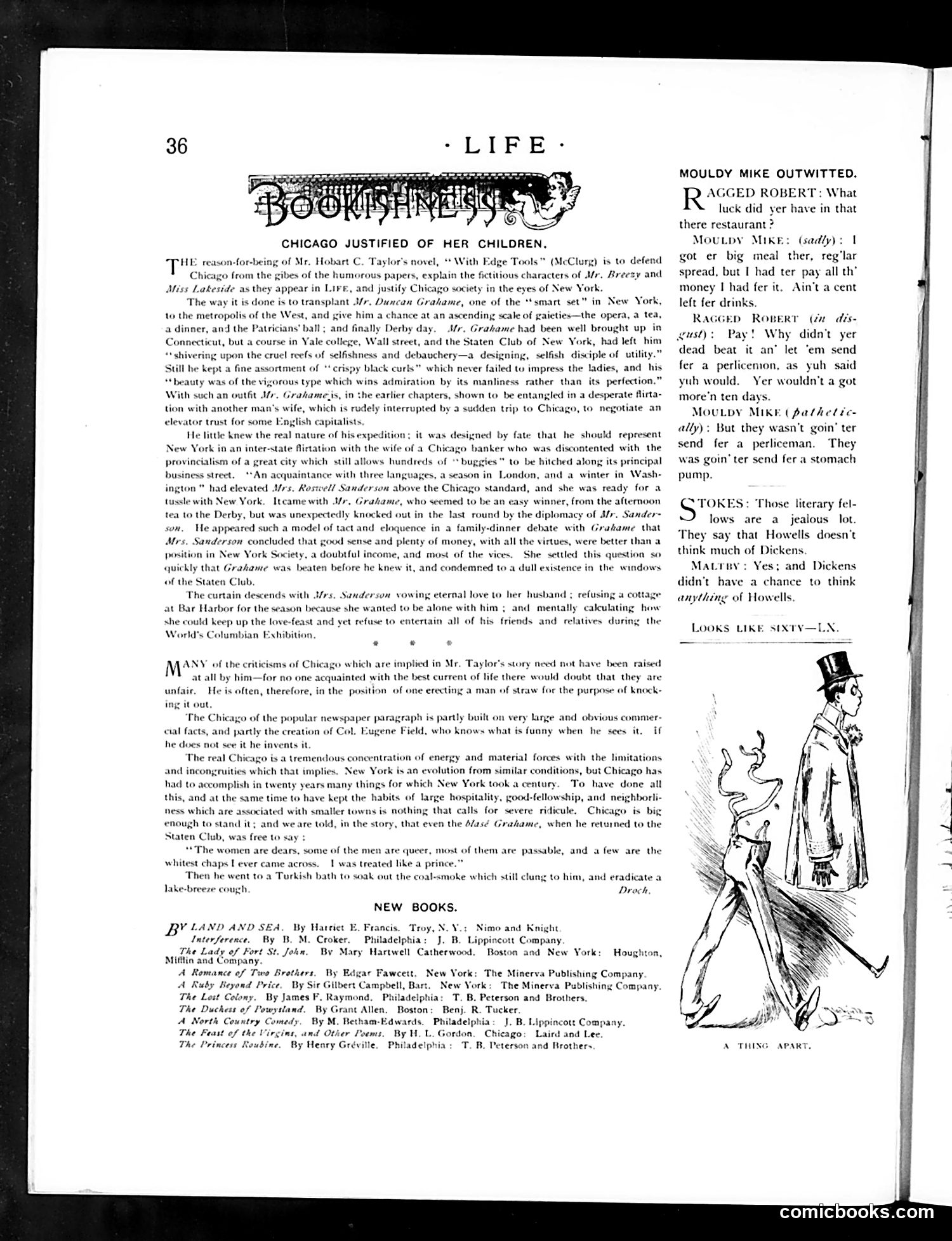
This page contains a book review column titled "Bookishness" discussing Hobart C. Taylor's novel *With Edge Tools*, which defends Chicago society against New York literary criticism. The main text critiques how Taylor portrays Chicago characters (*Mr. Breezy* and *Miss Lakeside*) to a New York audience. The right side features a dialogue ("Mouldy Mike Outwitted") mocking pretentious literary references, where characters debate whether Howells or Dickens discussed chicken dishes—apparently a joke about affected intellectualism. The small cartoon shows a well-dressed man in a top hat labeled "A Thing Apart," likely satirizing Chicago's self-conscious attempts to establish cultural sophistication comparable to Eastern cities. The page reflects early 20th-century East Coast/Midwest cultural rivalry.
📄 Transcribed text from this page (OCR, searchable)
Machine-transcribed from the original scan — historical spelling and the odd misread are preserved.
CHICAGO JUSTIFIED OF HER CHILDREN, reason-for-being of Mr, Hobart C. Taylor's novel, ** With (McClurg) is to defend 0 from the gibes of the humorous papers, explain the fictitious characters of Mr. Breezy and Afiss Lakeside as they appear in Lire, and justify Chicago society in the eyes of New York. The way it is done is to transplant Mr. Duncan Grahame, one of the * smart set" in New York, to the metropolis of the West, and give him a chance at an ascending scale of gaieties—the opera, a tea, a dinner, and the Patricians' ball; and finally Derby day. l/r. Grahame had been well brought up in Connecticut, but a course in Yale college, Wall street, and the Staten Club of New York, had left: him «shivering upon the cruel reefs of selfishness and debauchery—a designing, selfish disciple of utility.” Still he kept a fine assortment of “crispy black curls” which never failed tu impress the ladies, and his “beauty was of the vigorous type which wins admiration by its manliness rather than its perfection.” With such an outfit Jr tion with another man’s wife, w Edge Tools" Grahame js, in the earlier chapters, shown lo be entangled in a desperate flirta~ ich is rudely interrupted by a sudden trip to Chicago, to negotiate an elevator trust for some English capitalists He little knew the real nature New York provincialism of a great city which still allows hundreds of ** buggies to be hitched along its principal winter in Wash- was ready for a of hisexpedition; it was designed by fate that he should represent 0 an inter-state flirtation with the wife of a Chicago banker who was discontented with the business street. ‘An acquaintance with three languages, a season in London, and a ington had elevated Afrs, Roswell Sanderson above the Chicago standard, and. sh tussle with New York tea to the Derby, but was unexpectedly knocked out in the last round by the diplomacy of S/n. Sander son, He appeared such a model of tact and eloquence in a family-dinner debate with Grahame that Mrs, Sanderson concluded that good sense and plenty of money, with all the virtues, were better than a position in New York Society, a doubtful income, and me She settled this question so quickly that Grahame was beaten before he knew it, and condemned to a dull existence in the windows of the Staten Club, The curtain descends with Mrs. Sanderson vowing eternal love to her husband ; refusing a cottage at Bar Harbor for the season because she wanted to be alone with him ; and mentally calculating how she could keep up the love-feast and yet refuse to entertain all of his friends and relatives during the World's Columbian Exhibition N ANY at all by him—for no one acquainted with the best current of life there would doubt that they are He is often, therefore, in the position of one erecting a man of straw for the purpose of knock- Itcame with Mr, Grahame, who seemed to be an easy winner, from the afternoon of the vices. of the criticisms of Chicago which are implied in Mr, Taylor's story need not have been raised unfair, ing it out, The Chica cial facts, and partly the creation of Col, Eugene Field, who knows what is funny when he ts it, The real Chicago is a tremendous concentration of energy and material forces with the limitations and incongruities which that implies, New York is an evolution from similar conditions, but Chicago has had to ac k took a century. To have done all this, and at the same time to have kept the habits of large hospitality, good-fellowship, and_neighborli- hess which are associated with smaller towns is nothing that calls for severe ridicule. igo of the popular newspaper paragraph is partly built on very lange and obvious commer- sees it, if he dues not see it he inve nplish in twenty years many things for which New Chicago is big enough to stand it; and we are told, in the story, that even the 6/asé Grahame, when he returned to the Staten Club, was free to say : “The women are dears, some of the men are queer, most of them are passable, and a few are the whitest chaps L ever came 1 was treated like a prince.” Then he went to a Turkish bath to soak « Oss, t the coal-smoke which still clung to him, and eradicate a lake-t Droch NEW BOOKS. Francis, Troy, N. Vo: Philadelphia: J. B. By Mary Hartwell Catherwood, Nimo and Knight Lippincott Company Boston and New York: BY LAND AND SEA, By Marsiet E Interference. By B. M. Croker. The Lady of Fort St. John Mitflin and Company, A Romance of Two Brothers. Houghton, By Edgar Fawcett. New York: The Minerva Publishing Company A Ruby Beyond Price, By Sit Gilbert Campbell, Bart. New York: The Minerva Publishing Company. The Lost Colony. By James F. Raymond, Philadelphia: T. B. Peterson and Brothers. The Duchess of Powystand. By Grant Allen, Boston: Benj. R. Tucker A North Country Comedy, By M, Retham-Edwards. Philadelphia: J. B. Lippincott Company, The Feast of the Virgins, and Other Poems, By UW. L. Gordon. Chicago: Laird and Lee. The Princess Roubine. By Heary Gréville. Philadelph T. B. Peterson and Brothers MOULDY MIKE OUTWITTED. AGGED ROBERT: What luck did yer have in that there restaurant ? MouLpy MIKE: (sadly got er big meal ther, reg’lar spread, but | had ter pay all th’ money I had fer it, Ain't a cent left fer drinks, RAGGED ROBERT (4 dés- gust): Pay! Why didn’t: yer dead beat it an’ let ‘em send fer a perlicenion, as yuh said yuh would. Yer wouldn't a got more'n ten day MOULDY MIKE ( pathetéc- ally): But they wasn't goin’ ter send fer a perliceman. They was goin’ ter send fer a stomach pump. ~ TOKES: Those literary fel- lows jealous lot. They say that Howells doesn’t think much of Dickens. MALrBy : nd Dickens didn’t have a chance to think anything of Howells are a sixty—L, LooKS LIKE THING APART, comicbooks.com