
A complete issue · 14 pages · 1891
Life — December 10, 1891
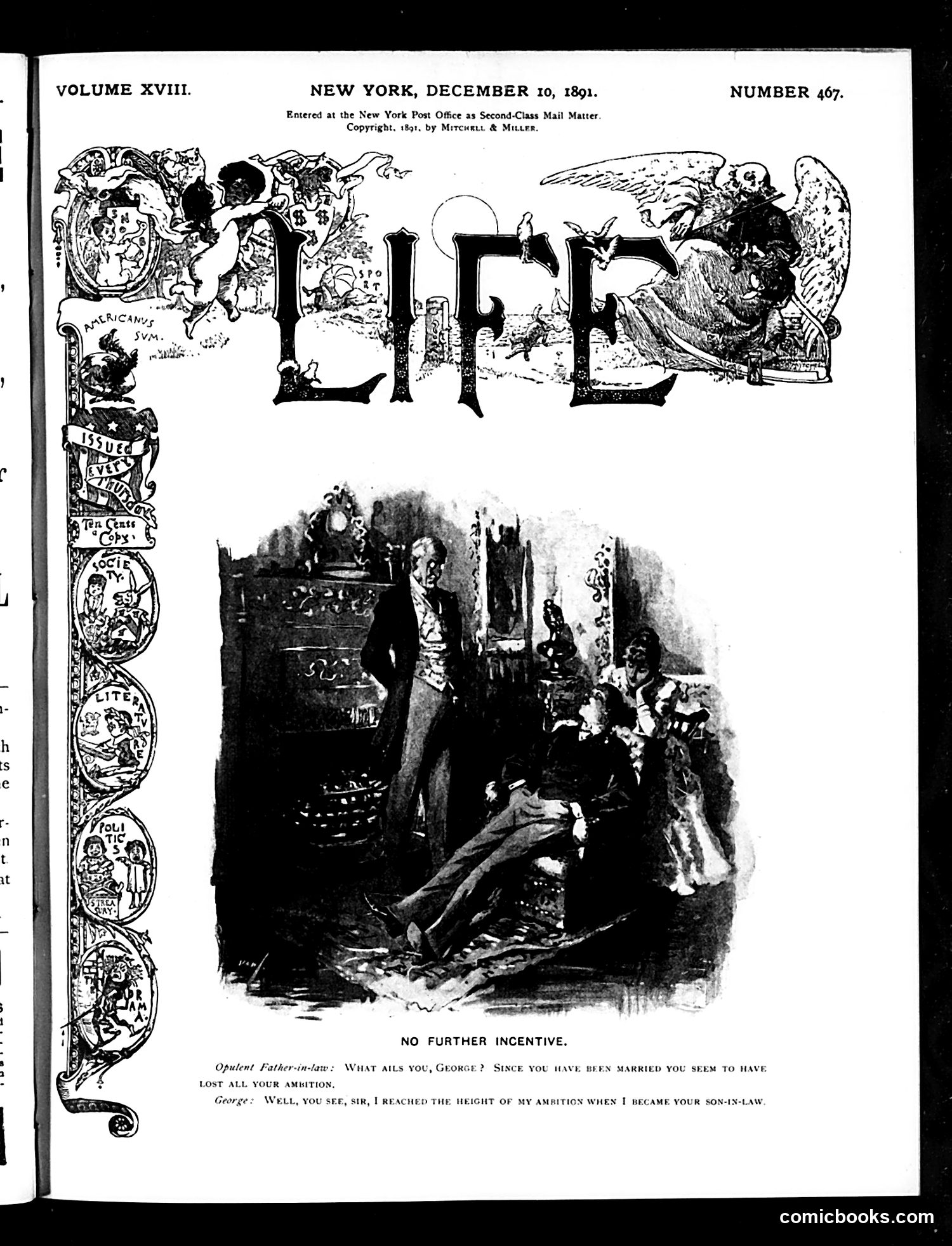
This cartoon satirizes a conversation between an opulent father-in-law and his son-in-law George. The father-in-law asks what troubles George, noting he's lost his ambition since marrying. George replies he's already achieved his ambitions by becoming the son-in-law—implying he married for wealth and social status rather than love or genuine aspiration. The wealthy interior setting and the father-in-law's ornate dress emphasize the family's affluence. The satire targets late-19th-century social climbing and mercenary marriages among the upper classes, mocking George for viewing marriage as a finishing line rather than a beginning, and suggesting he now lacks motivation for further achievement. It's commentary on shallow materialism in Gilded Age society.
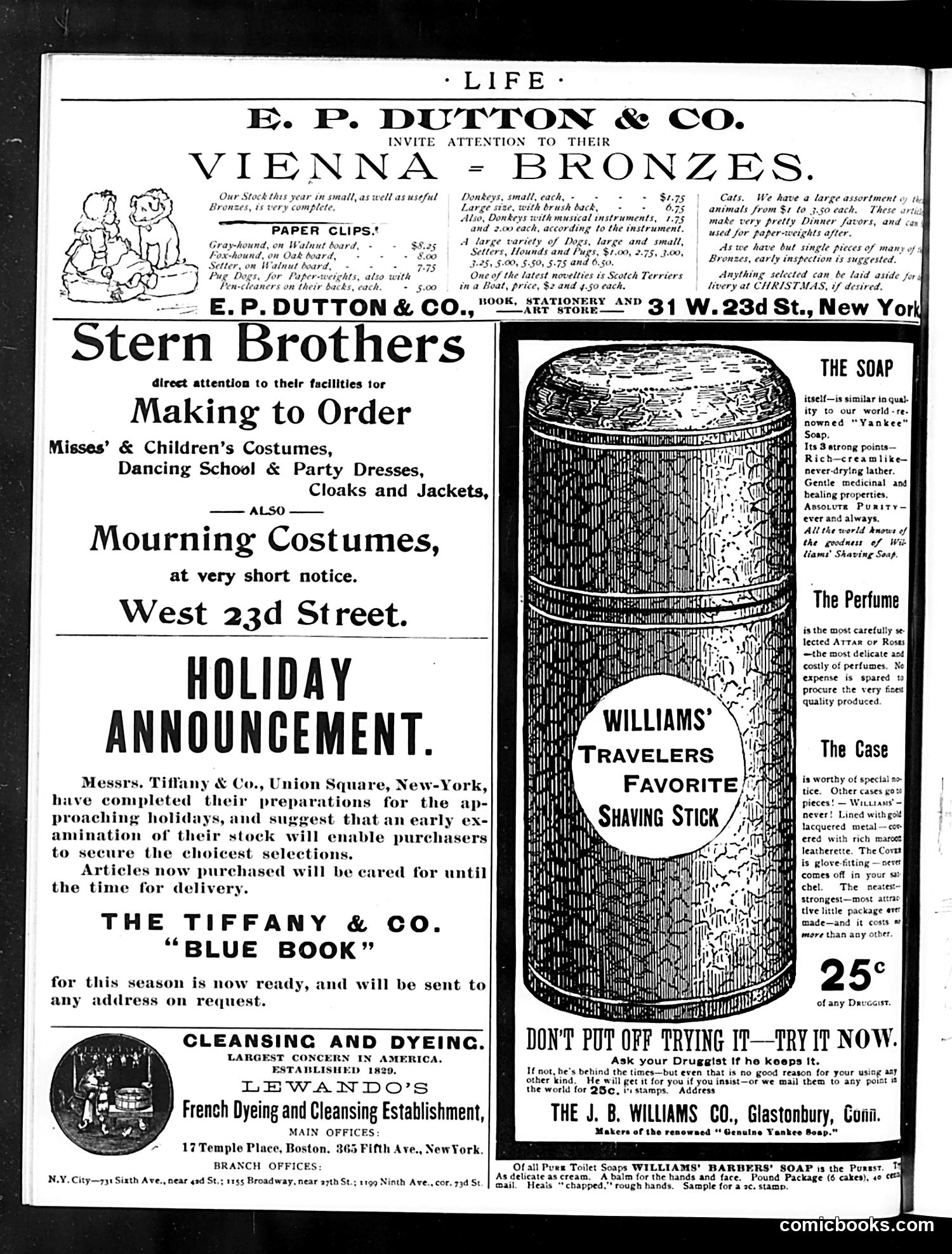
This page is primarily **advertising**, not satire or political commentary. It contains multiple commercial advertisements from the early 20th century: - **E.P. Dutton & Co.** advertises Vienna Bronzes and paper clips - **Stern Brothers** promotes custom costume-making services - **Tiffany & Co.** announces holiday shopping preparations - **French Dyeing and Cleansing Establishment** advertises laundry services - **Williams' Travelers Favorite Shaving Stick** features a large product illustration The only illustration with potential narrative content is the small cartoon at top showing children with toys—likely meant to appeal to holiday shoppers rather than convey political meaning. The page reflects typical early-1900s magazine advertising practices, mixing luxury goods with practical services.
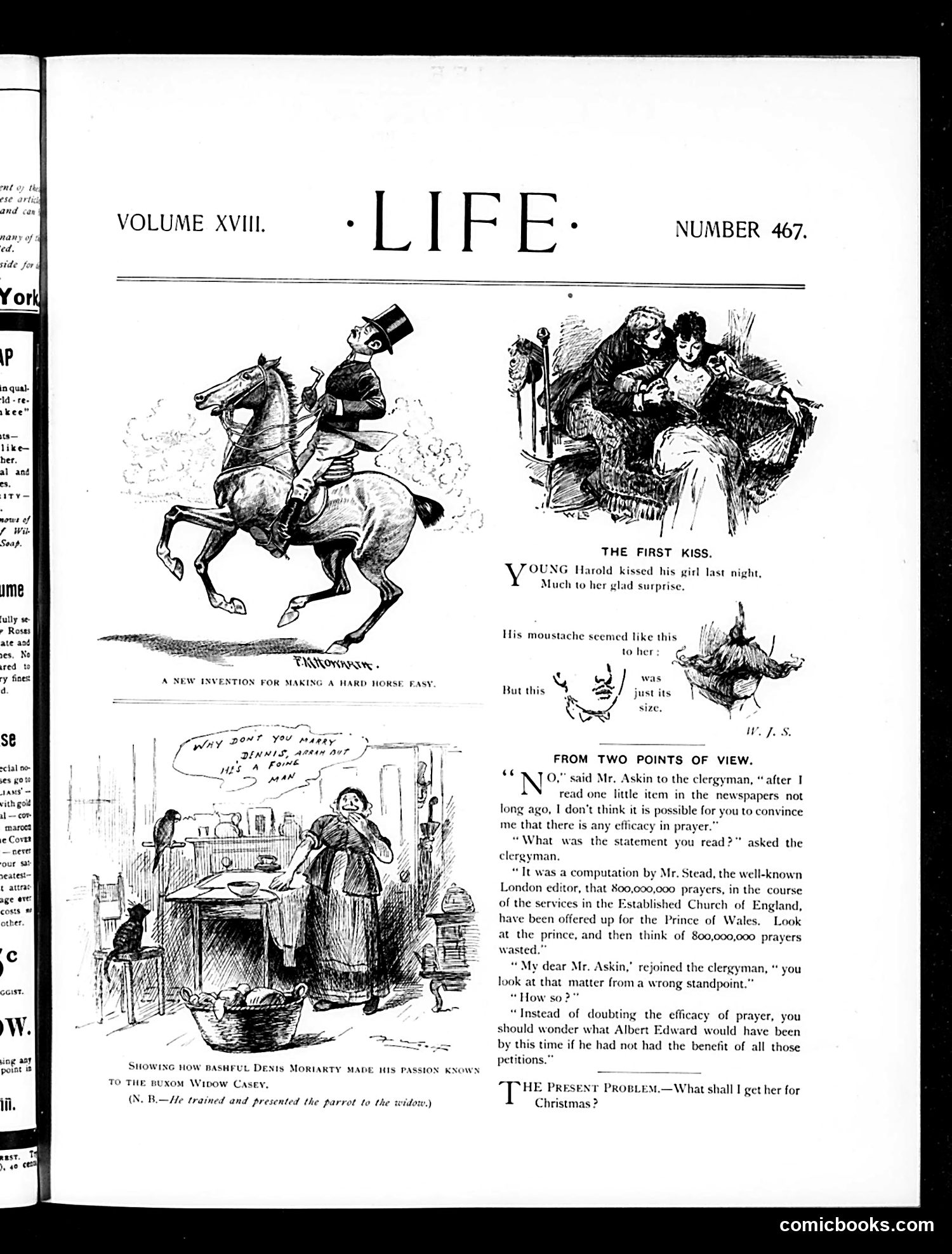
This page contains three separate humorous cartoons and a brief story section typical of Life's satirical format: **"Equestrianism"** shows a man on a rearing horse—a visual pun on making "a hard horse easy," likely mocking pretentious equestrian techniques. **"The First Kiss"** is a sentimental romantic scene with accompanying caricatures of a young man's mustache—the humor derives from the exaggerated contrast between the romantic moment and the unflattering rendering of his facial hair. **"From Two Points of View"** presents a debate between Mr. Askin and a clergyman regarding prayer's efficacy, referencing Edward's (likely Prince Edward) wartime prayers. The satire questions whether military success stems from prayer or other factors. **"The Present Problem"** opens a humorous Christmas gift-giving dilemma. These represent typical Life magazine social commentary and domestic humor of the era.
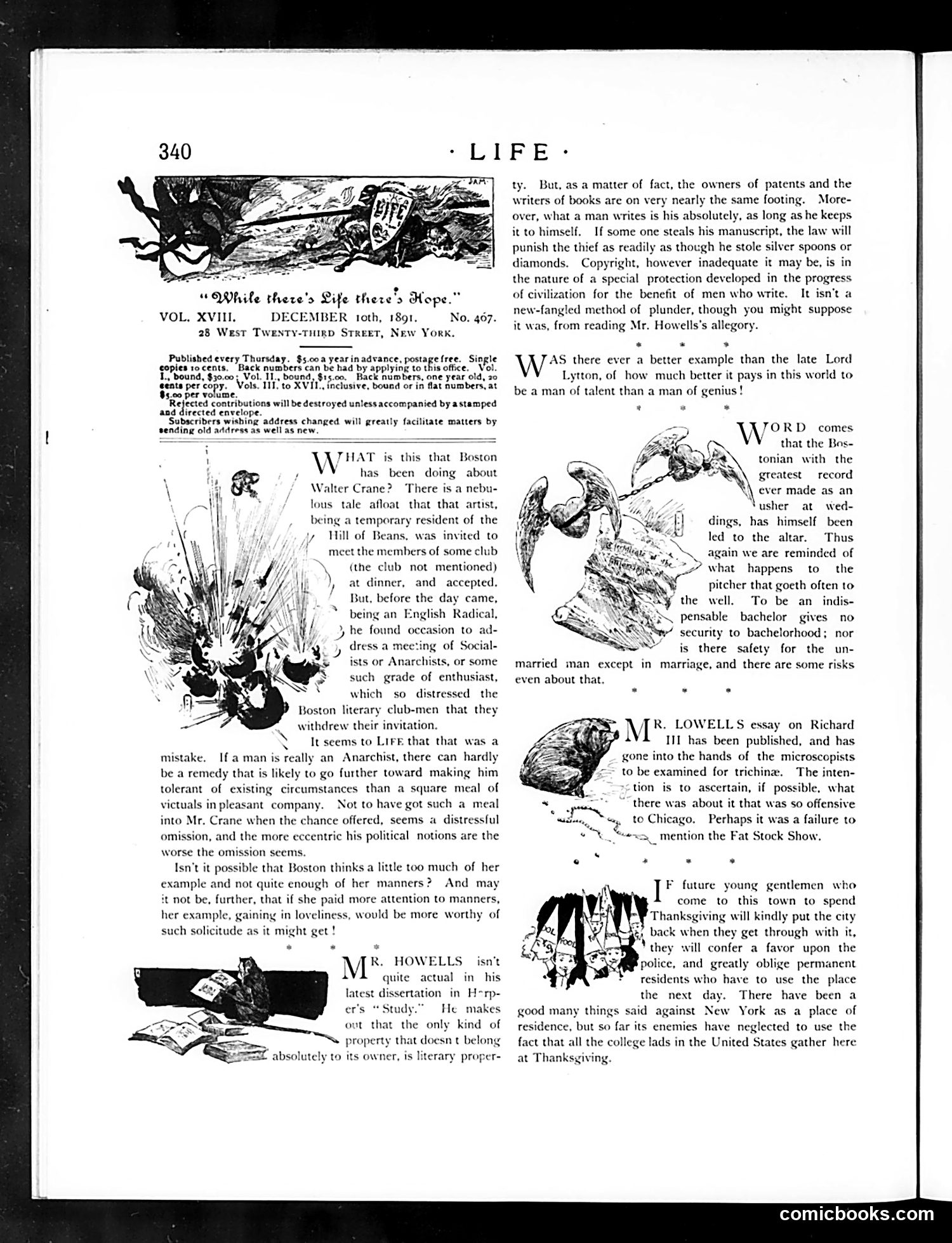
This page contains satirical essays rather than traditional cartoons. The main text discusses **Walter Crane**, a Boston artist and contemporary resident of "Hill of Beans," who declined a dinner invitation to an unspecified club after initially accepting. The satire critiques Crane's inconsistency: the author suggests that if Crane truly held anarchist principles, he should tolerate existing social circumstances rather than withdraw invitations based on political objections. The page also references **Mr. Howells** (likely William Dean Howells, the prominent American novelist) and his essay on Richard III, and includes social commentary about Thanksgiving and young college graduates visiting New York. The small illustrations are decorative vignettes supporting the text rather than standalone political cartoons.
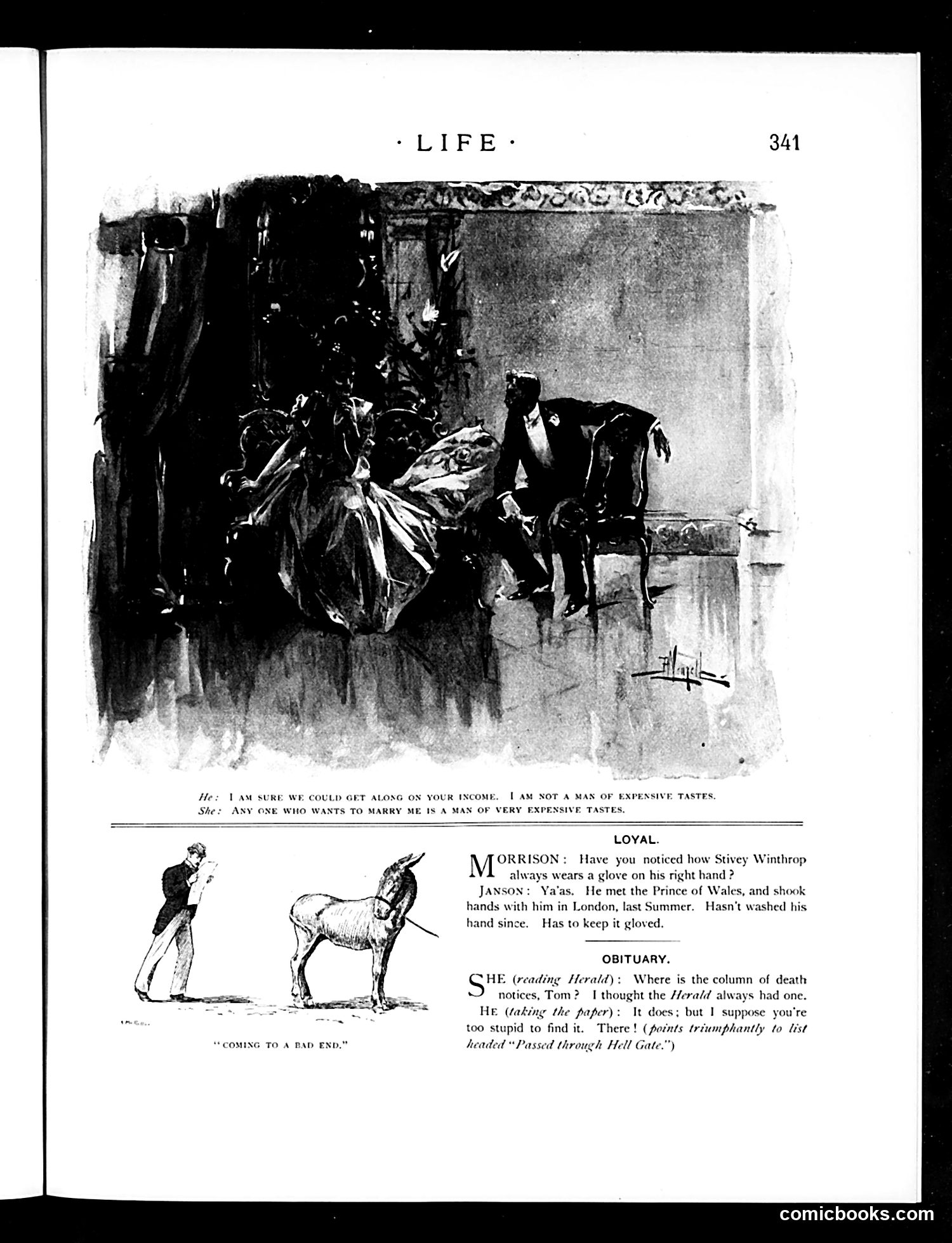
The page contains three satirical pieces: 1. **Top illustration "Loyal"**: A dialogue between Morrison and Janson about Stivey Winthrop wearing a perpetual glove on his right hand since meeting the Prince of Wales in London. The joke suggests Winthrop won't wash the hand after the royal handshake—a satirical jab at social climbing and excessive deference to aristocracy. 2. **Bottom left cartoon "Coming to a Bad End"**: Shows a man and a goat; the meaning is unclear without additional context. 3. **"Obituary" section**: A brief comedic exchange where a woman searches for death notices in the Herald, and a man suggests looking under "Passed through Hell Gate"—likely referencing a dangerous New York waterway passage. All pieces employ early 20th-century social satire about class pretension and urban life.
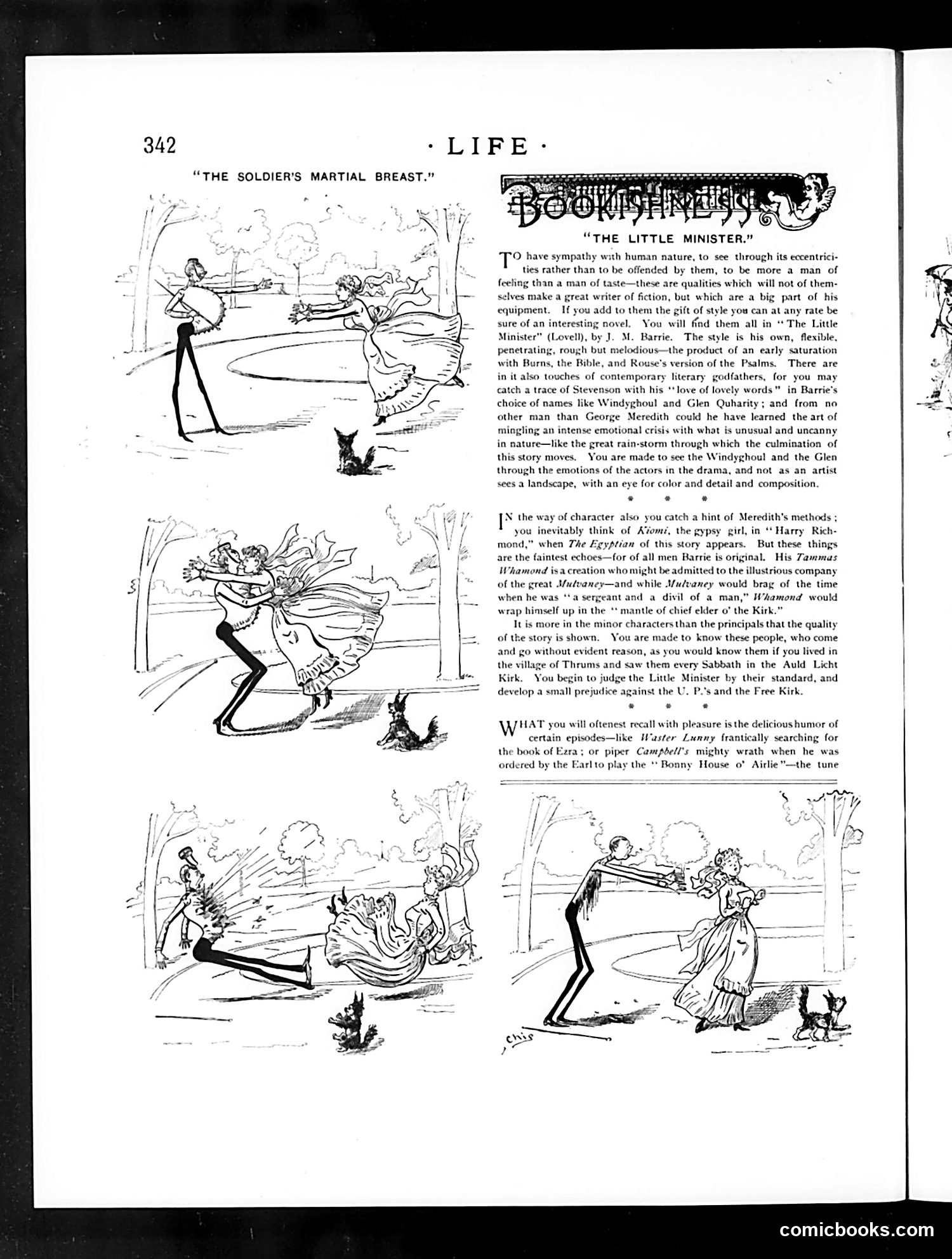
This page reviews "The Little Minister," a J.M. Barrie drama featuring characters named Windybould and Glen Quharrity. The four cartoon illustrations depict comedic scenes from the play's action, showing characters in exaggerated physical comedy—falling, stumbling, and interacting dramatically with props and each other. The review praises Barrie's ability to blend emotional depth with humor, comparing his character work to other literary figures like Meredith and Dickens. The text emphasizes how the play makes audiences sympathize with characters they'd encounter in ordinary village life, while the cartoons capture specific funny moments—likely "Water Lanny" searching for a book and "Campbell's" humorous scenes. The satire celebrates theatrical comedy itself rather than targeting political figures.
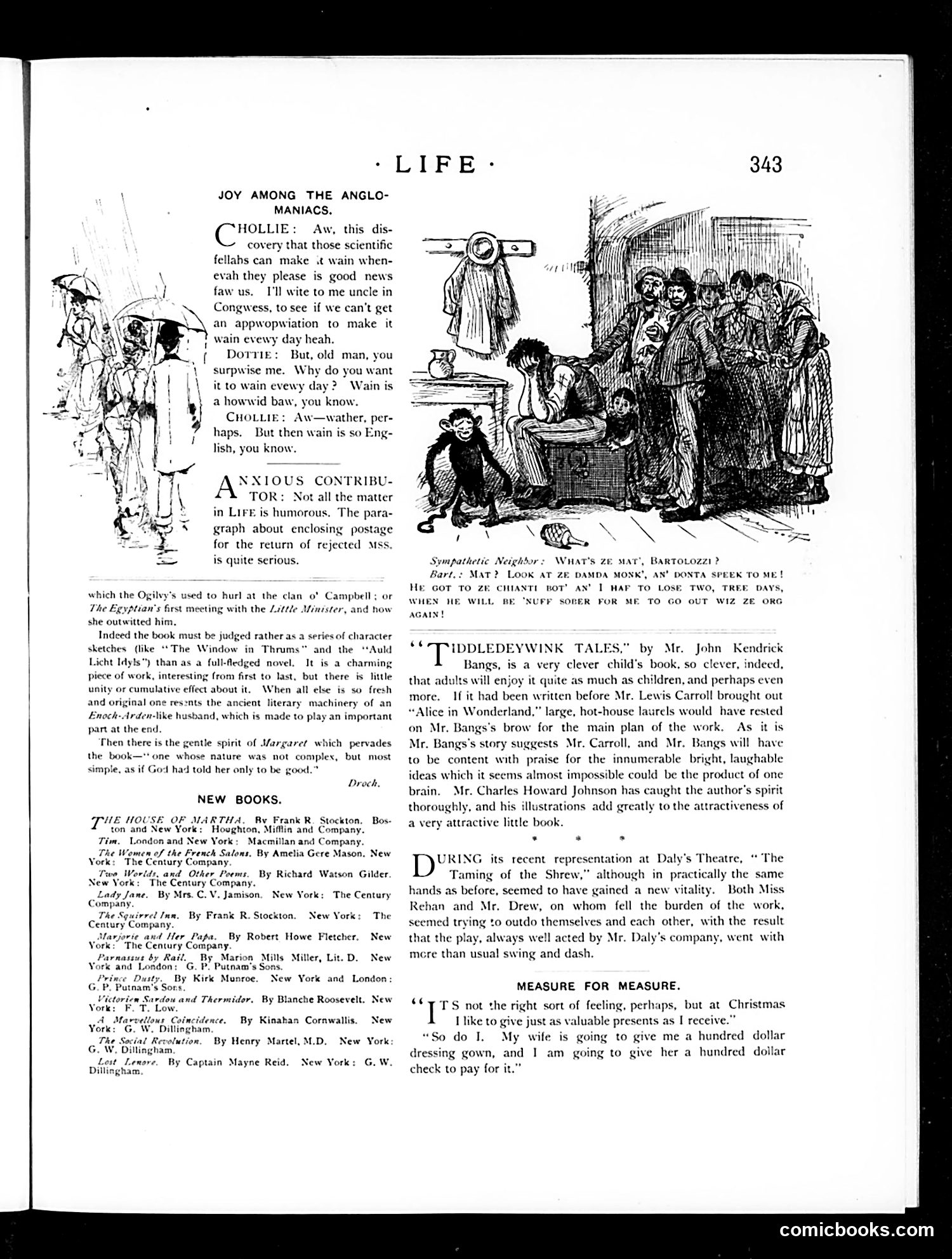
This page contains three distinct elements: 1. **"Joy Among the Anglo-Maniacs"** — A dialogue sketch mocking British affectation, where characters "Chollie" and "Dottie" discuss the absurdity of adopting English mannerisms (particularly the "wain" accent). The satire targets Americans' pretentious emulation of British culture. 2. **A street scene illustration** showing what appears to be urban poor or working-class figures, accompanying a serious contributor's note about *Life's* humorous vs. serious content. 3. **Book reviews** and a brief joke titled "Measure for Measure" about gift-giving expectations between spouses. The page demonstrates *Life's* mix of social satire (mocking class pretension) and lighter humor, characteristic of early 20th-century American satirical magazines.
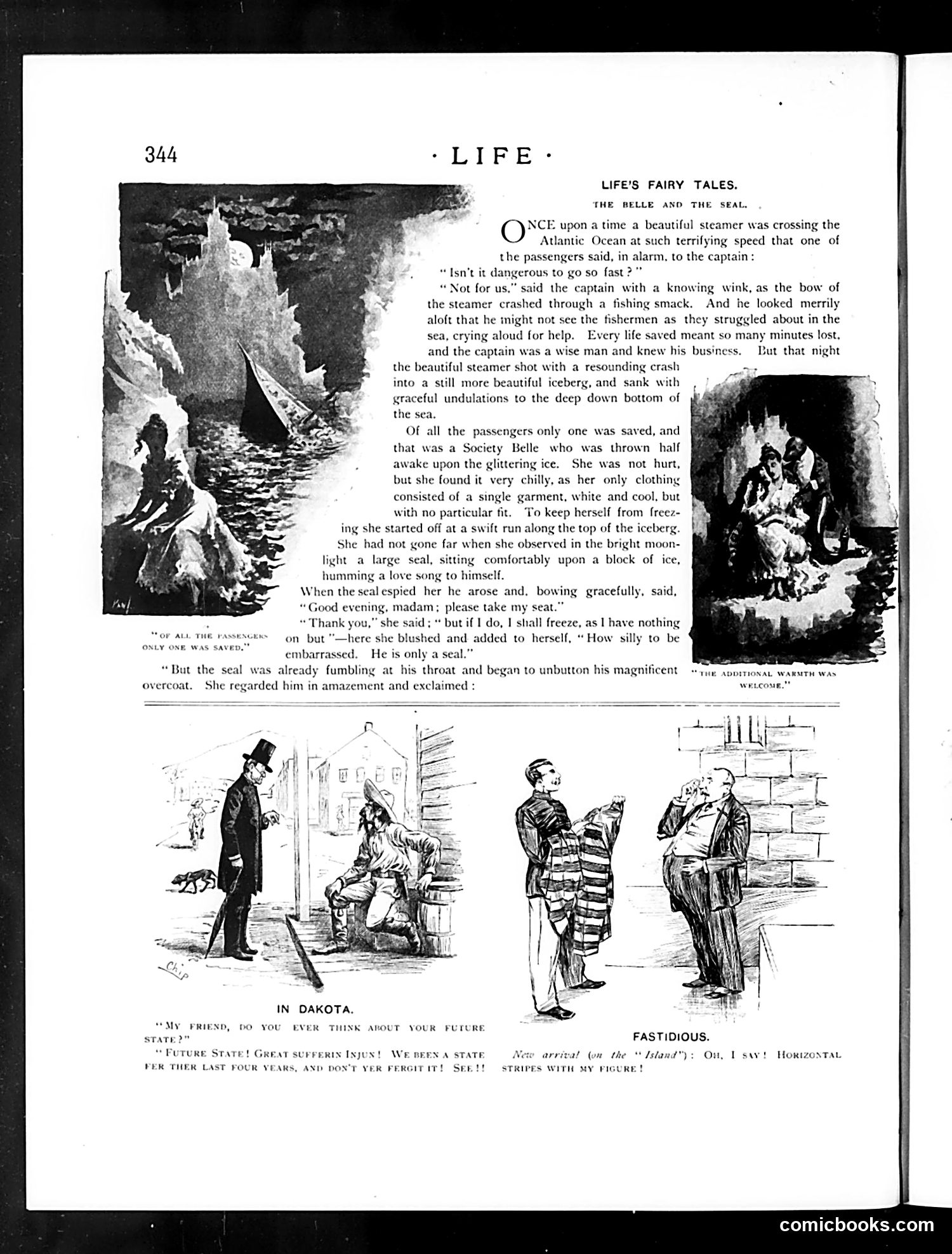
This page presents a satirical fairy tale about a shipwreck in the Atlantic Ocean. A "Society Belle" is the sole survivor, rescued by a seal who offers her his seat on an ice floe. When she hesitates to accept due to cold, the seal removes his coat—revealing he's actually a gentleman in disguise. The satire appears to mock upper-class women's vanity and impracticality. The "Society Belle" prioritizes propriety and appearances even in a life-or-death situation, embodying period stereotypes of privileged women as frivolous and helpless. Below are two unrelated cartoon vignettes: one about Dakota statehood, another about fashion ("Fastidious"), using typical early-1900s sketch comedy style.
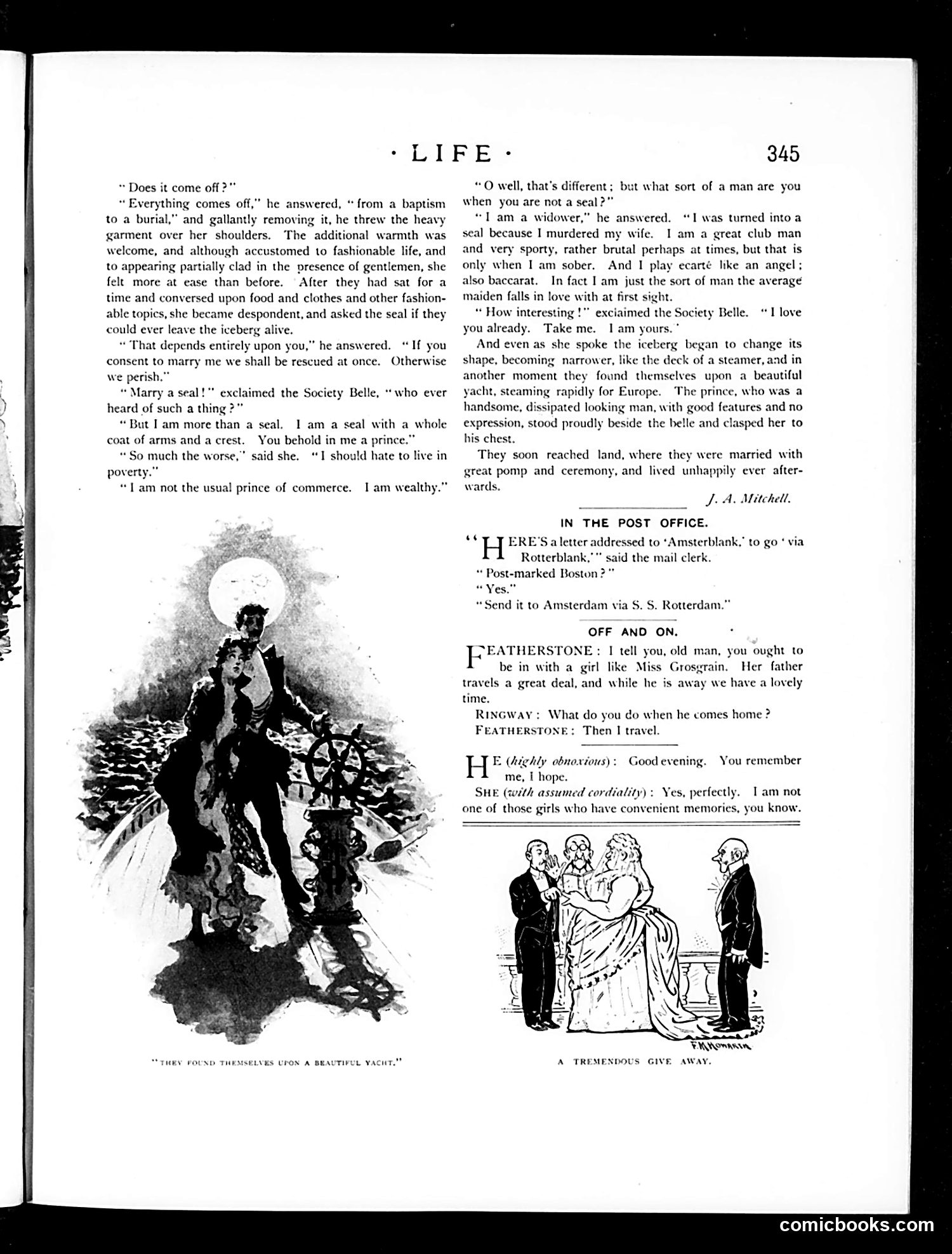
This page contains two distinct satirical pieces: **Top section** ("Life"): A dialogue between a Society Belle and a man who claims to be a seal—literally a marine animal transformed into human form after murdering his wife. The satire mocks wealthy socialites' shallow romanticism and poor judgment. The man boasts of his aristocratic "coat of arms" while admitting poverty, yet the Belle remains enchanted. The joke critiques how Society women are easily impressed by titles and stories, regardless of moral character or actual circumstances. **Bottom sections** ("In the Post Office" and "Off and On"): Brief comedic vignettes poking fun at domestic relationships and social pretense—a man's letter routing and a couple's infidelity. These employ Victorian-era humor conventions about marriage and travel. The illustrations support these satirical themes through period caricature style.
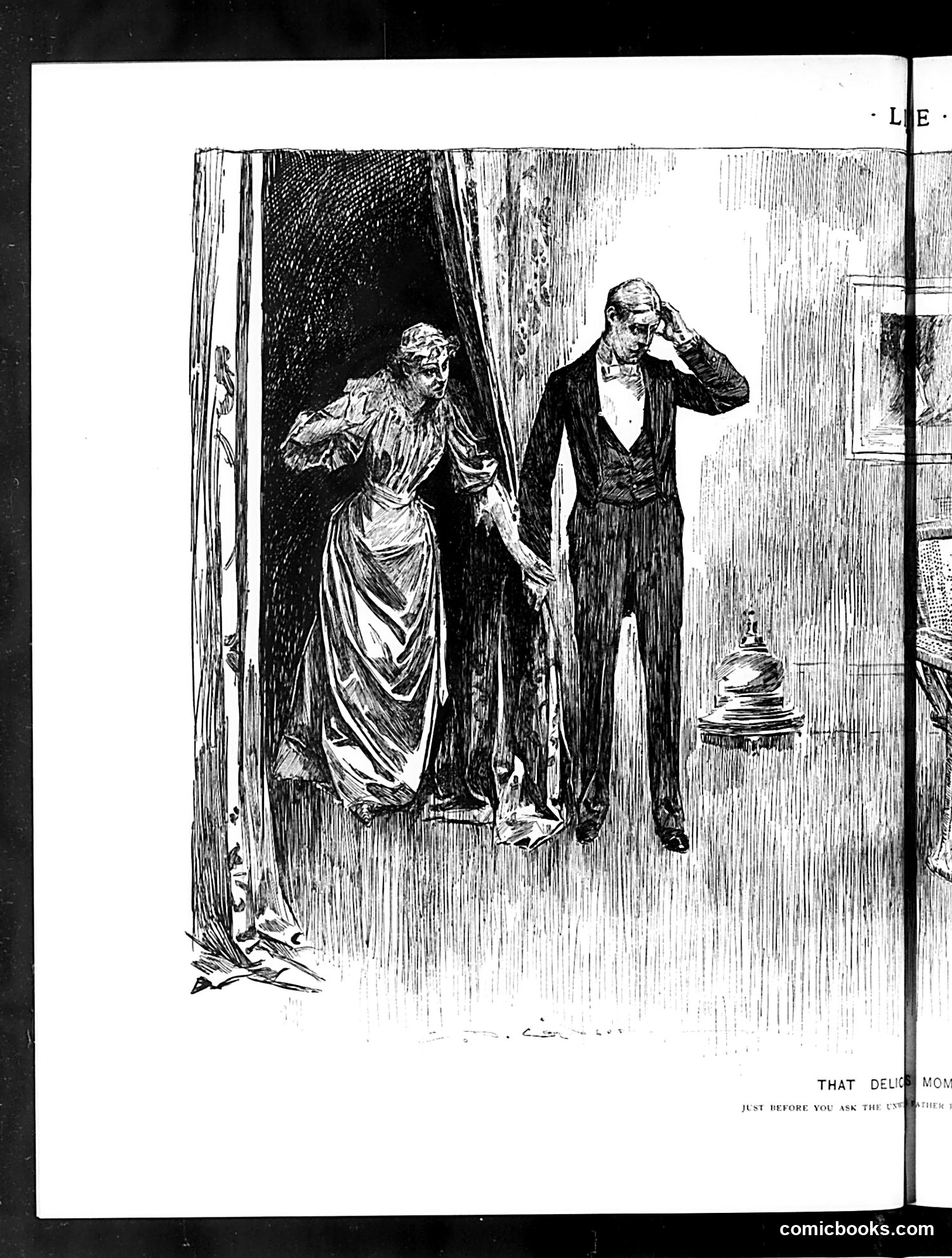
This appears to be a domestic scene illustration from Life magazine. Two figures are shown in a doorway—a woman in an elaborate dress emerging from or entering a darkened doorway, and a man in formal evening wear (tuxedo) standing nearby with his hand to his head in a gesture suggesting surprise, concern, or exasperation. The partial caption at bottom reads "THAT DELIG[HTFUL MOM..." and "JUST BEFORE YOU ASK THE UNPLEASANT..." The text suggests a humorous domestic situation, likely commenting on social etiquette or spousal interaction in upper-class settings. Without the complete caption, the specific satirical point remains unclear, though the tone appears to mock conventional relationship dynamics or social pretense of the era.
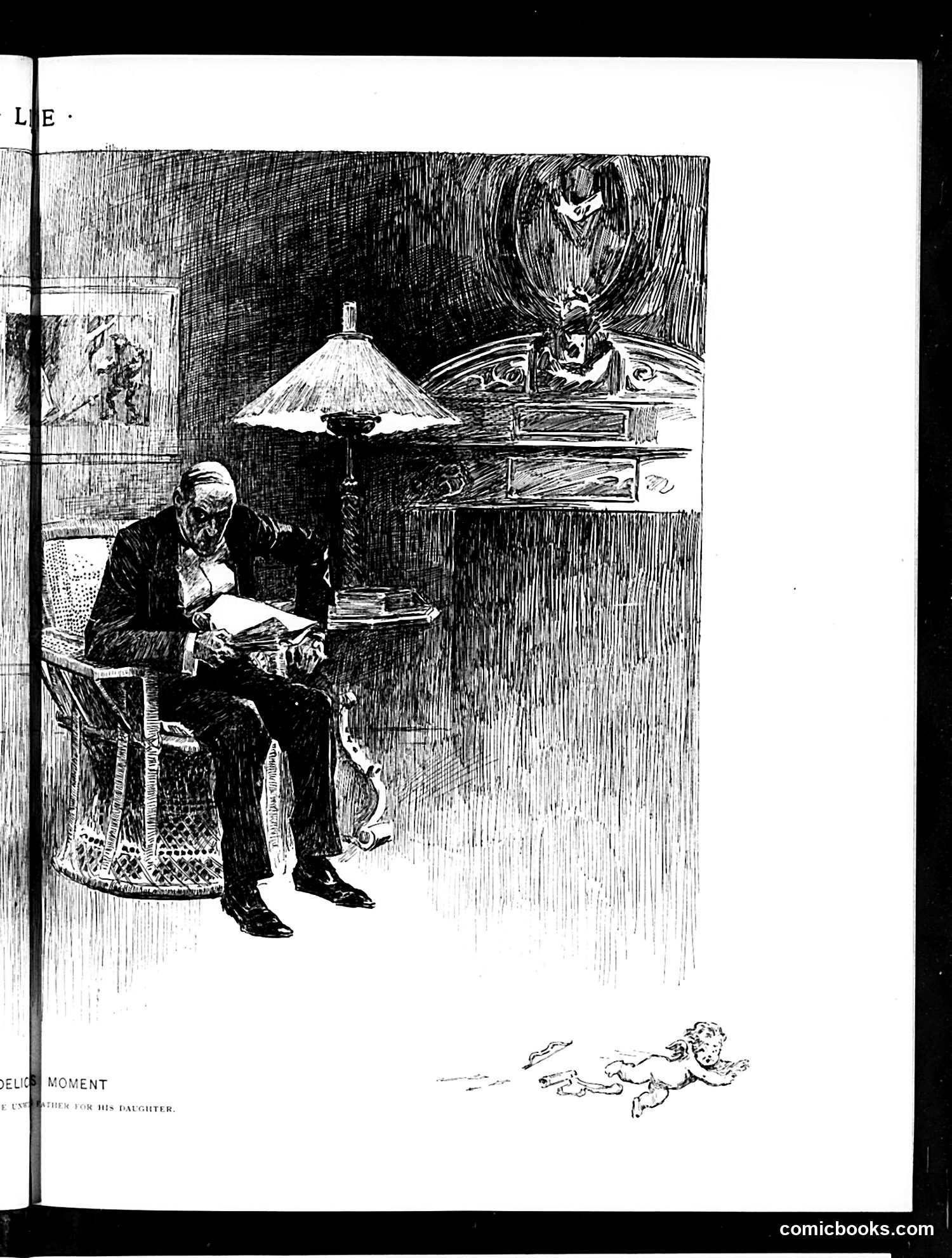
This illustration depicts a well-dressed gentleman seated under a reading lamp, absorbed in reading what appears to be correspondence or a document. The subtitle indicates this relates to "a letter from his daughter." The satire likely targets paternal sentiment—the "delicious moment" of a father receiving written affection from his daughter. The contrast between the man's formal, serious demeanor and the intimate domestic scene creates gentle humor about Victorian-era family relationships and sentimentality. The cherub figure sketched at the bottom reinforces the romantic, sentimental tone. This appears to be social commentary on middle-class domestic life and the particular pleasures fathers derived from correspondence with their daughters—a common theme in late-19th/early-20th-century American satirical magazines like *Life*.
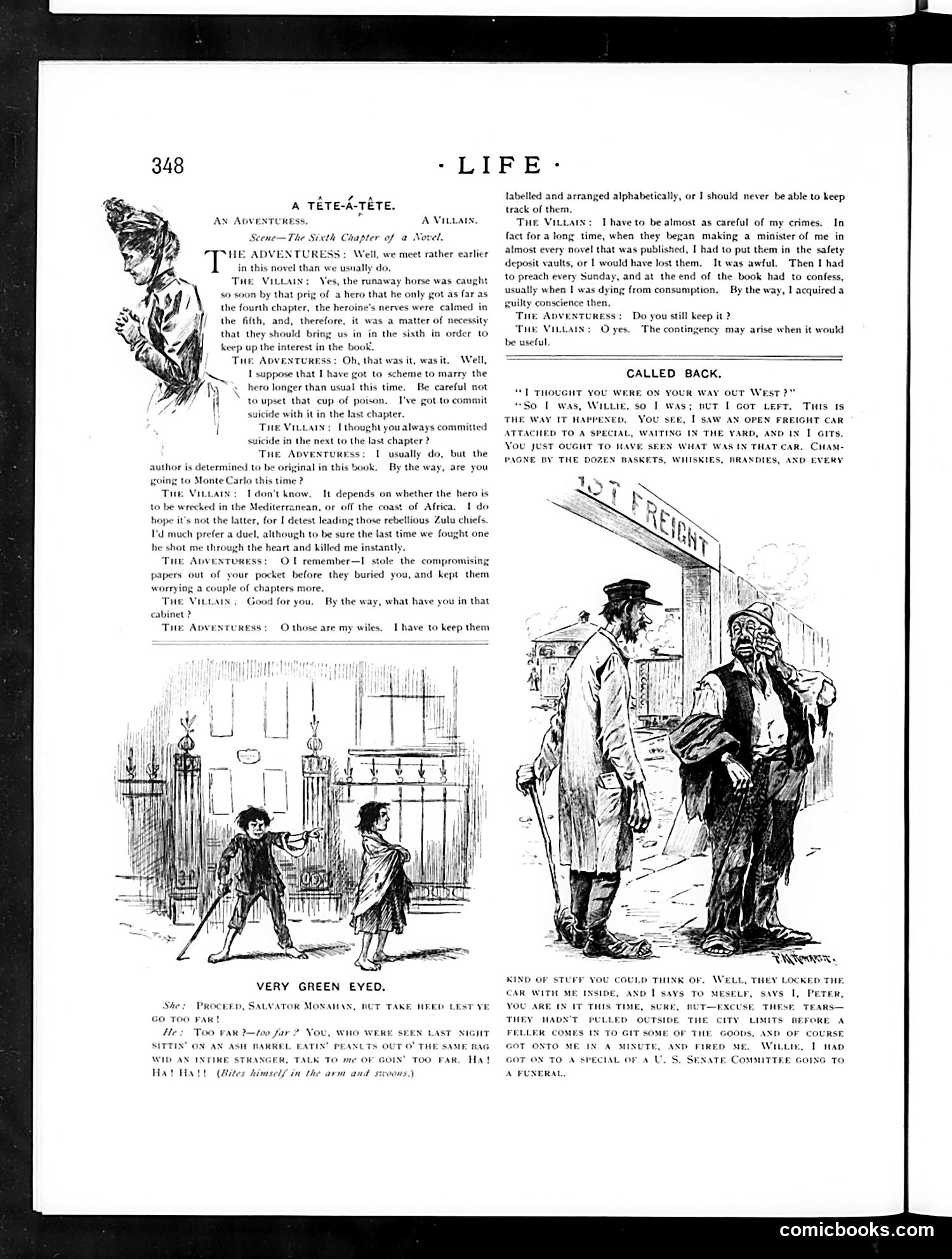
This page satirizes the formulaic conventions of serialized novels popular in the late 19th/early 20th century. The main dialogue between "The Adventuress" and "The Villain" mocks the predictable plot mechanics: characters discuss how the runaway horse must be caught by chapter four, the heroine calmed by chapter five, to maintain reader interest. They joke about repeating plot devices (poisoned cups, duels, Monte Carlo settings, confessions during consumption deaths) as if they're interchangeable props rather than genuine storytelling. The accompanying illustrations depict scenes from melodramatic fiction—children eavesdropping, villainous encounters—exemplifying the overwrought tropes being ridiculed. Below, "Called Back" and "Very Green Eyed" appear to be additional short satirical pieces about stock character types and romantic jealousy, further mocking Victorian literary clichés.
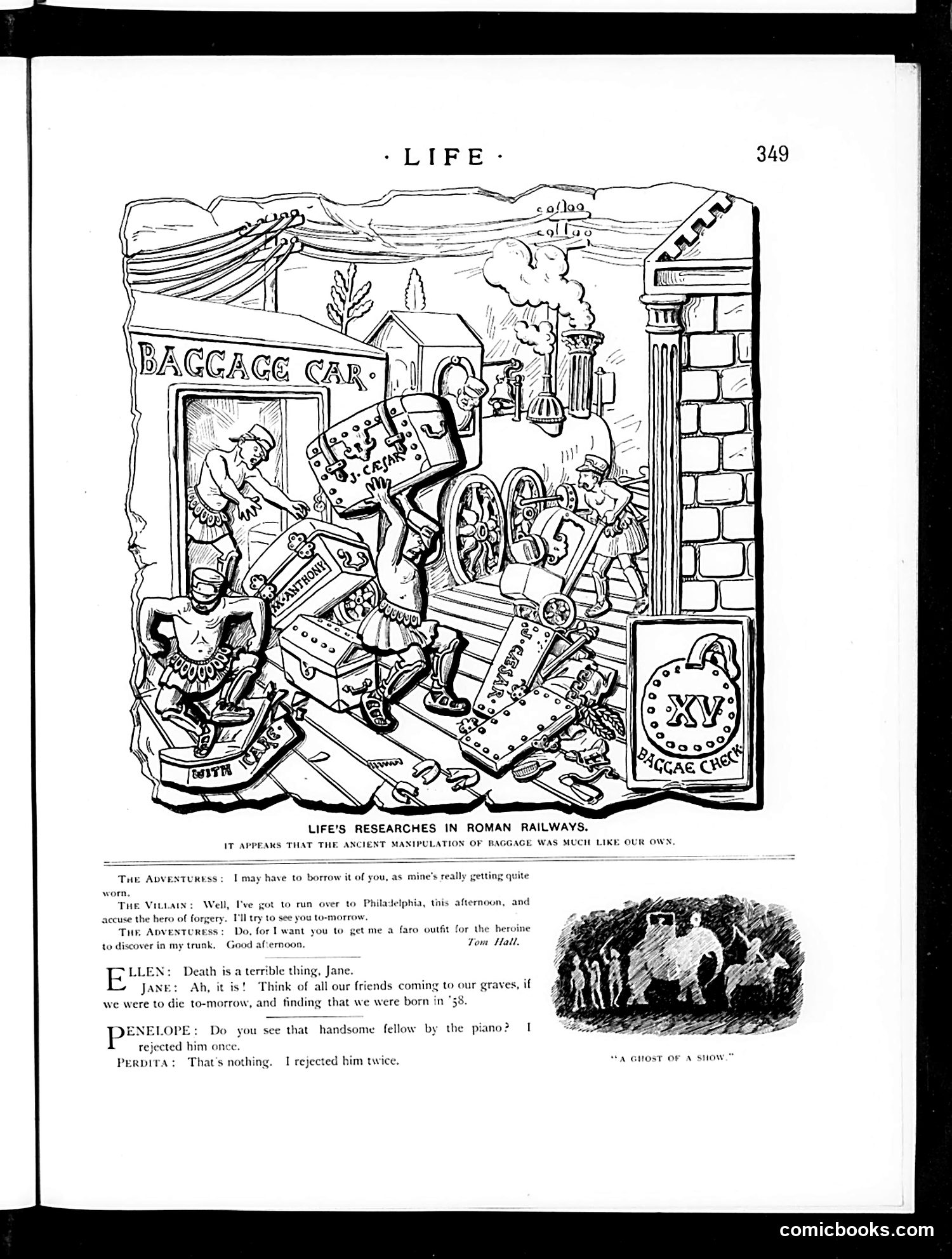
This satirical cartoon humorously compares ancient Roman baggage handling to contemporary (early 20th century) railroad practices. The elaborate illustration shows chaotic scenes of Roman porters and slaves managing luggage at what appears to be a Roman station, suggesting the process was equally disorganized and burdensome then as in modern times. Below, brief comedic dialogues mock contemporary social pretensions: characters discuss borrowing worn clothing, rushing to Philadelphia on business, packing theatrical costumes, and anxiously contemplating mortality—specifically the embarrassment of friends discovering one was "born in '58" (suggesting anxiety about aging or social status tied to birth year). The final exchange between Penelope and Perdita is a one-upmanship joke about romantic rejections, establishing their competitive, frivolous social standing. The cartoon's humor relies on equating trivial modern concerns with ancient Roman life, suggesting human nature—and social anxieties—remain unchanged across centuries.
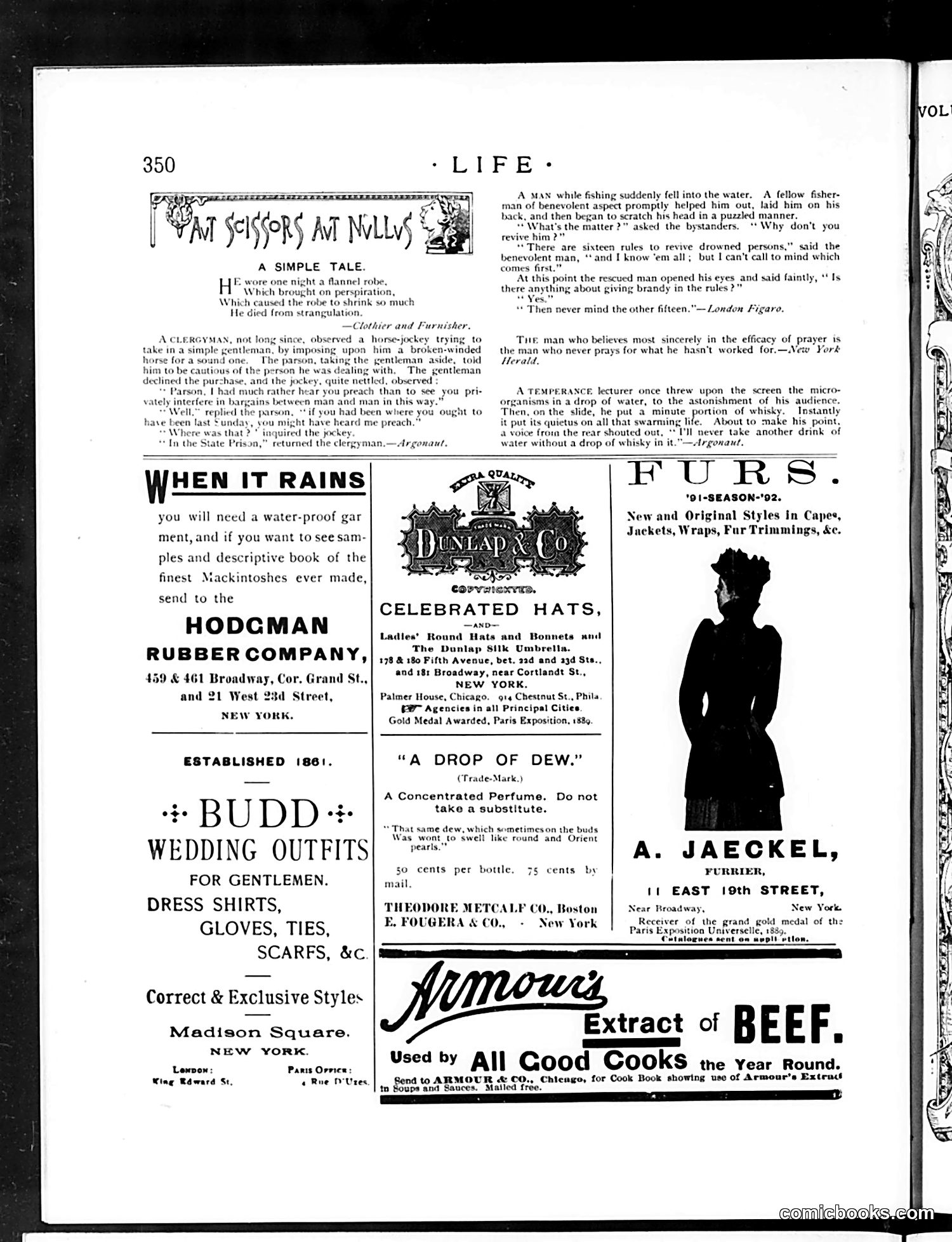
This is primarily a **page of advertising and short humorous anecdotes**, not political commentary. The three brief comic tales (marked "A SIMPLE TALE") use ironic humor common to late-19th-century satirical magazines: 1. **The drowned man story**: A well-meaning rescuer knows sixteen resuscitation rules but can't remember which to use first—until the victim, reviving himself, asks about brandy, proving practical thinking beats theoretical knowledge. 2. **The clergyman and horse-jockey**: A pastor refuses to buy a horse from a disreputable dealer, implying moral judgment. 3. **The temperance lecture**: A microscope demonstration of water organisms backfires when a heckler concludes he'll never drink plain water again—mocking temperance advocates' reasoning. The page is otherwise filled with **period advertisements** for rubber raincoats, wedding clothing, perfume, hats, furs, and beef extract—typical of Life's commercial content. There are no identifiable political figures or satirical cartoons in the visual sense.