
Life, 1891-12-10 · page 6 of 14
Life — December 10, 1891 — page 6: what you’re looking at
What you’re looking at
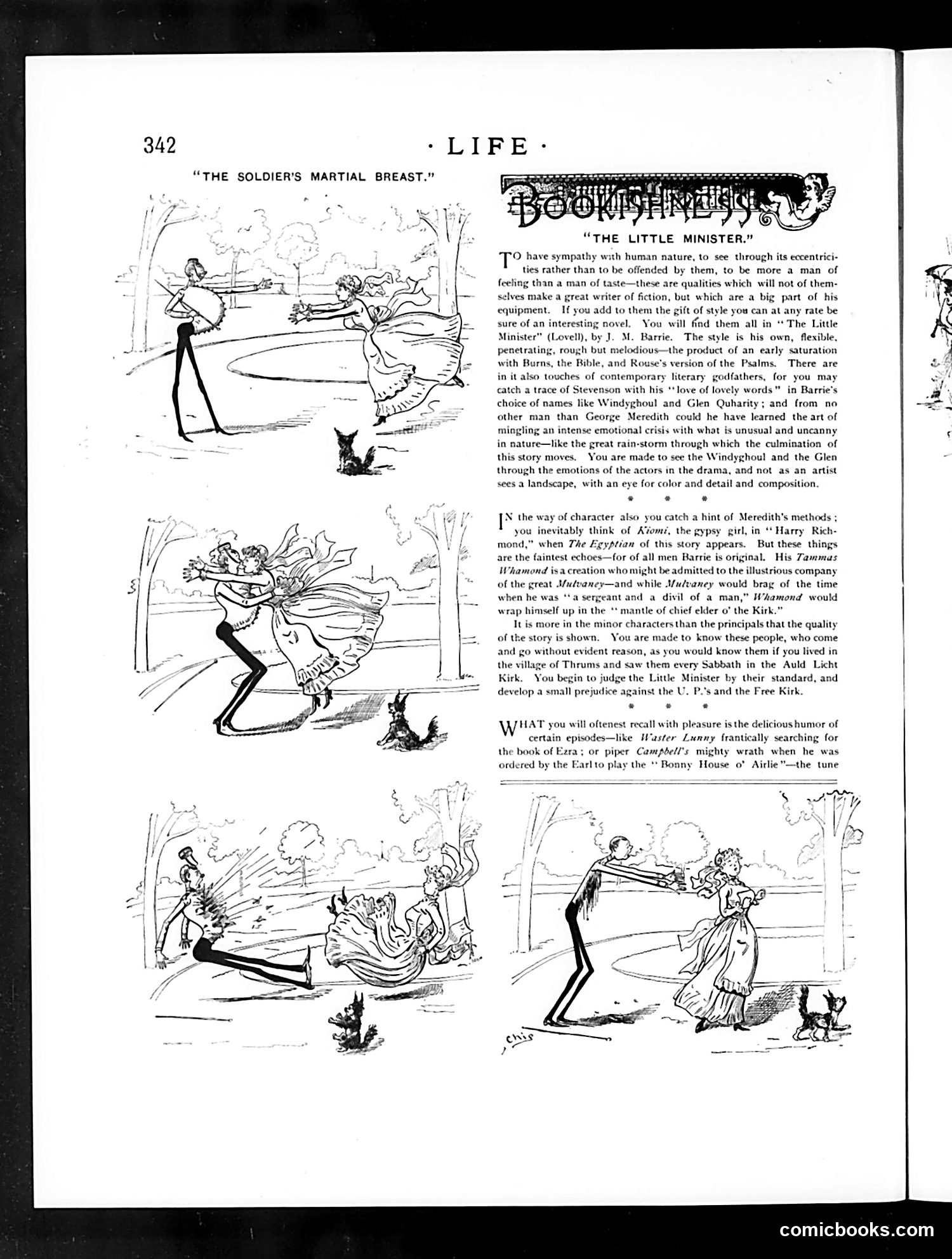
This page reviews "The Little Minister," a J.M. Barrie drama featuring characters named Windybould and Glen Quharrity. The four cartoon illustrations depict comedic scenes from the play's action, showing characters in exaggerated physical comedy—falling, stumbling, and interacting dramatically with props and each other. The review praises Barrie's ability to blend emotional depth with humor, comparing his character work to other literary figures like Meredith and Dickens. The text emphasizes how the play makes audiences sympathize with characters they'd encounter in ordinary village life, while the cartoons capture specific funny moments—likely "Water Lanny" searching for a book and "Campbell's" humorous scenes. The satire celebrates theatrical comedy itself rather than targeting political figures.
📄 Transcribed text from this page (OCR, searchable)
Machine-transcribed from the original scan — historical spelling and the odd misread are preserved.
- LIFE: “THE SOLDIER'S MARTIAL BREAST.” TO have sympathy with human nature, to sce through its eccentrici- ties rather than to be offended by them, to be more a man of feeling than a man of taste—these are qualities which will not of them- selves make a great writer of fiction, but which are a big part of his equipment. If you add to them the gift of style you can at any rate be sure of an interesting novel. You will find them all in * The Little Minister” (Lovell), by J. M. Barrie. The style is his own, flexible, penetrating, rough but melodious—the product of an early saturation with Burns, the Bible, and Rouse’s version of the Psalms. There are in it also touches of contemporary literary godfathers, for you may catch a trace of Stevenson with his “love of lovely words" in Barrie's choice of names like Windyghoul and Glen Quharity; and from no other man than George Meredith could he have learned the art of mingling an intense emotional crisis with what is unusual and uncanny in nature—like the great rain-storm through which the culmination of this story moves. You are made to sce the Windyghoul and the Glen through the emotions of the actors in the drama, and not as an artist sees a landscape, with an eye for color and detail and composition. ° * * N the way of character also you catch a hint of Meredith's methods ; you inevitably think of A'vom#, the gypsy girl, in ‘Harry Rich- mond,” when The Egyptian of this story appears. But these things are the faintest echoes—for of all men Barrie is original, His Zammas Whamond isa creation who might be admitted to the illustrious company of the great Mulvaney—and while Mulvaney would brag of the time when he was ‘a sergeant and a divil of a man,” Whamond would wrap himself up in the * mantle of chief elder 0° the Kirk.” It is more in the minor characters than the principals that the quality of the story is shown. You are made to know these people, who come and go without evident reason, as you would know them if you lived in the village of Thrums and saw them every Sabbath in the Auld Licht Kirk, You begin to judge the Little Minister by their standard, and develop a small prejudice against the U. P.’s and the Free Kirk. ° . * WHAT you will oftenest recall with pleasure isthe delicioushumor of certain episodes—like Waster Lunny frantically searching for the book of Ezra; or piper Campbell's mighty wrath when he was ordered by the Earlto play the “Bonny House o' Airlie"—the tune comicbooks.com