
A complete issue · 18 pages · 1891
Life — September 17, 1891
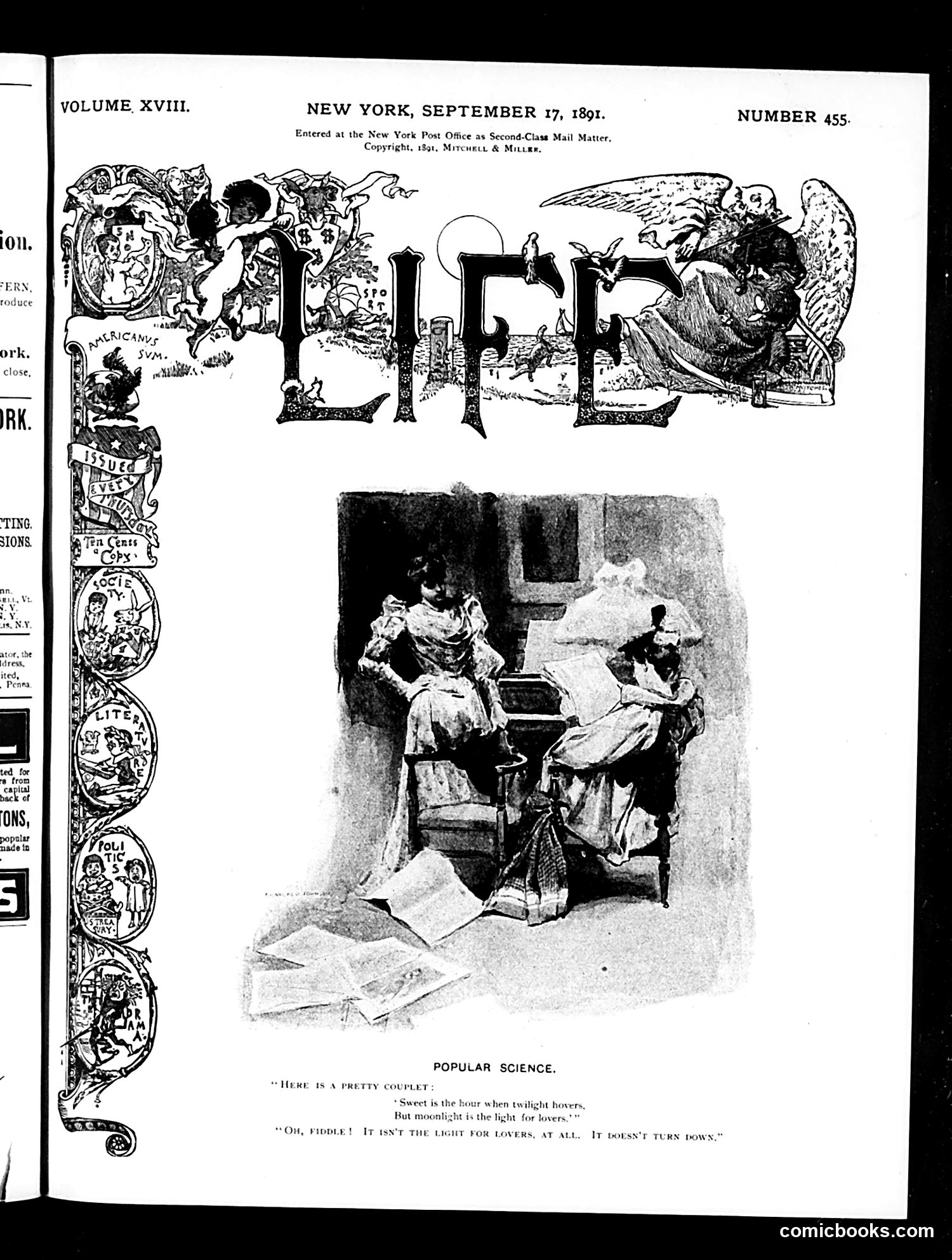
This page features a section titled "Popular Science" with an illustration and accompanying verses about moonlight and romantic encounters between lovers. The illustration shows two women in Victorian dress indoors, apparently looking at documents or papers. One woman appears skeptical or dismissive while the other gestures expressively. The verses below use pseudo-scientific language to humorously debunk a romantic notion: that moonlight creates the proper conditions for love. The punchline—"It isn't the light for lovers, at all. It doesn't turn hows"—appears to be a play on words or visual pun, though the exact meaning is unclear from the text alone. The satire likely mocks Victorian sentimentality about romance while employing mock-scientific reasoning typical of Life's humorous commentary on contemporary social customs.
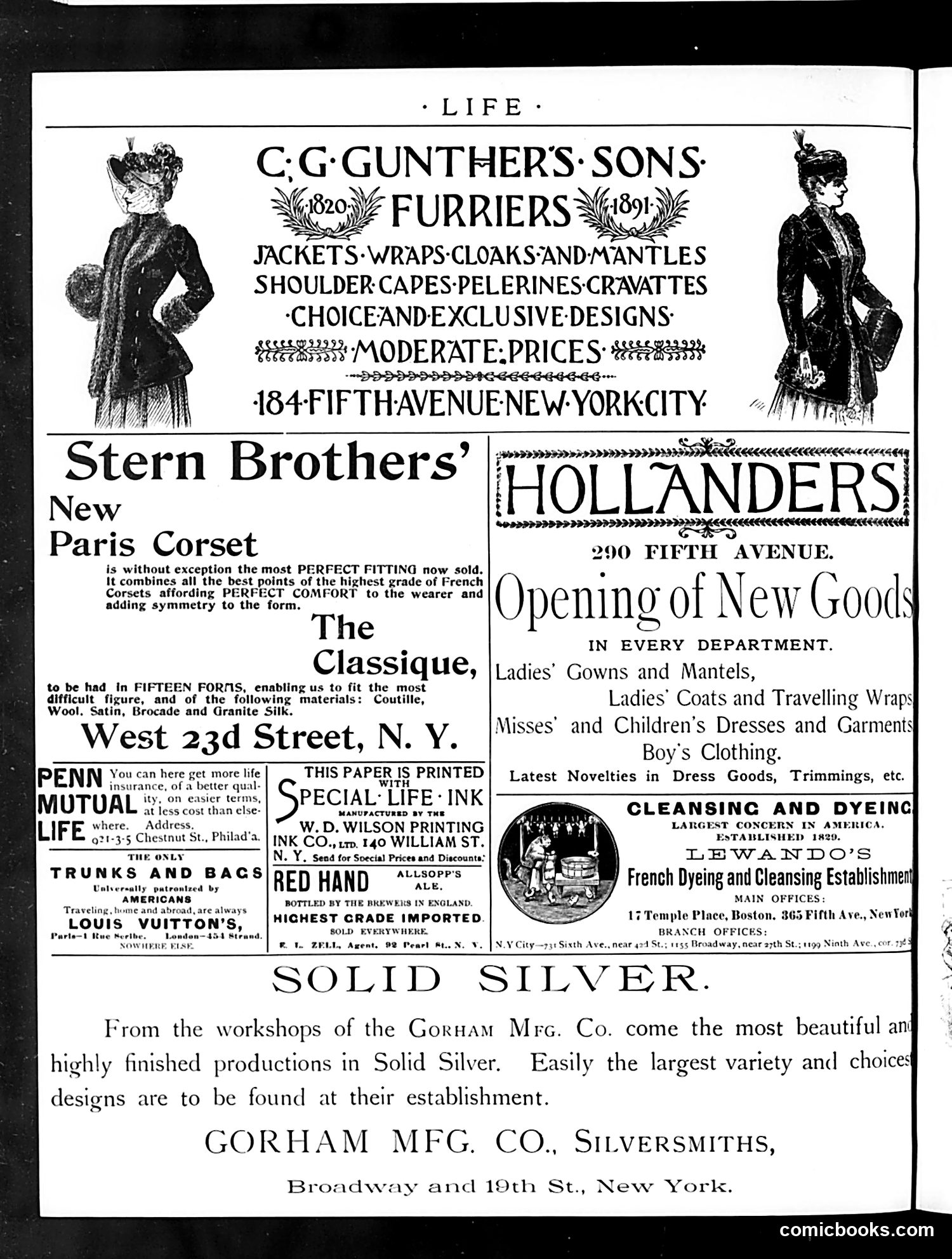
This page is primarily **advertising content** rather than editorial cartoons or satire. It contains multiple commercial advertisements from late 19th/early 20th century New York City businesses: - **C.G. Gunther's Sons**: Furriers advertising jackets, cloaks, and mantles at "moderate prices" - **Stern Brothers**: Corset advertisement emphasizing perfect fit - **Hollanders**: Department store announcing new goods in clothing and accessories - **Louis Vuitton**: Luggage and travel goods - **Leando's**: French dyeing and cleansing services - **Gorham Mfg. Co.**: Solid silver products The only visual elements are fashion illustrations of women in period clothing and decorative commercial imagery. There are **no political cartoons or satire** on this page—it represents typical early-1900s magazine advertising aimed at affluent New York City consumers.
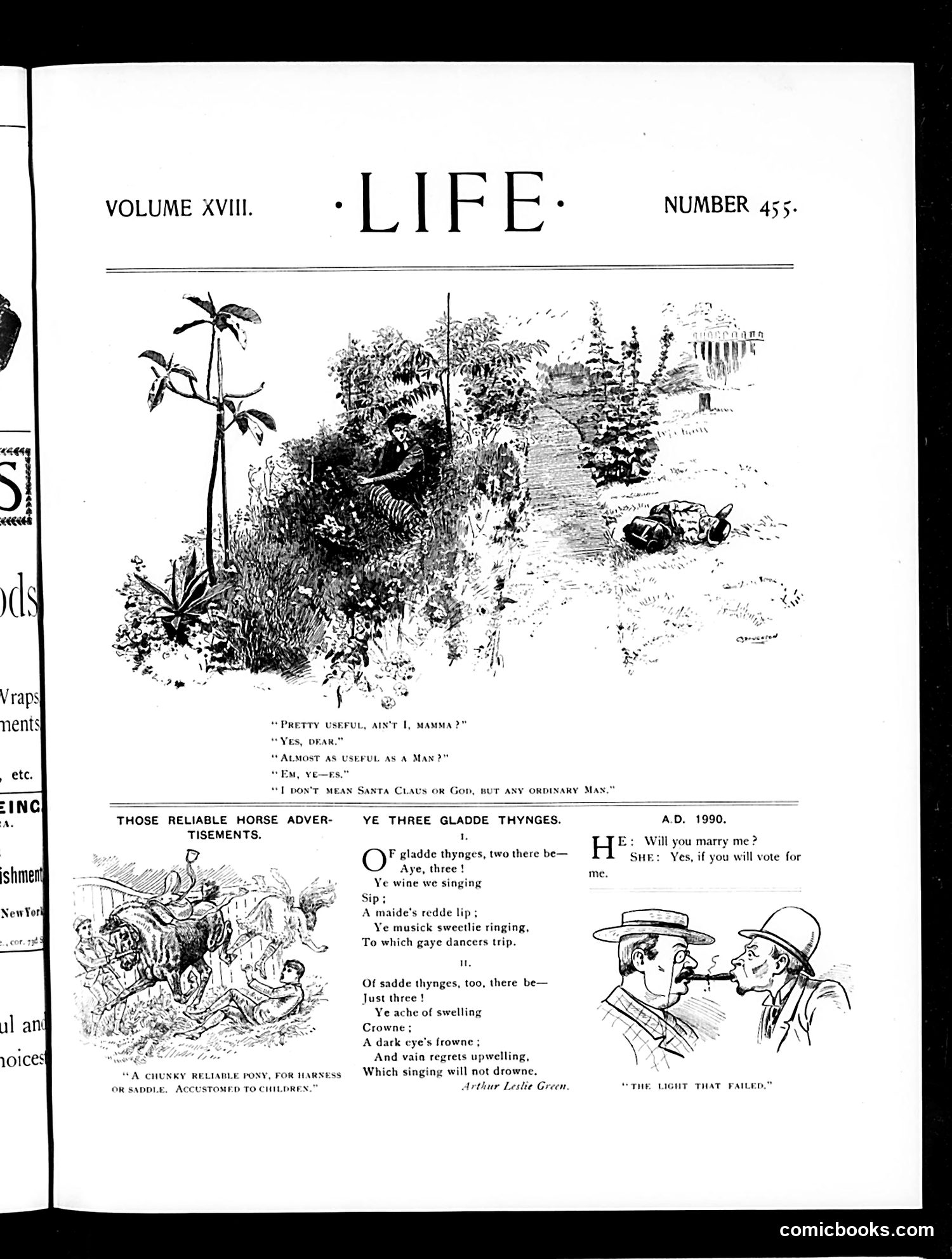
This page contains three distinct satirical pieces from 1890: 1. **Top illustration**: A domestic scene satirizing women's usefulness, with dialogue questioning whether women are "pretty useful" and "almost as useful as a man," concluding with a dismissive remark about Santa Claus and "ordinary man." 2. **"Those Reliable Horse Advertisements"**: Mocks exaggerated claims in horse-sale ads, depicting a comically chaotic, unsuitable horse for children—satirizing dishonest advertising practices. 3. **"Ye Three Gladde Thynges"** and **"The Light That Failed"**: A poem about pleasant things, followed by a brief comic scene where one man proposes marriage to another who agrees only if the proposer votes for him—satirizing corrupt political bargaining disguised as personal relationships. The page reflects 1890s concerns: gender roles, consumer fraud, and political corruption.
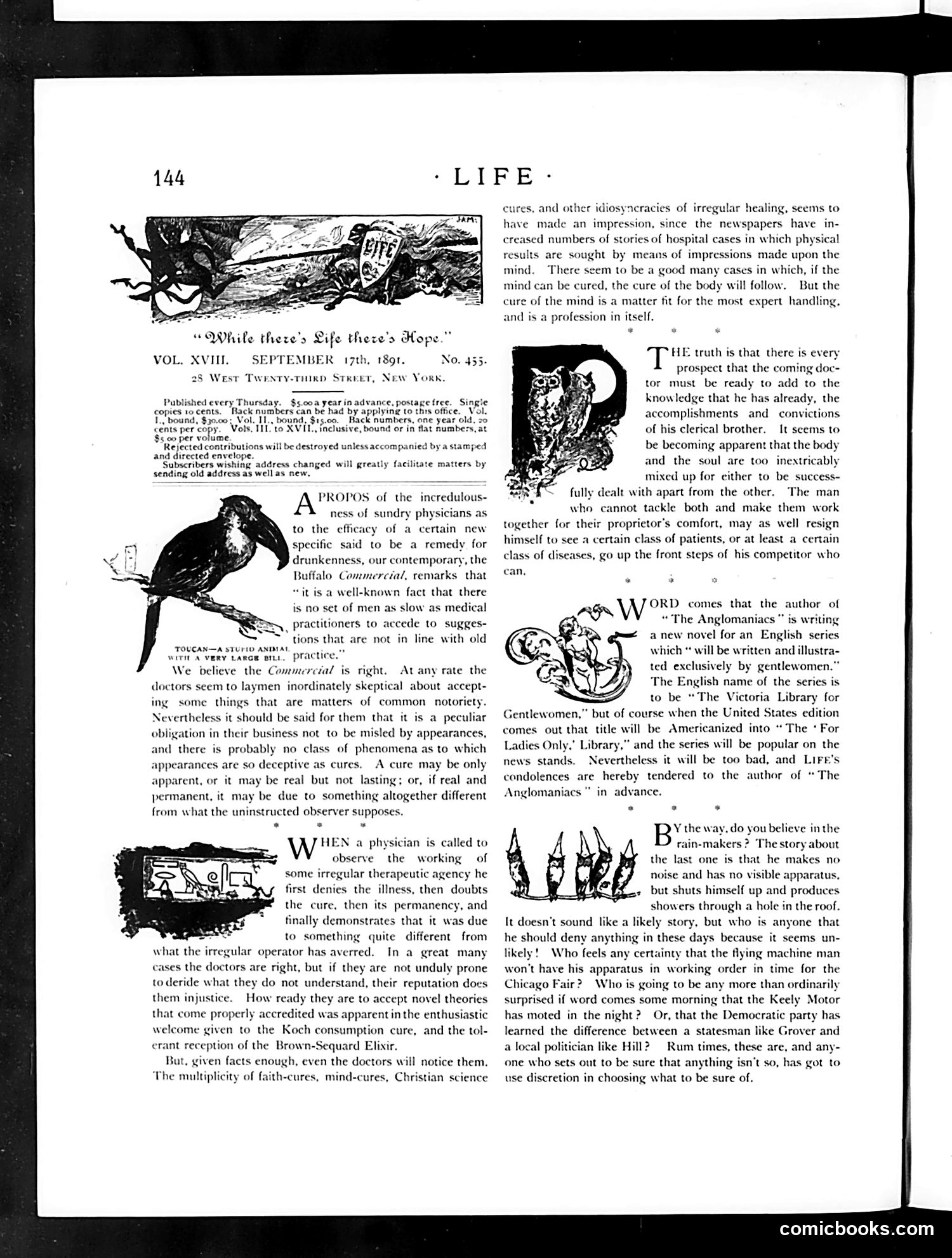
This page contains editorial commentary on medical practice rather than political cartoons. The text criticizes physicians who claim efficacy for dubious remedies—particularly regarding drunkenness treatment. The illustration of a toucan (labeled "A STUDY ANIMAL") appears to support discussion of irregular therapeutic claims. The satire targets doctors who accept patients' testimonials uncritically or rely on appearances rather than genuine medical knowledge. The second section mentions "The Anglomaniacs," an upcoming serialized novel for Life's readers. A separate brief commentary humorously questions belief in "rain-makers"—appearing to mock credulity about supernatural claims, possibly alluding to contemporary spiritualism or folk beliefs. The overall tone is skeptical of pseudoscience and medical charlatanism popular in the period.
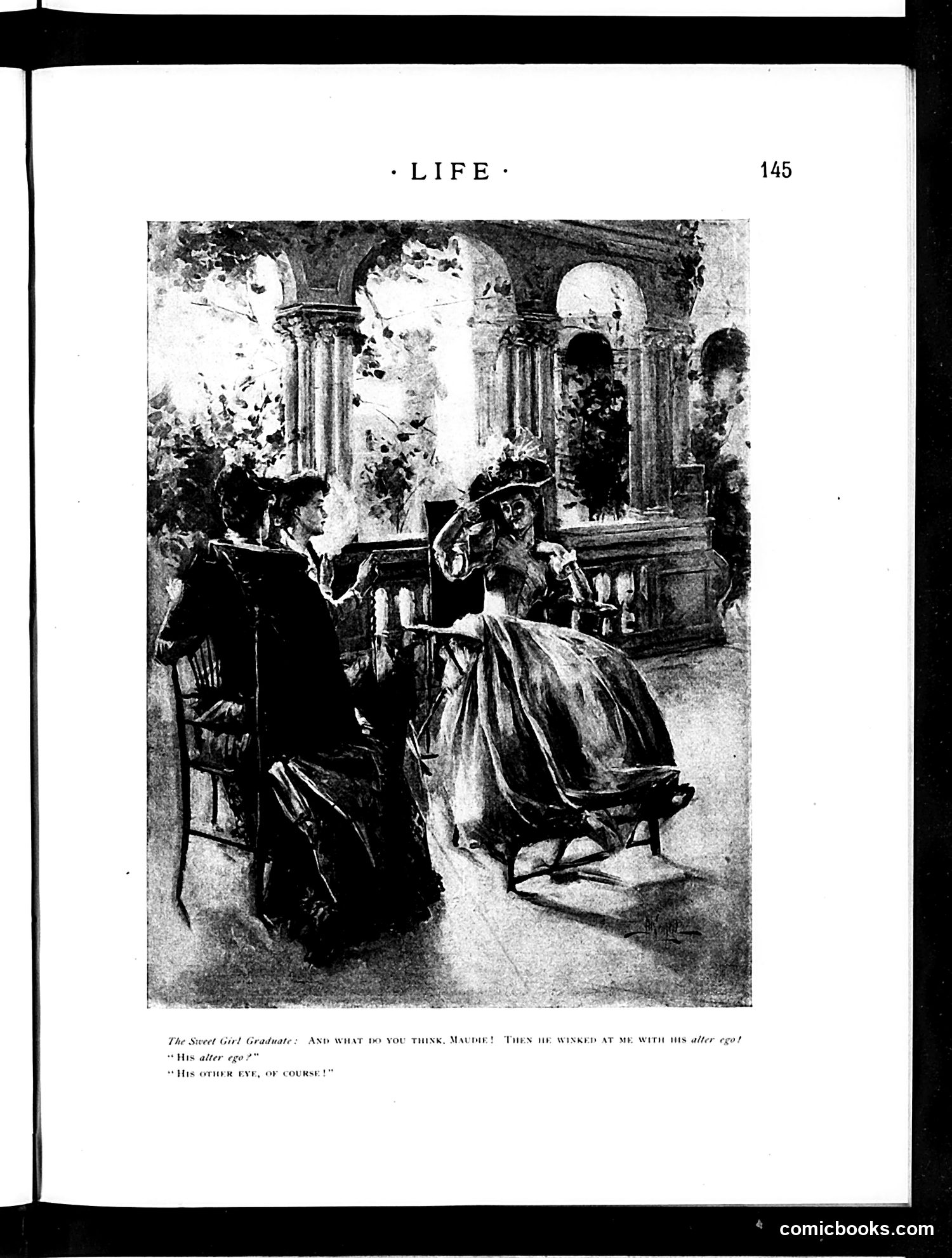
This satirical illustration depicts a young woman in an elegant dress conversing with a man in formal attire within a classical interior setting. The caption reads: "His other ego?" "Thus he winked at me with his other ego!" "His other eye, of course!" The joke plays on the phrase "other ego" (a pun on "alter ego"), suggesting the man is winking with his "other eye" rather than possessing a separate self. This appears to be social satire about courtship or flirtation, mocking either male behavior or the woman's naïveté in misinterpreting the man's intentions. The title references her as a "street girl graduate," implying commentary on women's social status or morality during the early 20th century. The humor relies on wordplay and innuendo.
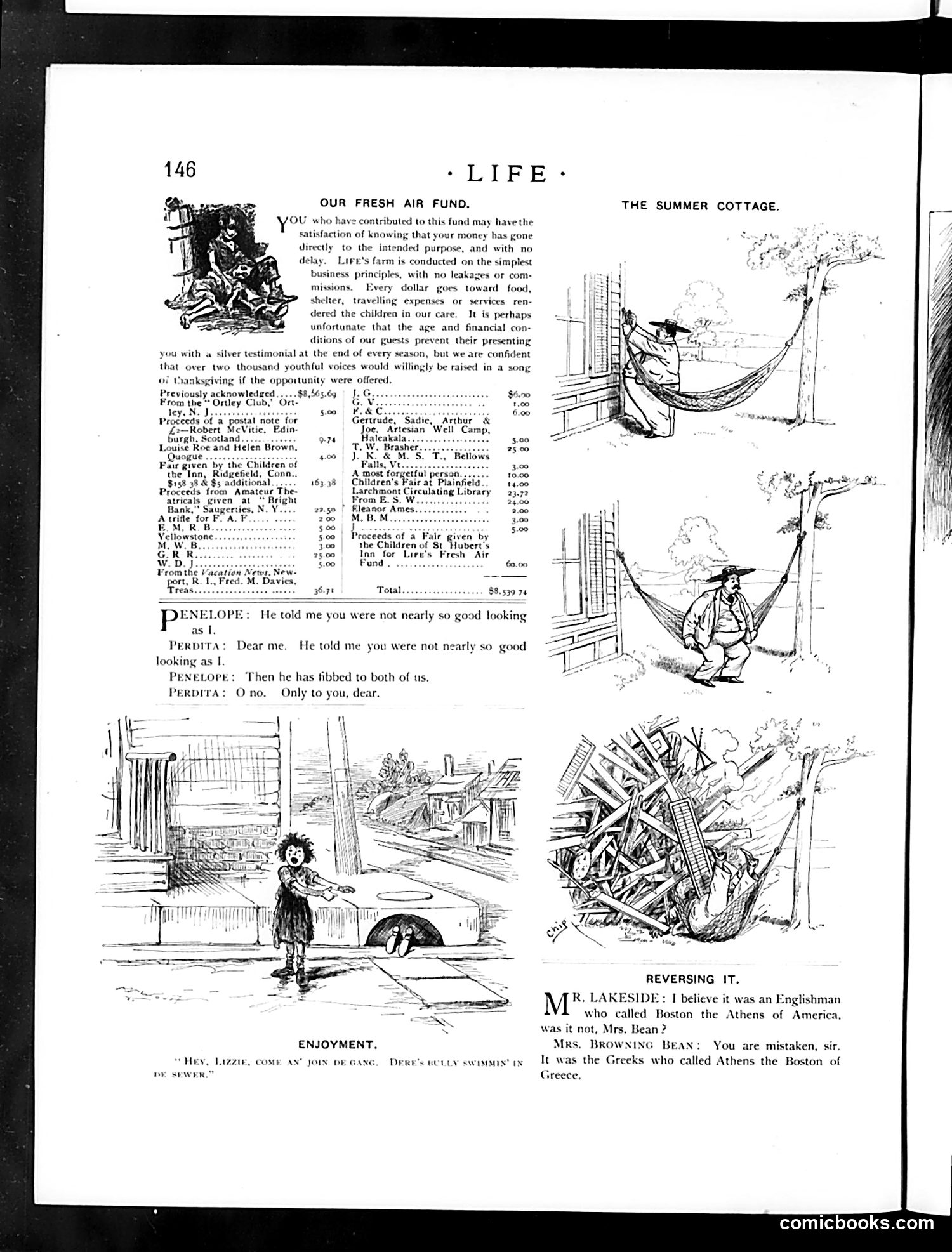
This page contains several distinct elements: **"Our Fresh Air Fund"** (left): A charitable fundraising list showing donations for sending children to summer camps/cottages. The amounts are modest (ranging from $1-$15), typical of early 20th-century charitable giving. **"The Summer Cottage"** (right): Three sketches depicting vacation leisure activities—children in hammocks and playing outdoors—illustrating the page's theme of summer recreation. **Comic dialogues** ("Enjoyment," "Reversing It"): Short humorous exchanges. One involves a sewer comment; another satirizes American cultural pretension by having characters debate whether Boston or Athens deserves the "Athens of America" designation, with a character correcting the misconception. The page's overall tone satirizes both charitable giving and American social aspirations typical of Life magazine's satirical approach to contemporary society.
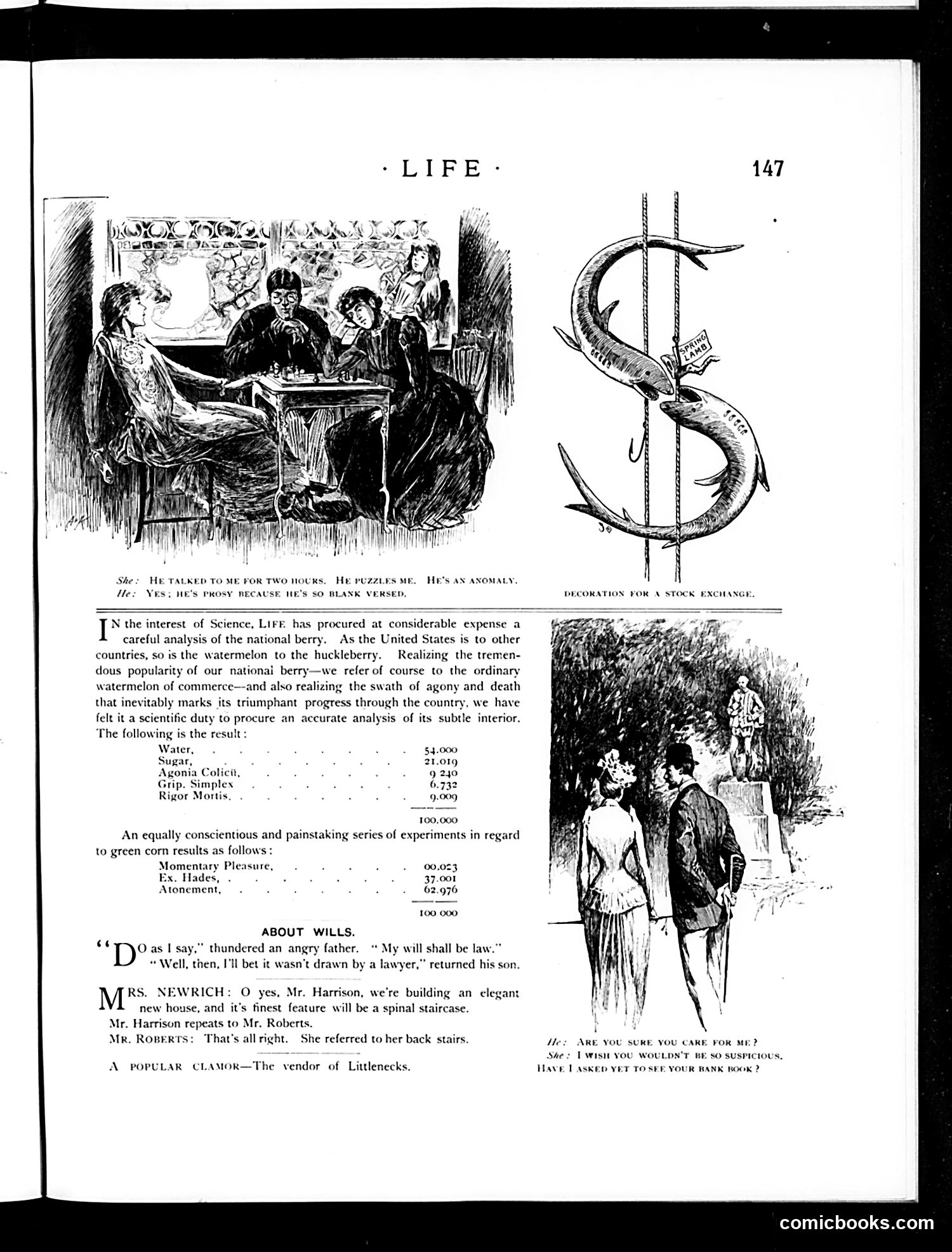
**Top cartoon**: A domestic scene where a man has talked to a woman for two hours. She calls him "an anomaly" with "blank verse"—satirizing pretentious intellectual conversation. The joke targets verbose, boring men who mistake verbosity for brilliance. **Dollar sign decoration**: A humorous financial symbol showing a fish hooked on the dollar sign, likely satirizing stock market speculation or the commodification of life during the commercial boom era. **Bottom cartoon**: Shows a couple walking, with dialogue about caring and bank books, suggesting anxieties about financial security in relationships. **Center text**: Appears to be genuine scientific analysis of watermelons and corn composition, presented as satire of overly detailed scientific reporting. **"About Wills" section**: A brief humorous exchange about legal documents and house construction. The page blends social satire with commercial and domestic concerns typical of early 20th-century American life.
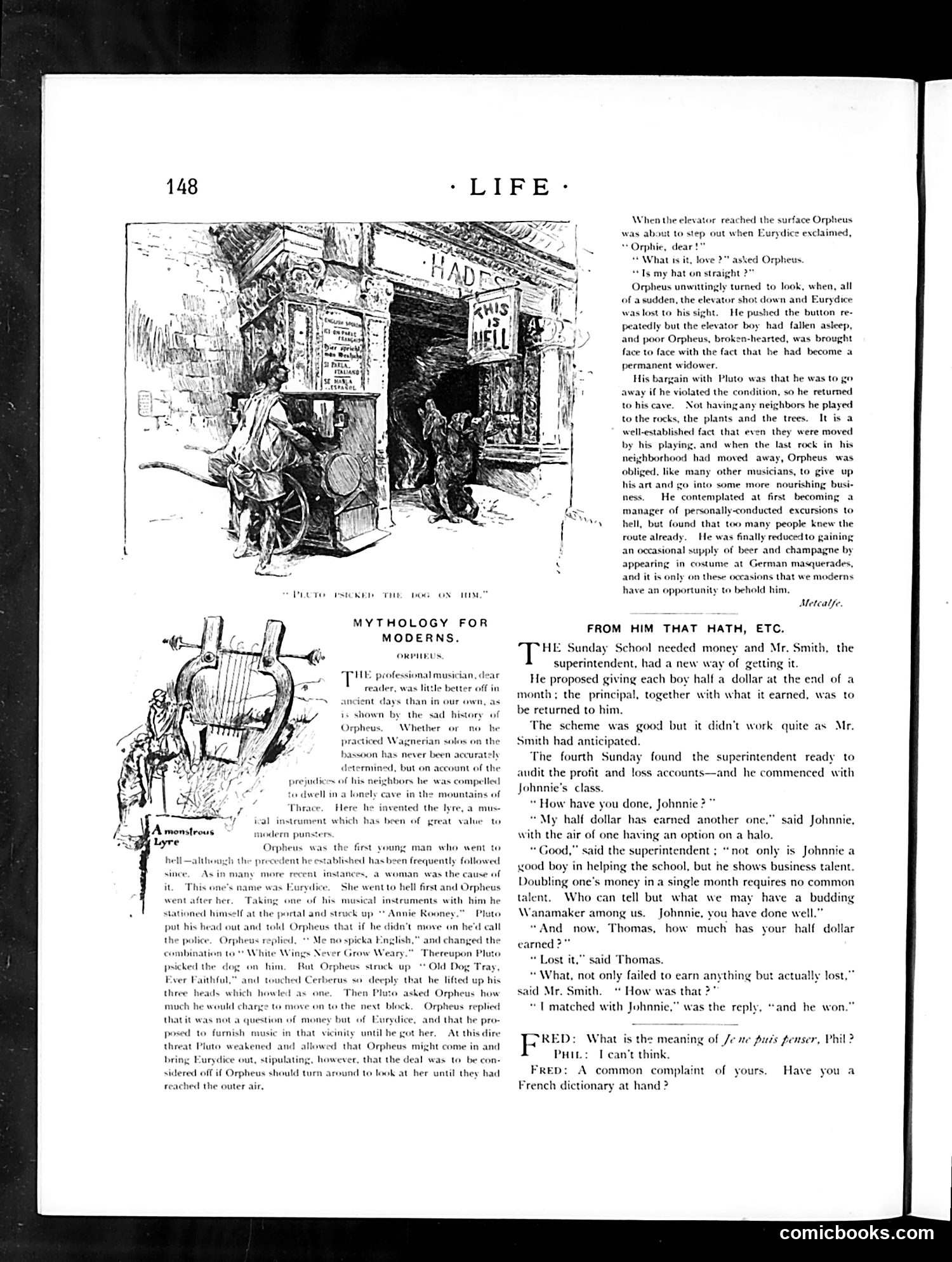
This page contains two distinct pieces of satirical content: 1. **"Pluto Ushered the Dog on Him"** (illustration, top): A sketch showing what appears to be a street scene with a dog and figures near a storefront. The caption's meaning is unclear from the image alone. 2. **"Mythology for Moderns: Orpheus"** (main article): A satirical retelling of the Greek myth updated for contemporary America. It mocks Orpheus as a struggling professional musician reduced to beer-hall performances in "German masquerades." The satire critiques how artistic talent fares in modern commercial society—even mythological genius must compromise for survival. The text suggests the piece comments on Depression-era economic hardship affecting performers. The page also includes an unrelated school finance anecdote about a superintendent's profit-sharing scheme with students.
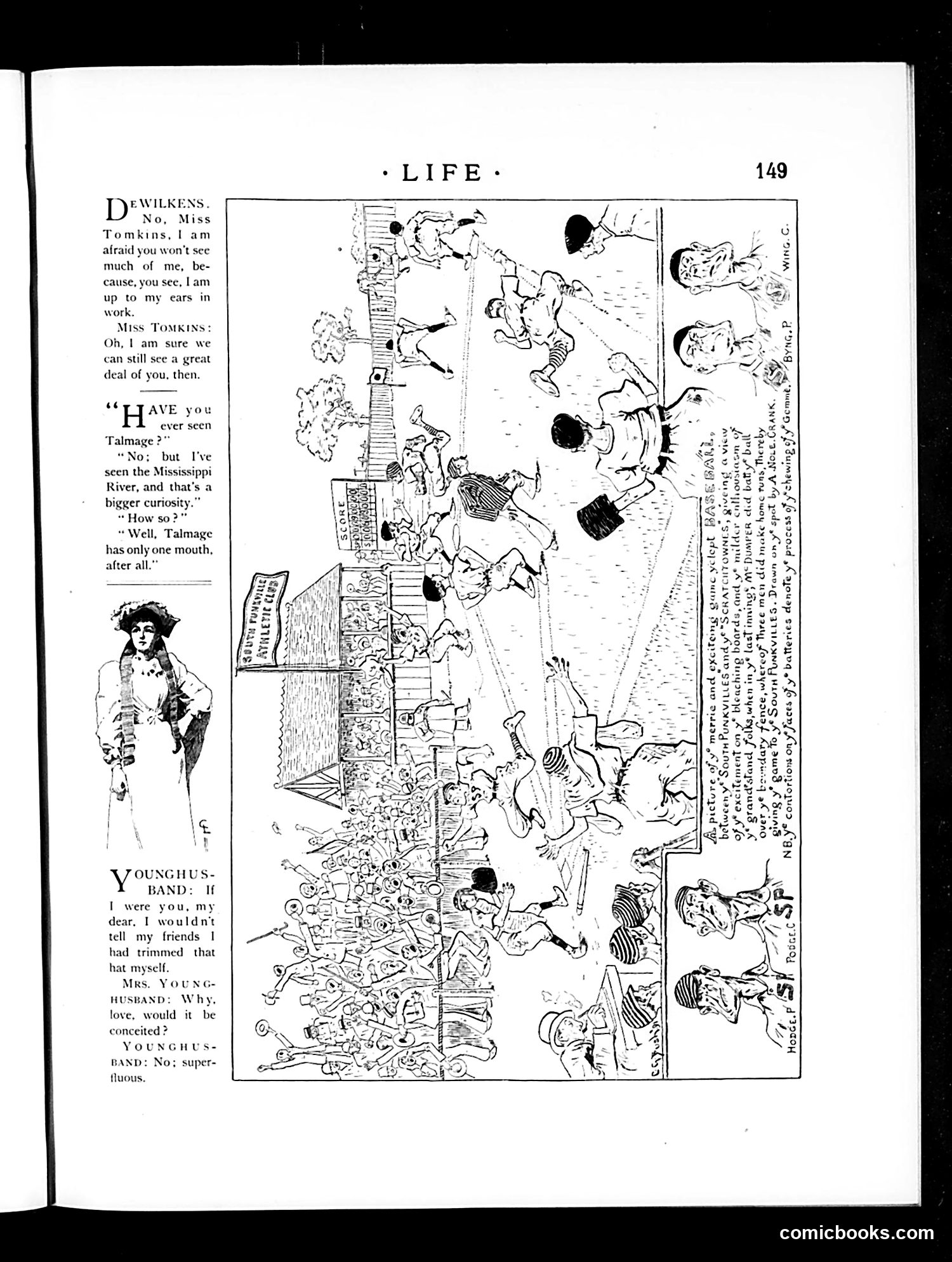
This page contains satirical dialogue and a large cartoon illustration. The text shows a conversation between "Dewilkens," "Miss Tomkins," and "Younghusband" discussing sightseeing and the Talmage River. The main cartoon depicts an extremely crowded riverboat or excursion vessel packed with passengers in chaotic, humorous poses. The satire targets **overcrowded tourist attractions** — specifically the apparent madness of popular river excursions where masses of people are sardined together. The contrast between the dialogue's casual mention of sightseeing and the cartoon's depiction of absolute pandemonium illustrates the gap between tourist expectations and reality. The packed, absurd masses of bodies suggest commentary on **commercialized tourism** and the undignified crush of crowds seeking leisure experiences, a theme Life magazine frequently mocked during the early 20th century.
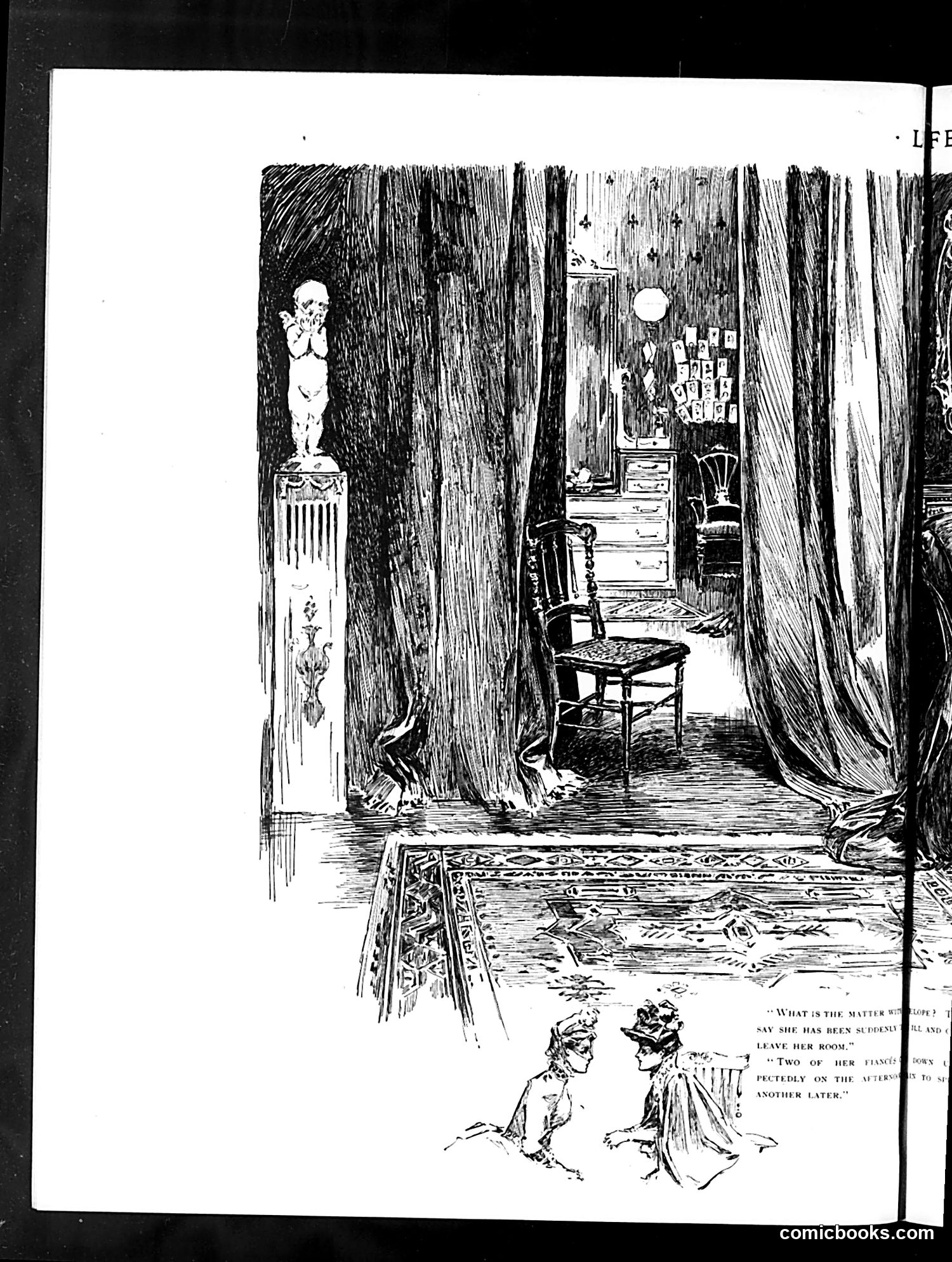
This illustration depicts an interior domestic scene with two women in conversation in the foreground, positioned below an elaborate bedroom viewed through curtains. The room features period furnishings including a chair, dresser with photographs, and decorative elements. The dialogue indicates a social scandal: one woman asks "What is the matter with Mabel? Say she has been suddenly ill and leave her room," to which the other responds "Two of her fiancés were suddenly on the other day [another later]." This satirizes the contemporary social phenomenon of women maintaining multiple engagements simultaneously—apparently a recognized scandal of the era. The humor derives from the absurdity of the situation and the woman's casual deception about her friend's "illness" to cover the embarrassment. The illustration style and subject matter are consistent with Life magazine's satirical commentary on upper-class social manners and courtship customs.
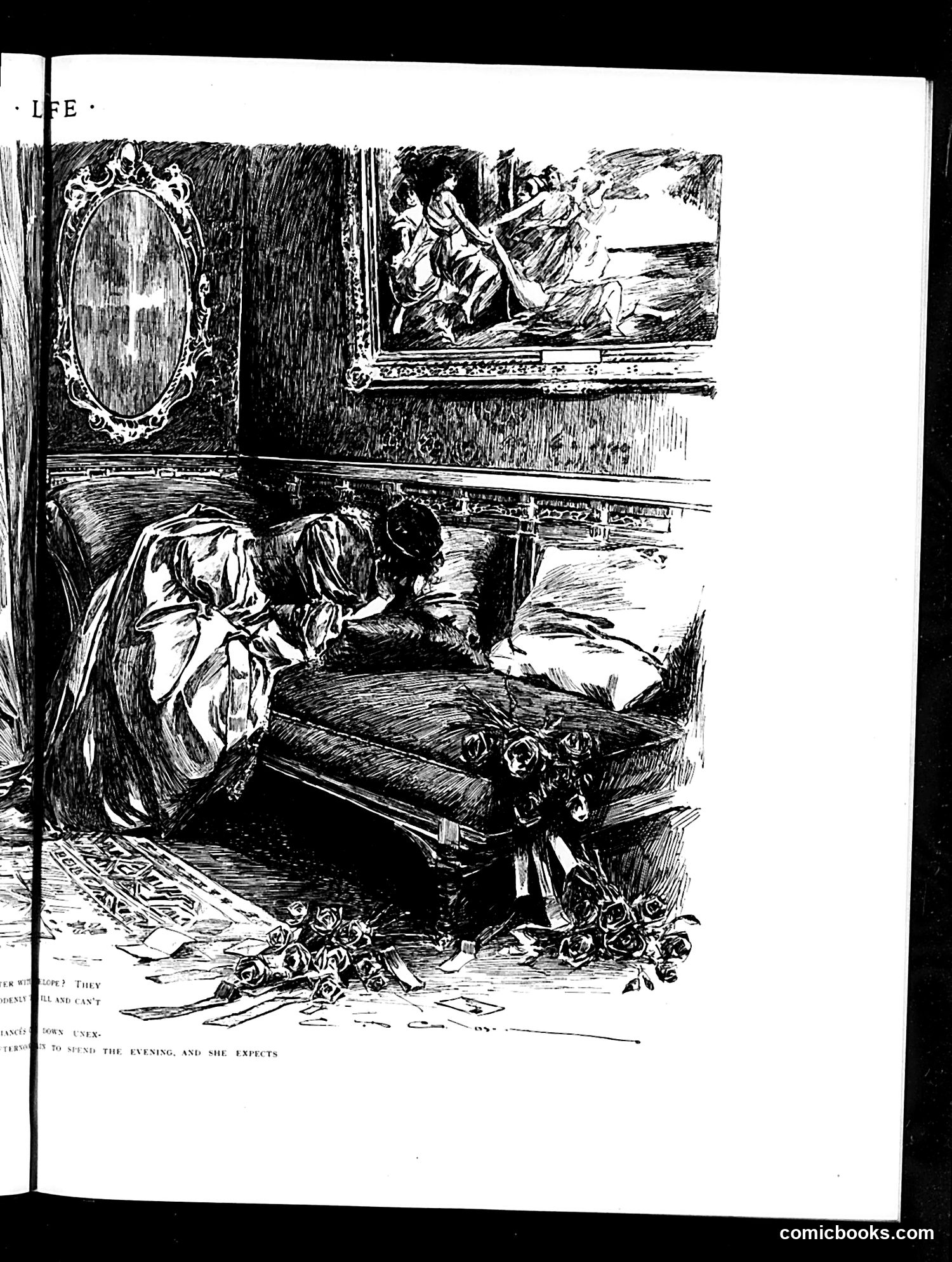
This appears to be an illustration from Life magazine's satirical section. The image shows a fashionable woman reclining on a couch in an ornate interior, gazing upward at a framed painting above her mantelpiece. The painting depicts classical or mythological figures in dramatic poses. The satire seems to target romantic idealism versus reality: the woman appears to be daydreaming about the idealized scenes in the artwork above her—scenes of drama, adventure, and passion—while she sits in her comfortable but mundane domestic setting surrounded by flowers. The caption (partially visible) references "the evening" and that "she expects," suggesting commentary on romantic expectations versus actual life. This type of satire was common in Life magazine, mocking both women's romantic fantasies and the gap between artistic aspiration and everyday existence.
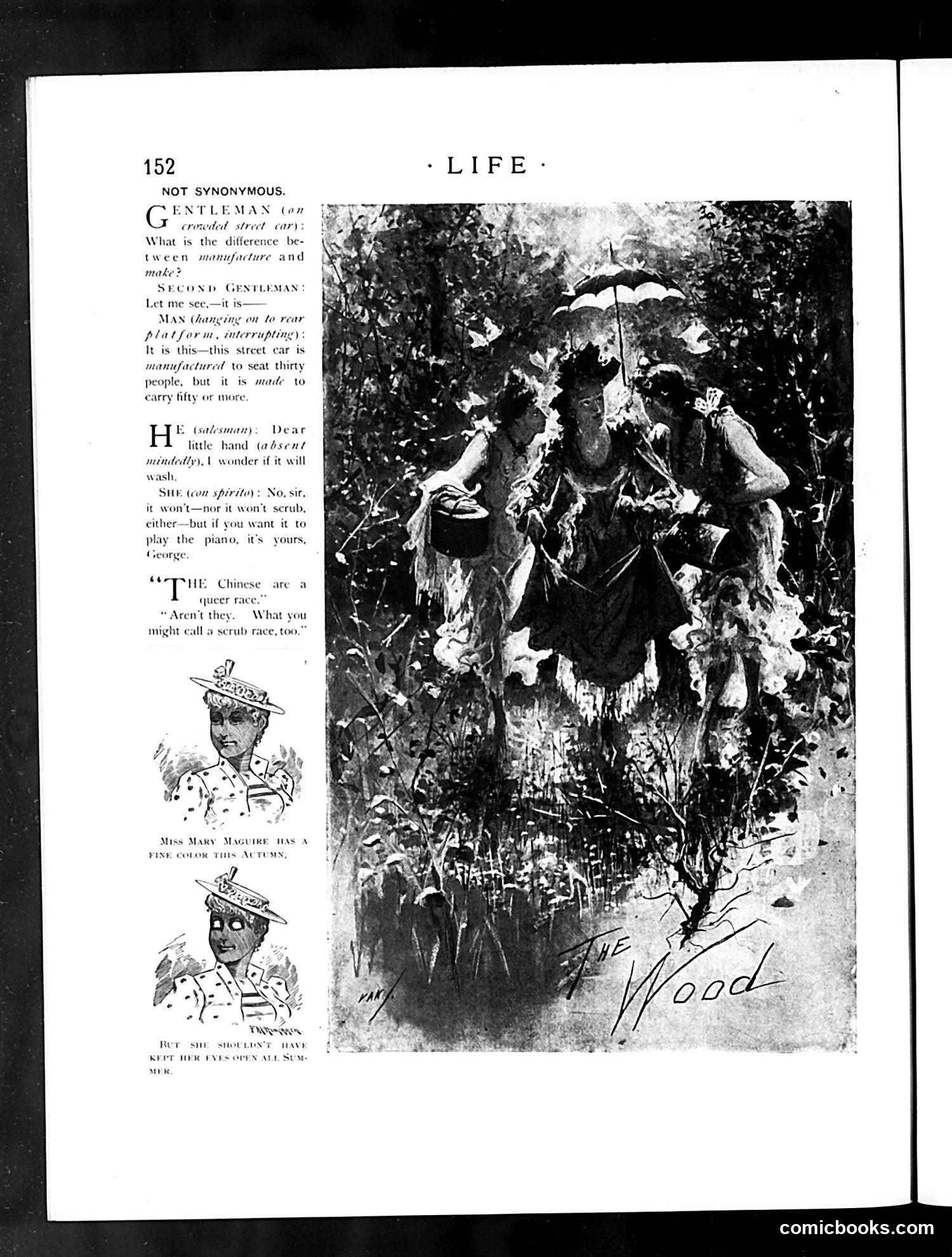
This page contains three unrelated satirical jokes typical of early 20th-century Life magazine humor: 1. **The streetcar joke** mocks the gap between manufacturing specifications and real-world use—a car designed to seat 30 is actually made to carry 50+, satirizing overcrowding on urban transit. 2. **The salesman dialogue** appears to be wordplay about a glove or similar item, where "Sue" jokes that if the item won't wash or scrub, at least it could "play the piano"—likely mocking both the product's poor quality and the absurdity of salesmen's exaggerations. 3. **The "Chinese are a queer race" exchange** uses a racist pun: someone suggests they're "queer" (odd), then another suggests calling them a "scrub race"—offensive period humor playing on stereotypes. 4. **The illustrations** reference Miss Mary Maguire's complexion, with a final note cautioning she shouldn't have kept her eyes open in the sun—likely referring to tanning or complexion issues contemporary to the era.
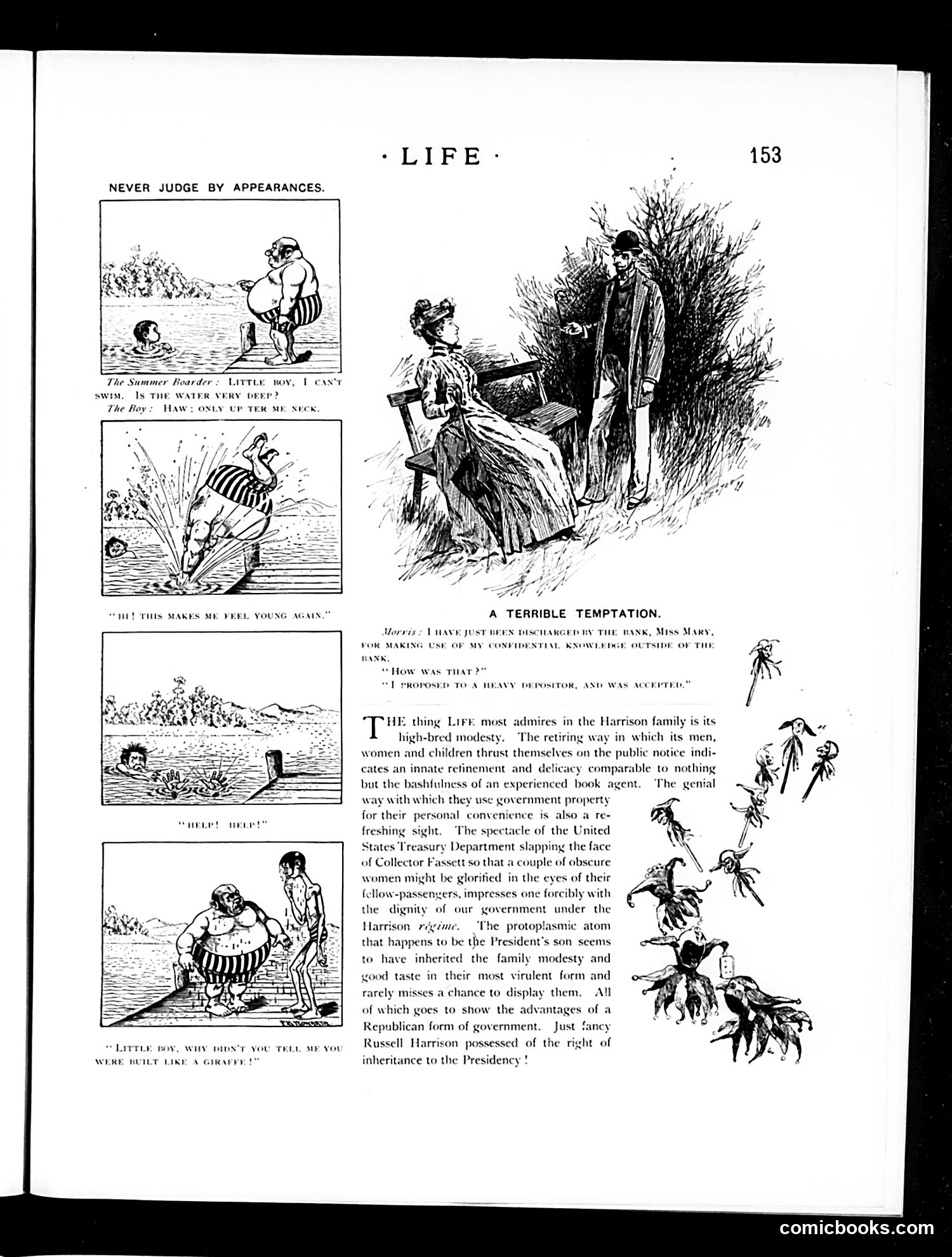
This page contains two distinct pieces of satire: **"Never Judge by Appearances"** (left): A comic strip mocking summer visitors. A portly man asks a boy about water depth; the boy replies it's only "up to my neck"—implying the man is unusually tall or the boy is being deliberately misleading. The humor plays on physical contrasts and innocent deception. **"A Terrible Temptation"** (right): Satirizes a bank employee (Morris) who was fired for using confidential depositor information—not for fraud, but to propose marriage to a wealthy client. The joke critiques both his misuse of privileged knowledge and his social climbing through financial information. **The Harrison Family critique** (main text): This is **political satire** attacking President Benjamin Harrison's administration (1889-1893) and his son Russell Harrison. Life sarcastically praises the Harrison family's "high-bred modesty" while actually condemning their shameless use of government power for personal glory and advantage—specifically referencing Treasury Department official Collector Fassett's conduct. The final jab questions whether Russell Harrison should inherit the presidency.
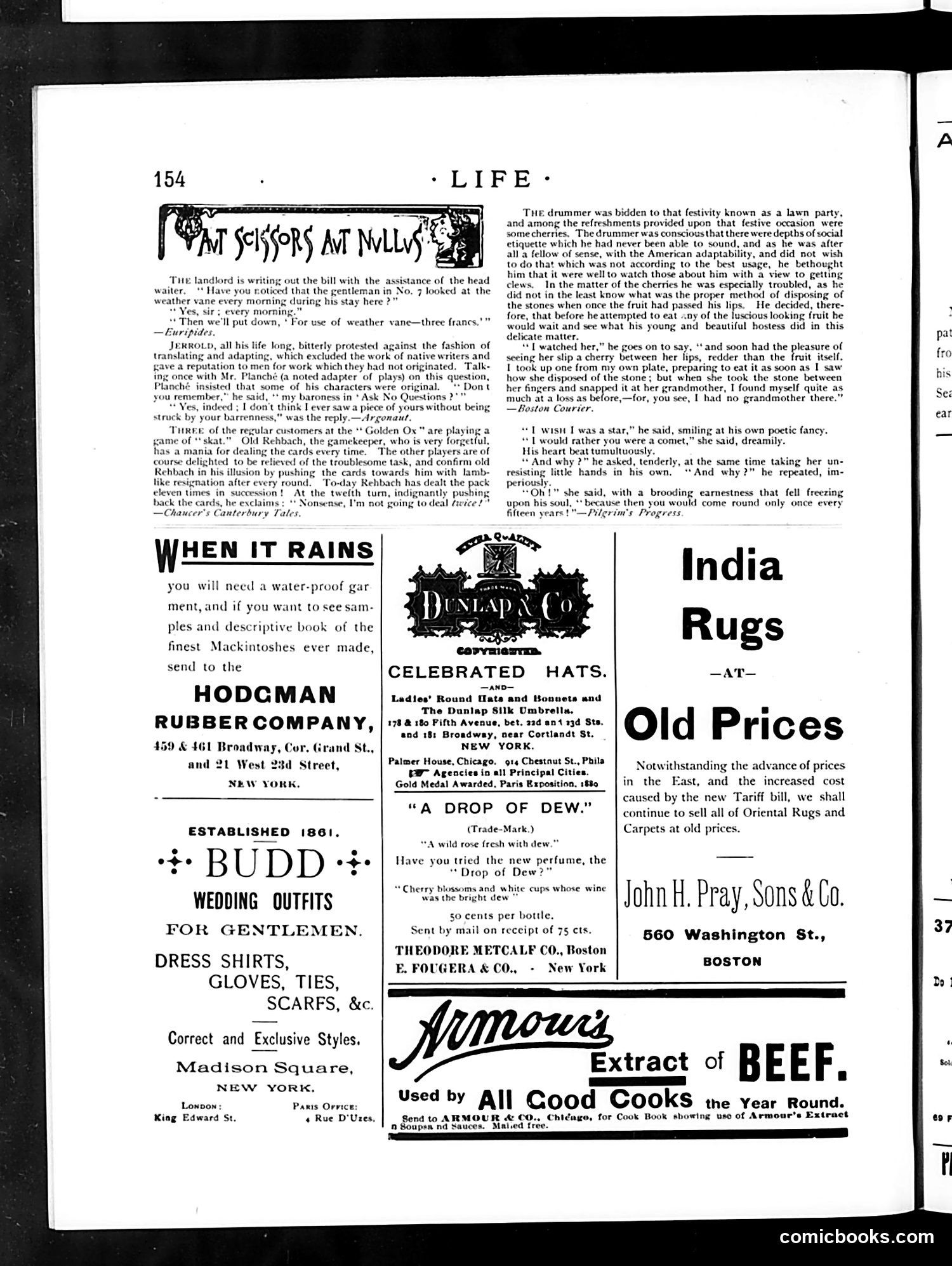
This page is primarily **advertising with several short humorous anecdotes** rather than political cartoons. The title cartoon depicts a landlord billing a hotel guest, joking that the gentleman checked the weather vane every morning—so they'll charge extra for "use of weather vane—three francs." It's gentle satire of petty hotel overcharging. The three short stories are Victorian-era humor pieces: one mocks playwright adaptations; another describes confusion over card-dealing in a game called "skat"; a third relates an American drummer (traveling salesman) at a lawn party who, uncertain about cherry-eating etiquette, watches his hostess spit the stone at her grandmother—leaving him equally confused. The final anecdote contains mild romantic satire: a man wishes he were a star; the woman prefers he were a comet (appearing only once every 75 years)—suggesting she wants minimal romantic contact. **The page is dominantly advertisements** for Hodgman rubber goods, Budd wedding outfits, Dunlap hats, India rugs, and Armour's beef extract. The humor reflects genteel, middle-class anxieties about social propriety and domestic life.
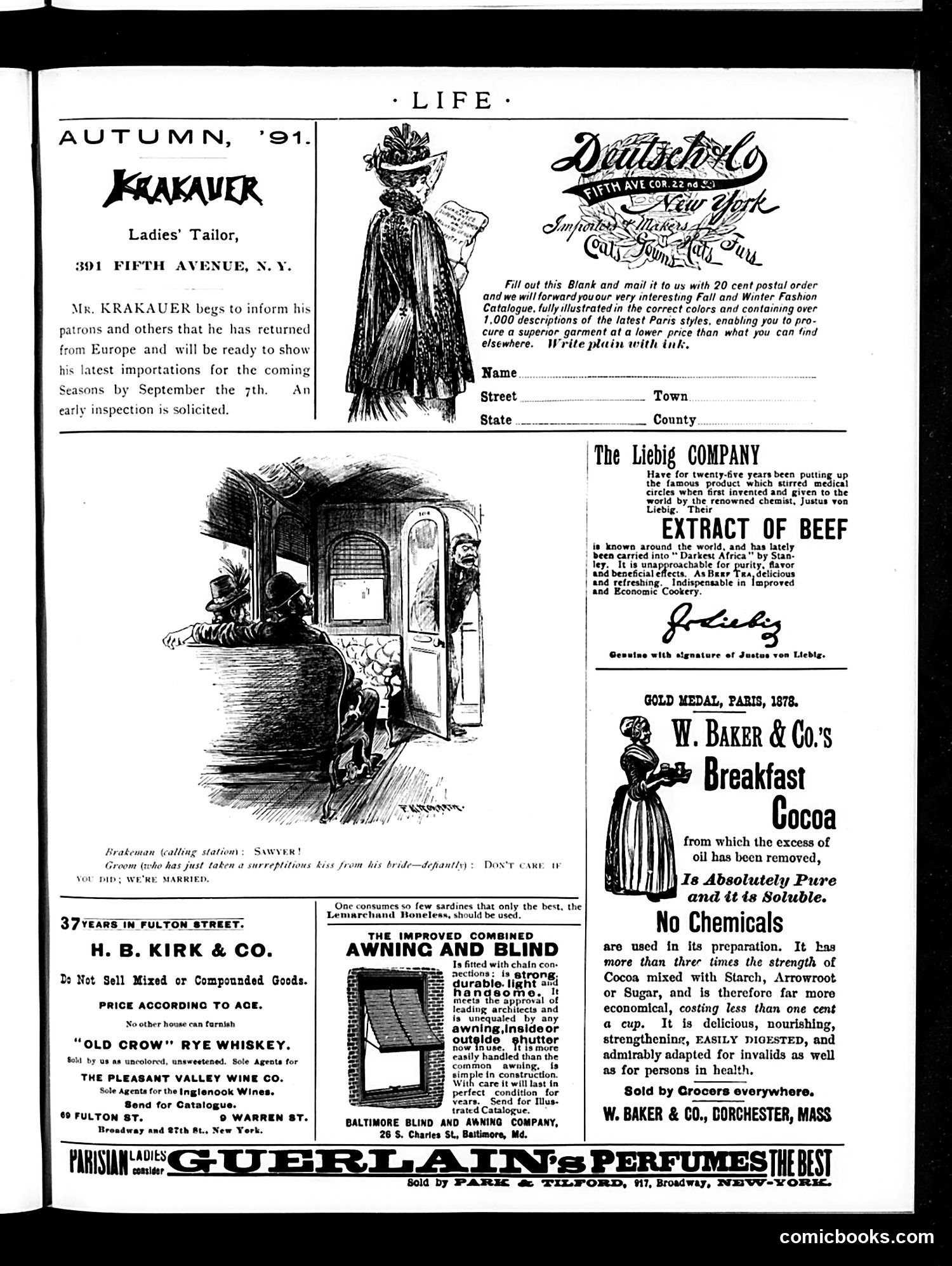
This is primarily an **advertising page** with one modest cartoon. The main content consists of period product ads (whiskey, cocoa, awnings, perfume, fashion services). The single cartoon depicts a **brakeman at a train station** confronting a groom who has just kissed his bride. The brakeman calls out "Sawyer!" (the groom's name, apparently), and the groom defensively responds "Don't care if you did; we're married." The joke appears to be a mild domestic humor: the brakeman is either playfully teasing or genuinely surprised to witness the newlywed couple's public affection at the station. The groom's defiant response suggests he's asserting his marital rights to kiss his wife despite potential social impropriety of public displays. It's sentimental rather than sharp satire—typical of 1891 magazine filler humor about newlyweds and propriety.
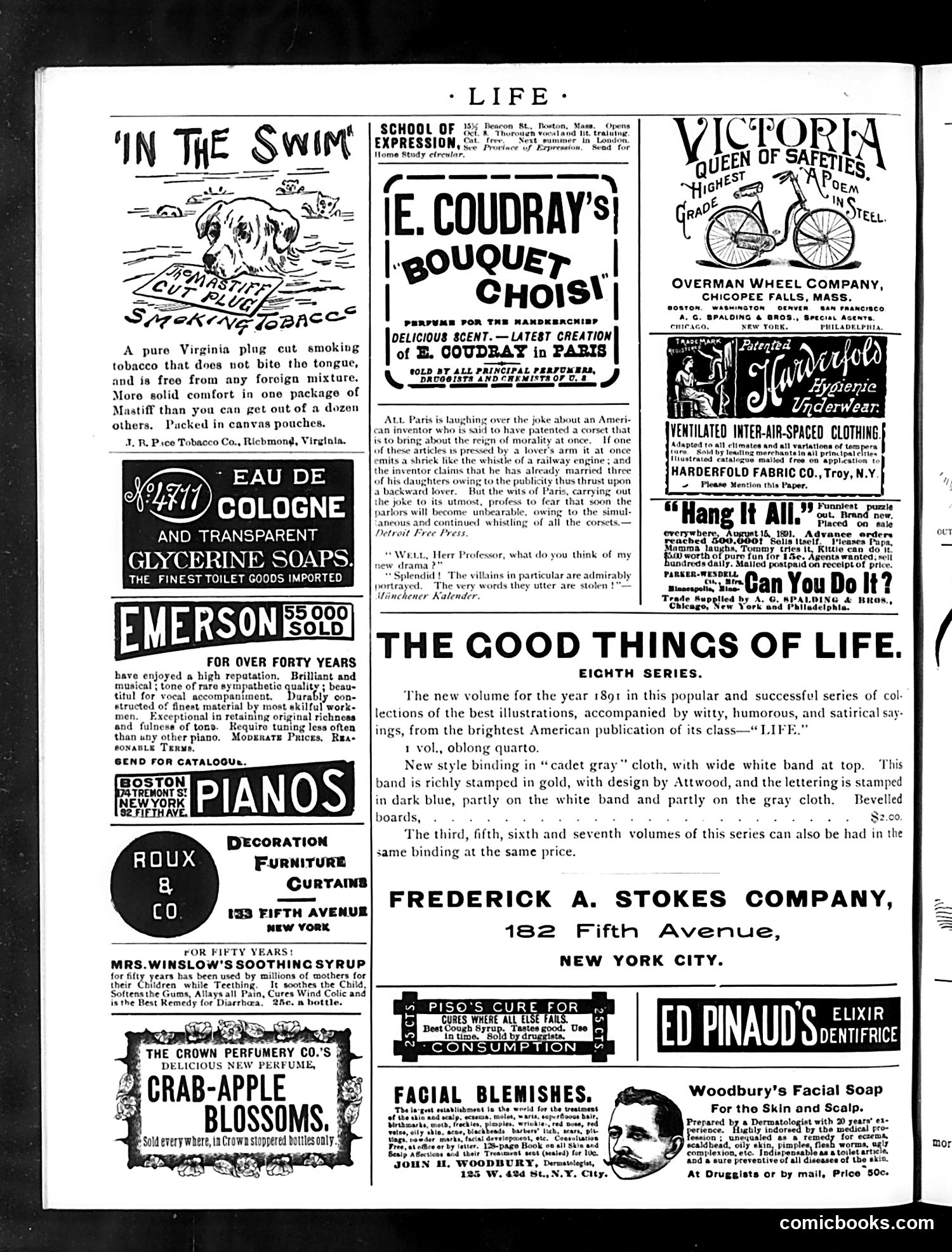
This page is primarily **advertisements** with one brief satirical anecdote. The main content of interest: **"The Corset Joke"** (center column): This references a humorous Paris story about an American inventor who patented a "moral corset"—a device that emits a loud whistle like a train when pressed by a lover's arm. The satire mocks both American prudishness and the inventor's absurd solution to morality. Parisian wits extended the joke by joking that parlors would become unbearable from constant whistling as multiple women wore these corsets. The humor relies on understanding **late 19th-century anxieties about courtship, chastity, and the tension between European sophistication and American moral rigidity**. The "shrieking corset" is a ridiculous mechanical enforcement of propriety. The page otherwise consists of period advertisements for tobacco, perfume, pianos, soap, and patent medicines—typical of Life magazine's revenue model.
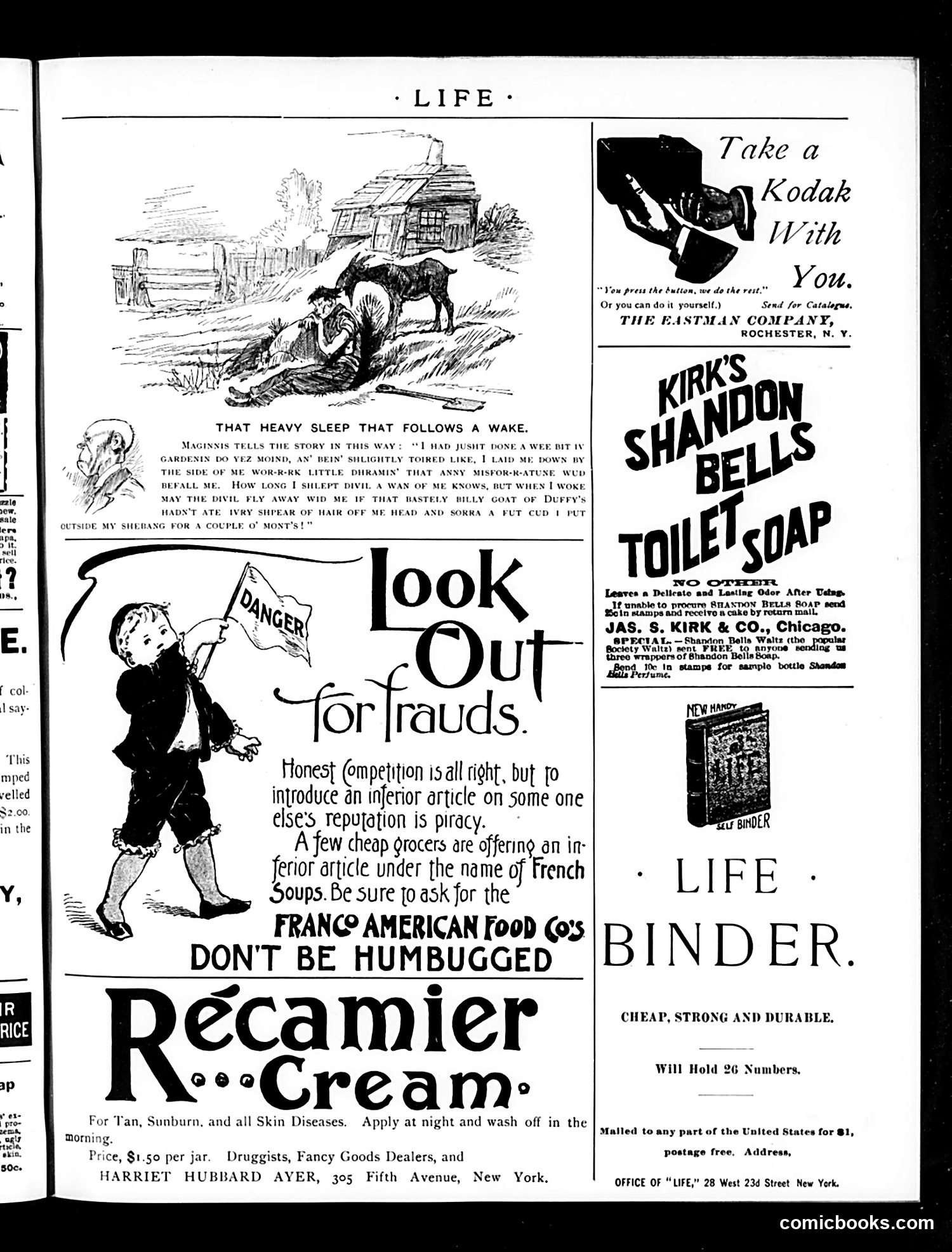
This page consists primarily of **advertisements and humor** rather than political commentary. The main cartoon warns against **product counterfeiting**. It depicts a child holding a "Danger" sign, cautioning consumers that unscrupulous grocers were selling inferior French soups under the legitimate "Franco American Food Co's" brand name. This was a common 19th-century fraud: competitors would cheaply imitate popular products to profit from an established reputation. The upper cartoon, titled "That Heavy Sleep That Follows a Wake," is an Irish-dialect humor piece (indicated by phonetic spelling like "JUSHT" and "DIVIL") about a man whose goat ate all his hair while he slept off a drinking binge. The remaining content is straightforward advertising for period products: Kodak cameras, Recamier Cream (a skin treatment), Shandon Bells soap, and a Life magazine binder. These ads reflect consumer goods and concerns of the era.
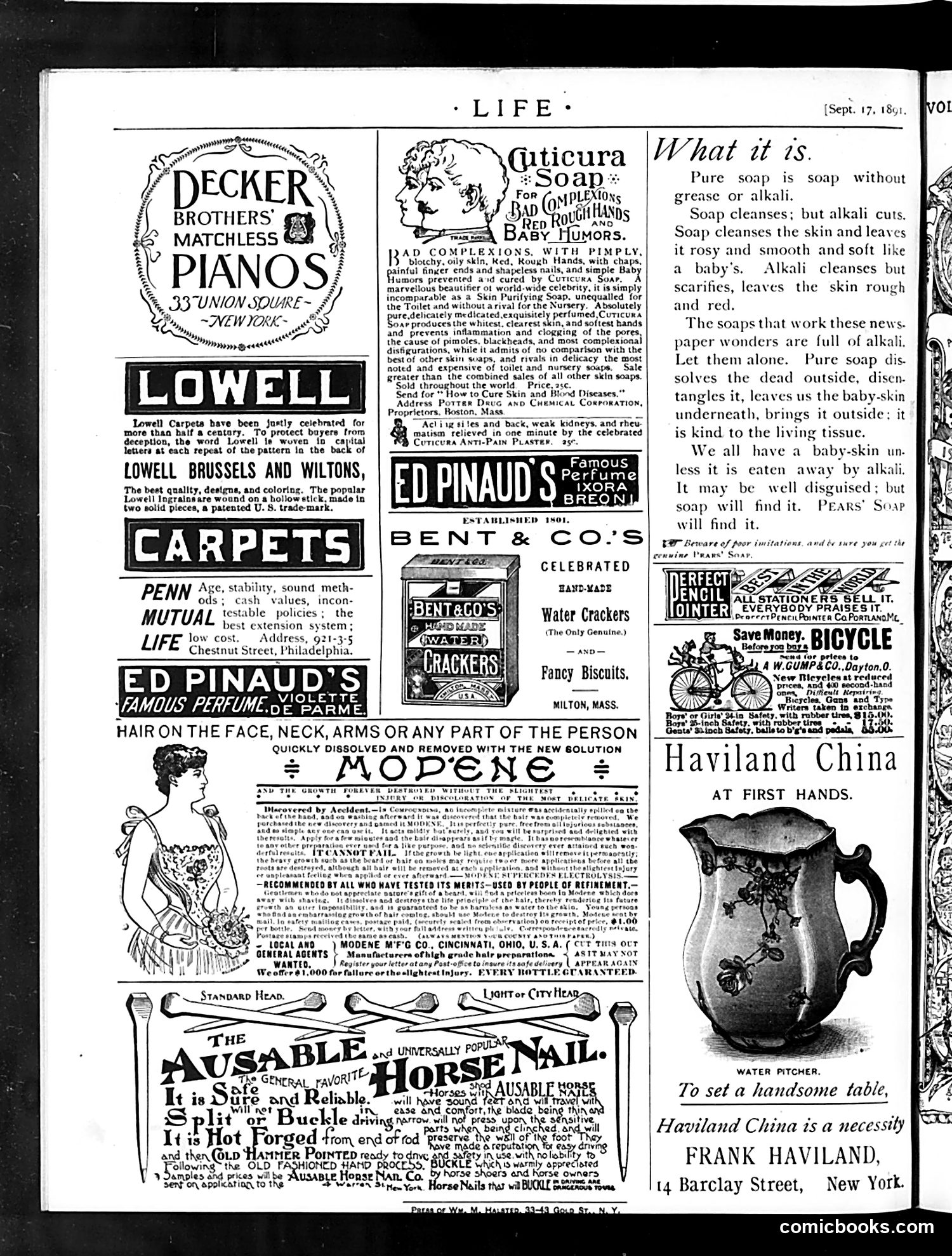
This page is primarily **advertising** rather than editorial content or satire. It features various commercial products typical of the 1890s: pianos, carpets, perfumes, soaps, crackers, bicycles, and china. The one substantial illustrated ad addresses a real health concern of the era: **hair removal**. The "Modene" product promises to eliminate unwanted facial and body hair "quickly and permanently without the slightest injury to the skin." The accompanying text emphasizes scientific legitimacy, claiming the method has been "tested" and that hair removal "was discovered" through experimentation. The **Pears' Soap ad** contains a social message: it contrasts pure soap (gentle, leaves skin "rosy and smooth") with caustic alkaline products that damage skin. This reflects genuine 19th-century concerns about harsh hygiene products. Other ads promote established brands (Cuticura, Ed Pinaud's) targeting common complaints: complexion issues, weak kidneys, rheumatism. The page overall reflects consumer anxieties and aspirational products of the Gilded Age.