
Life, 1891-09-17 · page 8 of 18
Life — September 17, 1891 — page 8: what you’re looking at
What you’re looking at
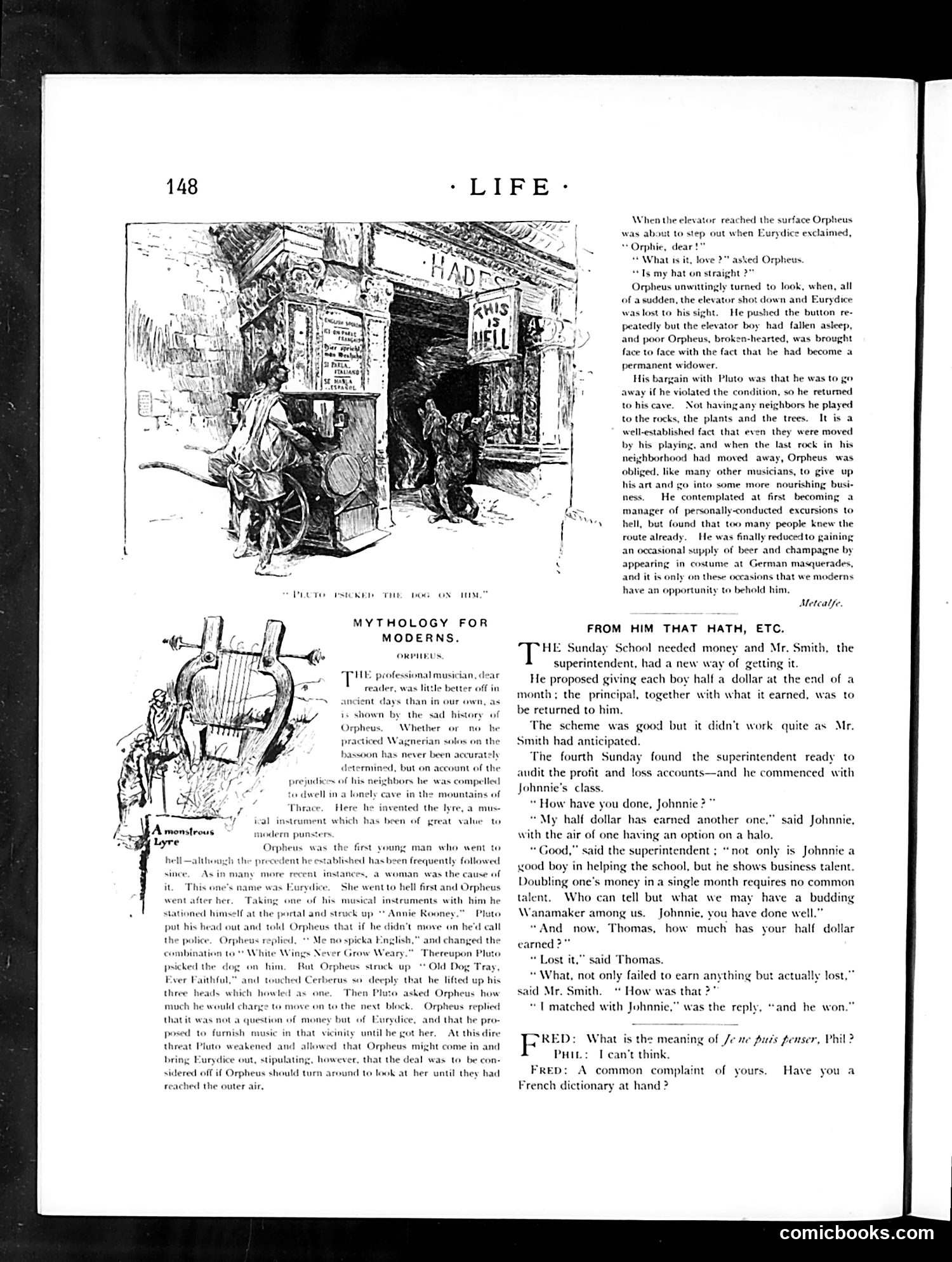
This page contains two distinct pieces of satirical content: 1. **"Pluto Ushered the Dog on Him"** (illustration, top): A sketch showing what appears to be a street scene with a dog and figures near a storefront. The caption's meaning is unclear from the image alone. 2. **"Mythology for Moderns: Orpheus"** (main article): A satirical retelling of the Greek myth updated for contemporary America. It mocks Orpheus as a struggling professional musician reduced to beer-hall performances in "German masquerades." The satire critiques how artistic talent fares in modern commercial society—even mythological genius must compromise for survival. The text suggests the piece comments on Depression-era economic hardship affecting performers. The page also includes an unrelated school finance anecdote about a superintendent's profit-sharing scheme with students.
📄 Transcribed text from this page (OCR, searchable)
Machine-transcribed from the original scan — historical spelling and the odd misread are preserved.
x \ “Wt PLoTo rstexen TH Hog ON tM.” MYTHOLOGY FOR MODERNS. ORPIEUS, “THLE professional musician, dear off in ancient days than in our own, reader, was little bett is shown by the sad history Whether or ian solos on the Orpheus. no he practiced W. bassoon has never been accurately nt of the hbors he was compelled determined, but on ac rdices of his nei to dwell ina lonely cave in the mountains of Thrace. Here he invented the lyre, a mus: ical insteument which has been of gn to A monstrous . Lyre h although th: As ir it This © went after deen punsters Orph precedent hee was the first young man who went to tly followed & woman was the cause of ent to hell first and Orpheus musical insteuments with him he Pluto n he'd call ab) hasbeen freque sin any more recen ‘s name was Eurydice Taking of hi sped himself at the portal and struck up * Annie Rooney.” put his head out and told Orpheus that if he didn’t mov ka English ss Never Grow Weary. Rut O I touched Cerber the police. Orpheus replied, Me ne Wi and changed the combinatic psicked the di hi Ever Faith three h much he w Thereupon Pluto s struck up“ Old Dog Tray, (he lifted up his so deeply t Is which howled as one, Then Pluto asked Orpheus how Orph estion of money but of Eurydice, and that bh ld charge to move on to the next block us replied that it was not aq pro- At this dire wed that Orpheus might come in and posed to furnish music in that vicinity until he got her, threat Pluto weakened and a . that the deal was to be con- ad to look 3 bring Eurydice out, stipulating, howev sidered off if Orpheus should turn are her until they had reached the outer air, When the elevator reached t was about to step out w + Orphie, + What is it, love 2” asked Orpheus “+ Is my hat on straight 2” Orpheus unwittingly turned to ook, when, all of a sudden, the elevator shot ¢ was lost to his sight. He pushed the button re- peatedly but the elevator boy had fallen asleep, and poor Orpheus, broken-hearted, was brought face to face with the fact that he had become a permanent widower His bargain with Pluto was that he was to go away if he violated the condition, so he returned to his cave. Not having any neighbors he played to the rocks, the plants and the trees. It is a well-established fact that even they were moved by his playing, and when the last rock in his neighborhood had moved away, Orpheus was obliged. like many other musicians, to give up his art and go into some more nourishing busi- ness. He contemplated at first becoming a manager of personally-conducted excursions to hell, but found that too many people knew the route already. an occasional supply of beer and champagne by appearing in costume at German masquerades, e surface Orpheus en Eurydice exclaimed, dear! wn and Eurydice He was finally reduced to gaining and it is only on these occasions that we moderns have an opportunity to behold him, Metcalfe, FROM HIM THAT HATH, ETC. HE Sunday School needed money and Mr. Smith, the superintendent, had a new way of getting it. He proposed giving each boy half a dollar at the end of a month; the principal, together with what it earned, was to be returned to him. The scheme was good but it didn't work quite as Mr. Smith had anticipated. The fourth Sunday found the superintendent ready to audit the profit and loss accounts—and he commenced with Johnnie's class. * How have you done, Johnni “My half dollar has earned another one.” said Johnnie, with the air of one having an option on a halo. “Good,” said the superintendent ; “not only is Johnnie a xood boy in helping the school, but he shows business talent. Doubling one’s money ina single month requires no common talent. Who can tell but what we may have a budding anamaker among us. Johnnie, you have done well.” And now, Thomas, how much has your half dollar carned >" “Lost it,” said Thomas. “ What, not only failed to earn anything but said Mr. Smith.“ How was . “TL matched with Johnnie,” was the reply ctually lost,” ‘and he won.” RED: What is the meaning of Je ne pir’s penser, Phil ? PHit: Tecan’t think. FreD: A common complaint of yours. French dictionary at hand ? Have you a comicbooks.com