
A complete issue · 14 pages · 1891
Life — August 27, 1891
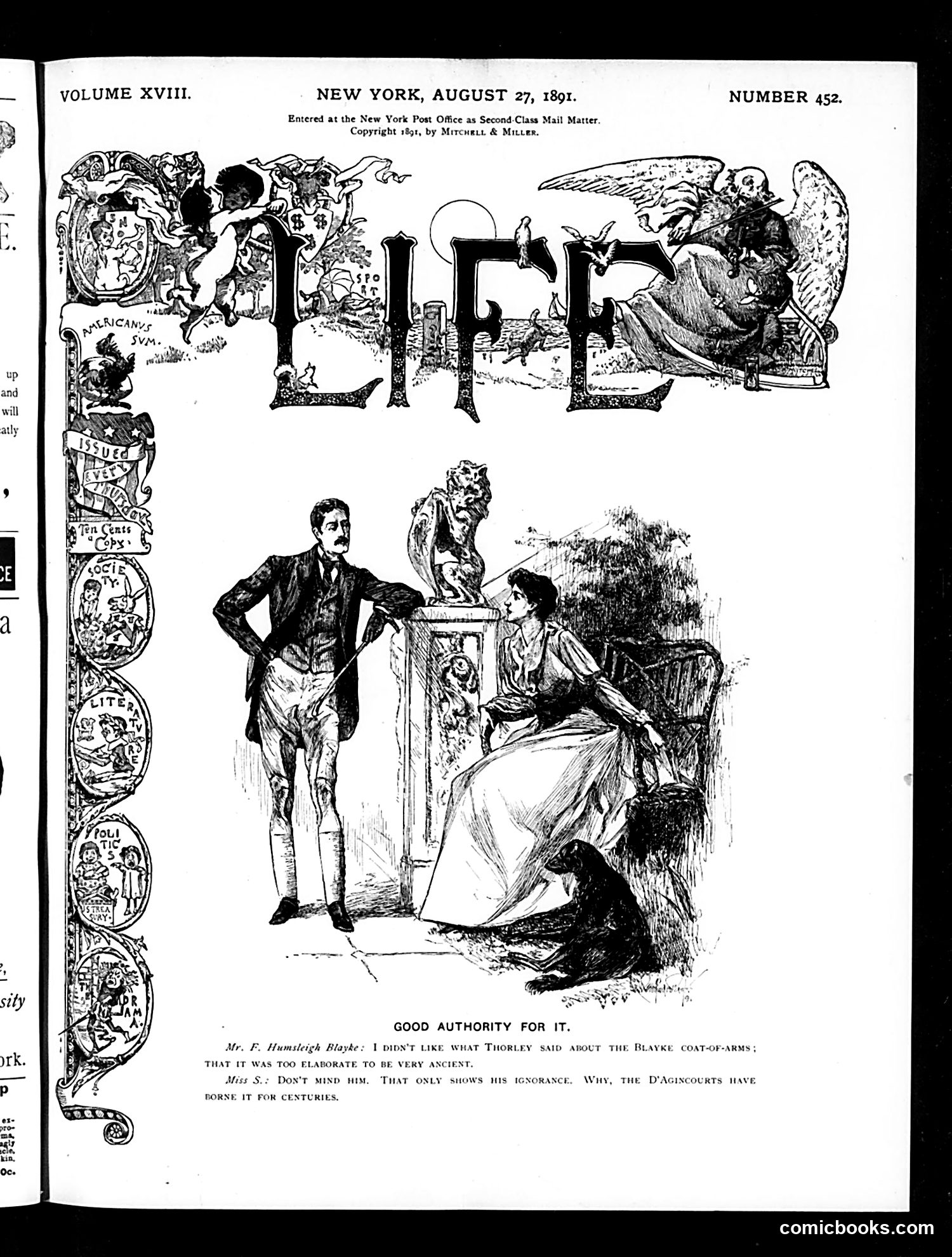
This satirical cartoon titled "Good Authority for It" depicts a social conversation about heraldry and family coats-of-arms. A man (Mr. F. Humdieck Blayke) dismisses criticism of the "Blayke coat-of-arms" as too elaborate and ancient, claiming ignorance excuses it. Miss S. responds that the D'Aincourts family has "borne it for centuries." The satire targets American social pretension—specifically wealthy Americans fabricating or exaggerating aristocratic European heritage. The elaborate decorative border on the left suggests mock-heraldic formality. The joke hinges on the absurdity of claiming ancient nobility while admitting ignorance of one's own family history, mocking the Gilded Age tendency to purchase or invent prestigious ancestry for social advancement.
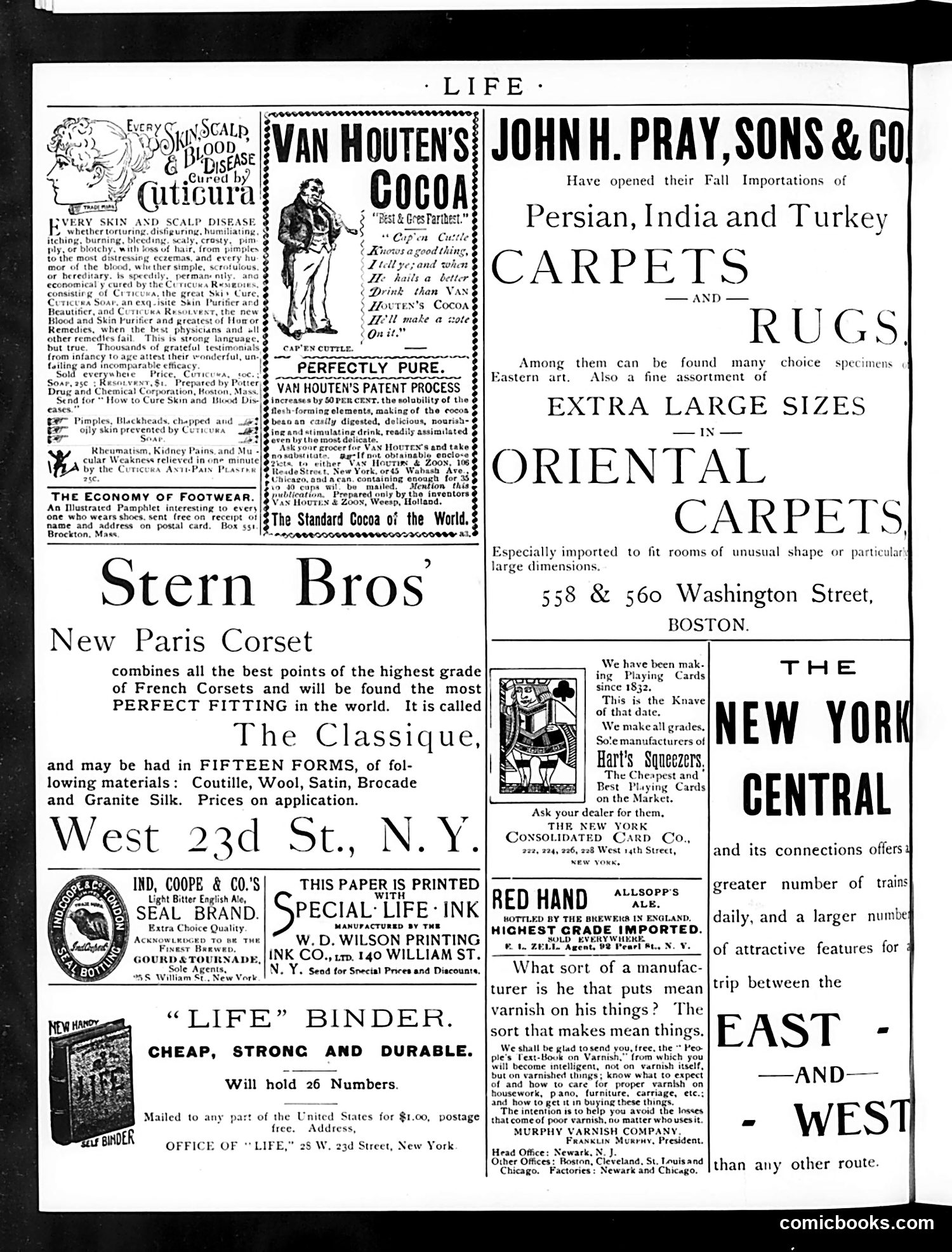
This page is primarily **advertisements** with one small satirical item. The main content includes ads for: - **Cuticura** remedies (skin treatments) - **Van Houten's Cocoa** - **Stern Bros' corsets** - **John H. Pray, Sons & Co** (carpets) - **New York Central Railway** - Various other products The only apparent satirical content is a brief paragraph criticizing manufacturers who apply "mean varnish" to inferior products, suggesting deceptive business practices. The text appears to reference the **Murphy Varnish Company**, implying they mask poor-quality goods with attractive finishes. This reflects turn-of-the-century consumer concerns about product quality and fraudulent manufacturing—a topic Life magazine frequently satirized. However, this is primarily a **commercial page** rather than editorial content.
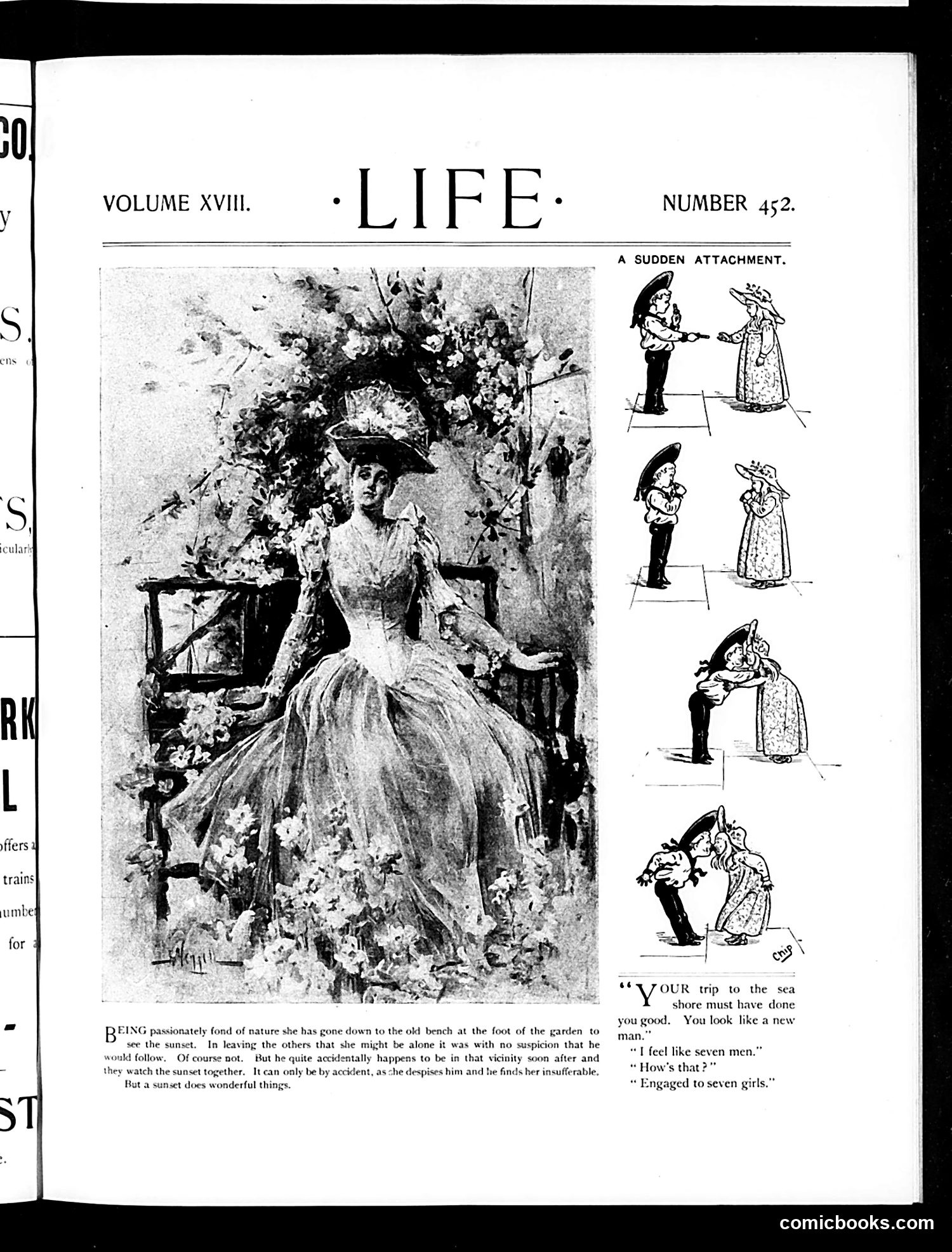
This page presents two distinct pieces: **Left:** A romantic illustration of a woman in an elaborate dress surrounded by flowers, seated in a garden at sunset—depicting idealized courtship imagery. **Right:** A comic strip titled "A Sudden Attachment" showing four sequential panels of a man and woman interacting. The dialogue reveals the joke: after a sea trip, the man feels "like seven men" and mentions being "engaged to seven girls." The humor satirizes rapid romantic entanglements and the comedic notion that a man returns from travel suddenly attractive to multiple women. This reflects early 20th-century Life magazine's frequent use of romantic and dating scenarios for humor, contrasting sentimental idealization with comic reality—a common satirical approach of the era.
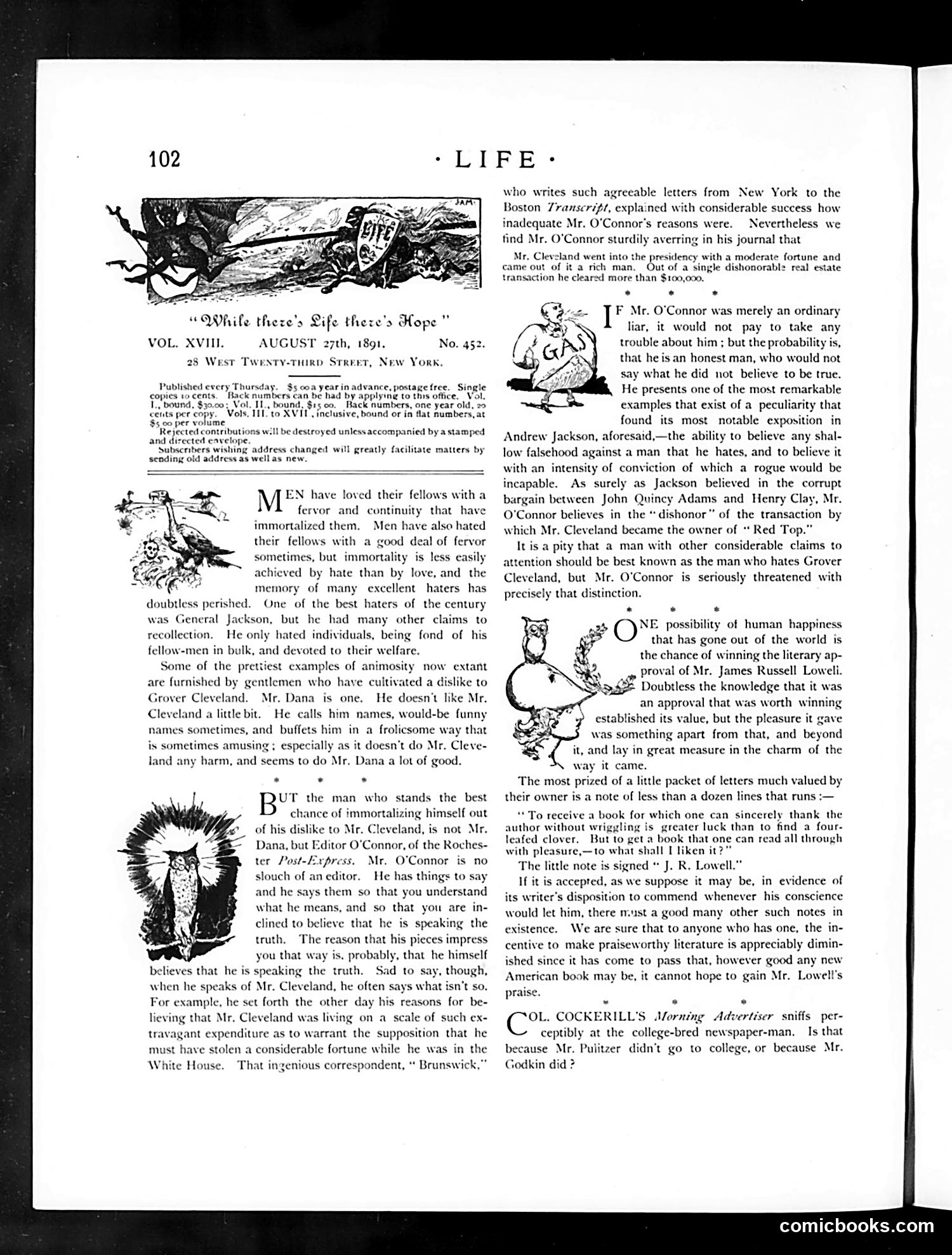
This page discusses Mr. O'Connor, an editor of the Rochester *Post-Express*, through a satirical lens. The text attacks O'Connor's credibility, suggesting he's an "honest man" who nonetheless spreads falsehoods with conviction—comparing his ability to believe his own lies to Andrew Jackson's certainty about corrupt dealings. The main target appears to be O'Connor's claims about Grover Cleveland's wealth and dishonest real estate transactions. The satire argues that O'Connor presents "remarkable examples" of believing unsubstantiated accusations against Cleveland, whom he opposes politically. The page also praises James Russell Lowell's literary approval and mocks Col. Cockerill's *Morning Advertiser* for unknown reasons. The illustrations are decorative vignettes rather than political cartoons.
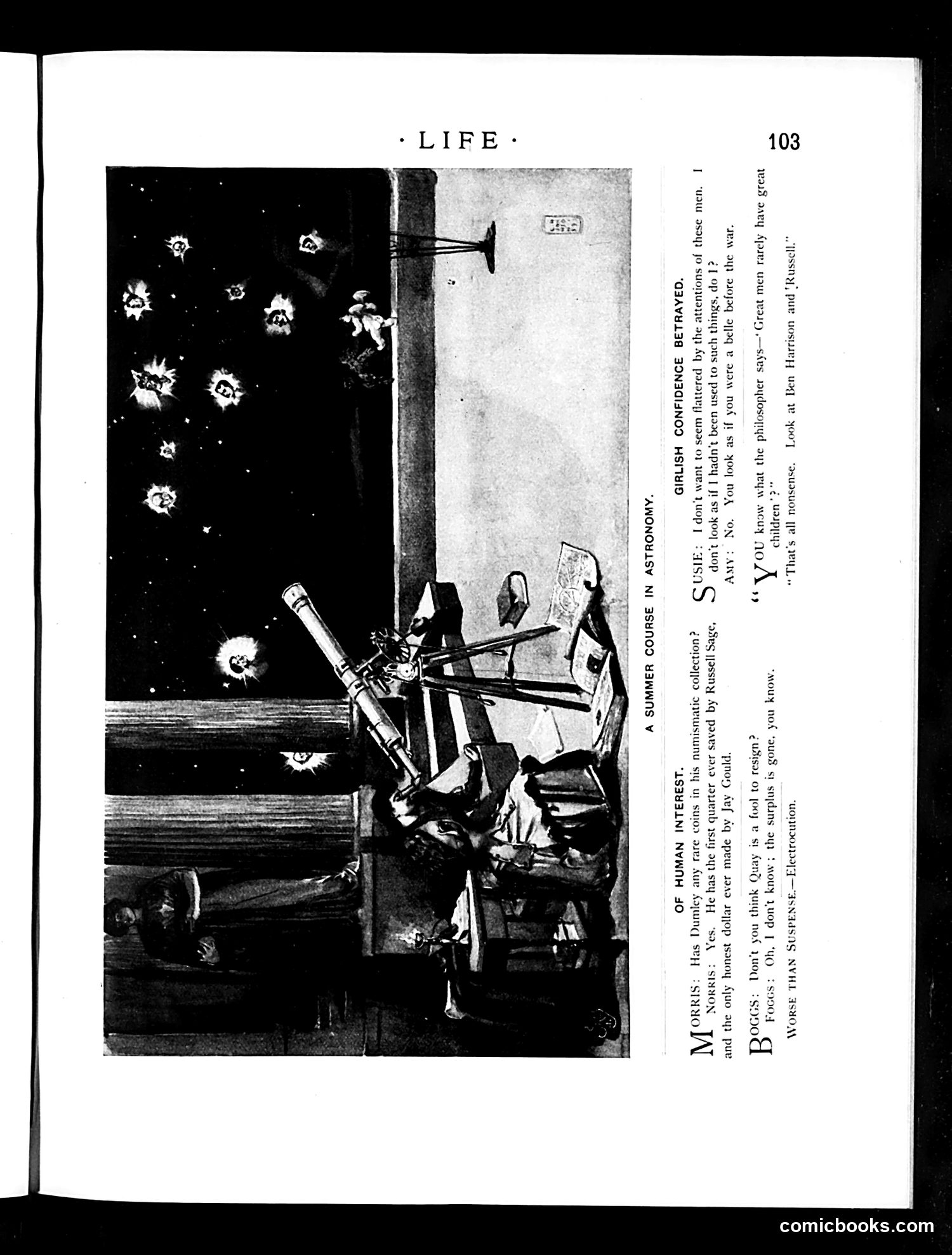
This illustration depicts a human observer at a telescope viewing the night sky filled with stellar objects. The caption reads "A SUMMER COURSE IN ASTRONOMY" with accompanying text about celestial observation. The satire appears to target amateur astronomers or the public's casual interest in stargazing. The humor likely stems from the contrast between the observer's earnest study and the somewhat chaotic or absurd presentation of the stars themselves. The text references "Morris" and mentions "His Majesty are worn in the luministic colorings" and discusses "Byss" (possibly an error for "abyss"). Without clearer context about the specific satirical target or date, the exact political or social commentary remains unclear, though it seems to mock either amateur astronomy enthusiasm or related scientific pretensions of the era.
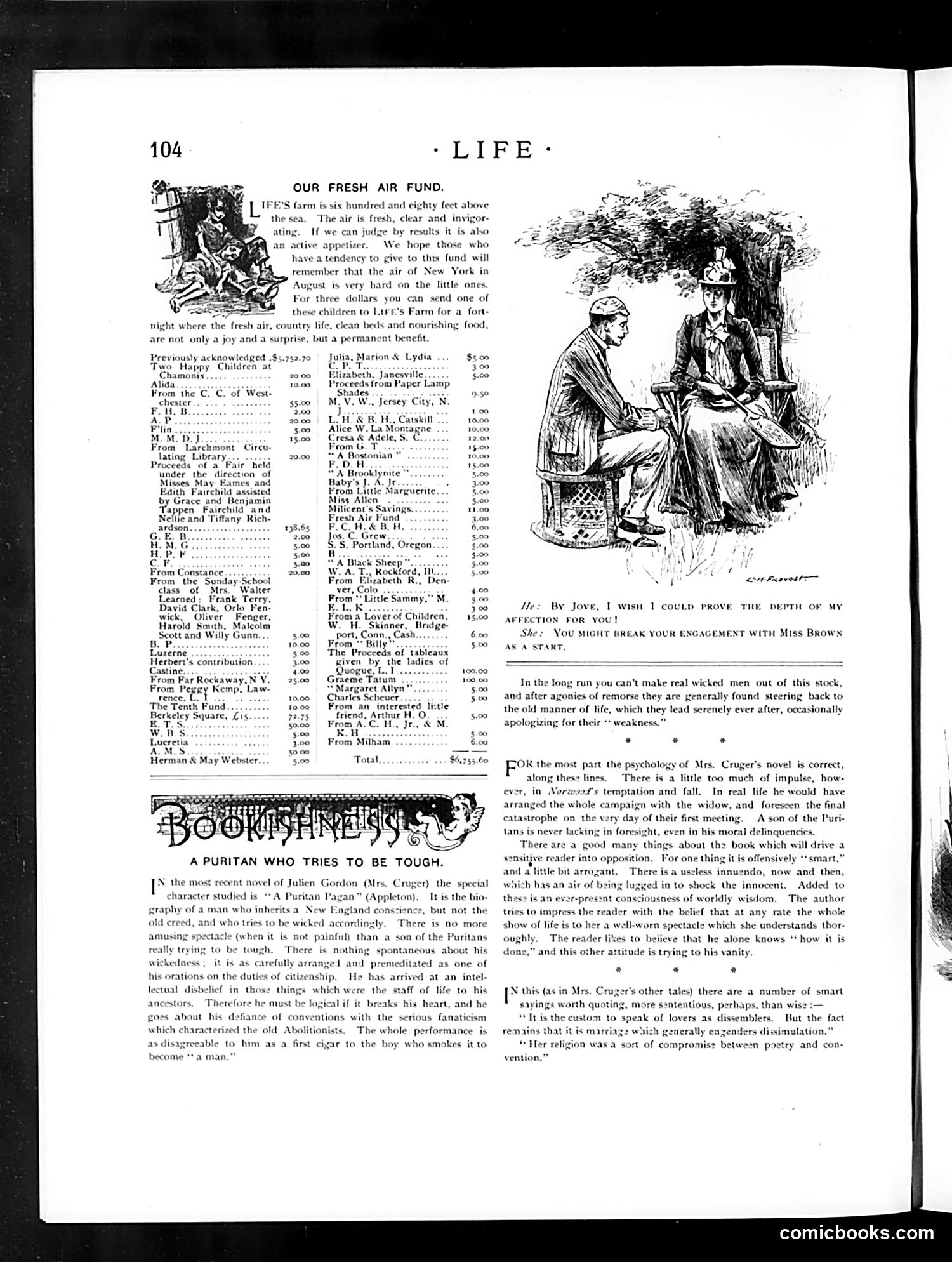
This page contains two distinct elements: **Upper Section:** "Our Fresh Air Fund" lists donations to a charitable cause providing countryside respite for poor urban children. The fund collected $6,733.60 from readers, with individual contributions ranging from $1-$100. This reflects early 20th-century Progressive Era philanthropy addressing urban poverty's effects on children. **Lower Section:** A review of Julien Gordon's novel "A Puritan Pagan" discusses its protagonist—a man struggling between Puritan moral rigidity and modern temptation. The reviewer critiques the character as hypocritical, noting his inability to reconcile strict conventions with genuine human desires. The satire targets the disconnect between rigid moralism and actual human behavior, a common Progressive-era literary theme examining social hypocrisy. Both sections reflect contemporary concerns about social reform.
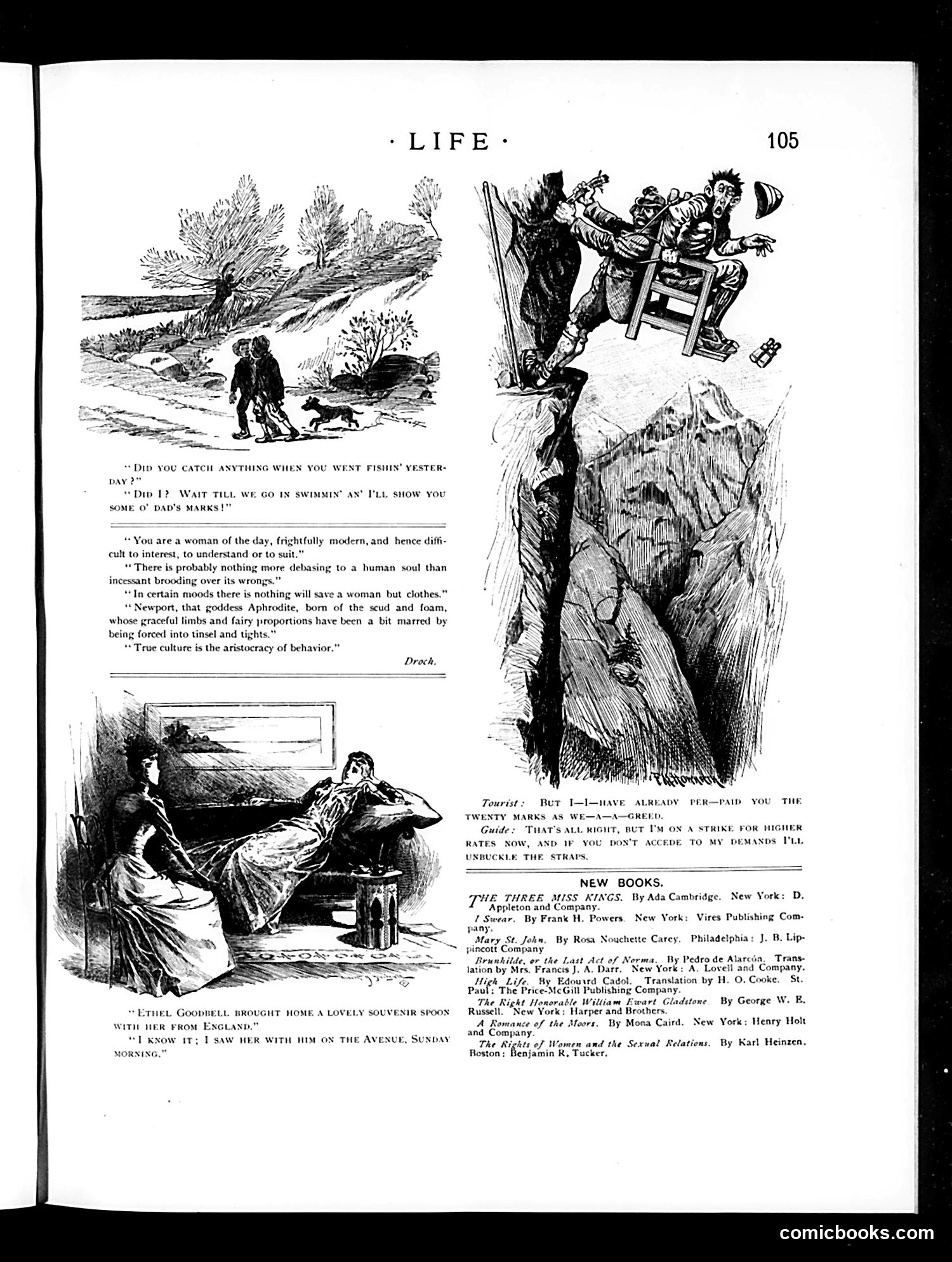
This page contains three distinct satirical cartoons and a book advertisement section. **Top left**: A domestic scene mocking a father-child fishing trip, where the child boasts about showing "dad's marks" (bruises), suggesting parental corporal punishment was common enough to joke about. **Top right**: A precarious scene of figures climbing a steep cliff or mountain, appearing to reference dangerous labor conditions or risky ventures—though the specific reference is unclear without additional context. **Bottom left**: An interior scene depicting leisure and idleness, with dialogue mocking women's fashion obsession and modern culture's superficiality—typical of Life's satirical commentary on society's priorities. The quoted text attributes to "Drack" suggest these are editorial cartoons commentary on contemporary social behaviors and attitudes toward modernity, fashion, and gender roles.
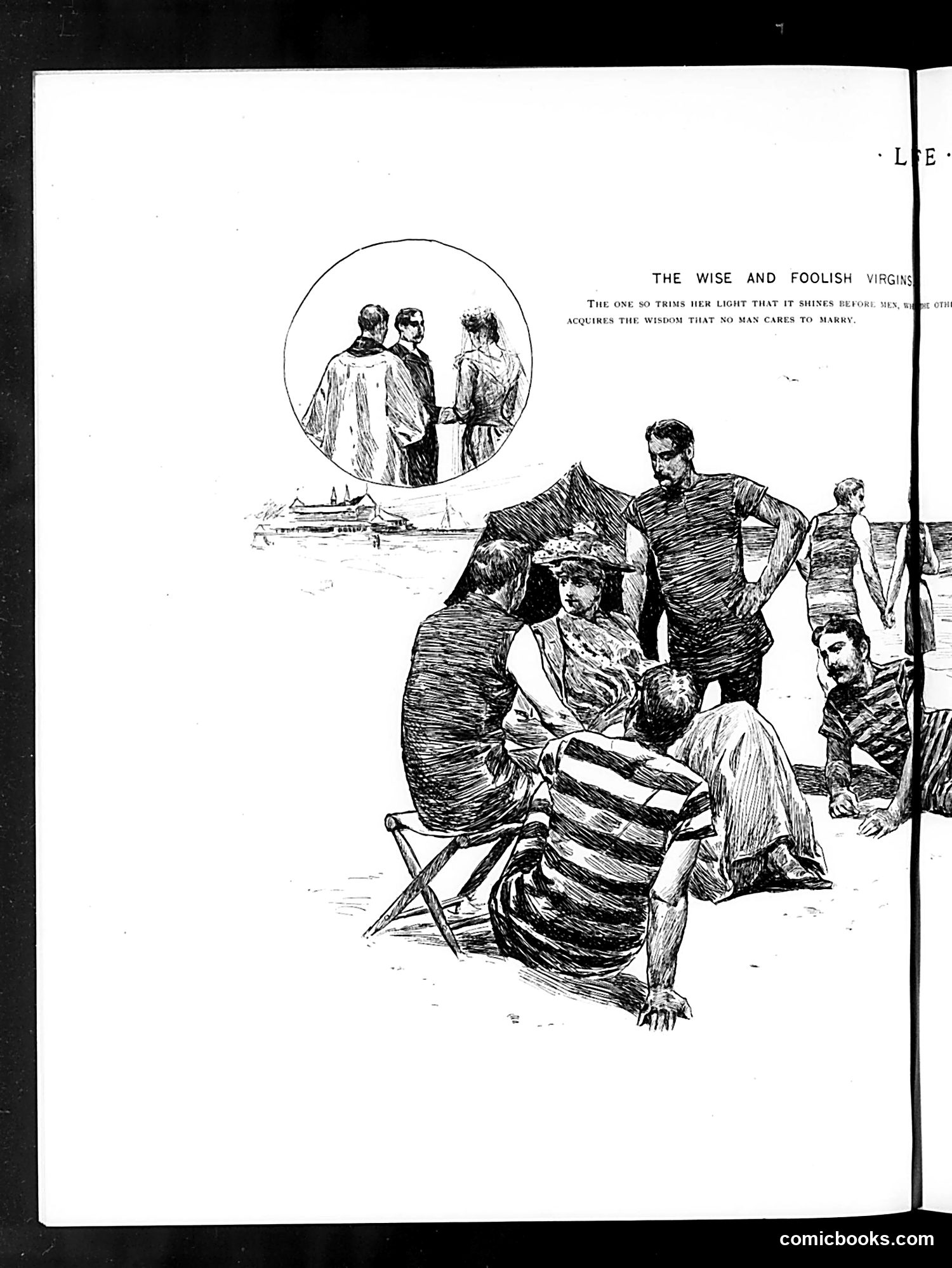
This page illustrates the Biblical parable of the wise and foolish virgins (Matthew 25). The circular inset shows three figures with a glowing lamp, representing the prepared wise virgins. Below, a group gathers around a seated woman in apparent distress or supplication, likely depicting the foolish virgins who neglected to prepare. The headline states the moral: "The one so trims her light that it shines before men, she and the other acquires the wisdom that no man cares to marry." This appears to be satirical commentary on women's social behavior and marriage prospects. The satire suggests that excessive self-presentation or vanity ("trimming her light") paradoxically repels potential suitors, while genuine virtue remains overlooked. The cartoon uses religious allegory to critique contemporary courtship expectations and women's social positioning.
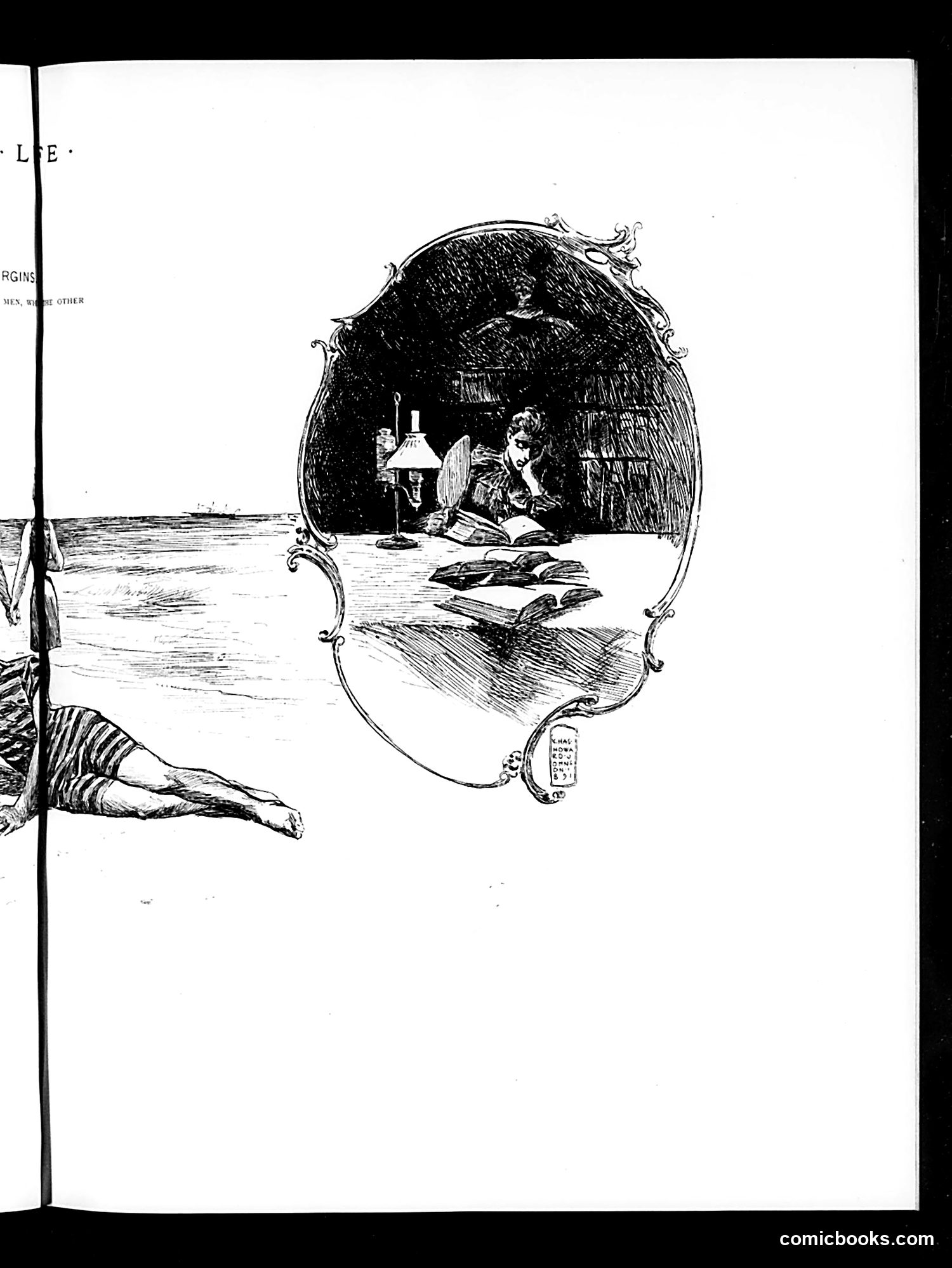
This is a surreal ink illustration showing a profile of a head in outline form. Inside the head's silhouette is a domestic scene: a figure (appears to be a woman) sits reading by lamplight in what looks like a cave or enclosed space, with books scattered on the ground. A leg protrudes from the lower left corner of the page. The cartoon appears to be satirizing intellectualism or scholarly pursuits—depicting the mind as an isolated, cave-like refuge where one retreats into books and study. The surreal composition suggests either escapism through reading or perhaps critiques the disconnection between intellectual life and physical reality. Without visible bylines or clearer contextual text, the specific satirical target remains somewhat unclear, though it likely comments on academic or literary culture of Life magazine's era.
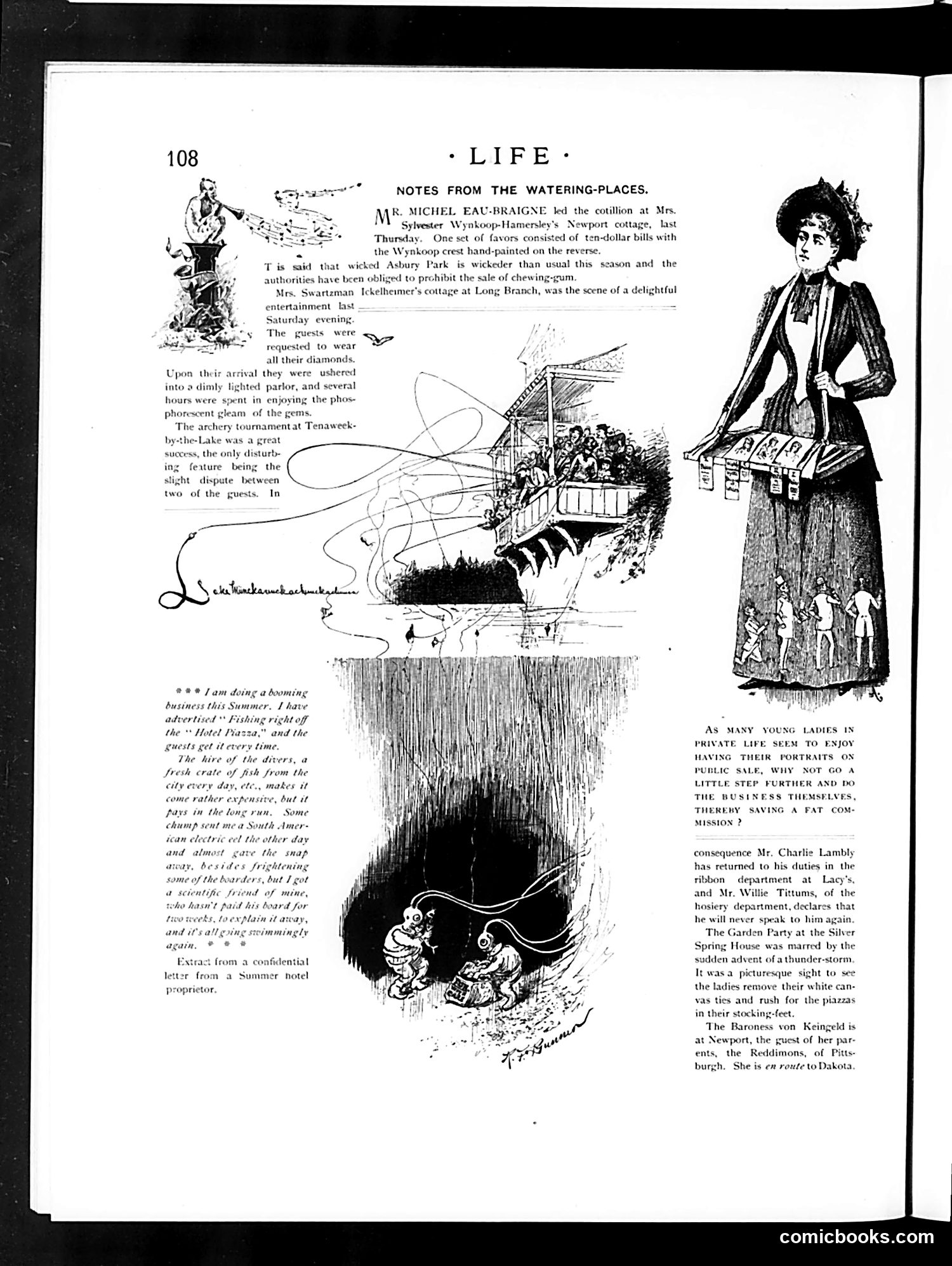
This page from *Life* magazine satirizes upper-class women entering business. The right illustration shows a fashionably dressed woman displaying portrait paintings for sale—a genteel entrepreneurial venture. The accompanying text mocks this trend, suggesting wealthy women are taking up small business projects (portrait sales, hotel management) as summer hobbies rather than serious work. The central illustration depicts people fishing at what appears to be a resort or watering hole, supporting the text's discussion of seasonal leisure activities. The satire targets the contradiction: these women claim to be conducting "booming business," yet they treat commerce as a fashionable pastime. The text sarcastically notes they're helping themselves while earning "a fat commission"—implying their business pursuits are more about social performance than genuine economic necessity or serious entrepreneurship.
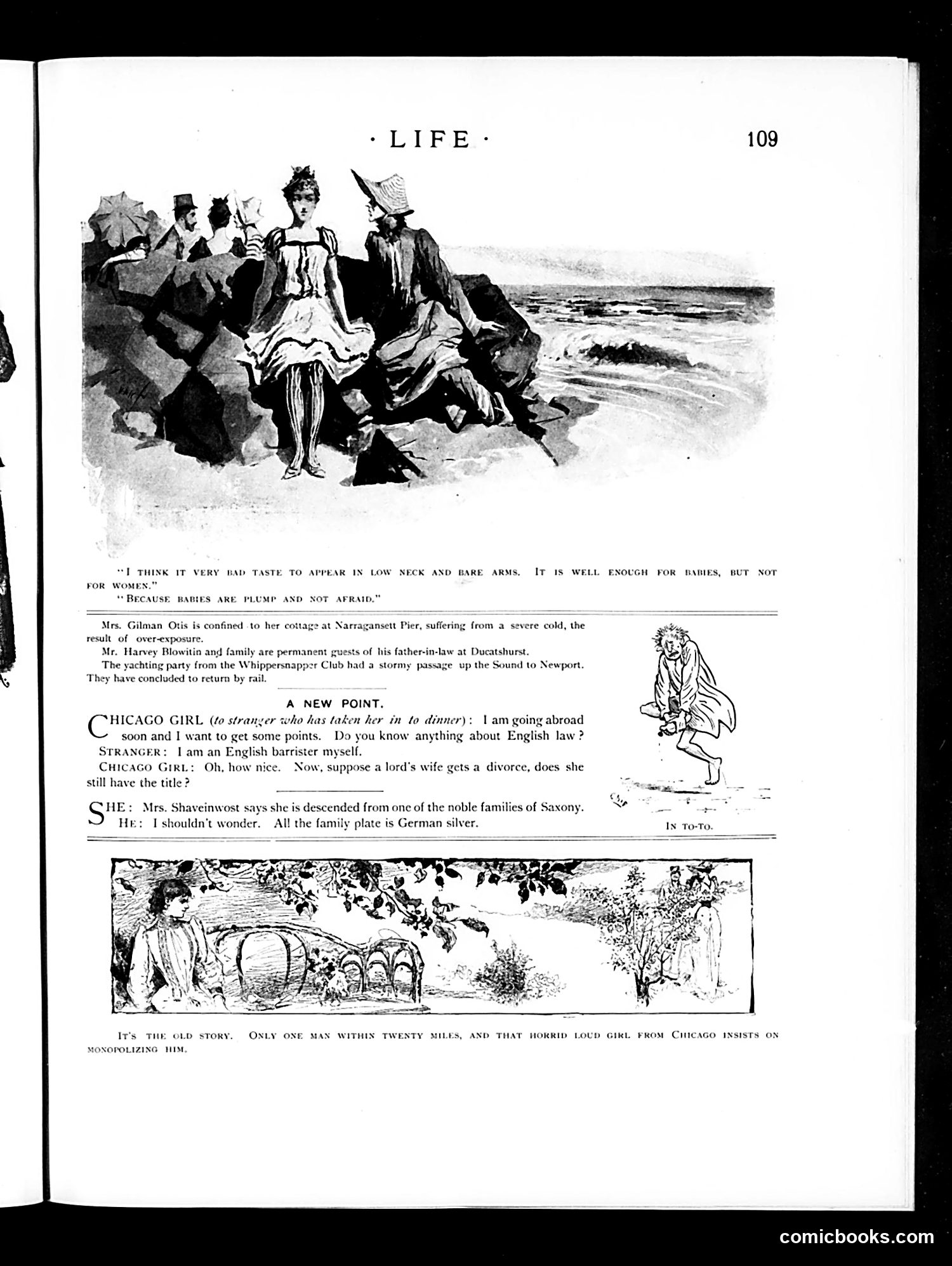
This page satirizes early 1900s gender and fashion conventions. The top illustration mocks women's beach attire—specifically the controversy over bare arms and low necklines. The quoted dialogue suggests society considered such exposure immodest for adult women, though acceptable for babies (who were "plump and not afraid"). The main comic exchange features a "Chicago Girl" seeking legal advice about a lord's wife's divorce status. This appears to mock American women's fascination with European aristocracy and their tendency to ask naive questions when abroad. The bottom illustration and caption humorously reference the "old story" of men monopolizing conversation—one man within twenty miles keeps a "horrid loud girl from Chicago" talking to herself, satirizing American women tourists' reputation for excessive talking.
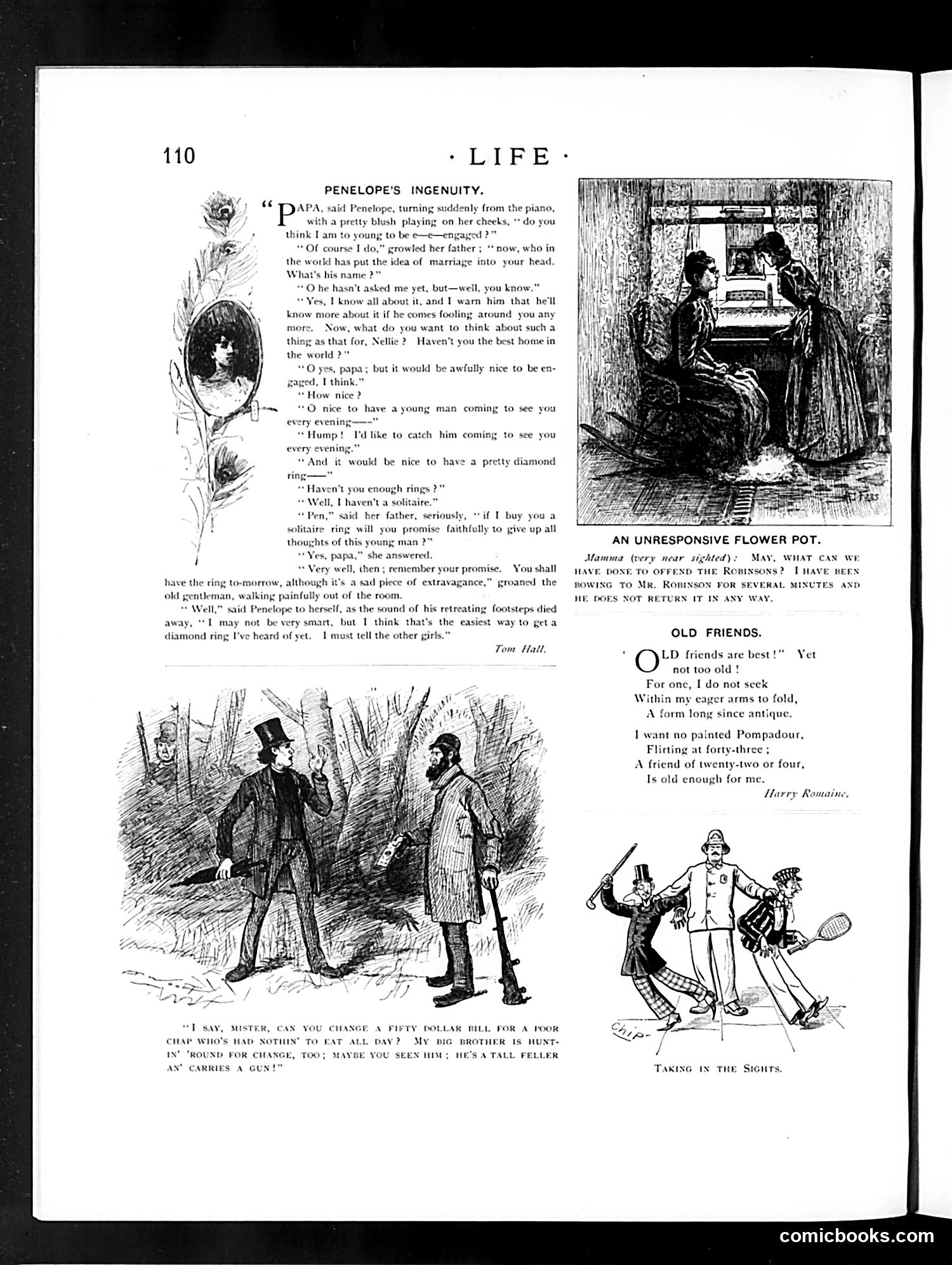
**Main Content: "Penelope's Ingenuity"** This satirical story depicts a young woman manipulating her father into buying her an expensive diamond ring by pretending to abandon romantic interests. Penelope feigns engagement ambitions to her disapproving father, who offers her a solitaire ring in exchange for promising to give up thoughts of a young man. The joke is that she accepts the bribe with no intention of keeping her promise—she immediately plans to tell "the other girls" about her scheme. The satire targets both paternal control over daughters' romantic lives and young women's cunning ways of circumventing that control. **Secondary Cartoons:** "An Unresponsive Flower Pot" appears to mock social awkwardness—a nearsighted woman complains about a neighbor (Robinson) ignoring her. The lower street scene depicts a con artist's pitch, using exaggerated language and a fabricated story about a hungry brother to solicit money. "Old Friends" and "Taking in the Sights" are poetry and illustrations with no clear satirical target.
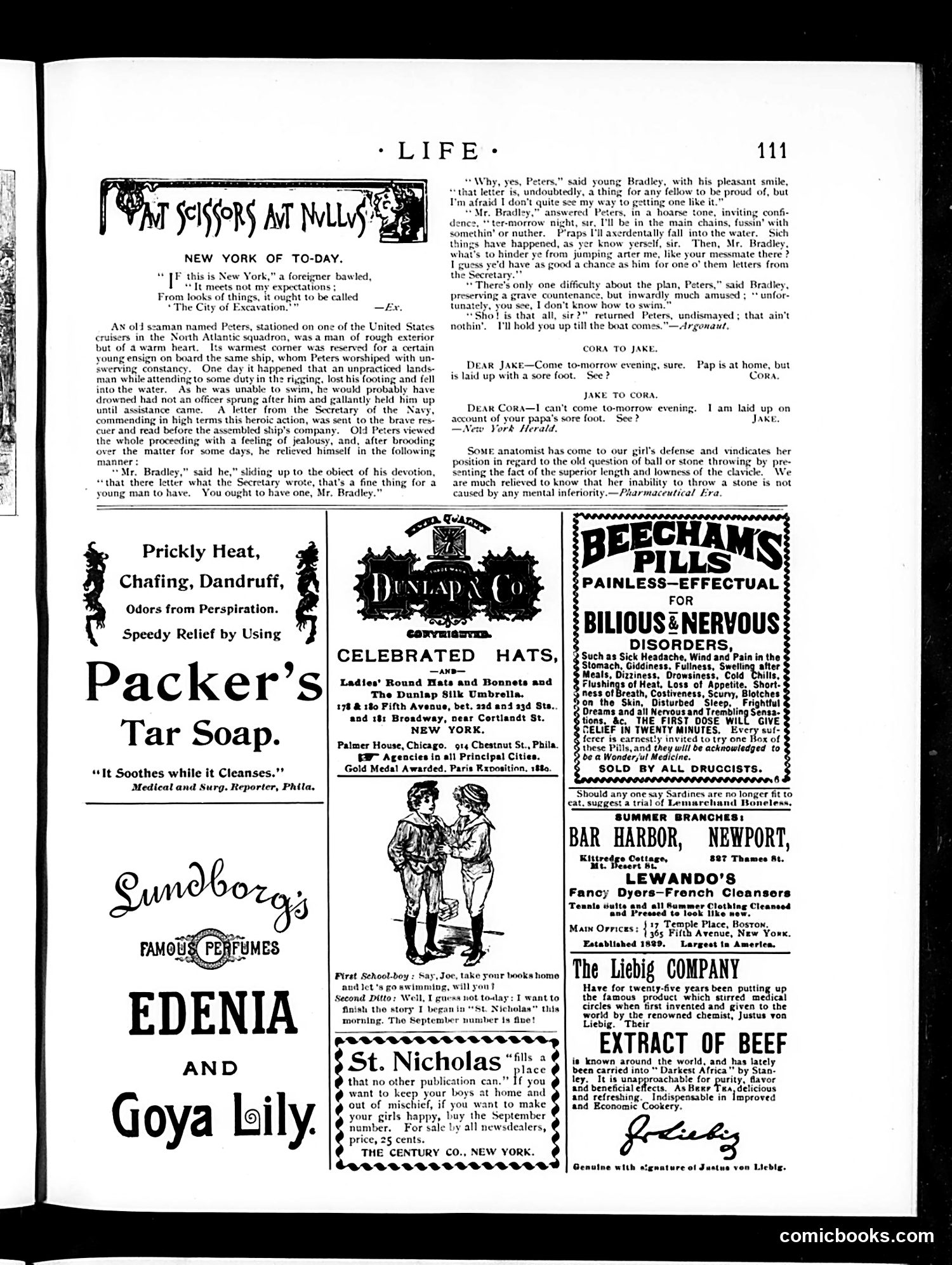
This page contains a humorous short story about naval life, presented in early Life magazine's satirical style. The narrative ridicules an enlisted sailor named Peters who becomes jealous when a young officer receives official commendation for a heroic rescue. Peters, who worships this officer, hatches a petty scheme: he'll deliberately fall into the water so the officer can rescue him again and earn another commendatory letter. The satire targets class consciousness and wounded pride in military hierarchy. Peters' indignation that the officer receives recognition—and his absurd plan to manufacture similar heroism—mocks both the rigidity of naval protocol and working-class resentment of preferential treatment for officers. The page also includes period advertisements (Packer's Tar Soap, Beecham's Pills, etc.) and brief humorous exchanges labeled "Cora to Jake," typical of Life's mixed-content format mixing social commentary with ads and miscellaneous humor.
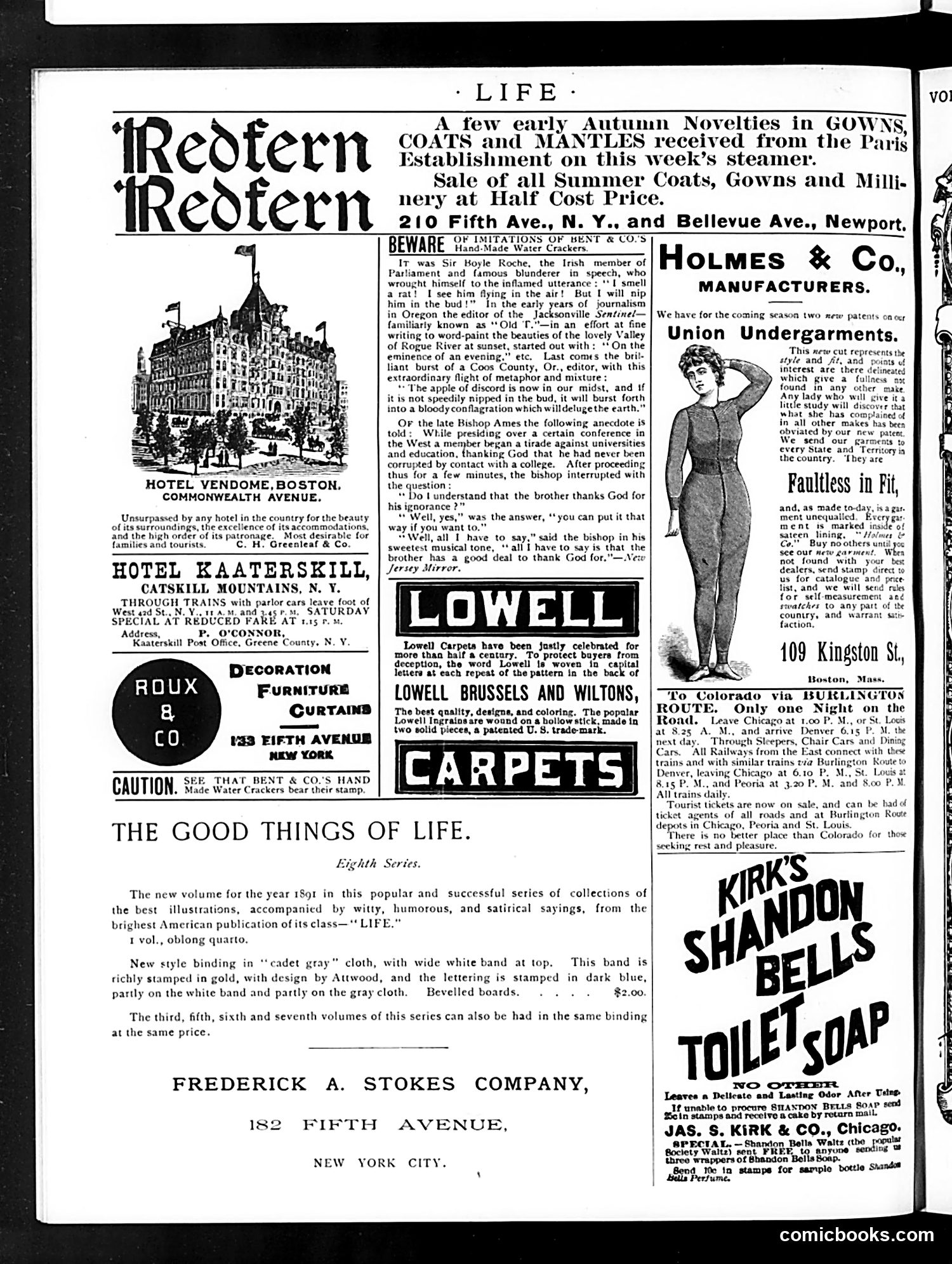
This page is primarily **advertising and literary content**, not political satire. The main feature, "The Good Things of Life," presents humorous **anecdotes about malapropisms and mixed metaphors**—linguistic blunders that were popular entertainment of the era. Examples include Sir Boyle Roche (an actual Irish politician known for verbal confusion), an Oregon newspaper editor's awkward phrase "eminence of an evening," and another editor's mixing of metaphors ("apple of discord...burst forth into a bloody conflagration which will deluge the earth"). The humor relies on readers appreciating how these speakers grotesquely misuse language—creating unintentionally absurd or contradictory images. A bishop's anecdote shows gentle mockery of anti-intellectual sentiment. The remainder consists of hotel advertisements (Vendome Boston, Kaaterskill), fashion retailers (Redfern), furniture companies, and product ads (Lowell Carpets, Kirk's Shandon Bells Soap). This reflects Life's business model mixing satire with commercial revenue.