
Life, 1891-08-27 · page 4 of 14
Life — August 27, 1891 — page 4: what you’re looking at
What you’re looking at
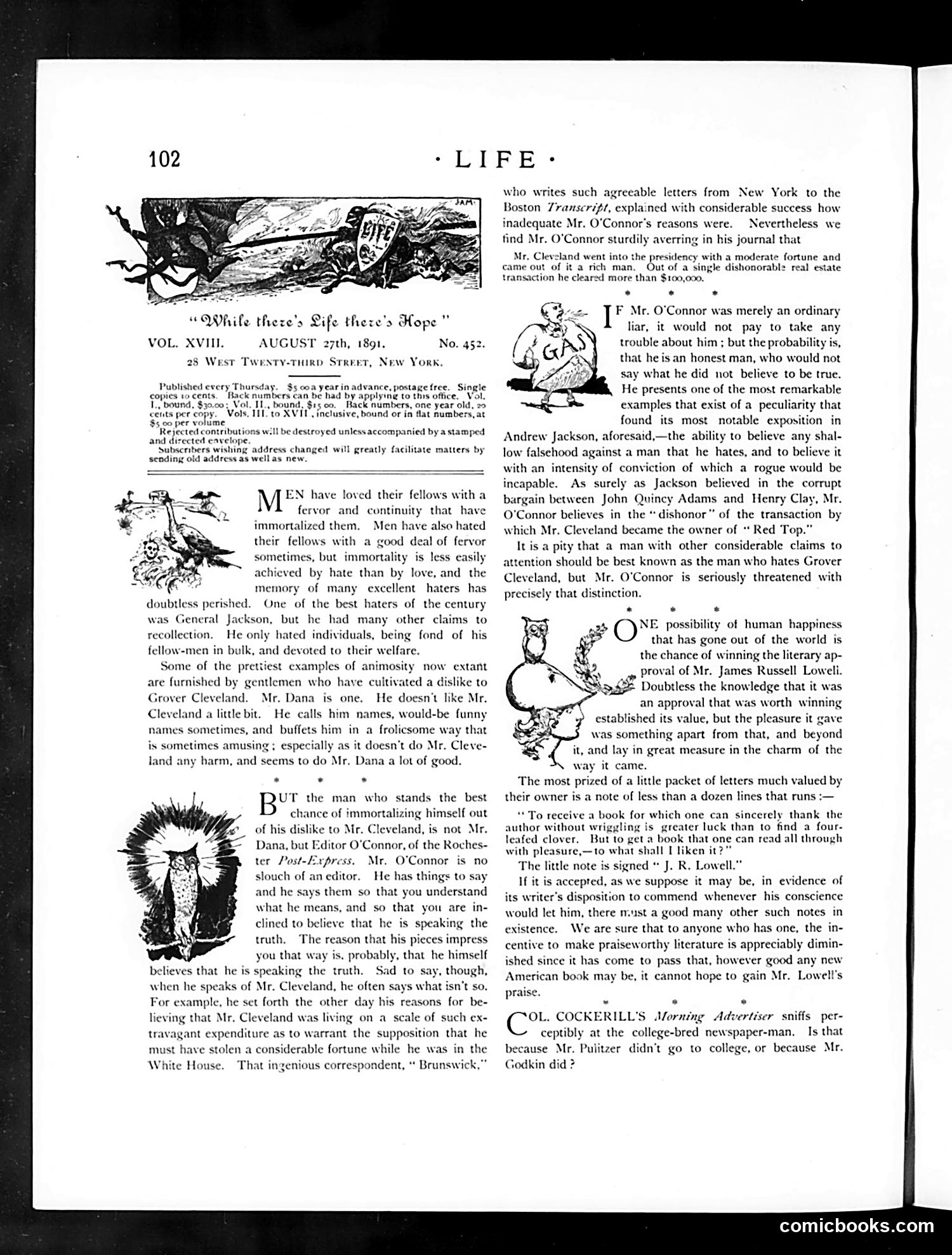
This page discusses Mr. O'Connor, an editor of the Rochester *Post-Express*, through a satirical lens. The text attacks O'Connor's credibility, suggesting he's an "honest man" who nonetheless spreads falsehoods with conviction—comparing his ability to believe his own lies to Andrew Jackson's certainty about corrupt dealings. The main target appears to be O'Connor's claims about Grover Cleveland's wealth and dishonest real estate transactions. The satire argues that O'Connor presents "remarkable examples" of believing unsubstantiated accusations against Cleveland, whom he opposes politically. The page also praises James Russell Lowell's literary approval and mocks Col. Cockerill's *Morning Advertiser* for unknown reasons. The illustrations are decorative vignettes rather than political cartoons.
📄 Transcribed text from this page (OCR, searchable)
Machine-transcribed from the original scan — historical spelling and the odd misread are preserved.
‘LIFE: “While there's Life there's Hope ” VOL. XVIII. AUGUST 27th, 1891, 28 West Twenty-tiarp Street, New York. No. 452. Published every Thur $5 c0a year in advance, postage free. Single copies to cents. Back numbers ean be had by applying to this office. Vol. 1., bound, $30.00; Vol. II., bound. $15 00, Back numbers, one year old, 29 cents per copy. Vols, IIL to XVIT, inclusive, bound or in flat numbers, at $5.00 per volume Rejected contributions will be destroyed unless accompanied by a stamped and directed eavelope. Subscribers wishing address changed will greatly facilitate matters by sending old address as wellas new N have loved their fellows with a fervor and continuity that hav immortalized them. Men have also hated their fellows with a good deal of fervor sometimes, but immortality is less easily ieved by hate than by love, and the memory of many excellent haters has One of the best haters of the century was General Jackson, but he had many other claims to recollection. He only hated individuals, being fond of his fellow-men in bulk, and devoted to their welfare. Some of the pretiiest examples of animosity now extant are furnished by gentlemen who have cultivated a dislike to Grover Cleveland. Mr. Dana is one. He doesn’t like Mr. Cleveland a little bit. He calls nN names, would-be funny names sometimes, and buffets him in a frolicsome way that is sometimes amusing ; especially as it doesn’t do Mr. Cleve- land any harm, and seems to do Mr. Dana a lot of good. doubtless perished. UT the man who stands the best chance of immortalizing himself out of his dislike to Mr. Cleveland, is not Mr. Dana, but Editor O'Connor, of the Roches- ter Post-Express. Mr. O'Connor is no slouch of an editor. He has things to say and he says them so that you understand what he means, and so that you are in- clined to believe that he is sp truth. The reason that his pieces impress you that way is, probably, that he himself believes that he is speaking the truth. Sad to say, though, when he speaks of Mr. Cleveland, he often says what isn’t so. For example, he set forth the other day his lieving that Mr, Cleveland was living on a_ scale of such ex- ant expenditure as to warrant the supposition that he must have stolen a considerable fortune while he was in the White House. ing the reasons for be- travas That ingenious correspondent, “ Bruns’ who writes such agreeable letters from New York to the Boston 7ranscrift, explained with considerable success how inadequate Mr. O'Connor's reasons were. Nevertheless we find Mr. O'Connor sturdily averring in his journal that Mr. Cleveland went into the presidency with a moderate fortune and came out of it a rich man, Out of a Single dishonorable real estate transaction he cleared more than $100,000, * * * F Mr. O'Connor was merely an ordinary r, it would not pay to take any trouble about him ; but the probability is, that he is an honest man, who would not say what he did not believe to be true. He presents one of the most remarkable examples that exist of a peculiarity that found its most notable exposition in Andrew Jackson, aforesaid,—the ability to believe any sh. low falsehood against a man that he hates, and to bel: it with an intensity of conviction of which a rogue would be incapable. As surely as Jackson believed in the corrupt bargain between John Quincy Adams and Henry Clay, Mr. O'Connor believes in the “dishonor” of the transaction by which Mr. Cleveland became the owner of “ Red Top.’ It is a pity that a man with other considerable claims to attention should be best known as the man who hates Grover Cleveland, but Mr. O'Connor is seriously threatened with precisely that distinction. * . * nod NE possibility of human happiness ¥ that has gone out of the world is ¥ the chance of winning the literary ap- Sk)» Proval of Mr. James Russell Lowell. NSAS AE Doubtless the knowledge that it was an approval that was worth winning established its value, but the pleasure it gave was something apart from that, and beyond it, and lay in great measure in the charm of the way it came. The most prized of a little packet of letters much valued by their owner is a note of less than a dozen lines that runs :— ** To receive a book for which one can sincerely thank the author without wriggling is greater luck than to find a four- leafed clover. But to get a book that one can read all through with pleasure,—to what shall I liken it?” The little note is signed * J. R. Lowell.” If it is accepted, as we suppose it may be, in evidence of its writer's disposition to commend whenever his conscience would let him, there must a good many other such notes in existence. We are sure that to anyone who has one, the in- centive to make praiseworthy literature is appreciably dimin- ished since it has come to pass that, however good any new American book may be, it cannot hope to gain Mr. Lowell's praise. - * . OL. COCKERILL’S Morning Advertiser snifis per- ceptibly at the college-bred newspaper-man, Is that because Mr. Pulitzer didn't go to college, or because Mr. Godkin did ? comicbooks.com