
A complete issue · 14 pages · 1891
Life — August 20, 1891
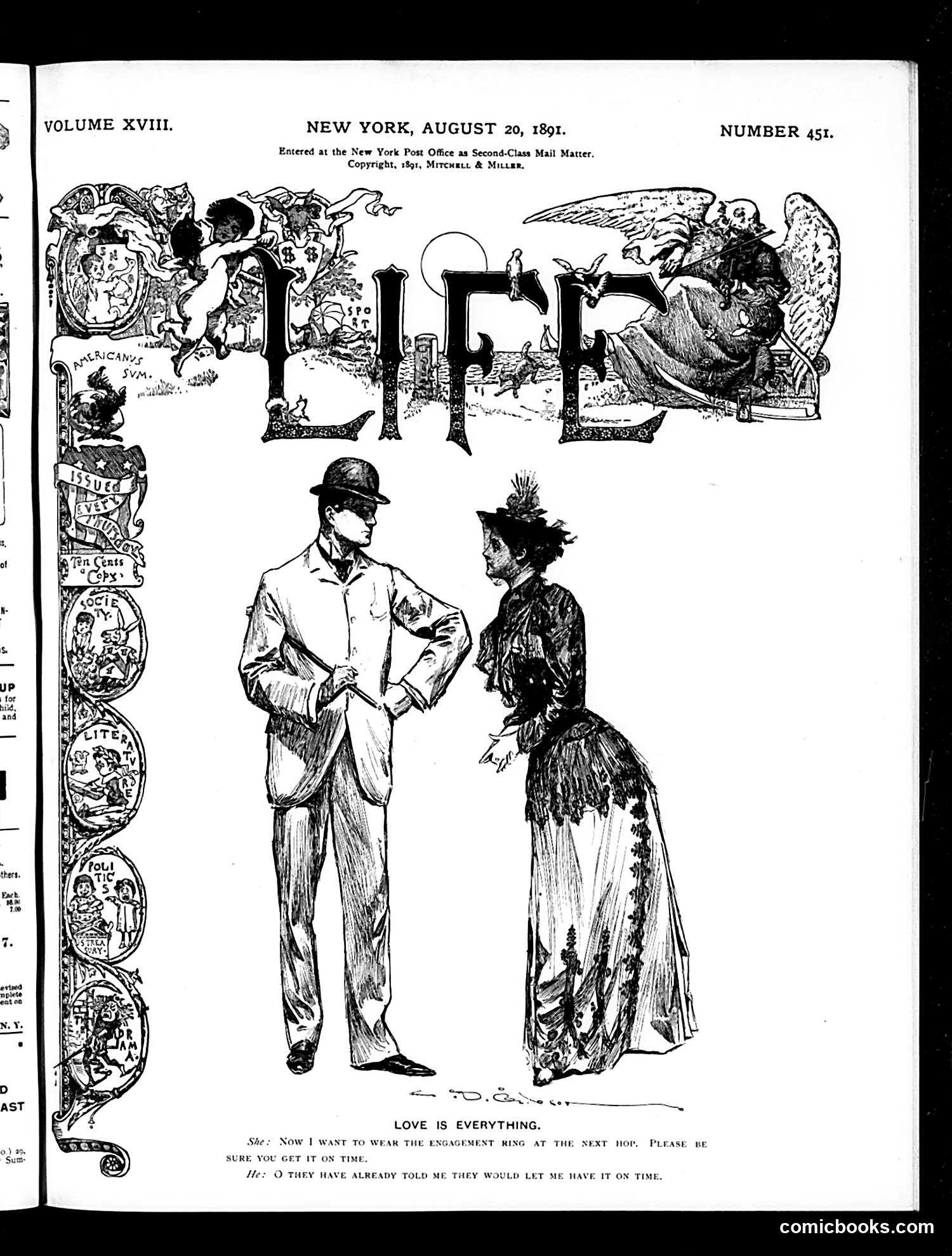
This satirical cartoon depicts a romantic scene titled "Love is Everything." A well-dressed man in a bowler hat and suit addresses a fashionably dressed woman wearing an elaborate feathered hat and decorative cape. The humor lies in the dialogue: she requests he wear an engagement ring at the next social gathering ("hop"), emphasizing material display. He responds that she's already been promised the ring would be available on time—suggesting either financial strain or procrastination on his part. The satire targets Victorian courtship customs and materialism, mocking how engagement announcements and visible status symbols (expensive jewelry, fashionable dress) took precedence over genuine romantic sentiment. The ornate decorative border featuring classical medallions reinforces the magazine's sophisticated, upper-class readership.
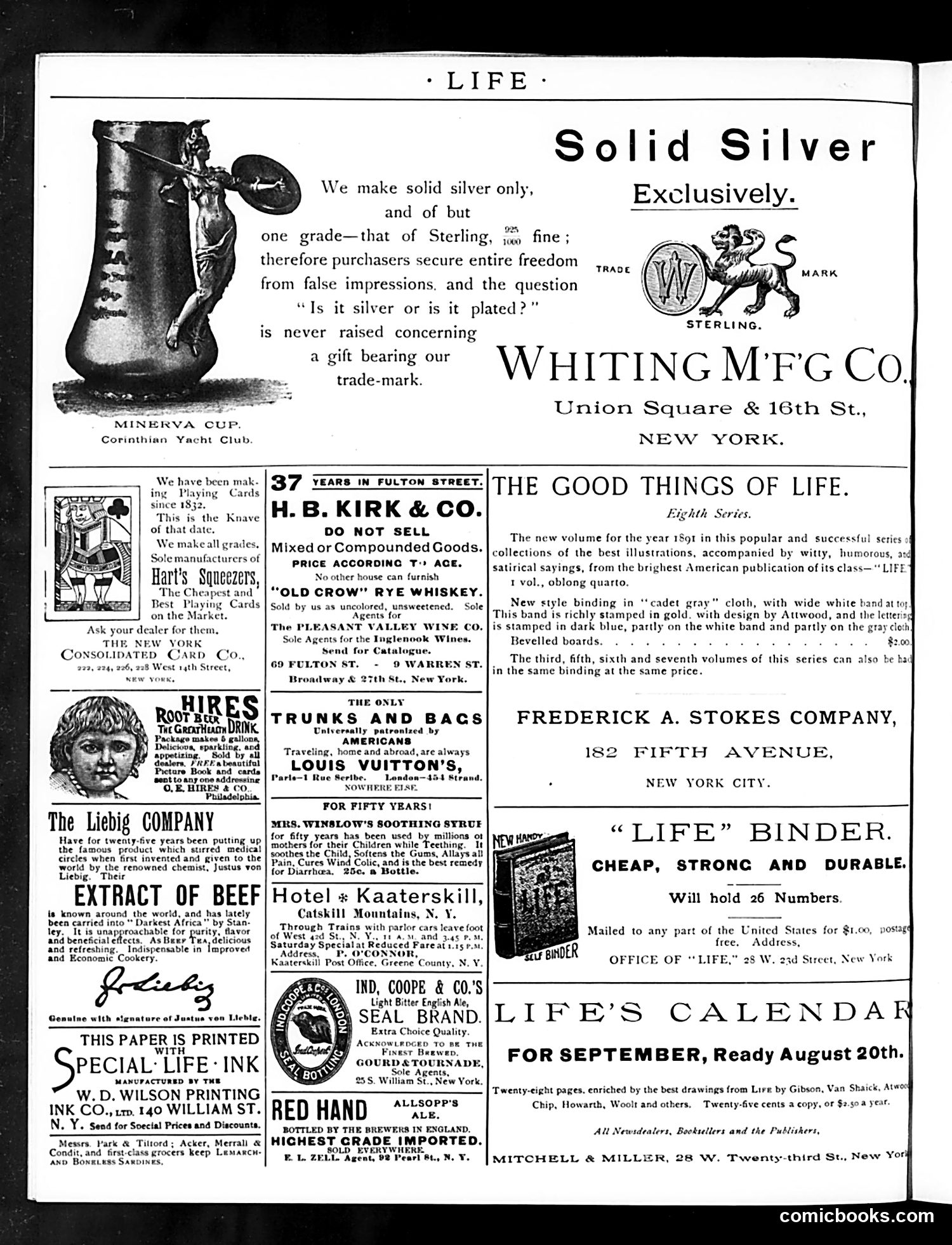
This page is predominantly **advertising**, not editorial content or political satire. The advertisements showcase luxury goods typical of the 1890s: Whiting Manufacturing Company's sterling silver serving pieces, playing cards, whiskey, wine, trunk and travel bags (including Louis Vuitton), beef extract, and ale. There's also promotion for Life's own products—a binder and calendar. One small illustration shows the **Minerva Cup** from the Corinthian Yacht Club, representing wealth and leisure culture. The only potentially satirical element is H.B. Kirk & Co.'s whiskey ad using a "Old Crow" brand, though this appears straightforward product marketing rather than social commentary. Overall, this is a **commercial page** reflecting Gilded Age consumer culture and advertising practices rather than political or social satire.
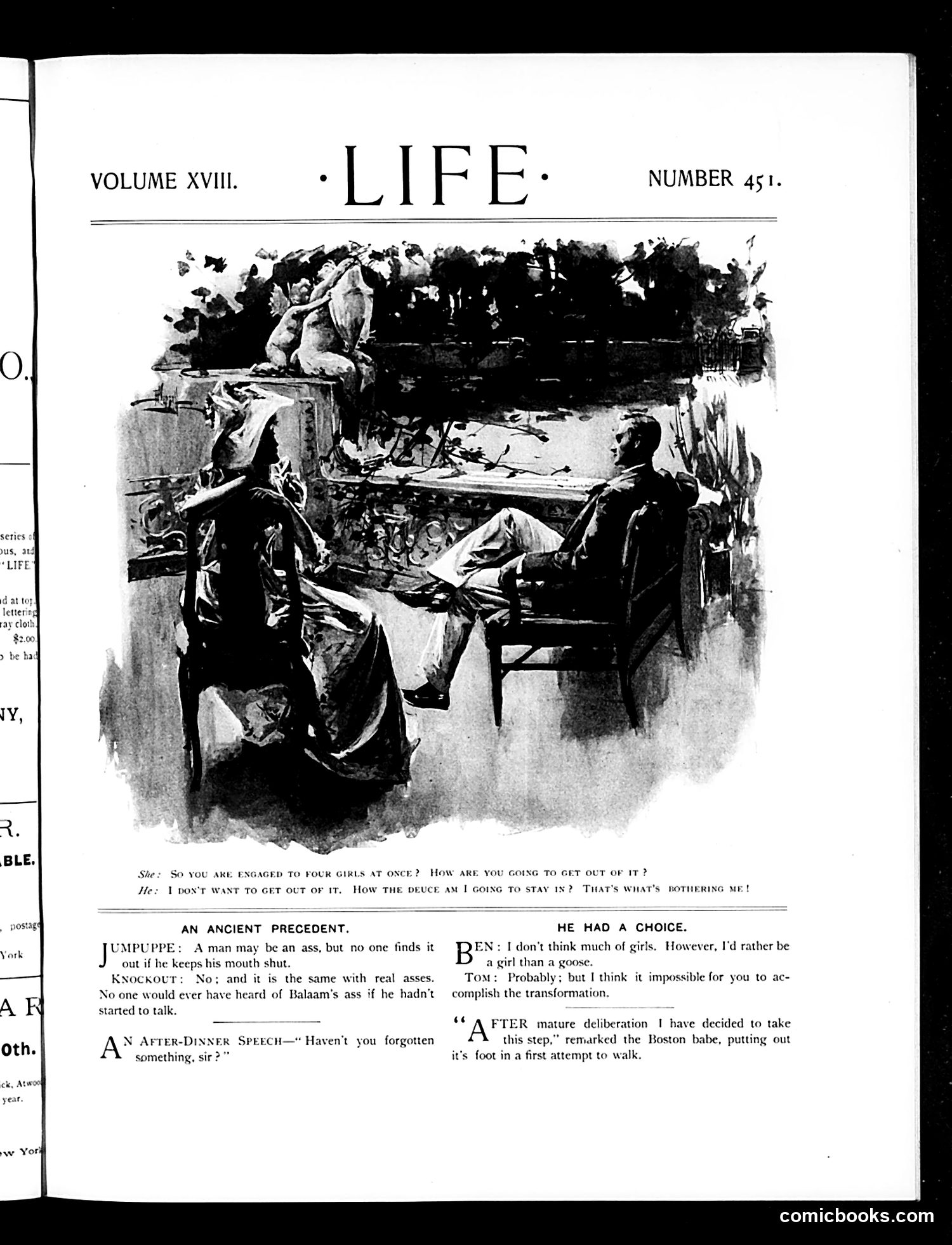
This page contains three separate humor pieces from *Life*, the satirical magazine. The main illustration depicts two men in conversation, with the caption about a man "engaged to four girls at once" and trying to escape the situation—likely a commentary on romantic deception or infidelity. Below are three joke sections: 1. **"An Ancient Precedent"** — a brief exchange about asses (donkeys) that won't talk, using animal behavior as social commentary. 2. **"An After-Dinner Speech"** — a joke about forgetfulness. 3. **"He Had a Choice"** — a dialogue about transforming a girl into a goose, suggesting transformation or escape from romantic entanglement. The humor relies on wordplay and absurdist scenarios typical of early 20th-century satirical magazines.
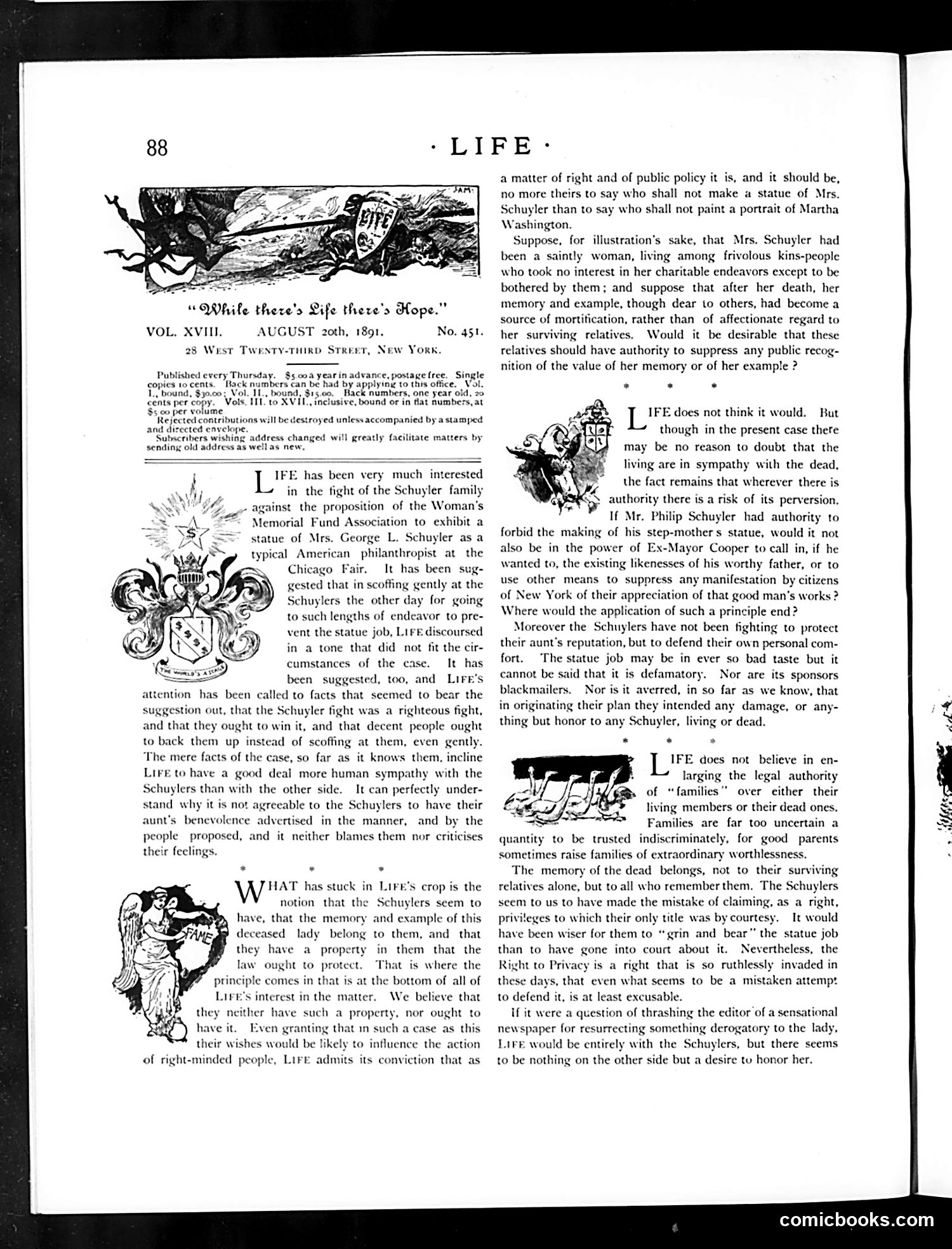
This page discusses a controversy involving the Schuyler family and a proposed statue of Mrs. George L. Schuyler at the Chicago World's Fair. The central issue concerns whether the family should have authority to suppress or control depictions of a deceased relative's memory. Life's editorial takes a libertarian stance: while sympathetic to the Schuylers' desire to protect their aunt's reputation, the magazine argues families shouldn't have absolute legal power over how the dead are memorialized. The piece distinguishes between defending personal honor and controlling public commemoration, ultimately supporting what it calls the "Right to Privacy"—a notable early articulation of this concept. The satirical illustrations (coat of arms, decorative figures) accompany this principled argument about competing rights.
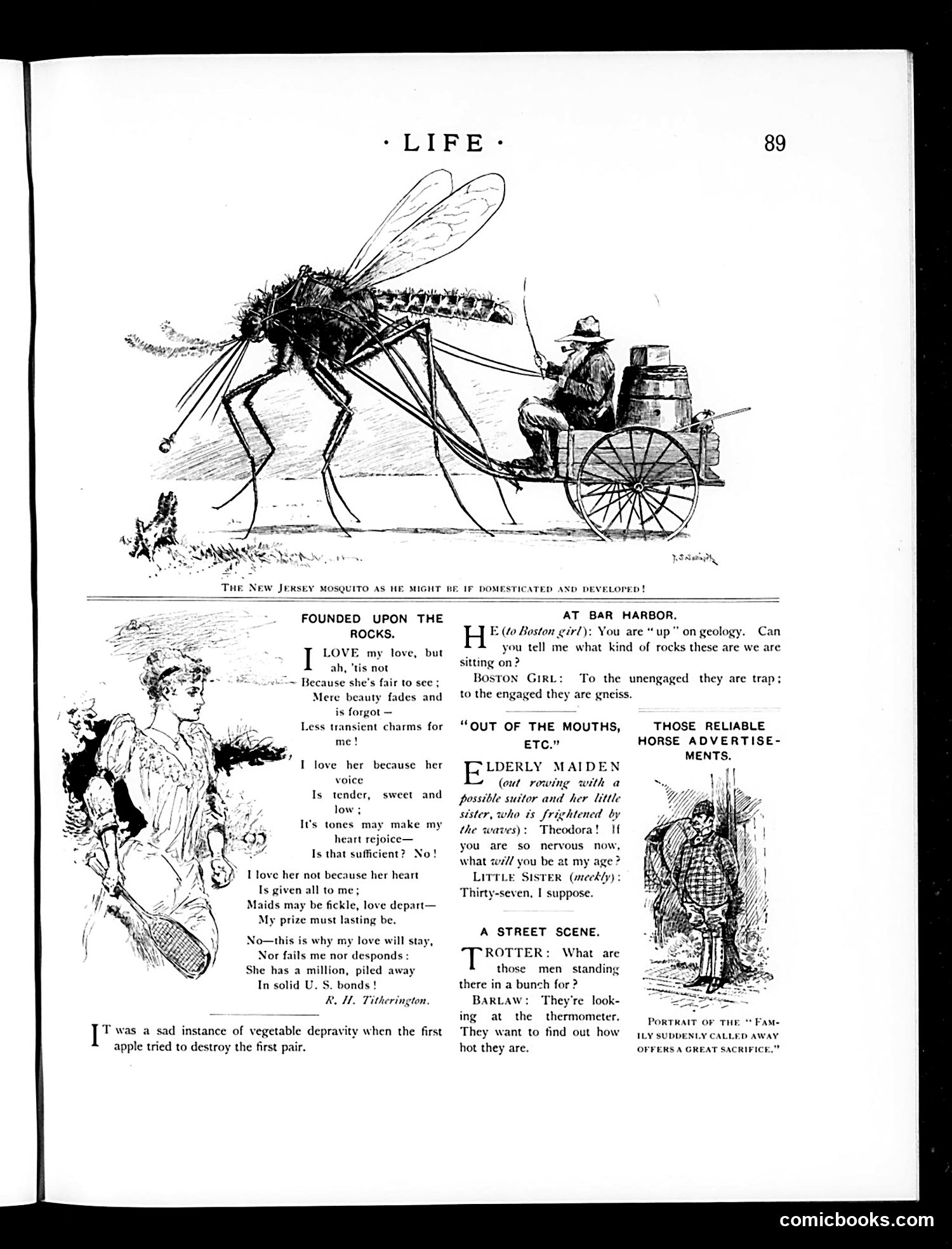
**Main Cartoon**: The top illustration satirizes New Jersey mosquitoes, depicting an oversized mosquito harnessed to pull a cart with a man and barrel—inverting the normal relationship between humans and beasts of burden. The caption reads: "The New Jersey mosquito as he might be if domesticated and developed!" This is a humorous exaggeration playing on New Jersey's reputation for large, aggressive mosquitoes, suggesting they're so formidable they could replace horses as draft animals. **Supporting Content**: The page includes humorous poetry and dialogue pieces about romantic love, an observation about apple blight, and street scene vignettes. These are typical satirical filler content mocking social pretensions and everyday absurdities of the era. The overall tone reflects Life's characteristic blend of visual humor and witty social commentary.
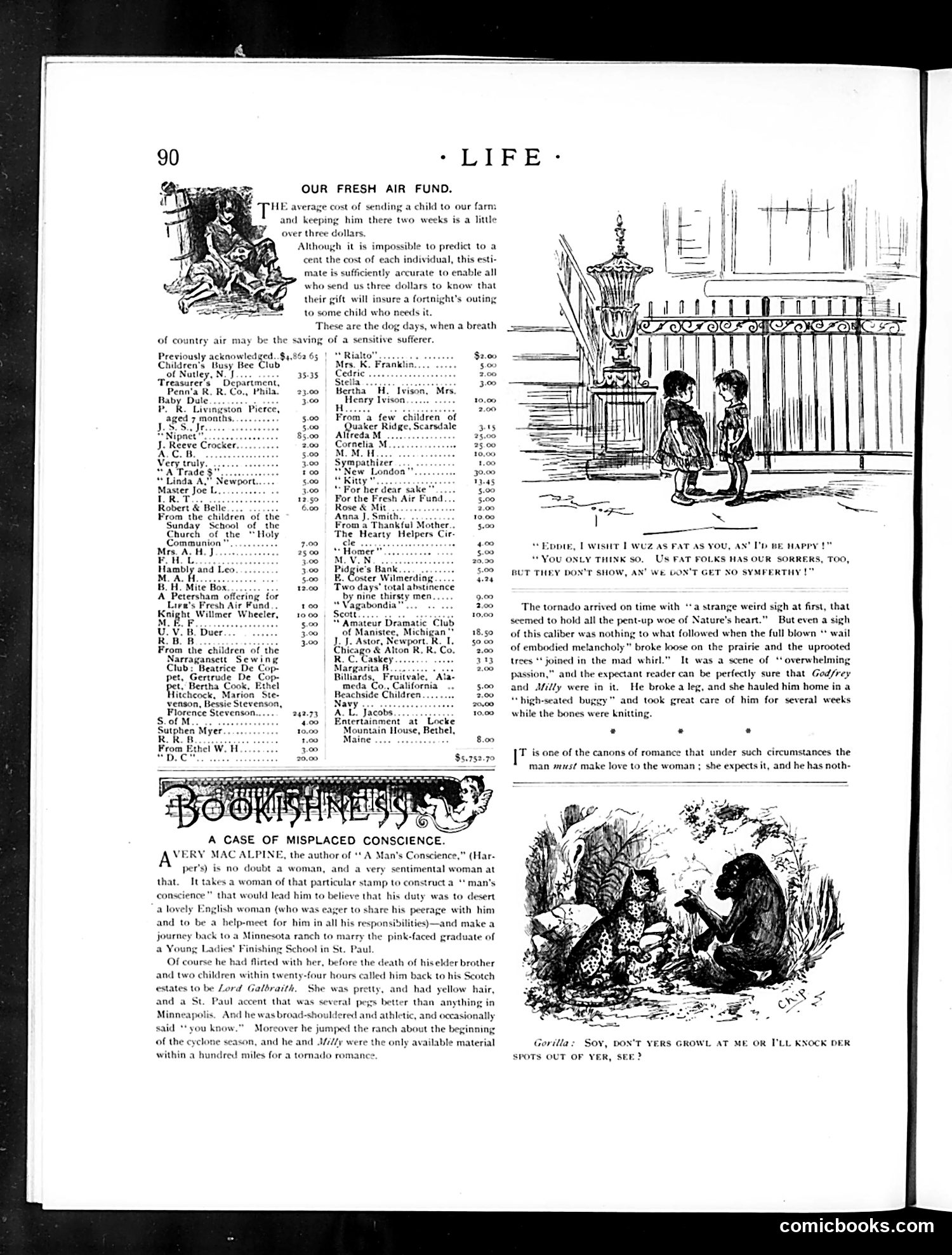
This page contains two distinct elements: **"Our Fresh Air Fund"** (top): A fundraising list for a children's charitable organization, detailing donors and amounts contributed to send poor urban children to countryside retreats for health benefits. This reflects Progressive Era concern for urban poverty and child welfare. **"A Case of Misplaced Conscience"** (bottom): A short story about a wealthy woman constructing a "man's conscience" by marrying a refined English woman to a Scottish nobleman, Lord Galbraith. The narrative appears satirical of aristocratic matchmaking and class pretensions. The accompanying illustration shows rural figures, likely commenting on the incongruity of upper-class romantic schemes versus rural simplicity. The cartoon at bottom right, showing someone at a fence, illustrates the story's rural setting and contrasts with the urban charity focus above.
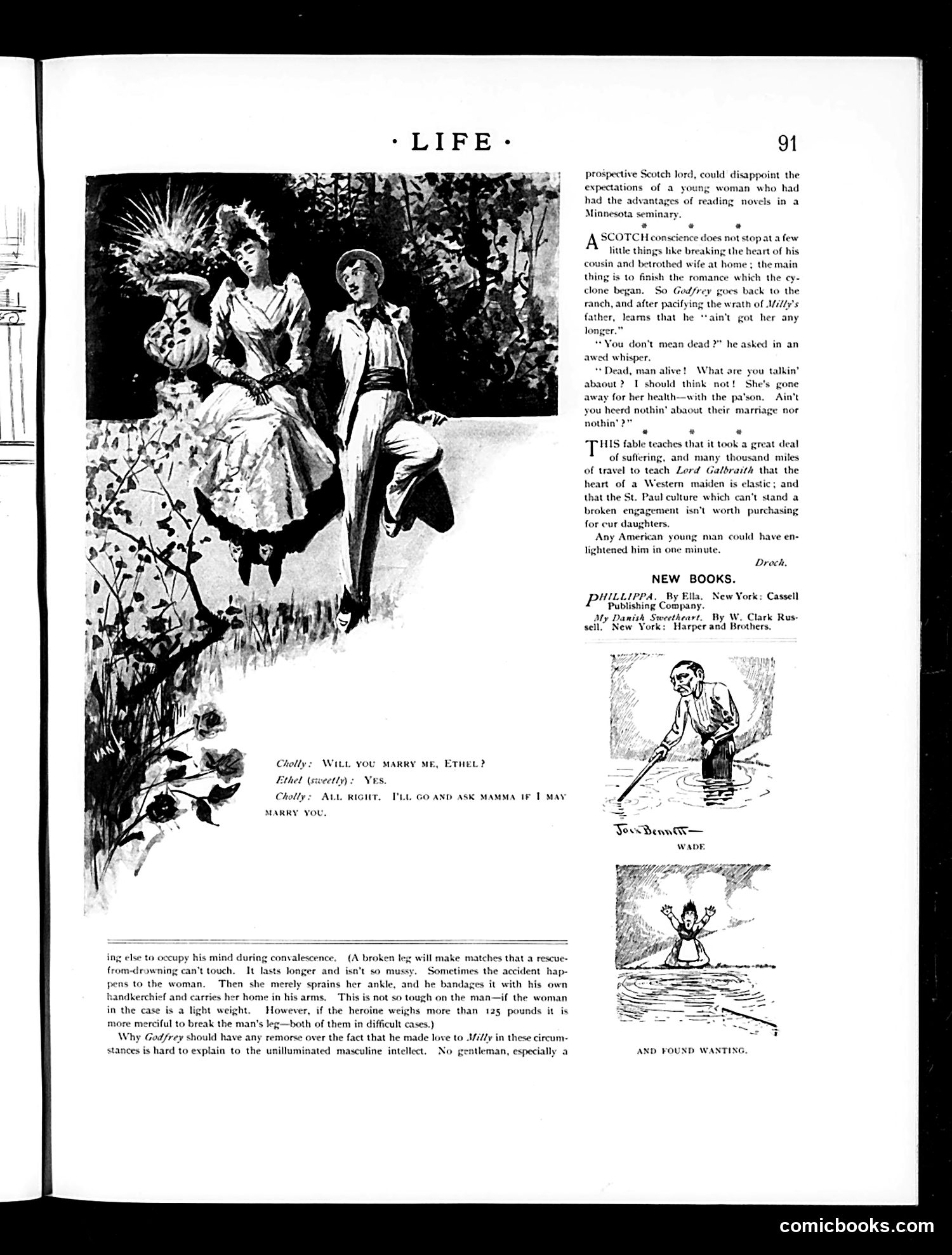
This page contains a literary review discussing a novel called *Lord Gahdraith* (author unclear from OCR). The main illustration depicts a romantic garden scene with figures in period costume, accompanying dialogue between characters named Cholly and Ethel about marriage. The "New Books" section reviews *Phillippa* by Ella and *My Dearest Sweetheart* by W. Clark Russell. Two small cartoon vignettes labeled "Wade" and "And Found Wasting" appear to be humorous illustrations, though their specific satirical content is difficult to determine from the image quality. The page appears primarily focused on literary criticism and entertainment rather than political satire, typical of Life's cultural coverage during this era.
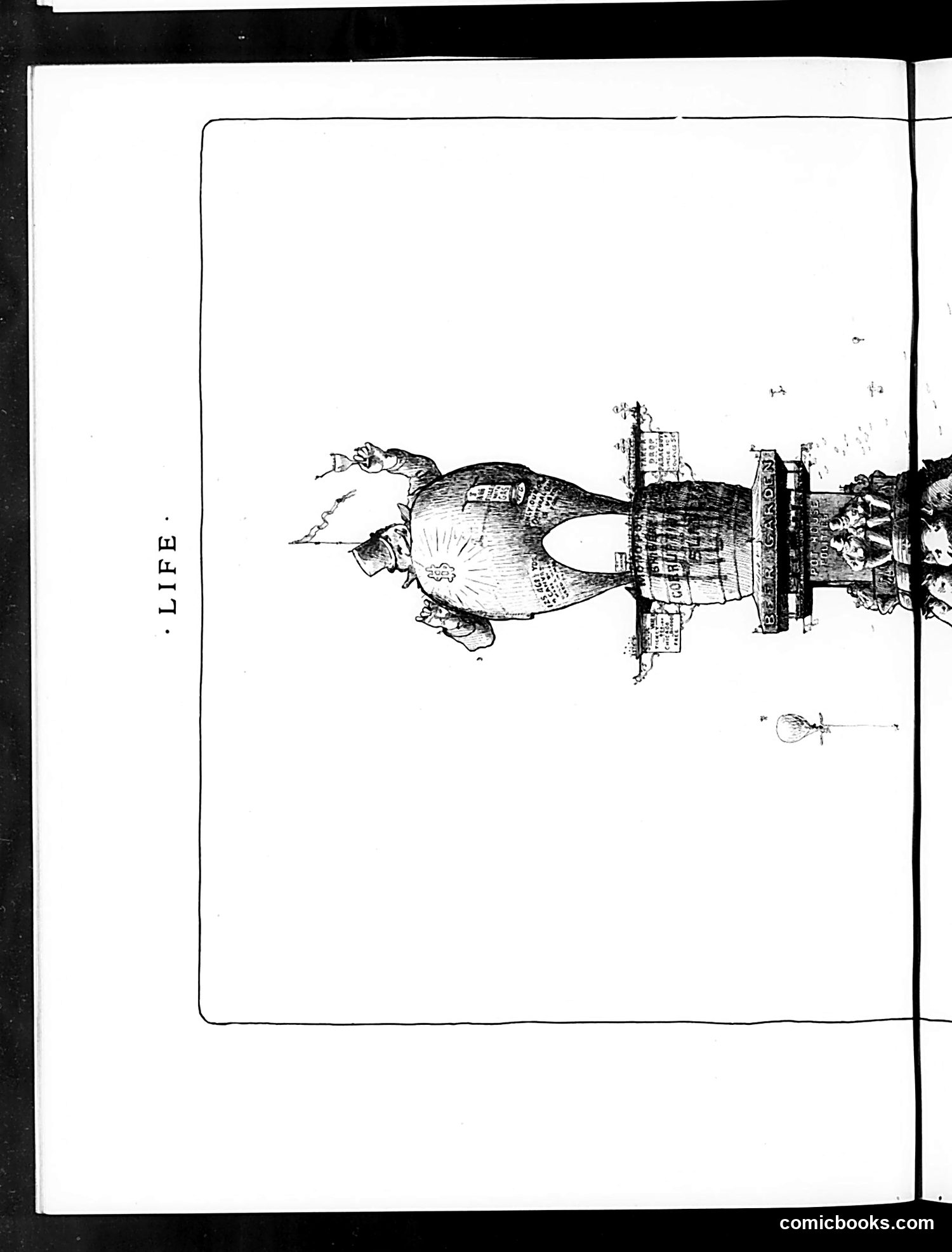
This page is titled "LIFE" and features a satirical illustration of a portly, well-dressed gentleman in formal attire standing next to what appears to be an ornate building or structure. The figure is depicted in a caricatured style typical of early American political satire, with exaggerated proportions emphasizing wealth and excess. Without additional context from surrounding pages or caption text, the specific identity of this figure and the precise political or social commentary remains unclear. However, the imagery suggests satire directed at wealthy elites, urban development, or capitalist excess—common targets of Life magazine's humor. The formal dress and architectural elements suggest commentary on the ruling class or business interests of the era.
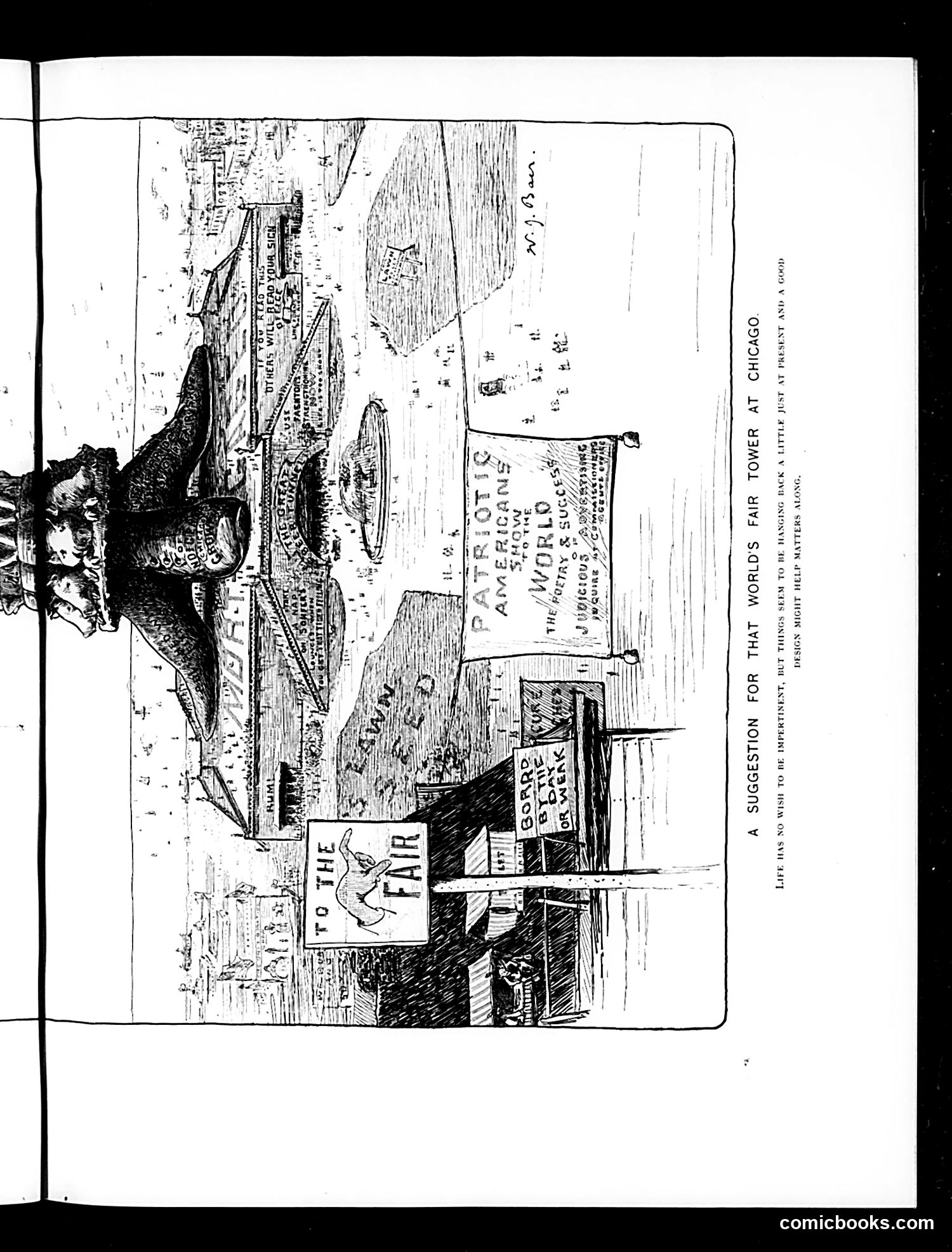
This appears to be a political cartoon from *Life* magazine depicting Chicago's world's fair (the World's Columbian Exposition of 1893). The image shows a caricatured figure at the top left, with various fair buildings and signage visible below, including references to "The World's Fair" and what appears to be exposition architecture. The caption reads "A SUGGESTION FOR THAT WORLD'S FAIR TOWER AT CHICAGO," suggesting this is satirical commentary on the fair's iconic structures or management. The specific figures and exact satirical point are difficult to determine from this reproduction quality, but the cartoon appears to mock either the fair's planning, cost, or someone involved in its administration—a common subject for *Life*'s satirical commentary on major public projects of the Gilded Age.
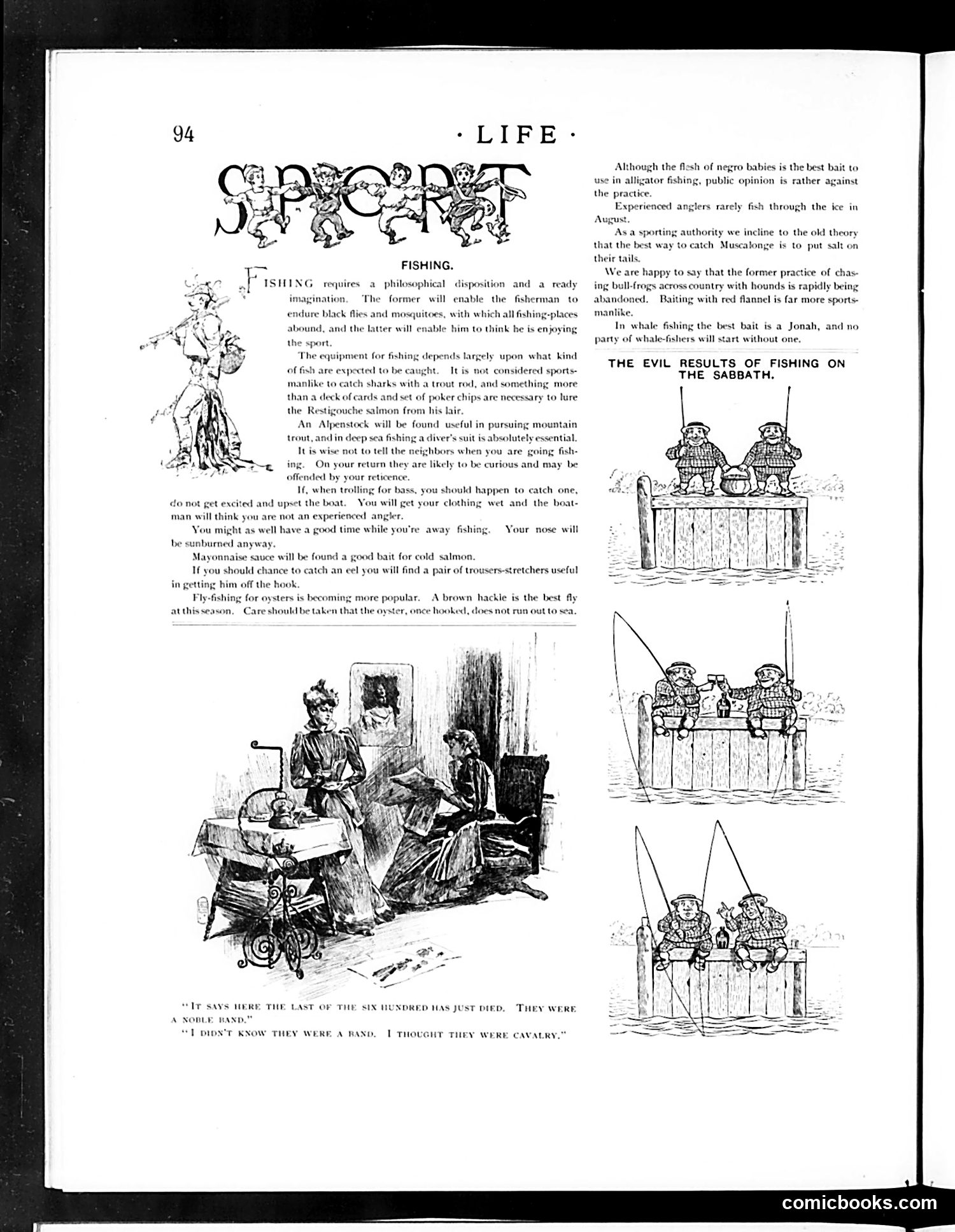
This page contains practical fishing advice and satirical illustrations rather than political commentary. The main content offers genuine tips for anglers—equipment selection, techniques for catching specific fish, and etiquette (avoiding disturbing neighbors while fishing). The satire appears in the section "THE EVIL RESULTS OF FISHING ON THE SABBATH," showing three sequential comic panels of fishermen on a boat. The images suggest consequences for violating religious observance—fishing on Sunday was traditionally considered sinful in Christian culture. The humor derives from the implicit punishment shown in these scenes, though the specific outcome is unclear from the visible illustrations. The bottom illustration depicts an unrelated social scene with dialogue, separate from the fishing content.
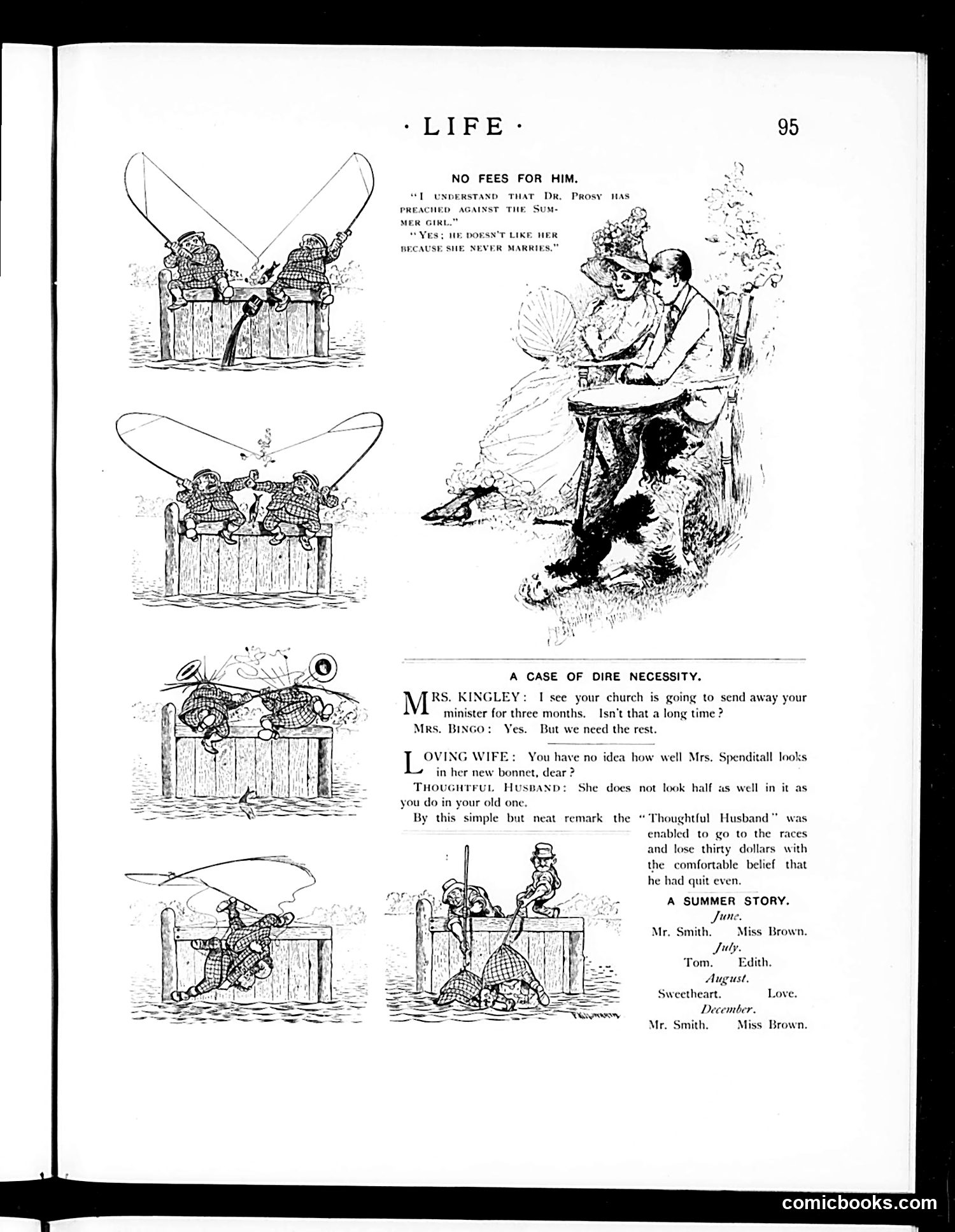
This page contains two separate satirical pieces from Life magazine. **Top section ("NO FEES FOR HIM"):** A series of comic panels showing two fishermen in a boat with increasingly large catches. The joke plays on Dr. Prosy's preaching against marriage—the caption explains he "doesn't like" marriage because "she never marries," meaning he avoids the expenses and complications of married life. The visual gag shows the fishermen's catches growing more unwieldy, paralleling how marriage obligations accumulate. **Bottom section ("A CASE OF DIRE NECESSITY" and "A SUMMER STORY"):** A domestic comedy sketch where a "Thoughtful Husband" compliments his wife's new bonnet—not from sincerity but as a calculated strategy to gain permission to attend the races and lose thirty dollars. The "Summer Story" cast list suggests this is a theatrical piece about romance and relationships. Both pieces satirize marriage dynamics and male domestic scheming common to early-20th-century humor.
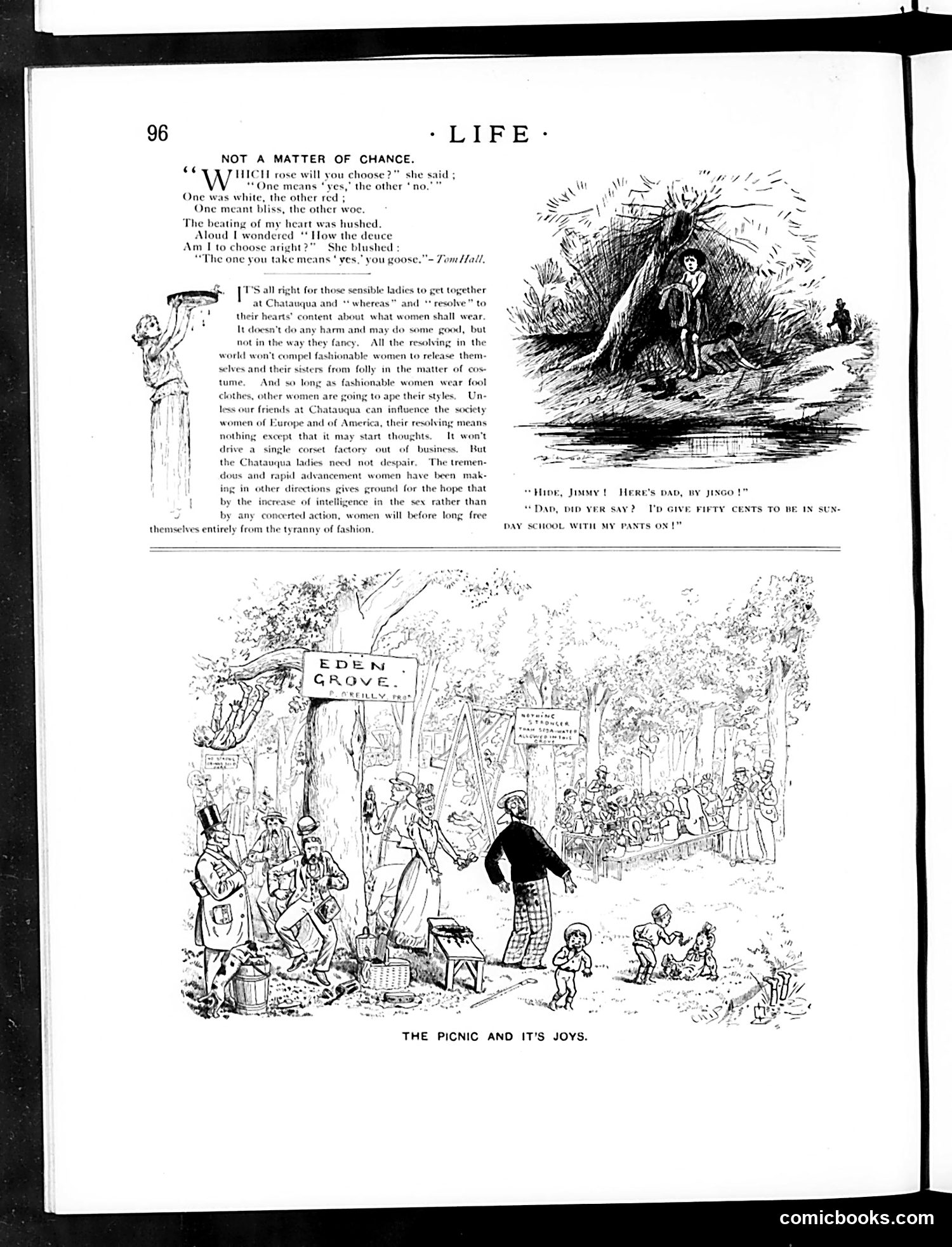
This page contains two distinct pieces satirizing late-19th/early-20th-century social life. The top poem, a romantic vignette, plays on courtship conventions—a woman offers a man a choice between two roses where one means "yes" and one means "no," but then reveals the choice doesn't matter; whichever he picks means "yes." It's gentle satire of romantic pretense and female coquetry. The longer prose section critiques women's reform efforts (likely referencing Chautauqua meetings and women's resolutions about dress reform). The author argues that earnest "resolving" about fashion won't change anything—fashionable women will continue following trends regardless. Real change will come only through women's broader intellectual advancement, not organized fashion campaigns. The bottom cartoon shows a picnic scene at "Eden Grove" with families and children, captioning working-class domestic life. The dialogue suggests a boy would pay to attend Sunday school *with pants on*—implying the poverty or rough conditions of his family life make proper clothing a luxury.
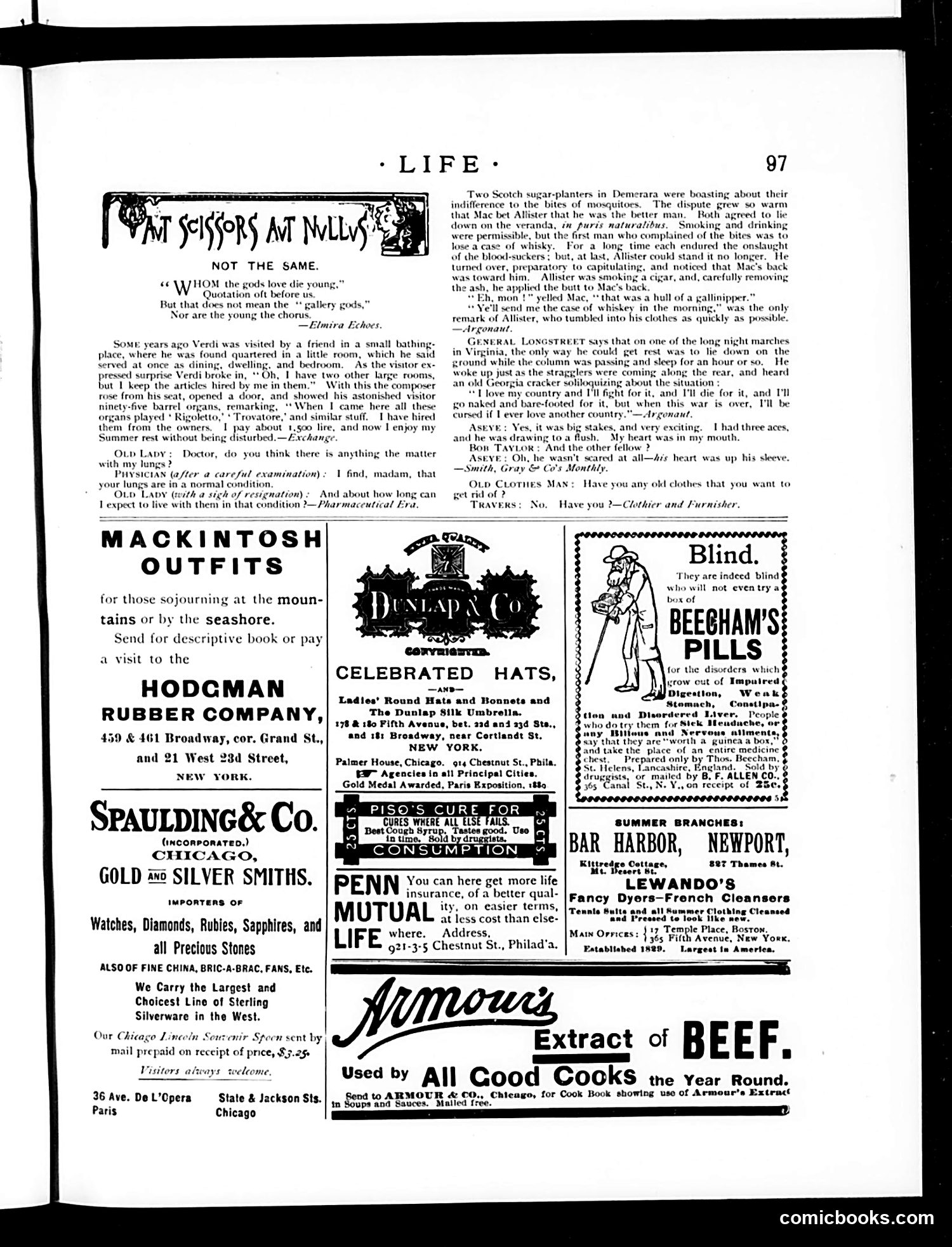
This page is primarily **advertising with humorous anecdotes**, not political satire. The main content consists of short humorous stories: **"Scissors at Nulloch"** presents three brief comedic tales: 1. A Verdi anecdote about the composer's frugality with hired objects 2. A story of two Scottish sugar planters in Demerara betting on mosquito-bite tolerance—one cheats by burning the other's back with a cigar 3. A Civil War anecdote where a Georgia soldier declares he'll fight for his country but never love another, expressing war fatigue The jokes rely on wordplay, unexpected twists, and period-specific scenarios (the colonial setting, Civil War references). The surrounding advertisements for rubber outfits, jewelry, pills, and beef extract are typical of the era's Life magazine format. There is **no clear political cartoon** visible—the page mixes light satirical humor with commercial notices, characteristic of this publication's mixed content approach.
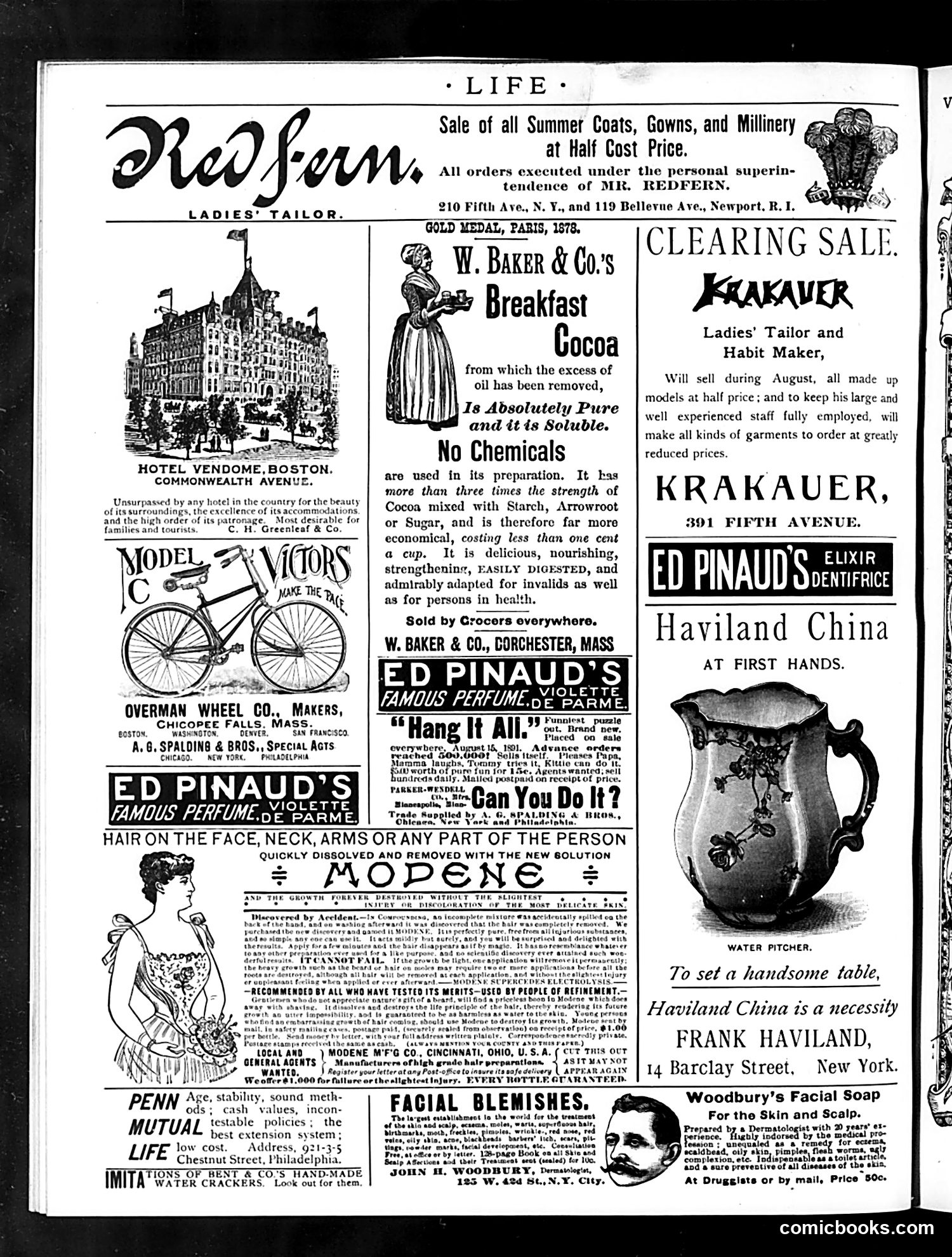
This is primarily an **advertising page** from Life magazine, not a political cartoon. It contains numerous product advertisements typical of late 19th-century American publications. The ads include: - **Fashion/tailoring services** (Redfern, Krakauer ladies' tailors) - **Consumer products** (W. Baker & Co.'s breakfast cocoa, Ed Pinaud perfume and hair removal solution "Modene," bicycles) - **Tableware** (Haviland China) - **Patent medicines** (Woodbury's Facial Soap for blemishes, Penn Mutual Life Insurance) The only potentially satirical element is the "Modene" hair removal advertisement, which uses exaggerated claims about dissolving unwanted facial hair "quickly"—typical of the dubious patent medicine marketing of the era. **Context for modern readers**: This reflects the era's obsession with appearance, the prevalence of unregulated medical claims, and how magazines relied on advertising revenue rather than editorial content.