
Life, 1891-08-20 · page 4 of 14
Life — August 20, 1891 — page 4: what you’re looking at
What you’re looking at
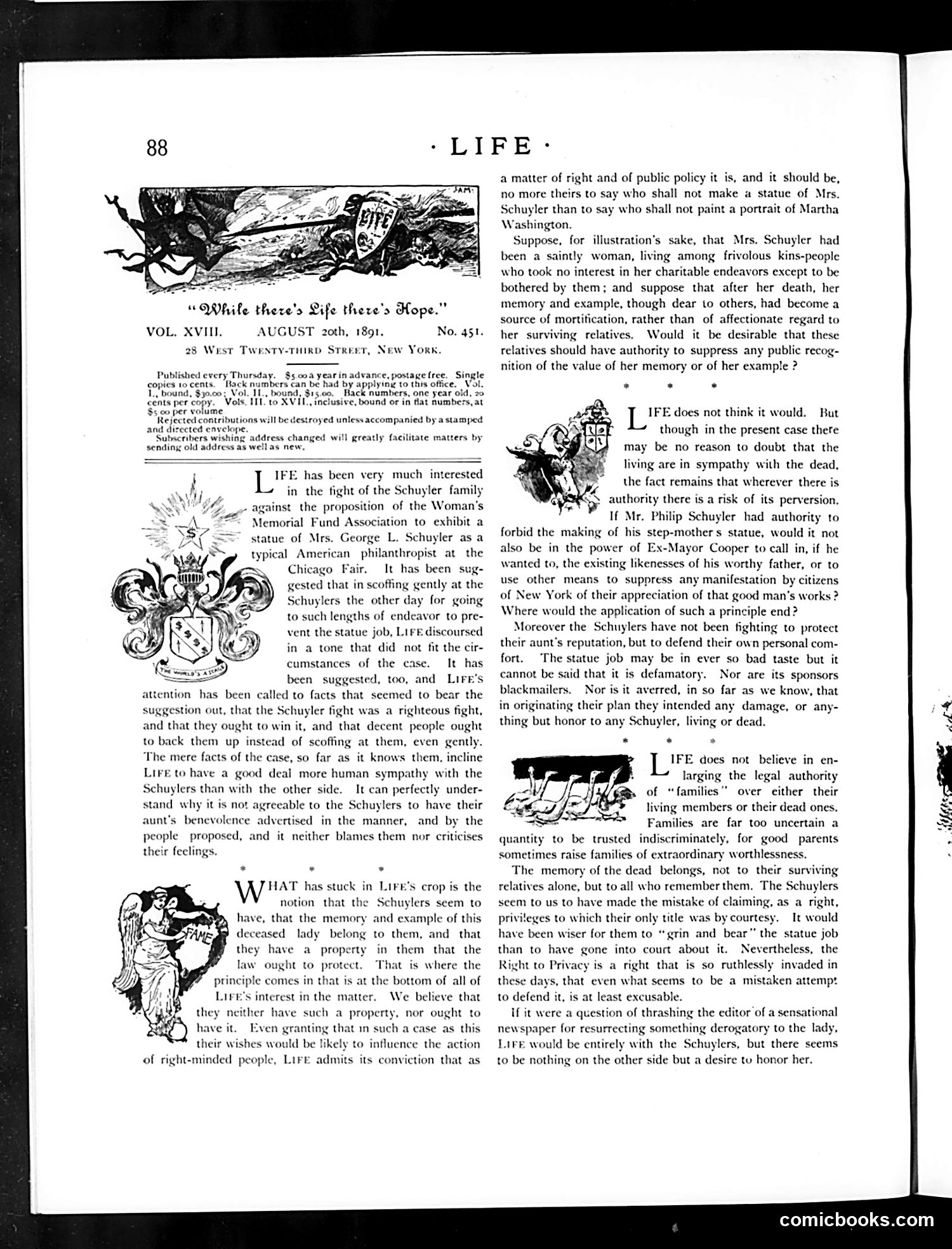
This page discusses a controversy involving the Schuyler family and a proposed statue of Mrs. George L. Schuyler at the Chicago World's Fair. The central issue concerns whether the family should have authority to suppress or control depictions of a deceased relative's memory. Life's editorial takes a libertarian stance: while sympathetic to the Schuylers' desire to protect their aunt's reputation, the magazine argues families shouldn't have absolute legal power over how the dead are memorialized. The piece distinguishes between defending personal honor and controlling public commemoration, ultimately supporting what it calls the "Right to Privacy"—a notable early articulation of this concept. The satirical illustrations (coat of arms, decorative figures) accompany this principled argument about competing rights.
📄 Transcribed text from this page (OCR, searchable)
Machine-transcribed from the original scan — historical spelling and the odd misread are preserved.
- LIFE: VOL. XVIII. AUGUST 20th, 1891. 28 West Twenty-THikd Street, New York. Published every Thursday. $5.00 year in advance, postage free. Single copies to cents. Back numbers can be had by applying to this office. Vol. T., bound, $30.00; Vol. I1., bound, $15.00, Back numbers, one year cénts per copy. Vols. ITT. to XVII, inclusive, bound of in flat numbe: oo per volume Rejected contributions will be destroyed unless accompanied by a stamped and directed cavelope. ribers wishing address changed will greatly facilitate matters by sending old address as well as new. IFE has been very much interested in the fight of the Schuyler family _ against the proposition of the Woman's Memorial Fund Association to exhibit a statue of Mrs. George L. Schuyler as a typical American philanthropist at the Chicago Fair, It has been sug- gested that in scoffing gently at the Schuylers the other day for going to such lengths of endeavor to pre- vent the statue job, Lire discoursed in a tone that did not fit the cir- cumstances of the case. It has been suggested, too, and LIFE’s attention has been called to facts seemed to bear the suggestion out, that the Schuyler fight was a righteous fight, and that they ought to win it, and that decent people ought to back them up instead of scoffing at them, even gently. The mere facts of the case, so far as it knows them, incline Lire to have a good deal more human sympathy with the Schuylers than with the other side. It can perfectly under- stand why it is not agreeable to the Schuylers to have their aunt's benevolence advertised in the manner, and by the people proposed, and it neither blames them nor criti their feelings. HAT has stuck in LiFe’s crop is the notion that the Schuylers seem to have, that the memory and example of this deceased lady belong to them, and that they have a property in them that the law ought to protect. That is where the principle comes in that is at the bottom of all of Lire’s interest in the matter. We believe that they neither have such a property, nor ought to have it. Even granting that in such a case as this their wishes would be likely to influence the action of right-minded people, Lire admits its conviction that as a matter of right and and it should be, no more theirs to say who shall not make a statue of Mrs. Schuyler than to say who shall not paint a portrait of Martha Washington. Suppose, for illustration’s sake, that Mrs. Schuyler had been a saintly woman, living among frivolous kins-people who took no interest in her charitable endeavors except to be bothered by them; and suppose that after her death, her memory and example, though dear to others, had become a source of mortification, rather than of affectionate regard to her surviving relatives. Would it be desirable that these relatives should have authority to suppress any public recog- nition of the value of her memory or of her example ? * * IFE does not think it would. But though in the present case there may be no reason to doubt that the living are in sympathy with the dead, “ the fact remains that wherever there is ~: authority there is a risk of its perversion. If Mr. Philip Schuyler had authority to forbid the making of his step-mothers statue, would it not also be in the power of Ex-Mayor Cooper to call in, if he wanted to, the existing likenesses of his worthy father, or to use other means to suppress any manifestation by citizens of New York of their appreciation of that good man’s works ? Where would the application of such a principle end? Moreover the Schuylers have not been fighting to protect their aunt's reputation, but to defend their own personal com- fort. The statue job may be in ever so bad taste but it cannot be said that it is defamatory. Nor are its sponsors blackmailers. Nor is it averred, in so far as we know, that in originating their plan they intended any damage, or any- thing but honor to any Schuyler, living or dead. * * IFE does not believe in en- larging the legal authority of “families over either their é living members or their dead ones. “S=—-e Families are far too uncertain a quantity to be trusted indiscriminately, for good parents sometimes raise families of extraordinary worthlessness. The memory of the dead belongs, not to their surviving relatives alone, but to all who remember them. The Schuylers. seem to us to have made the mistake of claiming, as a right, privileges to which their only title was by courtesy. It would have been wiser for them to “grin and bear” the statue job than to have gone into court about it. Nevertheless, the Right to Privacy is a right that is so ruthlessly invaded in these days, that even what seems to be a mistaken attempt to defend it, is at least excusable. ion of thrashing the editor of a sensational cting something derogatory to the lady, Lire would be entirely with the Schuylers, but there seems to be nothing on the other side but a desire tu honor her. comicbooks.com vr 2 7