
A complete issue · 14 pages · 1891
Life — July 9, 1891
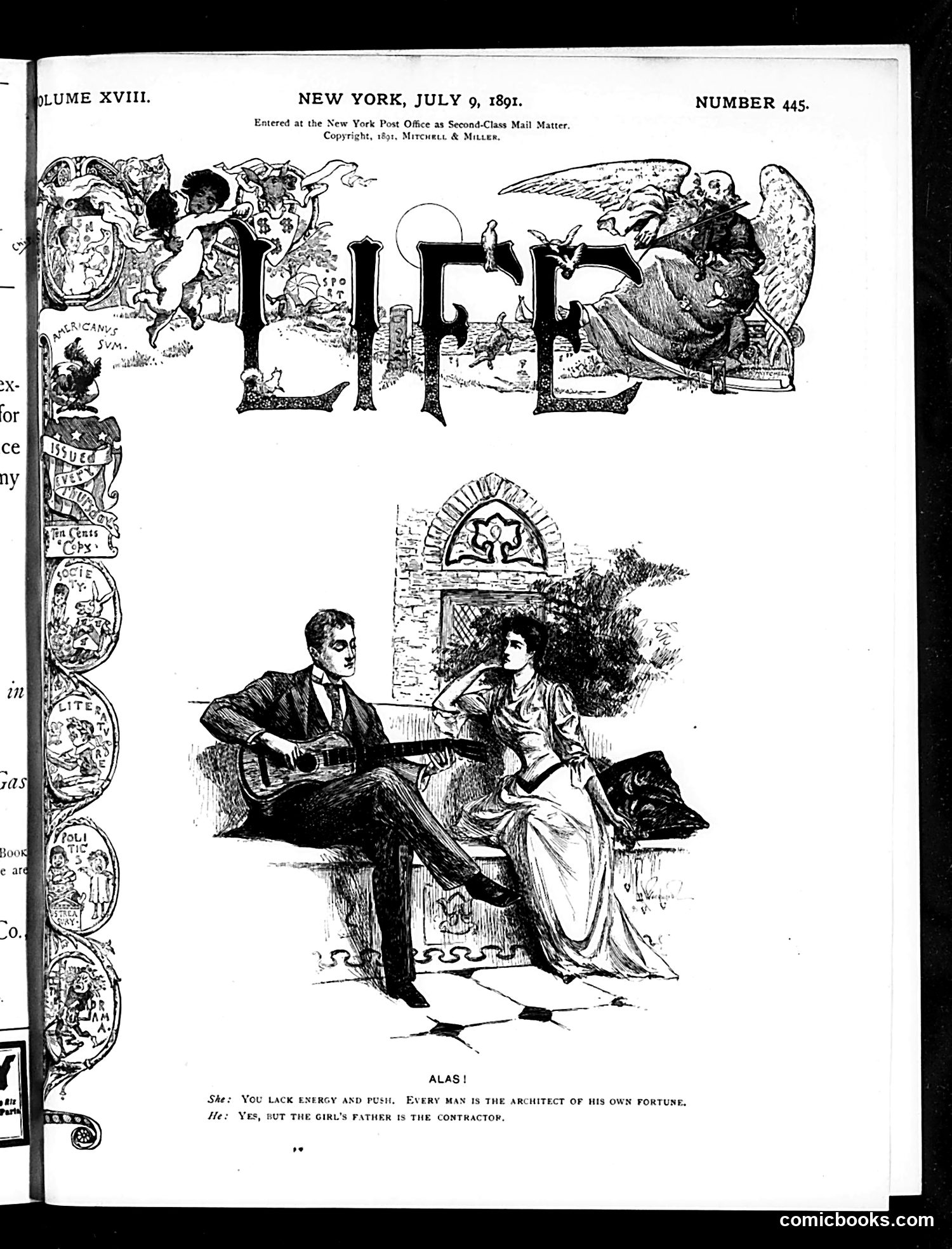
This cartoon depicts a romantic scene where a young man plays guitar to a woman seated beside a doorway. The caption's dialogue reveals the satirical point: the woman says the man "lacks energy and push" and that "every man is the architect of his own fortune," while the man replies that "the girl's father is the contractor." The joke mocks the common Victorian anxiety about masculine ambition and self-made success. Rather than being a self-directed "architect of his own fortune," this suitor's prospects depend entirely on the woman's father's approval and financial position—making the father the true "contractor" of any marriage arrangement. The satire critiques both romantic ideals of meritocracy and the economic realities of courtship in the Gilded Age.
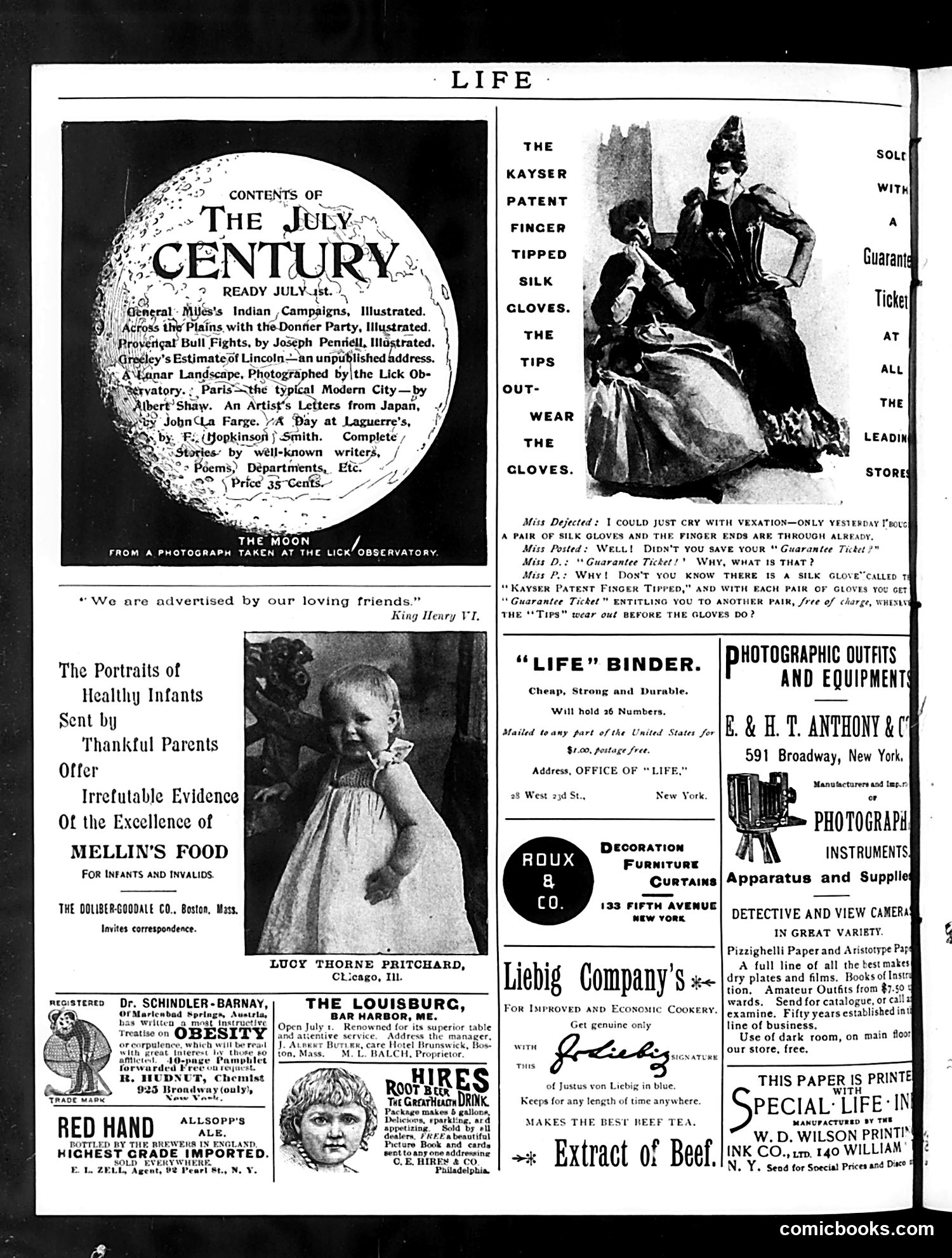
This page is primarily **advertising and product promotions** rather than political satire. The main content includes: 1. **The July Century Magazine advertisement** (top left) - promoting the upcoming issue's contents, including illustrated articles on General Miles's Indian Campaigns and other contemporary topics. 2. **Kayser Patent Finger-Tipped Silk Gloves advertisement** (top right) - featuring a woman modeling the product, with humorous dialogue about glove durability. 3. **Mellin's Food advertisement** (left) - promoting infant nutrition with a photograph of a healthy child. 4. **Various other ads** for Life Magazine binders, photographic equipment, beef extract, and other consumer goods. The page reflects **turn-of-the-century consumer culture** rather than political commentary, showcasing products marketed to middle and upper-class readers of this era.
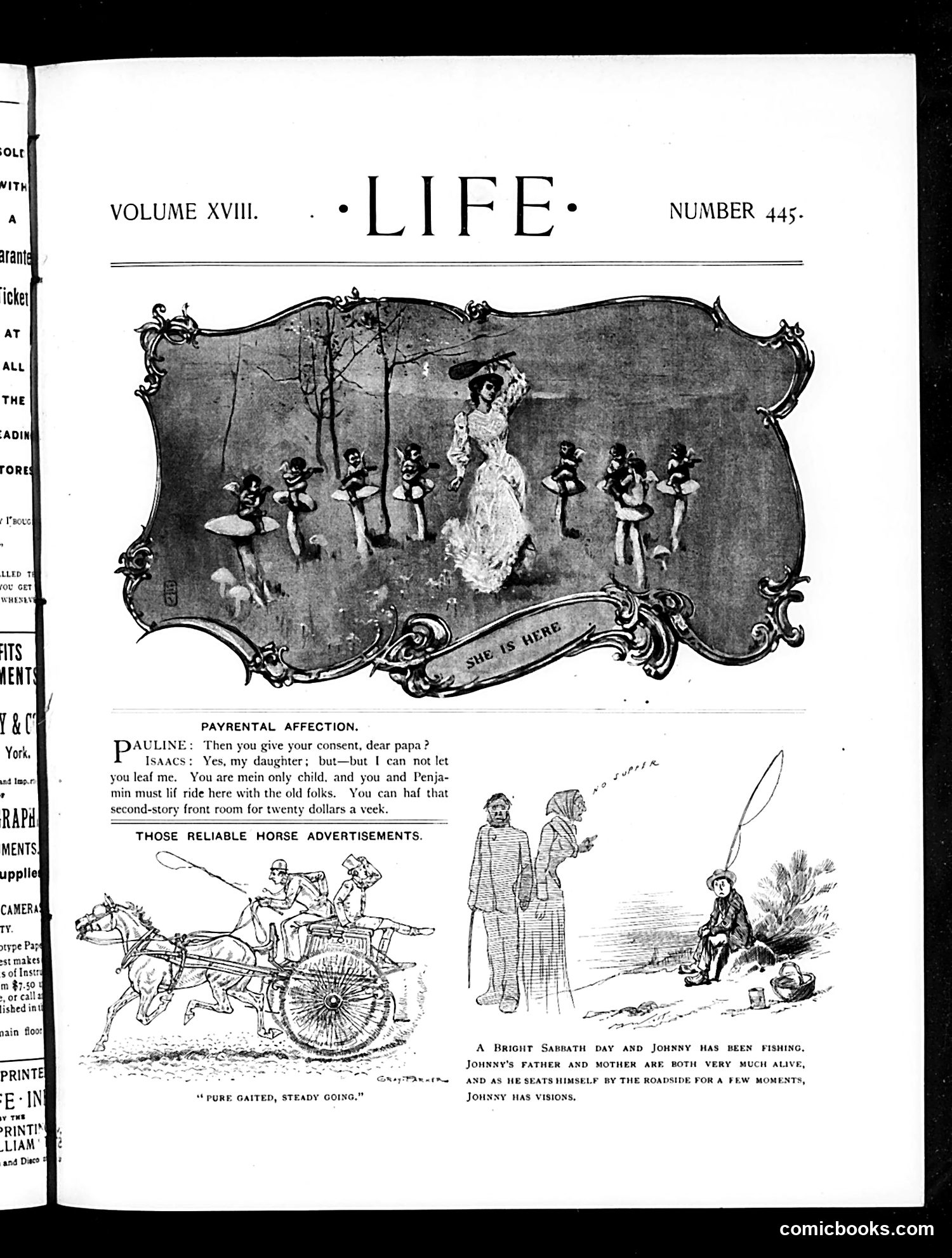
This page from *Life* magazine (Volume XVIII, Number 445) contains several distinct items: **"Parental Affection"** depicts a dialogue between Pauline and her father Isaacs. He refuses to let her leave home, insisting she remain his "only child," though offering her a "second-story front room for twenty dollars a week"—suggesting he'll rent space to her rather than grant independence. The satire mocks possessive parenting and the economic barriers young women faced in gaining autonomy. **"Those Reliable Horse Advertisements"** shows a cart with text "Pure gaited, steady going"—satirizing misleading horse-sale marketing claims. **The fishing scene** at right illustrates a separate story about Johnny and his parents enjoying a sabbath day by the roadside. The overall page combines domestic comedy with social commentary on parent-child relationships and commercial deception.
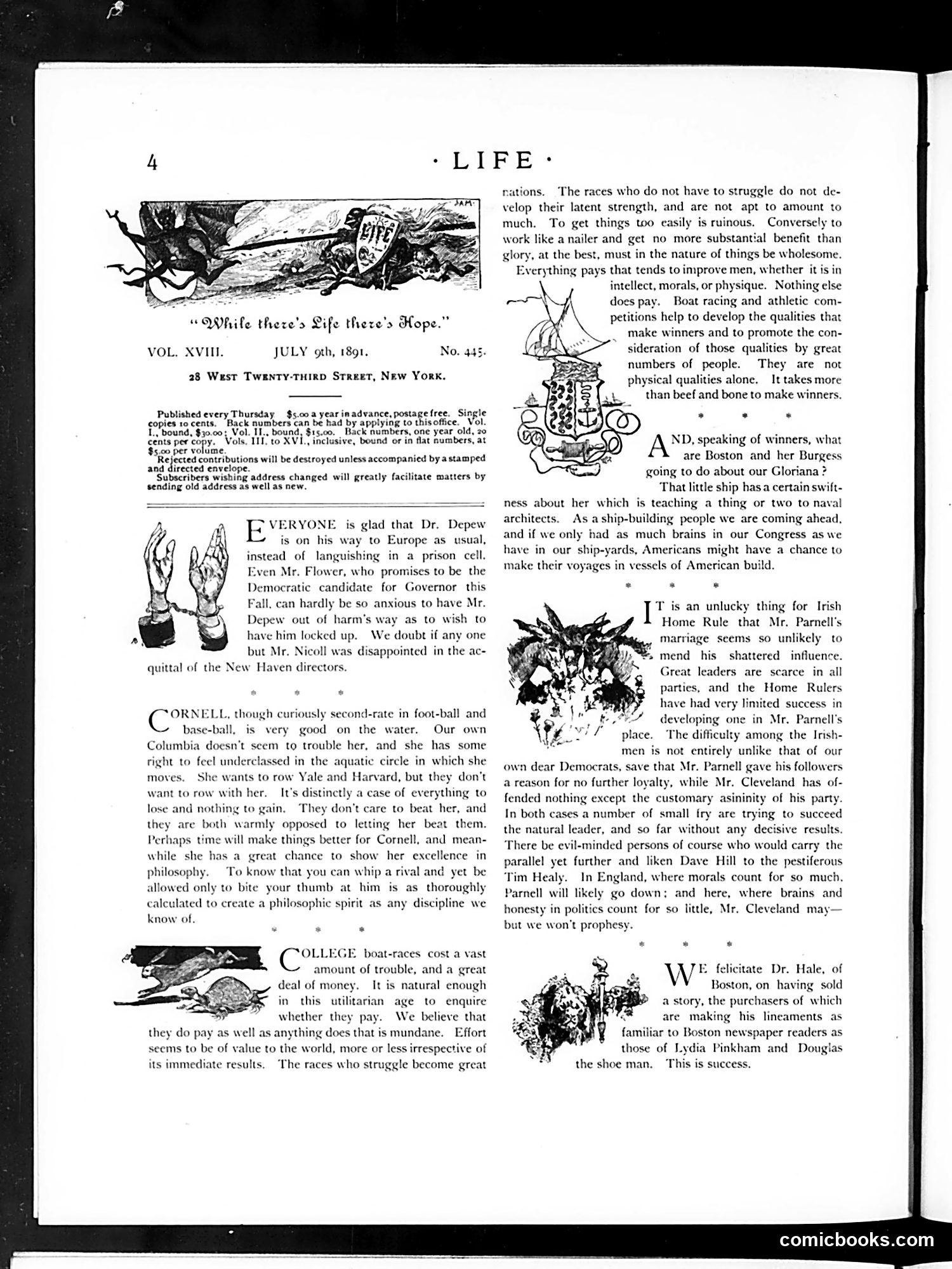
This page contains editorial commentary on contemporary political figures, primarily **Dr. Depew** (likely Chauncey Depew, a prominent Republican politician), who is departing for Europe. The writer sarcastically expresses relief at his absence, suggesting he was an undesirable political figure. The piece also discusses **Mr. Parnell's marriage** and Irish Home Rule politics, noting his diminished influence after personal scandal. It compares his situation to **Mr. Cleveland** (President Grover Cleveland), suggesting both Democratic leaders faced loyalty challenges. Additionally, there's commentary on **college boat races** as character-building exercises and mention of **Dr. Hale of Boston** selling a story to newspaper purchasers. The illustrations are decorative emblems rather than political caricatures. The satire relies heavily on political context familiar to 1891 readers.
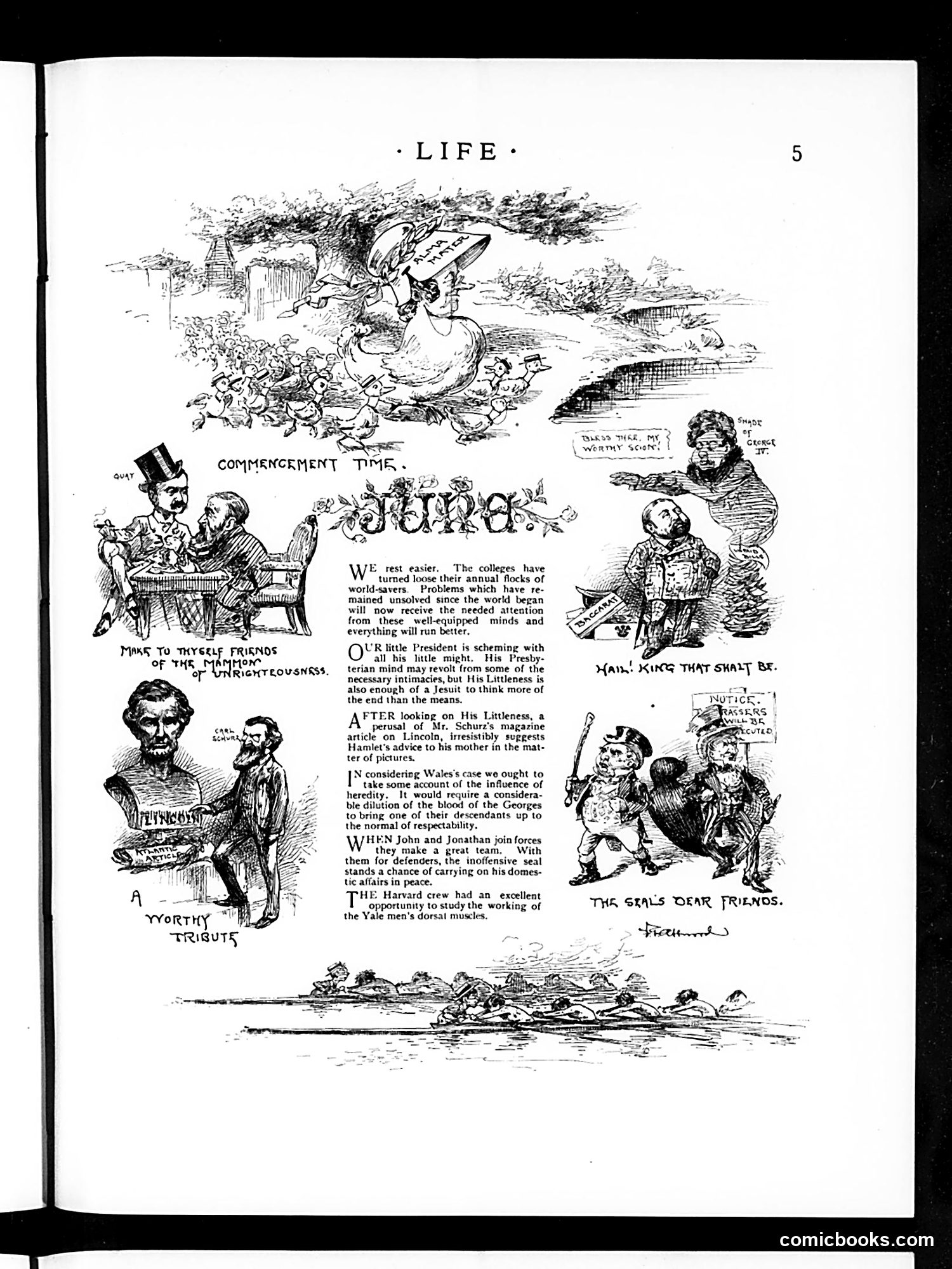
This satirical page mocks early 1900s college culture and leadership. "Commencement Time" depicts colleges releasing graduates to solve world problems, with captions suggesting optimism about their impact. The central text ridicules a "Little President" (likely Theodore Roosevelt) for scheming "with all his little might," suggesting his ambitions exceed his capacity. A reference to Lincoln's advice about pictures implies criticism of his public image management. "A Worthy Tribute" (left) appears to mock admiration for political figures. "The Seals Bear Friends" (right) uses animal caricatures—possibly representing political rivals or allies—in a humorous scene. The overall tone is skeptical of both youthful idealism and political leadership, typical of Life's satirical approach to American institutions and personalities of the period.
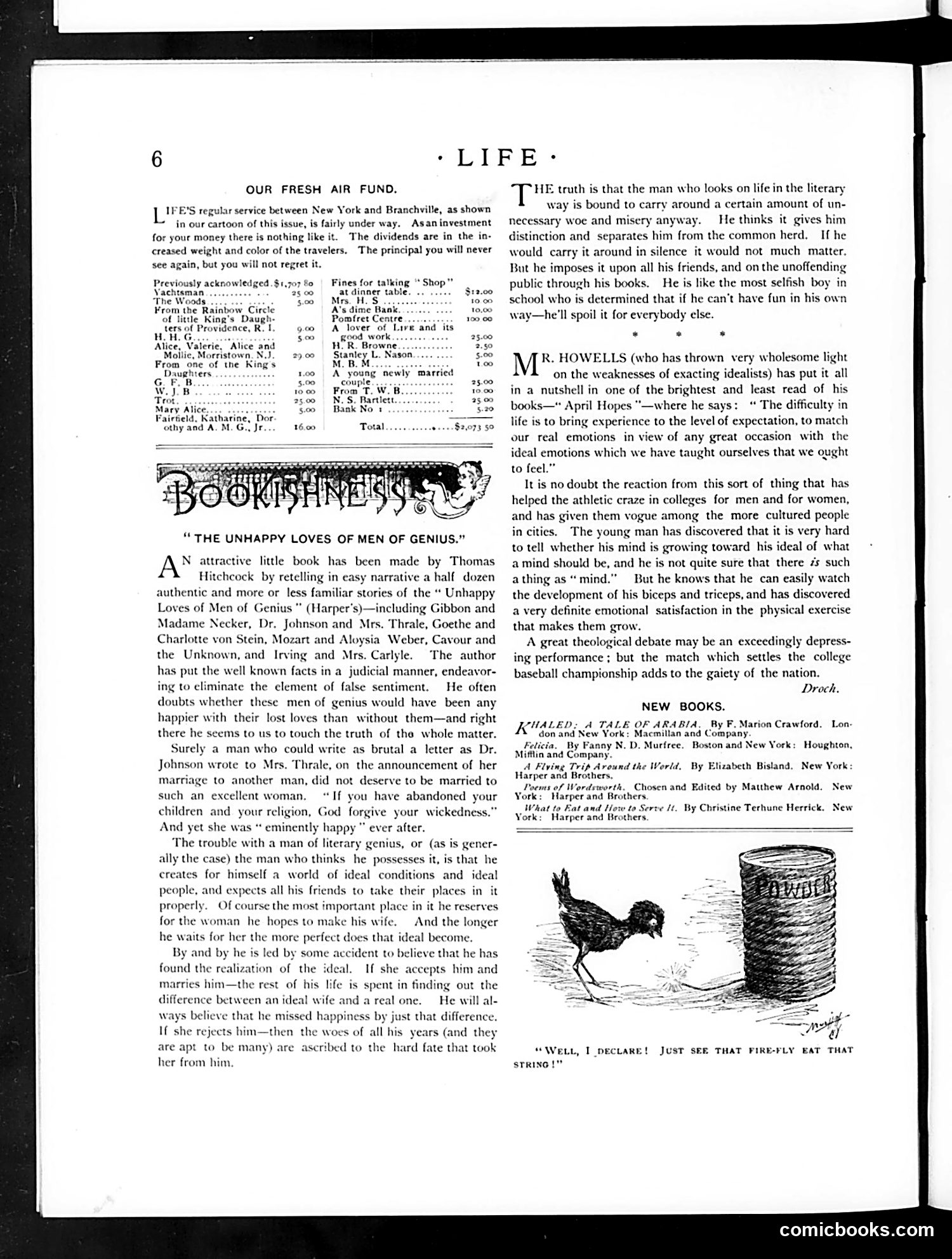
This page contains literary criticism and book reviews rather than political cartoons. The main content discusses how literary intellectuals create idealized worlds disconnected from reality, using William Dean Howells as an example of an author who brings "experience to the level of expectation." The only illustration is a small humorous drawing at bottom right showing a bird near a basket with the caption "Well, I declare! Just see that fire-fly eat that string!" This appears to be a simple visual joke about mistaken identity or observation—the bird observes a firefly apparently eating string, which is absurd, making the cartoon's humor derive from the unexpectedness of the scenario rather than political or social satire. The page is primarily editorial content focused on literary criticism.
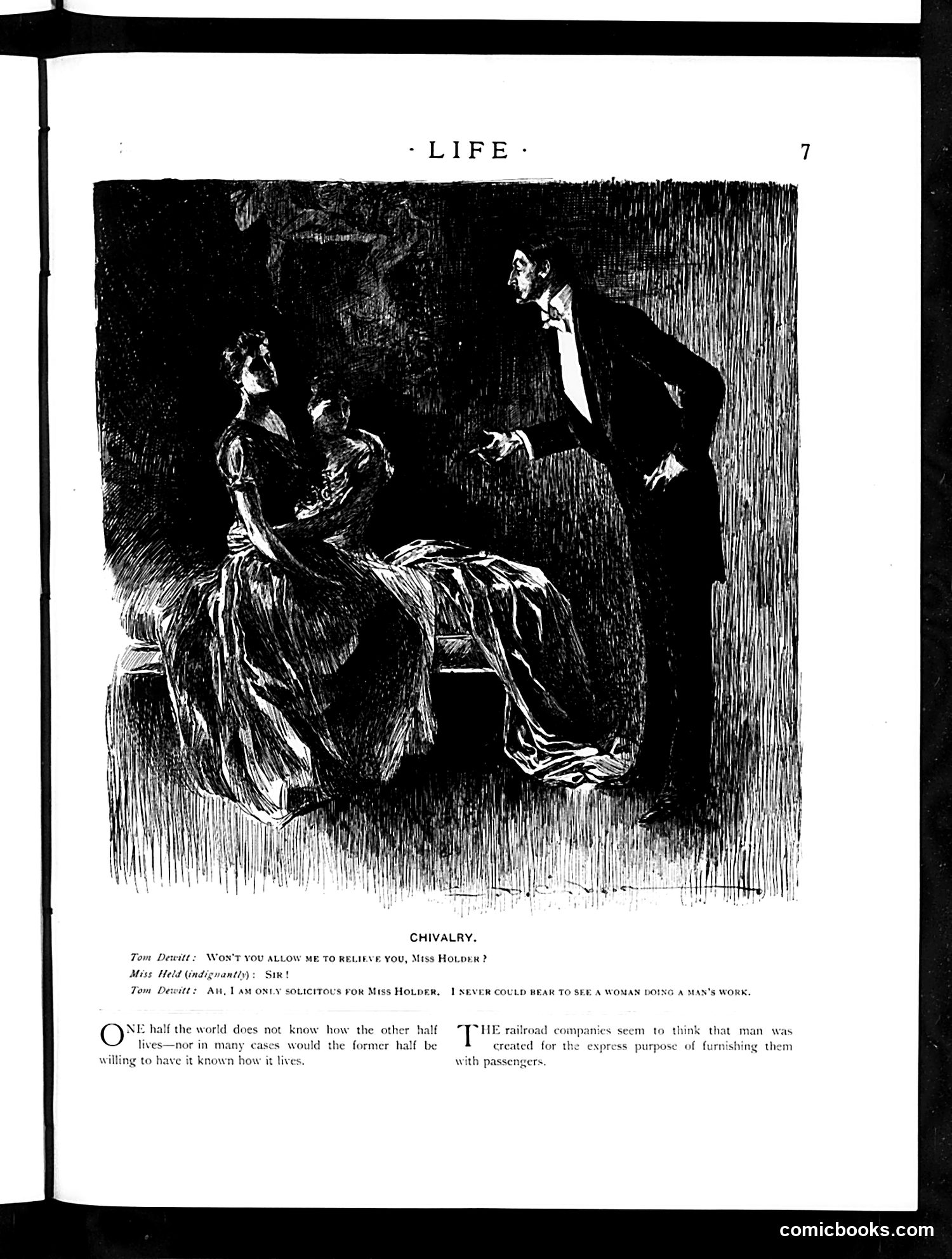
This cartoon satirizes outdated Victorian notions of chivalry. A well-dressed man (Tom Dewitt) refuses to allow a woman (Miss Holder) to do work, claiming he's "solicitous for Miss Holder" and can't bear "seeing a woman doing a man's work." The satire targets the hypocrisy of male chivalry—men claim to protect women while simultaneously excluding them from economic participation and opportunity. The accompanying text critiques how "one half the world does not know how the other half lives," suggesting that privileged men remain ignorant of women's actual circumstances and capabilities. The final paragraph mocks railroad companies' similar paternalistic logic, implying that institutional sexism masquerades as protective concern.
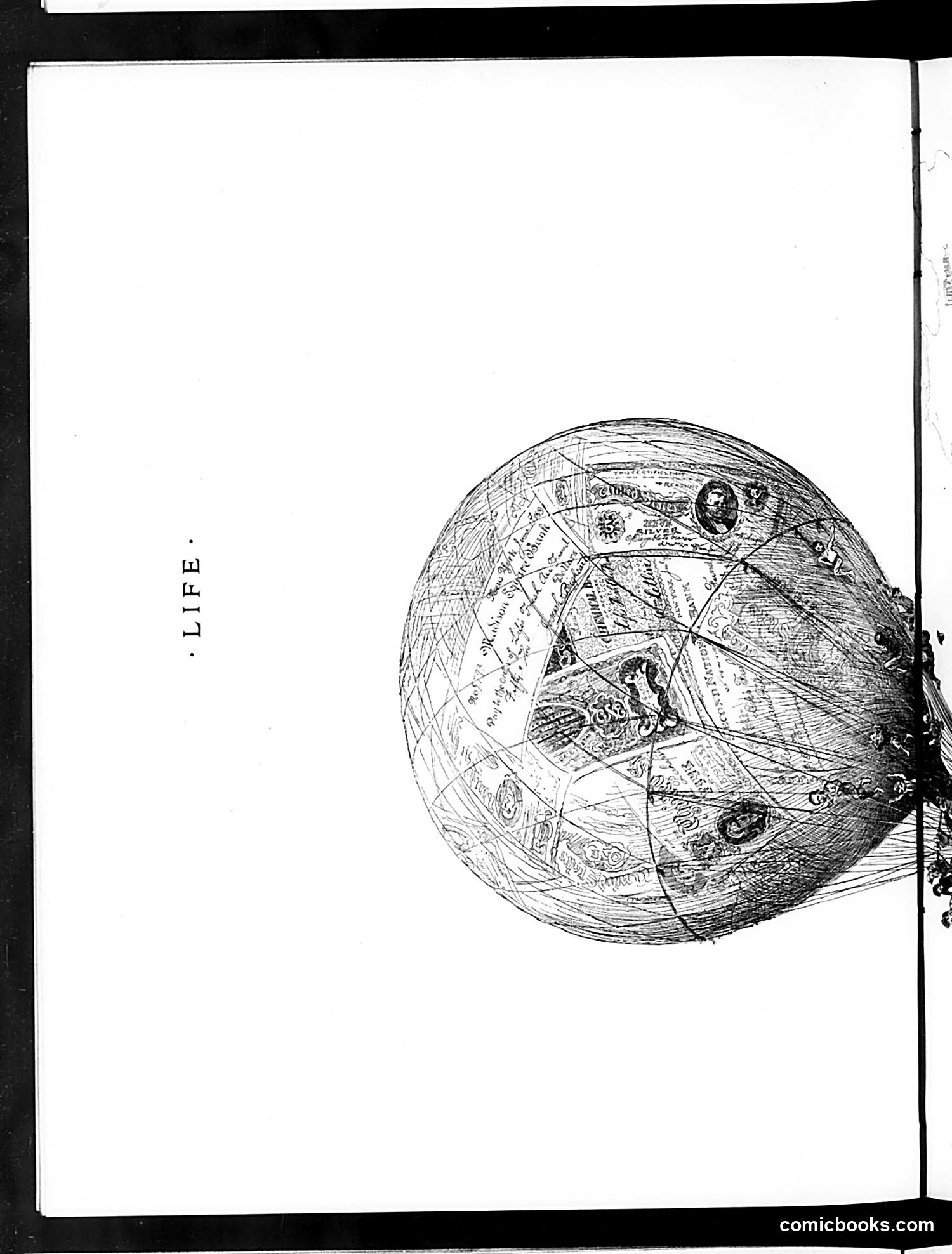
This appears to be a title page or section divider from Life magazine, featuring the word "LIFE" printed vertically on the left side. The main image is an intricate engraving of a globe or spherical map, rendered in fine cross-hatching and line work typical of 19th-century illustration. The globe shows various geographical regions and appears to contain detailed cartographic or decorative elements within its sections. Without additional context or visible text labeling specific regions or figures, I cannot definitively identify what particular political or social satire this represents. The artistic style suggests this is from an early period of Life magazine's publication, but the specific subject matter and satirical intent remain unclear from the image alone.
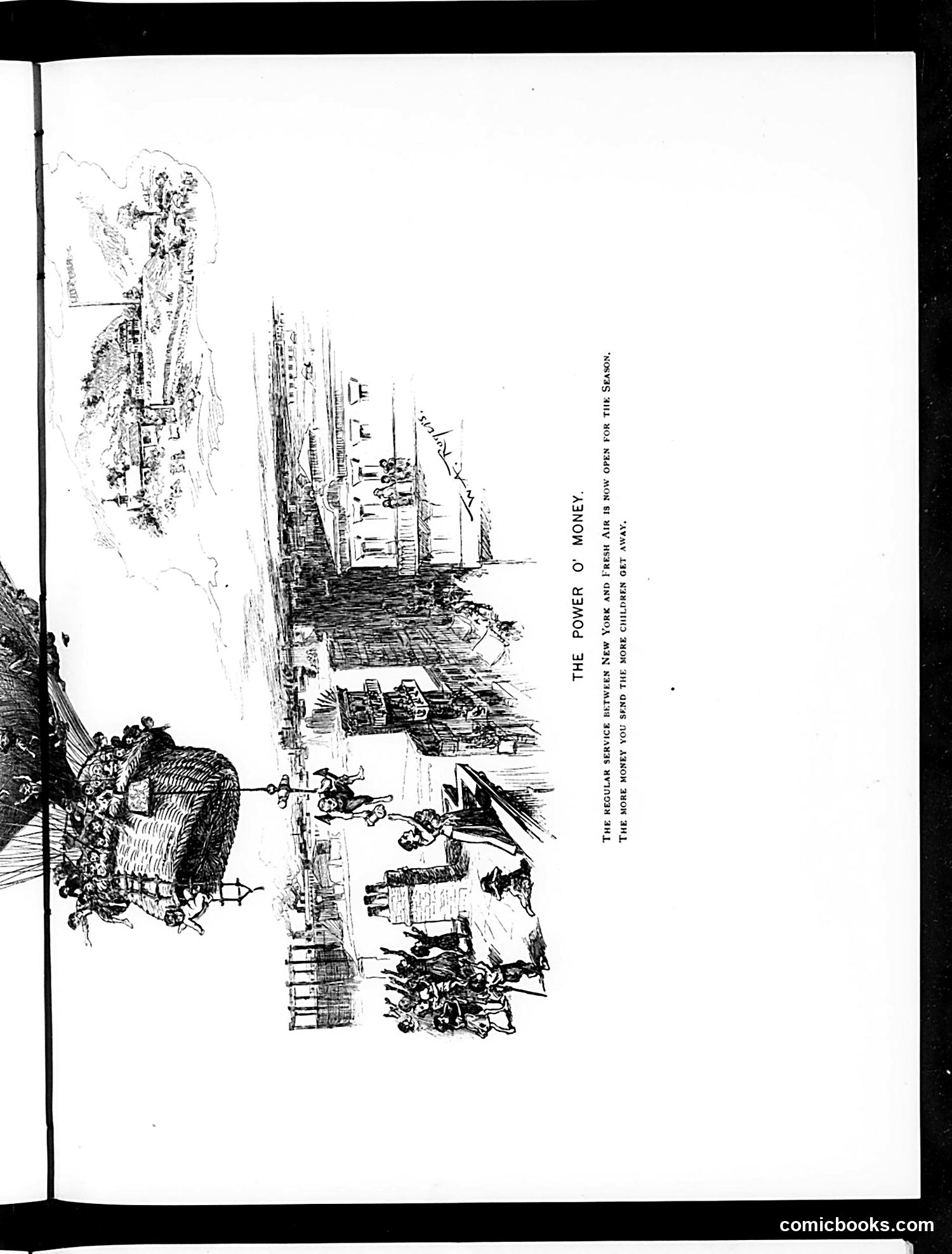
This satirical illustration depicts a wealthy figure (shown as a large, rotund man on the left) wielding enormous financial power over a cityscape. The image critiques how money controls urban society—the text beneath reads "The circular streets of New York are being paved. The more money you spend the more chances on a way." The cartoon reflects early-20th-century anxieties about plutocracy and wealth concentration in American cities. The bloated capitalist figure dominates the composition, suggesting that financial power literally shapes the urban landscape and determines how ordinary citizens navigate their world. This reflects Life magazine's satirical stance against unchecked corporate influence and economic inequality during the Progressive Era, when such critiques were common in American periodicals.
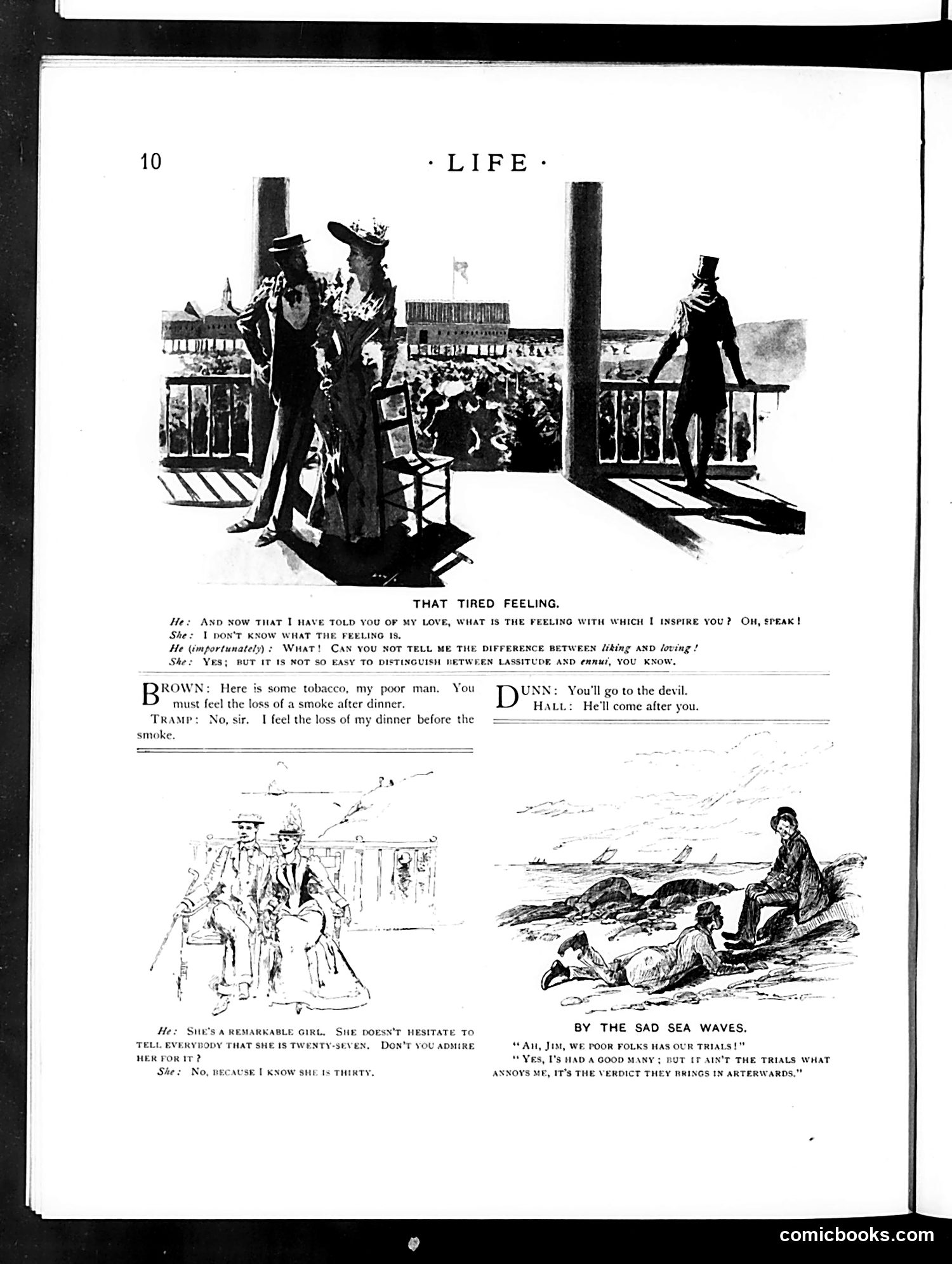
This page contains three separate satirical sketches about exhaustion and disillusionment. The top illustration depicts two well-dressed figures at what appears to be a public gathering, with dialogue about the distinction between "liking" and "loving"—satirizing romantic pretense among the upper classes. The middle sketch shows a man and woman discussing a "remarkable girl" of twenty-seven, with the joke hinging on her dishonesty about her age—a common target of period humor about vanity. The bottom illustration, "By the Sad Sea Waves," depicts poor or working-class people in distress by the shore, with dialogue suggesting they endure multiple hardships in life and expect divine judgment hereafter—social commentary on poverty and the working class's grim circumstances and fatalism. The overall theme appears to be different manifestations of weariness: romantic, social, and existential.
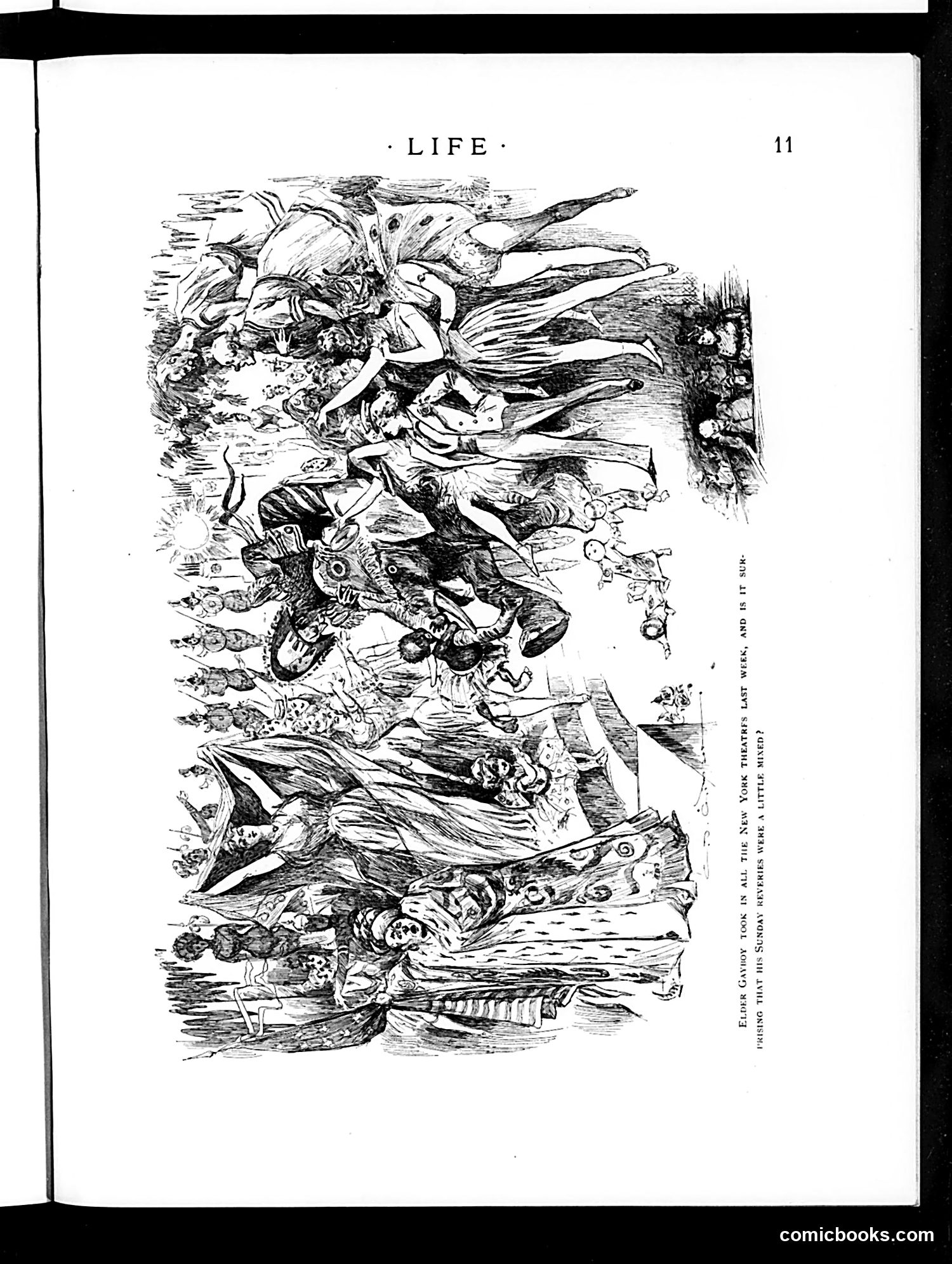
This is page 11 of *Life* magazine, featuring a single elaborate satirical engraving titled "EASTER GAIETY TOOK IN ALL THE SIX WORK-PEOPLE AND BETTS SUE" (text partially visible on right margin). The image depicts a chaotic Easter parade or celebration scene rendered in detailed pen-and-ink style. Multiple figures in period dress (appears to be late 19th century) are shown in exaggerated, comedic poses and expressions—some falling, gesturing wildly, or in absurd positions. The drawing style emphasizes physical comedy and social satire typical of *Life* magazine's humor. Without clearer text attribution or caption, the specific social commentary remains unclear, but the scene likely mocks Easter fashion displays, public behavior, or social pretension—common satirical targets of the era. The "six work-people and Betts" reference suggests commentary on class distinctions or specific contemporary figures.
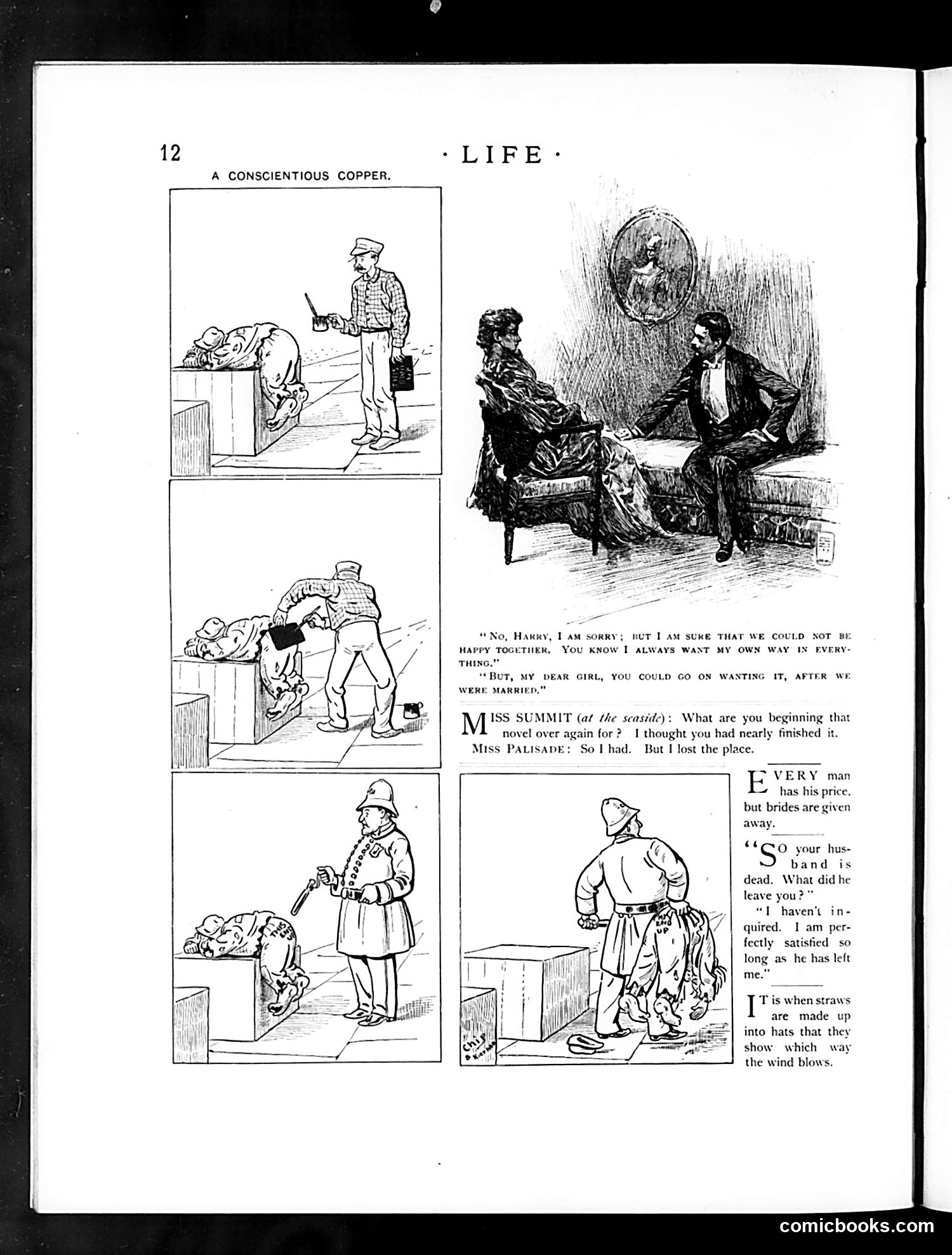
This page contains multiple satirical sketches about marriage and relationships, typical of *Life* magazine's humor. The main comic strip (left) depicts a police officer ("copper") repeatedly confronting a couple, apparently enforcing public decency laws. The satire seems to target either police overzealousness or the couple's shameless behavior in public spaces. The surrounding vignettes are witty aphorisms on marriage: - A woman tells her fiancé she'll continue wanting her own way after marriage; he replies she can keep wanting it - Two women discuss a novel manuscript one lost—a commentary on women's literary pursuits - A widow admits she hasn't inquired what her dead husband left her, satisfied merely that he's gone - A closing proverb equates straws in hats showing wind direction with revealing one's true nature The overall theme satirizes marriage as inherently compromising, women's independence versus domestic expectations, and the gap between romantic ideals and marital reality—common early-20th-century *Life* magazine subjects.
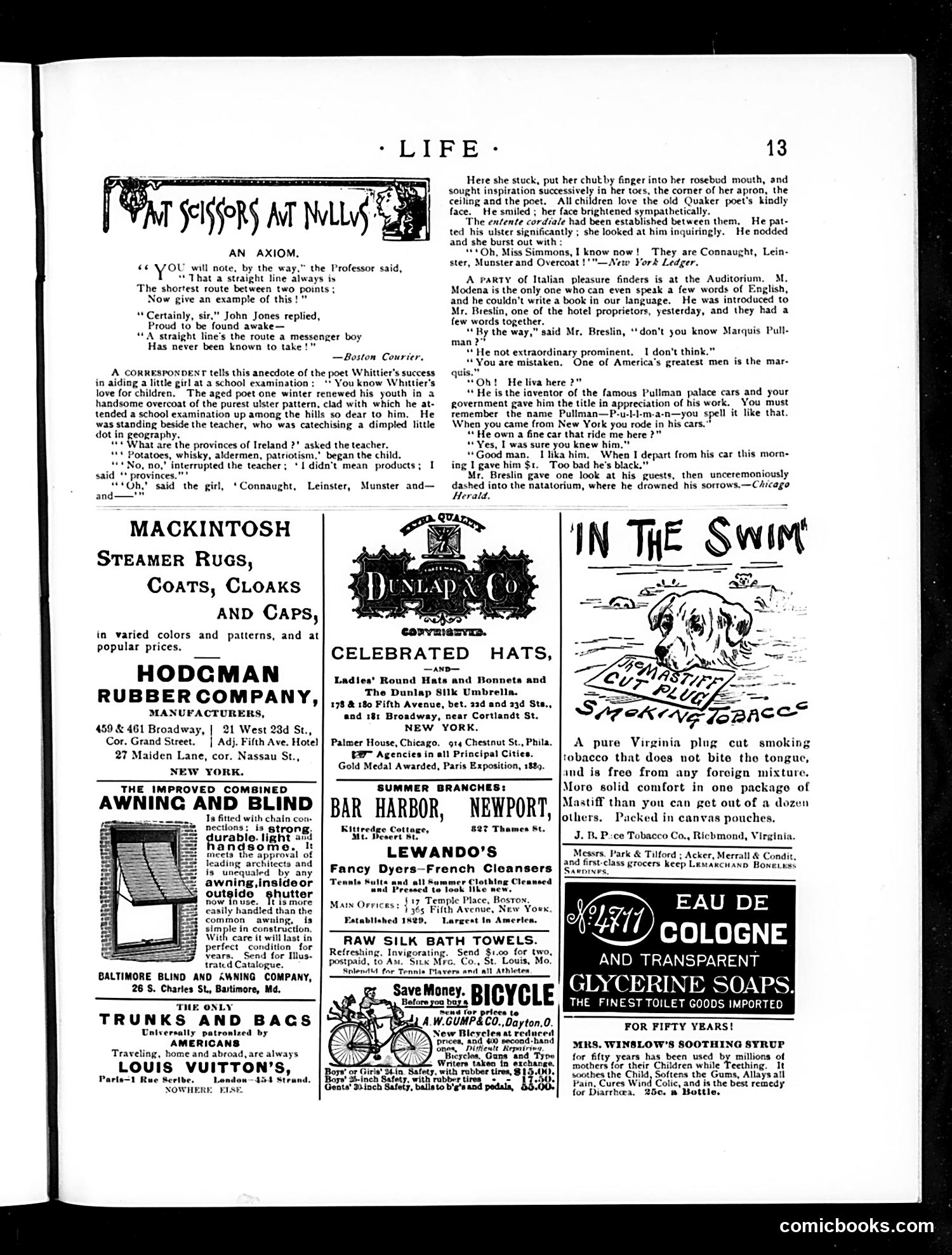
This page from *Life* magazine contains two satirical anecdotes about humorous misunderstandings: **The first joke** involves a schoolgirl asked to name Ireland's provinces. She correctly recalls "Connaught, Leinster, Munster" but gets stuck on the fourth. Poet John Greenleaf Whittier, standing nearby in a new ulster (overcoat), smiles encouragingly at her. She takes his gesture as a hint and answers "Overcoat"—mishearing or confusing his garment for "Ulster," the actual fourth province. The humor lies in her innocent, logical mistake. **The second anecdote** features Italian visitors meeting hotel proprietor Breslin. One guest is confused about American inventor George Pullman (of Pullman railway cars), initially dismissing him as unimportant. When Breslin explains Pullman's significance, the guest casually mentions he tipped Pullman $1 that morning—"too bad he's black." Breslin, apparently shocked by either the racial comment or the guest's ignorance, dramatically retreats to drown his sorrows. The satire targets either the guest's casual racism or his obliviousness. The remainder comprises period advertisements for clothing, home goods, and toiletries.
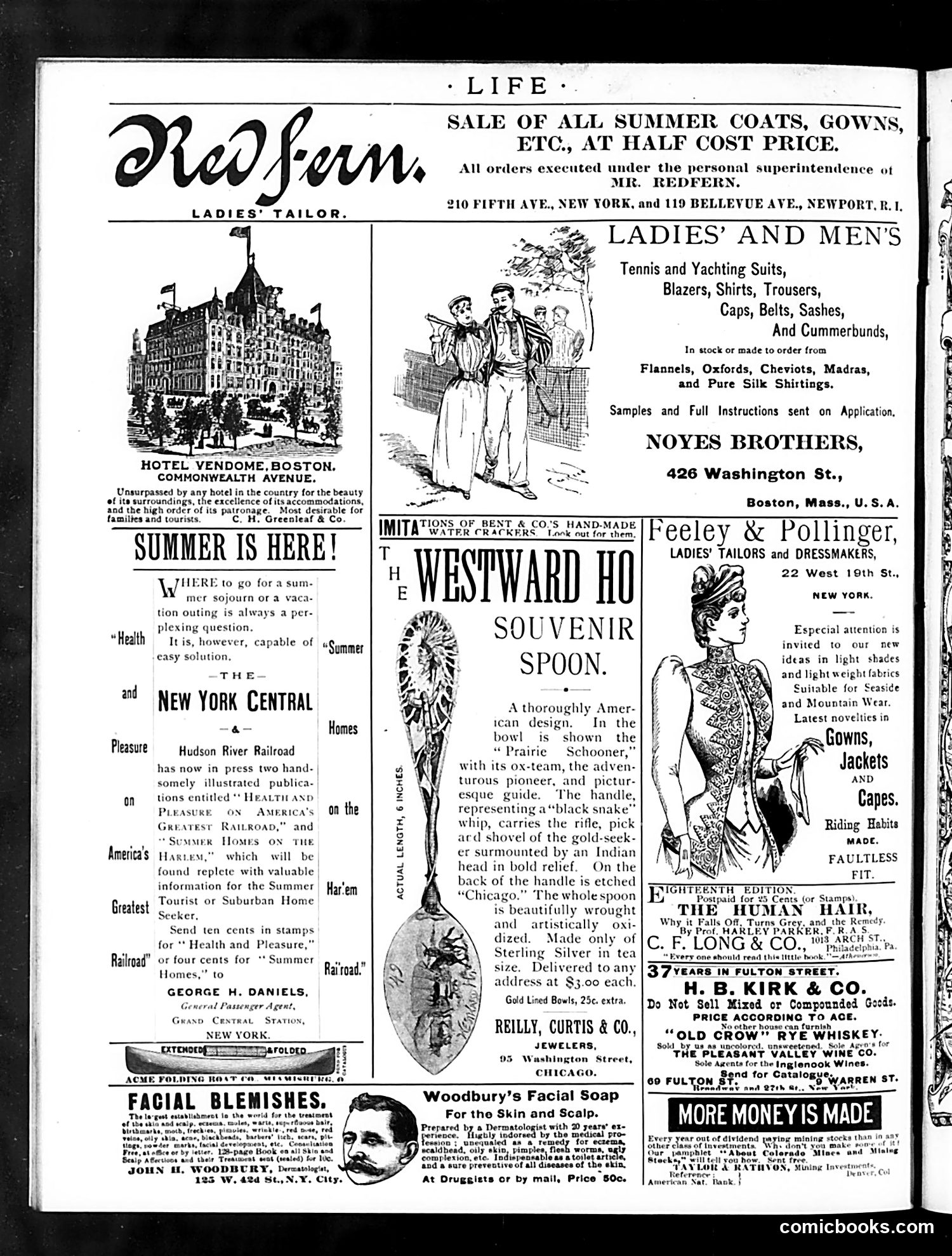
This is primarily an **advertising page** from Life magazine, not a satirical cartoon. The page contains no political cartoons or satirical content to analyze. The advertisements showcase **late 19th-century consumer goods and services**: ladies' tailors (Red Fern, Feeley & Pollinger), railroad travel promotions, a souvenir spoon featuring American frontier imagery (Prairie Schooner with pioneers and Native American imagery), facial treatments for "blemishes," and whiskey sales. The only visual content with potential social meaning is a **Westward Ho souvenir spoon** celebrating American expansion with stereotypical frontier iconography—ox-teams, gold-seekers, and a Native American head. This reflects the era's romanticization of westward expansion, though it's presented as promotional merchandise rather than satire. The page primarily documents **consumer culture and advertising conventions of the period**, showing what products and services were marketed to middle and upper-class readers of Life.