
Life, 1891-07-09 · page 6 of 14
Life — July 9, 1891 — page 6: what you’re looking at
What you’re looking at
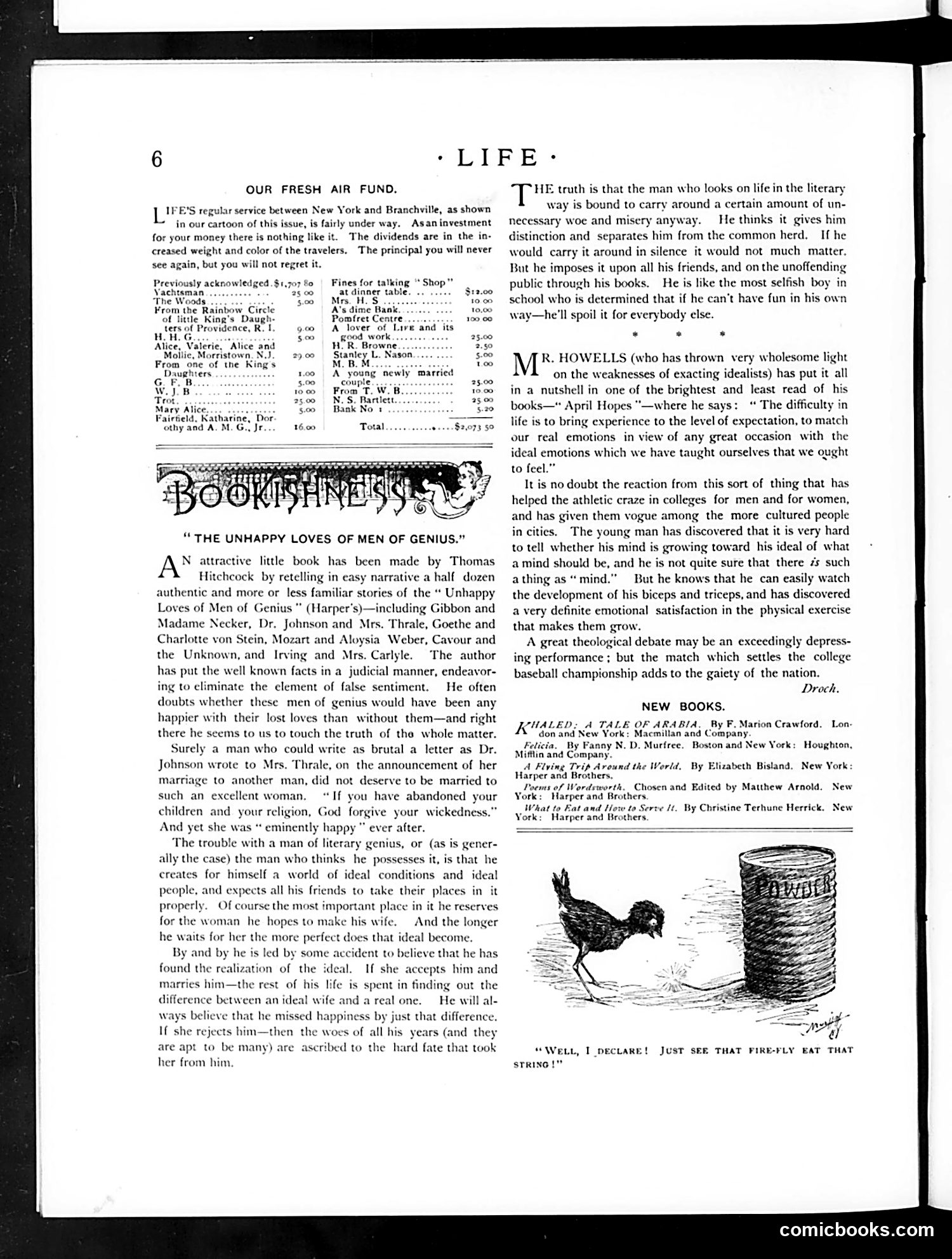
This page contains literary criticism and book reviews rather than political cartoons. The main content discusses how literary intellectuals create idealized worlds disconnected from reality, using William Dean Howells as an example of an author who brings "experience to the level of expectation." The only illustration is a small humorous drawing at bottom right showing a bird near a basket with the caption "Well, I declare! Just see that fire-fly eat that string!" This appears to be a simple visual joke about mistaken identity or observation—the bird observes a firefly apparently eating string, which is absurd, making the cartoon's humor derive from the unexpectedness of the scenario rather than political or social satire. The page is primarily editorial content focused on literary criticism.
📄 Transcribed text from this page (OCR, searchable)
Machine-transcribed from the original scan — historical spelling and the odd misread are preserved.
LIFE OUR FRESH AIR FUND. IFE'S regular service between New York and Branchville, as shown in our cartoon of this issue, is fairly under way. Asan investment for your money there is nothing like it. The dividends are in the in- creased weight and color of the travelers. The principal you will never see again, but you will not regret it. Previously acknowledged. $1 Vachtsman ....... . The Woods . From the Rainbow Circle of little King’s Daugh- ters of Providence, R. 1. H.H.G.. Alice, Valerie, “Alice and Moilic, Morristown. NJ From one of the Fines for talking at dinner table Mrs. H.S. A's dime Bank. - Pomfret Centre ..... A lover of Live and its good work....... H.R. Browne..... Stantey L. Nason MB. A young “newly” * Shop" “married Mary Alice. 7 Fairtield, Katharine, Dor- “ THE UNHAPPY LOVES OF MEN OF GENIUS.” JAN attractive little book has been made by Thomas Hitchcock by retelling in easy narrative a half dozen authentic and more or less familiar stories of the “ Unhappy Loves of Men of Genius ” (Harper’s)—including Gibbon and Madame Necker, Dr. Johnson and Mrs. Thrale, Goethe and Charlotte von Stein, Mozart and Aloysia Weber, Cavour and the Unknown, and Irving and Mrs. Carlyle. ‘The author has put the well known facts in a judicial manner, endeavor- ing to eliminate the clement of false sentiment. He often doubts whether these men of genius would have been any happier with their lost loves than without them—and right there he seems to us to touch the truth of the whole matter. Surely a man who could write brutal a letter as Dr. Johnson wrote to Mrs. Thrale, on the announcement of her marriage to another man, did not deserve to be married to such an excellent woman. “If you have abandoned your children and your religion, God forgive your wickedness. And yet she was “ eminently happy er after. The trouble with a man of literary genius, or (a gener- ally the case) the man who thinks he possesses it, is that he creates for himself a world of ideal conditions and ide people, and expects all his friends to take their places in it properly. Of course the most important place in it he reserves. for the woman he hopes to make his wife. And the longer he waits for her the more perfect does that ideal become. By and by he is led by some accident to believe that he has found the realization of the If she accepts him and marries him—the rest of his life is spent in finding out the difference between an ideal wife and a real one. ideal. He will al- ways believe that he missed happiness by just that difference. If she rejects him—then the woes of all his years (and they are apt to be many) are ascribed to the hard fate that took her from him. HE truth is that the man who looks on life in the literary way is bound to carry around a certain amount of un- ry woe and misery anyway. He thinks it gives him distinction and separates him from the common herd. If he would carry it around in silence it would not much matter. But he imposes it upon all his friends, and on the unoffending public through his books. He is like the most selfish boy in school who is determined that if he can’t have fun in his own way—he'll spoil it for everybody else. nece: * * * R. HOWELLS (who has thrown very wholesome light on the weaknesses of exacting idealists) has put it all hell in one of the brightest and least read of his April Hopes “—where he says: “ The difficulty in life is to bring experience to the level of expectation, to match our real emotions in view of any great occasion with the ideal emotions which we have taught ourselves that we ought to feel.” It is no doubt the reaction from this sort of thing that has helped the athletic craze in colleges for men and for women, and has given them vogue among the more cultured people in citics, The young man has discovered that it is very hard to tell whether his mind is growing toward his ideal of what amind should be, and he is not quite sure that there ¢s such athing as “ mind.” But he knows that he can easily watch the development of his biceps and triceps, and has discovered a very definite emotional satisfaction in the physical exercise that makes them grow. A great theological debate may be an exceedingly depress- ing performance ; but the match which settles the college baseball championship adds to the gaiety of the nation. Droch. NEW BOOKS. KUALED: A TALE OF ARABIA. By F. Marion Crawford. ‘A Gon and New York: Macmillan and Company Felicia, By Fanay N. D. Murfree. Boston and New York: Mifflin and Company. A Flying Trip Around the World, Harper and Brothers, Poems of Wordsworth. Chosen and Edited by Matthew Arnold. York: Harper and Brothers What to Eat and How to Serve Ht, By Christine Terhune Herrick. New York 0 Lon- Houghton, By Elizabeth Bisland, New York: New Harper and Br Sit JUST SER THAT FIRE-FLY , 1 DECLARE! EAT THAT STRING !"" comicbooks.com