
A complete issue · 18 pages · 1891
Life — June 11, 1891
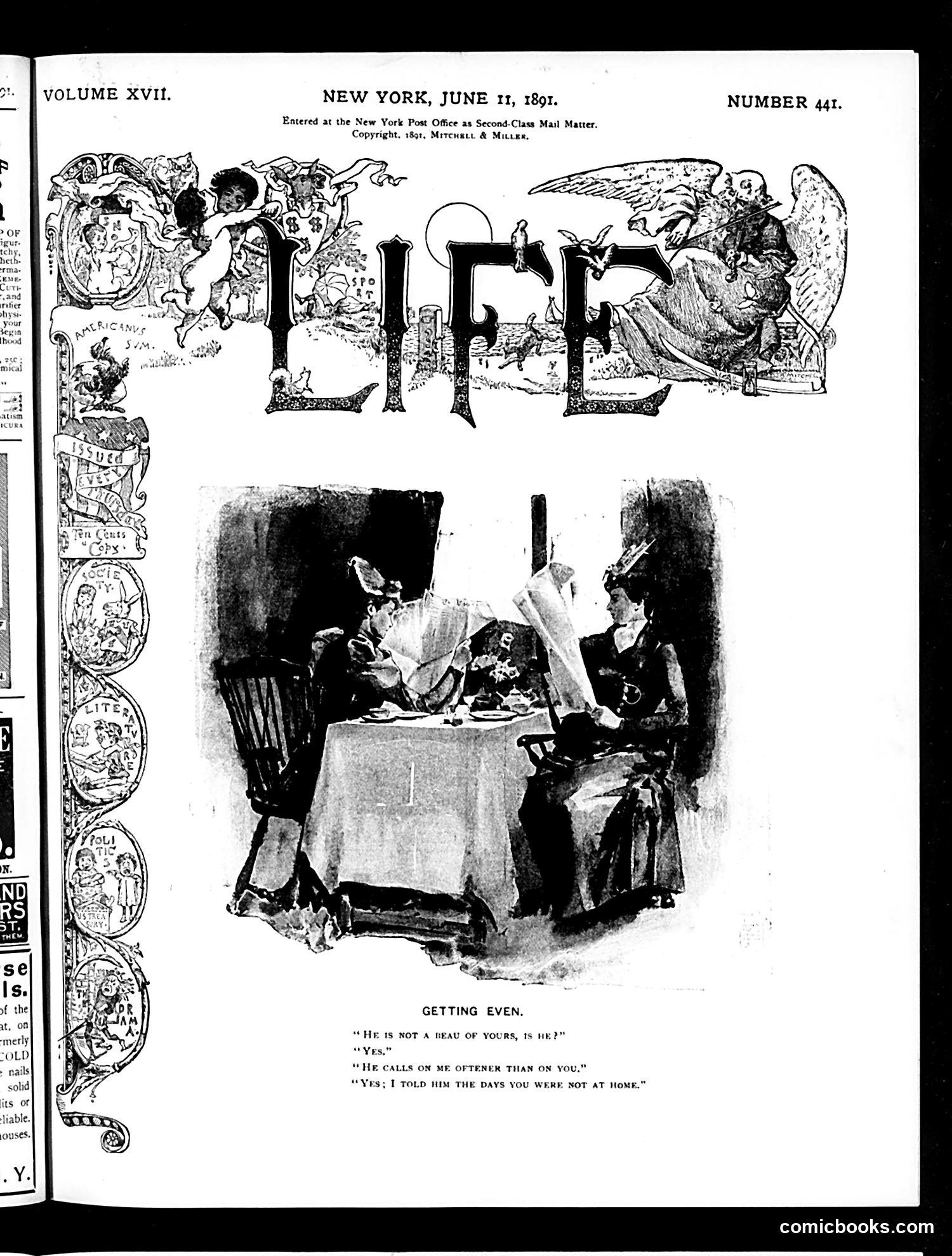
This cartoon depicts a domestic dispute centered on infidelity or neglect. A woman confronts a man at a table while reading a newspaper, her body language accusatory. The dialogue reveals the conflict: **"He is not a beau of yours, is he?"** **"Yes."** **"He calls on me oftener than on you."** **"Yes; I told him the days you were not at home."** The satire mocks marital revenge tactics—specifically, the husband deliberately encouraging a suitor to visit while the wife is absent, seemingly to make her jealous or punish her perceived coldness. The title "Getting Even" suggests tit-for-tat retaliation within marriage. This reflects late-Victorian anxieties about gender relations and domestic power struggles, presented here as darkly comic.
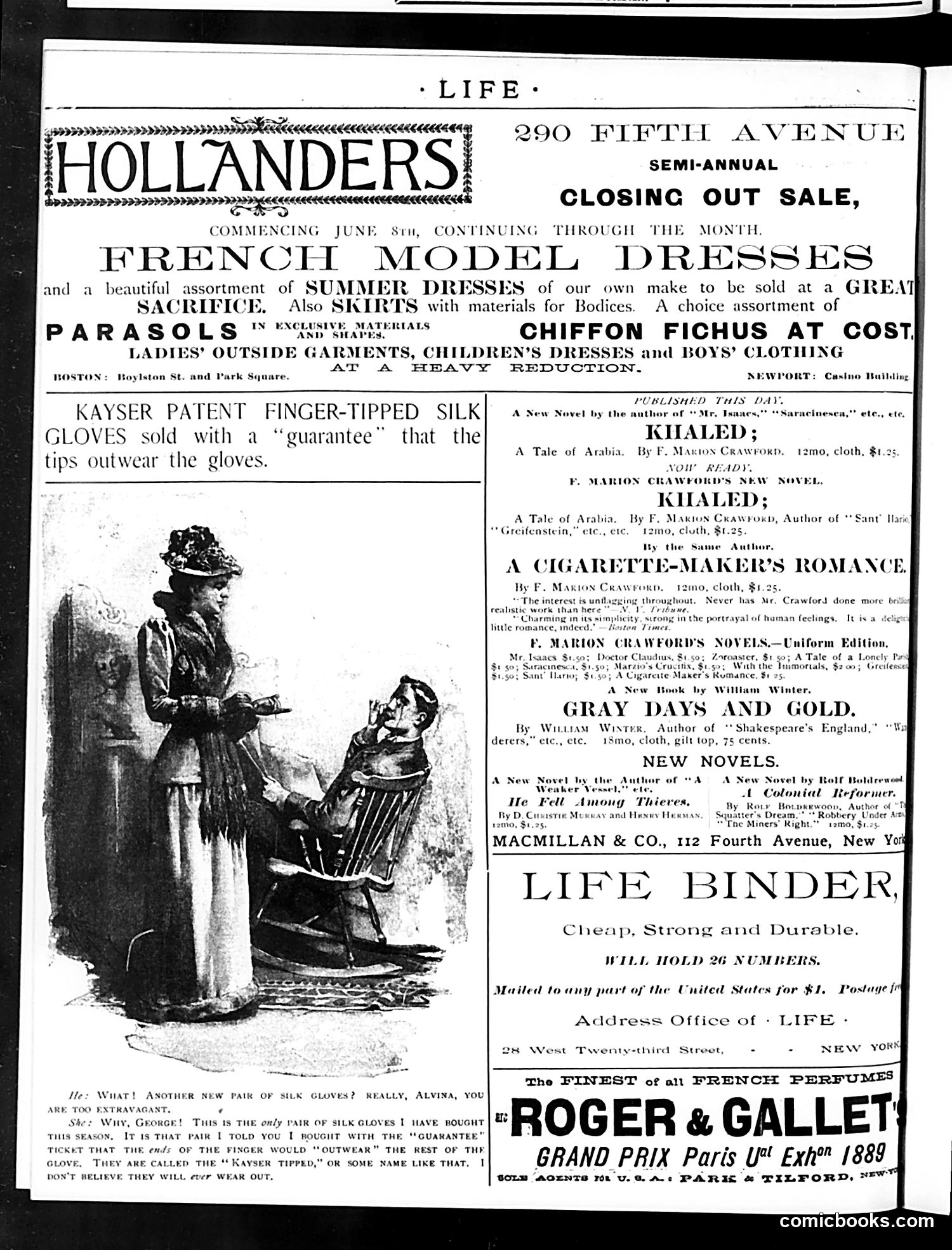
This page is primarily **advertising**, not satire or political commentary. The main content consists of commercial notices for: - **Hollanders** department store (290 Fifth Avenue) announcing a semi-annual closing-out sale featuring French model dresses and summer clothing - **Kayser Patent Finger-Tipped Silk Gloves**, marketed with a guarantee that the fingertips will outlast the gloves The only cartoon element is a small illustration accompanying the glove advertisement, showing two figures in period dress discussing the gloves' durability. The dialogue humorously emphasizes the product's superiority—the woman expresses surprise at the quality, while the man confirms these are the "*only* pair of silk gloves" with this guarantee. The remainder of the page consists of book advertisements from Macmillan & Co., a Life magazine binder ad, and Roger & Gallet perfume advertisement. This is a typical commercial page from an era when magazines relied heavily on advertising revenue.
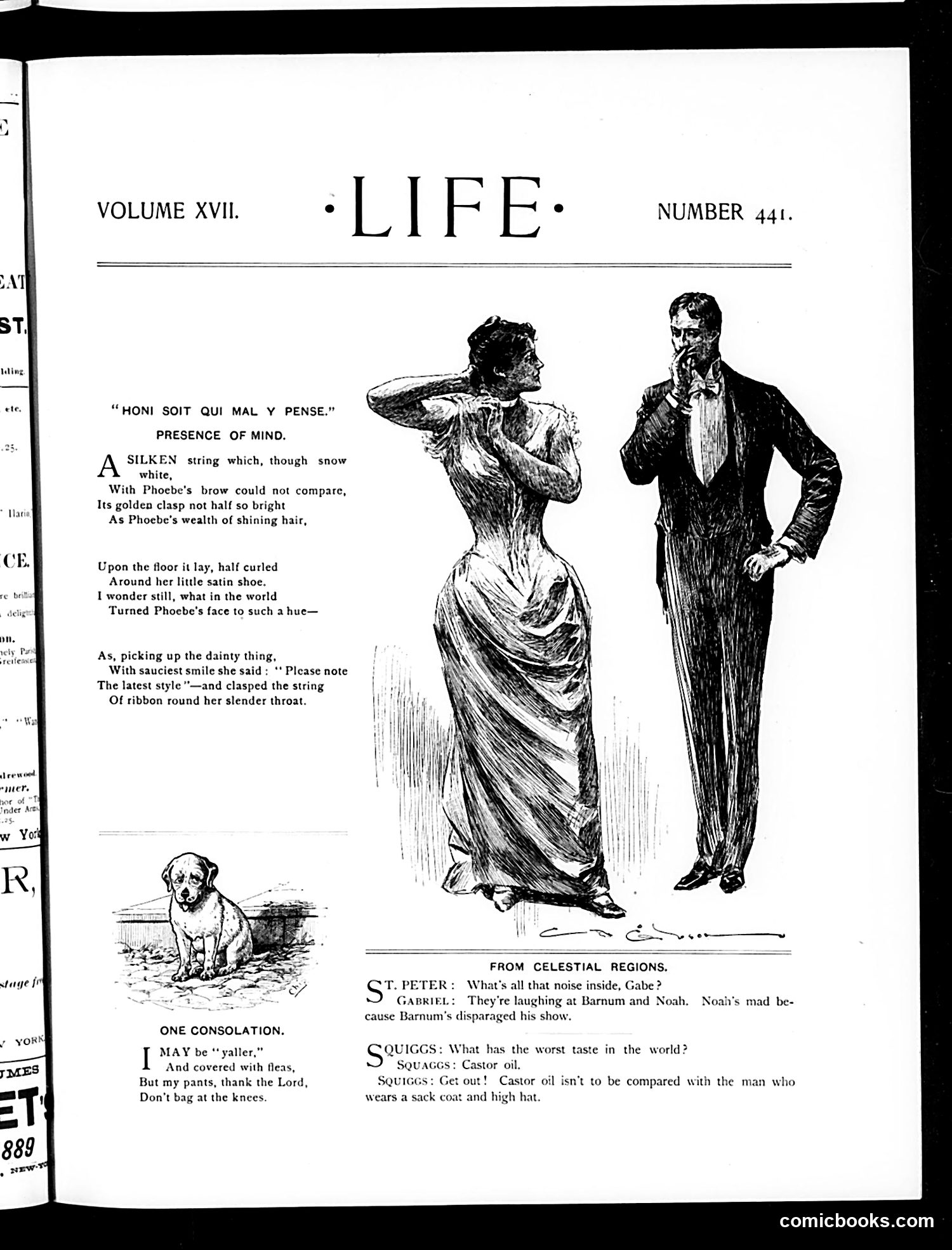
This page contains three separate humor pieces: 1. **"Honi Soit Qui Mal Y Pense" (Presence of Mind)**: A poem and illustration about a woman (Phoebe) who drops a silk string/ribbon and picks it up while a man observes. The joke plays on her composure and fashion consciousness. 2. **"One Consolation"**: A brief verse about a dog that is a "yaller" (yellow) and covered with fleas, consoling the owner that at least he doesn't have to complain about his knees. 3. **"From Celestial Regions"**: Jokes between religious figures (St. Peter, Gabriel, Squiggs) involving biblical references (Noah, Barnum's circus) and crude humor about castor oil and fashion taste. The satire appears gentle and focused on social etiquette, fashion, and bodily humor typical of early 1900s American publications.
This page features editorial commentary on college graduates and cultural diversity, with decorative illustrations rather than political cartoons. The main text discusses hopes for newly graduated college men—emphasizing they should develop self-reliance and moral character. It also notes contemporary social developments: a Japanese student chosen as Harvard Divinity School commencement speaker, and a Black student graduating from Columbia Law School in New York. The author expresses cautious optimism about these "interesting developments," though warns against "intercollegiate competition" in ethnic representation among orators. The final section critiques wealthy Americans (particularly Dr. Fordyce Barker) who spend summers abroad in Europe while neglecting opportunities in American cities like Chicago, suggesting this represents misplaced priorities.
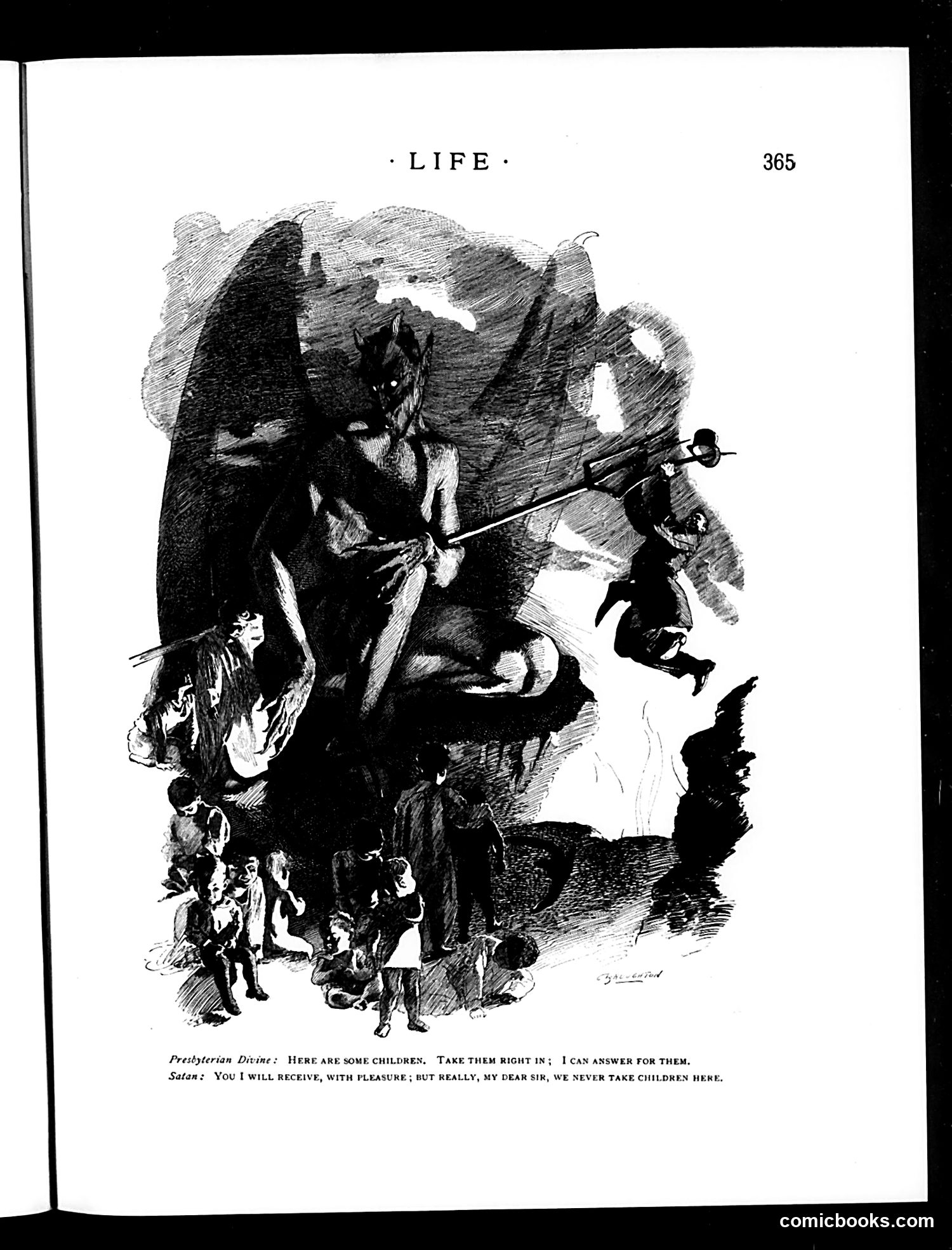
This satirical cartoon depicts a theological debate between a Presbyterian Divine (clergyman) and Satan. The Presbyterian offers to bring children to Satan, claiming he can "answer for them," while Satan refuses, stating he "never take[s] children here." The satire mocks Presbyterian doctrine and hypocrisy. By having Satan reject children while the clergyman volunteers them, the cartoonist suggests Presbyterian teachings are so harsh or damaging that even the Devil refuses involvement with children. The implication is that Presbyterian moral instruction—possibly regarding predestination, damnation, or strict Calvinism—is so severe it's portrayed as more demonic than actual evil. This reflects 19th-century American religious debates about denominational theology and child welfare.
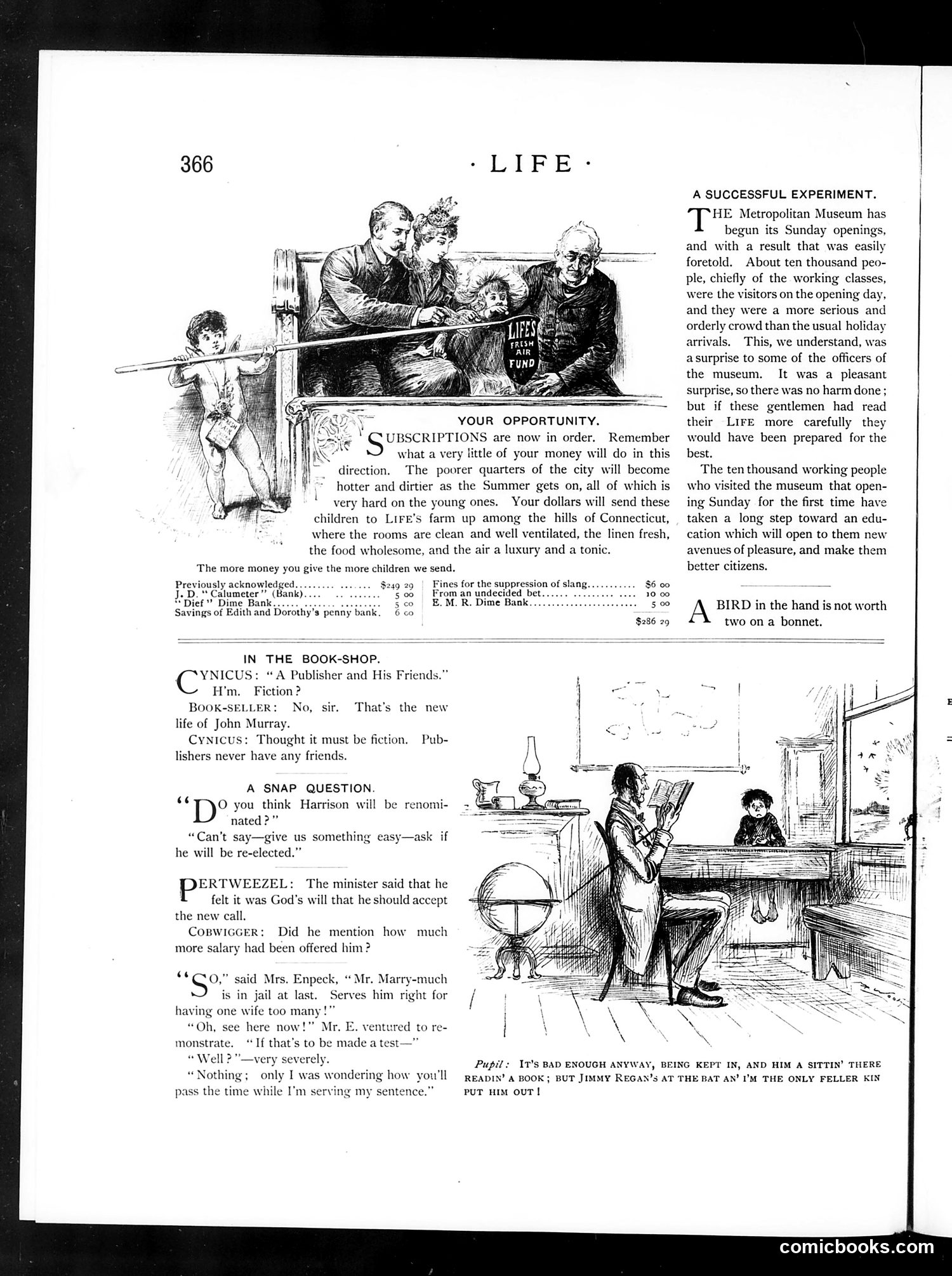
This page contains three distinct satirical pieces: 1. **"A Successful Experiment"** reports on the Metropolitan Museum's Sunday openings, praising working-class attendance as more orderly than typical holiday crowds—a mild social commentary on class behavior. 2. **"In the Book-Shop"** presents a brief joke: a publisher claims a new book is fiction about "a publisher and his friends." A bookseller responds that publishers never have friends—standard professional satire about the publishing industry's competitive nature. 3. **"A Snap Question"** and subsequent dialogue mock a minister who accepted a new position. The humor derives from a wife's complaint that accepting such roles means "having one wife to many"—satirizing clergy marriages and career ambitions. The page also includes a sketch of someone reading, with accompanying caption about Jimmy Regan being the "only feller kin put him out."
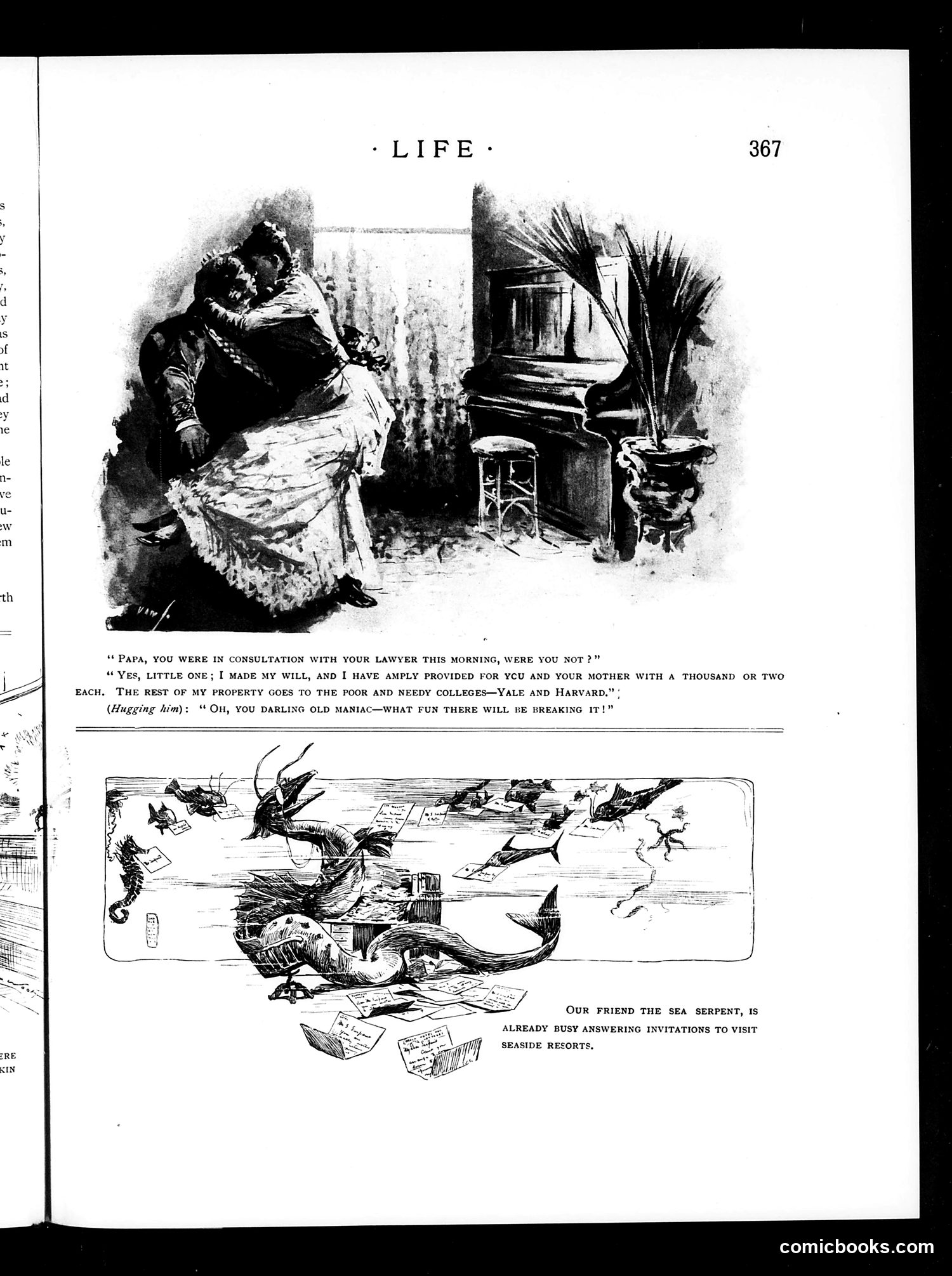
The upper cartoon depicts a domestic scene where a father discusses his will with his young child. He's arranged for "a thousand or two each" for the child and mother's education at "Yale and Harvard." The child's aside ("Hugging him") expresses excitement about breaking the old man's will—meaning spending the inheritance on fun rather than education. The lower illustration shows a sea serpent chaotically responding to social invitations, surrounded by scattered letters and papers. The caption explains he's "already busy answering invitations to visit seaside resorts." Both pieces mock wealthy families' pretensions: the upper cartoon satirizes parental assumptions about dutiful heirs, while the lower one humorously suggests even mythical creatures are caught up in fashionable seaside social obligations.
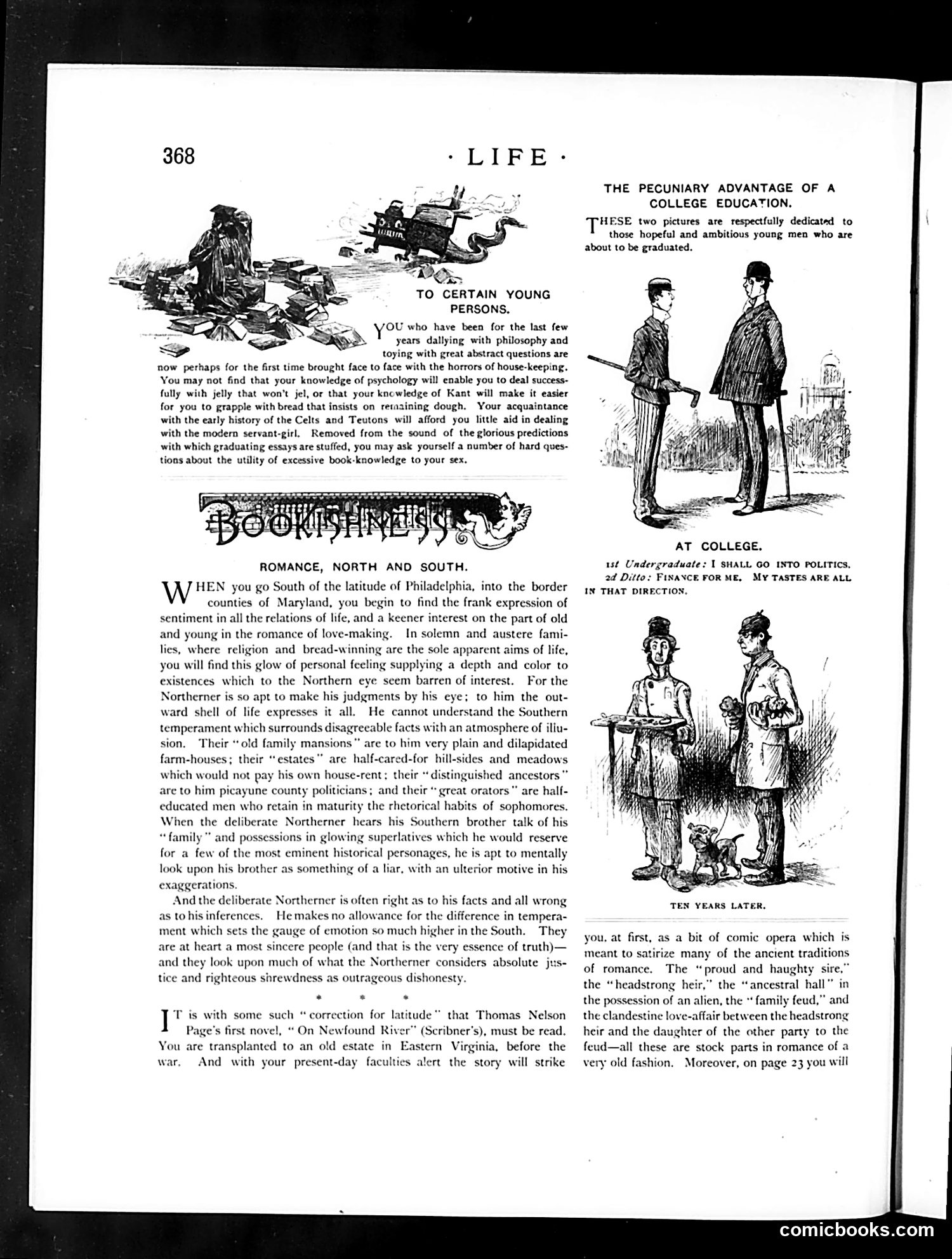
This page contains three distinct illustrations satirizing the college experience and regional American attitudes. The top cartoon mocks graduates entering practical life unprepared, showing chaos from their abstract philosophical education. The middle section, titled "Romance, North and South," satirizes regional cultural differences. It critiques Northern condescension toward Southern romanticism and family pride, suggesting Northerners view Southern gentility as pretentious lies masking poverty. The text references Thomas Nelson Page's novel "On Newfound River," suggesting contemporary debates about how American regions were portrayed in literature. The bottom illustration, "Ten Years Later," appears to show the consequences of romantic notions—depicting a couple with children, suggesting satire about the gap between romantic ideals and domestic reality. The overall theme criticizes naive idealism, whether philosophical or romantic, versus practical life demands.
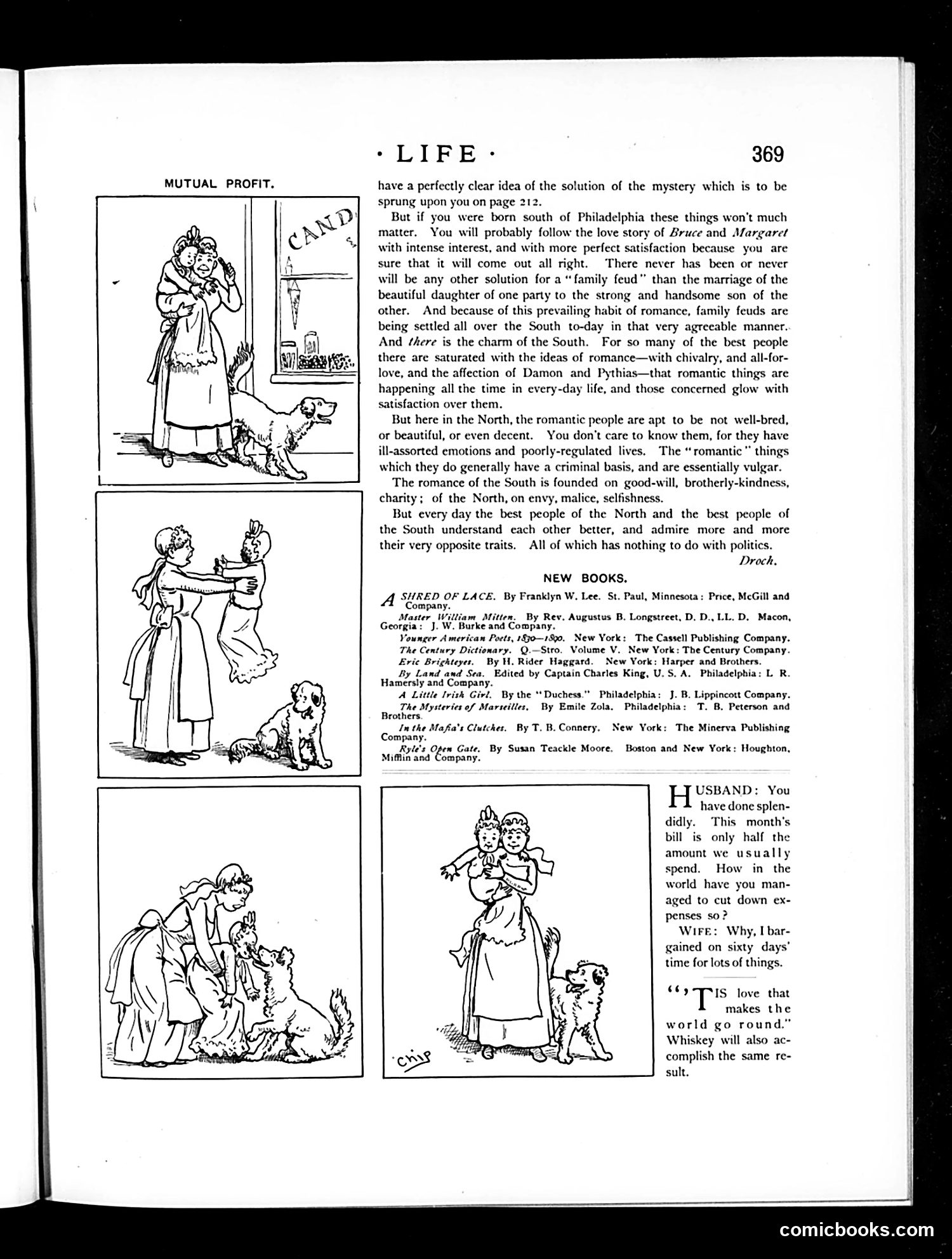
This page contains a section titled "MUTUAL PROFIT" with four cartoon illustrations depicting domestic scenes between husbands, wives, and children, along with small dogs. The cartoons appear to be humorous takes on family life and marriage dynamics. Below the cartoons is a dialogue between a Husband and Wife about household expenses. The wife has apparently bargained on "half days" to reduce spending, and the husband questions how this helps cut costs. The wife responds with a joke: "IS love that makes the world go round." Whiskey will also accomplish the same result." The humor plays on marital financial tensions and suggests alcohol as an alternative solution to economic problems—likely referencing Prohibition-era anxieties about drinking and domesticity. The cartoons illustrate ordinary family moments without clear political commentary.
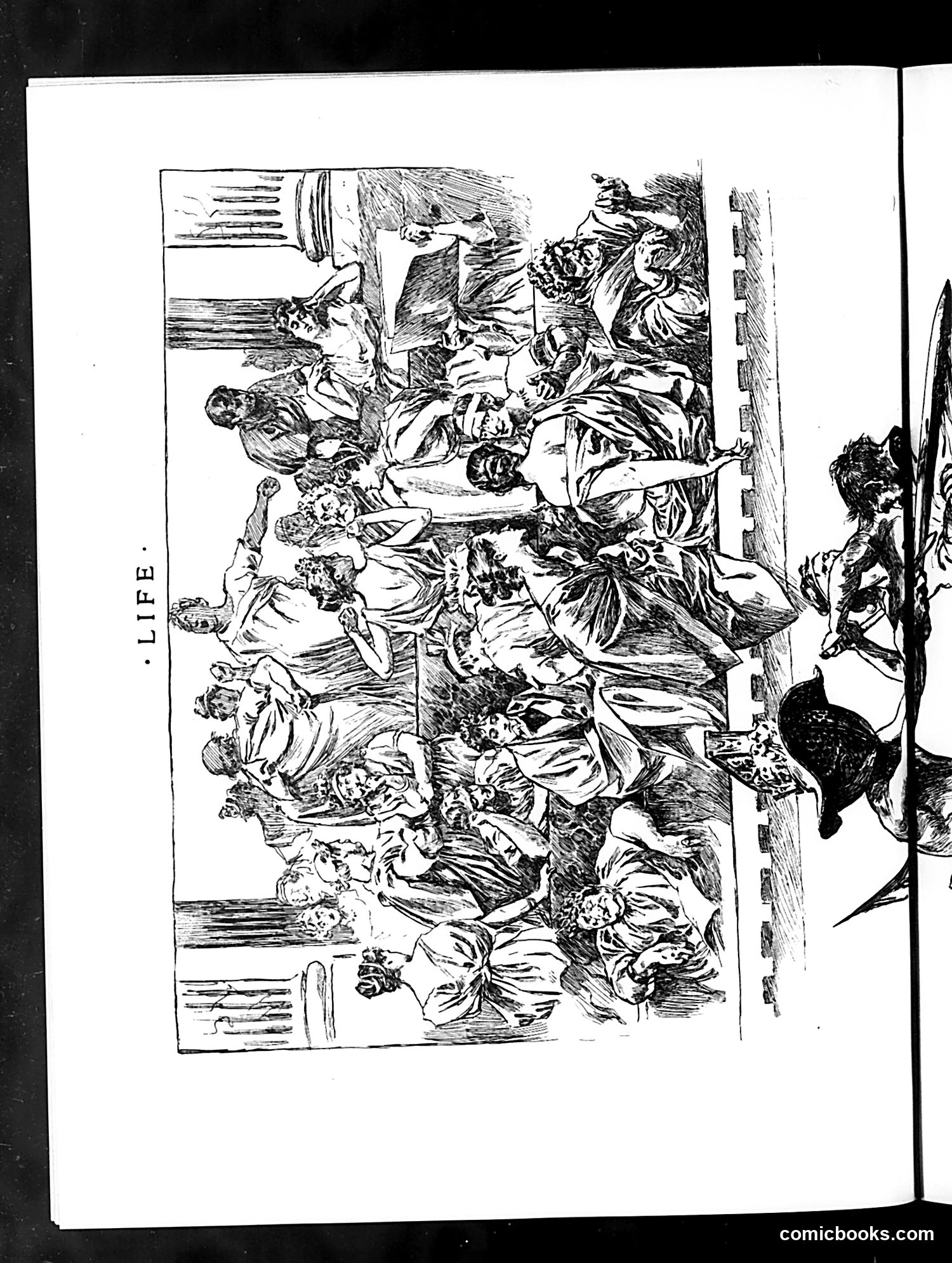
This page is titled "LIFE" and appears to be a satirical engraving depicting a crowded, chaotic indoor scene with multiple figures in 19th-century dress. The composition is densely packed with exaggerated characters in various poses and states of agitation or emotion. Without clearer legible text or identifying labels visible in the image itself, I cannot definitively identify the specific political figures, events, or satirical targets this cartoon references. The style suggests it's likely commentary on contemporary social or political upheaval, possibly related to a specific scandal, legislative debate, or public controversy of the era when *Life* magazine was published. To accurately explain the satire and its historical context, I would need either: visible captions identifying the figures, readable dialogue or text within the cartoon, or the publication date. As presented, I can only confirm it's a complex satirical scene, not the specific message it conveys.
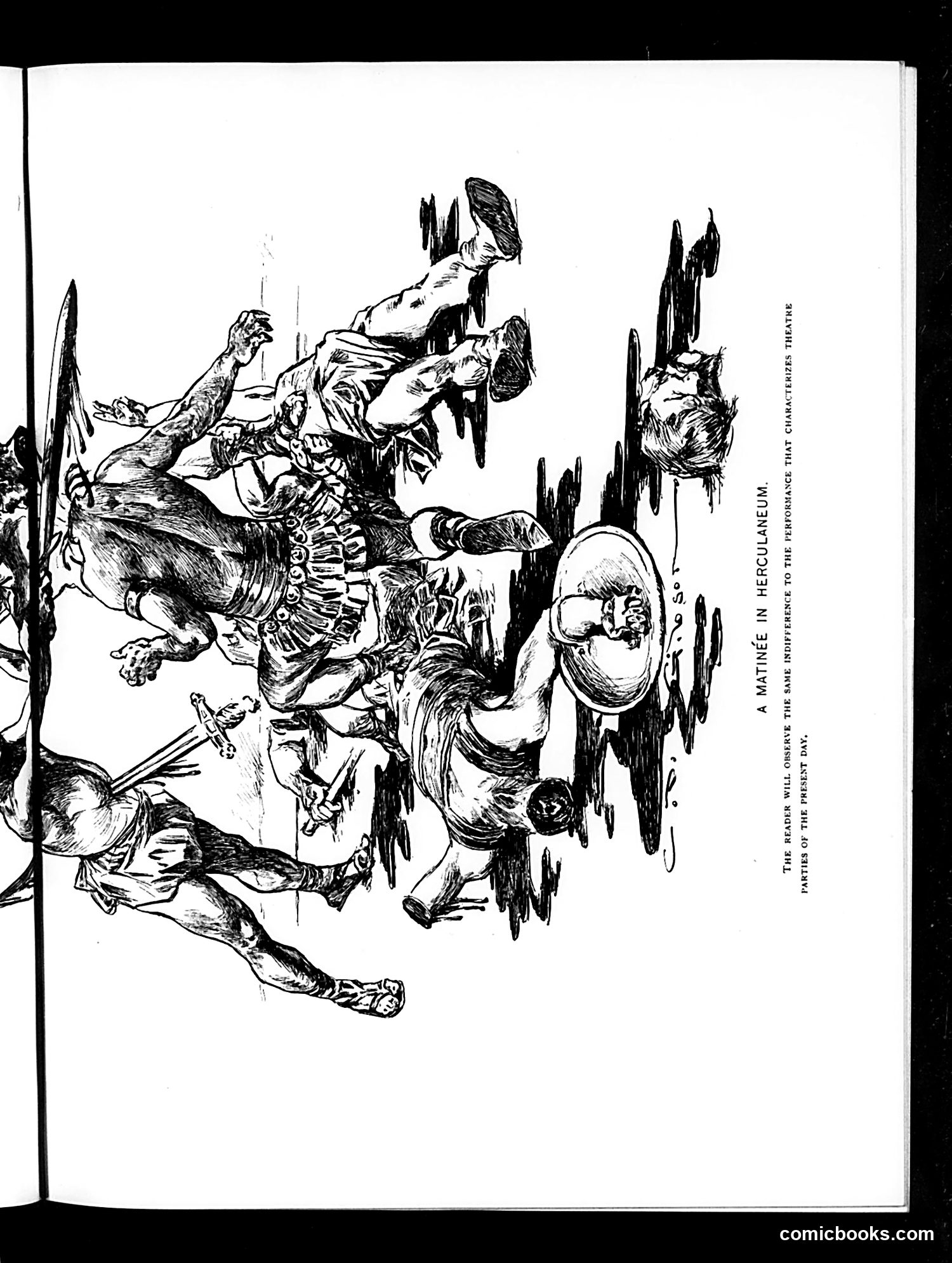
This satirical illustration depicts a chaotic theatrical scene titled "A Matinée in Heuglenaum," suggesting a performance in an imaginary or fantastical location. The drawing shows multiple figures in elaborate period costumes engaged in dramatic, tumultuous action—people fighting, falling, and gesturing wildly amid theatrical scenery. The satire likely mocks either contemporary theatrical productions known for their sensationalism and overwrought dramatics, or perhaps absurdist avant-garde performances of the era. The exaggerated expressions, tangled composition, and chaotic staging suggest ridicule of theatrical excess or pretension. Without clearer textual context, the specific theatrical work or movement being targeted remains unclear, though the cartoon clearly critiques the disconnect between artistic ambition and actual execution on stage.
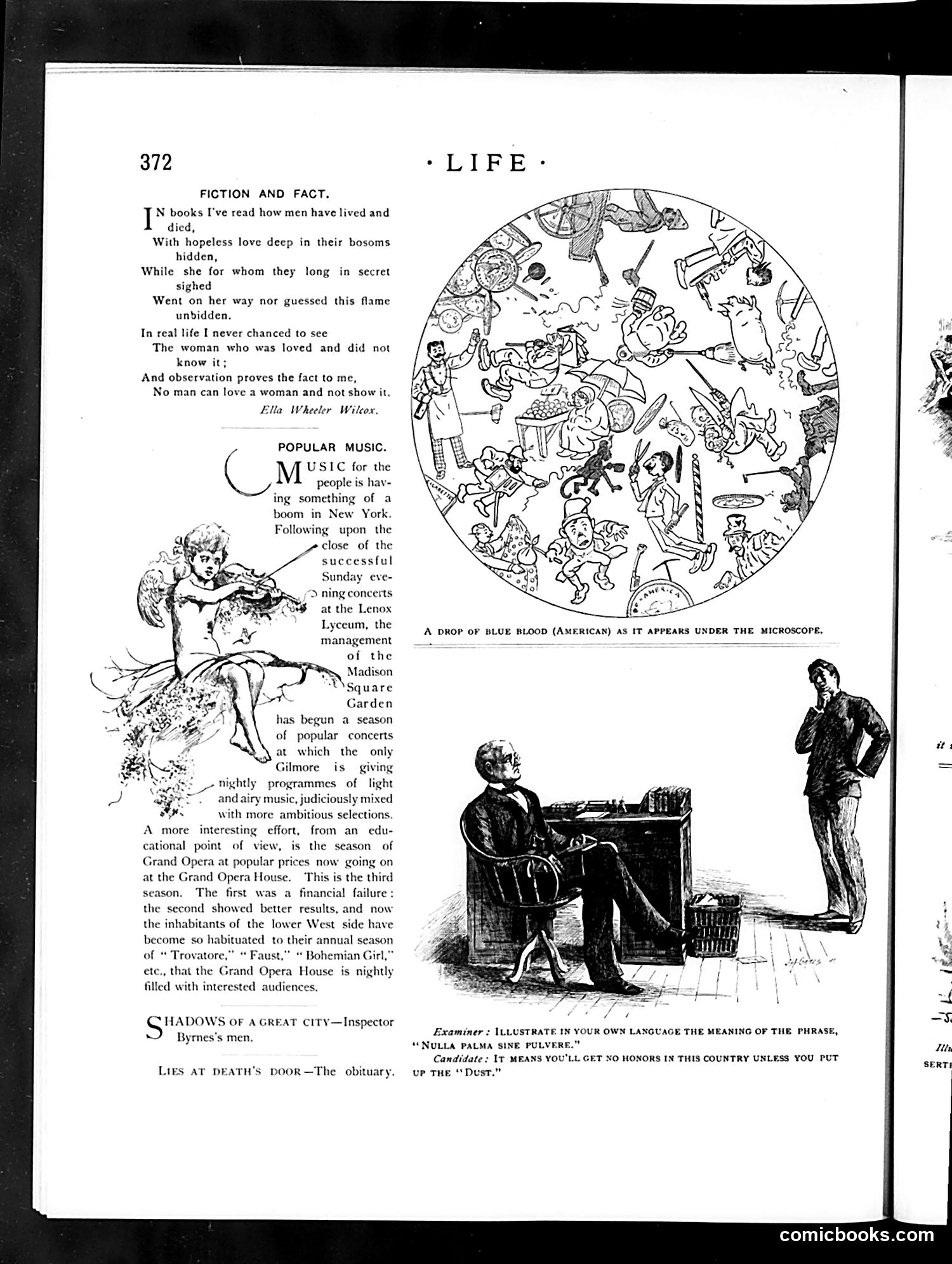
This page contains three distinct satirical pieces: **"Fiction and Fact"**: A poem by Ella Wheeler Wilcox arguing that in real life, men cannot hide romantic love—contrary to literary convention where men secretly pine for unaware women. **"Popular Music"**: A commentary on New York's cultural boom, praising affordable opera and concert seasons at venues like Madison Square Garden and the Grand Opera House, which have made high culture accessible to working-class audiences on the lower West side. **"A Drop of Blue Blood (American) as it Appears Under the Microscope"**: A satirical cartoon showing that American "blue blood" (aristocratic lineage) under microscopic examination appears identical to common blood—mocking American pretensions to aristocracy and suggesting democratic equality. The Latin motto "Nulla palma sine pulvere" ("no palm without dust") and the caption about "dust" reinforce that honor requires honest work, not inherited status. The page critiques both romantic sentimentality and class pretension through humor and social observation.
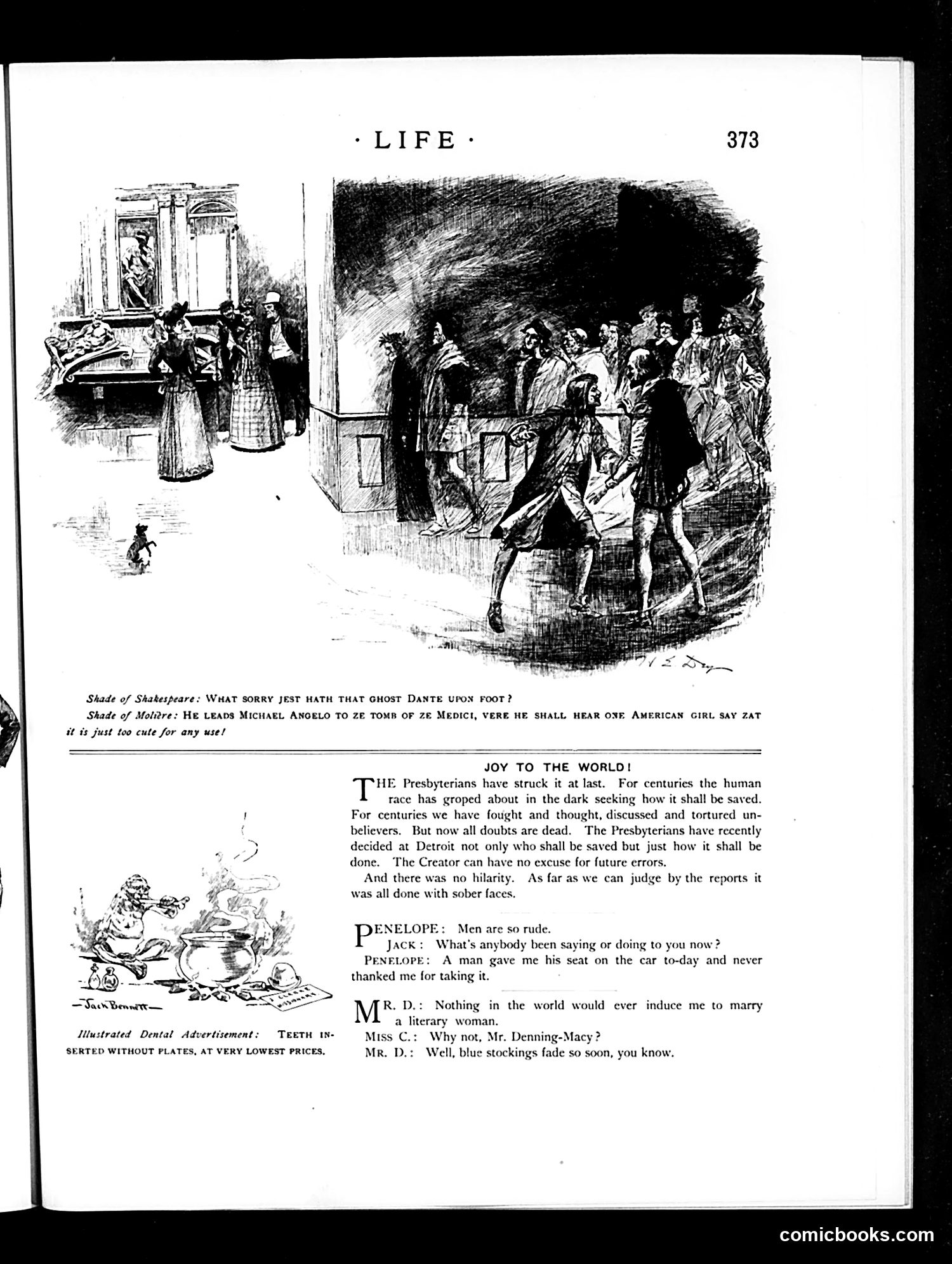
The page contains three distinct satirical pieces: **Top cartoon**: Mocks American tourists' cultural ignorance. Shades of Shakespeare and Molière observe an American girl at the Medici tomb finding Renaissance art "just too cute"—satirizing how wealthy Americans visited European cultural sites but lacked appreciation for their historical significance. **"Joy to the World"**: Ridicules Presbyterian Church leadership meeting in Detroit, sarcastically suggesting they've solved centuries of theological debate about salvation with absolute certainty and humorless self-importance. **Dialogue jokes**: Mock contemporary gender dynamics—men are criticized for both rudeness and courtesy; a man refuses to marry "literary women" because their intelligence ("blue stockings," slang for educated women) fades like fabric dye. This mocks both male arrogance and societal devaluation of female education. The **dental ad** at bottom is an unrelated period advertisement. Overall, the page satirizes American provincialism, religious pomposity, and sexism through witty exchanges typical of early 20th-century *Life* magazine humor.
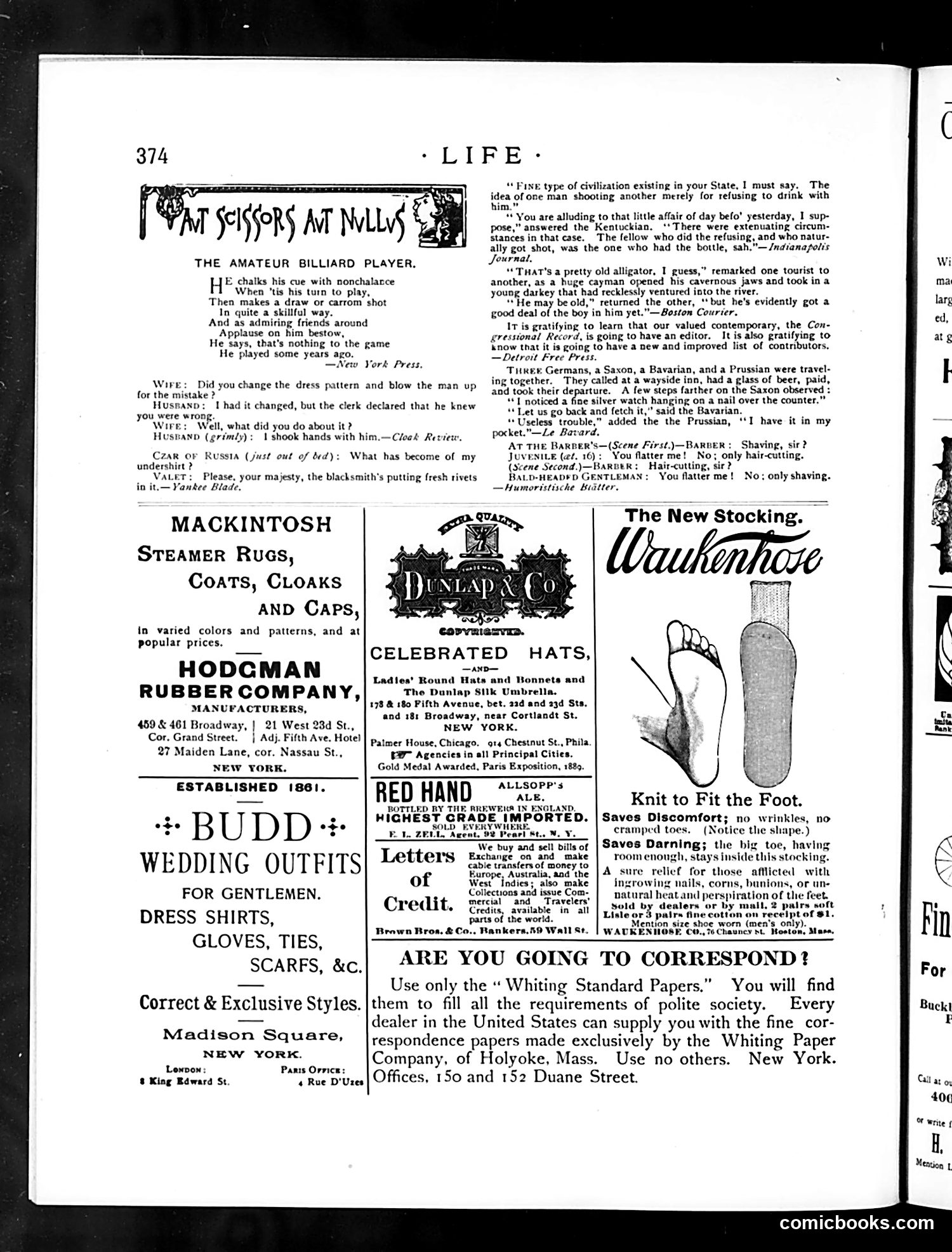
This page contains three separate jokes rather than a unified cartoon: 1. **"The Amateur Billiard Player"** – A poetic joke mocking a man who boasts about superior billiard skills from years past, only to play adequately now. It satirizes human tendency to exaggerate past accomplishments. 2. **"The Czar's Undershirt"** – A dark joke about the Russian Czar, playing on contemporary anxieties about Russian autocracy and instability. The valet's explanation that the blacksmith must reinforce the undershirt with rivets implies the Czar is so paranoid or unstable he requires armor even for undergarments—satirizing both Russian despotism and Western perceptions of Russian barbarism. 3. **"Kentucky Shooting Incident"** – A regional stereotype joke mocking Southern honor culture and gun violence. A man shoots another for refusing to drink with him, then rationalizes it with absurd logic—the victim "had the bottle," so he deserved it. This reflects period anxieties about lawlessness in the American South. The page is primarily advertising otherwise.
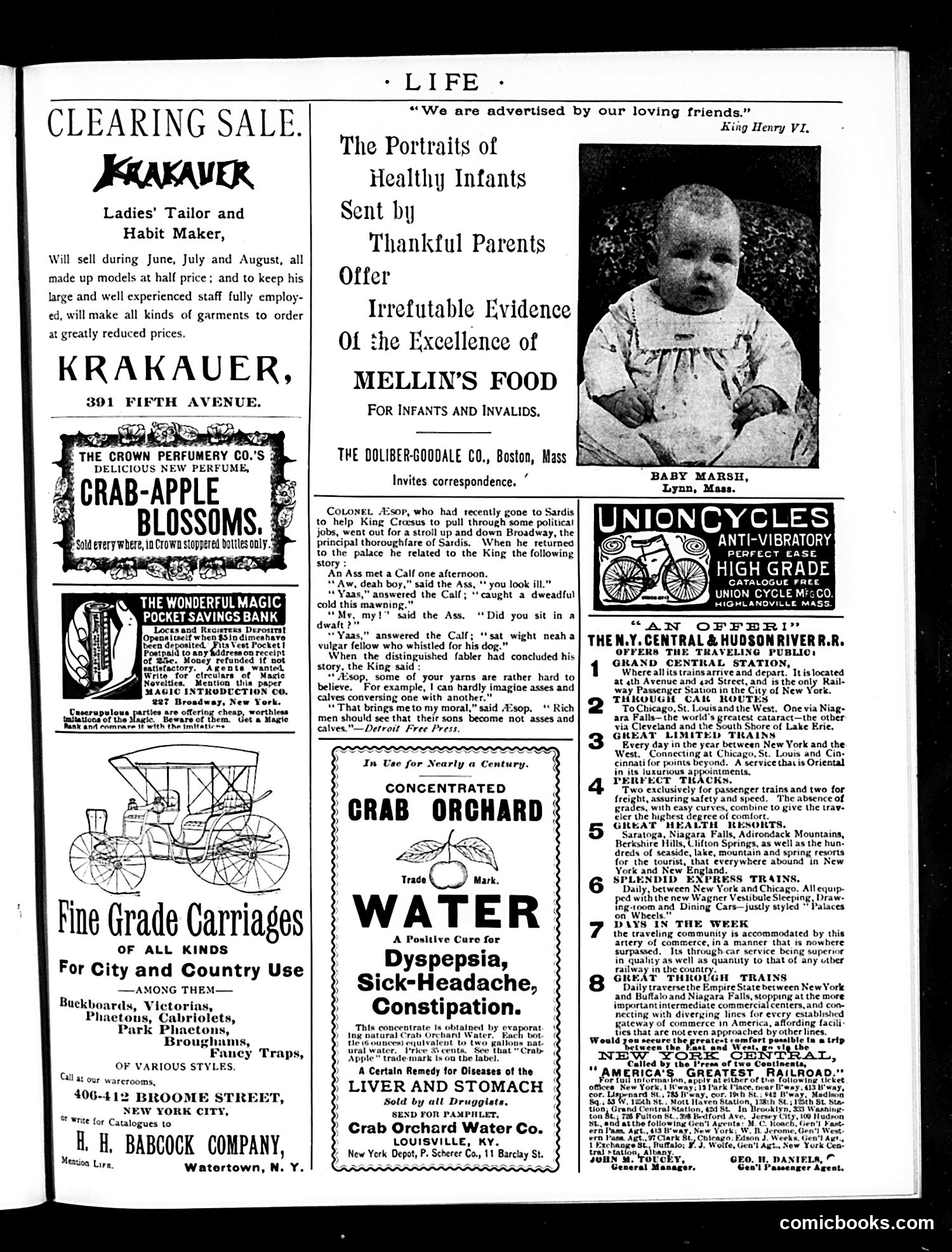
This is a standard page from *Life* magazine consisting almost entirely of commercial advertisements for goods and services (clothing tailors, perfume, carriages, food products, bicycles, railroads, etc.). There is one brief satirical fable included—a retelling of Aesop's tale about an Ass and Calf—but the page is dominated by ads. The fable's moral warns wealthy fathers that their sons risk becoming "asses" if exposed to vulgar influences. This is mild social commentary typical of the era, but the page itself functions mainly as a revenue source for the magazine through paid advertising rather than as a vehicle for political satire or caricature. No specific political figures or events are referenced or caricatured here.
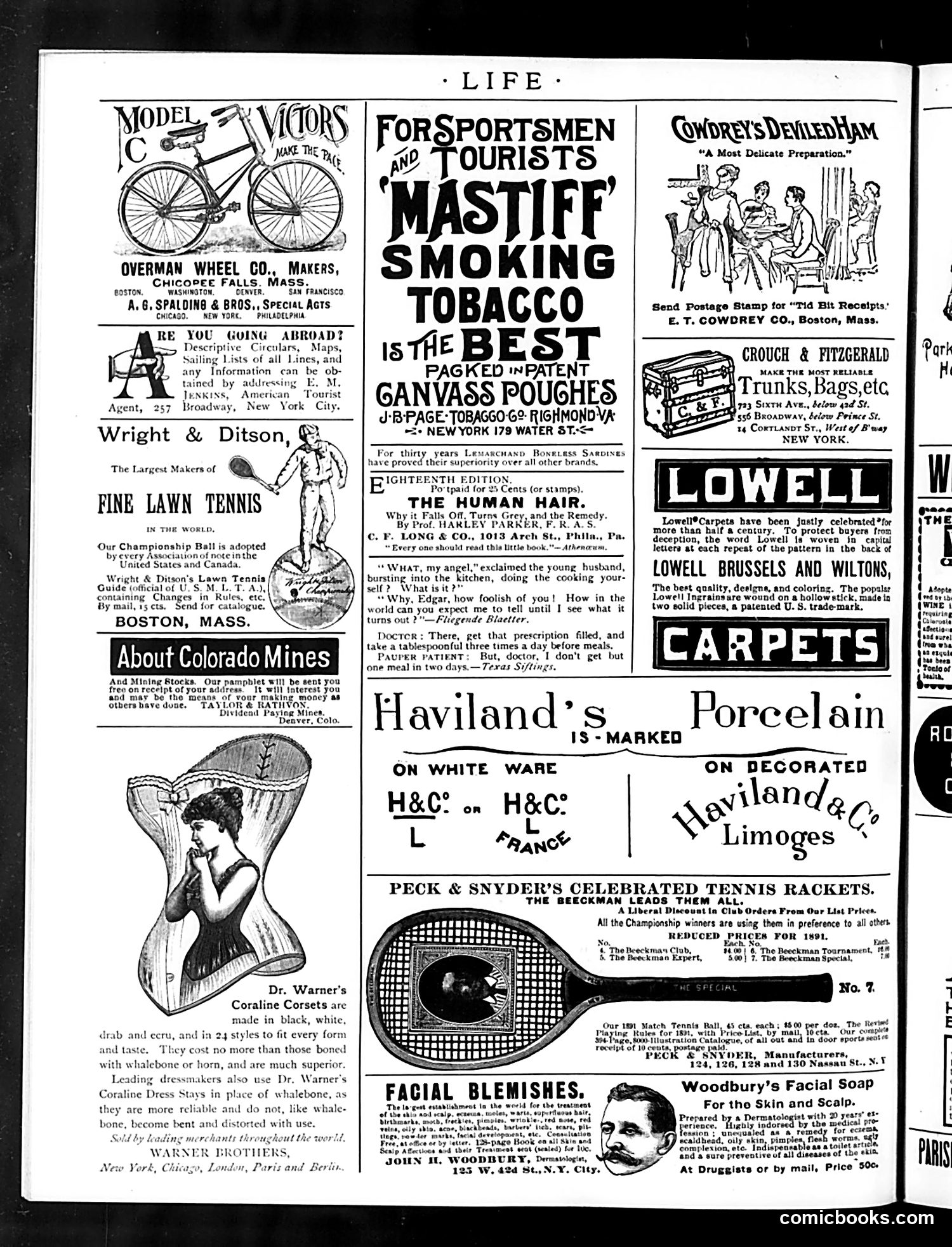
This is primarily an **advertising page** from Life magazine, not a satirical cartoon section. The page contains numerous product advertisements typical of the 1890s era. Notable ads include: - **Bicycles** (Overman Wheel Co.) and **lawn tennis equipment** (Wright & Ditson), reflecting the sporting craze of that period - **Mastiff Smoking Tobacco**, marketed to "sportssmen and tourists" - **Dr. Warner's Coraline Corsets**, a women's foundation garment - **Haviland Porcelain** dinnerware - **Lowell Carpets**, with anti-counterfeiting marks woven into the pattern - **Tennis rackets** by Peck & Snyder - Various patent medicines and toiletries The few **humorous items** are brief jokes (about cooking and doctor visits) scattered among ads—typical filler content for magazines of this era. The page demonstrates the commercial nature of Life magazine and consumer goods marketed to middle and upper-class Americans in the 1890s.
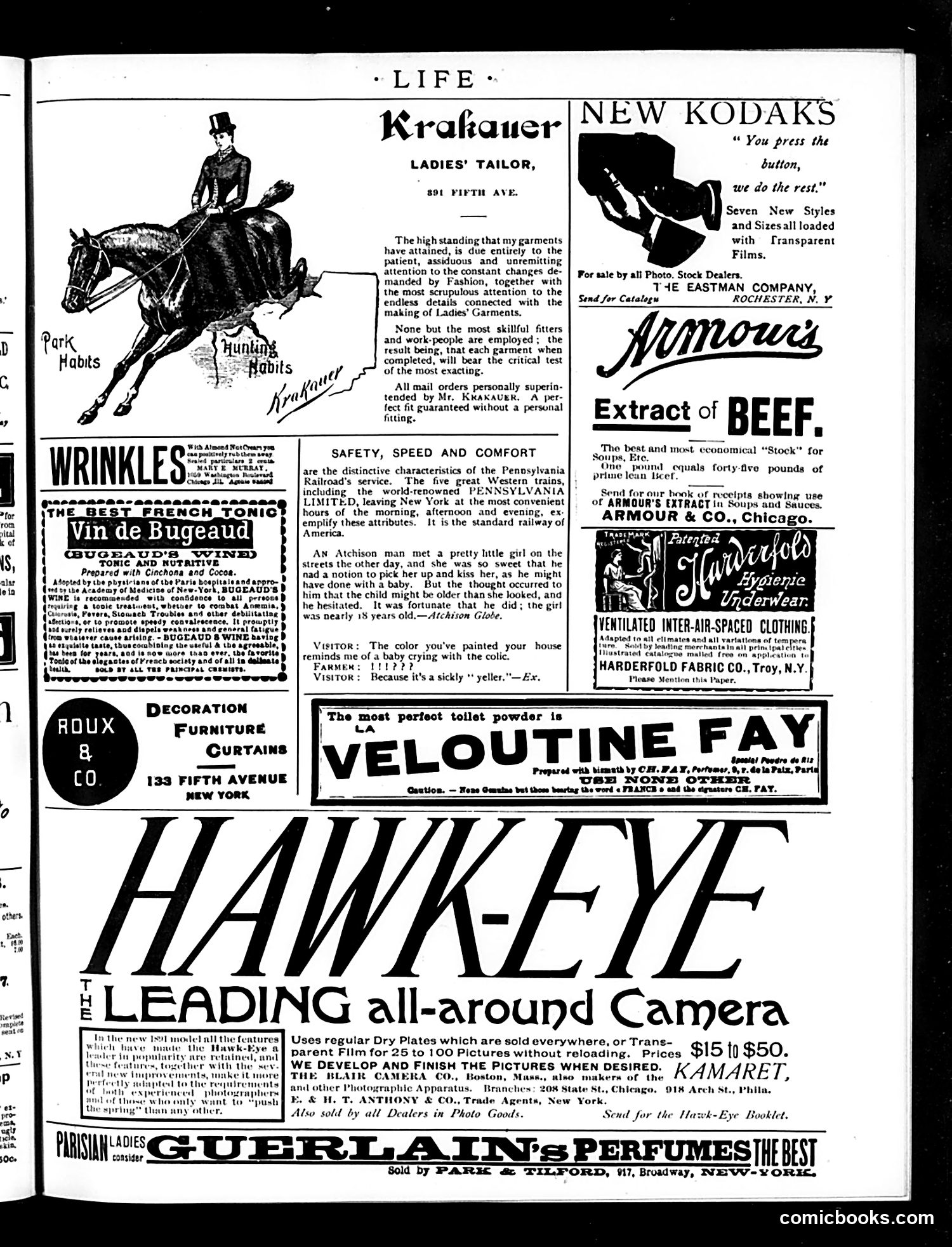
This is primarily an **advertising page** from an early Life magazine, with minimal satirical content. The main illustrated item is a **Krakauer Ladies' Tailor advertisement** featuring a woman in Victorian riding habit on horseback, labeled "Park Habits" and "Hunting Habits." The text emphasizes skilled tailoring and personal service—typical fashion advertising of the era. The only clear humor appears in two brief anecdotes: 1. An **Atchison Globe piece** mocking small-town naiveté: a man nearly kisses what he assumes is a baby on the street, but hesitates when he realizes the "child" might actually be an 18-year-old woman. 2. A visitor's joke about house paint color resembling "a baby crying with the colic"—crude visual humor. The remainder comprises product advertisements (cameras, beef extract, perfume, furniture) with no political or satirical content. The page demonstrates Life's mixed editorial-advertising format typical of early-20th-century magazines.
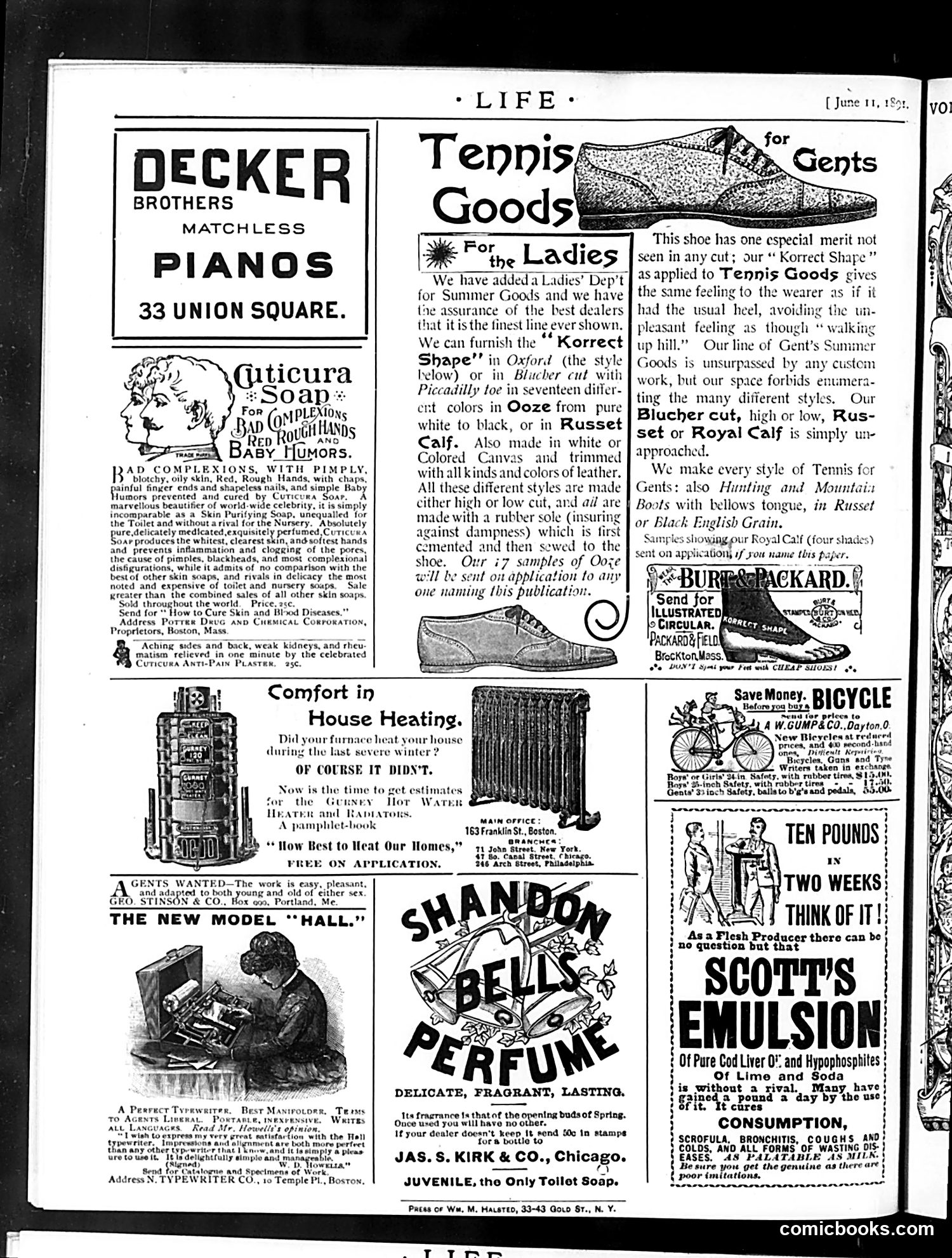
This is primarily a **commercial advertising page** with no political cartoons or satire. The page consists entirely of product advertisements typical of the 1890s era. Notable ads include: - **Decker Brothers Pianos** and **Cuticura Soap** (addressing "pimply, blotchy, oily skin") - **Tennis Goods for Gents** — shoes featuring "Korrect Shape" design to avoid "the unpleasant feeling as though walking up hill" - **Gurney Hot Water Heater** for home heating - **Shandon Bells Perfume** - **Scott's Emulsion** (a fish-oil supplement claiming to produce "ten pounds in two weeks") - **Bicycles** and a **typewriter** ("The New Model Hall") The ads reflect **late-Victorian consumer culture**: remedies for cosmetic imperfections, leisure goods (tennis, bicycles), and new technologies. The "Scott's Emulsion" ad's weight-gain claims particularly exemplify period attitudes toward health and body image that modern readers would find striking.