
Life, 1891-06-11 · page 4 of 18
Life — June 11, 1891 — page 4: what you’re looking at
What you’re looking at
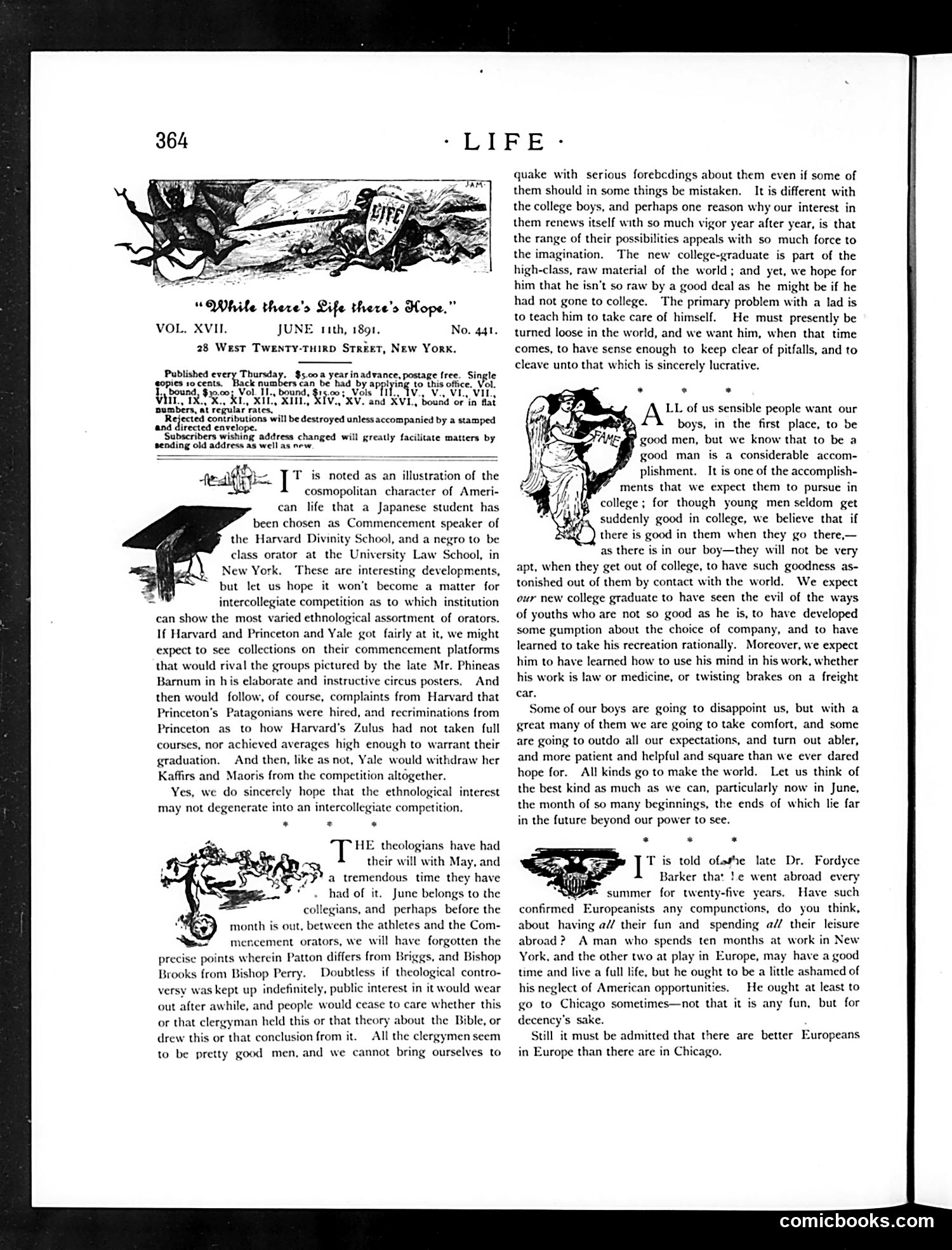
This page features editorial commentary on college graduates and cultural diversity, with decorative illustrations rather than political cartoons. The main text discusses hopes for newly graduated college men—emphasizing they should develop self-reliance and moral character. It also notes contemporary social developments: a Japanese student chosen as Harvard Divinity School commencement speaker, and a Black student graduating from Columbia Law School in New York. The author expresses cautious optimism about these "interesting developments," though warns against "intercollegiate competition" in ethnic representation among orators. The final section critiques wealthy Americans (particularly Dr. Fordyce Barker) who spend summers abroad in Europe while neglecting opportunities in American cities like Chicago, suggesting this represents misplaced priorities.
📄 Transcribed text from this page (OCR, searchable)
Machine-transcribed from the original scan — historical spelling and the odd misread are preserved.
- LIFE: “OMhile there's Life there’s Hope.” VOL. XVII. JUNE ith, 1891. 28 West TWENTY-THIRD STREE No. 441. » New York. Published every Thursday. $s.00a year inadvance, postage free. Single eopies 10 cents. ck num! can be had by applying to this office. Vor I, bound, $30.00; Vol 1, bound, $35.00; Vols it ii Ca V., VI, VIL, WHI, 1X.0°X.. XL, XID, XIIL, XIV.'XV. and XVI, bound of'in flat Bumbers, at regular rates. Rejected contributions will be destroyed unless accompanied by a stamped and directed envelope. ‘Subscribers wishing address changed will greatly facilitate matters by bending old address as well as new. ted I" is noted as an illustration of the cosmopolitan cl cter of Ameri- can life that a Japanese student has been chosen as Commencement speaker of the Harvard Divinity School, and a negro to be class orator at the University Law School, in New York. These are interesting developments, but let us hope it won't become a matter for intercollegiate competition as to which institution can show the most varied ethnological assortment of orators. If Harvard and Princeton and Yale got fairly at it, we might expect to see collections on their commencement platforms that would rival the groups pictured by the late Mr. Phineas Barnum in his elaborate and instructive circus posters, And then would follow, of course, complaints from Harvard that Princeton's Patagonians were hired, and recriminations from Princeton as to how Harvard's Zulus had not taken full courses, nor achieved averages high enough to warrant their graduation. And then, like as not, Yale would withdraw her Kaffirs and Maoris from the competition altogether. Yes, we do sincerely hope that the ethnological interest may not degenerate into an intercollegiate competition, . . . T# 2 theologians have had c their will with May, and a oy a tremendous time they have ’ had of it. June belongs to the collegians, and perhaps before the month is out, between the athletes and the Com- will have forgotten the points wherein Patton differs from Briggs, and Bishop Brooks from Bishop Perry. Doubtless if theological contro- versy was kept up indefinitely, public interest in it would wear out after awhile, and people would cease to care whether this or that clergyman held this or that theory about the Bible, or drew this or that conclusion from it. All the clergymen seem to be pretty good men, and we cannot bring ourselves to mencement orators, w quake with serious forebcdings about them even if some of them should in some things be mistaken. It is different with the college boys, and perhaps one reason why our interest in them renews itself with so much vigor year after year, is that the range of their possibilities appeals with so much force to the imagination. The new college-graduate is part of the high-class, raw material of the world; and yet, we hope for him that he isn’t so raw by a good deal as he might be if he had not gone to college. The primary problem with a lad is to teach him to take care of himself. He must presently be turned loose in the world, and we want him, when that time comes, to have sense enough to keep clear of pitfalls, and to cleave unto that which is sincerely lucrative. LL of us sensible people want our boys, in the first place, to be good men, but we know that to be a good man is a considerable accom- plishment. It is one of the accomplish- ments that we expect them to pursue in college ; for though young men seldom get suddenly good in college, we believe that if there is good in them when they go there, as there is in our boy—they will not be very apt, when they get out of college, to have such goodness as- tonished out of them by contact with the world. We expect our new college graduate to have seen the evil of the ways. of youths who are not so good as he is, to have developed some gumption about the choice of company, and to have learned to take his recreation rationally. Moreover, we expect him to have learned how to use his mind in his work, whether his work is law or medicine, or twisting brakes on a freight car. Some of our boys are going to disappoint us, but with a great many of them we are going to take comfort, and some are going to outdo all our expectations, and turn out abler, and more patient and helpful and square than we ever dared hope for. All kinds go to make the world. Let us think of the best kind as much as we can, particularly now in June, the month of so many beginnings, the ends of which lie far in the future beyond our power to see. * * . e, It is told ofa#he late Dr. Fordyce > Barker that !e went abroad every - summer for twenty-five years. Have such confirmed Europeanists any compunctions, do you think, about having a@é/ their fun and spending a// their leisure abroad? A man who spends ten months at work in New York, and the other two at play in Europe, may have a good time and live a full life, but he ought to be a little ashamed of his neglect of American opportunities He ought at least to go to Chicago sometimes—not that it is any fun, but for decency’s sake. Still it must be admitted that there are better in Europe than there are in Chicago. pe Rue Europeans comicbooks.com