
A complete issue · 16 pages · 1891
Life — June 4, 1891
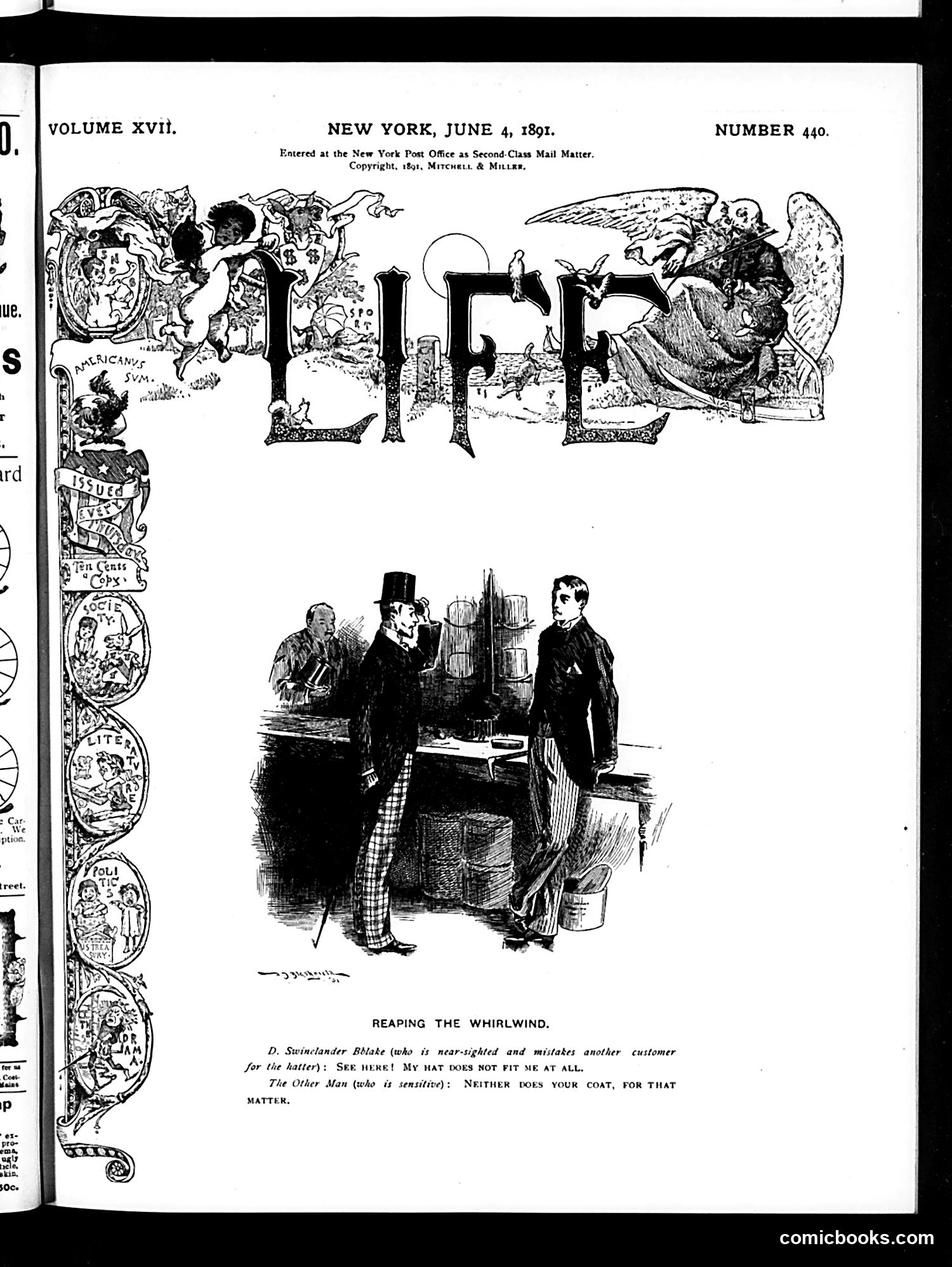
This cartoon depicts a commercial dispute, likely from 1891. The titled scene shows three men at what appears to be a shop counter. The dialogue indicates a customer service complaint: one man (identified as "D. Swinelander Blåke") complains his hat doesn't fit, while another customer notes his coat also doesn't fit. The humor appears to satirize poor merchandise quality or deceptive retail practices—the shopkeeper's indifferent responses ("Neither does your coat, for that matter") suggest he's dismissive of customers' legitimate complaints. The title "Reaping the Whirlwind" implies such poor business practices will eventually damage the merchant's reputation or profits. It's social satire targeting commercial dishonesty or incompetent shopkeepers of the era.
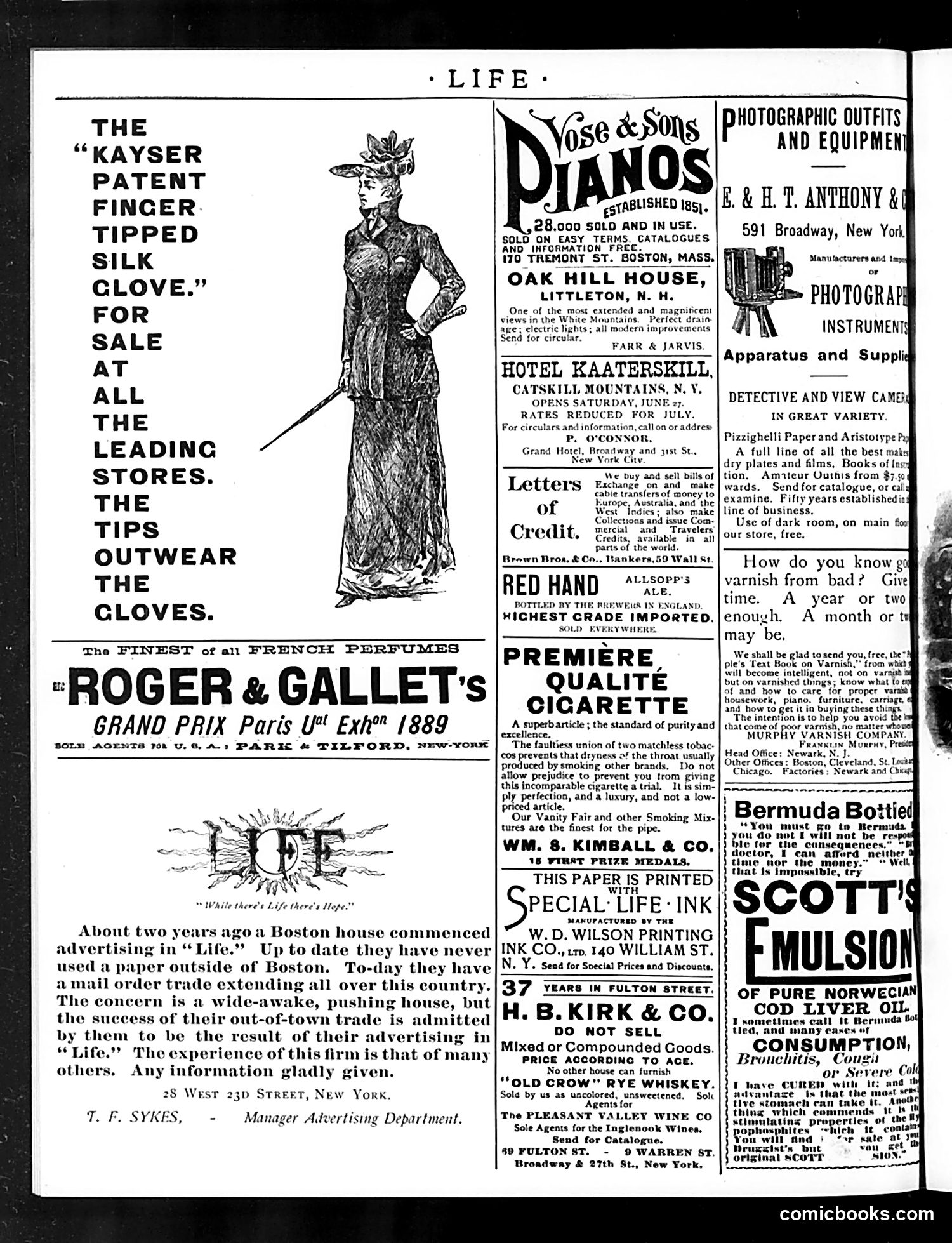
This page is **primarily advertising** with minimal satirical content. The main illustrated advertisement features an elegantly dressed woman in a long gown promoting the "Kayser Patent Finger Tipped Silk Glove," emphasizing that the gloves' tips wear better than competitors' products. The sole editorial content is a brief text piece by T.F. Sykes (Advertising Manager) describing how a Boston house's success using Life magazine for mail-order advertising has proven the publication's value to the broader business community. This serves as meta-advertising—promoting Life itself to potential advertisers. The remaining space contains product advertisements for perfume, pianos, cameras, cigarettes, varnish, and cod liver oil, typical of early 20th-century magazine monetization.
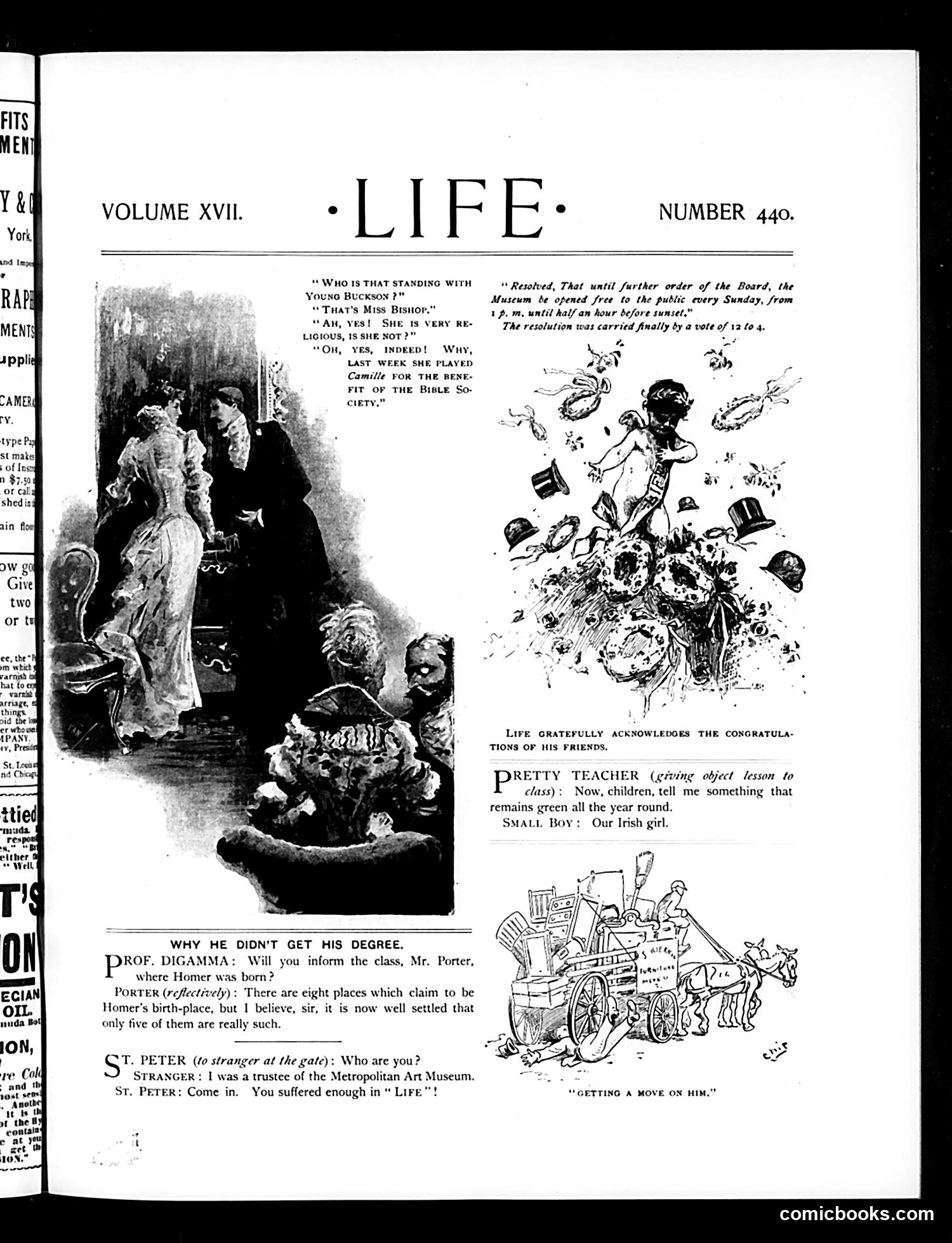
This page contains three satirical pieces: 1. **"Why He Didn't Get His Degree"**: Professor Digamma questions Mr. Porter about Homer's birthplace. Porter admits uncertainty, joking that eight different places claim to be Homer's birthplace—implying even scholars can't definitively answer basic questions. The satire mocks academic pretension and incomplete classical knowledge. 2. **"Pretty Teacher"**: A teacher asks children what stays green year-round. A student answers "Our Irish girl"—a stereotype joke about Irish complexions or possibly referencing Irish domestic servants common in early 1900s America. 3. **"St. Peter at the Gate"**: A stranger claims to be a Metropolitan Art Museum trustee; St. Peter sarcastically welcomes him, suggesting museum trustees suffered in "Life," implying cultural corruption or scandal. The humor targets academia, ethnic stereotypes, and institutional hypocrisy.
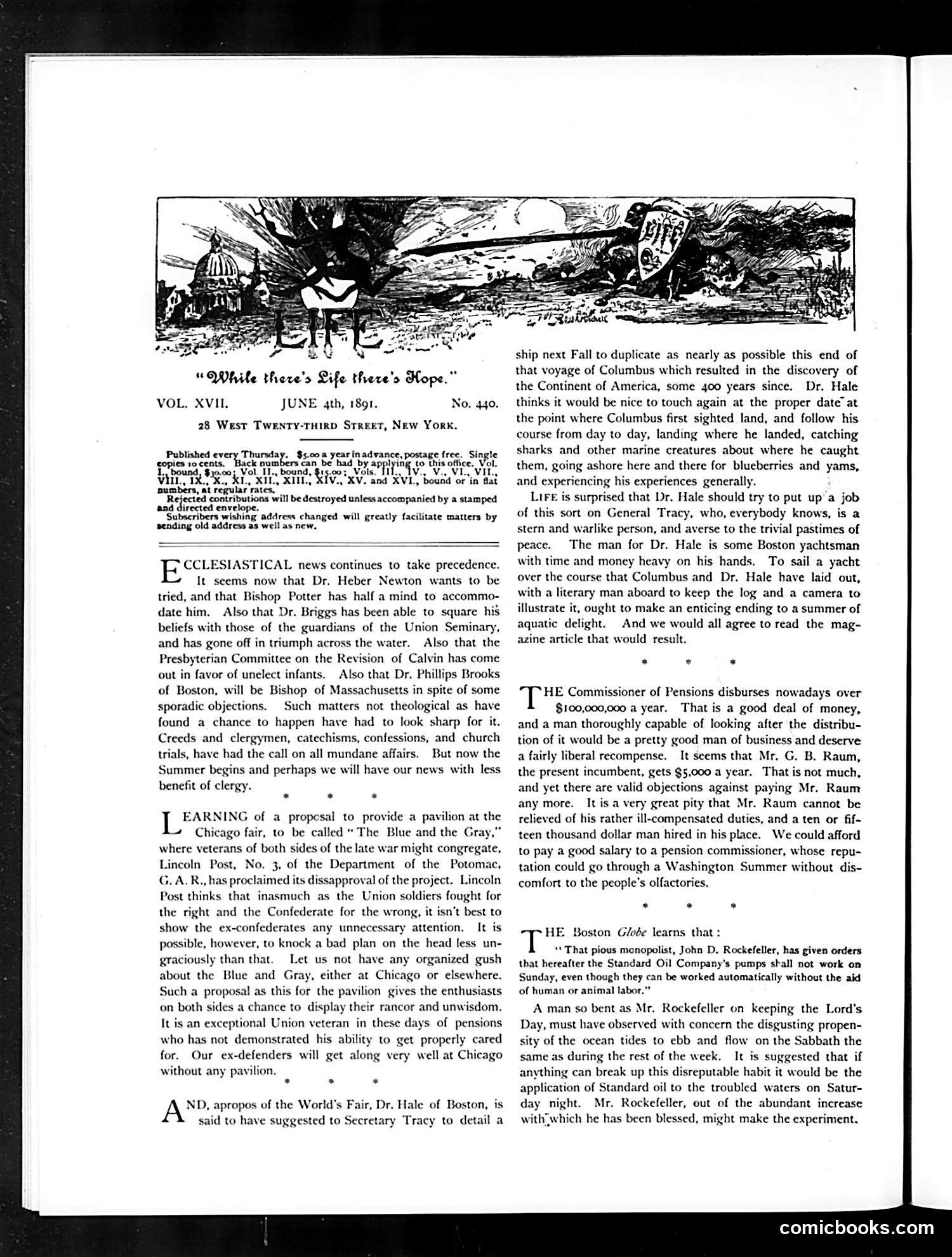
The masthead cartoon depicts a figure on horseback beneath a large dead tree, captioned "While there's Life there's Hope." This appears to be allegorical commentary on the magazine itself—suggesting Life magazine persists despite difficult circumstances. The text discusses ecclesiastical controversies (Bishop Potter, Calvin revision debates), a proposed Chicago pavilion for Civil War veterans, and Dr. Hale's suggestion regarding a Columbus voyage recreation for the World's Fair. The cartoon likely satirizes either institutional decline or perseverance through hardship, though without clearer identification of the horsed figure, the specific political target remains unclear. The dead tree imagery suggests decay or crisis, contrasting with the motto's optimism.
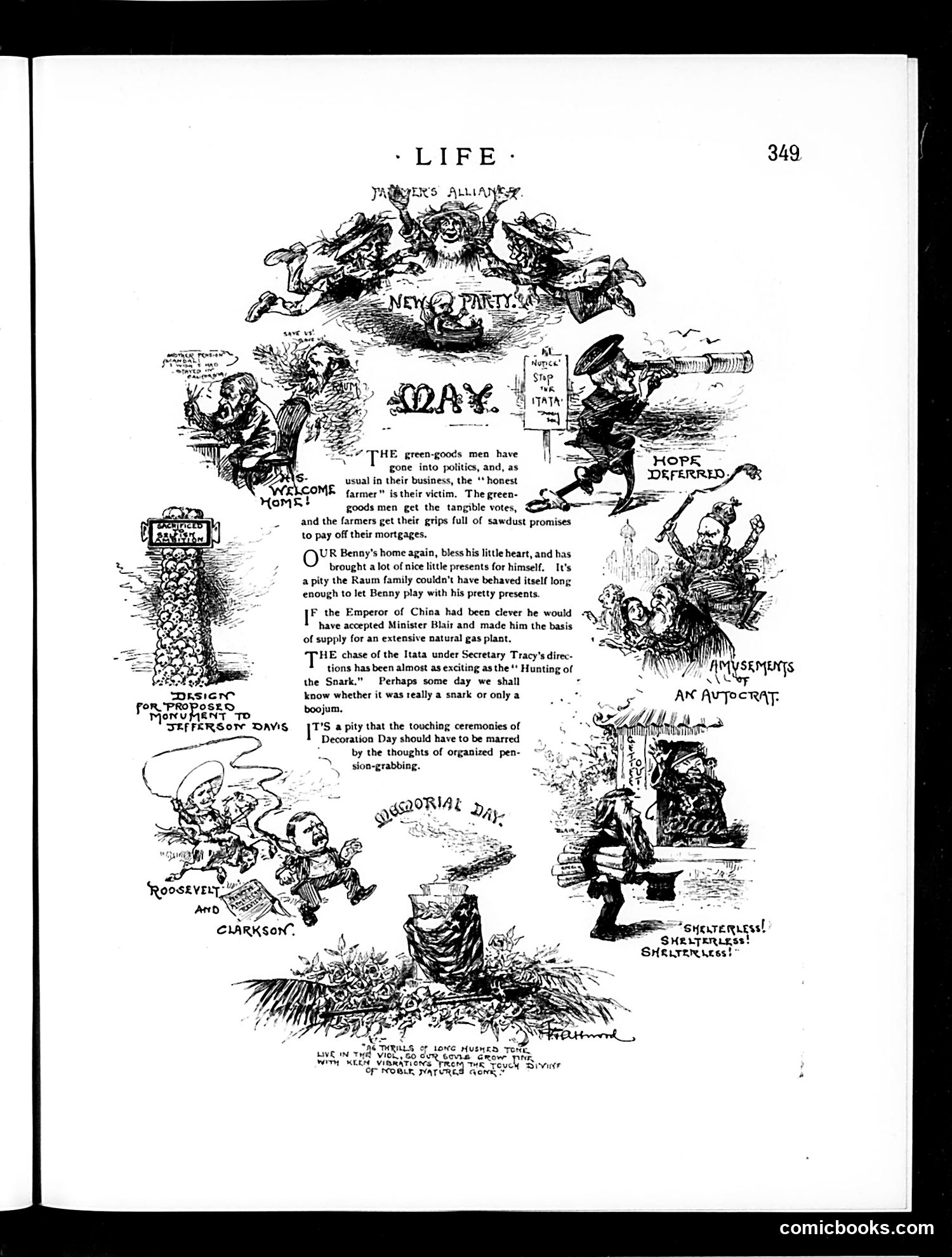
This page satirizes early 20th-century American politics through multiple cartoons. The central text discusses "green-goods men" exploiting farmers through false promises—a common scam targeting rural voters during political campaigns. Several labeled figures appear: "Roosevelt and Clarkson" (likely referencing Theodore Roosevelt-era politics), "Hope Deferred," and references to "Memorial Day" and "Amusements of an Autocrat." The cartoons mock political deception, particularly how politicians manipulate farmers with dishonest campaign pledges about mortgages and economic relief. Other panels reference China policy and Secretary Tracy's gas plant proposal, suggesting broader critiques of government incompetence and political theater. The overall message: politicians exploit rural constituencies with false promises while pursuing questionable policies.
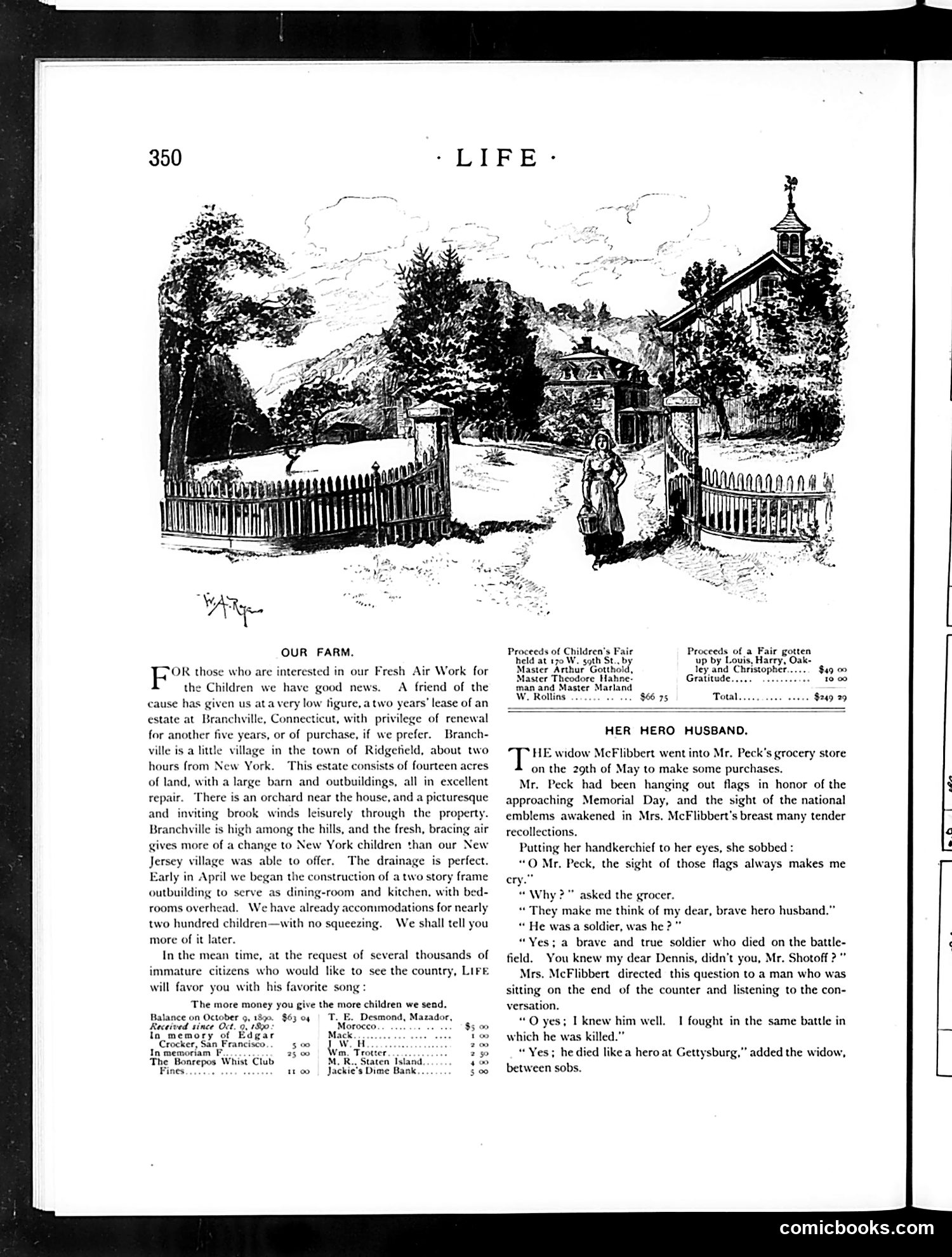
This page combines two unrelated items: an advertisement and a short story. **"Our Farm"** section advertises a Fresh Air Work initiative for children, promoting a Connecticut estate available for lease or purchase near Ridgefield. The accompanying illustration shows a pastoral farmhouse scene with a church in the distance—an idealized rural retreat for urban children. **"Her Hero Husband"** is a sentimental narrative about Mrs. McFlibbert visiting a grocer on Memorial Day. Upon seeing patriotic flag displays, she becomes emotional, confessing to Mr. Peck that her own husband was a soldier who died heroically at Gettysburg. The story trades in Civil War nostalgia and domestic sentimentality popular in early 20th-century magazines. Neither content is satirical; this represents typical *Life* magazine editorial and advertising fare from this era.
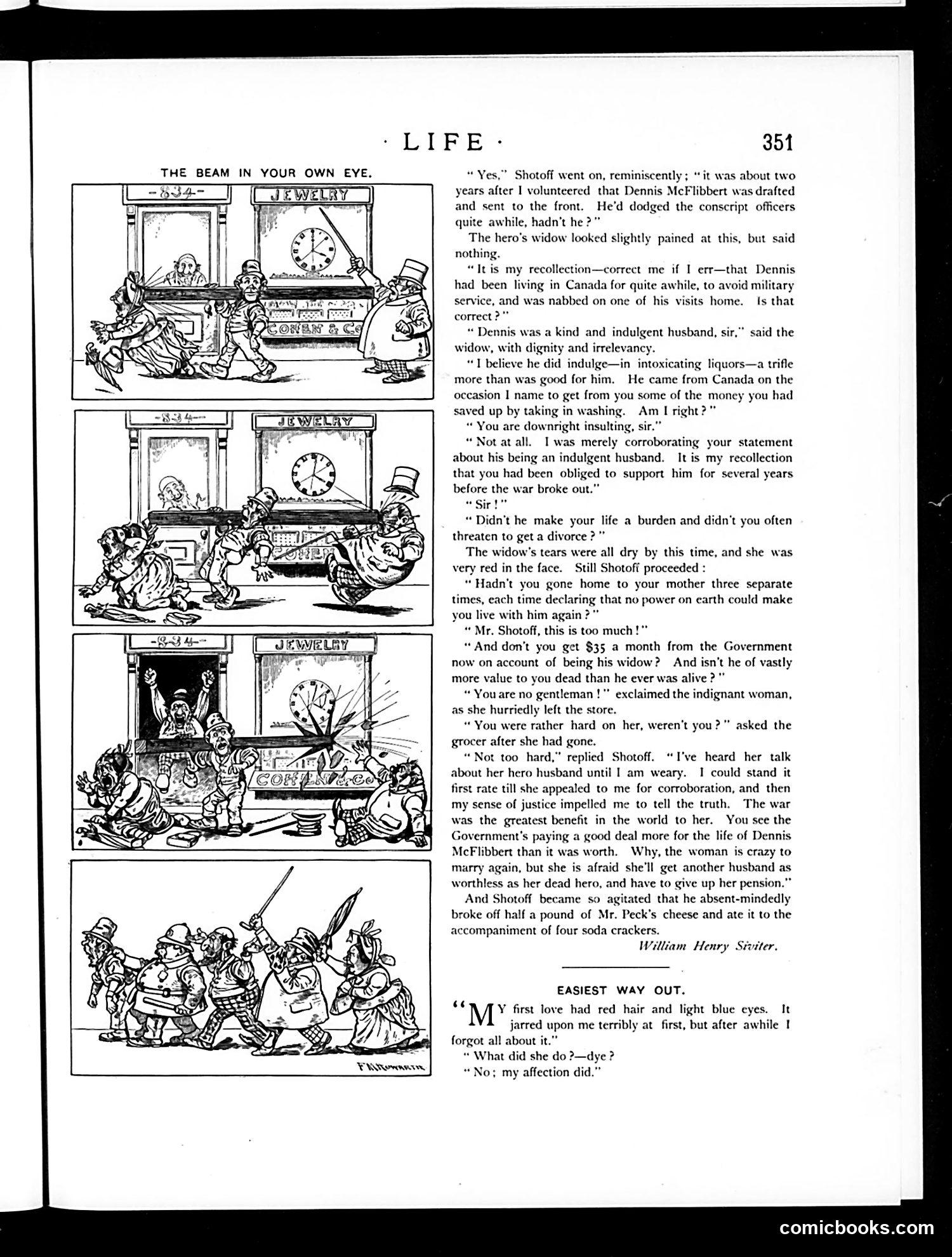
This page contains two distinct pieces: **Top Section:** A four-panel comic strip titled "The Beam in Your Own Eye" depicts a jewelry store scene. It appears to satirize a widow's complaint to a grocer about her late husband Dennis McFlibbert. The grocer (likely named Shotoff) systematically counters her grievances—revealing Dennis avoided military service in Canada, was an alcoholic, required financial support, and was generally worthless. The final panel shows an argument erupting. The satire targets the widow's selective memory and moral complaints about her husband when her own situation was morally questionable. **Bottom Section:** "Easiest Way Out" is a brief anecdote about forgetting a failed romantic relationship. It's sentimental rather than satirical—the narrator claims genuine affection (not physical appearance) enabled him to move past the breakup. Both pieces focus on relationships and character, typical of Life's humorous content.
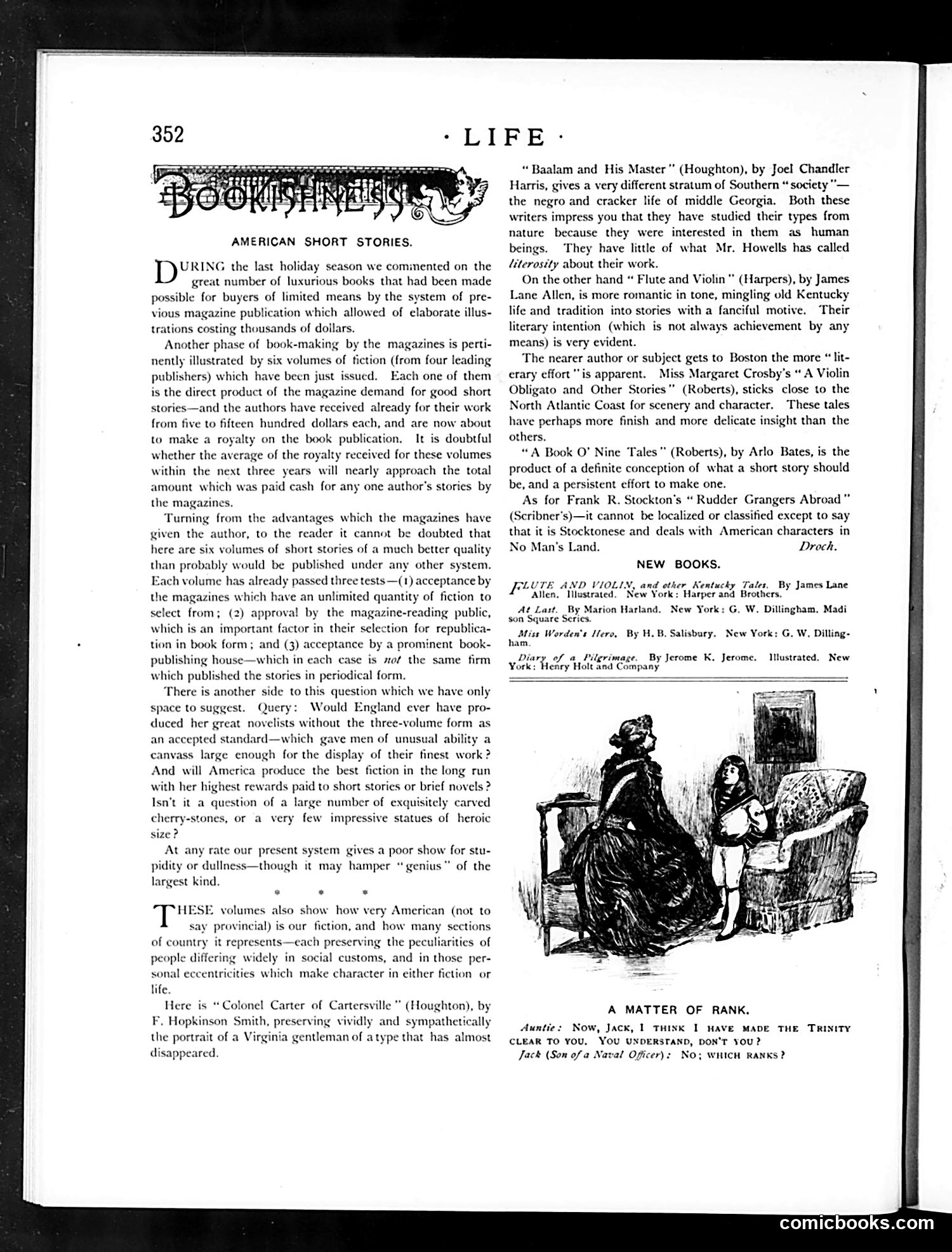
This cartoon illustrates a class-based joke about social hierarchy. A woman (Auntie) addresses a man (Jack), saying she's made "the Trinity clear" to him and asking if he understands—specifically, which ranks higher? Jack responds that he doesn't understand "which ranks" because he's identified as "Son of a Naval Officer." The humor depends on a pun: "ranks" (social standing/hierarchy) versus naval "ranks" (military positions). The joke suggests that someone of naval officer background would be confused about civilian social status distinctions, implying naval officers exist outside or below polite society's ranking system—a common period satire about military men lacking proper social refinement.
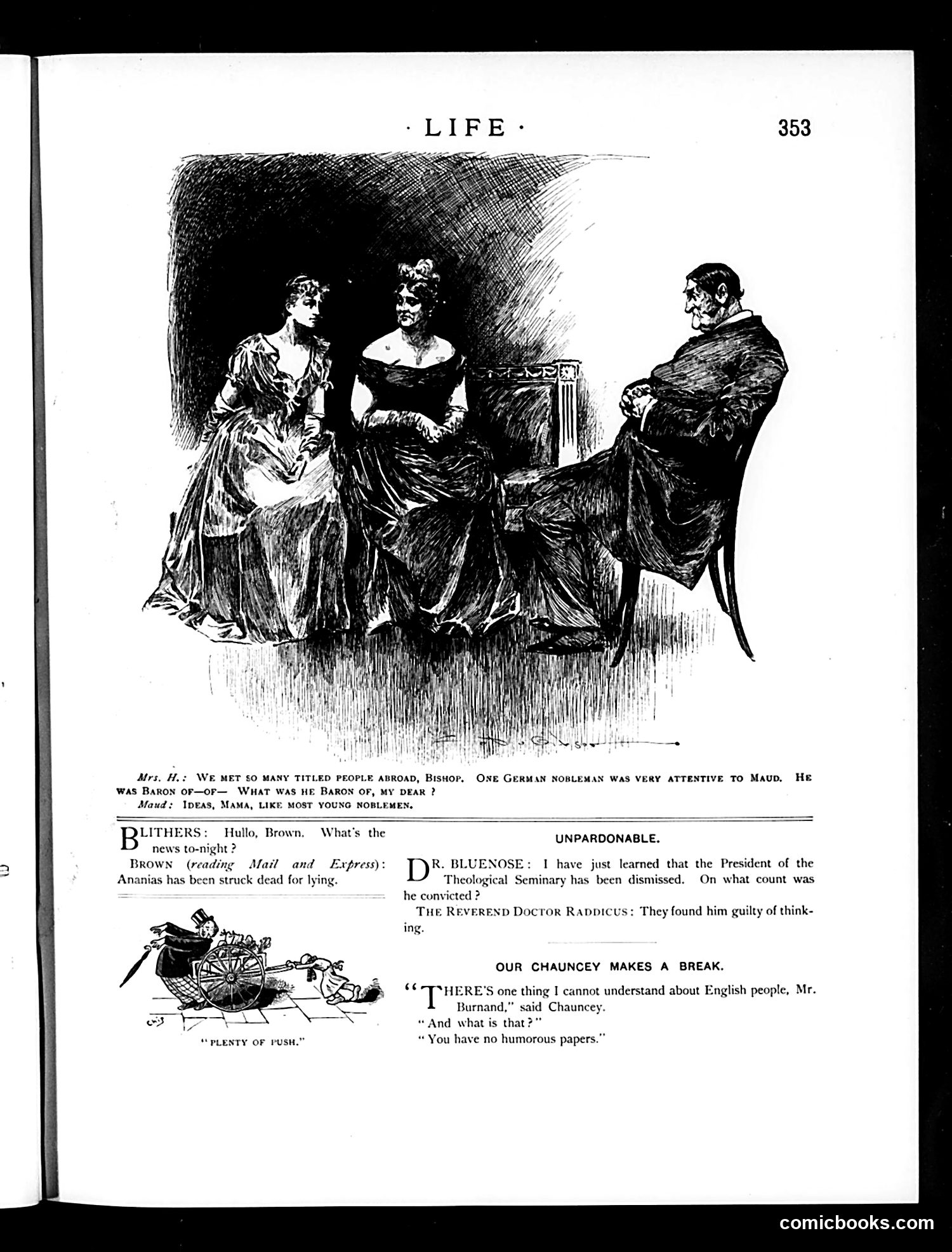
This page contains three separate satirical items: 1. **Top illustration**: Shows a social scene with two women and a man. The caption references "many titled people abroad, Bishop" and a "German nobleman" named Maud, satirizing American social climbing and attraction to European nobility—a common Life magazine theme mocking wealthy Americans' obsession with titles. 2. **Middle joke**: Blithers and Brown discuss Ananias being "struck dead for lying"—a biblical reference used as dark humor about dishonesty. 3. **Bottom section titled "Our Chauncey Makes a Break"**: Chauncey (likely a recurring character) cannot understand why English people lack "humorous papers." This appears to mock English cultural differences or the contrast between American and English humor standards. The page exemplifies Life's satirical approach to social pretension and cultural differences.
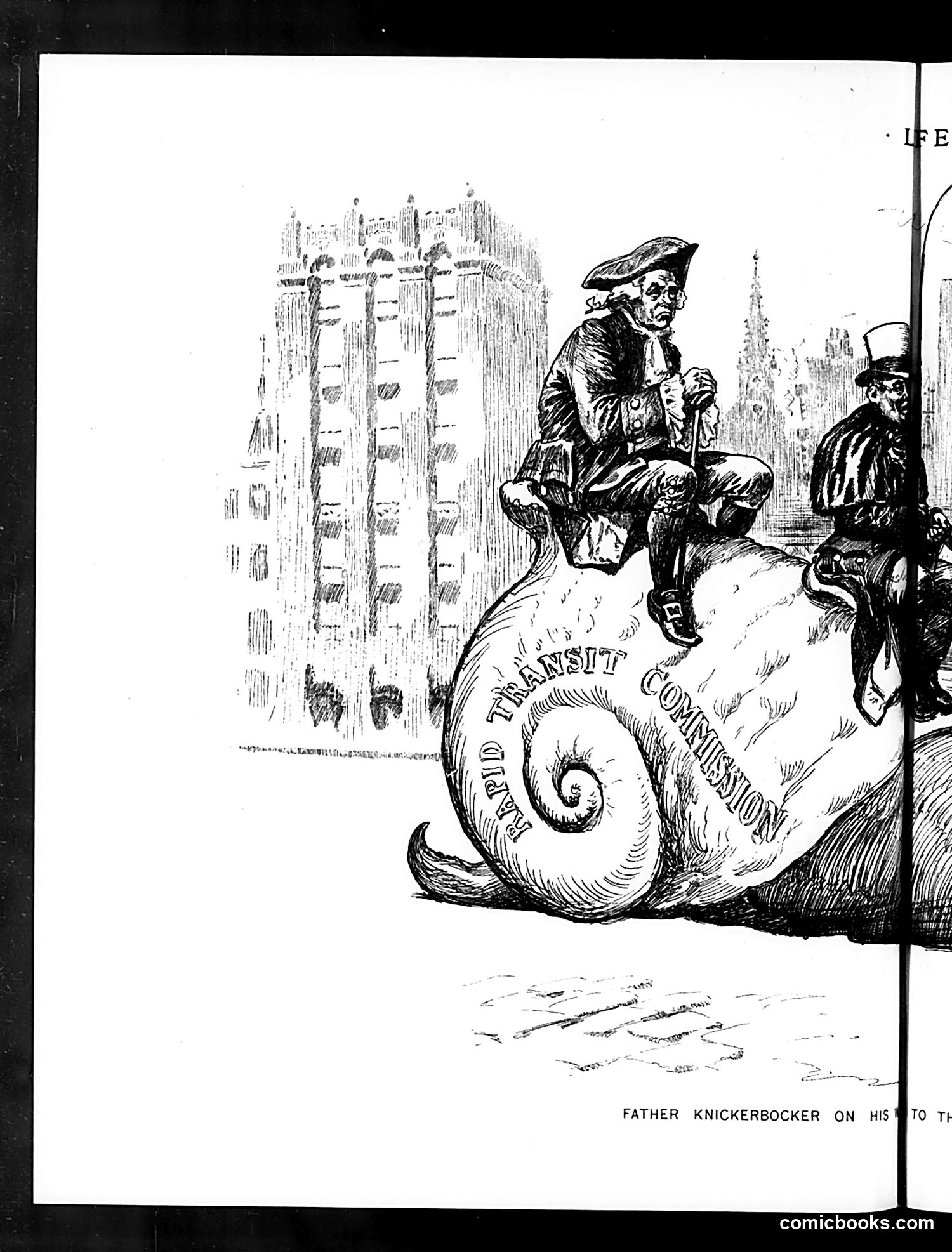
This satirical cartoon depicts **Father Knickerbocker**—a personified symbol of New York City—riding atop a large spiral shell labeled "RAPID TRANSIT COMMISSION." Two well-dressed men in top hats accompany him. The cartoon satirizes New York's rapid transit development, likely referencing early 20th-century subway construction projects. Father Knickerbocker's uncomfortable, precarious position on the spiraling shell suggests the chaotic, slow, or problematic nature of the city's transit expansion. The spiral's shape implies circular reasoning or going nowhere despite grand promises. The caption is cut off, but the image mocks municipal inefficiency—a common Life magazine theme—suggesting New York's transit commission wasn't delivering on its ambitious goals efficiently.
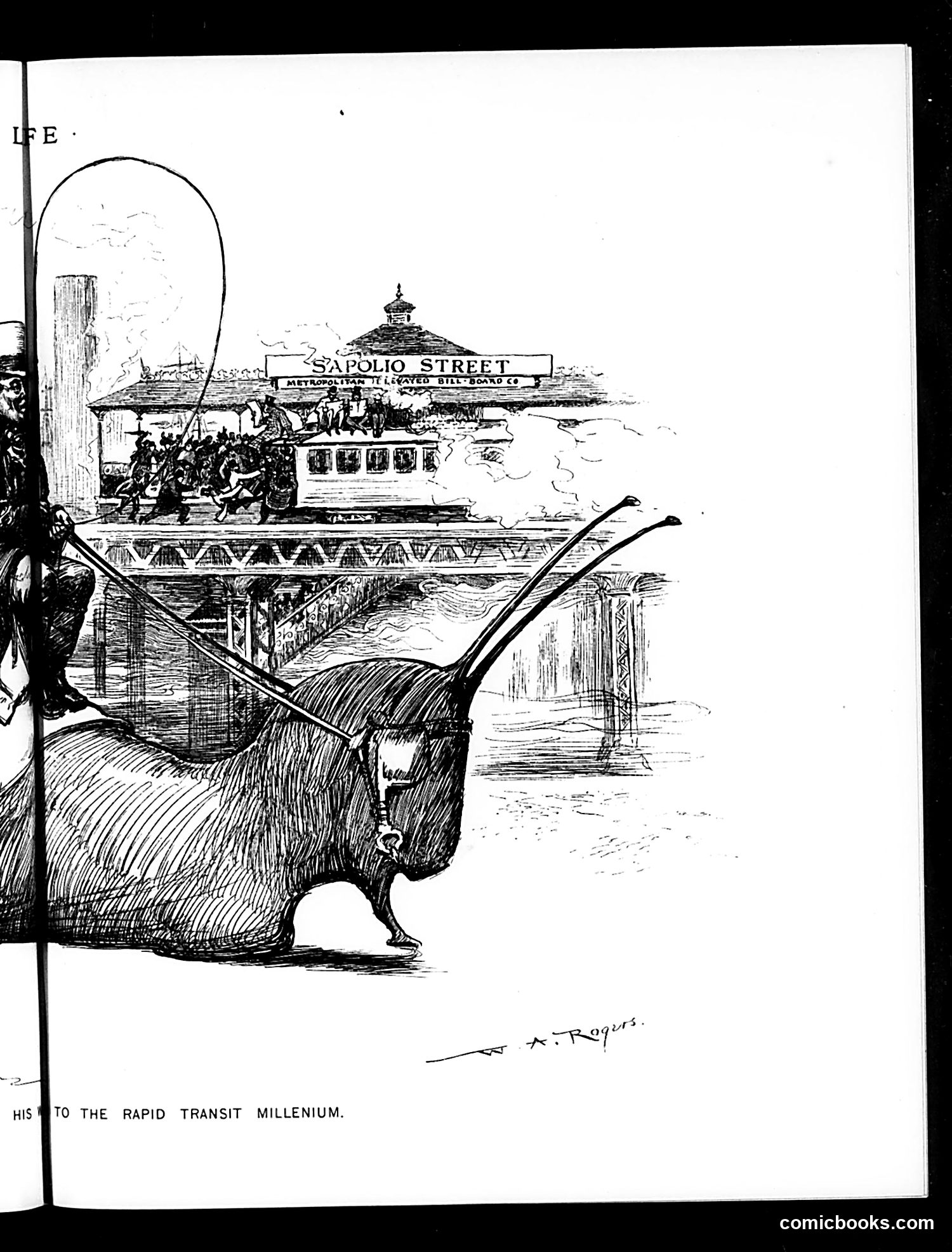
This satirical cartoon depicts a large bull in the foreground observing the Sapolio Street Metropolitan Elevated station in the background. The caption reads "His to the Rapid Transit Millennium," suggesting this is commentary on New York City's rapid transit development—likely the elevated railway system that was expanding around the turn of the 20th century. The bull appears to represent a skeptical or bemused observer of modern urban progress. The joke likely plays on the contrast between the "old" (represented by the animal) and the "new" technological advancement of rapid transit infrastructure. The satirical point seems to critique or mock the era's enthusiasm for modernization and rapid transit expansion as the city rushed toward the new millennium.
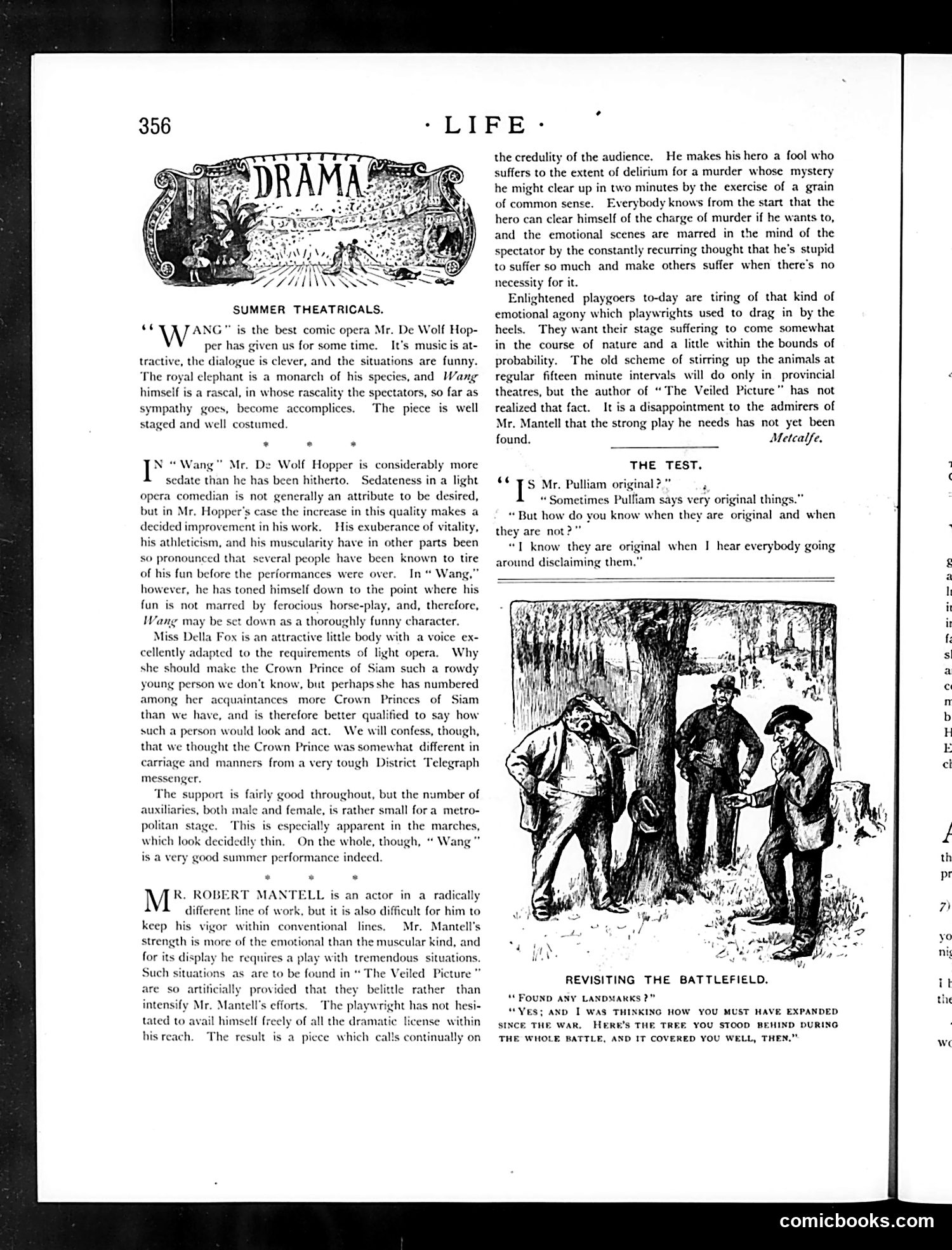
This page reviews three theatrical productions. The main content critiques the comic opera *Wang*, starring De Wolf Hopper, praising its music and humor while noting Hopper has toned down his typically "ferocious horse-play" — a restraint the reviewer considers an improvement. Actress Della Fox is praised for her voice, though the reviewer expresses bewilderment that she portrays a Siamese Crown Prince as "rowdy," sarcastically suggesting she may have personal experience with such royalty. The review of *The Veiled Picture* starring Robert Mantell is harshly critical. Mantell excels at emotional, dramatically intense roles, but the playwright has artificially contrived situations that undermine the drama. Specifically, the hero suffers delirious anguish over a murder charge he could easily resolve—a plot flaw that makes him appear foolish rather than tragic. The reviewer reflects broader theatrical trends: audiences are tiring of melodramatic emotional manipulation and demand suffering that feels naturalistic and probable, not artificially engineered every fifteen minutes for effect.
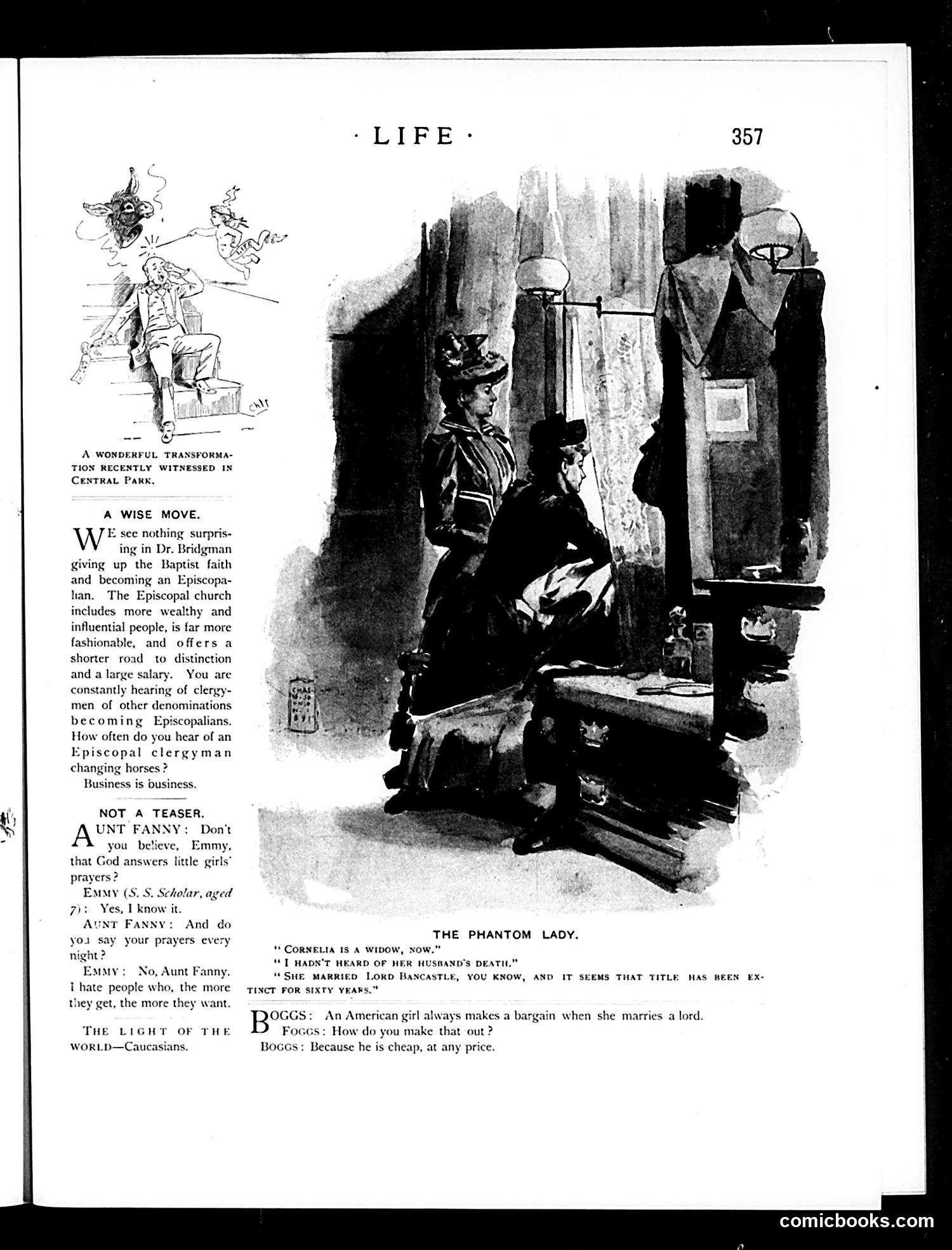
This page contains three separate satirical pieces mocking American society and religious hypocrisy: 1. **"A Wise Move"**: Satirizes clergy opportunism. Dr. Bridgman's conversion from Baptist to Episcopalian faith is presented as cynical careerism—the Episcopal church attracts wealthy patrons, offers faster advancement, and higher salaries. The satire notes clergy rarely switch denominations *away* from Episcopalianism, suggesting it's the denomination of financial advantage, not spiritual conviction. 2. **"Not a Teaser"**: A dialogue mocking materialism. Seven-year-old Emmy reveals she prays not from faith but from self-interest, admitting she hates people "the more they get, the more they want"—revealing children absorb society's greed. 3. **"The Phantom Lady"** and **Boggs dialogue**: Satirizes transatlantic marriages between wealthy American heiresses and impoverished English aristocrats. The exchange mocks American girls "making bargains" marrying titled men, with Boggs suggesting lords accept such marriages because American money makes them "cheap at any price."
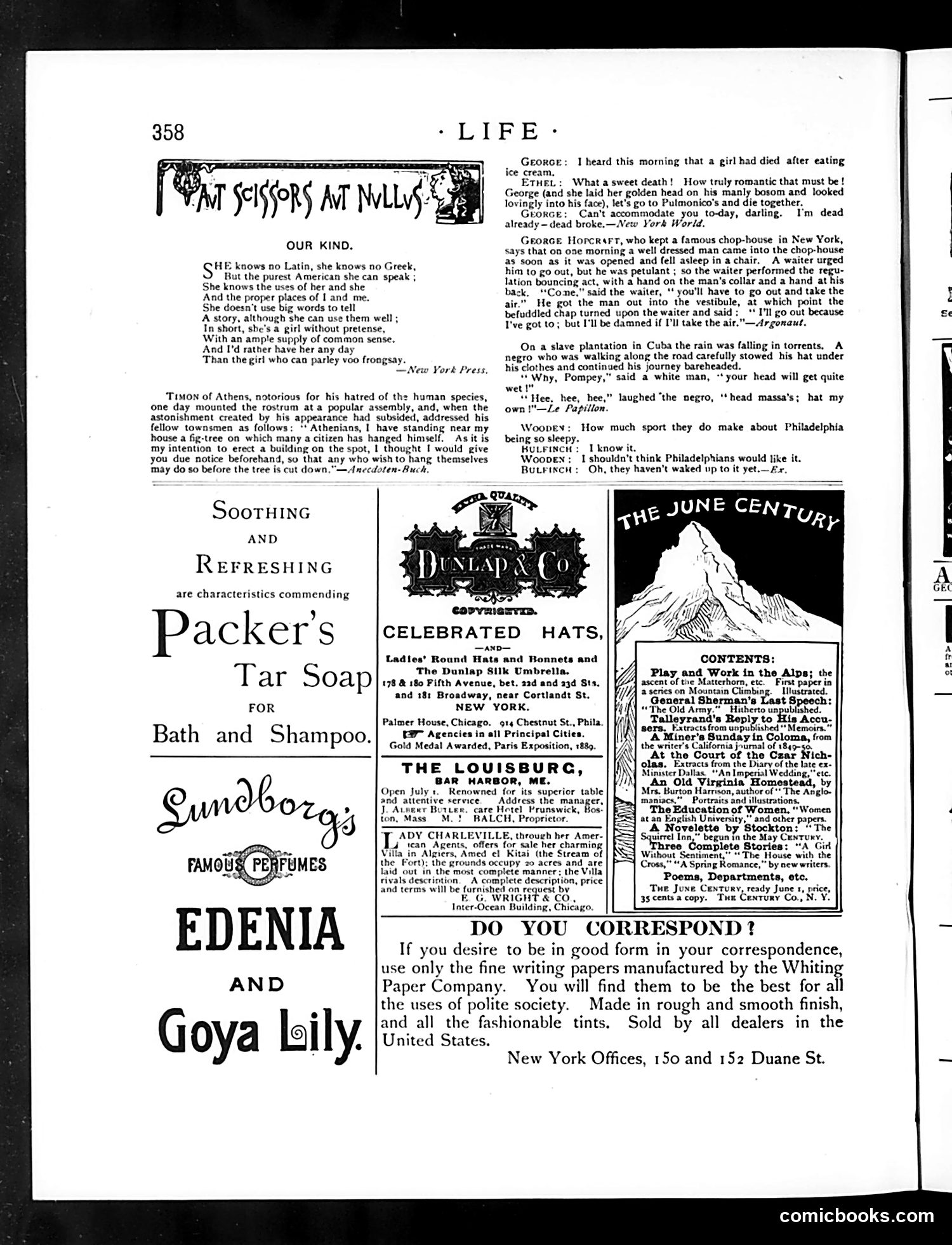
This page consists primarily of **humorous anecdotes and advertisements** rather than political cartoons. The jokes reflect turn-of-the-century American attitudes: "Our Kind" praises an unpretentious American woman who speaks plainly over affected Francophiles ("parley voo frongsay"). Other anecdotes mock romantic pretension, drunkenness, and working-class dialect. A Cuba plantation story contains period racial stereotypes—a enslaved man protecting "massa's" hat while his own head gets wet, presented as comedic. The Timon of Athens anecdote sardonically references suicide, while a Philadelphia joke suggests the city is unsophisticated ("haven't waked up to it yet"). **Advertisements dominate**: Dunlap hats, Packer's Tar Soap, Sumbotys perfumes, and The June Century magazine. The "Do You Correspond?" ad promotes fine writing paper. The humor reflects genteel, somewhat snobbish attitudes typical of Life's educated audience, with casual ethnic/class mockery considered entertainment.
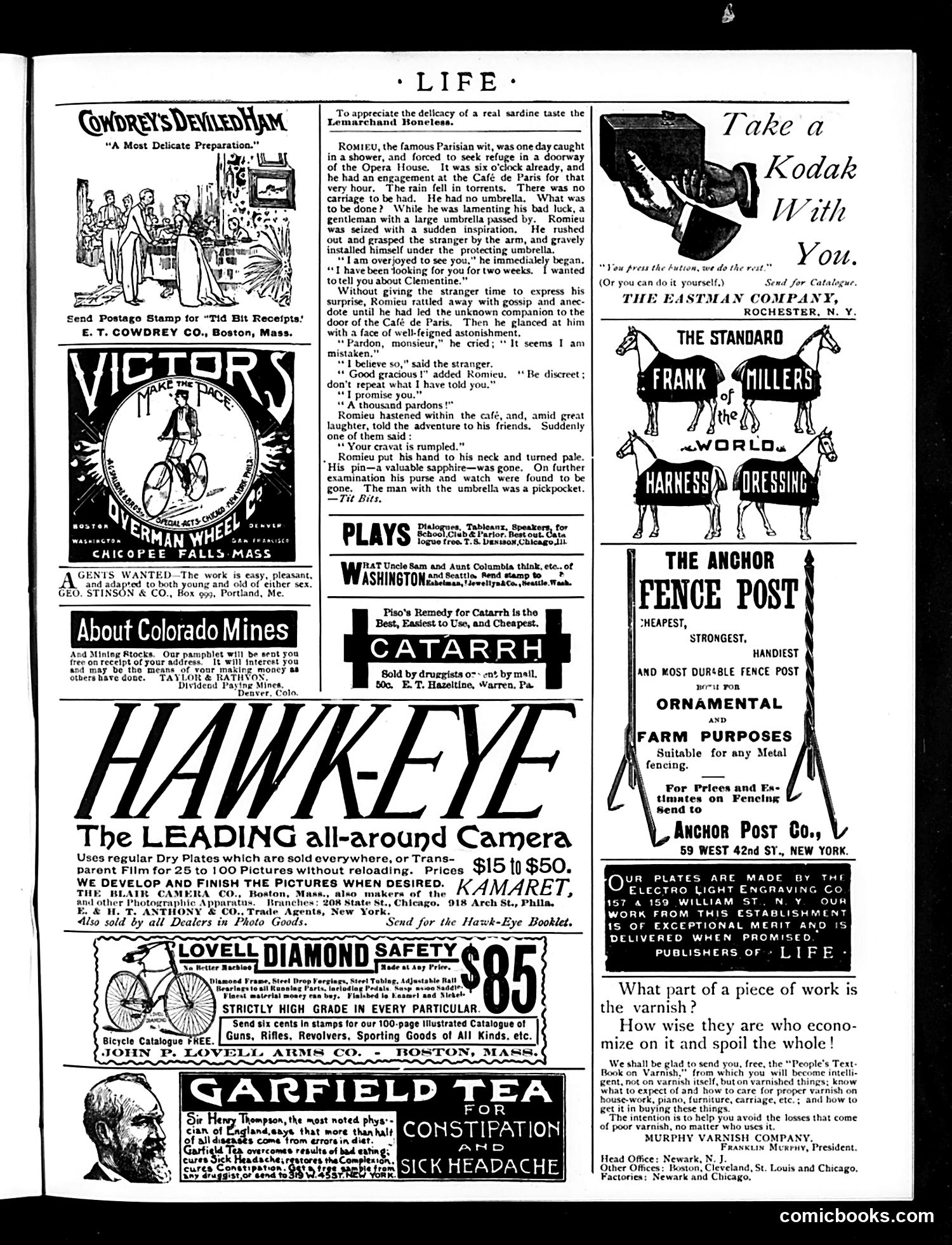
This is primarily an **advertisement and miscellaneous content page** from Life magazine, not a political cartoon. The dominant feature is a humorous **short story about Romieu**, a famous Parisian wit who, caught in rain without an umbrella, manipulates a stranger into sharing his umbrella by pretending to know him and gossiping about acquaintances. The joke's punchline: the "stranger" was a pickpocket who stole Romieu's valuable sapphire pin, watch, and purse—the schemer becomes the victim. The page is otherwise filled with **period advertisements** for consumer goods (cameras, bicycles, fence posts, catarrh remedy, tea) typical of early 1900s Life magazine. There are no political cartoons or satirical commentary targeting specific figures or events visible on this page. It represents straightforward commercial and entertainment content.
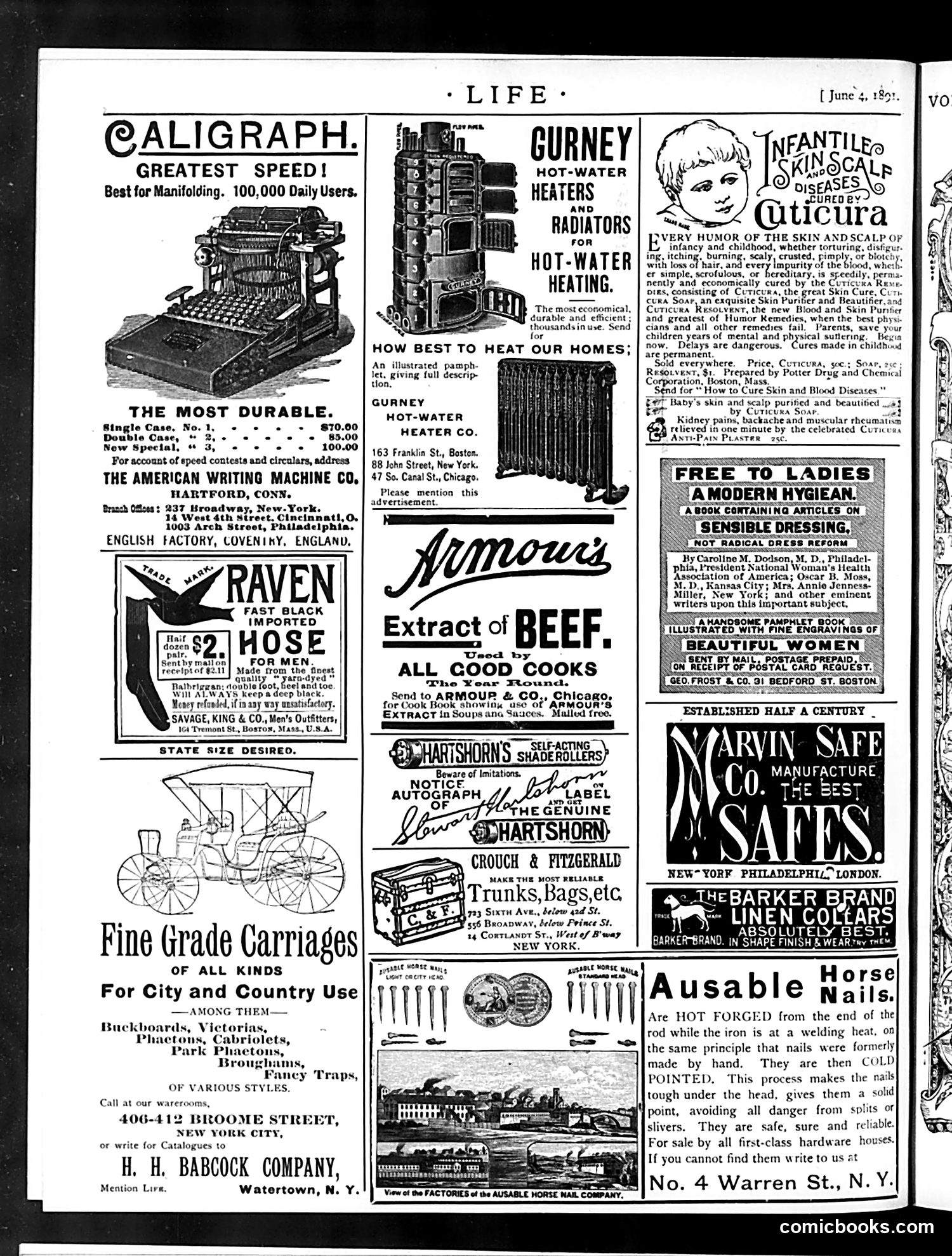
This is primarily an **advertising page** with no cartoons or satirical content. The page consists entirely of commercial advertisements typical of the 1890s, including: - **Office equipment** (Caligraph typewriter) - **Household items** (Gurney hot-water heaters, fine carriages) - **Food products** (Armour's beef extract) - **Patent medicines** (Cuticura products for skin conditions—heavily advertised with medical endorsements) - **Clothing and accessories** (Raven hose, Hartshorn shaderollers) - **Hardware** (Ausable horse nails) The most notable element is the **Cuticura advertisement**, which prominently features medical claims and doctor endorsements—reflecting the era's largely unregulated patent medicine industry that would later be targeted by progressive reformers. There is **no political satire, cartoon, or comic content** visible on this page.