
Life, 1891-06-04 · page 8 of 16
Life — June 4, 1891 — page 8: what you’re looking at
What you’re looking at
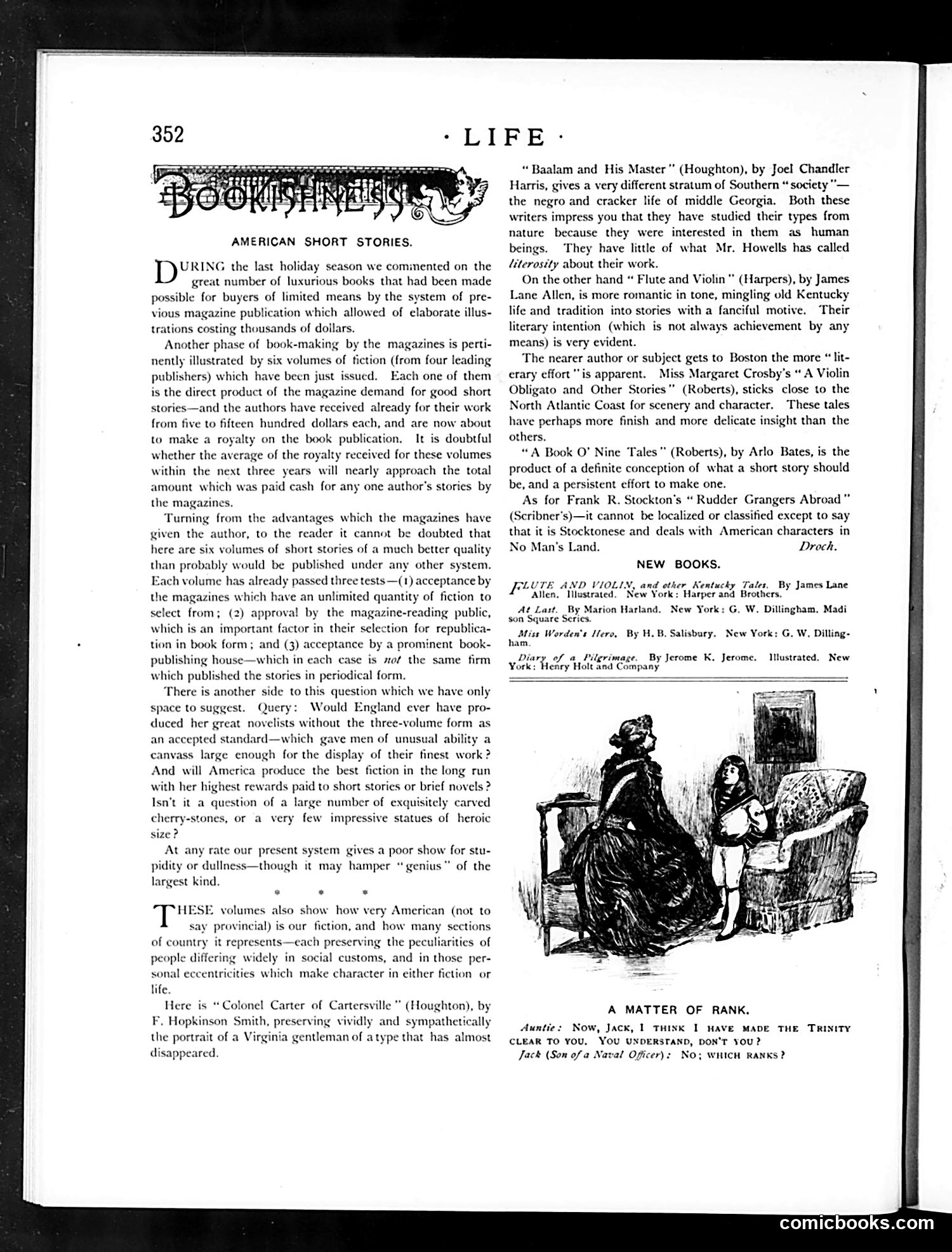
This cartoon illustrates a class-based joke about social hierarchy. A woman (Auntie) addresses a man (Jack), saying she's made "the Trinity clear" to him and asking if he understands—specifically, which ranks higher? Jack responds that he doesn't understand "which ranks" because he's identified as "Son of a Naval Officer." The humor depends on a pun: "ranks" (social standing/hierarchy) versus naval "ranks" (military positions). The joke suggests that someone of naval officer background would be confused about civilian social status distinctions, implying naval officers exist outside or below polite society's ranking system—a common period satire about military men lacking proper social refinement.
📄 Transcribed text from this page (OCR, searchable)
Machine-transcribed from the original scan — historical spelling and the odd misread are preserved.
‘LIFE: AMERICAN SHORT STORIES. URING the last holiday season we commented on the great number of luxurious books that had been made possible for buyers of limited means by the system of pre- vious magazine publication which allowed of elaborate illus- trations costing thousands of dollars. Another phase of book-making by the magazines is perti- nently illustrated by six volumes of fiction (from four leading publishers) which have been just issued. Each one of them is the direct product of the magazine demand for good short stories—and the authors have received already for their work from five to fifteen hundred dollars each, and are now about to make a royalty on the book publication. It is doubtful whether the average of the royalty received for these volumes within the next three years will nearly approach the total amount which was paid cash for any one author's stories by the magazines. Turning from the advantages which the magazines have given the author, to the reader it cannot be doubted that here are six volumes of short stories of a much better quality than probably would be published under any other system. Each volume has already passed three tests—(1) acceptance by the magazines which have an unlimited quantity of fiction to select from; (2) approval by the magazine-reading public, which is an important factor in their selection for republica- tion in book form; and (3) acceptance by a prominent book- publishing house—which in each case is of the same firm which published the stories in periodical form. There is another side to this question which we have only space to suggest. Query: Would England ever have pro- duced her great novelists without the three-volume form as an accepted standard—which ve men of unusual ability a canvass large enough for the display of their finest work ? And will America produce the best fiction in the long run with her highest rewards paid to short stories or brief novels ? Isn't it a question of a large number of exquisitely carved -stones, or a very few impressive statues of heroic At any rate our present system gives a poor show for stu- pidity or dullness—though it may hamper “ genius” of the st kind. * * . volumes also show how very American (not to say provincial) is our fiction, and how man: ch preserving the pe people differing widely in social customs, and in those per- of country it represents— sonal eccentricities which make character in either fiction or life. Here is “Colonel Carter of Cartersville " (Houghton), by F, Hopkinson Smith, preserving vividly and sympathetically the portrait of a Virginia gentleman of atype that has almost disappeared. “ Baalam and His Master" (Houghton), by Joe! Chandler Harris, gives a very different stratum of Southern “society "— the negro and cracker life of middle Georgia. Both these writers impress you that they have studied their types from nature because they were interested in them as human beings. They have little of what Mr. Howells has called literosity about their work. On the other hand “ Flute and Violin” (Harpers), by James Lane Allen, is more romantic in tone, mingling old Kentucky life and tradition into stories with a fanciful motive. Their literary intention (which is not always achievement by any means) is very evident. The nearer author or subject gets to Boston the more “ lit- erary effort "is apparent. Miss Margaret Crosby's “ A Violin Obligato and Other Stories" (Roberts), sticks close to the North Atlantic Coast for scenery and character, These tales have perhaps more finish and more delicate insight than the others. “A Book O' Nine Tales” (Roberts), by Arlo Bates, is the product of a definite conception of what a short story should be, and a persistent effort to make one. As for Frank R. Stockton’s “ Rudder Grangers Abroad” (Scribner’s)—it cannot be localized or classified except to say that it is Stocktonese and deals with American characters in No Man's Land. Droch. NEW BOOKS. GLUTE AND VIOLIN, and ether Kentucky Tales. By James Lane Allen, Illustrated. New York: Harper and Brothers. At Last. By Marion Harland, New York: G, W. Dillingham, Madi son Square Series. Afiss Worden's Hero, By H.B. Salisbury. New York: G. W, Dilling- of a Pilgrim By Jerome K. Jerome. Mlustrated. New Jenry Holt and C A MATTER OF RANK. Auntie: Now, Jack, 1 THink I HAVE MADE THE CLEAR TO YOU, YOU UNDERSTAND, DON’T you? Jack (Son ofa Naval Officer): NO; WHICH RANKS? comicbooks.com