
A complete issue · 16 pages · 1890
Life — August 21, 1890
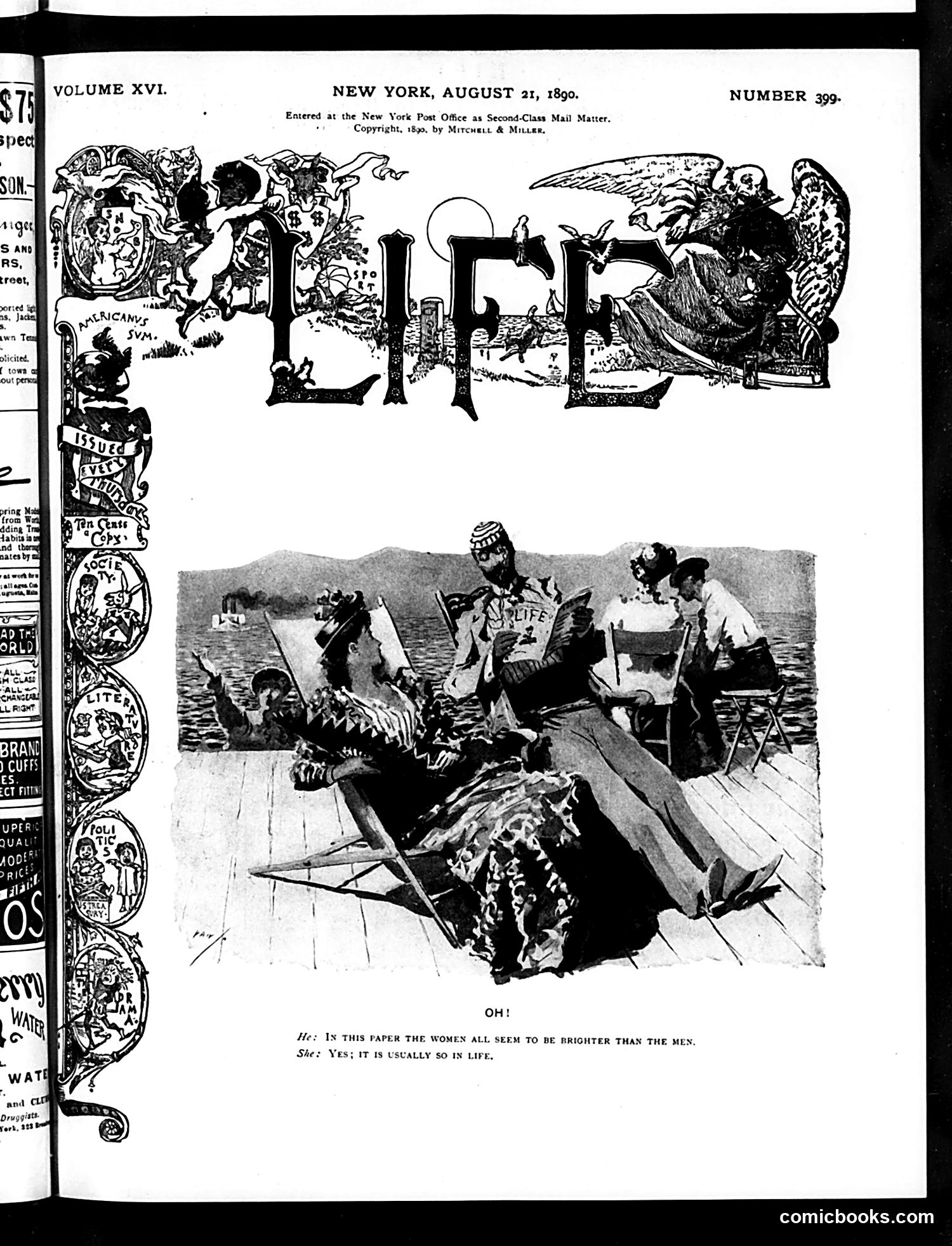
This page from Life magazine (August 21, 1890) contains a humorous dialogue about gender appearance. The photograph shows well-dressed people relaxing on a dock or boat by water, with mountains in the background. The caption presents a conversation: - **He**: "Is this paper the women all seem to be brighter than the men." - **She**: "Yes; it is usually so in life." The joke appears to satirize the common Victorian-era observation that women often appeared more vibrant, cheerful, or animated in social settings compared to men. The "She" character's response—"it is usually so in life"—suggests this reflects broader social reality rather than being merely a feature of newspaper representation. The ornate left border contains period advertisements typical of Life's commercial content.
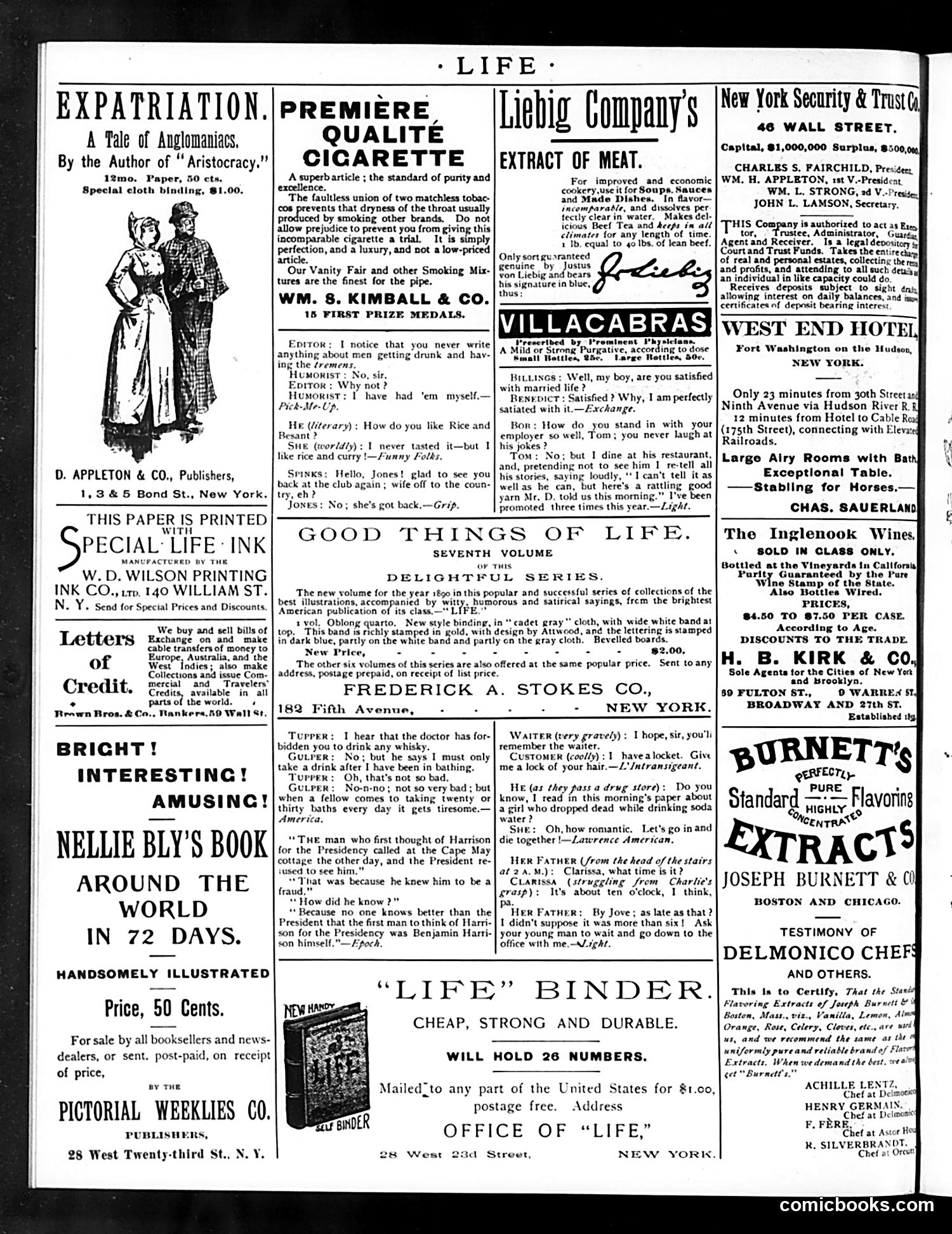
This page is primarily **advertising and promotional content** rather than political satire. The main cartoon shows two figures in period dress (appearing to be from a historical era) illustrating "Expatriation: A Tale of Anglomanias" — apparently a serialized story about Americans adopting British affectations. The cartoon's humor stems from social satire about Americans imitating English manners and customs, a recurring theme in Gilded Age American humor. The rest of the page features **product advertisements** (cigars, meat extract, wines, extracts) and promotional material for Life magazine subscriptions and binders, along with an advertisement for Nellie Bly's famous travel book "Around the World in 72 Days." The page reflects late-19th-century American print culture more than specific political commentary.
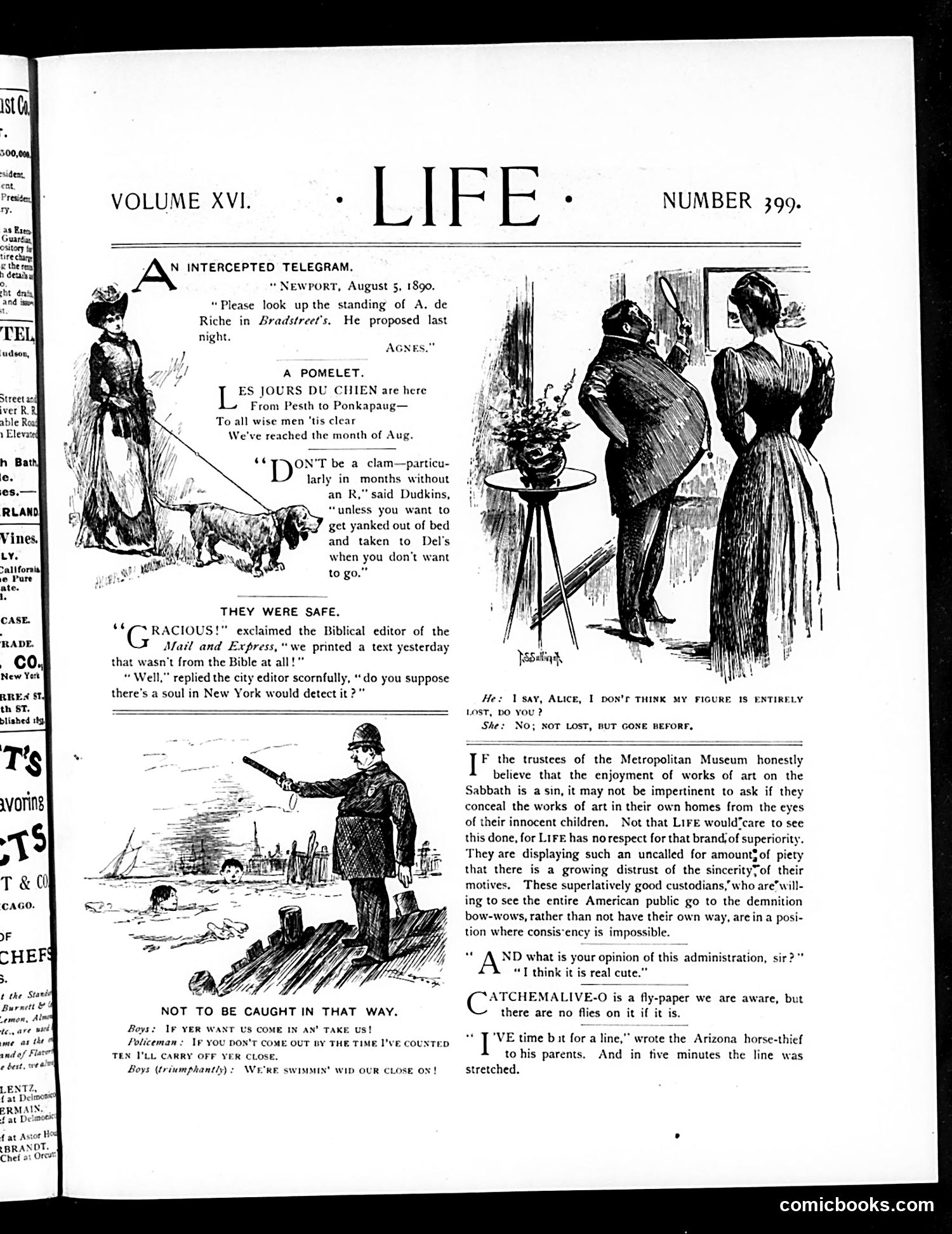
This satirical page from August 5, 1890, contains several unrelated humor pieces mocking contemporary social issues: **"An Intercepted Telegram"** jokes about a woman named Agnes warning about A. de Riche's "Braddress"—likely a corset or garment—being "proposed" (possibly referencing marriage or propriety). **"A Pomelet"** appears to be a brief poetic piece about dog days in summer. **"They Were Safe"** satirizes religious hypocrisy, with editors debating whether New York souls could be detected in printed text. **"Not to Be Caught in That Way"** depicts a fisherman and boys, apparently joking about fishing techniques and deception. The page also includes editorial commentary criticizing the Metropolitan Museum's censorship of artworks and religious prudishness about classical art displays.
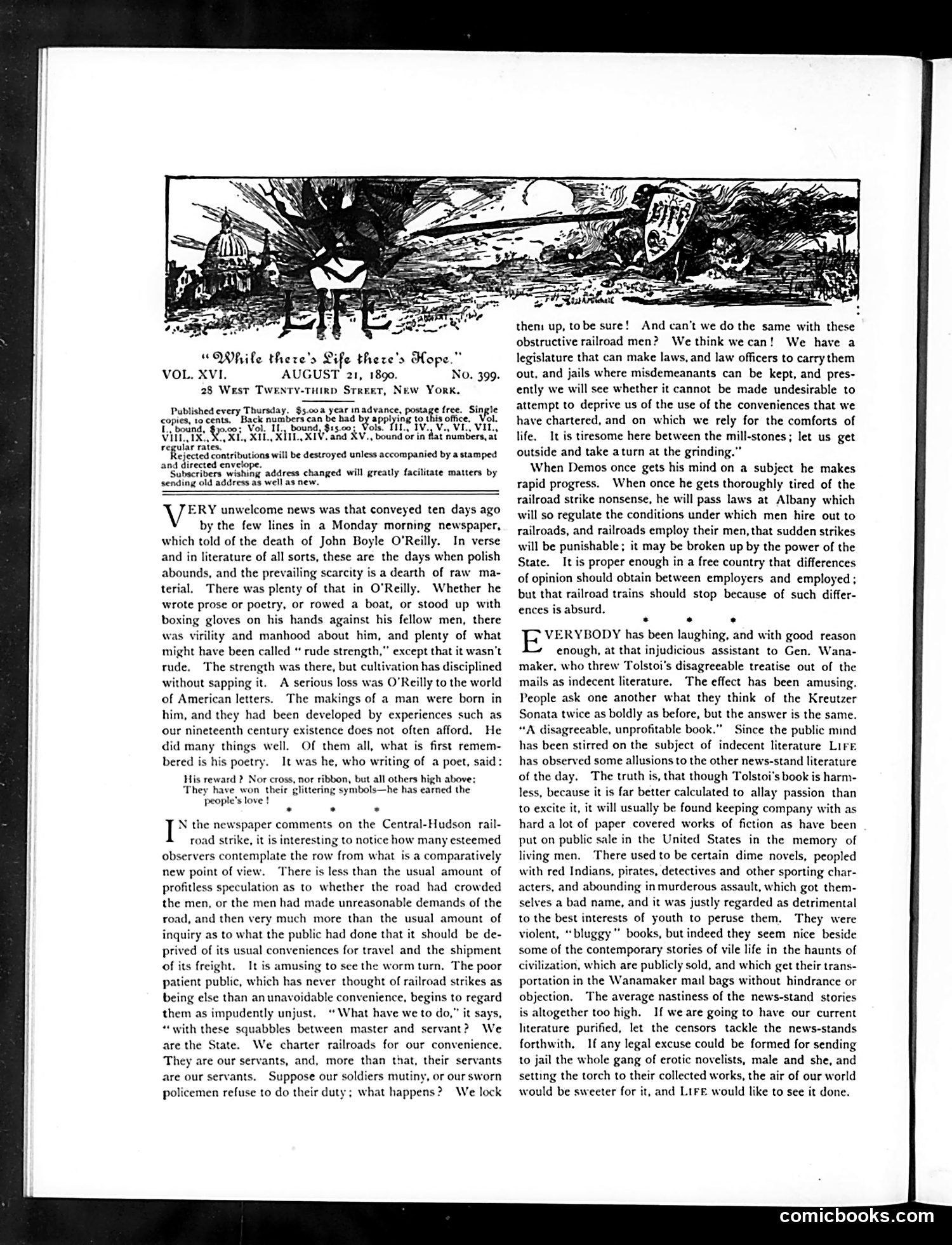
The masthead cartoon depicts a chaotic urban scene with industrial smokestacks and destruction, illustrating the consequences of labor unrest. The accompanying article addresses the recent Central-Hudson railroad strike and death of labor figure John Boyle O'Reilly. The editorial argues that while railroad workers' grievances deserve consideration, strikes that disrupt public services are unjustifiable in a free country. The author contends that legal mechanisms—legislature and courts—should resolve labor disputes, not work stoppages. A secondary critique targets General Wanamaker and dime novelist Tolstoi for distributing supposedly indecent literature. Life argues against censorship, suggesting that truly harmful material would better serve public morality than cheap sensationalist novels flooding newsstands.
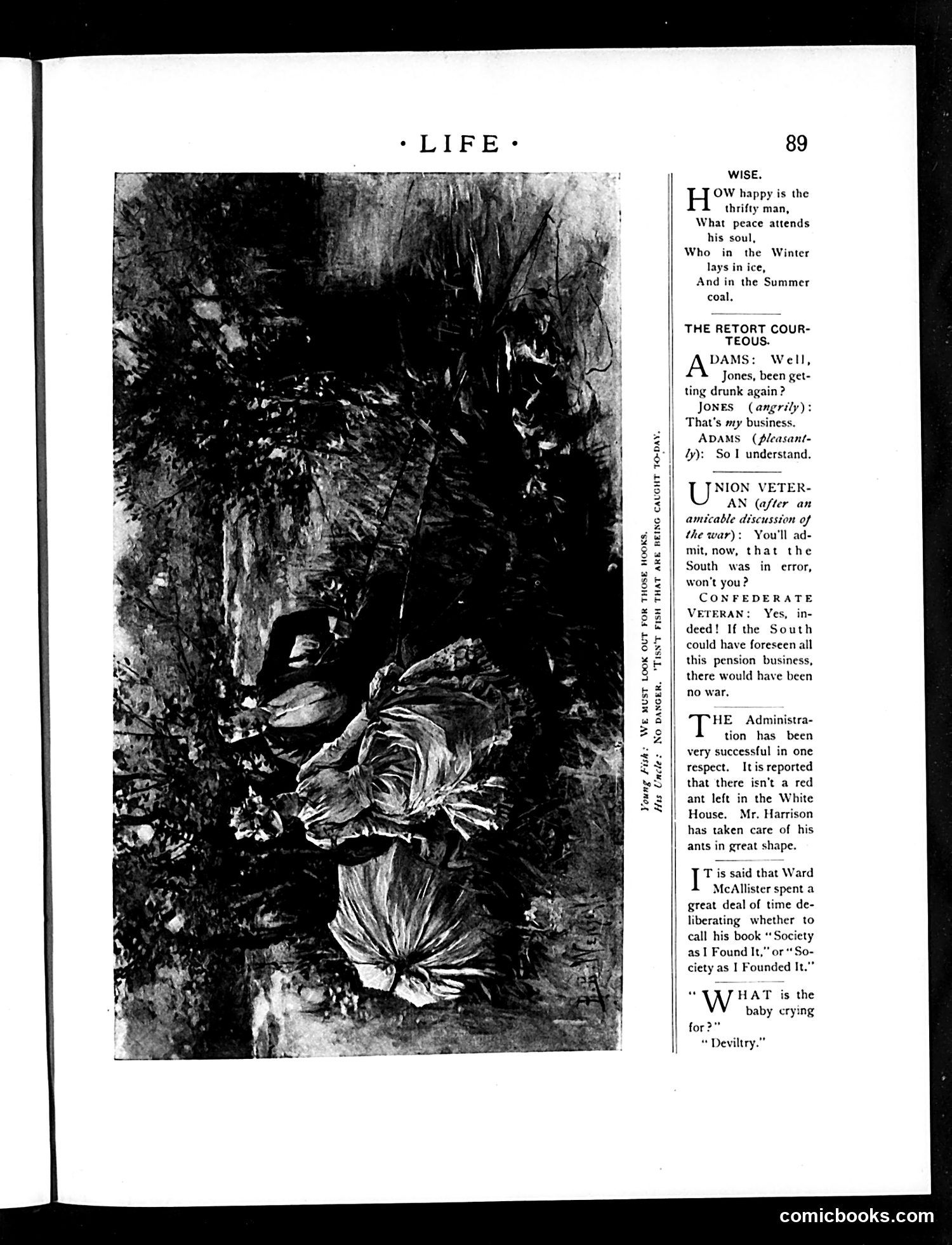
The main image appears to show a figure lying among foliage or debris—likely a political cartoon commentary, though the specific subject is unclear from the visual alone. The text sections are brief satirical pieces rather than cartoon captions: - "The Retort Courteous" depicts a dialogue between Jones (getting drunk) and Adams, suggesting social commentary on drinking habits - "Union Veteran" and "Confederate Veteran" debate whether the South was "in error," with the Confederate admitting the South was wrong—likely post-Civil War reconciliation satire - A quip about the Harrison Administration's success eliminating red ants from the White House - A reference to Ward McAllister's deliberation on what to call his book about "Society" - A final joke: "What is the baby crying for?" "Deviltry." The page mixes political and social satire typical of *Life* magazine's style, though specific historical context for some references remains unclear.
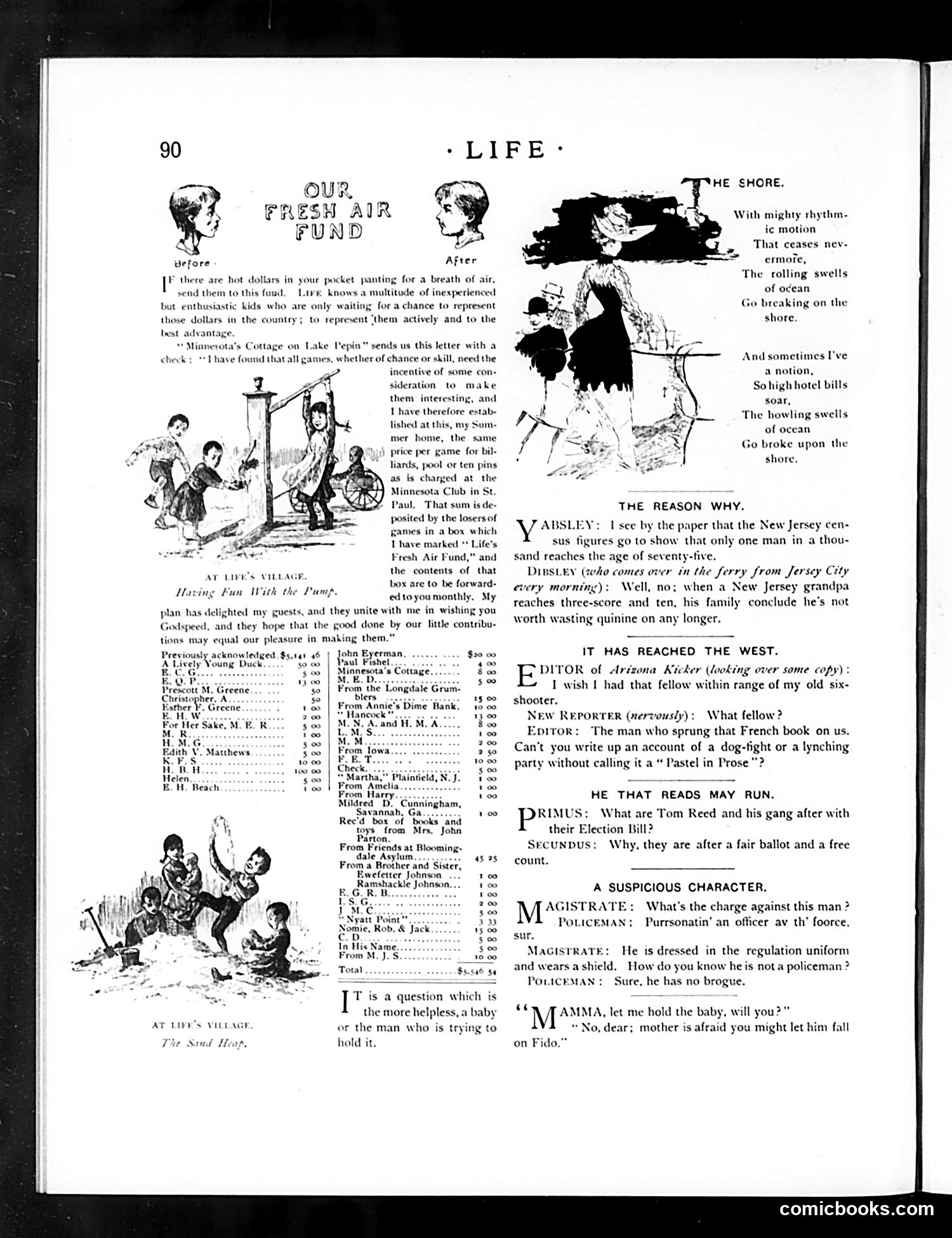
This page from *Life* magazine contains several satirical sections targeting early 20th-century American politics and social issues. **"Our Fresh Air Fund"** mocks a charitable initiative, contrasting "before" and "after" sketches of children. The accompanying text suggests the fund's actual value is questionable—a critique of wealthy philanthropists' patronizing efforts toward poor children. **"The Reason Why"** features a dialogue between characters debating census statistics about men reaching old age, with editorial commentary questioning the validity of such demographic claims. The remaining sections include brief satirical dialogues mocking contemporary figures and events—references to "Tom Reed and his gang" and electoral politics appear to target specific politicians, though the identities require additional historical context to confirm with certainty. The overall tone is skeptical of institutions and public figures.
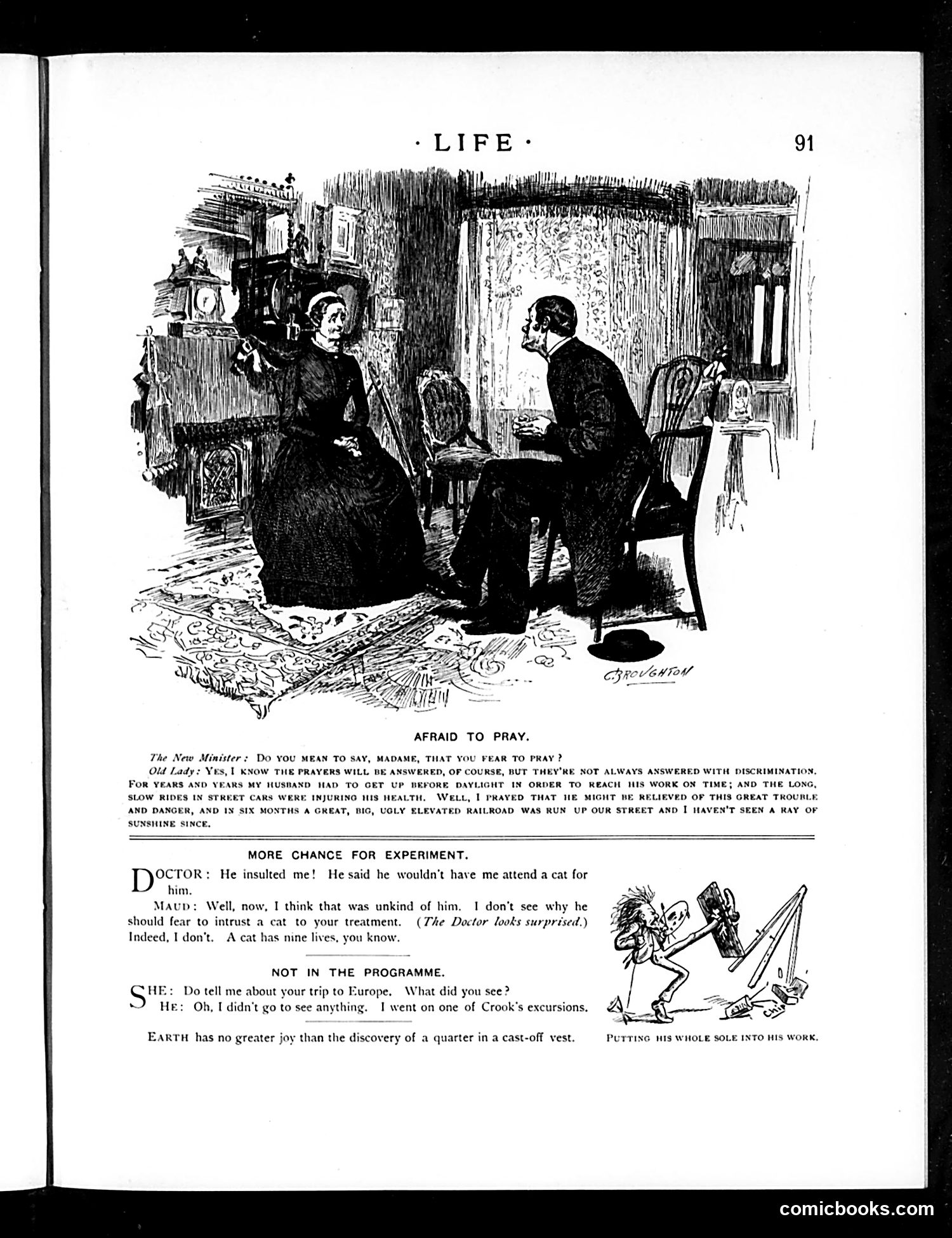
**"Afraid to Pray"** depicts a new minister responding to criticism about his prayer habits. The minister explains he avoids praying in public because his husband faced workplace discrimination—a railroad was shut down after he prayed for divine intervention on street time, preventing him from reaching work punctually. The satire targets religious hypocrisy and institutional intolerance: the minister fears that visible piety will invite retaliation against her family, suggesting that prayer itself has become socially dangerous rather than virtuous. **"More Chance for Experiment"** and **"Not in the Programme"** are brief comedic sketches about social awkwardness—one involving a doctor insulting a patient, another about tourists on packaged excursions seeing nothing of actual Europe. These mock pretension and missed experiences.
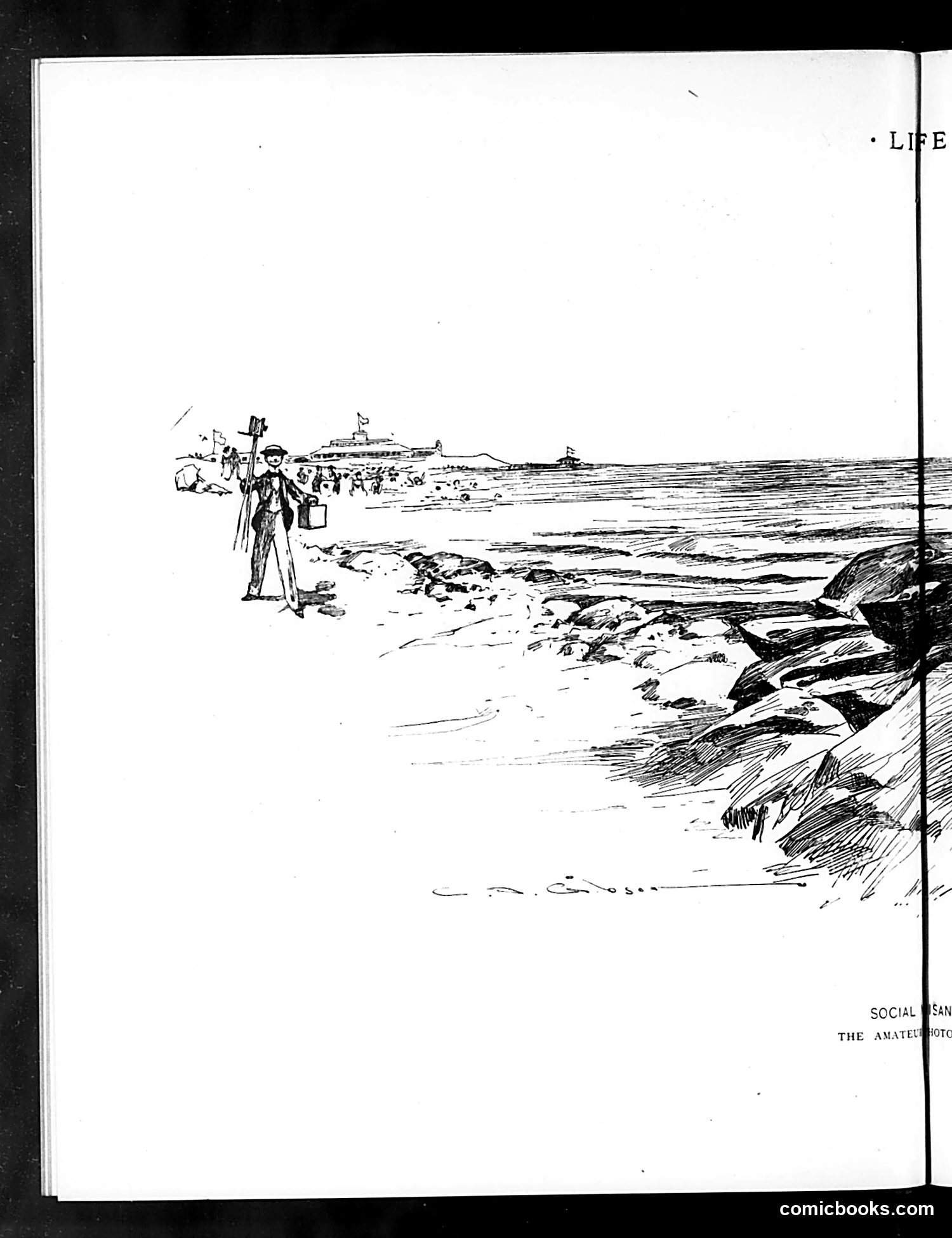
This is a satirical illustration from *Life* magazine showing a man standing on a rocky beach, dressed formally with a camera and equipment, gazing out at the ocean where ships are visible on the horizon. The text fragment at bottom references "THE AMATEUR PHOTOGRAPHER" and "SOCIAL SAN[ITARIUM]" (partially cut off). The satire appears to mock amateur photographers—likely wealthy leisure tourists—who traveled to coastal resorts with their new cameras to document scenic views. The formal attire and equipment suggest both pretension and the novelty of photography as an expensive hobby for affluent amateurs. The crowded beach in the background implies this was a fashionable social destination where such amateur photographers gathered, making the scene simultaneously ridiculous and relatable to *Life*'s educated, urban audience.
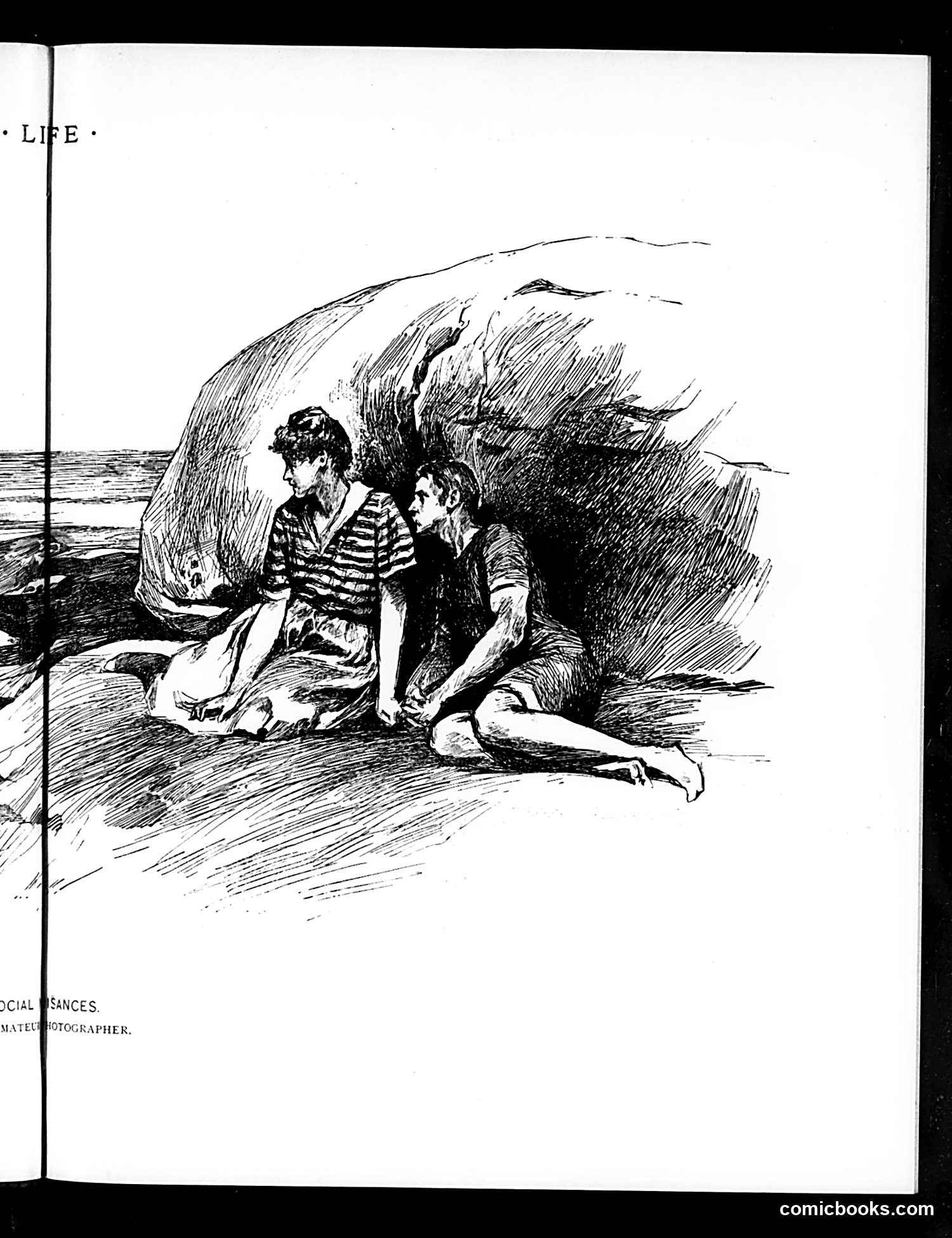
This appears to be an illustration from *Life* magazine showing two figures on a beach near a boat. The woman wears a striped sailor-style shirt, while the man reclines on the sand. The page header reads "LIFE" and partial text at bottom references "SOCIAL DANCES" and "PHOTOGRAPHER," though the full caption is cut off. Without the complete caption or article text, the specific satirical point is unclear. However, the scene likely comments on leisure, courtship, or beach society of the era. The casual, intimate beach setting suggests social commentary on modern dating or leisure activities—common *Life* magazine subjects for gentle satire. The precise political or social reference cannot be determined from the visible image alone.
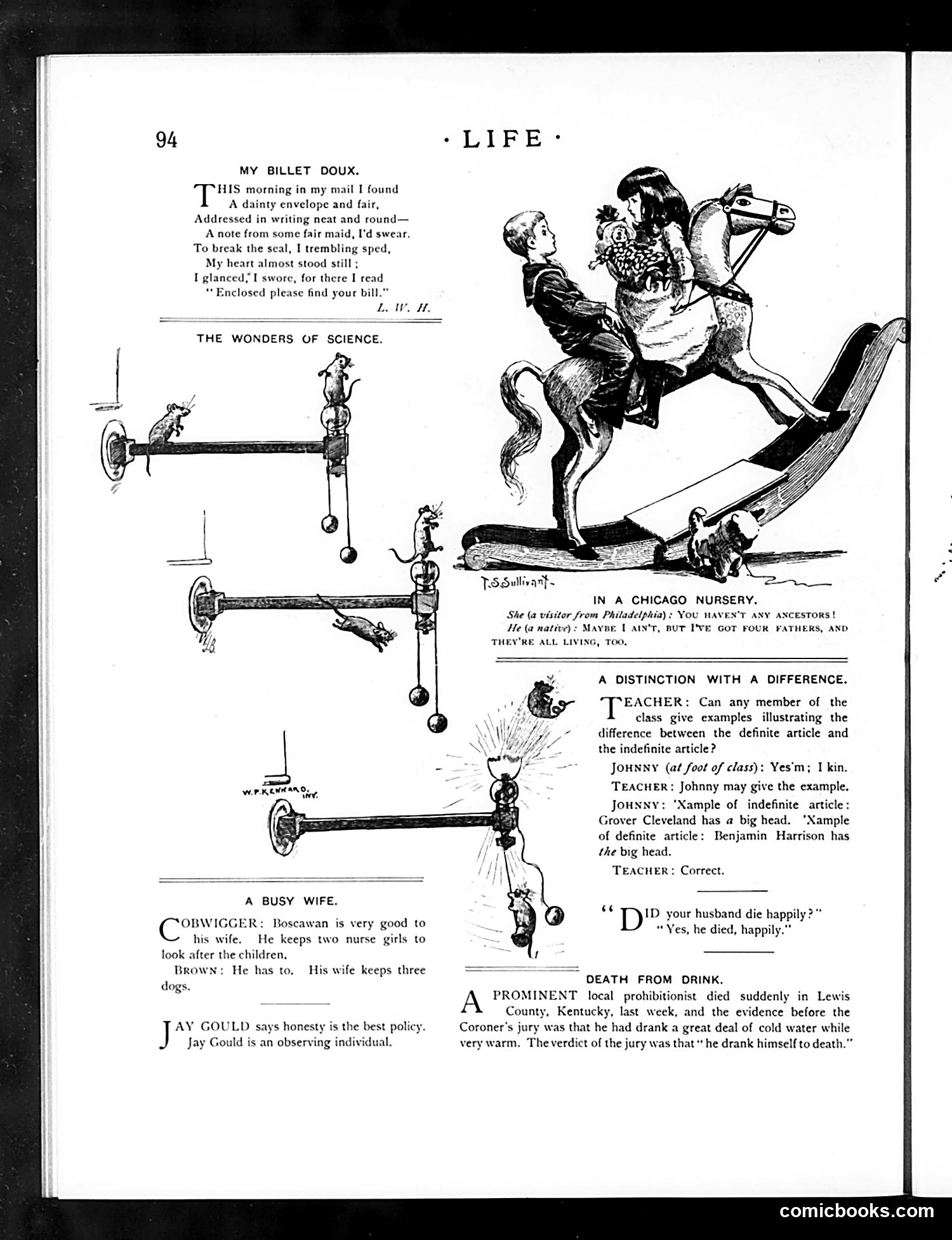
This page contains several brief humor items typical of early 20th-century Life magazine: **"My Billet Doux"** is a poem about finding a love letter in the mail, with the punchline being a bill instead. **"The Wonders of Science"** shows mechanical or scientific apparatus—the drawings appear to illustrate physics demonstrations, possibly related to leverage or motion. **"In a Chicago Nursery"** jokes about ancestry: a child claims to have "four fathers" who are all living, likely playing on a misunderstanding about biology or paternity. **"A Distinction with a Difference"** is a classroom scene where a student confuses the definite and indefinite articles through examples about specific people's head sizes. The remaining items are brief one-liners about marriage, honesty, and a news item about a prohibitionist's death from drinking cold water. These are standard satirical commentary on contemporary social issues.
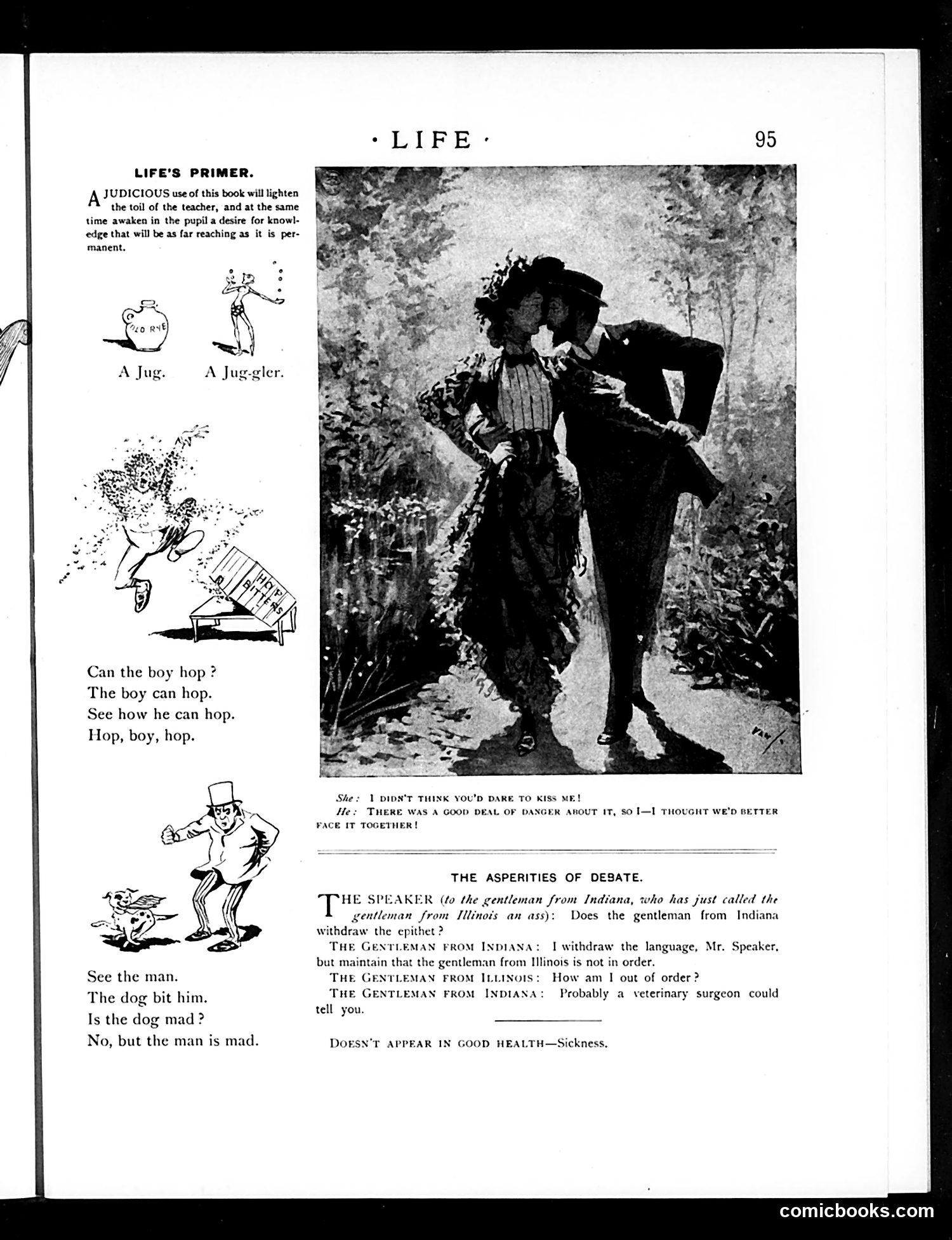
The page contains two distinct sections: **"Life's Primer"** (left): Simple educational illustrations teaching children basic concepts—a jug, a juggler, hopping, and a dog biting a man—with accompanying rhyming text. This appears to be instructional content for young readers. **Main photograph and cartoon** (right): A dramatic scene showing two figures (a woman and man in period costume) with dialogue about kissing and "danger." The caption suggests romantic peril or scandal. **"The Asperities of Debate"** (bottom): A political exchange between gentlemen from Indiana and Illinois debating parliamentary procedure and decorum. The satire mocks formal debate conventions and questions of parliamentary order—likely referencing contemporary congressional disputes, though specific figures aren't identified in the visible text.
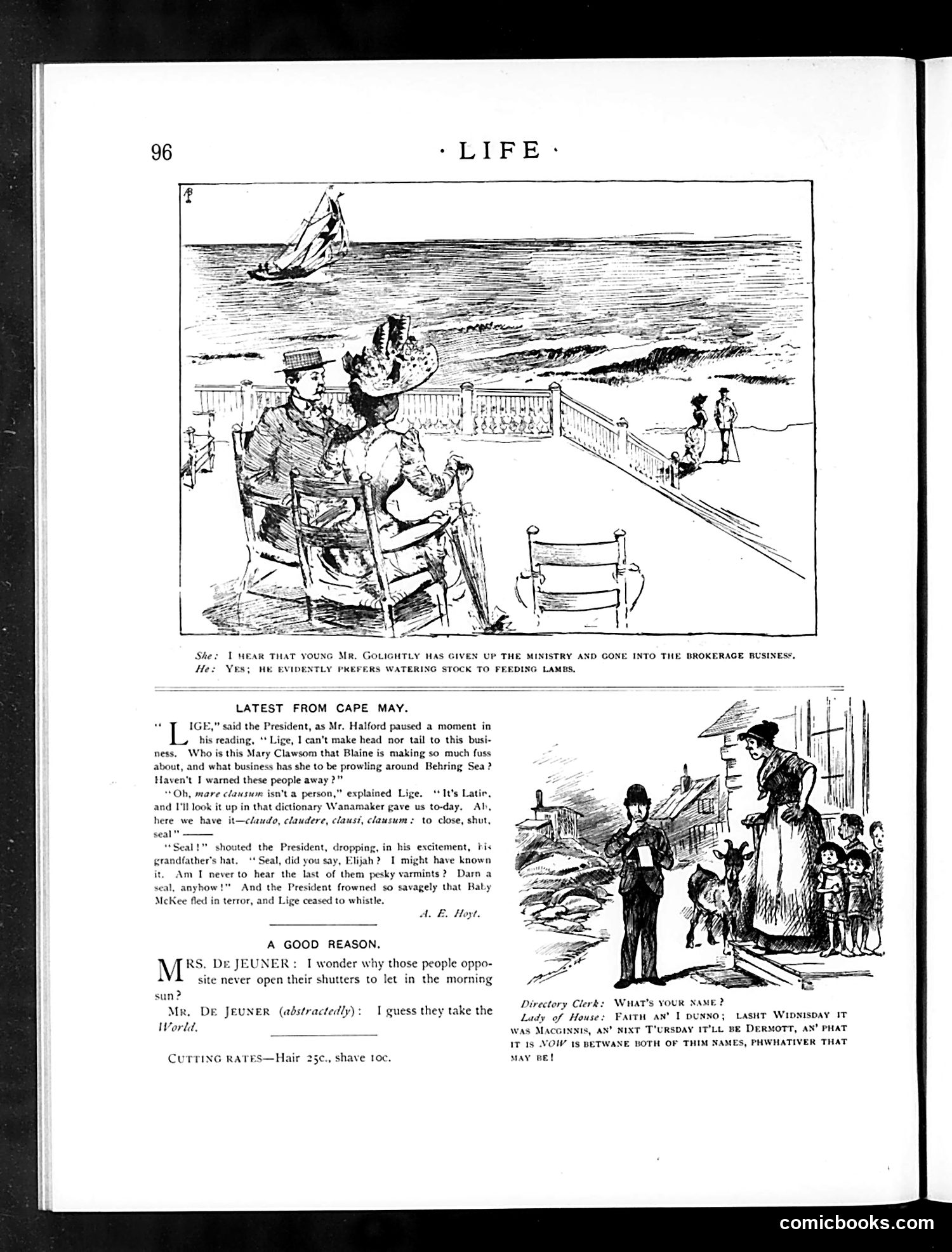
**Top cartoon:** A couple at the beach discusses Mr. Golightly's career change from ministry to stockbroking. The joke pivots on "watering stock"—a fraudulent practice of inflating company value—versus "feeding lambs," a pastoral/religious duty. The satire mocks how a clergyman abandons spiritual work for financial schemes, using financial jargon as double meaning. **"Latest from Cape May":** This references the Bering Sea Seal controversy (late 1880s-90s). President Harrison, confused about "mare clausum" (a legal term meaning closed sea), mistakes it for a person named "Mary Clawsom" connected to Secretary Blaine's diplomacy. The joke ridicules Harrison's ignorance—he confuses international maritime law with a woman's name, then overreacts about seals (the animals he'd banned hunting of). "Lige" helplessly explains the Latin origins while Harrison rages. **Bottom items:** Minor jokes about shutters/morning sun and a directory clerk listing multiple surnames for one woman—likely satirizing Irish naming conventions or marital status confusion.
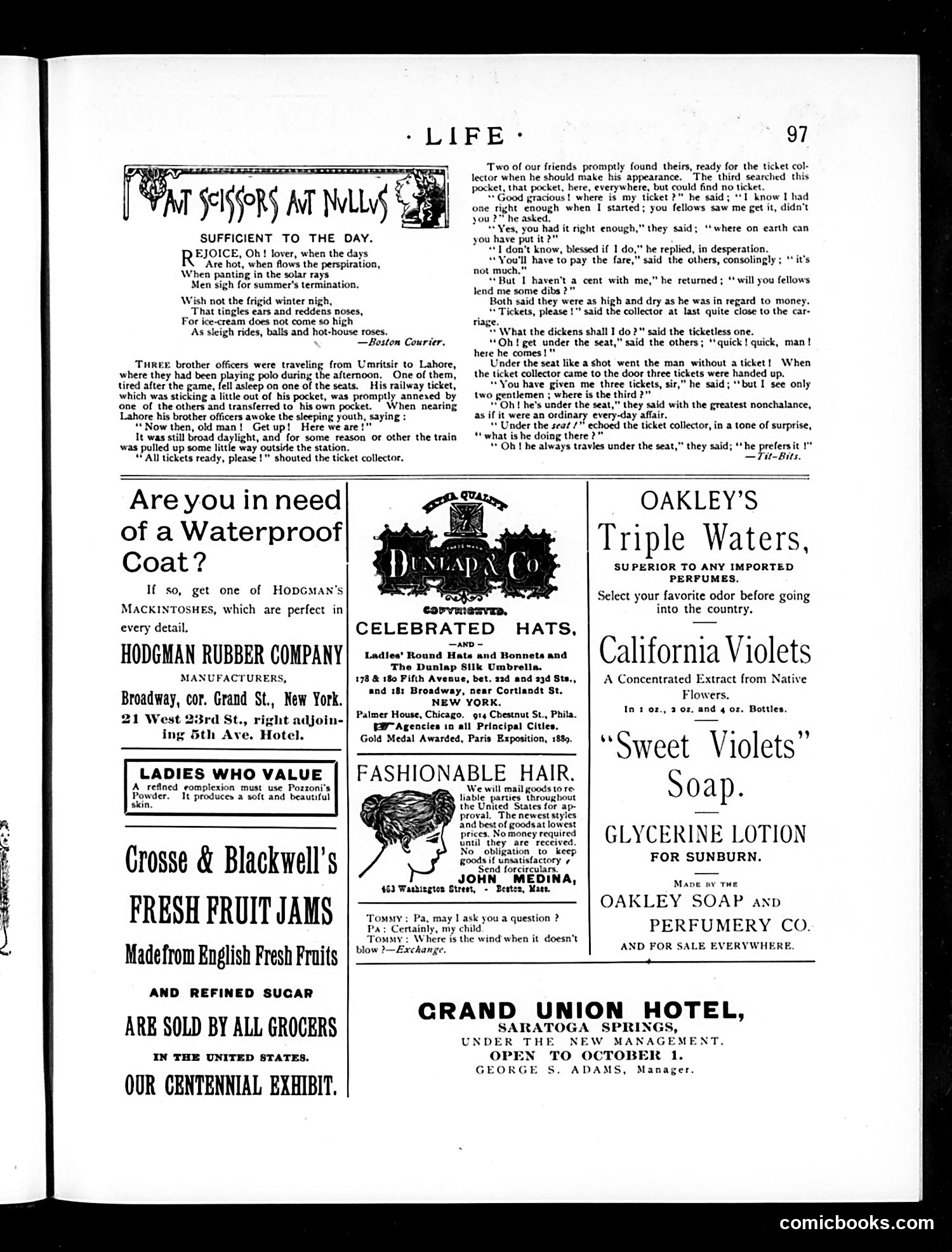
This page is primarily **advertisements** with a humorous anecdote in the upper portion. ## The Anecdote ("Sufficient to the Day") The story satirizes British colonial officers in India (Umritsar to Lahore). Three polo-playing officers trick a sleeping comrade by stealing his railway ticket and placing it in another's pocket. When the ticket collector arrives, rather than admit the prank or pay the fare, the officers hide the ticketless officer under the seat. When discovered, they casually claim he "always travels under the seat"—an absurd explanation delivered with such deadpan confidence that it apparently works. The satire mocks the arrogance and casual dishonesty of the British colonial class, their ability to brazenly lie with social confidence, and the implicit assumption that authority figures won't seriously challenge gentlemen's obvious falsehoods. ## Advertisements The page features typical Victorian-era product ads: rubber coats, ladies' complexion powder, jams, hats, perfumes, and hotel services—reflecting contemporary consumer culture.
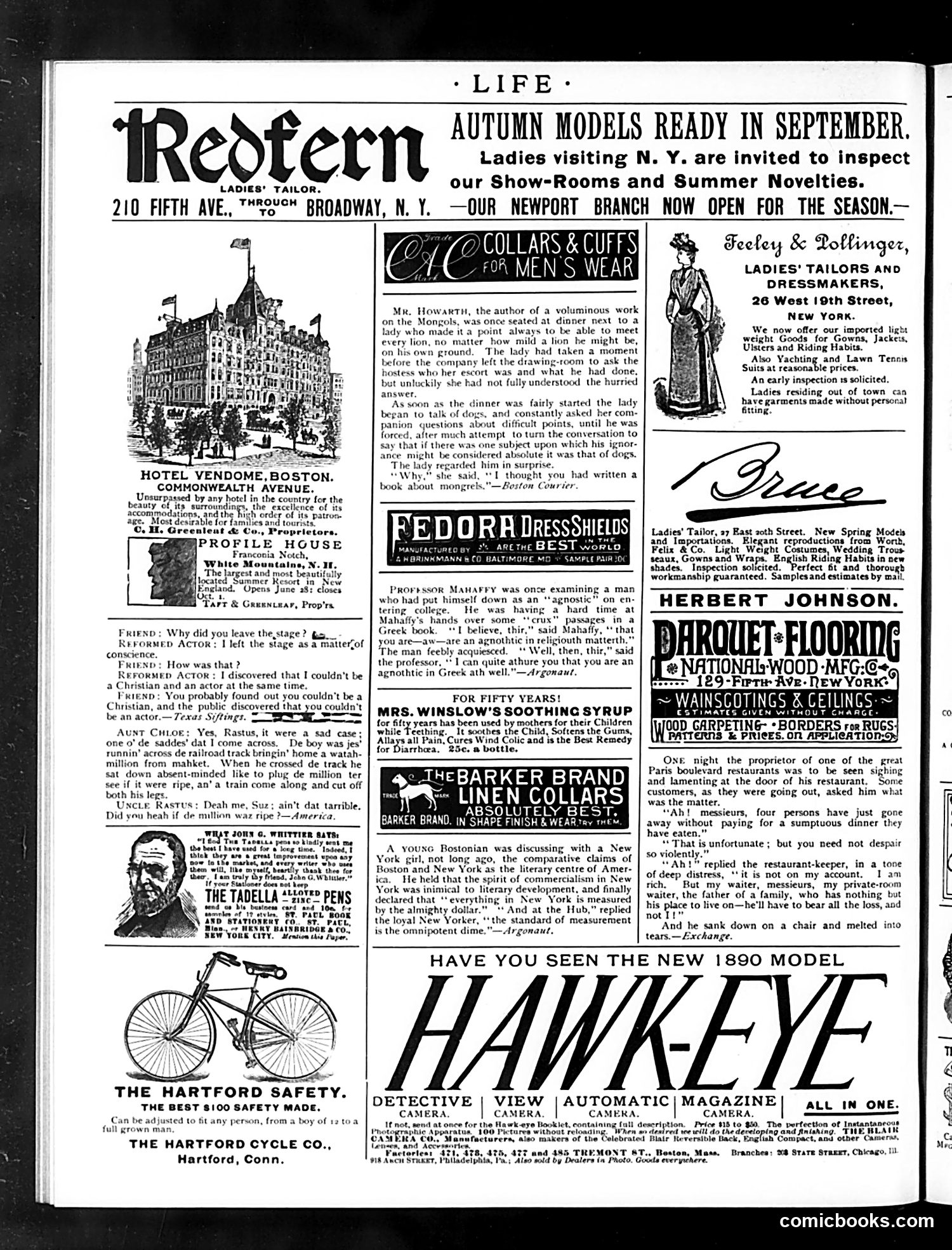
This page is primarily **advertising and humor anecdotes**, not political cartoons. The content reflects late-19th-century American life and attitudes. The humor pieces are brief conversational jokes typical of Life's format: - A "reformed actor" joke plays on hypocrisy—discovering you can't be Christian *and* an actor, or vice versa - A dialect story about "Rastus" (racist stereotyping common then) involves a boy killed by a train while inspecting a watermelon - An anecdote mocks a society woman who pretends expertise on "Mongols" but actually means dogs - Professor Mahaffy's joke ridicules a student's claimed agnosticism by suggesting he's ignorant of Greek The **Boston vs. New York** debate reflects real 19th-century cultural rivalry over which city was America's intellectual center. Advertisements include women's tailoring, dress shields, flooring, and notably **Mrs. Winslow's Soothing Syrup**—a patent medicine containing opiates, now recognized as dangerous. The page reveals period attitudes: casual racism, patent medicine marketing, and class-conscious humor aimed at educated readers.
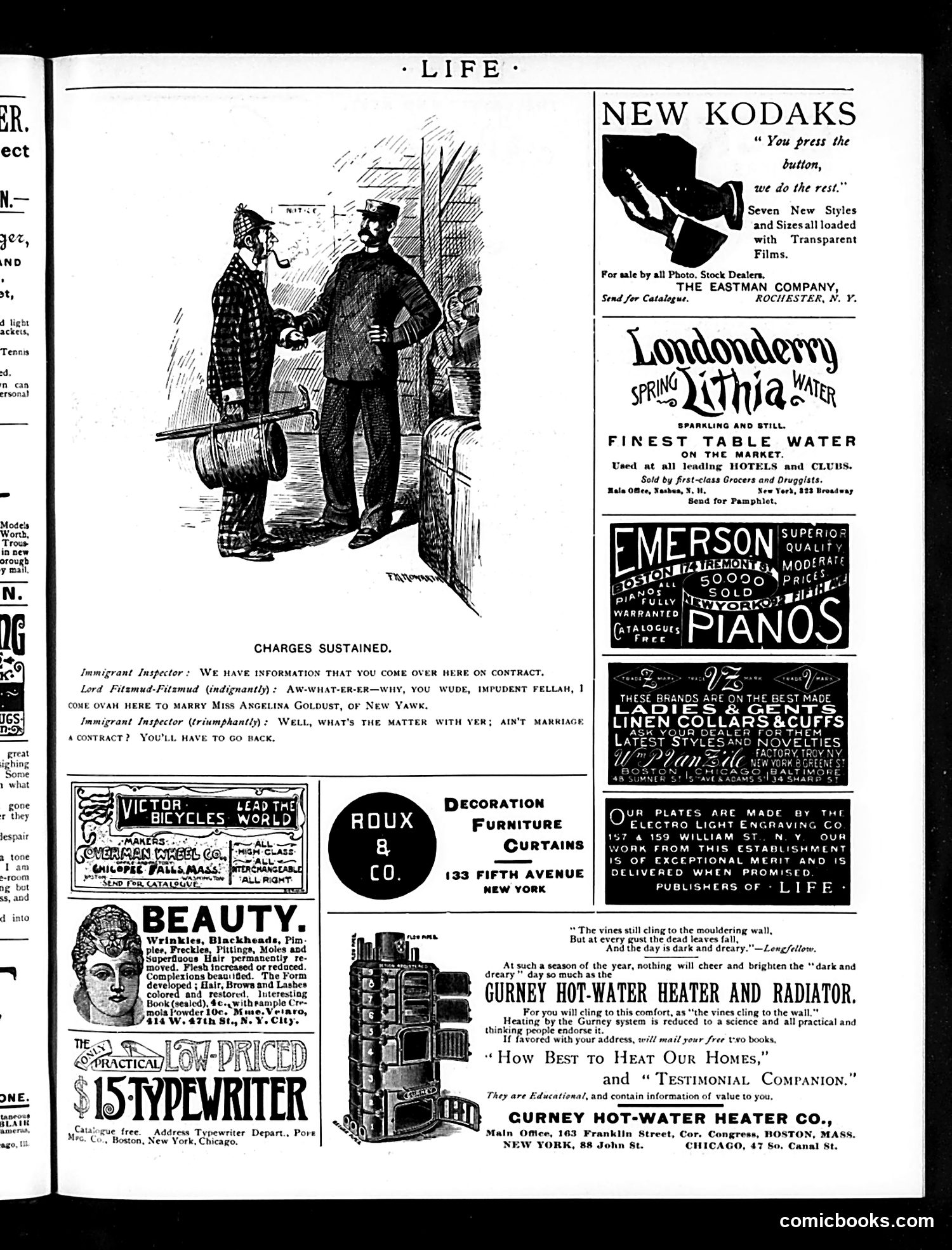
The main cartoon depicts an immigration inspector confronting an arriving British aristocrat ("Lord Fitzmud-Fitzmud") who claims he's come to marry a wealthy American heiress, Miss Angelina Goldust of New York. The inspector accuses him of entering "on contract"—implying he's a paid laborer brought over illegally—and dismisses his marriage claim as itself a "contract." The punchline: the inspector orders him deported anyway. The satire targets the common practice of wealthy European nobles marrying rich American heiresses for money. By equating marriage to an illegal labor contract, *Life* mocks both the mercenary nature of such unions and the inspector's democratic leveling—even aristocrats aren't exempt from scrutiny. The cartoon also gently ridicules the Anglophile pretension of American wealthy who sought European titles through marriage.
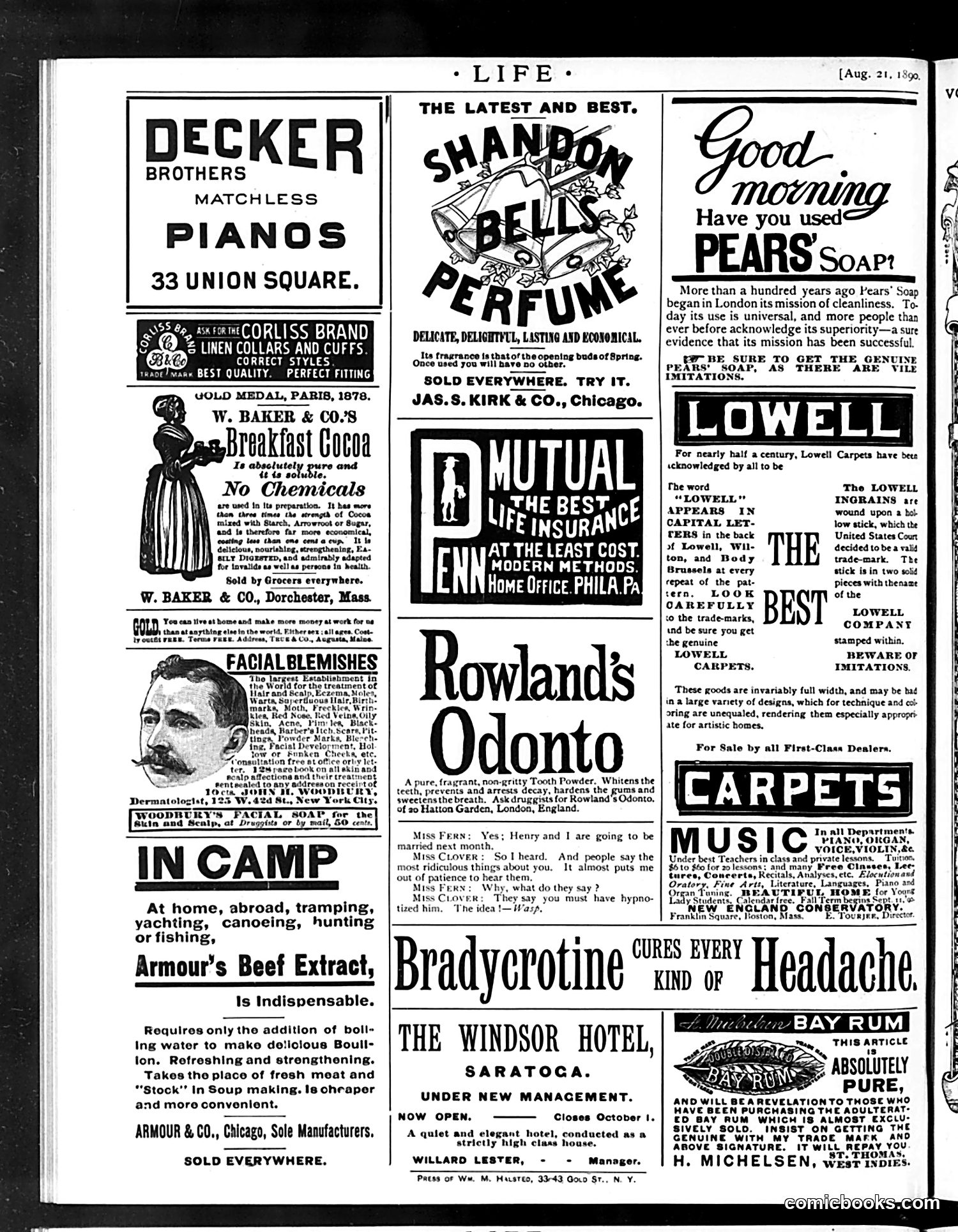
This page is primarily **advertisements** with one brief comedic dialogue at the bottom. ## The Humor Section The only satirical content is a short conversation between "Miss Fern" and "Miss Clover" about Miss Fern's engagement to Henry. Miss Clover jokingly suggests that Miss Fern must have "hypnotized" Henry into proposing—implying he wouldn't marry her otherwise. Miss Fern responds dismissively ("The idea!"). This is gentle, Victorian-era humor playing on anxieties about courtship and female manipulation. ## The Advertisements The page is dominated by 1890 product ads: pianos, cocoa, breakfast food, soap, carpets, perfume, tooth powder, beef extract, and a hotel. These include common period marketing tactics—testimonials, claims of superiority over "imitations," and assertions of long-standing reputation. Notable is the repeated emphasis on buying **genuine** products and avoiding counterfeits, suggesting widespread fraud in consumer goods during this era. The ad copy often features hyperbolic health claims typical of the 1890s.