
Life, 1890-08-21 · page 4 of 16
Life — August 21, 1890 — page 4: what you’re looking at
What you’re looking at
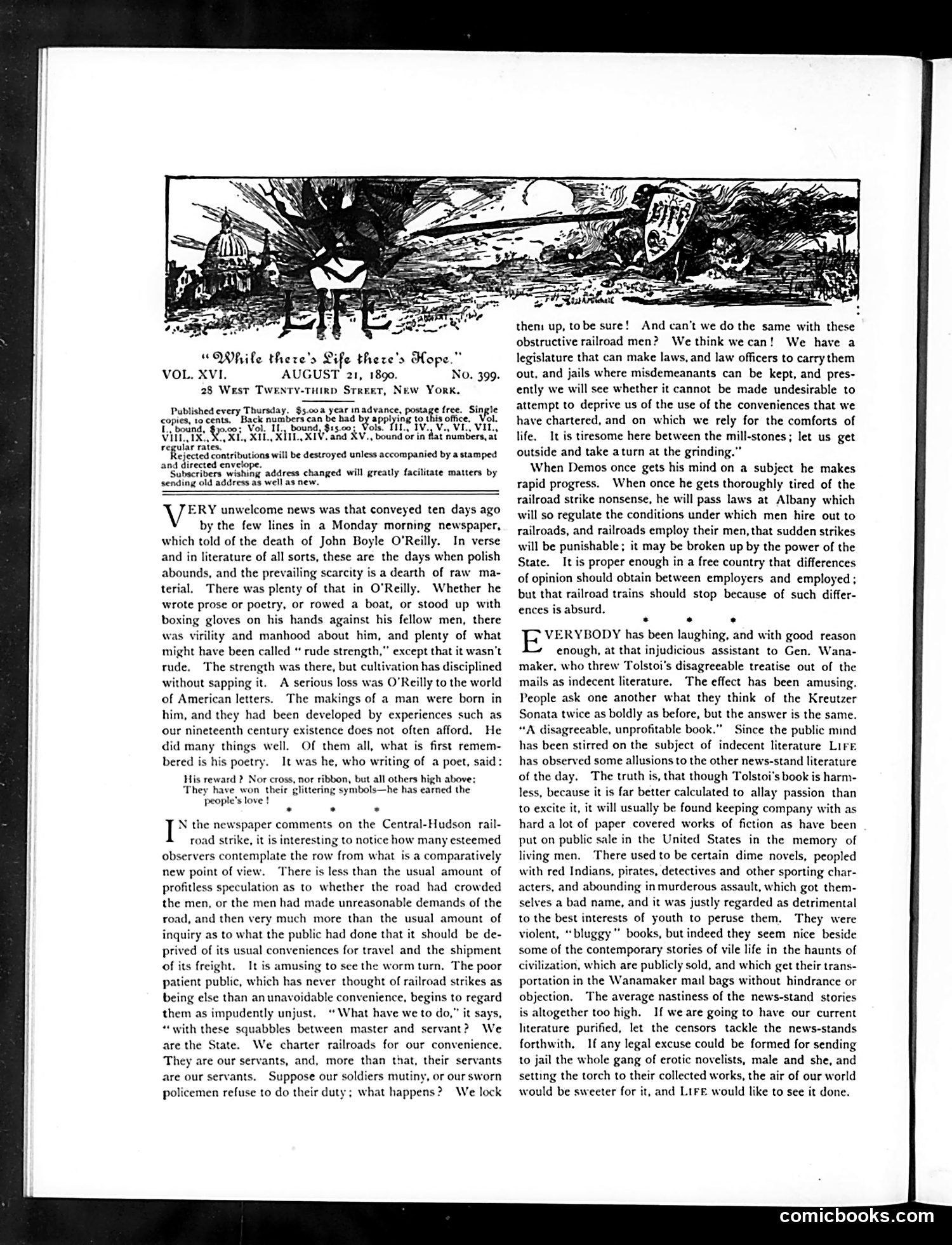
The masthead cartoon depicts a chaotic urban scene with industrial smokestacks and destruction, illustrating the consequences of labor unrest. The accompanying article addresses the recent Central-Hudson railroad strike and death of labor figure John Boyle O'Reilly. The editorial argues that while railroad workers' grievances deserve consideration, strikes that disrupt public services are unjustifiable in a free country. The author contends that legal mechanisms—legislature and courts—should resolve labor disputes, not work stoppages. A secondary critique targets General Wanamaker and dime novelist Tolstoi for distributing supposedly indecent literature. Life argues against censorship, suggesting that truly harmful material would better serve public morality than cheap sensationalist novels flooding newsstands.
📄 Transcribed text from this page (OCR, searchable)
Machine-transcribed from the original scan — historical spelling and the odd misread are preserved.
“While there's Life there's XVI. AUGUST 21, 1890. Hope.” VOL. No. 399. 28 West TwWENtTY-THIRD Street, New York, Published every Thursday. $5.00a year inadvance, postage free. Sing! genes, toeents, Back numbers can be had by applying to this office, vot Vol. II, $15.00; Vit Te, WOE, IL, Kine eit aka RVs ‘bound Sein fat aummbera ad rey ‘ular rates, ‘ejected contributions will be destroyed unless accompanied by a stamped and directed envelo Subscribers wishing address changed will greatly facilitate matters by sending old address as well as new. ERY unwelcome news was that conveyed ten days ago by the few lines in a Monday morning newspaper, which told of the death of John Boyle O'Reilly. In verse and in literature of all sorts, these are the days when polish abounds, and the prevailing scarcity is a dearth of raw ma- terial. There was plenty of that in O'Reilly. Whether he wrote prose or poetry, or rowed a boat, or stood up with boxing gloves on his hands against his fellow men, there was virility and manhood about him, and plenty of what might have been called “ rude strength,” except that it wasn’t rude. The strength was there, but cultivation has disciplined without sapping it. A serious loss was O'Reilly to the world of American letters. The makings of a man were born in him, and they had been developed by experiences such as our nineteenth century existence does not often afford. He did many things well. Of them all, what is first remem- bered is his poetry. It was he, who writing of a poet, said: His reward ? Nor cross, nor ribbon, but all others high above: They have won their glittering symbols—he has earned the people's love ! . . . N the newspaper comments on the Central-Hudson rail- road strike, it is interesting to notice how many esteemed observers contemplate the row from what is a comparatively new point of view. There is less than the usual amount of profitless speculation as to whether the road had crowded the men, or the men had made unreasonable demands of the road, and then very much more than the usual amount of inquiry as to what the public had done that it should be de- prived of its usual conveniences for travel and the shipment of its freight. It musing to sce the worm turn. The poor patient public, which has never thought of railroad strikes as being else than an unavoidable convenience, begins to regard them as impudently unjust. ‘* What have we to do,” it says, “with these squabbles between master and servant? We are the State. We charter railroads for our convenience. They are our servants, and, more than that, their servants are our servants. Suppose our soldiers mutiny, or our sworn policemen refuse to do their duty; what happens? We lock them: up, tobe sure! And can’t we do the same with these obstructive railroad men? We think wecan! We have a legislature that can make laws, and law officers to carry them out, and jails where misdemeanants can be kept, and pres- ently we will see whether it cannot be made undesirable to attempt to deprive us of the use of the conveniences that we have chartered, and on which we rely for the comforts of life. It is tiresome here between the mill-stones; let us get outside and take aturn at the grinding.” When Demos once gets his mind on a subject he makes rapid progress. When once he gets thoroughly tired of the railroad strike nonsense, he will pass laws at Albany which will so regulate the conditions under which men hire out to railroads, and railroads employ their men, that sudden strikes will be punishable; it may be broken up by the power of the State. It is proper enough in a free country that differences of opinion should obtain between employers and employed; but that railroad trains should stop because of such differ- ences is absurd. . . . EVERYBODY has been laughing, and with good reason enough, at that injudicious assistant to Gen. Wana- maker, who threw Tolstoi's disagreeable treatise out of the mails as indecent literature. The effect has been amusing. People ask one another what they think of the Kreutzer Sonata twice as boldly as before, but the answer is the same. “A disagreeable, unprofitable book.” Since the public mind has been stirred on the subject of indecent literature Lire has observed some allusions to the other news-stand literature of the day, The truth is, that though Tolstoi’s book is harm- less, because it is far better calculated to allay passion than to excite it, it will usually be found keeping company with as hard a lot of paper covered works of fiction as have been put on public sale in the United States in the memory of living men. There used to be certain dime novels, peopled with red Indians, pirates, detectives and other sporting char- acters, and abounding in murderous assault, which got them- selves a bad name, and it was justly regarded as detrimental to the best interests of youth to peruse them. They were violent, “bluggy" books, but indeed they seem nice beside some of the contemporary stories of vile life in the haunts of civilization, which are publicly sold, and which get their trans- portation in the Wanamaker mail bags without hindrance or objection, The average nastiness of the news-stand stories is altogether too high. If we are going to have our current Iterature purified, let the censors tackle the news-stands forthwith. If any legal excuse could be formed for sending to jail the whole gang of erotic novelists, male and she, and setting the torch to their collected works, the air of our world would be sweeter for it, and Lire would like to see it done. comicbooks.com