
A complete issue · 16 pages · 1890
Life — August 7, 1890
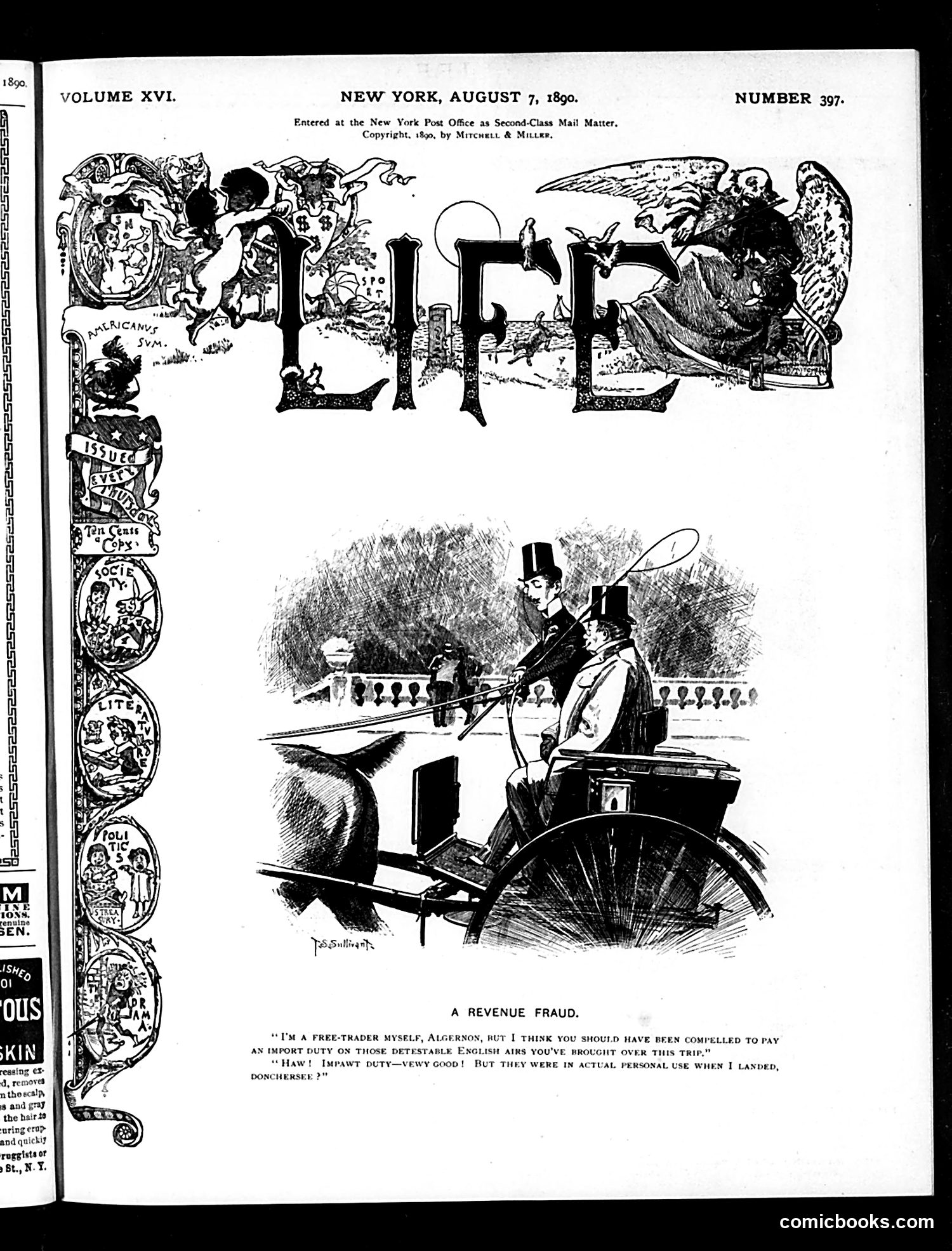
This cartoon satirizes what appears to be a tariff or customs duty dispute. Two gentlemen in top hats ride in a carriage pulled by a donkey (likely representing a political figure or the public). The caption shows an Algernon (likely a British aristocrat) complaining to his companion about being forced to pay import duty on English goods brought to America, claiming they were "personal use" rather than commercial goods. The satire targets either: 1. **Tariff evasion schemes** by wealthy travelers smuggling goods 2. **Protectionist tariff policies** the U.S. maintained against British imports 3. **Class privilege** — the wealthy claiming personal exemptions from duties ordinary citizens must pay The donkey suggests the public bears the burden of such fraudulent schemes or unfair trade practices.
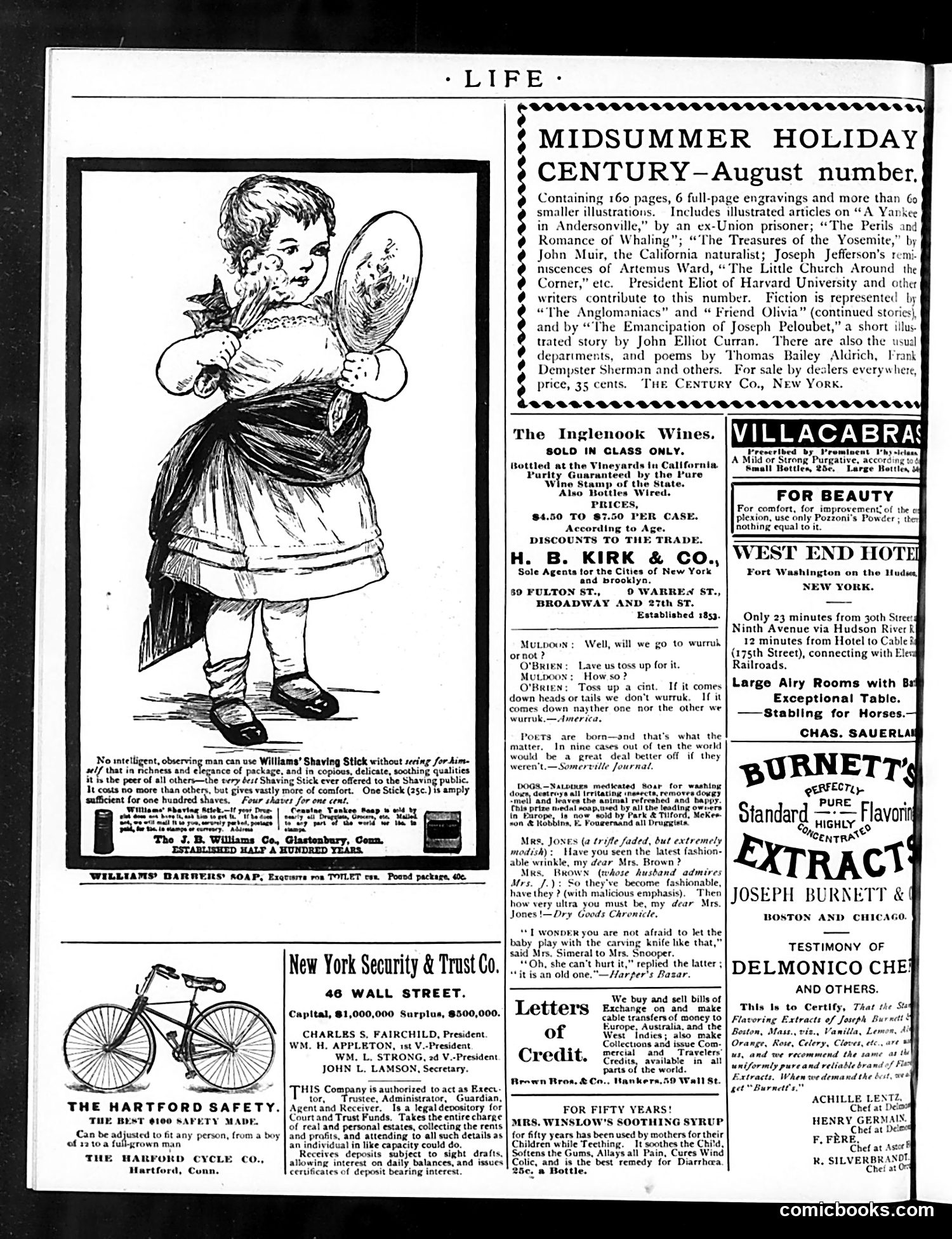
This page is primarily **advertising and miscellaneous content** rather than political satire. The dominant image is a Victorian-era illustration of a cherub or cupid figure holding a mirror, used to advertise **Williams' Shaving Stick**—a grooming product emphasizing comfort and safety. The page contains multiple advertisements for various products: wine, hotels, bicycles, financial services, and patent medicines (including Mrs. Winslow's Soothing Syrup for infants). There is a small humorous section titled "Letters of Credit" with domestic comedy dialogue about social fashion, but this is minor filler content, not political commentary. This represents a typical Life magazine page from the period, mixing commercial advertising with light entertainment rather than pointed political satire.
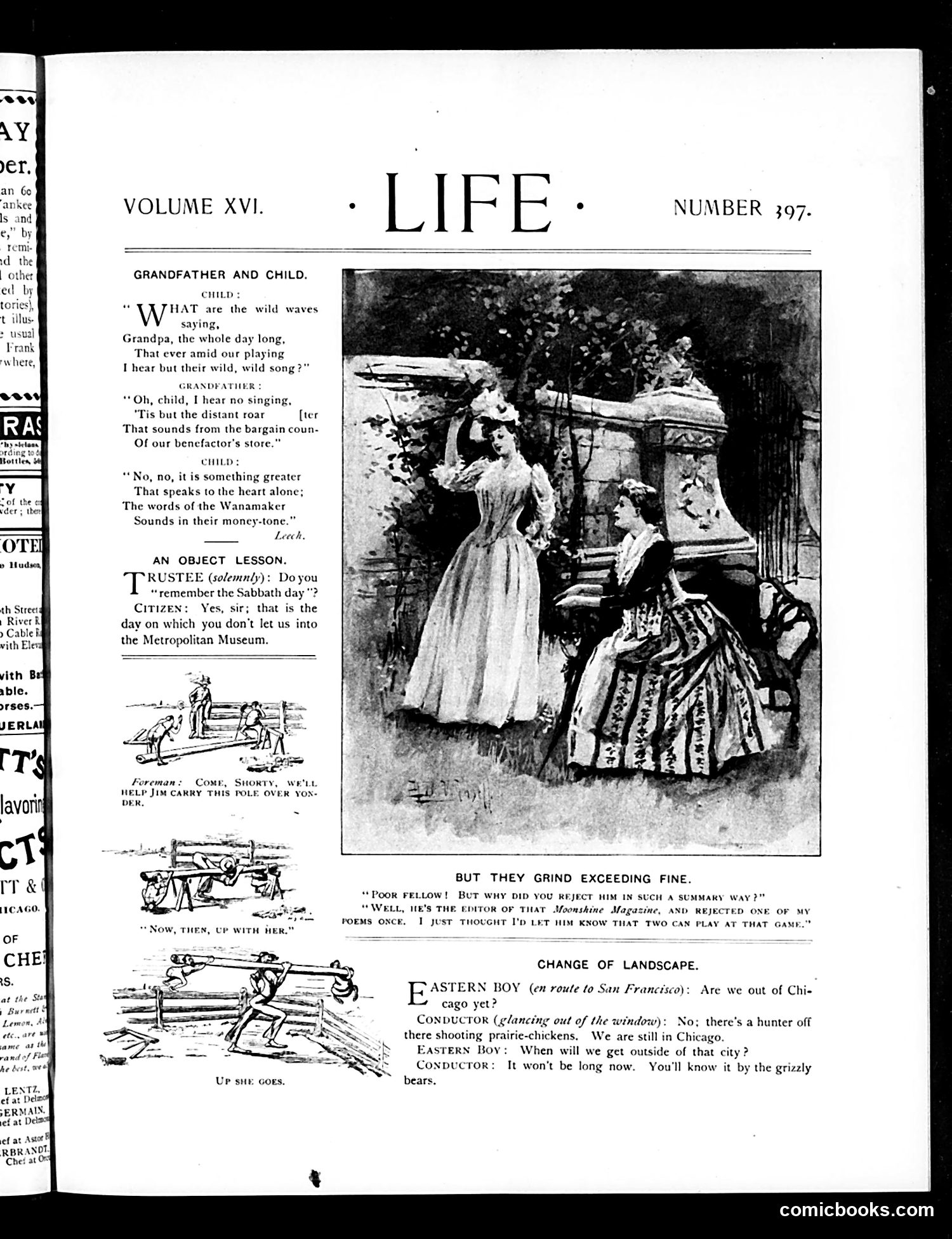
This page contains three distinct pieces: 1. **"Grandfather and Child"** — A sentimental poem where a child asks a grandfather about "wild waves" and "wild song," and the grandfather attributes the sounds to the "Wanamaker," likely referencing the Wanamaker department store's famous pipe organ, a prominent Philadelphia landmark known for its distinctive sounds. 2. **"An Object Lesson"** — A brief satirical piece mocking a trustee's reminder about the Sabbath day and museum visiting rules, suggesting institutional stuffiness. 3. **"Change of Landscape"** — A humorous dialogue between an Eastern boy and train conductor about leaving Chicago, with the conductor promising they'll recognize their destination by "grizzly bears," playing on western frontier stereotypes. The cartoons use gentle domestic and travel humor typical of early 20th-century American satire.
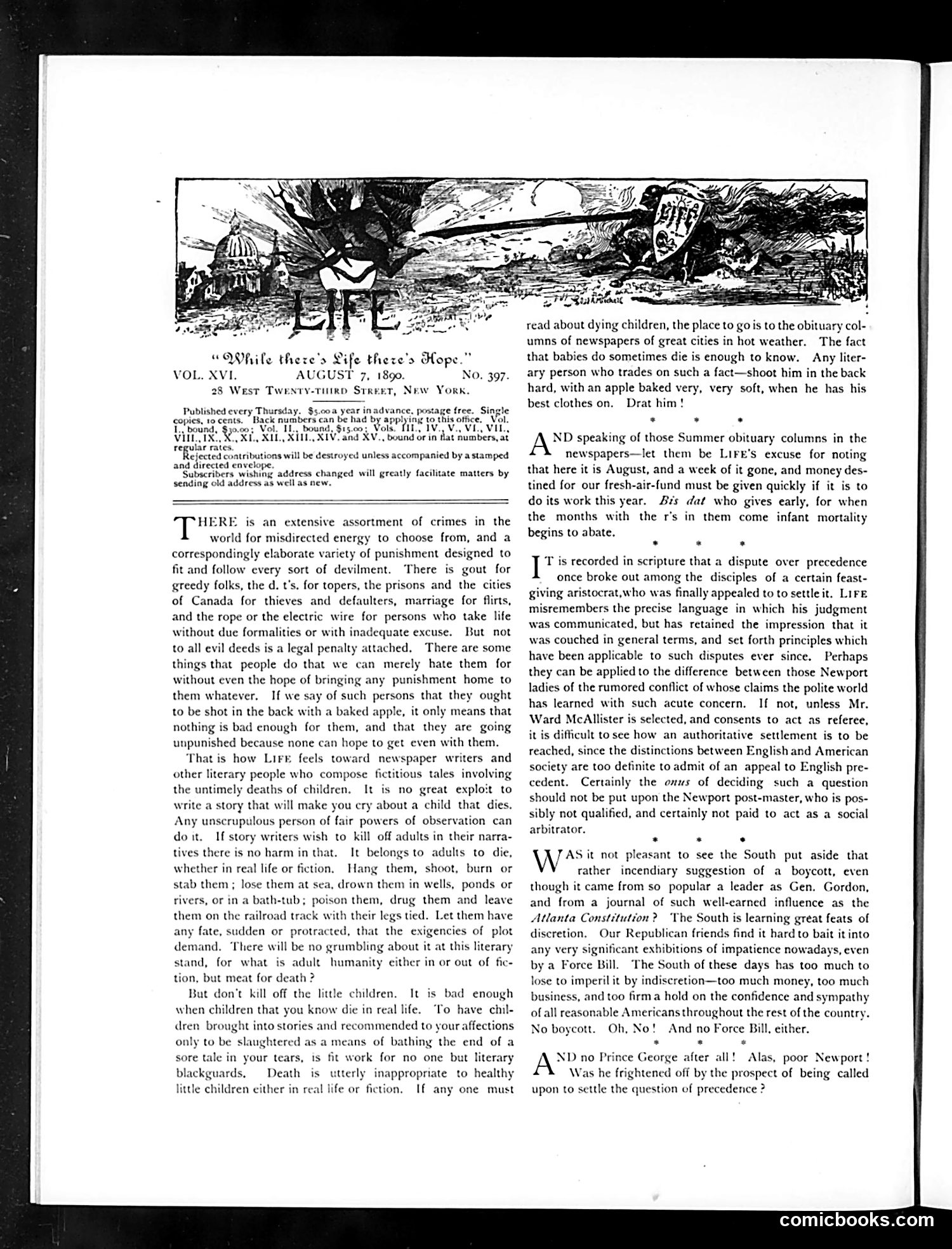
**The Cartoon:** The masthead illustration depicts a classical allegorical scene with a figure (likely "Life" personified) surrounded by natural and architectural elements—suggesting themes of civilization, mortality, and human consequence. **The Editorial Content:** The main article criticizes newspaper writers who sensationalize children's deaths in summer obituary columns for profit. The editor argues this exploitative practice is morally indefensible, comparing it to other serious crimes. The piece contrasts literary treatment of child death (acceptable in fiction) with real-life exploitation. A secondary note discusses Southern boycott suggestions and a dispute over social precedence involving Newport society figures, arguing such matters should be settled through proper social channels rather than public force. The page demonstrates Life's role as social satirist, attacking both media ethics and upper-class pretension.
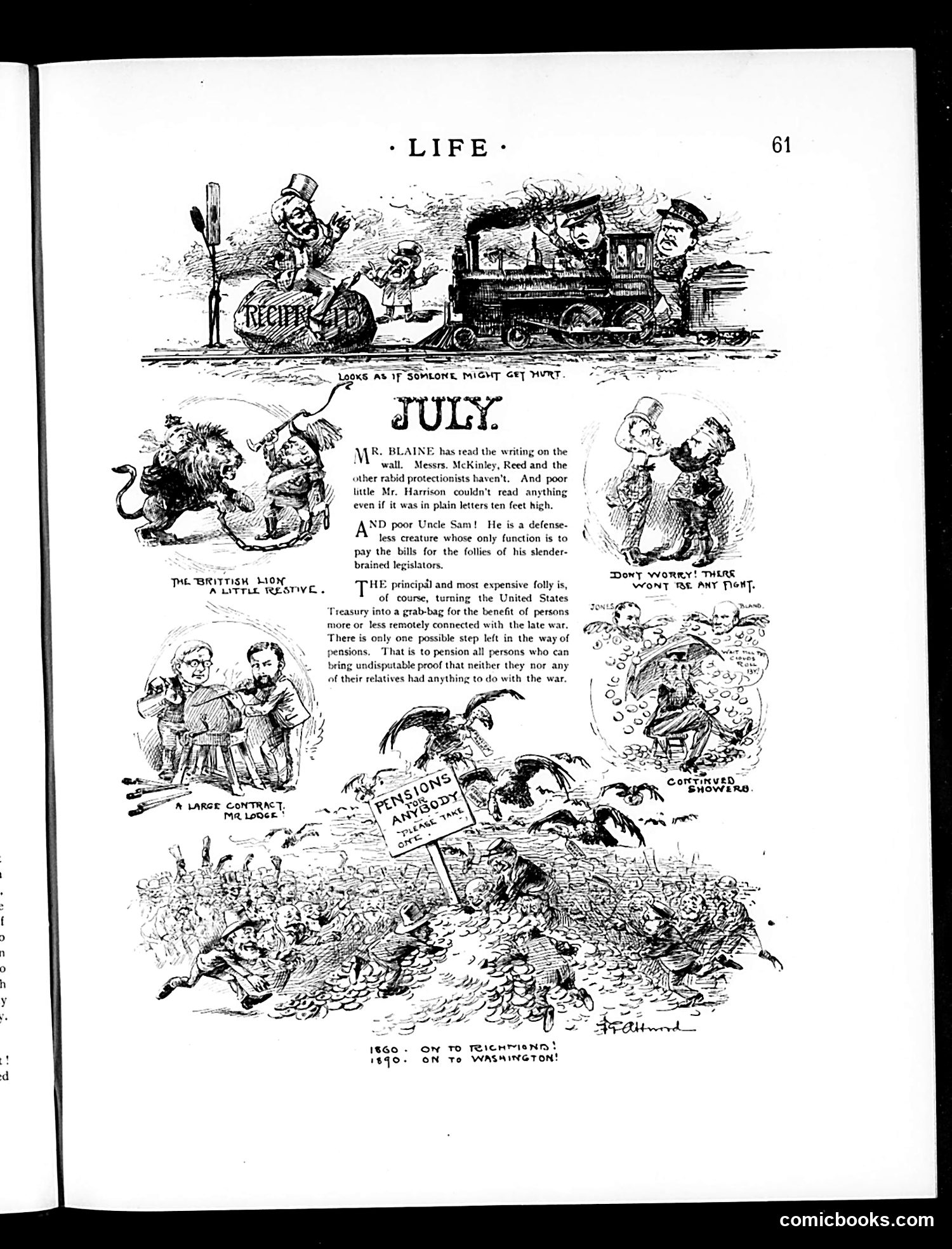
This page satirizes postwar pension politics, circa 1919-1920. The text criticizes the British Lion as "a little restive" over American pension proposals that would benefit persons remotely connected to WWI, creating what the author calls a "grab-bag" of undeserving recipients. The central cartoon depicts "Pensions Anybody?" with figures drowning in paperwork and chaos, suggesting the administrative disaster of such broad eligibility. The bottom panel references "1860: On to Richmond! 1890: On to Washington!"—contrasting the Civil War's clear purpose with contemporary political squabbling over pension funds. Figures like "Mr. Blaine" and "Uncle Sam" represent political actors. The satire attacks what the author sees as cynical, wasteful pension expansion disconnected from actual war service—a critique of government overreach and fiscal irresponsibility.
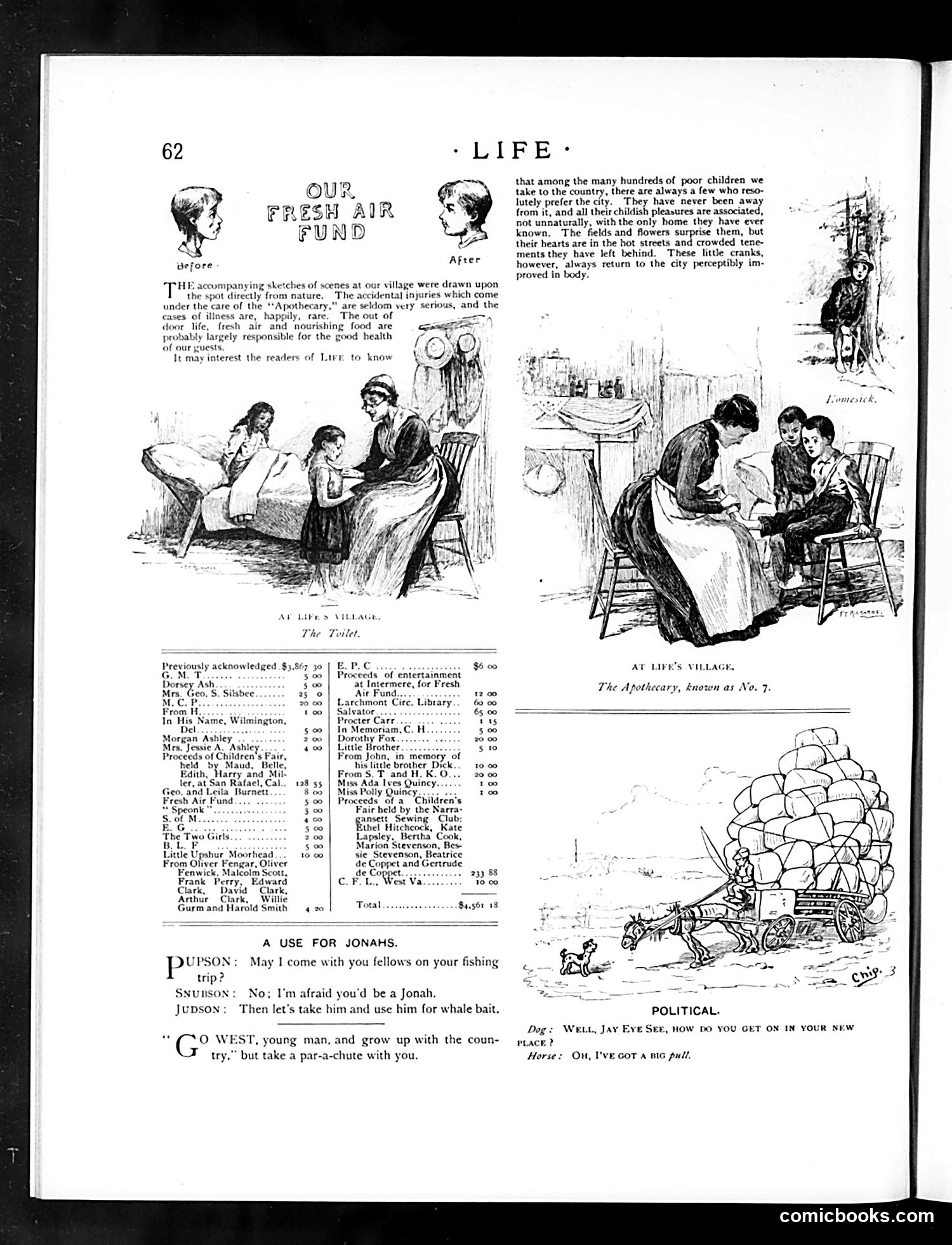
This page contains three distinct sections: **"Our Fresh Air Fund"** (top): An illustrated article about a charitable program sending poor urban children to the countryside. The sketches show before/after comparisons, depicting children's improved health from rural exposure. The accompanying list documents donations to the fund. **"A Use for Jonahs"** (middle): A brief satirical joke playing on the biblical Jonah story. The humor relies on the dated metaphor of an unlucky person as a "Jonah," suggesting such individuals be used for whale bait—dark period humor. **"Political"** (bottom): A simple two-panel cartoon featuring a dog and horse discussing a new residence. The horse boasts of having "a big pull," using the era's slang for political influence or connections—satirizing how personal success often depends on favoritism rather than merit.
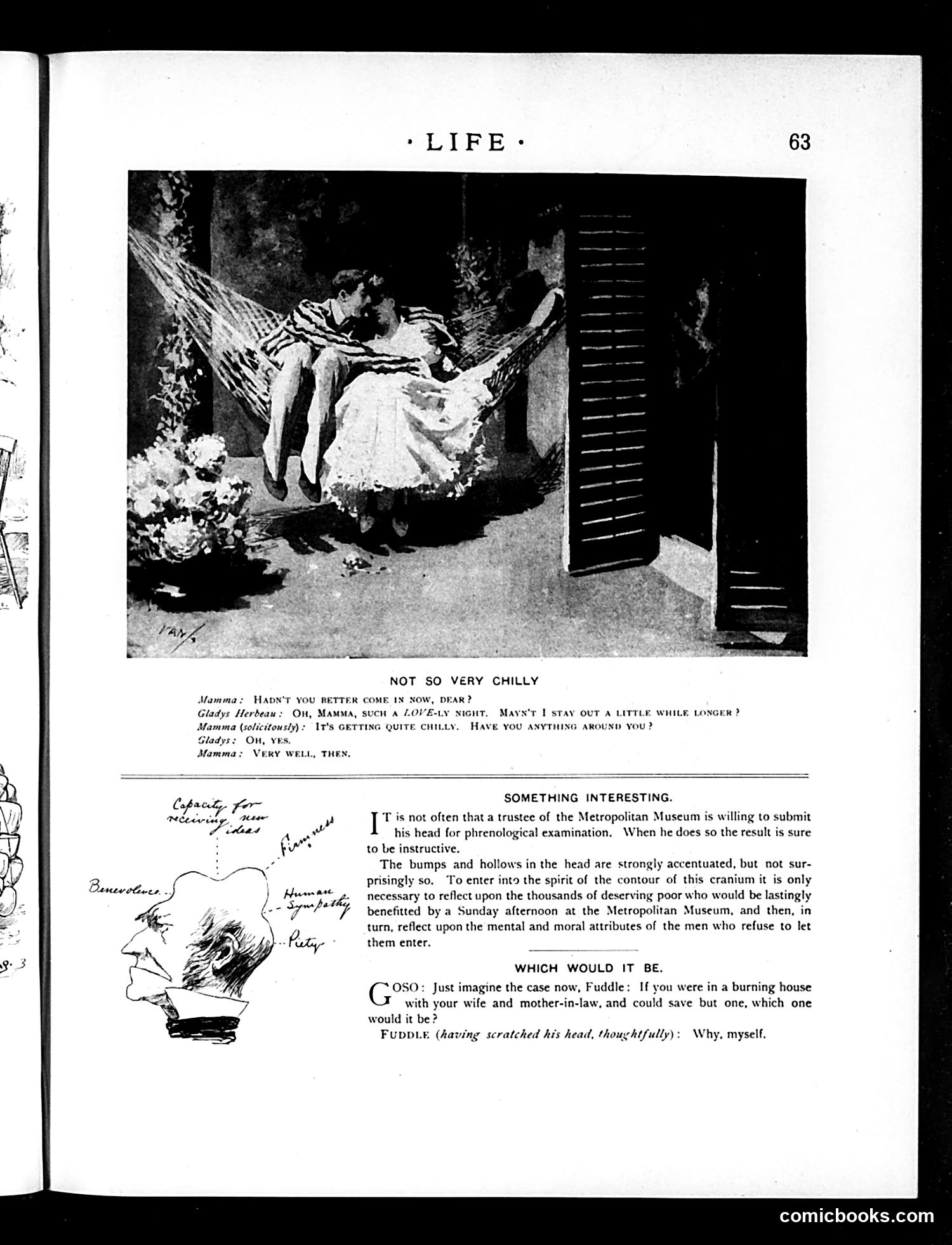
This page contains two separate items from *Life* magazine: 1. **"Not So Very Chilly"** — A comedic domestic scene showing a couple in a hammock while the woman's mother arrives home unexpectedly. The joke relies on the awkwardness of being caught in an intimate moment. 2. **"Something Interesting"** and **"Which Would It Be"** — Two brief humor pieces. The first discusses a Metropolitan Museum trustee undergoing phrenological examination (measuring skull shape to determine character). The second presents a moral dilemma: Goso asks Fuddle which family member he'd save from a burning house, and Fuddle self-servingly answers "myself." These are light social satire pieces typical of early-to-mid 20th century *Life* magazine's gentle humor about domestic life, pseudo-science, and human nature.
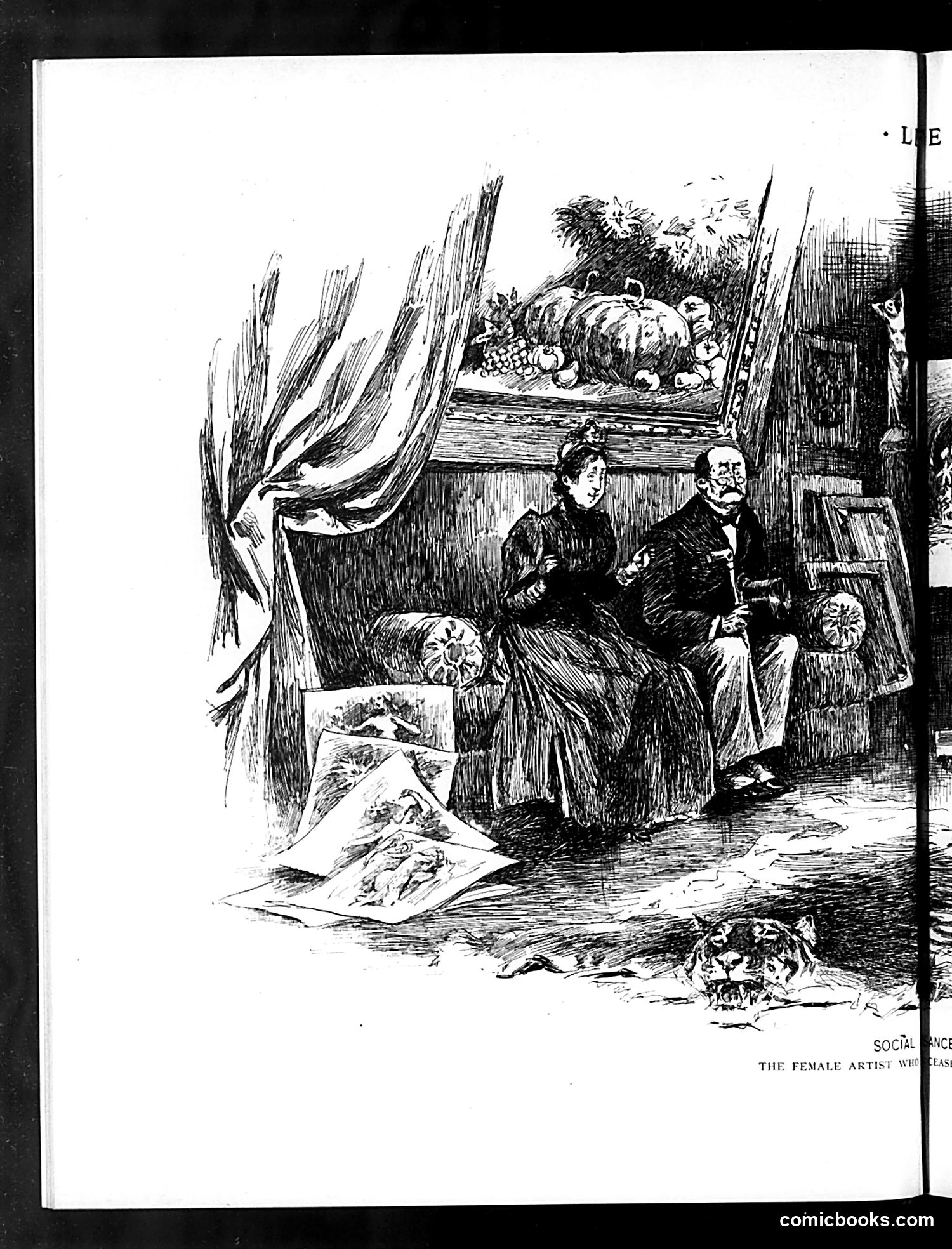
This appears to be a satirical illustration from *Life* magazine commenting on female artists in what seems to be a studio or exhibition space. The sketch shows two figures examining artwork displayed on walls and floor, with still-life arrangements (fruits, vegetables) visible on a shelf above. The partial caption "THE FEMALE ARTIST WHO..." suggests social commentary about women in the art world, likely critiquing their subject matter or professional status. The arrangement of produce and domestic still-life imagery may mock the types of subjects female artists were expected or relegated to painting during this era, reflecting gender biases in 19th-century art criticism and the art establishment's dismissive attitude toward women practitioners. The specific target of the satire remains unclear without the complete caption.
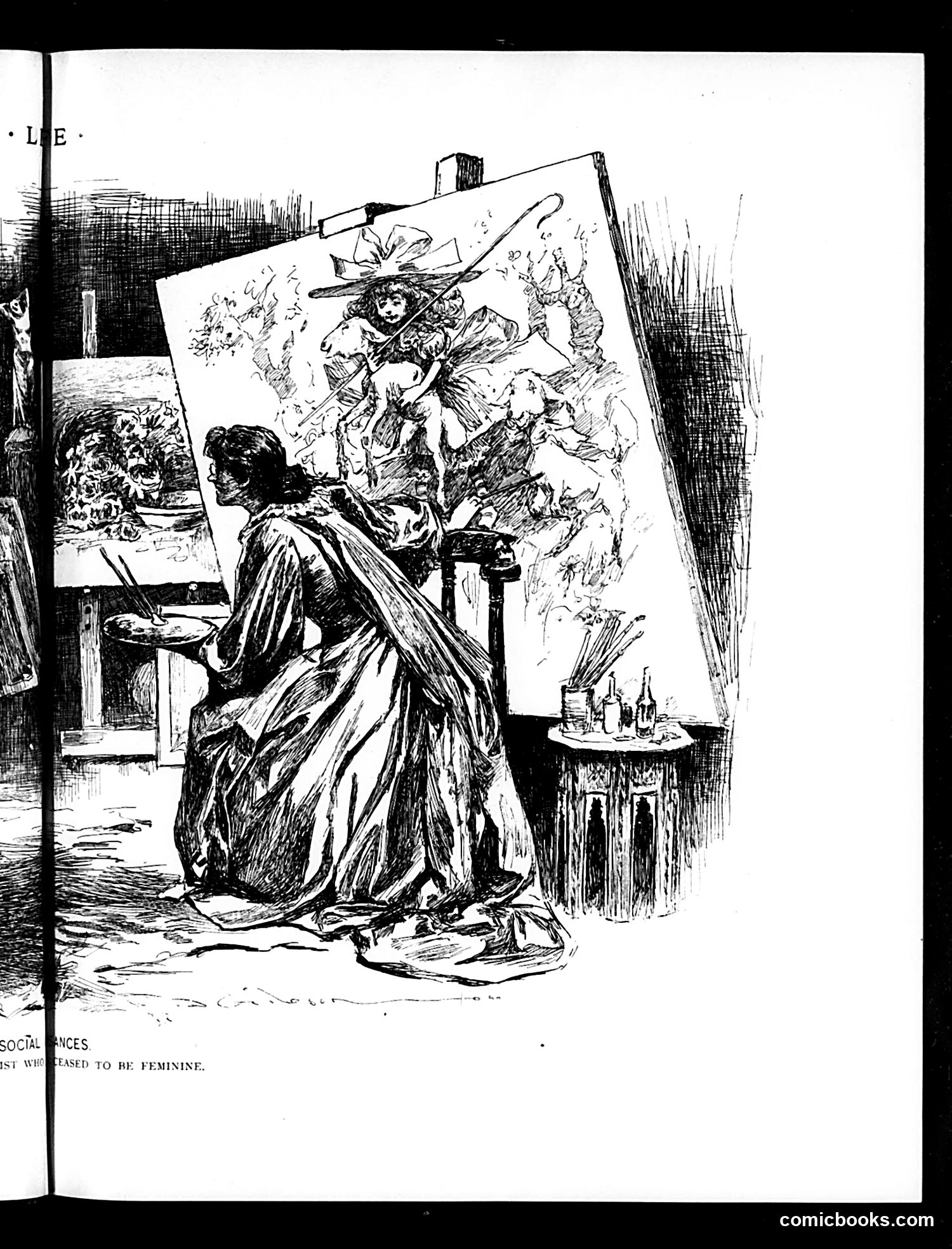
This is a satirical illustration showing a female artist painting at an easel in her studio. The caption reads "SOCIAL DANCES / [?] PLEASED TO BE FEMININE." The cartoon appears to satirize early 20th-century debates about women's roles and artistic pursuits. The woman is depicted painting what looks like dynamic, energetic figures—possibly dancers or mythological subjects—while herself dressed in flowing, decidedly feminine clothing. The satire likely works on multiple levels: either mocking women artists for adopting masculine creative ambitions while maintaining feminine appearance, or conversely, celebrating that women can be both serious artists AND feminine. The exact point depends on *Life* magazine's editorial stance at publication, which the OCR text fragment doesn't fully clarify. The illustration style is detailed cross-hatching typical of late 19th/early 20th-century satirical prints.
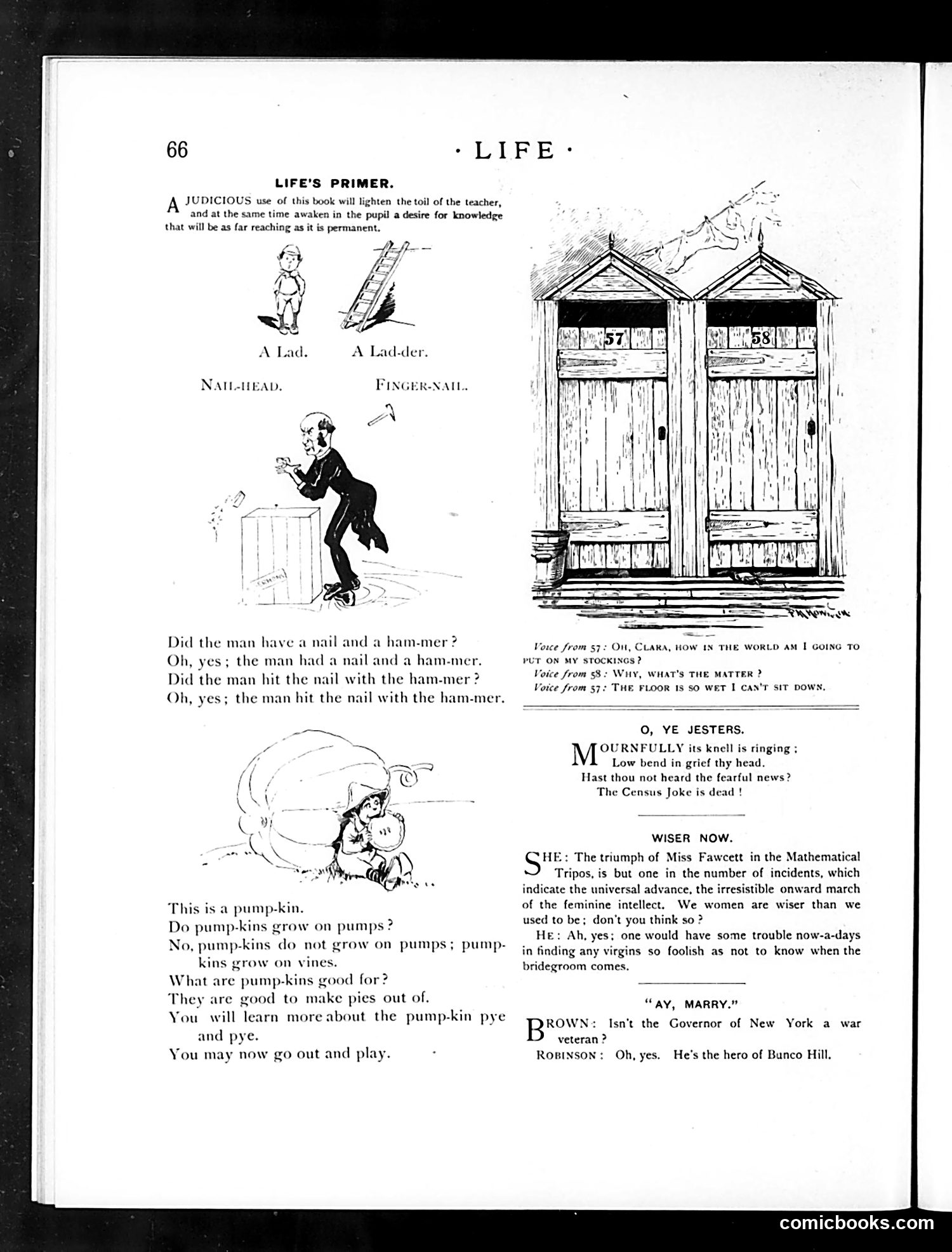
This page presents educational humor for children through pun-based wordplay and visual jokes. "A Lad" and "A Ladder" are homophone jokes; "Nail-head" and "Finger-nail" play on compound words with double meanings. The main cartoon shows a man using a hammer to hit a nail—literally illustrating the nursery-rhyme dialogue about whether the man hit the nail with the hammer. Below, a pumpkin illustration teaches children that pumpkins grow on vines, not plants. The right side contains unrelated society commentary, including "Wiser Now" (about women's intellectual advancement) and "Ay, Marry" (discussing the Governor of New York as a war veteran, likely referencing Bunco Hill). This is primarily **educational satire aimed at children**, using puns and visual gags rather than political commentary.
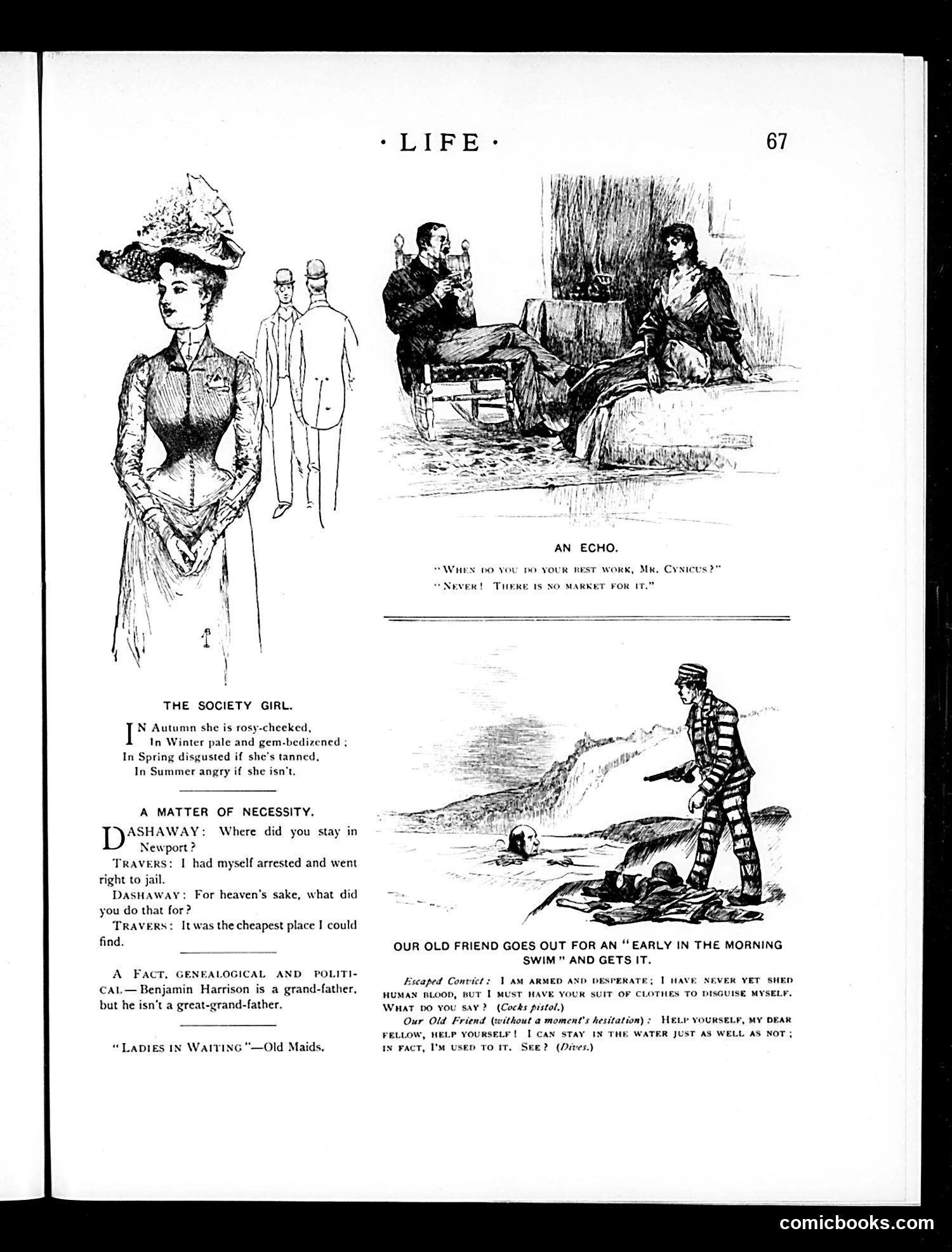
This page contains several satirical sketches mocking social types of the era: **"The Society Girl"** — A fashionable woman whose appearance changes with seasons (rosy-cheeked in autumn, pale in winter, tanned in summer, angry in spring), satirizing wealthy women's vanity and seasonal lifestyle patterns. **"An Echo"** — A dialogue where a man asks a successful artist about his best work, only to hear it has "no market," suggesting the gap between artistic merit and commercial viability. **"A Matter of Necessity"** — A brief exchange about jail as the "cheapest place" to stay, darkly joking about poverty. **"Our Old Friend Goes Out for an Early Morning Swim"** — A rescue scene satirizing either foolishness or desperation. The humor targets idle society, artistic struggle, poverty, and human folly—typical concerns of Edwardian-era American satire.
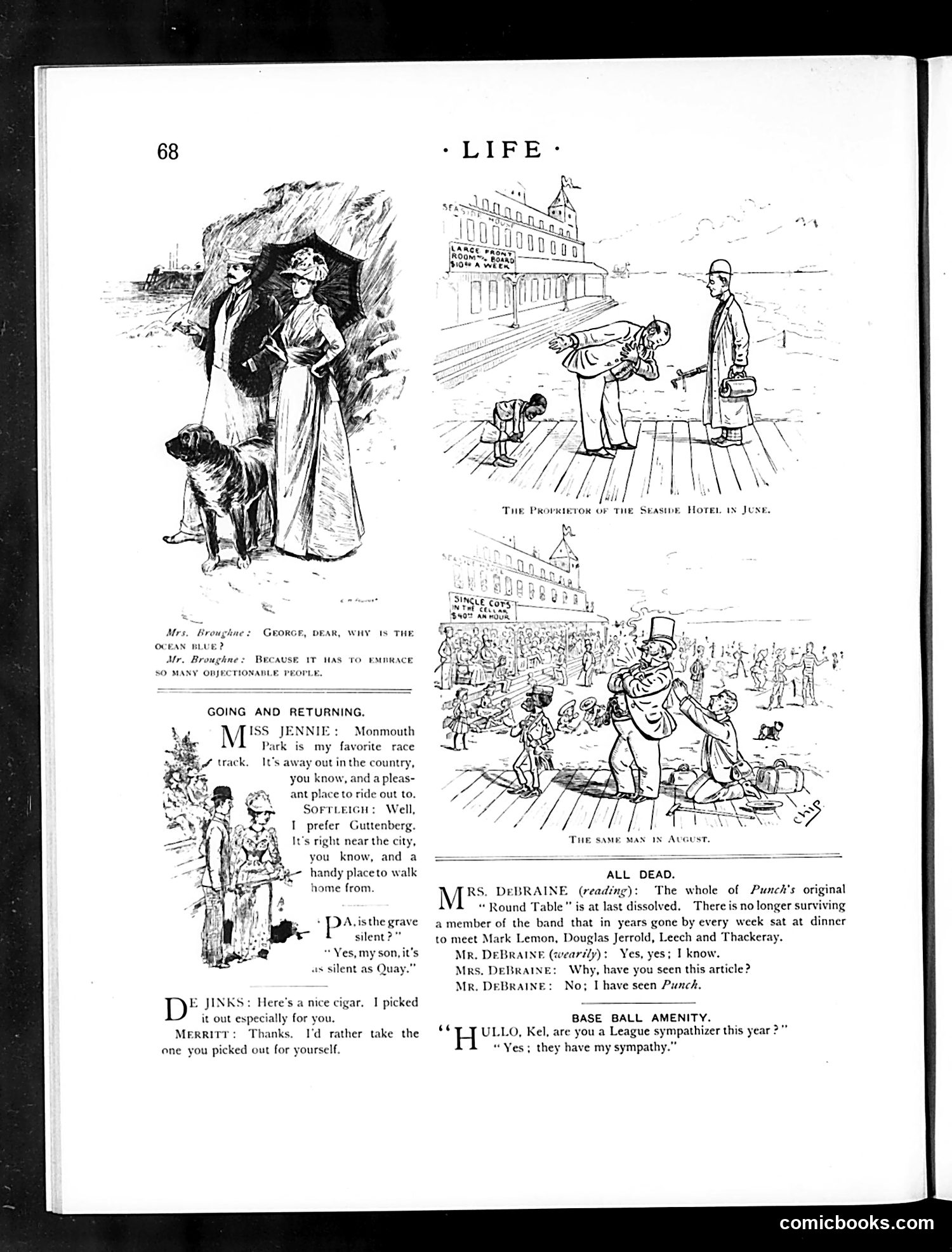
This page contains several brief satirical sketches typical of Life's social humor: **"Ocean Blue"**: A couple jokes that the ocean embraces "objectionable people"—likely mocking pretentious seaside resort society. **"Going and Returning"**: Two men debate racetrack locations. Softleigh prefers Guttenberg because it's near the city with "a handy placeto walk home from"—the humor lies in the implied reason: he's broke and can't afford transportation back. **"All Dead"**: Mrs. Debraine reads that Punch magazine's original editorial circle (Mark Lemon, Douglas Jerrold, Leech, Thackeray) has completely disbanded. Mr. Debraine's response—"No; I have seen Punch"—is a deadpan joke suggesting the magazine itself is now lifeless. **"Base Ball Amenity"**: A quick quip about baseball league sympathizers offering only sympathy, not actual support—likely satirizing fair-weather fans. The page illustrates Life's trademark witty, conversational humor targeting middle-class social pretension and absurdity.
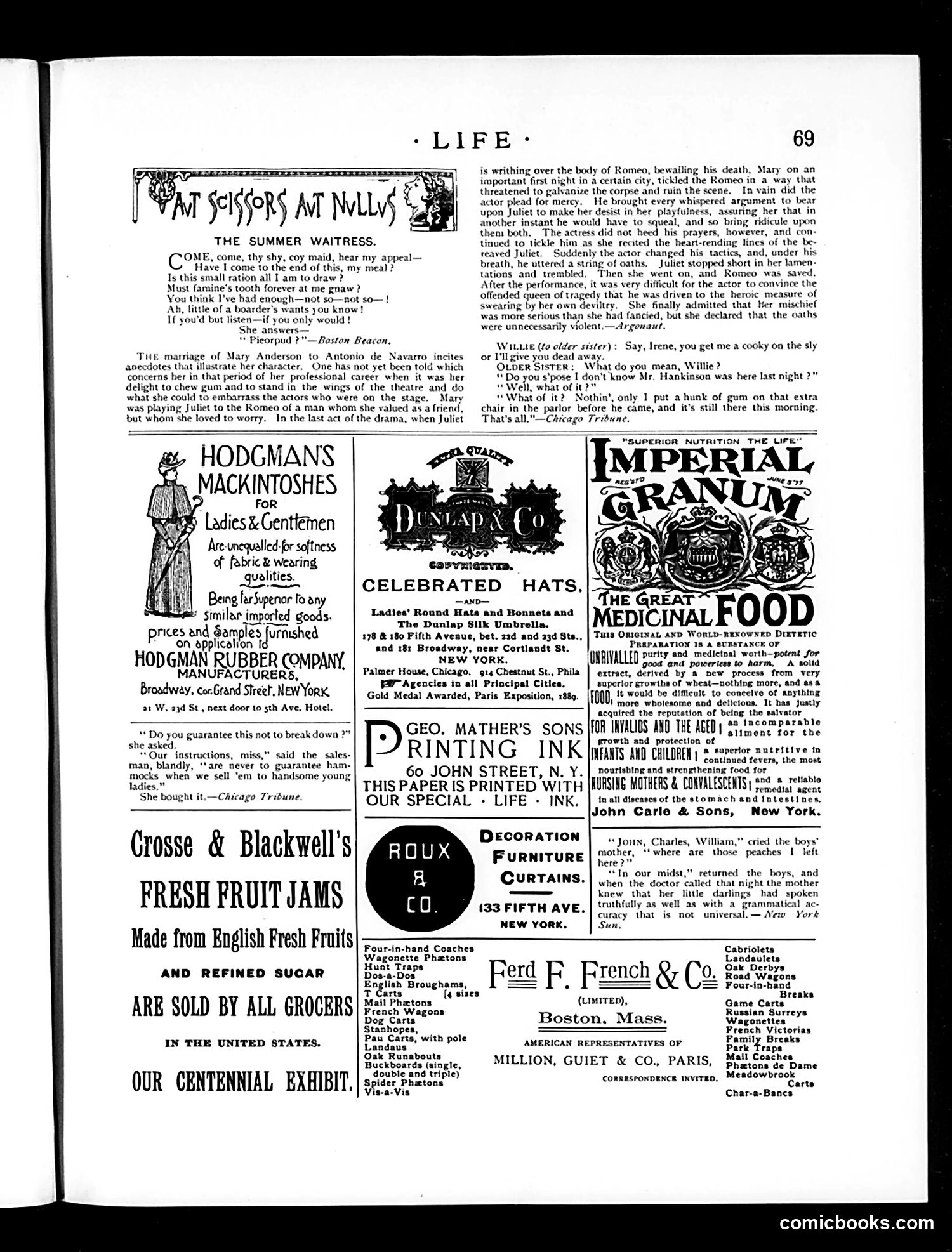
This page from *Life* magazine contains two short humorous sketches aimed at contemporary readers: **"The Summer Waitress"** presents a comedic poem about a boarder's complaint that a waitress serves inadequate portions. The joke plays on the tension between hungry customers and cost-conscious establishments—a relatable dining frustration of the era. **The Mary Anderson anecdote** recounts an actress's mischievous backstage behavior during a Romeo and Juliet performance. She deliberately tickles the "dead" Romeo to provoke him, nearly ruining the scene. The humor derives from her abuse of theatrical authority and her resistance to the actor's pleas—a tale of professional misconduct played for laughs. **"Willie and Irene"** depicts sibling blackmail: a boy threatens to expose his sister's unsupervised male visitor unless she provides cookies. The humor lies in the discovery that gum she placed on a parlor chair remains evidence of the visit. All three sketches center on **mischief and deception**—characters exploiting social situations for personal advantage. The page is otherwise dominated by period advertisements for mackintoshes, hats, jams, and furniture.
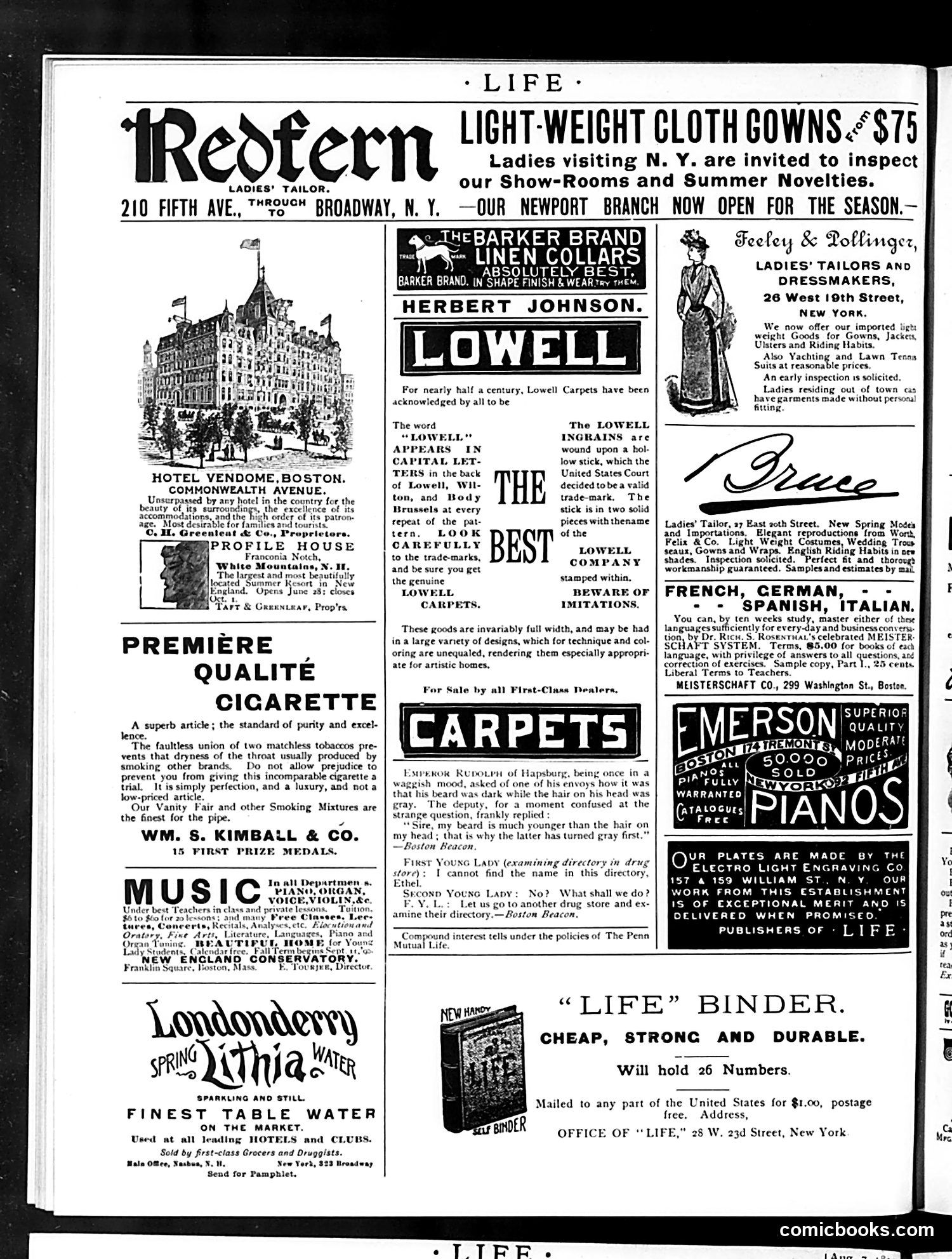
This is primarily an **advertising page** from Life magazine, not a satirical cartoon page. It contains commercial advertisements for luxury goods and services aimed at wealthy Americans circa early 1900s. The small text items labeled "Boston Beacon" appear to be brief humorous anecdotes rather than political satire: - One jokes about Emperor Franz Joseph's beard being darker than his head hair because it's "younger" - Another depicts two young women unable to find a name in a drugstore directory, so they plan to check another drugstore instead—a mild joke about inefficiency The bulk of the page advertises **upscale goods**: Redfern ladies' tailoring ($75 gowns), Lowell carpets (emphasizing authenticity against imitations), Emerson pianos, Londonderry water, and hotels. There is **no significant political cartoon or satire** on this page—it is essentially a commercial compilation reflecting the consumer aspirations of Life's affluent readership.
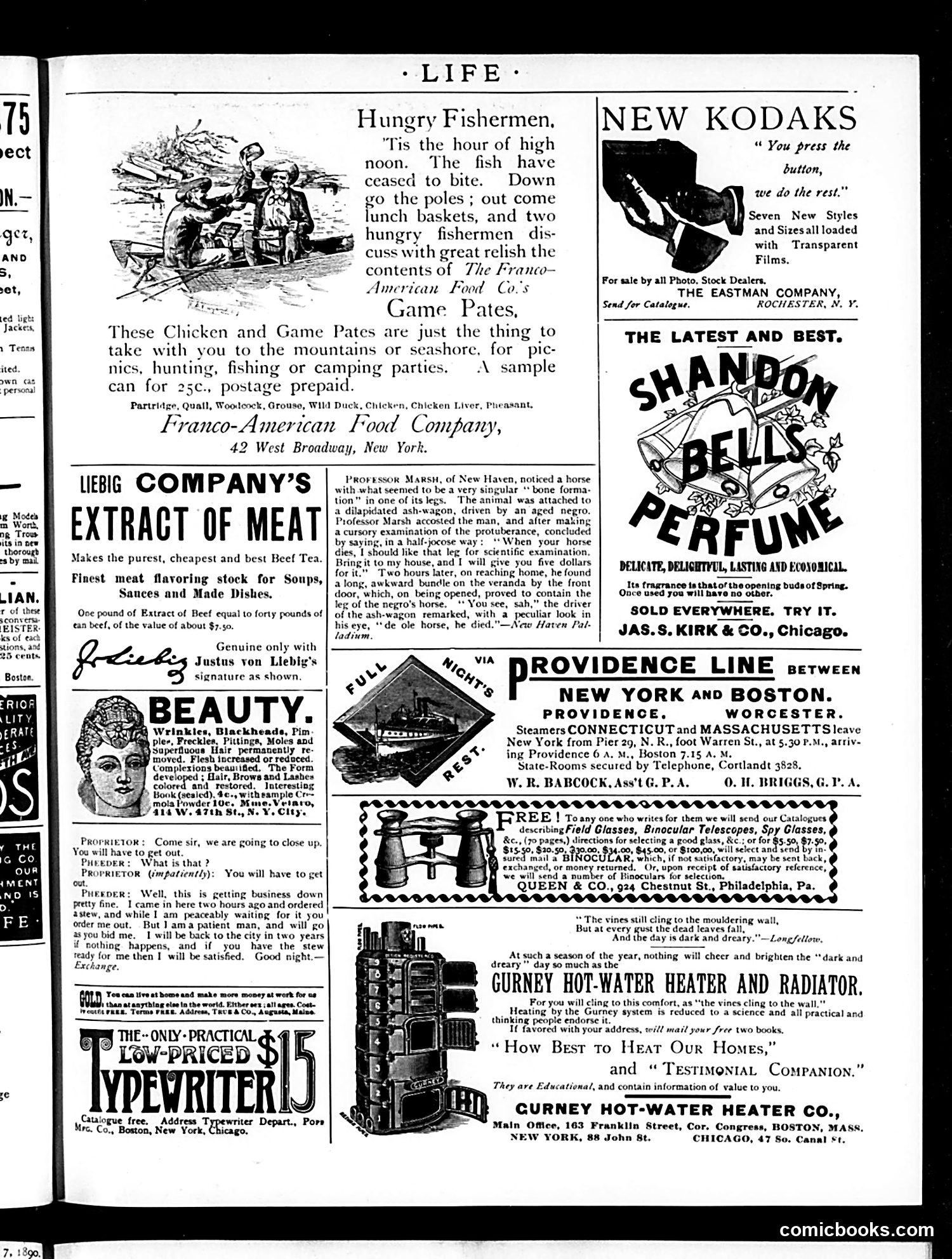
This page is primarily **advertisements** with one brief humorous anecdote, not political cartoons. The main illustrated content shows **"Hungry Fishermen"** taking a lunch break—a relatable scene used to advertise Franco-American Game Pates (canned meat products). The visual joke is simple: hungry men out fishing find ready-made food more convenient than catching fish. Below that is a short **satirical anecdote** about Professor Marsh (a real paleontologist from Yale) who asks an elderly Black ash-wagon driver to bring him a horse's unusual leg bone for scientific study. When the man literally delivers the dead horse's leg to Marsh's house hours later, the humor comes from taking Marsh's casual request literally—the driver complied without understanding (or pretending not to understand) the professor's academic intent. The joke relies on period stereotypes about Black workers and class differences. The rest of the page is standard period advertising for cameras, food extracts, beauty treatments, and shipping lines—typical magazine filler of the era.
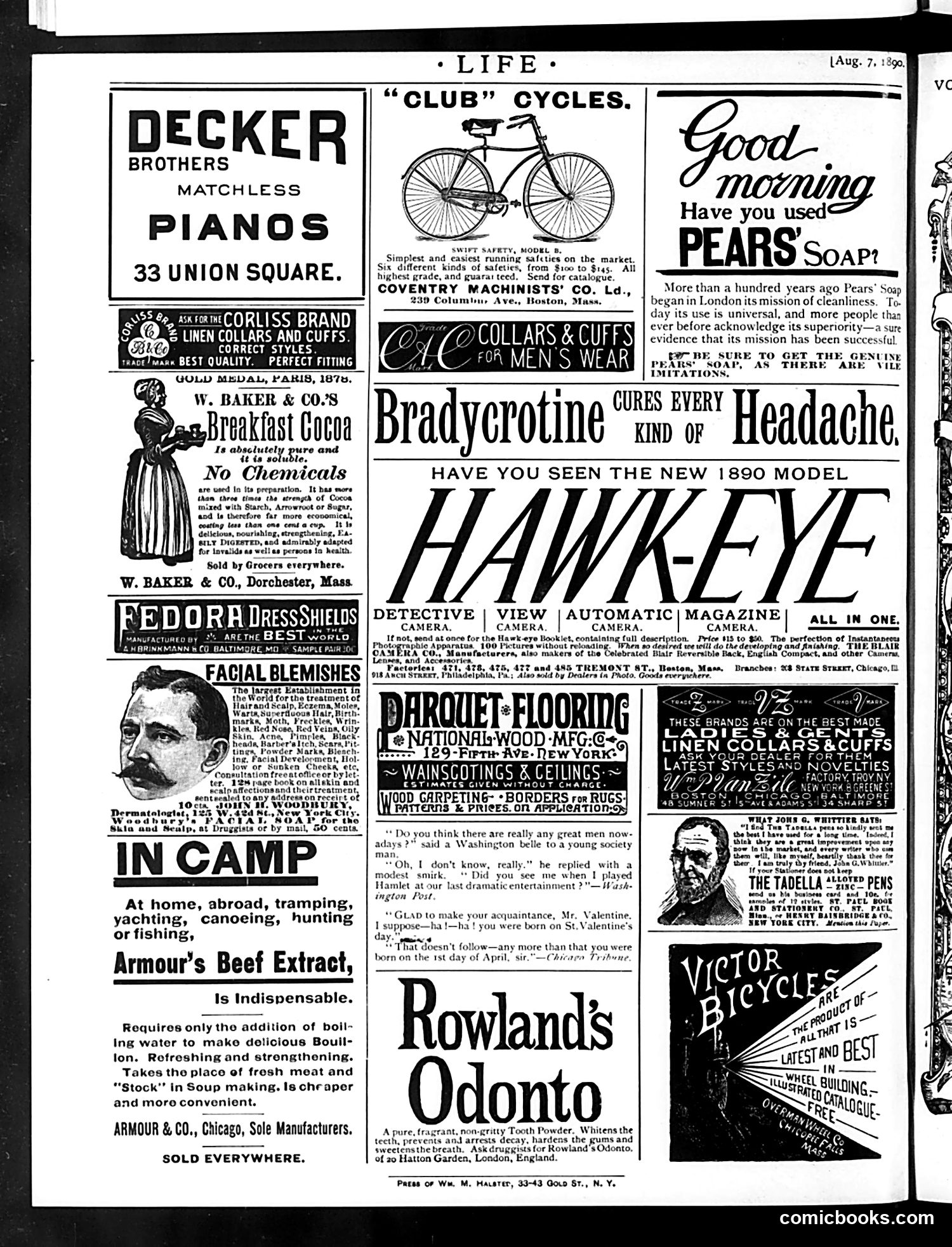
This is primarily an **advertising page** with minimal editorial content. The few non-advertisement items are brief humorous anecdotes: 1. **Washington Belle Joke**: A society woman asks if great men still exist. A young man responds by boasting about his dramatic performance as Hamlet, missing her point entirely. The satire targets male vanity and self-importance. 2. **Valentine's Day Joke**: A play on words where someone claims to have met Mr. Valentine but expresses surprise he wasn't born on St. Valentine's Day—implying you'd expect someone named Valentine to have that birthday. The punchline suggests this logic is as absurd as being born on April 1st (April Fools' Day) just because of your name. The remainder consists of period advertisements for pianos, cocoa, soap, bicycles, cameras, dress shields, and other consumer goods typical of 1890s marketing. No political content or significant satire is present on this page.