
Life, 1890-08-07 · page 4 of 16
Life — August 7, 1890 — page 4: what you’re looking at
What you’re looking at
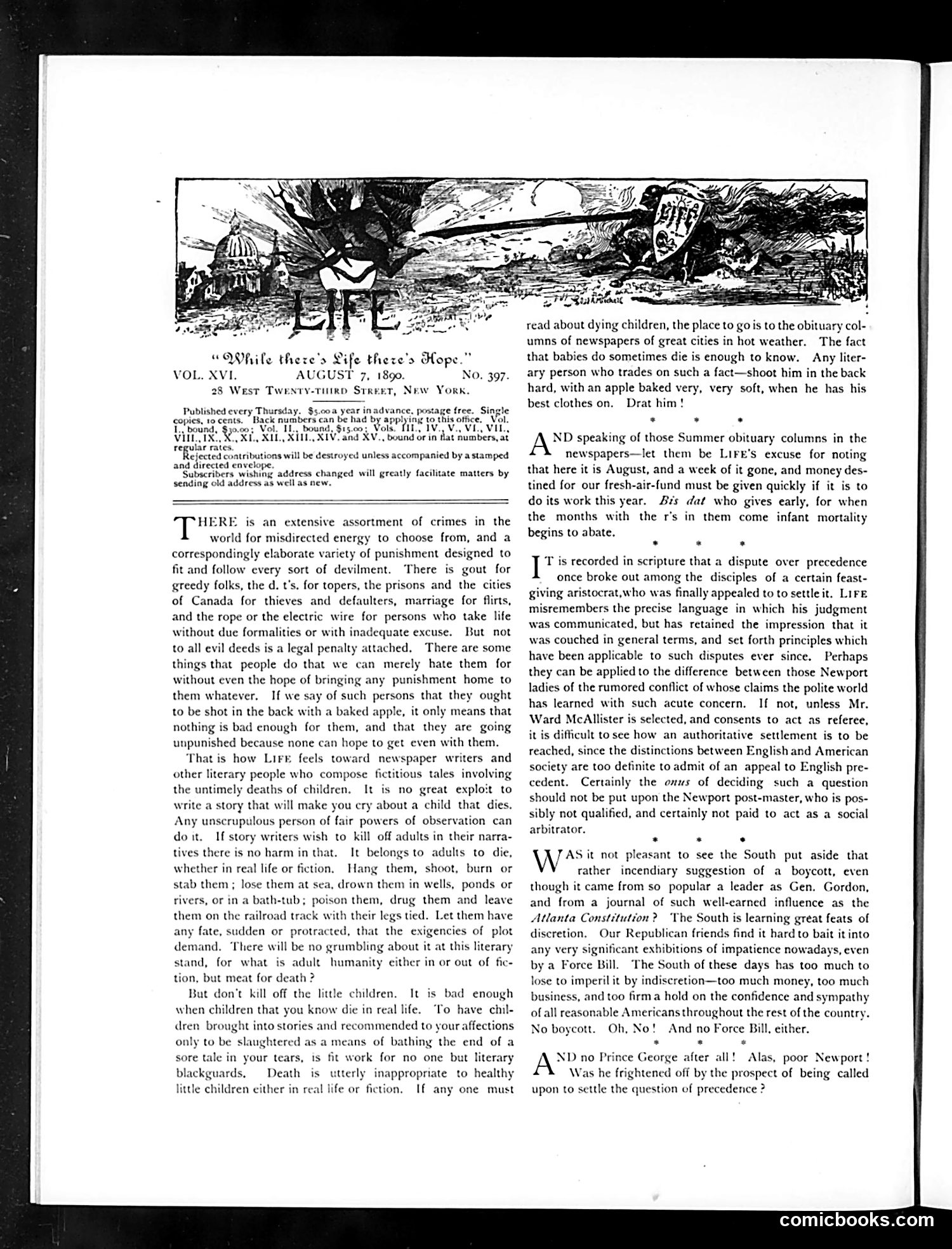
**The Cartoon:** The masthead illustration depicts a classical allegorical scene with a figure (likely "Life" personified) surrounded by natural and architectural elements—suggesting themes of civilization, mortality, and human consequence. **The Editorial Content:** The main article criticizes newspaper writers who sensationalize children's deaths in summer obituary columns for profit. The editor argues this exploitative practice is morally indefensible, comparing it to other serious crimes. The piece contrasts literary treatment of child death (acceptable in fiction) with real-life exploitation. A secondary note discusses Southern boycott suggestions and a dispute over social precedence involving Newport society figures, arguing such matters should be settled through proper social channels rather than public force. The page demonstrates Life's role as social satirist, attacking both media ethics and upper-class pretension.
📄 Transcribed text from this page (OCR, searchable)
Machine-transcribed from the original scan — historical spelling and the odd misread are preserved.
“While there's Life there's Hope.” VOL. XVI AUGUST 7, 1899. No. 397. 28 West Twenty-Tuirp Street, New York. Published every Thursday, $5.00 year in adv. copies, 10 cents. Back numbers can be had by applying to this office. Vol. I. bound, 0; Vol. IL, bound, $15.00; Vols. a. LV. Vig VE VER.« ) 11, XII, XIVeand XV., bound or in dat humbers, at ce. postage free. Single ejected contributions will be destroyed unless accompanied by a stamped and directed envelope. Subscribers wishing address changed will greatly facilitate matters by sending old address as well as new. HERE is an extensive assortment of crimes in the world for misdirected energy to choose from, and a correspondingly elaborate variety of punishment designed to fit and follow every sort of devilment. There is gout for greedy folks, the d. t's. for topers, the prisons and the cities of Canada for thieves and defaulters, marriage for flirts, and the rope or the electric wire for persons who take life without due formalities or with inadequate excuse. But not to all evil deeds is a legal penalty attached, There are some things that people do that we merely hate them for without even the hope of bringing any punishment home to them whatever. If we say of such persons that they ought to be shot in the back with a baked apple, it only means that nothing is bad enough for them, and that they are going unpunished because none can hope to get even with them. Thatis how Lire feels toward newspaper writers and other literary people who compose fictitious tales involving the untimely deaths of children, It is no great exploit to write a story that will make you cry about a child that dies. Any unscrupulous person of fair powers of observation can do it. If story writers wish to kill off adults in their narra- tives there is no harm in that. It belongs to adults to die, whether in real life or fiction. Hang them, shoot, burn or stab them ; lose them at sea, drown them in wells, ponds or rivers, or in a bath-tub; poison them, drug them and leave them on the railroad track with their legs tied. Let them have any fate, sudden or protracted, that the exigencies of plot demand. There will be no grumbling about it at this literary stand, for what is adult humanity either in or out of fic- tion, but meat for deatt But don’t kill off the little children. It is bad enough when children that you know die in real life. To have chil- dren brought into stories and recommended to your affections only to be slaughtered as a means of bathing the end of a sore tale in your tears, is fit work for no one but literary blackguards. Death inappropriate to healthy little children either in real life or fiction. If any one must read about dying children, the place to go is to the obituary col- umns of newspapers of great cities in hot weather. The fact that babies do sometimes die is enough to know. Any liter- ary person who trades on such a fact—shoot him in the back hard, with an apple baked very, very soft, when he has his best clothes on, Drat him! ‘D speaking of those Summer obituary columns in the newspapers—let them be LiF excuse for noting that here it is August, and a week of it gone, and money des- tined for our fresh-air-fund must be given quickly if it is to do its work this year. Bzs dat who gives early, for when the months with the r’s in them come infant mortality begins to abate, . * . T is recorded in scripture that a dispute over precedence once broke out among the disciples of a certain feast- giving aristocrat,who was finally appealed to to settle it. LIFE misremembers the precise language in which his judgment was communicated, but has retained the impression that it was couched in general terms, and set forth principles which have been applicable to such disputes ever since. Perhaps they can be applied to the difference between those Newport ladies of the rumored conflict of whose claims the polite world has learned with such acute concern. If not, unless Mr. Ward McAllister is selected, and consents to act as referee, it is difficult to see how authoritative settlement is to be reached, since the distinctions between English and American society are too definite to admit of an appeal to English pre- cedent. Certainly the ows of deciding such a question should not be put upon the Newport post-master, who is pos- sibly not qualified, and certainly not paid to act as a social arbitrator. . . . W AS it not pleasant to see the South put aside that rather incendiary suggestion of a boycott, even though it came from so popular a leader as Gen. Gordon, and from a journal of such well-earned influence as the Atlanta Constitution? The South is learning great feats of discretion, Our Republican friends find it hard to bait it into any very significant exhibitions of impatience nowadays, even by a Force Bill. The South of these days has too much to lose to imperil it by indiscretion—too much money, too much business, and too firma hold on the confidence and sympathy of all reasonable Americansthroughout the rest of the country. No boycott. Oh, No! And no Force Bill, either. ‘D no I Alas, poor Newport ! * * * A ince George after all! Was he frightened off by the prospect of being called upon to settle the question of precedence ? comicbooks.com