
A complete issue · 16 pages · 1890
Life — July 31, 1890
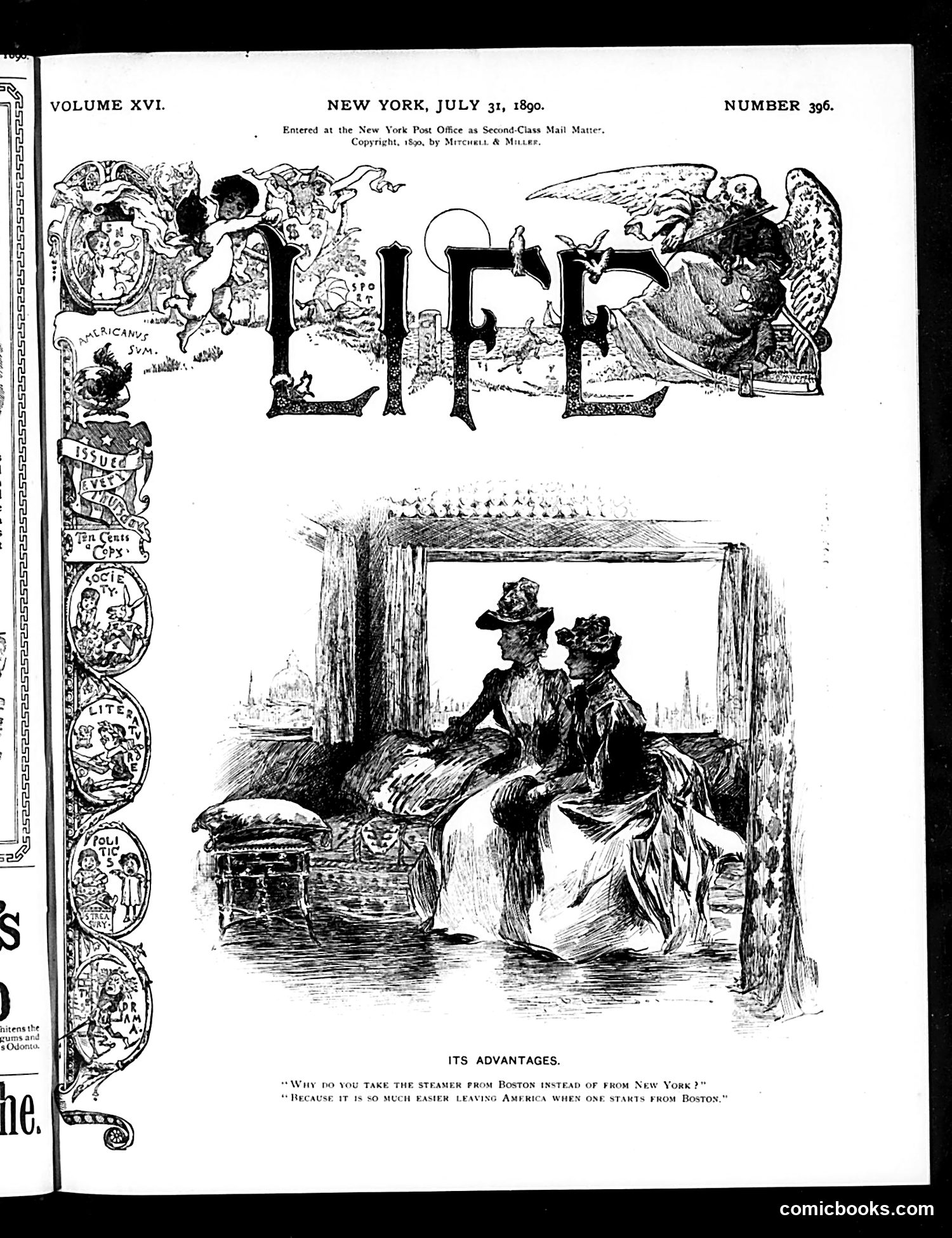
This satirical cartoon mocks the comparative ease of emigrating from America via Boston versus New York. Two fashionably dressed women sit in what appears to be a ship's cabin, conversing. The caption reads: "Why do you take the steamer from Boston instead of from New York?" "Because it is so much easier leaving America when one starts from Boston." The joke targets wealthy Americans (likely women of leisure) who wish to abandon the country, suggesting Boston provides a more convenient departure point. This reflects 1890s anxieties about wealthy citizens emigrating, possibly due to economic or social discontent. The cartoon satirizes both their restlessness and the comparative logistics of American port cities during this era.
This page is primarily **advertising**, not editorial content or political cartoons. The advertisements include: - A "Life" binder for magazine storage - Furniture, printing ink, and cigarettes - Mrs. Winslow's Soothing Syrup (a patent medicine) - Fresh fruit jams and other consumer goods - The Hartford Safety bicycle The only illustrative content is **The Hartford Safety bicycle advertisement**, featuring a simple line drawing of a bicycle rather than political satire or social commentary. The upper left contains a book advertisement for *Expatriation* by the author of "Aristocracy," but this is commercial promotion, not satirical editorial material. **This appears to be primarily a commercial advertising page rather than satirical commentary.**
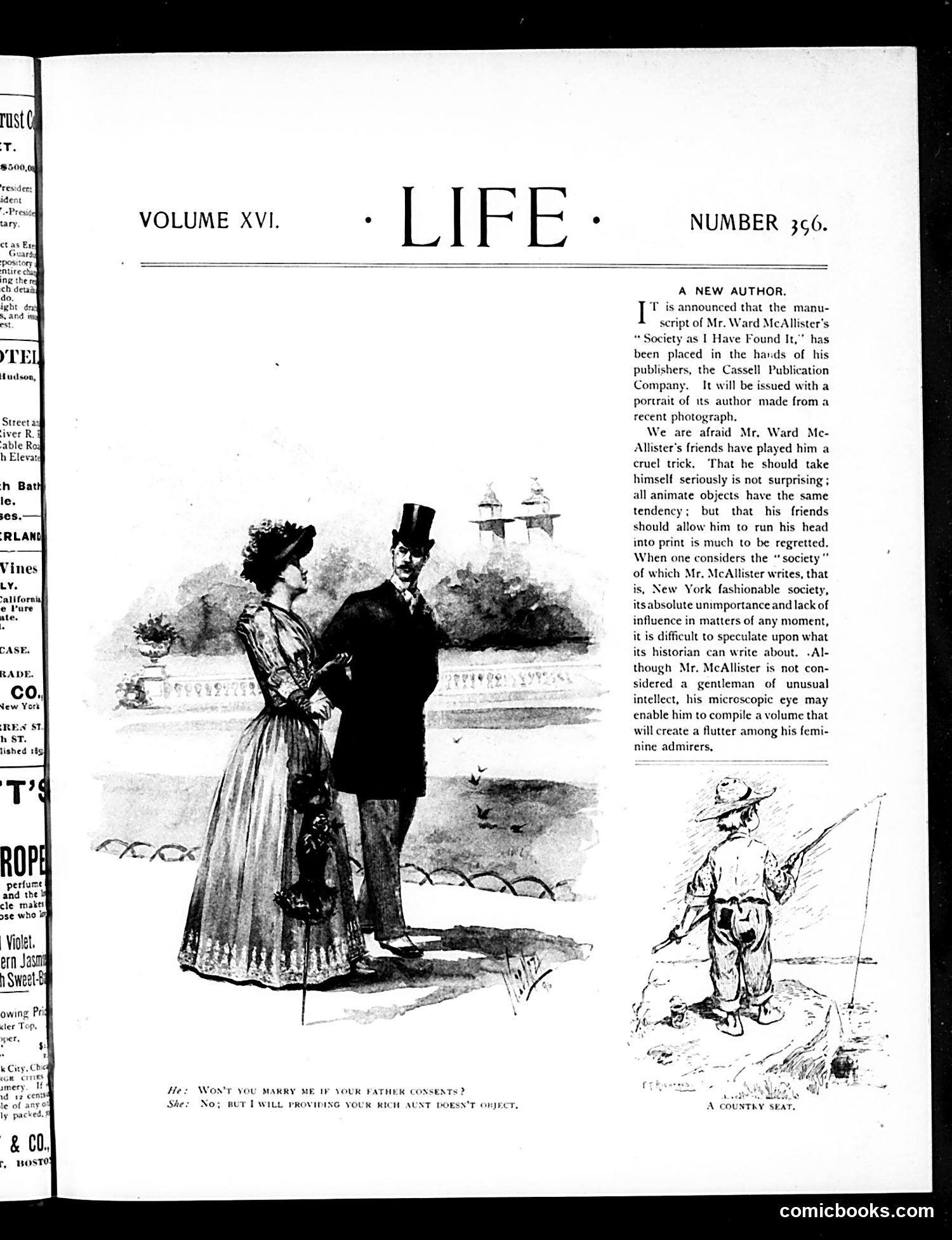
The page announces Ward McAllister's manuscript "Society as I Have Found It" will be published by Cassell Publication Company. The text sarcastically criticizes McAllister as a social arbiter of New York's fashionable society, suggesting his writing lacks substance—merely documenting an "absolute unimportance and lack of influence in matters of any moment." The main cartoon depicts a well-dressed couple in conversation. The caption reads: "He: Won't you marry me if your father consents? She: No; but I will providing you aunt doesn't object." This joke satirizes the absurd social hierarchies of elite society, where an aunt's approval supposedly carries more weight than a father's consent—mocking the arbitrary nature of high-society rules and etiquette that McAllister documented.
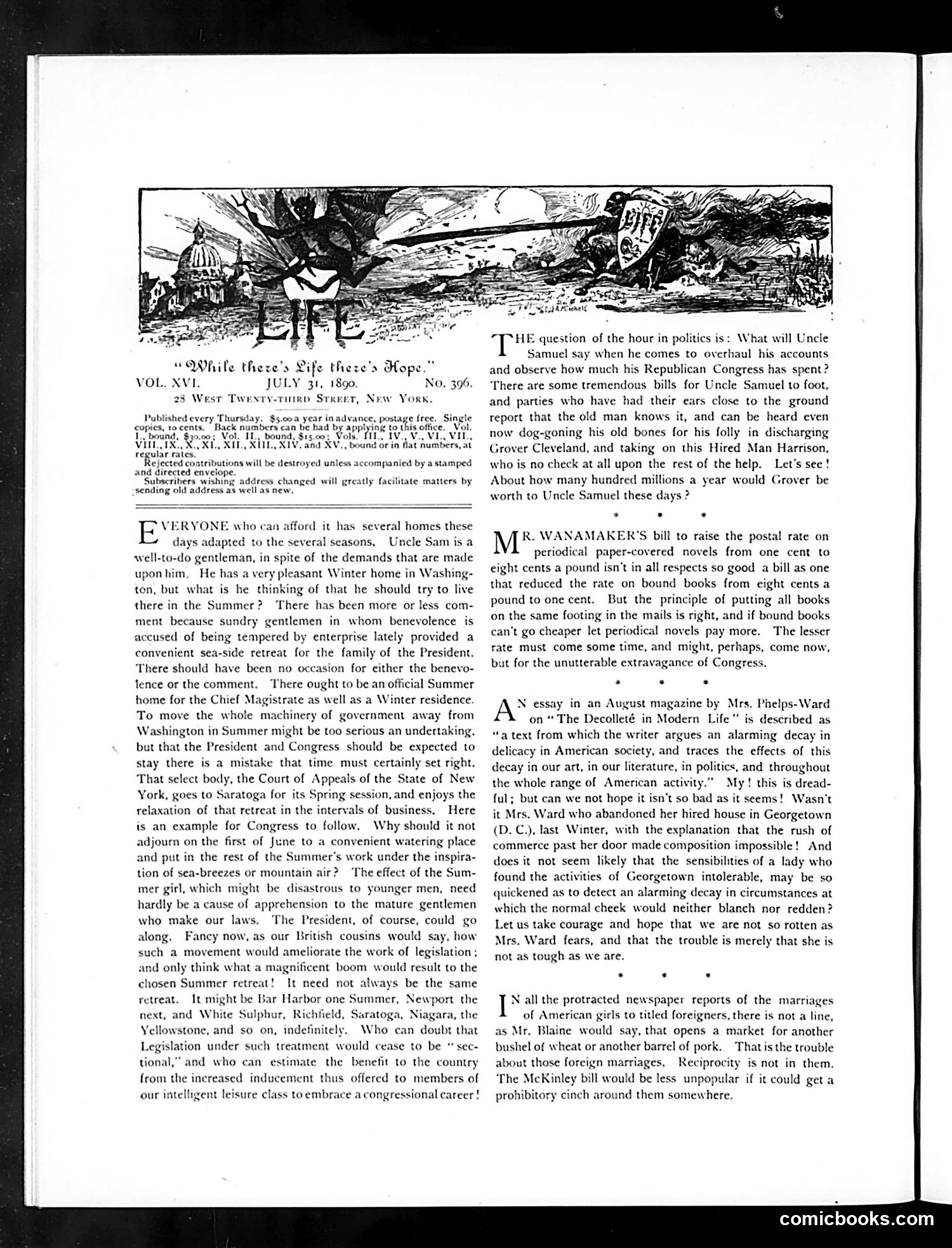
The masthead cartoon depicts Uncle Sam seated contentedly, captioned "While there's Life there's Hope." The accompanying editorial discusses Uncle Sam as a gentleman who should maintain multiple seasonal residences—a Winter home in Washington and a Summer retreat elsewhere (suggesting Saratoga, Newport, or similar leisure destinations). The satire critiques the expectation that the President and Congress should relocate seasonally for comfort and health, arguing this would improve legislative efficiency. The piece mocks the notion that government leaders require elaborate accommodations and leisure time to function properly. The remaining page contains brief political commentary on postal rates, foreign marriages of American women, and concerns about American cultural decline—typical satirical targets for *Life* magazine of this era.
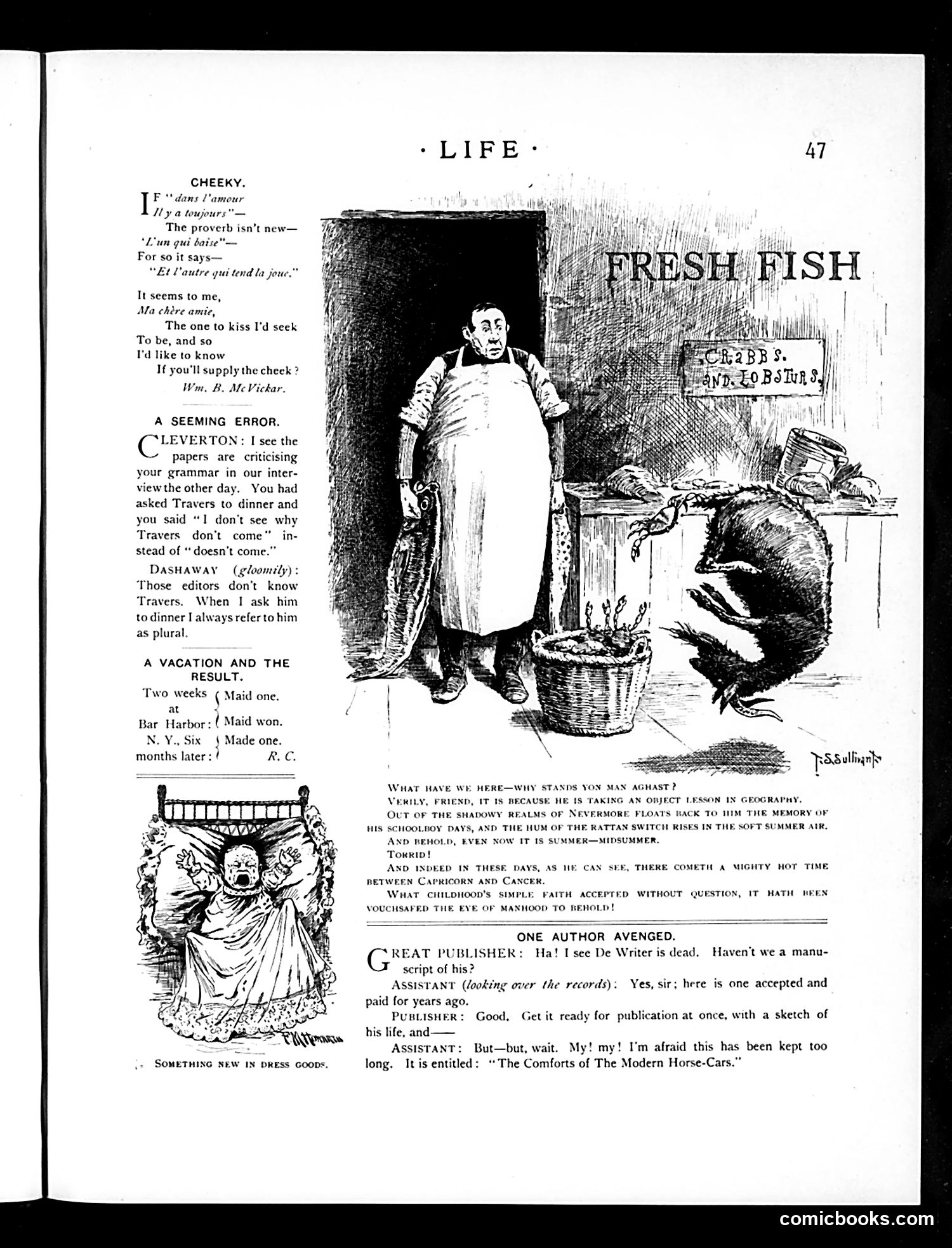
**Main Cartoon ("Fresh Fish"):** This satirical illustration depicts a fishmonger displaying his wares. The caption suggests the man represents someone taking a "geography lesson" from Nevermore (likely a literary reference), comparing his memories of schoolboy days to summer's return. The passage uses allegory—the "fresh fish" stand symbolizes how childhood innocence gets lost or corrupted in adulthood. The actual joke appears obscure without fuller context. **"One Author Avenged":** A brief comedic dialogue between a Publisher and Assistant about discovering a dead writer's manuscript titled "The Comforts of The Modern Horse-Cars." The humor lies in the ironic timing—publishing work about horse-cars (outdated by the modern era) as a "comfort," suggesting unintentional absurdity through temporal displacement. Both pieces reflect Life's characteristic blend of visual and textual satire targeting social pretension and cultural shifts.
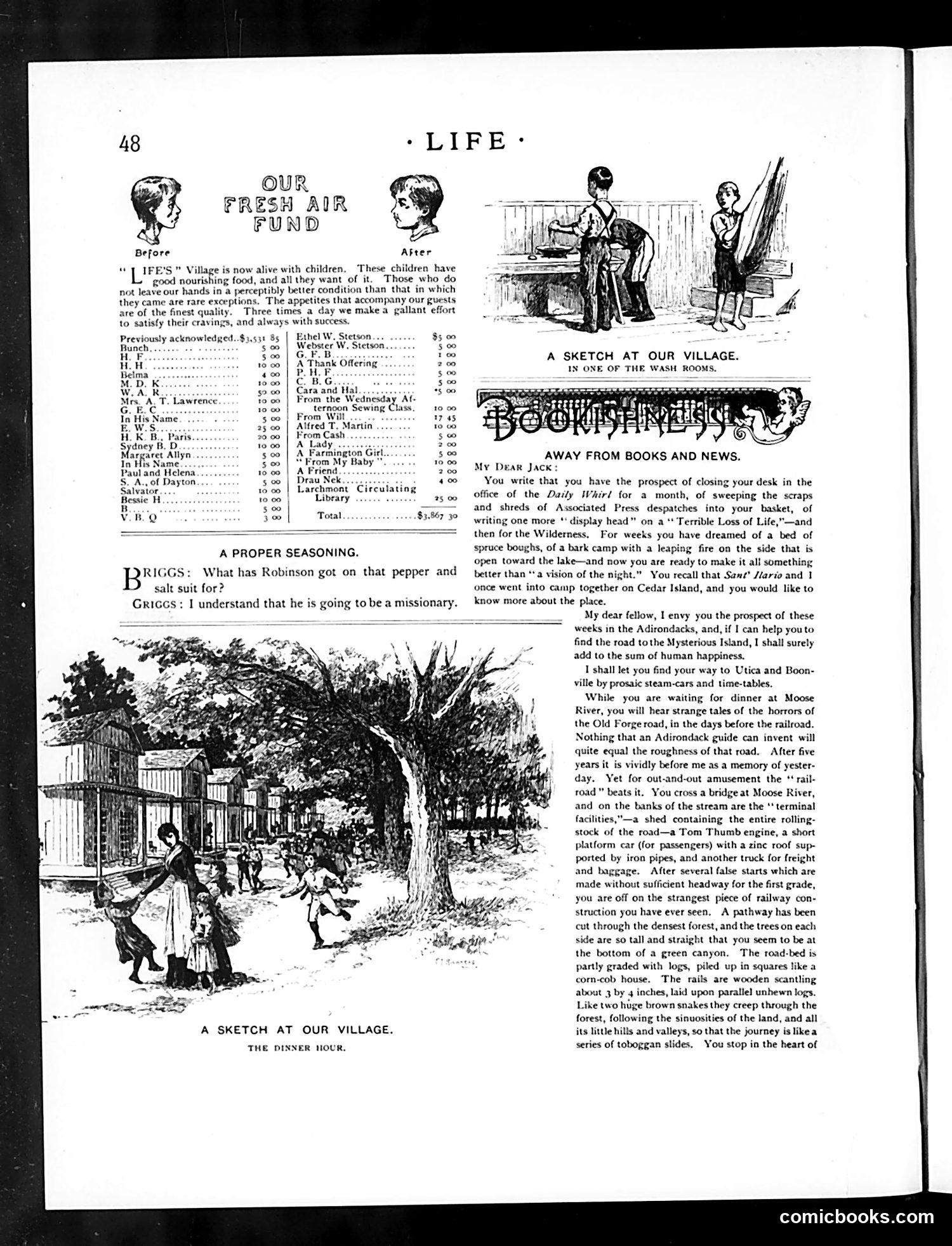
This page contains three distinct sections: 1. **"Our Fresh Air Fund"** lists donors contributing to a charitable program that provided urban children outdoor recreation—a Progressive Era social welfare initiative. 2. **"A Proper Seasoning"** is a brief joke: Briggs asks Robinson why he's wearing "pepper and salt" clothing, and Robinson replies he's becoming a missionary. The humor relies on a double meaning—"pepper and salt" refers to the fabric pattern. 3. **"Away from Books and News"** is a travel narrative encouraging readers to escape urban life for the Adirondacks and mysterious wilderness areas, emphasizing adventure and natural beauty. The sketches illustrate rural village life. Overall, the page reflects early-20th-century themes: charitable philanthropy, wordplay humor, and romantic escapism to nature—common in Life's satirical commentary on contemporary American society.
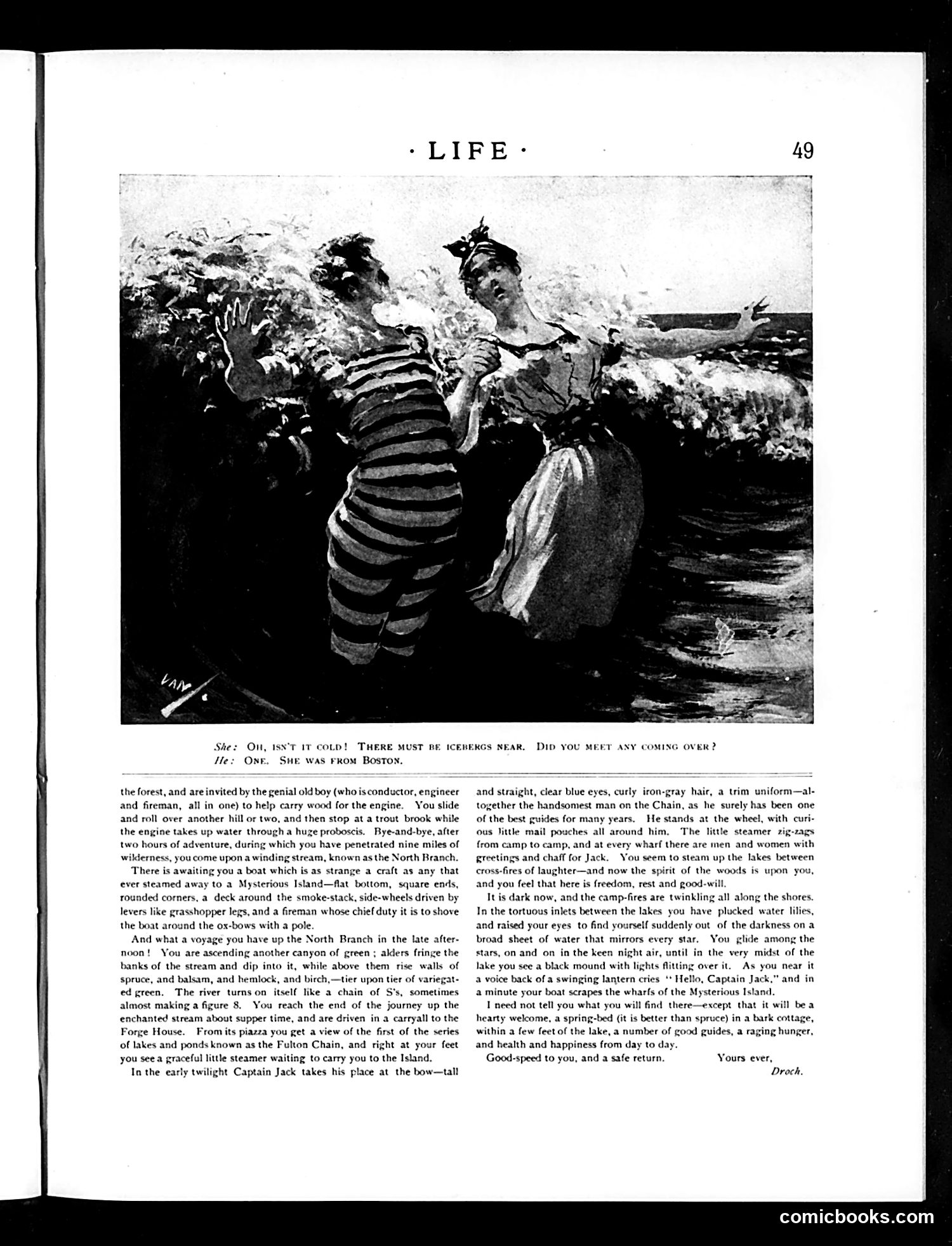
This page from *Life* magazine contains a narrative travel piece rather than political satire. The photograph shows two women in a romantic woodland setting—one wearing a striped bathing suit, the other in regular dress—with the caption referencing cold water and someone from Boston. The accompanying text describes a scenic journey through forests and waterways, mentioning a "genial old boy" who serves as guide/conductor, canoe travel, and overnight camping. It references "Captain Jack" and details about the North Branch and Fulton Chain of lakes. This appears to be **leisure/travel writing**, likely promoting a vacation destination in upstate New York (the Adirondacks region). The romantic imagery and detailed descriptions aim to entice readers to visit similar outdoor locations. It's entertainment content rather than political commentary or satire.
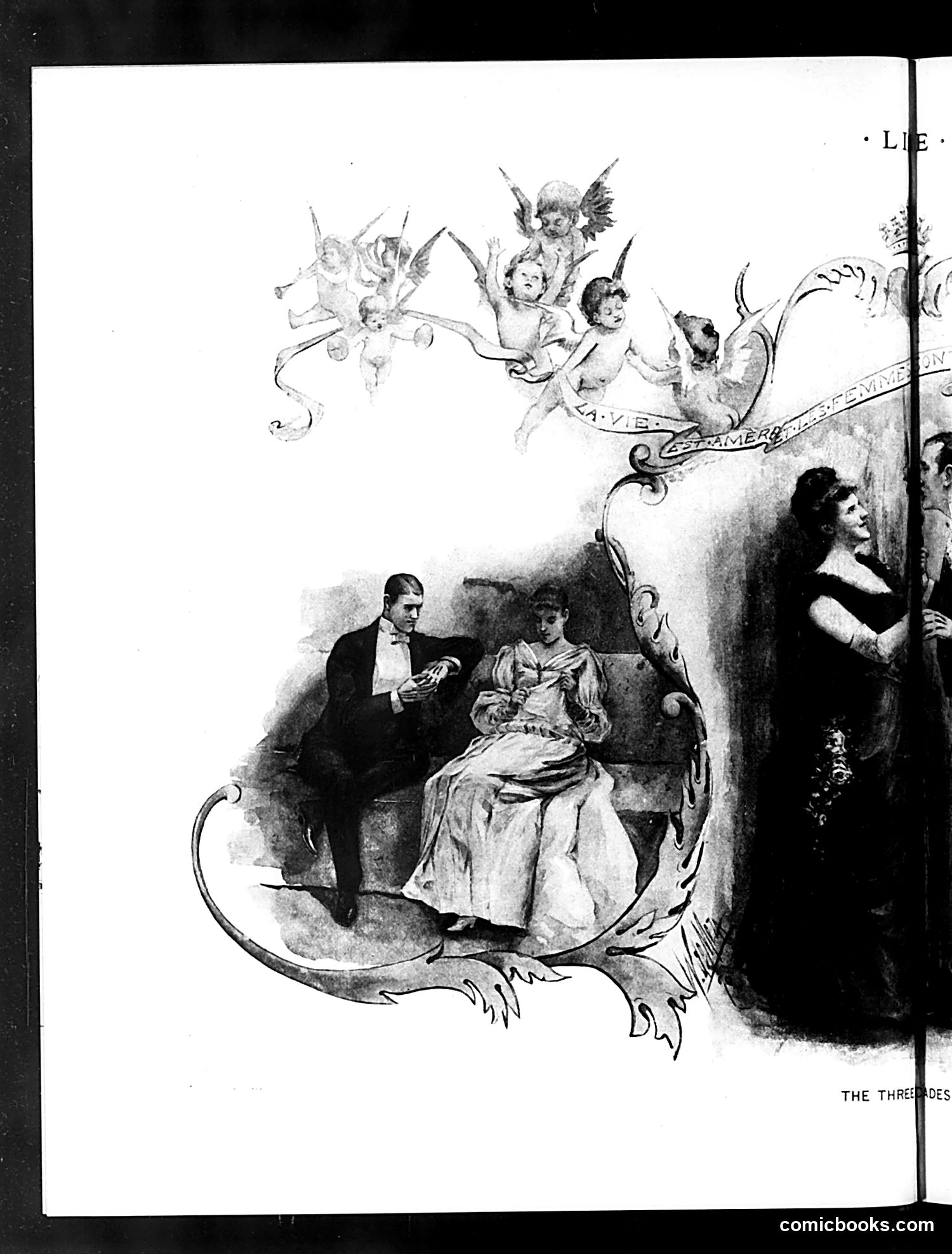
This satirical illustration depicts romantic/social dynamics across three life stages. The central scene shows a well-dressed man courting a seated woman, with cupids hovering above them—representing young love and courtship. On the right stands a darker figure (likely representing an older woman or widow), appearing to observe or intrude upon the scene. The ornamental frame with scrollwork suggests this is commentary on how romantic ideals and relationships change with age. The title "THE THREE AGES" indicates the cartoon contrasts youthful romance with later-life realities. This reflects Life magazine's typical humor about courtship, marriage, and aging—poking fun at how romantic expectations differ across a person's lifespan. The allegorical use of cupids emphasizes the contrast between idealized young love and more complicated mature relationships.
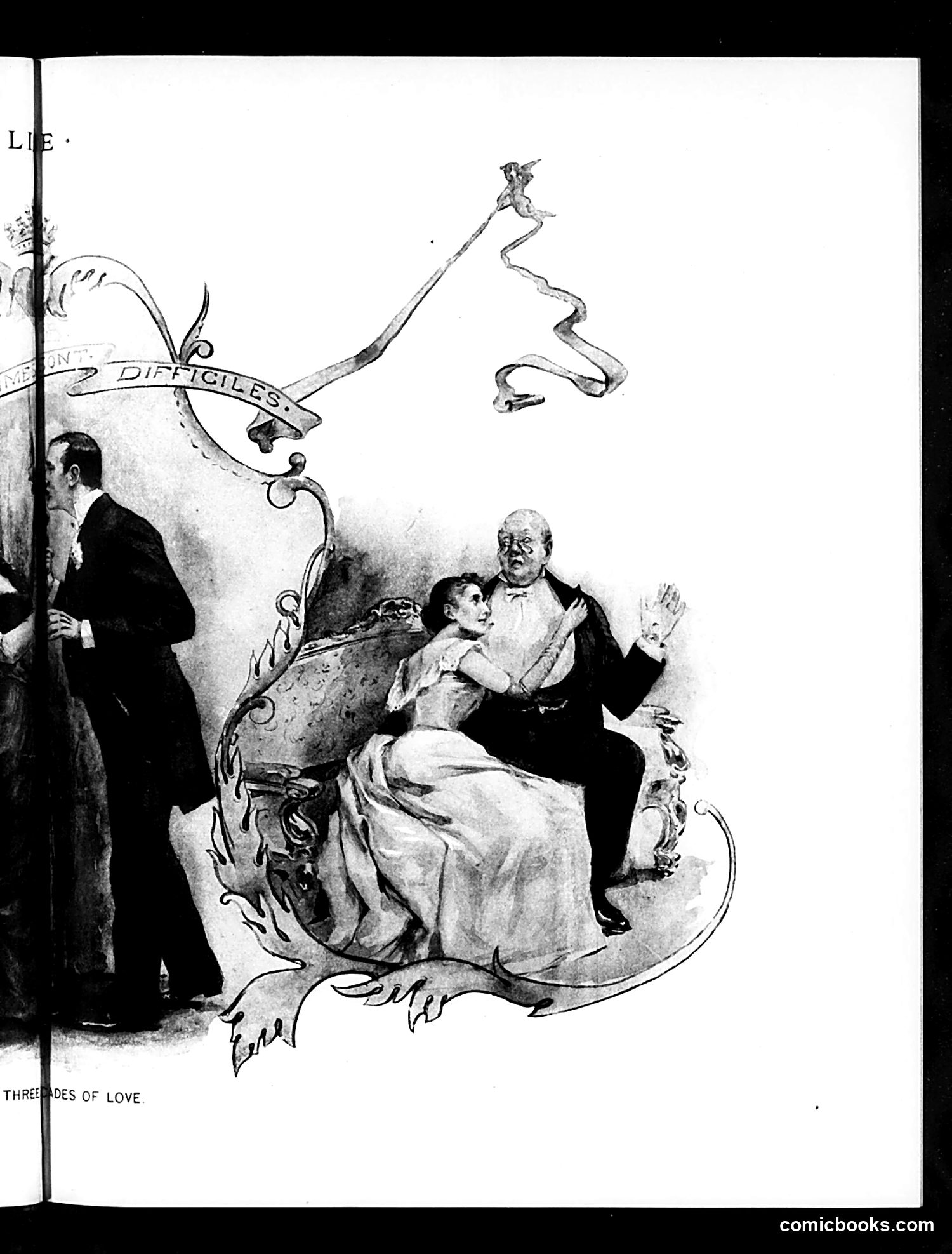
This satirical cartoon depicts a domestic scene labeled "Threads of Love" with the word "Difficulties" visible on a decorative element. The composition shows three figures: a woman in a light dress seated centrally, an older gentleman beside her gesturing expressively, and a man in dark clothing standing apart on the left observing the scene. The tangled, thread-like lines flowing through the composition suggest romantic or marital complications. The cartoon appears to satirize the complexities of romantic relationships or marriage, possibly commenting on infidelity, jealousy, or relationship entanglements common to early 20th-century social satire. The specific identities of these figures remain unclear without additional context.
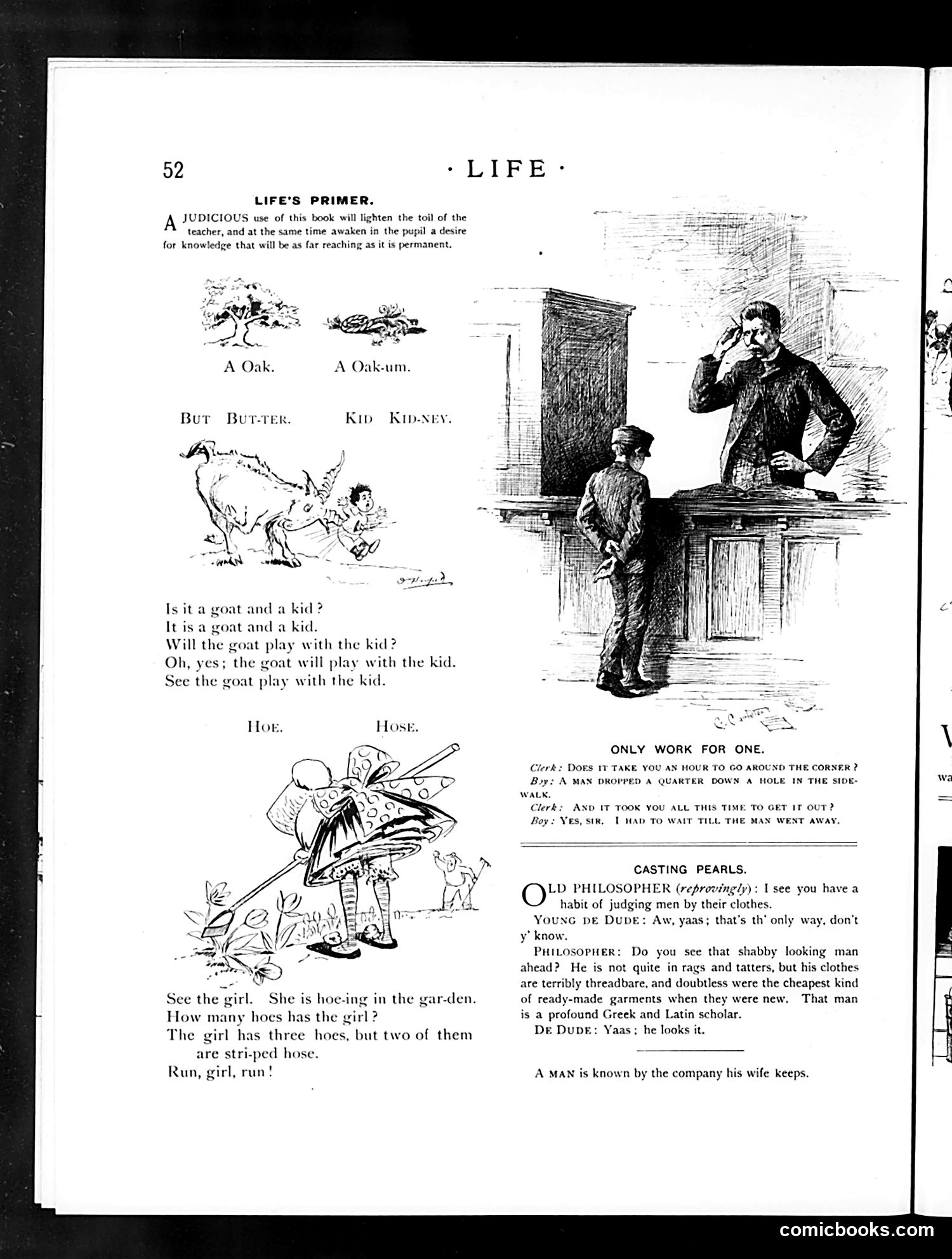
This page combines children's educational content with adult satire. The top section ("Life's Primer") uses wordplay and illustrations to teach simple concepts—"A Oak" / "A Oak-um," "But Butter" / "Kid Kidney"—employing puns typical of Victorian educational materials. The right side contains two separate satirical pieces. "Only Work for One" depicts a clerk and messenger, with dialogue mocking bureaucratic inefficiency and time-wasting. "Casting Pearls" presents a dialogue between a philosopher and young dude, satirizing class assumptions. The philosopher defends a shabby-dressed scholar as a "profound Greek and Latin scholar," while the dude judges by appearance alone—ridiculing superficial social judgment based on clothing rather than intellect.
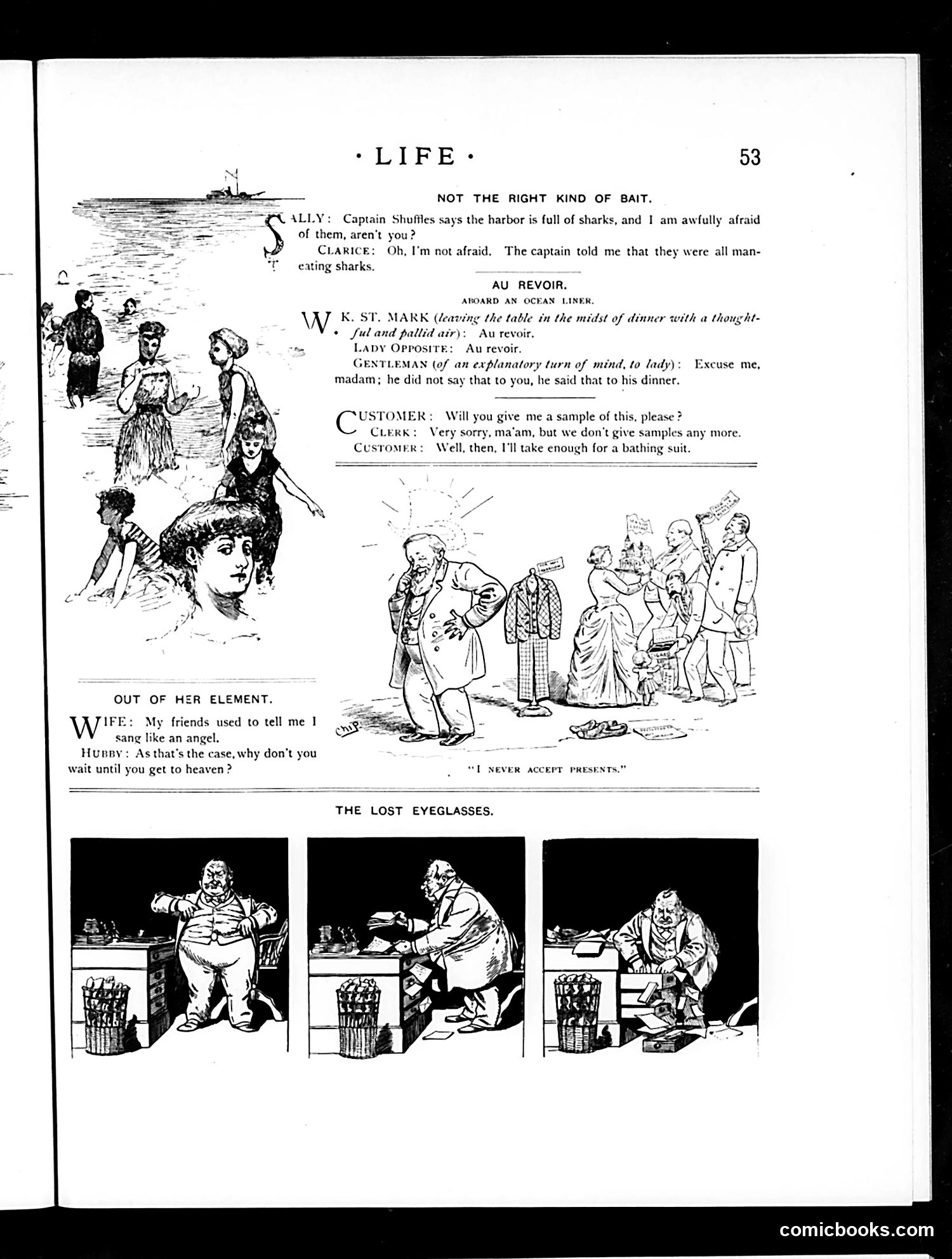
This page contains four separate comedic sketches: 1. **"Not the Right Kind of Bait"** - A conversation between passengers about sharks in the harbor, playing on fear of sea travel. 2. **"Au Revoir"** - A dinner scene aboard an ocean liner where a gentleman apologizes for an awkward comment, satirizing social etiquette among upper-class travelers. 3. **"Out of Her Element"** - A husband-wife joke about a wife who "sang like an angel," suggesting she should wait for heaven—dark humor about marital discord. 4. **"The Lost Eyeglasses"** - A three-panel comic strip showing a man searching for his glasses at a desk, likely a slapstick visual gag about misplaced objects. 5. **"I Never Accept Presents"** - A social satire about gift-giving etiquette. The humor targets early 20th-century middle and upper-class social conventions and domestic life.
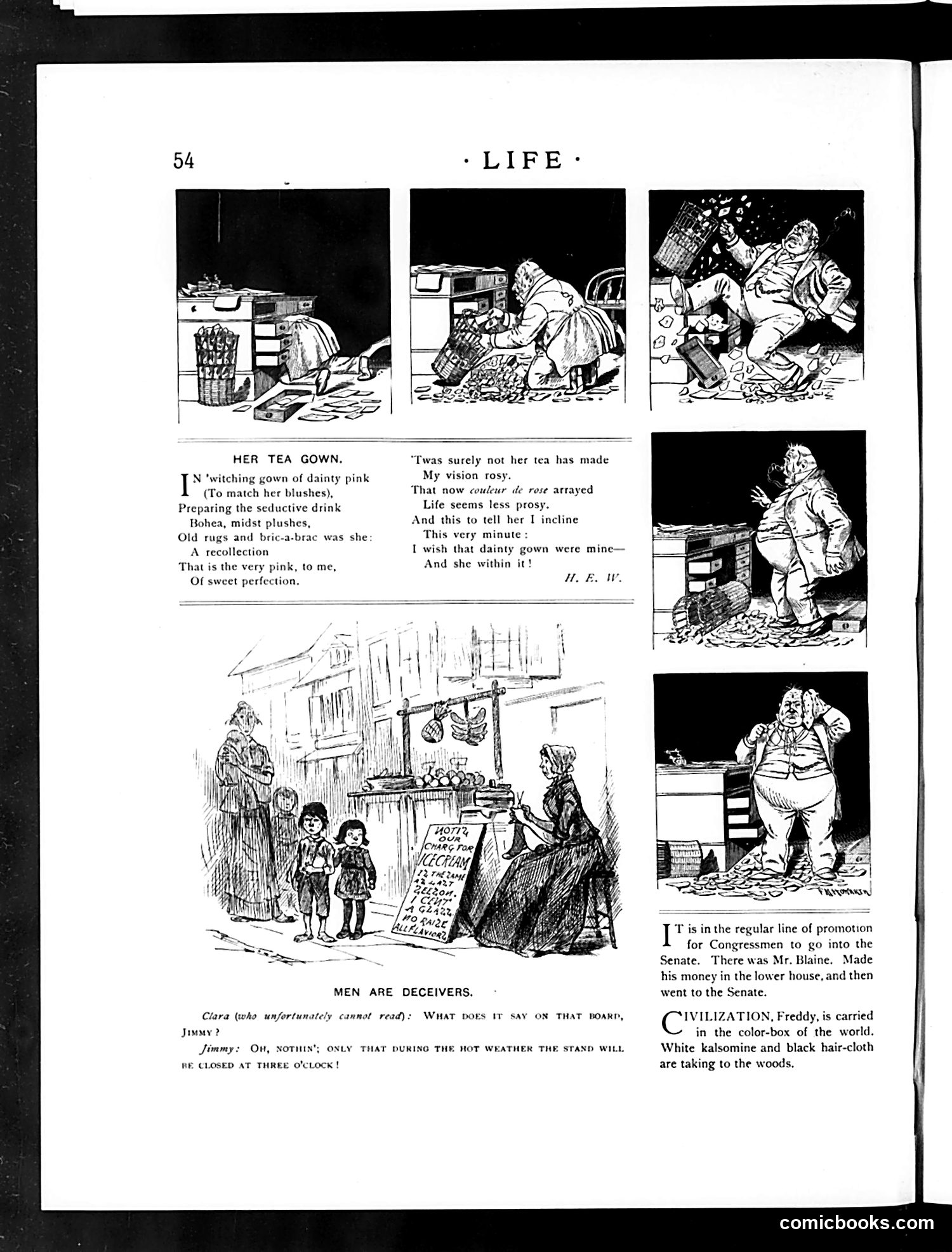
This page contains three distinct humorous pieces typical of early 20th-century American satire: **"Her Tea Gown"**: A romantic poem mocking sentimental Victorian courtship. A man is enchanted by a woman in a pink tea gown preparing tea, but the joke is his ulterior motive—he wants both the gown *and* the woman in it, reducing romance to physical desire. **"Men Are Deceivers"**: A brief comic dialogue where a child (Clara) asks Jimmy to read a shop sign. Jimmy deliberately misreads it, claiming the stand closes at 3 PM when it actually says something else—illustrating the title's point that men (even boys) are dishonest. **The Congressional Anecdote**: A brief quip about Mr. Blaine (likely James G. Blaine, 19th-century politician), noting the common path from the House to Senate as a money-making venture. **"Civilization"**: An obscure final joke suggesting civilization is superficial, reduced to whitewash and black cloth—possibly satirizing materialistic values. The accompanying illustrations show domestic chaos and social pretension.
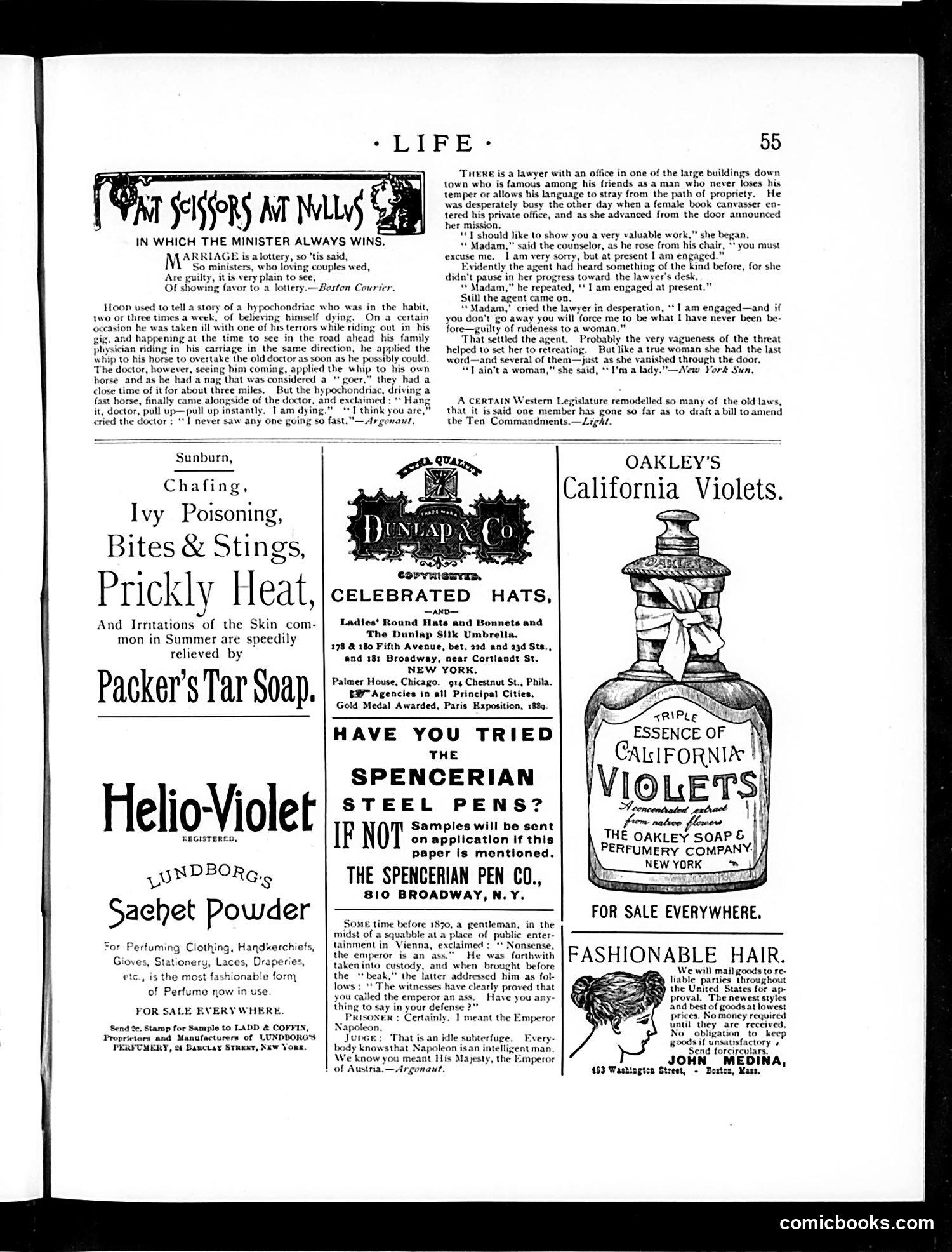
This page contains **three humorous anecdotes** rather than political cartoons: 1. **"Scissors at Nully"**: A jest about ministers officiating marriages, playing on "lottery" wordplay—ministers conduct many weddings, thus "show favor to a lottery." 2. **The Hypochondriac Doctor**: A story about a man convinced he's dying who chases down his physician on horseback for miles, only to have the doctor out-race him. The punchline: when the hypochondriac finally catches him, the doctor dismisses him with "I never saw anyone going so fast." 3. **The Lawyer and Book Canvasser**: A salesman won't leave a busy lawyer's office despite repeated dismissals. When he threatens to become "rude to a woman"—apparently unprecedented in his character—she finally retreats, but has the last word, proving herself "a lady" not "a woman." The page is primarily **advertising** (Packer's Tar Soap, Dunlap Hats, Spencerian Pens, etc.), with brief satirical prose pieces occupying the upper portion.
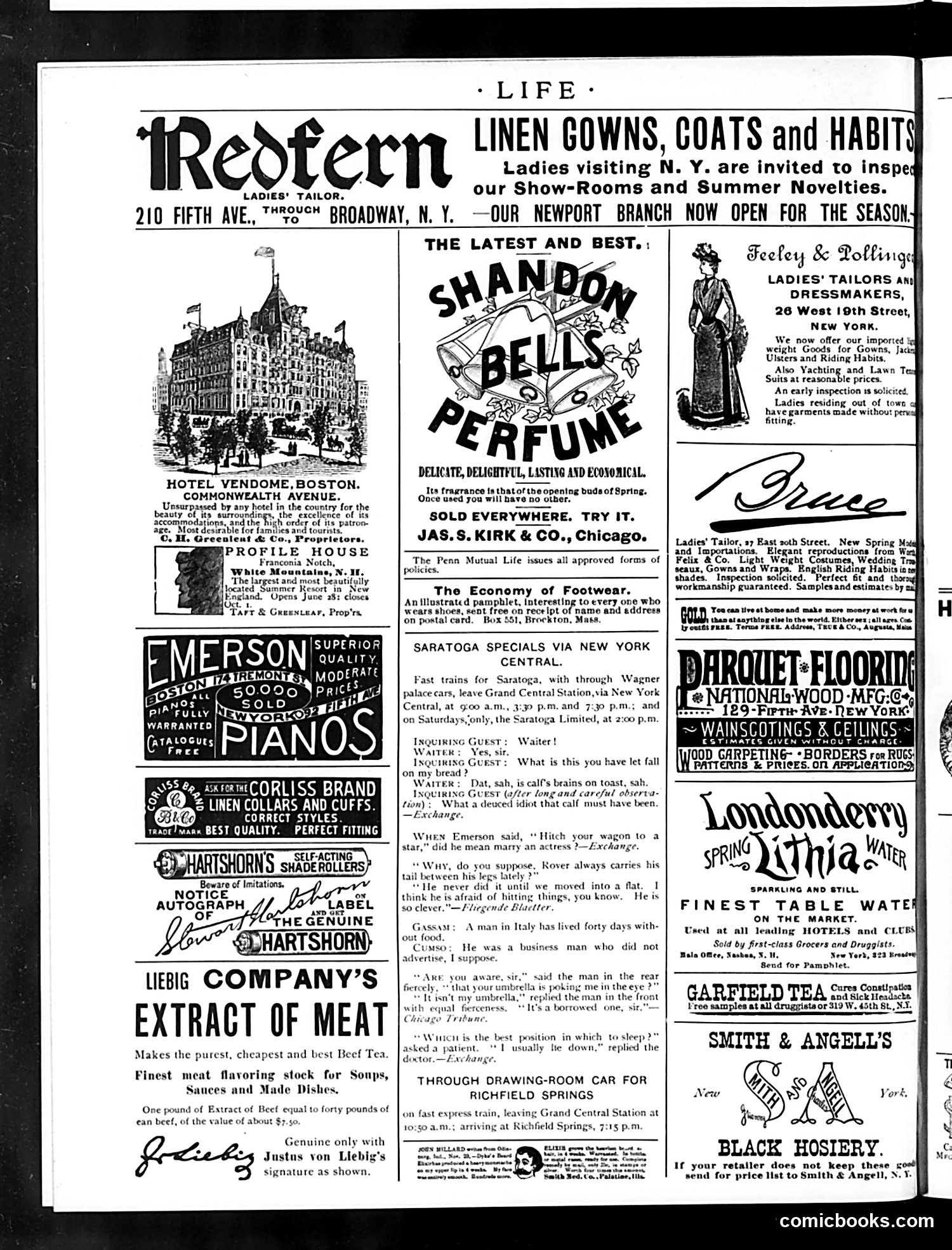
This is primarily a **commercial advertising page** from Life magazine, not a political cartoon. The page features numerous ads for late 19th-century luxury goods and services: ladies' tailoring, hotels (Hotel Vendome in Boston, Profile House in New Hampshire), pianos, perfume (Shandon Bells), meat extract, and rail service to Saratoga Springs. Interspersed are brief **humorous exchanges** typical of the era's light comedy: a waiter's deadpan response about calf brains, jokes about hitching wagons to actresses (referencing Emerson), and observations about apartment living. These rely on period assumptions about class, gender, and social manners that modern readers would find quaint rather than particularly sharp satire. The page reflects **Gilded Age consumer culture**—targeting wealthy women through fashion and leisure advertising while demonstrating contemporary wit through brief, genteel comedy bits. There are no identifiable political figures or substantive social critique present.
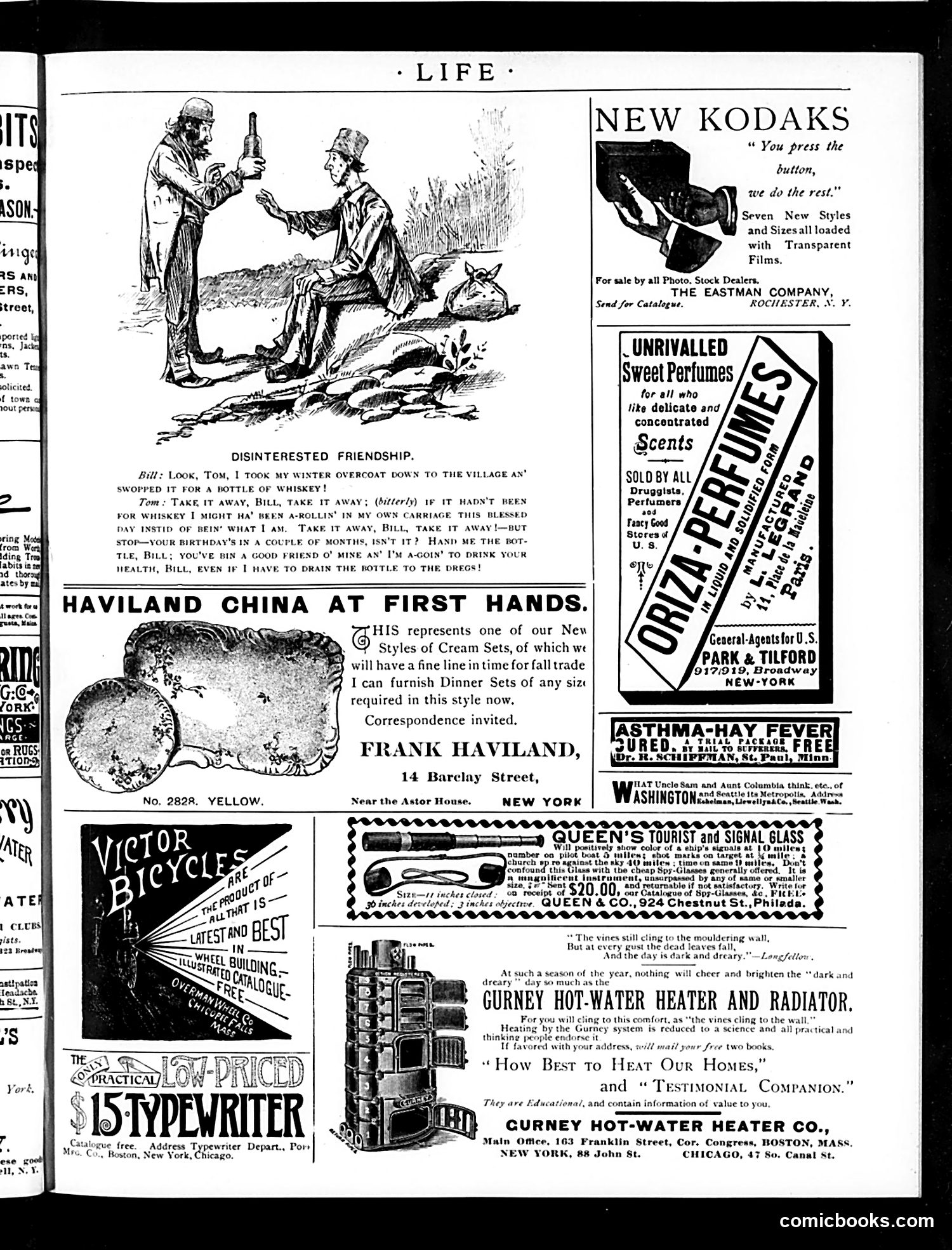
This cartoon satirizes alcoholism and self-destructive behavior disguised as friendship. Two poor men, Bill and Tom, engage in a darkly ironic exchange: Bill trades his winter overcoat for whiskey, and Tom—rather than offering genuine help—accepts the bottle, claiming whiskey ruined his life but he'll drink to Bill's health anyway. The satire targets the rationalization of addiction: both men acknowledge whiskey's destructive power yet actively participate in it. Tom's statement that he'd be riding in a carriage "if it hadn't been for whiskey" reveals how the substance derails lives, yet he demands more of it. The title "Disinterested Friendship" is mockingly ironic—their "friendship" involves mutual enablement toward self-harm rather than actual concern for each other's welfare. This reflects late-19th-century anxieties about poverty, vice, and the cycle of alcoholism in working-class communities.
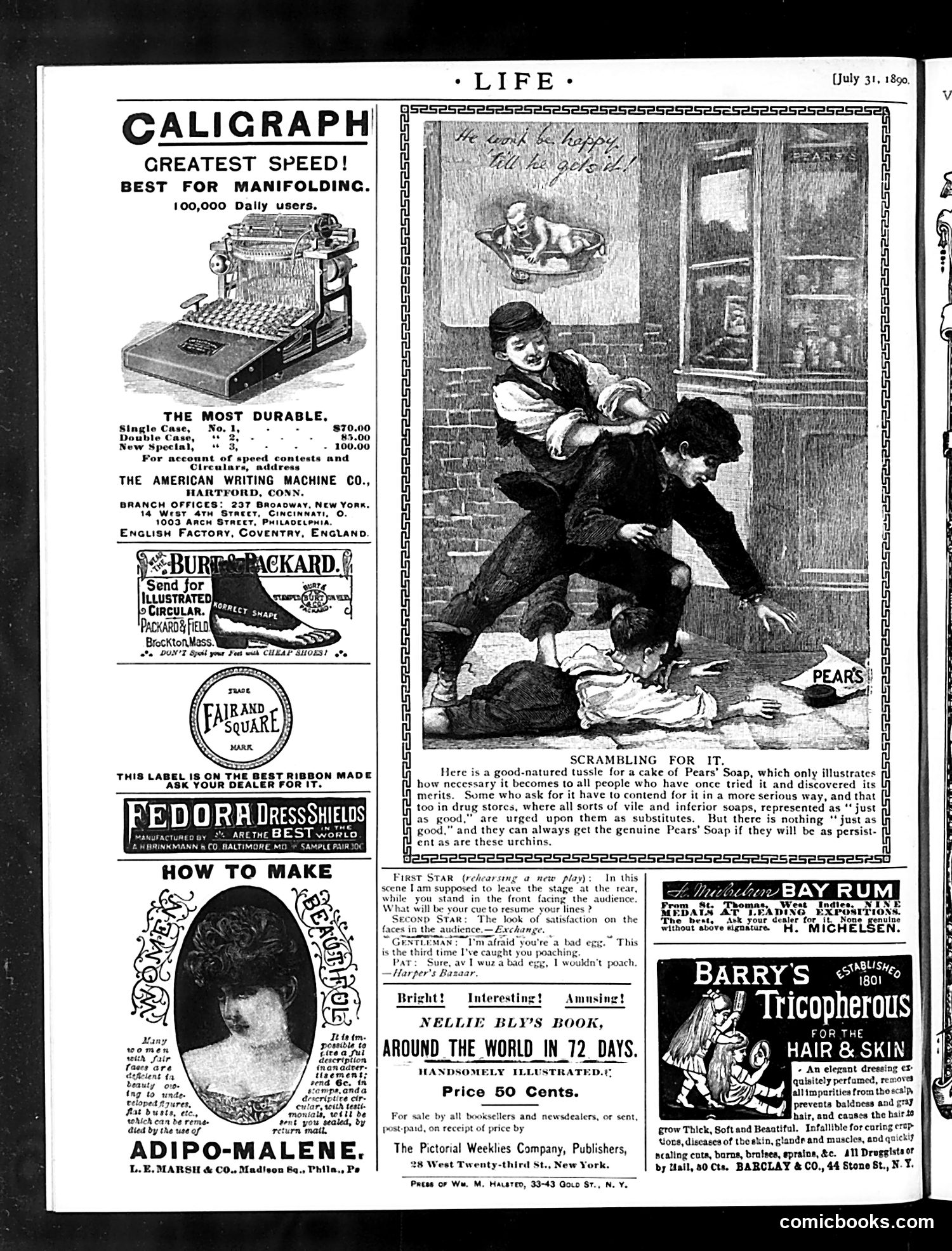
This page is primarily **advertising** from Life magazine (July 31, 1890). The main cartoon illustrates a Pears' Soap ad showing street urchins physically fighting over a cake of soap—a humorous visual metaphor for the product's desirability. The accompanying text explains the joke: consumers so desperately want genuine Pears' Soap that they must "scramble" for it because pharmacists try to sell inferior substitutes claiming to be "just as good." The cartoon depicts this competitive demand as child's play, suggesting the soap's reputation makes it worth fighting for. The page also includes ads for typewriters (Caligraph), corsets, dress shields, and beauty products (Adipo-Malene), plus a promotion for Nellie Bly's travel memoir *Around the World in 72 Days*—a reference to her famous 1889-1890 circumnavigation journey.