
A complete issue · 16 pages · 1890
Life — July 17, 1890
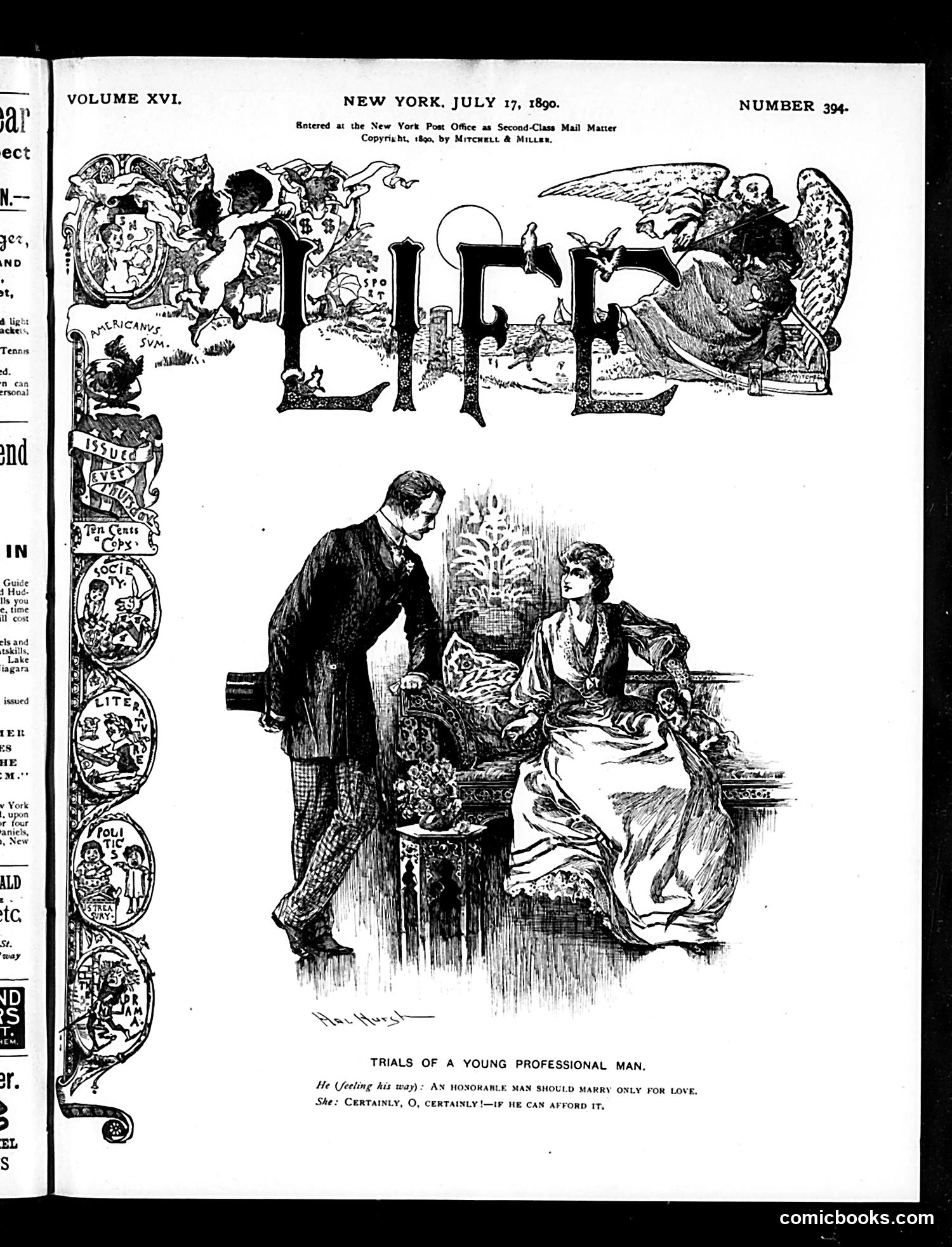
This satirical cartoon depicts a social dilemma common to late-19th-century America. The caption presents a dialogue between a young man and woman: **His (ironic suggestion):** "An honorable man should marry only for love." **Her (practical response):** "Certainly, O, certainly!—if he can afford it." The joke critiques the tension between romantic ideals and economic reality. While the man espouses the Victorian ideal that marriage should be based on love, the woman's retort highlights the practical necessity of financial security—suggesting that poor young professionals cannot afford the luxury of marrying for love alone. This satirizes both the gap between upper-class romantic rhetoric and working/middle-class economic pressures, and perhaps women's pragmatic assessment of marriage as an economic arrangement rather than purely romantic union.
This page is **primarily advertising** with a header section about summer reading recommendations. The advertisements include books from Roberts Brothers publishers, the Luray Inn hotel in Virginia, printing services, bicycles, hotels, wine, and perfume products. The only cartoon visible is a **Victor Bicycles advertisement** featuring a stylized illustration of a bicycle with dramatic rays emanating from it, using common late-19th-century advertising aesthetic. This is not political satire but rather commercial promotion emphasizing the product as "the latest rest in racing." The page reflects the magazine's business model: mixing editorial content about literature with paid advertisements targeted at educated, middle-class readers interested in consumer goods and leisure activities.
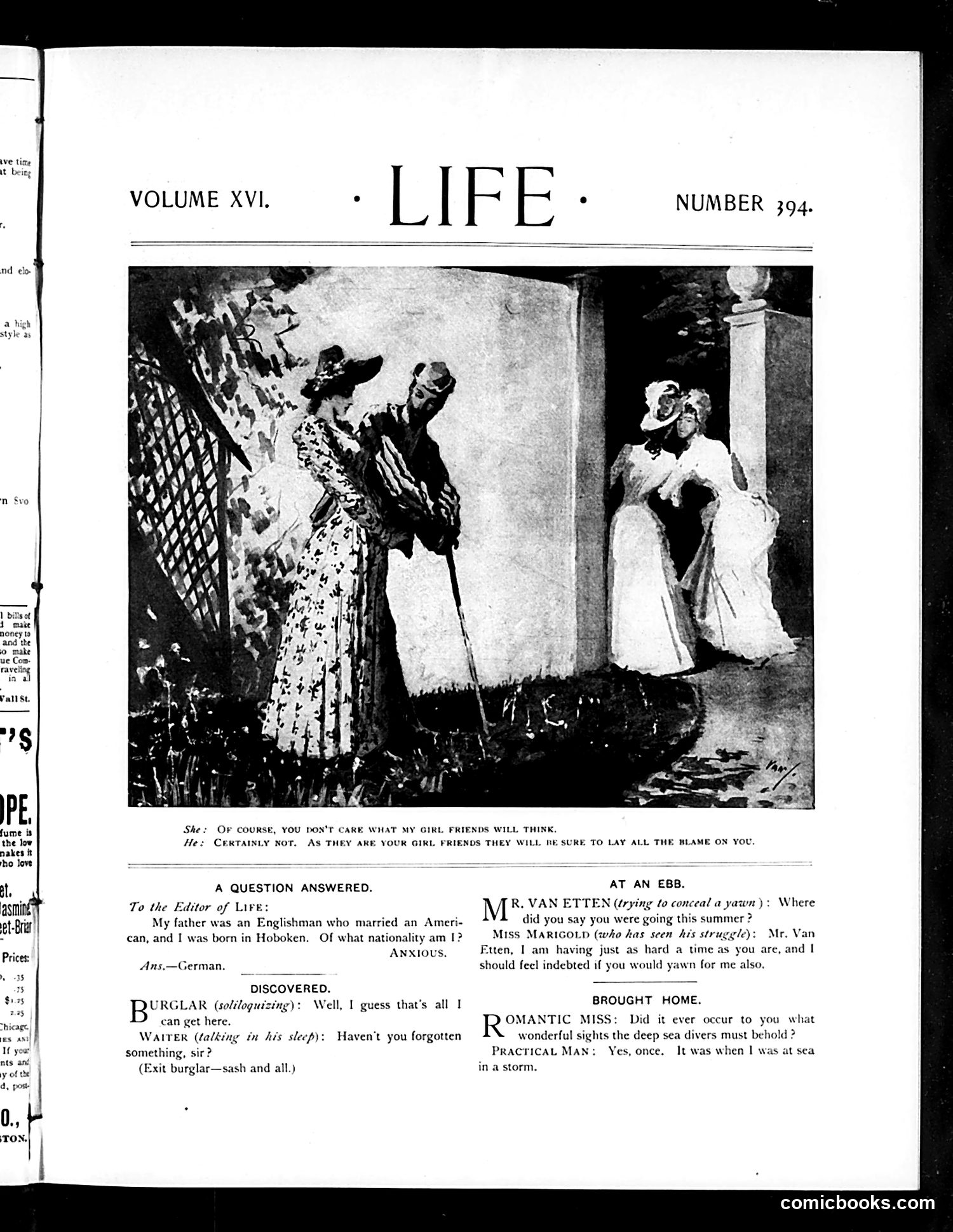
This page contains a domestic comedy sketch and several brief humorous letters to the editor. The main illustration depicts a marital dispute: a man appears to be caught between his wife and another woman (described as "your girl friends"), with the wife sarcastically remarking she doesn't care what his girl friends think, while he protests they'll blame him for the situation. Below are three short comic exchanges: a burglar interrupting a waiter's sleep, and two reader letters about an Englishman's nationality and a romantic sea story. The humor relies on typical early-20th-century domestic comedy tropes—infidelity accusations, marital conflict, and sarcastic banter. The content reflects period attitudes toward marriage and gender relations rather than political satire.
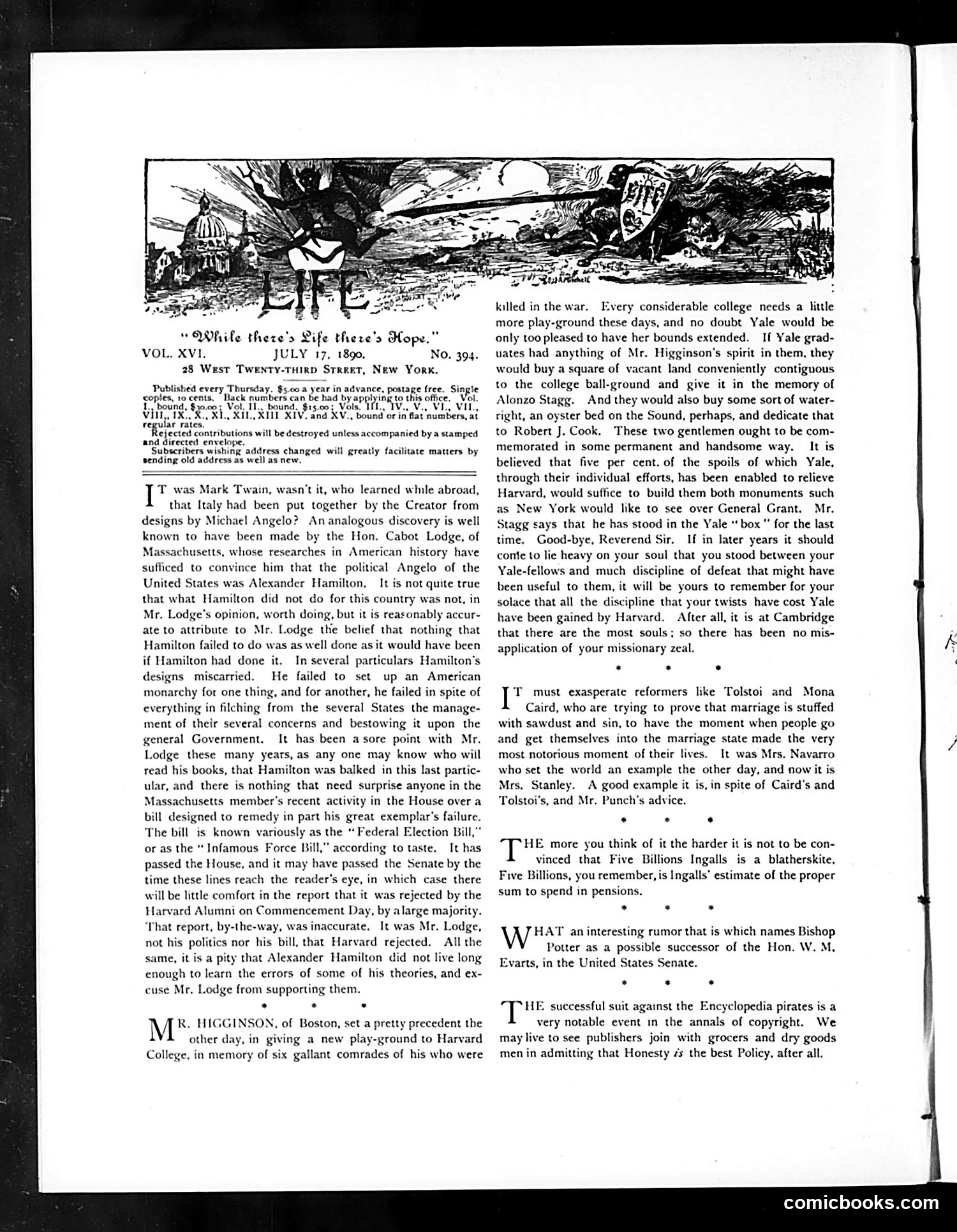
This page from Life (July 17, 1890) contains editorial commentary rather than cartoon illustrations. The text discusses several political and social topics: 1. **Mark Twain and Italian governance**: References Twain's observations about Italy's political design, contrasting it with Alexander Hamilton's failure to establish proper American governmental structures. 2. **Cabot Lodge's critiques**: Discusses the Massachusetts politician's views on Hamilton's errors and federal policy failures. 3. **Harvard College fundraising**: Mr. Higginson of Boston donated a playground to Harvard in memory of six comrades killed in war, highlighting the need for college recreational spaces. 4. **Social criticism**: Brief satirical notes on marriage reformers (Tolstoy, Mona Caird) and copyright law disputes with encyclopedia publishers. The page exemplifies Life's role as a venue for political commentary and social satire of the era.
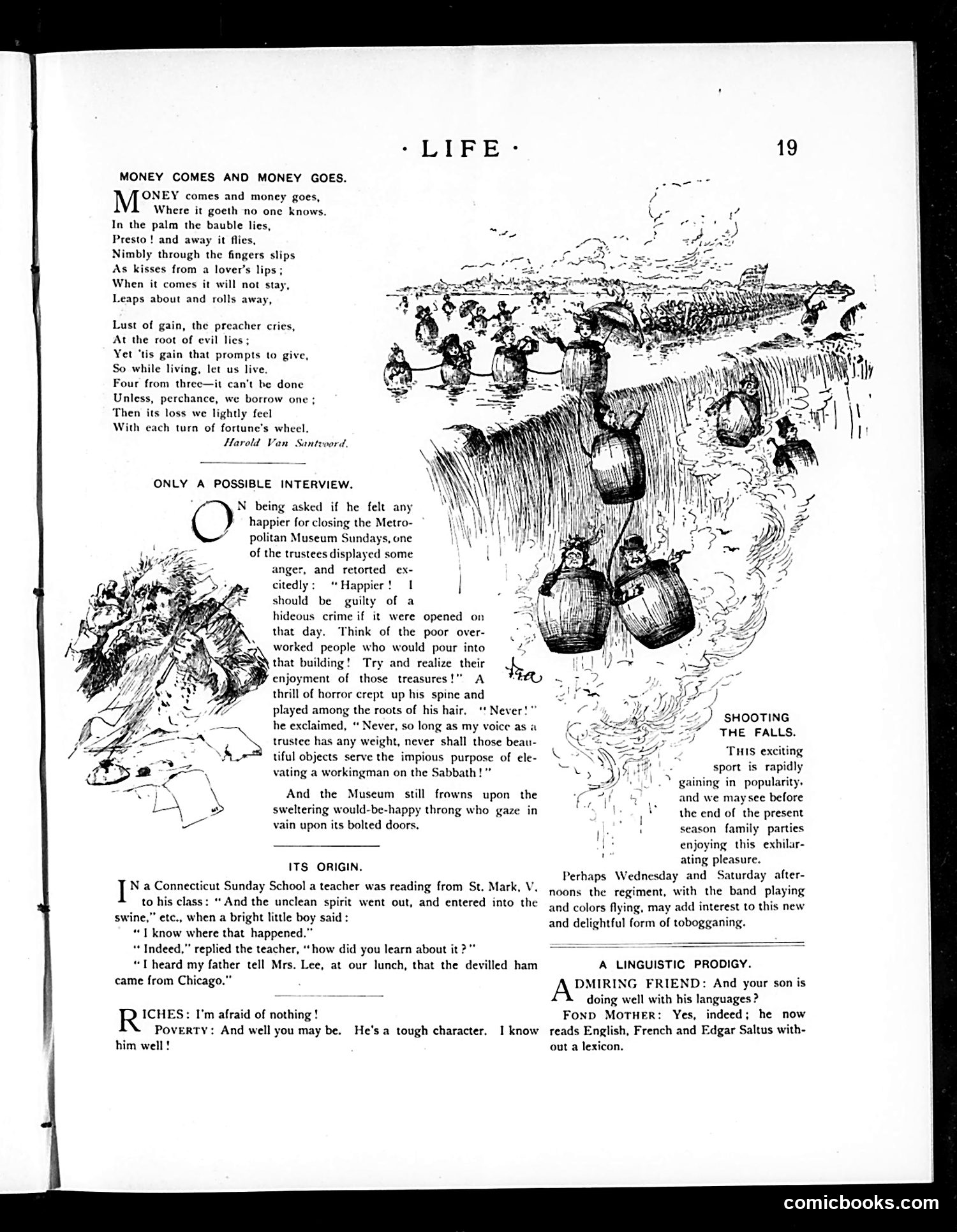
This page contains several short satirical pieces rather than a single cartoon: **"Money Comes and Money Goes"** is a moralistic poem about financial instability and the fleeting nature of wealth. **"Only a Possible Interview"** mocks a museum trustee's defensive response to criticism about opening on Sundays. The trustee dismisses concerns about overworked people accessing the museum, suggesting the real issue is keeping working-class visitors out—satirizing class-based museum policies. **"Its Origin"** presents a humorous anecdote about a boy explaining demonic possession through his father's lunch. **"Riches: Poverty"** is a brief joke contrasting wealthy and poor characters. **"Shooting the Falls"** briefly mentions a new sporting trend. **"A Linguistic Prodigy"** jokes about a child learning multiple languages. The illustrations are decorative rather than politically pointed.
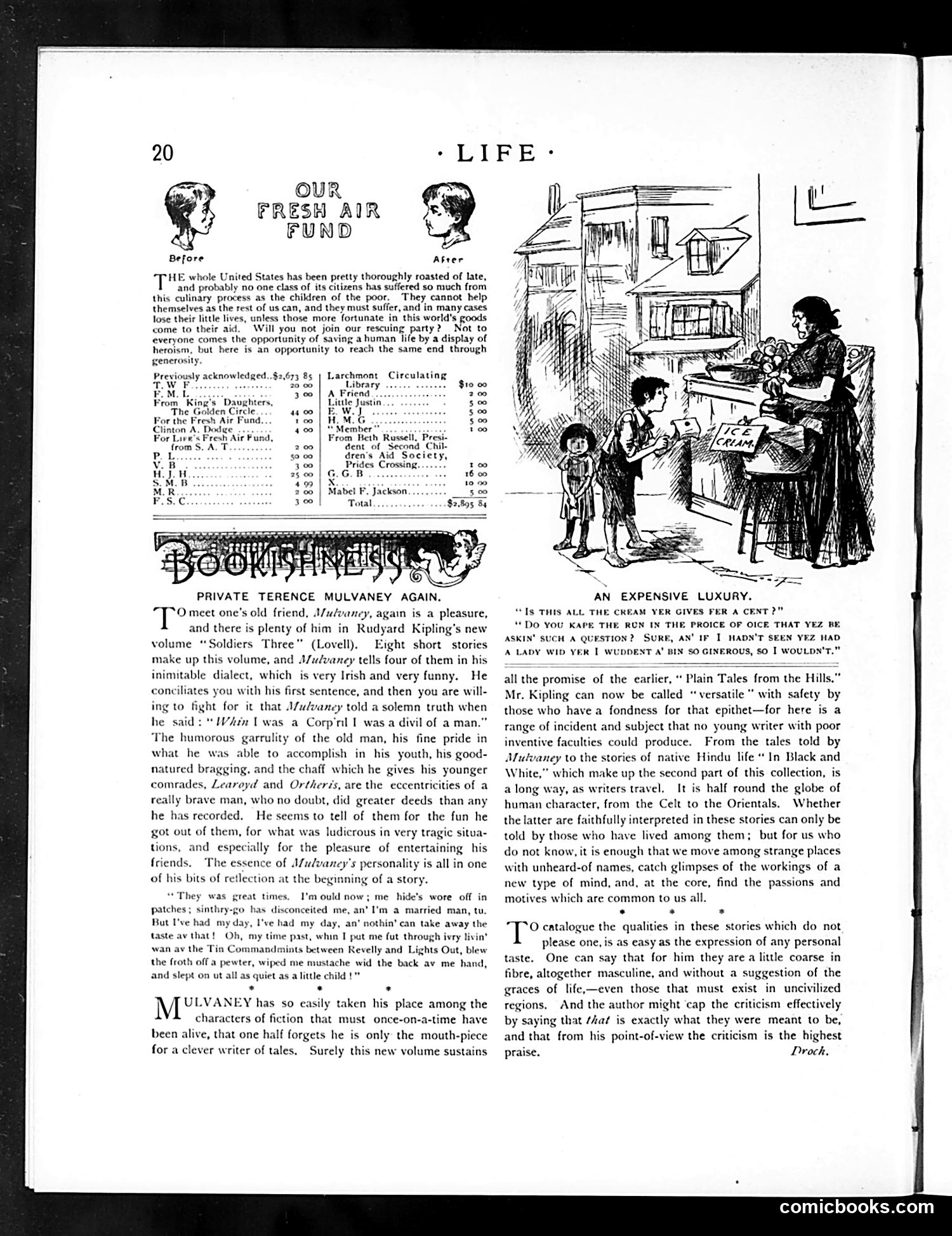
This page contains two distinct sections: **"Our Fresh Air Fund"** (top left): A charitable fundraising appeal with before/after illustrations showing the impact of fresh air on sickly poor children. The list tracks donations to help underprivileged children from urban tenements experience healthier conditions. **Book Reviews** (bottom): The main content discusses Private Terence Mulvaney, a character from Rudyard Kipling's new volume "Soldiers Three." The review praises Kipling's ability to capture authentic Irish dialect and character quirks. It compares his work favorably to his earlier "Plain Tales from the Hills." **"An Expensive Luxury"** (right illustration): Shows a domestic scene where a woman questions the cost of cream for her table, humorously contrasting with the charitable giving discussed elsewhere on the page. The page juxtaposes philanthropic appeals with literary criticism and domestic humor.
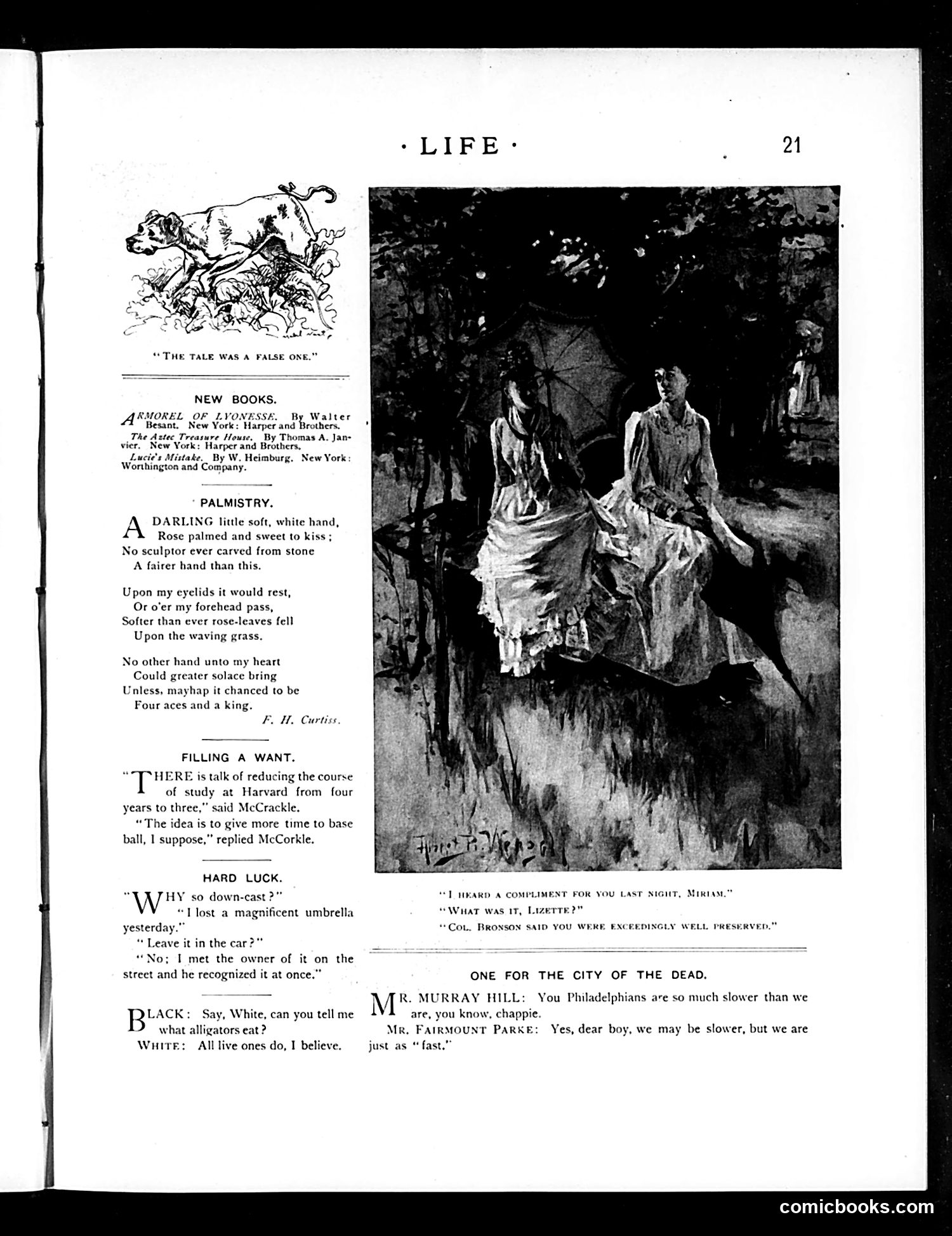
This page contains several brief humorous items rather than sustained political cartoons. The content includes: **"Palmistry"** - A romantic poem praising a woman's hand, attributed to F. H. Curtiss. **"Filling a Want"** - A joke about reducing Harvard's four-year curriculum to three years, poking fun at educational efficiency. **"Hard Luck"** - A brief comic exchange about losing an umbrella and recognizing its owner on the street. **"Black: Say, White, can you tell me what alligators eat?"** - A racial joke playing on names "Black" and "White." **"One for the City of the Dead"** - A dialogue between Mr. Murray Hill and Mr. Fairmount Parke about Philadelphia being slower than other cities, a mild regional jab. The page primarily showcases Life's satirical humor style: wordplay, social observation, and light mockery of contemporary life and regional differences.
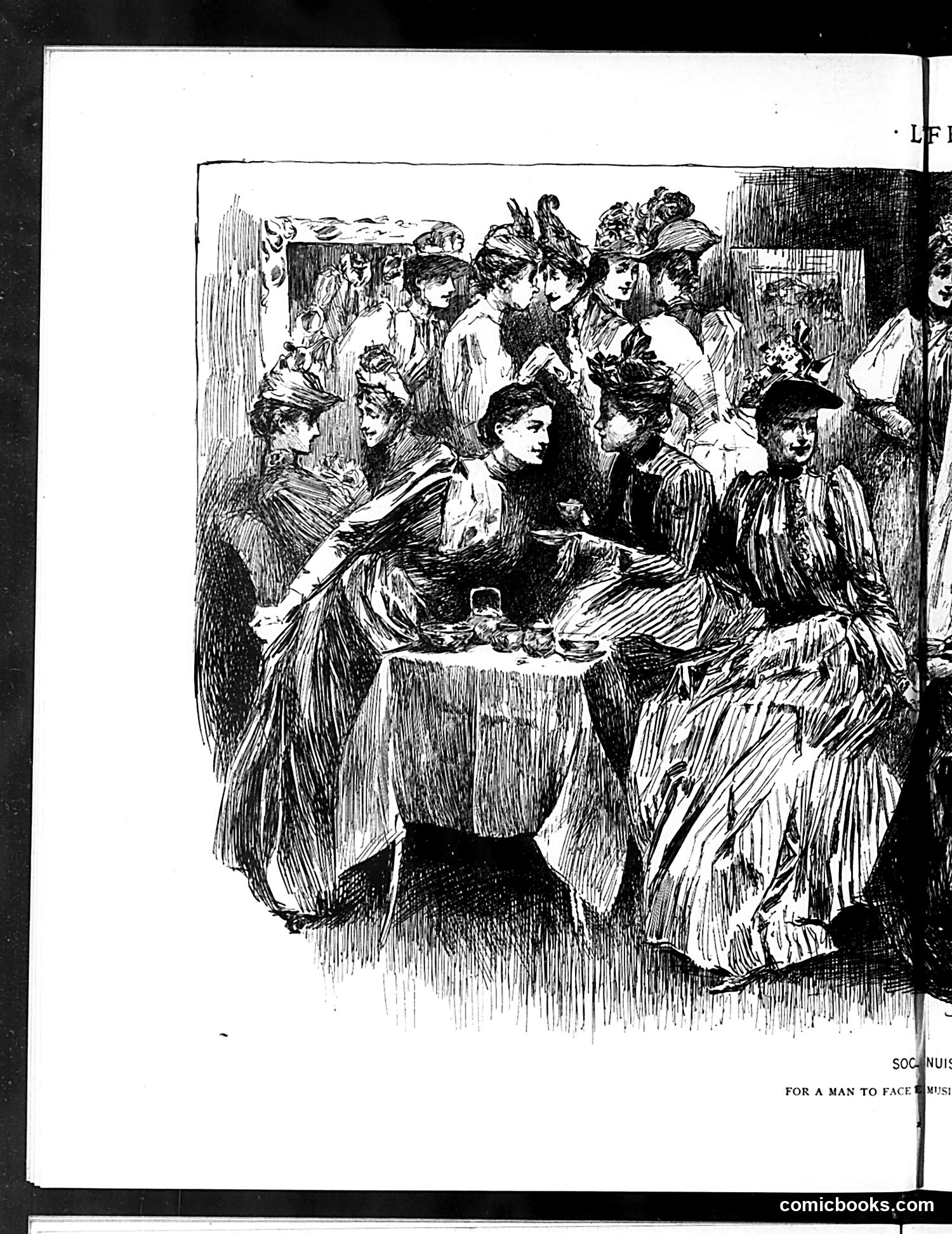
This is a black and white sketch depicting a crowded social gathering of well-dressed women in what appears to be late 19th-century attire, gathered around a small table. The partial caption visible reads "FOR A MAN TO FACE E MUSI" (text cut off). The satire appears to target **social anxiety or awkwardness in mixed-gender social situations**—specifically the discomfort men faced when navigating women's social spaces or gatherings. The crowded, bustling scene of elaborately dressed women surrounding a central table suggests the intimidating or chaotic nature of such encounters from a male perspective. Without the complete caption, the exact joke remains unclear, but this reflects **fin-de-siècle humor about gender relations and social etiquette**, a common theme in Life magazine's satirical commentary on Victorian and Edwardian society.
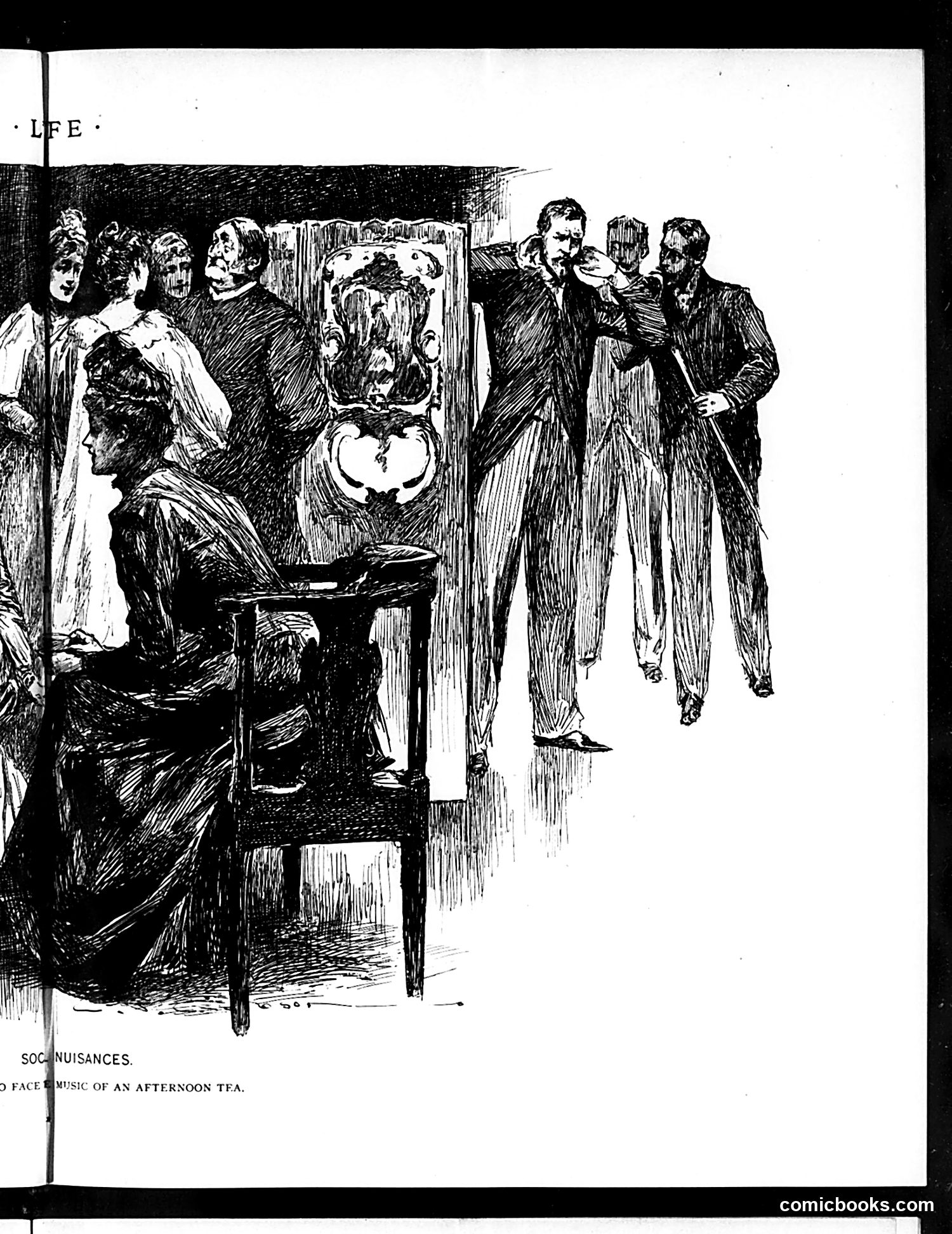
This satirical illustration depicts a common social embarrassment of the Victorian/Edwardian era: amateur musical performances at social gatherings. The scene shows an unwilling audience enduring a woman's recital at an afternoon tea party. The central figure appears to be a female musician performing at a piano or similar instrument, while well-dressed guests display various expressions of discomfort and boredom—some turning away, others appearing pained. The satire targets the social convention where hosts felt obligated to feature amateur musicians, often talentless, during social calls. "Discordant face music" suggests both the poor quality of the performance and the distorted facial reactions it produces in listeners forced to maintain polite composure despite evident suffering.
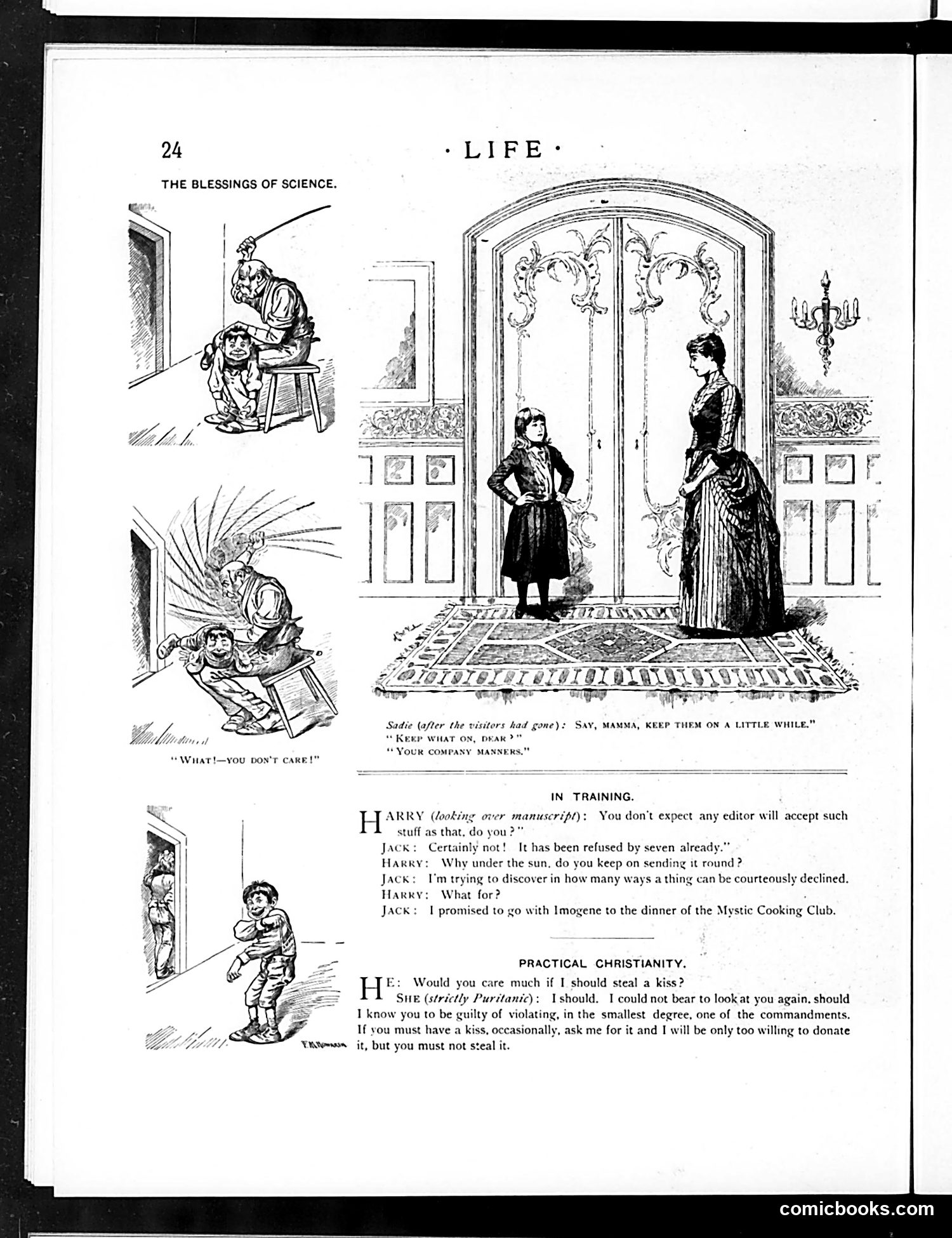
**"The Blessings of Science"** depicts a humorous contrast: a scientist conducting an electrical experiment on a child while another child watches in horror. The satire critiques unregulated scientific experimentation on human subjects, presenting science's "blessings" as potentially dangerous when applied carelessly. **The right panel** shows a mother instructing her daughter on proper social etiquette—"keep them on a little while" and "your company manners"—satirizing Victorian social conventions and the performative nature of upper-class behavior. **"In Training"** and **"Practical Christianity"** are brief comedic dialogues. The first jokes about manuscript rejection; the second presents ironic "Christian" advice about stealing kisses, mocking hypocritical morality that permits minor transgressions. Overall, the page satirizes scientific recklessness, social pretense, and moral hypocrisy in early 20th-century society.
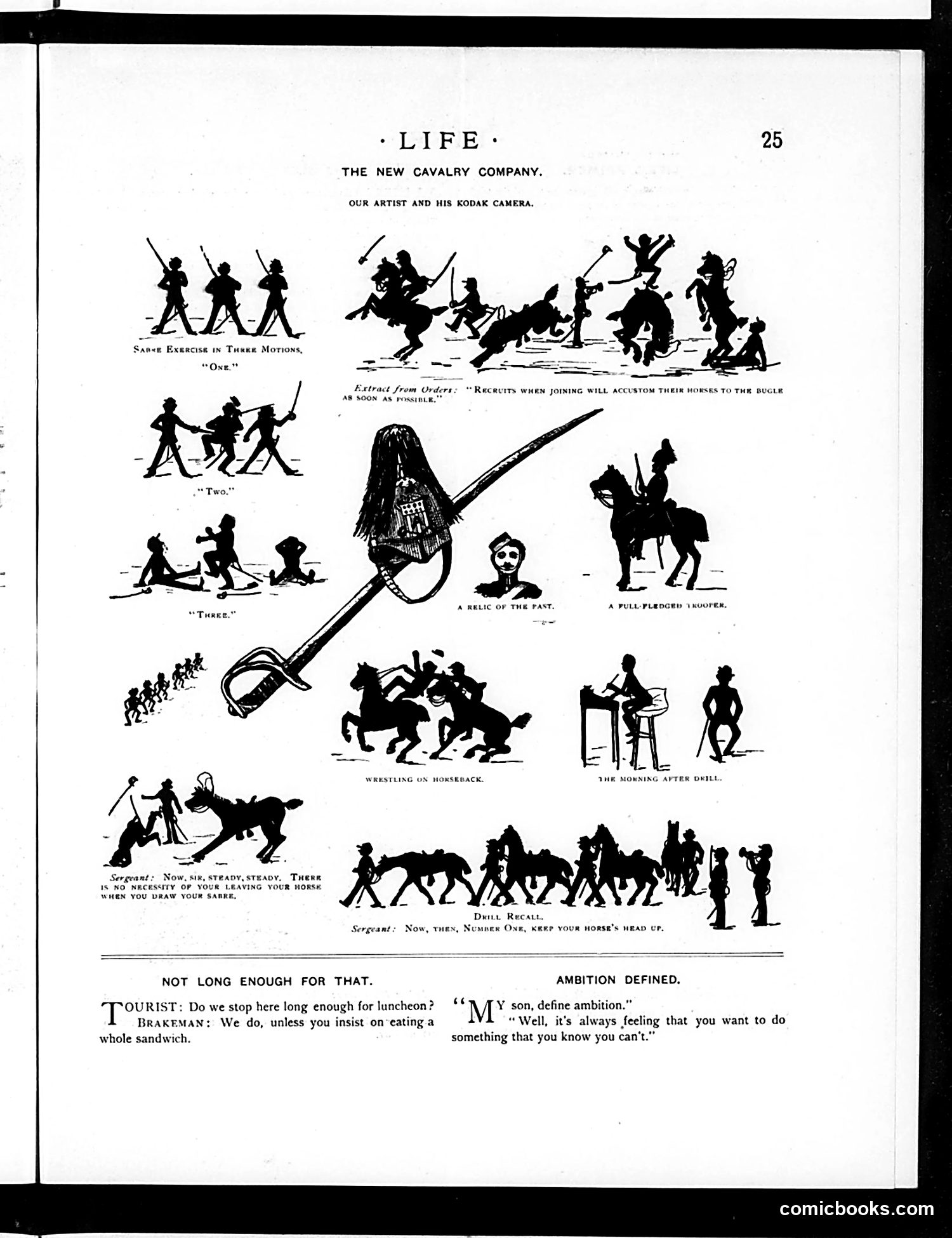
This page from *Life* magazine satirizes military cavalry training through silhouette illustrations. The top section, titled "The New Cavalry Company: Our Artist and His Kodak Camera," depicts various cavalry exercises and maneuvers in exaggerated, humorous poses—soldiers performing drills, wrestling on horseback, and conducting formations. The satire targets the perceived absurdity of traditional cavalry tactics in a modern era. The phrase "Our Artist and His Kodak Camera" suggests the magazine is documenting these training methods through photography, implying they're worth mocking as outdated. Below are two brief joke exchanges: one about a tourist and brakeman debating lunch timing, another defining ambition as "feeling that you want to do something that you know you can't." The cartoons mock ceremonial military practices as increasingly irrelevant.
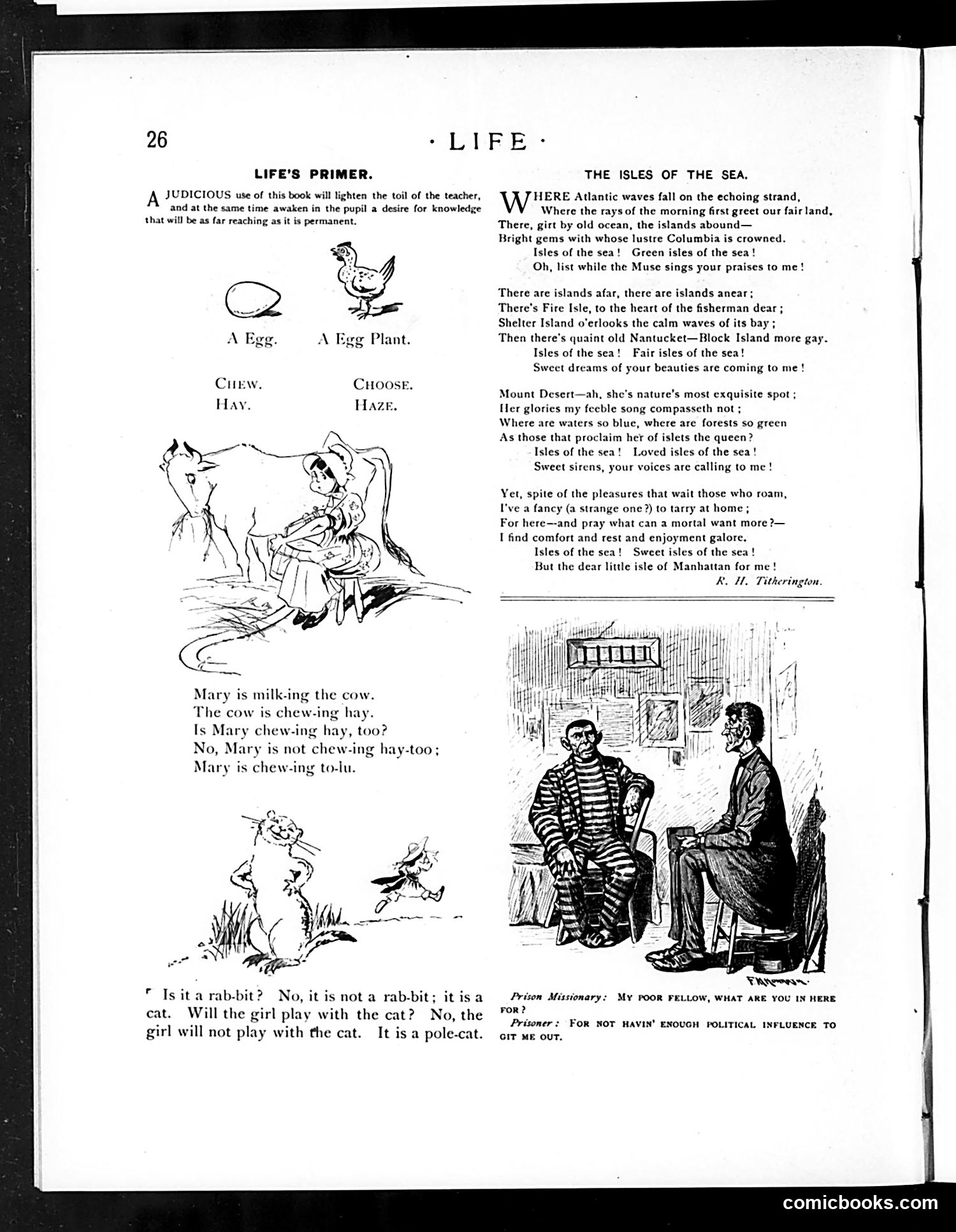
This page mixes educational primers with social satire. The top section includes simple lessons ("Life's Primer") teaching children basic vocabulary through images and rhymes—eggs, hay, cows, and animals. The bottom cartoon depicts a **Prison Missionary** visiting an inmate. The prisoner's response—that he's imprisoned for lacking "enough political influence to git me out"—satirizes **political corruption and patronage** in the late 19th/early 20th century. The joke suggests that criminal justice is determined not by guilt or innocence, but by one's political connections. Those with sufficient influence could escape prosecution or imprisonment; the poor and powerless could not. The poem "Isles of the Sea" celebrates American islands (Nantucket, Block Island, Manhattan), with the twist that the poet ultimately prefers Manhattan to scenic alternatives—likely reflecting contemporary urban life and commerce. The page title "Life's Primer" uses educational framing ironically to present cynical social commentary about American institutions.
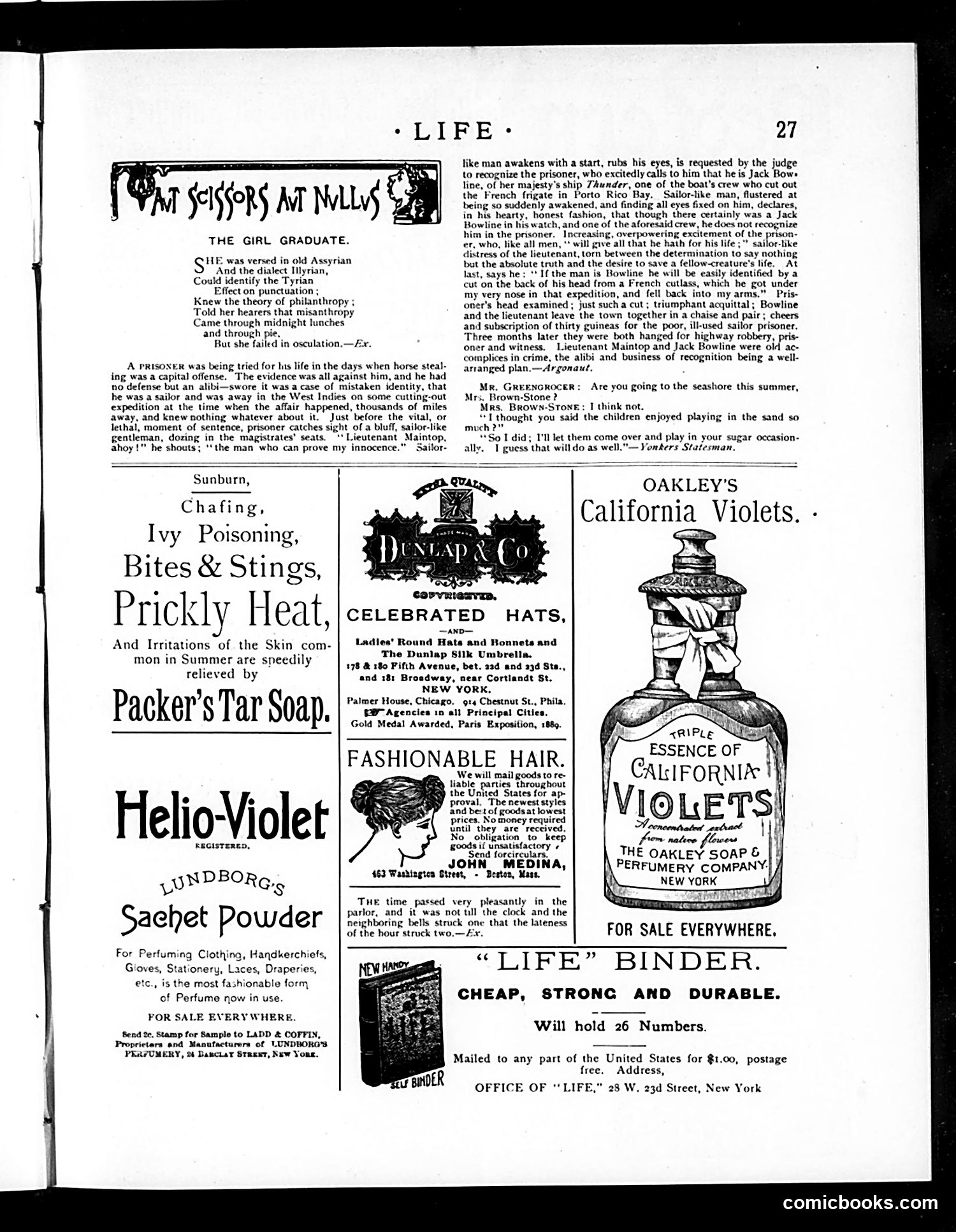
This page contains two distinct narrative pieces alongside period advertisements. **"The Girl Graduate"** is a satirical poem about an overeducated woman versed in ancient languages and philanthropic theory but lacking practical domestic skills—particularly "osculation" (kissing), suggesting she's unmarriageable despite her intellectual credentials. The joke targets 19th-century anxieties about female education making women unsuitable wives. **"A Prisoner"** tells a darkly ironic anecdote: a sailor accused of horse theft produces a supposed witness (Lieutenant Maintop) who identifies him, leading to acquittal. The twist: both were actually accomplices, and the "alibi" was a con. The satire mocks the unreliability of eyewitness testimony and justice itself. A brief dialogue between a grocer and "Mrs. Brown-Stone" jokes about wealthy summer leisure—she won't visit the seashore but will let her children play in the grocer's sand pile instead, satirizing upper-class penny-pinching. The remainder is period advertising for soaps, perfumes, hats, and a magazine binder.
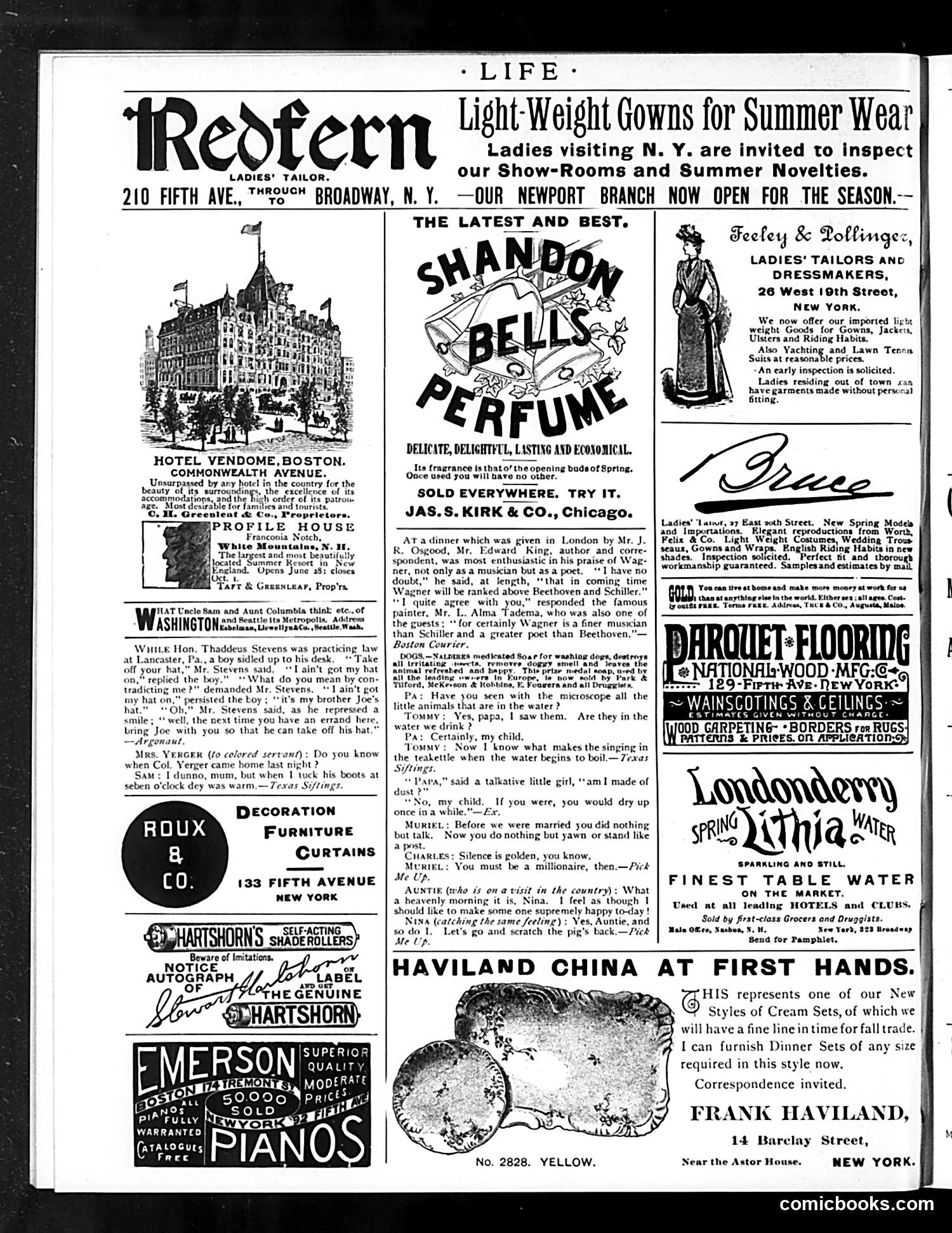
This is primarily an **advertising page** from Life magazine, not a political cartoon. It features: **Main content**: Commercial advertisements for luxury goods (Redfern ladies' tailoring, Shandon Bells perfume, pianos, furniture, china, water) interspersed with brief **humorous anecdotes**. **The humor pieces** are gentle, non-political jokes about: - A boy's semantic quibble about whose hat he's wearing (Thaddeus Stevens anecdote) - A servant's warm boots revealing the master came home late drunk - Microscopic organisms in drinking water causing teakettle sounds - A wife's observation that her husband traded talking before marriage for yawning after **No political satire is evident.** The page reflects **Gilded Age consumer culture**—targeting wealthy New York ladies with imported fashions and fine goods. The humor is domestic and observational rather than satirical.
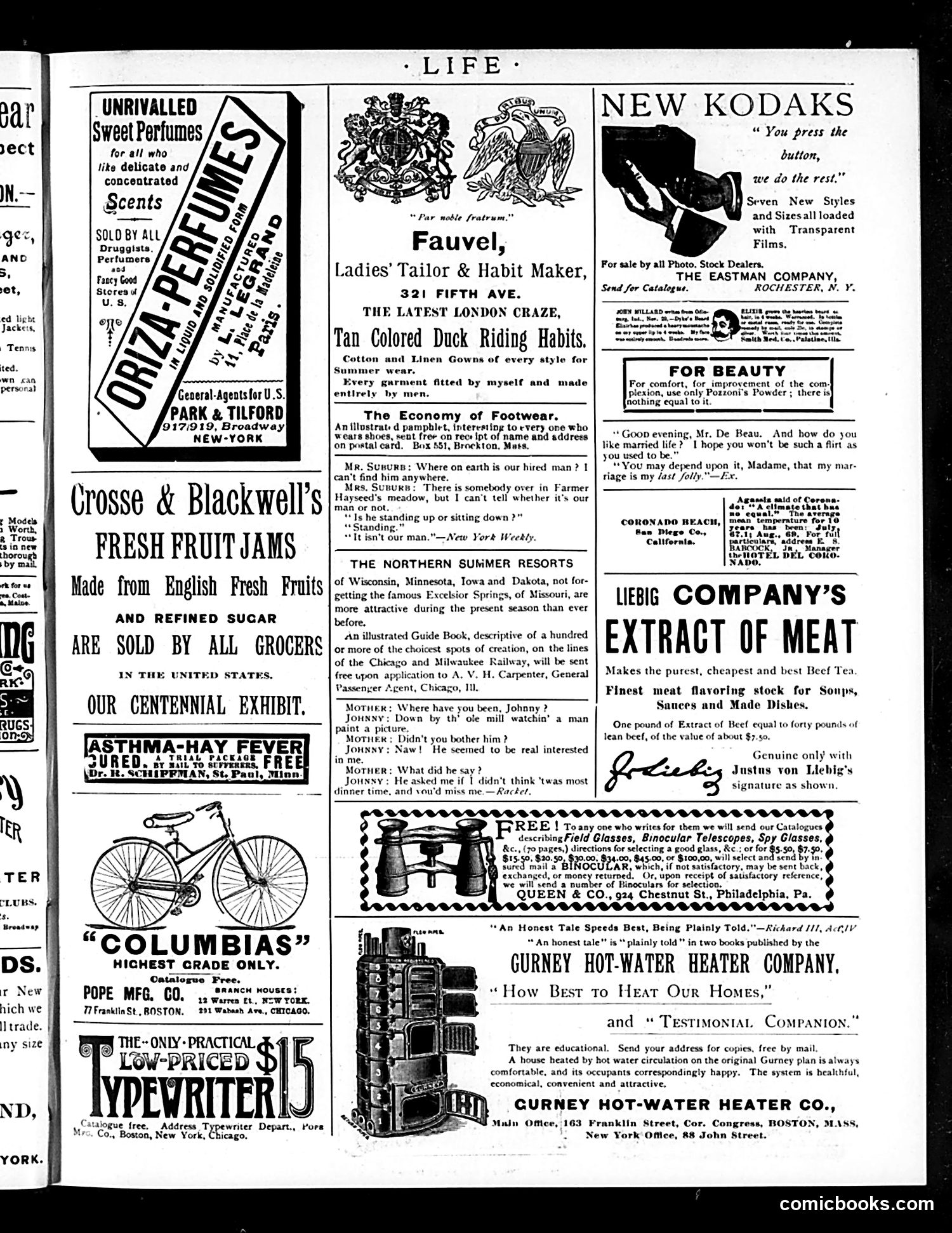
This is primarily an **advertising page** from Life magazine, with minimal editorial content. The few jokes/cartoons present are brief: **The Humor:** - A rural dialogue about a hired man ("standing" vs. "sitting" determines identity) — gentle, class-based humor about farm workers - A scene with a painter where a boy unknowingly annoys an artist, who asks if it's "dinner time" — mild observational humor about parental worry - A courtship joke where a man promises marriage will reform his flirtatiousness — light domestic satire **Historical Context for Modern Readers:** The page reflects late-19th-century consumer culture: bicycles ("Columbias"), early typewriters ($15—expensive), the new Kodak camera (revolutionary—consumers "press the button, we do the rest"), and luxury goods (French perfumes, British preserves). The rural/urban divide appears in jokes mocking farmhands. Women's fashion ("Tan Colored Duck Riding Habits") and beauty products dominate advertising. **The satire is minimal and gentle**—mostly social observation rather than political commentary. This reflects Life's role as a lifestyle/humor magazine for middle-class readers.
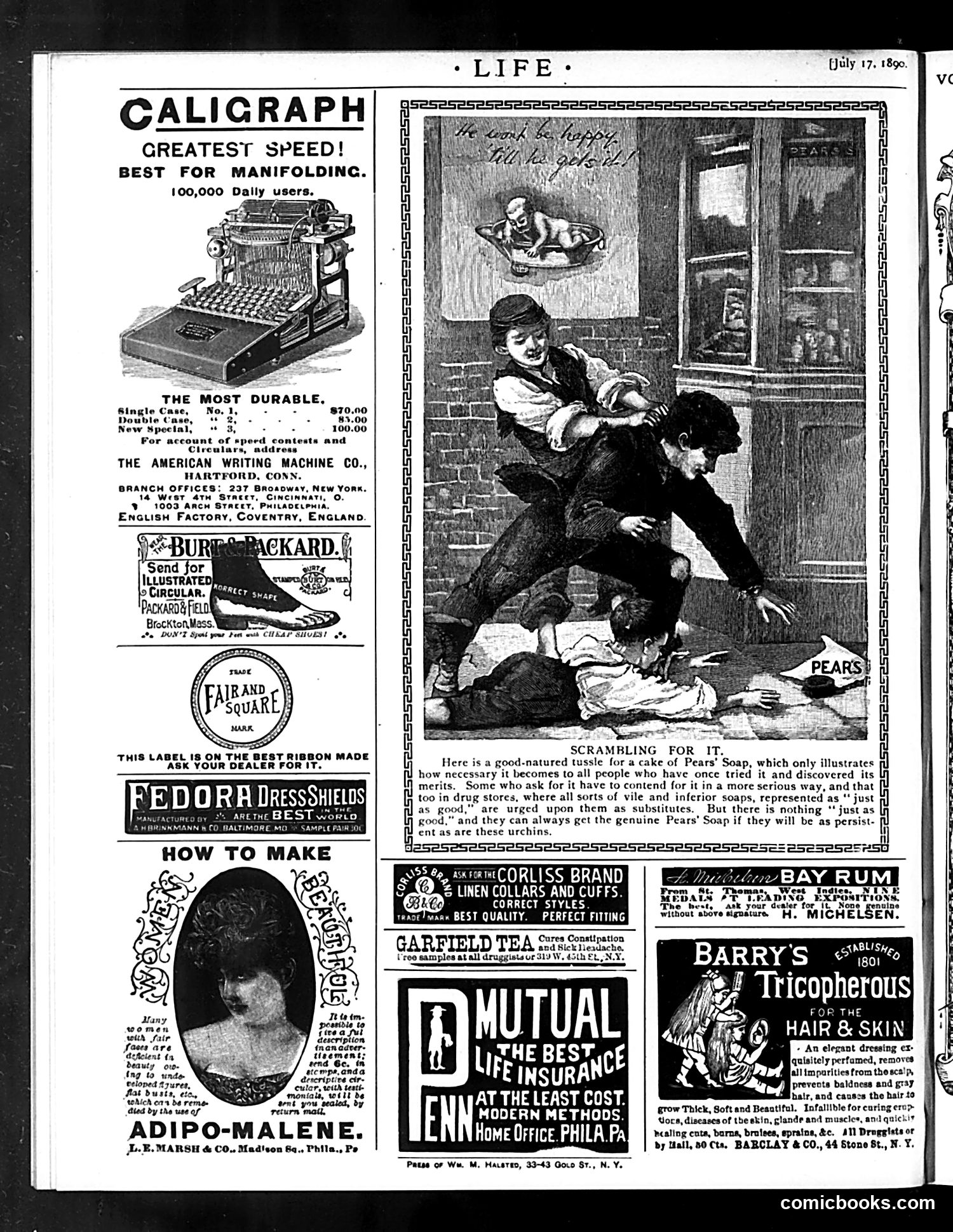
This page is primarily **advertisements** with one small satirical illustration titled "Scrambling for It." The main cartoon depicts two street urchins fighting over a cake of Pears' Soap. The accompanying text explains the joke: it's meant to humorously illustrate how desirable genuine Pears' Soap is once people discover its quality. The satire targets inferior soap manufacturers who try to pass off their products as equivalent substitutes. The caption notes that consumers "scramble" just as persistently as these boys to obtain the genuine article rather than accept cheaper imitations. The cartoon reflects late-19th-century consumer culture concerns about counterfeit or adulterated products. The "good-natured tussle" between the children serves as lighthearted advertising—suggesting Pears' Soap is worth fighting for. The remainder of the page contains period patent medicines and consumer goods advertisements (typewriters, hair tonics, insurance, corsets), typical of Life magazine's revenue model at this time.