
Life, 1890-07-17 · page 4 of 16
Life — July 17, 1890 — page 4: what you’re looking at
What you’re looking at
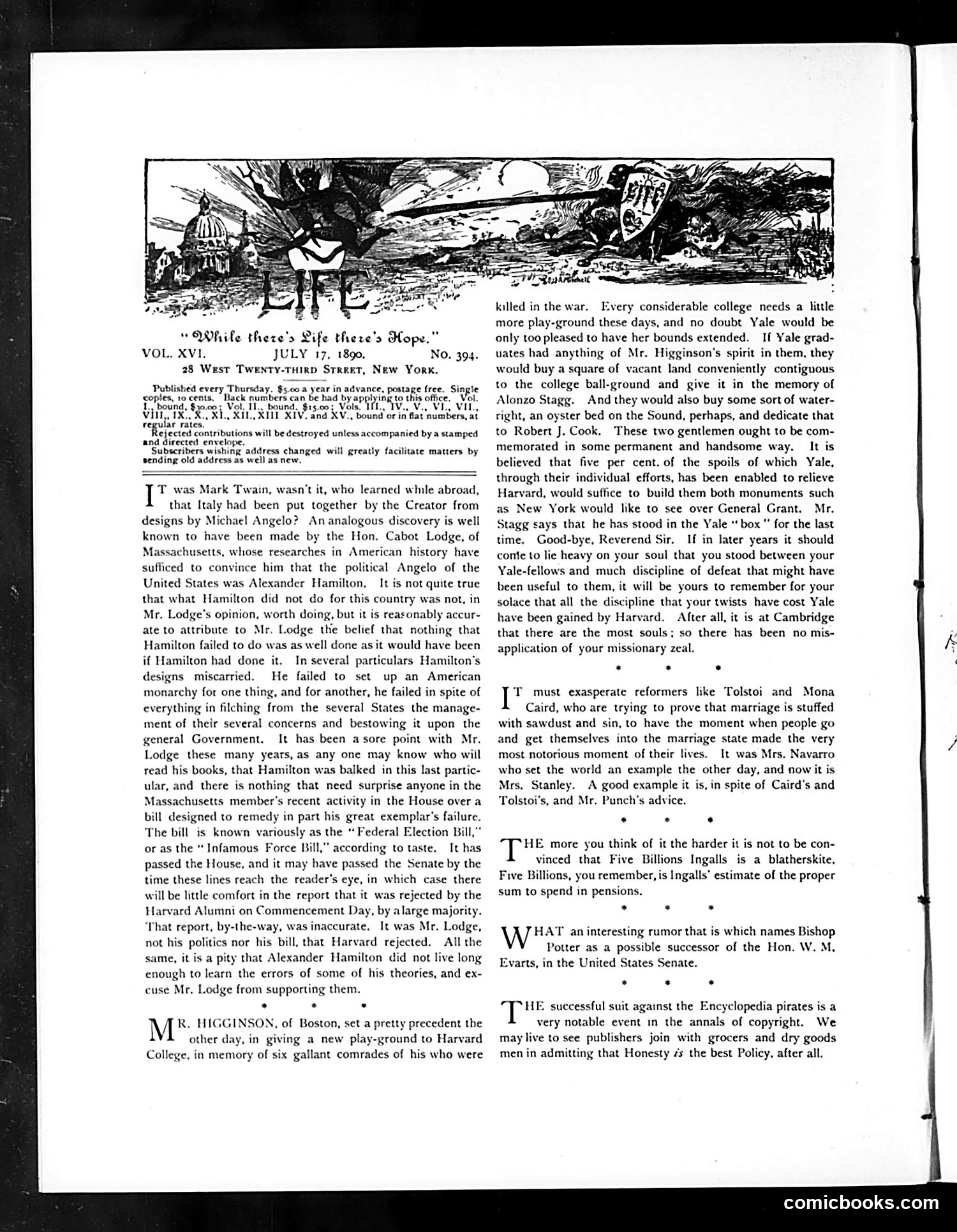
This page from Life (July 17, 1890) contains editorial commentary rather than cartoon illustrations. The text discusses several political and social topics: 1. **Mark Twain and Italian governance**: References Twain's observations about Italy's political design, contrasting it with Alexander Hamilton's failure to establish proper American governmental structures. 2. **Cabot Lodge's critiques**: Discusses the Massachusetts politician's views on Hamilton's errors and federal policy failures. 3. **Harvard College fundraising**: Mr. Higginson of Boston donated a playground to Harvard in memory of six comrades killed in war, highlighting the need for college recreational spaces. 4. **Social criticism**: Brief satirical notes on marriage reformers (Tolstoy, Mona Caird) and copyright law disputes with encyclopedia publishers. The page exemplifies Life's role as a venue for political commentary and social satire of the era.
📄 Transcribed text from this page (OCR, searchable)
Machine-transcribed from the original scan — historical spelling and the odd misread are preserved.
“While there's Life there's Hope.” VOL, XVI. JULY 17, 1890, No. 394. 28 West Twenty-THIRD Street, New York. Published every Thursday. $5.00 a year in advance, postage free. Single copies, 10 cents, Back numbers can be had by apy ink to this offi Vol. 1., bound, $30.00; Vol. II... bound. $15.00; voit nn TV, Ven VIL, Vill, IX..°X., XL, X11, XHT XIV. and XV., bound or in fat numbers, at regular rates, ‘ejected contributions will be destroyed unless accompanied by a stamped and directed envelope. Subscribers wishing address changed will greatly facilitate matters by sending old address as well as new. T was Mark Twain, wasn’t it, who learned while abroad, that Italy had been put together by the Creator from designs by Michael Angelo? Ananalogous discovery is well known to have been made by the Hon, Cabot Lodge, of Massachusetts, whose researches in American history have sufficed to convince him that the political Angelo of the United States was Alexander Hamilton, It is not quite true that what Hamilton did not do for this country was not, in Mr. Lodge's opinion, worth doing, but it is reasonably accur- ate to attribute to Mr. Lodge the belief that nothing that Hamilton failed to do was as well done as it would have been if Hamilton had done it. In several particulars Hamilton's designs miscarried. He failed to set up an American monarchy for one thing, and for another, he failed in spite of everything in filching from the several States the manage- ment of their several concerns and bestowing it upon the general Government. It has been a sore point with Mr. Lodge these many years, as any one may know who will read his books, that Hamilton was balked in this last partic- ular, and there is nothing that need surprise anyone in the Massachusetts member's recent activity in the House over a bill designed to remedy in part his great exemplar’s failure. The bill is known variously as the “ Federal Election Bill,” or as the “Infamous Force Bill,” according to taste. It has passed the House, and it may have passed the Senate by the time these lines reach the reader's eye, in which case there will be little comfort in the report that it was rejected by the Harvard Alumni on Commencement Day, by alarge majority. ‘That report, by-the-way, was inaccurate. It was Mr. Lodge, not his politics nor his bill, that Harvard rejected. All the same, it is a pity that Alexander Hamilton did not live long enough to learn the errors of some of his theories, and ex- cuse Mr, Lodge from supporting them. . . . M R. HIGGINSON, of Boston, set a pretty precedent the Nk other day, in giving a new play-ground to Harvard College, in memory of six gallant comrades of his who were ea eH fg Be pa at killed in the war. Every considerable college needs a little more play-ground these days, and no doubt Yale would be only too pleased to have her bounds extended. If Yale grad- uates had anything of Mr. Higginson’s spirit in them, they would buy a square of vacant land conveniently contiguous to the college ball-ground and give it in the memory of Alonzo Stagg. And they would also buy some sort of water- right, an oyster bed on the Sound, perhaps, and dedicate that to Robert J. Cook. These two gentlemen ought to be com- memorated in some permanent and handsome way. It is believed that five per cent. of the spoils of which Yale, through their individual efforts, has been enabled to relieve Harvard, would suffice to build them both monuments such as New York would like to see over General Grant. Mr. Stagg says that he has stood in the Yale ‘box " for the last time. Good-bye, Reverend Sir. If in later years it should conte to lie heavy on your soul that you stood between your Yale-fellows and much discipline of defeat that might have been useful to them, it will be yours to remember for your solace that all the discipline that your twists have cost Yale have been gained by Harvard. After all, it is at Cambridge that there are the most souls; so there has been no mis- application of your missionary zeal. I" must exasperate reformers like Tolstoi and Mona Caird, who are trying to prove that marriage is stuffed with sawdust and sin, to have the moment when people go and get themselves into the marriage state made the very most notorious moment of their lives. It was Mrs. Navarro who set the world an example the other day, and now it is Mrs. Stanley. A good example it is, in spite of Caird’s and Tolstoi's, and Mr. Punch’s advice. HE more you think of it the harder it is not to be con- vinced that Five Billions Ingalls is a blatherskite, Five Billions, you remember, is Ingalls’ estimate of the proper sum to spend in pensions. . . . W HAT an interesting rumor that is which names Bishop Potter as a possible successor of the Hon. W. M. Evarts, in the United States Senate. . . . HE successful suit against the Encyclopedia pirates is a very notable event in the annals of copyright. We may live to see publishers join with grocers and dry goods men in admitting that Honesty ¢s the best Policy, after all. comicbooks.com