
A complete issue · 15 pages · 1890
Life — June 26, 1890
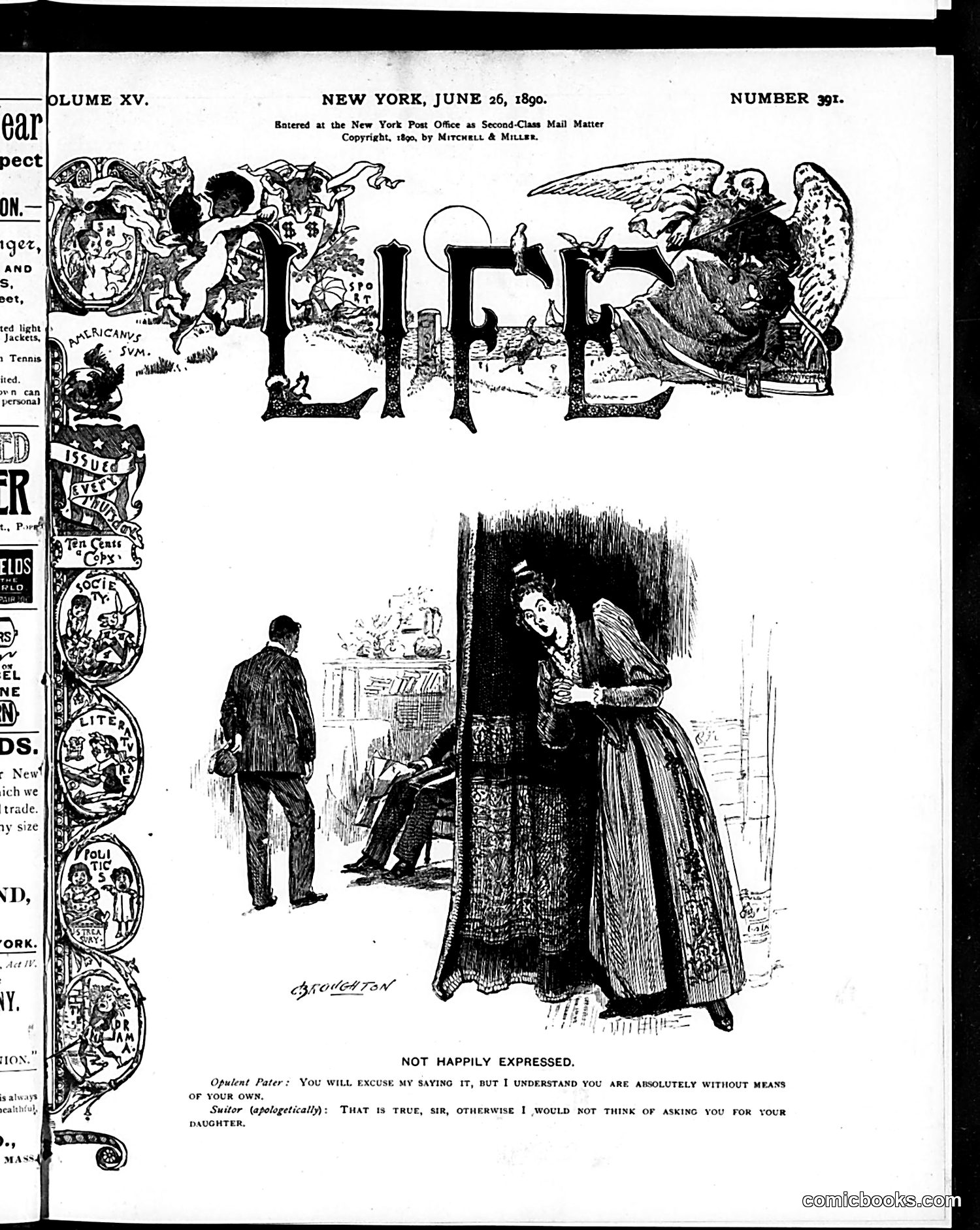
This page contains a satirical cartoon titled "NOT HAPPILY EXPRESSED" depicting a social awkwardness between a suitor and a young woman's father. The scene shows a gentleman caller departing while the father delivers a cutting remark. The suitor (apologetically) explains he lacks independent means, and the father responds sarcastically that this makes perfect sense—otherwise he wouldn't presume to ask for the daughter's hand in marriage. The satire targets the economic realities of late 19th-century courtship, where a suitor's financial stability was essential for marriage approval. The cartoon mocks both the awkward social convention and the father's pointed reminder that a poor man has no legitimate claim to court his daughter. It reflects class-conscious attitudes about marriage and economic dependency prevalent in the Gilded Age.
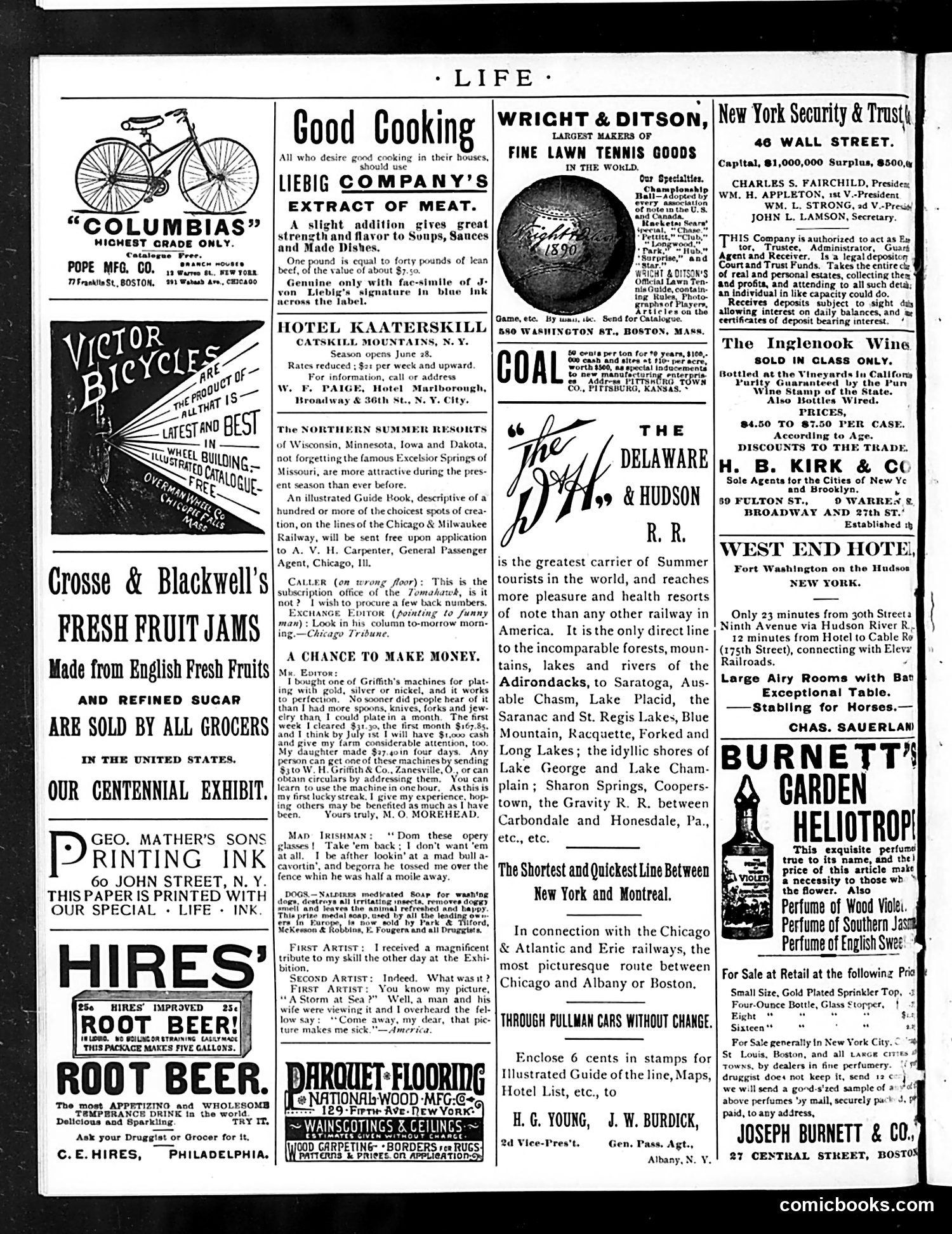
This page is **primarily advertisements** with minimal editorial content. The ads promote bicycles (Columbias, Victor), food products (Liebig's meat extract, Crosse & Blackwell jams, Hires root beer), hotels, and the Delaware & Hudson Railway. The only identifiable satirical element is a small section titled "First Artists" featuring what appears to be humorous anecdotes about painters, though the text is too small to read clearly in the image. The page reflects turn-of-the-century commercial culture rather than political satire. It demonstrates how Life magazine—originally a humor publication—increasingly relied on advertising revenue, mixing advertisements with occasional jokes and commentary. The products advertised (bicycles, packaged foods) suggest growing consumer culture and industrialization of the era.
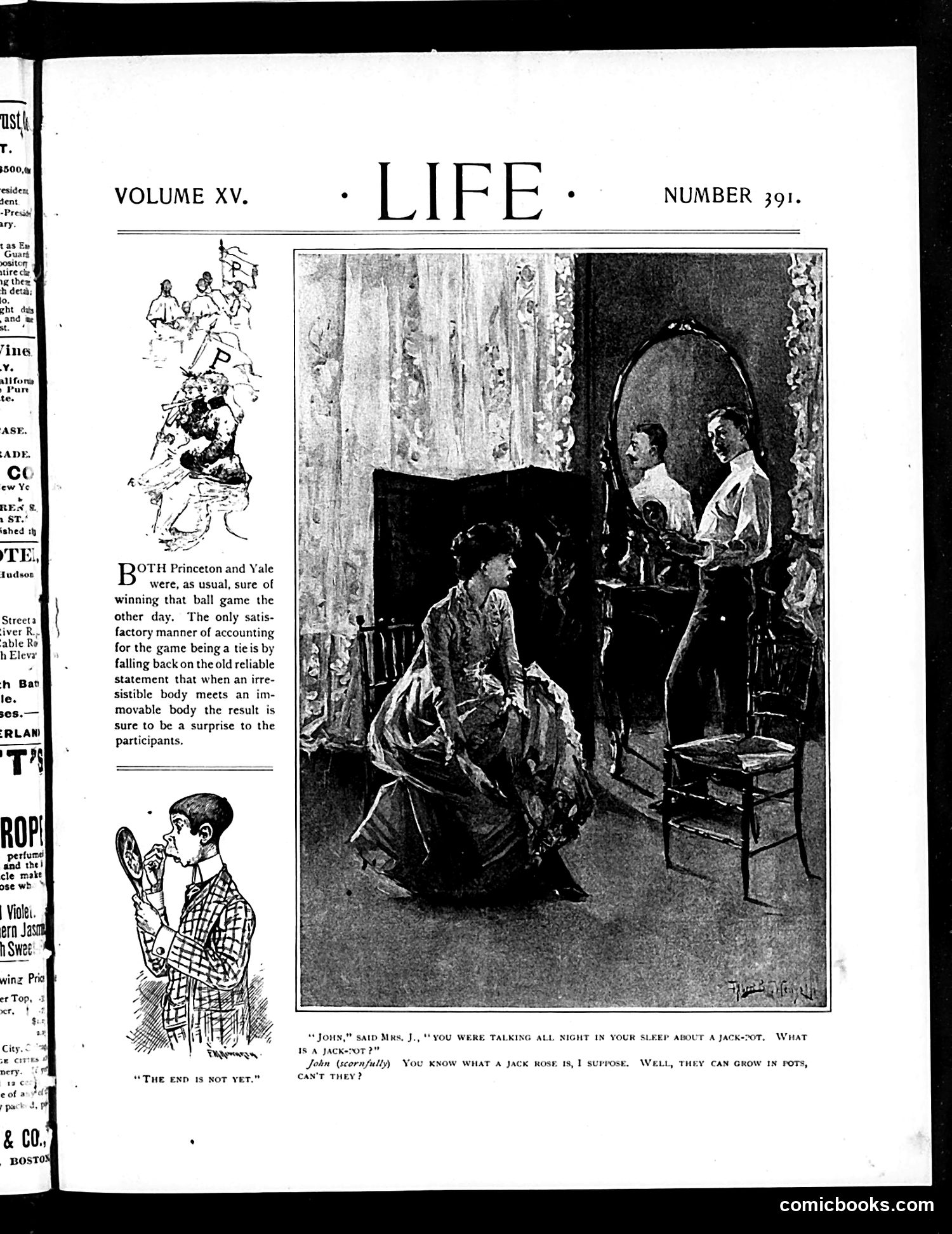
The main illustration depicts a domestic scene where a woman sits before a mirror while two men stand behind her. The caption references a "jack-nut" — a husband discussing his wife's nighttime sleep-talking about jackknives. The joke plays on the wife's response that "jack roses" can grow in pots, suggesting she was actually dreaming about flowers rather than the husband's feared interpretation. The left sidebar contains a small cartoon of a boy with a mirror and the caption "The End Is Not Yet," likely a visual gag about reflection or self-examination. The page's upper text discusses Princeton and Yale winning a ball game, noting the surprise outcome when "an irresistible body meets an immovable body." This appears to be sports commentary humor typical of Life's era.
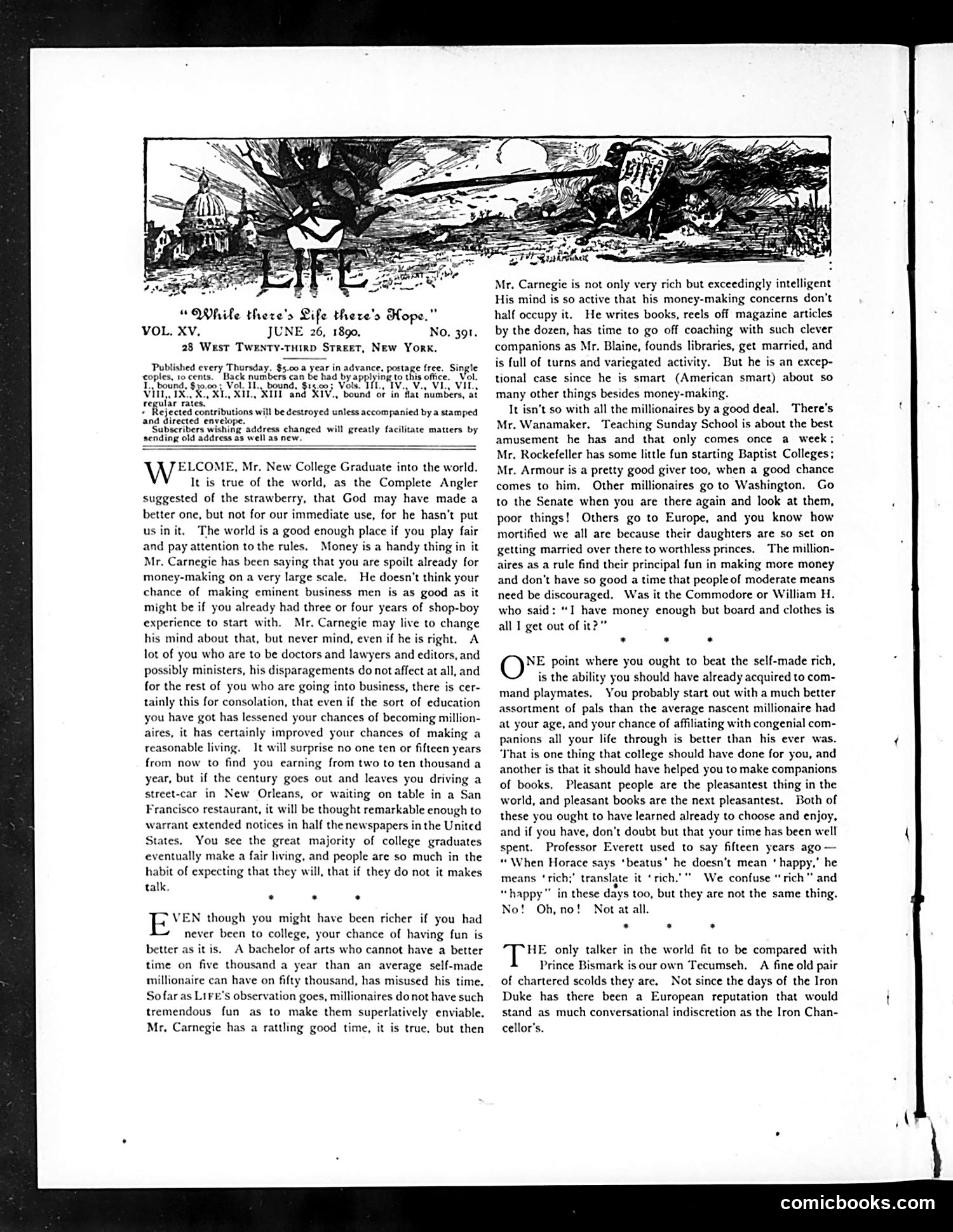
The decorative header illustration appears to be allegorical rather than depicting specific political figures—showing classical/mythological imagery with a moon and landscape, though details are unclear. The editorial text discusses wealth and success, specifically mentioning **Andrew Carnegie, Mr. Wanamaker, Mr. Rockefeller, and Mr. Armour**—prominent American millionaires of the Gilded Age. The author satirizes their business success while questioning whether wealth alone constitutes a good life. The piece advises young college graduates that education's value lies not in making money but in acquiring refined companions and appreciating literature and culture. It critiques self-made millionaires for their focus on accumulation over enjoyment, suggesting they've missed life's pleasures despite their riches. The satire targets the era's obsession with wealth accumulation over intellectual and cultural fulfillment.
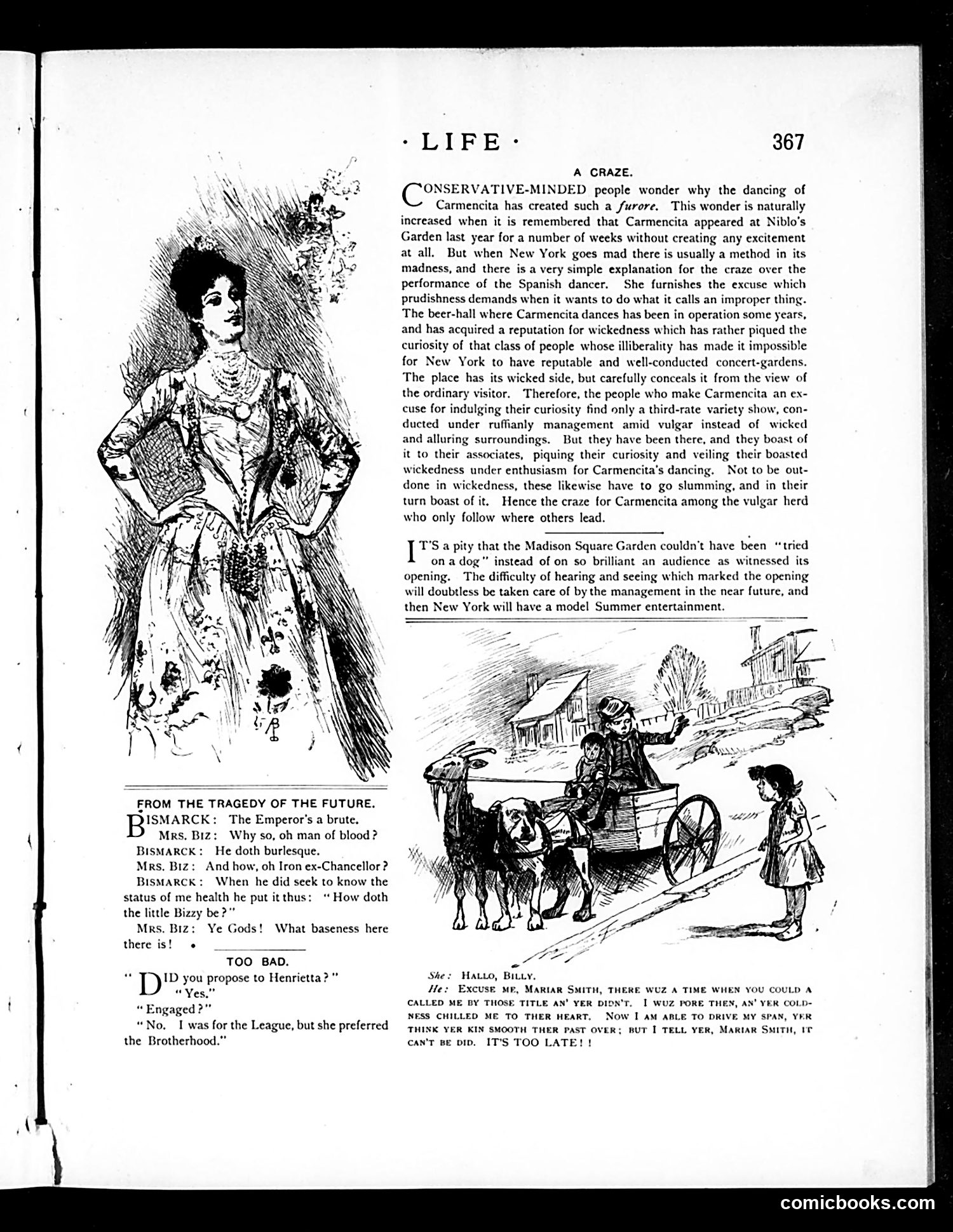
**Main Article: "A Craze"** This piece satirizes the obsession with Spanish dancer Carmencita, whose performances at Niblo's Garden created a social frenzy. The author mocks New York's high society for hypocritically patronizing a disreputable beer hall—a venue with a scandalous reputation—under the pretense of sophisticated cultural interest. The satire suggests the wealthy use Carmencita as an excuse to indulge in "vulgar" entertainment while maintaining respectability. The final jab criticizes the Madison Square Garden opening's technical problems, implying proper management could have prevented the disaster. **Secondary Jokes** Two brief comic dialogues mock romantic proposals and lost courtship customs, using dated social conventions as humor. The page reflects Gilded Age tensions between Victorian respectability and urban entertainment venues.
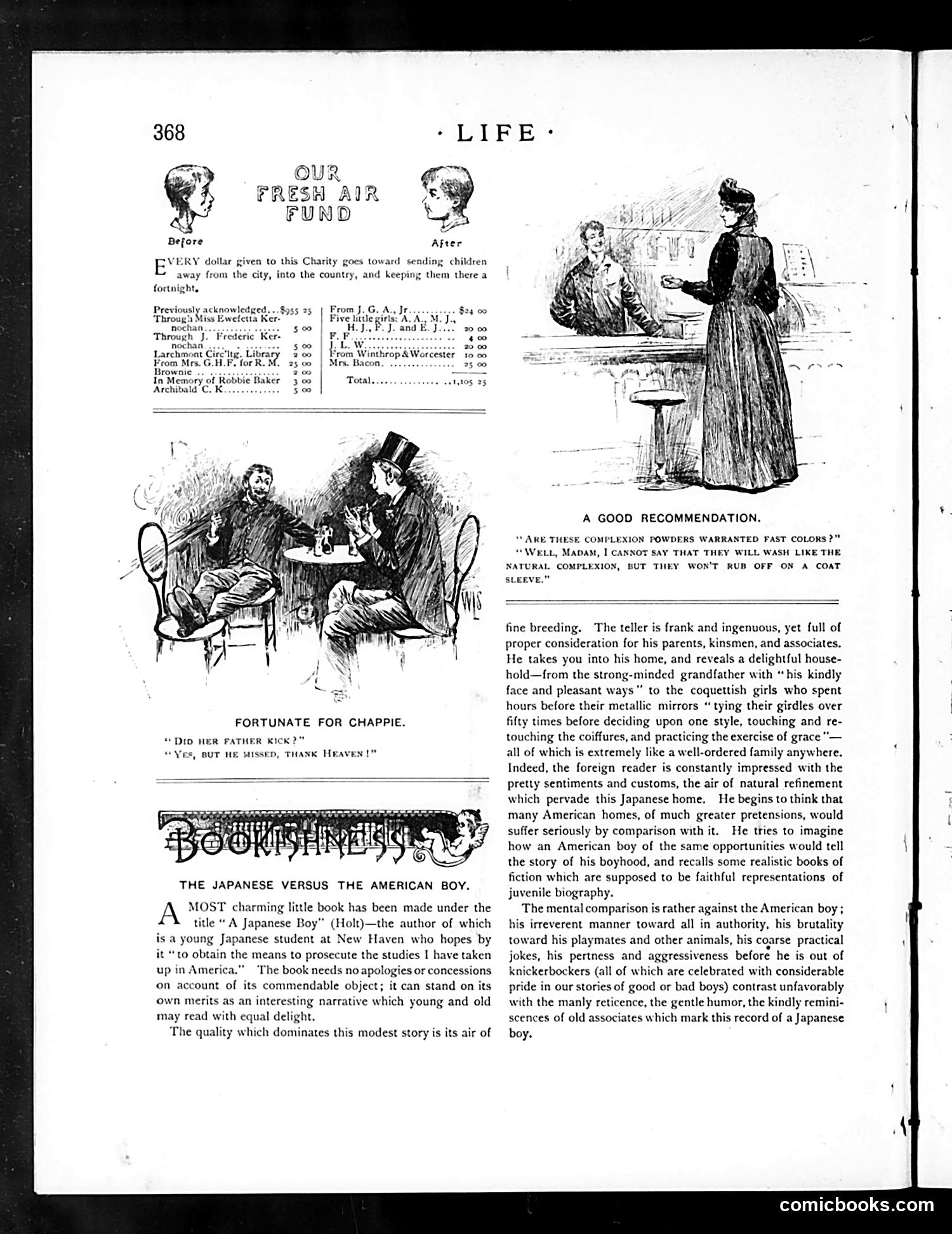
This page contains three distinct items: 1. **"Our Fresh Air Fund"** - A charity announcement soliciting donations to send city children to the countryside for overnight stays, with a list of contributors. 2. **"Fortunate for Chappie"** - A cartoon depicting two men at a table with the caption "Did her father kick?" / "Yes, but he missed, thank heavens!" The joke concerns a woman's father attempting to physically assault someone (presumably her suitor), suggesting social anxiety about courtship and parental authority. 3. **"The Japanese Versus the American Boy"** - A book review comparing a Japanese boy's refined manners and respect for authority with an American boy's irreverent, aggressive, and crude behavior. The reviewer notes American homes' "greater pretensions" would suffer by comparison, presenting this as cultural commentary rather than overt satire.
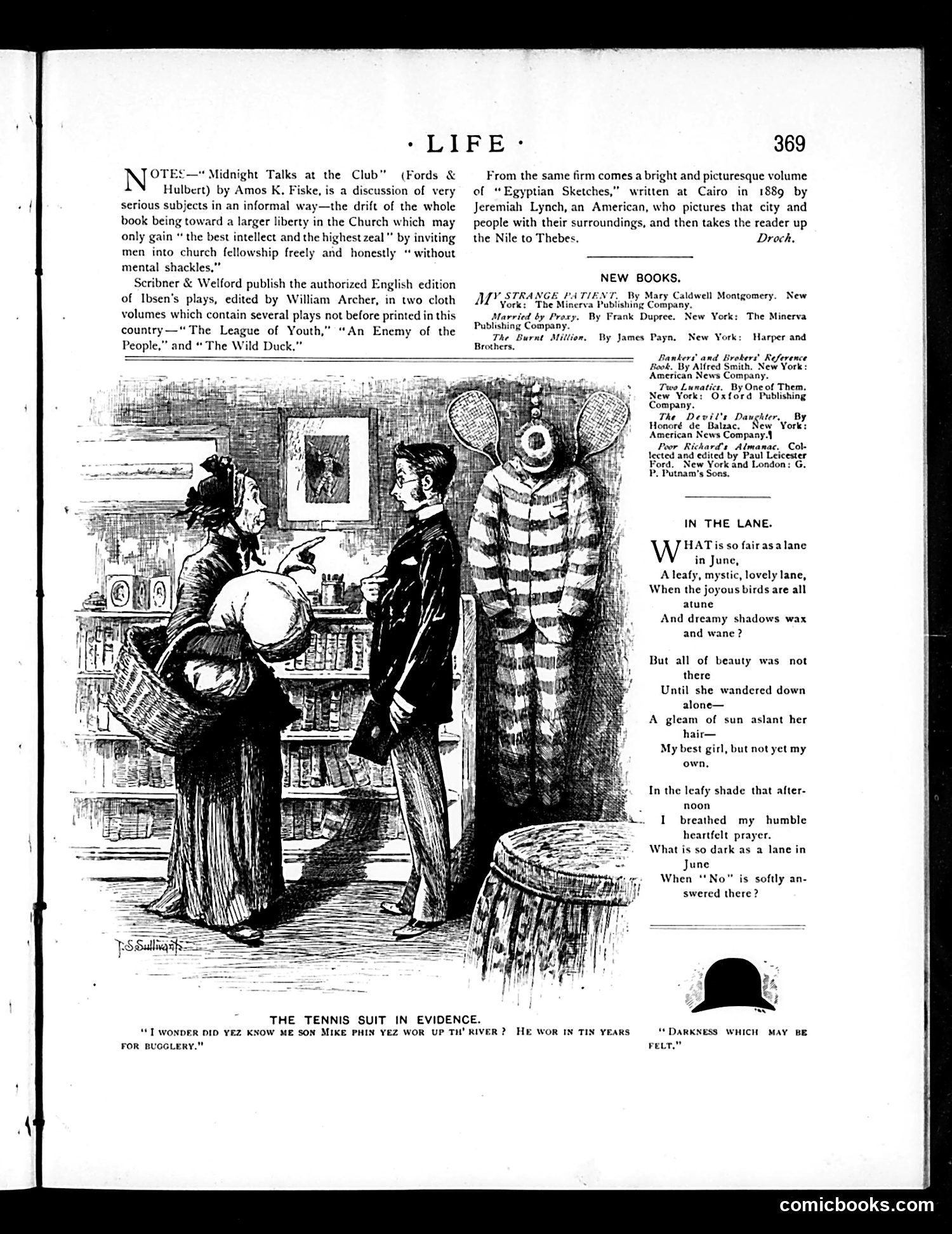
This page contains two distinct items: **"The Tennis Suit in Evidence"** (cartoon): A domestic scene showing a woman displaying a tennis suit to a man, with caption joking about the suit's longevity. The humor appears to rest on the woman's claim that her son wore it for "ruggery" (rugby) ten years ago, yet it still looks serviceable. This is gentle satire about either the durability of clothing or, less charitably, women's tendency to hold onto old garments. **"In the Lane"** (poem): A romantic verse about a man encountering a mysterious woman in a June lane, capturing a fleeting moment of attraction and yearning. It's sentimental Victorian-era poetry with no apparent satirical intent. The page primarily showcases literary and artistic content rather than political commentary, typical of *Life* magazine's mixed editorial approach during this period.
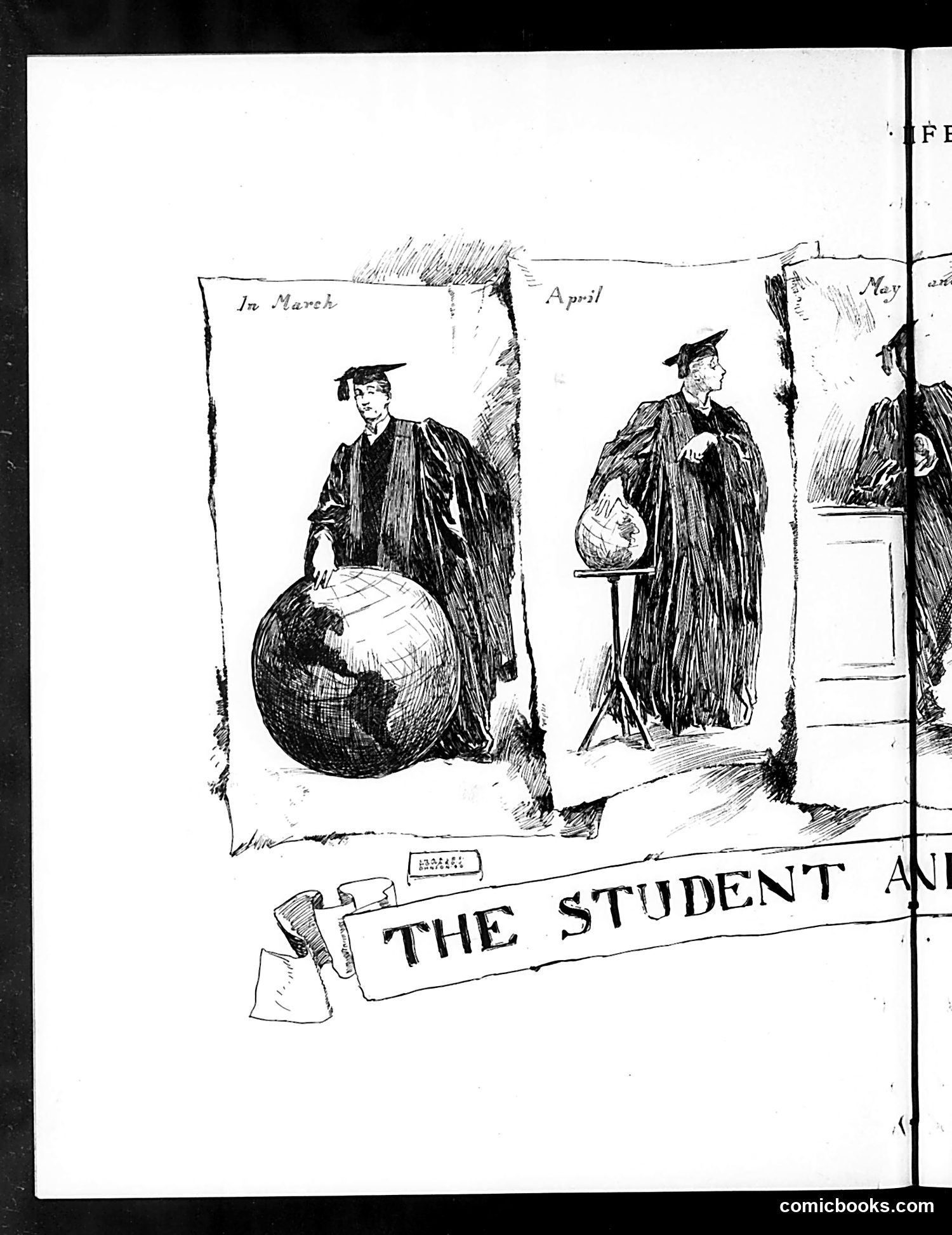
This cartoon appears to document the progression of a student through the academic year, labeled with months: "In March" and "April" visible at the top. The left panel shows a graduate in academic robes cradling a large globe or world, suggesting ambitious intellectual aspirations. The right panel depicts the same figure in May, now appearing more weary or diminished, holding what seems to be a smaller or deflated sphere. The satire appears to comment on how student idealism and grand expectations—represented by the substantial globe—shrink or diminish as the academic year progresses. It's a commentary on the gap between youthful academic ambitions and the grinding reality of actual studies, with the deteriorating globe symbolizing fading hopes and enthusiasm.
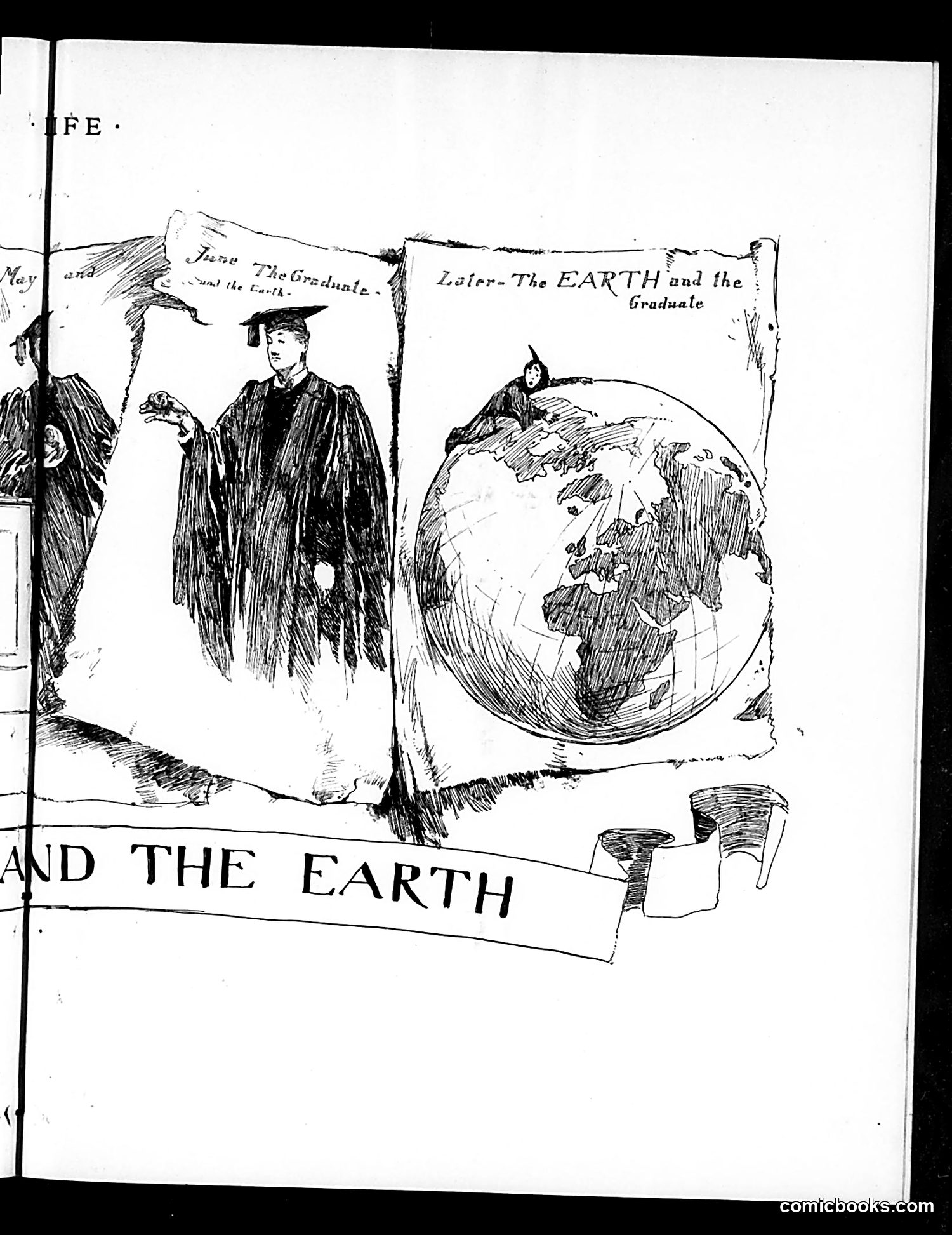
This satirical cartoon depicts a graduation scene with two panels showing progression. On the left, a graduate in cap and gown holds what appears to be a diploma. The right panel shows "Later—The EARTH and the Graduate," presenting the same figure now positioned atop a globe. The satire likely comments on the gap between academic achievement and actual worldly power or responsibility. The graduate, fresh from education, is contrasted with his diminished position relative to the Earth itself—suggesting that despite receiving a diploma, a young person remains insignificant against global realities and challenges. The visual joke emphasizes the humbling reality awaiting graduates entering the world.
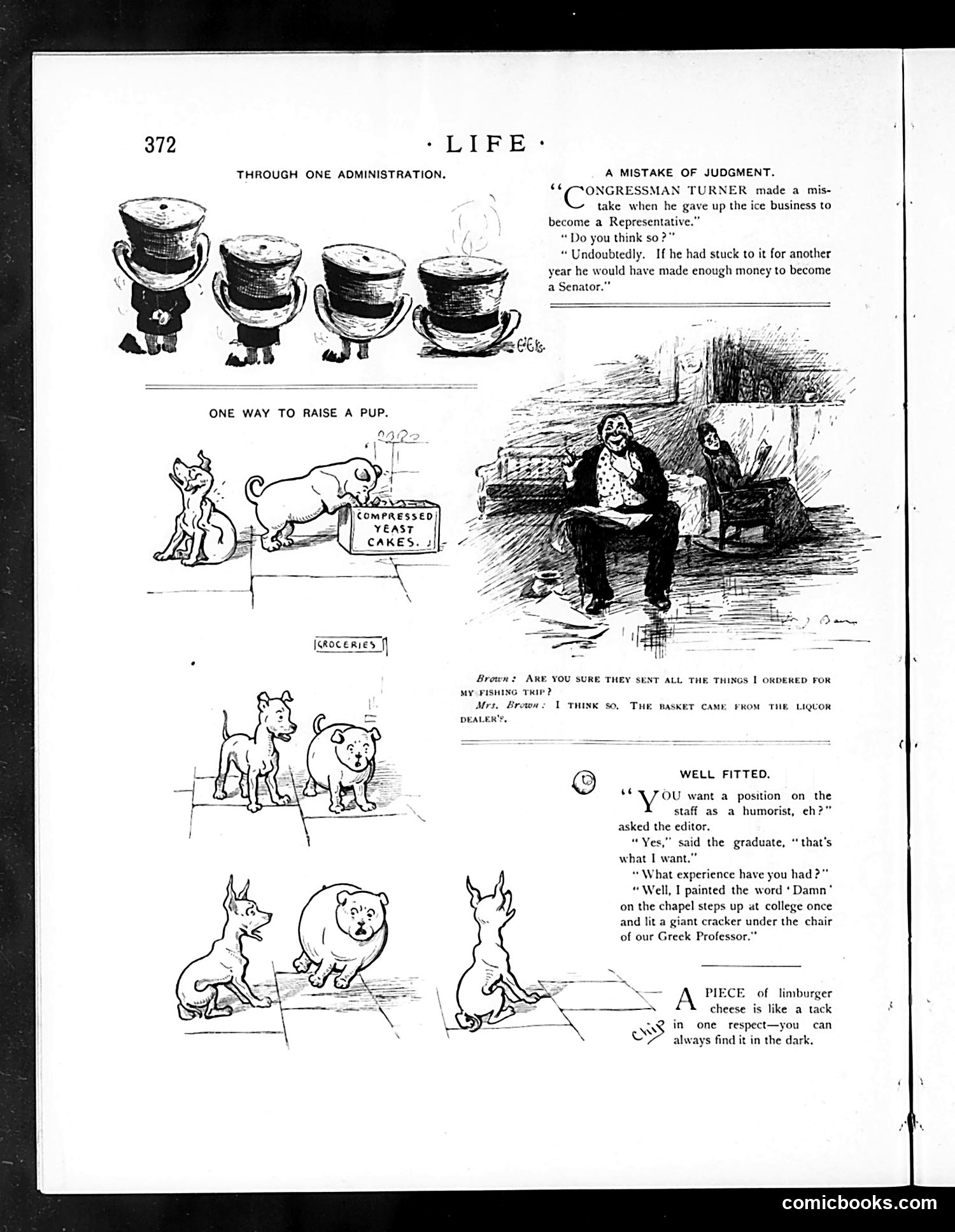
This page contains several unrelated humorous cartoons and short jokes typical of Life's satirical format: **"Through One Administration"** shows buckets progressively shrinking, likely satirizing government inefficiency or budget cuts over time. **"One Way to Raise a Pup"** depicts dogs being fed compressed dog cakes from a groceries box—a visual joke about commercial pet food. **"A Mistake of Judgment"** mocks Congressman Turner, suggesting he abandoned a profitable ice business to pursue politics, implying he'd have earned more money staying in business. **"Well Fitted"** jokes about a job applicant's only qualification being a college prank (painting "Damn" on chapel steps). The page concludes with a one-liner comparing limburger cheese to a tack—both difficult to locate in darkness.
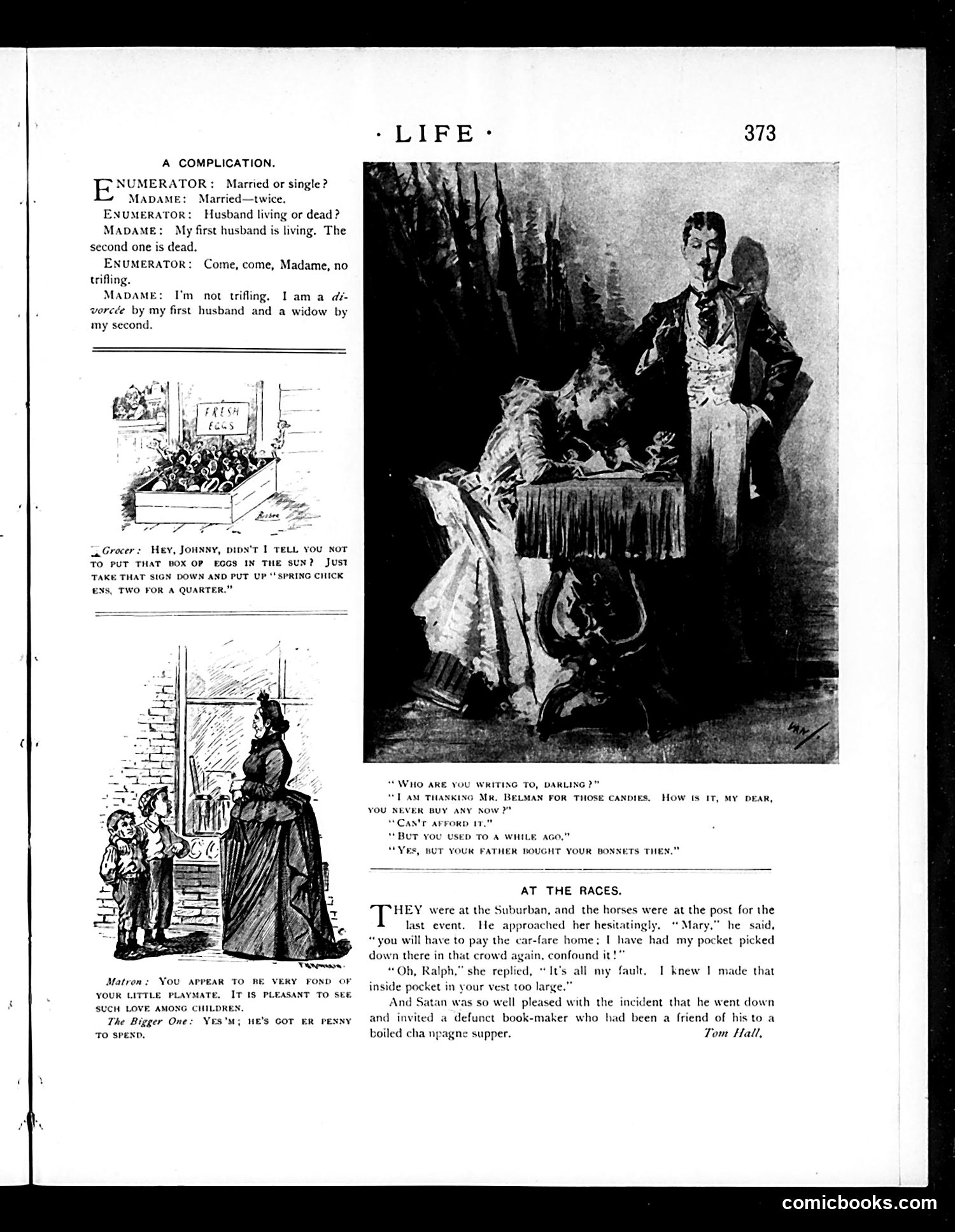
This page contains three separate satirical sketches: 1. **"A Complication"** (top left): A humorous dialogue where a census enumerator asks a woman her marital status. She replies she's "a divorcee by my first husband and a widow by my second"—satirizing the bureaucratic confusion created by women's changing legal statuses through marriage and divorce. 2. **Grocer scene** (middle left): A grocer instructs someone about egg storage, with a price joke about "spring chickens." 3. **"At the Races"** (bottom): A scene at the horse races where a man named Ralph admits to losing money and having an "inside pocket" too large—satirizing gambling losses and financial embarrassment among the leisure class. The illustrations use period-appropriate dress and social settings typical of early 20th-century American life.
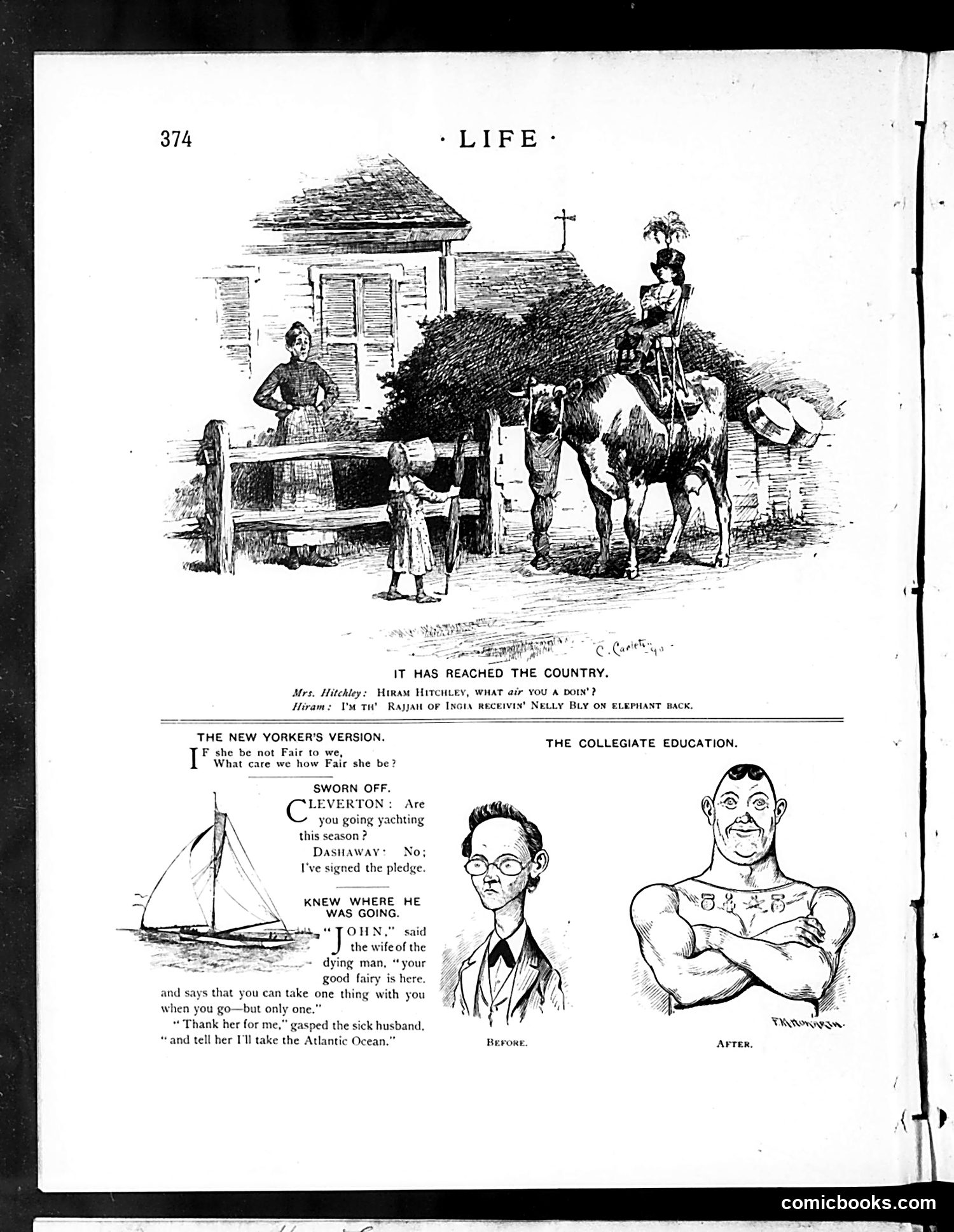
This page contains three satirical pieces reflecting late 19th/early 20th-century American culture: **Top cartoon**: References Nelly Bly, the famous journalist known for her around-the-world journey and investigative reporting. The joke mocks how her celebrity has reached rural America—a farmer thinks "Rajah of India receiving Nelly Bly on elephant back" is newsworthy country gossip. **"Sworn Off"**: A social commentary on the temperance movement. Two men discuss yachting; one has "signed the pledge" (abstaining from alcohol), satirizing how Prohibition sentiment was spreading among the upper classes. **"Knew Where He Was Going"**: A dark humor piece about a dying man choosing to take "the Atlantic Ocean" with him—absurdist humor about prioritizing luxury/escape over material possessions. **"Collegiate Education"**: Before/After drawings showing physical transformation through college, suggesting collegiate athletics produced muscular, confident men from studious types—commentary on changing educational values. The page reflects turn-of-the-century anxieties about Prohibition, celebrity culture, and educational modernization.
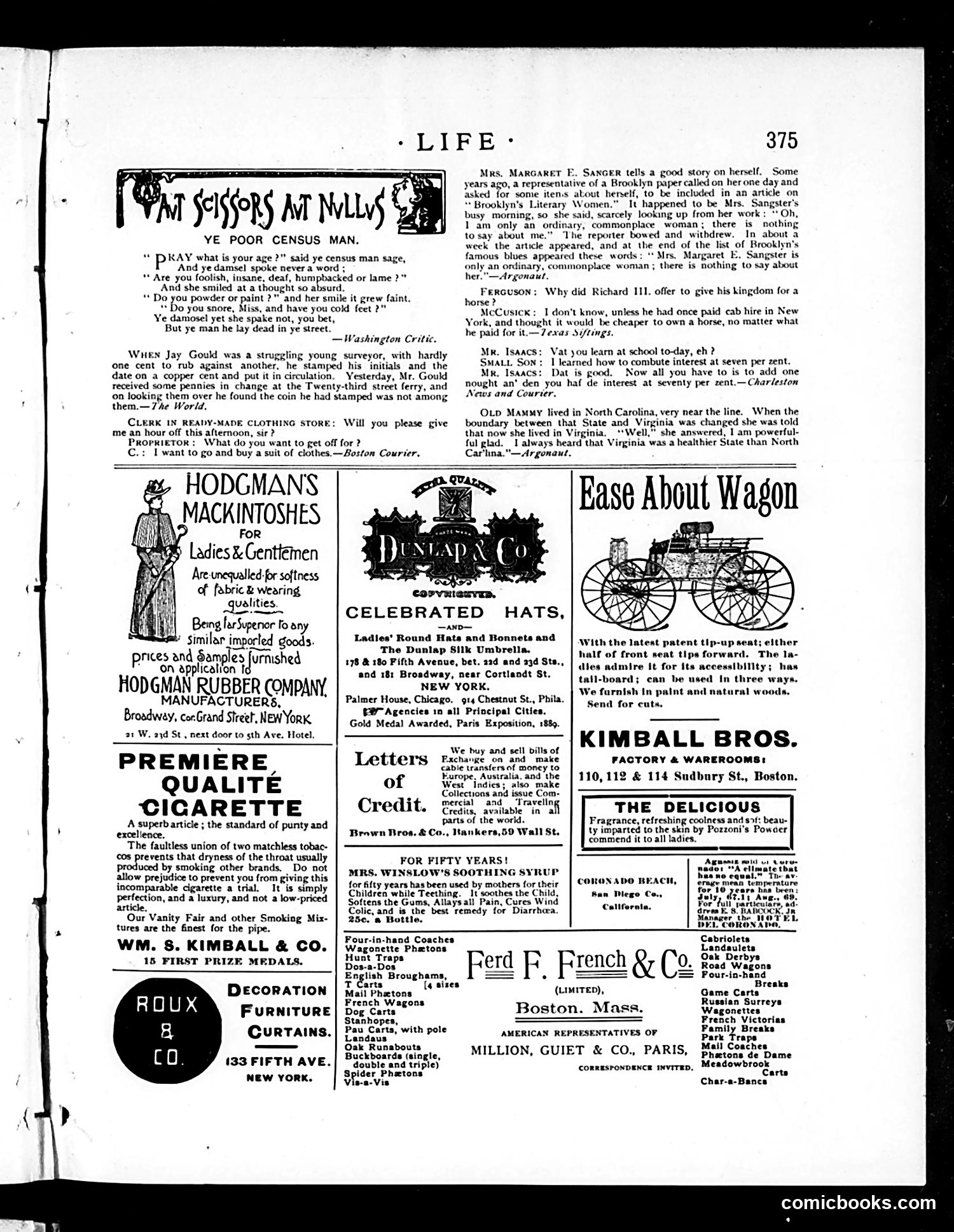
**WHAT THIS PAGE CONTAINS:** This is primarily a **humor and advertising page** from Life magazine. The top half features four separate jokes; the bottom half is mostly advertisements. **THE HUMOR:** 1. "Ye Poor Census Man" - A comic poem where a census taker asks an uncooperative woman personal questions (age, appearance, habits). She refuses to answer until he supposedly dies from frustration—satire on women's privacy and vanity about personal questions. 2. **Jay Gould anecdote** - A brief story mocking wealthy industrialist Jay Gould. The joke: he once marked a penny decades ago hoping to track it; when he finds it again, it's not there, suggesting even his schemes fail. 3. **Clerk and clothes** - Quick joke about an employee wanting time off to buy clothes his boss objects to, implying the boss controls his appearance. 4. **Old Mammy dialect joke** - A stereotypical enslaved/formerly enslaved Black woman prefers Virginia over North Carolina for health reasons, playing on era-typical racial humor. **No political cartoon is visible**—this is chiefly comic anecdotes and period advertising (cigarettes, hats, furniture).
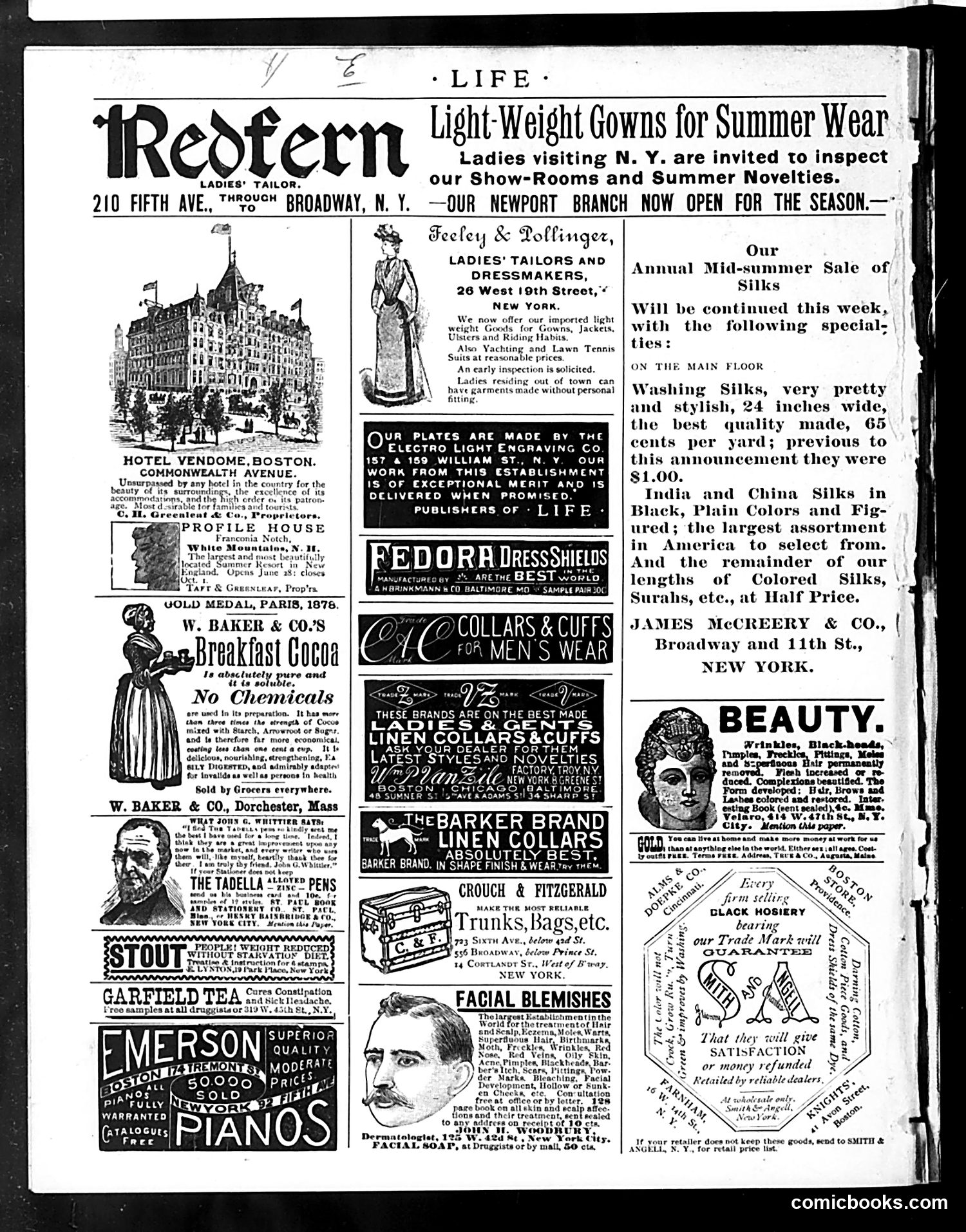
This is primarily **an advertising page**, not a satirical cartoon page. The page consists almost entirely of commercial advertisements for late 19th-century goods and services. Notable ads include: - **Redfern and other dressmakers** advertising light summer clothing for women - **W. Baker & Co.'s Breakfast Cocoa**, emphasizing it contains "no chemicals" and is pure—reflecting consumer anxieties of the era about food adulteration - **Emerson Pianos** and other luxury goods - Various **collar and cuff manufacturers** for men's wear - **Facial blemish treatments** and beauty products The page reflects the commercial nature of *Life* magazine, which supported itself through advertising. The ads reveal period concerns: women's fashion and social visiting (Newport society), men's formal wear standards, health-conscious food purchasing, and emerging beauty/cosmetic industries. There is **no visible political cartoon or satire** on this particular page—it's a straightforward commercial section targeting affluent urban readers in New York.

I can see this is a page from Life magazine, but the image is almost entirely black with only faint white edges visible on the left side, suggesting it's a scan of a mostly blank or heavily darkened page. The OCR text provided is empty, containing no readable content. Without visible cartoon imagery, legible text, or identifiable figures, I cannot determine what political or social satire this page contains, what historical references it makes, or who any caricatured figures might represent. To provide accurate historical analysis as requested, I would need a clearer image where the actual cartoon(s), illustrations, or text are visible and readable.