
Life, 1890-06-26 · page 6 of 15
Life — June 26, 1890 — page 6: what you’re looking at
What you’re looking at
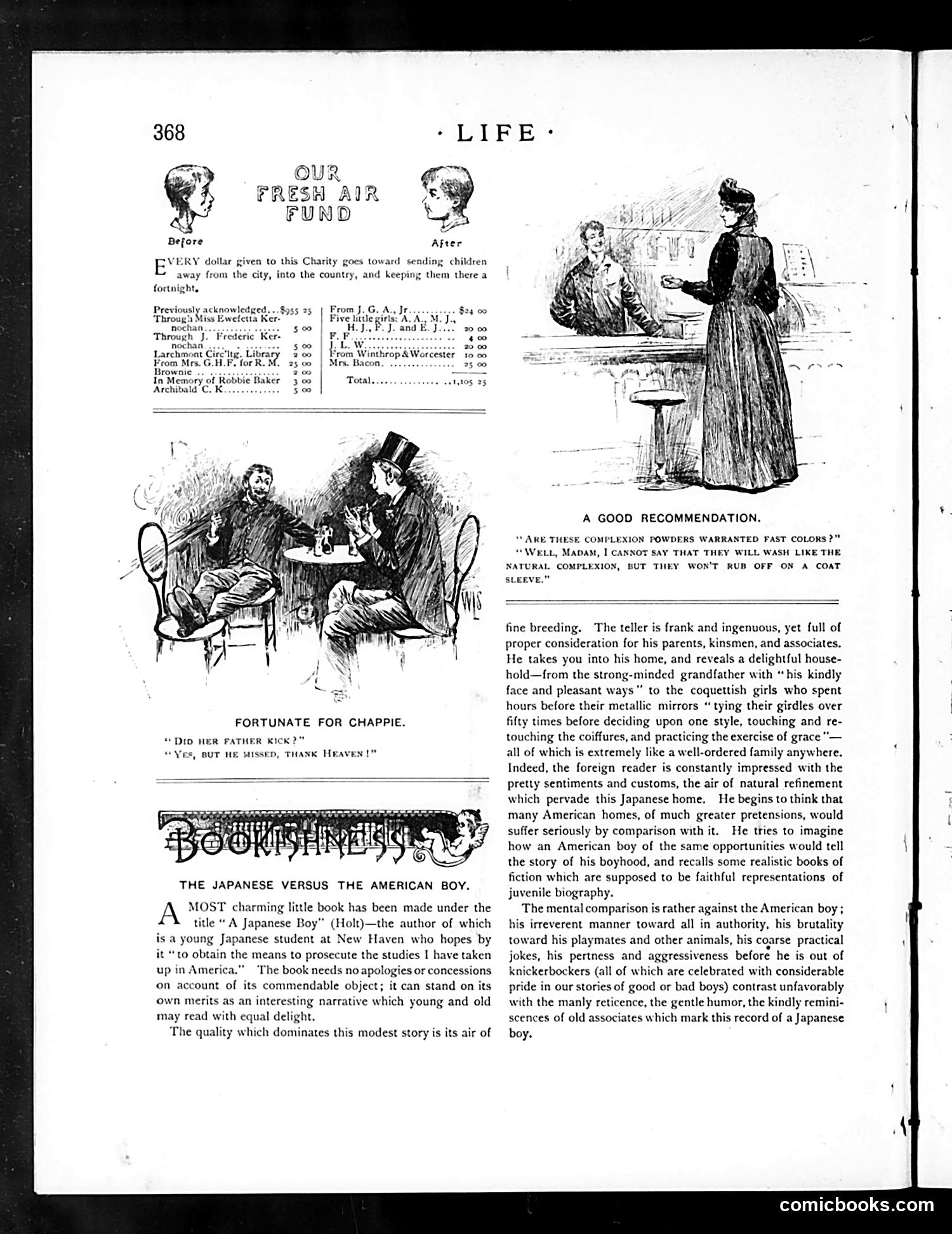
This page contains three distinct items: 1. **"Our Fresh Air Fund"** - A charity announcement soliciting donations to send city children to the countryside for overnight stays, with a list of contributors. 2. **"Fortunate for Chappie"** - A cartoon depicting two men at a table with the caption "Did her father kick?" / "Yes, but he missed, thank heavens!" The joke concerns a woman's father attempting to physically assault someone (presumably her suitor), suggesting social anxiety about courtship and parental authority. 3. **"The Japanese Versus the American Boy"** - A book review comparing a Japanese boy's refined manners and respect for authority with an American boy's irreverent, aggressive, and crude behavior. The reviewer notes American homes' "greater pretensions" would suffer by comparison, presenting this as cultural commentary rather than overt satire.
📄 Transcribed text from this page (OCR, searchable)
Machine-transcribed from the original scan — historical spelling and the odd misread are preserved.
FRESH AIR FUND Before VERY dollar given to this Charity goes toward sending children away from the city, into the country, and keeping them there a fortnight. Previously acknowledge 5 | From J.G. A., Jr.. Throug’s Miss Ewefe z Five little girts: A. $00 HJ. F. 5.00 2 00 25 00 | 253 00 300 Circitg, Libran From Mrs. G.H.F, for R. M. Brownie .. ..... In Memory of Robt Archibald C. K rop &Worcester Baker setytos 25 FORTUNATE FOR CHAPPIE. “Dio HER FATHER KICK?” “Yes, BUT HE MISSED, THANK HEAVEN!” THE JAPANESE VERSUS THE AMERICAN BOY. MOST charming little book has been made under the title “A Japanese Boy” (Holt)—the author of which is a young Japanese student at New Haven who hopes by it “to obtain the means to prosecute the studies | have taken up in America.” The book needs no apologies or concessions on account of its commendable object; it can stand on its own merits as an interesting narrative which young and old may read with equal delight. The quality which dominates this modest story is its air of A GOOD RECOMMENDATION. ‘ARE THESE COMPLEXION POWDERS WARRANTED FAST COLORS?" “WELL, MADAM, I CANNOT SAY THAT THEY WILL WASH LIKE THE TURAL COMPLEXION, BUT THEY WON'T RUB OFF ON A COAT fine breeding. The teller is frank and ingenuous, yet full of proper consideration for his parents, kinsmen, and associates. He takes you into his home, and reveals a delightful house- hold—from the strong-minded grandfather with “his kindly face and pleasant ways” to the coquettish girls who spent hours before their metallic mirrors “ tying their girdles over fifty times before deciding upon one style, touching and re- touching the coiffures, and practicing the exercise of grace ""— all of which is extremely like a well-ordered family anywhere. Indeed, the foreign reader is constantly impressed with the pretty sentiments and customs, the air of natural refinement which pervade this Japanese home. He begins to think that many American homes, of much greater pretensions, would suffer seriously by comparison with it. He tries to imagine how an American boy of the same opportunities would tell the story of his boyhood, and recalls some realistic books of fiction which are supposed to be faithful representations of juvenile biography. The mental comparison is rather against the American boy ; his irreverent manner toward all in authority, his brutality toward his playmates and other animals, his coarse practical jokes, his pertness and aggressiveness before he is out of knickerbockers (all of which are celebrated with considerable pride in our stories of good or bad boys) contrast unfavorably with the manly reticence, the gentle humor, the kindly remini- scences of old associates which mark this record of a Japanese boy. comicbooks.com