
A complete issue · 14 pages · 1890
Life — June 19, 1890
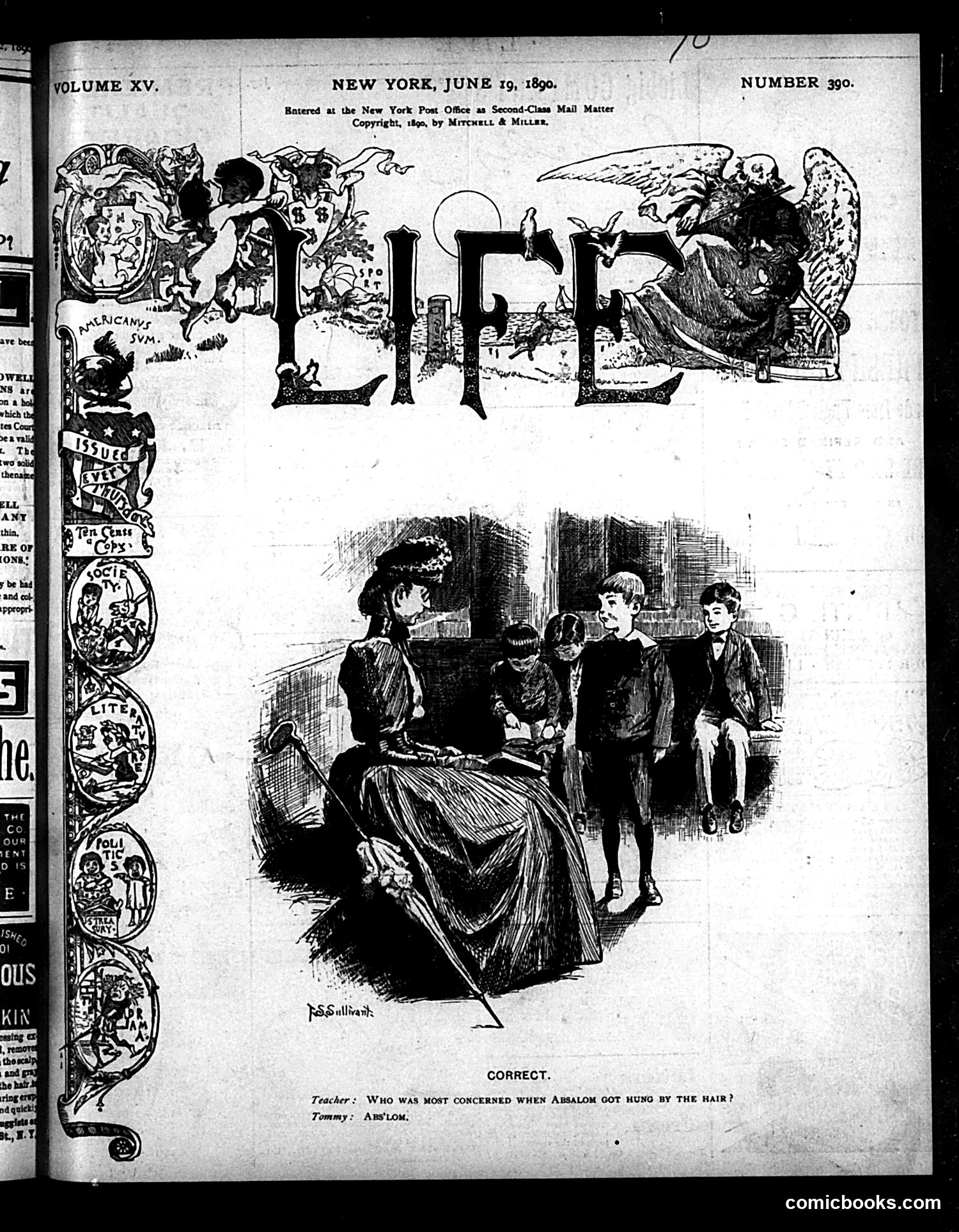
This page from Life magazine (Volume XV, Number 390) contains a classroom scene cartoon titled "CORRECT." The joke presents a teacher asking students: "WHO WAS MOST CONCERNED WHEN ABSALOM GOT HUNG BY THE HAIR?" A student named Tommy answers: "HIS MOTHER." This is a humorous biblical reference to the Old Testament story of Absalom (2 Samuel 18), King David's rebellious son who died when his hair caught in a tree during battle. The joke's humor relies on the obvious answer—a mother would naturally be most concerned about her son's death—presenting this as a "correct" but absurdly literal-minded schoolroom response to what might have been intended as a more theological or dramatic question. The ornamental left margin contains decorative period advertisements typical of Life's format.
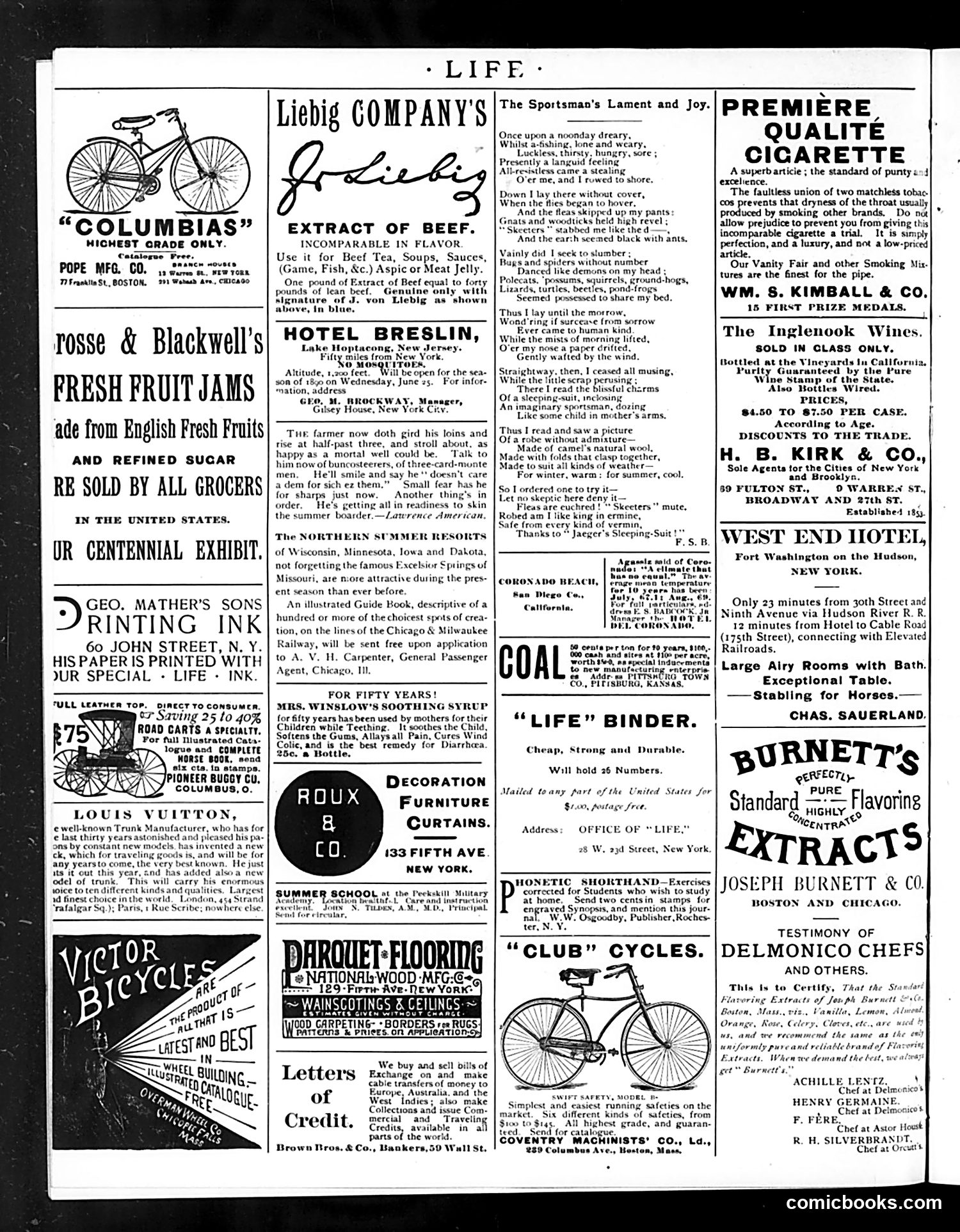
This page is primarily **advertising**, not satirical content. It features commercial advertisements for various late 19th-century products and services, including: - Bicycles (Columbia, Victor, Club Cycles) - Food products (Liebig's Extract of Beef, Fosse & Blackwell's Jams) - Furniture and home goods (Roux & Co. curtains, parquet flooring) - Extracts and flavorings (Burnett's) - Hotels (West End Hotel, New York) - Various other goods The only notable editorial content is "The Sportsman's Lament and Joy," a poem about fishing disappointments. There is **no political cartoon or satirical commentary** on this page—it represents Life magazine's revenue model: mixing modest editorial content with extensive paid advertising to reach affluent readers interested in consumer goods and leisure activities.
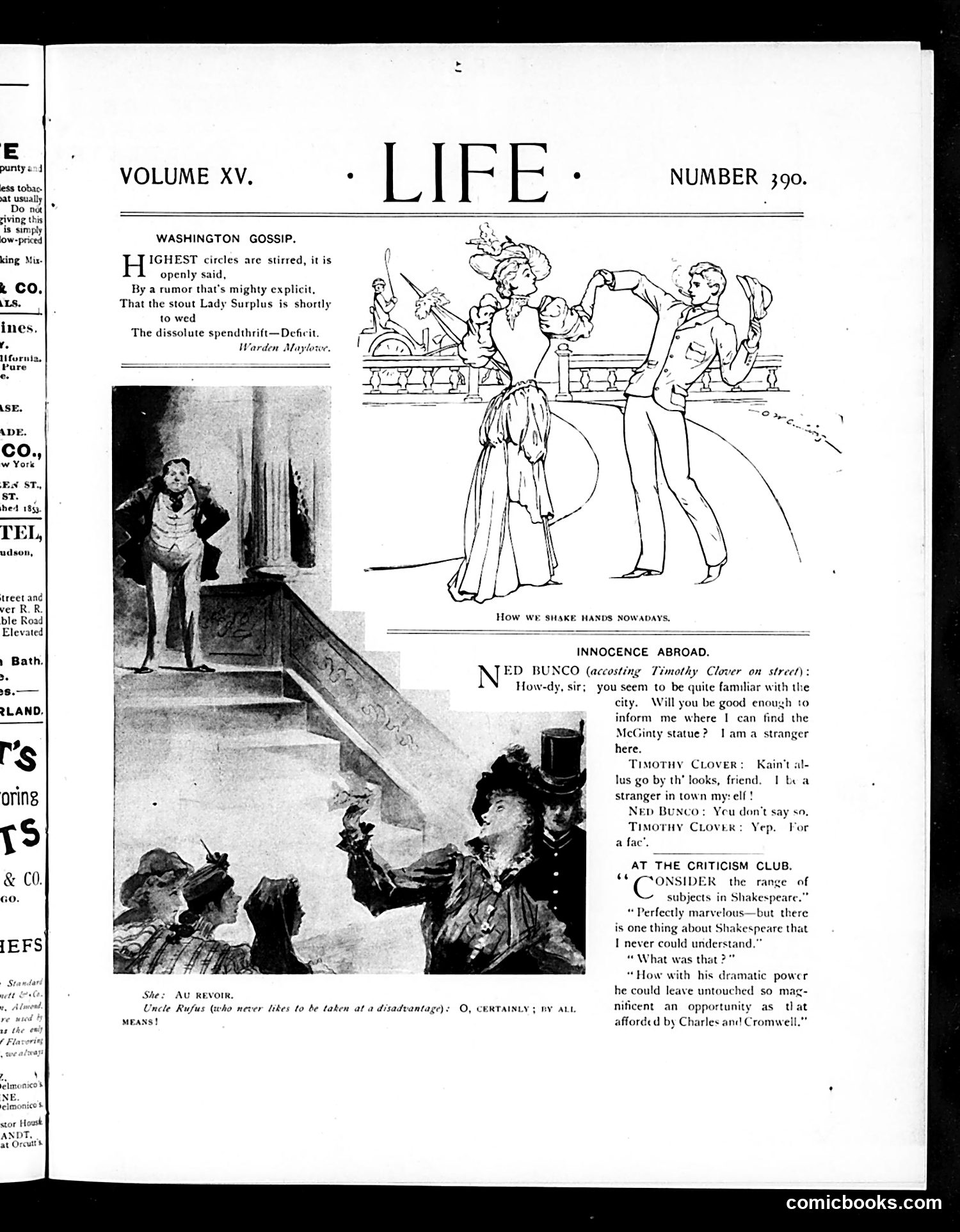
This page contains three distinct pieces of satire: 1. **"Washington Gossip"** (top): A poem about Lady Surplus being "short to wed" and "dissolute spendthrift" — appears to satirize Washington social scandals through personification. 2. **"How We Shake Hands Nowadays"** (illustration): A cartoon mocking modern handshake etiquette, showing exaggerated, awkward physical contact between men and women — likely satirizing changing social conventions of the era. 3. **"Innocence Abroad"** (photograph with dialogue): Features "Ned Bunco" and "Timothy Clover," with Uncle Rufus referenced. The dialogue suggests satire of tourists or foreigners seeking famous landmarks (McGinty statue), mocking naive travelers and local con-artists. 4. **"At The Criticism Club"** (bottom): Discussion of Shakespeare's dramatic power—likely literary satire about academic pretension.
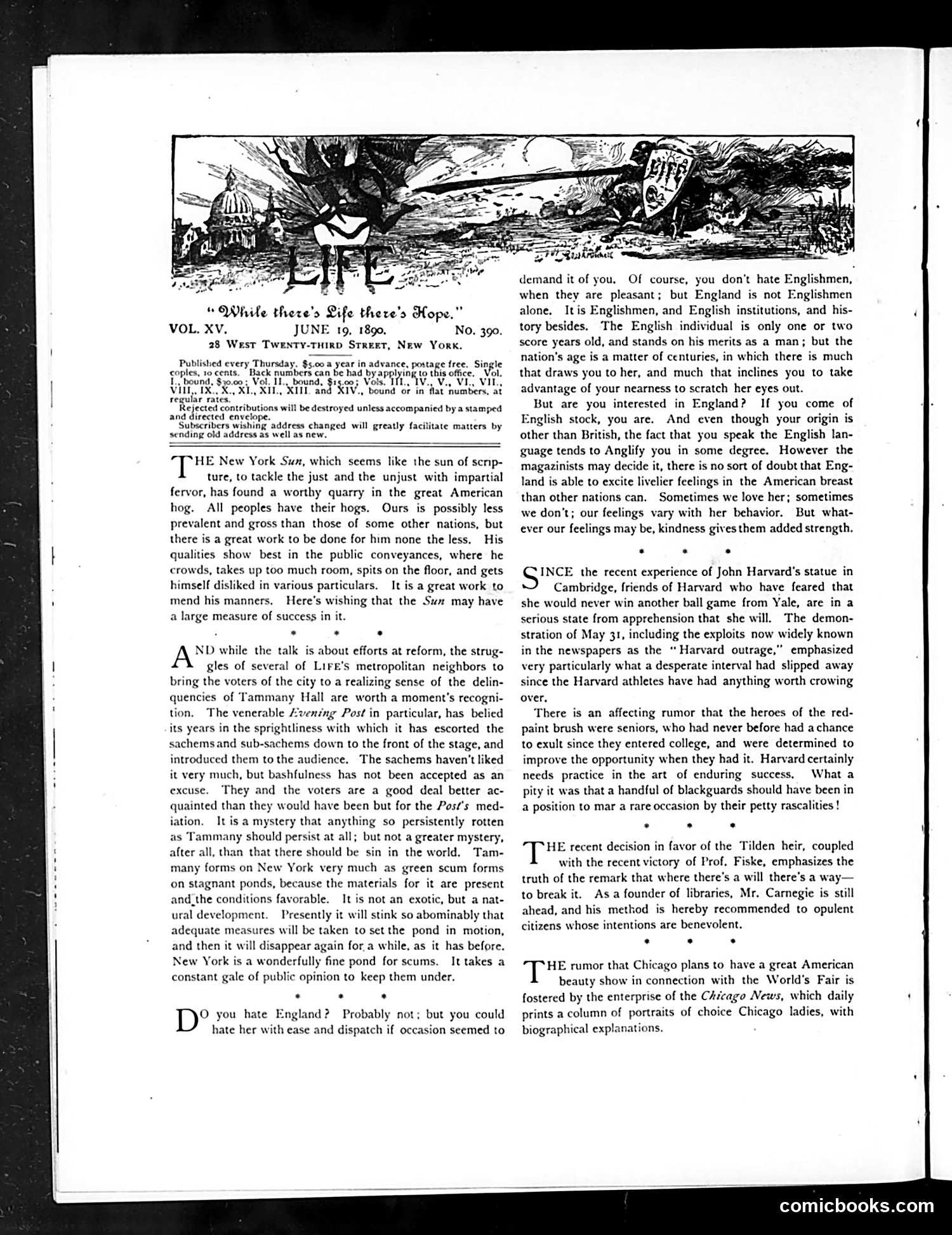
**The Masthead Cartoon:** The illustration at top depicts "Life" as a figure observing a cityscape with a dome (likely St. Paul's Cathedral, London) alongside American landmarks. The caption "'While there's Life there's Hope'" establishes the magazine's satirical persona as social commentator. **The Editorial Content:** The page discusses reform efforts in New York City, particularly regarding Tammany Hall's political corruption and mismanagement of public spaces like stagnant ponds. It critiques the persistence of these problems despite public opinion. Other sections reference John Harvard's statue controversy at Cambridge, the Tilden heir decision, and Chicago's World's Fair beauty pageant plans. **Overall Function:** Rather than single-panel political cartoons, this page exemplifies Life's approach: using illustrated mastheads and editorial commentary to satirize contemporary American civic and social issues.
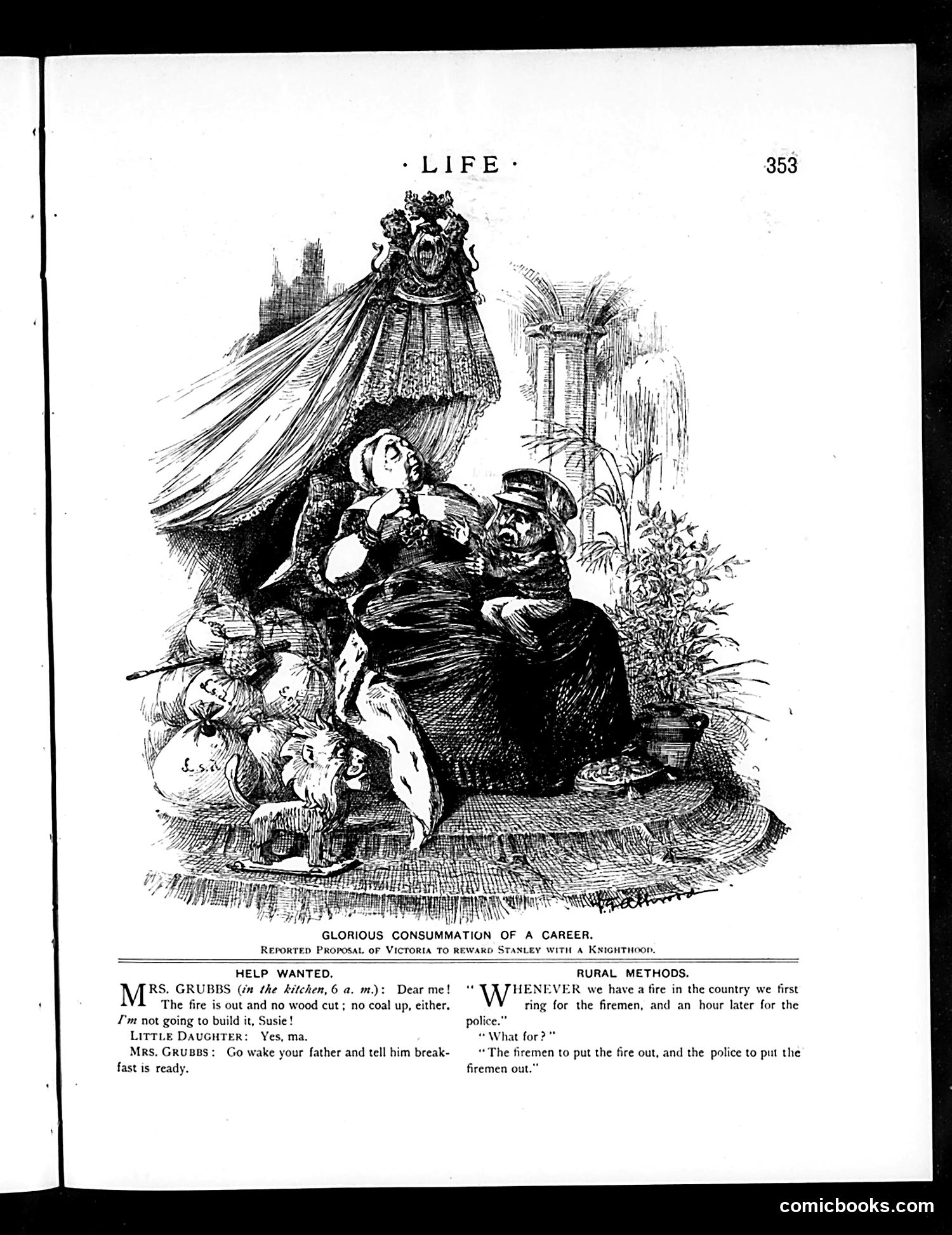
This satirical cartoon mocks Victorian-era upper-class excess and hypocrisy. The title "Glorious Consummation of a Career" depicts an ornate, elaborate coat of arms presiding over two rotund, well-fed figures (appearing to be wealthy industrialists or nobles) being served by smaller figures below—likely representing workers or servants. The accompanying text jokes about rural inefficiency: Mrs. Grubbs complains about lacking firewood, while the "Rural Methods" section satirizes countryside logic—that firemen should extinguish fires and police should remove firemen, suggesting circular absurdity in country management. The cartoon ridicules both aristocratic materialism (the sumptuous coat of arms, elaborate dress) and working-class or rural incompetence, typical of Life magazine's social criticism of the era.
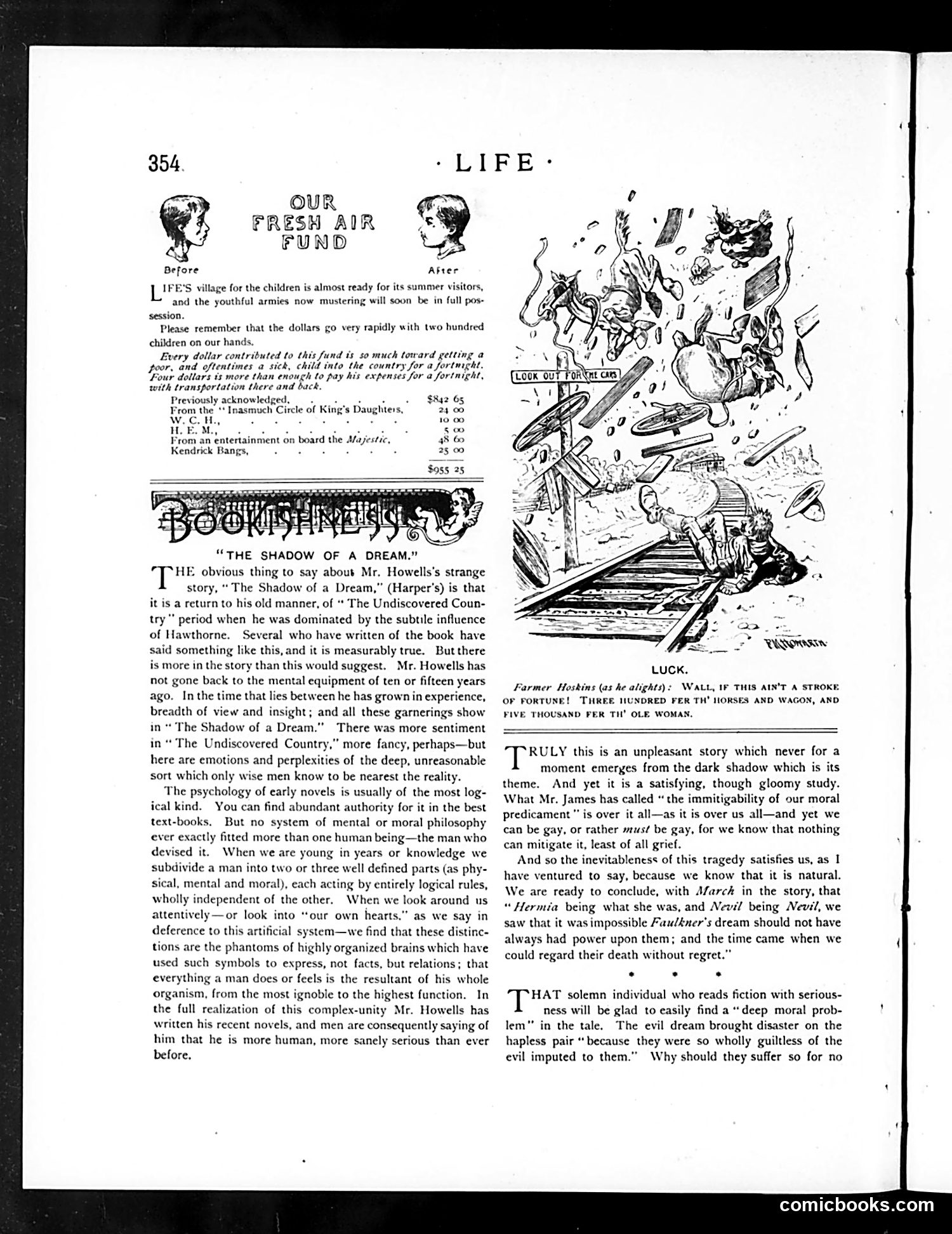
This cartoon depicts a farmer experiencing a dramatic reversal of fortune. The illustration shows a man being blown away by wind alongside scattered money, documents, and farm equipment. The caption reads: "WALL, IF THIS AIN'T A STROKE OF FORTUNE! THREE HUNDRED PER TH' HORSES AND WAGONS, AND FIVE THOUSAND PER TH' OLD WOMAN!" The satire targets how rural people measured wealth and valued their possessions. The farmer considers losing his wife and livestock a fortunate financial gain—suggesting he valued her less than livestock. This reflects early-20th-century rural attitudes and economics, where a farmer's wife's labor was essential but culturally undervalued compared to animals and equipment. The dark humor critiques both farmer mentality and broader gender inequities of the era.
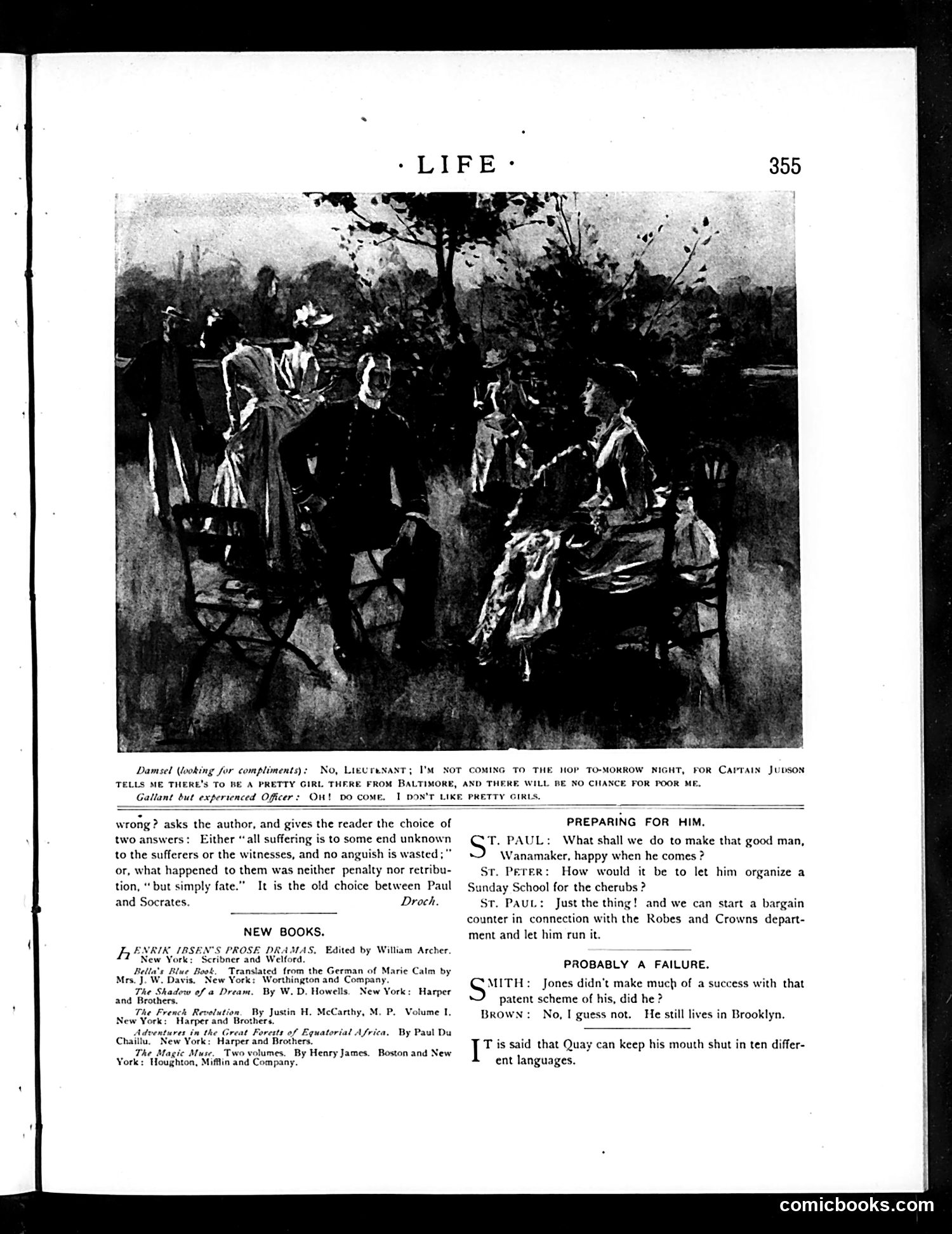
The main image shows a social scene in a park with multiple figures in period dress. The caption references "Daniel (looking for compliments)" and involves dialogue between a Lieutenant and Captain Judson about a "pretty girl" from Baltimore, with wordplay about the Lieutenant not attending "the hop to-morrow night." This appears to be a satirical theatrical or literary scene, likely from an adaptation or serialized story rather than a political cartoon. The humor centers on social courtship dynamics and military social obligations of the era. The page also includes a "New Books" section listing contemporary publications and brief comic exchanges about failed business schemes and language abilities. Without clearer historical context about the specific characters or publication date, the precise satirical target remains unclear, though it reflects period upper-class social comedy conventions.
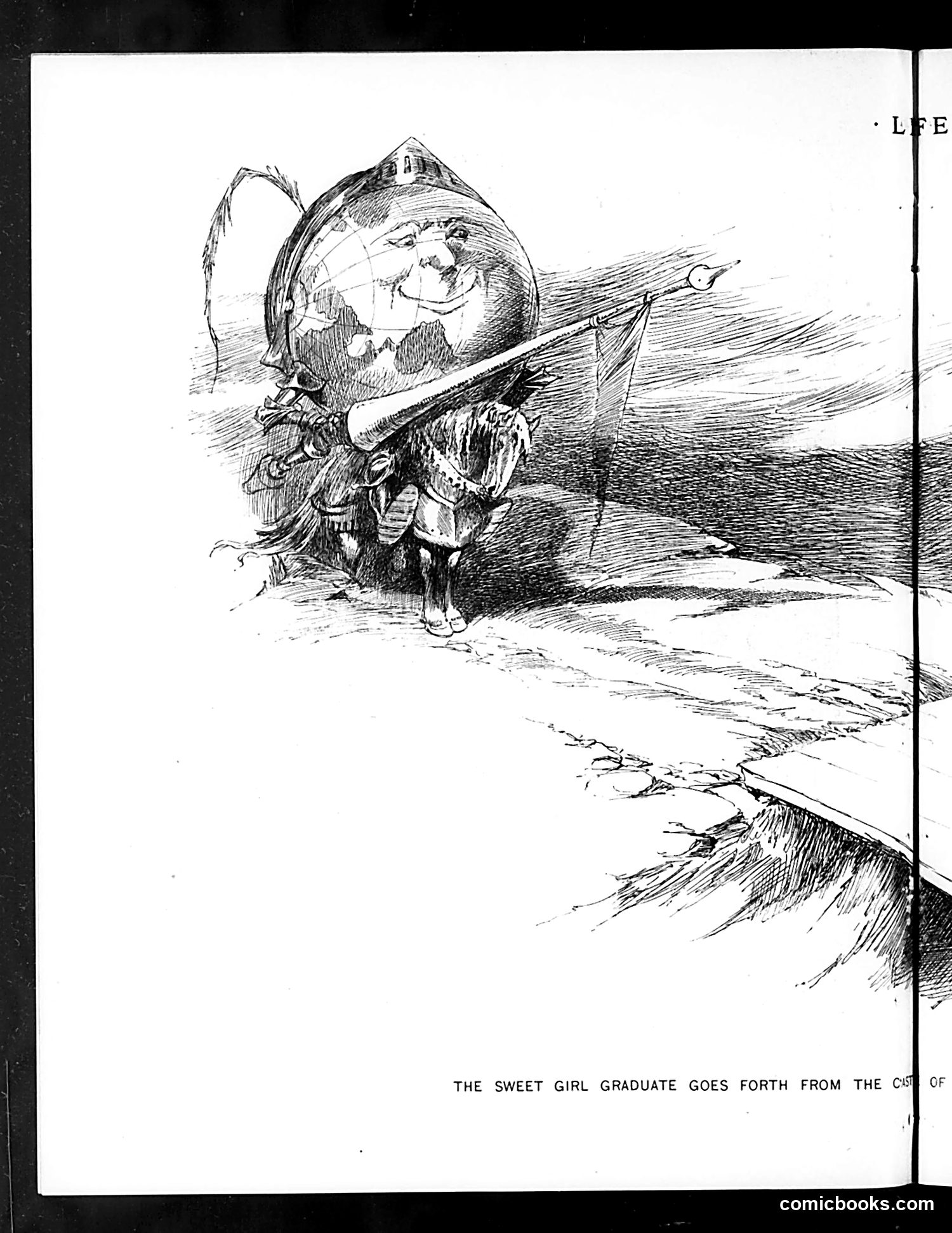
This is a satirical illustration titled "The Sweet Girl Graduate Goes Forth from the Castle of..." (text cut off). The image depicts a young woman equipped like an explorer or adventurer—carrying a telescope, rope, and other expedition gear—emerging from what appears to be a large globe or spherical structure. The satire mocks the newly educated woman entering the world. Rather than suggesting she's prepared for adult life through her education, the cartoon implies she's ill-equipped, humorously burdened with inappropriate or useless tools. This reflects early-20th-century skepticism about women's education and their capacity to function independently in society. The "graduate" is portrayed as naive and comically unprepared despite her credentials.
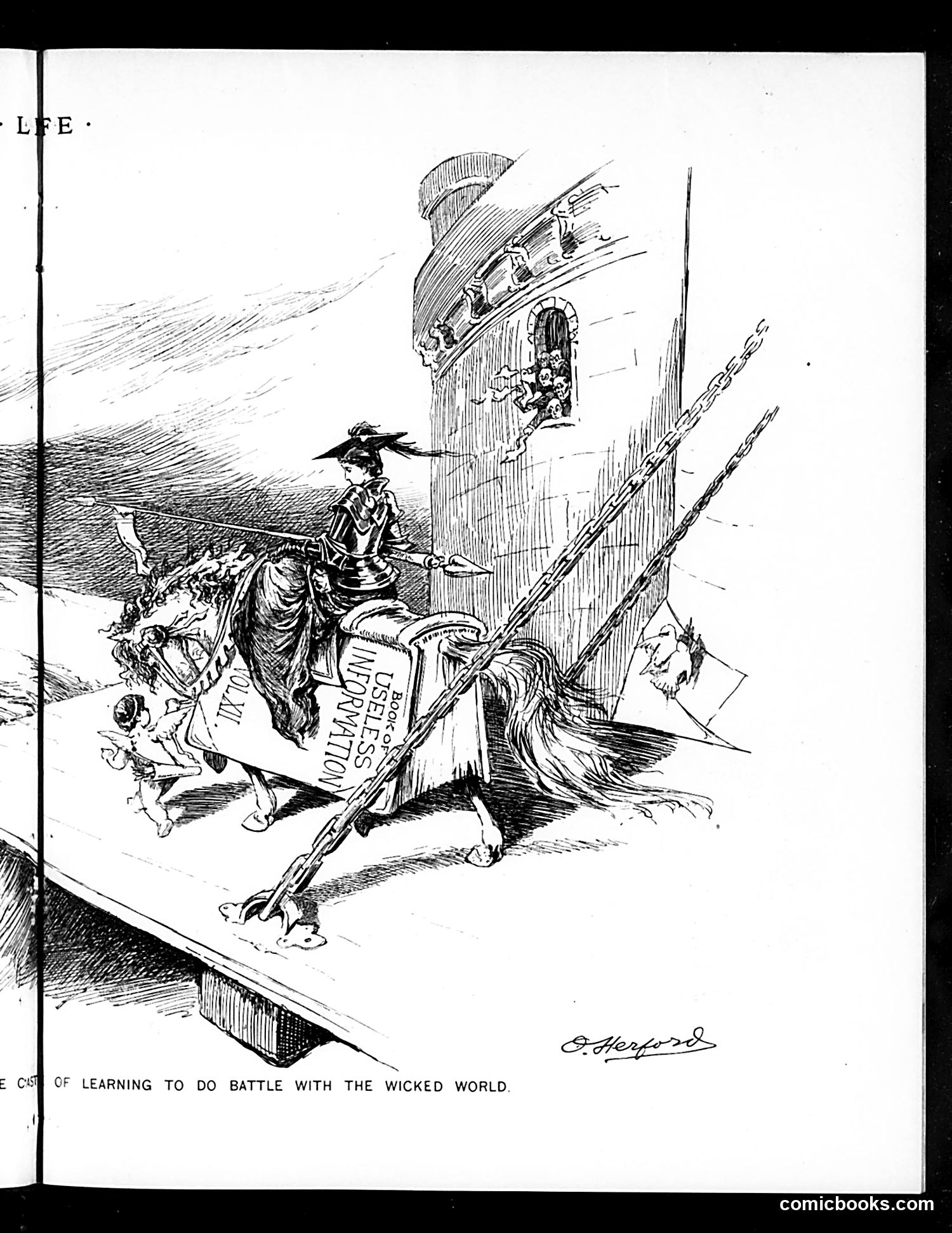
This is a satirical illustration titled "Learning to Do Battle with the Wicked World." The image depicts a woman on horseback being trained or instructed by figures representing worldly temptations and vices. The banner or sign she carries appears to reference "conflicts" or "battles" (text partially visible). The cartoon uses allegorical imagery—the woman as an innocent figure, the demonic or monstrous creatures as embodiments of sin or corruption—to satirize the challenges young women face navigating society. The "wicked world" references appear to be vices or moral dangers. The artist's signature reads "Udo Keppler" (or similar). This reflects early 20th-century Life magazine's frequent moralizing satire about gender roles, education, and social virtue.
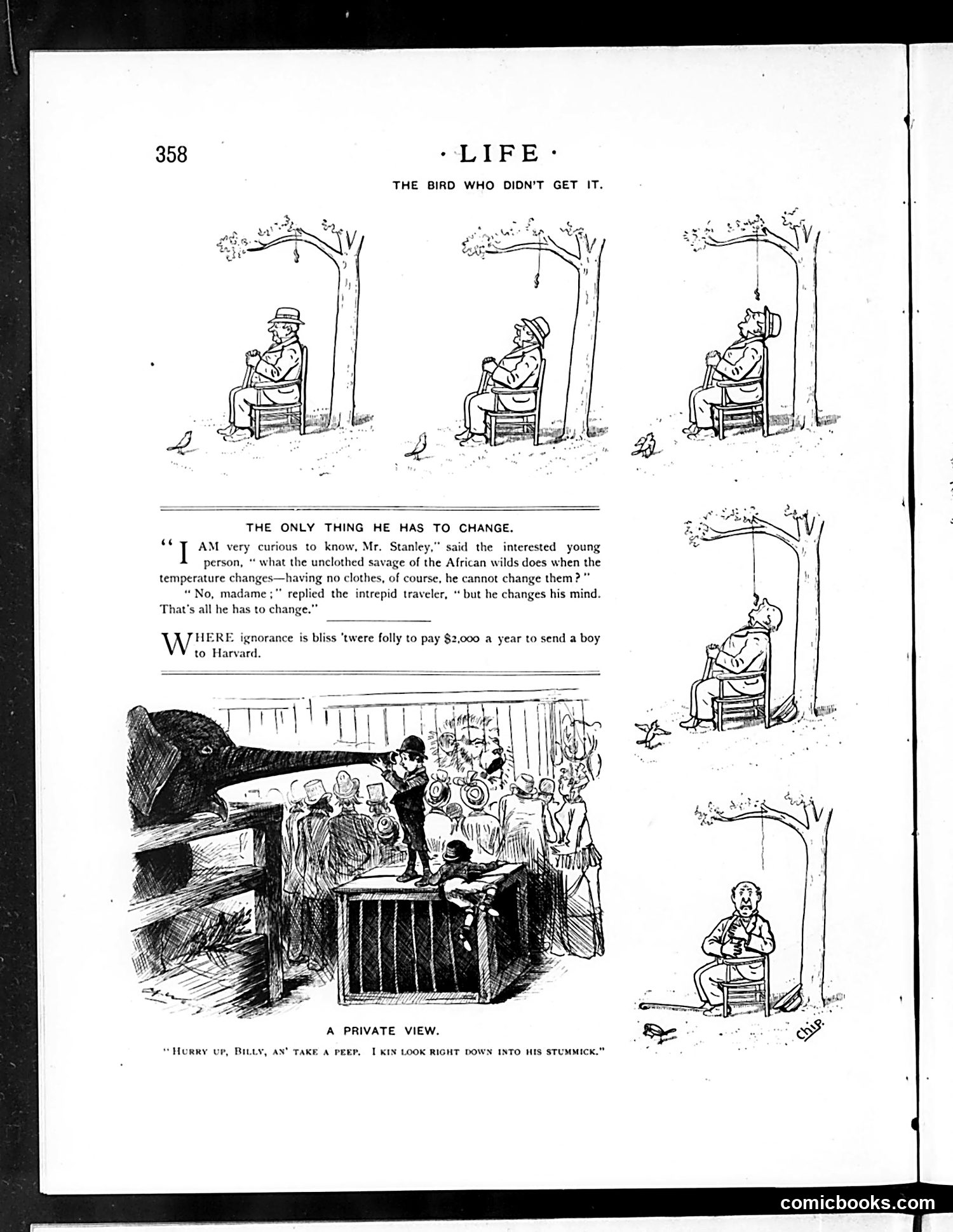
This page contains two separate satirical pieces: **Top Comic Strip:** A man sits under a tree with a bird, progressively moving closer. The caption "The Only Thing He Has to Change" references a dialogue about whether African savages can change their clothes—the traveler's reply that they change their minds instead suggests stubborn inability to adapt. **Bottom Section:** Critiques Harvard's $2,000 annual tuition (then extraordinarily expensive) as wasteful, calling it "ignorance bliss." The accompanying sketch "A Private View" shows what appears to be a zoo or menagerie exhibit with crowds viewing animals, captioned with crude dialect humor about looking "down into its stummick"—suggesting the wealthy education produces people as intellectually developed as zoo animals. The satire targets both class privilege and educational pretension.
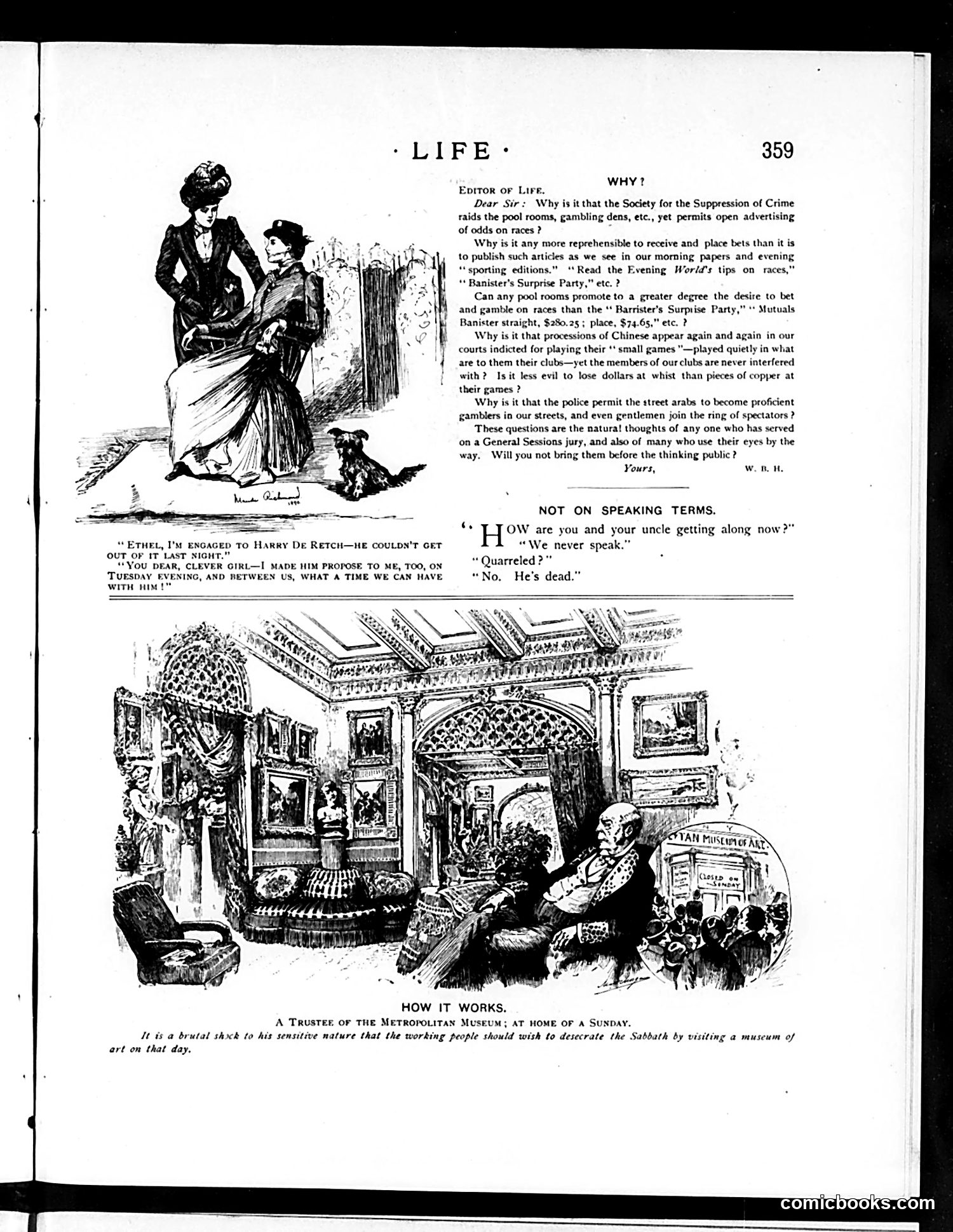
**Top Cartoon:** Shows a woman and child with a small dog. The caption references "Harry De Retch" and an engagement, with dialogue about a "Tuesday evening" together. This appears to be a social/romantic satire about courtship etiquette among the upper classes. **Letter Section ("Why I"):** A reader complains to the Editor about inconsistent law enforcement—specifically that authorities raid gambling operations and pool halls while permitting horse-race betting, Chinese lottery games, and street gambling. The writer questions why working-class gambling is suppressed while wealthy pastimes escape police attention. **Bottom Cartoon ("How It Works"):** Depicts a museum trustee at home on Sunday, satirizing the hypocrisy of cultural elites who expect working people to visit museums on their day off rather than rest. The page critiques class-based double standards in Gilded Age society.
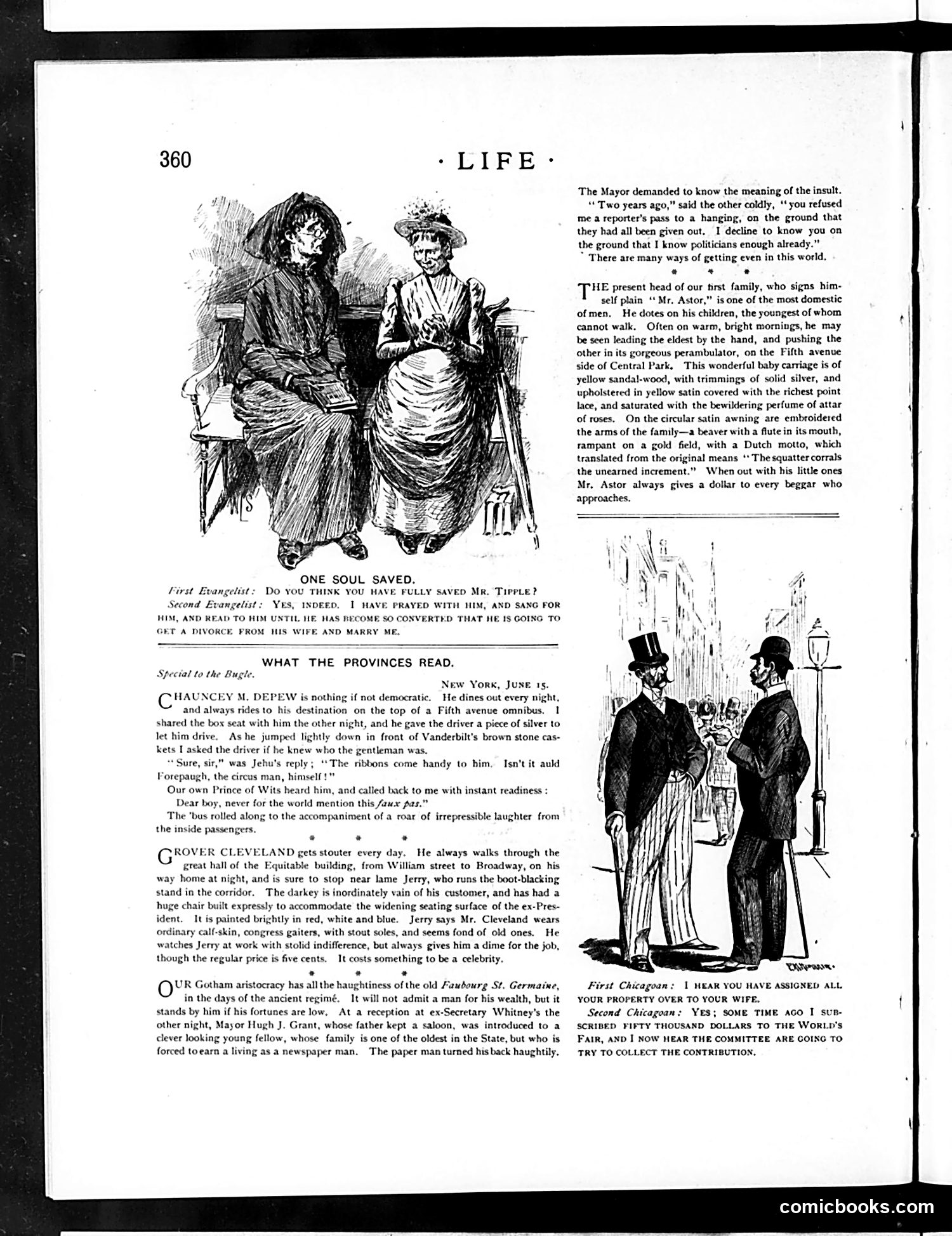
This page contains multiple brief satirical vignettes mocking prominent American figures and social pretenses of the Gilded Age. **"One Soul Saved"**: A joke about evangelists using religion as cover for personal seduction—one evangelist claims to have "converted" Mr. Tippee so thoroughly he'll divorce his wife and marry *her*. **Chauncey M. Depew anecdote**: Satirizes the railroad magnate's democratic pretensions. He rides atop a Fifth Avenue omnibus; a driver mistakes him for circus owner Forepaugh, creating ironic humor about his ordinariness despite wealth. **Grover Cleveland**: Mocks the ex-President's weight gain through an anecdote about a specially built boot-shine chair, emphasizing his expanding girth. **Mayor Grant vs. newspaper man**: Social comedy about class resentment—a blue-blooded young man snubs the Mayor (whose father kept a saloon) by refusing to acknowledge him. **Mr. Astor**: Satirizes extreme wealthy ostentation—his infant's carriage costs a fortune with embroidered family beaver coat-of-arms, while his motto translates to "the squatter corrals the unearned increment" (mocking inherited wealth).
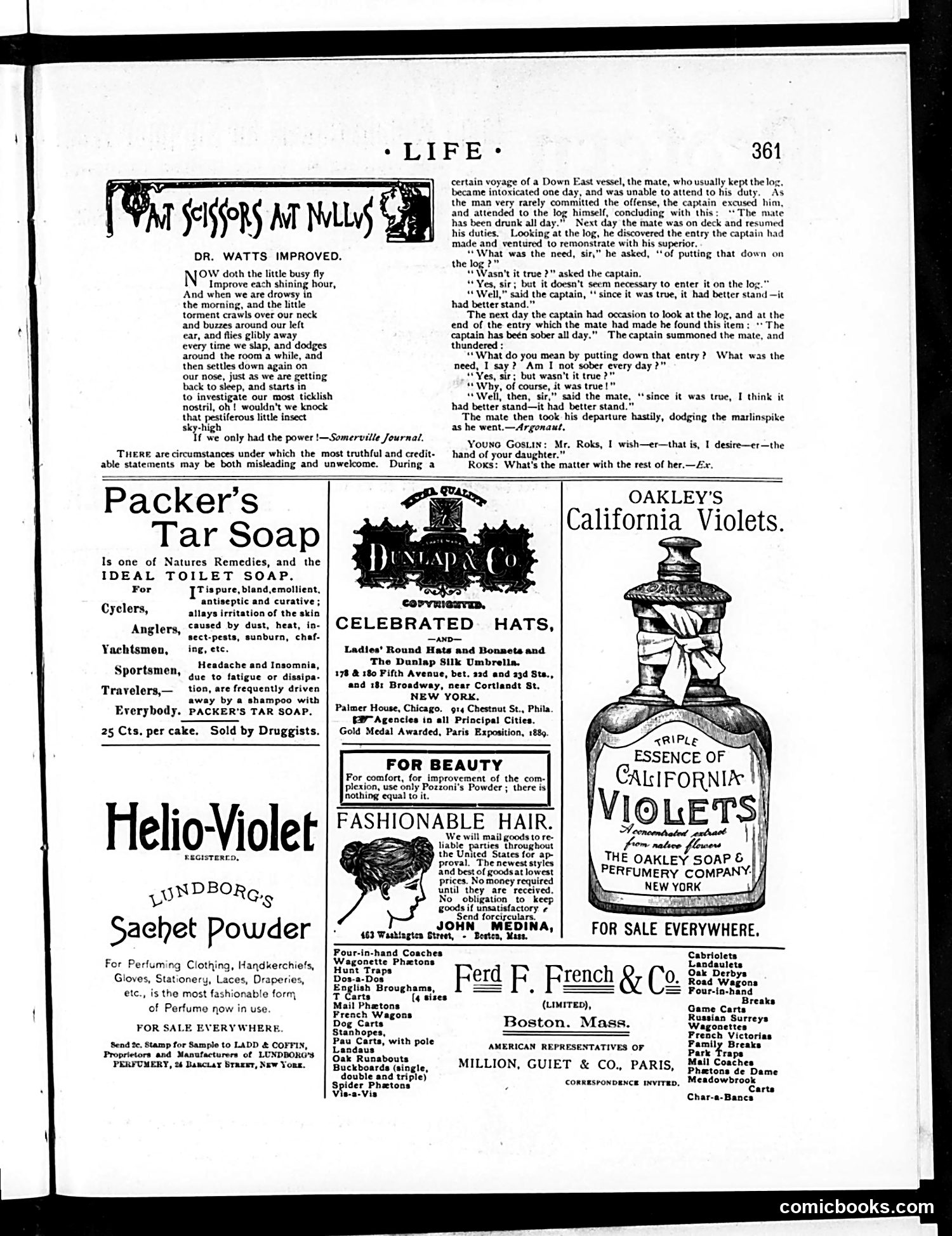
This page contains **two humorous anecdotes** and **period advertisements**. The main cartoon/story titled "Scissors at Nulls" presents a joke about literal truth versus propriety. A ship's captain records that the mate was "drunk all day"—factually true but seemingly unnecessary for the log. When the mate retaliates by noting the captain was "sober all day," the captain protests, even though it's equally true. The satire mocks the captain's hypocrisy: he demands factual accuracy until that accuracy embarrasses *him*. It's a commentary on selective truth-telling and double standards. A secondary brief joke follows about a young man proposing to a woman—he says he desires "the hand of your daughter," and her father cheekily responds, "What's the matter with the rest of her?"—a literal-minded rebuttal to an antiquated romantic phrase. The remainder is **advertising**: soaps, perfumes, hats, and beauty products typical of the era, reflecting late 19th-century consumer culture.
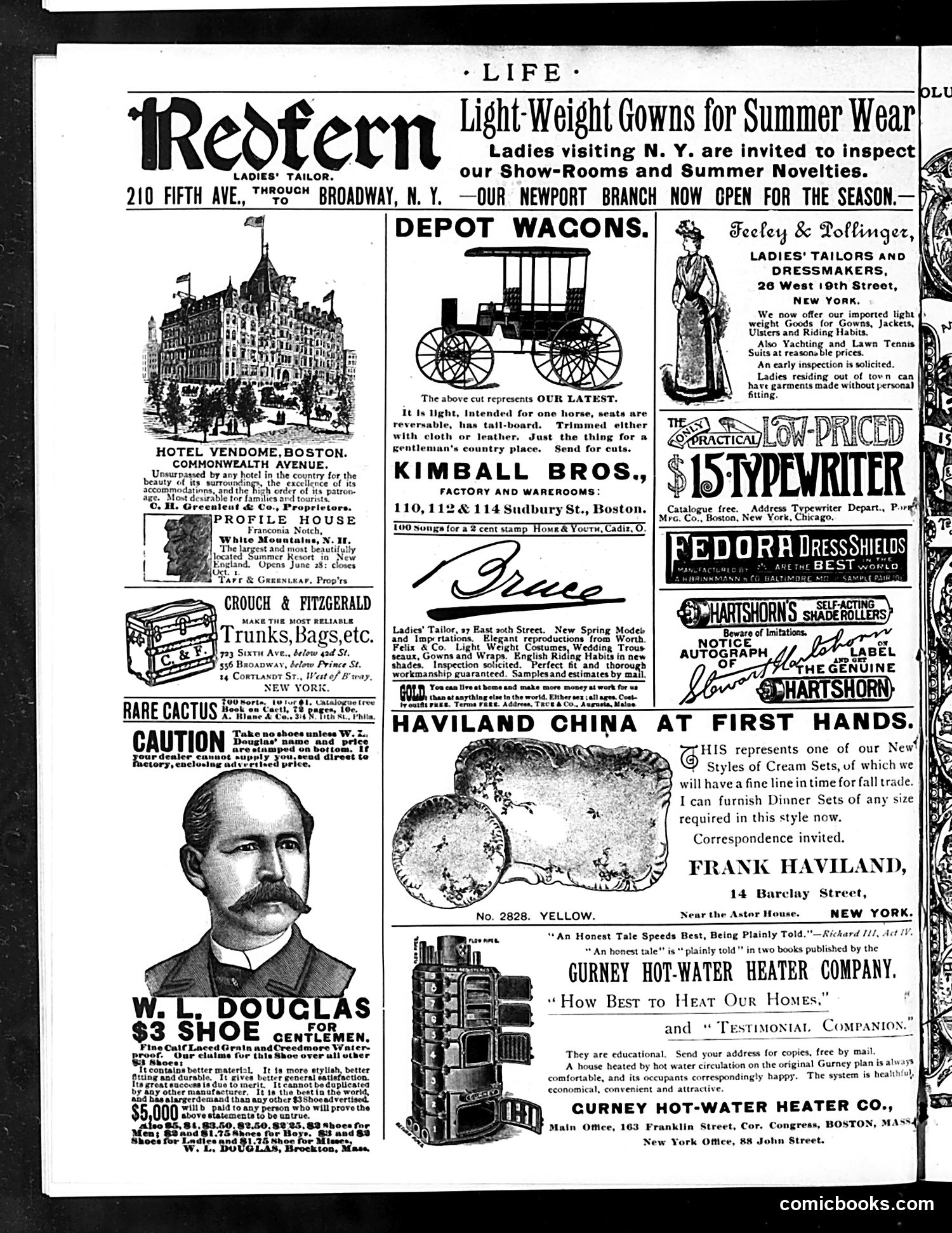
This is primarily an **advertising page** with minimal editorial content. The page consists almost entirely of commercial advertisements for goods and services targeting upper-middle-class consumers circa early 1900s. Key advertisers include: - **Redfern** (ladies' tailor, Fifth Avenue/Broadway) - **Hotel Vendome** (Boston luxury hotel) - **Crouch & Fitzgerald** (luggage/trunks) - **W.L. Douglas** (men's shoes, $3 price point) - **Kimball Bros.** (depot wagons/carriages) - **Haviland China** (fine dinnerware) - **Gurney Hot-Water Heater Company** (home heating systems) The advertisements emphasize luxury goods, summer fashions, and modern conveniences. The Shakespeare quote ("An Honest Tale Speeds Best") appears in the Gurney ad, suggesting advertisers used literary authority to validate products. There is **no discernible political cartoon or satire** on this page—it functions as a straightforward commercial space reflecting the commercial character of Life magazine during this era.