
Life, 1890-06-19 · page 6 of 14
Life — June 19, 1890 — page 6: what you’re looking at
What you’re looking at
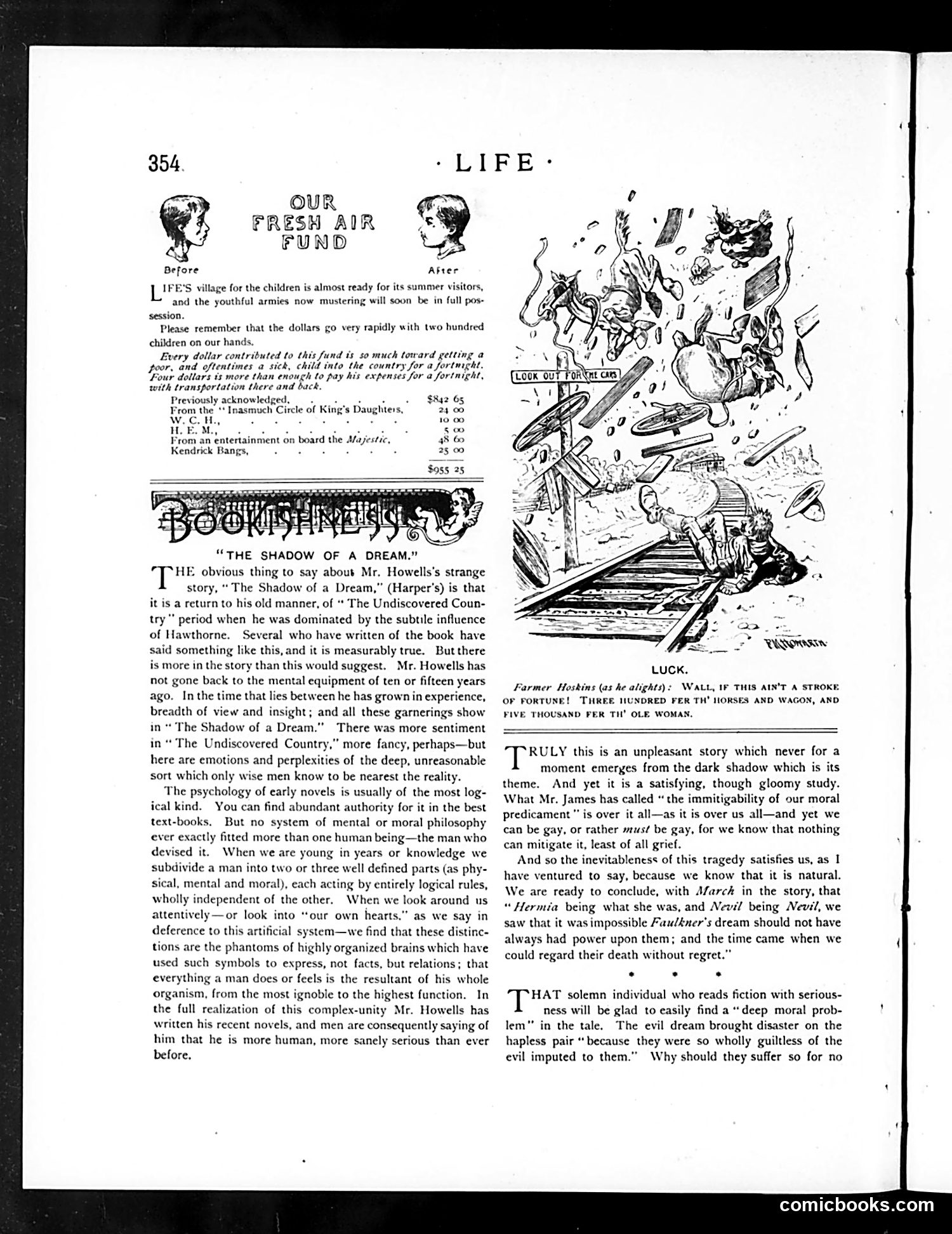
This cartoon depicts a farmer experiencing a dramatic reversal of fortune. The illustration shows a man being blown away by wind alongside scattered money, documents, and farm equipment. The caption reads: "WALL, IF THIS AIN'T A STROKE OF FORTUNE! THREE HUNDRED PER TH' HORSES AND WAGONS, AND FIVE THOUSAND PER TH' OLD WOMAN!" The satire targets how rural people measured wealth and valued their possessions. The farmer considers losing his wife and livestock a fortunate financial gain—suggesting he valued her less than livestock. This reflects early-20th-century rural attitudes and economics, where a farmer's wife's labor was essential but culturally undervalued compared to animals and equipment. The dark humor critiques both farmer mentality and broader gender inequities of the era.
📄 Transcribed text from this page (OCR, searchable)
Machine-transcribed from the original scan — historical spelling and the odd misread are preserved.
OUR FRESH AIR FUND Before After LIFE'S village forthe children is almost ready for its summer visitors, and the youthful armies now mustering will soon be in full pos- session. Please remember that the dollars go very rapidly with two hundred chikiren on our hands. Every dollar contributed to this fund ts so much toward getting a poor, and oftentimes a sick, child into the country for a fortmght. Four dollars ts more than enough to pay his expenses for a fortnight, with transportation there and back. Previously acknowledged, 5 7 eee From the * Inasmuch Circle of King’s Daughters, $842 65, From an entertainment on board the Afajestic, Kendrick Bangs, : “THE SHADOW OF A DREAM.” HE obvious thing to say about Mr. Howells’s strange story, “* The Shadow of a Dream,” (Harper's) is that it is a return to his old manner, of * The Undiscovered Coun- try" period when he was dominated by the subtile influence of Hawthorne. Several who have written of the book have said something like this, and it is measurably true. But there is more in the story than this would suggest. Mr. Howells has not gone back to the mental equipment of ten or fifteen years ago. In the time that lies between he has grown in experience, breadth of view and insight; and all these garnerings show in “ The Shadow of a Dream." There was more sentiment in“ The Undiscovered Country,” more fancy, perhaps—but here are emotions and perplexities of the deep, unreasonable sort which only wise men know to be nearest the reality. The psychology of early novels is usually of the most log- ‘al kind. You can find abundant authority for it in the best text-books. But no system of mental or moral philosophy ever exactly fitted more than one human being—the man who devised it. When we are young in years or knowledge we subdivide a man into two or three well defined parts (as phy- sical, mental and moral), each acting by entirely logical rules, wholly independent of the other. When we look around us attentively—or look into “our own hearts.” as we say in deference to this artificial system—we find that these distinc- tions are the phantoms of highly organized brains which have used such symbols to express, not facts, but relations; that everything a man does or feels is the resultant of his whole organism, from the most ignoble to the highest function. In the full realization of this complex-unity Mr. Howells has written his recent novels, and men are consequently saying of him that he is more human, more sanely serious than ever before. LUCK. Farmer Hoskins (as he alights): WALL, 1F THIS AIN'T A STROKE OF FORTUNE! THREE HUNDRED FER TH’ HORSES AND WAGON, AND FIVE THOUSAND FER TH’ OLE WOMAN, TRY this is an unpleasant story which never for a moment emerges from the dark shadow which is its theme. And yet it is a satisfying, though gloomy study. What Mr. James has called “ the immitigability of our moral predicament " is over it all—as it is over us all—and yet we can be gay, or rather must be gay, for we know that nothing can mitigate it, least of all grief. And so the inevitableness of this tragedy satisfies us, as I have ventured to say, because we know that it is natural. We are ready to conclude, with Afarch in the story, that “Hermia being what she was, and Nevil being Nevil, we saw that it was impossible Fau/éner's dream should not have always had power upon them; and the time came when we could regard their death without regret.” HAT solemn individual who reads fiction with serious- ness will be glad to easily find a ‘deep moral prob- lem" in the tale. The evil dream brought disaster on the hapless pair “because they were so wholly guiltless of the evil imputed to them.” Why should they suffer so for no comicbooks.com