
A complete issue · 16 pages · 1890
Life — March 6, 1890
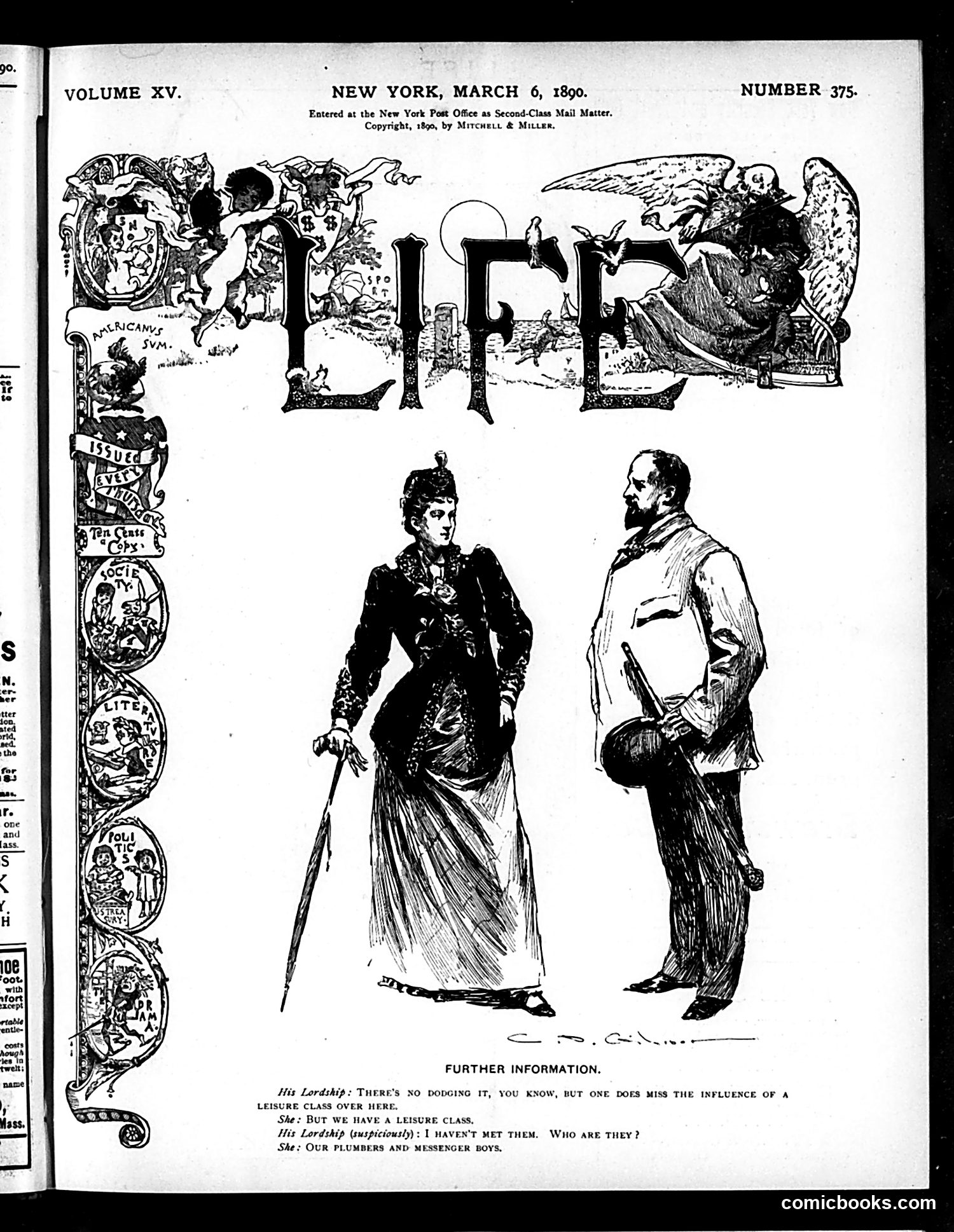
This satirical cartoon depicts a conversation between a well-dressed man and woman about "leisure class" society. The woman, holding a fan and appearing fashionable, questions the man about who certain people are. He responds that they are "plumbers and messenger boys." The joke satirizes the blurred social distinctions of the leisure class—wealthy people who claim to represent a distinct upper tier of society cannot reliably distinguish actual members of their own class from working-class tradespeople. This mocks the pretensions of 1890s "high society" and their supposed refinement, suggesting their markers of status are superficial or unreliable. The cartoon critiques class consciousness and social snobbery of the Gilded Age era.
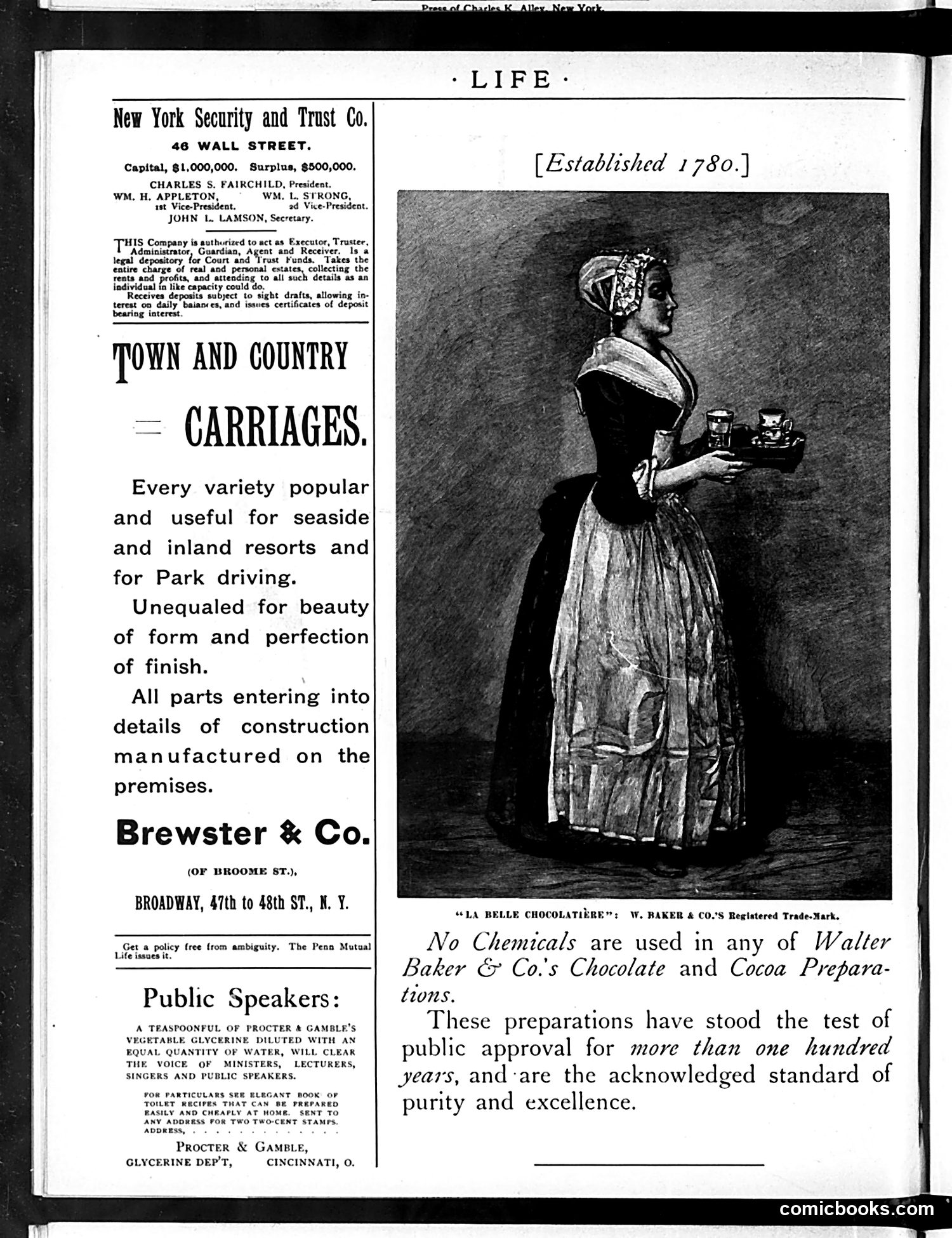
This page is primarily **advertising content** rather than political satire or editorial cartoons. The main image—"La Belle Chocolatière"—is a classical portrait advertisement for Walter Baker & Co.'s chocolate and cocoa products, established 1780. The company emphasizes that **no chemicals** are used in their preparations, which have "stood the test of public approval for more than one hundred years." The other advertisements on the page promote: New York Security and Trust Co. (banking/financial services), Brewster & Co. (carriages for town and country use), and Procter & Gamble (glycerine products for public speakers). There is no political cartoon or satirical content visible here—this is a standard commercial advertising page from *Life* magazine.
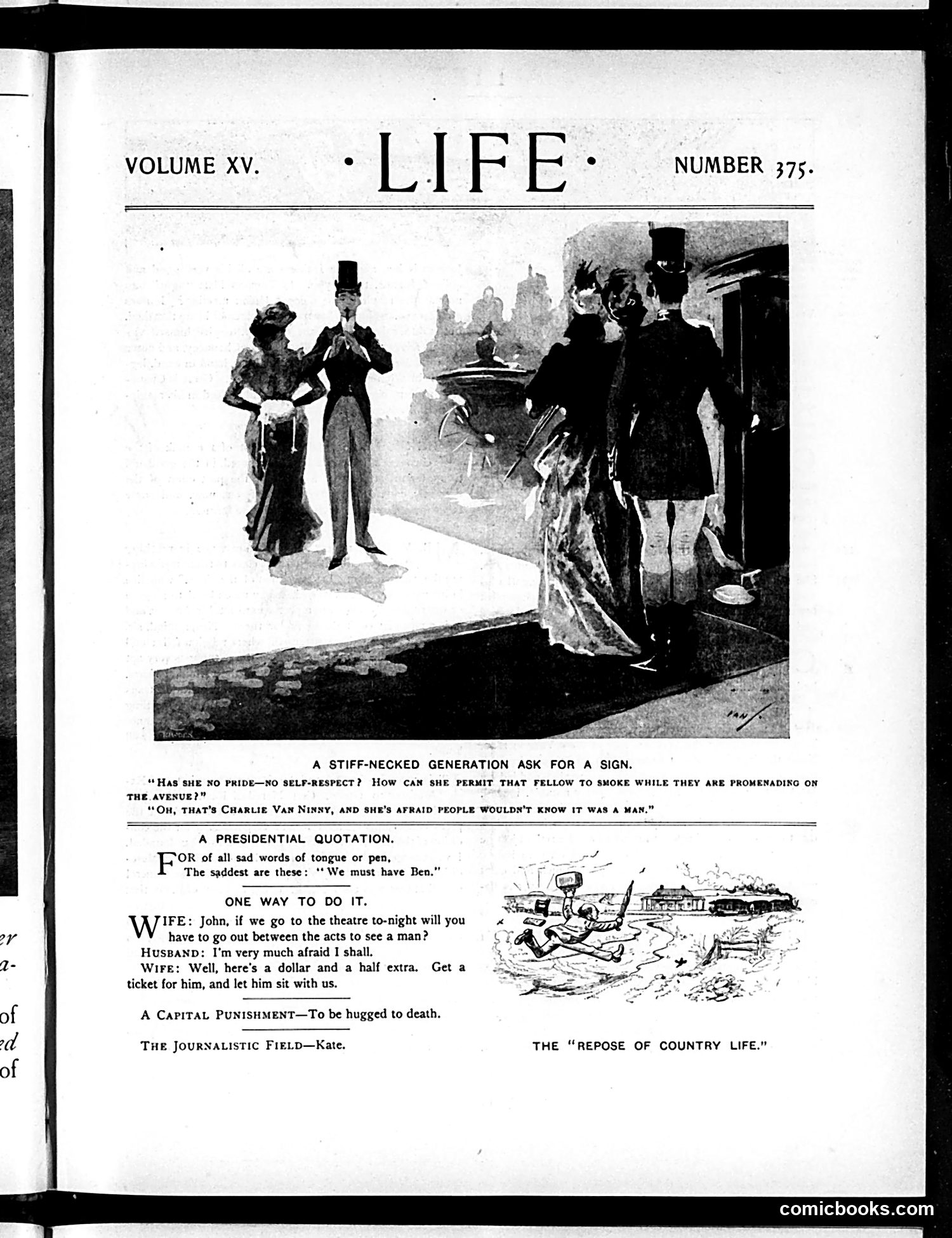
The top cartoon depicts a social etiquette debate. A formally-dressed couple stands apart from a group of fashionable people. The caption questions whether a woman should permit a man to smoke while they're on an avenue together, suggesting this violates propriety. The punchline references "Charlie Van Nirby," implying he's wealthy enough that people overlook his poor manners—the satire mocks how social rules are selectively enforced based on class status. Below are three brief humorous items: a presidential quotation about loss, a domestic joke about theater tickets, and a pun about capital punishment. The small illustration labeled "Repose of Country Life" shows rural leisure. Overall, this page combines social commentary on class-based etiquette standards with light domestic humor typical of early 20th-century Life magazine.
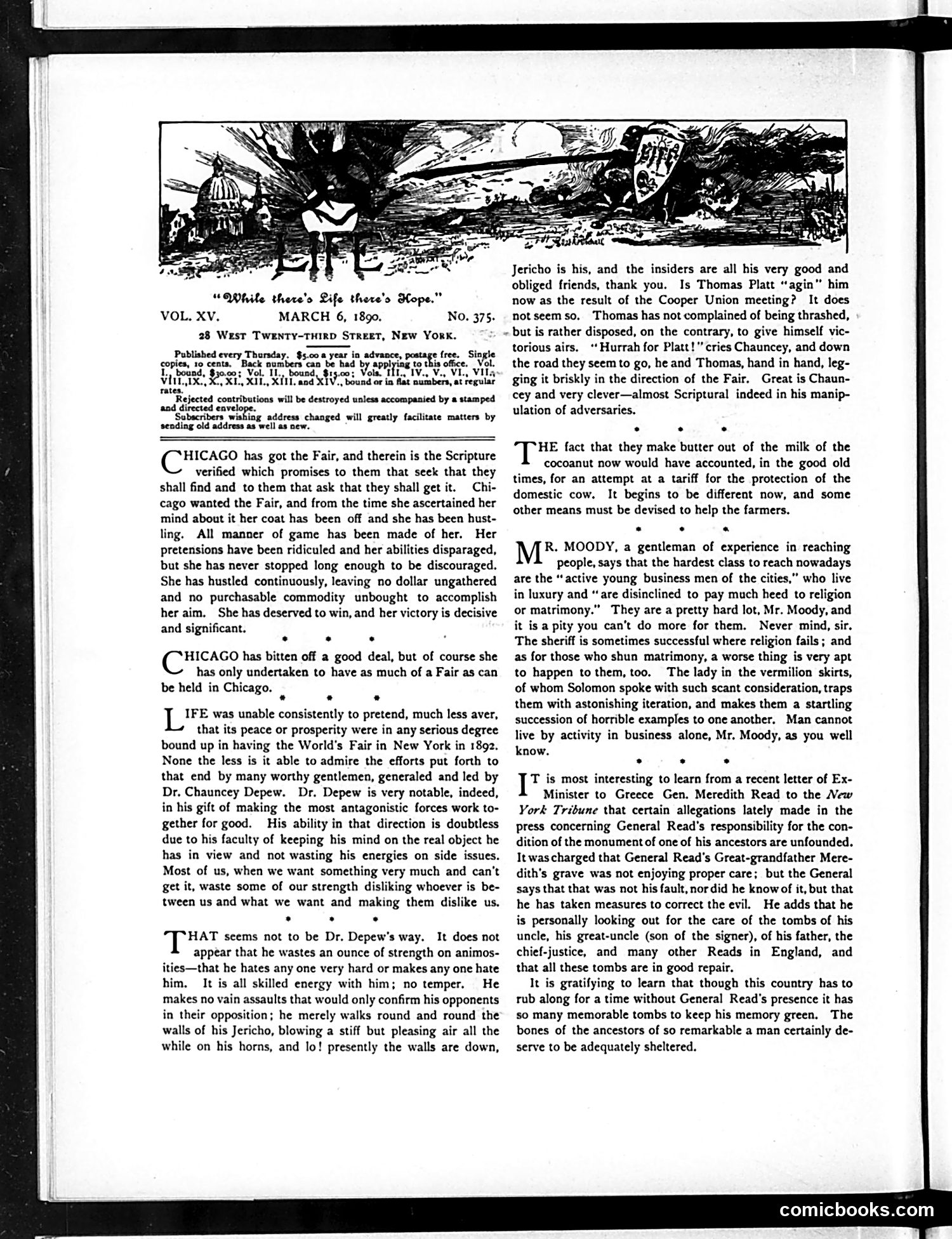
The masthead cartoon depicts a figure labeled "While there's Life there's Hope," showing what appears to be a personified representation of *Life* magazine itself—likely as an optimistic or resilient character. The article text discusses Chicago's successful World's Fair bid and Dr. Chancey Depew, a prominent public figure. The satire focuses on Depew's rhetorical skills and political maneuvering—the piece suggests he's exceptionally effective at persuasion while remaining diplomatically neutral on contentious issues. Another section addresses Gen. Meredith Read regarding allegations about monument maintenance, suggesting *Life* is commenting on current political and social management issues of the era. The overall tone is satirical commentary on contemporary American public figures and civic affairs.
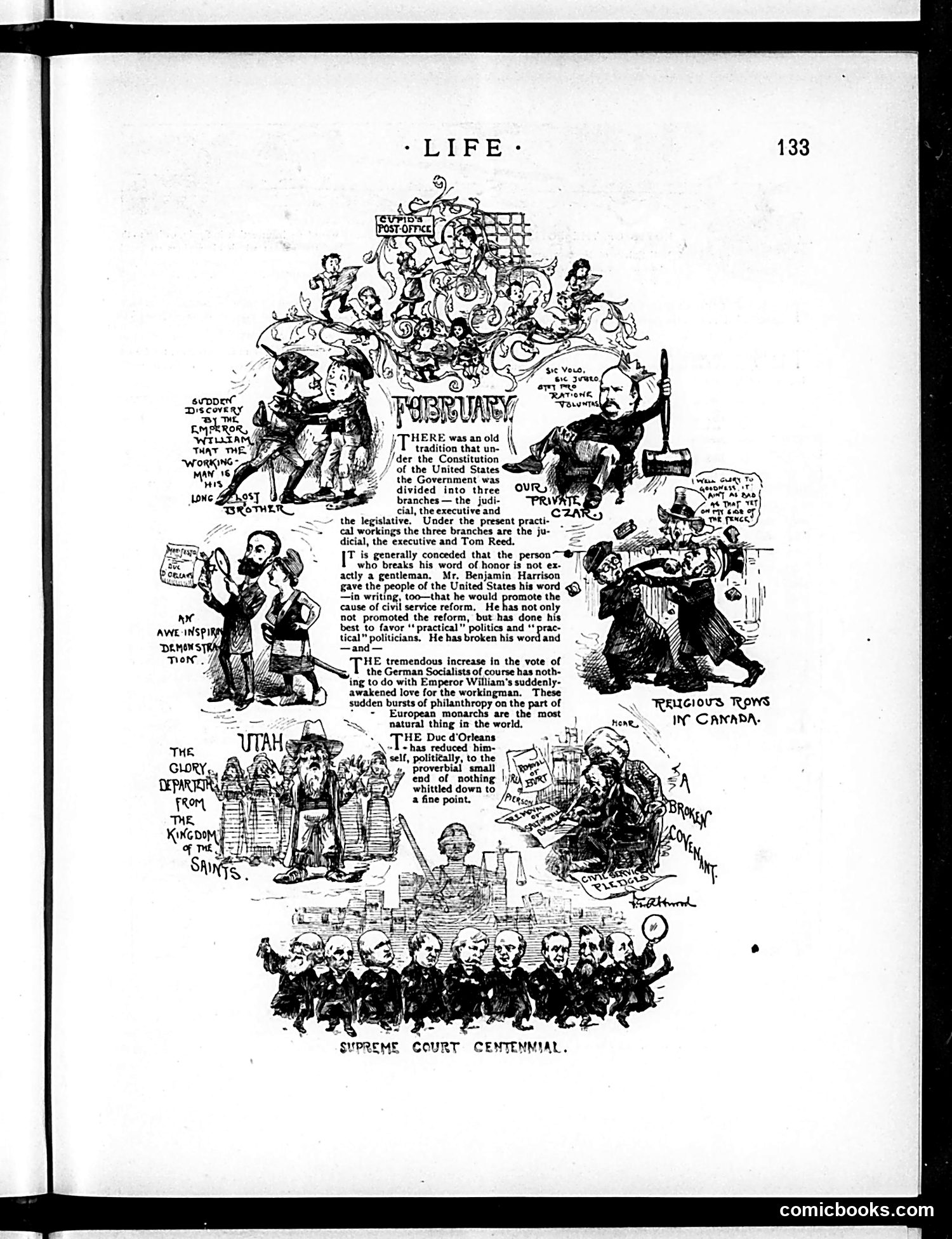
This page features multiple satirical cartoons commenting on early 20th-century American politics and society. The central section discusses Benjamin Harrison's civil service reform efforts, suggesting he promoted reform while favoring "practical politics" and patronage. The cartoons mock various political figures and situations: "The Glory Departing from the Kingdom of the Saints" appears to reference Utah and the Mormon church; "Religious Rows in Canada" depicts ecclesiastical conflicts; and "Our Party Czar" critiques political machine control. The bottom panel, "Supreme Court Centennial," shows nine justices, likely celebrating the Court's 100th anniversary around the 1890s. The overall tone satirizes political hypocrisy, patronage systems, and institutional power struggles of the Gilded Age era. Exact figure identifications are unclear from the image alone.
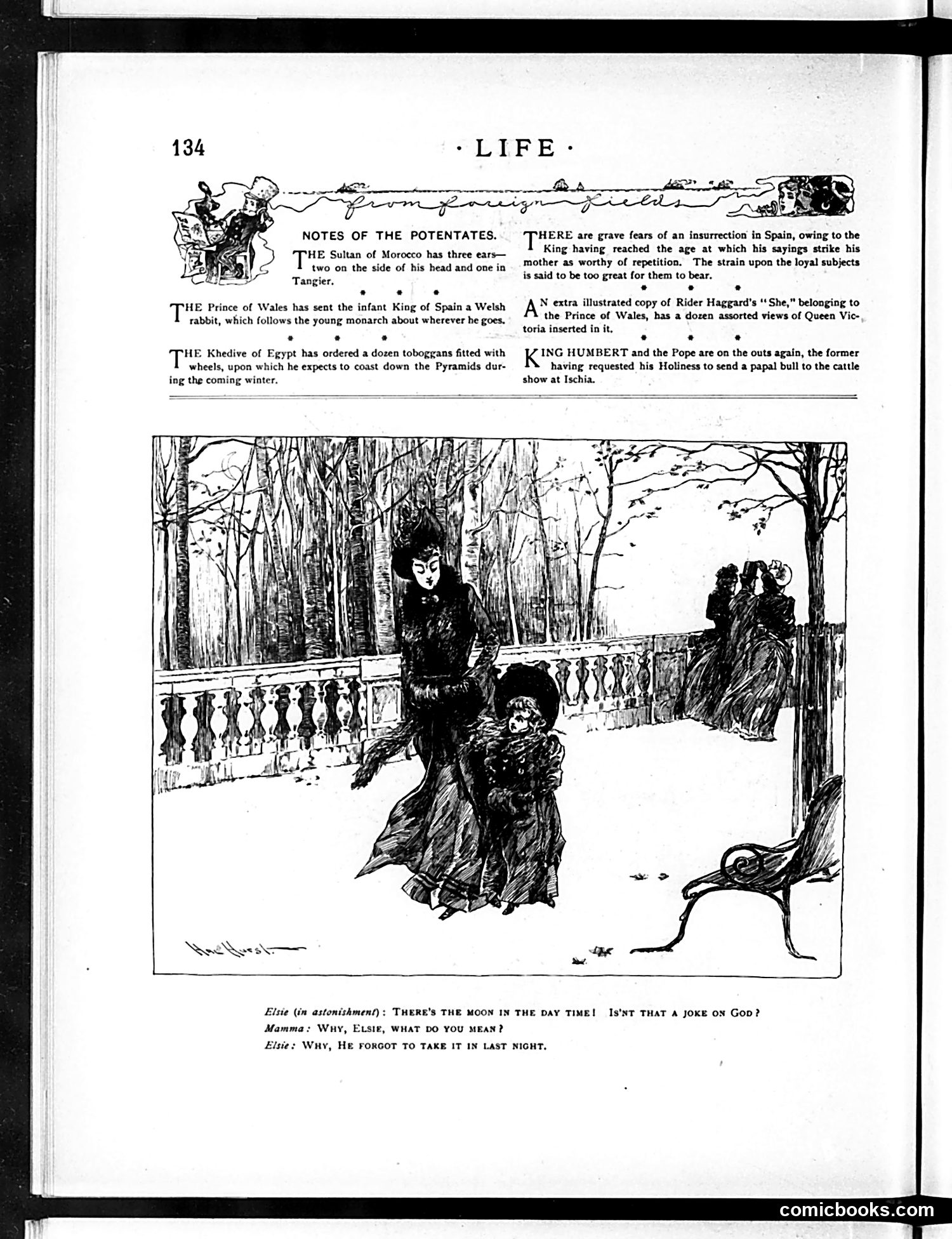
This page features brief satirical notes about international leaders alongside an illustration. The text mentions: - The Sultan of Morocco's three ears (satirizing his power or absurdity) - The Prince of Wales sending a Welsh rabbit to the infant King of Spain (a pun on "Welsh rabbit," a cheese dish) - The Khedive of Egypt ordering toboggans to coast down the Pyramids The accompanying illustration depicts a winter scene with elegantly dressed figures, showing a woman and child in a snowy landscape with a balustrade. The caption contains dialogue about seeing the moon during daylight—a character's absent-minded observation presented as humorous. The satire mocks the eccentricities and perceived foolishness of various European and Middle Eastern rulers of the period.
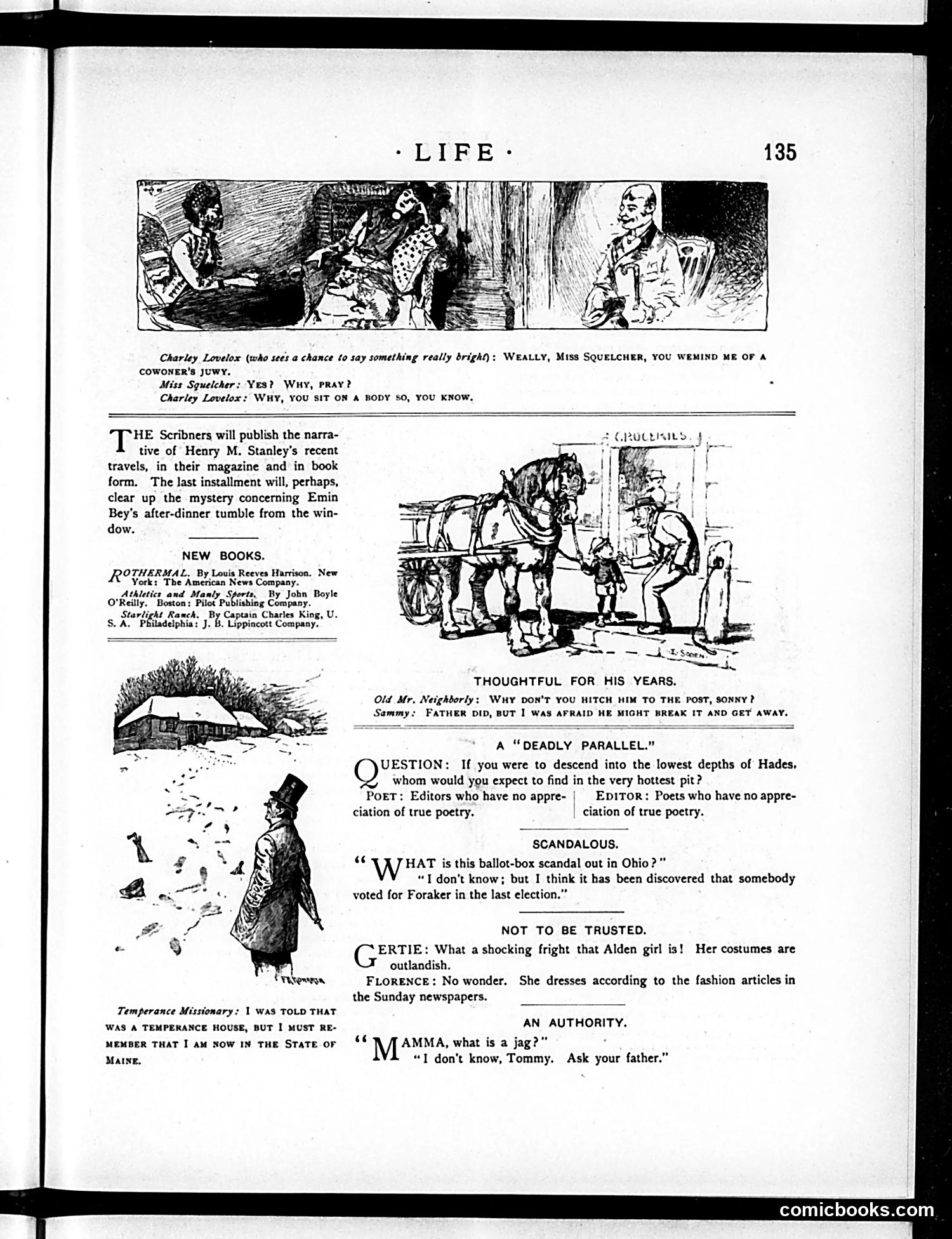
This page contains several brief satirical items typical of Life's humor section: **Top cartoon**: Shows a social interaction where "Charley Lovelox" makes an inappropriate comment to "Miss Squelcher," joking about a "cowgirl's juicy" (likely a crude reference). The humor relies on a character being tactless. **Middle section**: Includes a drawing titled "Thoughtful for His Years" about a boy named Sammy and his father, suggesting precocious or inappropriate behavior from a child. **Bottom jokes**: Include wordplay and social commentary—one mocks Ohio politics (referencing "Foraker"), another criticizes fashion trends in newspapers, and a final exchange plays on a child asking what "jag" means. The page reflects early-20th-century American humor: relatively mild by modern standards, focused on social awkwardness and generational differences rather than explicit political commentary.
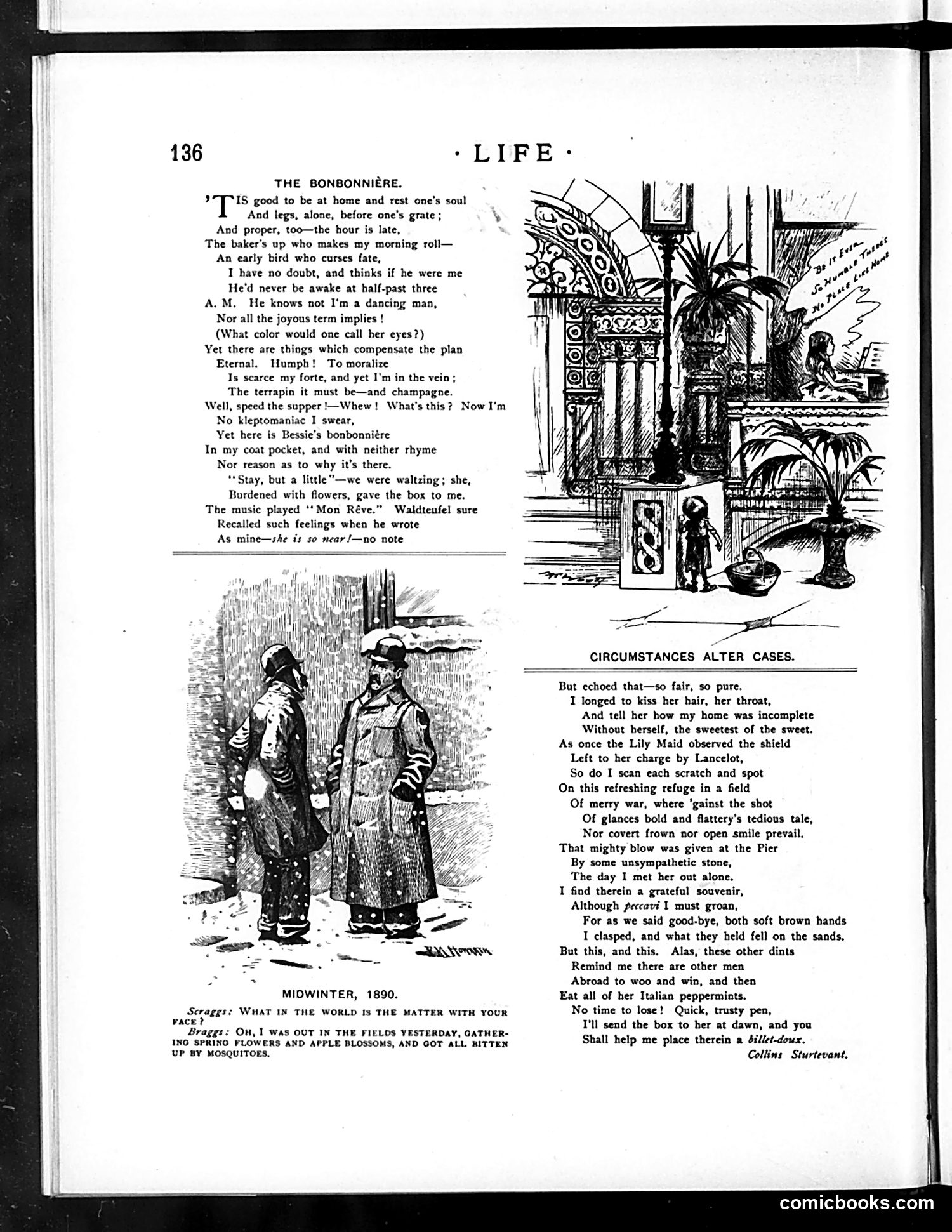
This page contains poetry and illustrations rather than political cartoons. "The Bonbonnière" is a romantic poem about longing for a woman, accompanied by an architectural sketch of an ornate building entrance. Below is an illustration captioned "Midwinter, 1890" showing two men in winter coats having a conversation. The accompanying dialogue suggests one man complaining about missing spring flowers and blossoms while mosquitoes ruined his season—a humorous complaint about seasonal inconveniences. "Circumstances Alter Cases" is another poem about romantic loss and separation, referencing a Lily Maid and memories of a pier encounter. The page is primarily *literary* rather than satirical—featuring verse and gentle illustrative humor about seasonal discomfort and romance rather than political commentary or social critique.
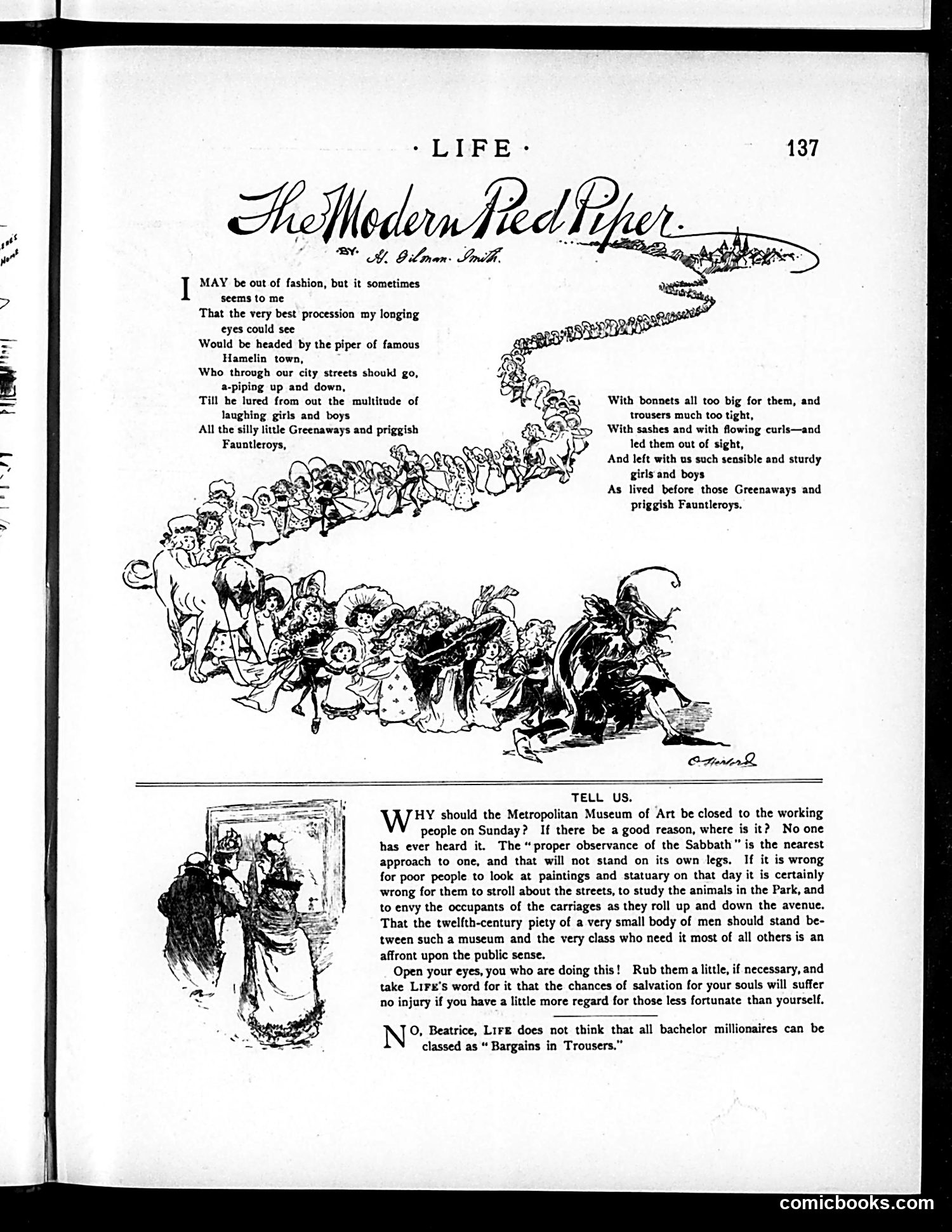
**The Cartoon:** A pied piper leads a long procession of children through city streets. The accompanying poem laments that fashionable society has abandoned traditional child-rearing, leaving children in the care of nannies and governesses who instill poor values ("sashes and flowing curls"). The satirist wishes a "modern pied piper of famous Hamelin town" would lead away these poorly-raised children. **The Satire:** This attacks turn-of-the-century upper-class parenting practices—specifically the outsourcing of child-rearing to servants rather than parents taking direct responsibility. The reference to Hamelin's legendary pied piper (who led children away) suggests these children are essentially already "lost." **Below:** A separate item mocks the Metropolitan Museum closing Sundays to working people, and another quips about bachelor millionaires as "bargains in trousers."
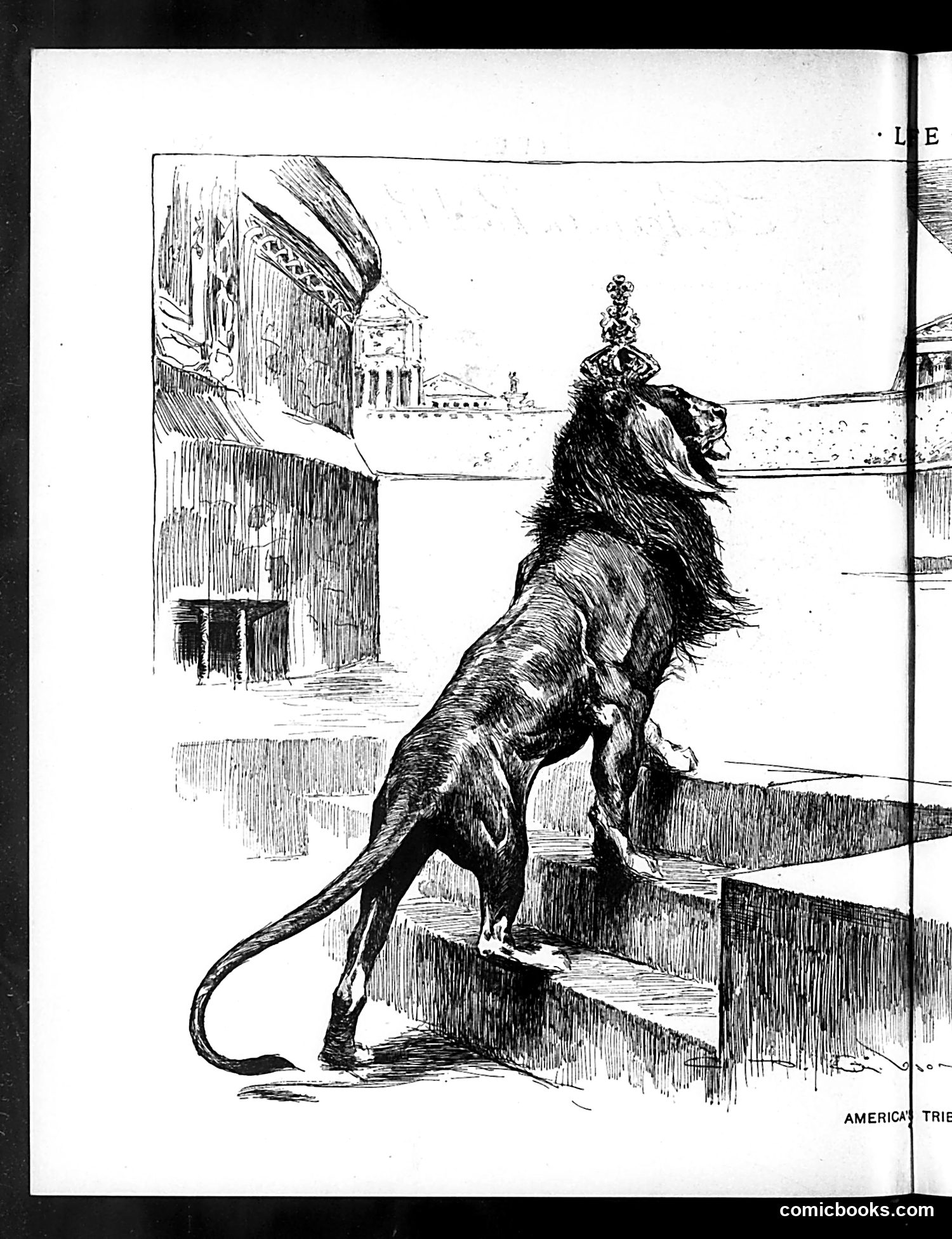
This is a satirical sketch depicting an anthropomorphized donkey wearing a crown, standing on hind legs in what appears to be a formal architectural setting. The donkey's regal bearing—complete with an ornate crown—suggests mockery of authority or leadership. The cartoon likely comments on American politics, as indicated by the partial text "AMERICA TRIB" (possibly "Tribune") at the bottom. The donkey traditionally represents the Democratic Party in American political cartoons. Without the full caption or date, the specific reference remains unclear, but the image appears to satirize either a Democratic politician or party leadership, suggesting incompetence or unsuitable rule through the crude juxtaposition of a beast wearing symbols of power and nobility.
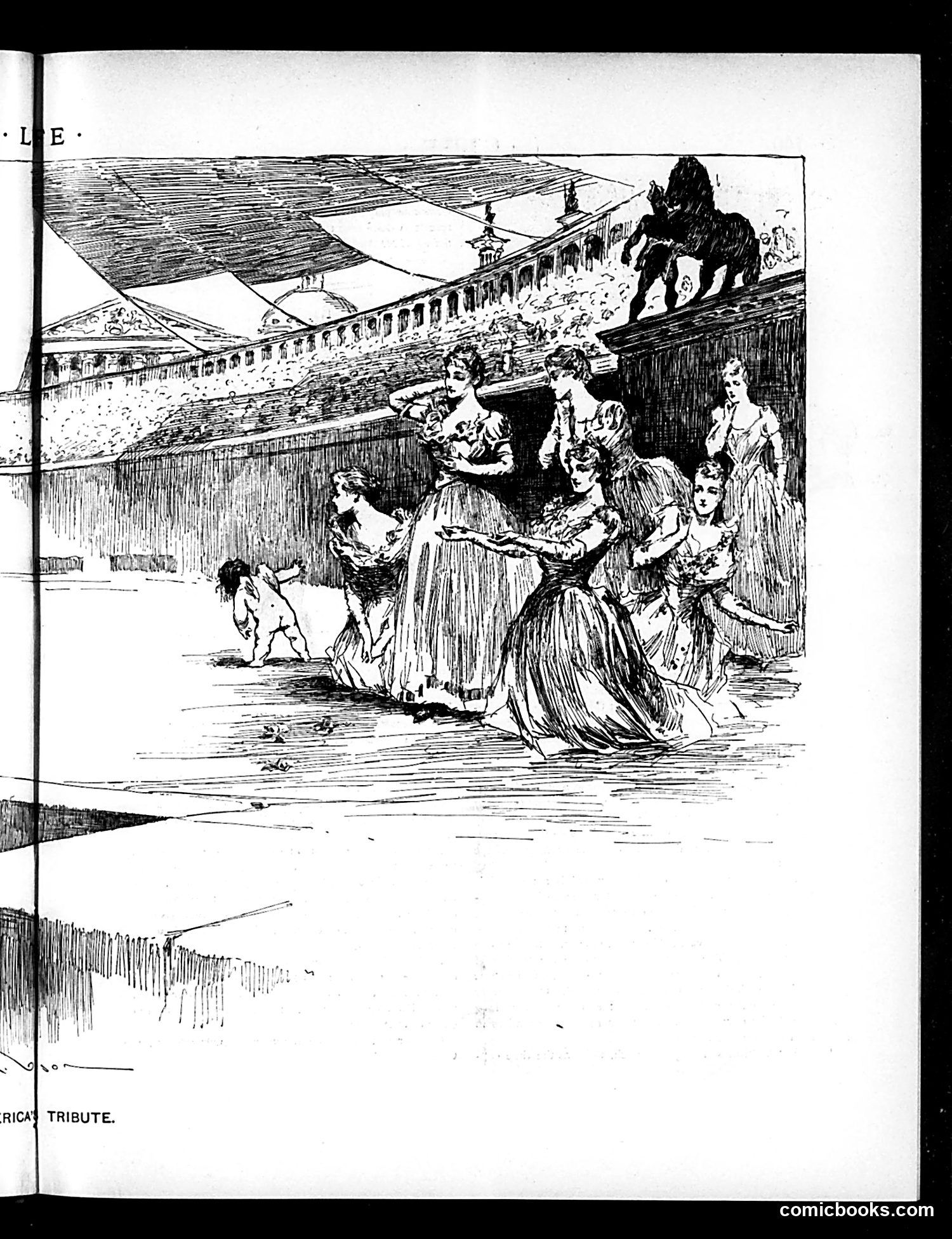
This is an illustration from *Life* magazine showing a scene at what appears to be a circus or public spectacle. A group of well-dressed women in elaborate gowns gather to observe a small figure (likely a child or person of diminished stature) performing or displayed in the arena below. The architectural setting suggests a grand amphitheater with tiered seating in the background. The satire appears to critique the voyeuristic entertainment of the wealthy classes — specifically, their attendance at exhibitions of human oddities or "freak shows" as entertainment. The contrast between the refined appearance of the observers and the objectification of the displayed figure suggests social commentary on class exploitation and the dehumanizing nature of such spectacles for public amusement.
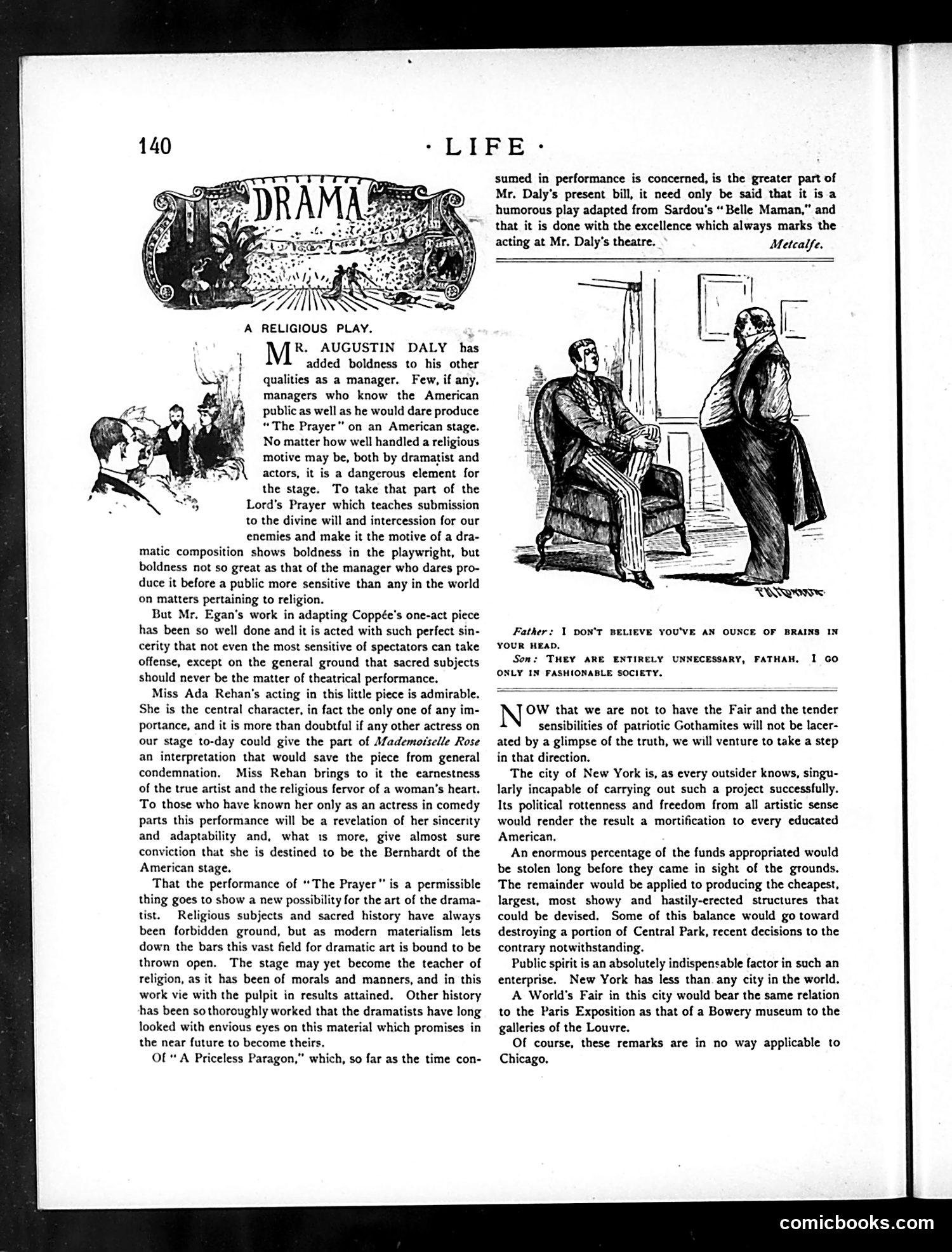
This page reviews theatrical productions by manager Augustin Daly. The main article praises actress Ada Rehan's performance in "The Prayer," adapted from a French play by Coppée. The critic (Metcalfe) argues that while producing religious material on stage is bold and potentially controversial, Rehan's sincere acting makes it acceptable—suggesting she may become "the Bernhardt of the American stage" (referencing the famous actress Sarah Bernhardt). The small cartoon depicts a father-son conversation about manners. The son dismissively tells his father that brains are "entirely unnecessary" and only "fashionable in society"—a satirical jab at upper-class pretension and superficiality. A separate editorial section criticizes New York City's inability to successfully execute a proposed fair project, attacking civic corruption and lack of artistic vision.
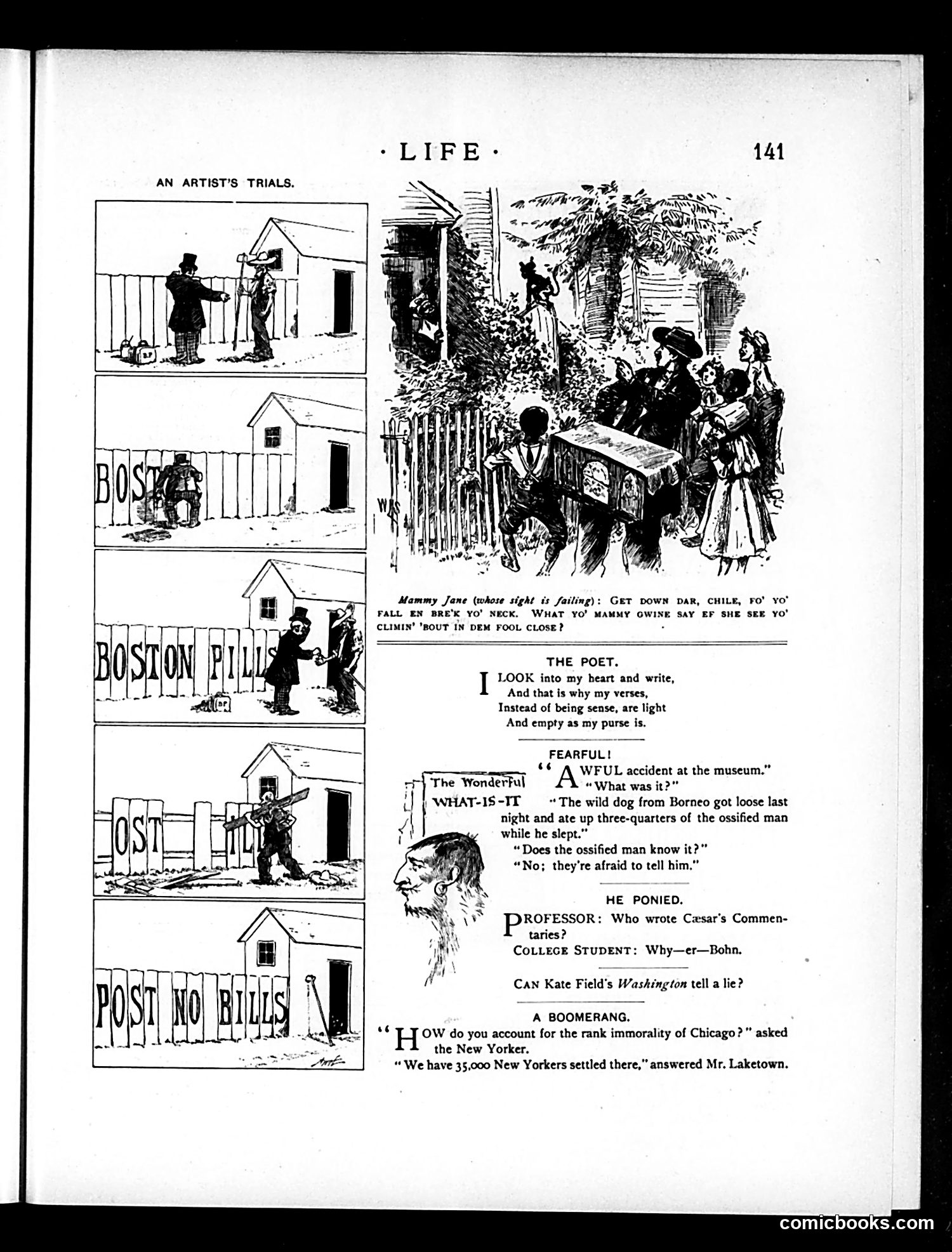
This page contains several satirical pieces typical of late 19th-century American humor: **"An Artist's Trials"** (left panel): A comic strip showing an artist repeatedly painting signs ("BOSTON," "BOSTON PILLS," "POST NO BILLS") on a fence, with each attempt being destroyed or obscured. The satire mocks struggling commercial artists forced to do humble sign-painting work. **"The Poet"**: Self-deprecating verse about a poet whose work is "light and empty" because his purse is equally empty—satirizing impoverished artists. **"Fearful" anecdote**: A darkly humorous museum story where a loose "wild dog from Borneo" ate three-quarters of a preserved ("ossified") man's body, with the punchline being staff fear telling him about the damage. **"He Ponied"**: A brief joke where a college student, asked who wrote Caesar's Commentaries, answers "Bohn"—likely a pun on the publisher Bohn's Classical Library. **"A Boomerang"**: Social satire where a New Yorker criticizes Chicago's immorality, only to be told 35,000 New Yorkers live there—implying New Yorkers themselves are responsible for the city's moral decline.
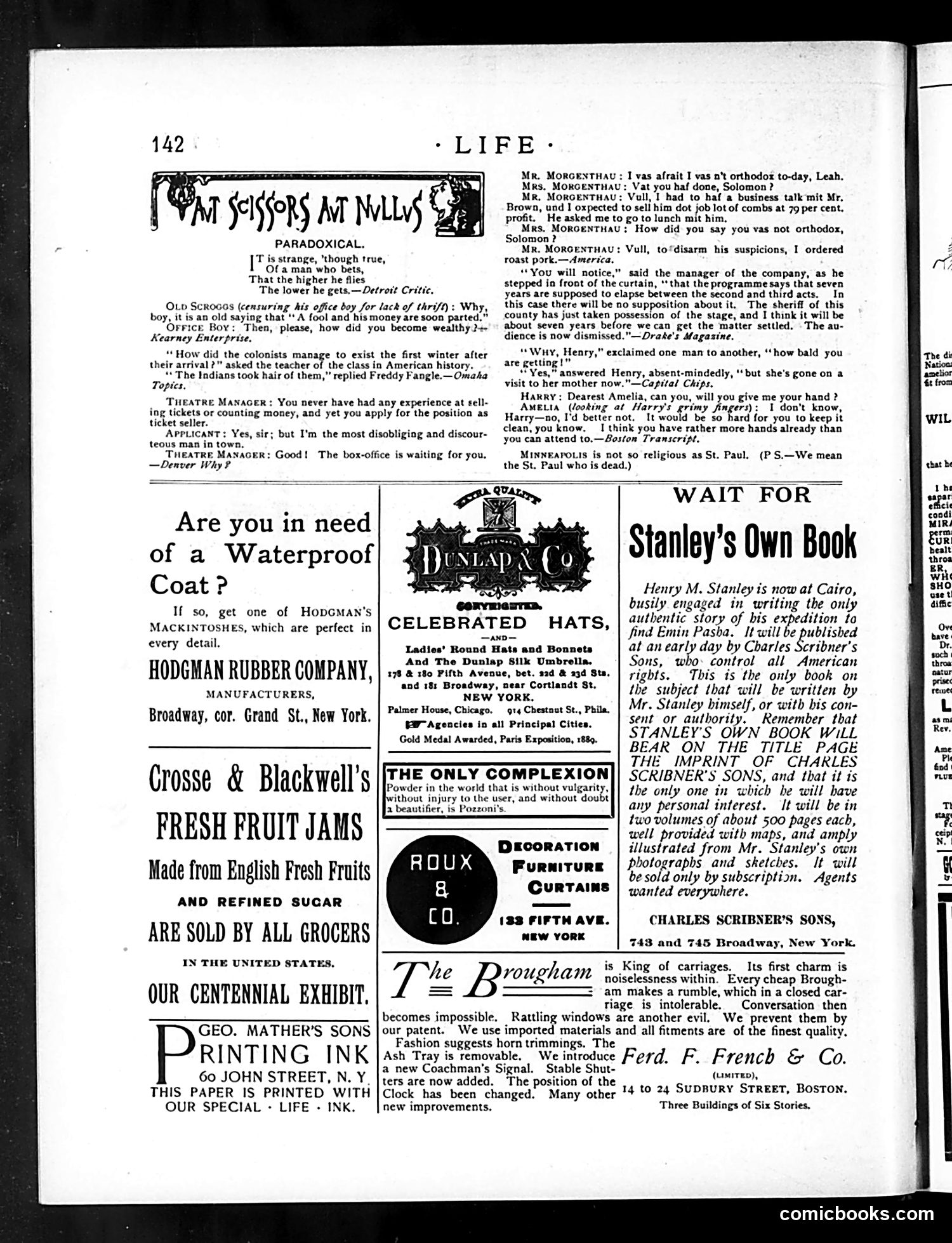
This page is primarily **advertising with embedded humor pieces**, typical of Life's format. The cartoons are brief workplace and domestic jokes: 1. **"Scissors at Nulls"** - A paradoxical riddle about a man who rises higher but gets lower (likely referencing financial speculation or social climbing). 2. **Office Boy joke** - Commentary on wealth acquisition: an old man lectures a boy about fools and money, but the boy points out the man himself became wealthy despite this wisdom, suggesting hypocrisy or luck rather than principle. 3. **Theater Manager exchange** - Satirizes business logic: hiring a rude, unhelpful man specifically for a customer-facing ticket-selling position. 4. **Jewish humor pieces** - Features characters with Yiddish-inflected speech (Morgenthaus) discussing business ethics and Orthodox dietary laws; another about a bald man. These represent period comedy conventions—often relying on ethnic stereotypes common to 1890s American humor magazines. The page is dominated by **advertisements** (rubber coats, hats, jams, furniture, carriages), indicating Life's business model of mixing editorial content with paid promotions.
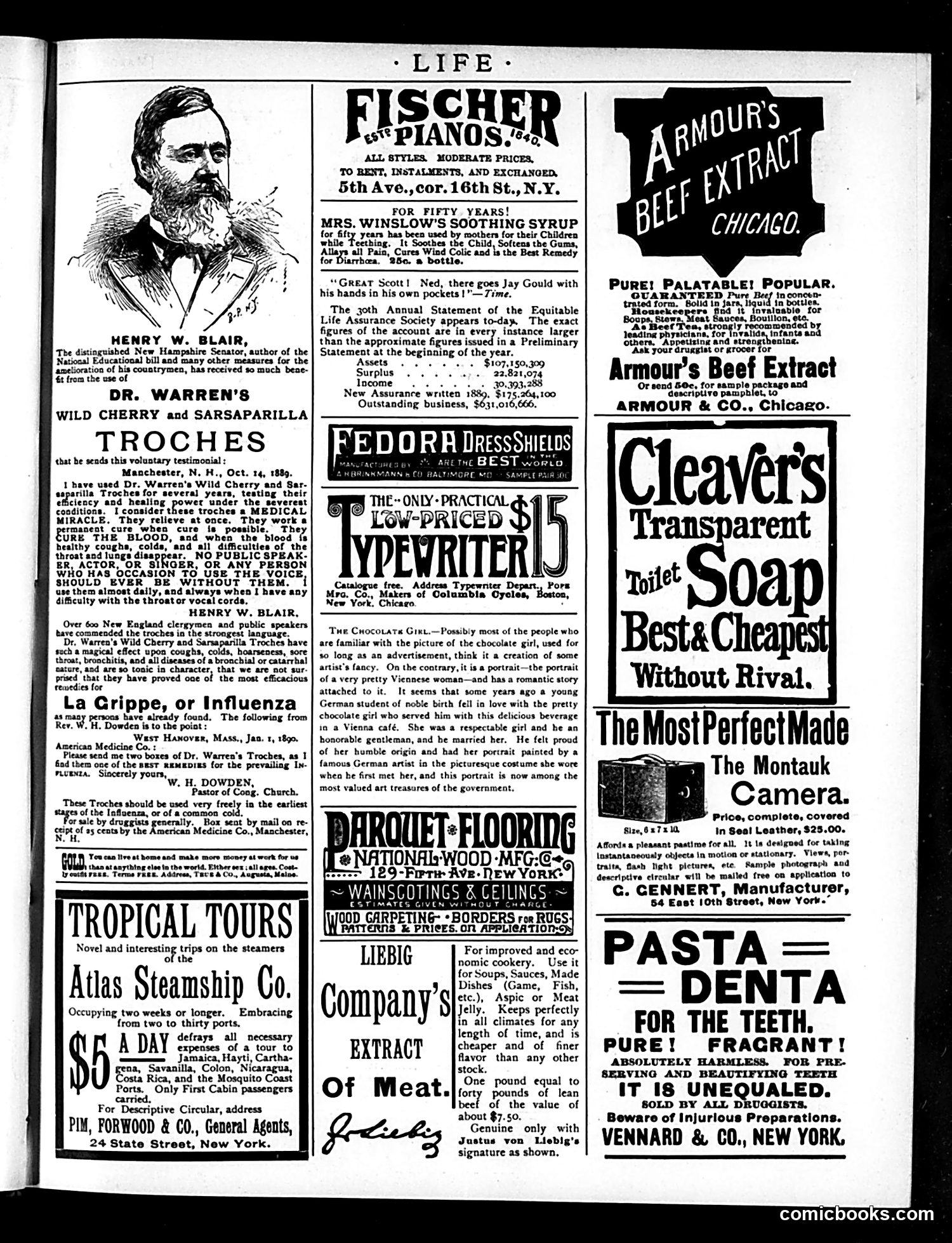
This is primarily an **advertising page** from Life magazine, circa 1889-1890. There are no political cartoons; instead, it contains advertisements and endorsements typical of that era. The main editorial content is a small joke (marked "Time") about **Jay Gould**, the notoriously wealthy railroad magnate, sarcastically depicted as having "his hands in his own pockets"—implying he's so greedy he won't spend money even his own way. The page features period advertisements for patent medicines (Dr. Warren's troches for throat ailments), steamship tours, typewriters, and meat extract—products marketed with testimonials from prominent figures like Senator Henry W. Blair. These endorsements, now recognized as dubious, were standard advertising practice then. The ads reflect Victorian-era consumer culture and health concerns, particularly influenza ("La Grippe") remedies and voice-care products for public speakers. Modern readers might find the medical claims laughably unsubstantiated.
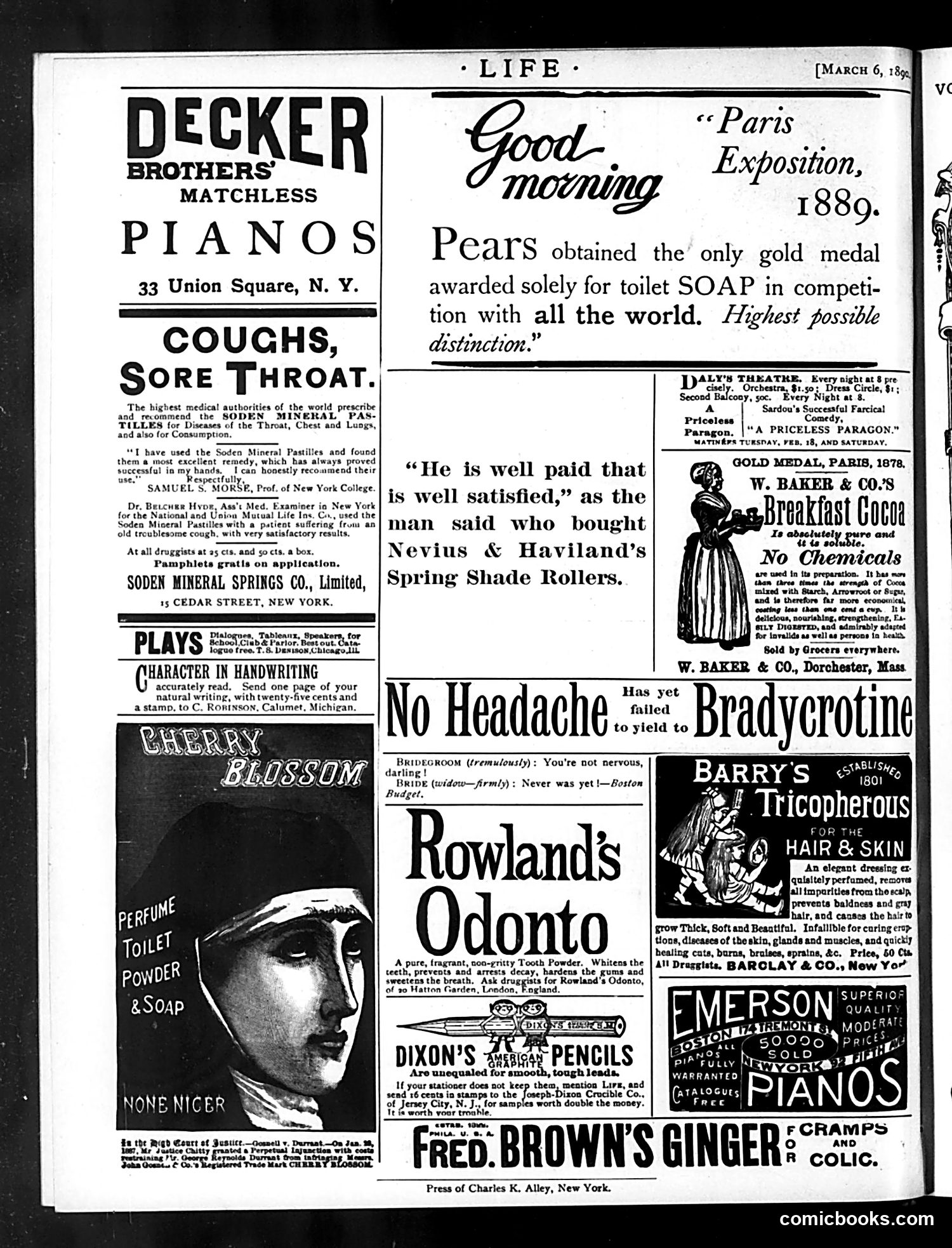
This is primarily an **advertising page** rather than a satirical cartoon page. It features period product advertisements typical of the 1890s, with one small joke: The central humor piece is a brief **bride-and-groom joke**: A nervous bridegroom asks his bride if she's anxious. She replies (as a widow) that she's "never was yet"—implying she's experienced at marriage, having been widowed before. This plays on Victorian anxieties about female respectability and marriage. The page is dominated by **patent medicine and consumer product ads**: Soden Mineral Pastilles for coughs, Pears soap (advertising its Paris Exposition gold medal), W. Baker's Breakfast Cocoa, Bradycrotine headache remedy, Rowland's Odonto toothpowder, Barry's Tricopherous hair treatment, and Fred. Brown's Ginger for cramps. These reflect 1890s marketing practices emphasizing medical authority and international awards to sell ordinary products. The ads reveal contemporary preoccupations with health remedies, personal grooming, and consumer status symbols.