
A complete issue · 18 pages · 1889
Life — October 17, 1889
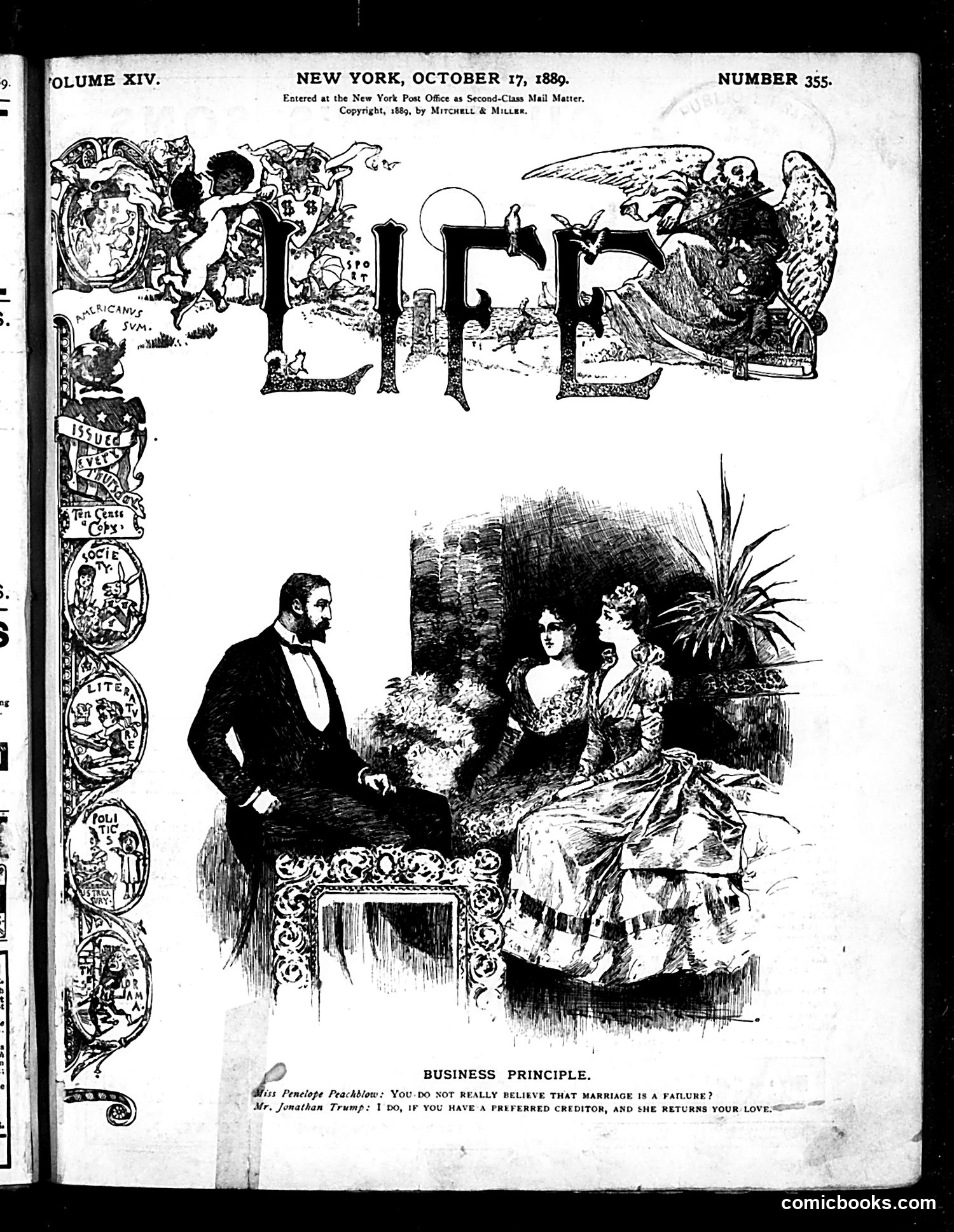
This cartoon satirizes wealthy marriage dynamics of the Gilded Age. A well-dressed man converses with two fashionable women in an ornate interior setting, likely a drawing room. The caption reads: "Miss Principle's Problem: You do not really believe that marriage is a failure? Mr. Jonathan Trump: I do, if you have a preferred creditor, and she returns your love." The satire targets the mercenary nature of marriage among the wealthy, where financial considerations ("preferred creditor") override genuine affection. The name "Jonathan Trump" appears to reference a common figure type representing American materialism, though the specific individual remains unclear. The joke suggests that marriage "fails" when a woman loves a man based on his wealth rather than genuine feeling—critiquing the transactional nature of high-society courtship.
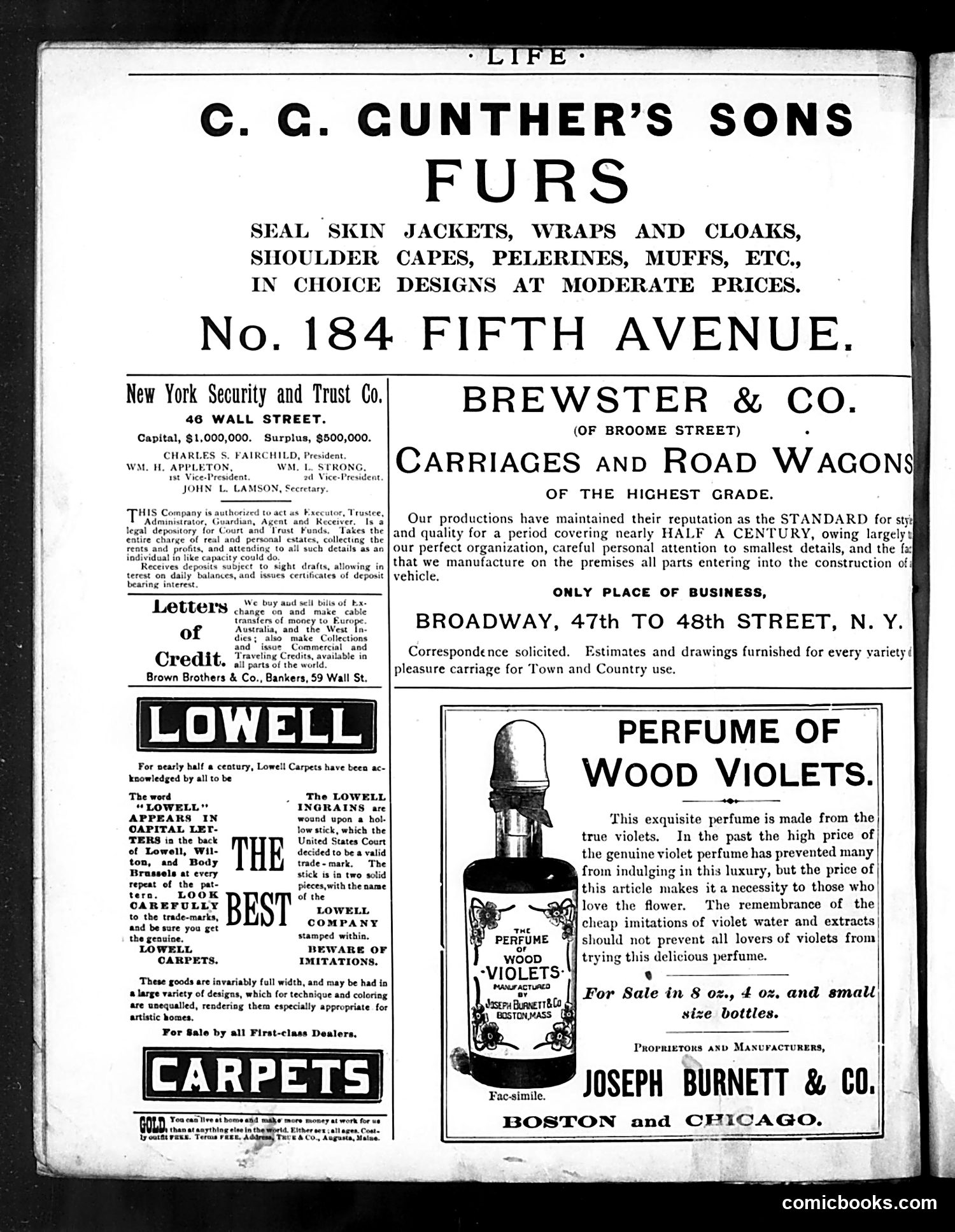
This page is **primarily advertising**, not editorial content or satire. It contains four distinct advertisements: 1. **C.C. Gunther's Sons Furs** — fur garments at Fifth Avenue 2. **New York Security and Trust Co.** — banking/trust services 3. **Brewster & Co.** — high-end carriages and wagons 4. **Lowell Carpets** — carpet company emphasizing quality and authenticity 5. **Joseph Burnett & Co.** — "Perfume of Wood Violets" from Boston and Chicago There is no political cartoon or satirical content visible. The Lowell Carpets ad does include some text about trademark protection and counterfeits, but this is commercial messaging rather than social commentary. The page reflects late 19th/early 20th-century consumer advertising for luxury goods aimed at wealthy urban readers.
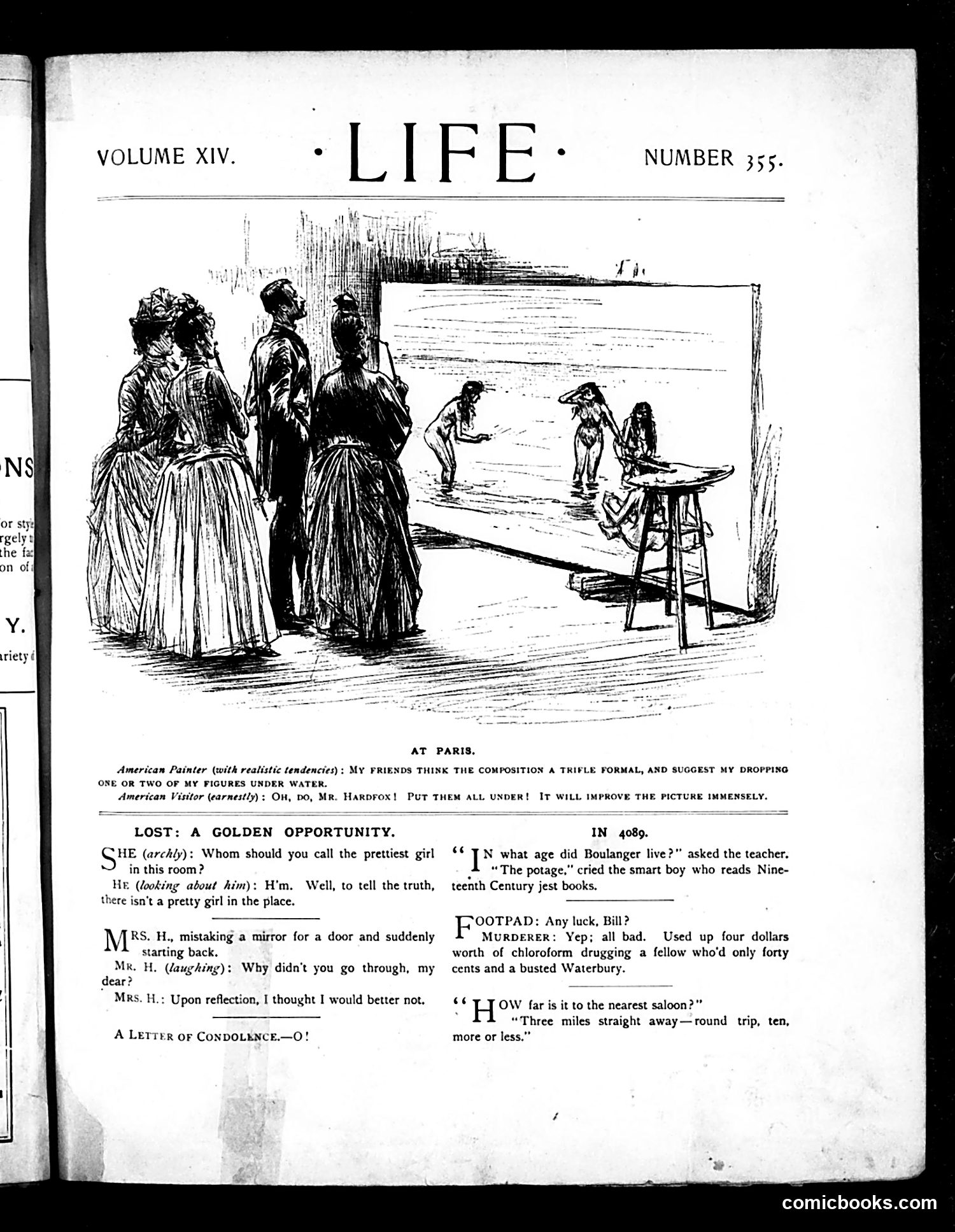
The top illustration titled "AT PARIS" depicts a satirical dialogue between artists. An American painter suggests dropping figures underwater to improve composition, while a French visitor sarcastically dismisses this as overly formal. The humor targets aesthetic debates between American and French artistic traditions—Americans viewed as bold experimenters, the French as rigid formalists. Below are three brief comedic vignettes labeled "LOST: A GOLDEN OPPORTUNITY" and "IN 4089," featuring wordplay and situational humor about physical mishaps and misunderstandings. The page's satire primarily mocks transatlantic artistic pretension and the obsession with compositional "rules" in academic painting—suggesting that rigid adherence to formal theory produces absurd results.
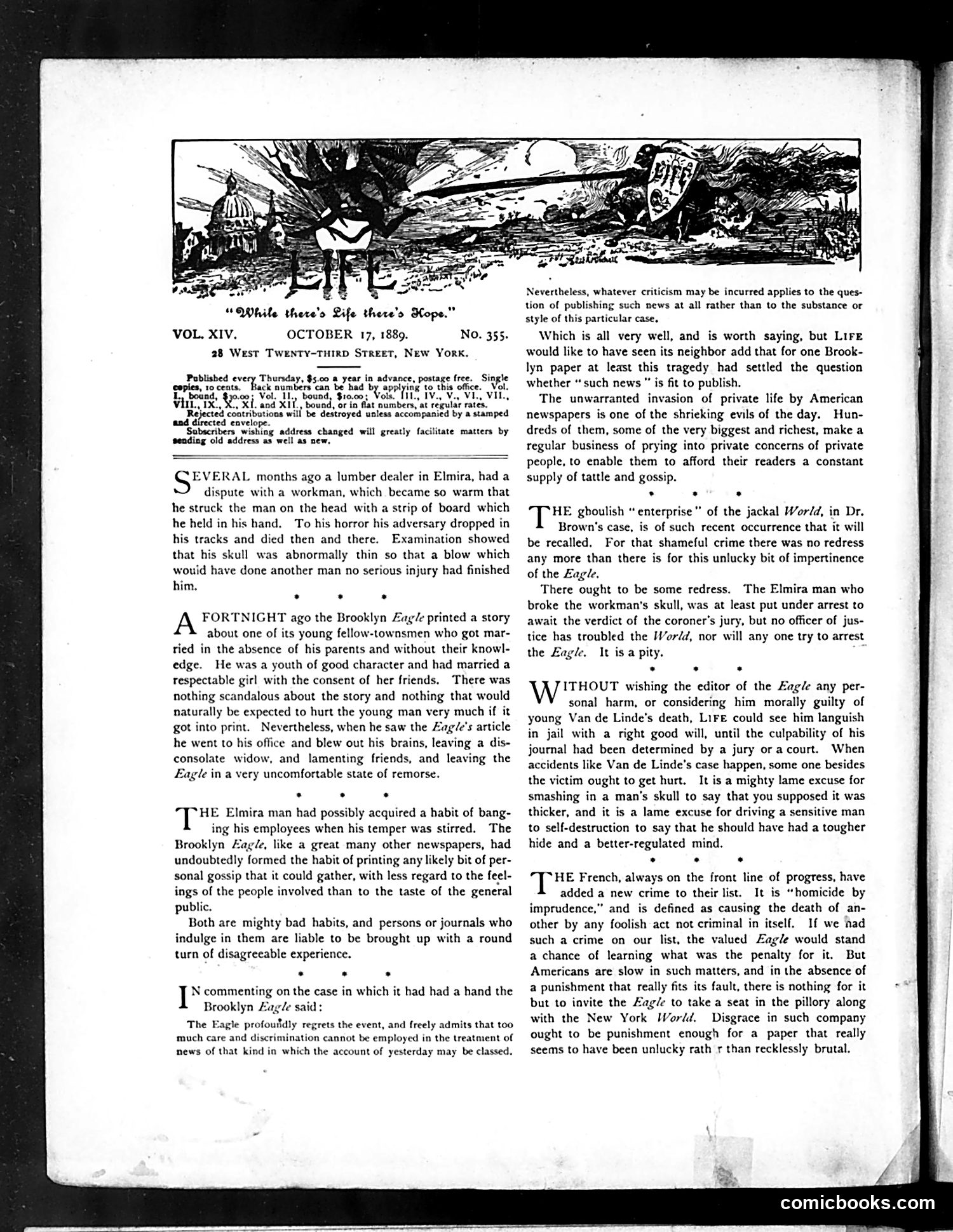
The masthead cartoon depicts a figure sitting atop a globe labeled "1889," surrounded by chaotic scenes including what appears to be a domed building (possibly St. Paul's Cathedral or similar landmark) and destruction. The title "While there's Life there's Hope" suggests ironic commentary on contemporary crises. The article text criticizes American newspapers' invasive reporting practices, specifically discussing two cases: an Elmira lumber dealer who struck a workman, and a Brooklyn *Eagle* story about a young man's elopement. The piece condemns sensationalist journalism that invades private lives for gossip, contrasting American papers unfavorably with French approaches to press standards. The satire targets newspapers' reckless brutality in pursuing scandal over public welfare.
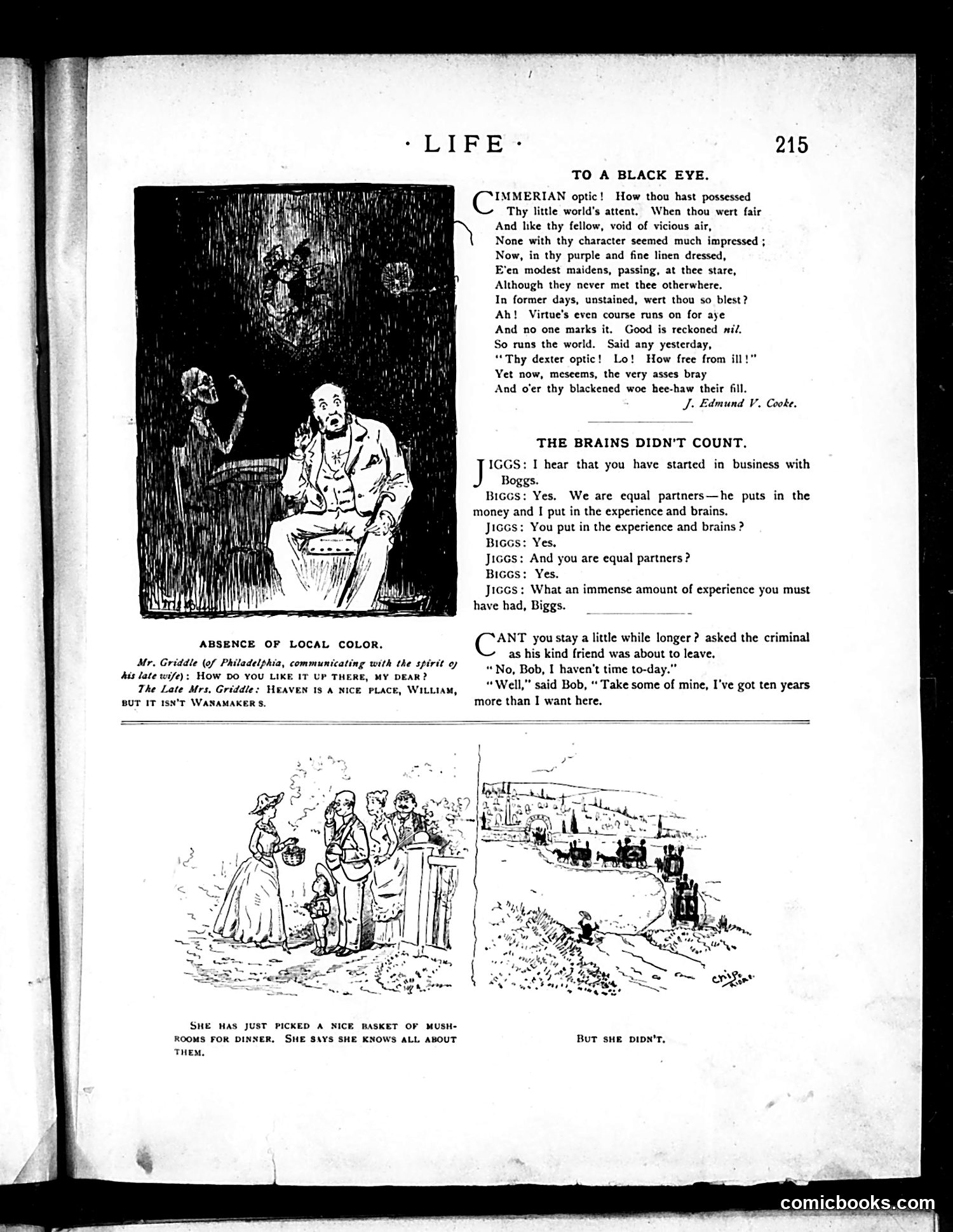
**"To a Black Eye"** (top): A poem by J. Edmund V. Cooke addressing someone with a black eye, praising their character and virtue despite their injury. The accompanying illustration shows a man with a blackened eye—likely satirizing how minor physical flaws don't diminish one's worth. **"The Brains Didn't Count"** (middle): A dialogue joke where Jiggs and Biggs are business partners. Biggs contributed money while Jiggs contributed "experience and brains." When asked if they're equal partners, Biggs says yes—the humor being that Jiggs's intellectual contribution is worthless compared to capital investment. **Bottom cartoon**: Satirizes female ignorance about mushrooms—a woman confidently selects mushrooms for dinner claiming expertise, but "didn't" actually know them, risking poisoning.
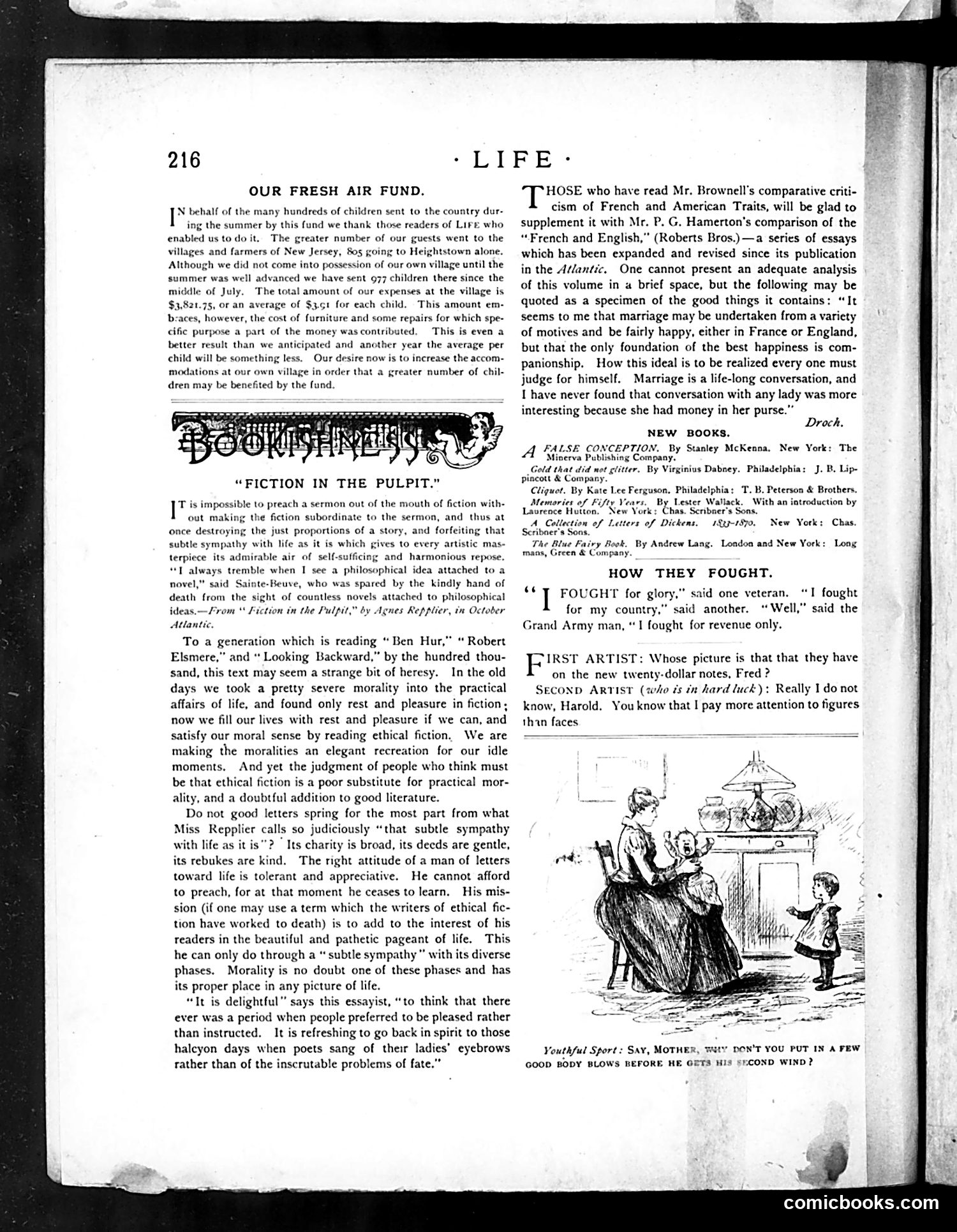
This page contains two distinct sections: **"Fiction in the Pulpit"** is an essay critiquing the use of fiction in sermons. The author argues against dismissing novels as immoral distraction, contending that ethical fiction serves moral education better than rigid doctrinal preaching. The piece defends reading for pleasure while maintaining moral purpose. **"How They Fought"** presents a humorous dialogue between veterans with different war motivations—one fought for glory, another for country, a third for revenge. This satirizes the varied, sometimes contradictory reasons men enlisted. The accompanying cartoon shows a woman and child, with the caption suggesting mothers should encourage physical fitness ("good body blows") to prepare sons for combat. This darkly jokes about militarism and maternal responsibility for producing strong soldiers, reflecting early 20th-century anxieties about national preparedness.
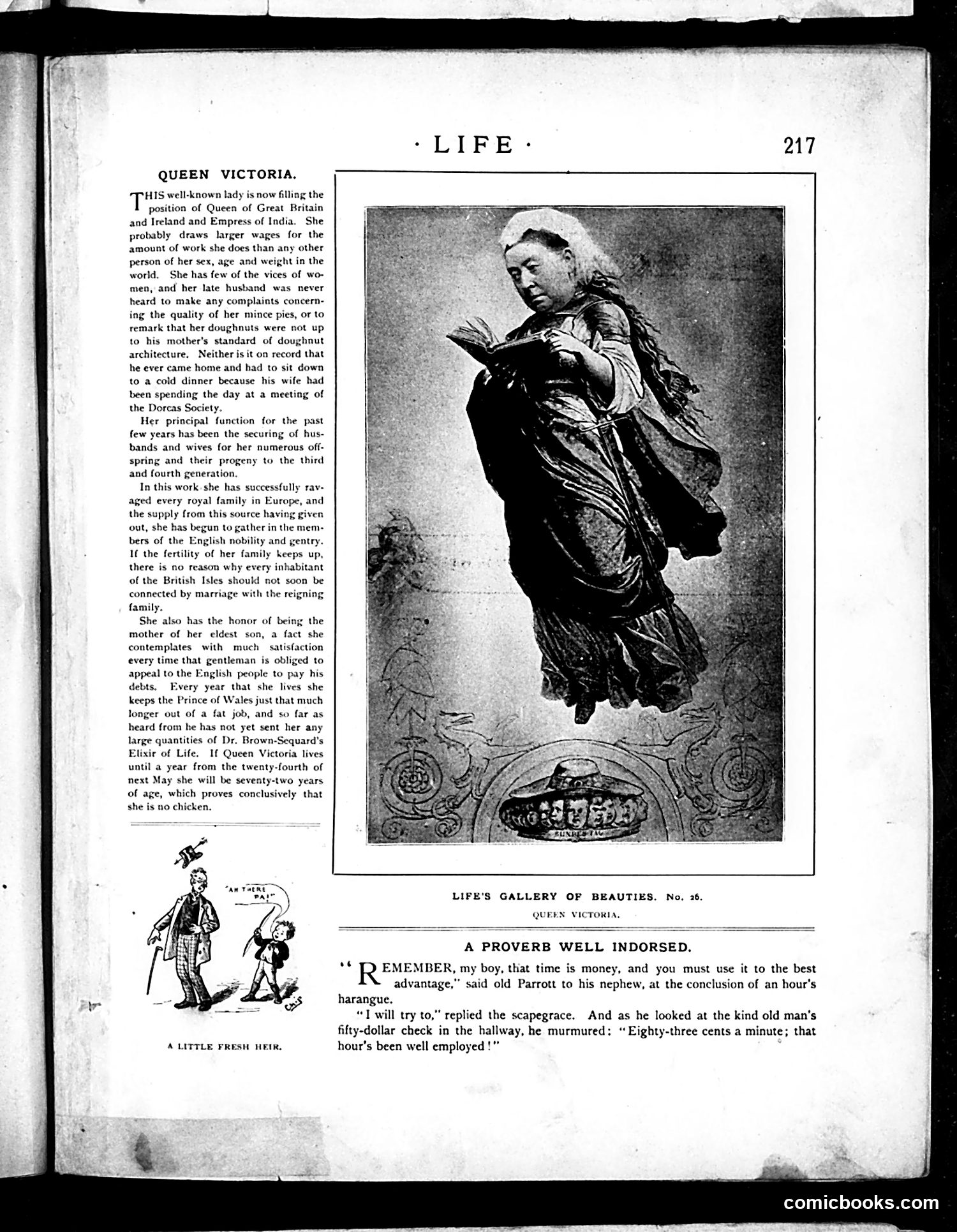
**Main Content: "Queen Victoria" Portrait** The large photograph labeled "Life's Gallery of Beauties No. 26" depicts Queen Victoria. The accompanying text satirizes her work securing advantageous marriages for her children and grandchildren throughout European nobility, describing this as her "principal function" and suggesting it ensures future British influence across the continent. **Small Cartoon: "A Little Fresh Heir"** The bottom cartoon shows an elderly man (appears to be Parrot, based on OCR text) with a young scapegoat, illustrating the accompanying proverb: "Remember, my boy, that time is money." The joke plays on the boy being called a "scapegoat" while learning frugality—a pun on both his role and the proverb about efficient time management.
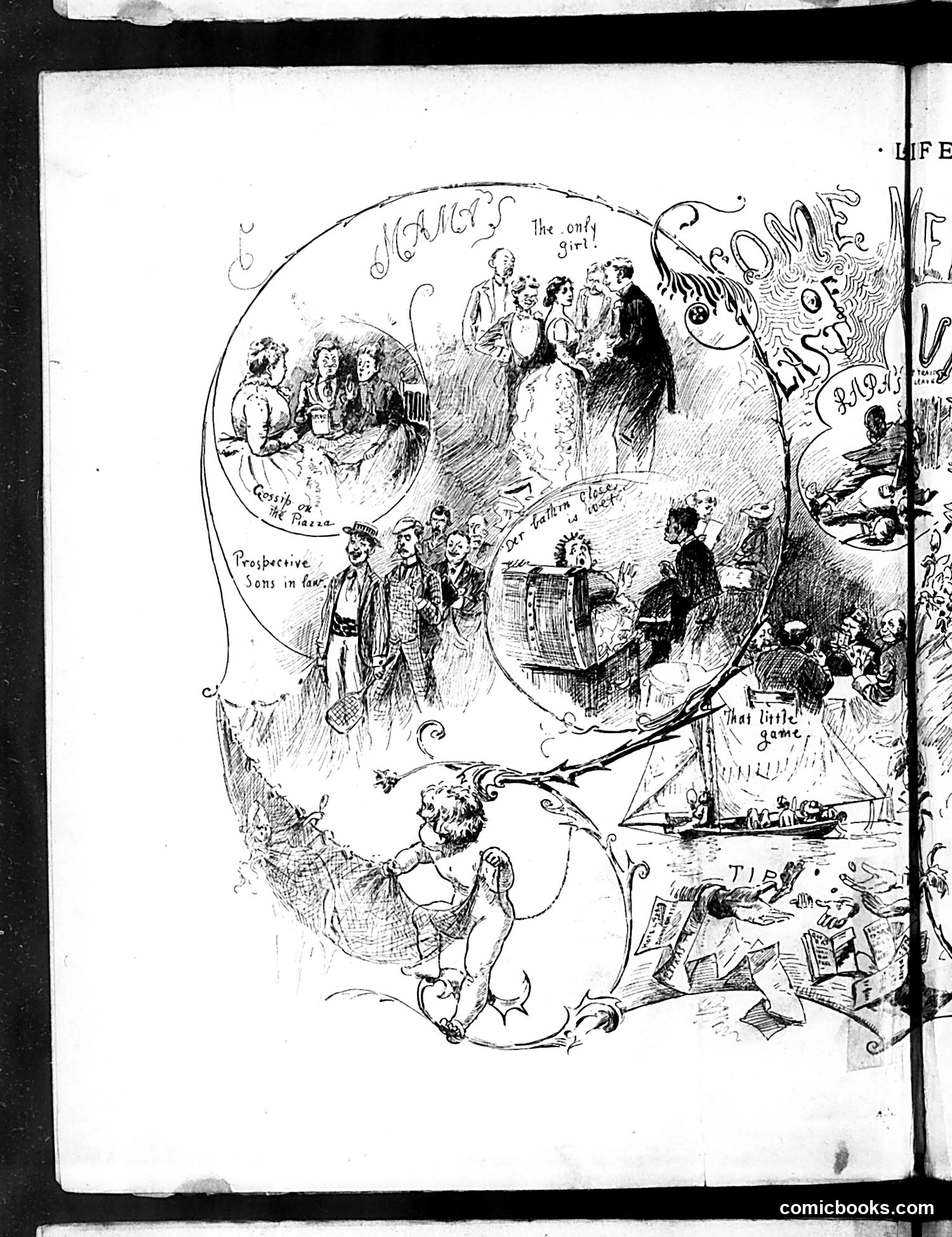
This appears to be a satirical illustration from *Life* magazine organized around a large question mark. The cartoon depicts various social scenes labeled with phrases like "the only girl," "Prospective Sons in law," and "that little game." The composition suggests commentary on **courtship and marriage dynamics** of the era—a popular satirical topic. The vignettes arranged within the question mark likely mock different aspects of romantic pursuit: women's marriage prospects, men's intentions, and social rituals around pairing off. The scattered figures at the bottom (including what appear to be discarded papers or rejected suitors) reinforce the satirical tone about the uncertainties and complications of finding romance. Without clearer labels identifying specific contemporary figures or events, the exact political targets remain unclear, though the overall message appears to be gentle social satire about courtship customs.
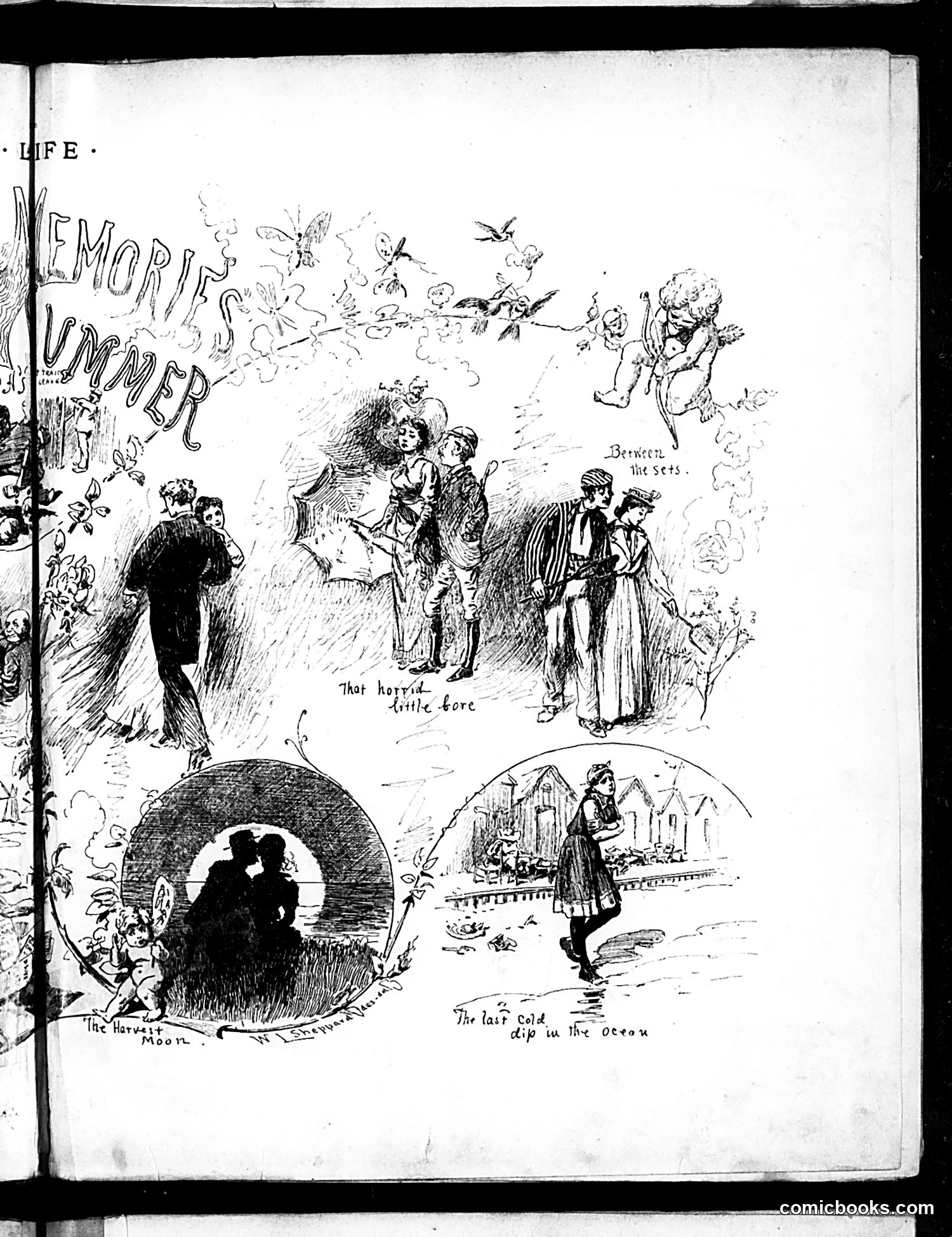
This page presents four satirical vignettes about memory and remembrance. The title "Memoirs Under" (likely "Memoirs Underway") suggests commentary on autobiographical accounts. The sketches depict: 1. **"That horrid little bore"** - figures dismissing an unwanted acquaintance 2. **"Between the Seas"** - unclear reference, possibly romantic or nautical themed 3. **"The Harvest Moon"** - a silhouetted couple in an intimate moment 4. **"The last cold dip in the Ocean"** - a woman wading into water The satire appears to mock sentimental memoir-writing and romanticized memory—particularly how people selectively remember (or misremember) past relationships and experiences. The contrasting images suggest how individuals reconstruct their personal histories through rose-tinted nostalgia while conveniently forgetting unpleasant encounters. This reflects period concerns about truthfulness in autobiography.
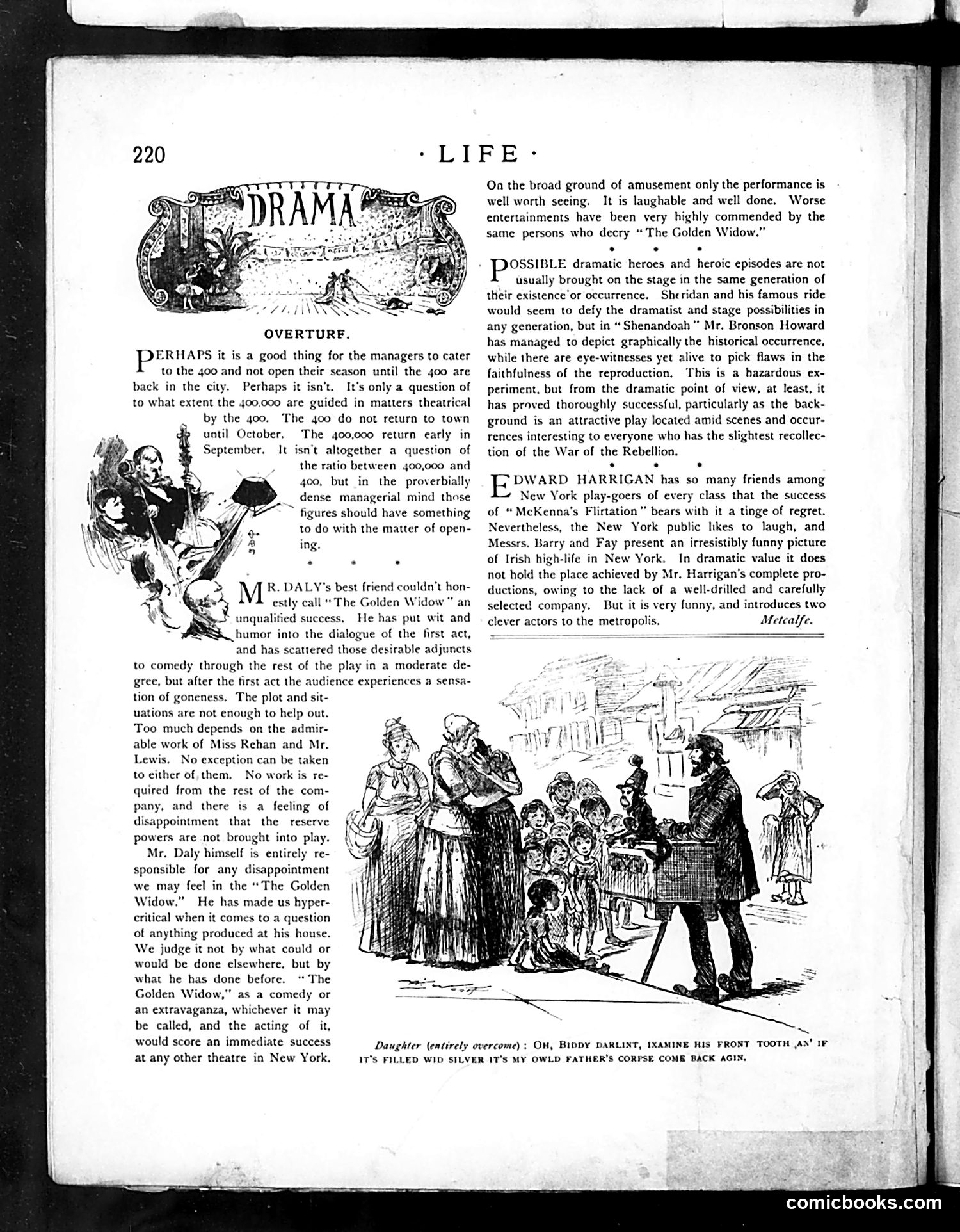
This page reviews theatrical performances for what appears to be an early 20th-century audience. The text discusses Mr. Daly's production of "The Golden Widow," praising the acting of Miss Rehan and Mr. Lewis while noting the plot relies heavily on their performances. The section also mentions Edward Harrigan's "McKenna's Flirtation," described as a funny depiction of Irish-American life in New York. The reviewer credits actors Harry and Fay for making it entertaining despite weak dramatic structure. The illustration shows a street scene, likely depicting one of these theatrical settings. The caption references characters named Biddy and Darlist in a humorous domestic scenario involving a father's corpse, suggesting the darker comedic tone of period theatrical farce.
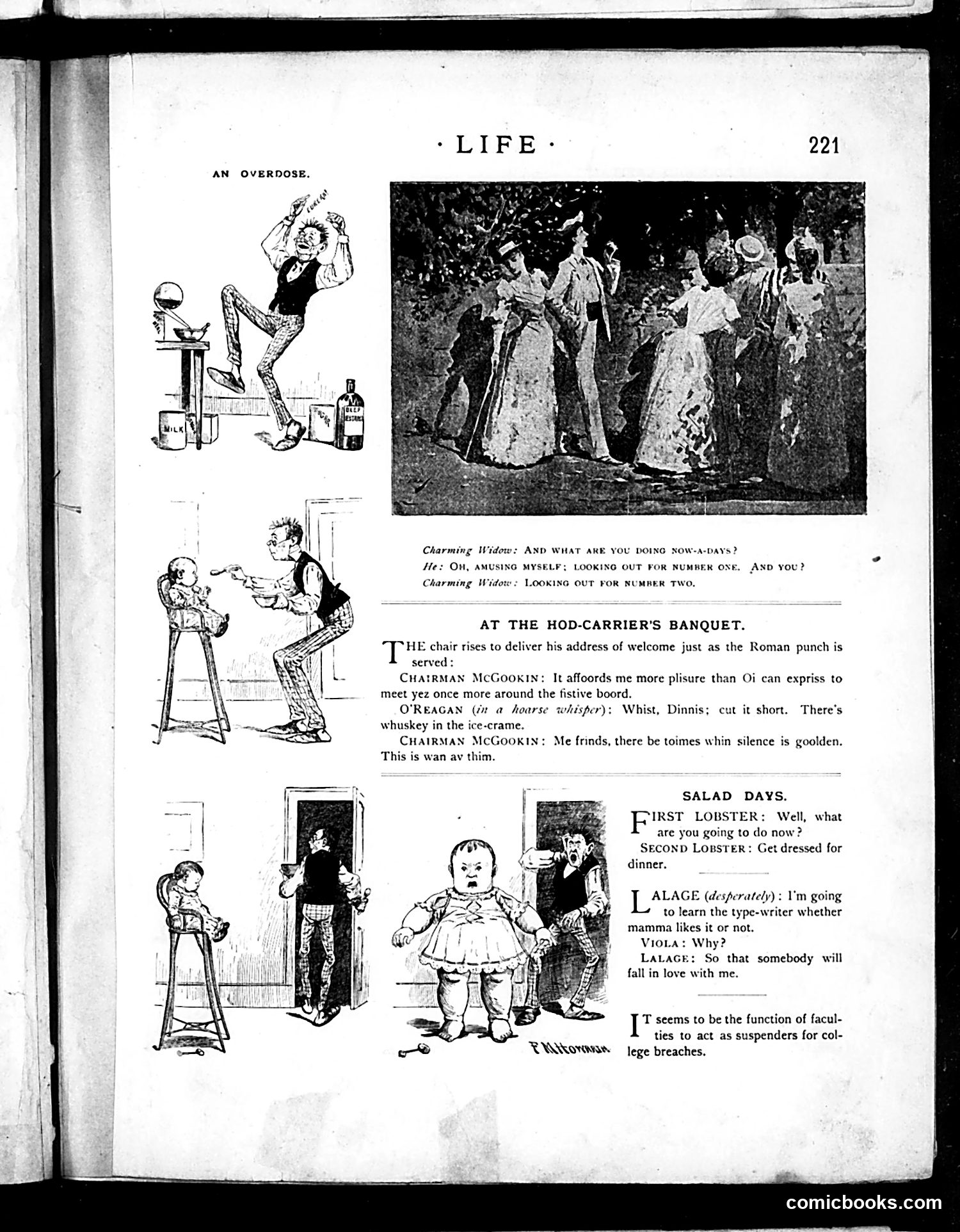
This page from Life magazine contains three distinct satirical pieces: 1. **"An Overdose"** (top left): Cartoon illustrations mocking alcohol overconsumption, showing a drunken figure in exaggerated poses amid bottles and glasses—social commentary on drinking culture. 2. **"At the Hod-Carrier's Banquet"** (center): A photograph with dialogue satirizing a formal gathering. "Hod-carrier" (a laborer) suggests class humor—working-class figures attempting upper-class formality. The jokes reference whiskey in ice-cream and O'Regan's Irish surname, playing on ethnic stereotypes common to early 20th-century American humor. 3. **"Salad Days"** (bottom right): Comic sketches with dialogue between "Lalage" and others, making innuendos about romance and social expectations—typical period humor about courtship and gender roles. The overall tone reflects early 1900s American satirical magazine conventions: alcohol, class, ethnicity, and courtship as primary humor subjects.
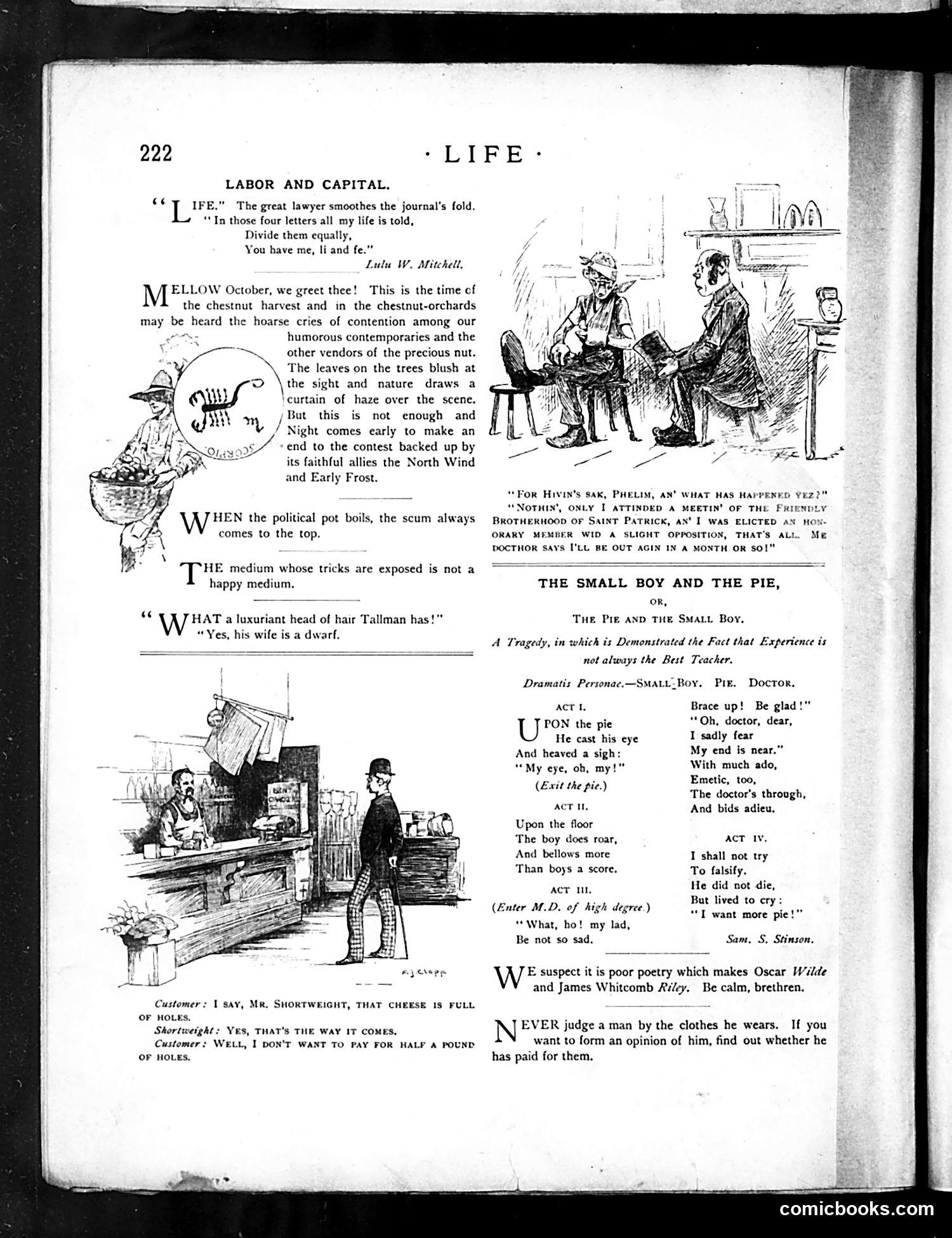
This page contains multiple satirical pieces typical of Life's late-19th-century format: **"Labor and Capital"** section features several disconnected jokes and observations. The "Political Pot" aphorism mocks how corruption rises to prominence. A Shortweight vendor cartoon satirizes consumer fraud—a grocer sells "cheese full of holes" and refuses refunds, claiming that's how it comes naturally. **"The Small Boy and the Pie"** is a mock-tragic playlet about a boy who eats an entire pie, becomes ill, survives, and immediately demands more pie. It appears to satirize Irish-American working-class excess (the dialect humor and St. Patrick's Brotherhood reference suggest Irish immigrant targets). The page concludes with observations on clothing/poverty as moral indicators and dismisses certain poetry as poor. The overall tone reflects Life's editorial stance: middle-class mockery of immigrants, con artists, and working-class behavior—typical gilded-age satirical content that punches downward at perceived social inferiors rather than powerful figures.
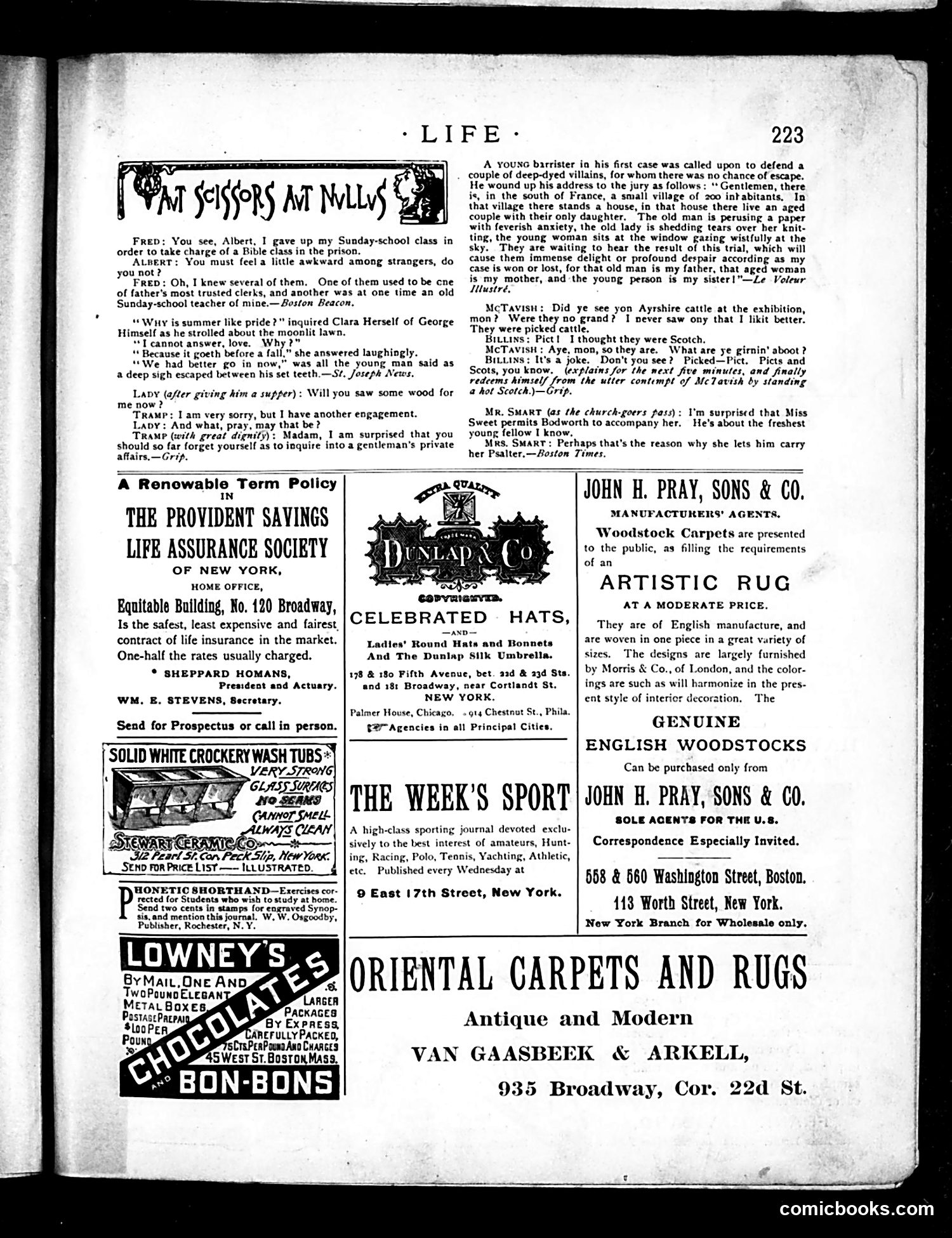
This page contains five brief humorous anecdotes typical of *Life* magazine's satirical style: **"Scissors at Nullus":** A prison chaplain encounters former respectable citizens (his father's clerk, an old Sunday-school teacher) now incarcerated—ironic commentary on respectability's fragility. **The remaining comics** feature wordplay and social humor: - A young man reacts with resigned sighs to his girlfriend's Bible pun - A tramp claims "gentleman's affairs" too important to do chores - A barrister's melodramatic courtroom appeal about his suffering family - A Scottish cattle-show pun about "Picts" (the ancient people) vs. "picked cattle" - A woman allows a "fresh" (forward/flirtatious) young man to carry her prayer book—an ironic contradiction These represent *Life's* staple mix of gentle domestic humor, puns, and mild social observation rather than sharp political satire. The page is primarily **advertising** (insurance, carpets, hats, shorthand courses), with humor content as editorial filler.
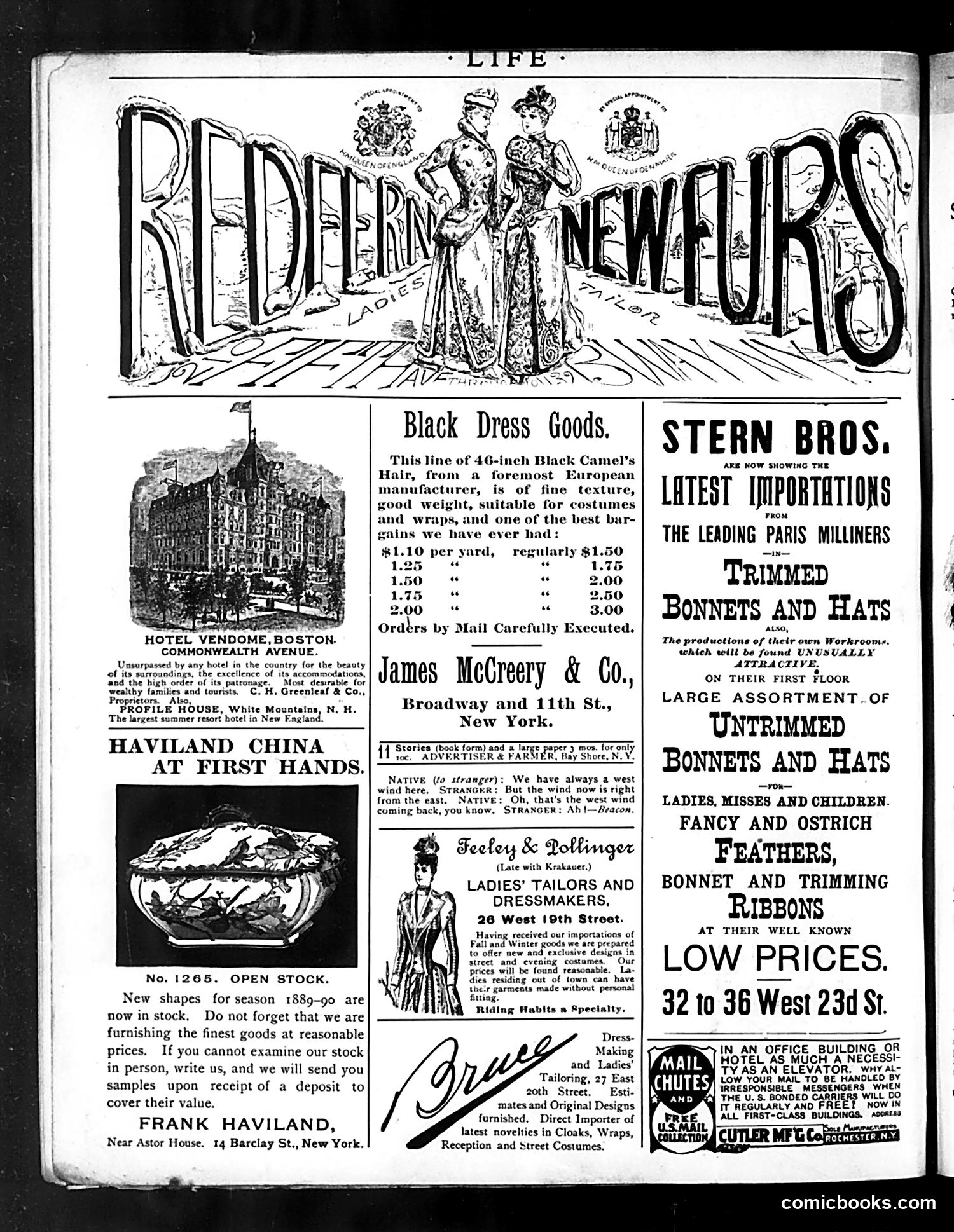
This is primarily a **advertisements page** from Life magazine (circa 1889), not a political cartoon. The large decorative header "REDDINGTONS" and "NEWEARS" (likely advertising fashionable ladies' clothing) dominates the top, featuring two elegantly dressed women—typical imagery for upscale department store marketing of the era. The page contains various commercial ads: Haviland China, James McCreery & Co. (black dress goods), Stern Bros. (bonnets and hats from Paris), hotels, and dressmakers. There is one brief satirical exchange near the center—a "Stranger" and "Native" discussing wind direction—a mild joke about regional knowledge, but it's secondary to the commercial content. The satire here is **gentle social commentary** about contemporary fashion, wealth, and consumer culture rather than political commentary. Modern readers should recognize this reflects late-19th-century consumer capitalism targeting affluent women.
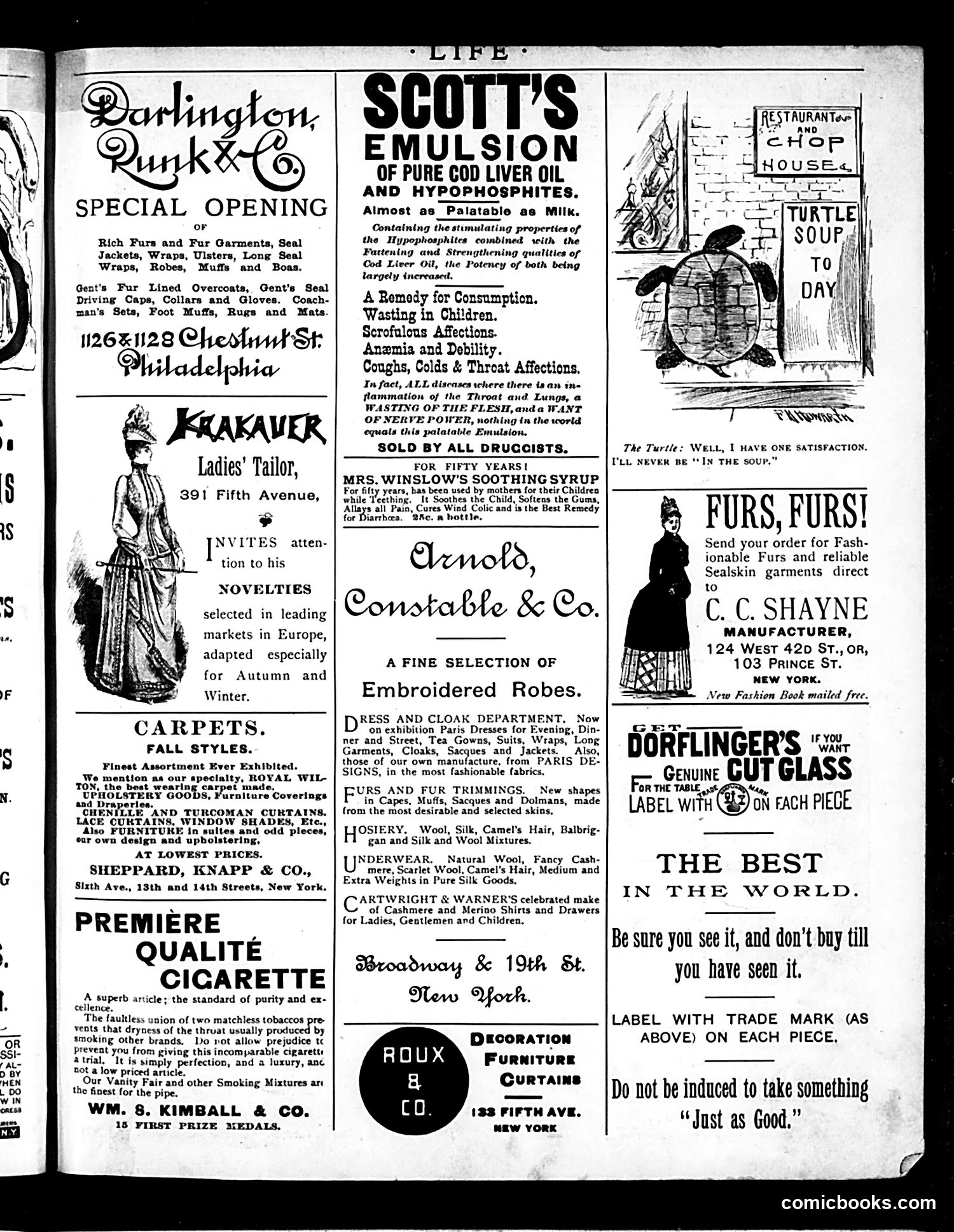
This page is **primarily advertisements** with one small cartoon. The cartoon appears in the upper right: a turtle in a pot says "Well, I have one satisfaction. I'll never be 'in the soup.'" This is a **visual pun** playing on the common phrase "in the soup" (meaning in trouble or difficulty). The turtle, literally about to become soup, ironically claims it will never be "in the soup"—demonstrating darkly humorous wordplay typical of Life magazine's satirical style. The rest of the page contains period advertisements for luxury goods (furs, carpets, clothing, cigarettes) and patent medicines (Scott's Emulsion for consumption, Mrs. Winslow's Soothing Syrup). These ads reflect late 19th-century consumer culture and the prevalence of unregulated medicinal claims. **No political satire or social commentary** is present—this is primarily a commercial page with a single joke cartoon embedded among advertisements.
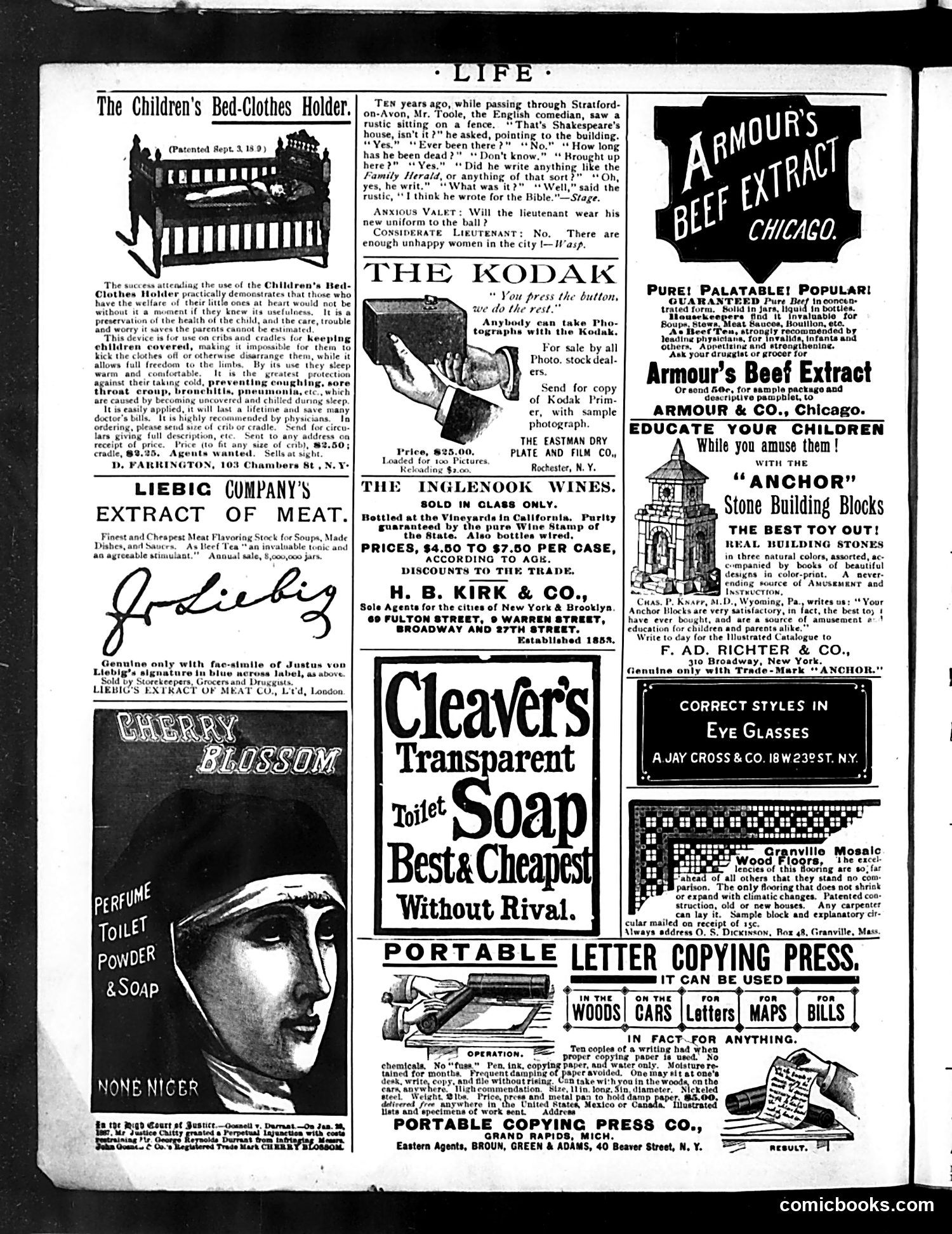
This page is primarily **advertising**, with two brief humorous anecdotes at the top. ## The Jokes The first anecdote mocks rural English ignorance: a Stratford-upon-Avon farmer doesn't recognize Shakespeare's name or significance, claiming the playwright "wrote for the Bible"—suggesting peasant unfamiliarity with literature. The second is a brief military joke: a considerate lieutenant won't wear his new uniform to a ball because there are "enough unhappy women in the city"—implying jilted former lovers. ## The Advertisements The bulk of the page advertises consumer products typical of the late 1800s: bed-clothes holders for children, Kodak cameras (with their famous "You press the button, we do the rest" slogan), Liebig's meat extract, California wine, Armour's beef extract, eyeglasses, building blocks, and a portable letter-copying press. These ads reflect middle-class consumer culture and emerging technologies of the era.
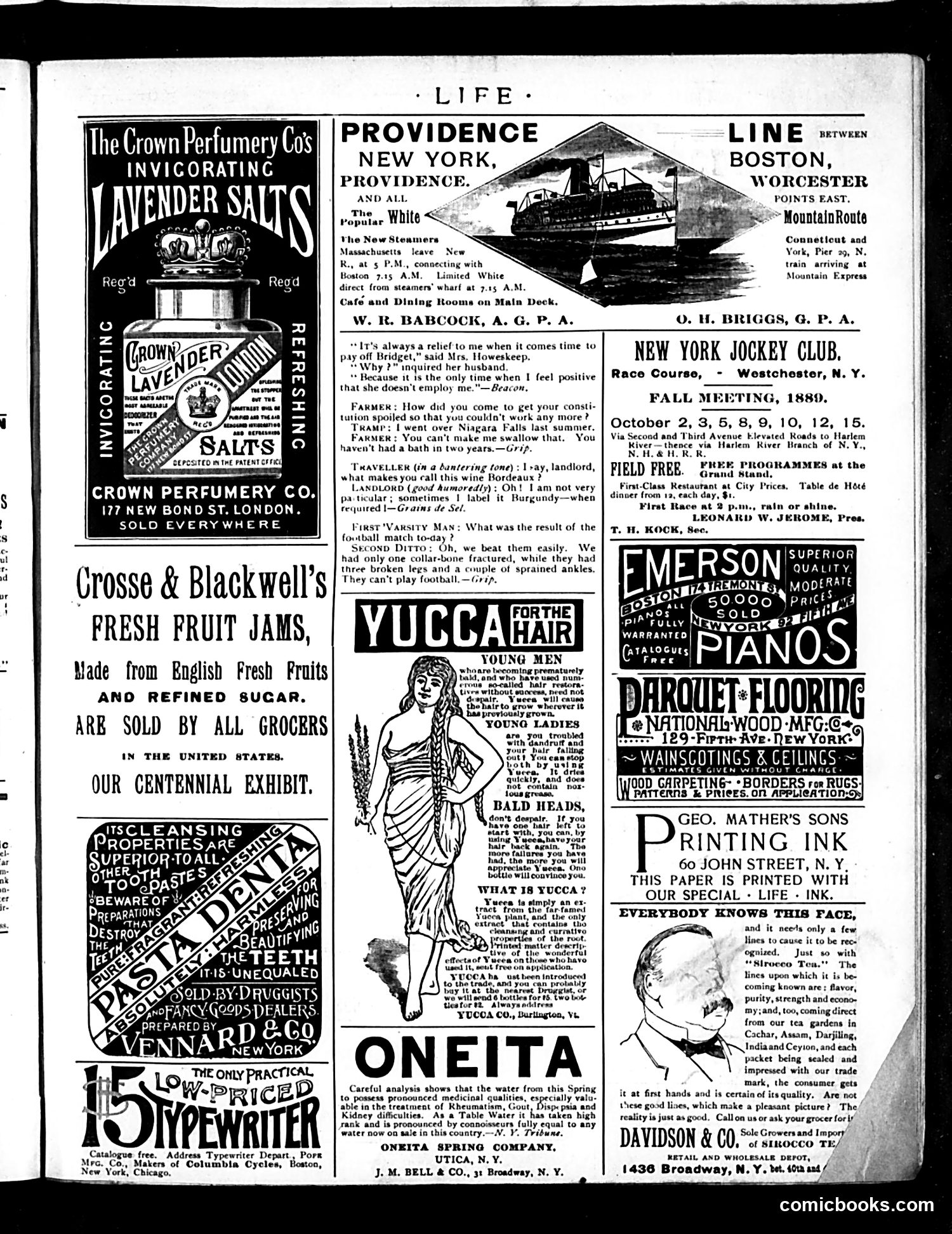
This is primarily an **advertising page** from Life's Fall 1889 issue, with small comic filler pieces interspersed among commercial notices. The modest cartoons/jokes are period humor reflecting late-Victorian concerns: - A domestic joke about paying servants ("Bridget") — playing on the common Irish immigrant housemaid stereotype - A farmer's tall tale about Niagara Falls, doubted because he looks unwashed - A innkeeper's deception, relabeling cheap wines as premium Bordeaux - College athletics humor mocking football injuries as badges of honor The **advertisements reveal 1889 consumer culture**: steamship lines, hair restoration products ("Yucca"), typewriters, pianos, mineral springs, and jams. Notably, "Yucca for Hair" targets both male baldness and female hair loss—gender-specific marketing for an era obsessed with appearance. The **printing ink advertisement** is meta-promotional: Life itself printed on their special ink. The overall tone is lighthearted, class-conscious satire mixed with commercial messaging—typical of Life's formula as a humor magazine supported by wealthy advertisers selling luxury goods to middle and upper-class readers.
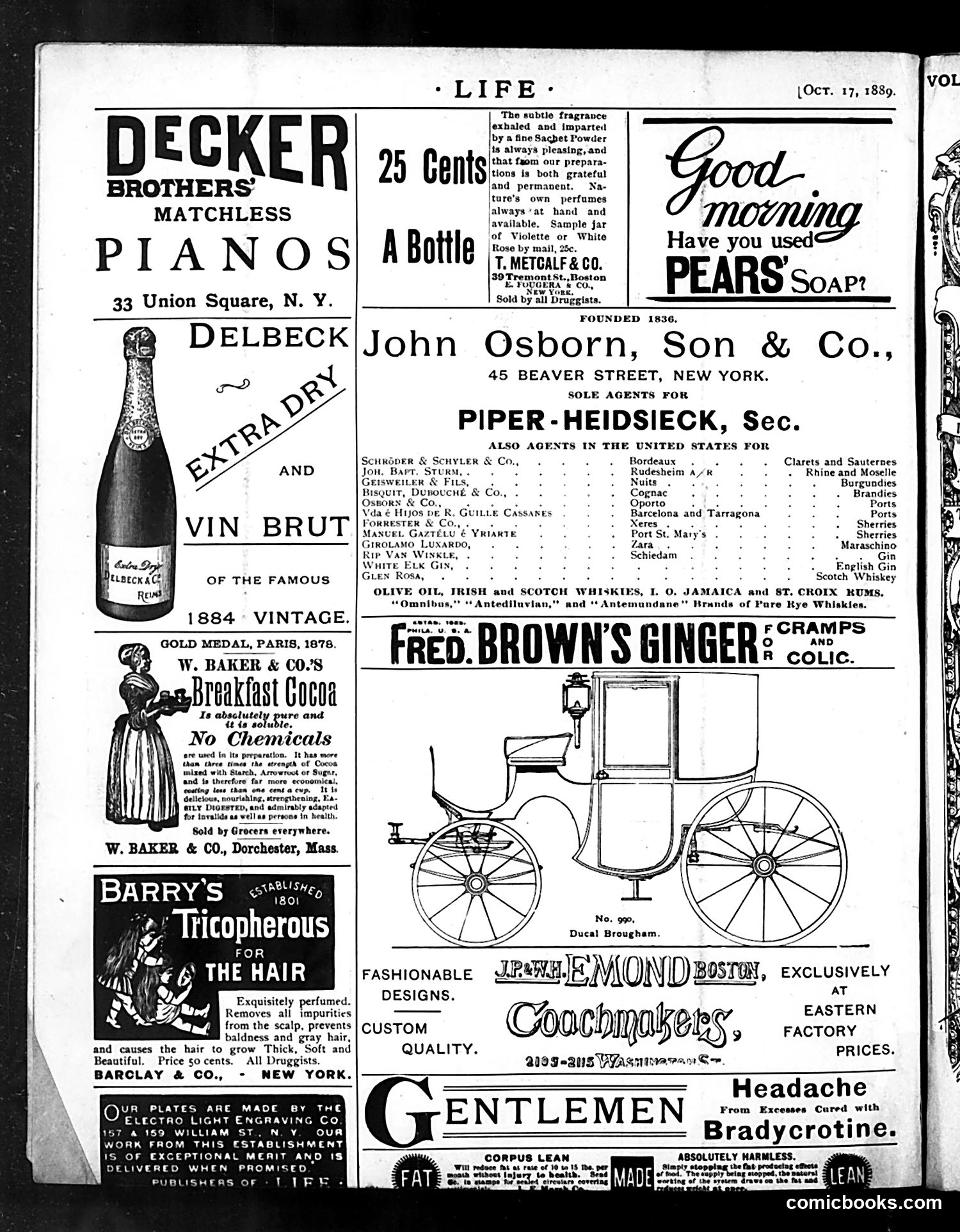
This page is **entirely advertising**—there are no cartoons or satirical content to analyze. The ads reflect 1880s consumer products and concerns: piano manufacturers, cocoa and breakfast foods, hair treatments (addressing baldness and gray hair as problems requiring solutions), perfumed sachets, and patent medicines like "Bradycrotine" for headaches and "Fred. Brown's Ginger" for digestive complaints. Of note: the prominence of hair-care ads and the explicit marketing of remedies for baldness suggest these were significant anxieties for the era's gentlemen. The page also advertises alcohol extensively—champagne, wine, whiskey, gin—reflecting the period's open marketing of spirits without modern warning labels or restrictions. The overall effect documents what late-19th-century Americans bought and what merchants thought would sell: luxuries, remedies for aging, and alcohol.