
Life, 1889-10-17 · page 6 of 18
Life — October 17, 1889 — page 6: what you’re looking at
What you’re looking at
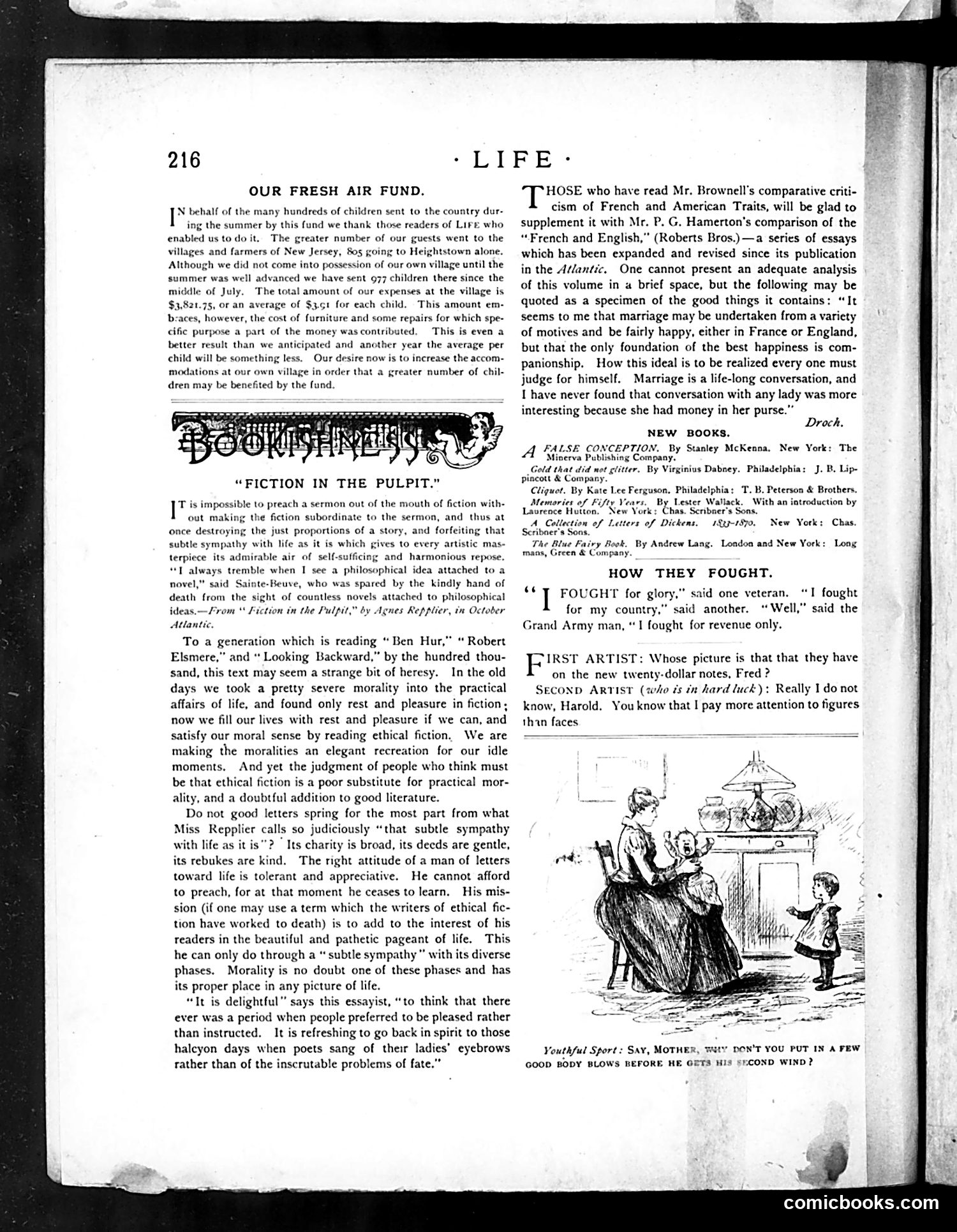
This page contains two distinct sections: **"Fiction in the Pulpit"** is an essay critiquing the use of fiction in sermons. The author argues against dismissing novels as immoral distraction, contending that ethical fiction serves moral education better than rigid doctrinal preaching. The piece defends reading for pleasure while maintaining moral purpose. **"How They Fought"** presents a humorous dialogue between veterans with different war motivations—one fought for glory, another for country, a third for revenge. This satirizes the varied, sometimes contradictory reasons men enlisted. The accompanying cartoon shows a woman and child, with the caption suggesting mothers should encourage physical fitness ("good body blows") to prepare sons for combat. This darkly jokes about militarism and maternal responsibility for producing strong soldiers, reflecting early 20th-century anxieties about national preparedness.
📄 Transcribed text from this page (OCR, searchable)
Machine-transcribed from the original scan — historical spelling and the odd misread are preserved.
- LIFE: OUR FRESH AIR FUND. [* behalf of the many hundreds of children sent to the country dur- ing the summer by this fund we thank those readers of Lire who enabled us to do it, The greater number of our guests went to the villages and farmers of New Jersey, 805 going to Heightstown alone. Although we did not come into possession of our own village until the summer was well advanced we have sent 977 children there since the middle of July. The total amount of our expenses at the village is $3,821.75, or an average of $3.¢1 for each child. This amount em- braces, however, the cost of furniture and some repairs for which spe- cific purpose a part of the money was contributed, This is even a better result than we anticipated and another year the average per child will be something less. Our desire now is to increase the accom- modations at our own village in order that a greater number of chil- dren may be benefited by the fund. “FICTION IN THE PULPIT.” I" is impossible to preach a sermon out of the mouth of fiction with- out making the fiction subordinate to the sermon, and thus at once destrc the just proportions of a story, and forfeiting that subtle sympathy with life as it is which gives to every artistic mas- terpiece its admirable air of self-sufficing and harmonious repose. “1 always tremble when I see a philosophical idea attached to a novel,” said Sainte-Beuve, who was spared by the kindly hand of death from the sight of countless novels attached to philosophical ideas.—From “ Fiction in the Pulpit,” by Agnes Repplier, in October Atlantic. To a generation which is reading * Ben Hur,” “ Robert Elsmere,” and “ Looking Backward,” by the hundred thou- sand, this text may seem a strange bit of heresy. In the old days we took a pretty severe morality into the practical affairs of life, and found only rest and pleasure in fiction; now we fill our lives with rest and pleasure if we can, and satisfy our moral sense by reading ethical fiction. We are making the moralities an elegant recreation for our idle moments, And yet the judgment of people who think must be that ethical fiction is a poor substitute for practical mor- ality, and a doubtful addition to good literature. Do not good letters spring for the most part from what Miss Repplier calls so judiciously “that subtle sympathy with life as it is"? "Its charity is broad, its deeds are gentle, its rebukes are kind. The right attitude of a man of letters toward life is tolerant and appreciative. He cannot afford to preach, for at that moment he ceases to learn. His mis- sion (if one may use a term which the writers of ethical fi tion have worked to death) is to add to the interest of his readers in the beautiful and pathetic pageant of life. This he can only do through a “ subtle sympathy ” with its diverse phases. Morality is no doubt one of these phases and has its proper place in any picture of life. “It is delightful” says this essayist, “to think that there ever was a period when people preferred to be pleased rather than instructed. It is refreshing to go back in spirit to those halcyon days when poets sang of their ladies’ eyebrows rather than of the inscrutable problems of fate.” HOSE who have read Mr. Brownell's comparative criti- cism of French and American Traits, will be glad to supplement it with Mr. P. G. Hamerton’s comparison of the “French and English,” (Roberts Bros.)—a series of essays which has been expanded and revised since its publication in the AV/antic. One cannot present an adequate analysis of this volume in a brief space, but the following may be quoted as a specimen of the good things it contains: “It seems to me that marriage may be undertaken from a variety of motives and be fairly happy, either in France or England, but that the only foundation of the best happiness is com- panionship. How this ideal is to be realized every one must judge for himself. Marriage is a life-long conversation, and I have never found that conversation with any lady was more interesting because she had money in her purse.” Droch. NEW BOOKS. Al FALSE CONCEPTION. By Stanley McKenna. Mioerva Publishing Company. Gold that did not glitter. By Virginius Dabney. Philadelphia: pincott & Company. Cliguot. By Kate Lee Ferguson. Philadelphia: T. B. Peterson & Brothers, Memories of Fifty Vears, By Lester Wallack, With an jatroduction by Laurence Hutton. New York: Chas. Scribner's Sons. Chas. A Collection of Letters of Dickens, Scriboer's Sons. The Blue Fairy Book. By Andrew Lang. London and New York: HOW THEY FOUGHT. es I said one veteran. “I fought “Well,” said the FOUGHT for glory Grand Army man, “1 fought for revenue only. New York: The J.B. Lip. sp-1870, New York: Long for my country,” said another. IRST ARTIST: Whose picture is that that they have on the new twenty-dollar notes, Fred ? SECOND ART (who és tn hard luck): Really Ido not know, Harold. You know that I pay more attention to figures than faces Youthful Sport : Sav, MOTHE: * DON'T YOU PUT IN A FEW GOOD BODY BLOWS BEFORE HE GETS HIS SECOND WIND? comicbooks.com