A complete issue · 18 pages · 1889
Life — October 3, 1889
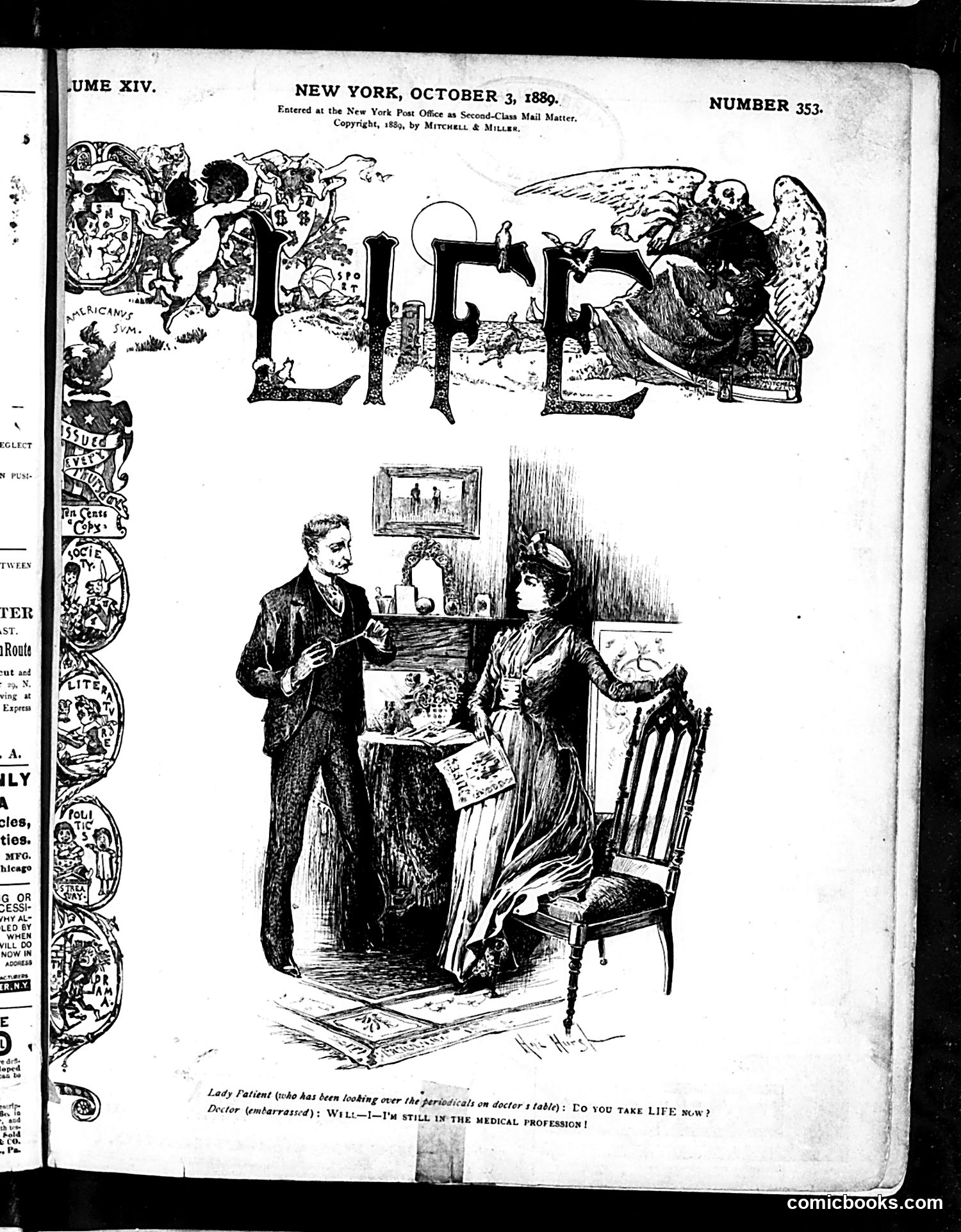
The main cartoon depicts a domestic scene where a doctor presents a painting or artwork to a woman seated in an interior. The caption reads: "Lady Patient (who has been looking over the periodicals on doctor's table): 'Do you take LIFE now?' / Doctor (embarrassed): 'Well—I'm STILL IN THE MEDICAL PROFESSION!'" The joke is that the woman has discovered *Life* magazine among the doctor's reading materials and is teasing him about it—implying that reading the satirical magazine might be unbecoming to a serious medical professional. The humor relies on the reputation of *Life* as frivolous entertainment rather than respectable reading material. The doctor's embarrassed response suggests he's defensive about being caught with something deemed insufficiently dignified for his profession.
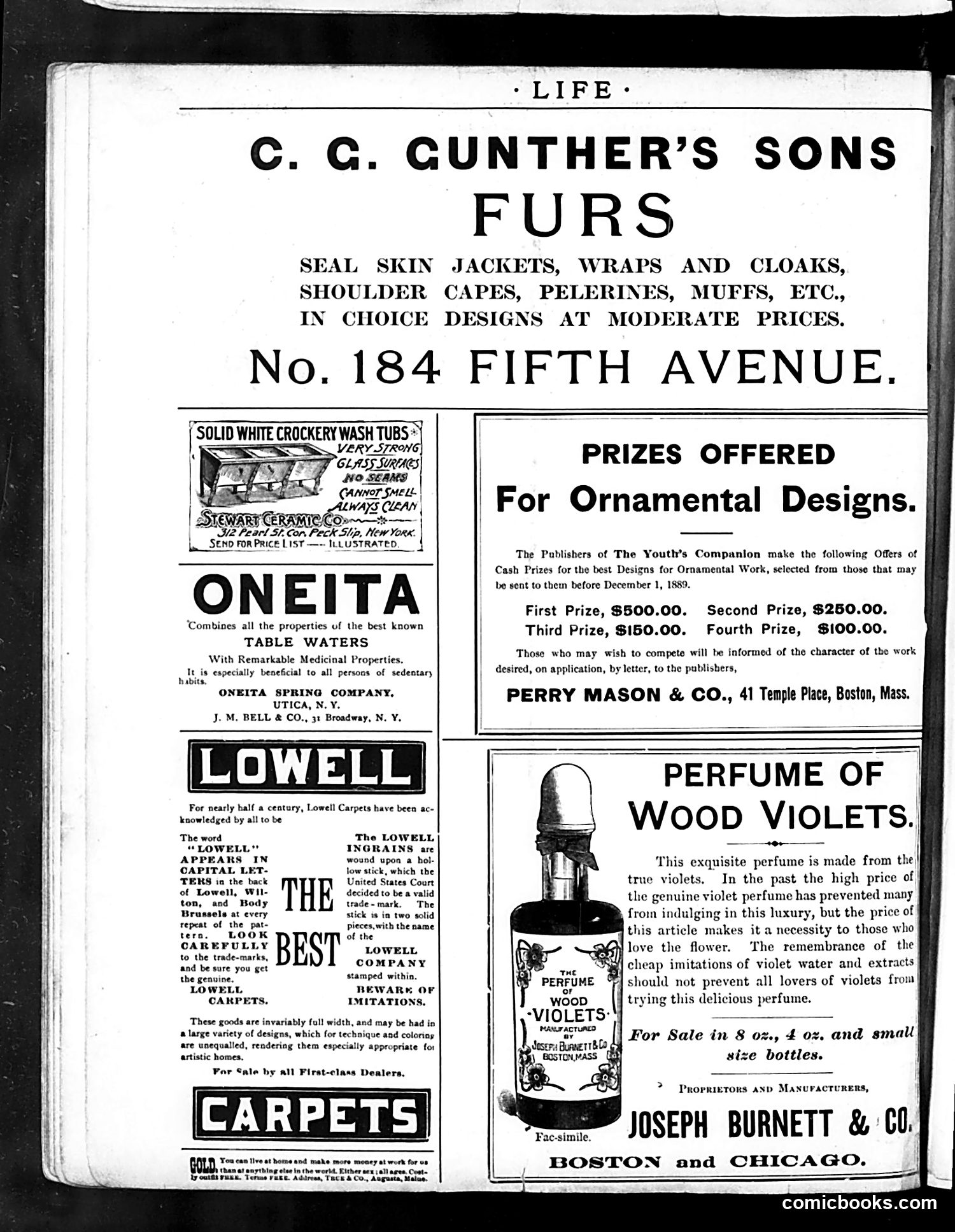
This page is primarily **advertising content** rather than satirical cartoons. It contains four distinct advertisements: 1. **C.G. Gunther's Sons Furs** - promoting seal skin jackets and fur accessories at Fifth Avenue 2. **Oneita Table Waters** - a mineral water product from Utica, NY 3. **Lowell Carpets** - emphasizing quality and the company's long reputation, with text about their distinctive patterns and durability 4. **Perfume of Wood Violets** by Joseph Burnett & Co. - featuring a bottle illustration and promoting an affordable violet perfume The page represents typical late-19th century Life magazine content, mixing commercial advertisements with editorial material. There are no political cartoons or satirical commentary visible—this is a straightforward advertising section aimed at affluent readers of the period.
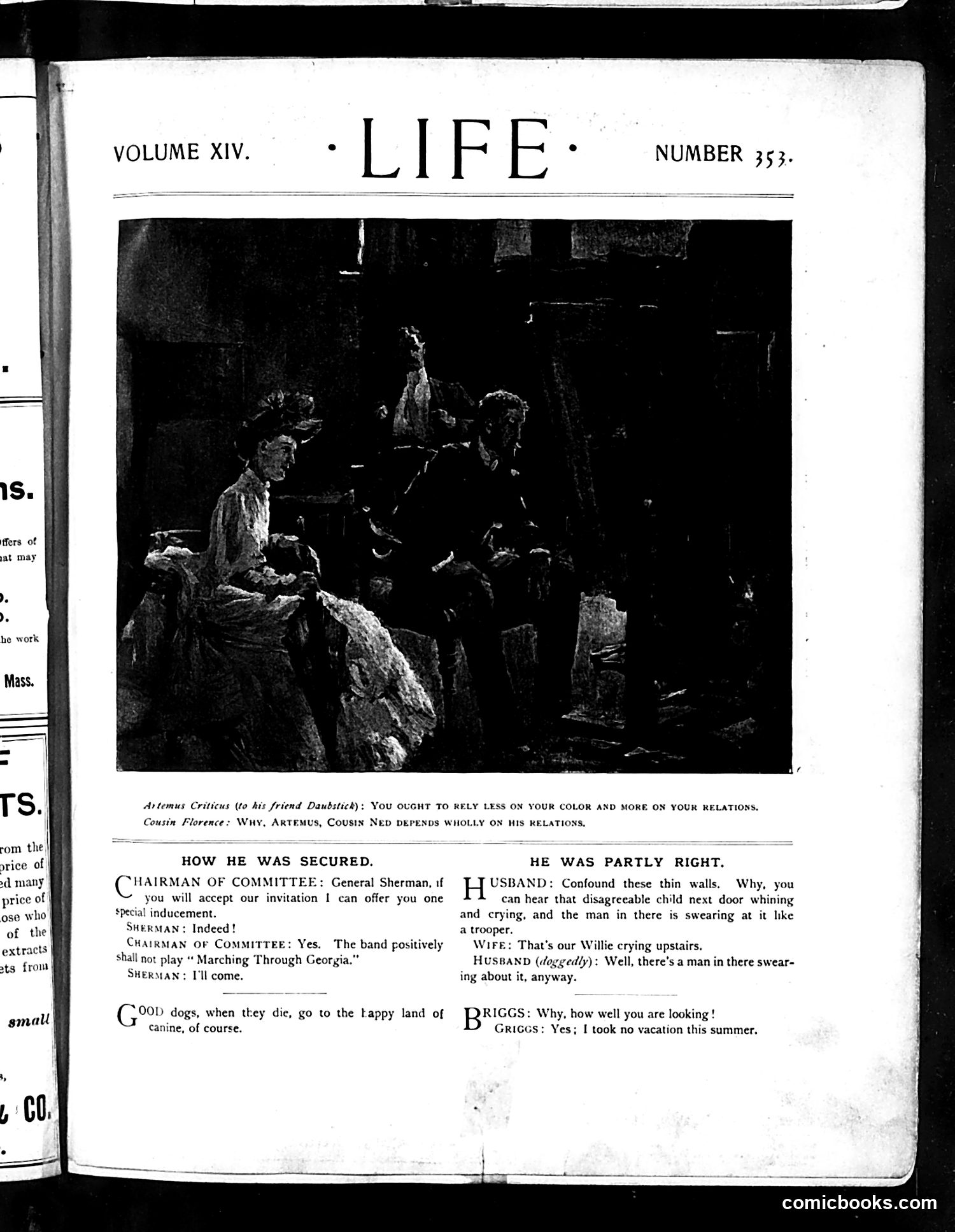
This page from *Life* magazine (Volume XIV, Number 352) contains satirical dialogues rather than political cartoons. The top image appears to show a domestic scene, with accompanying text referencing **Artemus Criticks** advising someone named **Danstitick** about prioritizing relationships over appearance—a social commentary on values. Below are two separate humorous exchanges: 1. **"How He Was Secured"**: A dialogue between a **Chairman of Committee** and **General Sherman**, apparently about securing Sherman's attendance at an event by offering to exclude "Marching Through Georgia" from the program—a reference to Sherman's Civil War campaign. 2. **"He Was Partly Right"**: A domestic quarrel between husband and wife about noise from neighbors, with comedic misunderstandings about a child "crying upstairs" and a man "swearing." The humor relies on wordplay and domestic/social situations rather than explicit political satire.
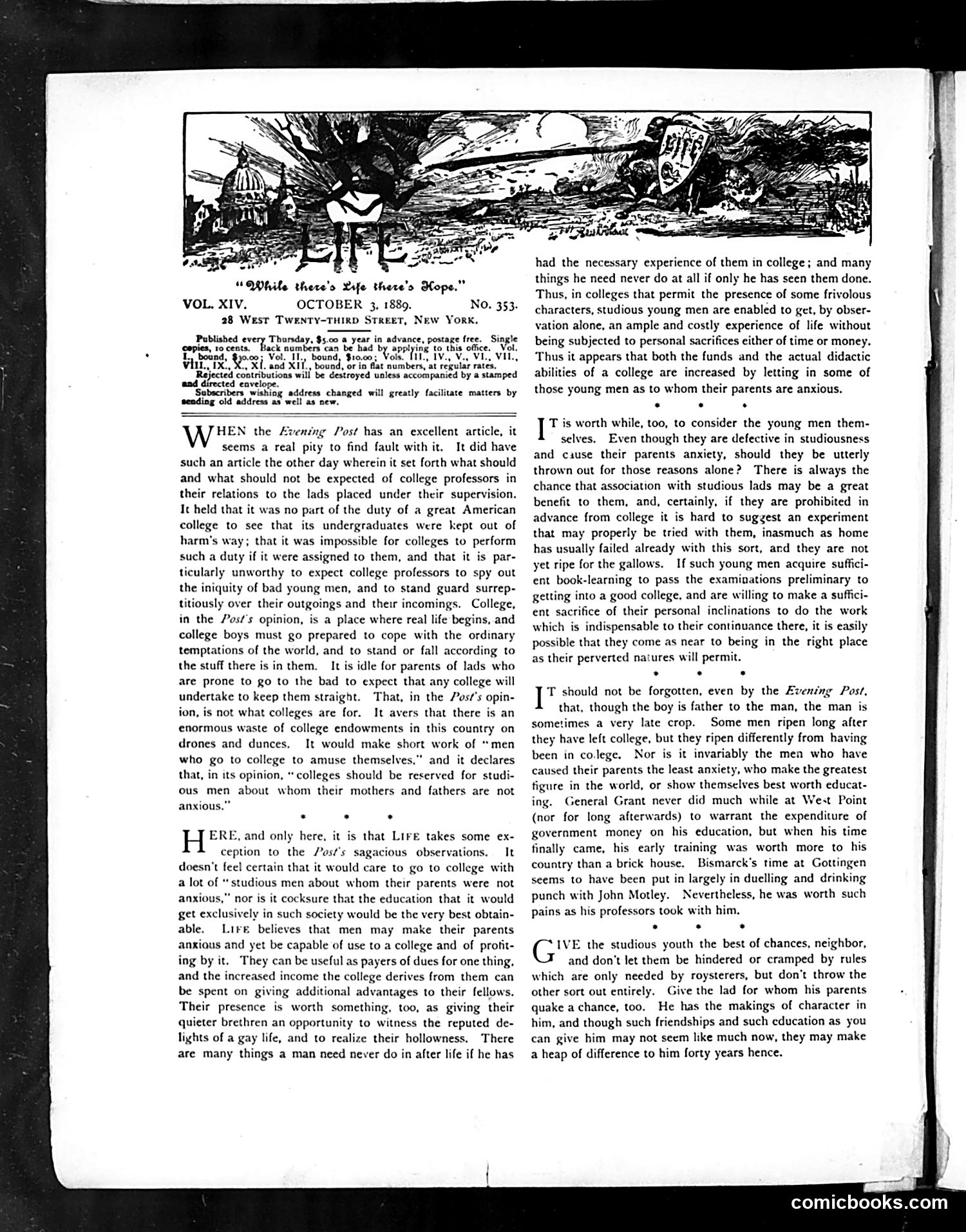
The masthead illustration at top depicts a chaotic landscape with classical architecture (a dome, likely representing government or institutional authority) amid destruction and turmoil. A figure appears to be gesturing dramatically in the center. The accompanying text discusses college education, arguing that colleges should allow some "frivolous characters" and "studious young men" to associate together. The piece defends permitting students whose parents are anxious about their behavior, suggesting such friendships and exposure might benefit them morally. The cartoon likely satirizes concerns about college discipline and student misconduct—a recurring 1880s debate. Without clearer identification of specific figures, the exact targets remain unclear, but the overall critique appears directed at overly restrictive college policies regarding student character and conduct.
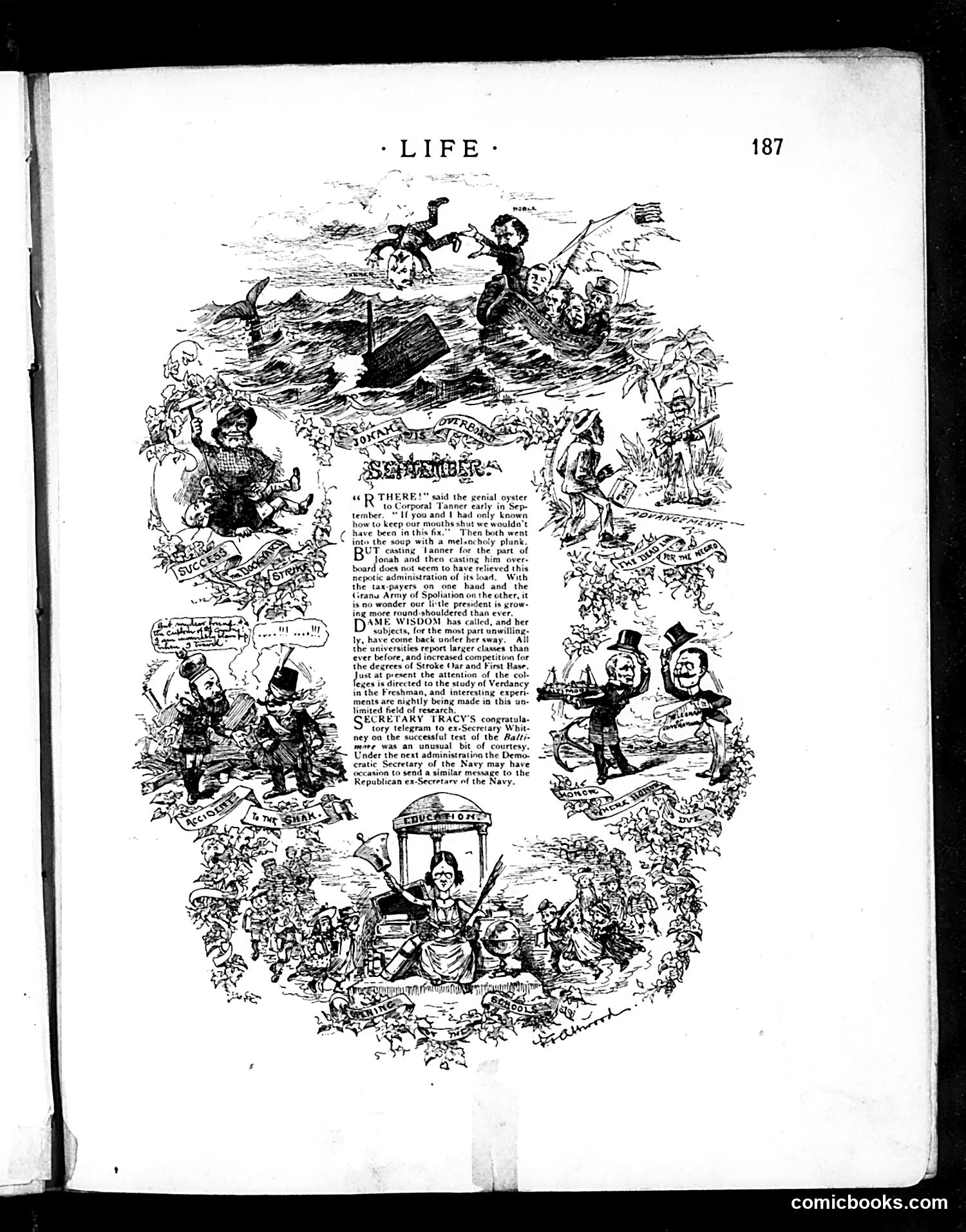
This satirical page mocks contemporary political and social issues through interconnected vignettes. The top scene depicts figures in a boat labeled "SEPTEMBER," likely referencing a current event. The text discusses an "genial oyster" and criticisms of naval administration under what appears to be the "Grand Army of Spoliation." References to "DAME WISDOM" calling universities suggest satire about education policy and increased competition for university attendance. The middle section features dialogue between two figures in top hats, discussing naval matters and Secretary Tracy—likely Secretary of the Navy Benjamin Franklin Tracy (1889-1893). The bottom depicts "EDUCATION" as a central figure surrounded by crowds, satirizing American educational debates of the era. Overall, the cartoon critiques naval administration, political corruption ("spoliation"), and educational policy through whimsical, interconnected imagery typical of Life's satirical style.
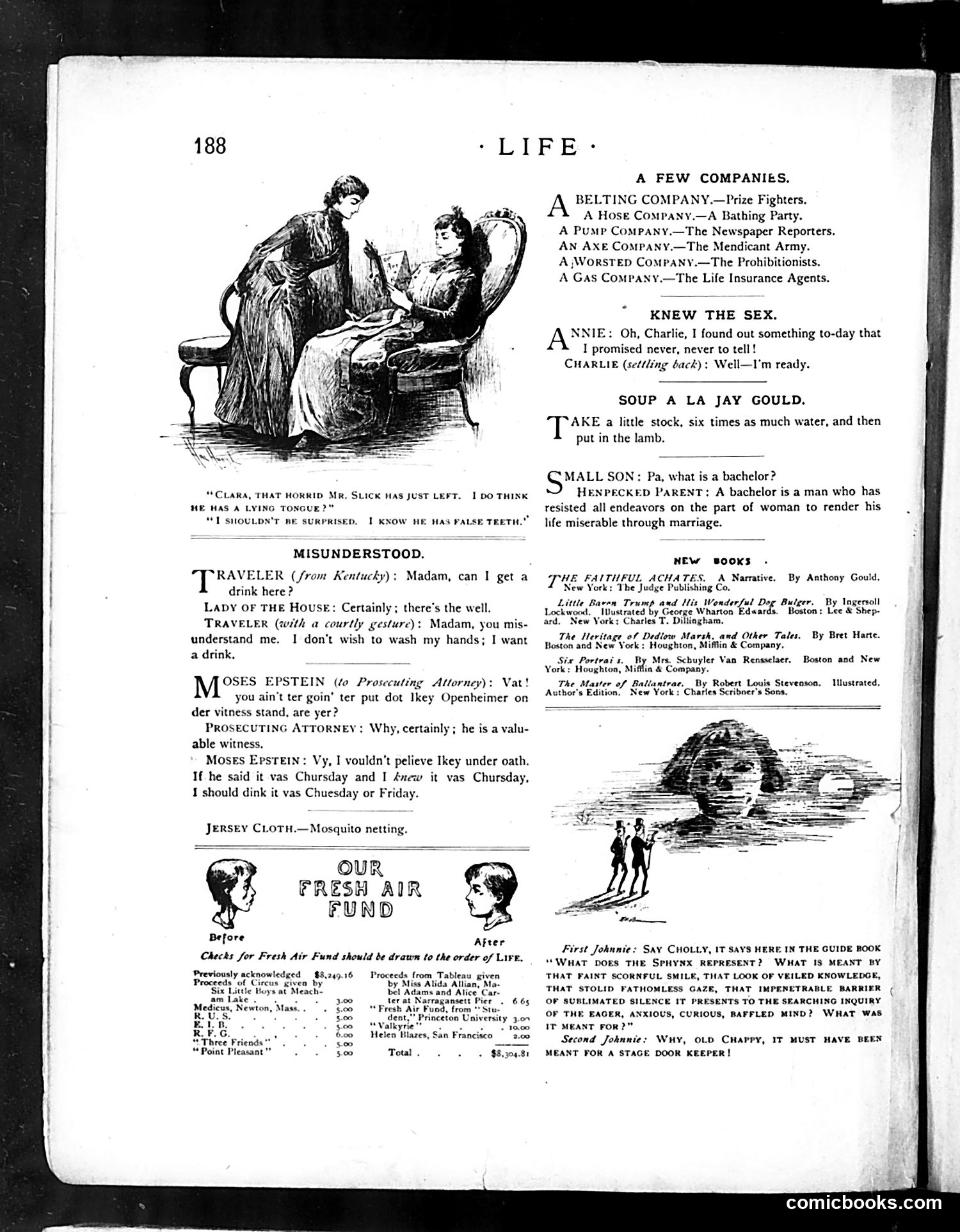
**Main Visual Content:** The large illustration shows two figures in Victorian dress—a woman standing and a man seated—in what appears to be a domestic scene. The caption beneath reads: "Clara, that horrid Mr. Slick has just left. I do think he has a lying tongue!" / "I shouldn't be surprised. I know he has false teeth." **The Satire:** This joke plays on a double meaning: "lying tongue" (speaking falsely) versus literal false teeth. The humor derives from deliberately misinterpreting the wife's complaint—taking her figurative accusation literally. This reflects Victorian-era satirical humor that relied on wordplay and misunderstandings. The remaining page content includes miscellaneous jokes, book advertisements, and a "Fresh Air Fund" section—typical Life magazine filler material from this period.
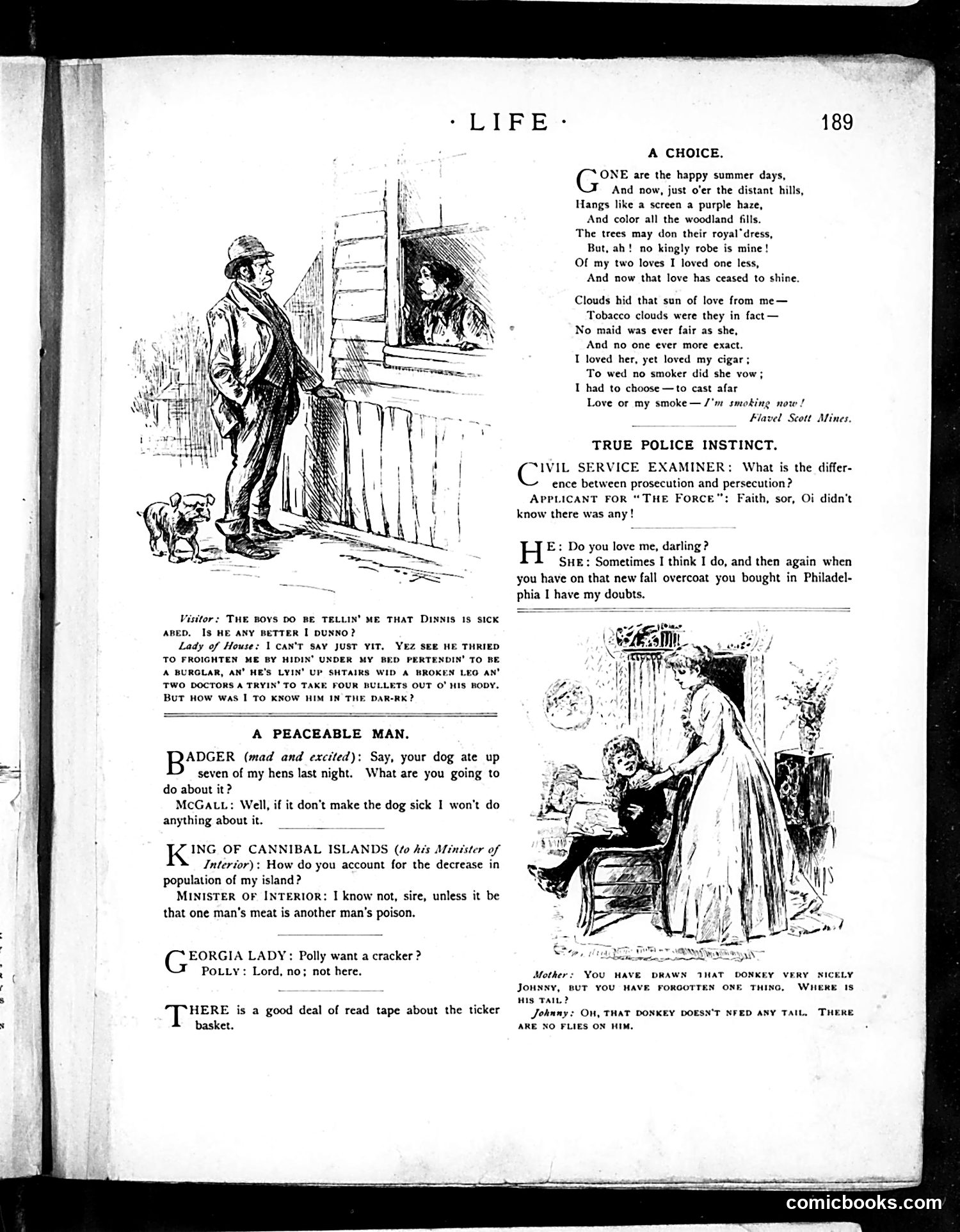
This page contains several brief satirical dialogues and sketches typical of early 20th-century American humor magazines. **"A Choice"** is a poem about romantic sacrifice—choosing between love and smoking, ultimately selecting cigars. **"True Police Instinct"** mocks civil service examiners through a dialogue where an applicant cannot distinguish between "prosecution" and "persecution." **"A Peaceable Man"** satirizes indifference: a character refuses to address his dog eating hens, showing apathetic acceptance. **"King of Cannibal Islands"** presents dark humor about population decline, with a minister joking that "one man's meat is another man's poison." **"Georgia Lady/Polly"** contains a brief domestic exchange about crackers. The sketches use rapid-fire joke structures common to Life's format—short, punchy dialogues exploiting wordplay, absurdity, and social commentary rather than targeting specific political figures or events.
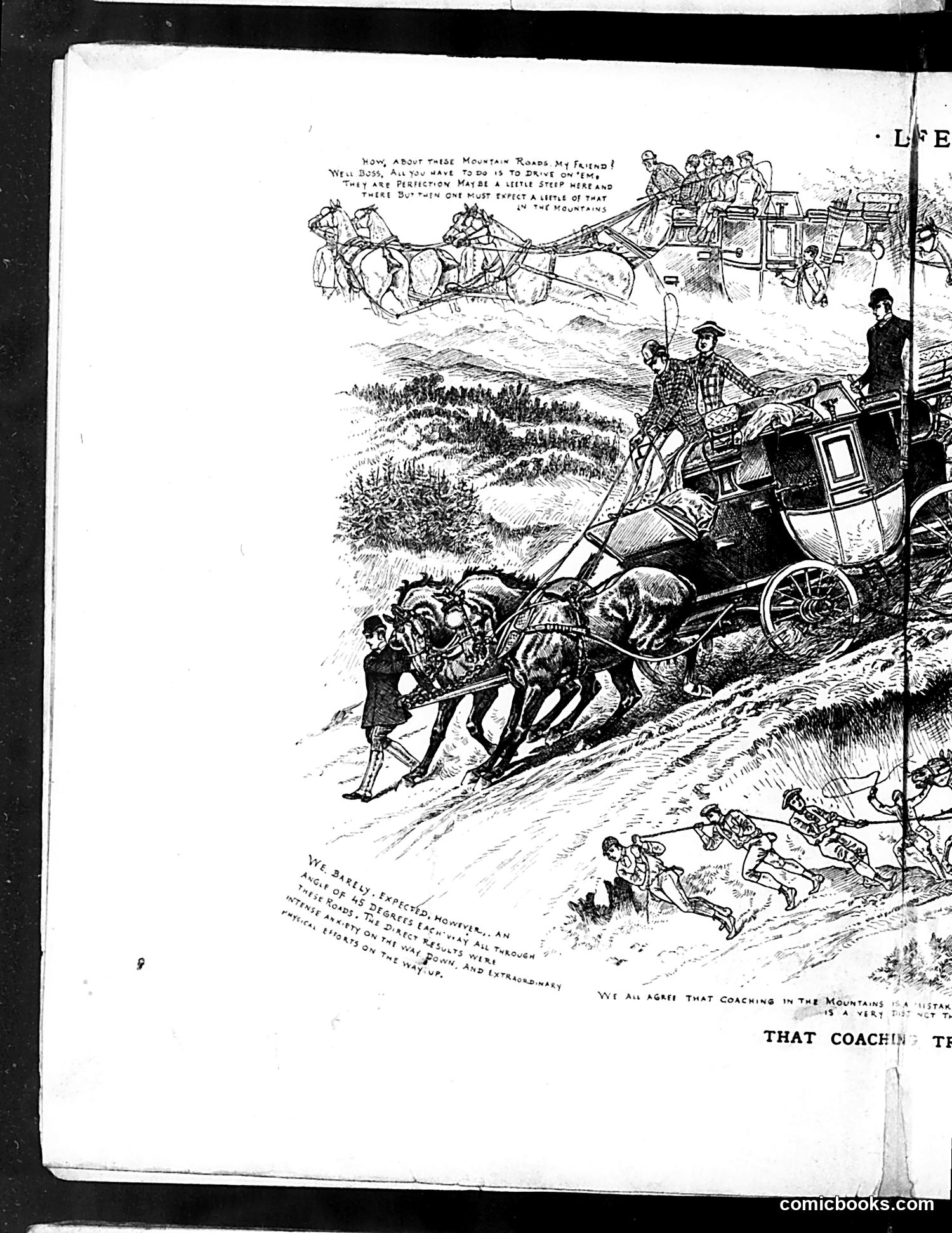
This page contains an illustration satirizing mountain stagecoach travel. The cartoon depicts horse-drawn coaches navigating treacherous mountain terrain, with passengers experiencing the rough journey. The text at top describes challenges of mountain coaching—drivers must navigate sharp turns and handle teams of horses on difficult roads. The bottom caption references "coaching in the mountains" as "a very...uncertain" experience (text partially cut off). The satire appears to mock both the discomfort of nineteenth-century mountain travel and possibly the romantic notions people held about such journeys. The detailed illustration emphasizes the physical strain on both passengers and animals, contrasting reality against idealized perceptions of frontier travel. Without complete OCR text, the specific satirical target remains somewhat unclear, but the overall message critiques the arduous nature of mountain coaching.
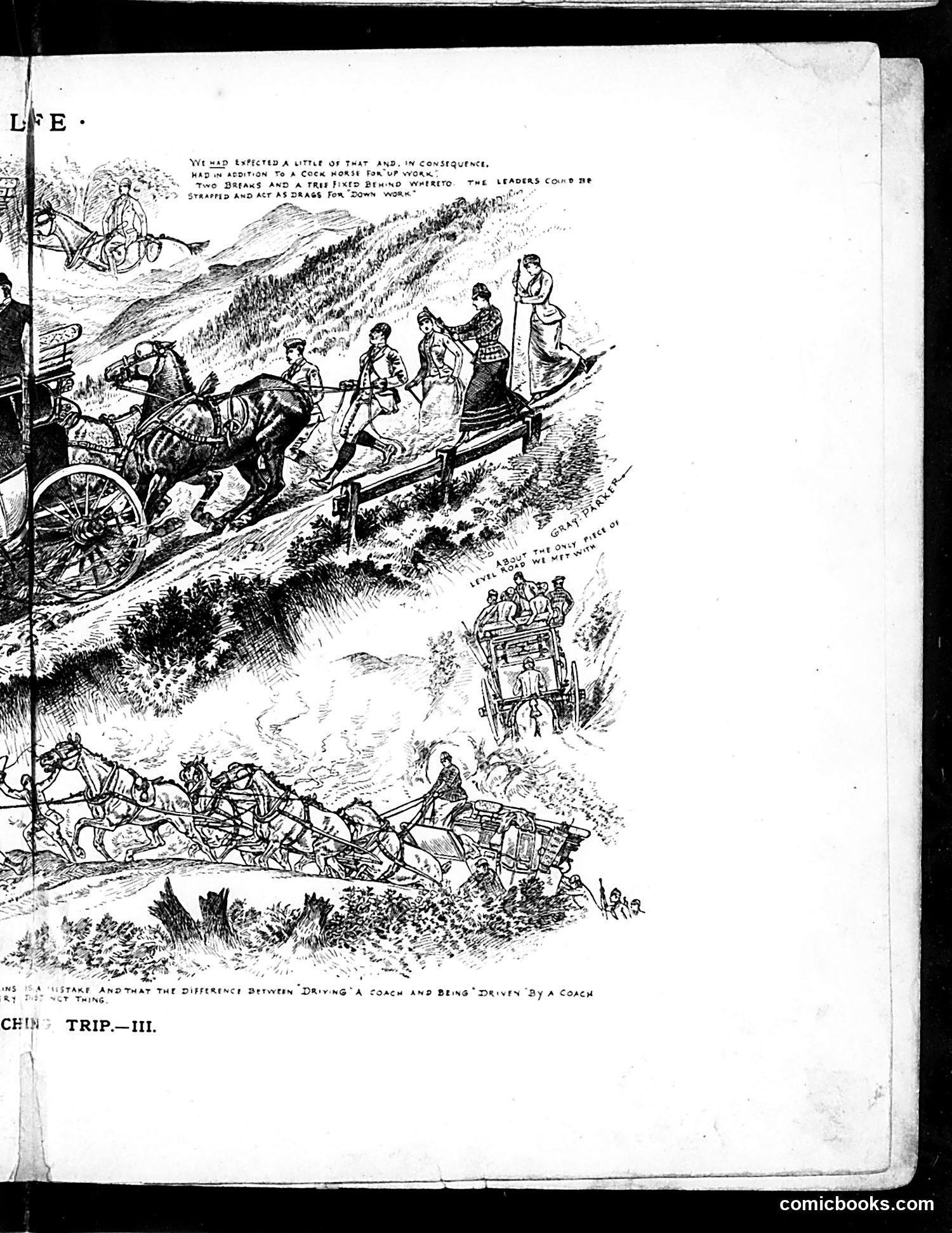
This illustration depicts a coaching (horse-drawn carriage) excursion gone chaotic, showing the humorous difference between "driving a coach" and "being driven by a coach." The top panels show an organized, controlled journey with passengers properly seated. The bottom panels show the same journey in disorder—horses, passengers, and cargo scattered and tumbling down a hillside in disarray. The satire appears to mock incompetent or reckless coaching practices, perhaps referencing actual coaching companies or operators of the era. The visual humor contrasts careful management versus negligent mismanagement of public transportation. The caption explicitly states the lesson: the vast difference in outcomes between competent and incompetent coaching operations.
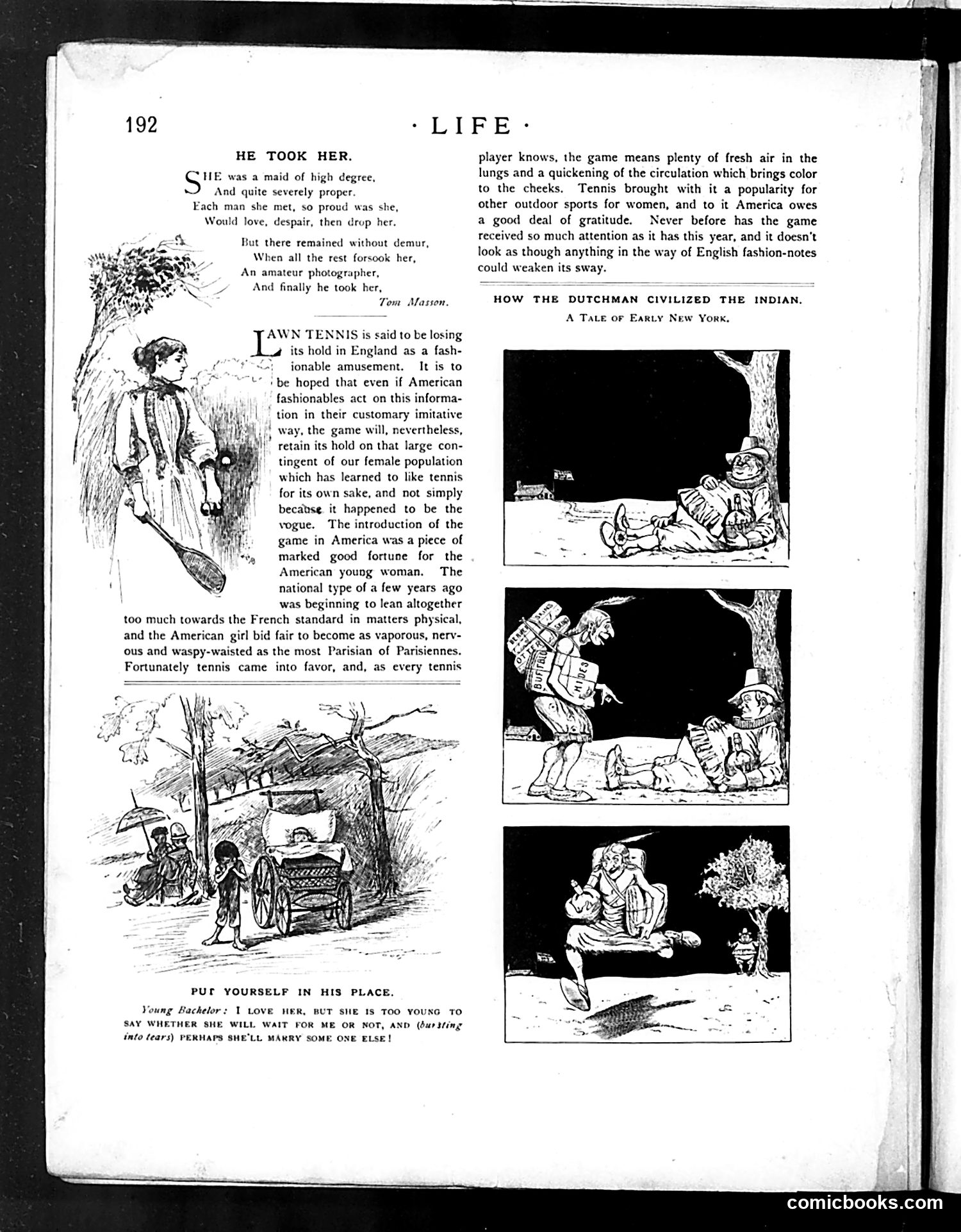
This page contains two separate pieces: **Left side ("He Took Her" and "Put Yourself in His Place"):** A romantic/sentimental story with accompanying illustrations about a maid and suitors, using conventional Victorian narrative tropes. **Right side ("How the Dutchman Civilized the Indian"):** A three-panel comic strip depicting interactions between a Dutch colonist and a Native American, rendered in caricature. The humor appears to rely on physical comedy and the "civilizing" premise—a common (and now offensive) colonial-era trope. The panels show the Dutch figure teaching or imposing European behaviors on the Native American through slapstick scenarios. The satire reflects early-20th-century attitudes toward colonialism and racial "civilization narratives" that modern readers would recognize as deeply problematic, though the magazine presented this as light entertainment.
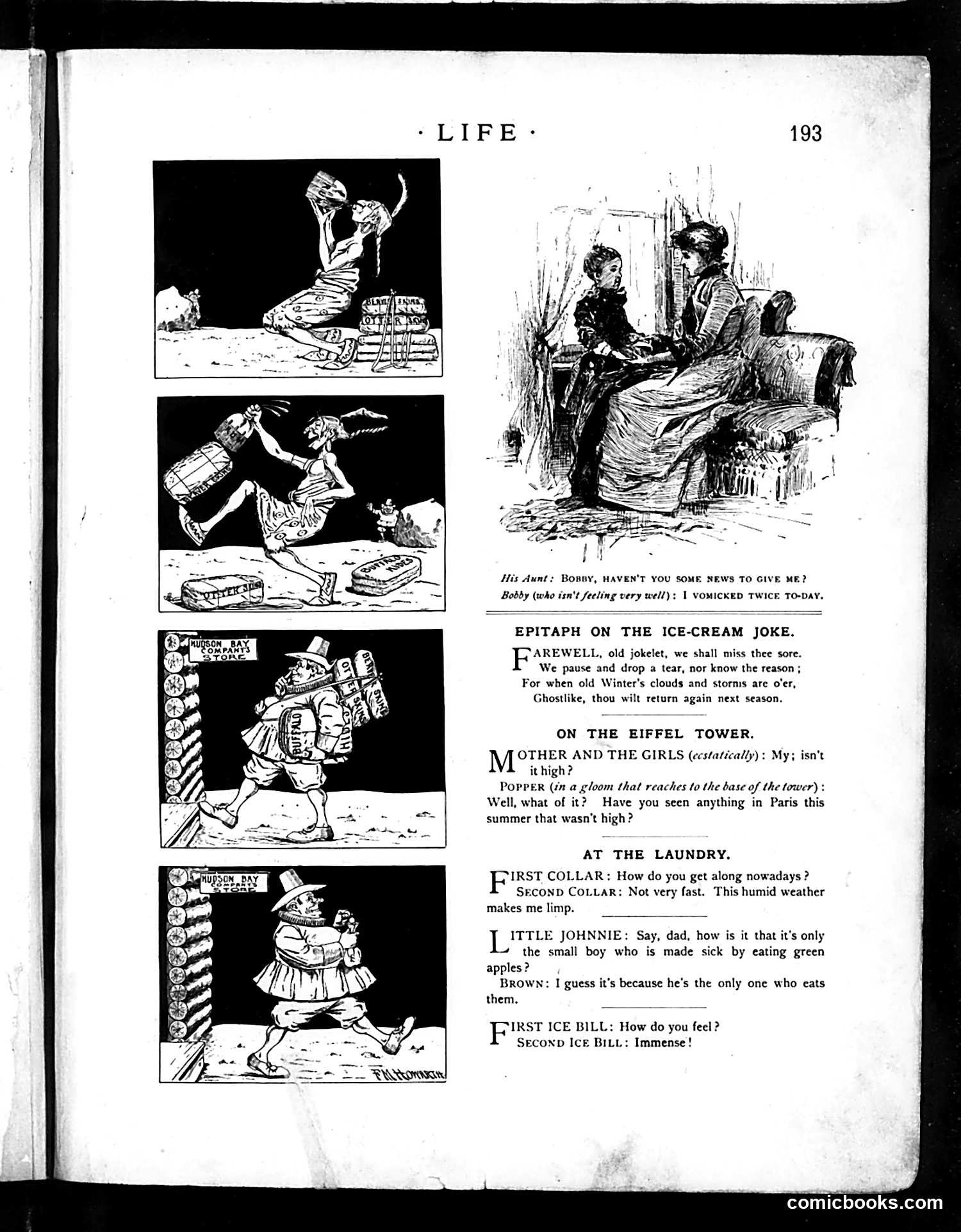
This page contains four unrelated comic strips (left) and several short jokes (right), typical of Life's satirical humor format. The **comic strips** use visual gags involving slapstick and exaggeration—characters with oversized loads, physical mishaps—common to early 20th-century comic humor. The **written jokes** target everyday situations: an ice-cream vendor's seasonal business, tourist behavior at the Eiffel Tower, laundry workers' complaints, and children's logic about digestive problems. One joke plays on the phrase "immense" (meaning both huge and sick). Another mocks parents' explanations to children. The humor reflects **pre-modern social contexts**: servants/workers complaining, casual childhood illness from eating fruit, and class-based observations about tourism and domestic labor. No specific political figures or events are referenced.
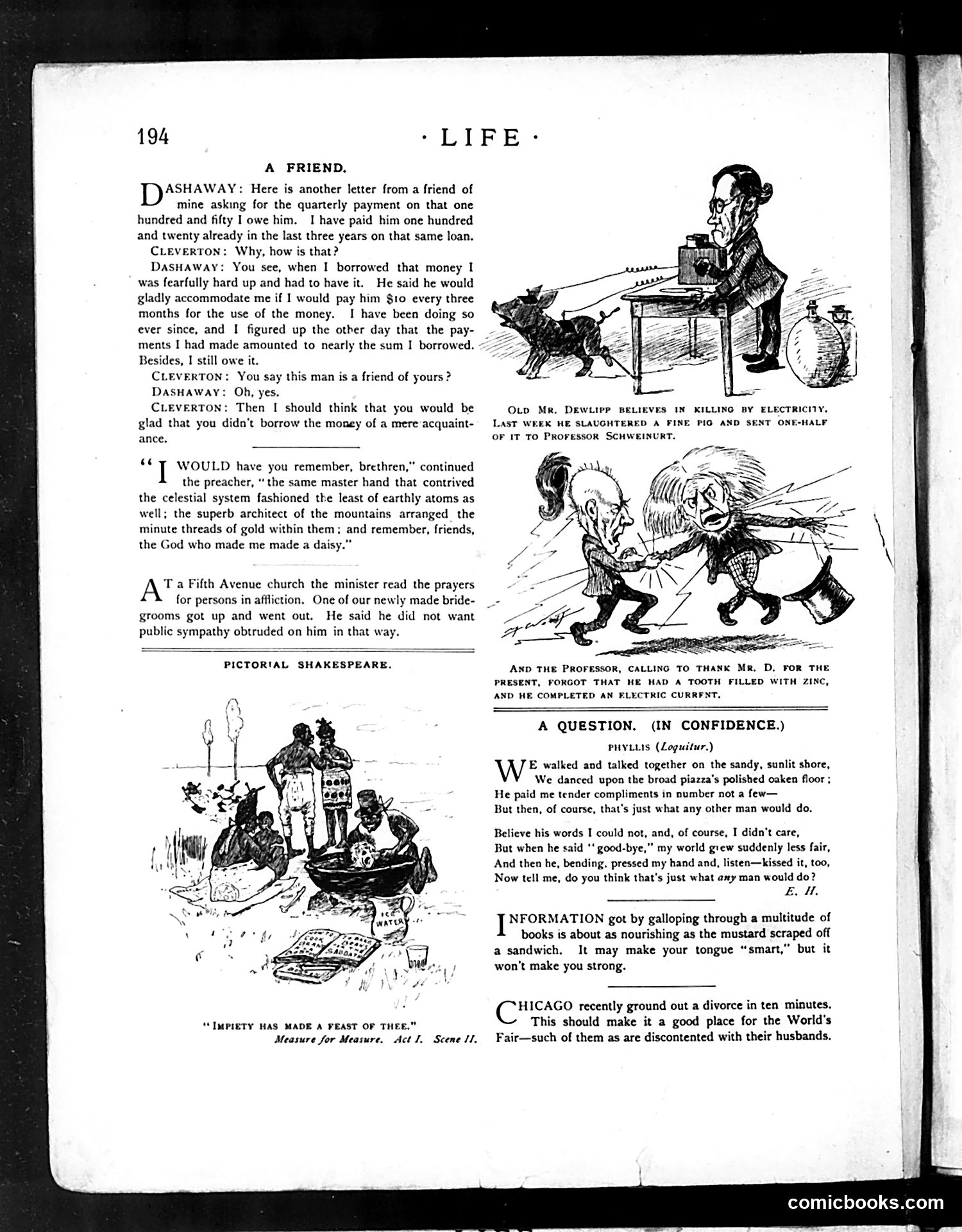
This page contains several satirical pieces typical of early Life magazine humor: **"A Friend"** mocks predatory lending. Dashaway borrowed money at punishing interest rates—paying $10 quarterly for use—and has already repaid nearly the principal amount while still owing the original sum. Cleverton's deadpan response highlights the absurdity: if this is how friends treat you, you're lucky the lender wasn't merely an acquaintance. **"Pictorial Shakespeare"** illustrates a scene from *Measure for Measure* showing a feast/banquet, with a caption about impiety. **"Old Mr. Dewlipp"** (top right cartoon) jokes about experimental electrocution: Dewlipp kills a pig electrically and sends it to Professor Schweinurt, who accidentally completes an electrical circuit when thanking him—because his tooth has a zinc filling, electrocuting him. **"A Question"** is romantic verse satirizing women's contradictory feelings: the speaker doubts her suitor's sincerity yet feels devastated when he leaves, questioning whether his kiss was genuinely special or routine. Minor pieces satirize religious hypocrisy and hasty divorce in Chicago.
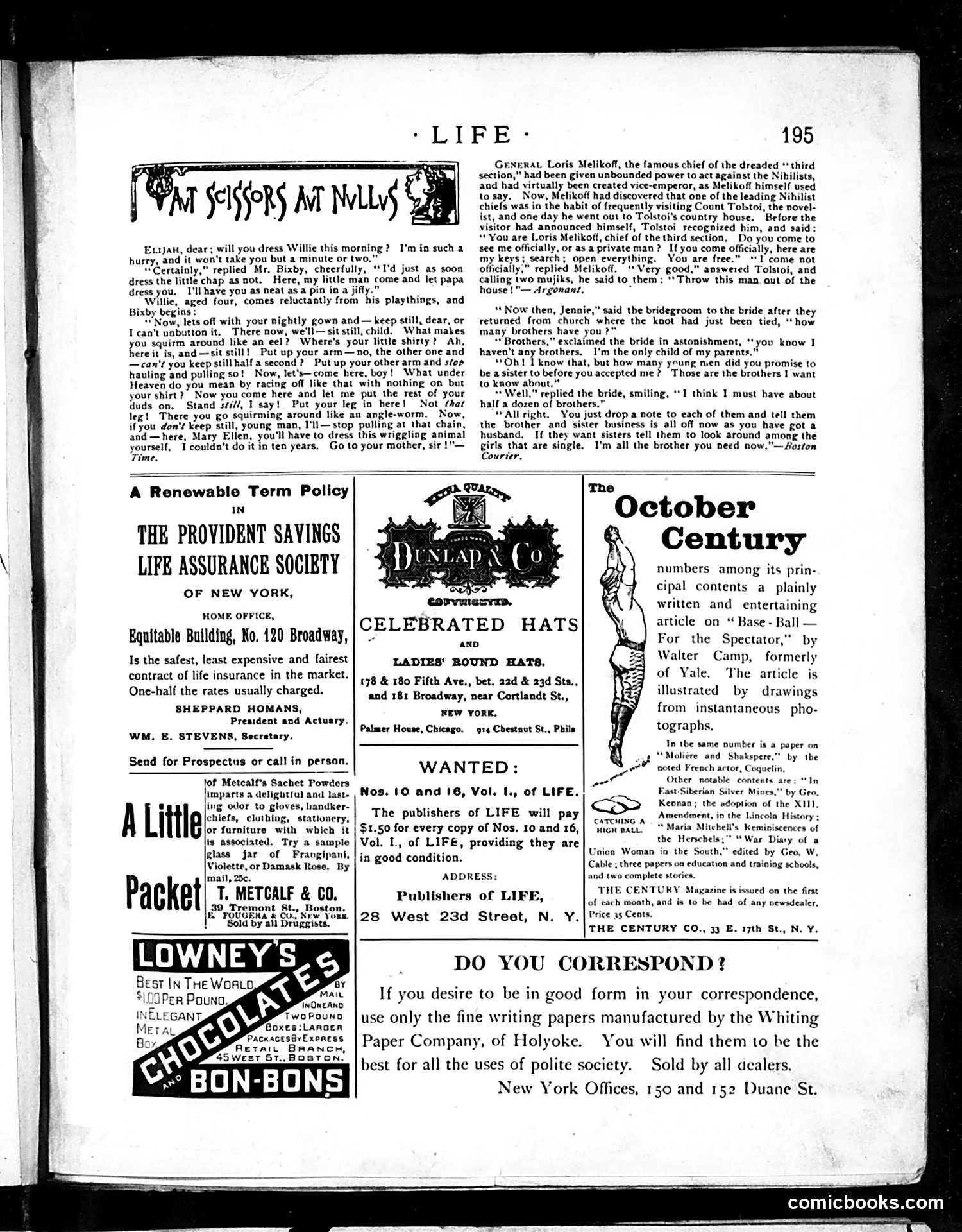
This page contains three humorous narrative pieces typical of *Life* magazine's satirical style: **"Scissors at Nully"** depicts a father (Mr. Bixby) attempting to dress his four-year-old son Willie, with mounting frustration as the child wriggles and resists. The humor lies in the adult's exasperation with childish behavior—the boy squirms, runs off half-dressed, and generally makes the simple task impossibly difficult. The father finally gives up, handing the child back to the mother. This satirizes parental patience (or lack thereof) and the chaos of dressing young children. **The second piece** recounts an anecdote about Russian official Loris Melikoff visiting novelist Count Tolstoi, who rebuffs him by offering either official access to search his home, or personal rejection—then has servants throw him out. It illustrates Tolstoi's defiance against state authority. **The third narrative** jokes about a newlywed husband demanding his bride sever ties with male admirers she'd promised to be "sisters to" before marriage, now that he is her only "brother." The humor relies on the double meaning of "brother." The page is primarily advertising otherwise.
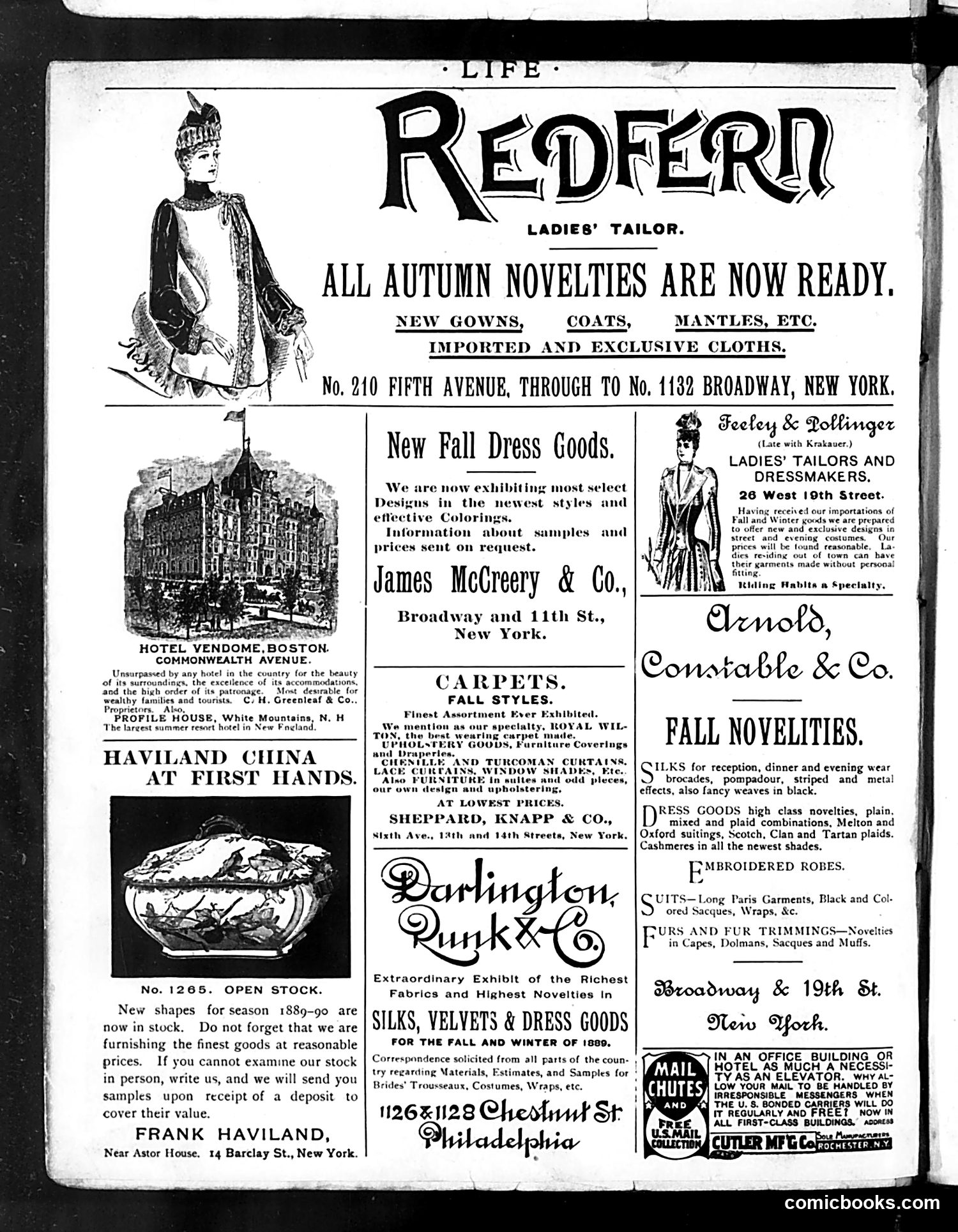
This page from *Life* magazine contains **no political cartoons or satire**. It is primarily a collection of advertisements for upscale women's clothing retailers, tailors, and fabric suppliers in late 1880s New York and Philadelphia—targeting wealthy customers seeking autumn fashions, imported silks, carpets, and hotel accommodations. The only image with potential satirical intent is the small advertisement at bottom right for "Mail Chutes," which includes a brief joke: "IN AN OFFICE BUILDING OR HOTEL AS NECESSARY AS AN ELEVATOR. Why allow your mail to be handled by irresponsible messengers..." This is straightforward commercial humor promoting a practical invention (a mail delivery system), not political commentary. The page reflects the magazine's business model of mixing editorial content with high-end advertising aimed at prosperous readers.
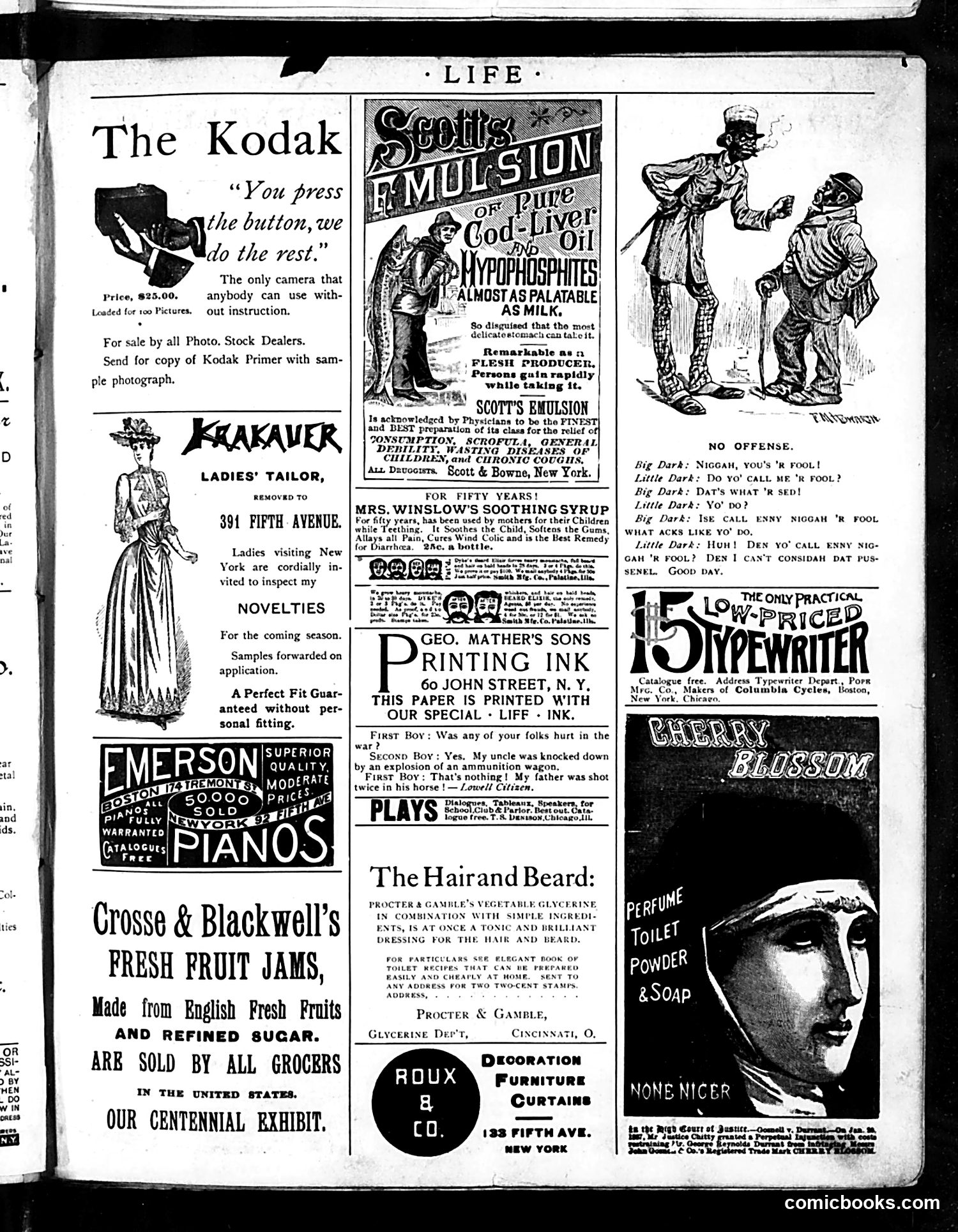
This cartoon depicts a racial stereotype dialogue between two Black figures, labeled "Big Dark" and "Little Dark." The "joke" turns on wordplay: Big Dark insults Little Dark as a fool, but Little Dark protests that calling someone a fool requires them to actually be foolish—implying Big Dark himself must be the fool for making such an accusation. The cartoon reflects deeply offensive 19th-century minstrelsy traditions, using exaggerated dialect ("Yo!" "Dat") and dehumanizing nomenclature. The title "No Offense" suggests the humor was meant to seem harmless, though the caricatures and language are plainly derogatory by modern standards. This represents Life magazine's satirical content of its era—humor aimed at dominant audiences that casually perpetuated racial mockery as entertainment. Modern readers should understand this reflects historical racism, not legitimate satire.
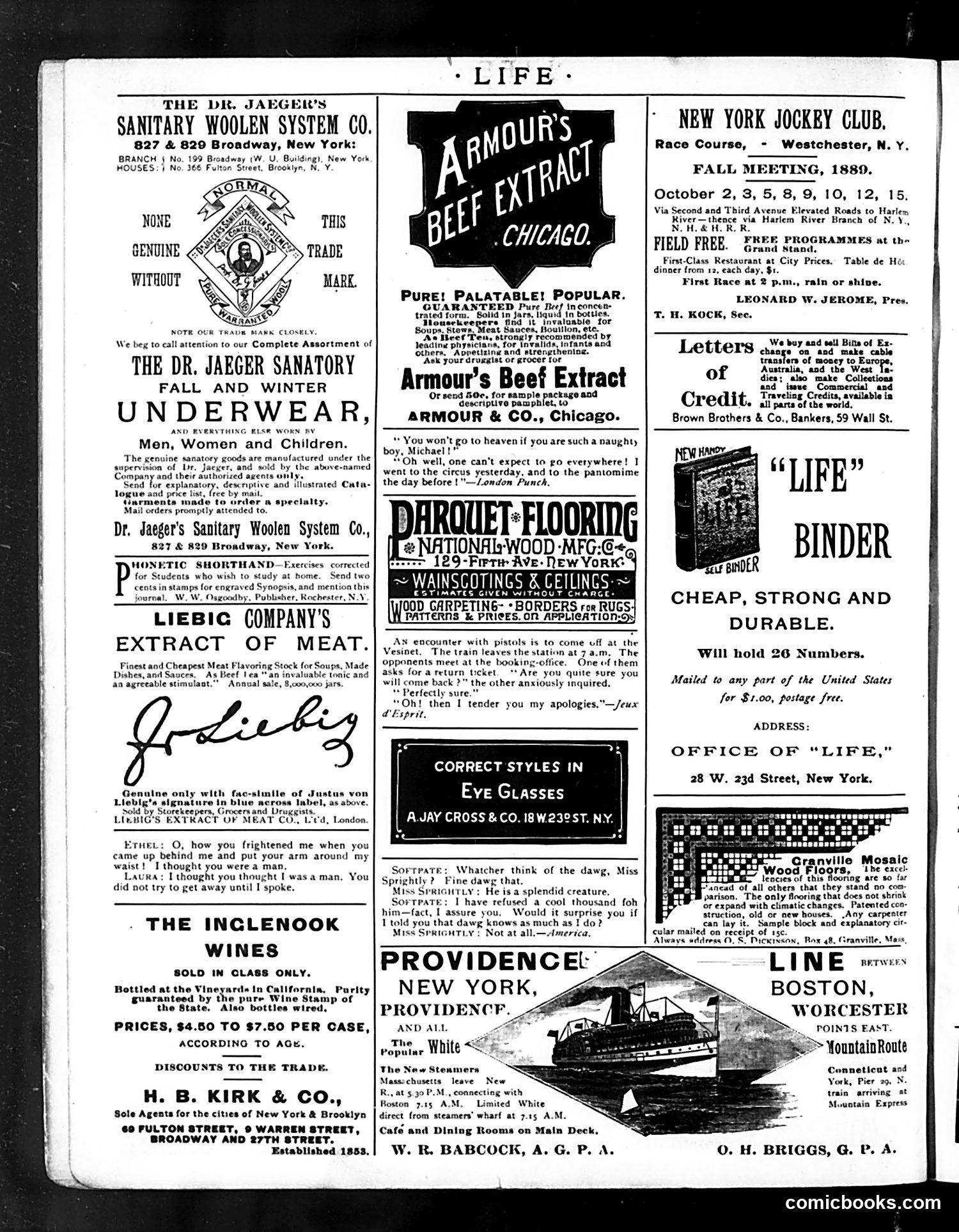
This page is primarily an advertising compendium from an 1880 *Life* magazine issue. There is minimal political cartoon content. The only identifiable satirical humor appears in short comedic exchanges—brief jokes formatted as dialogues, likely reprinted from *London Punch*. One depicts a boy named Michael claiming he cannot expect "to go everywhere" since he's already attended the circus and pantomime. Another involves a humorous exchange about whether a duel's participant will return from the confrontation. The rest is standard commercial advertising: Dr. Jaeger's sanitary underwear, Armour's Beef Extract, Liebig's Meat Extract, wines, eyeglasses, shorthand instruction, and shipping lines. Without identifying any actual cartoons or caricatures of specific public figures, the page functions primarily as a revenue-generating advertisement section rather than as satire or political commentary.
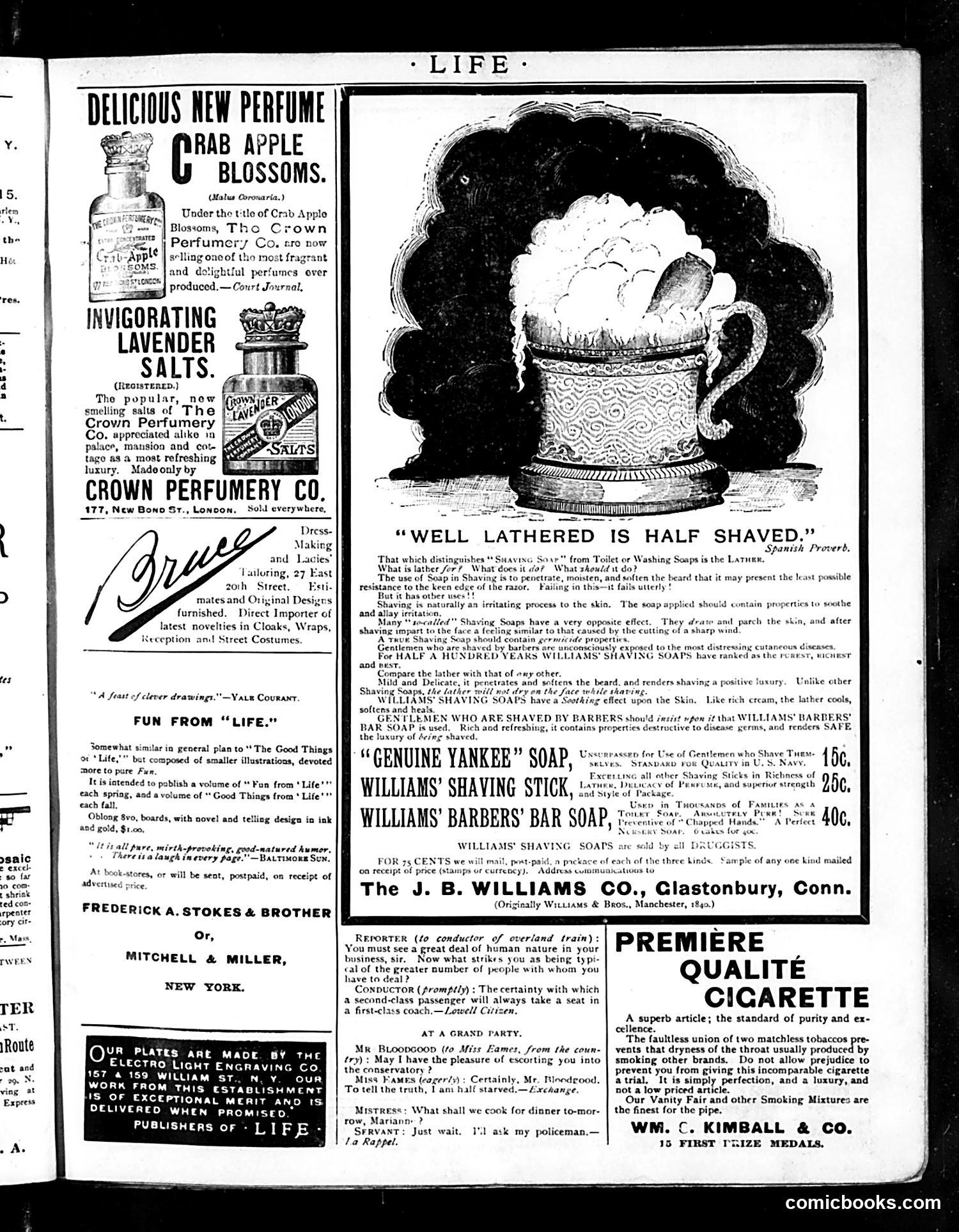
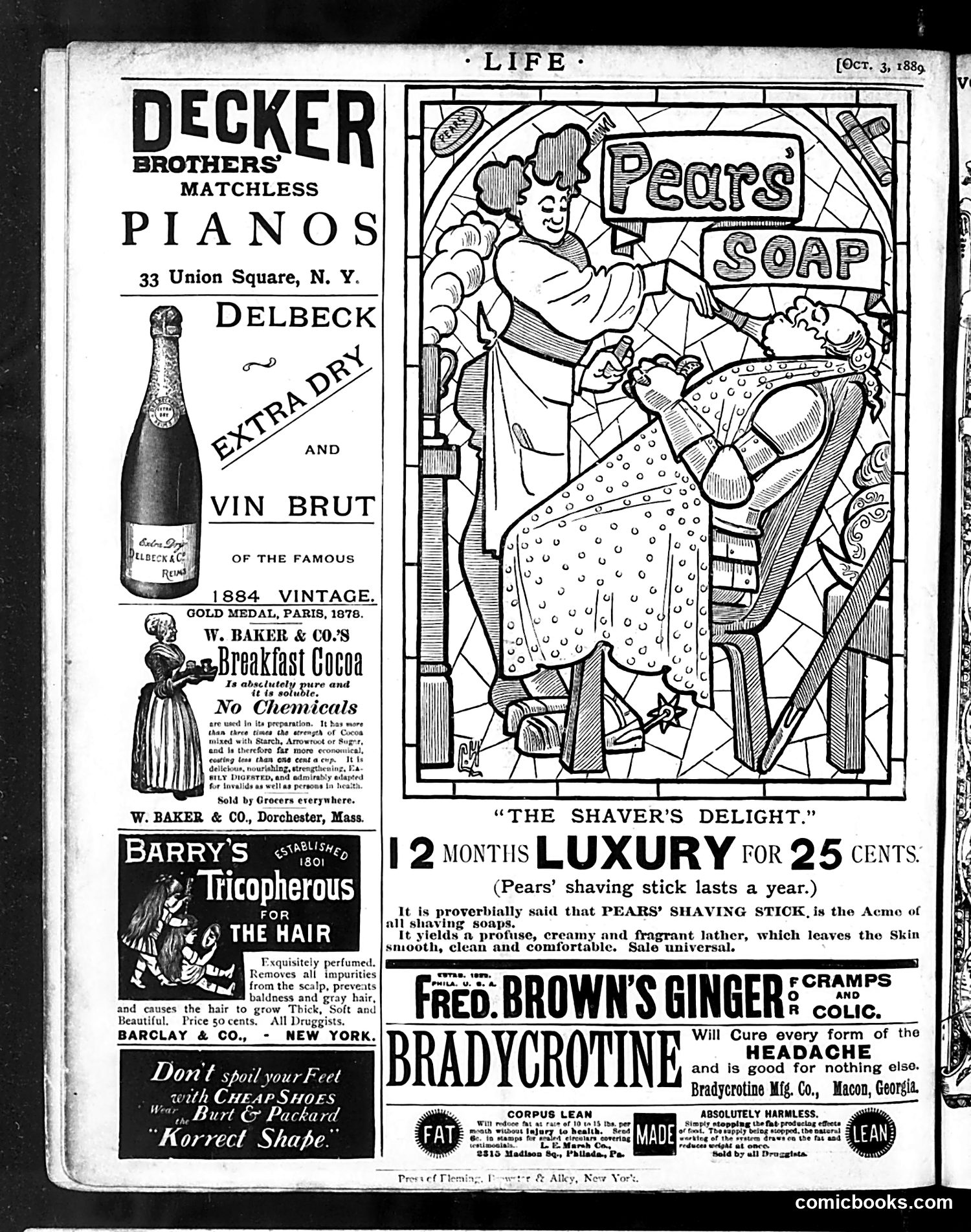
This page is primarily **advertising**, not political satire. The main content features: **The Central Cartoon** ("Well Lathered is Half Shaved"): Illustrates a Spanish proverb about shaving preparation. It depicts a man's head emerging from a decorative bowl of lather, visually demonstrating the article's argument that proper soap lather is essential to shaving—it softens the beard, protects skin from irritation, and prevents cuts. This is literal product education, not satire. **Advertisements**: The page is dominated by Williams' Shaving Soaps ads (emphasizing their soothing properties), Crown Perfumery products, and publisher notices for book collections of humorous drawings from *Life* magazine. **Minor Comic Exchanges** (bottom): Brief dialogue snippets between a train conductor and reporter appear to be excerpts from longer humorous pieces, but lack sufficient context to interpret. **Context for Modern Readers**: This reflects Victorian-era consumer marketing emphasizing health benefits and "scientific" product claims—common advertising rhetoric of the period.