
A complete issue · 16 pages · 1889
Life — September 26, 1889
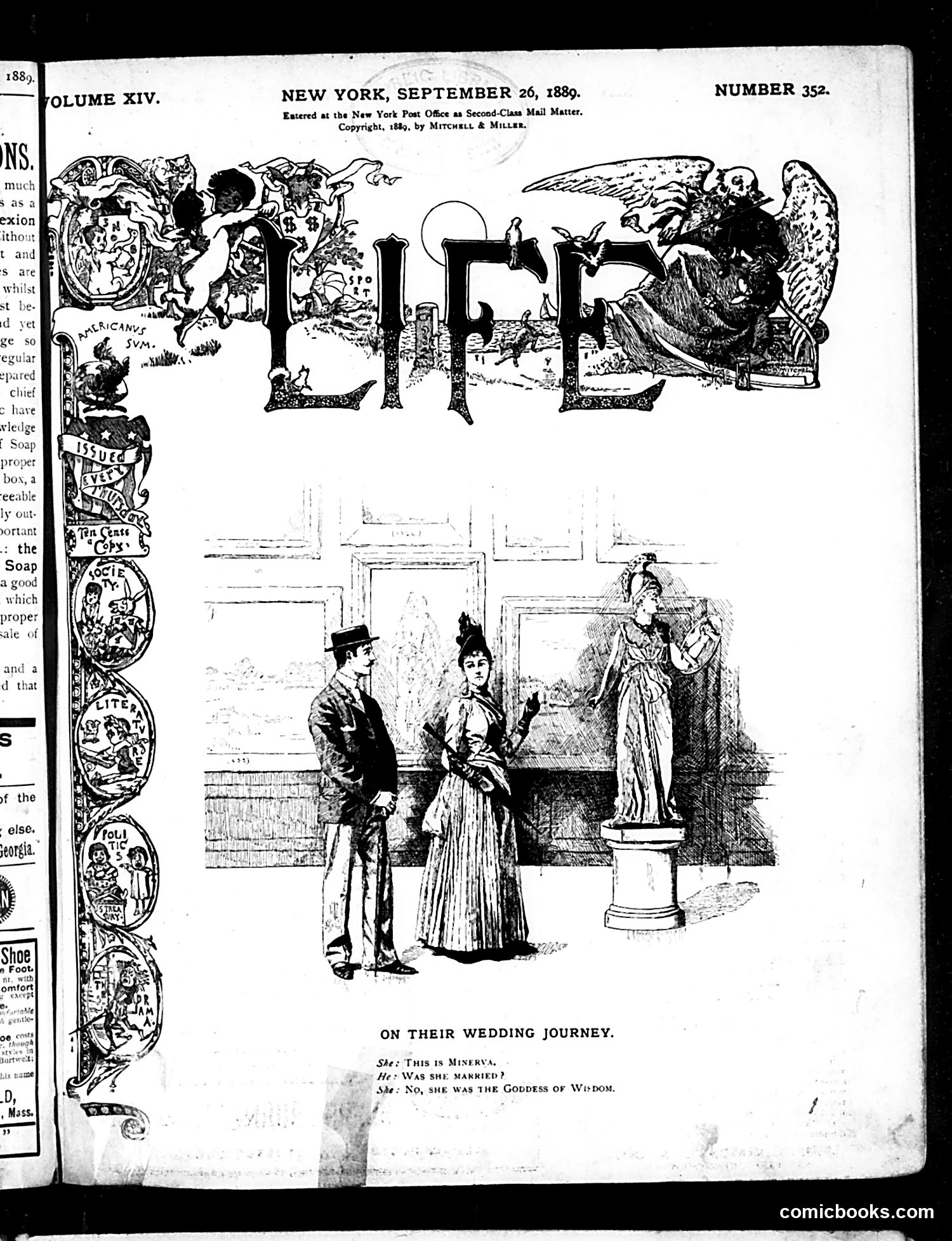
This page features a satirical cartoon titled "On Their Wedding Journey." The illustration depicts a well-dressed couple (a man in a top hat and a woman in a long dress) viewing what appears to be a classical statue in what looks like a museum or gallery setting. The humor relies on a classical reference. The caption reads: "She: This is Minerva. He: Was she married? She: No, she was the Goddess of Wisdom." The joke is a barbed comment on marriage and women's intelligence—sarcastically suggesting that the goddess of wisdom remained unmarried, implying that marriage and wisdom are incompatible for women. This reflects late-19th-century satirical attitudes toward matrimony and gender, common in the era's humor magazines.
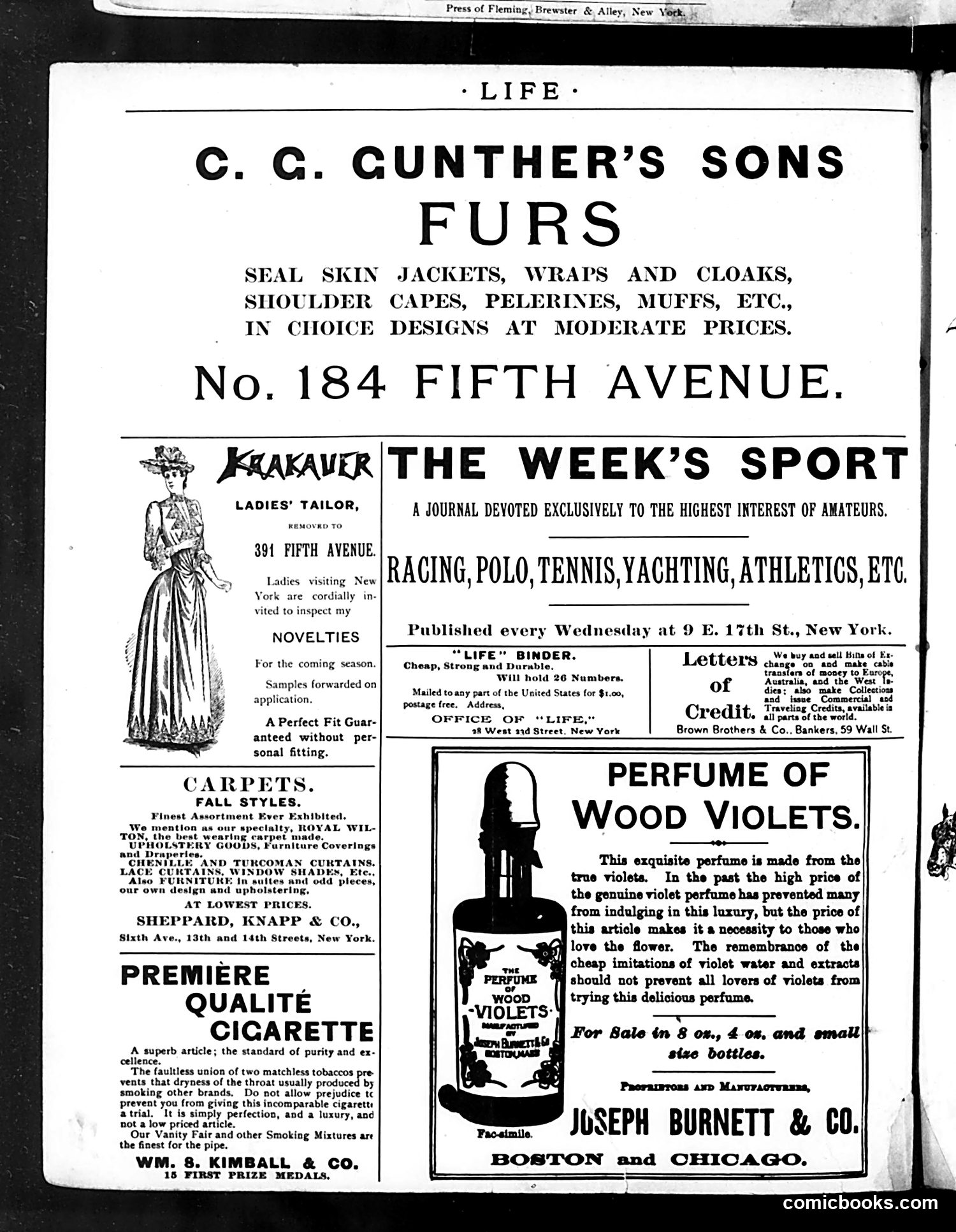
This page is **primarily advertising**, not satirical content. It contains several commercial ads from the early 1900s: - **C.C. Cunther's Sons Furs** (Fifth Avenue) advertises seal-skin jackets and cloaks - **Kalkauer** (ladies' tailor) shows a fashion illustration of an elegant woman in period dress - **Sheppard, Knapp & Co.** promotes carpets and upholstery goods - **Wm. S. Kimball & Co.** advertises "Première Qualité" cigarettes - **Joseph Burnett & Co.** features "Perfume of Wood Violets" The page also includes a header for "The Week's Sport," a journal section covering racing, polo, tennis, and athletics. There is no political cartoon or satirical content visible. The fashion illustration is decorative advertising, not commentary.
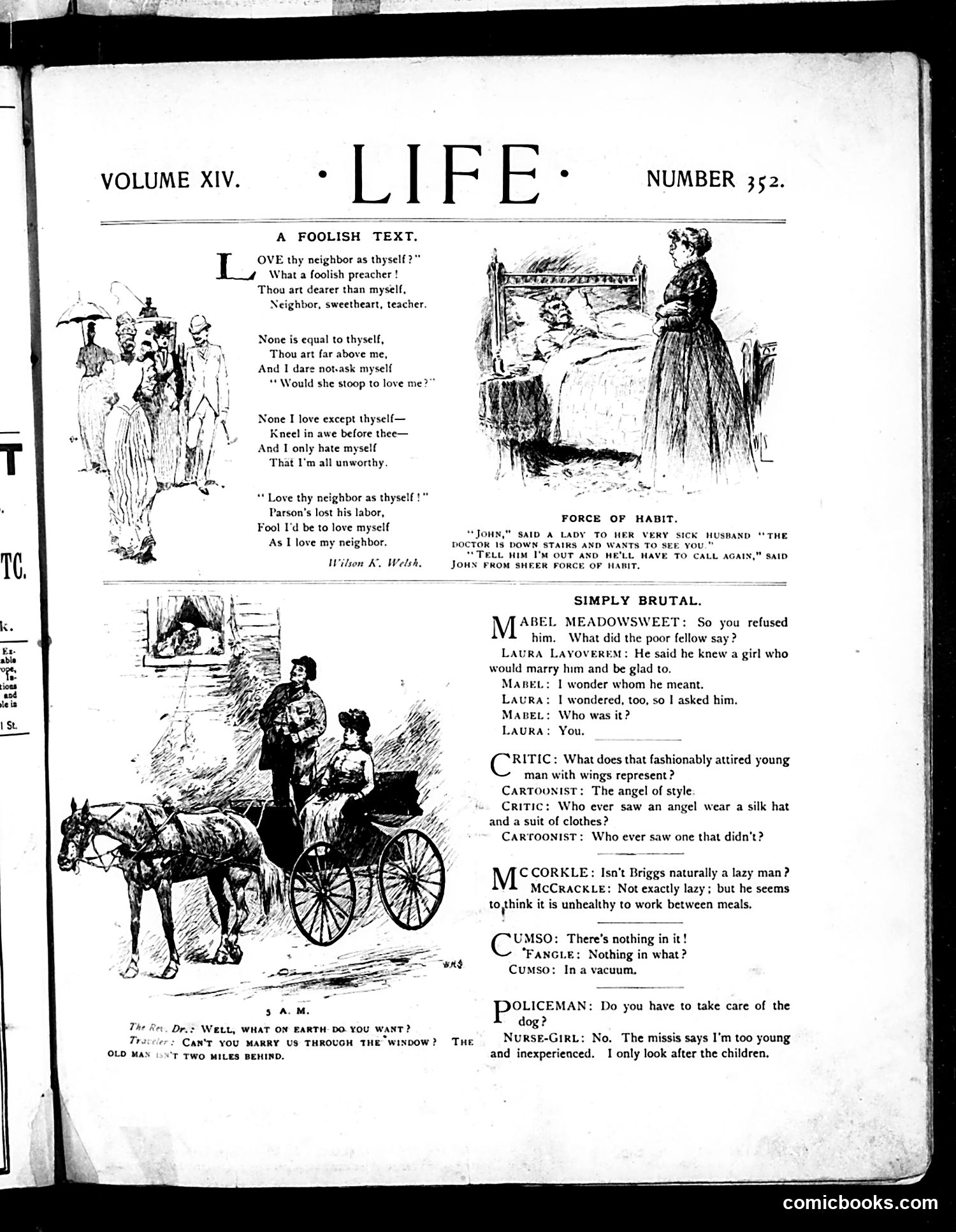
This page contains three distinct satirical pieces: **"A Foolish Text"** parodies religious preaching about self-love versus neighborly love, using Wilson K. Wells's poem to mock excessive self-regard. **"Force of Habit"** presents a cartoon where a doctor tells a lady her sick husband needs calling upon, but she refuses—the joke being she's so habituated to neglecting him that even his illness doesn't change her behavior. **"Simply Brutal"** mocks courtship rejection and social pretension through dialogue between characters Mabel and Laura, plus exchanges satirizing fashion-conscious young men and lazy work habits. The bottom illustration shows a carriage scene with accompanying dialogue about impossible demands (marrying through a window while two miles behind). Overall, these pieces target Victorian social hypocrisy, relationship dynamics, and class affectations through humor and caricature.
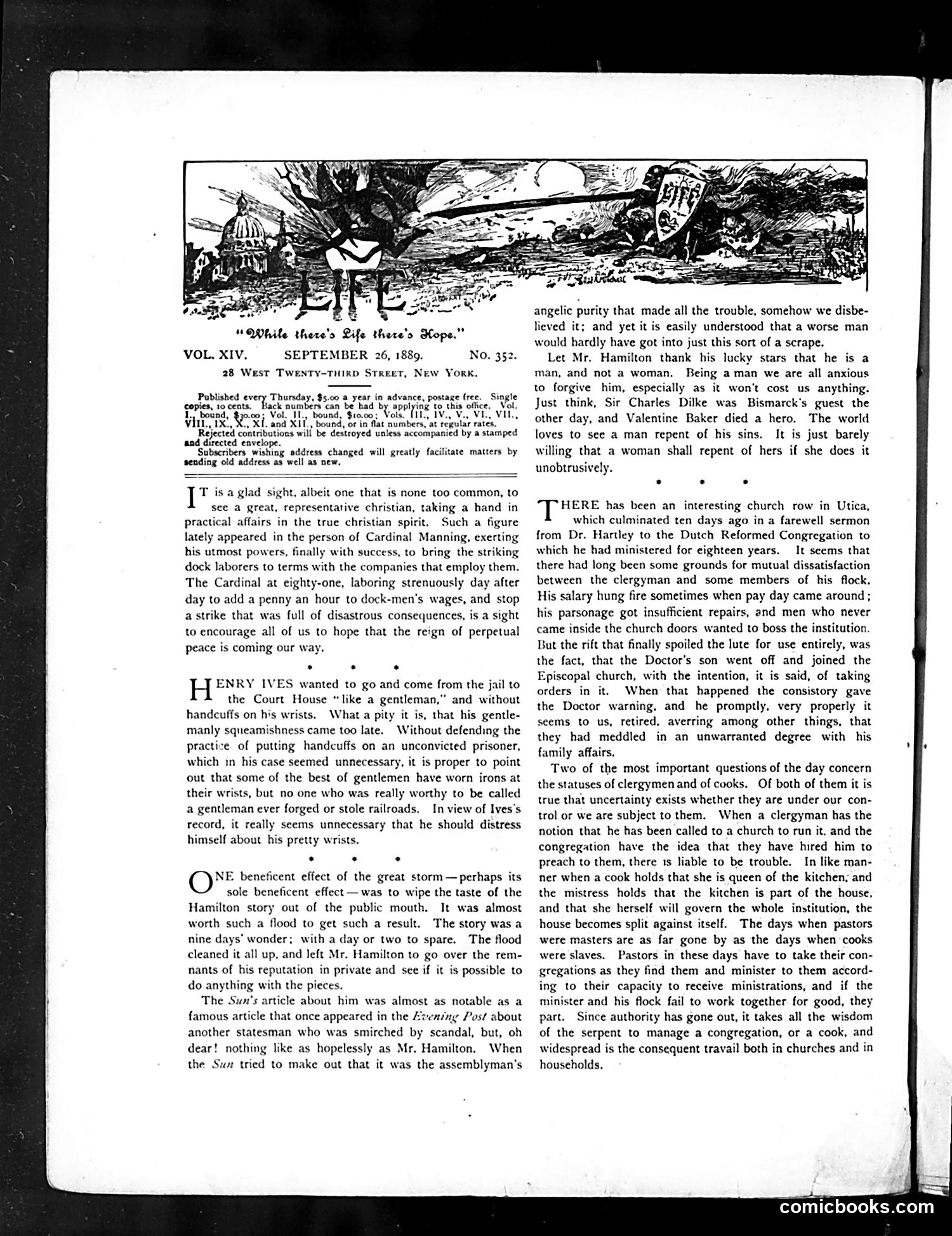
The masthead illustration depicts a satirical landscape combining religious and industrial imagery—a cathedral dome alongside factory smokestacks and what appears to be a comet or celestial phenomenon, suggesting tension between spiritual and material concerns of the era. The text discusses Cardinal Manning's involvement in dock labor disputes, praising his practical Christian intervention in labor negotiations. It also critiques Henry Ives's courtroom behavior regarding railroads and discusses ecclesiastical authority disputes in Utica involving Dr. Hartley and the Dutch Reformed Congregation. The satire targets clerical authority and institutional power, questioning whether clergy or cooks truly govern churches and households. The overall tone mocks institutional pretension while applauding Manning's tangible charitable work—a common Progressive-era critique of established religion's actual social impact.
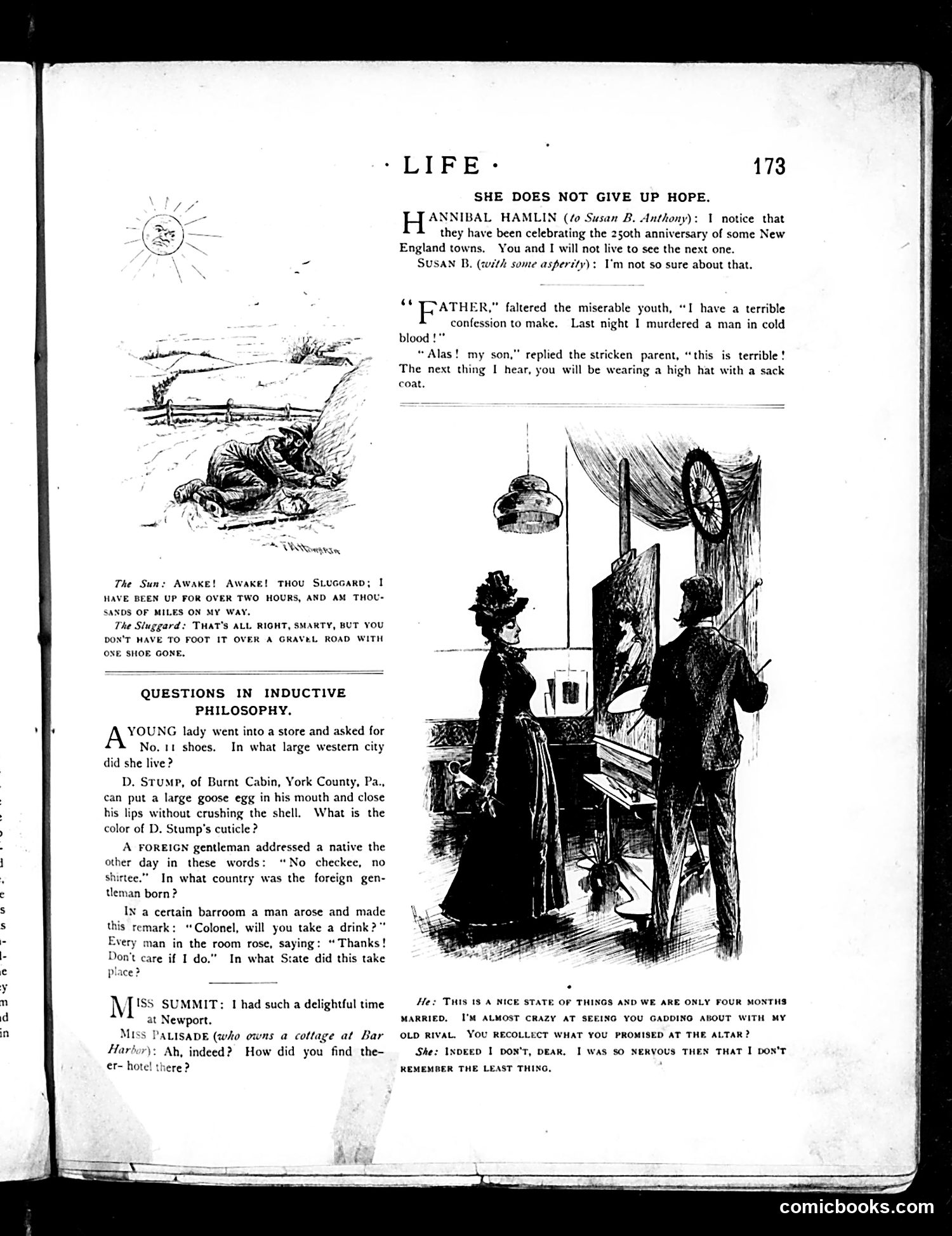
This page contains **satirical dialogues and jokes** rather than political cartoons. The main illustrated scene shows a woman and man at what appears to be a shop or counter, accompanying a domestic humor piece about newlyweds. The dialogue references the man's jealousy over his wife socializing with a rival, with her dismissively responding that she doesn't remember promises made during courtship. Below are "Questions in Inductive Philosophy"—humorous riddle-style jokes covering topics like shoe sizes, foreign visitors, and tavern etiquette. The content is **lighthearted social satire** mocking everyday situations: courtship behavior, marriage dynamics, and social interactions. There's no specific political reference—this represents *Life* magazine's typical satirical humor about American social conventions and gender relations of the era.
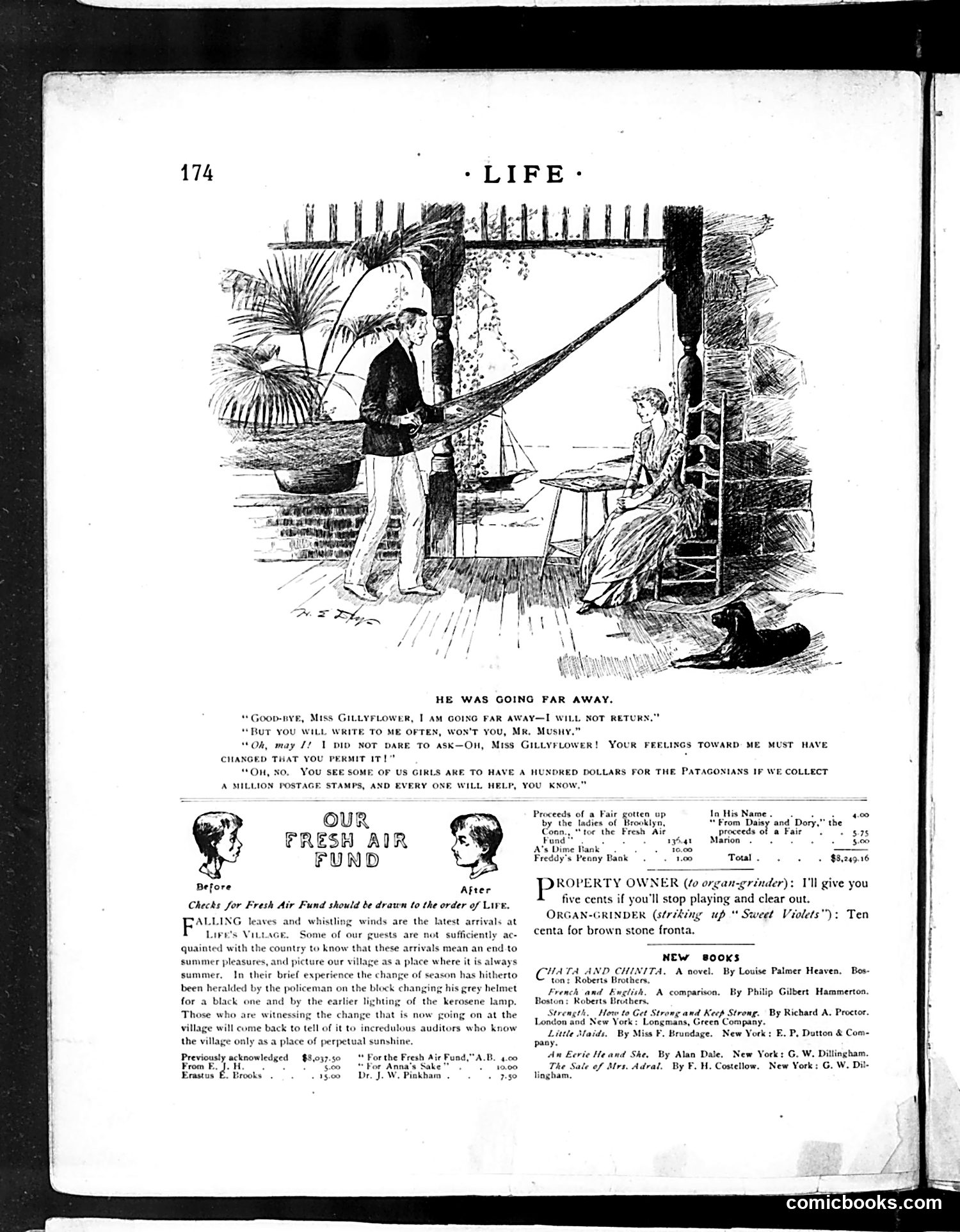
This page contains a sketch depicting a departure scene titled "He Was Going Far Away." The dialogue shows a man (Mr. Mushy) leaving Miss Gillyflower, with exchanges about writing letters and collecting postage stamps for Patagonian relief efforts—a clear reference to a contemporary charitable cause. The main illustration satirizes sentimental Victorian-era farewells and romantic letter-writing conventions. The humor lies in the juxtaposition of romantic sentiment with the mundane detail about stamp collecting for charity, deflating the emotional drama of the goodbye. Below is an advertisement for the "Fresh Air Fund," which provided country outings for city children—a legitimate charitable organization that Life's readers would recognize as worthy. The page also advertises new books, functioning primarily as a mixed editorial and advertising spread typical of early 20th-century magazines.
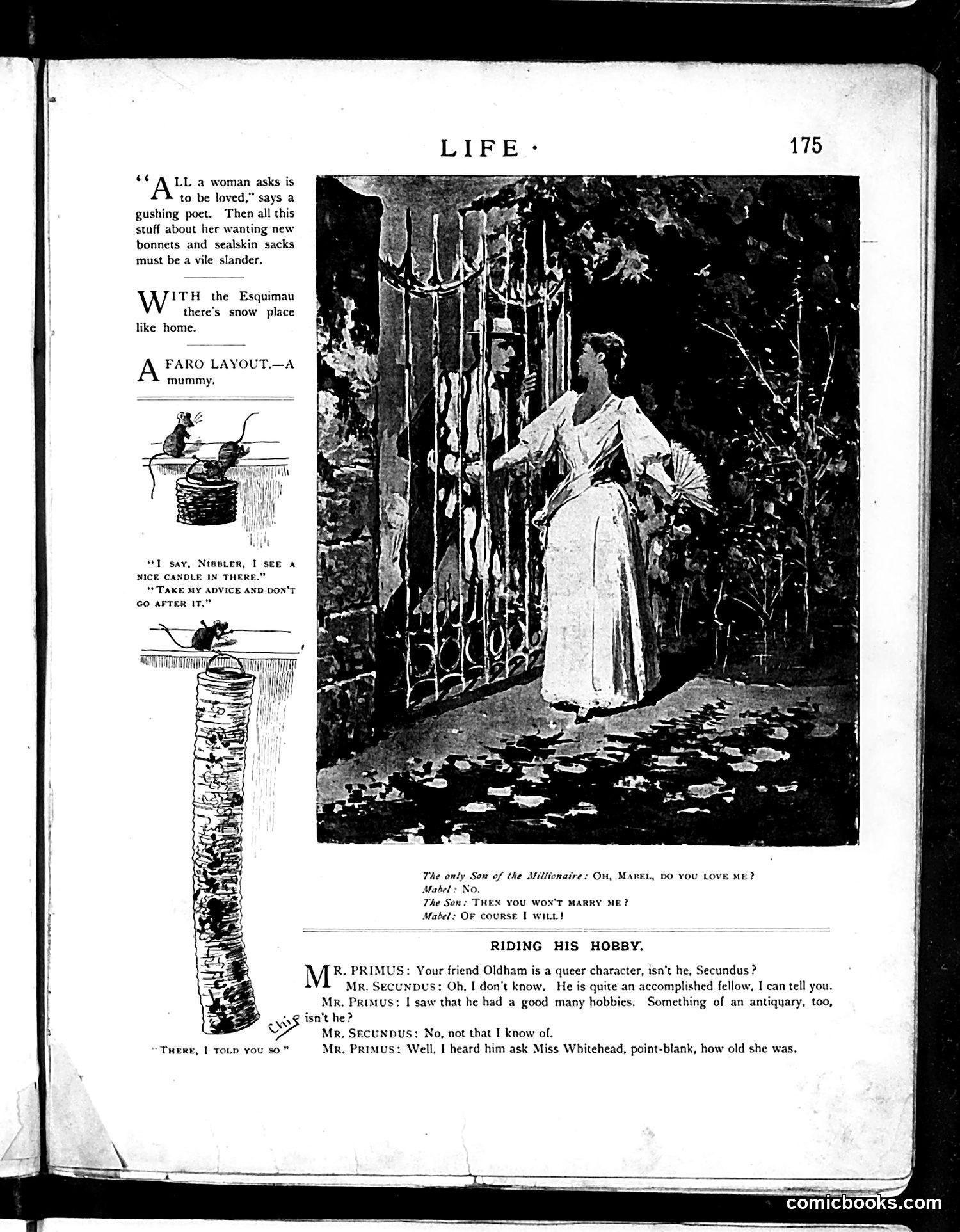
This page contains two distinct pieces of satirical content: **Upper section:** A "Faro Layout" cartoon mocking women's fashion demands. The humor relies on a mouse giving advice about avoiding "nick games" (gambling) to other mice, using the double meaning of "slander" to critique women's complaints about fashion expenses. **Lower section:** A dialogue between "Mr. Primus" and "Mr. Secundus" discussing their friend Oldham's hobby collecting. The conversation appears to satirize wealthy men's eccentric collecting habits, with a reference to asking Miss Whitehead about Oldham's age—though the specific context of this reference is unclear without additional background. **Large photograph:** Shows a woman in classical dress at a garden gate, captioned "The Only Son of the Millionaire"—likely satirizing romantic or melodramatic scenarios common to period literature. The overall tone targets upper-class leisure activities and consumerism.
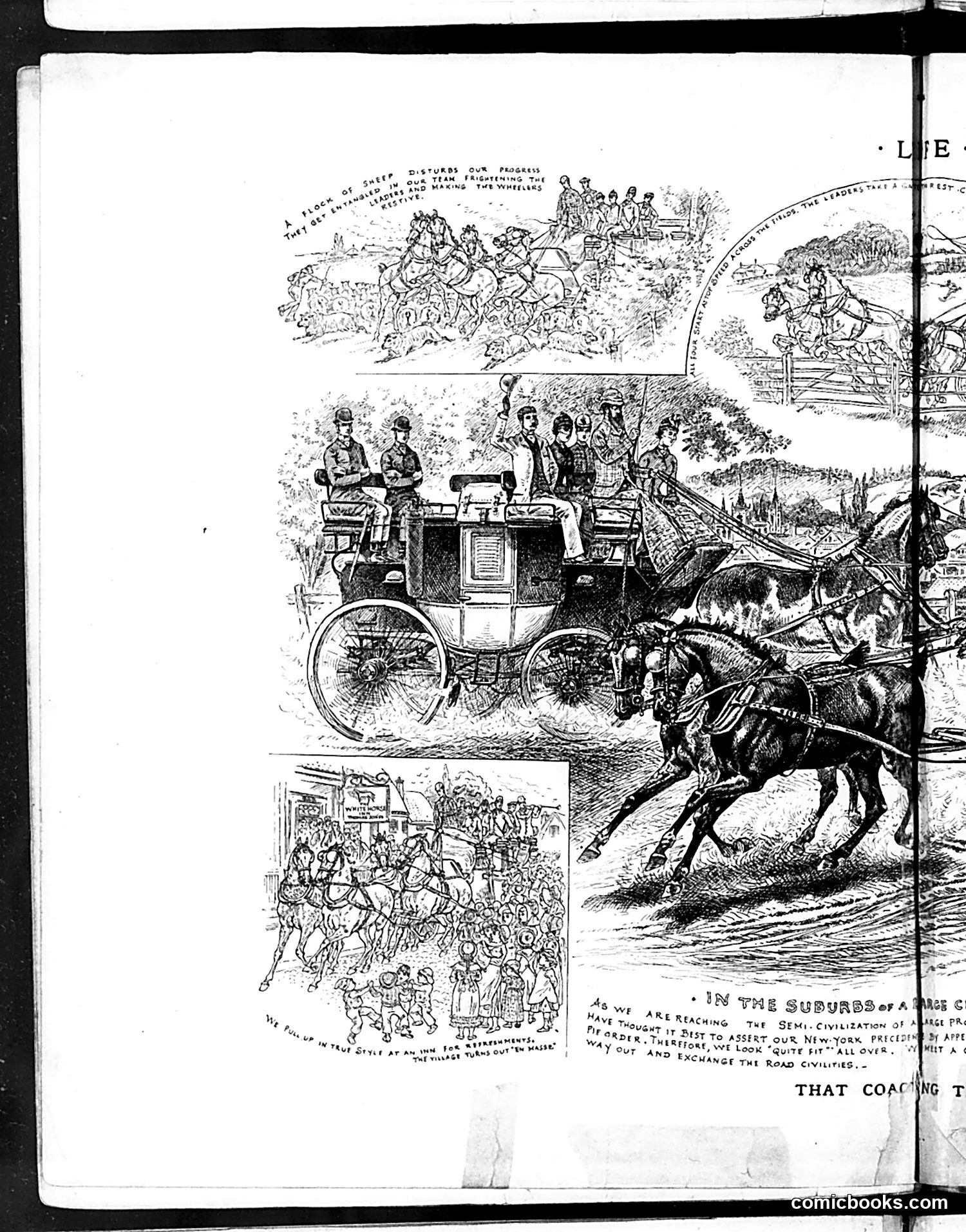
This page contains satirical illustrations of **coaching travel** and the social dynamics around it. The main cartoon depicts an ornate horse-drawn coach filled with well-dressed passengers, with accompanying scenes showing crowds and activity. The text references "**suburbs of a large city**" and mentions "**New-York precious**" alongside commentary about "**road civilities**" — suggesting satire about how urban travelers interact during coach journeys. The bottom panel shows chaotic street scenes, likely mocking the disorder and congestion of coaching travel or city transit. The overall tone appears to mock the pretensions and inconveniences of 19th-century coaching culture, where crowded conditions and social friction contradicted travelers' expectations of civilized travel. The page heading "**THAT COACHING T[ime]**" confirms the subject matter.
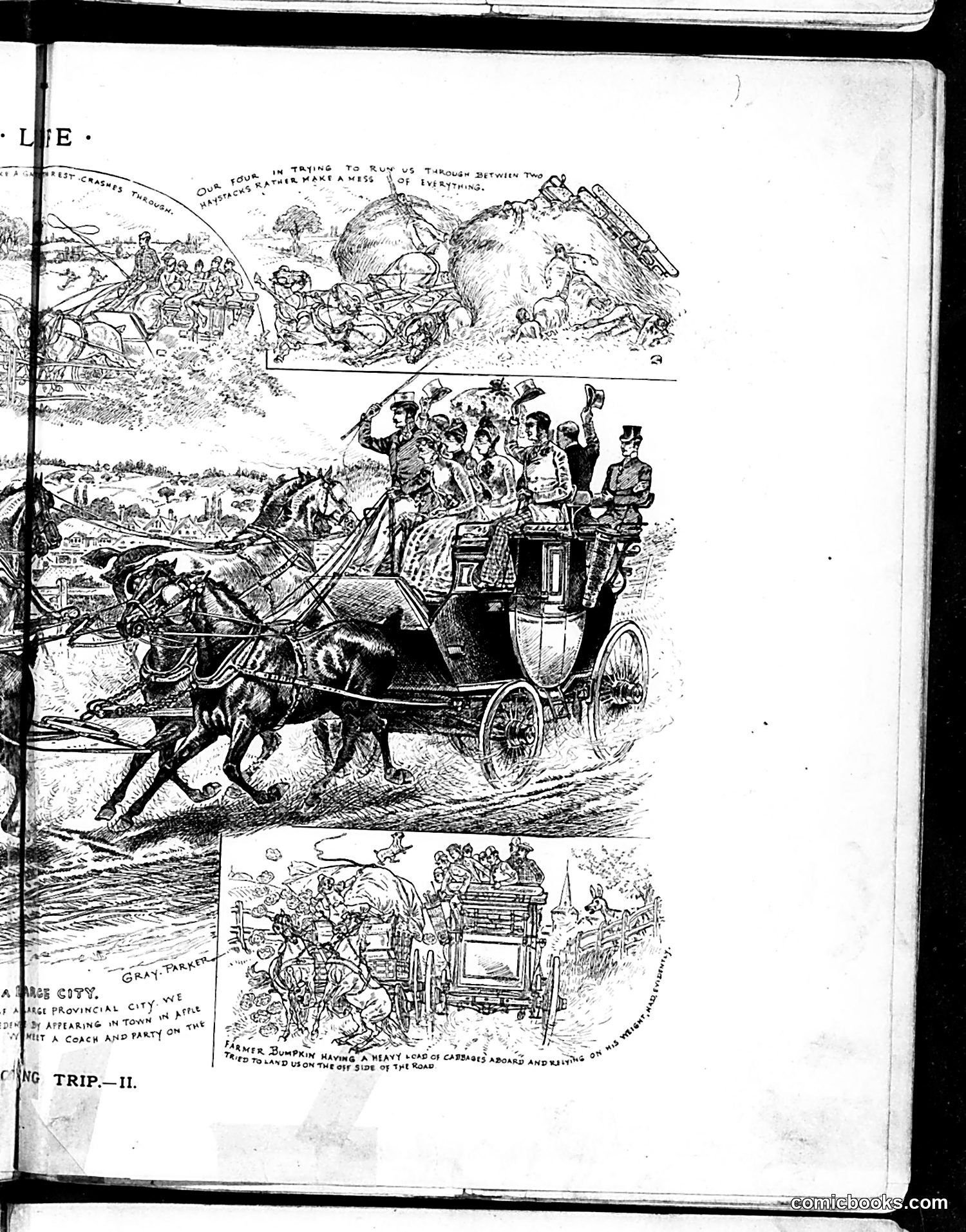
This page depicts three scenes of a country outing or excursion, likely satirizing rural travel and provincial life in late 19th or early 20th century America. The top panel shows a chaotic picnic or gathering scene with numerous figures amid natural features. The middle illustration features a horse-drawn carriage packed with well-dressed urban passengers, suggesting city folk venturing into the countryside. The bottom scene depicts a farmer's cart laden with produce or cargo, contrasting the refined city travelers above. The overall satire appears to mock the contrast between urban sophistication and rural simplicity, or the humorous complications that arise when city dwellers attempt country recreation. The crowded, disorganized compositions emphasize comic disorder. Without clearer text visibility, specific political references remain unclear.
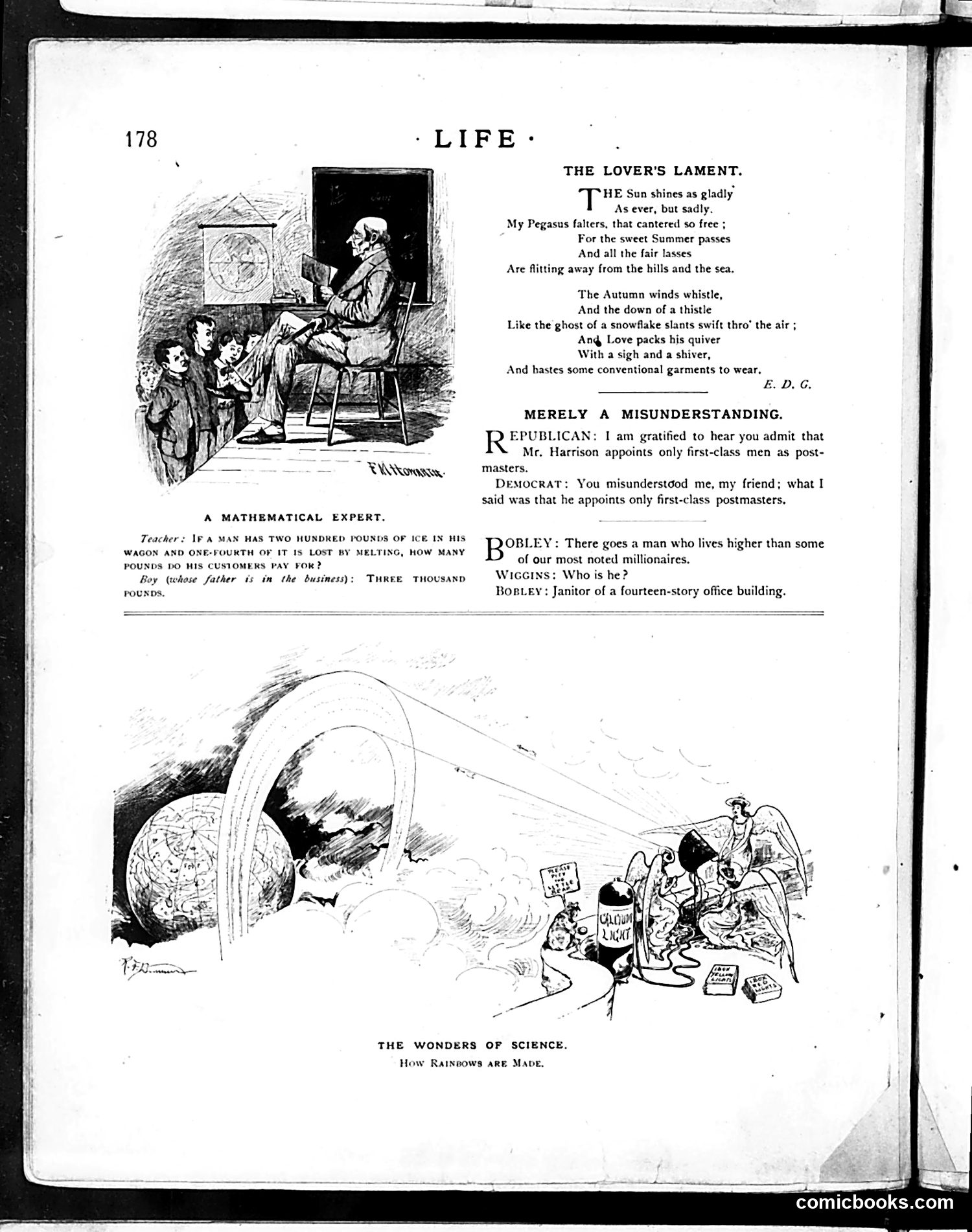
**Top cartoon**: A teacher poses an arithmetic problem to students about melting ice. The joke plays on the absurdity of the math: if a man loses 1/4 of 200 pounds of ice, he'd have 150 pounds left—but the "answer" given (3,000 pounds) is nonsensical, satirizing either incompetent teaching or student confusion. **Middle section**: A brief political exchange where a Republican misinterprets a Democrat's statement about postmaster appointments. The satire mocks how politicians deliberately or accidentally misconstrue each other's words—a commentary on political dishonesty or poor communication. **Bottom**: A reference to "Wonders of Science" (how rainbows are made), though the illustration is partially unclear. All pieces are gentle satires on education, politics, and public discourse.
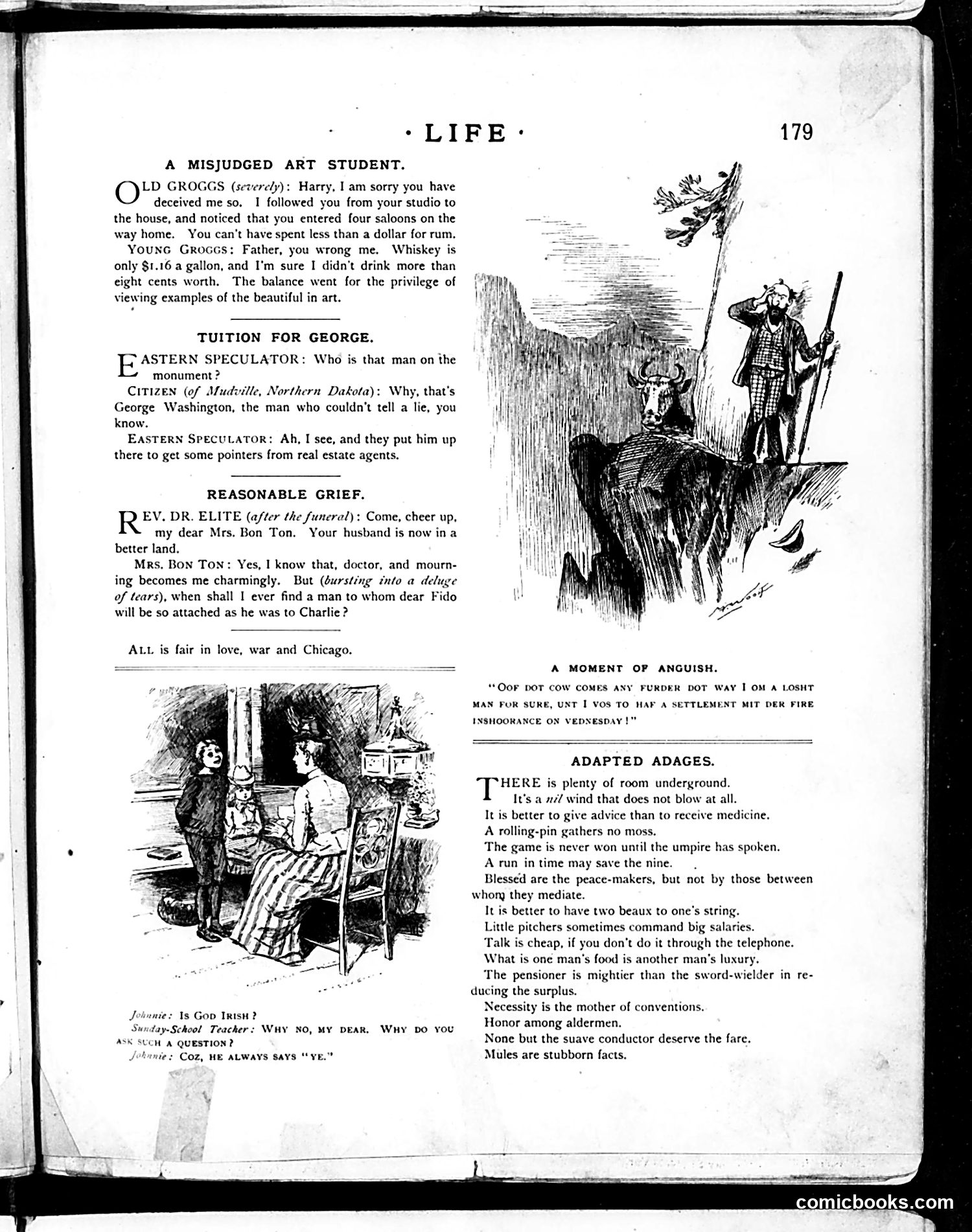
This page contains several satirical dialogues and illustrations typical of early 20th-century American humor: 1. **"A Misjudged Art Student"**: Old Groggs defends spending money on viewing art in saloons rather than drinking alcohol—a joke about prioritizing culture over vice. 2. **"Tuition for George"**: A speculator questions whether a George Washington monument figure is actually Washington, with the punchline that he's been placed there by real estate agents to boost property values—satirizing commercial exploitation of patriotic symbols. 3. **"Reasonable Grief"**: A widow mourns her late husband while a clergyman consoles her, illustrating sentimental Victorian grief conventions. The illustrations use period pen-and-ink style typical of Life's visual humor, mocking American materialism, pretension, and social conventions.
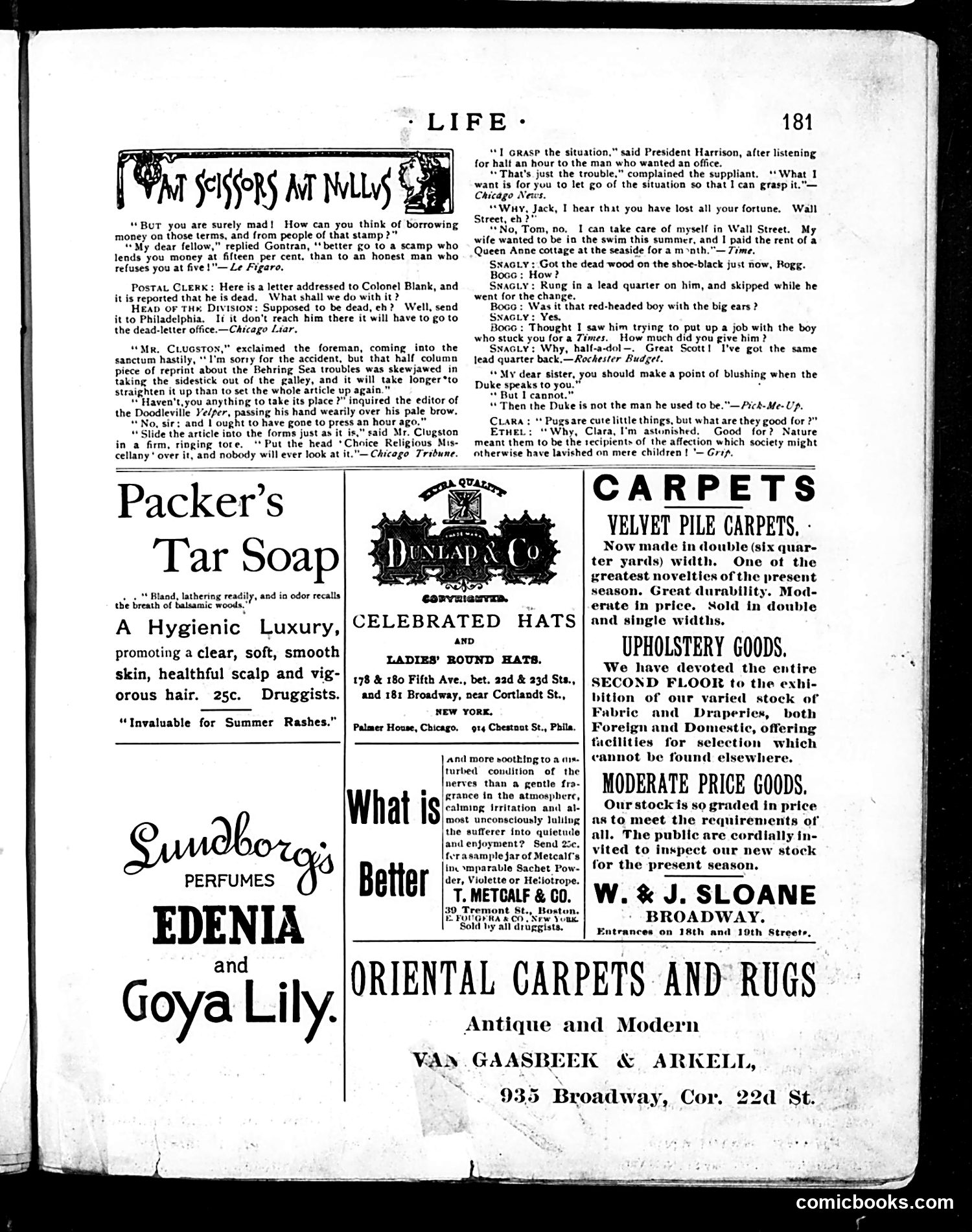
This page contains six brief humorous anecdotes typical of *Life* magazine's satirical format. Rather than illustrated political cartoons, these are short jokes extracted from various newspapers, mocking contemporary social follies: **Key themes:** - Financial irresponsibility (borrowing at high interest; losing fortunes to seaside rents) - Bureaucratic absurdity (sending dead man's mail to Philadelphia; disguising poorly printed articles as "Religious Miscellany") - Street scams (con artists passing counterfeit quarters) - Social pretense (blushing for a Duke; the joke that pugs exist so society can transfer affection meant for children onto dogs) - A Harrison administration joke about the President and job-seekers The page is primarily **advertising** (Packer's Tar Soap, Lundborg's Perfumes, carpet dealers, hat sellers). The humor reflects *Life*'s focus on mocking everyday American vanity, fraud, and incompetence rather than specific political events.
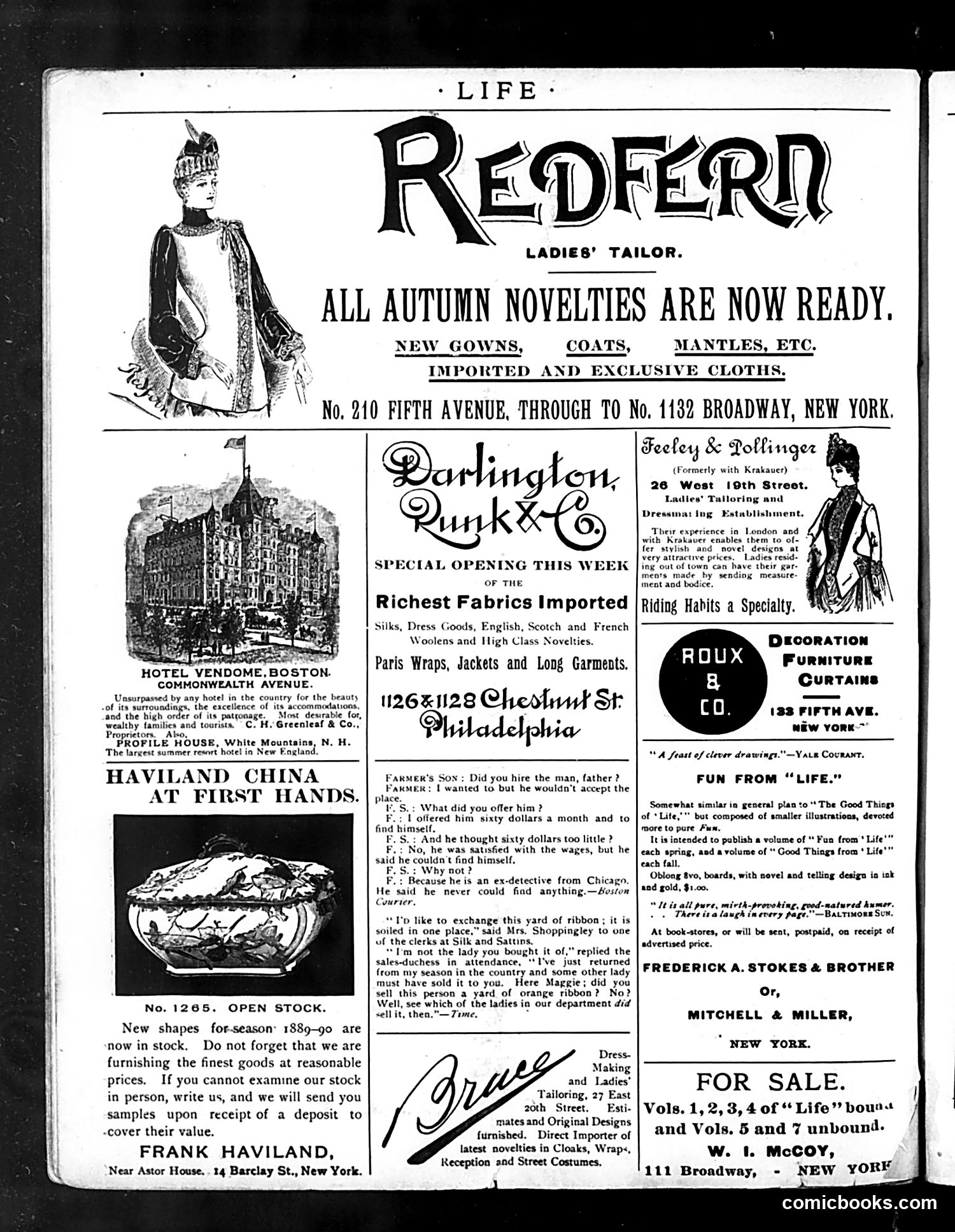
This is primarily an **advertising page** from *Life* magazine, not a satirical cartoon page. It features numerous commercial advertisements for ladies' fashion, hotels, and home goods typical of the 1889-1890 era. The page includes **two brief humorous anecdotes** rather than political satire: 1. A joke about a farmer unable to hire a man because the applicant—an ex-detective from Chicago—couldn't "find himself" (a pun on the detective's professional inability to locate things). 2. A satire on pretentious retail service, where a customer trying to return soiled ribbon encounters a snobbish saleswoman who claims she's just returned from the country and cannot help, redirecting the customer to find whoever originally sold her the item. Both jokes mock **everyday social frustrations**: incompetent employment and retail rudeness. They require no specific historical context beyond understanding late-19th-century commercial culture. The page's primary purpose is commercial rather than political commentary.
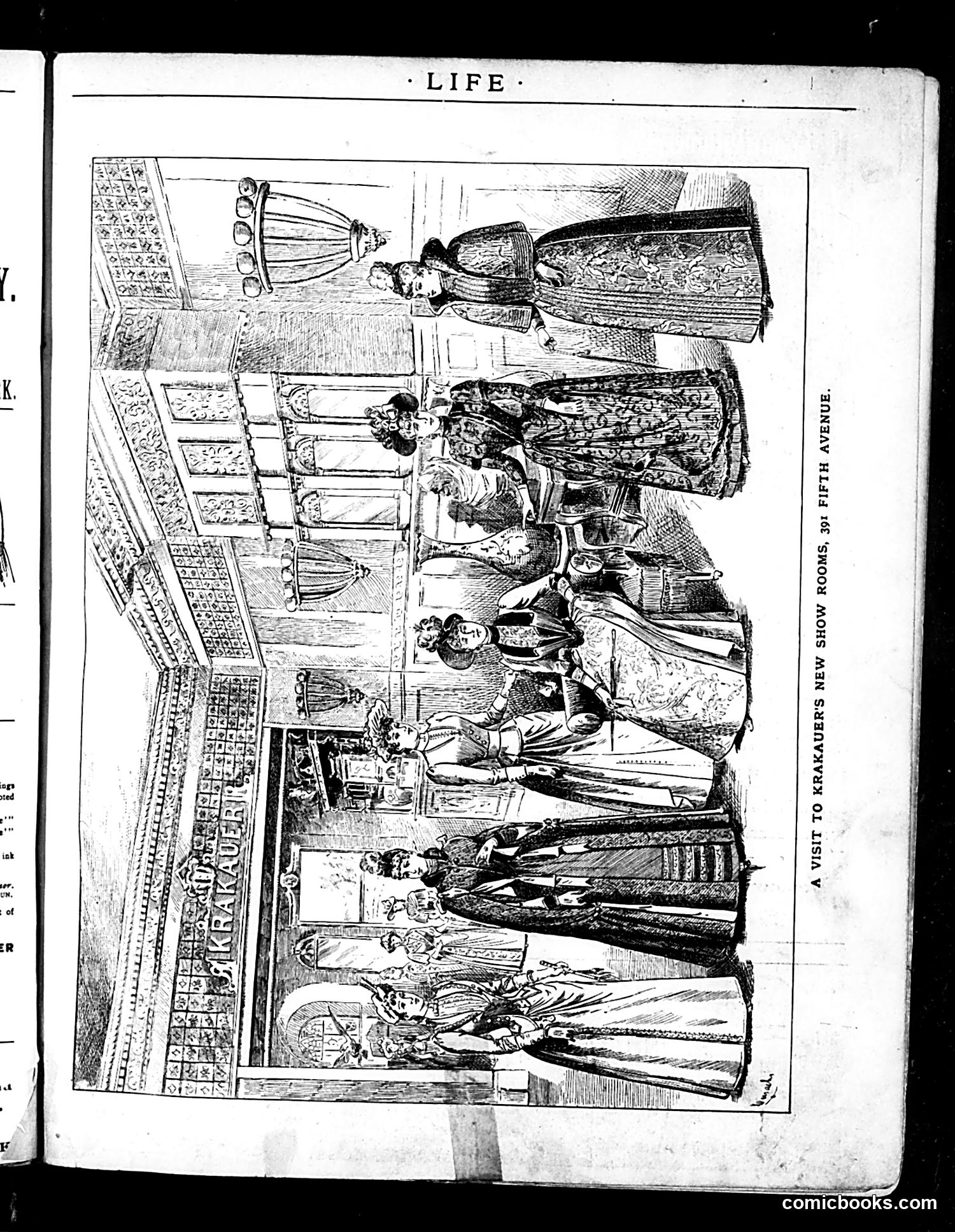
I cannot reliably interpret this page. The OCR text is severely corrupted and illegible, making it impossible to identify the specific political or social references intended by the cartoon. While the image shows what appears to be a satirical illustration depicting multiple figures in period dress in an interior setting, without readable text or clear caption identifying the subjects, I cannot accurately explain the cartoon's meaning, the figures depicted, or the joke being made. To properly analyze this Life magazine content, a clearer text source or additional context would be needed.
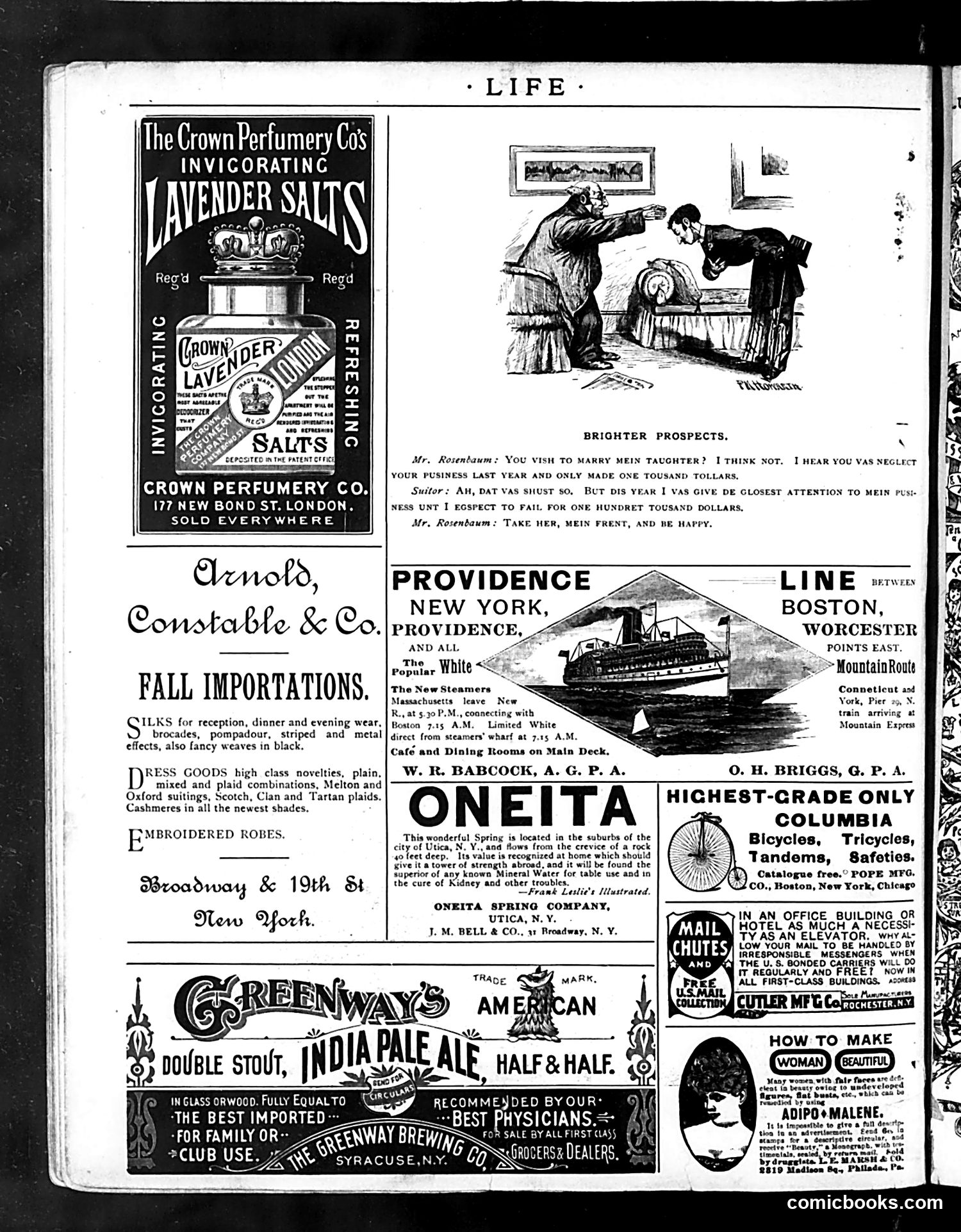
This single-panel cartoon satirizes Jewish immigrant business culture and financial desperation in turn-of-the-century America. **The Setup:** Mr. Rosenbaum initially refuses his daughter's suitor because the young man earned only $1,000 the previous year, showing negligent business practices. **The Punchline:** The suitor's response—that he now expects to *fail* for $100,000—reverses the father's logic. Rosenbaum immediately approves the match, reasoning that massive financial failure demonstrates such ambitious business activity that marriage is now acceptable. **The Satire:** The joke mocks both the stereotype of Jewish fathers obsessed with their daughters' suitors' wealth, and the broader Gilded Age assumption that any commercial activity—even catastrophic failure—signifies success and respectability. The exaggerated Yiddish dialect ("vis," "tousand") was typical of period ethnic humor, whether intended mockingly or affectionately. The cartoon reflects contemporary attitudes toward immigrant entrepreneurship and financial aspiration.