
Life, 1889-09-26 · page 4 of 16
Life — September 26, 1889 — page 4: what you’re looking at
What you’re looking at
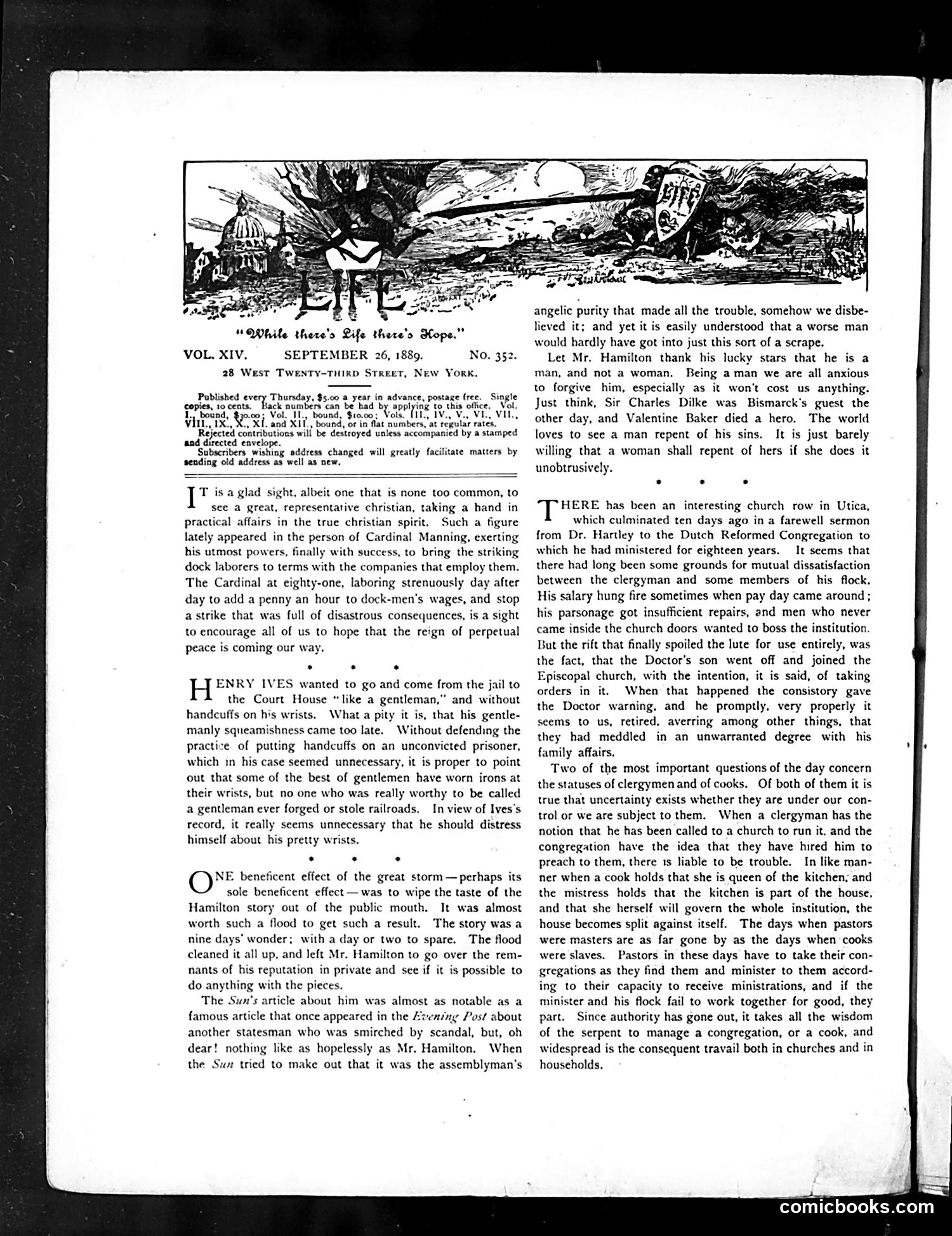
The masthead illustration depicts a satirical landscape combining religious and industrial imagery—a cathedral dome alongside factory smokestacks and what appears to be a comet or celestial phenomenon, suggesting tension between spiritual and material concerns of the era. The text discusses Cardinal Manning's involvement in dock labor disputes, praising his practical Christian intervention in labor negotiations. It also critiques Henry Ives's courtroom behavior regarding railroads and discusses ecclesiastical authority disputes in Utica involving Dr. Hartley and the Dutch Reformed Congregation. The satire targets clerical authority and institutional power, questioning whether clergy or cooks truly govern churches and households. The overall tone mocks institutional pretension while applauding Manning's tangible charitable work—a common Progressive-era critique of established religion's actual social impact.
📄 Transcribed text from this page (OCR, searchable)
Machine-transcribed from the original scan — historical spelling and the odd misread are preserved.
“OMile there's Life there's Hope.” VOL. XIV. SEPTEMBER 26, 1889. No. 352. 28 West Twenty-THIRp Street, New York. Published every Thursday, $5.00 a year in advance, postage (re. copies, ro cents. Hack numbers can be bad by applying e this office. 1., bound, Il., bound, $10.00; Vols Lis 4 VIL, vit rae ted , bound, or in flat numbers, ne nie rates. sntributions will be destroyed unless accompanied by a stamped and directed envelope. Subscribers wishing address changed will greatly facilitate matters by sending old address as well as new. J" is a glad sight, albeit one that is none too common, to see a great, representative christian, taking a hand in practical affairs in the true christian spirit. Such a figure lately appeared in the person of Cardinal Manning, exerting his utmost powers, finally with success, to bring the striking dock laborers to terms with the companies that employ them, The Cardinal at eighty-one, laboring strenuously day after day to add a penny an hour to dock-men’s wages, and stop a strike that was full of disastrous consequences, is a sight to encourage all of us to hope that the reign of perpetual peace is coming our way. Single vite . . . ENRY IVES wanted to go and come from the jail to the Court House “like a gentleman,” and without handcuffs on his wrists. What a pity it is, that his gentle- manly squeamishness came too late. Without defending the practice of putting handcuffs on an unconvicted prisoner, which in his case seemed unnecessary, it is proper to point out that some of the best of gentlemen have worn irons at their wrists, but no one who was really worthy to be called a gentleman ever forged or stole railroads. In view of Ives’s record, it really seems unnecessary that he should distress himself about his pretty wrists. NE beneficent effect of the great storm—perhaps its sole beneficent effect— was to wipe the taste of the Hamilton story out of the public mouth. It was almost worth such a flood to get such a result, The story was a nine days’ wonder; with a day or two to spare. The flood cleaned it all up, and left Mr. Hamilton to go over the rem- nants of his reputation in private and see if it is possible to do anything with the pieces. The Sun's article about him was almost as notable as a famous article that once appeared in the Even/ny Post about another statesman who was smirched by scandal, but, oh dear! nothing like as hopelessly as Mr. Hamilton, When the Sux tried to make out that it was the assemblyman’s angelic purity that made all the trouble, somehow we disbe- lieved it; and yet it is easily understood that a worse man would hardly have got into just this sort of a scrape. Let Mr. Hamilton thank his lucky stars that he is a man, and not a woman. Being a man we are all anxious to forgive him, especially as it won't cost us anything. Just think, Sir Charles Dilke was Bismarck’s guest the other day, and Valentine Baker died a hero. The world loves to see a man repent of his sins. It is just barely willing that a woman shall repent of hers if she does it unobtrusively. . . ° HERE has been an interesting church row in Utica, which culminated ten days ago in a farewell sermon from Dr. Hartley to the Dutch Reformed Congregation to which he had ministered for eighteen years. It seems that there had long been some grounds for mutual dissatisfaction between the clergyman and some members of his flock. His salary hung fire sometimes when pay day came around ; his parsonage got insufficient repairs, and men who never came inside the church doors wanted to boss the institution. But the rift that finally spoiled the lute for use entirely, was the fact, that the Doctor's son went off and joined the Episcopal church, with the intention, it is said, of taking orders in it. When that happened the consistory gave the Doctor warning, and he promptly, very properly it seems to us, retired, averring among other things, that they had meddled in an unwarranted degree with his family affairs. Two of the most important questions of the day concern the statuses of clergymen and of cooks. Of both of them it is true that uncertainty exists whether they are under our con- trol or we are subject to them. When a clergyman has the notion that he has been called to a church to run it. and the congregation have the idea that they have hired him to preach to them, there 1s liable to be trouble. In like man- ner when a cook holds that she is queen of the kitchen; and the mistress holds that the kitchen is part of the house, and that she herself will govern the whole institution, the house becomes split against itself. The days when pastors were masters are as far gone by as the days when cooks were slaves. Pastors in these days have to take their con- gregations as they find them and minister to them accord- ing to their capacity to receive ministrations, and if the minister and his flock fail to work together for good, they part. Since authority has gone out, it takes all the wisdom of the serpent to manage a congregation, or a cook, and widespread is the consequent travail both in churches and in households, comicbooks.com