
A complete issue · 16 pages · 1889
Life — August 29, 1889
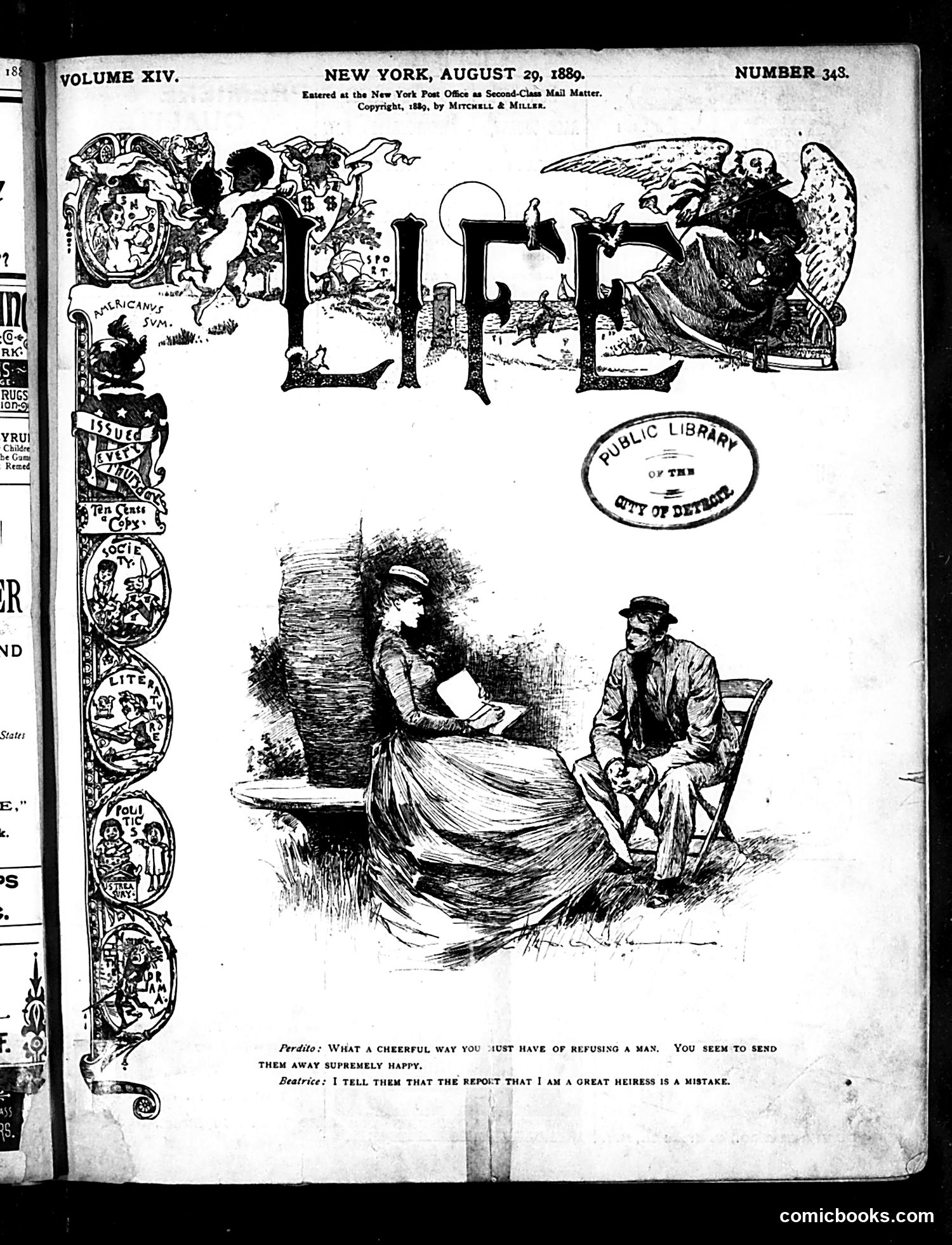
This page contains a single illustration with satirical dialogue. A well-dressed woman sits reading while a working-class man sits nearby. The caption presents their contrasting views: The **Perdita** (woman) praises the man for cheerfully accepting dismissal, saying he "seem[s] to send them away supremely happy." The **Beatrice** (man) responds that this reputation for being "a great heiress is a mistake." The satire appears to target wealth disparities and class attitudes of the Gilded Age—specifically mocking how the wealthy dismiss working-class laborers with apparent indifference, while the man ironically notes that his supposed wealth (which apparently doesn't exist) is the only reason for any attention paid to him. It's social commentary on labor relations and materialism.
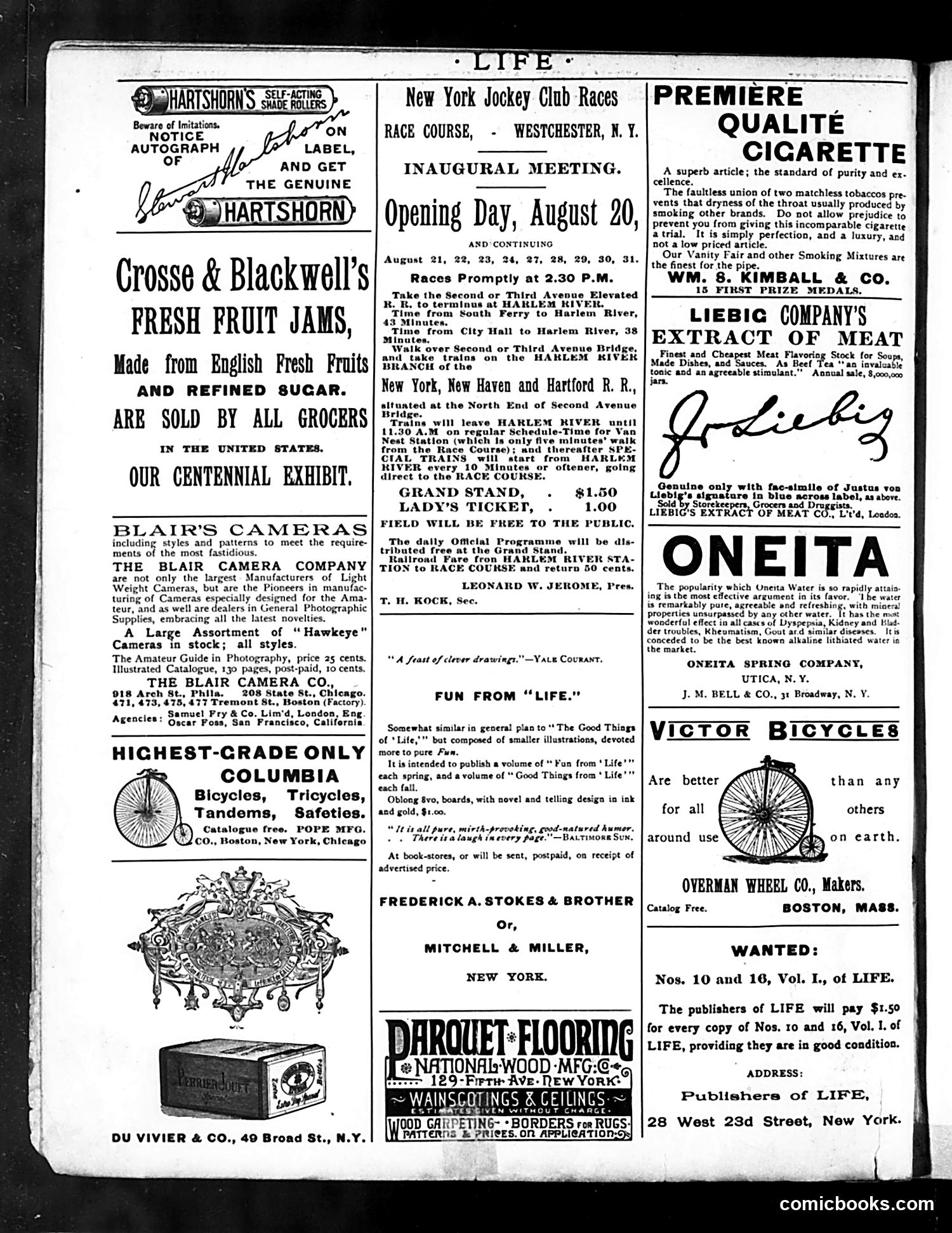
This page is **primarily advertising**, not editorial content or political cartoons. It contains numerous period advertisements for products including: - Hartshorn's Self-Acting Window Rollers - Crosse & Blackwell's Fresh Fruit Jams - Blair Camera Company cameras - Columbia Bicycles - Victor Bicycles - Premiere Qualité Cigarettes - Liebig's Extract of Meat - Oneita undergarments - Parquet Flooring The only non-advertising content is a brief notice about the **New York Jockey Club's inaugural horse races** at Westchester, N.Y., opening August 20, with race details and ticket pricing. There are no political cartoons or satirical commentary visible on this page.
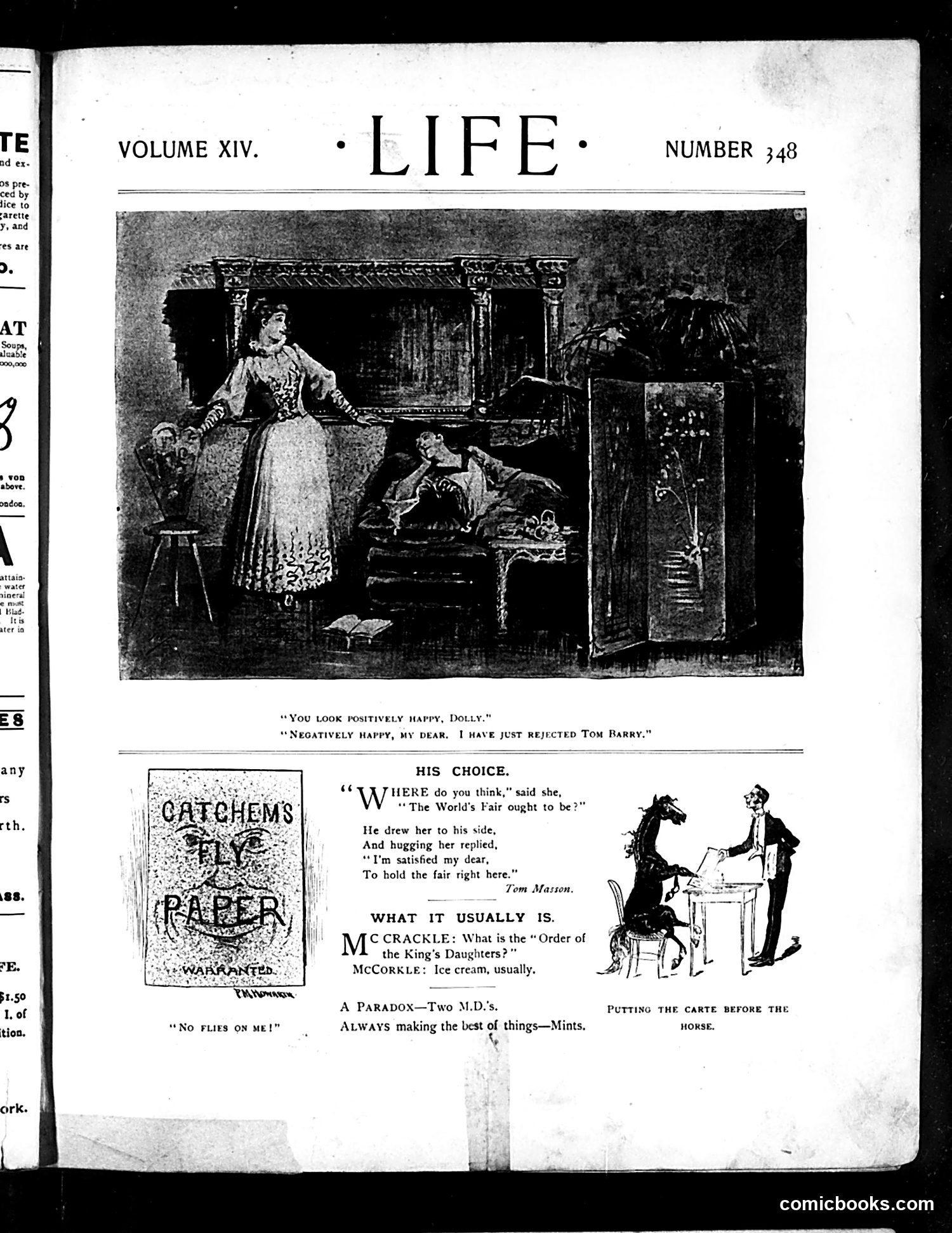
This page contains three distinct humor pieces: 1. **Top illustration**: A domestic scene captioned "You look positively happy, Dolly" / "Negatively happy, my dear. I have just rejected Tom Barry." The satire appears to target romantic rejection and female independence—the woman's paradoxical "negative happiness" at refusing a suitor suggests commentary on women's marital choices. 2. **"His Choice"**: A poem about choosing between worldly success and romantic love, referencing "the World's Fair" (likely the 1893 Chicago World's Fair). 3. **"What It Usually Is"**: Brief jokes about the "Order of the King's Daughters" and an M.D. paradox about mints. The bottom cartoon shows a man presenting a horse to another, captioned "Putting the carte before the horse"—a pun on the phrase "putting the cart before the horse."
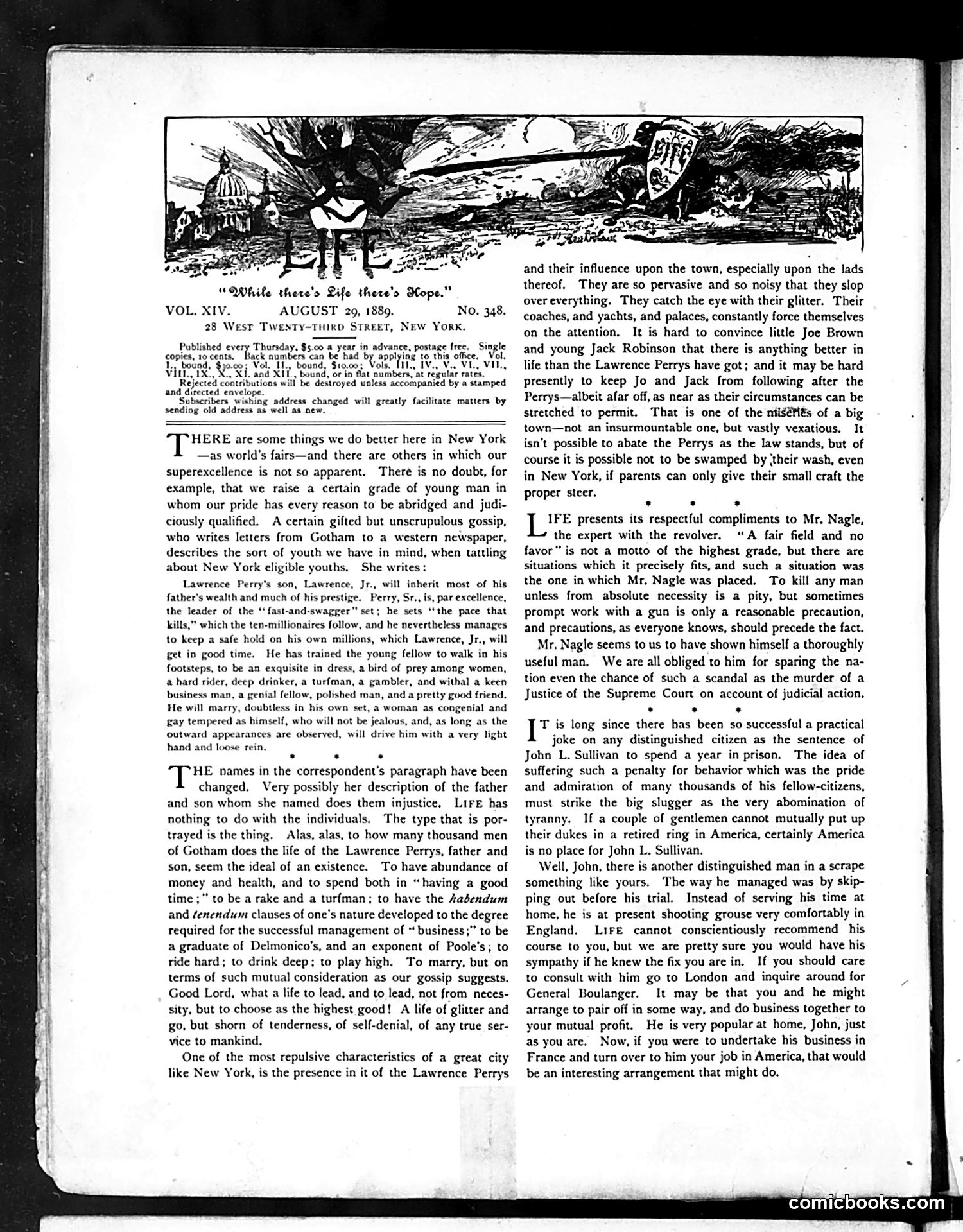
The woodcut illustration at the top depicts a chaotic scene with figures and debris, though the specific subject is unclear from the image alone. The accompanying headline reads "While there's Life there's Hope." The text discusses New York society, particularly criticizing the "Lawrence Perrys"—wealthy, ostentatious socialites whose extravagant behavior and influence over young men is described as pervasive and "noisy." The article expresses concern about their corrupting effect on youth. The piece then shifts to praising a "Mr. Nagle," an expert with a revolver, for demonstrating responsible behavior. It also sarcastically comments on John L. Sullivan's imprisonment, using his case to critique lenient treatment of powerful men versus ordinary citizens. The overall tone criticizes wealth-based social privilege and inconsistent justice.
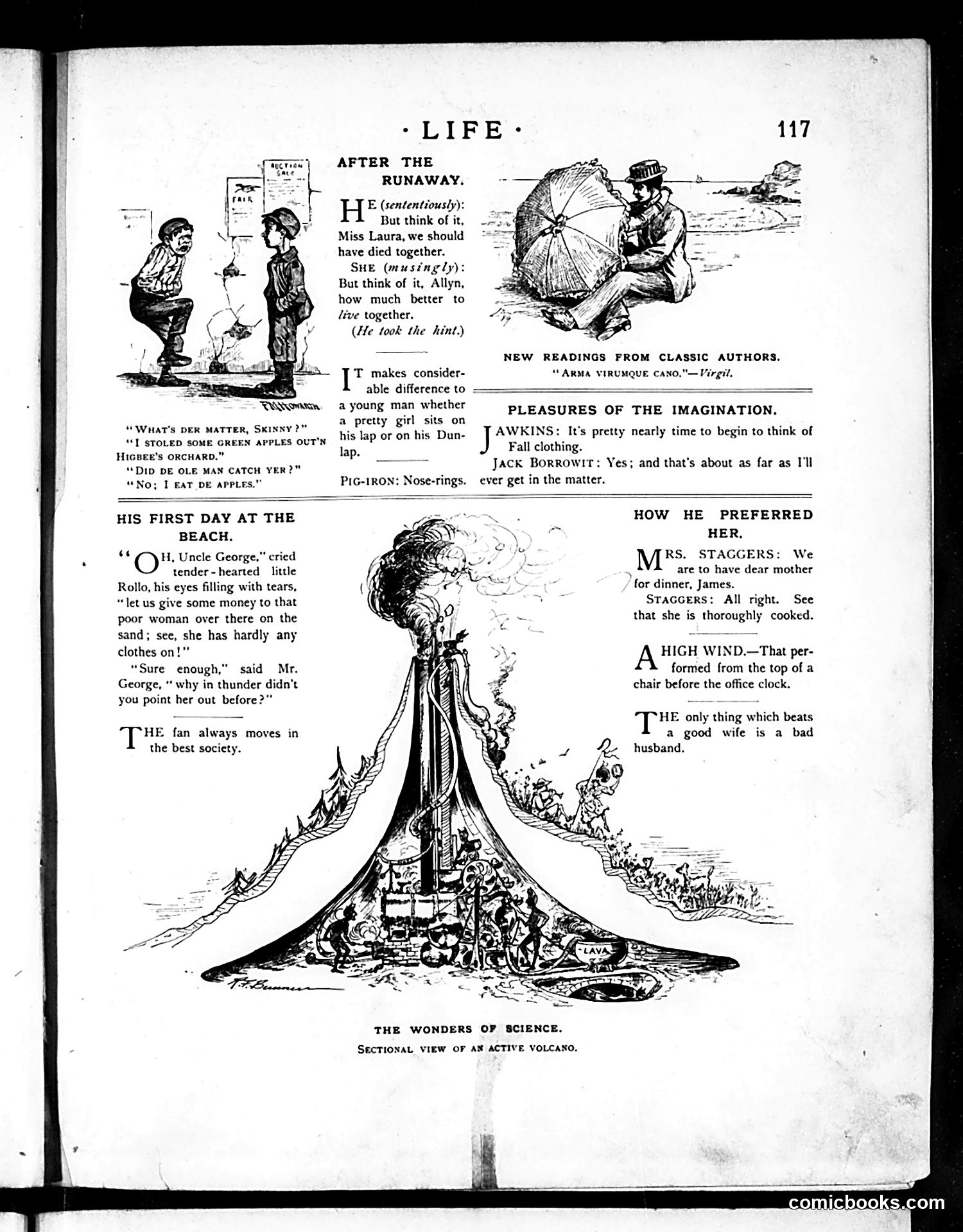
This page contains several unrelated satirical humor pieces typical of Life magazine's format: **"After the Runaway"** presents a brief romantic dialogue between a couple who eloped, with the man suggesting they should have "died together" while the woman prefers to "live together"—a mild joke about marriage. **"His First Day at the Beach"** depicts Uncle George's embarrassment over a poor woman on the beach, illustrating class anxieties of the era. The large volcano diagram labeled "The Wonders of Science" appears to be genuine educational content rather than satire. Other brief quips address social conventions: "The fan always moves in the best society," commentary on wives versus husbands, and observations about fall clothing. These represent typical turn-of-the-century American humor—light, domestic-focused, and generally inoffensive by modern standards.
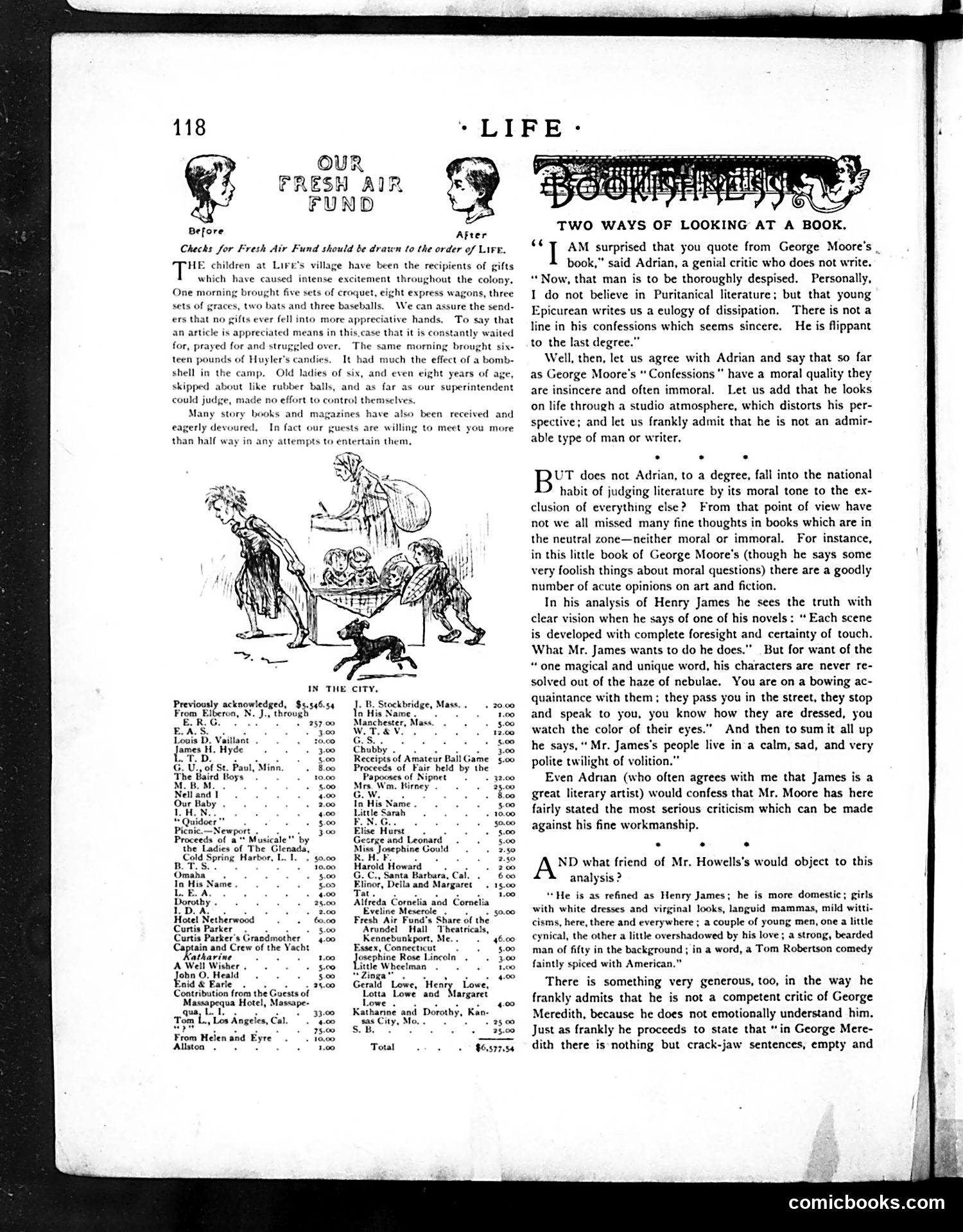
This page combines two distinct sections: **"Our Fresh Air Fund"** (left): A before-and-after illustration showing the transformative effects of Life's charitable Fresh Air Fund program for children. The "before" image depicts malnourished, poorly-clothed urban children; the "after" shows healthier, better-nourished children. The accompanying text celebrates donations and grateful recipients, presenting the fund as successful philanthropy for disadvantaged city children. **"Two Ways of Looking at a Book"** (right): A literary criticism piece debating George Moore's "Confessions." The author argues Moore's work, while morally questionable, contains legitimate artistic merit and shouldn't be dismissed purely on moral grounds. The piece critiques overly moralistic literary judgment, advocating for aesthetic appreciation independent of ethical concerns—a progressive editorial stance for the era. The page reflects early-20th-century concerns with urban poverty relief and evolving attitudes toward literary modernism.
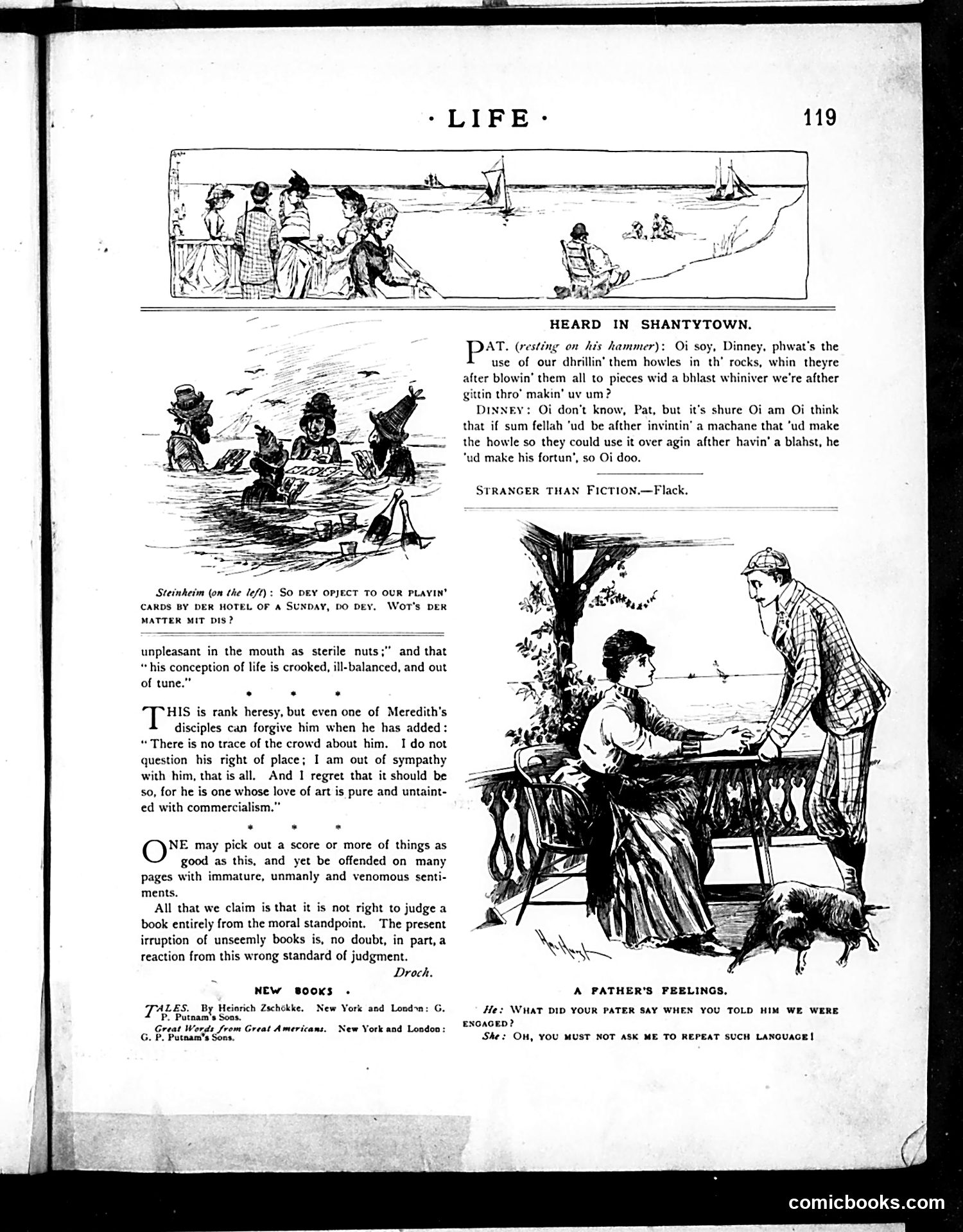
This page contains three separate humorous pieces: 1. **"Heard in Shantytown"**: A dialogue joke featuring working-class characters (Pat and Dinney) discussing how to repair damaged fishing boats using improvised methods—satirizing lower-class resourcefulness and their distinctive dialect speech patterns. 2. **"Stranger than Fiction"**: A brief commentary by Flack criticizing what appears to be artistic or literary excess—mocking pretentious creative work. 3. **"A Father's Feelings"**: A cartoon showing a man hearing his fiancée's engagement announcement, responding with shock at her choice of language. The humor lies in the father's prudish reaction to her colorful speech. The page emphasizes class-based humor and social commentary typical of early 20th-century American satirical magazines, targeting working-class dialect and Victorian propriety violations.
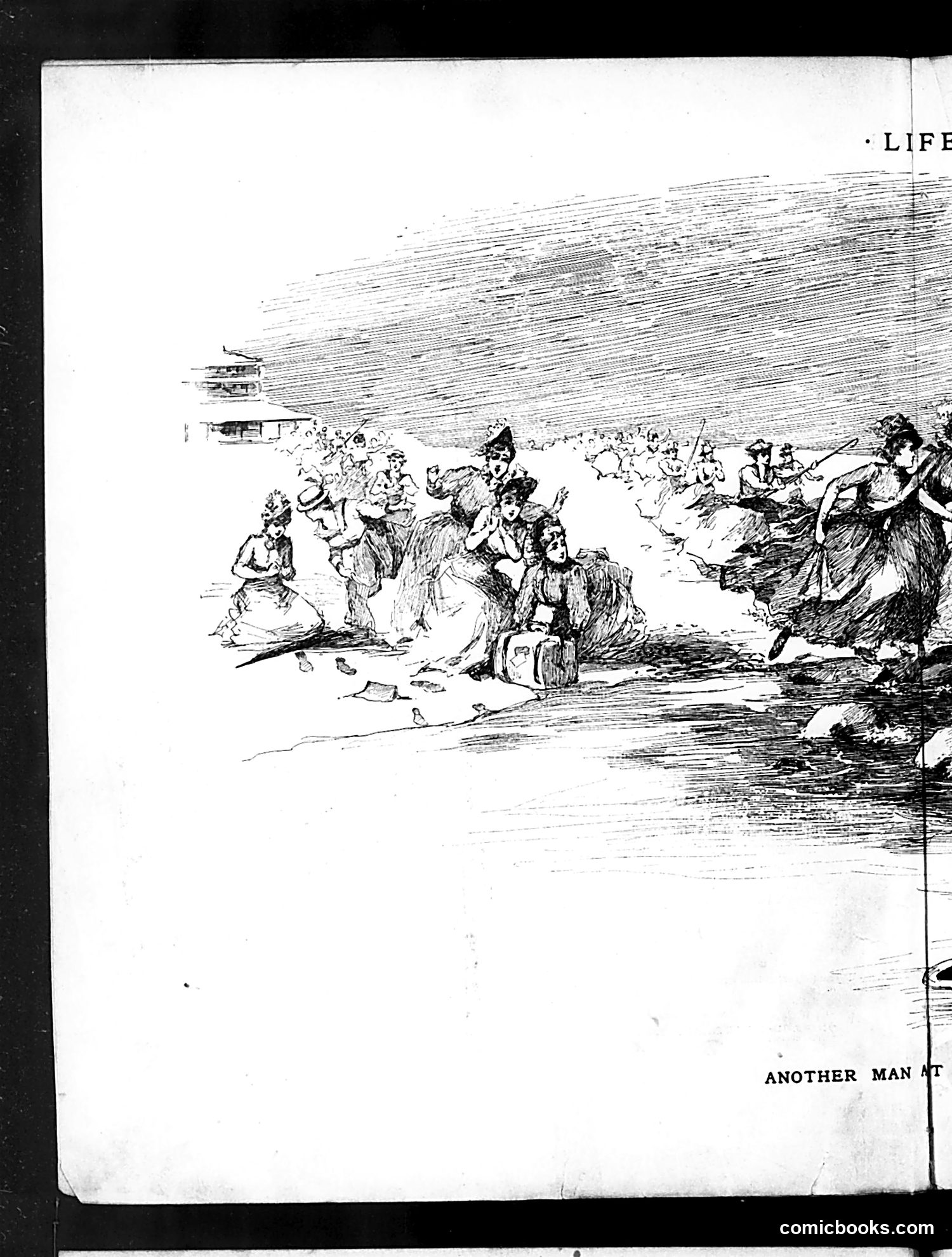
This is a satirical illustration from *Life* magazine showing a beach or seaside scene. The sketch depicts well-dressed Victorian or Edwardian-era figures gathered on a beach, with what appears to be a fashionably-dressed woman as a central focus. The partial text visible reads "ANOTHER MAN AT" (likely continuing on the next page). The satire likely comments on social behavior at leisure destinations—possibly mocking the vanity, flirtation, or social posturing of beachgoers of the era. The detailed clothing and the composition suggest commentary on upper-class or middle-class social conventions and courtship rituals. Without the complete caption or surrounding context, the specific target of the satire remains unclear, but the scene critiques leisure-class behavior typical of *Life* magazine's social commentary.
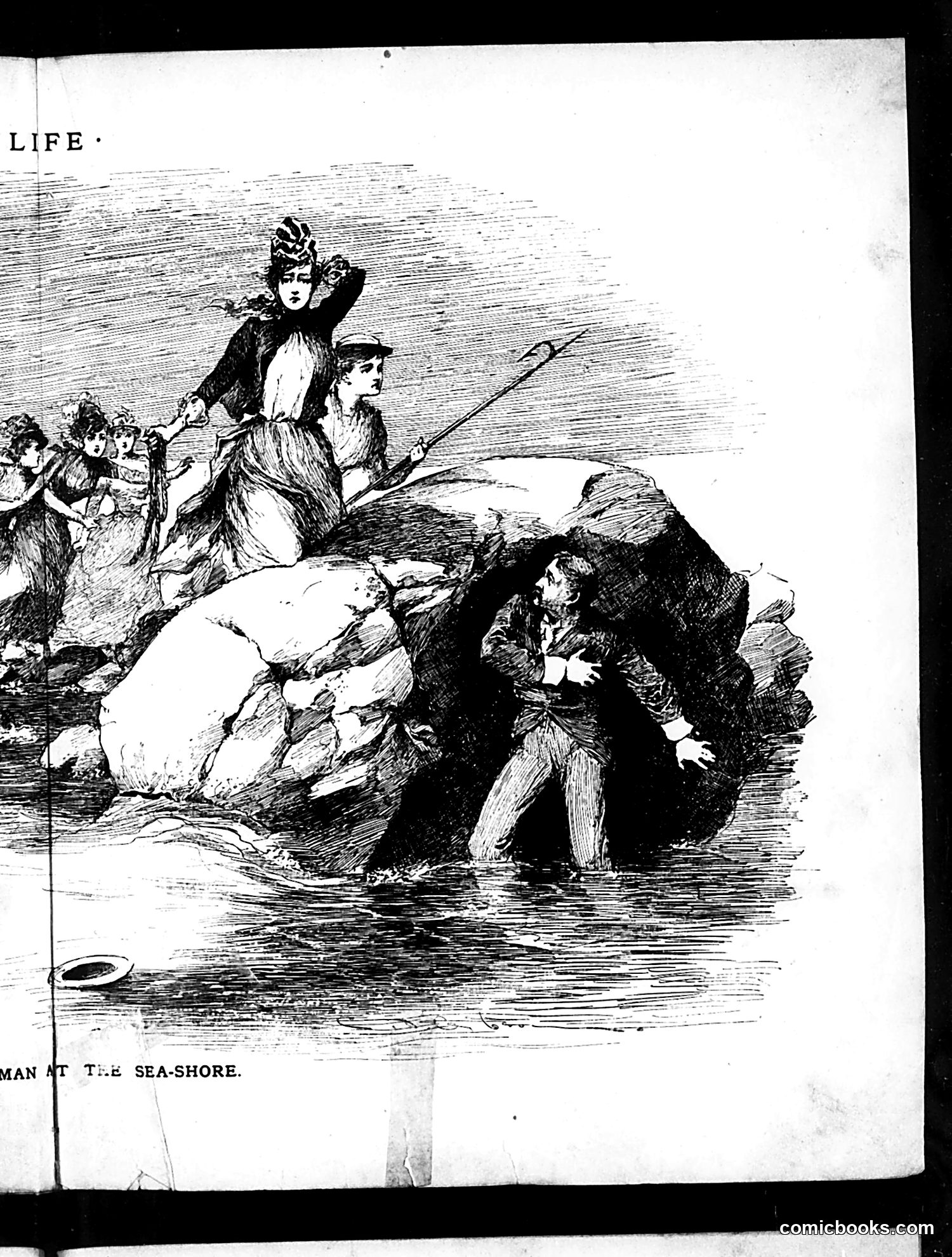
This satirical engraving depicts a man in formal attire partially submerged in water at the seashore, appearing distressed or struggling. Above him on the rocks stand elegantly dressed women with parasols, seemingly observing or ignoring his plight. The cartoon likely satirizes class dynamics or gender relations of the Victorian/Gilded Age era. The contrast between the women's refined leisure activity (seaside recreation) and the man's predicament suggests social commentary—possibly about male vulnerability, changing social hierarchies, or the indifference of upper-class women to masculine distress. Without additional context about the specific issue date or broader narrative, the exact political or social reference remains unclear, though the composition clearly invokes themes of social observation and disparity.
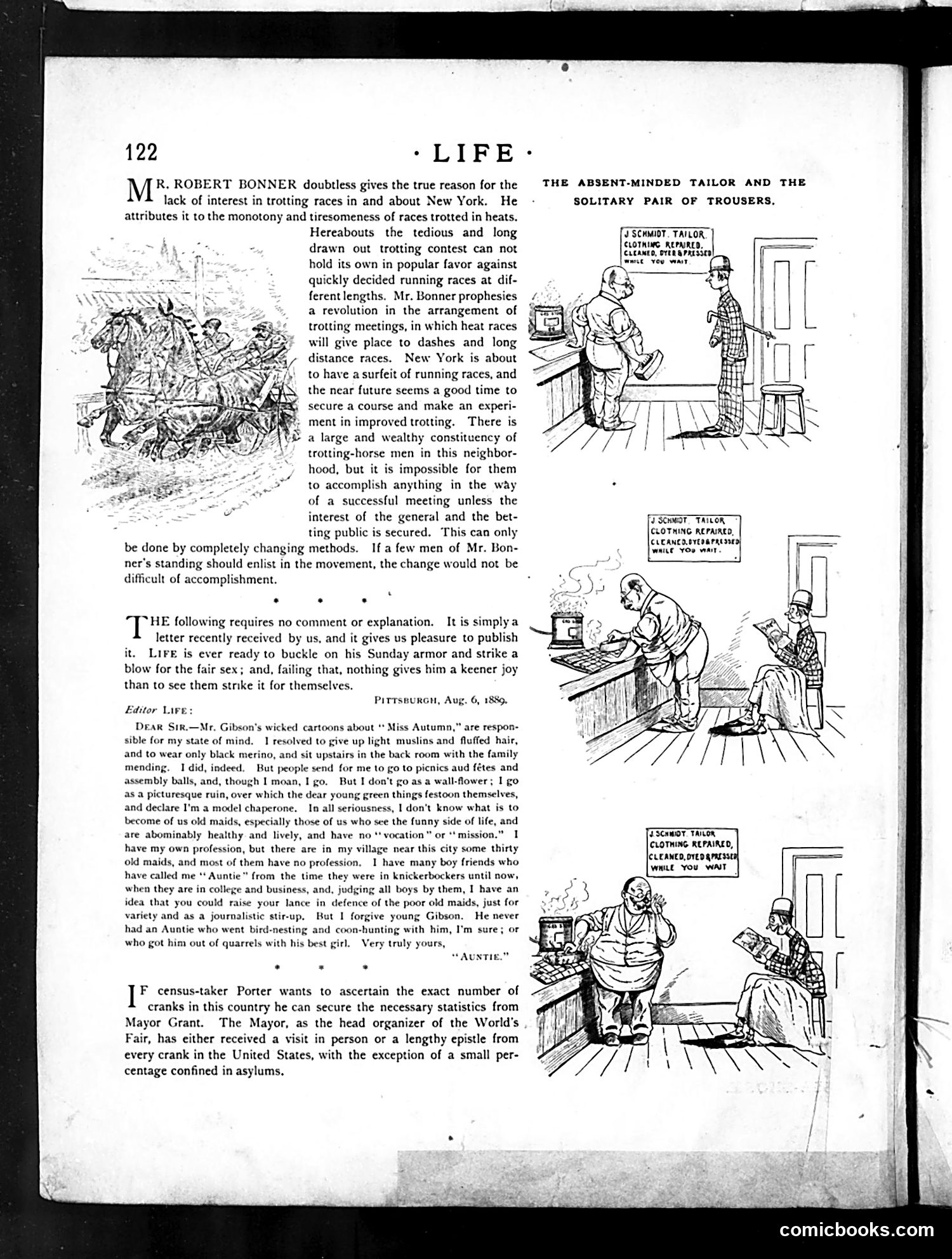
This page contains three comic strips titled "The Absent-Minded Tailor and the Solitary Pair of Trousers," depicting a bumbling tailor who repeatedly mishandles a customer's clothing repairs. The humor targets working-class incompetence and poor service. Each panel shows the tailor making excuses or presenting botched work—clothing remains unrepaired, is damaged further, or is simply lost. The customer (shown as increasingly exasperated) represents the frustrated consumer dealing with unreliable tradesmen. The satire reflects early 20th-century anxieties about service quality and craftsmanship. The tailor's absent-mindedness and the "solitary pair of trousers" that seemingly vanish suggests both physical comedy and social commentary on the reliability of urban service providers during this era.
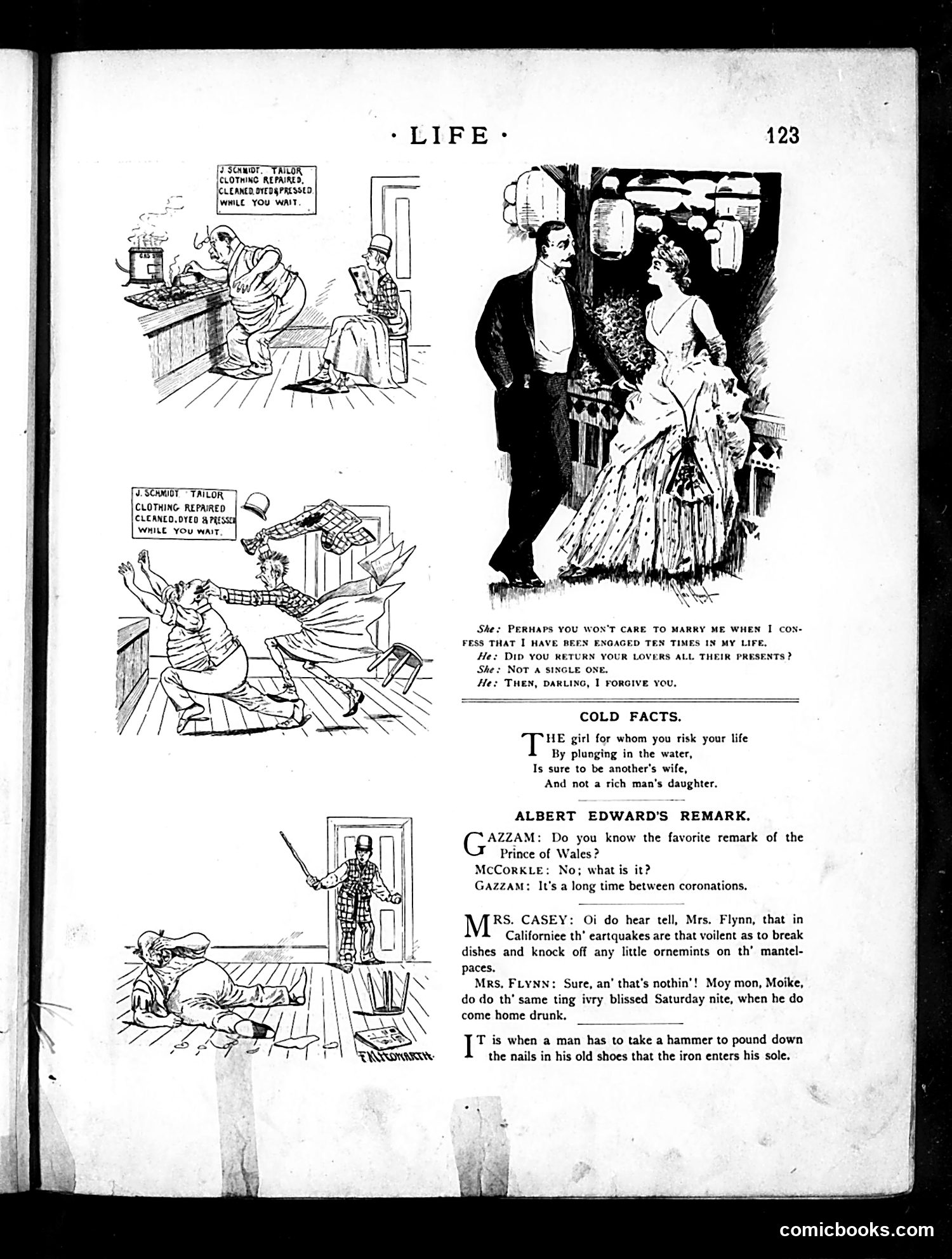
This page contains three cartoon strips satirizing domestic life and gender relations, likely from the early 20th century. The left cartoons mock "wait service" businesses (laundry, tailoring) by depicting wives who accumulate endless garments needing repair while husbands wait at home. The main illustration shows a couple, with dialogue suggesting the woman has been engaged ten times. The man's willingness to forgive despite her romantic history satirizes male desperation in courtship. "Cold Facts" and "Albert Edward's Remark" sections offer cynical observations: women who risk themselves for love become others' wives, not wealthy daughters; and a quip about the Prince of Wales' coronation timing. The bottom cartoon shows a man arriving home to domestic chaos—likely depicting the consequences of drunkenness or neglect. Overall, the page mocks both marital complications and working-class domestic frustrations through humorous exaggeration.
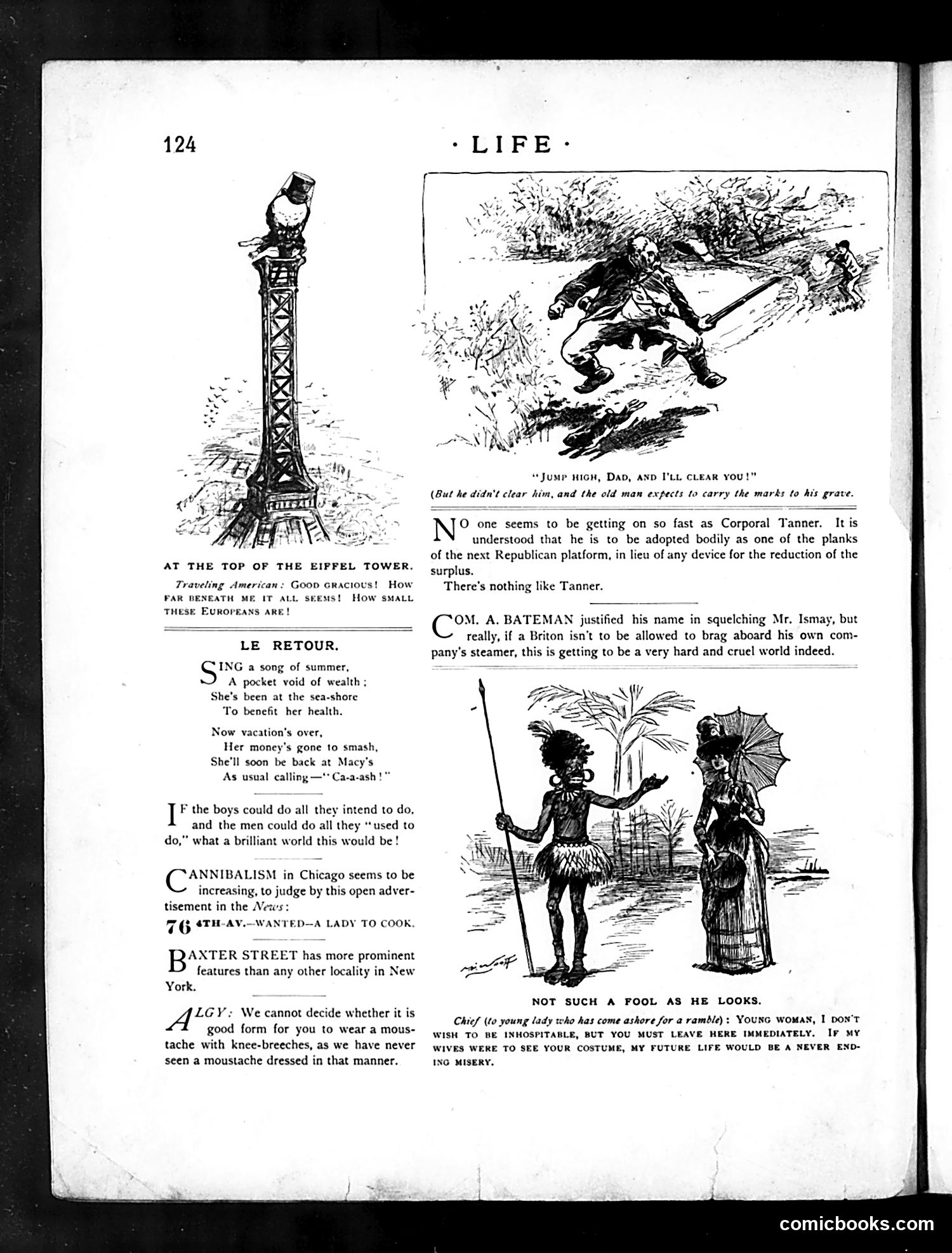
This page contains multiple brief satirical commentaries typical of *Life* magazine's humor: **Top cartoon**: An American tourist at the Eiffel Tower marvels at how small everything appears below, sarcastically commenting on European grandeur—mocking American provincialism and boastfulness abroad. **"Le Retour"**: Jokes about a woman's summer vacation funded by a depleted purse, now returning to work at Macy's asking for "cash"—satirizing the genteel poor and seasonal employment. **Corporal Tanner reference**: Appears to mock a Republican political figure being adopted as a platform plank to address budget surplus—political satire on using personalities rather than policy. **Bateman/Ismay quip**: Likely references a ship incident where a Briton was criticized; satirizes class and nationality tensions. **Colonial chief cartoon**: A comedic "fish-out-of-water" joke about a native chief threatening to expel a European woman in modern dress, fearing his wives' jealousy—mocking both colonial stereotypes and Victorian sensibilities about women's clothing. The page blends topical political jokes with social satire about American travelers, class, and gender conventions.
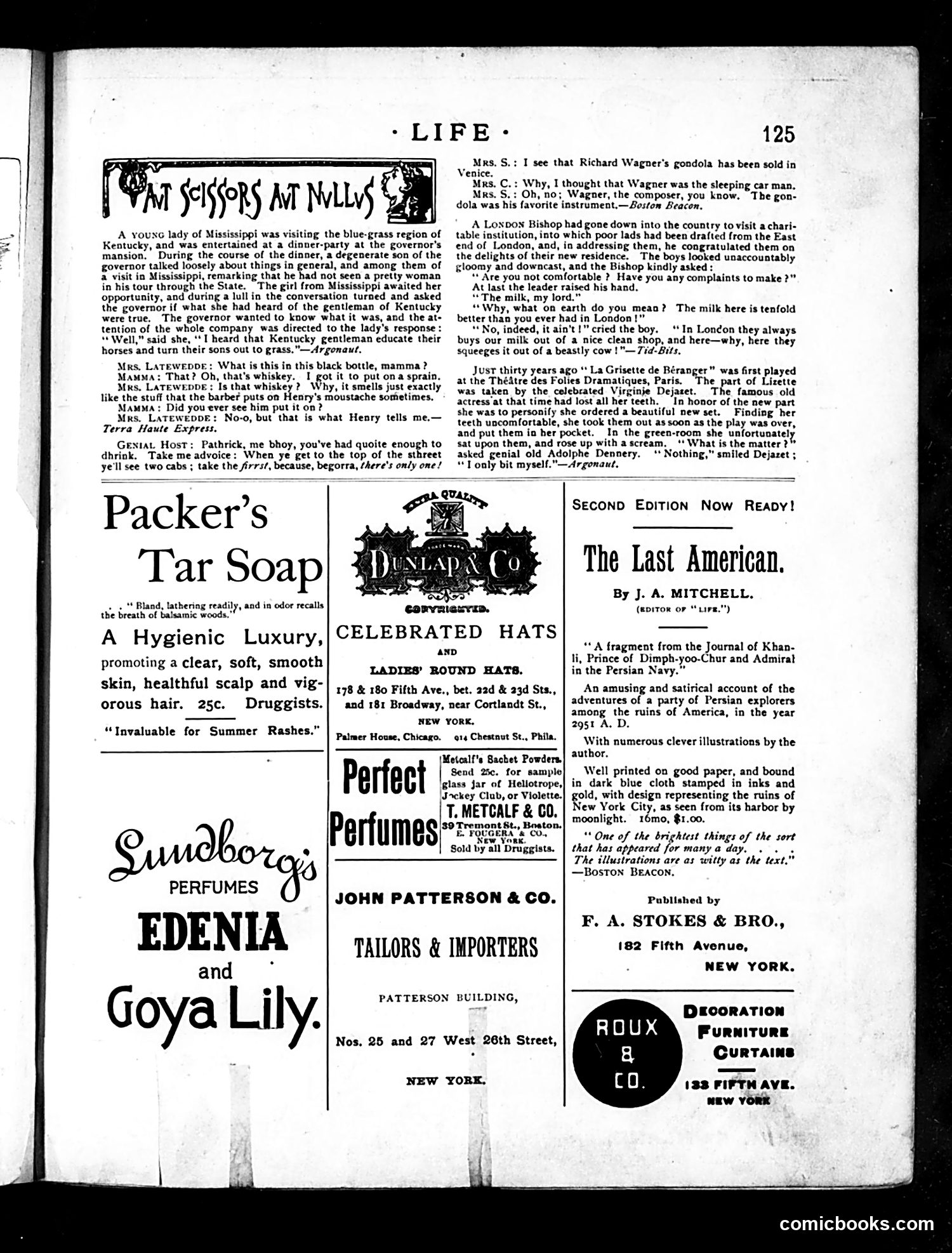
This page contains **four brief humorous anecdotes** typical of Life's satirical content, rather than political cartoons: 1. **Kentucky gentleman joke**: A Mississippi woman insults Kentucky by claiming they "educate their horses and turn their sons out to grass"—implying Kentuckians are less refined than animals. 2. **Whiskey/barber cologne confusion**: A woman mistakes whiskey for liniment because it smells like what her husband uses on his mustache, suggesting men's grooming products and alcohol are indistinguishable. 3. **Wagner confusion**: A person mistakes composer Richard Wagner for a sleeping-car manufacturer, poking fun at cultural ignorance. 4. **Fresh milk complaint**: Poor London boys prefer bottled milk to fresh cow's milk from the countryside, inverting typical pastoral romanticism—they find direct milking from cows unsettling. The page is primarily **advertisements** (Packer's Tar Soap, perfumes, hats, tailors). The humor targets class pretensions, cultural ignorance, and inverted expectations—characteristic of Life's gentle, urbane satire.
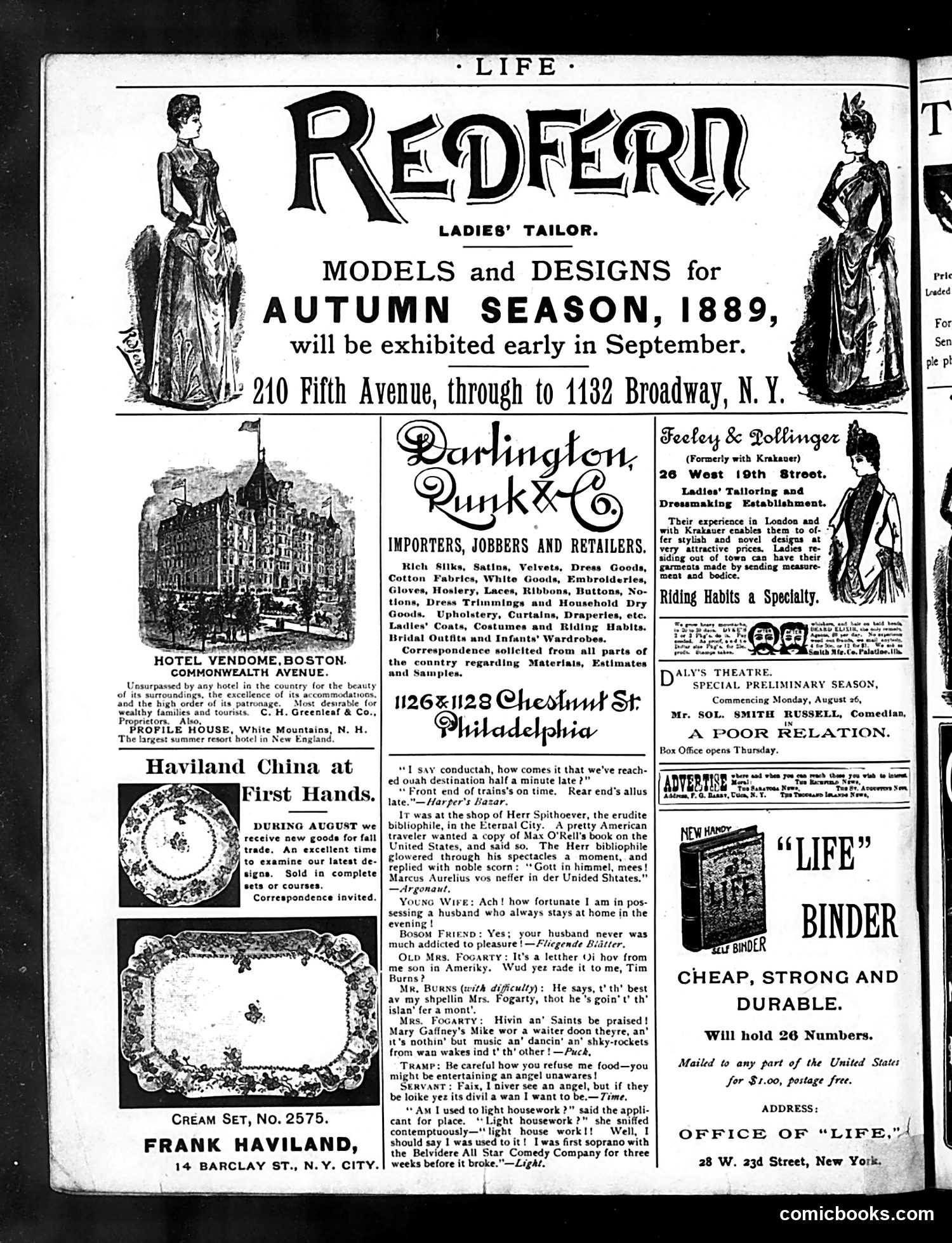
This is primarily an **advertising page** with scattered humorous filler content typical of the era. The main advertisements promote luxury goods and services—ladies' tailoring, fine china, fabric imports, and hotels—reflecting the affluent readership Life cultivated. The brief jokes scattered throughout are ethnic humor common to 1880s publications: an Irish servant girl, a German-accented antiquarian bookseller, and working-class characters speaking in exaggerated dialects. These represent the casual, casual prejudices of the period. One joke involves a train conductor's excuse for lateness; another satirizes theatrical aspirations (a woman claims experience with a comedy troupe as "housework" expertise). **Context for modern readers:** This reflects a magazine aimed at upper-class, English-speaking urbanites who found ethnic caricature entertainment. The advertisements show what constituted luxury in 1889—imported fabrics, tailored clothing, and resort hotels—while the humor reveals period attitudes toward immigrants and working classes.
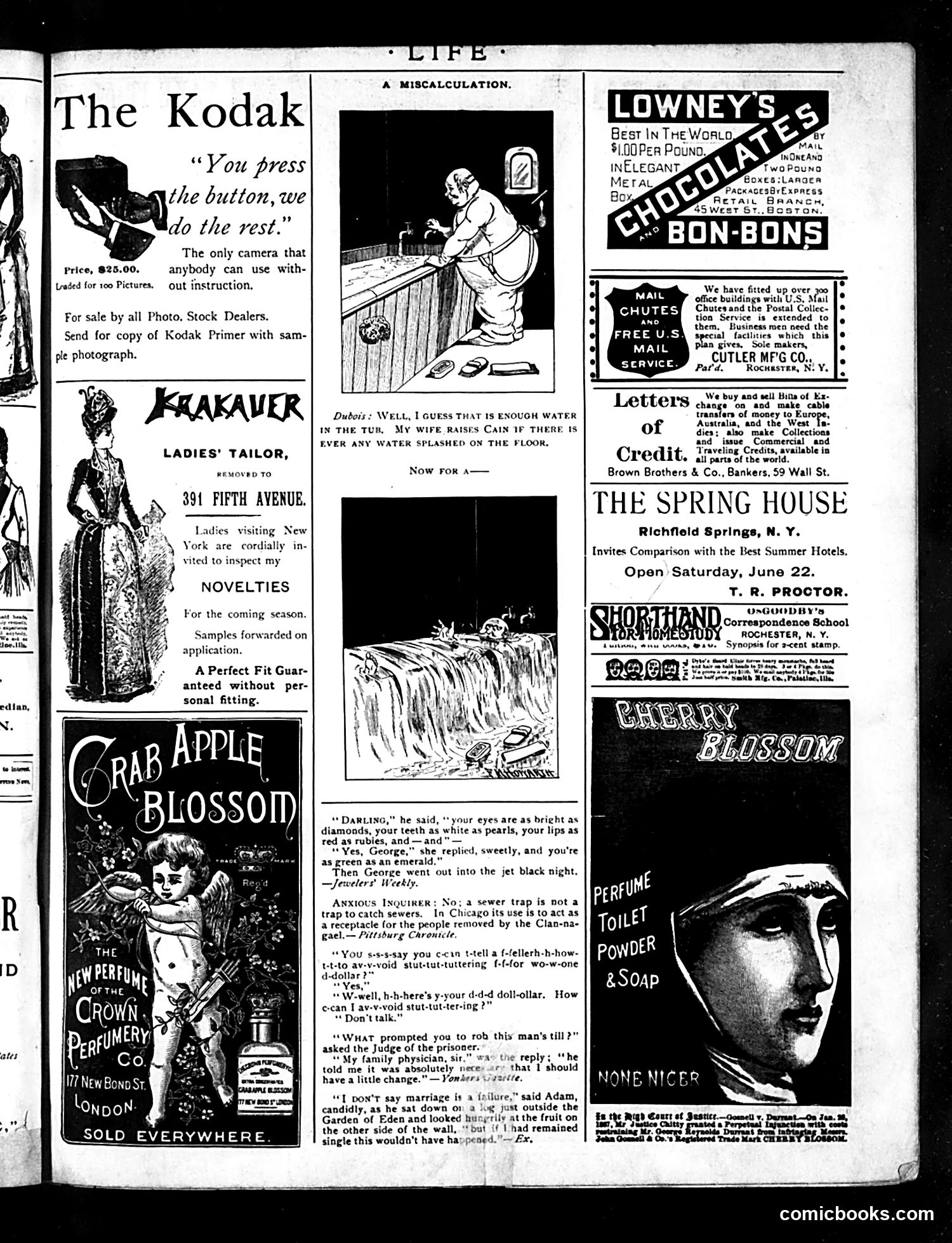
This is primarily an **advertising page** from Life magazine with one central cartoon titled "A Miscalculation." **The Main Cartoon:** Shows a man in a bathtub speaking to someone off-screen. He complains that his wife gets angry when water splashes on the floor—yet he's apparently creating a massive flood. The joke is his miscalculation: he's trying to avoid her anger by limiting water, but he's actually making the mess worse. It's straightforward domestic humor about marital conflict and poor planning. **The Surrounding Content:** The page is filled with period advertisements (Kodak cameras, tailors, perfume, hotels) and a series of brief jokes about stuttering, robbery, marriage, and Chicago sewers. These jokes reflect early 1900s American humor styles—puns, wordplay, and social commentary (the Chicago sewer reference appears to reference Irish-American gang activity). **No political satire is evident** on this page; it's entertainment and commercial advertising typical of Life's satirical magazine format of the era.
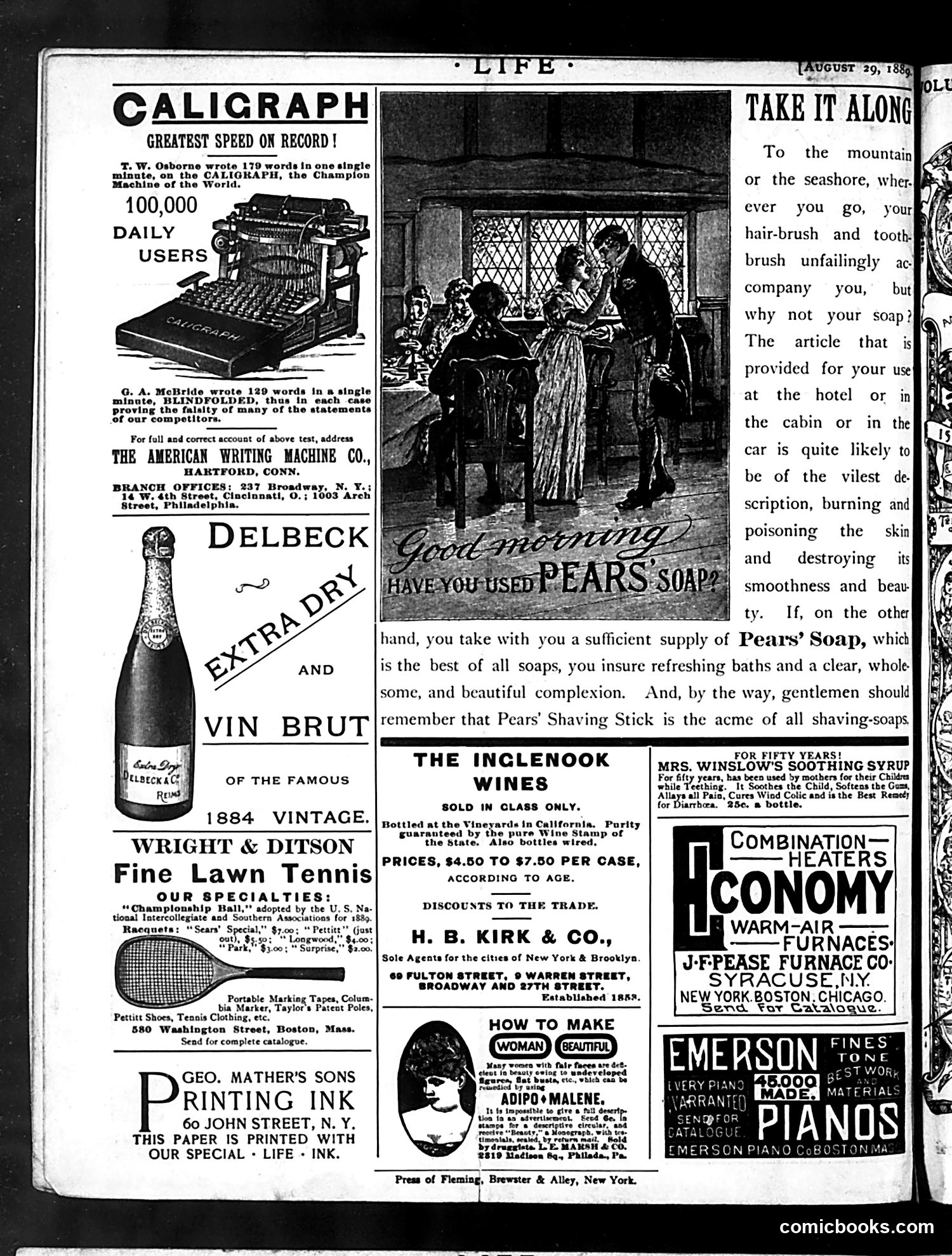
This page is **primarily advertisements**, not editorial satire. It showcases late-19th-century consumer products targeted at middle and upper-class Americans: **Key advertisements include:** - **Caligraph typewriter**: Boasts speed records (179 words/minute) to compete with other writing machines - **Pears' Soap**: The largest ad promotes soap as essential travel luggage, implying hotel soap is dangerously poor quality - **Delbeck wine** (1884 vintage) - **Wright & Ditson tennis equipment**: Marketed to affluent sports enthusiasts - **Mrs. Winslow's Soothing Syrup**: A 50-year-old children's teething remedy - **Emerson pianos** and heating furnaces **The satire, if any, is subtle**: The Pears' Soap ad gently mocks travelers' assumptions that provided toiletries are adequate, suggesting genteel consumers bring superior products. The typewriter ads subtly mock competitors' claims. This reflects Life's dual purpose: satirical editorial content mixed with high-end advertising for an educated, wealthy readership.