
A complete issue · 16 pages · 1889
Life — August 15, 1889
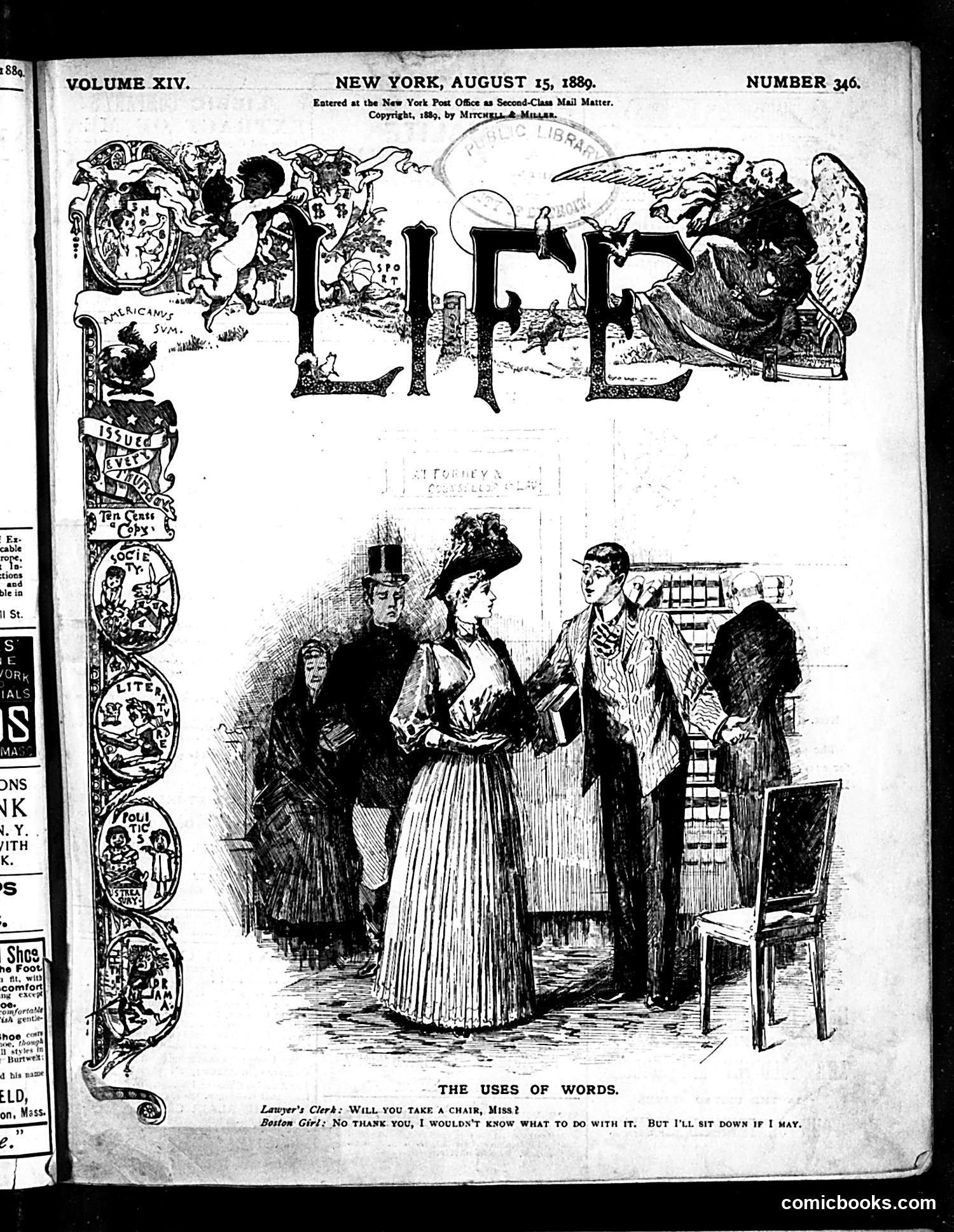
This satirical cartoon illustrates a social clash between a Boston woman (identified as "Boston Girl") and a lawyer's clerk in what appears to be a legal office. The joke hinges on the phrase "take a chair." The clerk offers her a seat using standard language, but the Boston woman interprets or rejects it pedantically—insisting she wouldn't know what to "do with it" but will "sit down if I may." The humor targets pretentious Boston intellectual culture of the era, mocking how educated New Englanders were perceived as overly particular about language and social conventions. The cartoon suggests Bostonians were so concerned with precise terminology that they missed the obvious social meaning of common expressions, making them appear ridiculous and socially awkward.
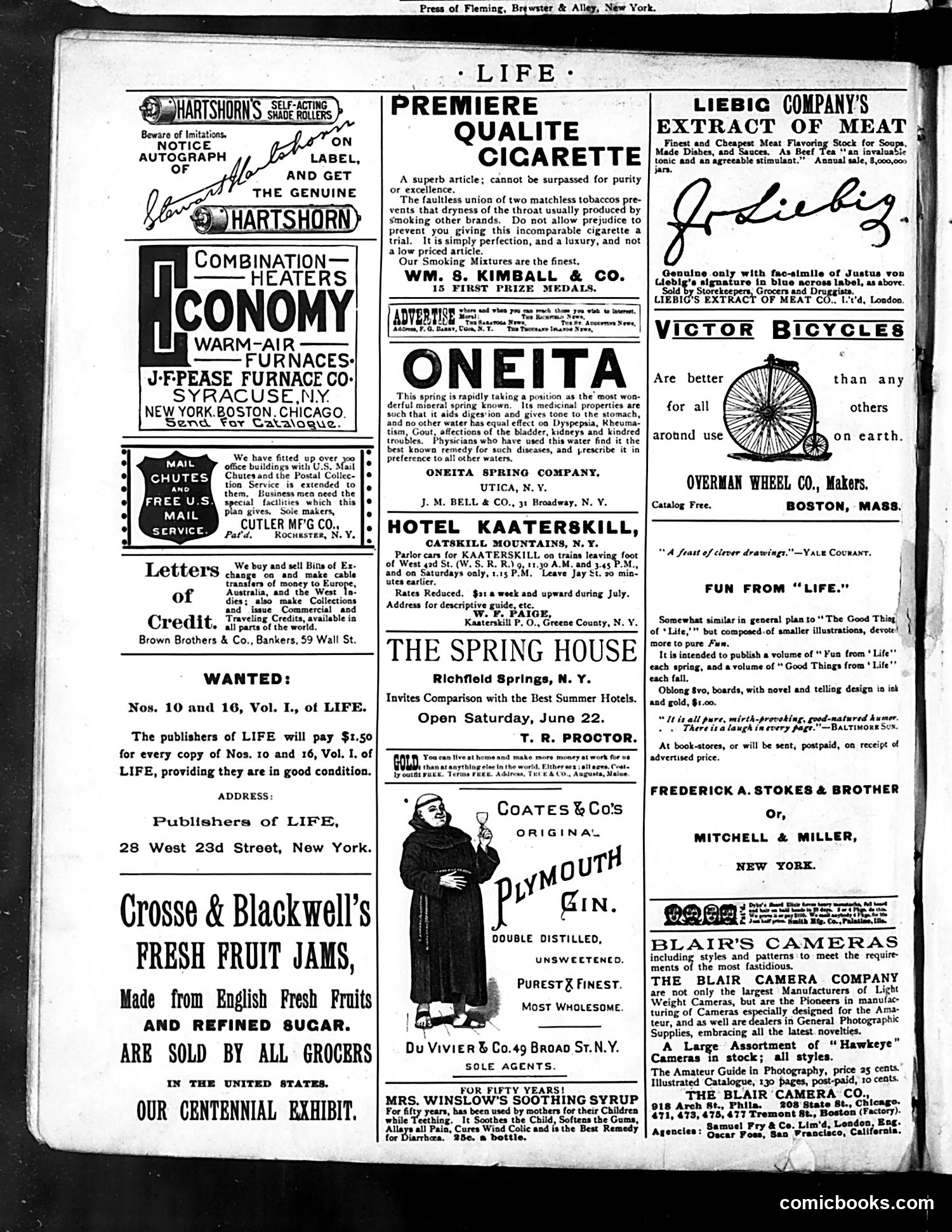
This page is **primarily advertising** with no political cartoons or satirical editorial content visible. The advertisements include: - **Hartshorn's Self-Acting Shade Rollers** (with an autograph) - **Economy Combination Heaters** (furnace company) - **Premiere Qualite Cigarettes** (signed endorsement, likely by an athlete or celebrity) - **Liebig Company's Extract of Meat** (food product) - **Victor Bicycles** (with wheel illustration) - **Oneita spring water** (medicinal claims) - **Plymouth Gin** (with monk figure illustration) - **Blair's Cameras** - **Crosse & Blackwell's Jam** - **Mrs. Winslow's Soothing Syrup** (patent medicine) The page also includes a "Letters of Credit" section and notices about back issues. No satirical or political content is evident.
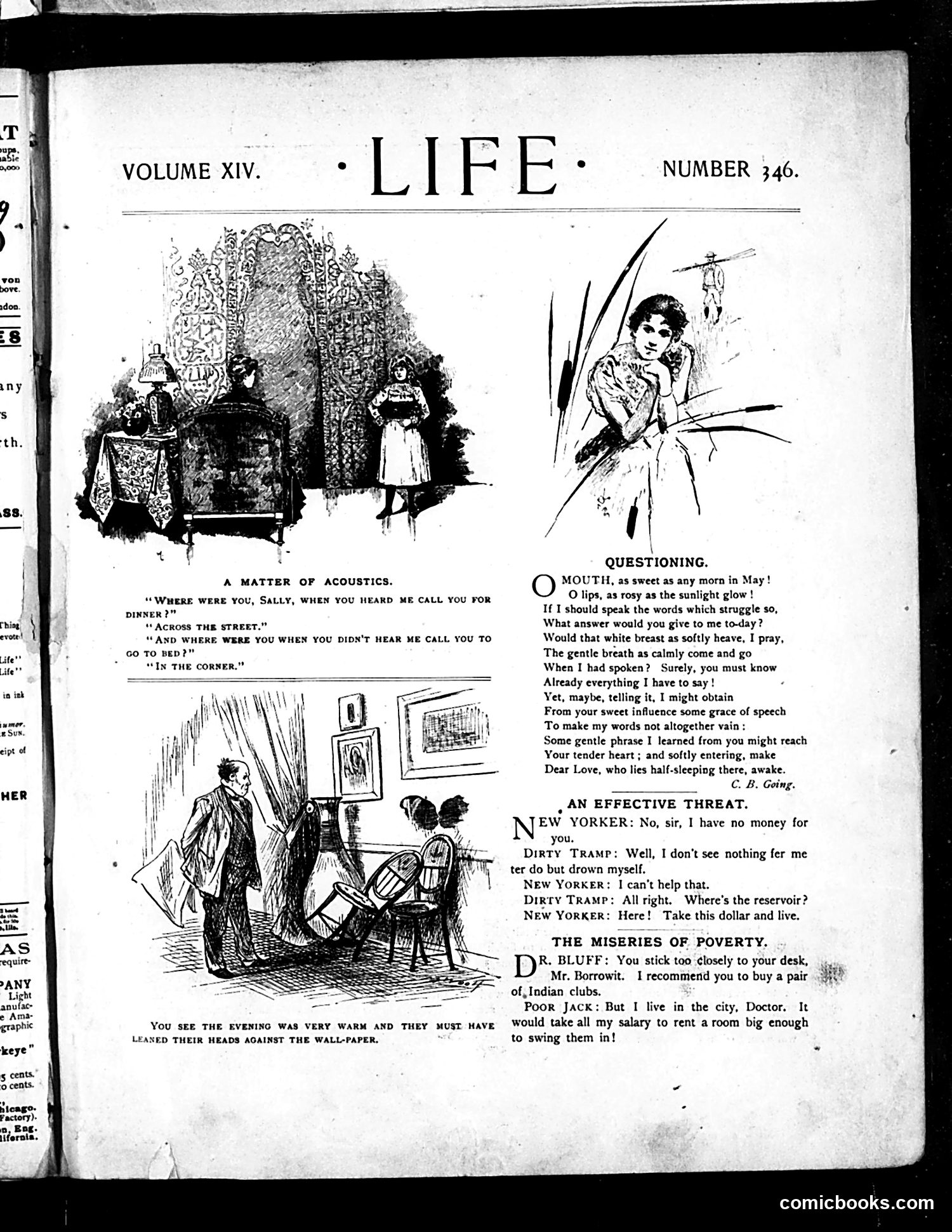
This page contains three separate humorous pieces typical of early 20th-century Life magazine: **"A Matter of Acoustics"**: A domestic joke about a wife (Sally) selectively hearing her husband's calls—she hears him calling for dinner "across the street" but ignores bedtime summons "in the corner." The humor relies on the stereotype of wives feigning deafness to inconvenient requests. **"Questioning"**: A sentimental poem about courtship, with romantic imagery of lips and gentle persuasion. **"An Effective Threat" and "The Miseries of Poverty"**: Humorous dialogues depicting class differences—a wealthy New Yorker and "Dirty Tramp" discussing money, and a doctor (Dr. Bluff) and poor patient (Jack) discussing urban poverty and housing costs. The cartoons employ period-typical social satire about gender dynamics, class relations, and urban life.
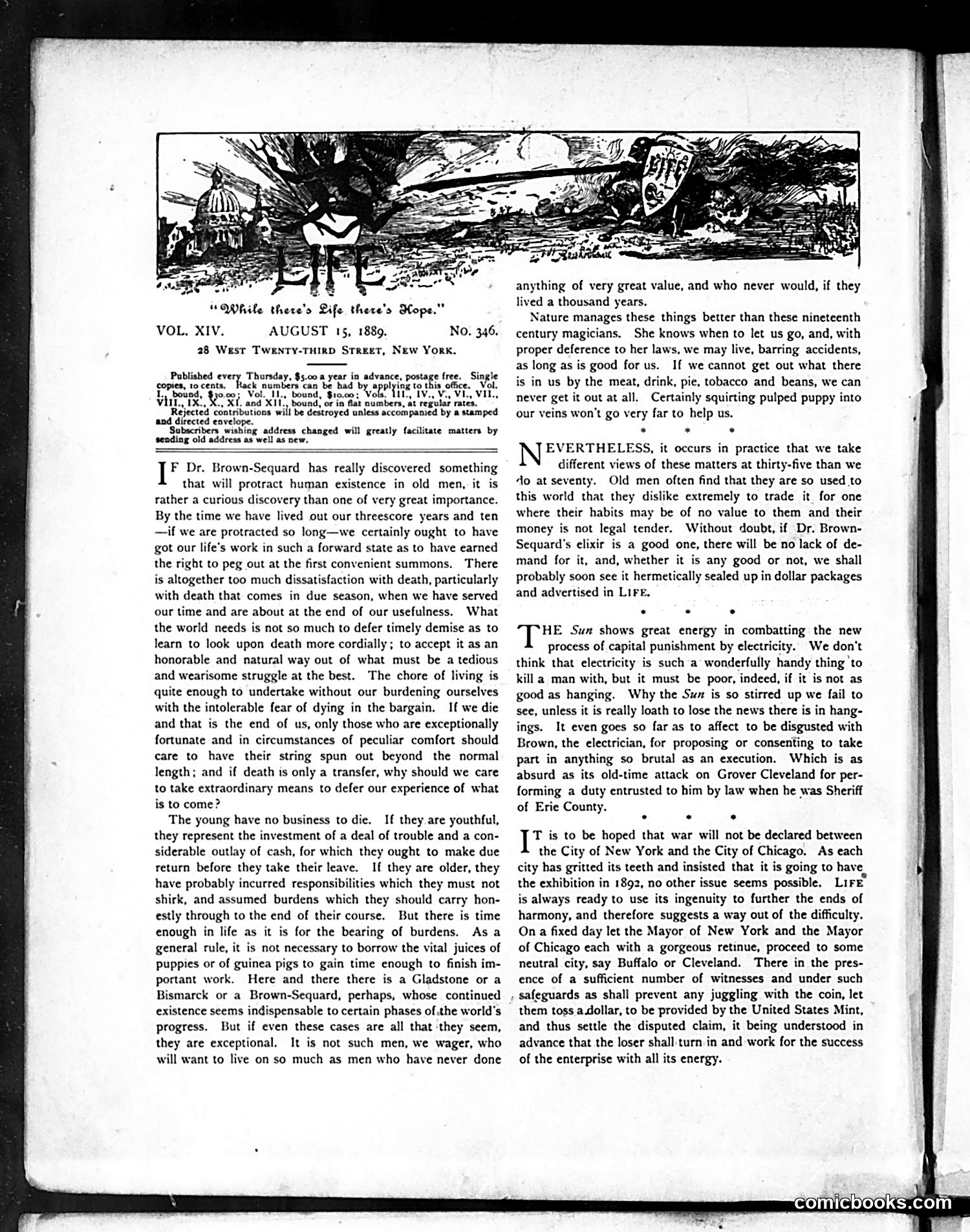
The cartoon titled "While there's Life there's Hops" appears at top left but is too small to read details clearly. The page is primarily editorial text discussing mortality and longevity in aging men, referencing Dr. Brown-Sequard's claimed discovery of life-extension treatments. The text also discusses capital punishment by electricity (a contemporary controversy), mocking the *Sun* newspaper's opposition to electrocution as "brutal" while defending it as modern progress. A final section proposes settling a rivalry between New York and Chicago by hosting the 1893 World's Fair in a "neutral city" like Buffalo or Cleveland instead—political satire about urban competition during the Gilded Age. The content reflects 1889 preoccupations: life extension, new execution methods, and inter-city rivalry.
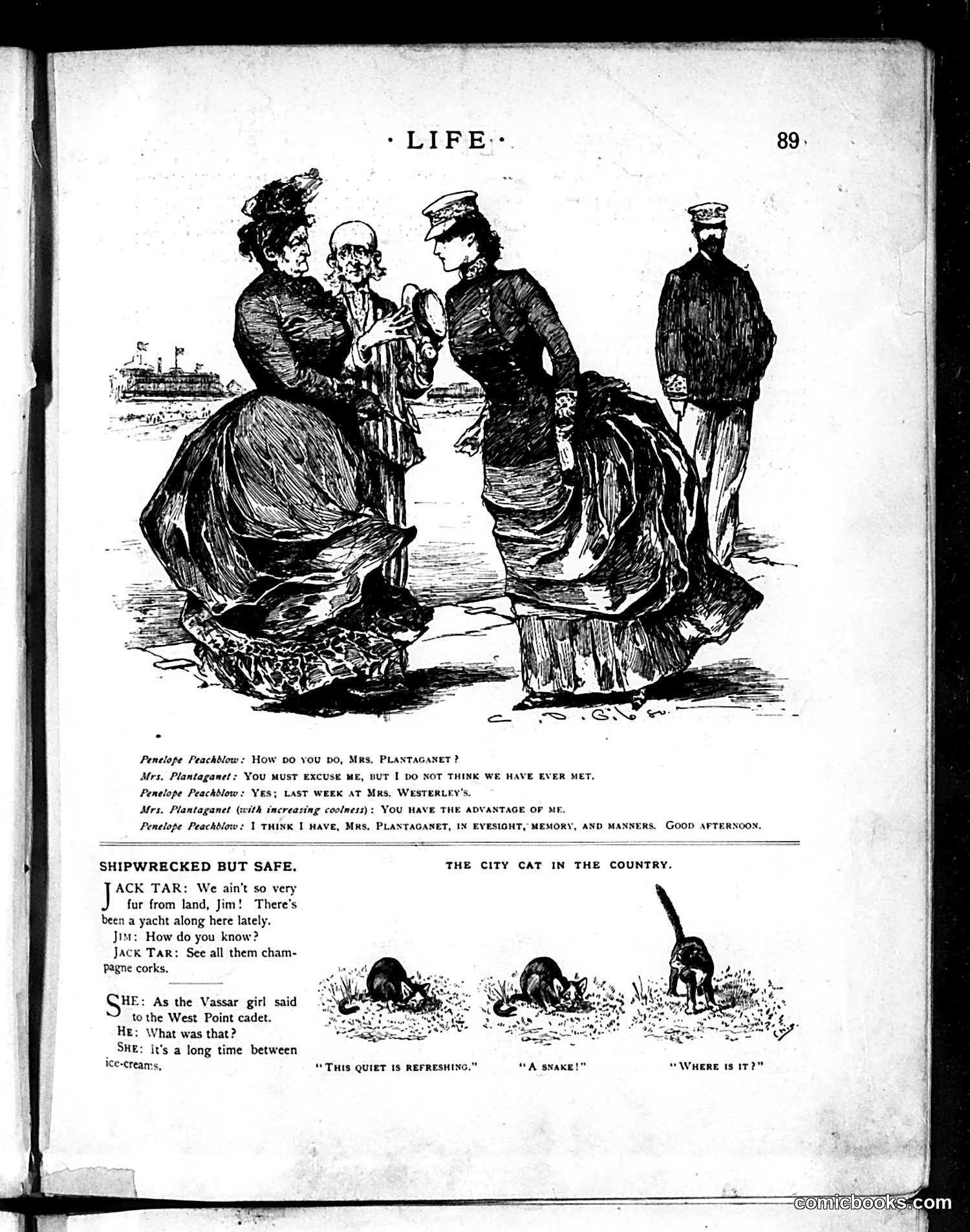
**Top Cartoon - "Principle Teachism":** This depicts a social encounter where a well-dressed woman (Mrs. Plantagemet) meets another woman and introduces her to a third party. The satire mocks Victorian-era social hypocrisy: Mrs. Plantagemet claims she doesn't think they've met, yet acknowledges seeing the woman "last week at Mrs. Westerley's." The punchline criticizes how wealthy society women maintained false pretense about their social circles while obviously knowing each other—a commentary on aristocratic affectation and dishonesty. **Bottom Cartoons - "The City Cat in the Country":** Shows a cat encountering snakes in rural settings. The joke presents urban contrast: a city cat's naive reactions ("This quiet is refreshing," "A snake!," "Where is it?") humorously illustrate the culture shock of city dwellers encountering nature.
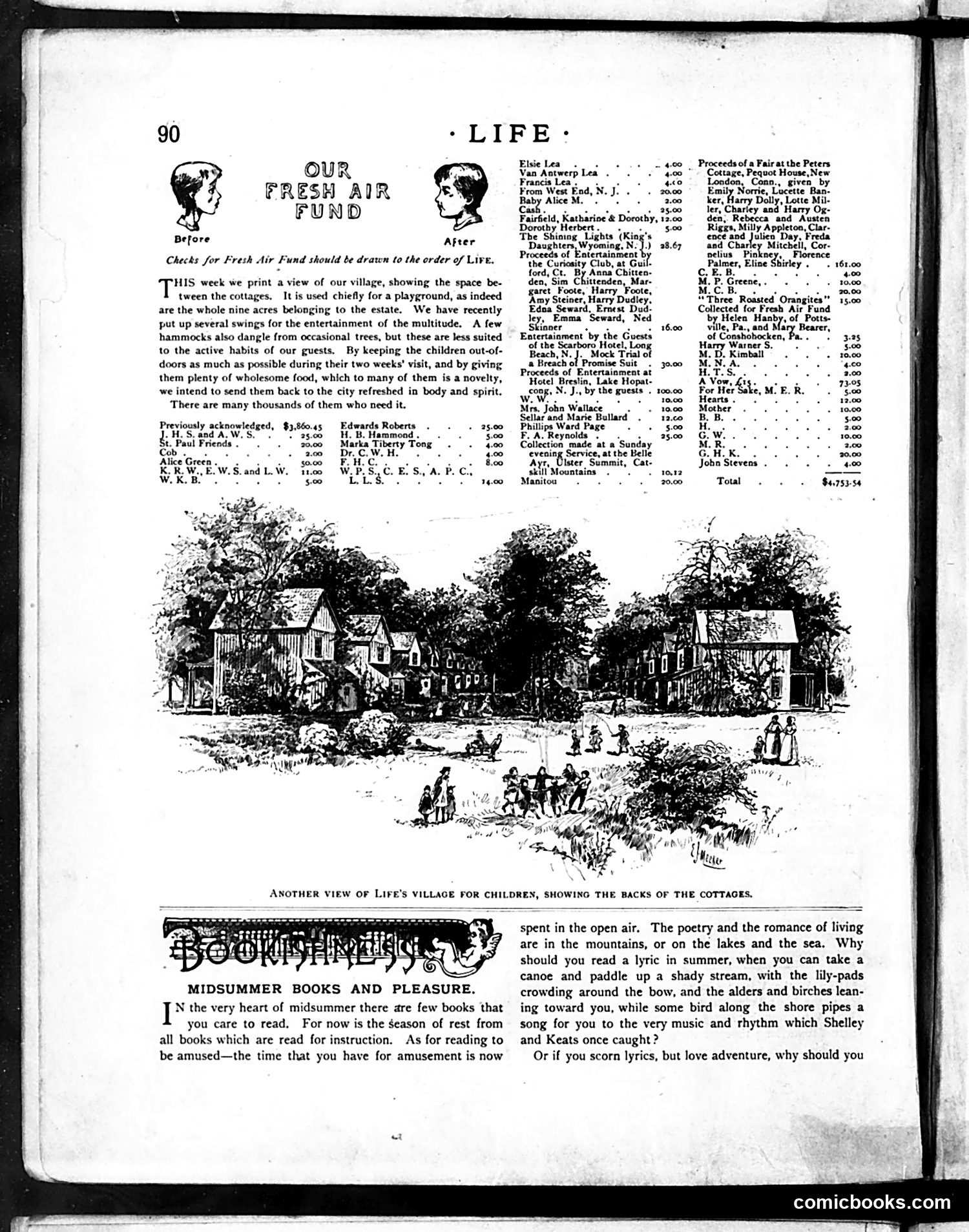
This page features "Our Fresh Air Fund," a charitable initiative providing outdoor recreation for children from crowded urban areas. The two profile illustrations labeled "Before" and "After" appear to show the physical transformation of children who benefit from country air and outdoor activities. The accompanying village illustration depicts Life's idealized "village for children," showcasing cottages and grounds where urban youth could experience nature and rural life. The lower section, "Midsummer Books and Pleasure," discusses summer reading recommendations, advocating for literature that combines instruction with amusement rather than purely instructional texts. The page reflects Progressive Era values emphasizing public health, outdoor recreation, and children's welfare—concerns about urban crowding and child development that motivated philanthropic efforts in early 20th-century America.
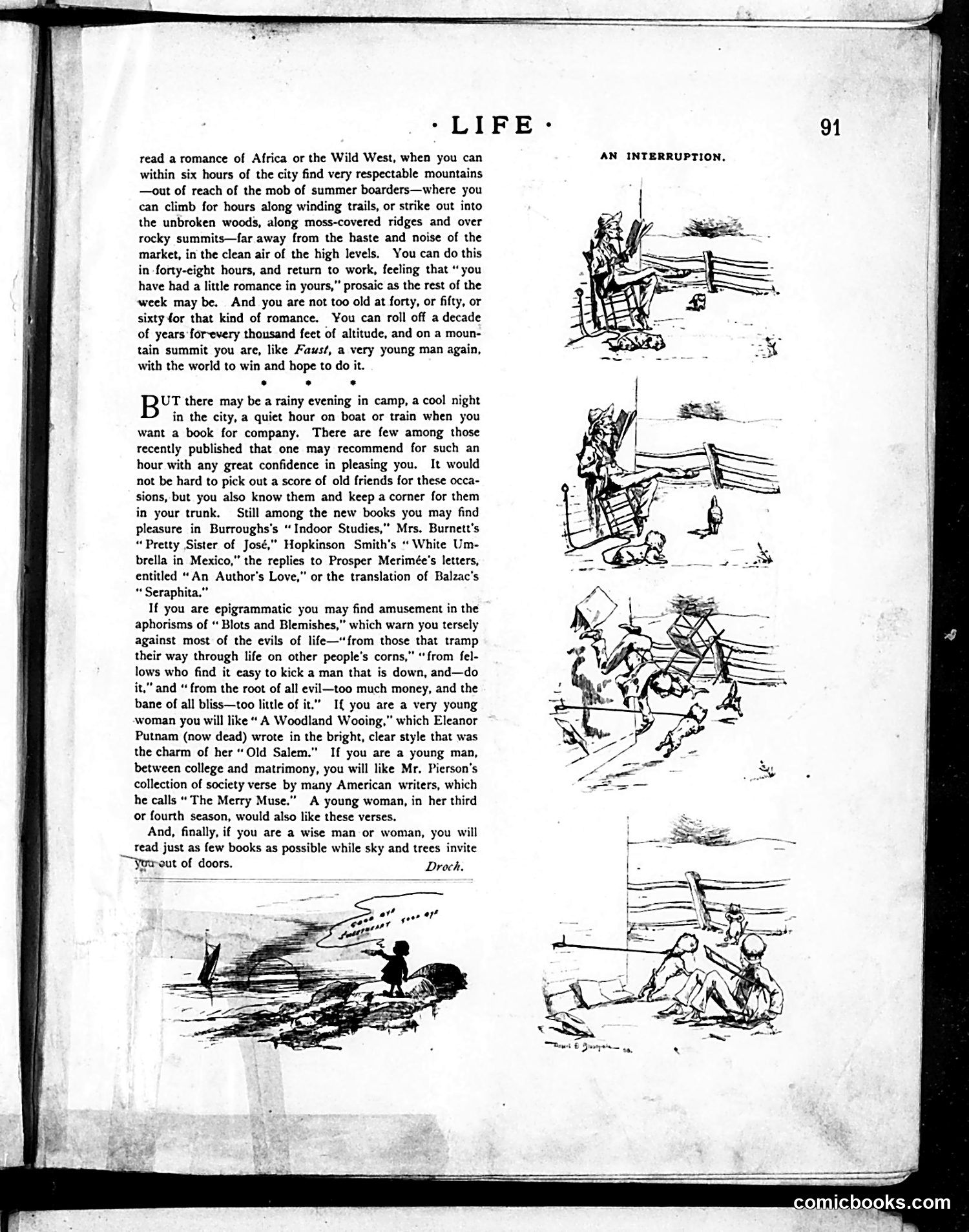
This page features a series of four comic illustrations titled "An Interruption," depicting camping or outdoor scenes. The sketches show progressively more chaotic situations at what appears to be a campsite with a tent. The humor appears to stem from the escalating disruption of a peaceful camping experience—likely showing someone's outdoor retreat being interrupted by increasingly absurd circumstances (possibly weather, animals, or other campers). The accompanying text discusses romantic getaways and book recommendations for leisure time, making the visual gag an ironic counterpoint: while the article suggests peaceful outdoor reading, the cartoons show camping going humorously wrong. The artist's signature appears to be present on the final illustration, though it's not entirely clear from this reproduction.
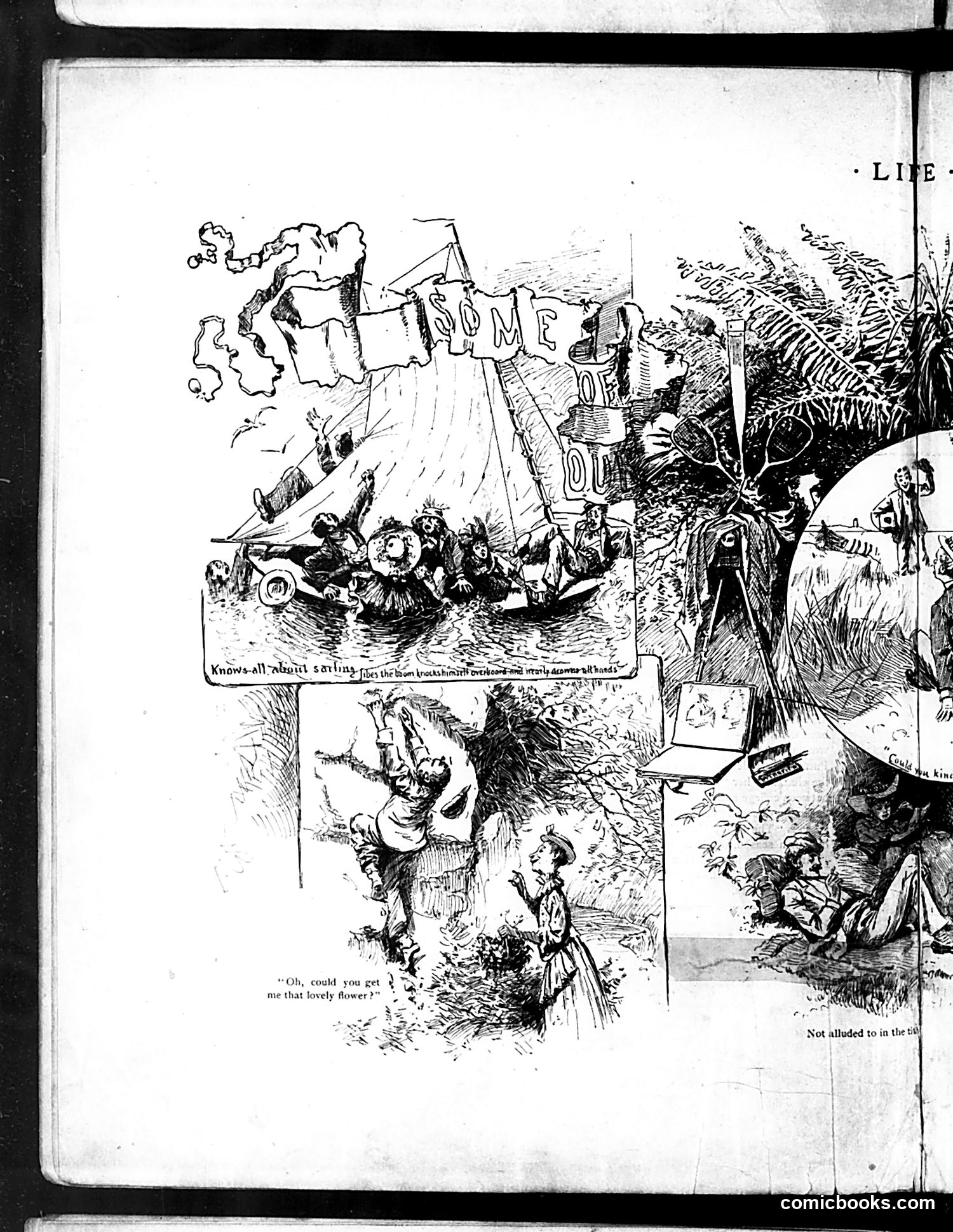
This page from *Life* magazine contains two satirical illustrations: **Top panel**: Shows a ship labeled "SOME" with passengers and a sail. The caption references "sailing" and mentions "boats beneath and around and simply drowns them all." **Bottom left**: A figure playing guitar to another figure, captioned "Oh, could you get me that lovely flower?" **Bottom right**: Appears to show figures by water, with partial caption "Not alluded to in the..." The overall theme suggests **social satire about leisure activities or romance**, typical of *Life's* humor. The nautical imagery in the top panel may reference voyage or travel metaphors common in period satire. However, without complete captions and clearer context about the publication date, I cannot definitively identify the specific political figures or events being satirized. The drawing style suggests early-to-mid 20th century.
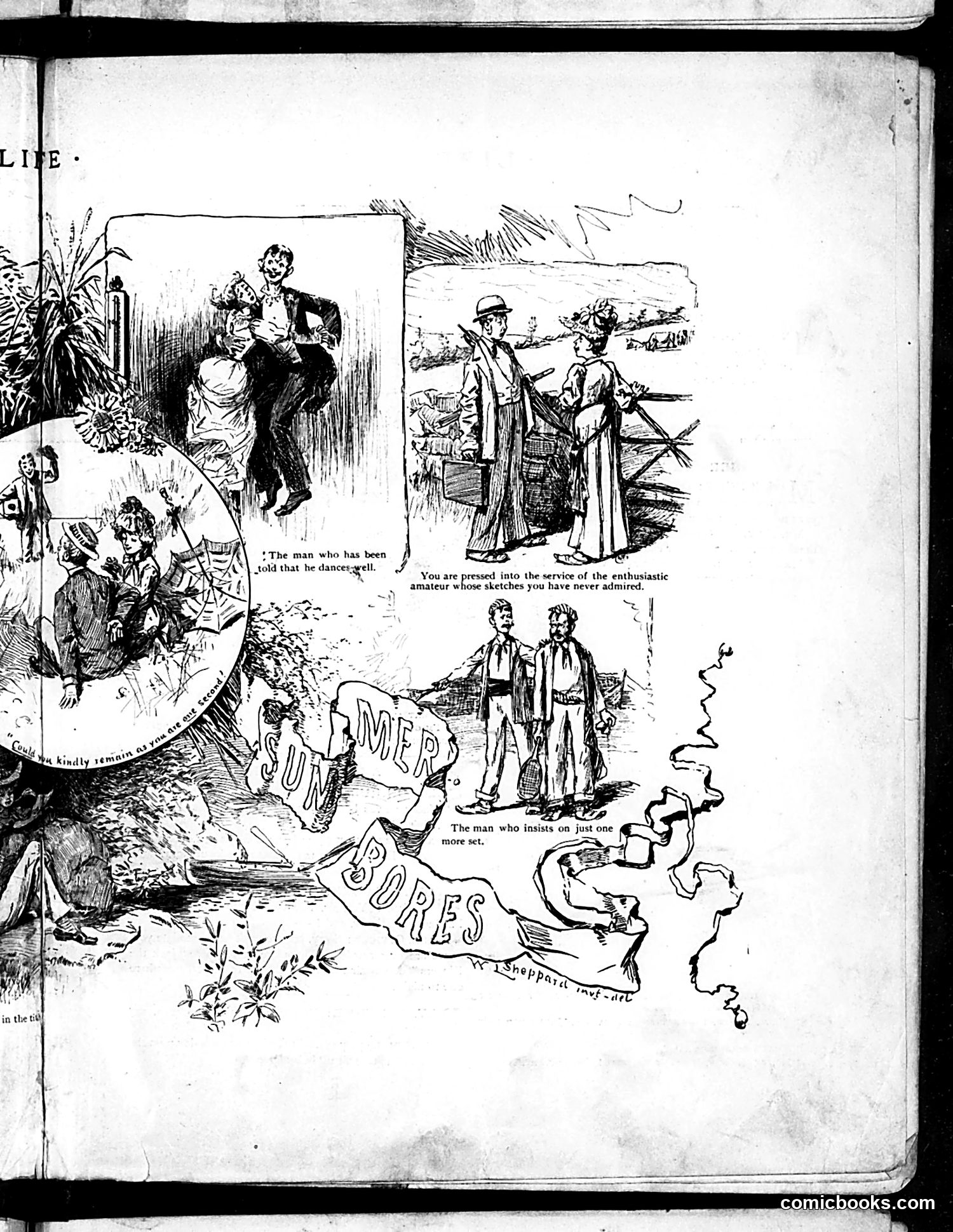
This page from *Life* magazine contains three related satirical vignettes about amateur artists and their social pretensions: 1. **Top left**: "The man who has been told that he dances well" — mocking someone who received one compliment and now considers themselves accomplished. 2. **Top right**: A scene showing someone being "pressed into the service of the enthusiastic amateur whose sketches you have never admired" — satirizing how amateur artists pressure friends to view their work. 3. **Bottom**: "The man who insists on just one more set" — depicting someone performing additional artistic pieces despite their audience's lack of enthusiasm. The cartoon satirizes the common social phenomenon of amateur artists who, emboldened by minimal praise or their own confidence, impose their mediocre work on unwilling audiences. It's gentle mockery of vanity and social awkwardness among aspiring creative people.
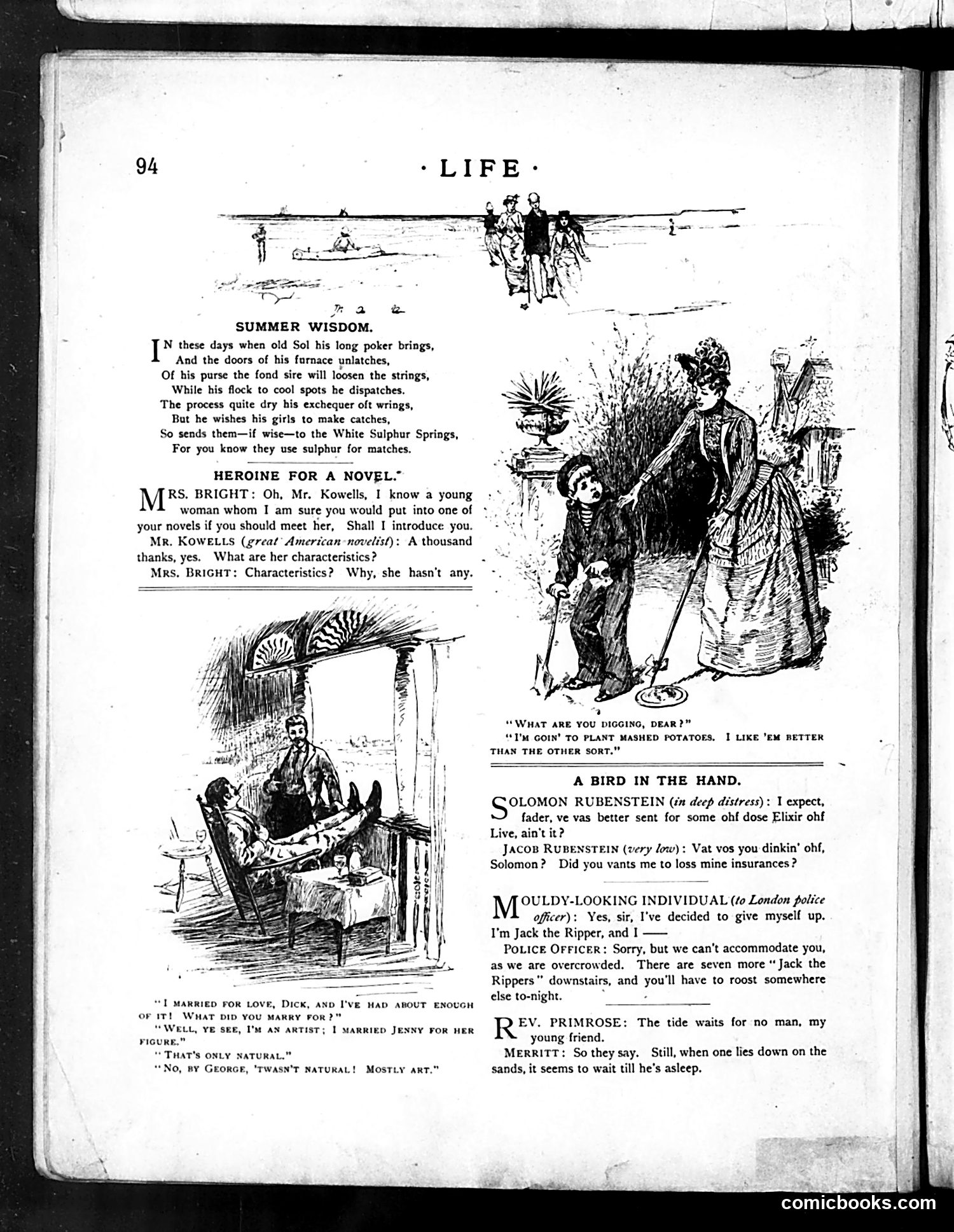
This page contains several humor pieces targeting early 20th-century social conventions: **"Summer Wisdom"** mocks wealthy men's seasonal behavior—their mistresses replace their wives during summer, while they send their wives to sulfur springs (a health resort), supposedly for medicinal reasons. **"Heroine for a Novel"** presents a conversation where Mr. Knowells asks Mrs. Bright to suggest a female character for his novel. She refuses because the woman has "no characteristics"—a joke about her being vapid and generic. **"A Bird in the Hand"** and the bottom dialogue mock class pretension and social climbing, with characters discussing marriage motivations and identity deceptions. The cartoons use ink sketches depicting period clothing and domestic/social settings to satirize marriage, wealth, and class aspirations among early 20th-century Americans.
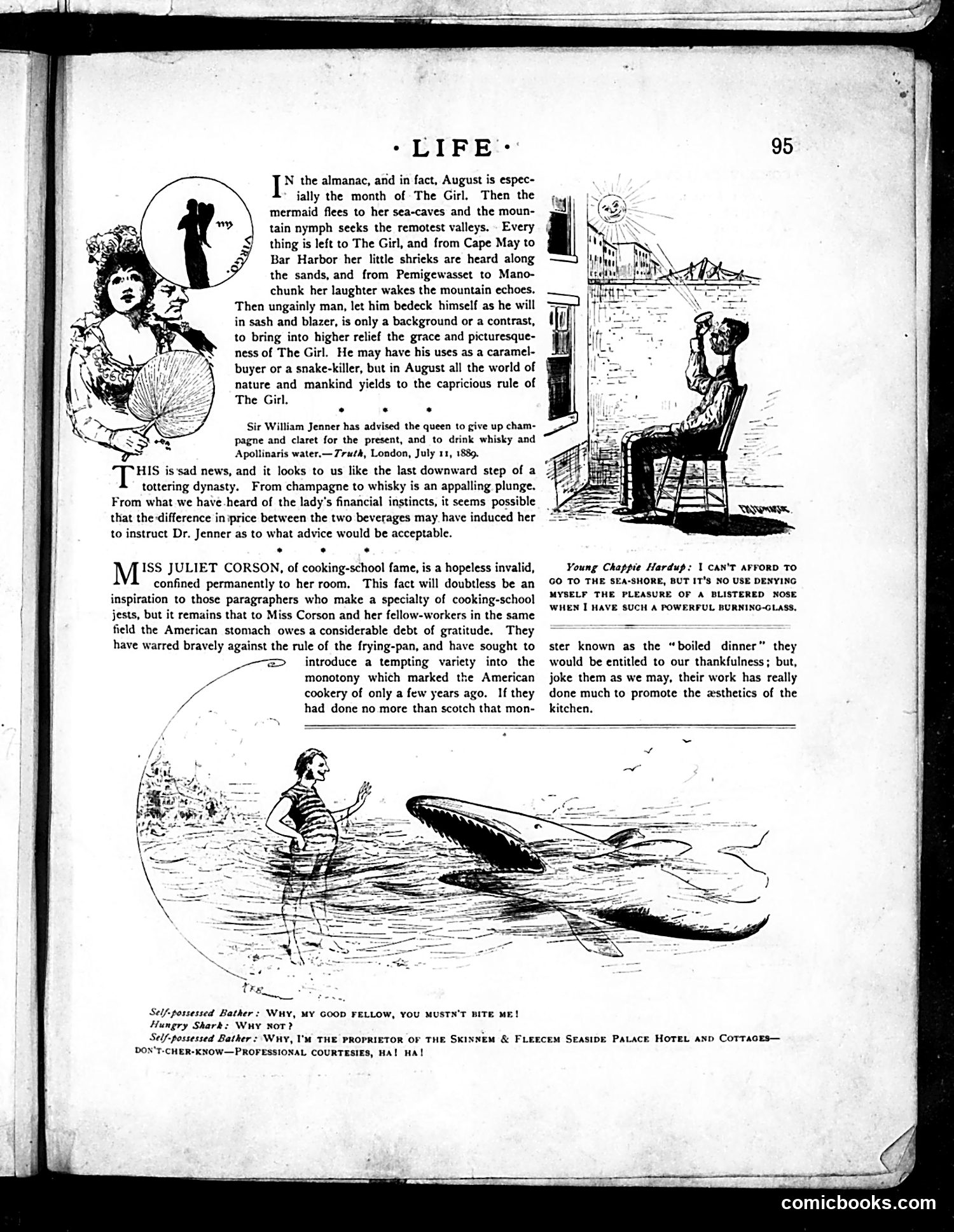
This page contains two separate satirical pieces about summer leisure and social pretension. **Top section** discusses "The Girl"—likely a popular cultural figure or type—whose presence supposedly dominates August in New England resort areas. The text mocks how nature and human activity supposedly yield to her capricious rule. A quote from Sir William Jenner advises the Queen to abandon champagne for whisky, satirizing concerns about aristocratic excess and health. **Bottom section** praises Miss Juliet Corson, a real cooking-school educator, for improving American culinary standards. The accompanying cartoon depicts a comical encounter between a self-satisfied barber and a hungry shark at the seaside, suggesting pretension meets reality. The barber's boasting about his hotel is interrupted by the shark's indifference. The overall theme: mocking social vanity and class affectation through humor.
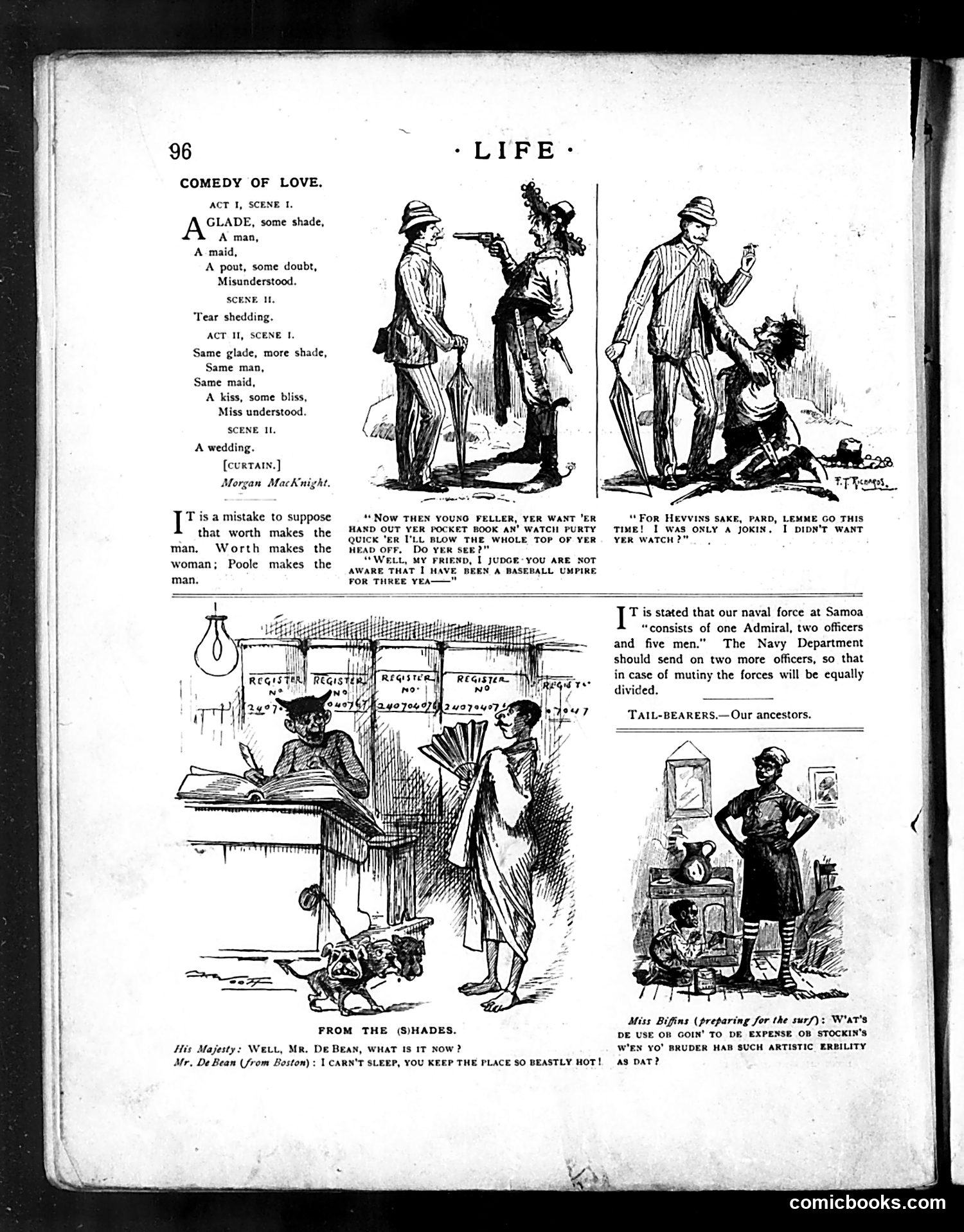
This page contains multiple humorous sketches lampooning romantic and social situations of the era. **"Comedy of Love"** (top): A satirical playlet by Morgan MacKnight mocking romantic conventions—showing how love progresses from misunderstanding to tears to kisses to marriage, with a cynical closing line that "Worth makes the woman; Poole makes the man" (likely referencing a contemporary tailor or fashion figure). **The gun-robbery sketches** (middle): Two parallel scenes where a robber threatens victims with a gun, but misunderstandings arise—one victim thinks it's a joke about baseball umpires; another thinks the robber wants his watch rather than his money. **"From the Shades"** (lower left): A brief domestic joke about a Bostonian guest complaining the room is too hot. **Samoa naval joke**: A brief editorial comment about inadequate naval forces. **"Tail-Bearers"** (right): A sketch mocking artistic pretension, suggesting an African American woman prepares to pose for expensive portraits rather than pay for them herself. The humor reflects period attitudes and social stereotypes typical of 1890s American satirical magazines.
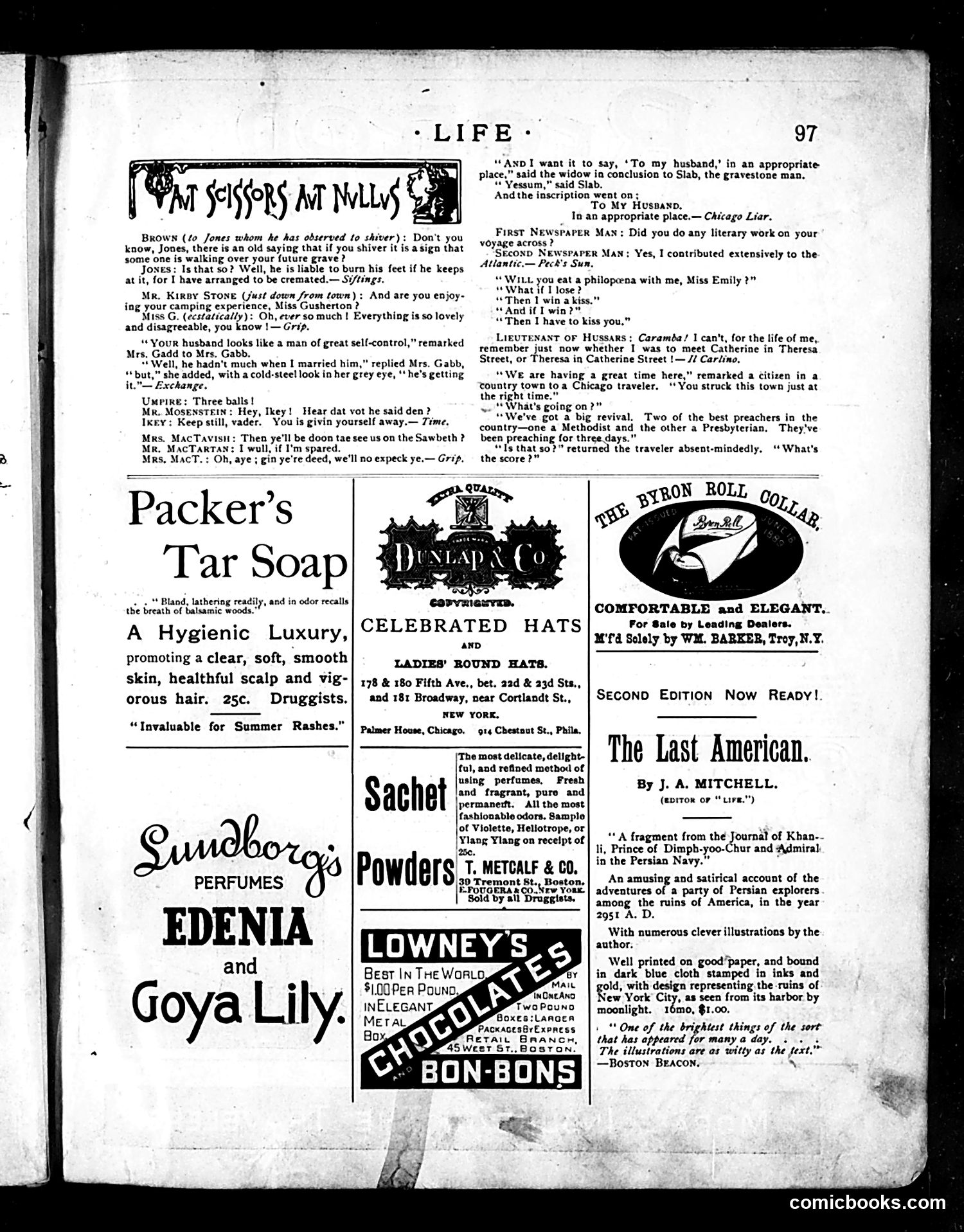
This page combines short satirical jokes with period advertisements. The humor pieces mock contemporary social pretensions and ethnic stereotypes typical of late 19th/early 20th-century American comedy. The jokes include: a man's dark joke about being cremated; a woman praising camping as "lovely and disagreeable"; a husband gaining "self-control" through marriage; and ethnic dialect humor featuring Jewish and Scottish characters. One joke satirizes religious revival meetings, with a traveler asking "What's the score?" as if a revival were a sporting competition. The advertisements promote luxury goods—Packer's Tar Soap, perfumes (Edenia, Goya Lily), hats, chocolates, and a book called "The Last American" depicting Persian explorers discovering America's ruins in 2951 A.D.—reflecting upper-middle-class consumer culture of the era.
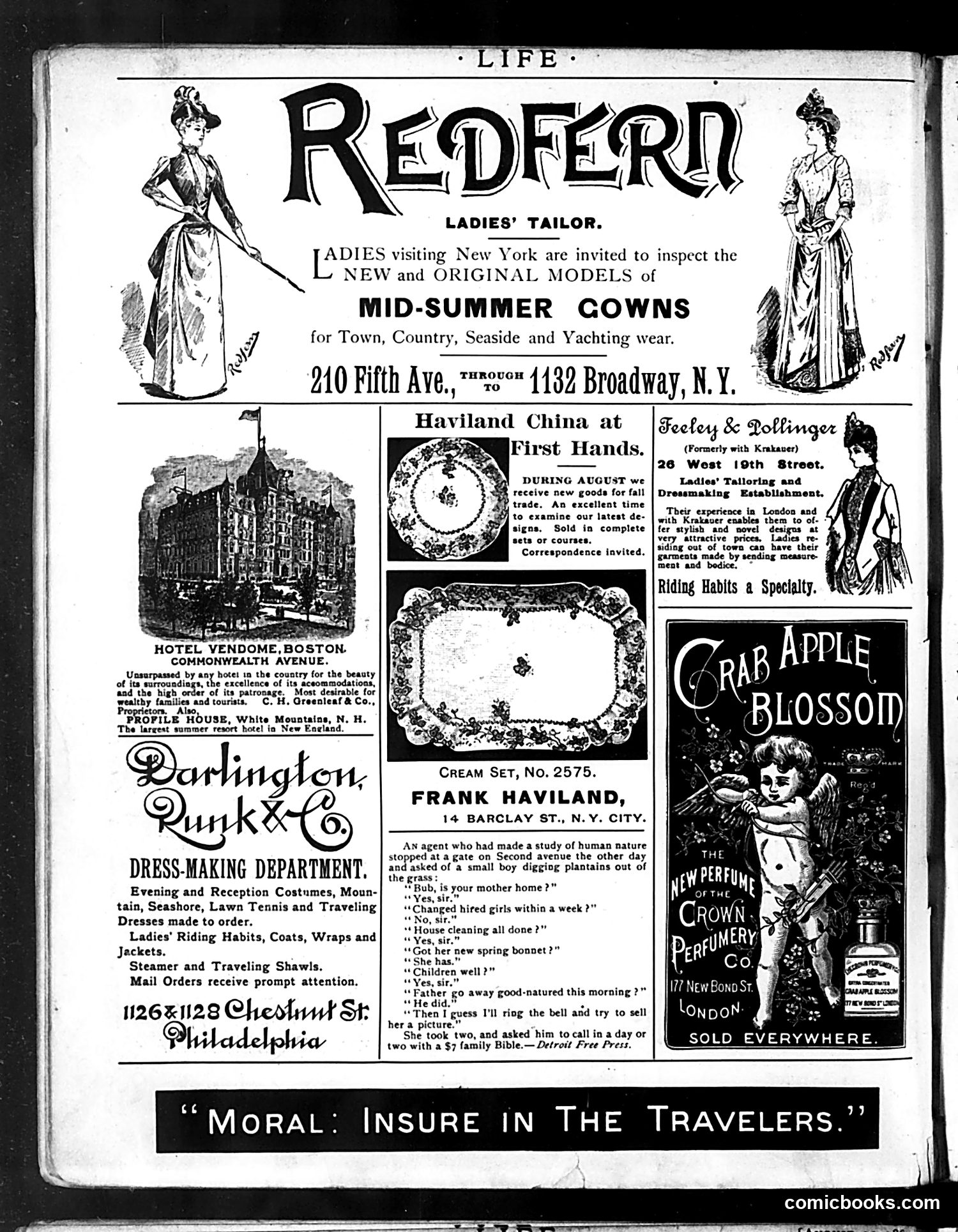
This page is primarily **advertising**, not political satire. It showcases late 19th/early 20th-century commercial establishments: **Main Content:** The "Redfern" advertisement dominates—a prestigious ladies' tailor advertising mid-summer gowns for various social occasions (town, country, seaside, yachting wear). **Supporting Ads Include:** - Hotel Vendome (Boston) and Profile House (White Mountains resort hotels) - Haviland China - Foeley & Pollinger (ladies' tailoring and dressmaking) - Darlington dress-making department - Crab Apple Blossom perfume **The Only Comic Element:** A brief anecdote by Frank Haviland about a door-to-door insurance salesman attempting to sell policies by asking a series of leading questions about household chaos, concluding he'll return with a $7 family Bible. The joke implies the family's disorganized state proves their need for insurance. **Bottom Line:** "Moral: Insure in The Travelers"—a transparent advertisement masquerading as humor. The page reflects period consumer culture and marketing tactics rather than political commentary.
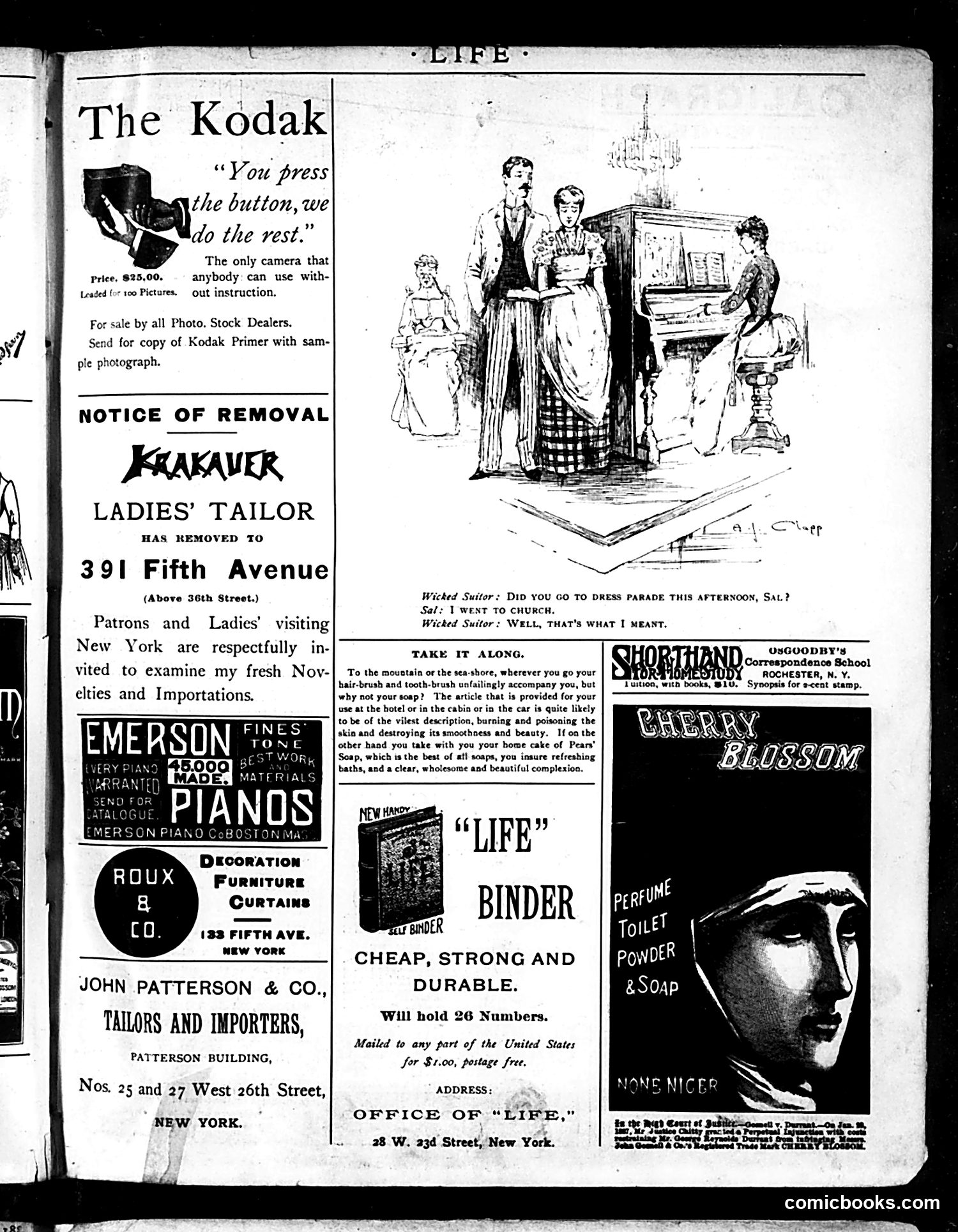
This page contains mostly **advertising** (Kodak cameras, pianos, tailoring services, soap) with one brief **cartoon joke** about courtship norms. ## The Cartoon The small comic sketch depicts a young woman named "Sal" and a "wicked suitor." He jokingly conflates "dress parade" (a military gathering where young men gathered) with church attendance—implying both are the same occasion because unmarried women were chaperoned and socialized at military parades, just as at church. Her complaint that he equates church with a parade for meeting girls is the joke—he's crudely suggesting military gatherings were primarily venues for courting, not civic events. The humor relies on mocking the suitor's transparent dating strategy. ## Context This reflects early-1900s anxieties about courtship and the limited, chaperoned social spaces where young men and women could meet—both religious and quasi-military settings being "respectable" backdrops for romance. The rest of the page is commercial advertising typical of Life's era.
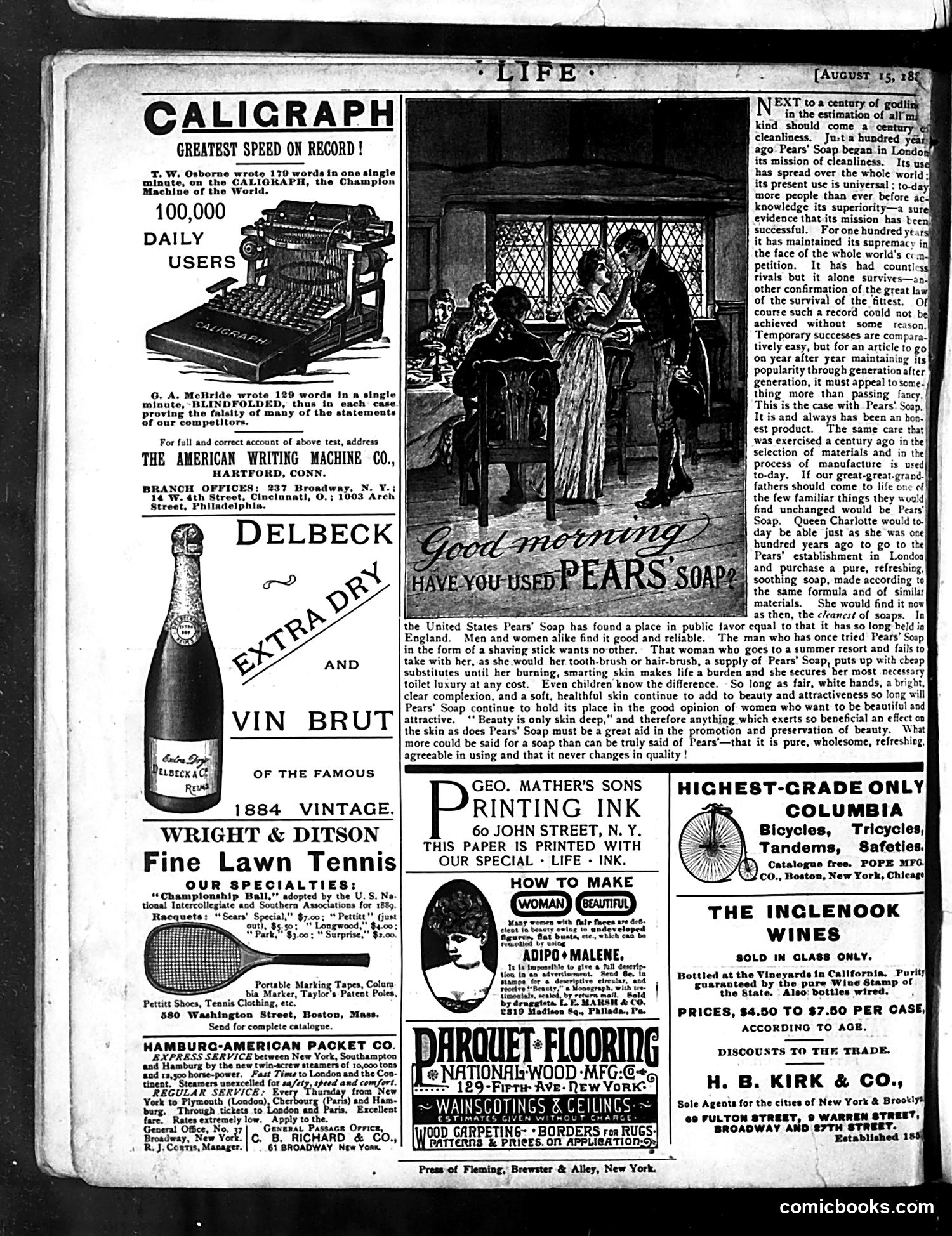
This page is primarily **advertising**, not political satire. It contains multiple product advertisements typical of the 1880s: **Main content:** The Caligraph typewriter claims speed records (179 words per minute), competing with other early writing machines. This reflects the emerging office technology market of the era. **Other advertisements** include: - Delbeck champagne (1884 vintage) - Wright & Ditson tennis equipment - Hamburg-American steamship line - Pears' Soap (with extensive copy emphasizing 100-year tradition and purity) - Various other consumer goods **The Pears' Soap ad** is notable for using "survival of the fittest" rhetoric—a popular 19th-century concept—to claim the product's superiority through longevity, positioning it against "countless rivals." There are **no political cartoons** on this page. The "Good Morning" illustration accompanying Pears' Soap is purely decorative advertising imagery, not satire. This appears to be a commercial issue focused on consumer goods marketing.