
Life, 1889-08-15 · page 4 of 16
Life — August 15, 1889 — page 4: what you’re looking at
What you’re looking at
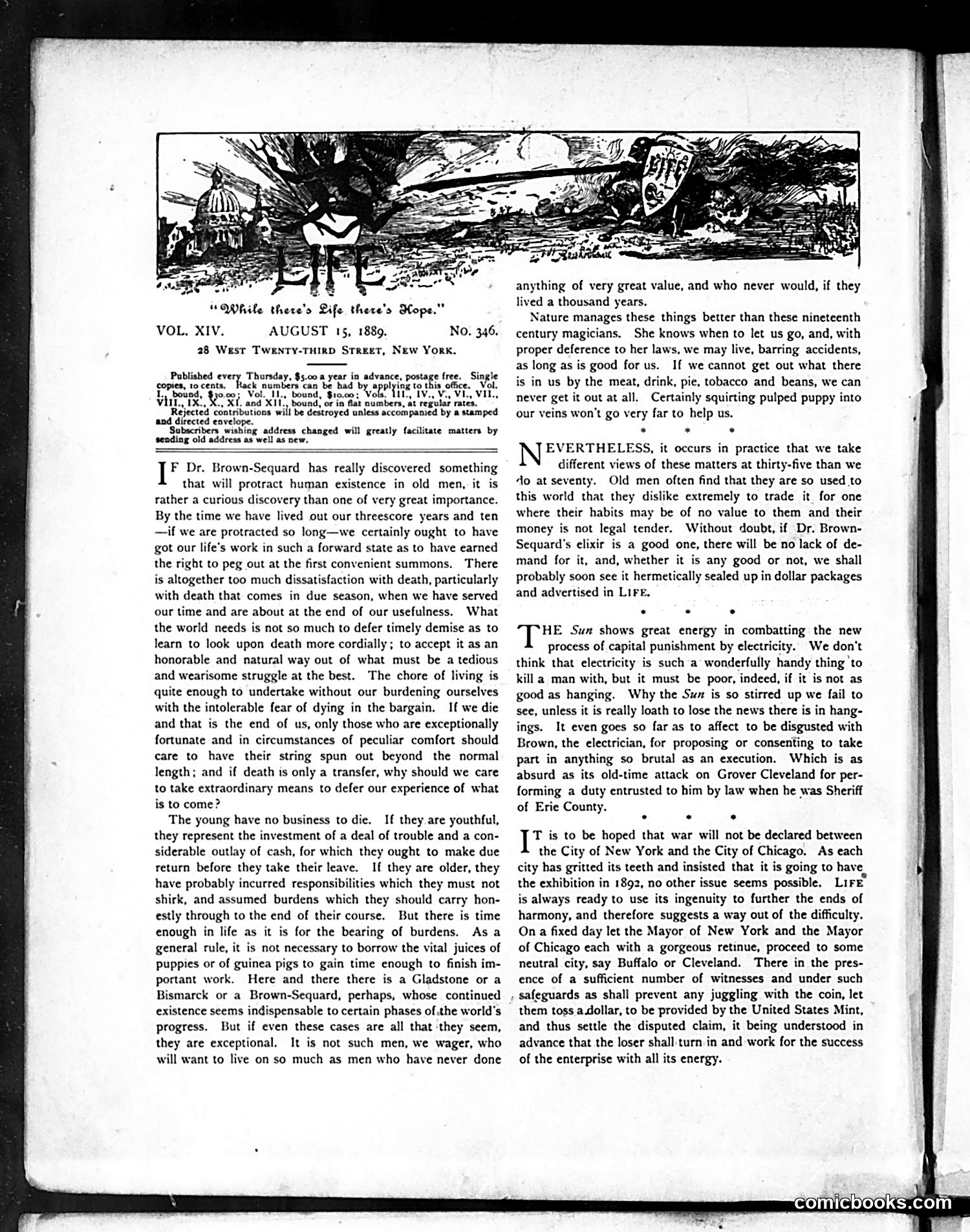
The cartoon titled "While there's Life there's Hops" appears at top left but is too small to read details clearly. The page is primarily editorial text discussing mortality and longevity in aging men, referencing Dr. Brown-Sequard's claimed discovery of life-extension treatments. The text also discusses capital punishment by electricity (a contemporary controversy), mocking the *Sun* newspaper's opposition to electrocution as "brutal" while defending it as modern progress. A final section proposes settling a rivalry between New York and Chicago by hosting the 1893 World's Fair in a "neutral city" like Buffalo or Cleveland instead—political satire about urban competition during the Gilded Age. The content reflects 1889 preoccupations: life extension, new execution methods, and inter-city rivalry.
📄 Transcribed text from this page (OCR, searchable)
Machine-transcribed from the original scan — historical spelling and the odd misread are preserved.
“WMhile there's Life there's Hope.” VOL. XIV. AUGUST 15, 1889, No. 346. 28 West Twenty-THirp Street, New York, Published every Thursday, $5.00 a year in advance, postage free. Single copies, ro cents, Rack numbers can be had by applying to this office, Vol. Ly bound. $yoe; Vol. II. bound, $ro.eo: vob {tis TV., Va Vie Vile, VIII, 1X. XT. and X11-, bound, or in fat numbers, at regular rates. Rejected contributions will be destroyed unless accompanied by a stamped and directed envelope. Subscribers wishing address changed will greatly facilitate matters by sending old address as well as new. F Dr. Brown-Sequard has really discovered something that will protract human existence in old men, it is rather a curious discovery than one of very great importance. By the time we have lived out our threescore years and ten —if we are protracted so long—we certainly ought to have got our life's work in such a forward state as to have earned the right to peg out at the first convenient summons. There is altogether too much dissatisfaction with death, particularly with death that comes in due season, when we have served our time and are about at the end of our usefulness. What the world needs is not so much to defer timely demise as to learn to look upon death more cordially; to accept it as an honorable and natural way out of what must be a tedious and wearisome struggle at the best. The chore of living is quite enough to undertake without our burdening ourselves with the intolerable fear of dying in the bargain. If we die and that is the end of us, only those who are exceptionally fortunate and in circumstances of peculiar comfort should care to have their string spun out beyond the normal length; and if death is only a transfer, why should we care to take extraordinary means to defer our experience of what is to come? The young have no business to die. If they are youthful, they represent the investment of a deal of trouble and a con- siderable outlay of cash, for which they ought to make due return before they take their leave. If they are older, they have probably incurred responsibilities which they must not shirk, and assumed burdens which they should carry hon- estly through to the end of their course. But there is time enough in life as it is for the bearing of burdens. As a general rule, it is not necessary to borrow the vital juices of puppies or of guinea pigs to gain time enough to finish im- portant work. Here and there there is a Gladstone or a Bismarck or a Brown-Sequard, perhaps, whose continued existence seems indispensable to certain phases ofthe world’s progress. But if even these cases are all that they seem, they are exceptional. It is not such men, we wager, who will want to live on so much as men who have never done anything of very great value, and who never would, if they lived a thousand years. Nature manages these things better than these nineteenth century magicians. She knows when to let us go, and, with proper deference to her laws, we may live, barring accidents, as long as is good for us. If we cannot get out what there is in us by the meat, drink, pie, tobacco and beans, we can never get it out at all. Certainly squirting pulped puppy into our veins won't go very far to help us. . * . EVERTHELESS, it occurs in practice that we take different views of these matters at thirty-five than we do at seventy. Old men often find that they are so used to this world that they dislike extremely to trade it for one where their habits may be of no value to them and their money is not legal tender. Without doubt, if Dr. Brown- Sequard’s elixir is a good one, there will be no lack of de- mand for it, and, whether it is any good or not, we shall probably soon see it hermetically sealed up in dollar packages and advertised in LIFE. HE Sun shows great energy in combatting the new process of capital punishment by electricity. We don't think that electricity is such a wonderfully handy thing 'to kill a man with, but it must be poor, indeed, if it is not as good as hanging. Why the Sux is so stirred up we fail to see, unless it is really loath to lose the news there is in hang- ings. It even goes so far as to affect to be disgusted with Brown, the electrician, for proposing or consenting to take part in anything so brutal as an execution, Which is as absurd as its old-time attack on Grover Cleveland for per- forming a duty entrusted to him by law when he was Sheriff of Erie County. . . T is to be hoped that war will not be declared between the City of New York and the City of Chicago. As each city has gritted its teeth and insisted that it is going to have the exhibition in 1892, no other issue seems possible. LIFE is always ready to use its ingenuity to further the ends of harmony, and therefore suggests a way out of the difficulty. On a fixed day let the Mayor of New York and the Mayor of Chicago each with a gorgeous retinue, proceed to some neutral city, say Buffalo or Cleveland. There in the pres- ence of a sufficient number of witnesses and under such , safeguards as shall prevent any juggling with the coin, let them toss a.dollar, to be provided by the United States Mint, and thus settle the disputed claim, it being understood in advance that the loser shall turn in and work for the success of the enterprise with all its energy.