
A complete issue · 16 pages · 1889
Life — June 13, 1889
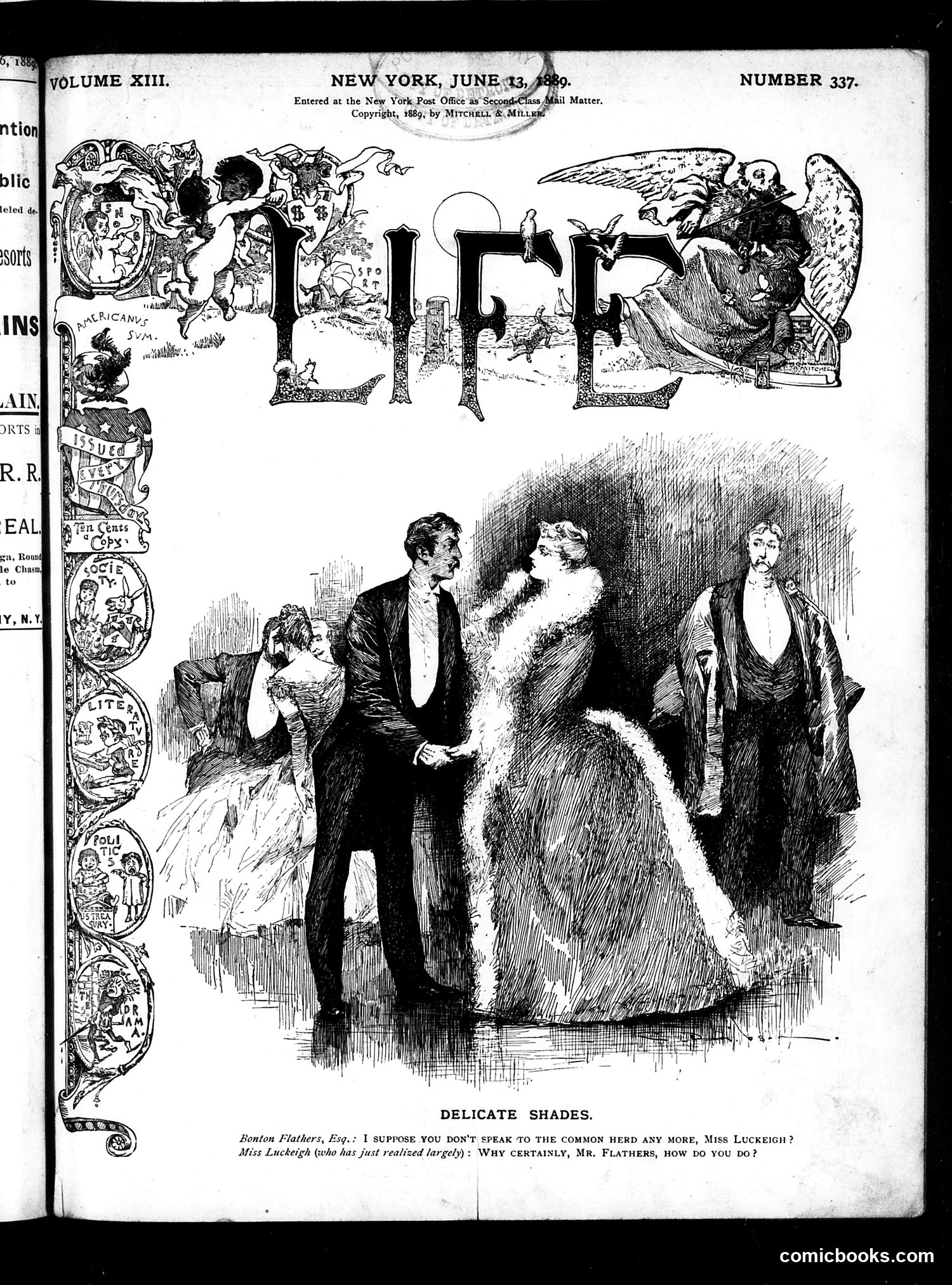
This cartoon satirizes social hypocrisy among the upper classes. The scene depicts a gentleman (Boston Flathers) encountering a woman of questionable reputation (Miss Luckeigh) at what appears to be a formal social gathering. The joke centers on social pretense: Flathers claims he no longer speaks to "the common herd," yet he encounters Miss Luckeigh—apparently someone he previously associated with but now must acknowledge in public. Her response, "Why certainly, Mr. Flathers, how do you do?"—delivered with pointed politeness—exposes his snobbishness as hollow. The title "Delicate Shades" references the carefully maintained social distinctions among the wealthy, while the cartoon mocks how fragile and ridiculous these class boundaries actually are.
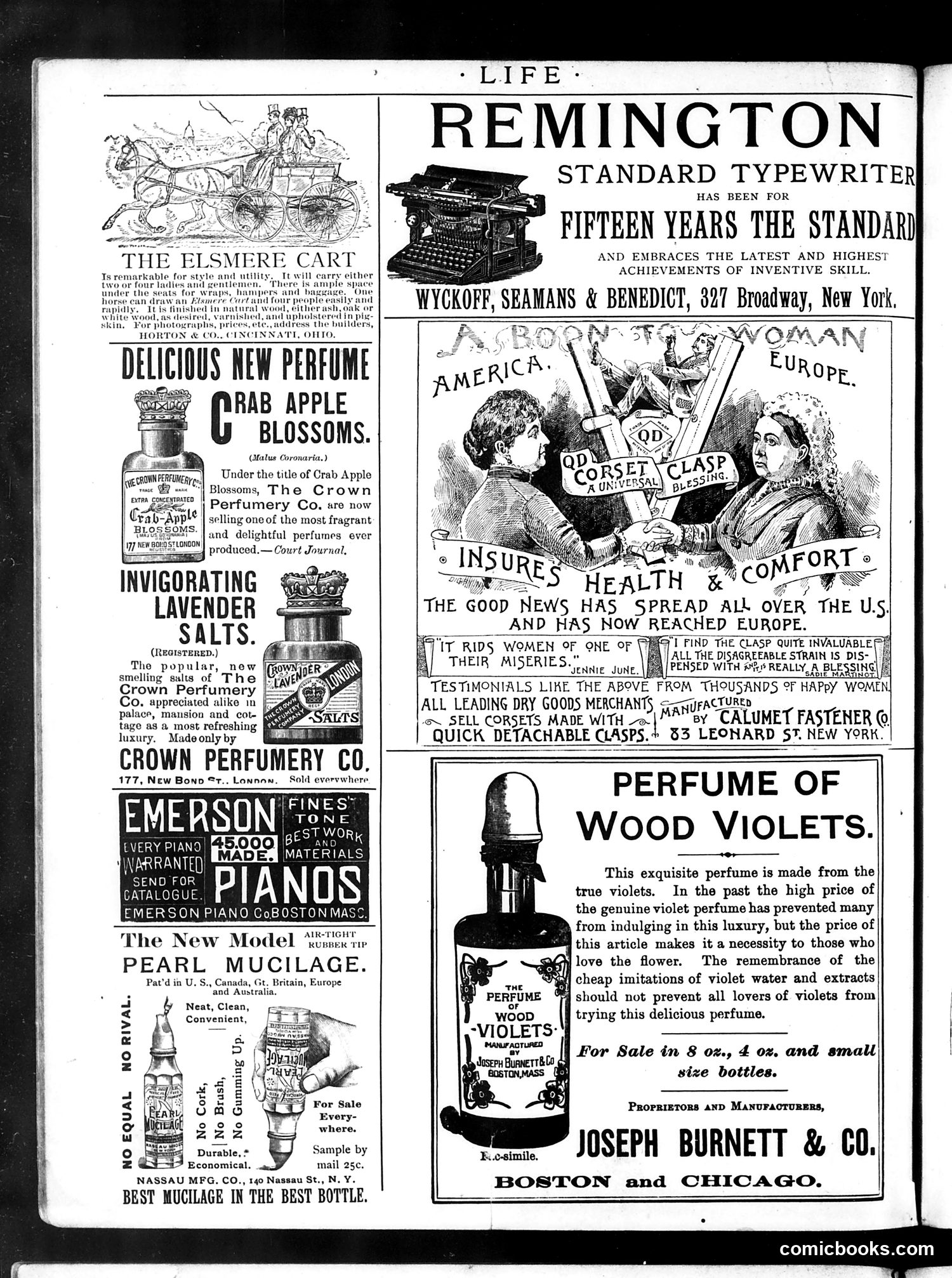
This page is primarily **advertisements** for consumer goods (perfumes, typewriters, pianos, corset fasteners) typical of early 20th-century Life magazine. The one satirical element is the **"Corset Clasp" advertisement** (center-right), which depicts two women labeled "America" and "Europe" embracing via a mechanical clasp device. The joke appears to satirize commercial "solutions" to social problems—here, marketing a corset fastener as promoting international "health" and "comfort." The text ironically claims "the good news has spread all over the U.S. and has now reached Europe," mocking both consumer culture and the breathless marketing language of the era. The women's expressions suggest the absurdity of reducing complex international relations or women's welfare to a commercial product. The satire targets **excessive advertising claims** and the era's tendency to commercialize everything.
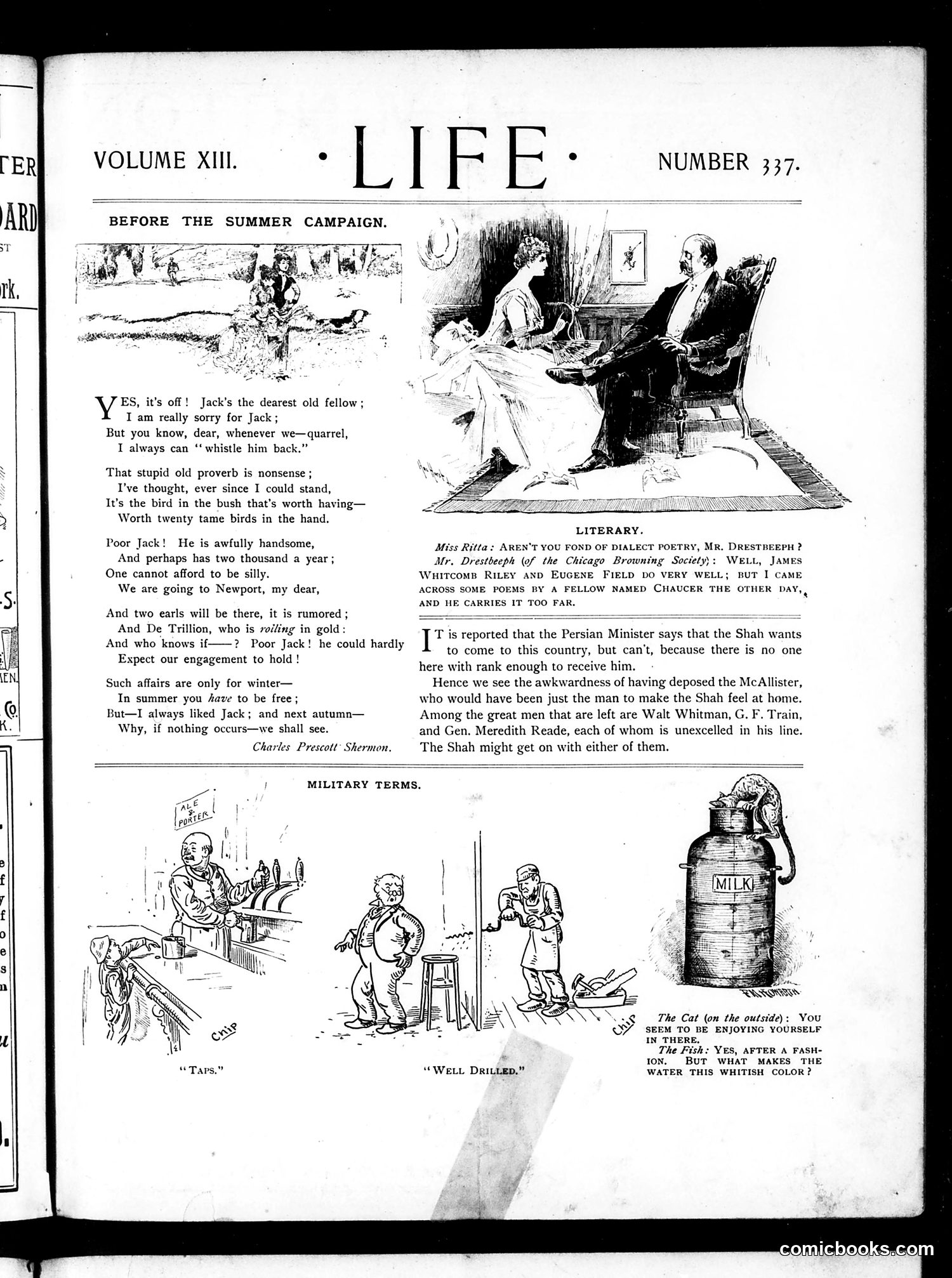
This page contains three satirical sections: **"Before the Summer Campaign"** (top): A poem by Charles Prescott Sherwood mocking someone named Jack—"the dearest old fellow"—who is poor but handsome. It references Newport society and suggests Jack will be "free" in summer to pursue romantic interests, implying working-class men were expected to accommodate wealthy women's seasonal social schedules. **"Literary"** (middle): A brief note about Persian diplomatic issues, mentioning the Shah's potential visit and criticizing the absence of suitable American officials like McAllister, Whitman, Reade, or Meredith to receive him. **"Military Terms"** (bottom): Three humorous military-themed cartoons labeled "Taps," "Well Drilled," and "The Cat (on the outside)," using military vocabulary as double entendre for everyday situations.
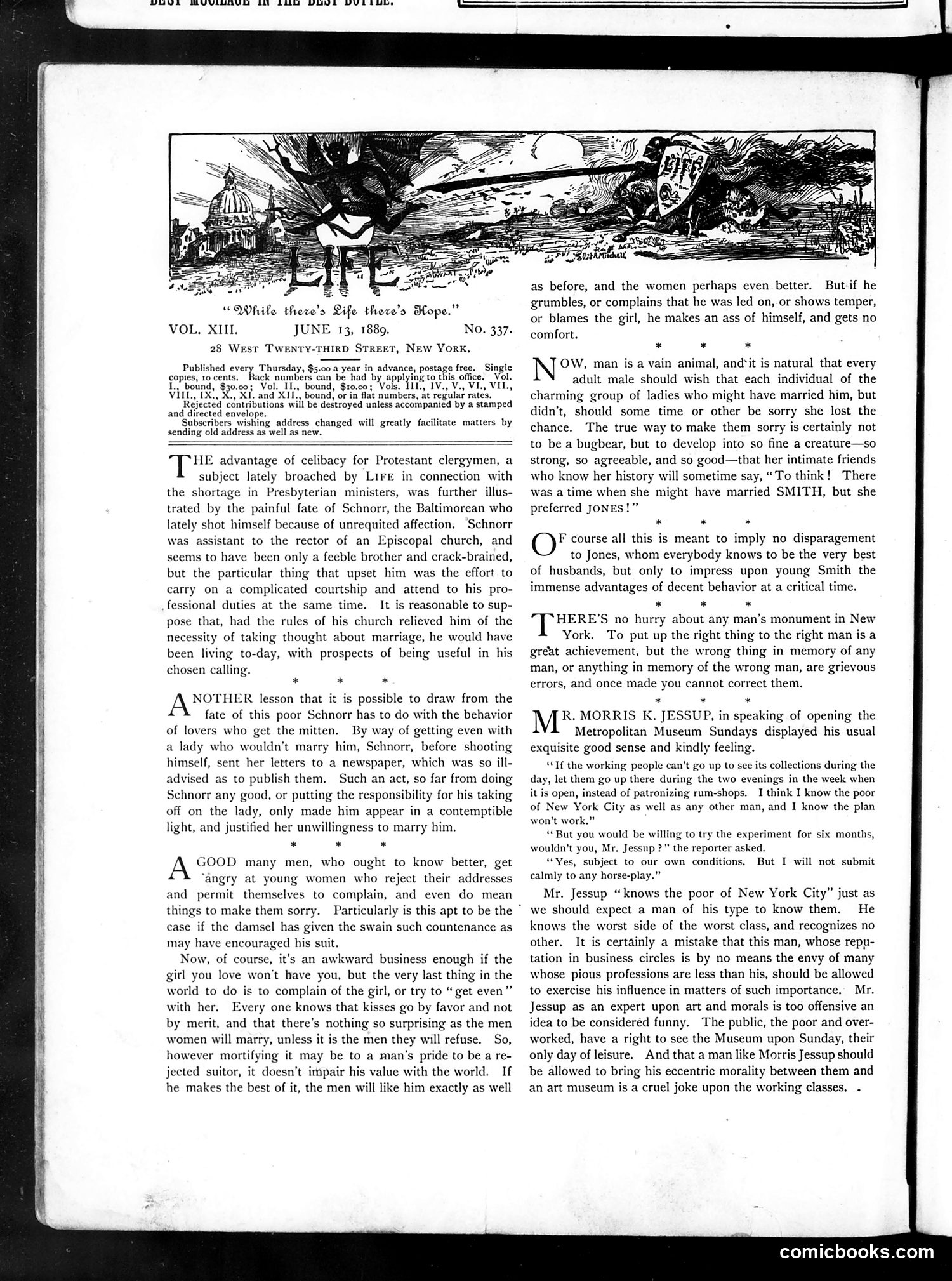
The masthead illustration depicts a cherub or cupid figure observing a landscape with a domed building (likely St. Paul's Cathedral, London), accompanied by the caption "While there's Life there's Hope." The page's article critiques celibacy rules for Protestant clergy—a contemporary church policy debate. It uses the cautionary tale of Schnorr, an Episcopal church assistant whose discreet courtship was exposed through newspaper letters, causing scandal. The satire targets male vanity and hypocrisy: men want romantic attention from women but punish women socially for reciprocating. The piece mocks society's double standards regarding courtship, suggesting men who complain about rejection while blaming women are simply preserving their own dignity through self-deception.
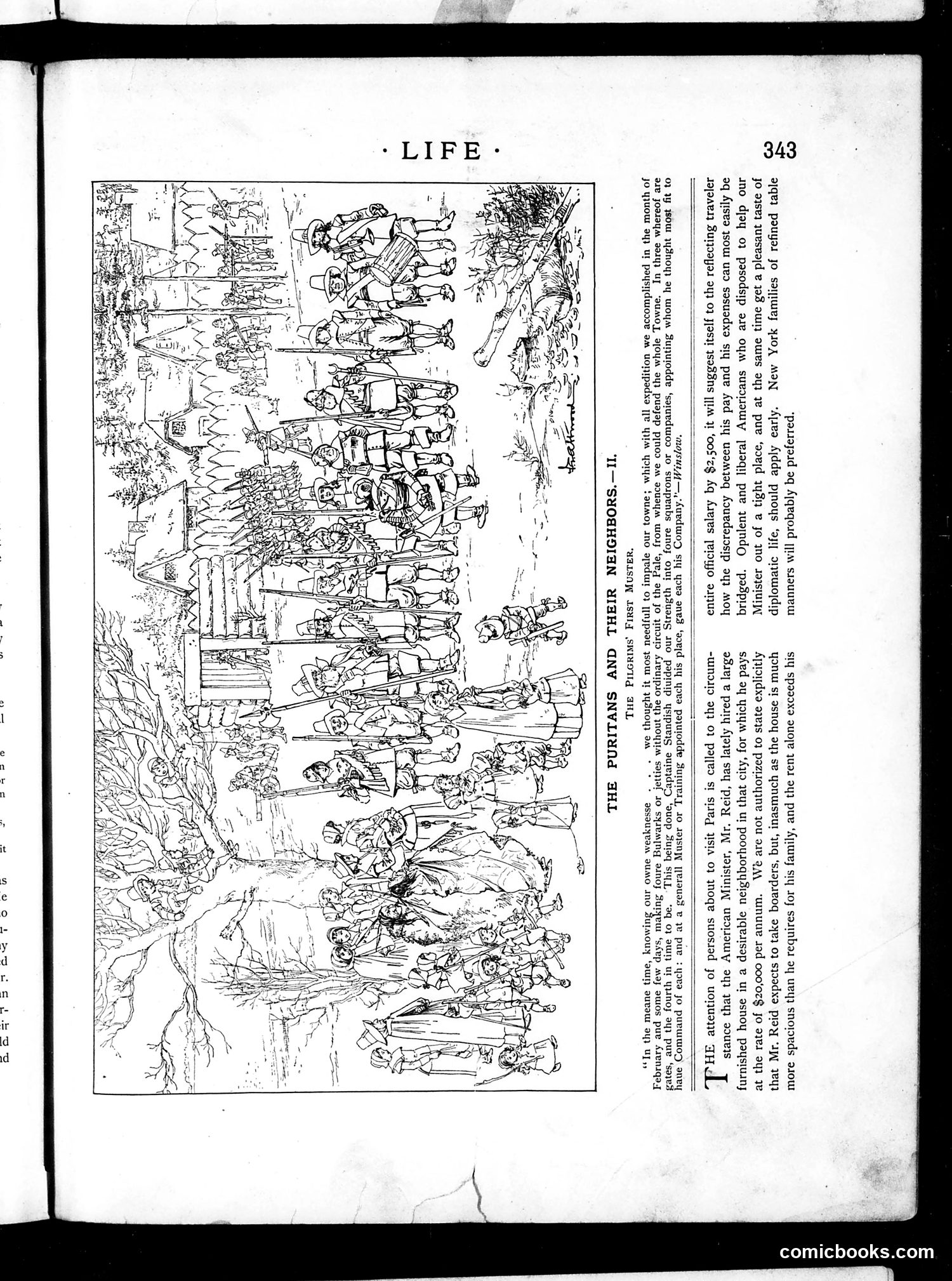
This satirical illustration depicts a large gathering of figures arranged in rows, appearing to show colonists or early American settlers. The title references "Puritans and their neighbors," suggesting a comparison between different groups in early American society. The accompanying text discusses how "the most knowing ones" wore accomplishment, and references conflicts between groups and displacement of Native Americans ("Opulent and bribbed"). The satire appears to critique the Puritans' self-righteousness and their treatment of others, including indigenous peoples and neighboring communities. The dense, crowded composition emphasizes the large numbers involved, while the formal arrangement suggests pomposity. Without clearer individual identifications, the cartoon's specific political targets remain somewhat unclear, though the general thrust criticizes Puritan hypocrisy regarding their actual moral conduct versus their stated principles.
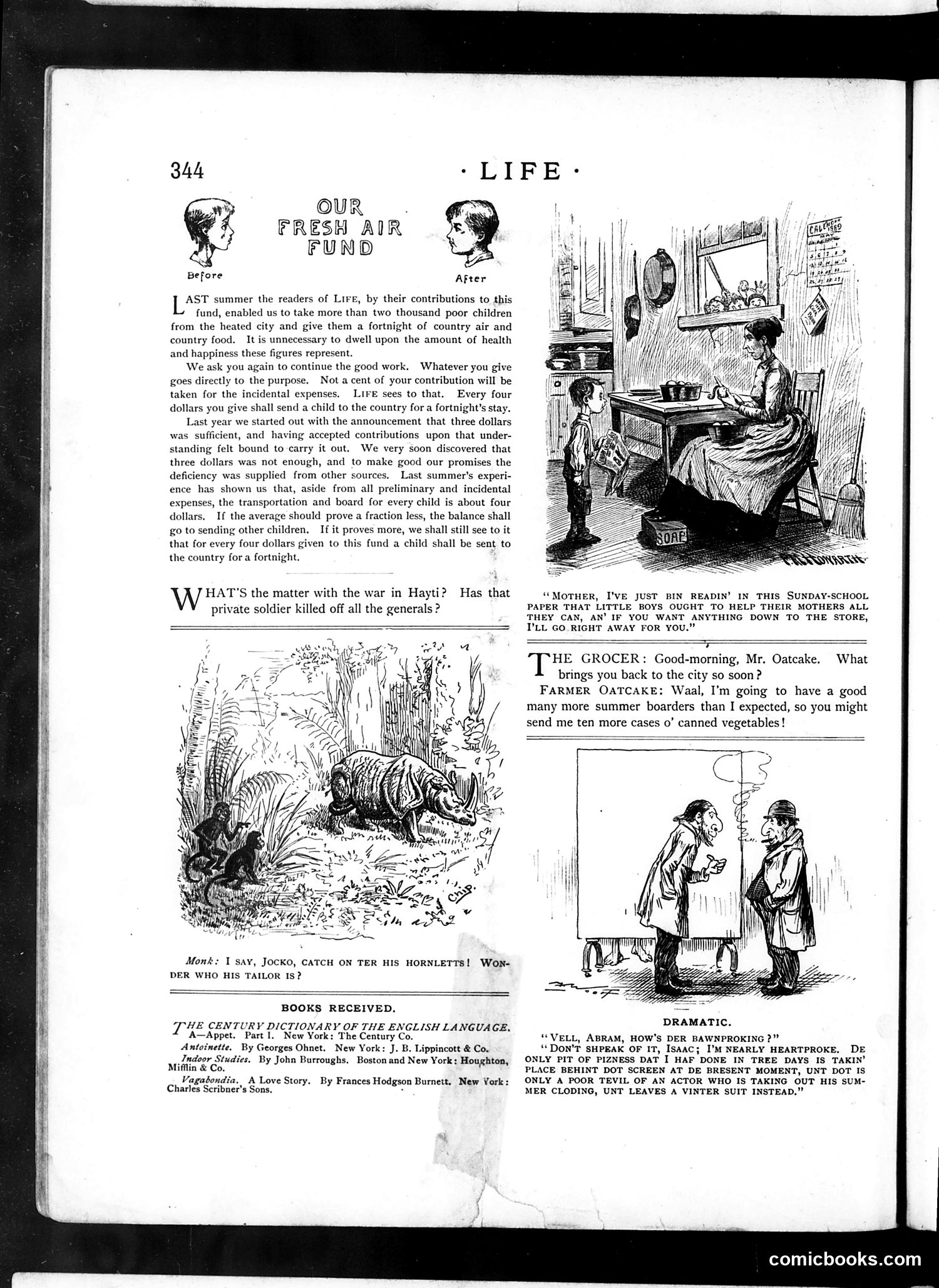
This page contains three distinct items: 1. **"Our Fresh Air Fund"** (top): An appeal for donations to send poor urban children to the countryside for health benefits. The "Before/After" illustrations show a sickly child transformed by country air. 2. **Haiti War Joke** (middle-left): A brief satirical comment on the war in Haiti, asking rhetorically whether a private soldier killed all the generals—likely mocking confused reporting or the complexity of the conflict. 3. **"Books Received" and "Dramatic" sections** (bottom): These are brief literary notices and a humorous dramatic dialogue between a grocer and farmer about summer boarders and canned vegetables—typical period humor about rural-urban commerce. The page reflects early 20th-century American concerns: urban poverty, colonial military involvement, and rural-urban cultural differences.
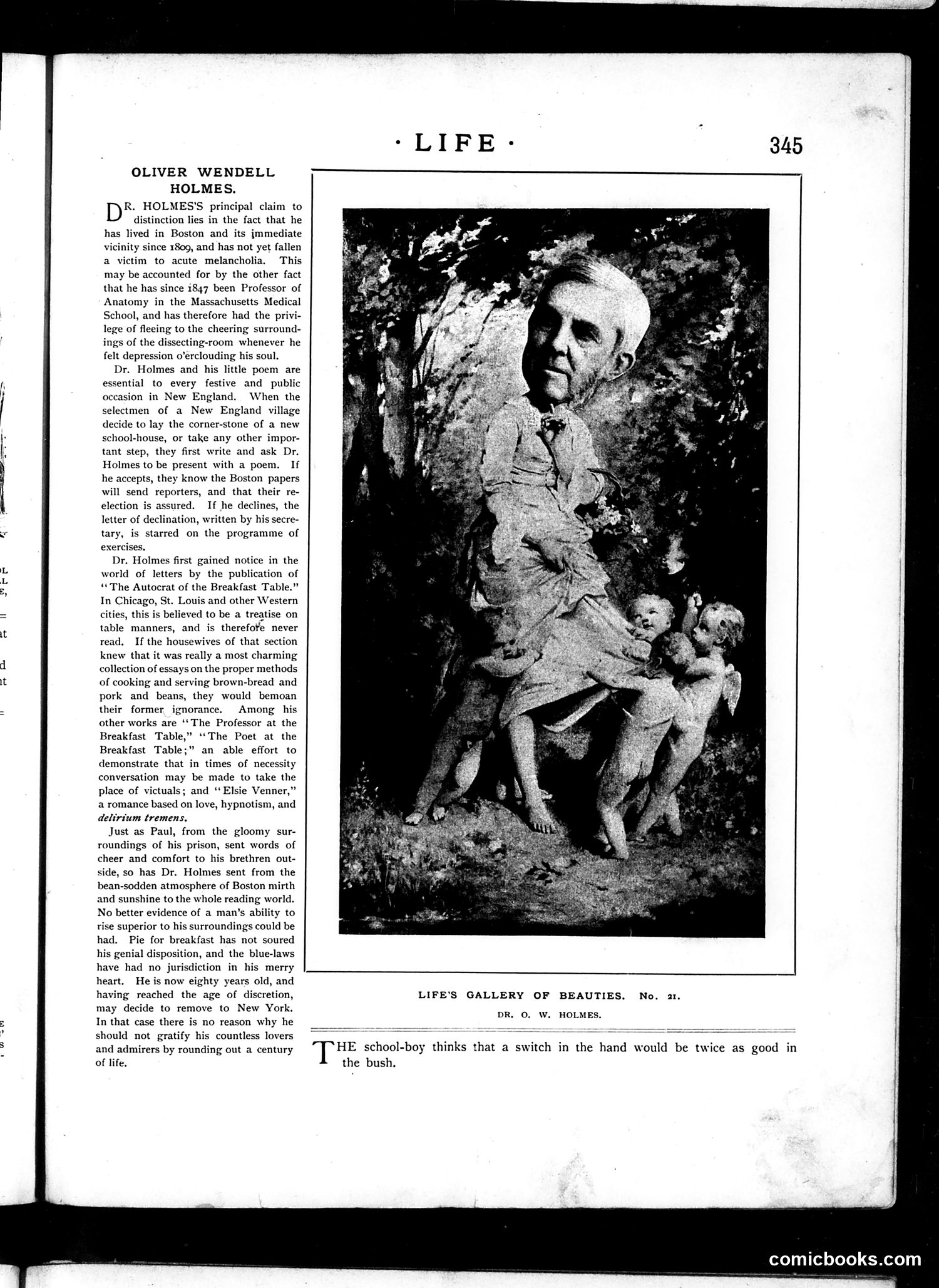
This page features a biographical sketch of Dr. Oliver Wendell Holmes, a prominent Boston physician and Professor of Anatomy at Massachusetts Medical School. The accompanying illustration is labeled "Life's Gallery of Beauties, No. 31: Dr. O. W. Holmes." The text celebrates Holmes's literary and social contributions to New England life, noting that his poetry and essays are essential to public occasions. It mentions his published work "The Autocrat of the Breakfast Table" and credits him with improving public understanding of cooking and serving methods. The illustration appears to be a portrait photograph of Holmes in his later years. At the bottom of the page is a humorous aphorism: "The school-boy thinks that a switch in the hand would be twice as good in the bush"—a playful inversion of the proverb "a bird in the hand is worth two in the bush," likely reflecting Holmes's wit.
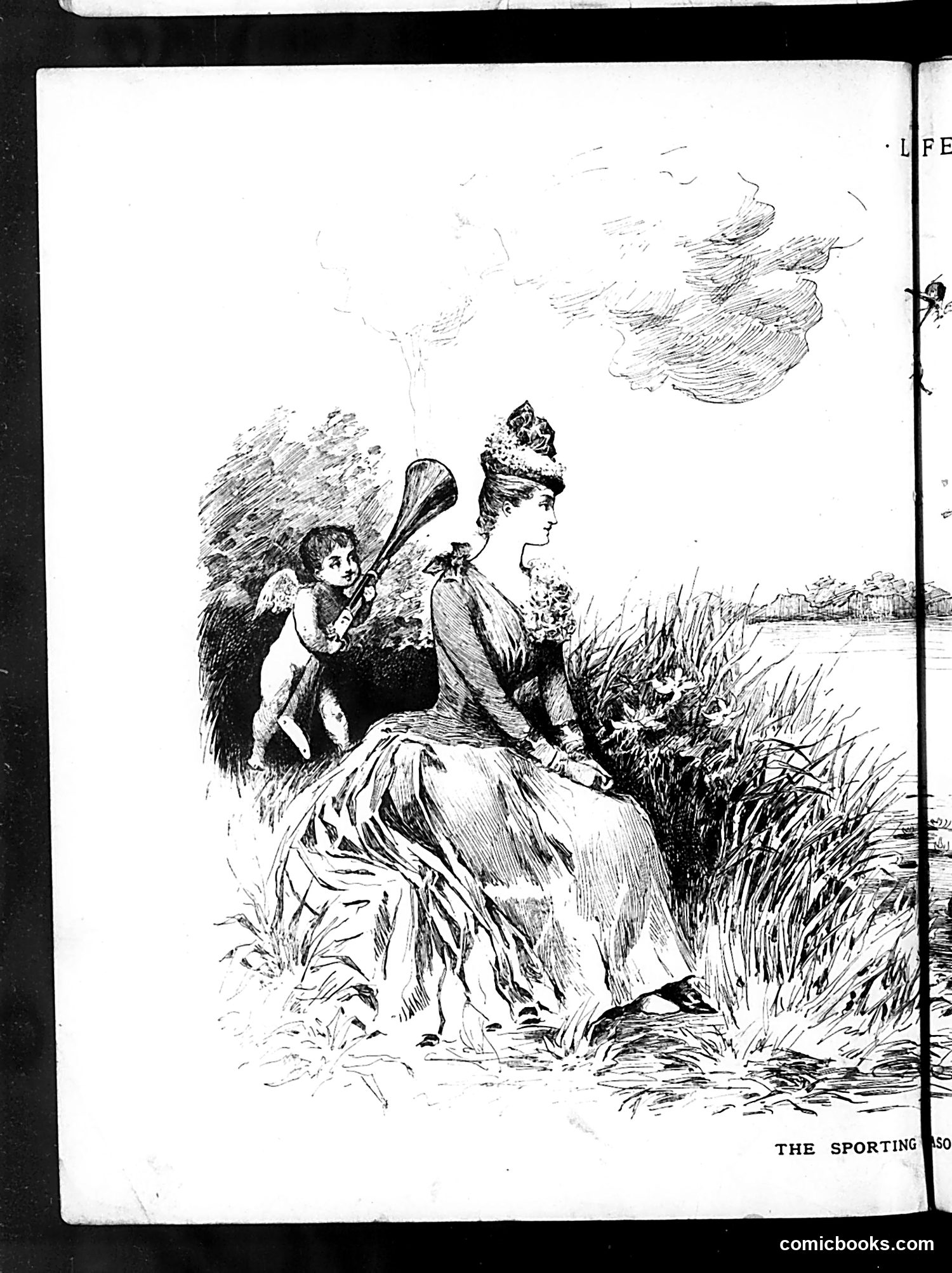
This sketch depicts a fashionable woman in an elaborate hat and dress standing by a body of water with reeds. She's accompanied by a cherub or cupid figure and what appears to be a gentleman. The setting suggests a recreational outing—likely fishing or boating, given the water and vegetation. The satire likely comments on late 19th/early 20th-century leisure culture and gender roles. The woman's ornate clothing and prominent positioning suggest commentary on feminine fashion or behavior during leisure activities. The cherub's presence adds a romantic or amorous dimension, possibly mocking sentimental attitudes toward courtship or outdoor romance. The incomplete caption "THE SPORTING" suggests this is part of a larger editorial about sporting activities or fashionable society behavior, though the specific target remains unclear without full context.
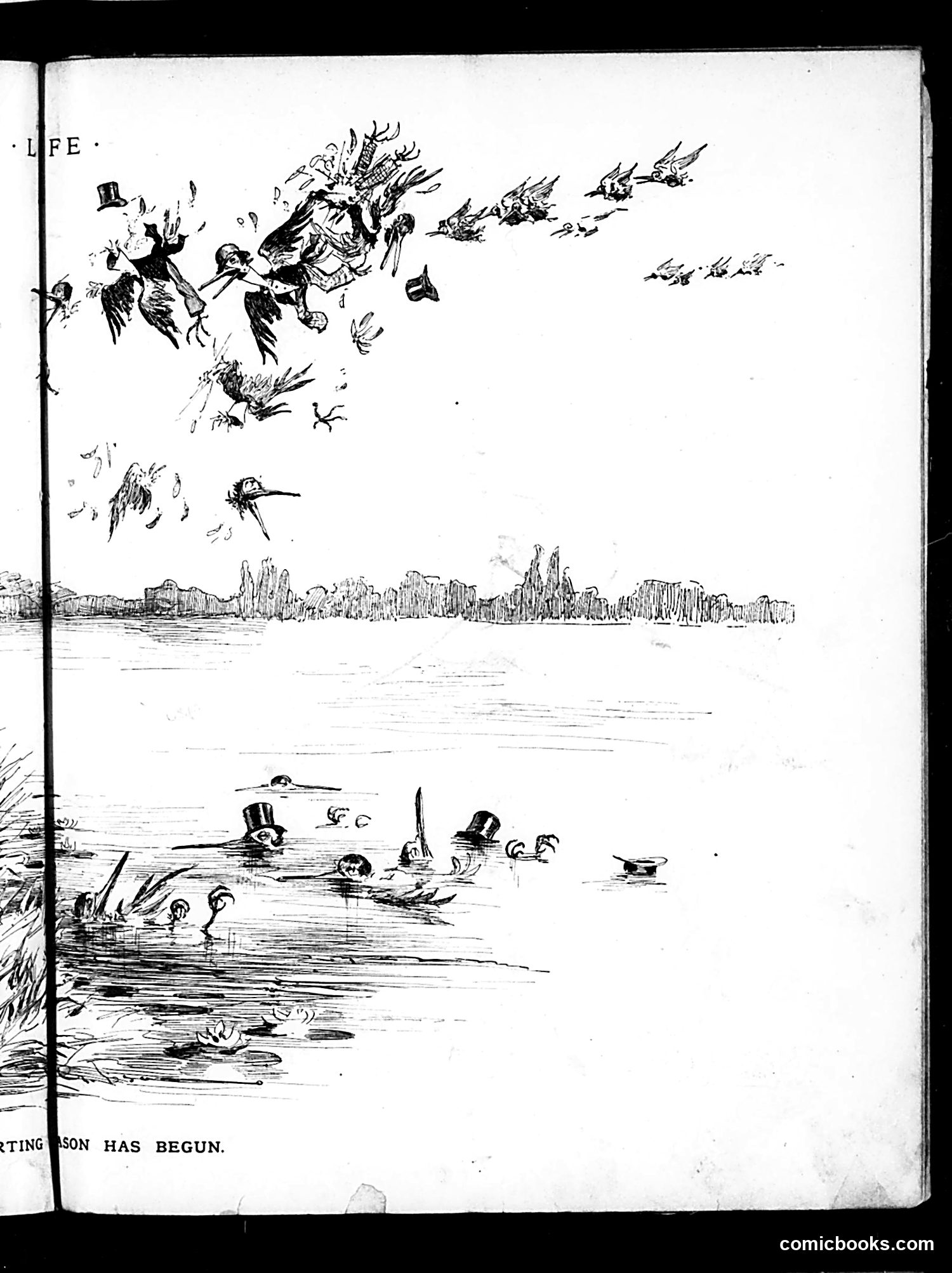
This page from *Life* magazine shows a satirical cartoon depicting what appears to be a hunting or shooting season scenario. The top portion shows figures being expelled or scattered violently through the air—likely politicians or public figures depicted as game birds or prey being hunted. The bottom shows a water scene with figures in top hats partially submerged or struggling in water, suggesting chaos or downfall. The partial text reads "...RTING SEASON HAS BEGUN," indicating this is commentary on some form of "open season"—a metaphorical hunting period where certain targets become fair game for criticism or attack. Without the full caption and date, the specific political figures and event referenced remain unclear, but the satire critiques either a political upheaval, scandal, or period of public targeting of officials or institutions.
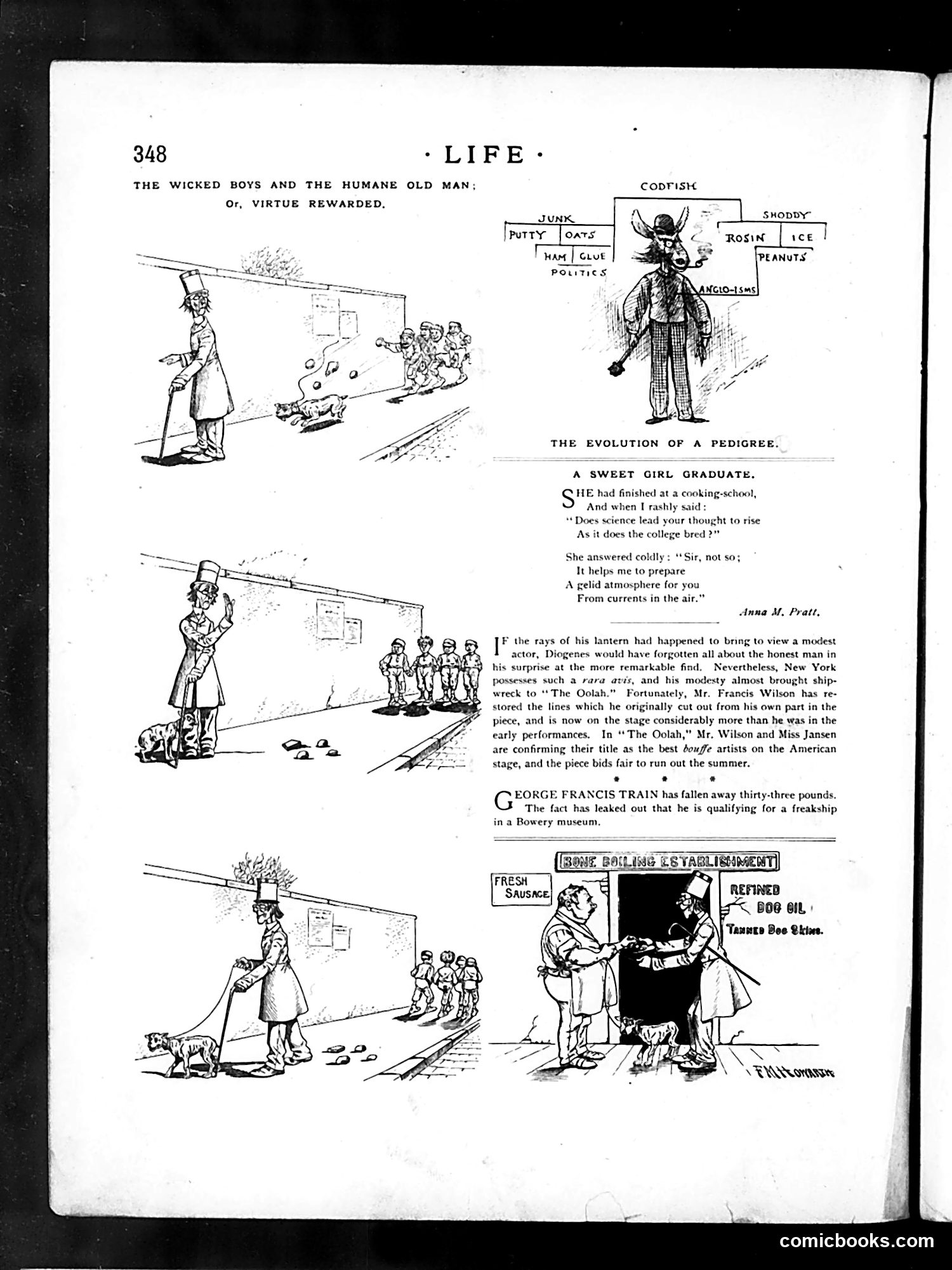
This page contains three sequential cartoons titled "The Wicked Boys and the Humane Old Man; Or, Virtue Rewarded." The narrative shows an elderly man attempting to discipline mischievous boys by various means—first with a rope/noose apparatus, then trying to catch them, finally using a dog. The progression suggests the boys' persistent misbehavior defeats the man's efforts at correction. The page also includes a brief poem "A Sweet Girl Graduate," unrelated social commentary about a cooking-school graduate, and news items about theatrical performances and George Francis Train. A small cartoon at bottom depicts a butcher shop ("Some Bailing Establishment") where a vendor offers "Fresh Sausage" to customers, likely implying darker humor about the sausage's questionable ingredients. The overall tone is satirical domestic humor typical of early American comedy magazines.
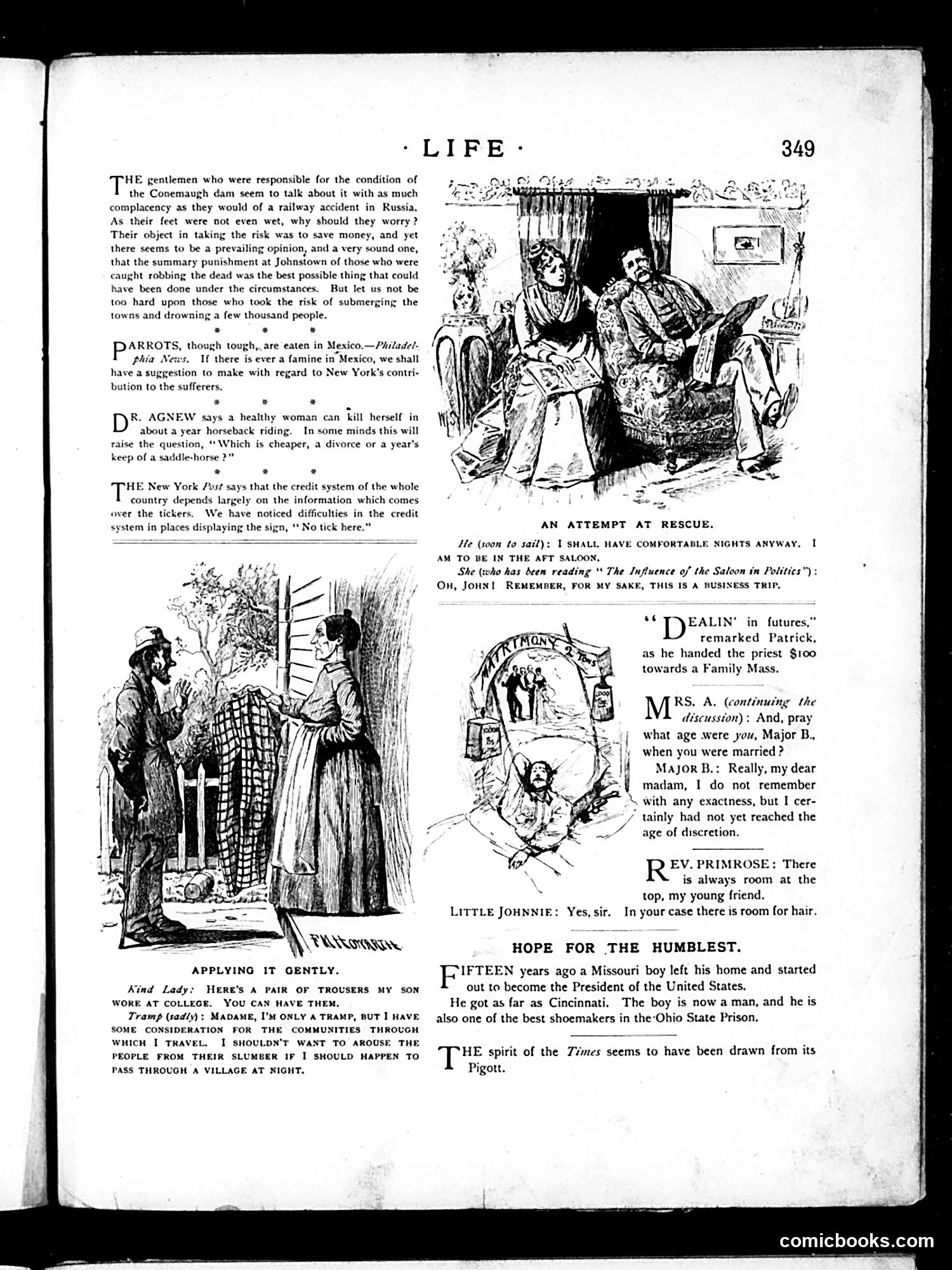
The cartoon depicts a domestic scene where a woman reads a book titled "The Influence of the Salmon in Politics" while her husband tries to engage her attention. The satire mocks intellectual pretension and marital disconnect: the wife is so absorbed in an absurdly obscure scholarly topic that she ignores her husband's attempts at conversation, dismissing his concerns as "business" matters. The humor lies in the contrast between the wife's claimed intellectual pursuits (a deliberately ridiculous book topic) and her avoidance of actual domestic communication. The caption "An Attempt at Rescue" suggests the husband's futile effort to reconnect with his distracted spouse, satirizing both affected intellectualism and the communication breakdown in marriages of the era.
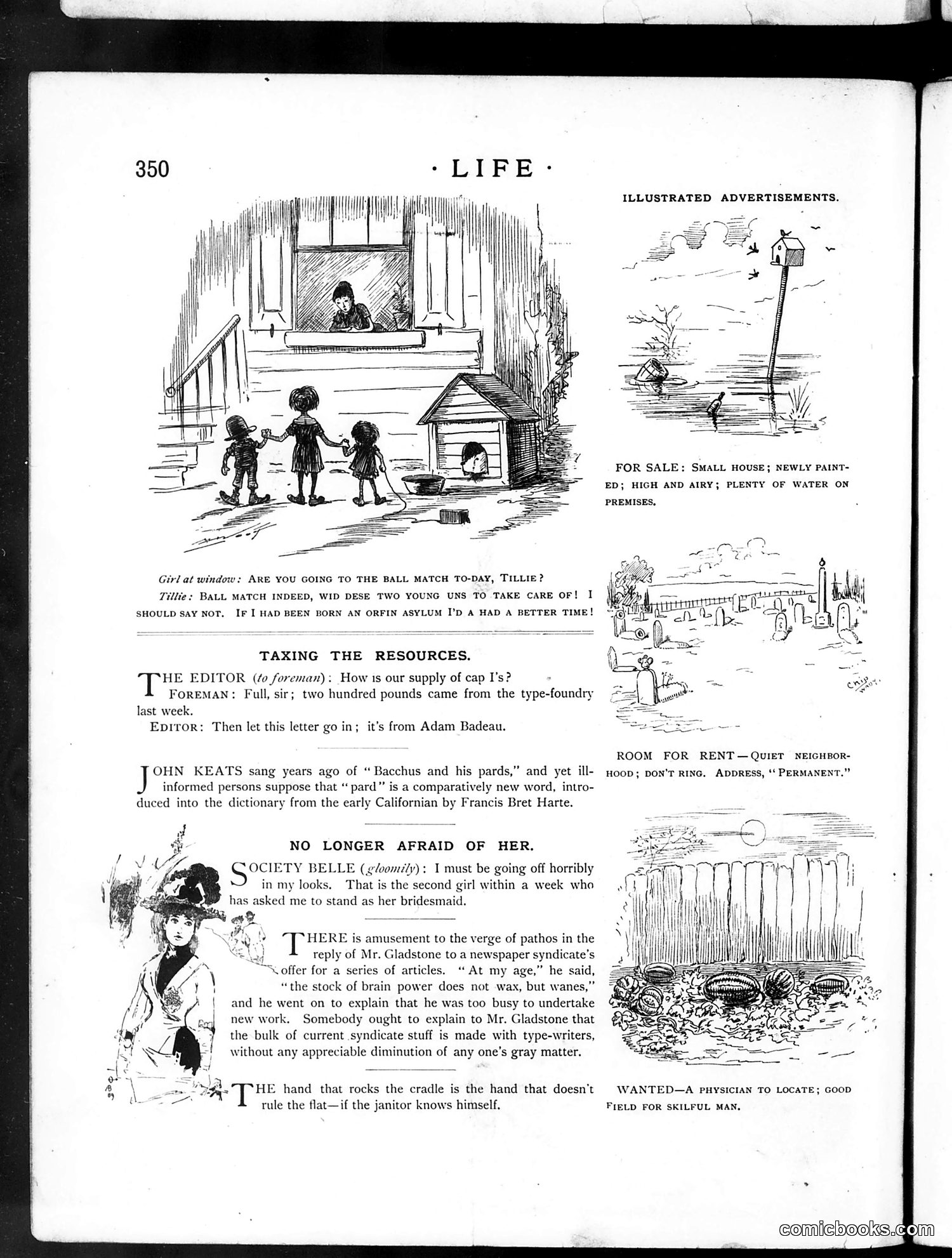
This page contains several short humorous pieces targeting contemporary issues and figures: **"Girl at Window"**: A working-class woman (Tillie, with dialect spelling) complains that childcare responsibilities prevent her from attending a baseball game. Her bitter quip—that she'd have had an easier life in an orphan asylum—satirizes the grinding hardship of motherhood and domestic servitude for poor women. **"Taxing the Resources"**: An editor jokes about using up capital I's from the type-foundry on a letter from Adam Badeau (likely a contemporary writer), implying his work is verbose or excessive. **"No Longer Afraid of Her"**: A society belle realizes she's losing her attractiveness—a second woman has asked her to be bridesmaid rather than compete with her for male attention. **Gladstone Reference**: Mocks the aging British Prime Minister William Gladstone's excuse for refusing syndicated articles, suggesting his complaint about diminishing "brain power" is pretentious when syndicate work requires no intellectual effort anyway. The page's tone is characteristic of *Life's* satirical focus on social class, gender roles, and public figures.
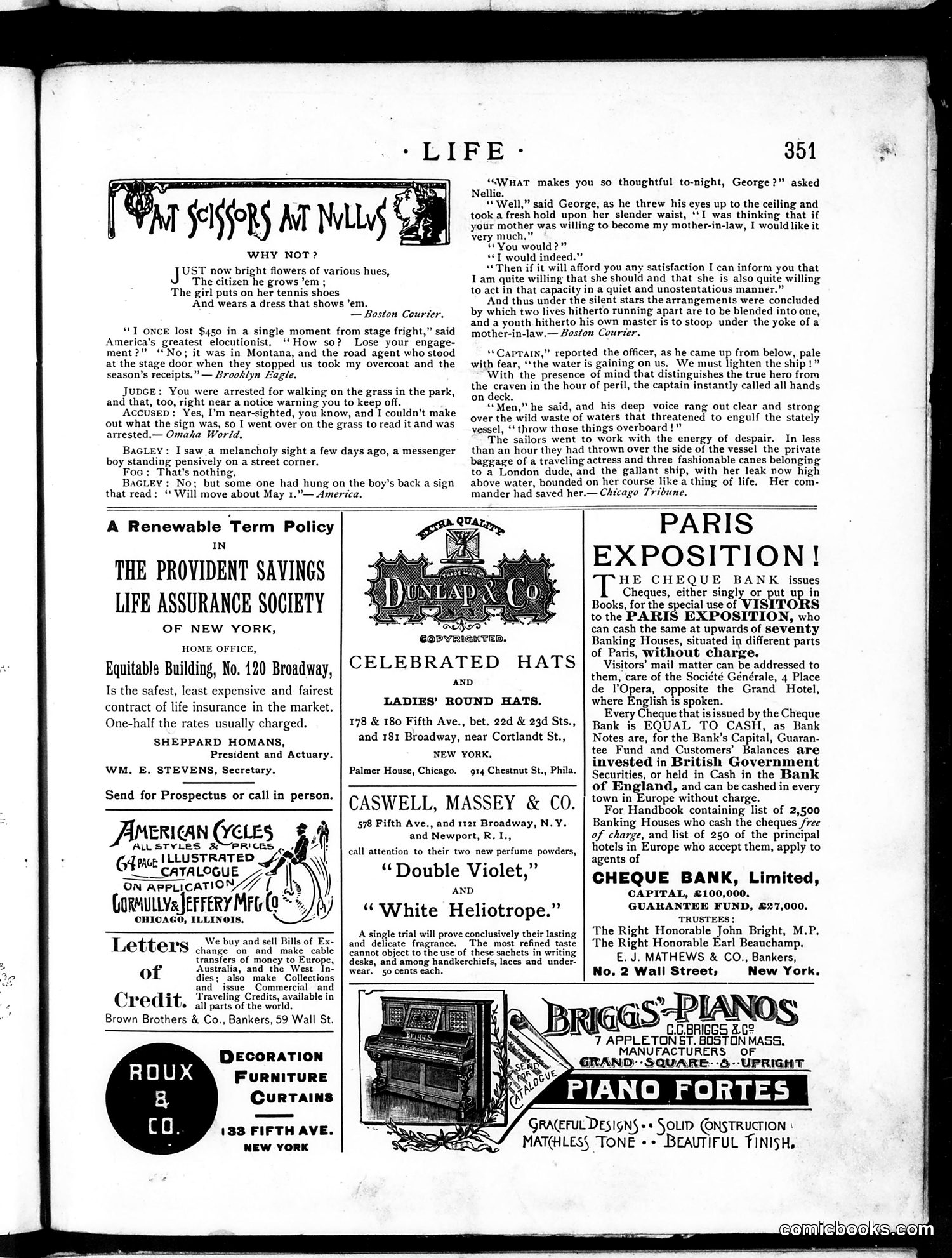
This page from *Life* magazine contains multiple brief humorous anecdotes rather than political cartoons. The header "CORSAIRS AT NULLUS" likely refers to satirizing pirates or predatory figures. The jokes mock contemporary social types and situations. One anecdote ridicules a nearsighted accused man; another satirizes a messenger boy facing eviction; a third parodies an elocutionist who lost money to a road agent in Montana, conflating stage fright with actual robbery. The main narrative involves George courting a woman while anxiously contemplating acquiring a mother-in-law—a common Victorian-era joke topic, suggesting matrimonial anxiety. The final anecdote humorously depicts a ship captain heroically "saving" his vessel by ordering crew to throw overboard an actress's baggage and a dude's canes rather than cargo. The satire targets class pretension, masculine anxieties about marriage and family, and absurdist logic. The rest of the page features period advertisements (insurance, hats, pianos, furniture).
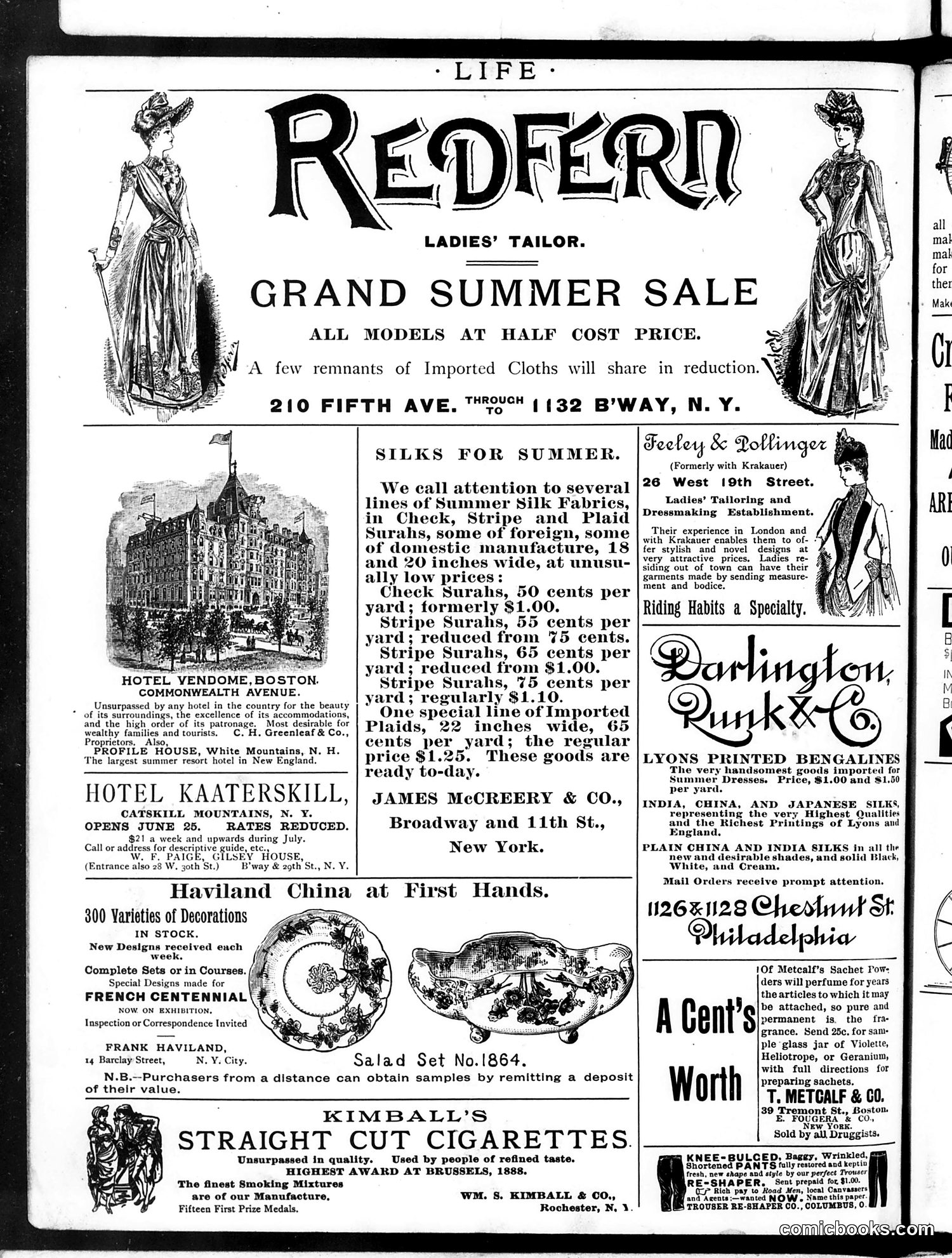
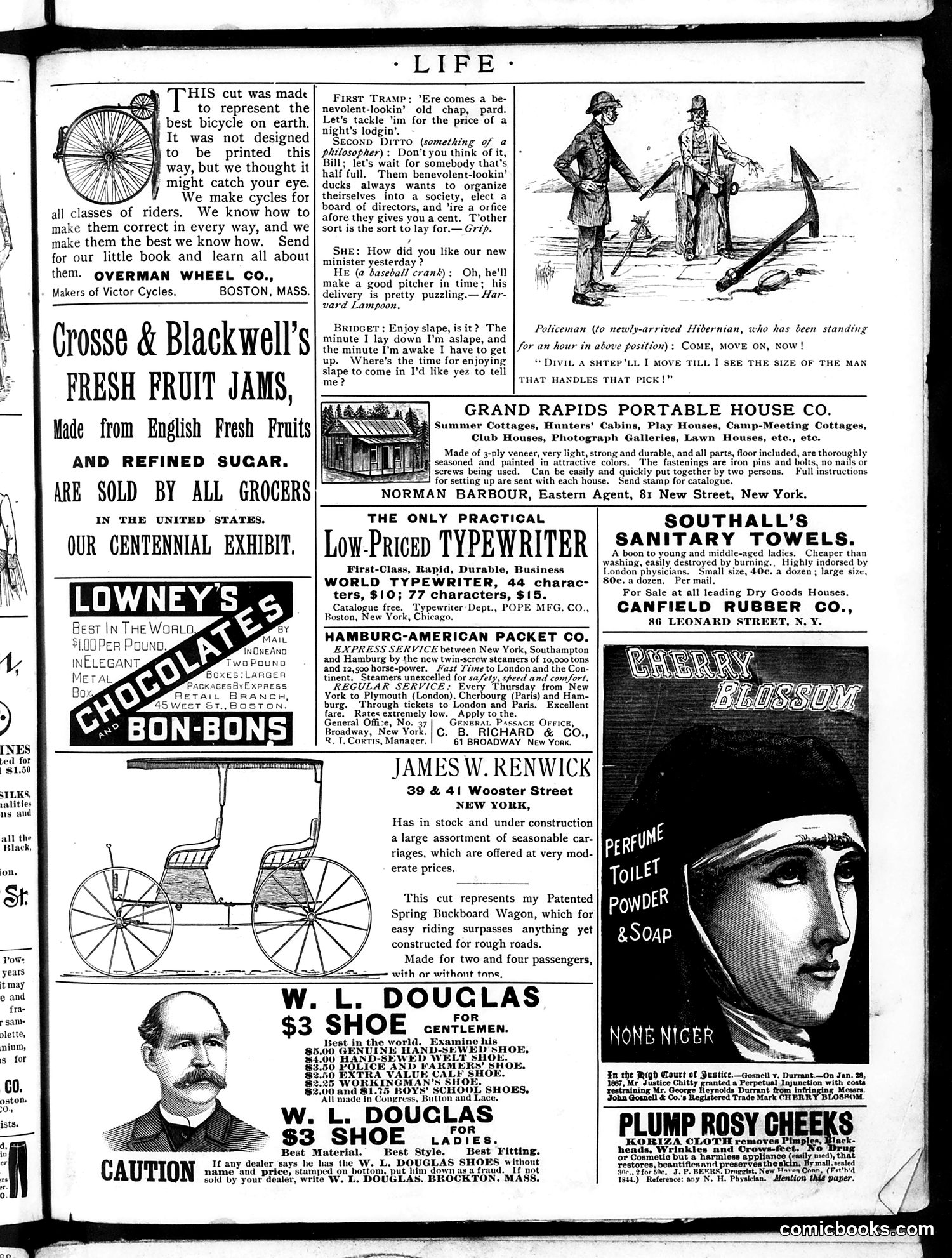
This page is primarily **advertisements** mixed with brief **humorous comic sketches**—typical of Life magazine's format in this era. The **three cartoon vignettes** are brief satirical observations: 1. **"Two Tramps"**: Contrasts street-level wisdom about wealthy donors. The joke: "benevolent-looking" rich men will waste beggars' time creating bureaucratic committees ("elect a board of directors") before giving money, whereas half-drunk men give directly. Social commentary on wealthy philanthropy's inefficiency. 2. **Minister/Baseball joke**: A pun on "delivery"—the new minister's preaching style is compared to a pitcher's throwing technique. 3. **Irish Immigrant & Policeman**: Playing on Irish immigrant stereotypes and accent ("divil," "shtep"), the joke mocks a newly-arrived Irish laborer's obstinate refusal to move for a policeman until seeing the strength of whoever must handle the pickaxe—suggesting Irish laborers' reputation for physicality and stubbornness. The rest are period advertisements for bicycles, jams, typewriters, shoes, and carriages—no political cartoons present.
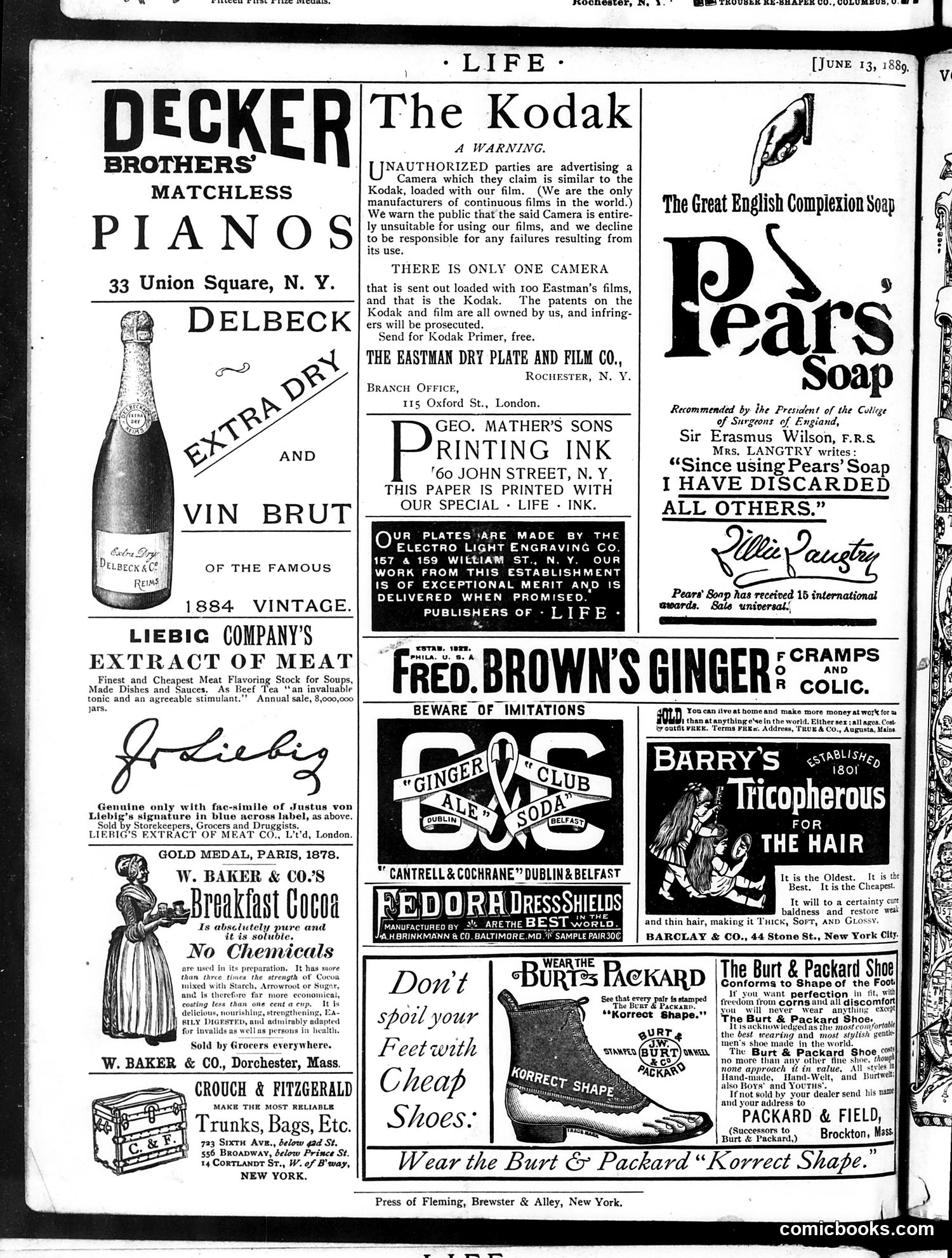
This page is **primarily advertising**, not satirical editorial content. It contains product advertisements typical of late-19th-century magazines, with one notable exception: **The Kodak warning**. ## The Kodak Advertisement's Significance The Kodak company's prominent warning is the only editorial-like content here. It addresses **patent infringement and market competition**. Eastman Kodak warns the public against unauthorized competitors selling similar cameras, claiming these knockoffs are "entirely unsuitable" for Kodak film and warning that the company won't be responsible for failures. This reflects the intense early competition in photography technology and Kodak's aggressive protection of its film monopoly ("We are the only manufacturers of continuous films in the world"). ## Remaining Content Other advertisements promote consumer goods standard to the era: pianos, cocoa, soap, shoe brands, and hair tonic. Notably, **Pears' Soap** features an endorsement from actress Lillie Langtry, a celebrity endorsement strategy already common by 1889. The page documents consumer culture and emerging patent disputes in the nascent photography industry rather than containing satire or political commentary.