
Life, 1889-06-13 · page 4 of 16
Life — June 13, 1889 — page 4: what you’re looking at
What you’re looking at
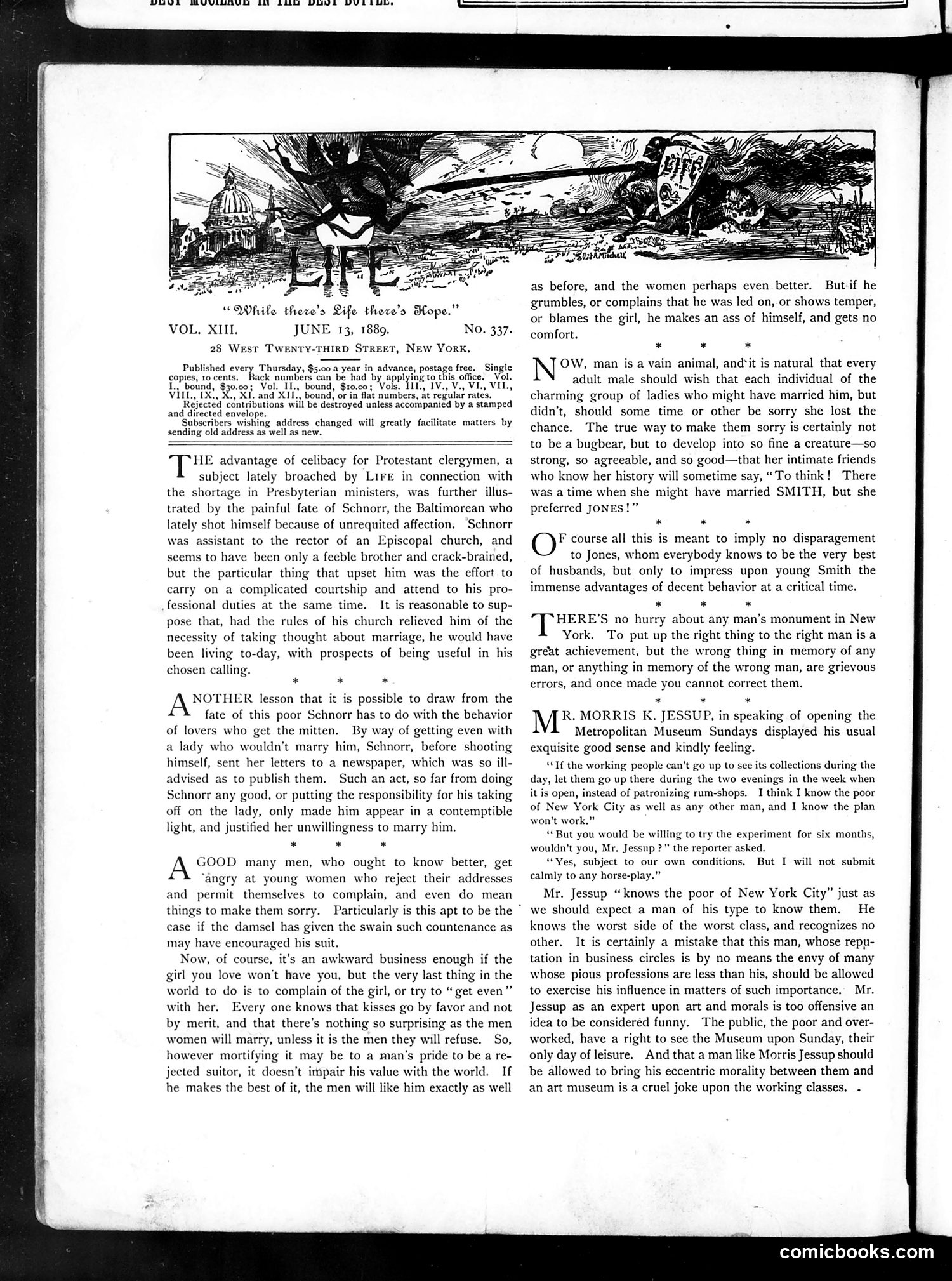
The masthead illustration depicts a cherub or cupid figure observing a landscape with a domed building (likely St. Paul's Cathedral, London), accompanied by the caption "While there's Life there's Hope." The page's article critiques celibacy rules for Protestant clergy—a contemporary church policy debate. It uses the cautionary tale of Schnorr, an Episcopal church assistant whose discreet courtship was exposed through newspaper letters, causing scandal. The satire targets male vanity and hypocrisy: men want romantic attention from women but punish women socially for reciprocating. The piece mocks society's double standards regarding courtship, suggesting men who complain about rejection while blaming women are simply preserving their own dignity through self-deception.
📄 Transcribed text from this page (OCR, searchable)
Machine-transcribed from the original scan — historical spelling and the odd misread are preserved.
Se Se ee ee eS a eee “While there's Life theze’s Hope.” VOL. XIII. JUNE 13, 1889. No. 337. 28 West TWENTY-THIRD STREET, New York, Published every Thursday, $5.00 a year in advance, postage free. Single copies, ro cents. Back numbers can be had by applying to this office. Vol. 1) bound, $30.00; Vol. Il, bound, $10.00; Vols {Ils 1V., V., Vi. VII., VIIL., IX!, X., XI. and X11, bound, or in flat numbers, at regular rates. Rejected contributions will be destroyed unless accompamed by a stamped and directed envelope. Subscribers wishing address changed will greatly facilitate matters by sending old address as well as new. HE advantage of celibacy for Protestant clergymen, a subject lately broached by Lire in connection with the shortage in Presbyterian ministers, was further illus- trated by the painful fate of Schnorr, the Baltimorean who lately shot himself because of unrequited affection. Schnorr was assistant to the rector of an Episcopal church, and seems to have been only a feeble brother and crack-brained, but the particular thing that upset him was the effort to carry on a complicated courtship and attend to his pro- fessional duties at the same time. It is reasonable to sup- pose that, had the rules of his church relieved him of the necessity of taking thought about marriage, he would have been living to-day, with prospects of being useful in his chosen calling. * * * NOTHER lesson that it is possible to draw from the fate of this poor Schnorr has to do with the behavior of lovers who get the mitten. By way of getting even with a lady who wouldn't marry him, Schnorr, before shooting himself, sent her letters to a newspaper, which was so ill- advised as to publish them. Such an act, so far from doing Schnorr any good, or putting the responsibility for his taking off on the lady, only made him appear in a contemptible light, and justified her unwillingness to marry him. * * * GOOD many men, who ought to know better, get ‘angry at young women who reject their addresses and permit themselves to complain, and even do mean things to make them sorry. case if the damsel has given the swain such countenance as may have encouraged his suit. Now, of course, it’s an awkward business enough if the girl you love won't have you, but the very last thing in the world to do is to complain of the girl, or try to “ get even” with her. Every one knows that kisses go by favor and not by merit, and that there's nothing so surprising as the men women will marry, unless it is the men they will refuse. So, however mortifying it may be to a man’s pride to be a re- jected suitor, it doesn’t impair his value with the world. If he makes the best of it, the men will like him exactly as well Particularly is this apt to be the as before, and the women perhaps even better. But if he grumbles, or complains that he was led on, or shows temper, or blames the girl, he makes an ass of himself, and gets no comfort. * * * OW, man is a vain animal, and*it is natural that every adult male should wish that each individual of the charming group of ladies who might have married him, but didn’t, should some time or other be sorry she lost the chance. The true way to make them sorry is certainly not to be a bugbear, but to develop into so fine a creature—so strong, so agreeable, and so good—that her intimate friends who know her history will sometime say, “To think! There was a time when she might have married SMITH, but she preferred JONES!” * * * F course all this is meant to imply no disparagement to Jones, whom everybody knows to be the very best of husbands, but only to impress upon young Smith the immense advantages of decent behavior at a critical time. * * * HERE’S no hurry about any man’s monument in New York. To put up the right thing to the right man is a great achievement, but the wrong thing in memory of any man, or anything in memory of the wrong man, are grievous errors, and once made you cannot correct them. x * * M*. MORRIS K. JESSUP, in speaking of opening the Metropolitan Museum Sundays displayed his usual exquisite good sense and kindly feeling. “If the working people can’t go up to see its collections during the day, let them go up there during the two evenings in the week when it is open, instead of patronizing rum-shops. I think I know the poor of New York City as well as any other man, and I know the plan won't work,” “But you would be willing to try the experiment for six months, wouldn't you, Mr. Jessup ?" the reporter asked. “Yes, subject to our own conditions. But I will not submit calmly to any horse-play.” Mr. Jessup “knows the poor of New York City” just as we should expect a man of his type to know them. He knows the worst side of the worst class, and recognizes no other. It is certainly a mistake that this man, whose repu- tation in business circles is by no means the envy of many whose pious professions are less than his, should be allowed to exercise his influence in matters of such importance. Mr. Jessup as an expert upon art and morals is too offensive an idea to be considered funny. The public, the poor and over- worked, have a right to see the Museum upon Sunday, their only day of leisure. And that a man like Morris Jessup should be allowed to bring his eccentric morality between them and an art museum is a cruel joke upon the working classes. . comicbooks.com