
A complete issue · 18 pages · 1889
Life — March 7, 1889
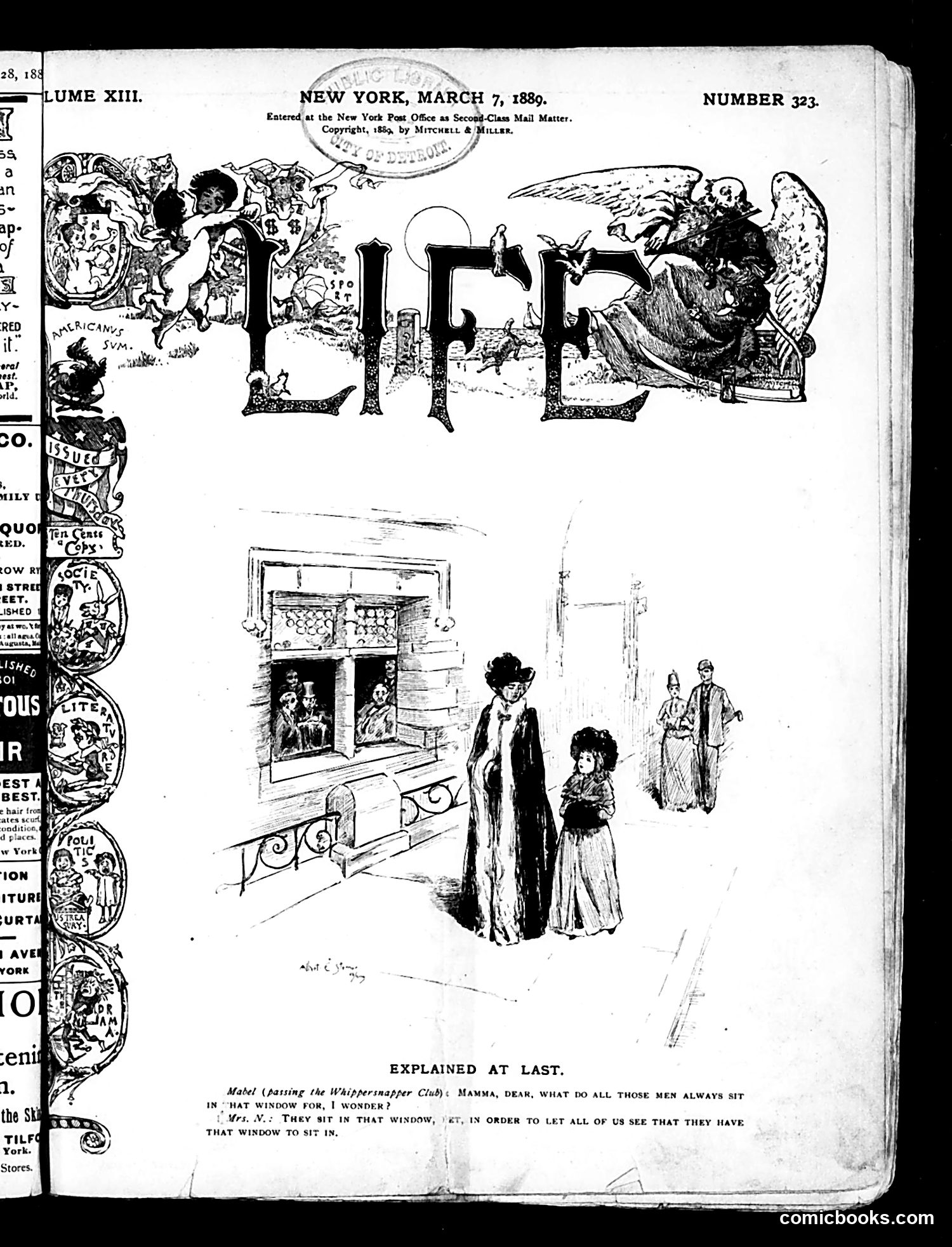
This page from *Life* contains a social satire cartoon titled "Explained at Last." The image shows a well-dressed woman and child observing men sitting in a shop window, with the caption explaining their presence: the men sit there "in order to let all of us see that they have that window to sit in." The joke satirizes upper-class vanity and conspicuous display—specifically, wealthy individuals using visible window seats as status symbols to demonstrate their leisure and social standing. The cartoon mocks the absurdity of people positioning themselves publicly merely to advertise their access to fashionable spaces, targeting the pretentiousness of 1880s high society who used visible consumption and public presence as markers of wealth and respectability.
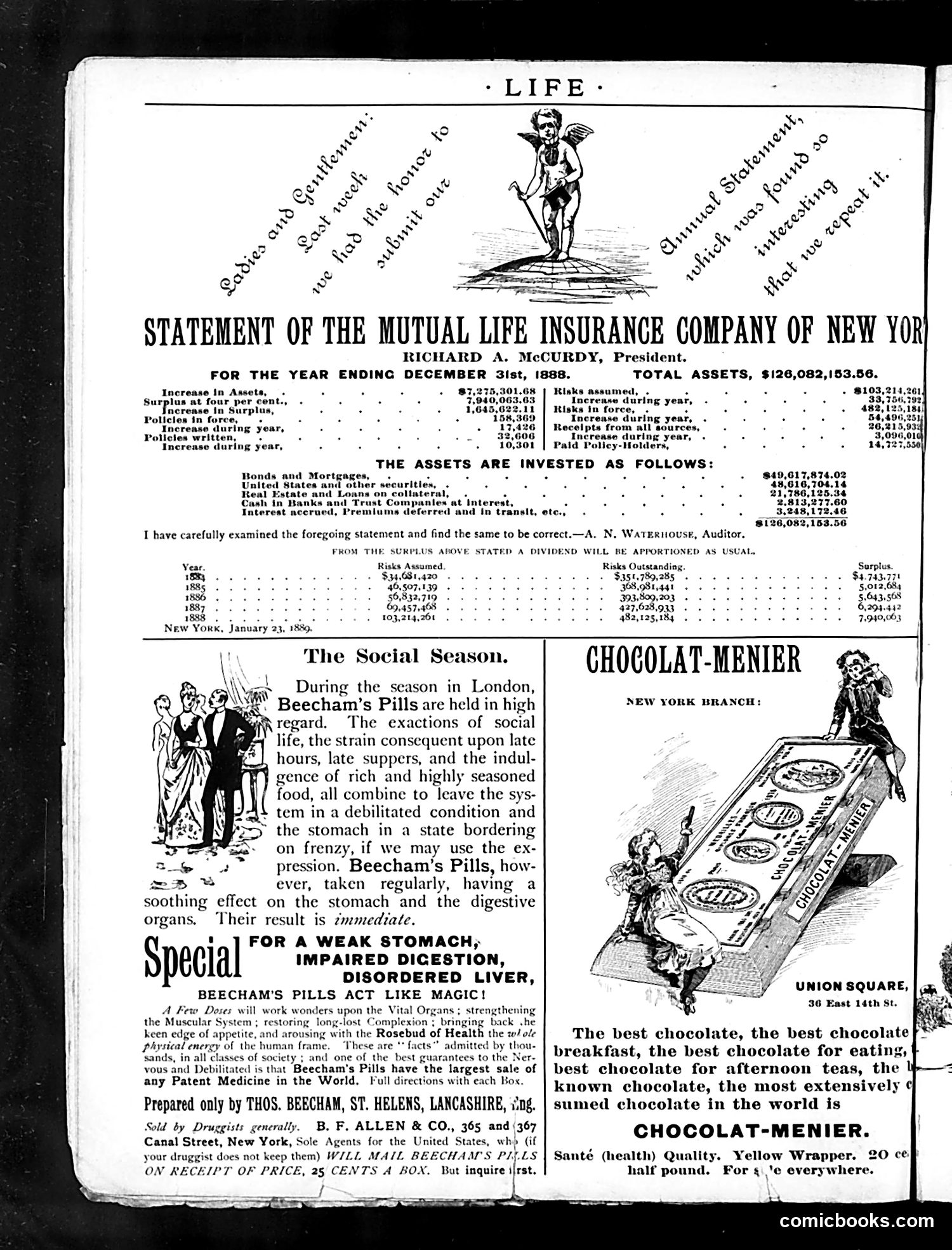
This page is primarily **advertising and financial statements**, not political satire. The top half contains a financial statement for the Mutual Life Insurance Company of New York (for year ending December 31, 1888), with total assets of $126,082,153.56. The lower half features two advertisements: one for **Beecham's Pills** (a patent medicine claiming to cure digestive ailments caused by "late hours, late suppers, and the indulgence of rich and highly seasoned food" during London's social season), and one for **Chocolat-Menier** chocolate, marketed as "the best chocolate" for various occasions. There is a small decorative figure of Cupid/cherub at the top center, but no political cartoon or satire is evident on this page.
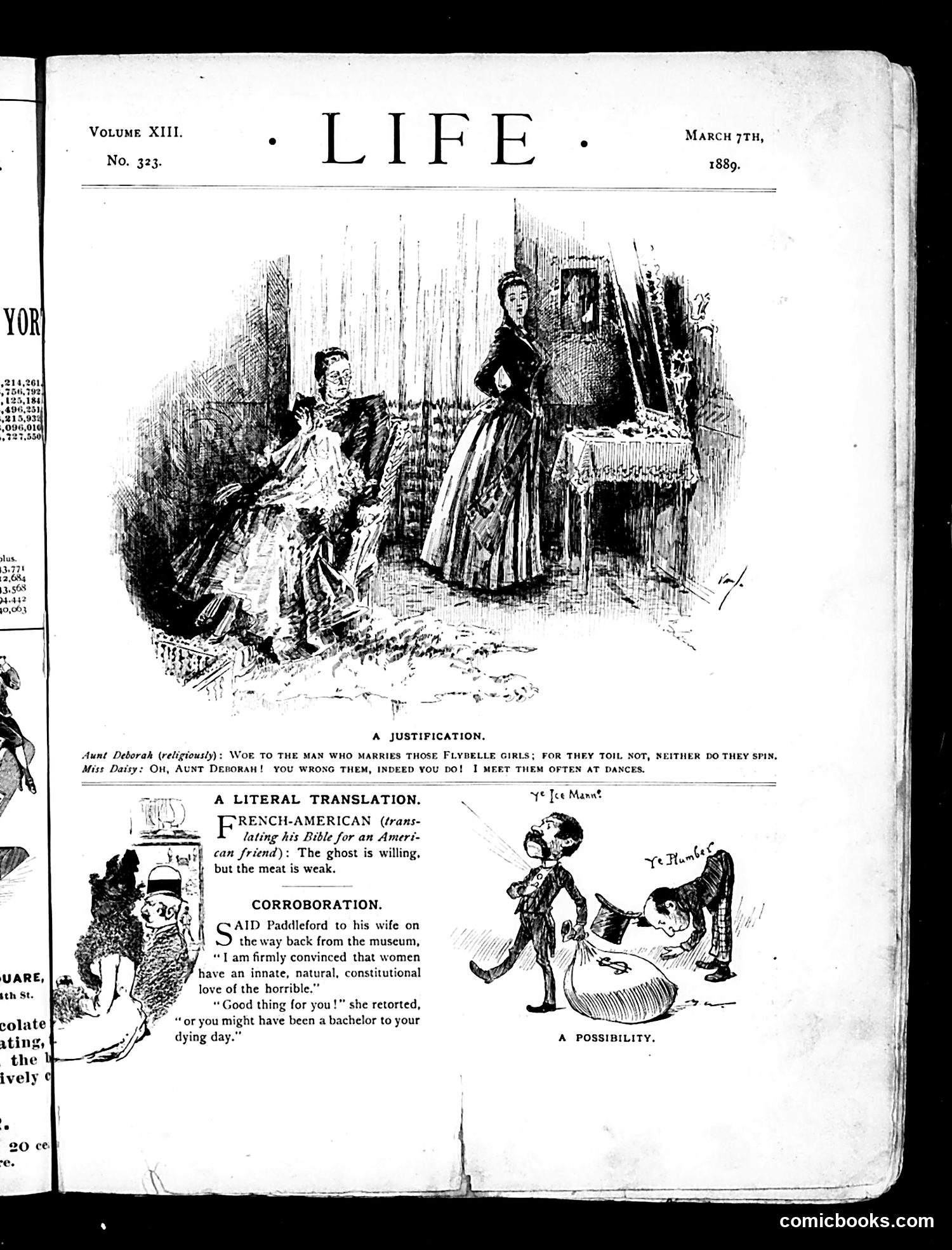
This page contains three satirical humor pieces: **"A Justification"** mocks Aunt Deborah's remark about "flybelle girls" who don't toil or spin, comparing them to biblical lilies—suggesting idle, ornamental women. **"A Literal Translation"** jokes about a French-American translating his Bible for an American friend, with the punchline about weak "meat" (likely a sexual innuendo). **"Corroboration"** presents a domestic scene where Paddleford boasts women have an "innate, natural, constitutional love of the horrible." His wife sarcastically responds by wishing he'd been a bachelor—implying marriage makes women miserable, inverting his claim. **"A Possibility"** (bottom right) shows a woman apparently throwing a man, captioned to suggest this as a possible outcome of gender conflict. These pieces satirize gender relations and stereotypes about women's nature and domestic roles.
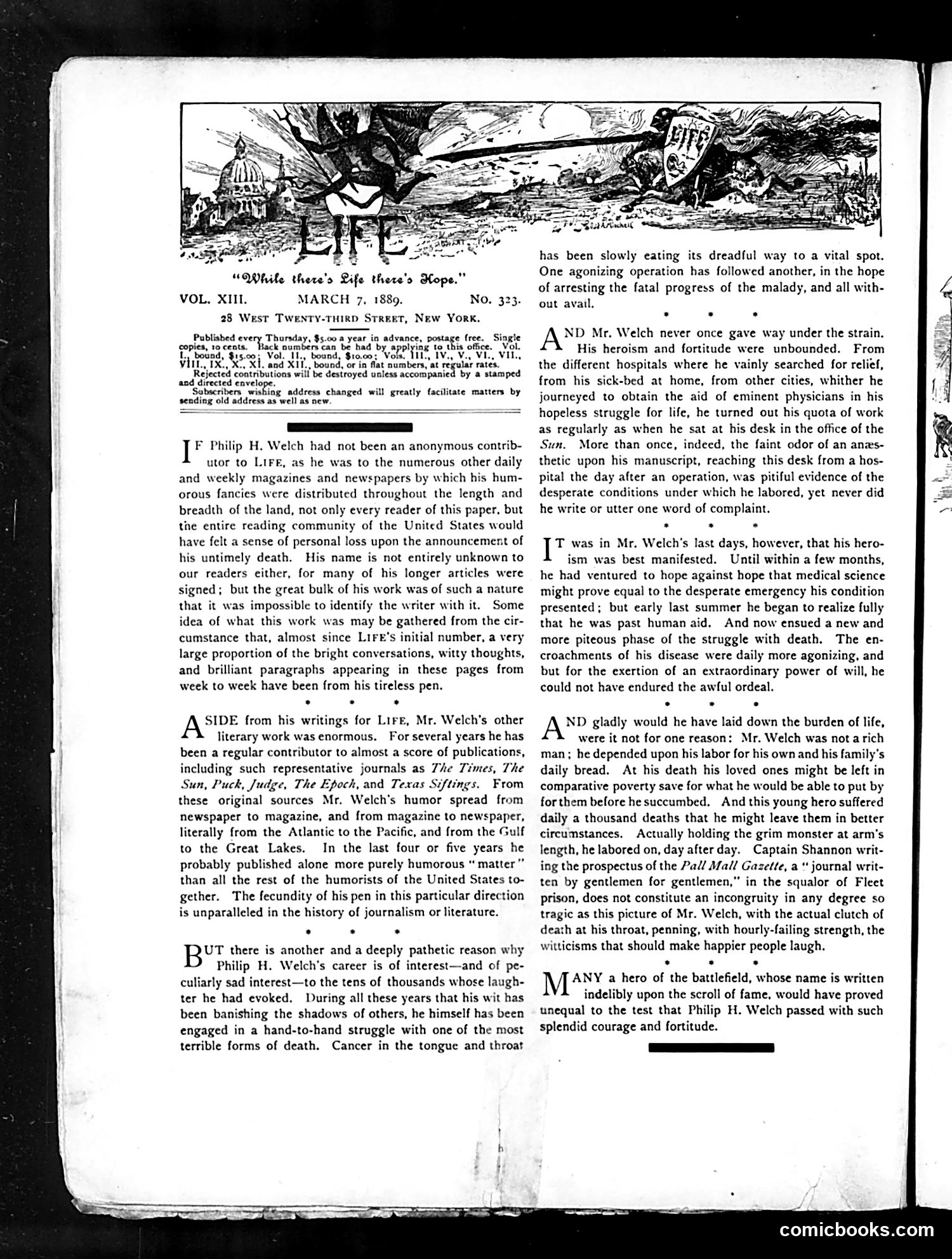
**The Header Cartoon:** The small illustrated banner shows a landscape with a bare tree, classical buildings, and the title "While there's Life there's Hope." This appears to be the magazine's masthead rather than political satire. **The Article:** The page is a memorial tribute to **Philip H. Welch**, a prolific anonymous contributor to Life and other publications (The Times, The Sun, Puck, Judge, The Epoch, Texas Siftings). The text celebrates his work as a humorist and journalist, detailing his struggle with throat cancer. Rather than satirizing a political figure or event, this is a sincere eulogy praising Welch's courage during his illness and his literary contributions to American humor journalism.
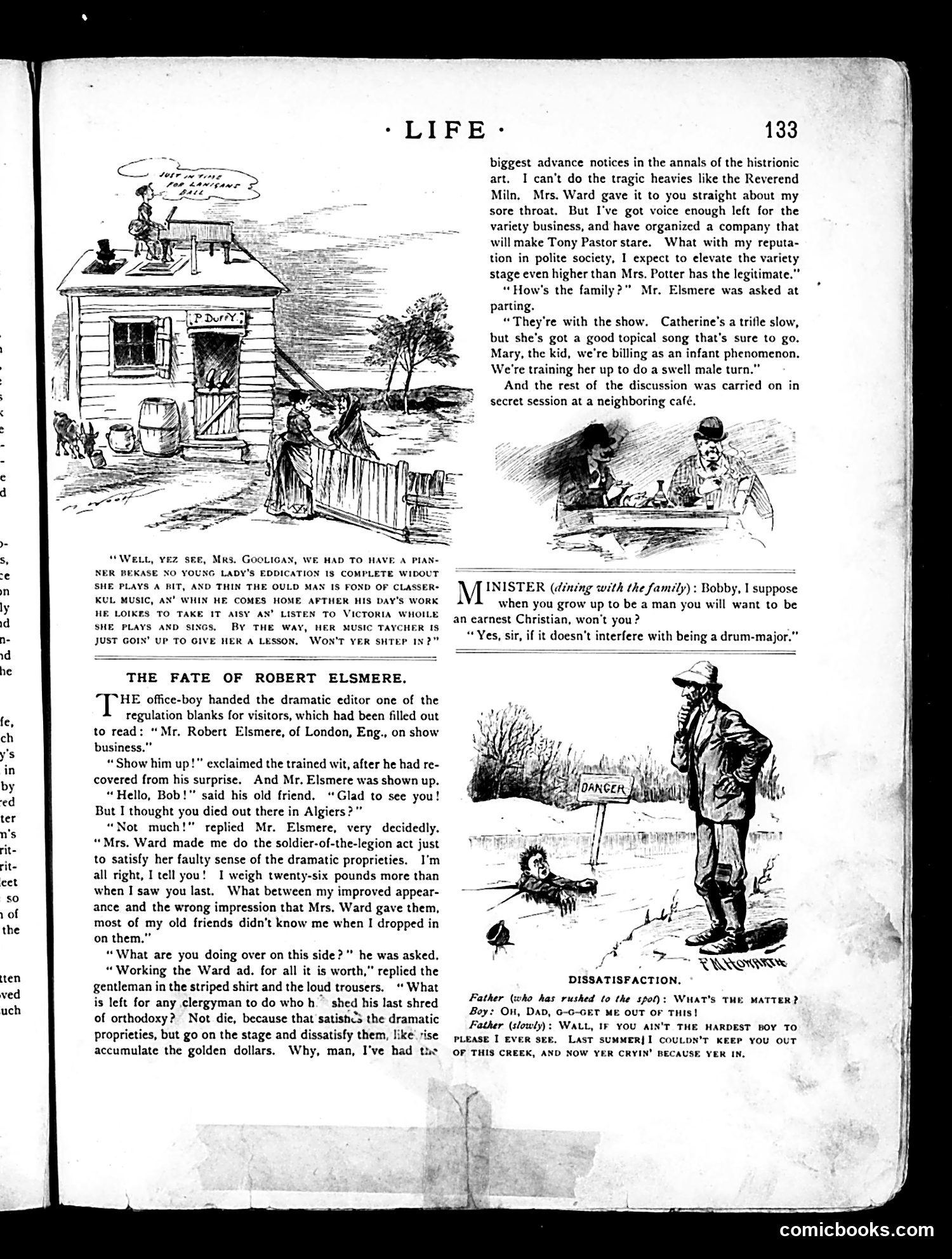
This page contains two satirical pieces. The top section mocks theatrical variety entertainment, depicting a cheaply-constructed "pop-up" theater where performers showcase acts. The accompanying text ridicules Mrs. Ward's organization of a variety show featuring her daughter Catherine, suggesting the venture is amateurish despite grandiose claims about "elevating" the variety stage. The main article, "The Fate of Robert Elsmere," uses the unexpected reappearance of a man supposedly dead in Algeria to satirize dramatic newspaper announcements and theatrical pretension. His friend notes the exaggeration of his transformation, while Elsmere cynically explains he simply works for Mrs. Ward staging theatrical productions to impress society. The cartoons throughout mock upper-class cultural pretensions and amateur theatricality.
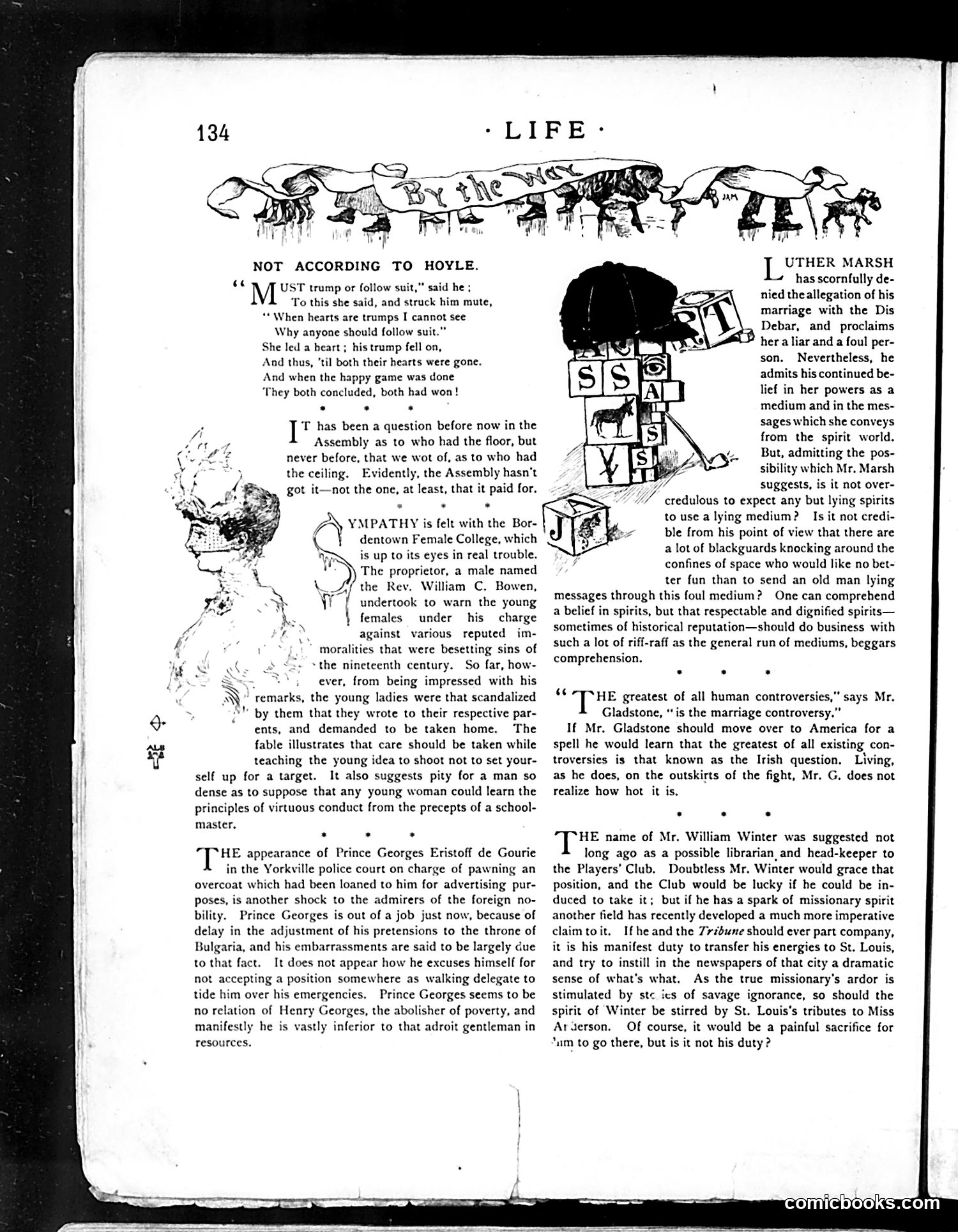
This page contains three satirical pieces typical of early 20th-century Life magazine commentary: 1. **"Not According to Hoyle"** (top): A poem mocking romantic "rules" and heartbreak, illustrated with a sketch of a woman's face. The title references etiquette standards. 2. **Luther Marsh controversy**: Text discusses Marsh's denial that his marriage to a spiritualist medium ("Dis Debar") was illegitimate, while admitting belief in her supernatural powers. The satire questions the credibility of using mediums for spiritual messages. 3. **Prince Georges Eristoff**: Describes a Russian prince arrested for paving stones (possibly vagrant behavior). The text sarcastically notes his supposed poverty and entitlement, mocking foreign nobility. 4. **William Winter/Tribune Library position**: Brief commentary suggesting Winter as a possible librarian, questioning whether the Tribune would genuinely employ him. The overall tone is characteristic Life mockery of social pretension and contemporary figures.
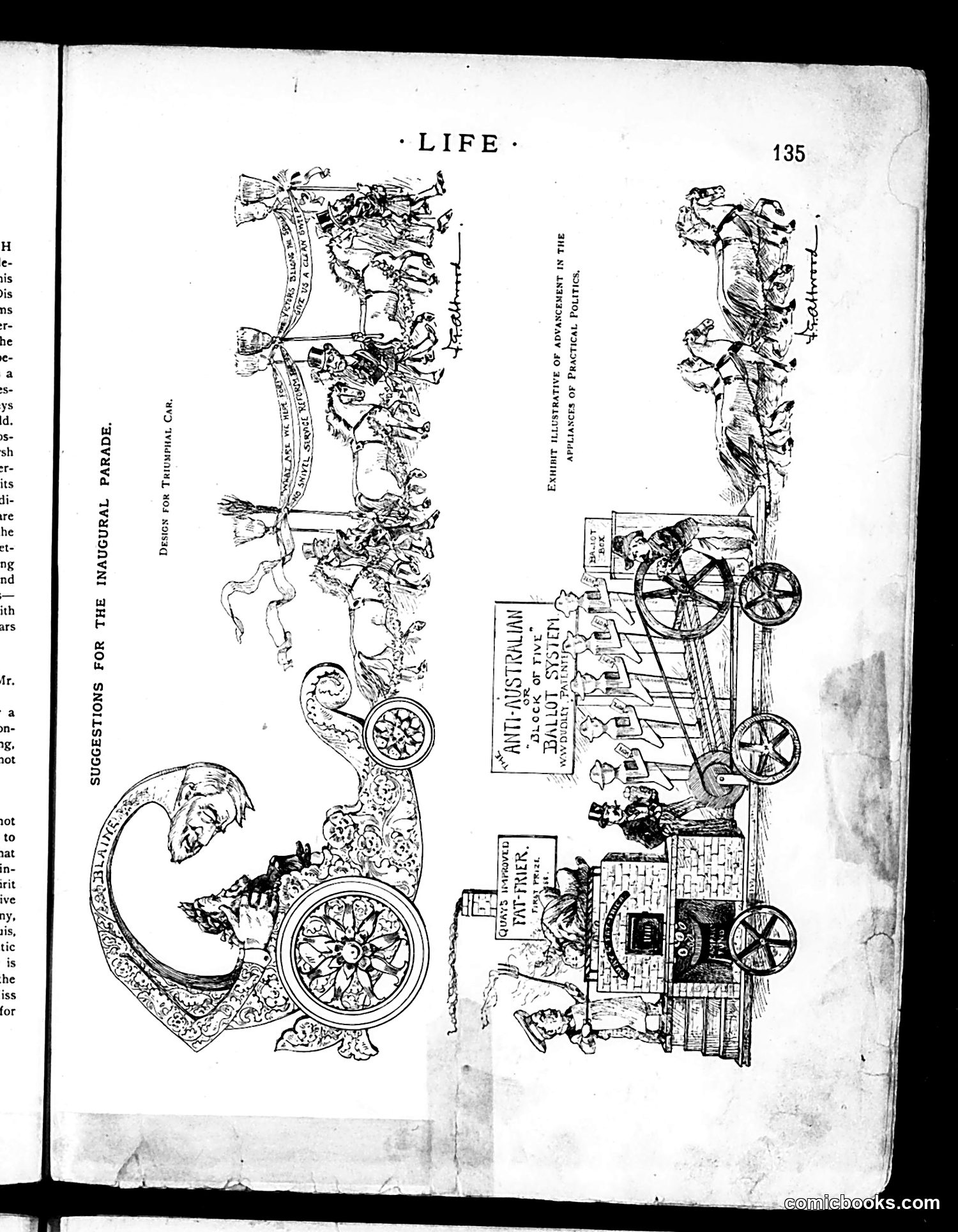
This page contains two satirical illustrations: **Left ("Suggestions for the Inaugural Parade"):** A decorative initial letter "S" features political figures and imagery, likely mocking the design of a presidential inaugural parade. The ornate styling suggests ridicule of elaborate ceremonial displays. **Right ("Anti-Prohibition"):** Shows figures around bicycles and what appears to be a residence or establishment. The title references anti-Prohibition sentiment (the era when alcohol sales were banned in America). The bicycles and architectural elements suggest commentary on how people circumvented alcohol laws during Prohibition, possibly mocking speakeasies or bootlegging operations. Both illustrations use exaggerated caricature typical of *Life* magazine's satirical approach to contemporary American politics and social issues of the early 20th century.
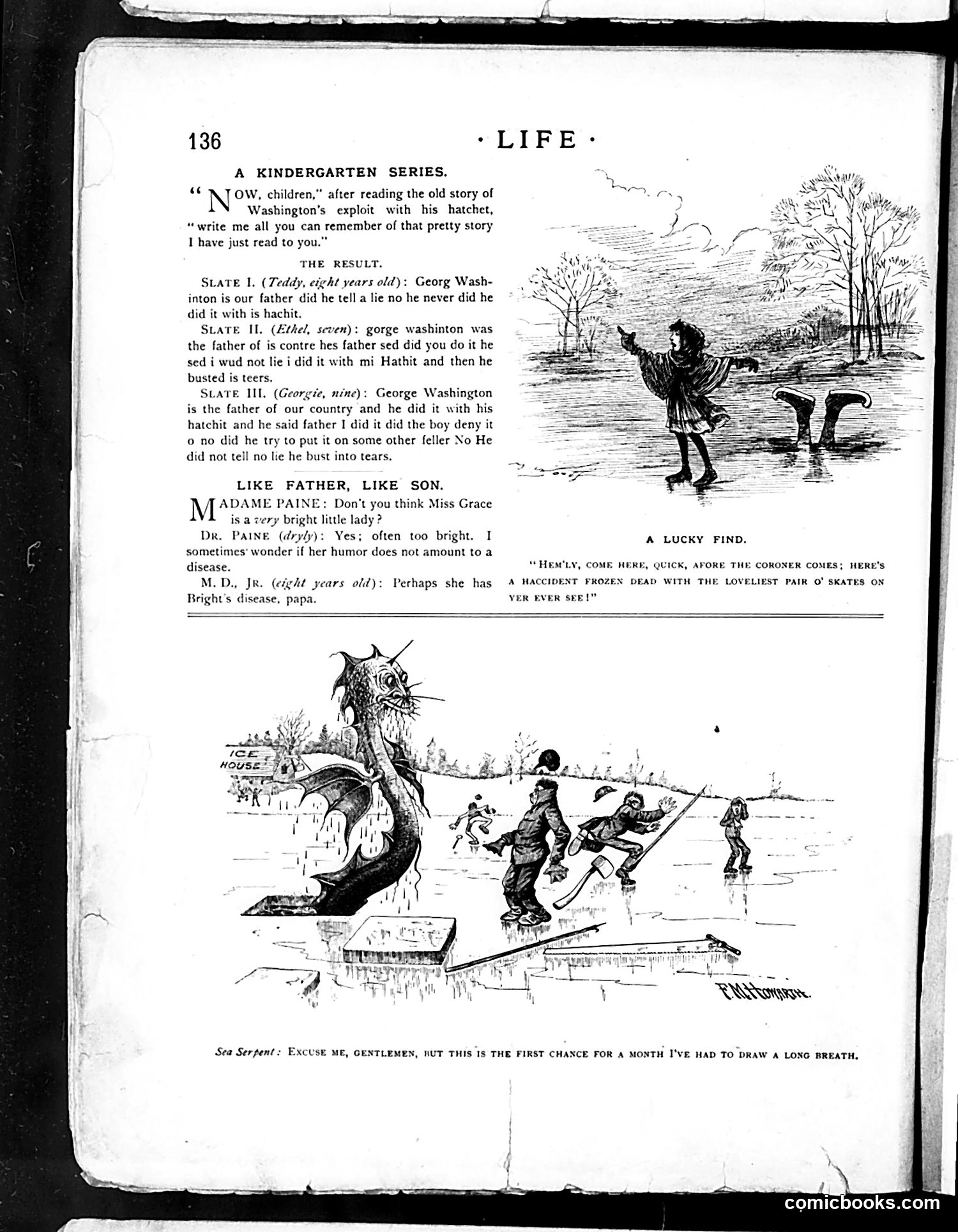
This page contains two distinct pieces: **"A Kindergarten Series"** presents children's retellings of the Washington cherry-tree legend, showing how the story gets garbled through retelling—each child adds or changes details, ultimately distorting the original moral tale about honesty. **"A Lucky Find"** depicts a winter scene where people have discovered a frozen dead body in ice, with one character exclaiming they've found "the loveliest pair o' skates"—a dark humor cartoon playing on the macabre discovery and the speaker's obliviousness or morbid priorities. **"Sea Serpent"** shows a fantastical creature in water while men skate nearby; the creature humorously claims this is "the first chance for a month I've had to draw a long breath"—anthropomorphizing the mythical beast with exasperation. The page blends educational content with satirical humor typical of Life magazine's style.
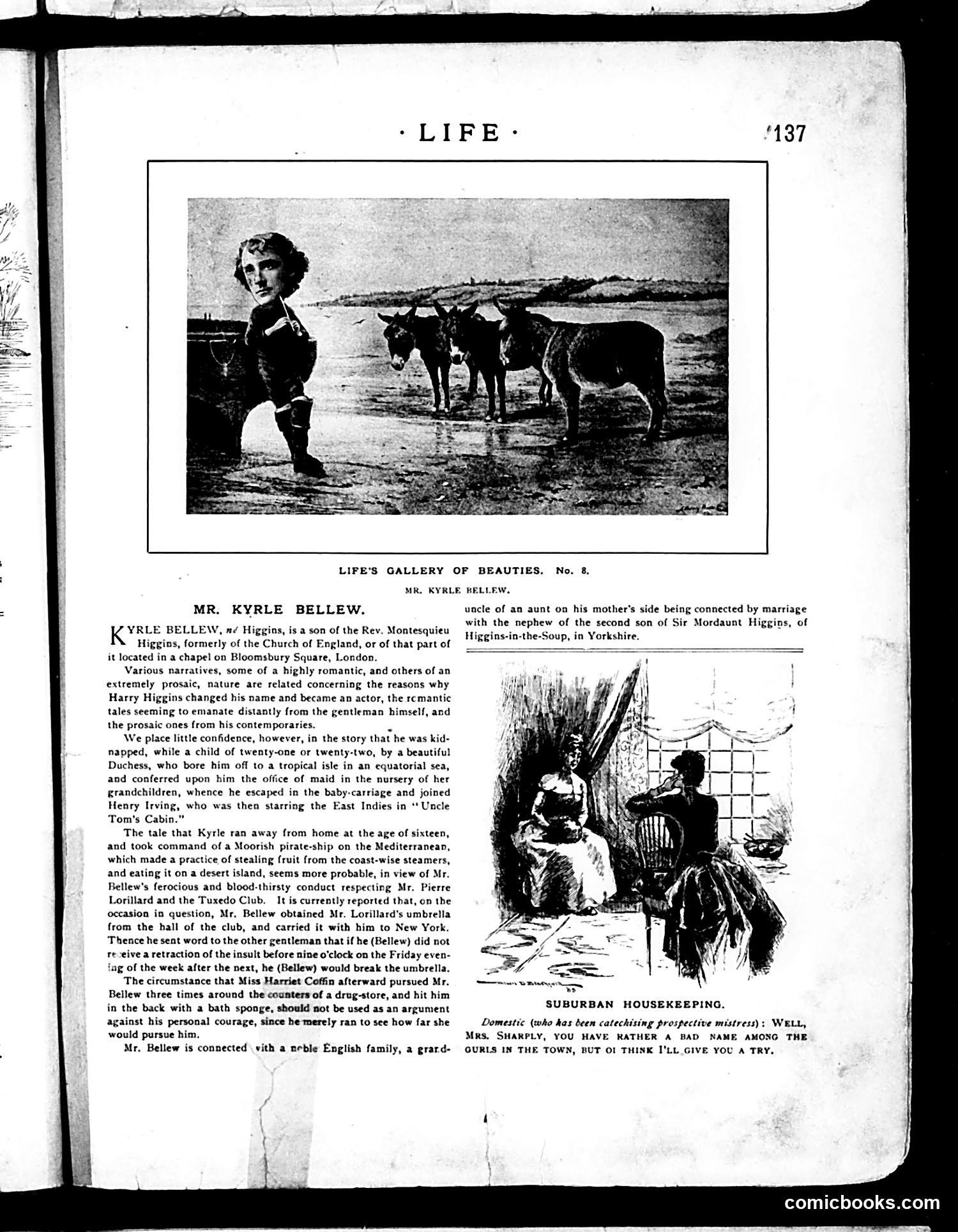
This page contains "Life's Gallery of Beauties No. 8," featuring **Mr. Kyrle Bellew**, an actor. The biographical text describes his romantic background—born to a beautiful Duchess in an equatorial location, raised by relatives, and connected to notable English families through marriage. The main photograph shows Bellew posing with donkeys on a beach, a humorous juxtaposition of theatrical glamour with mundane seaside animals. Below is an unrelated cartoon titled "Suburban Housekeeping" depicting a domestic scene with a woman and man, with dialogue about naming "the gurls in the town." This appears to be satirizing small-town social dynamics and domestic life. The page mixes theatrical celebrity profiles with social satire typical of Life's format.
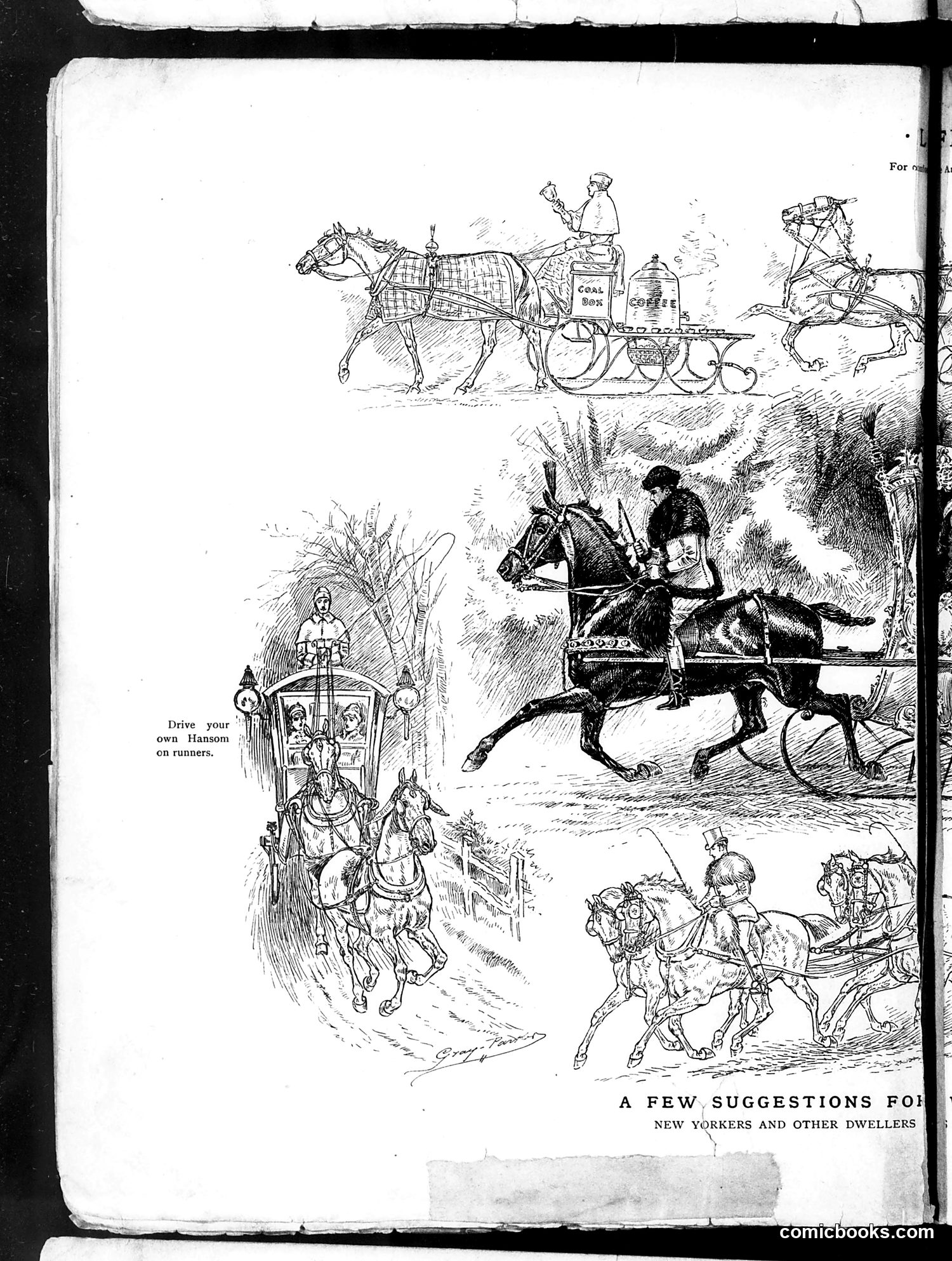
This page presents satirical illustrations titled "A Few Suggestions for New Yorkers and Other Dwellers," offering humorous commentary on urban transportation and leisure. The sketches depict various horse-drawn vehicles and riding scenarios: a hansom cab with multiple passengers, a coal/coffee delivery cart pulled by a single horse, riders on horseback, and formal carriages. One caption reads "Drive your own Hansom on runners," suggesting adaptation of city carriages for winter conditions. The satire appears to mock New York's transportation culture—likely critiquing the congestion, variety of vehicles, and social pretensions of urban travel. The "runners" reference suggests converting summer carriages to winter sleds. The overall tone humorously exaggerates the chaos of city streets while gently ridiculing New Yorkers' transportation habits and status-conscious choices regarding conveyances.
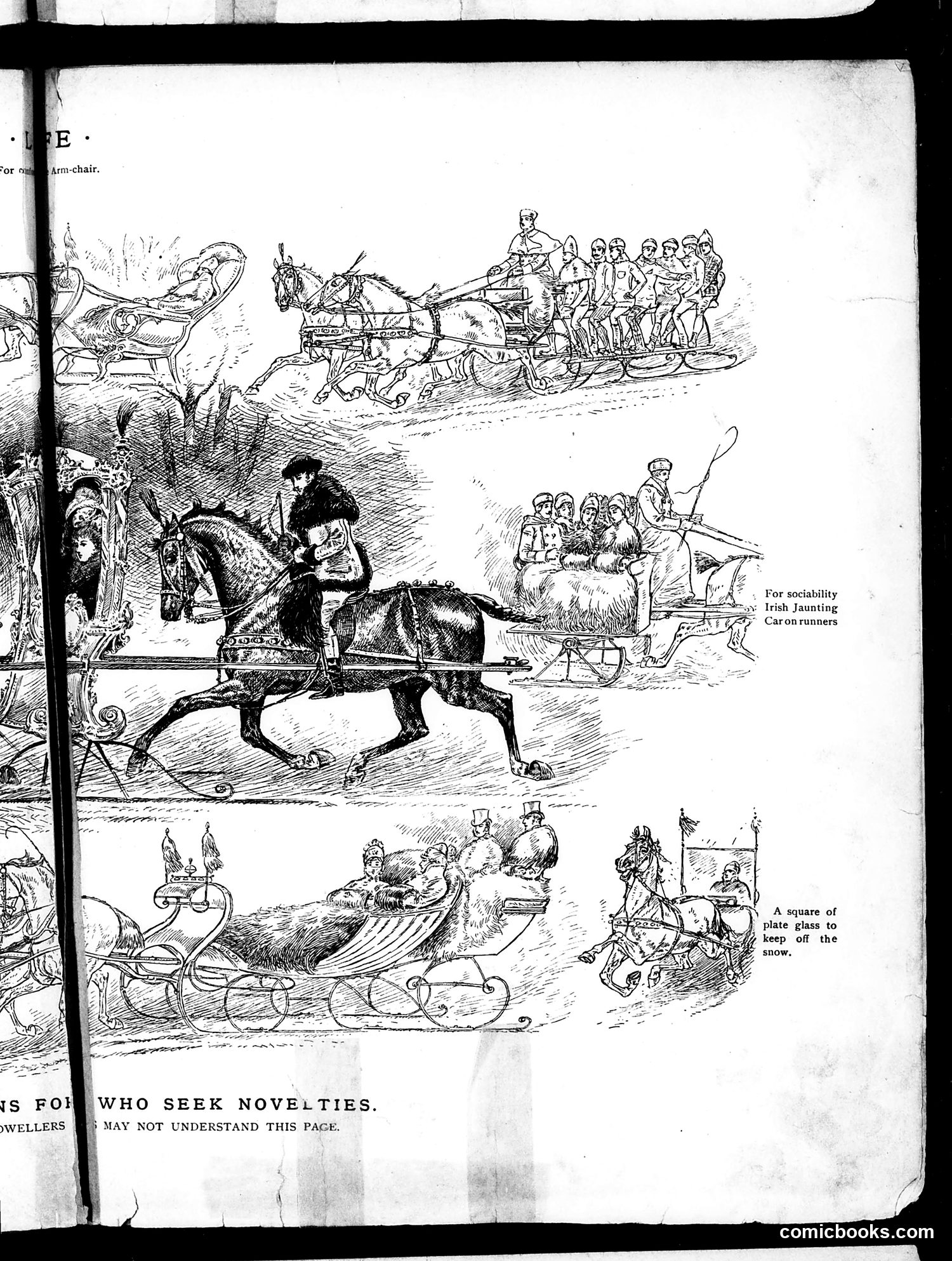
This appears to be a satirical illustration page titled "FOR WHO SEEK NOVELTIES" (with note "DWELLERS MAY NOT UNDERSTAND THIS PACE"). The drawings depict various absurd winter transportation contraptions—sleighs and carriages of exaggerated, impractical designs. The satire mocks wealthy people seeking fashionable novelties for winter recreation. Specific labels like "Irish Jaunting Car runners" and "plate glass to keep off the snow" highlight ridiculous luxury features meant for show rather than function. The overall joke targets Victorian-era conspicuous consumption and the upper classes' obsession with novel, elaborate (and often impractical) status symbols. The crude, humorous sketches emphasize how ridiculous these novelty vehicles appear—suggesting that those without means ("dwellers") wouldn't understand the frivolous pursuit of such extravagant winter fashions.
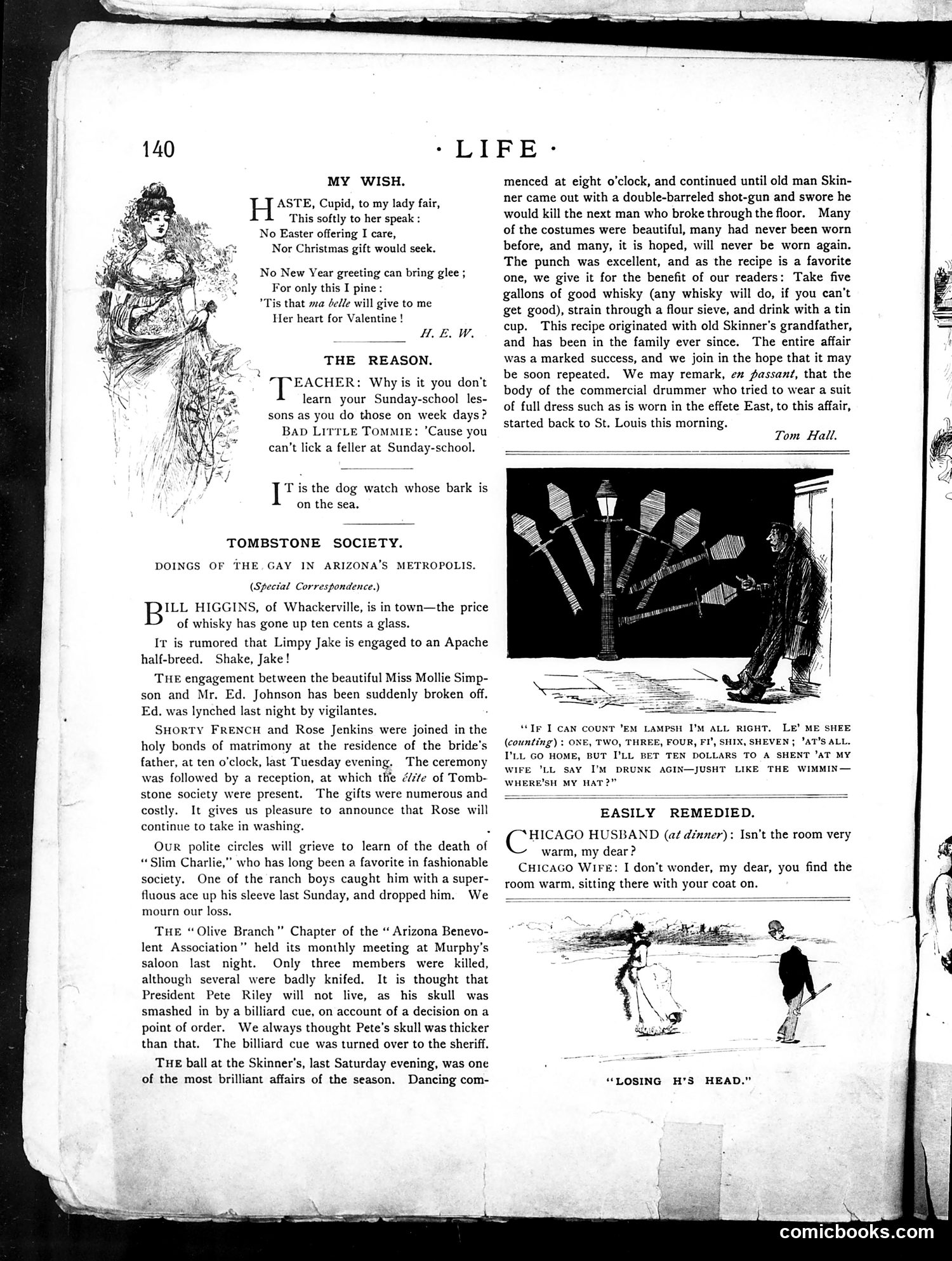
This page contains satirical humor typical of early Life magazine (a publication known for wit and social commentary, not photographs). **"My Wish"** and **"The Reason"** are brief comedic verses—the first romantic, the second a joke about a boy preferring weekday lessons because Sunday school teachers can't physically punish students there. **"Tombstone Society"** is the main feature: satirical "society news" from Arizona's frontier town, mocking the violence and lawlessness of the Old West. Items report casually on lynchings, murders by billiard cue, and deaths during "charitable" meetings, while maintaining a gossip-column tone typically used for high-society events. The joke is the incongruity—treating frontier brutality with refined newspaper language. The punch recipe joke emphasizes frontier drinking culture. **"Easily Remedied"** and **"Losing H's Head"** are captioned cartoons about domestic life: one depicts a husband still wearing his coat indoors, the other shows a drunk man counting lamp posts to prove sobriety. Both mock male behavior and marital conflict humorously. The satire targets frontier lawlessness, masculine foolishness, and gender dynamics.
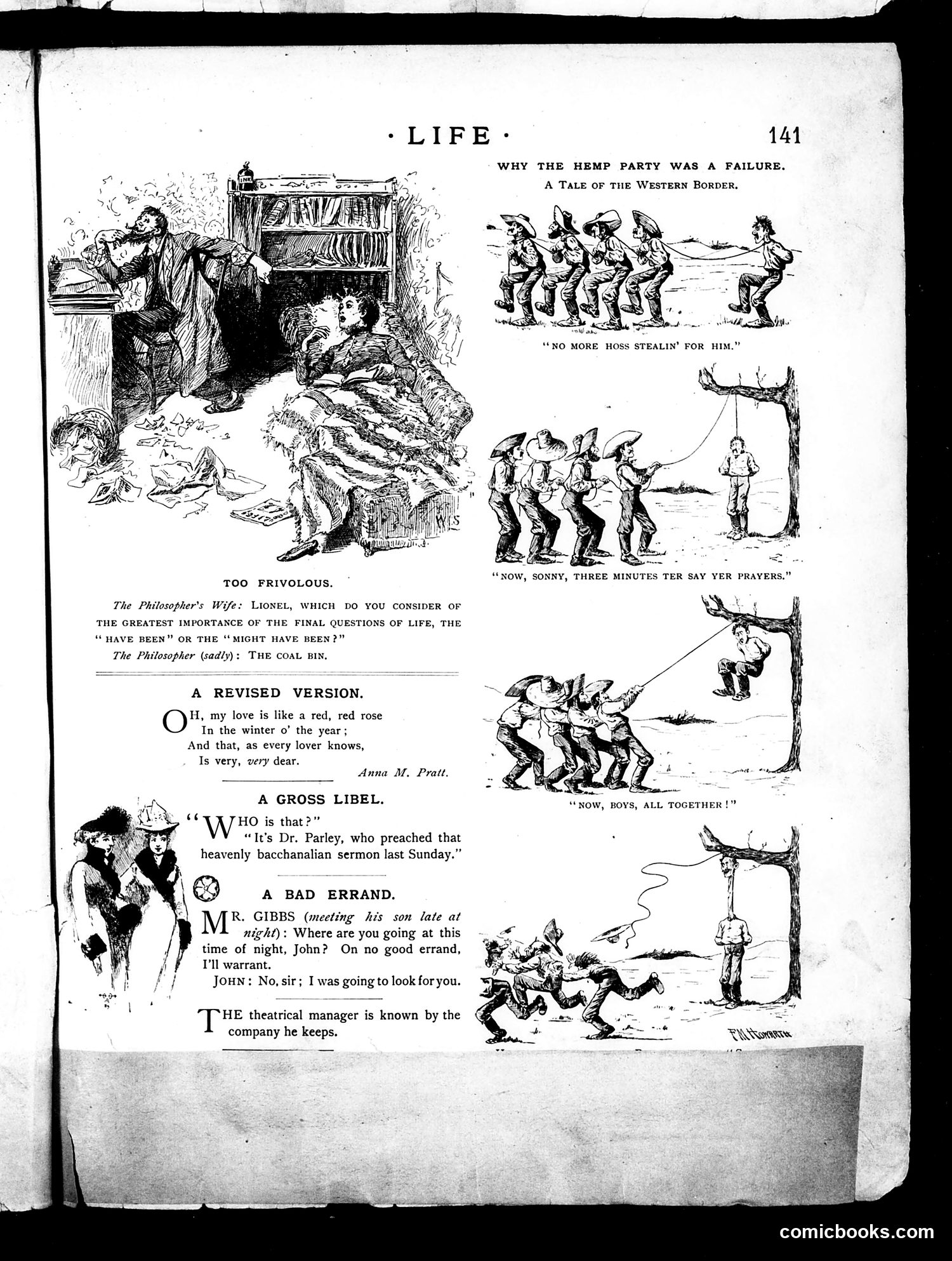
This page contains several unrelated satirical pieces typical of Life magazine's humor: **"Why the Hemp Party Was a Failure"** shows frontier figures attempting executions by hanging—apparently mocking a political party or movement as incompetent or frivolous, though the specific "Hemp Party" reference is unclear without additional context. **"Too Frivolous"** satirizes an absent-minded philosopher more concerned with his coal bin than philosophical questions, mocking intellectuals disconnected from practical reality. **"A Gross Libel"** references Dr. Parley preaching a "heavenly bacchanalian sermon"—religious hypocrisy about a minister contradicting Christian temperance values. **"A Bad Errand"** presents a father-son joke where the son humorously turns parental suspicion back on the father. The final note about theatrical managers relates to the company they keep—a general aphorism about reputation. All pieces rely on wordplay, irony, and social commentary typical of early American satirical magazines.
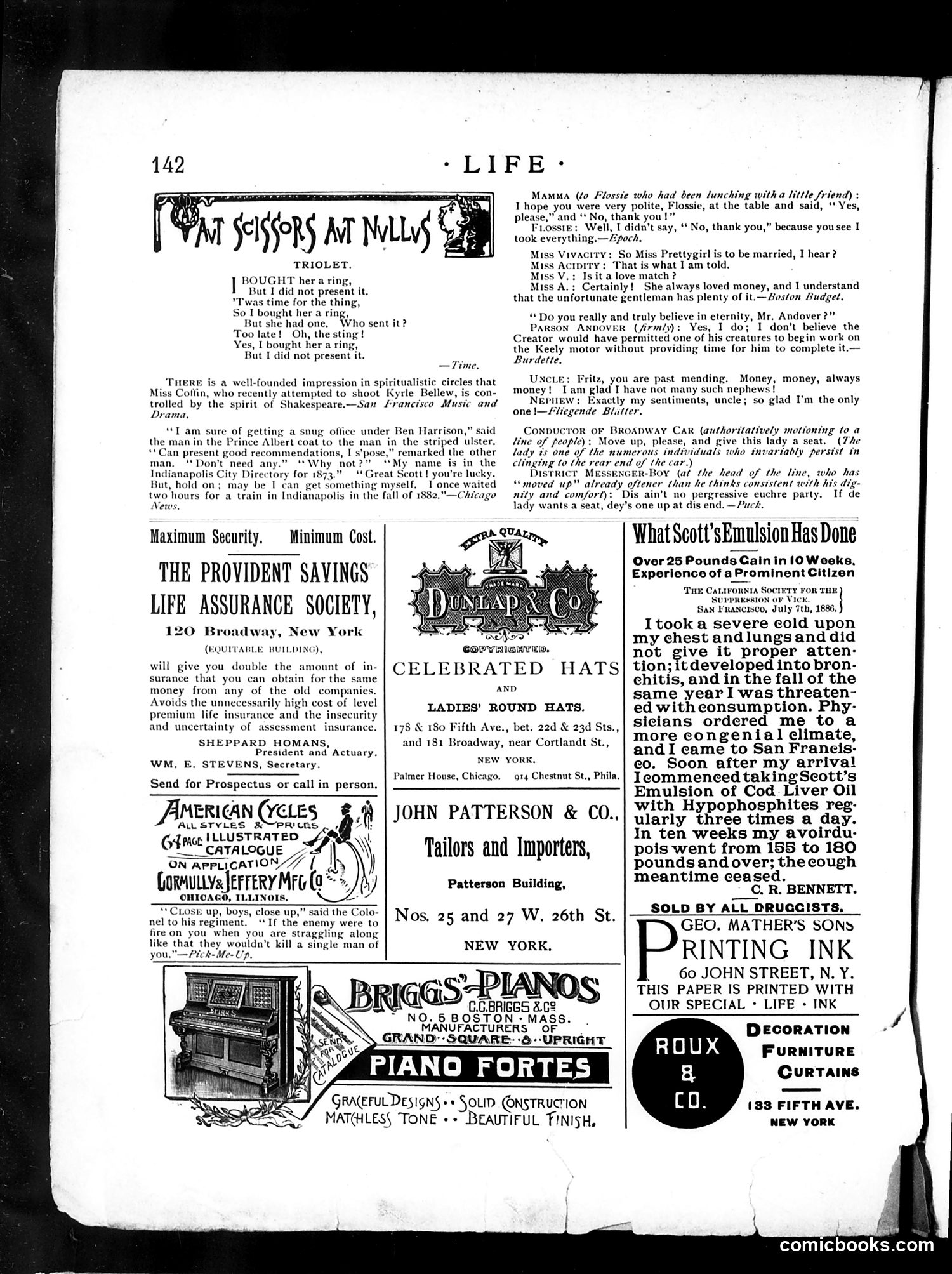
This page is primarily **humorous poetry and comic vignettes** rather than political cartoons. The main content includes: **The Triolet poem**: A light joke about a man who bought an engagement ring for a woman, only to discover she already owned one (from an unknown sender), making his gift redundant and awkward. **The social humor pieces** are brief satirical anecdotes mocking: - Spiritualism (a contemporary fad claiming spirits controlled people) - Political patronage under President Benjamin Harrison - Upper-class courtship and marriage motivated by money rather than love - Pompous clergy and their contradictions - Social pretension and etiquette **The bulk of the page is advertisements** for life insurance, pianos, cycles, hats, and tailoring services—typical of *Life* magazine's revenue model. The humor is gentle, domestic satire reflecting late-19th-century concerns about materialism, social climbing, and the absurdities of polite society. No specific political figures are caricatured here.
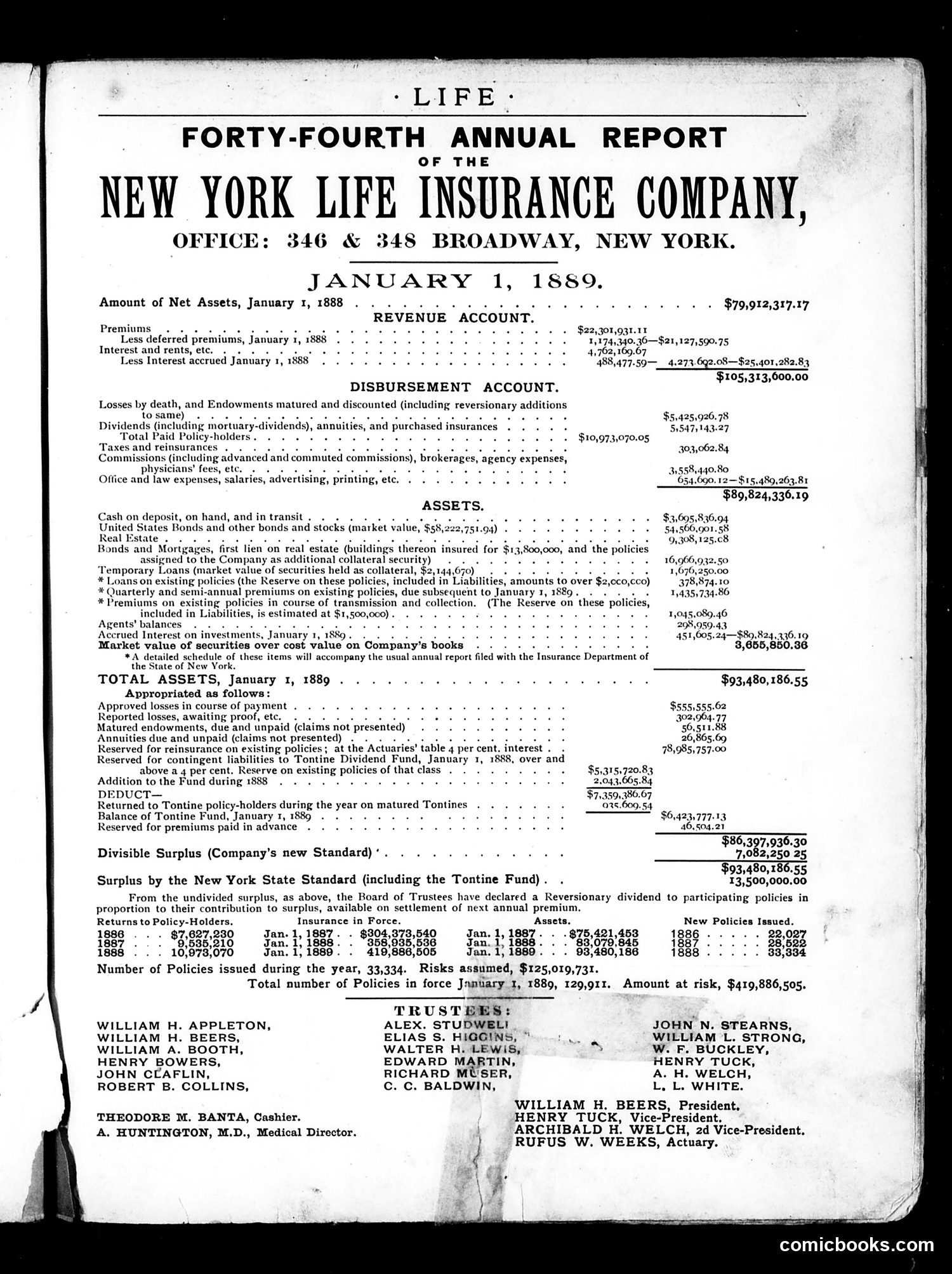
This is a financial document—the forty-fourth annual report of the New York Life Insurance Company, dated January 1, 1889. It lists detailed accounting information: assets ($93,480,186.55), revenue, disbursements, and allocations of funds. **Life magazine context**: *Life* was primarily a satirical/humor publication, but it also published serious content including financial reports and business notices. This appears to be a paid announcement or official filing rather than editorial material. There are no cartoons, caricatures, or satirical illustrations visible on this page. The content is strictly financial documentation with lists of trustees and company officers at the bottom.
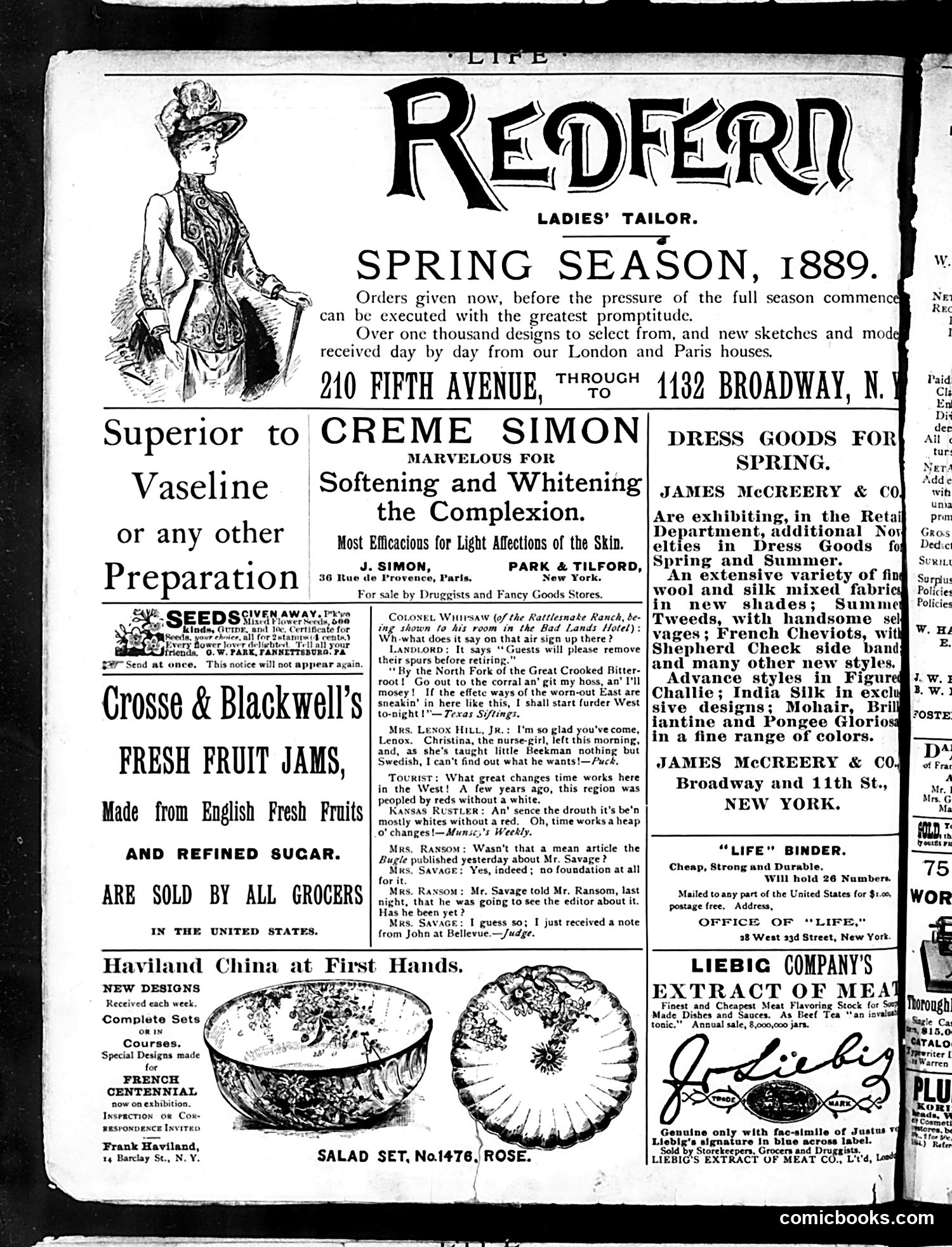
This is primarily an **advertising page** with several embedded satirical vignettes typical of Life magazine's format. The page features four short comic sketches poking fun at social pretension and cultural change: 1. **"Colonel Whitsaw"**: A frontier rancher is scandalized that a Western hotel requests guests remove their spurs before retiring—a sign of "effete" Eastern civilization encroaching on the Wild West. 2. **The Swedish Nursemaid**: A wealthy New York matron complains her nanny taught her child only Swedish, leaving the parents unable to communicate with their own son—mocking the influx of immigrant servants. 3. **The Drought Joke**: A tourist notes the West was once populated by Native Americans; a rustler quips it's now mostly whites after the drought—dark humor about demographic displacement. 4. **The Gossip Snippet**: A brief exchange about newspaper scandal and confrontation. These sketches reflect 1880s anxieties: Western expansion, immigration, class anxiety, and changing social mores. The surrounding advertisements (dress goods, cosmetics, china, extract of meat) target affluent readers—the magazine's intended audience.
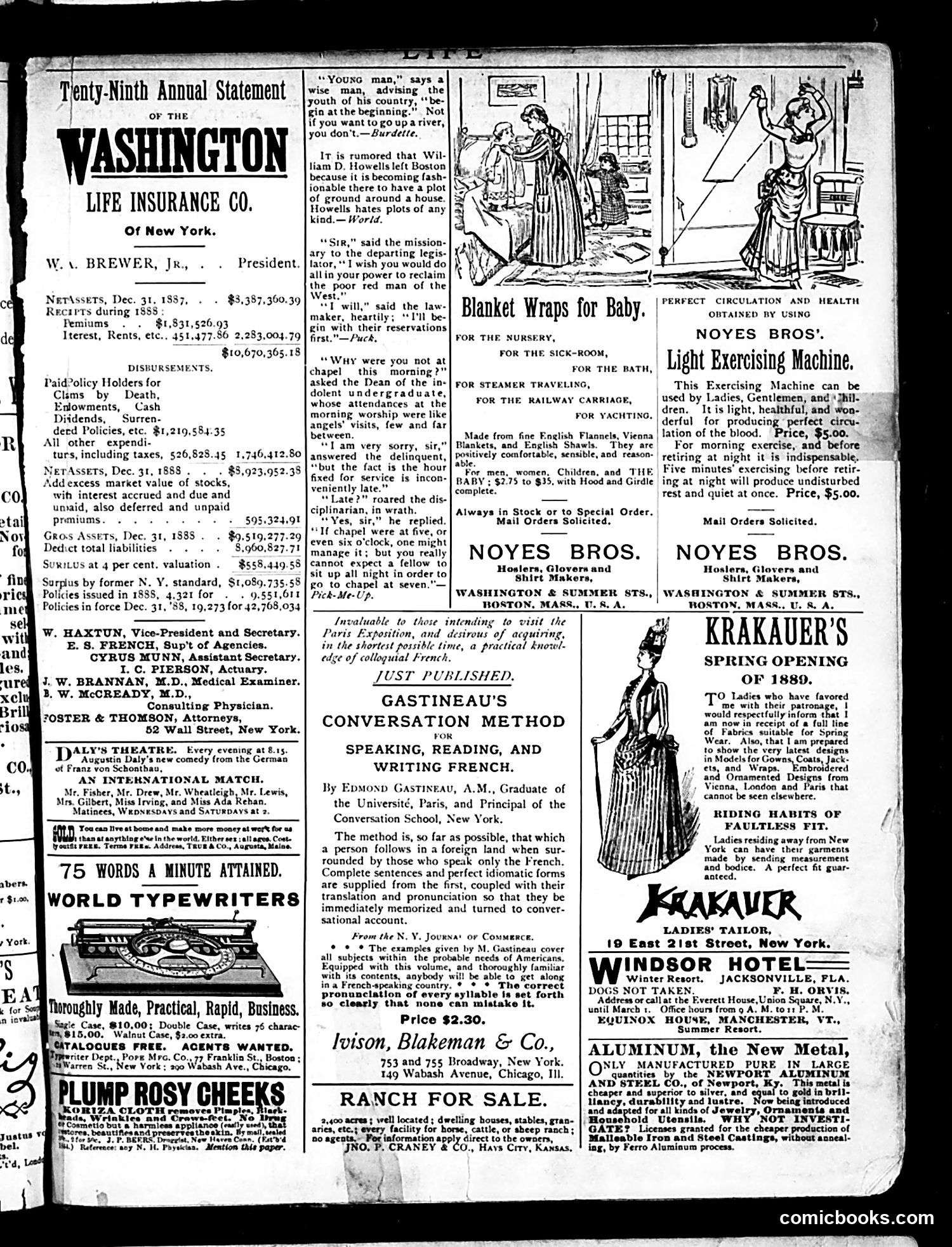
This page is predominantly a financial statement and advertisements for the Washington Life Insurance Company's 1888 annual report, combined with miscellaneous period advertisements and brief satirical jokes. The small humorous items are: - A quip about river travel advice (Burdette quote) - A jab at William D. Howells, suggesting he left Boston because plots of land were becoming fashionable (wordplay on "plots" — both literal property and narrative) - A missionary/legislator exchange mocking hollow promises about "reclaiming" Native Americans - A student defending chapel tardiness by questioning the logic of early services These jokes reflect 1880s concerns: urbanization, literary criticism of Howells, paternalistic views of Native Americans, and student irreverence. The page itself—comprising insurance data, theater notices, typewriter ads, and health tonics—exemplifies typical Life magazine content blending financial information with commercial advertising and gentle social satire.
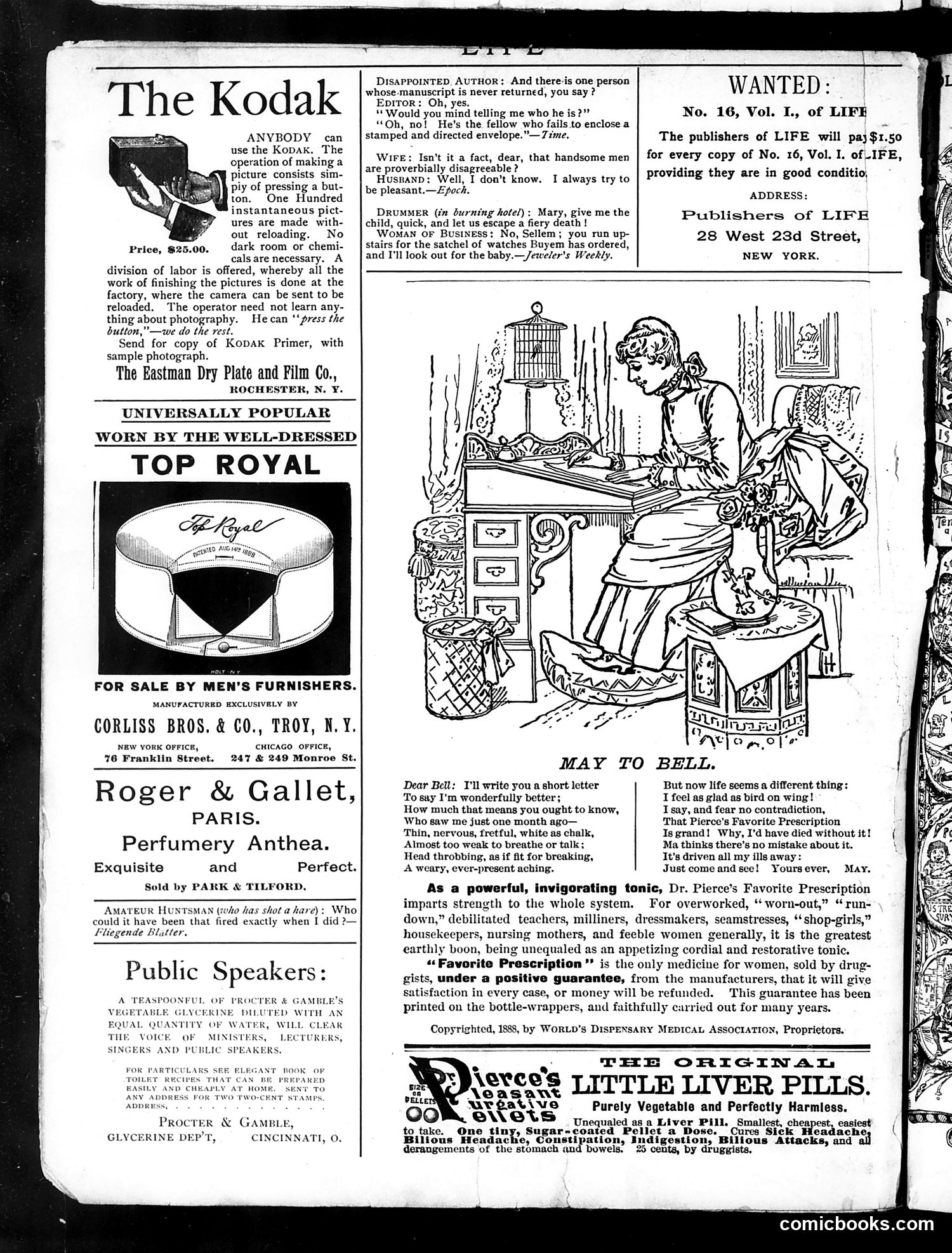
This page from *Life* magazine (1888) is primarily **advertising with small joke items interspersed**—not a political cartoon. The advertisements showcase consumer products: Kodak cameras (emphasizing ease of use for amateurs), Top Royal hats, French perfume, and notably Dr. Pierce's "Favorite Prescription," a patent medicine marketed to women as a tonic for fatigue and ailments. The brief humor pieces are mild social satire: an editor's joke about rejected manuscripts (authors forgetting return postage), a husband's diplomatic response about handsome men's disagreeableness, and a darkly comic "Drummer in burning hotel" bit where a businesswoman prioritizes retrieving watches over escaping danger—satirizing mercenary priorities. The "May to Bell" testimonial is a fake endorsement for Pierce's Prescription, presenting it as miraculous for women's health—typical of 19th-century patent medicine marketing that exploited women's medical vulnerabilities without scientific basis.