
A complete issue · 14 pages · 1888
Life — December 20, 1888
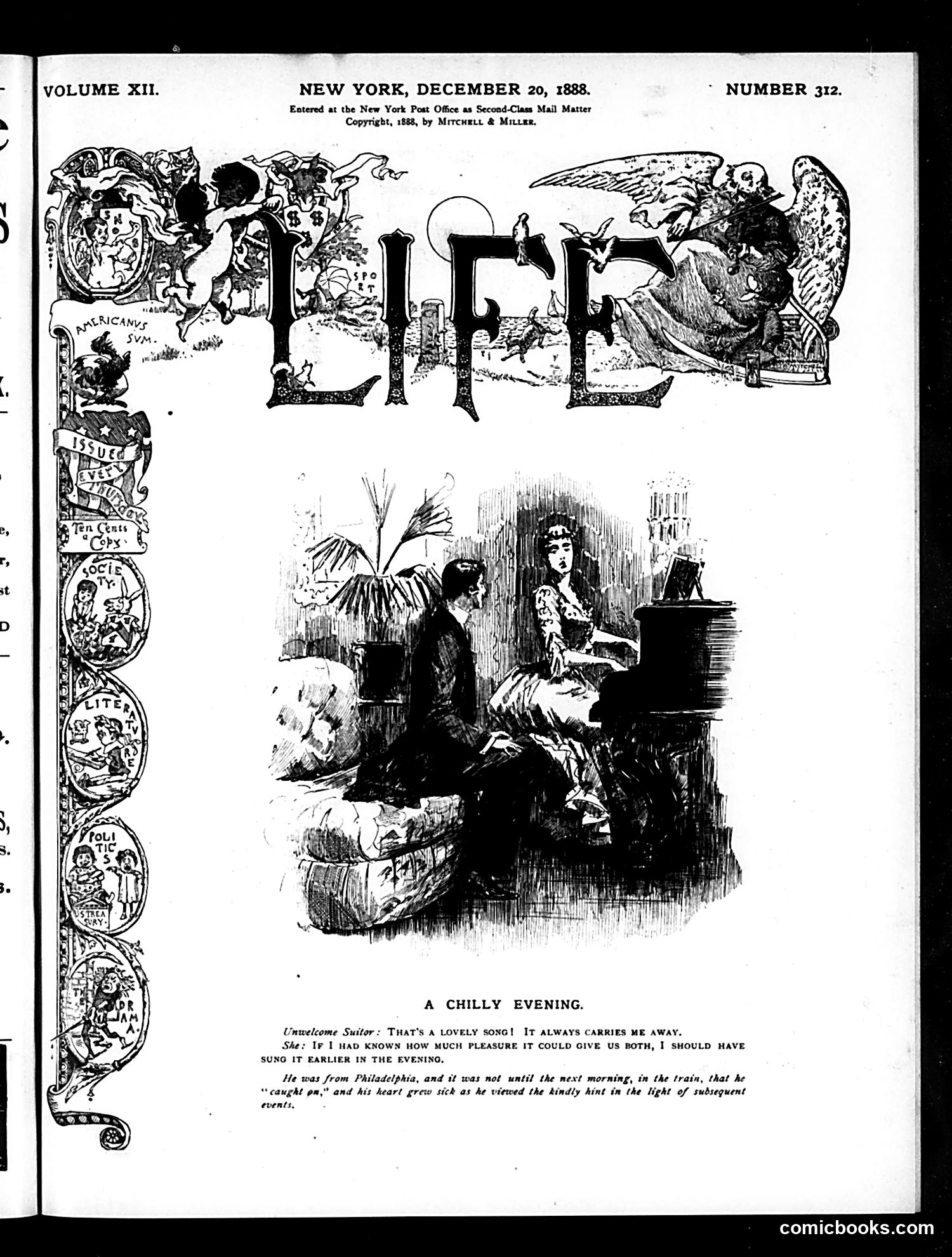
This illustration depicts a domestic scene titled "A Chilly Evening," showing a couple in Victorian dress. The "Unwelcome Suitor" sings a song, which the woman finds pleasant but the man (appearing to be her father or guardian) finds annoying. The accompanying text reveals the joke's darker implication: the suitor is from Philadelphia and only "caught on" the next morning by train—suggesting he overstayed his unwelcome visit. The satire targets persistent, unwanted romantic suitors who impose themselves on households despite clear social rejection. The "chilly" title references both the cold evening and the frosty reception the man receives from the protective male figure present.
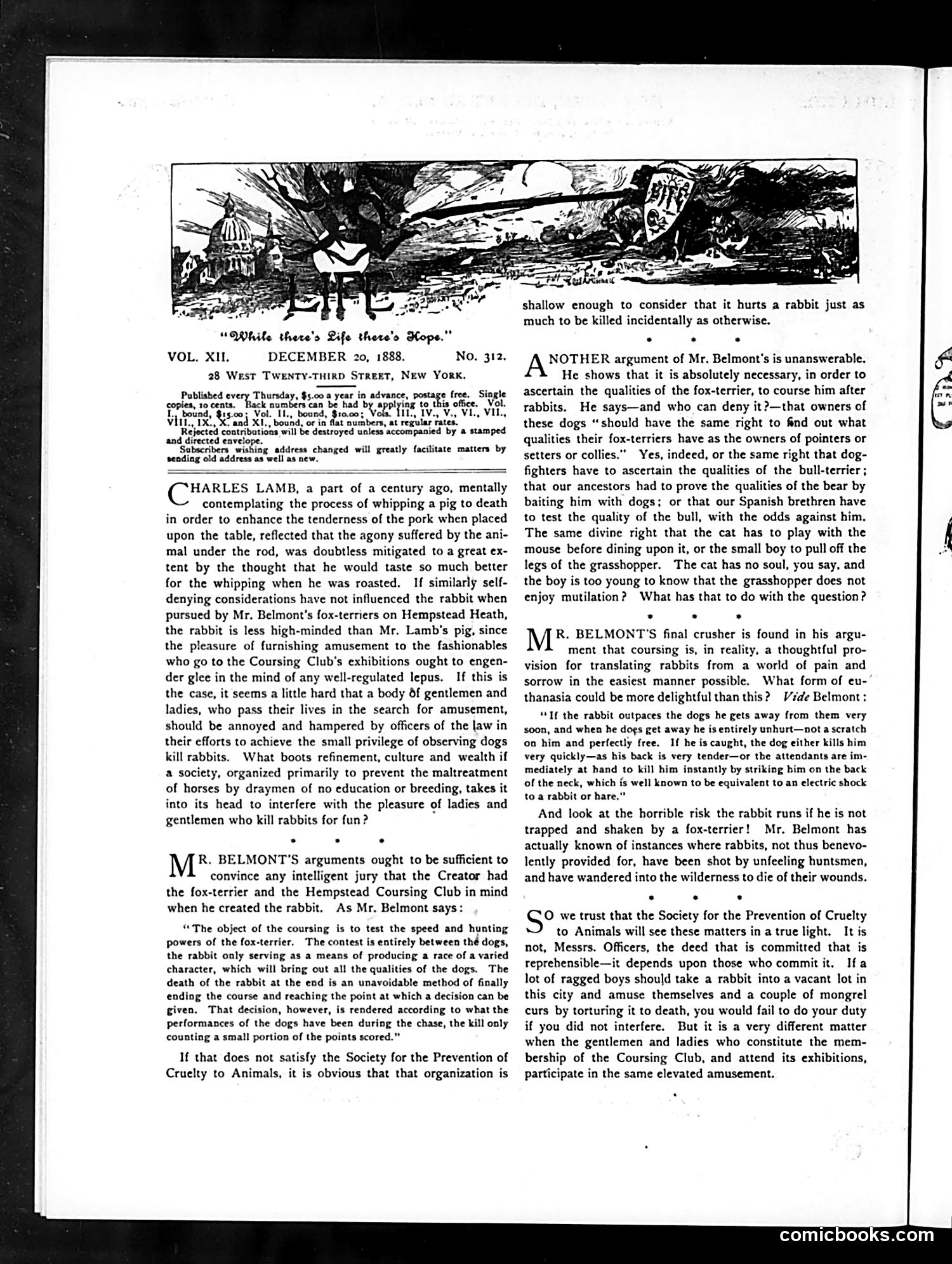
This page from *Life* (December 20, 1888) features editorial commentary criticizing the Coursing Club's practice of hunting rabbits with fox-terriers for sport. The small illustration at top depicts this blood sport. The text argues that such coursing is cruel and indefensible—that rabbits suffer needlessly and may be accidentally killed during hunts. The satire targets wealthy gentlemen and ladies of the Coursing Club who justify the practice as testing dogs' hunting abilities. The author mocks their reasoning as hypocritical: if they accept killing animals for amusement, they should logically tolerate children torturing grasshoppers for fun. The piece appeals to the Society for the Prevention of Cruelty to Animals to intervene, suggesting that fashionable sport venues should not be exempt from animal welfare standards.
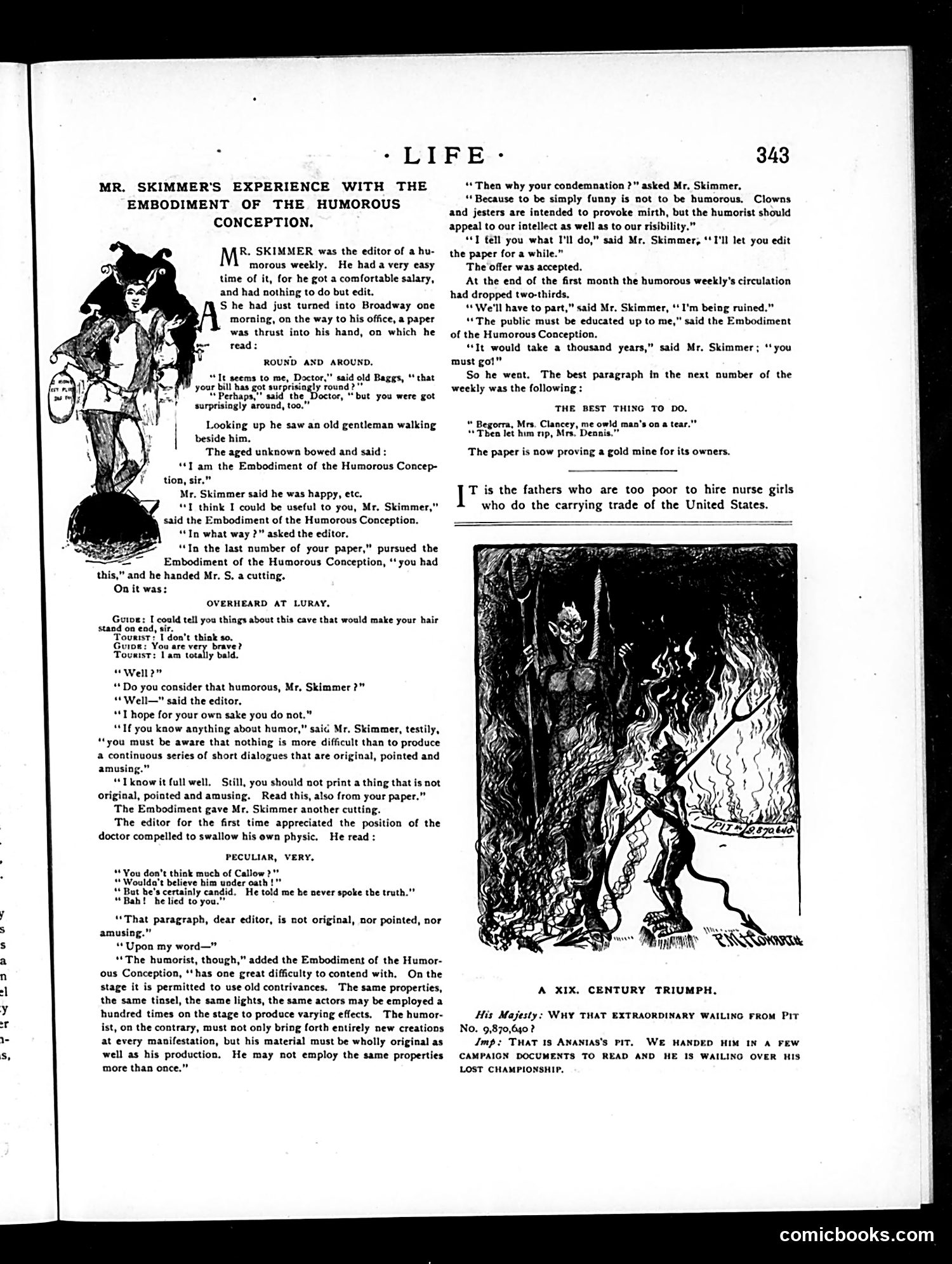
This page contains two distinct pieces: **Left side:** "Mr. Skimmer's Experience with the Embodiment of the Humorous Conception" — a satirical narrative about an editor struggling to define and produce humor. The text debates what makes something truly "humorous" versus merely "funny," suggesting tension between intellectual comedy standards and popular entertainment. The accompanying illustration shows a jester-like figure, reinforcing the theme. **Right side:** A dark illustration titled "A XIX. Century Triumph" depicting what appears to be a demonic or hellish scene. The caption references "His Majesty" and mentions Amanias's pit, wailing, and a "lost championship" — likely political satire, though the specific reference remains unclear without additional context. Both pieces appear to critique standards of humor and possibly contemporary political figures.
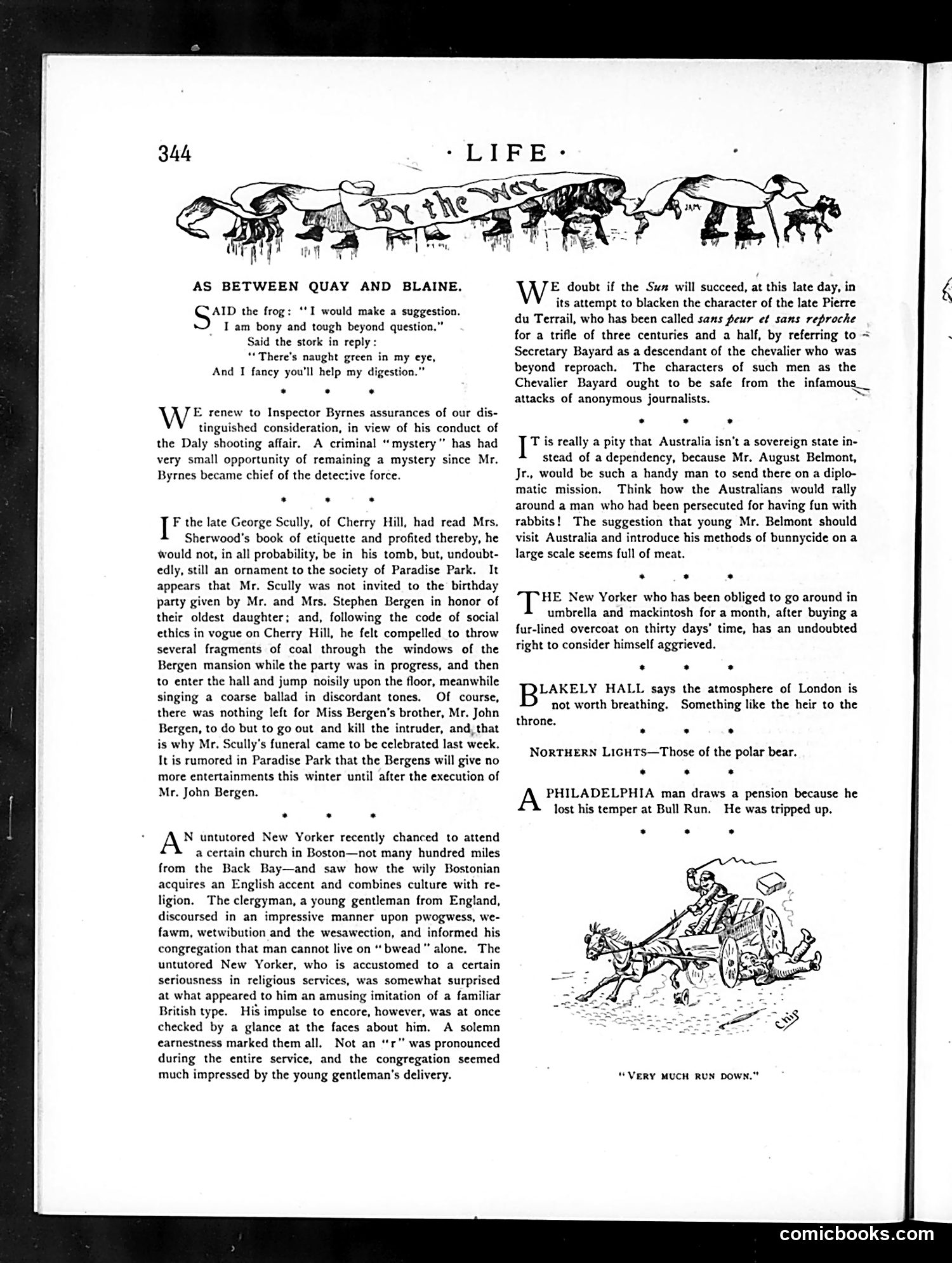
This page contains several brief satirical anecdotes rather than political cartoons. Key items include: **"As Between Quay and Blaine"**: A humorous dialogue between a frog and stork about digestion, likely political commentary on figures Matthew Quay and James G. Blaine, though the exact reference is unclear. **Inspector Byrnes**: References the "Daily shooting affair" and a criminal "mystery," praising the police inspector's conduct. **George Scully anecdote**: Satirizes social pretension in Paradise Park through a story about coal fragments thrown during a party. **The bottom cartoon** depicts a man in a cart being pulled by a donkey, captioned "Very much run down"—a visual pun on physical exhaustion. Other brief items mock London's atmosphere, a Philadelphia pension case, and a Boston clergyman's sermon style. The satire targets social hypocrisy and urban absurdities.
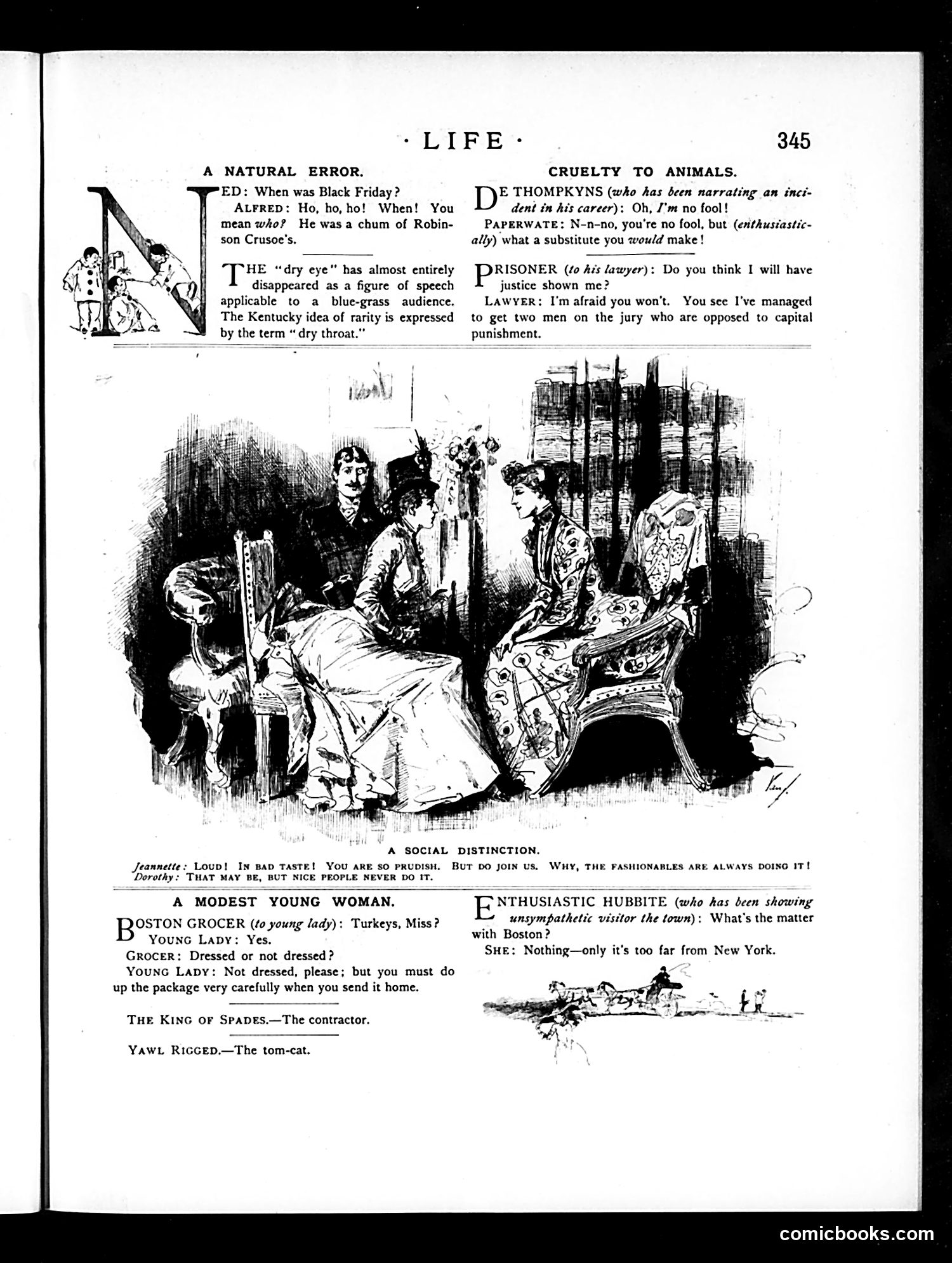
This page contains several brief satirical vignettes typical of Life's humor: **"A Natural Error"** mocks the phrase "dry eye" as outdated slang, referencing Robinson Crusoe. The joke relies on period colloquialisms readers would recognize. **"Cruelty to Animals"** satirizes De Thompkyvis (likely a character name), with Paperware enthusiastically endorsing something substitutional—the exact target is unclear, but it appears to mock someone's misguided enthusiasm. **"A Social Distinction"** depicts fashionable society members, with the caption suggesting irony about why fashionable people engage in activities despite claiming not to. **Other sections** include brief exchanges between a Boston grocer and a young lady about turkey packaging, and definitions of playing-card terms as animal metaphors. The humor relies heavily on period-specific language and social references that obscure the precise targets today.
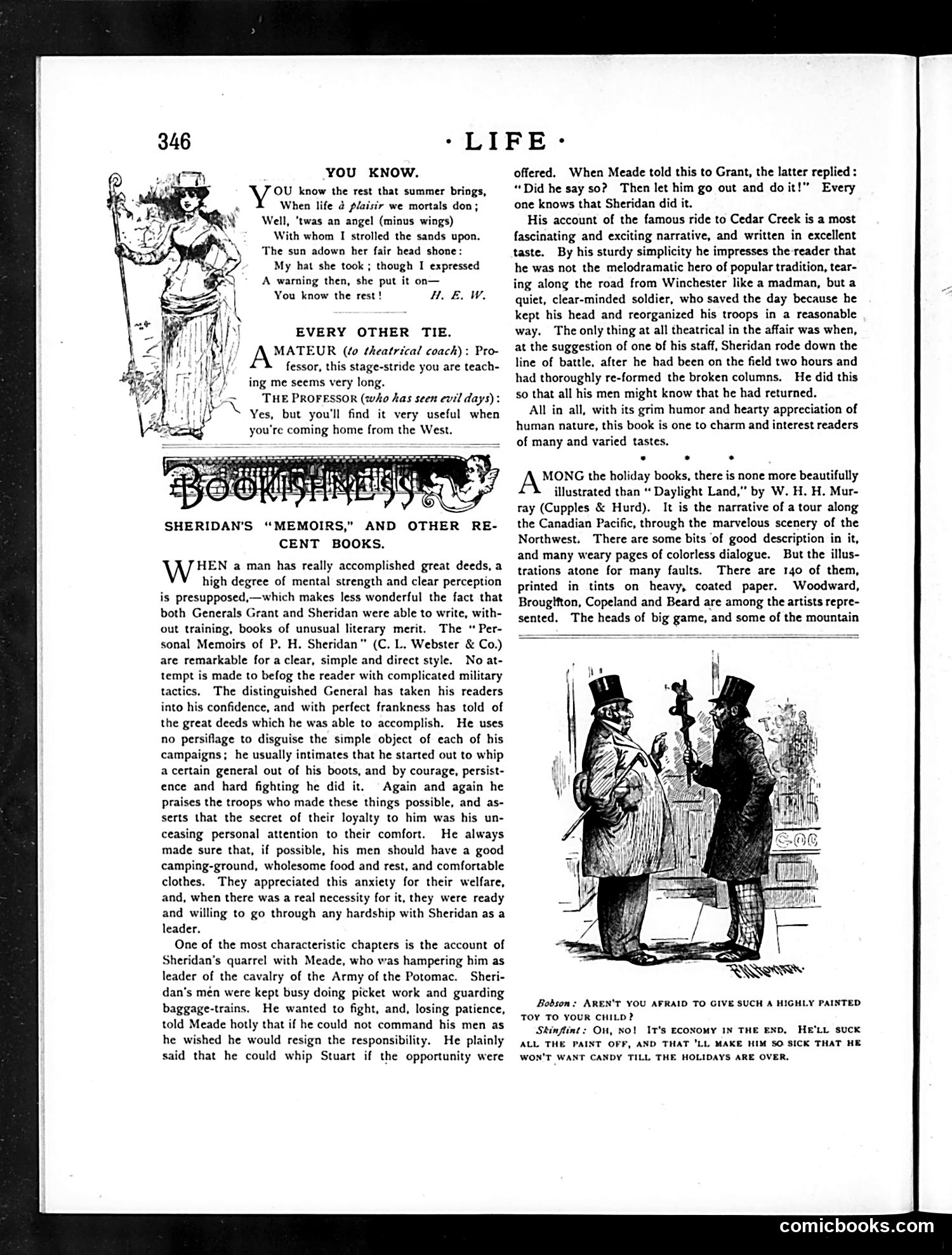
This page primarily discusses General Sheridan's military memoirs rather than presenting political satire. The main cartoon depicts two men in period dress engaged in conversation on a city street—likely illustrating a scene from literature or contemporary life. The bottom dialogue between "Robson" and "Simkins" is a humorous exchange about giving a painted toy to a child. Simkins jokes that the toy will make the child sick by eating its paint, which will solve the problem of the child wanting candy after the holidays end. This is domestic humor relying on exaggeration—the absurdist notion that parental problems can be solved through induced illness. The page is primarily book review/editorial content rather than political commentary.
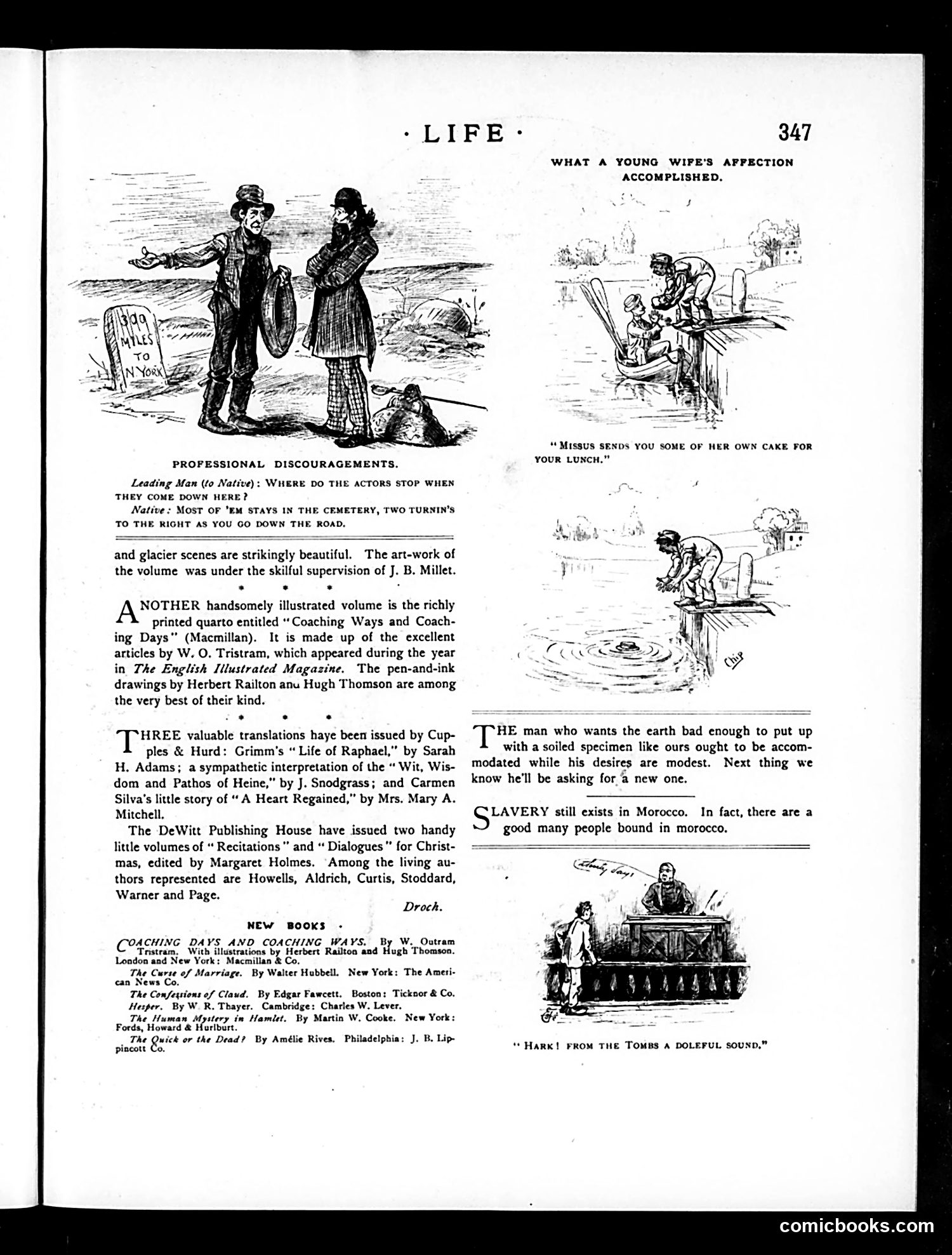
This page contains two distinct sections: **Top cartoons** titled "Professional Discouragements" and "What a Young Wife's Affection Accomplished" appear to be humorous domestic and social vignettes rather than political satire. The first shows a Native American interaction; the second depicts fishing scenes with a couple. **Main text** discusses newly published books, including volumes on coaching and various literary works. A notable mention: "Slavery still exists in Morocco. In fact, there are a good many people bound in morocco"—a pun on "morocco" leather binding, making light of actual human slavery through wordplay. **Bottom illustration** shows what appears to be a graveyard scene with the caption "Hark! from the tombs a doleful sound." The page is primarily literary commentary rather than political commentary.
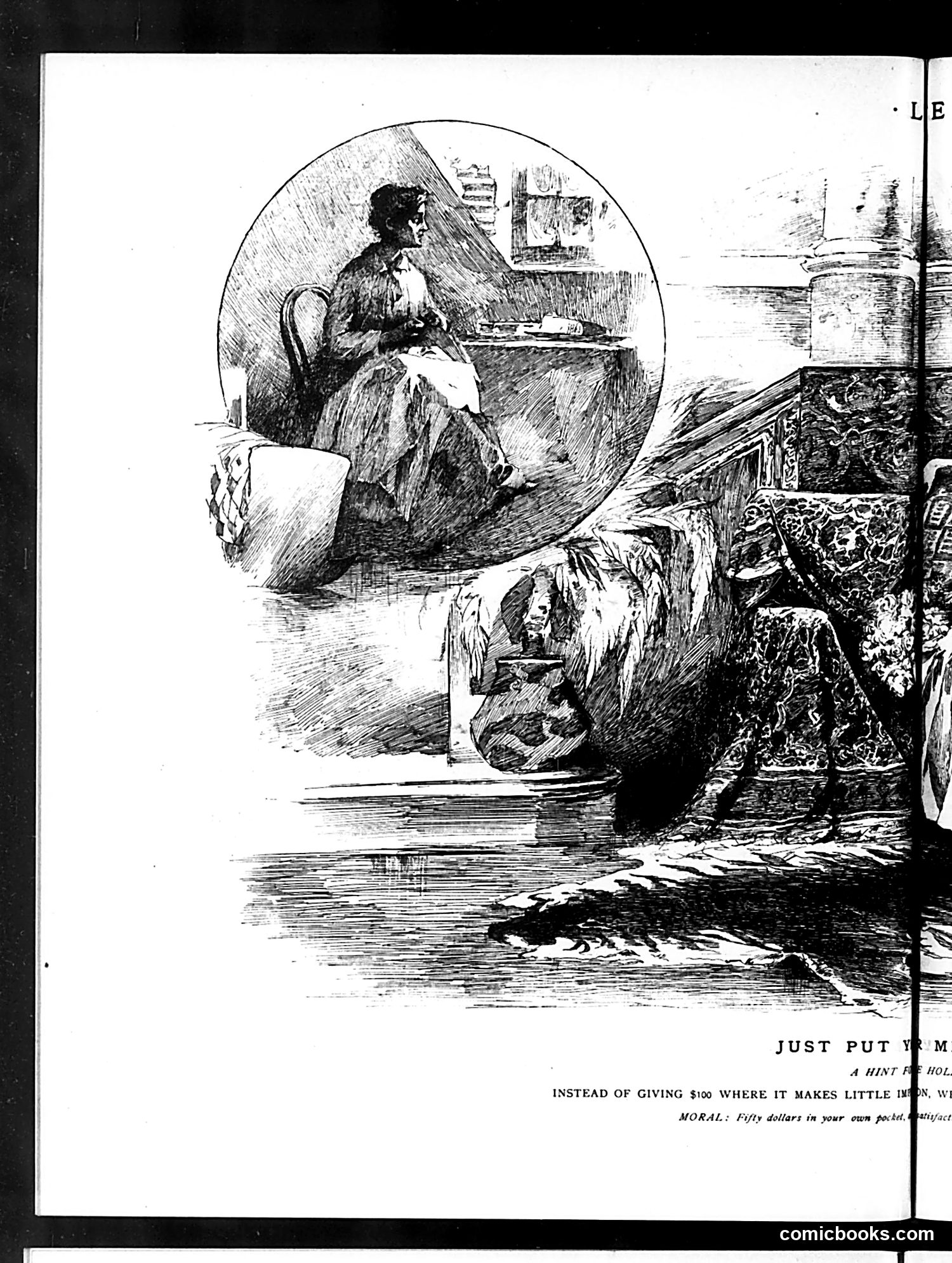
This appears to be a satirical cartoon criticizing charitable giving practices. The image shows a wealthy woman in an interior setting, depicted in a circular vignette. The visible text reads: "JUST PUT IT IN / A HINT FOR HOLI- / INSTEAD OF GIVING $100 WHERE IT MAKES LITTLE IMP, WI-" with a moral stating "Fifty dollars in your own pocket." The satire targets the contradiction between public charitable donations and personal financial self-interest. The cartoon suggests that rather than giving $100 to charity where "it makes little impression," donors should keep fifty dollars for themselves—mocking the hypocrisy of those who make grand charitable gestures while being unwilling to genuinely sacrifice. The woman's comfortable, leisured appearance emphasizes the wealth involved, making the moral critique about misplaced priorities sharper.
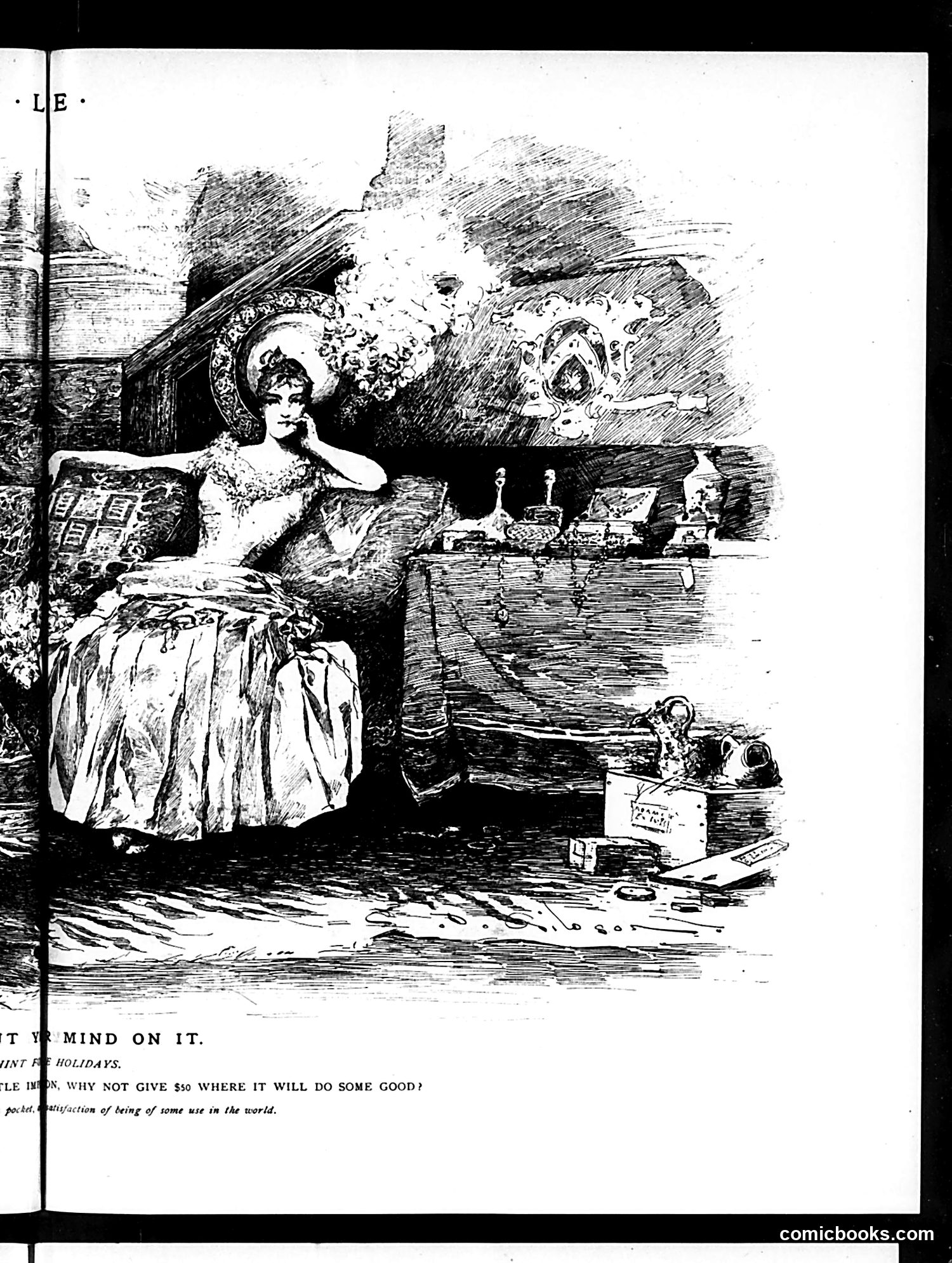
This appears to be a satirical illustration about charitable giving during the holiday season. The visible text urges readers to "GIVE $10 WHERE IT WILL DO SOME GOOD," emphasizing the satisfaction of helping those in need. The image shows a wealthy woman in elaborate dress and jewelry, reclining in luxury among fashionable furnishings and cosmetics. The contrast between her opulence and the message about charitable giving suggests social satire—likely critiquing the wealthy for their self-indulgence during holidays when others suffer poverty. The illustration's style and composition imply the cartoon mocks upper-class complacency and appeals to readers' conscience regarding economic inequality. The specific target or occasion remains unclear without the full article context.
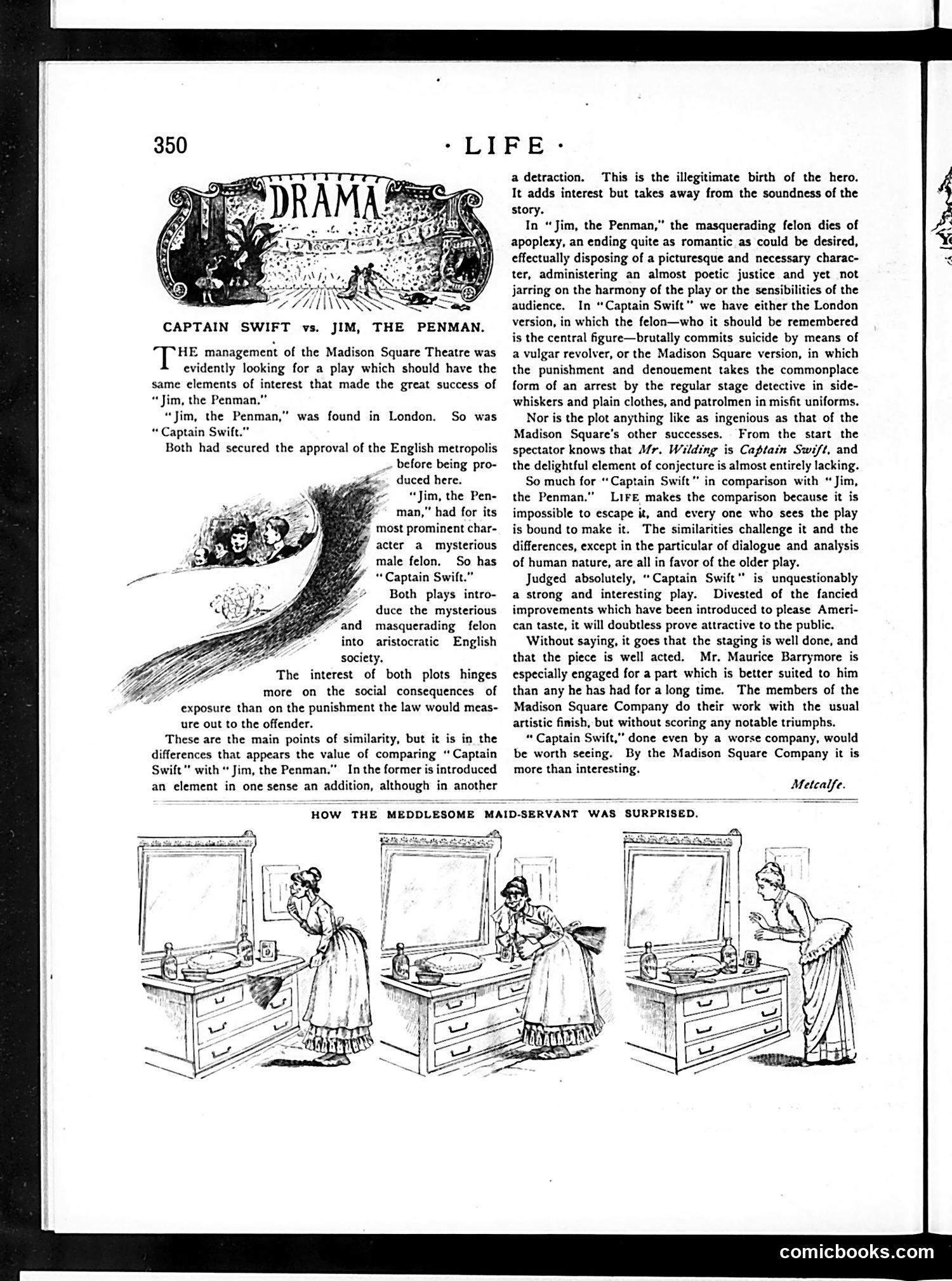
This page reviews two plays staged at Madison Square Theatre. The text compares "Captain Swift" (featuring a mysterious male felon in aristocratic English society) with "Jim, the Penman" (about a masquerading criminal who commits suicide). The reviewer notes both plays hinge on social consequences of criminal exposure rather than punishment itself. While "Jim, the Penman" offers more ingenious plotting, "Captain Swift" is judged the superior play—better structured, with stronger character work by actor Maurice Barrymore. The bottom illustration, "How the Meddlesome Maid-Servant Was Surprised," shows a domestic comic sequence of a servant encountering something unexpected at a vanity mirror, though its relation to the reviews above is unclear.
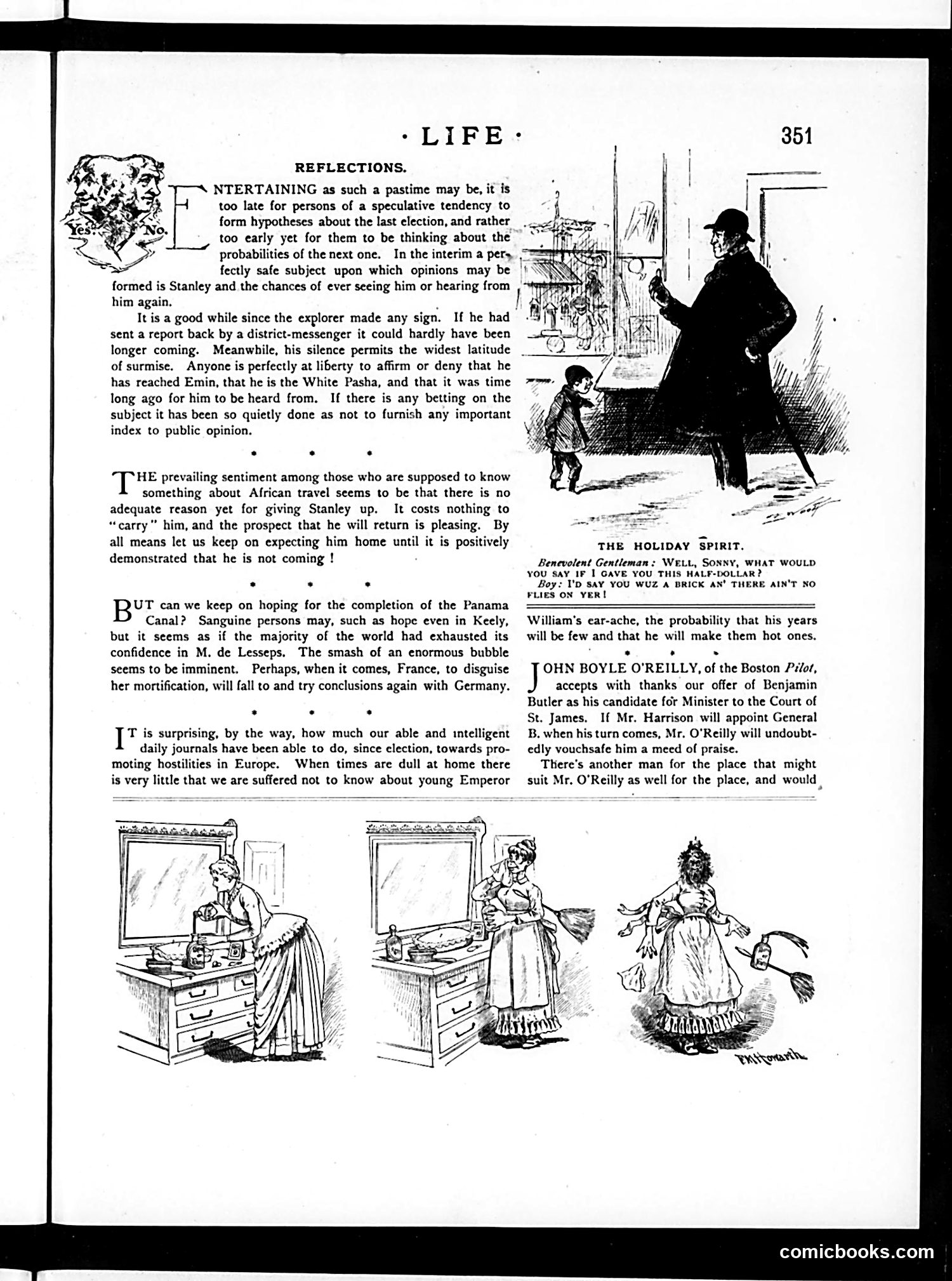
This page contains several distinct satirical pieces from *Life* magazine (likely 1880s-90s based on references): **Main Reflections Section:** Discusses explorer Henry Morton Stanley's silence after his African expedition seeking Emin Pasha. The writer wryly notes that with no news, people are free to speculate wildly—a safe topic unlike recent elections or upcoming ones. The commentary also touches on the Panama Canal's failing prospects under de Lesseps and satirizes American newspapers' tendency to sensationalize European conflicts (particularly involving "young Emperor"—likely Wilhelm II) when domestic news is slow. **"The Holiday Spirit" Cartoon:** Shows a gentleman offering a half-dollar to a street boy, who responds enthusiastically that the giver is "a brick" (generous) and there are "no flies on" him (he's sharp/honest). This mocks performative holiday charity—the boy's exaggerated gratitude for a small coin. **O'Reilly Section:** References John Boyle O'Reilly (Boston editor) and satirizes the appointment of Benjamin Butler as a potential Minister to the Court of St. James—apparently an ironic suggestion of an unsuitable candidate.
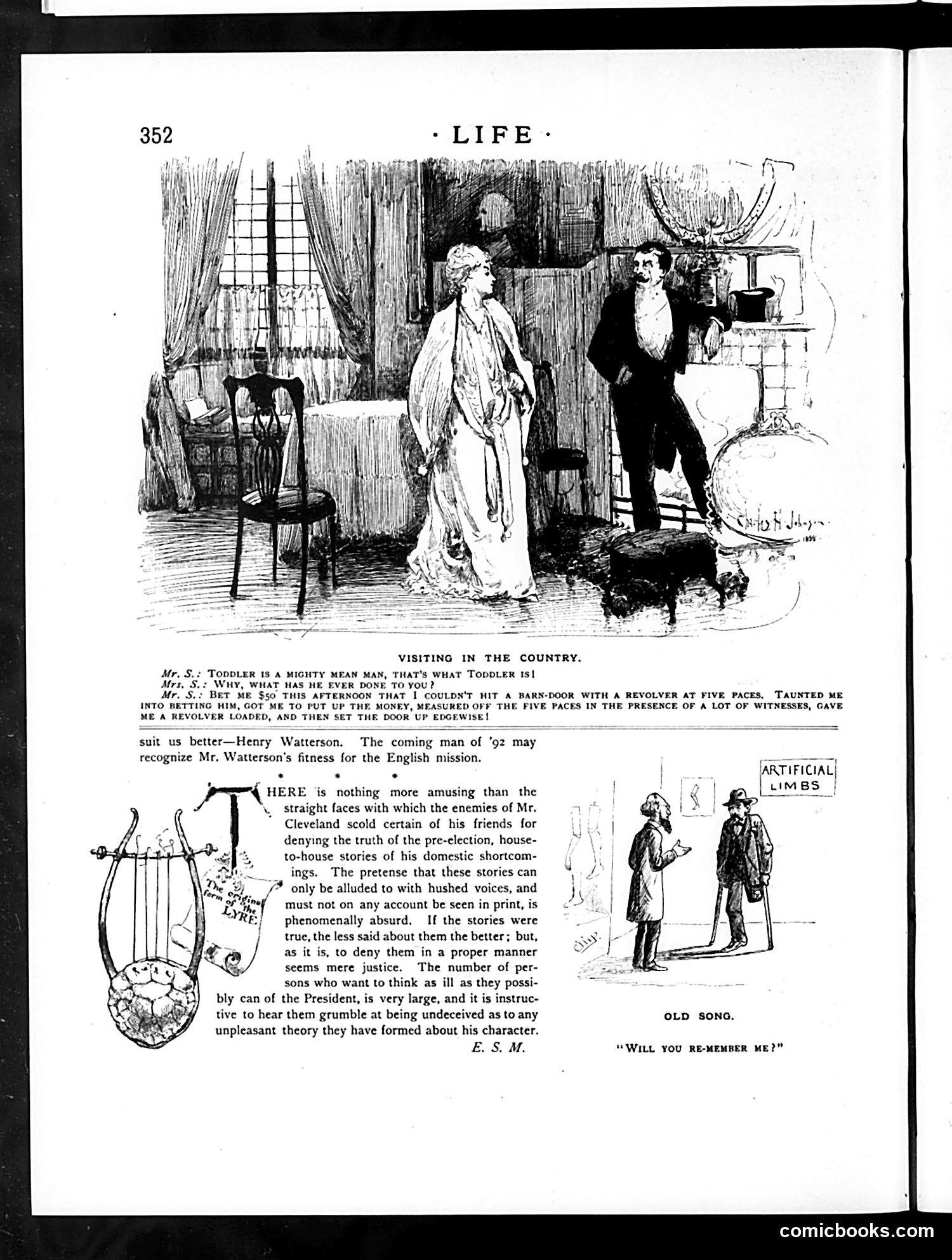
The top cartoon depicts a con man's trick: "Toddler" bets a victim $50 he can't hit a barn door with a revolver at five paces. After securing the bet and witnesses, Toddler measures the distance and then sets the door *edgewise*—making it nearly impossible to hit. It's a scam relying on the victim's overconfidence and the trickster's dishonesty. The page's text below discusses President Cleveland's domestic scandal—pre-election rumors about his personal life. The author (E.S.M.) satirizes Cleveland's political enemies who spread these rumors but then feign moral offense when asked to defend them publicly. The comparison suggests these opponents are like "Toddler": they set up unfair conditions, then act victimized when called out. The "Old Song" cartoon ("Will You Remember Me?") appears separately, likely unrelated satire about forgotten promises or aging concerns.
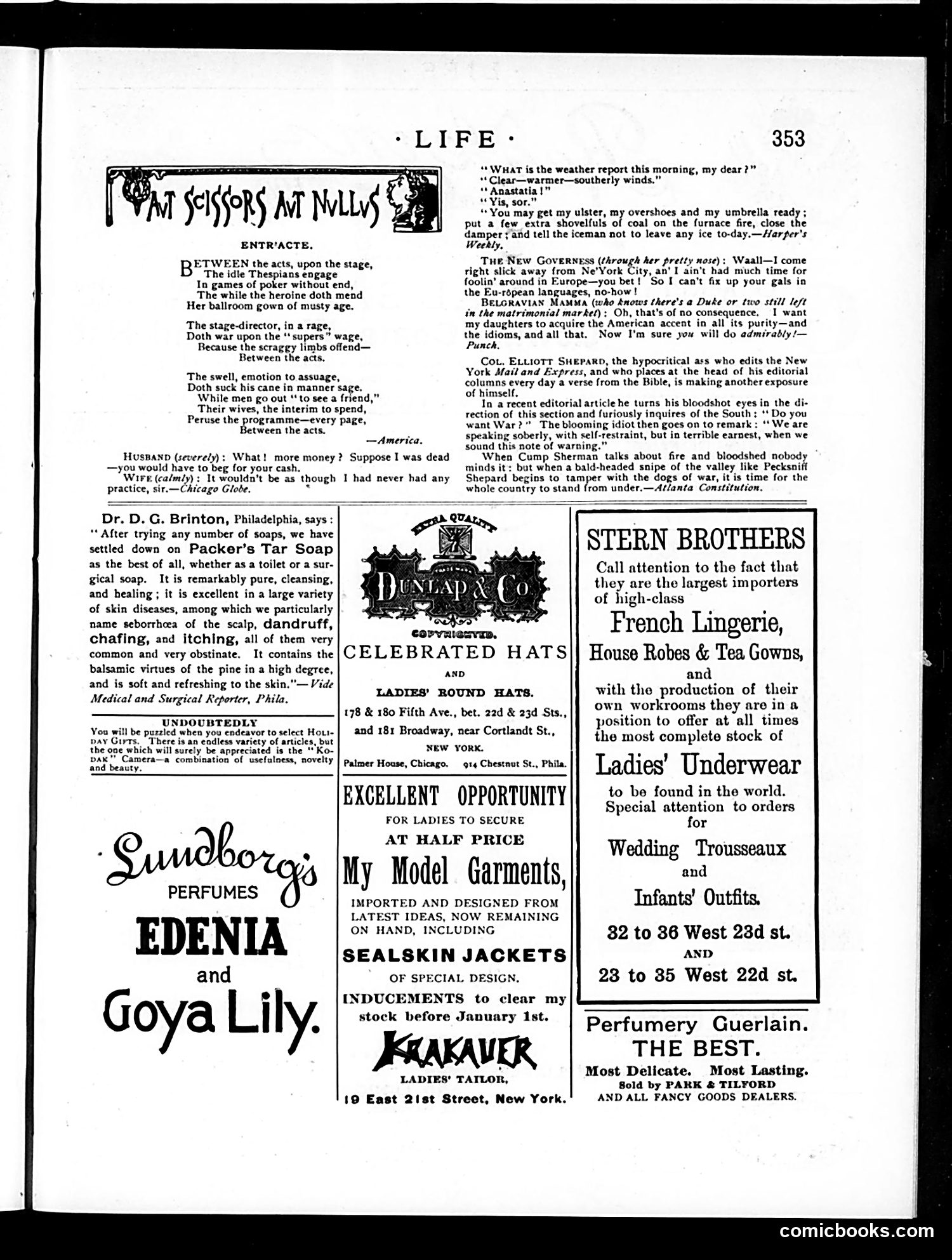
This page is primarily **advertising with interspersed satirical content**. The main satirical pieces include: 1. **"Between the Acts"** — A light poem about backstage theater behavior: actors gambling, stage directors arguing about extras' wages, fashionable men sneaking out, and wives reading programs. 2. **Two joke dialogues**: One about a wife's financial independence (implying women's economic vulnerability), another mocking an American governess hired by British aristocrats seeking American accents for their daughters. 3. **A political attack on Col. Elliott Shepard**, editor of the *New York Mail and Express*, calling him a hypocrite for quoting scripture while making inflammatory pro-war rhetoric about the South. The author compares him unfavorably to General Sherman, suggesting his threats are absurd coming from someone the author dismisses as weak. The remainder consists of period advertisements for perfumes, hats, lingerie, tailoring, and other goods typical of the era.
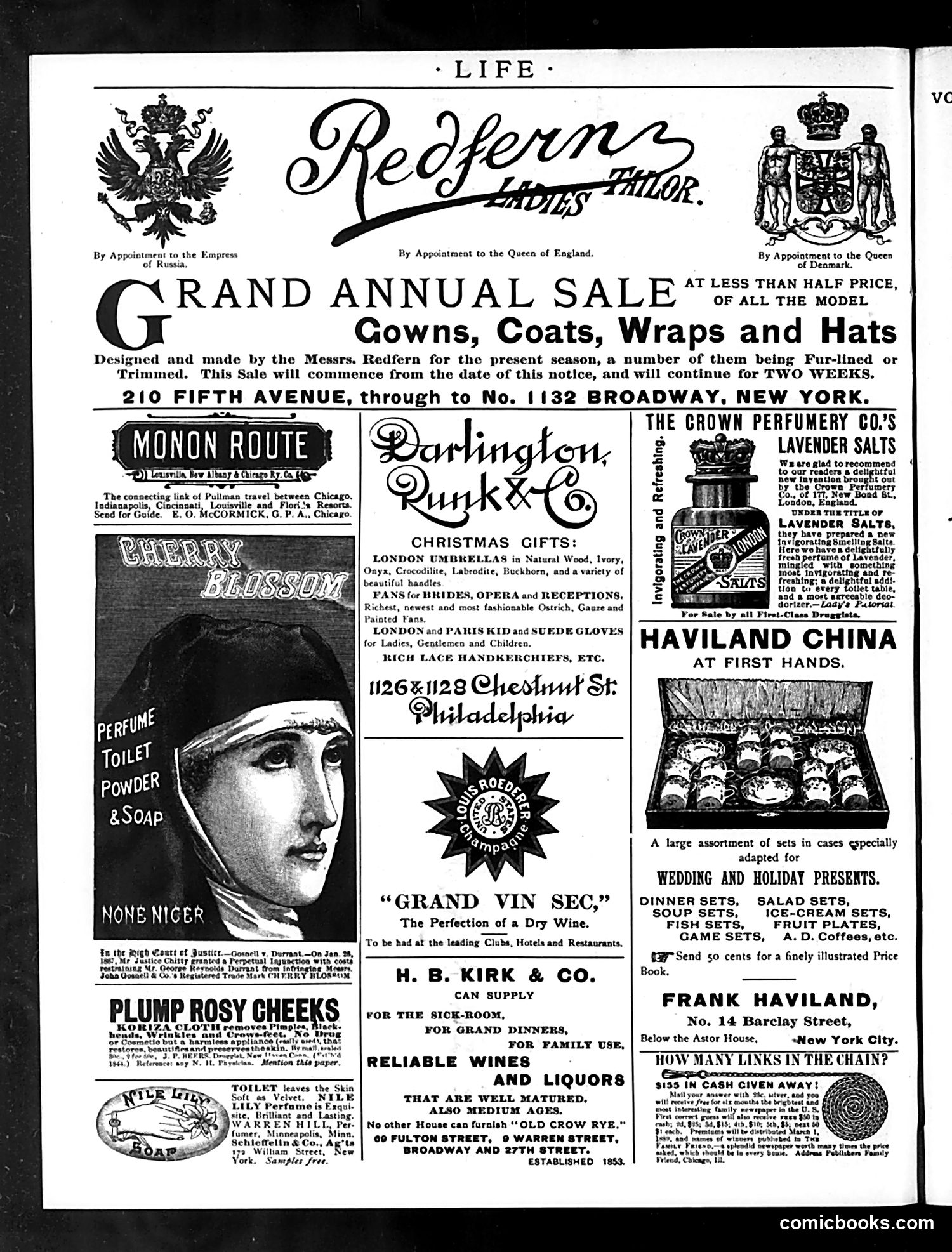
This page is primarily **advertising**, not satire or editorial cartooning. It's a Life magazine advertisement section from the late 19th century featuring luxury goods and services. The notable visual element is the **"Cherry Blossom" perfume ad** (left side), featuring a woman's profile in classical style—typical of period beauty product marketing. The ad promotes skincare and perfume products. The **"Redfern" fashion house advertisement** dominates the top, offering a grand annual sale of women's clothing (gowns, coats, wraps, hats) at "less than half price," noting designs are "fur-lined or trimmed." Redfern held royal appointments to courts across Europe and England, signaling luxury. Other ads feature Christmas gifts (fans, gloves, umbrellas), fine wines and liquors, china dinnerware sets, and various toiletries—all targeting wealthy urban consumers. **No political satire is evident.** This is straightforward period advertising reflecting Gilded Age consumer culture and aspirational luxury marketing.