
Life, 1888-12-20 · page 6 of 14
Life — December 20, 1888 — page 6: what you’re looking at
What you’re looking at
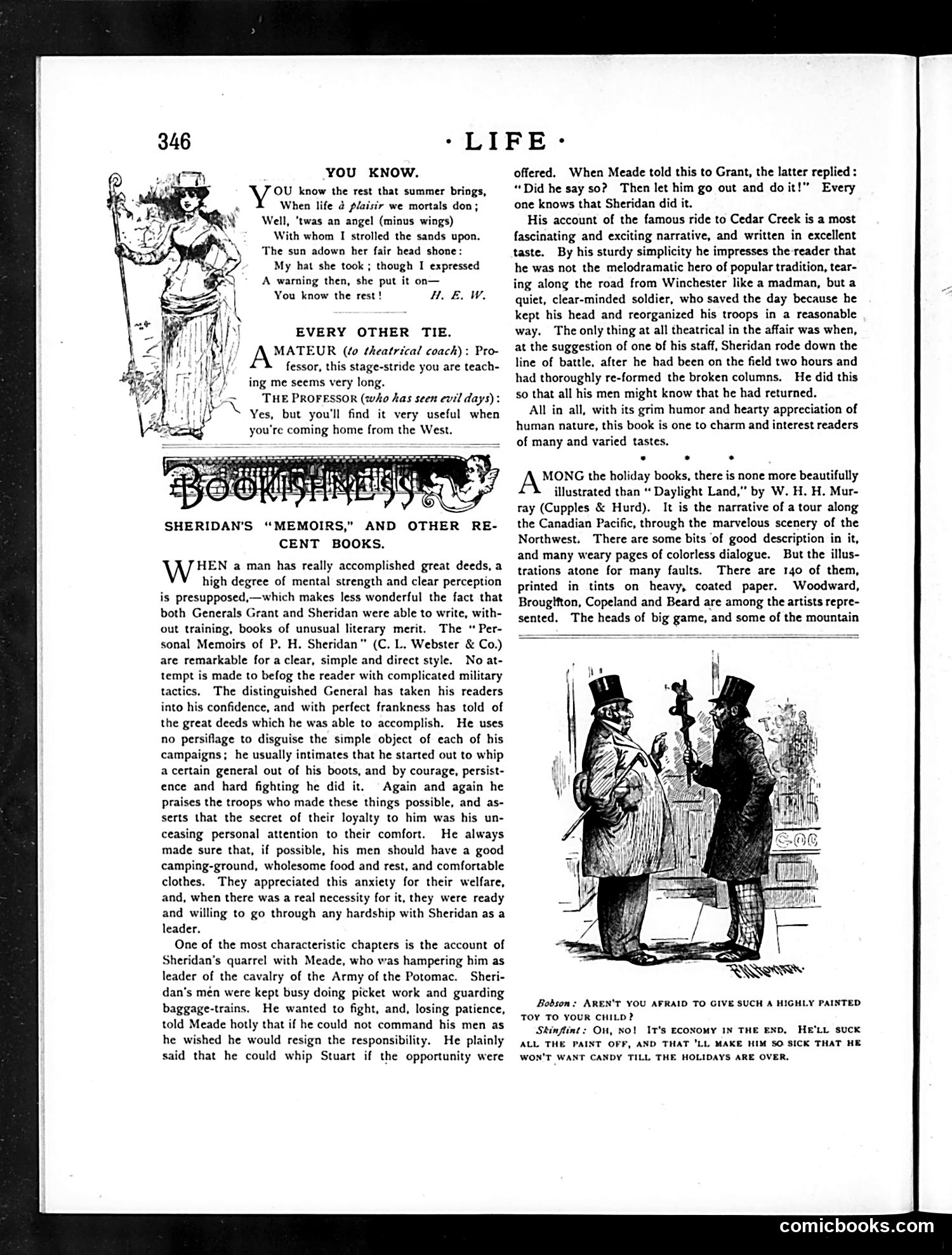
This page primarily discusses General Sheridan's military memoirs rather than presenting political satire. The main cartoon depicts two men in period dress engaged in conversation on a city street—likely illustrating a scene from literature or contemporary life. The bottom dialogue between "Robson" and "Simkins" is a humorous exchange about giving a painted toy to a child. Simkins jokes that the toy will make the child sick by eating its paint, which will solve the problem of the child wanting candy after the holidays end. This is domestic humor relying on exaggeration—the absurdist notion that parental problems can be solved through induced illness. The page is primarily book review/editorial content rather than political commentary.
📄 Transcribed text from this page (OCR, searchable)
Machine-transcribed from the original scan — historical spelling and the odd misread are preserved.
- LIFE: YOU KNOW. OU know the rest that summer brings, When life @ plaisir we mortals don; Well, ‘twas an angel (minus wings) With whom I strolled the sands upon. The sun adown her fair head shone: My hat she took ; though I expressed A warning then, she put it on— You know the rest! HL EW. EVERY OTHER TIE. MATEUR (fo theatrical coach): Pro- fessor, this stage-stride you are teach- ing me seems very long. THE PROFESSOR (who has seen evil days): Yes, but you'll find it very useful when you're coming home from the West. SHERIDAN’S “MEMOIRS,” AND OTHER RE- CENT BOOKS. HEN a man has really accomplished great deeds, a high degree of mental strength and clear perception is presupposed,—which makes less wonderful the fact that both Generals Grant and Sheridan were able to write, with- out training, books of unusual literary merit. The “ Per- sonal Memoirs of P. H. Sheridan” (C. L. Webster & Co.) are remarkable for a clear, simple and direct style. No at- tempt is made to befog the reader with complicated military tactics. The distinguished General has taken his readers into his confidence, and with perfect frankness has told of the great deeds which he was able to accomplish. He uses no persiflage to disguise the simple object of each of his campaigns; he usually intimates that he started out to whip acertain general out of his boots, and by courage, persist- ence and hard fighting he did it. Again and again he praises the troops who made these things possible, and as- serts that the secret of their loyalty to him was his un- ceasing personal attention to their comfort. He always made sure that, if possible, his men should have a good camping-ground, wholesome food and rest, and comfortable clothes. They appreciated this anxiety for their welfare, and, when there was a real necessity for it, they were ready and willing to go through any hardship with Sheridan as a leader. One of the most characteristic chapters is the account of Sheridan's quarrel with Meade, who was hampering him as leader of the cavalry of the Army of the Potomac. Sheri- dan’s mén were kept busy doing picket work and guarding baggage-trains. He wanted to fight, and, losing patience, told Meade hotly that if he could not command his men as he wished he would resign the responsibility. He plainly said that he could whip Stuart if the opportunity were offered. When Meade told this to Grant, the latter replied: “Did he say so? Then let him go out and doit!” Every one knows that Sheridan did it. His account of the famous ride to Cedar Creek is a most fascinating and exciting narrative, and written in excellent taste. By his sturdy simplicity he impresses the reader that he was not the melodramatic hero of popular tradition, tear- ing along the road from Winchester like a madman, but a quiet, clear-minded soldier, who saved the day because he kept his head and reorganized his troops in a reasonable way. The only thing at all theatrical in the affair was when, at the suggestion of one of his staff, Sheridan rode down the line of battle, after he had been on the field two hours and had thoroughly re-formed the broken columns, He did this so that all his men might know that he had returned. All in all, with its grim humor and hearty appreciation of human nature, this book is one to charm and interest readers of many and varied tastes. . . . MONG the holiday books, there is none more beautifully illustrated than “ Daylight Land,” by W. H. H. Mur- ray (Cupples & Hurd). It is the narrative of a tour along the Canadian Pacific, through the marvelous scenery of the Northwest. There are some bits ‘of good description in it, and many weary pages of colorless dialogue. But the illus- trations atone for many faults. There are 140 of them, printed in tints on heavy, coated paper. Woodward, Brougifton, Copeland and Beard are among the artists repre- Bobson: AREN'T YOU AFRAID TO GIVE SUCH A HIGHLY PAINTED TOY TO YOUR CHILD? Skinflint: Ou, No! It's ECONOMY IN THE END, He'LL sucK ALL THE PAINT OFF, AND THAT 'LL MAKE HIM SO SICK THAT HE WON'T WANT CANDY TILL THE HOLIDAYS ARE OVER. comicbooks.com