
A complete issue · 16 pages · 1888
Life — December 6, 1888
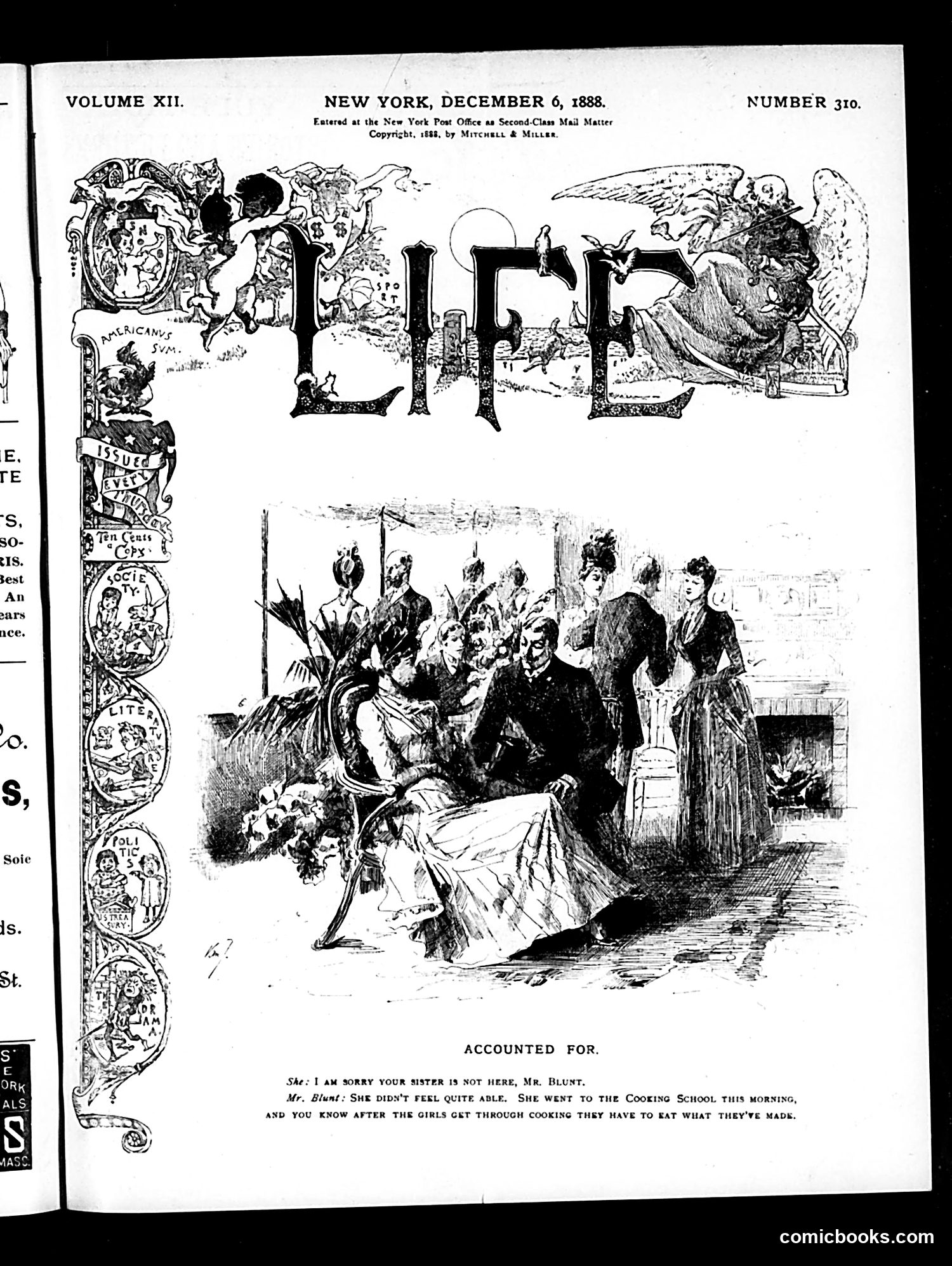
This cartoon satirizes domestic excuses and social expectations of upper-class women. The scene depicts a social gathering where a woman is conspicuously absent. When Mr. Blunt asks about the missing sister, he's told she "didn't feel quite able" and has gone to cooking school—adding the barb that "after the girls get through cooking they have to eat what they've made." The satire targets two things: (1) the Victorian-era practice of women using vague illness as social excuse, and (2) the emerging "New Woman" phenomenon—educated women attending practical schools rather than performing traditional domestic roles. The joke suggests that cooking school itself is punishment enough, making the woman's absence both explainable and ridiculous to the period's sensibilities.
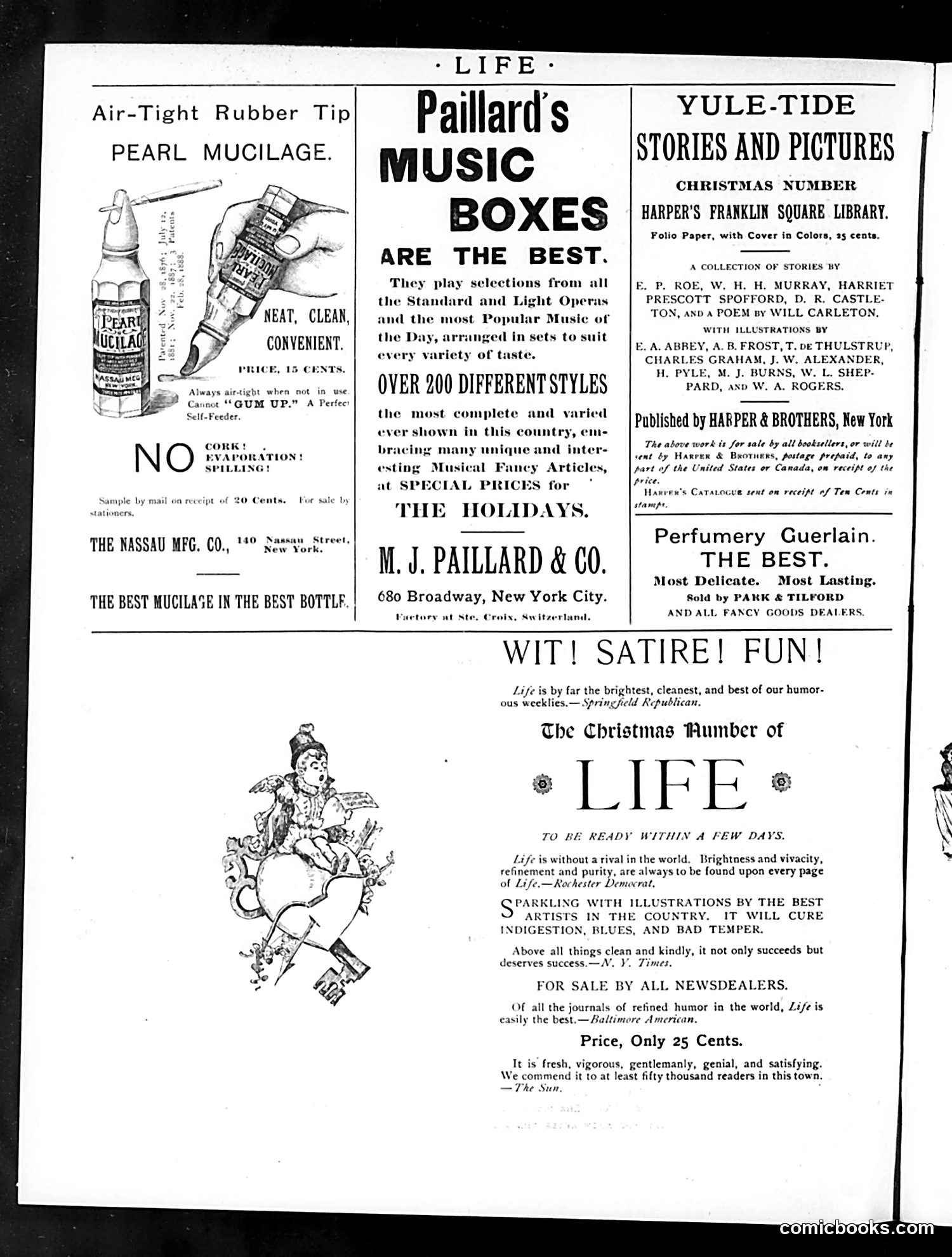
This page is primarily **advertising and promotional content** for Life magazine's Christmas issue, not political satire. The central illustration depicts a jolly, rotund figure (likely Father Christmas/Santa Claus) overflowing with holiday gifts and festive items—a straightforward seasonal image promoting the upcoming Christmas number. The advertisements include Pearl Mucilage, Paillard's Music Boxes, Harper's Franklin Square Library, and Guerlain Perfumery. The text emphasizes Life's humorous content, quoting endorsements from newspapers praising its "brightness and vivacity" and "clean and kindly" satire. **No identifiable political figures or specific social commentary appears on this page.** It functions as a holiday marketing piece celebrating Life's satirical humor magazine in general terms.
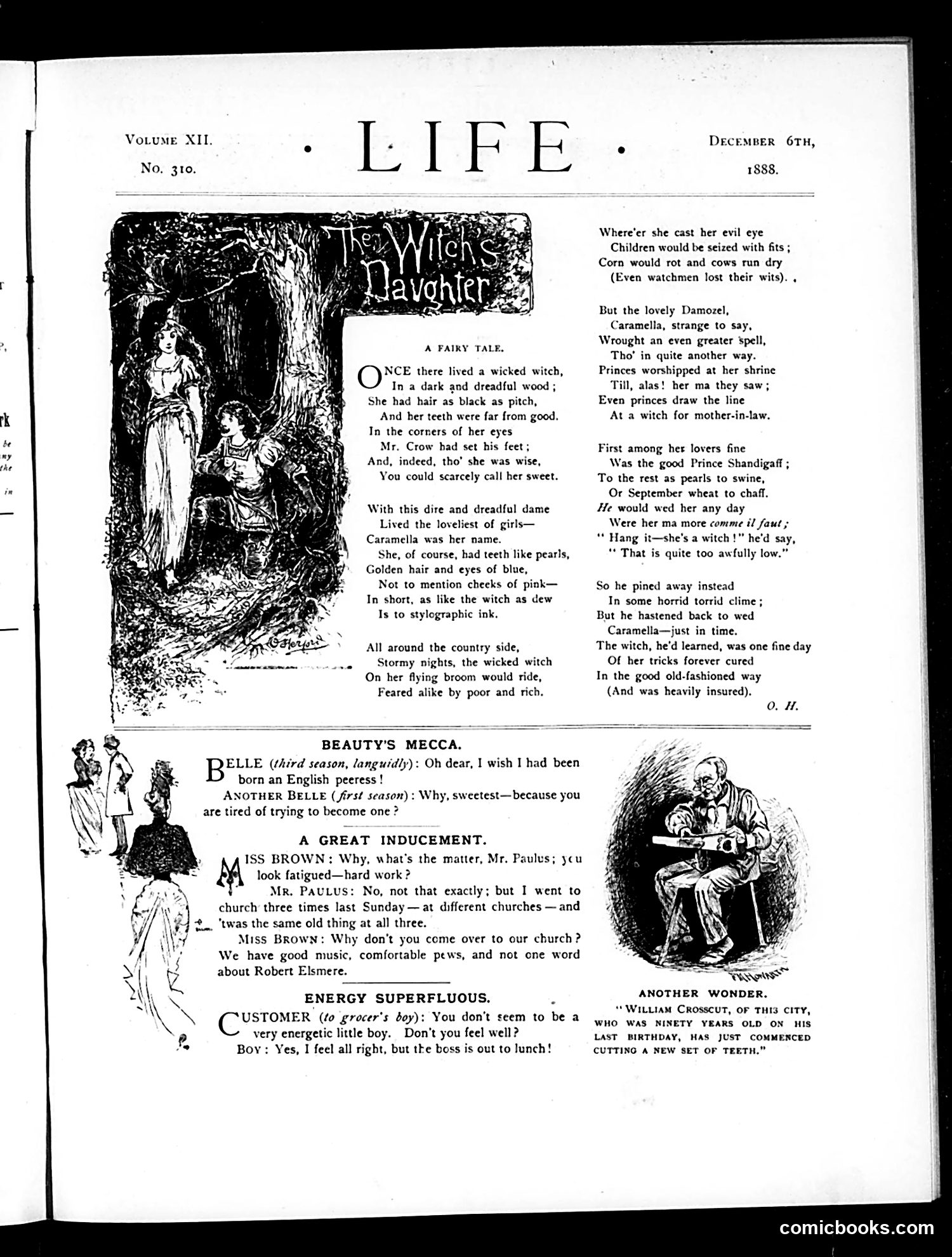
This page contains three separate satirical pieces: 1. **"The Witch's Daughter"** - A fairy tale poem about Caramella, a beautiful girl born to a wicked witch. The narrative describes how princes pursue her despite her mother's evil reputation, ultimately marrying her. The satire appears to comment on how physical beauty can overcome social stigma or questionable family background. 2. **"Beauty's Mecca"** - A brief dialogue mocking women's social aspirations, with a Belle lamenting she wasn't born English, suggesting contemporary anxieties about class and national identity. 3. **Shorter humor pieces** - Including "A Great Inducement," "Energy Superfluous," and "Another Wonder," which appear to be typical Victorian-era comedic anecdotes about everyday life and human nature. The overall page reflects *Life* magazine's satirical approach to social commentary and domestic humor.
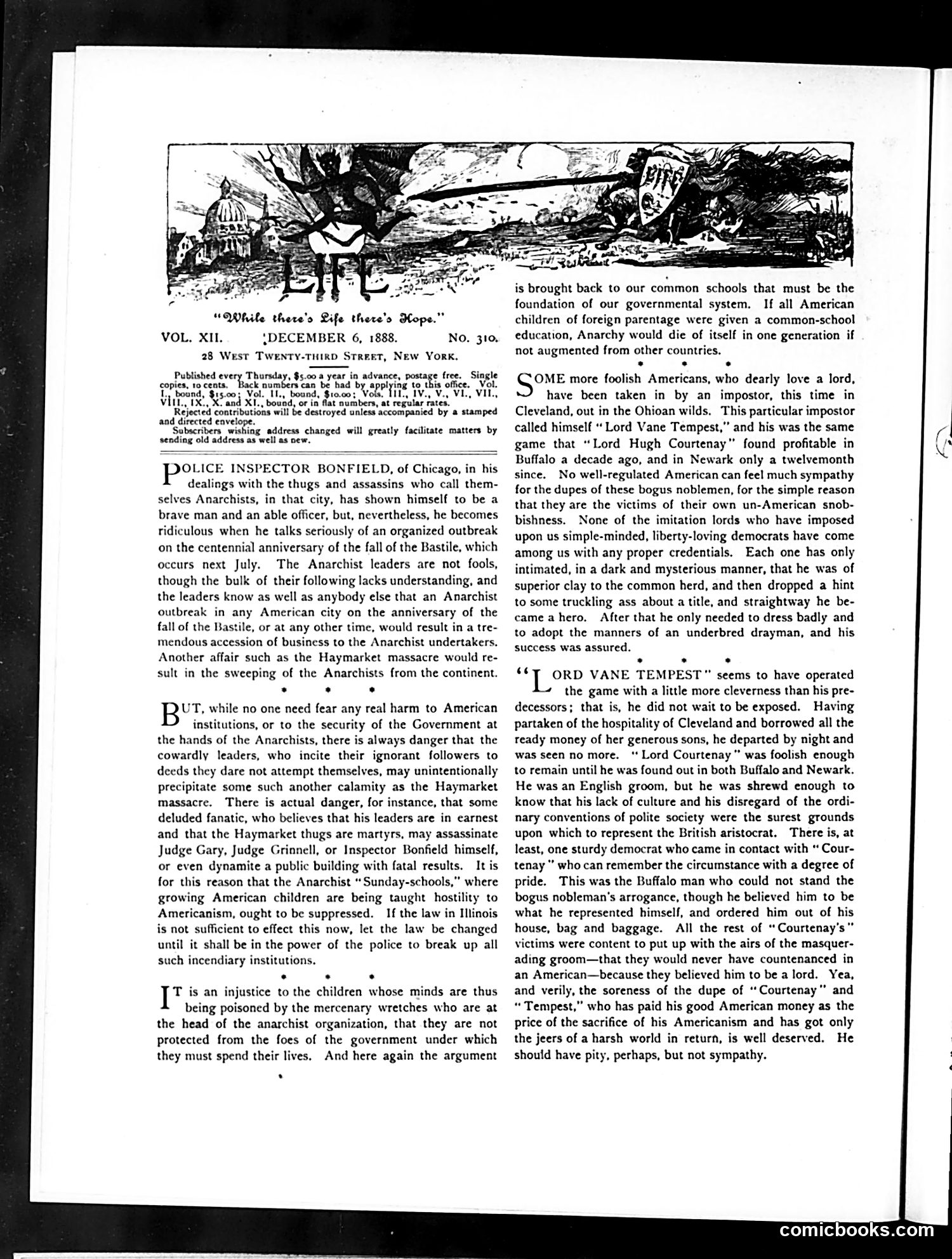
The cartoon's masthead "While there's Life there's Hope" appears above a darkly satirical illustration depicting what seems to be anarchist violence or destruction—featuring a demolished landscape with scattered debris and destruction. The article discusses Police Inspector Bonfield of Chicago and concerns about anarchist threats to American institutions. It references "Lord Vance Tempest" and "Lord Courtenay," describing them as imposters who deceived Americans with false noble credentials before disappearing with money. The satire targets both foreign anarchists allegedly infiltrating America and gullible American elites susceptible to con artists claiming aristocratic titles. The piece argues that anarchist "Sunday schools" teaching children anti-Americanism pose dangers requiring police action, while also mocking wealthy Americans foolish enough to be defrauded by obvious fraudsters.
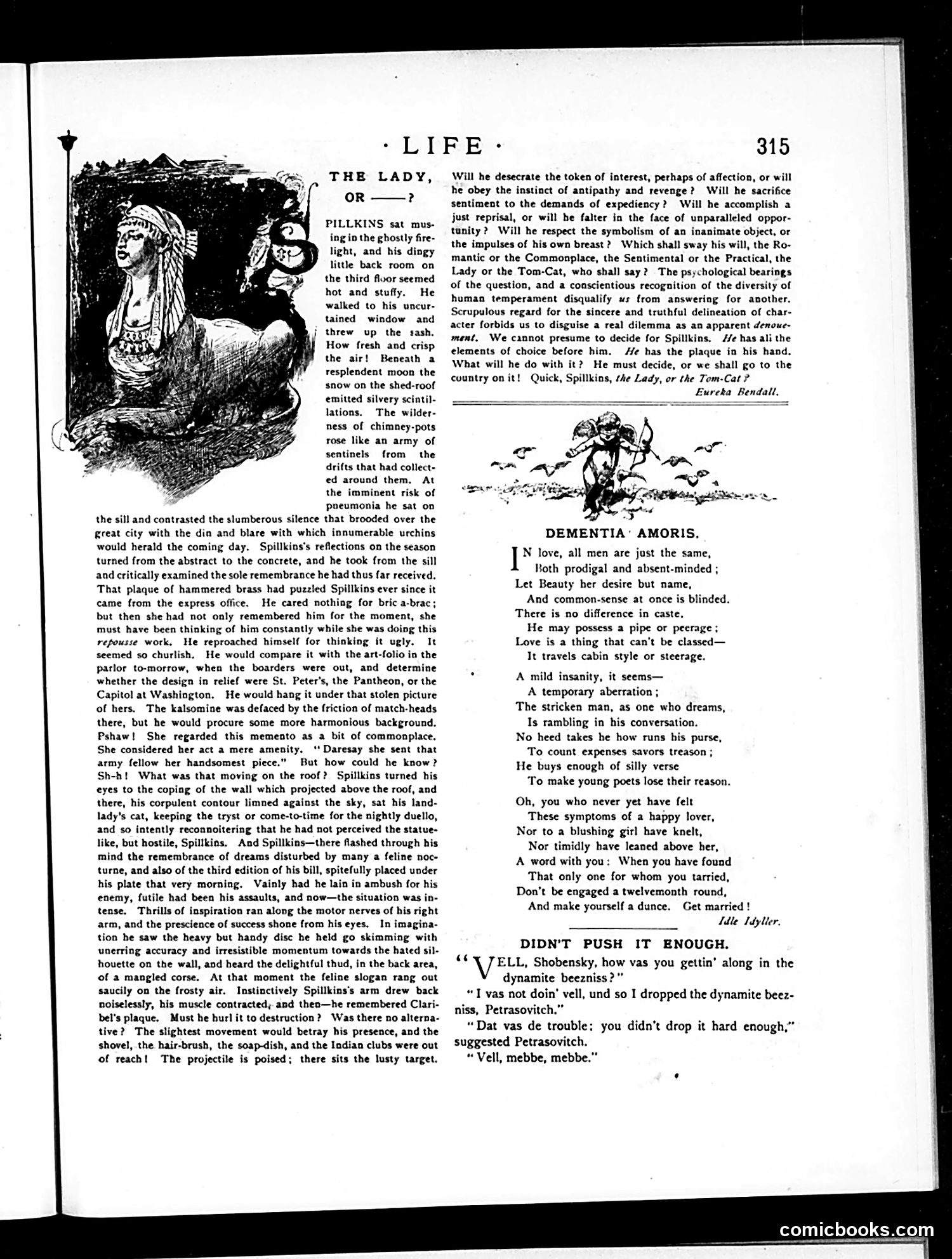
This page contains three distinct pieces rather than a unified political cartoon: 1. **"The Lady, or—?"** - A satirical column debating whether a gentleman named Spillkins should pursue a romantic relationship. The accompanying illustration shows a Victorian-era figure at a window. This is social satire about courtship decisions, not political commentary. 2. **"Dementia Amoris"** - A poem mocking lovesick behavior and absent-mindedness, with lines like "In love, all men are just the same, / Both prodigal and absent-minded." 3. **"Didn't Push It Enough"** - A brief comedic dialogue between Shobensky and Petrasovitch about dropping dynamite, suggesting satire about Russian politics or anarchist activities, though the specific reference is unclear. The page is primarily humorous social commentary rather than direct political satire.
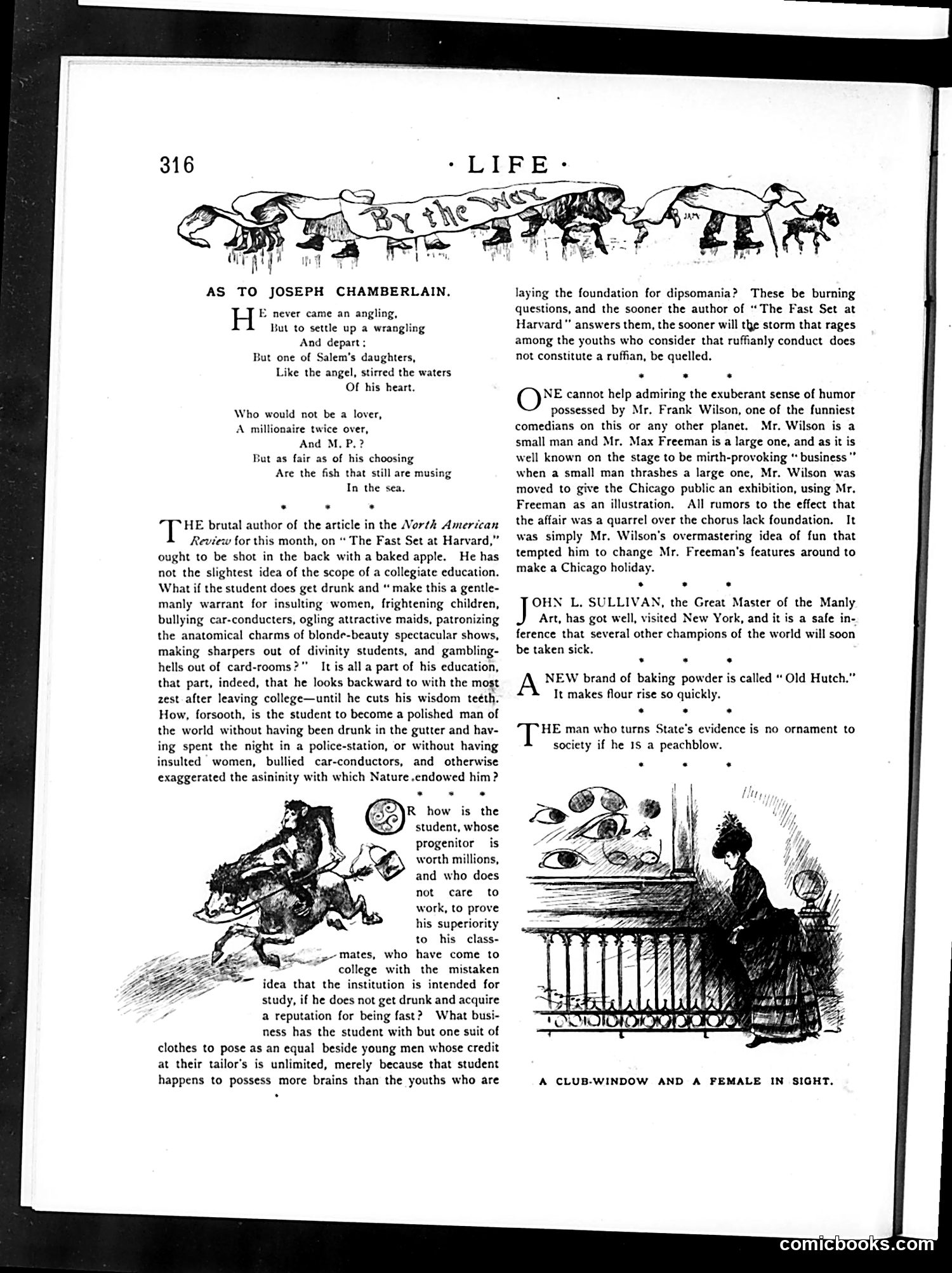
This page satirizes collegiate excess and poor character development at elite universities. The main article criticizes wealthy students who arrive at college unprepared for adulthood, using their family fortune to avoid earning respect through merit or hard work. The left cartoon depicts a student character apparently stumbling or being propelled forward—likely representing the chaos of such undisciplined youth. The right illustration captioned "A Club-Window and a Female in Sight" shows a woman observed from what appears to be a gentlemen's club window, satirizing the superficial social interactions and voyeurism of privileged men. The overall message critiques how inherited wealth enables poor behavior without consequences, preventing young men from developing into responsible adults. The satire targets the disconnect between collegiate education's stated purpose and wealthy students' actual conduct.
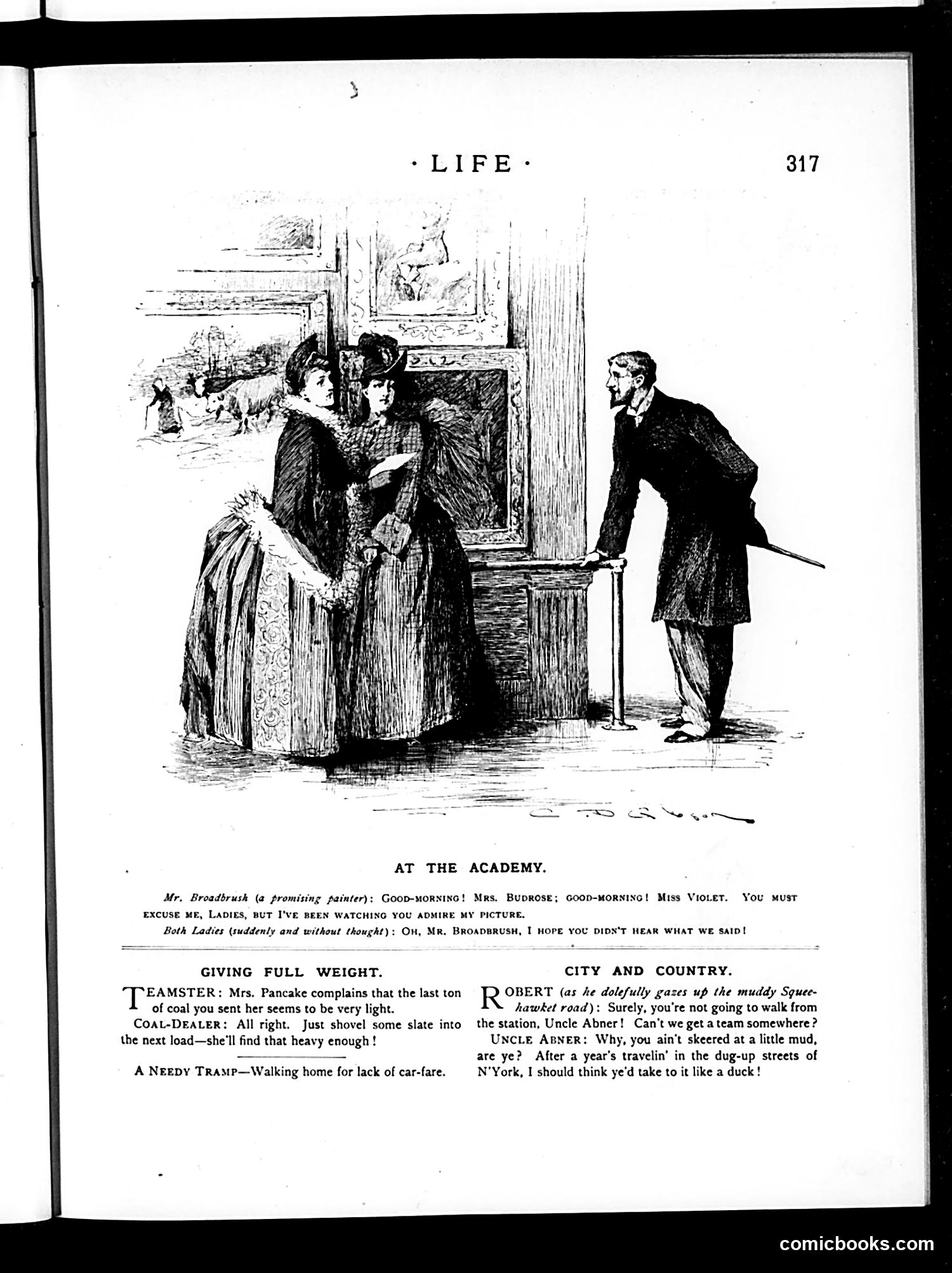
**"AT THE ACADEMY"** depicts a social scene at an art academy. A male painter (Mr. Broadbrush) is presenting his work to two fashionable women visitors (Mrs. Ambrose and Miss Violet). The women respond dismissively, hoping the painter didn't overhear their critical remarks about his picture—a typical satire on polite society's hypocrisy and the gap between public praise and private judgment regarding amateur artists. The three short jokes below mock working-class struggles: complaints about insufficient coal delivery, a tramp lacking carfare, and muddy roads in the countryside. These reflect common period concerns about poverty, urban infrastructure, and rural conditions in early 20th-century America.
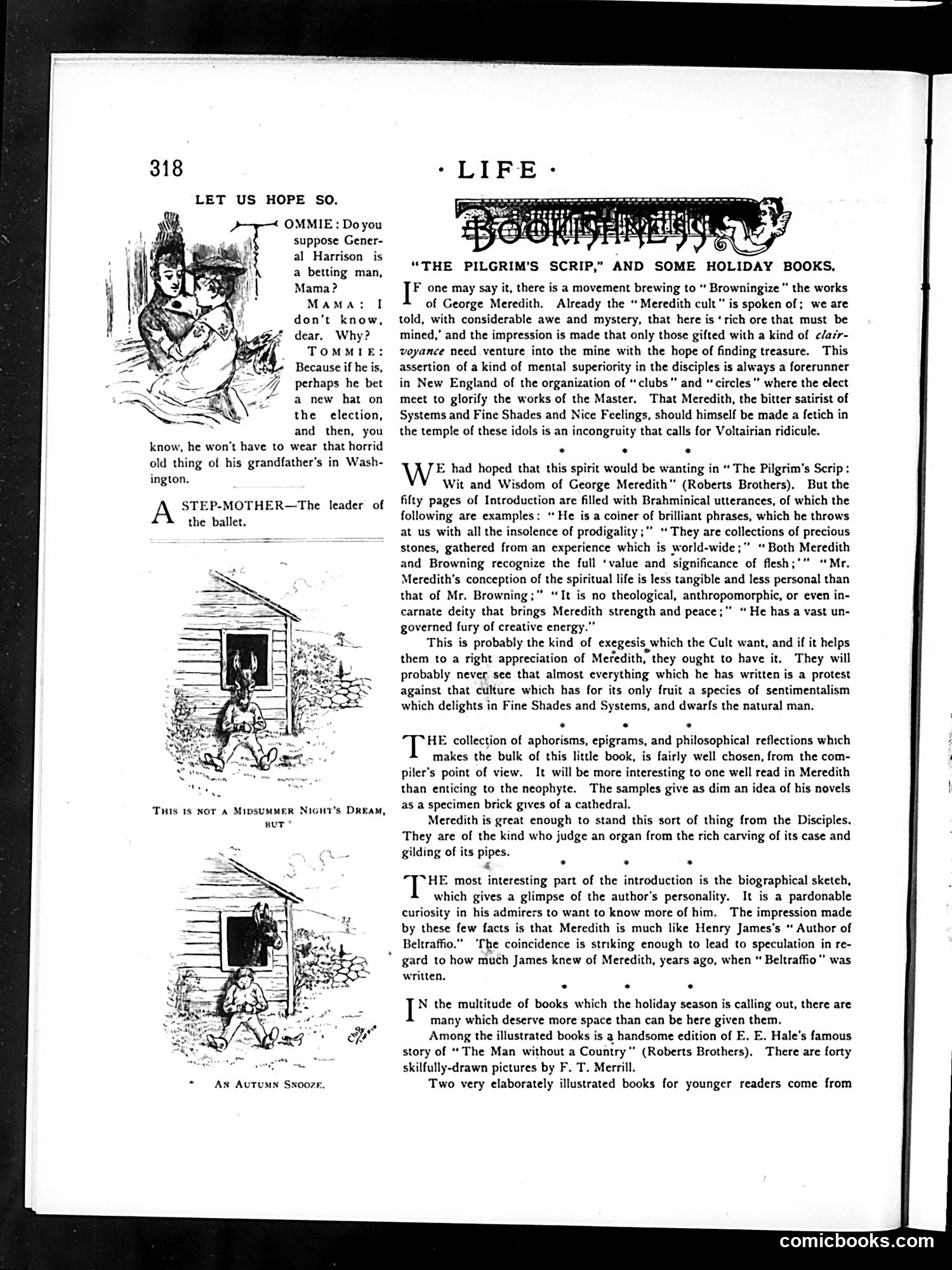
This page is primarily a **book review** rather than political satire. It critiques George Meredith's "The Pilgrim's Scrip: Wit and Wisdom of George Meredith" (Roberts Brothers), alongside holiday book recommendations. The reviewer expresses disappointment that Meredith's followers ("the Cult") expect the book to demonstrate intellectual superiority, but instead find it contains contradictions—particularly that Meredith criticizes the very "Fine Shades and Systems" his disciples admire. The satire targets Meredith's pretentious admirers rather than Meredith himself. The page also mentions E.E. Hale's "The Man without a Country" and notes the similarity between Meredith and Henry James as literary figures. The small cartoons ("Let Us Hope So," "An Autumn Snooze") appear to be unrelated humorous illustrations typical of Life magazine's format.
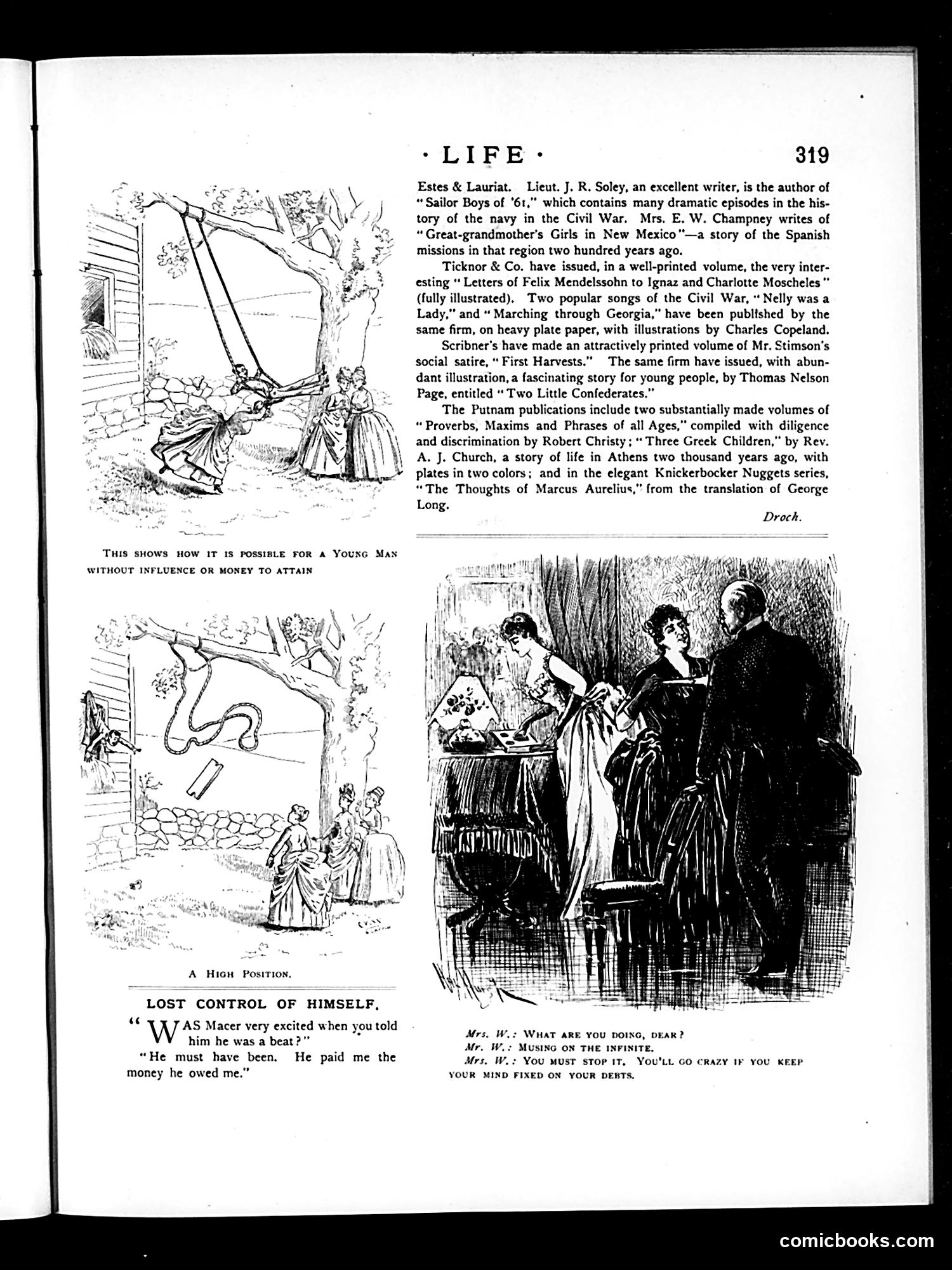
This page contains **literary reviews and social satire cartoons**, not political commentary. The top section reviews recent books by various publishers, including works on Civil War history, Spanish missions, and Greek classical studies. **"A High Position"** (left cartoon) shows a young man in an elevated position, illustrating the caption "This shows how it is possible for a young man without influence or money to attain." **"Lost Control of Himself"** (right cartoon) depicts a social scene where a man discusses debts with others. The dialogue reveals satire about financial irresponsibility—a man boasts about being "a beat" (someone who doesn't pay debts), and someone warns that obsessing over unpaid money will drive him "crazy." The humor targets Victorian-era attitudes about social status, debt, and masculine responsibility.
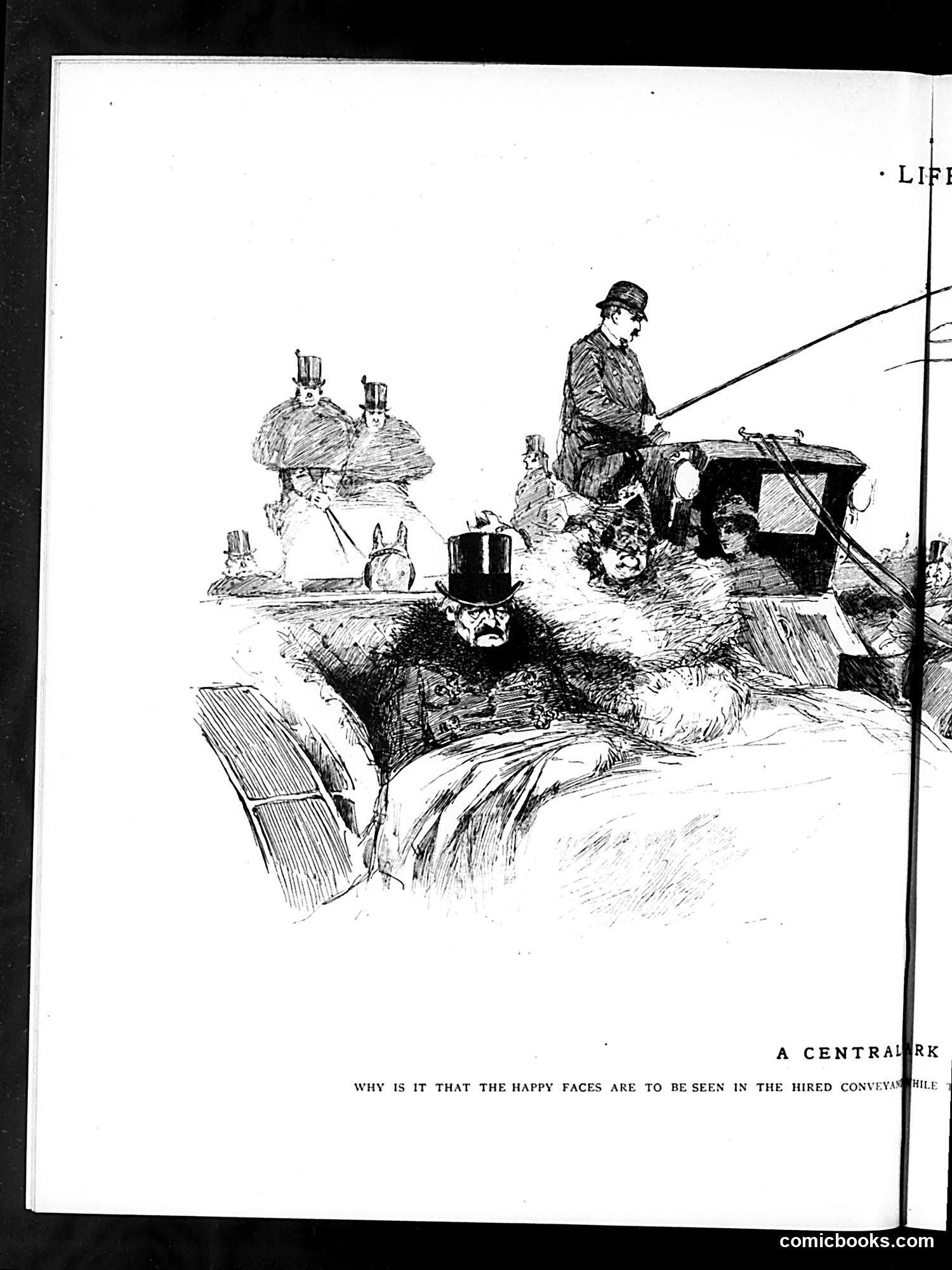
This is a satirical sketch titled "A CENTRAL ARK" with the caption "WHY IS IT THAT THE HAPPY FACES ARE TO BE SEEN IN THE HIRED CONVEYANCE?" The cartoon depicts a hired carriage or omnibus filled with well-dressed passengers wearing top hats, appearing cheerful and content. The sketch satirizes the contrast between the happiness of people riding in commercial transportation versus those outside it—likely suggesting that paying for a ride brings comfort and satisfaction. The "Central Ark" reference appears to be a pun on Central Park in New York City. The satire likely mocks either the quality of public transportation or social class distinctions, implying that hired conveyances represented a superior travel experience that guaranteed passenger contentment. The drawing style and fashion suggest this is from the late 19th century.
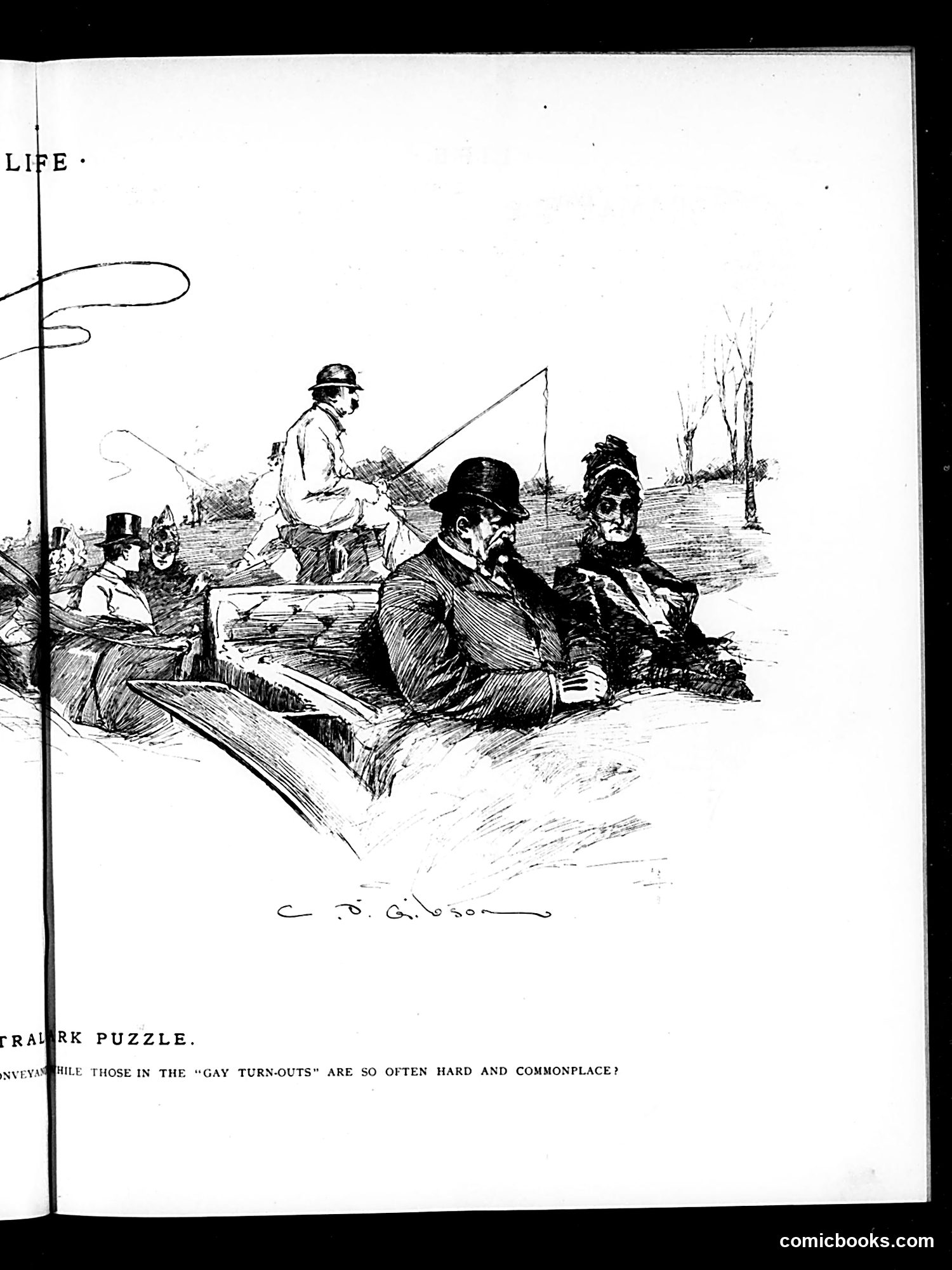
This page appears to be a "Life" magazine puzzle or satirical illustration titled "Traibrick Puzzle" (OCR may have garbled the title). The sketch shows well-dressed Victorian-era figures in a boat on water, with one man fishing in the background. The caption questions why those in "gay turn-outs" (fashionable carriages or outings) are "so often hard and commonplace"—likely satirizing the contrast between outward appearance and inner character among the wealthy or fashionable classes. The illustration is signed by what appears to be a period artist. Without clearer OCR or additional context, the specific individuals caricatured remain unclear, though the satire targets social pretension and the disconnect between elegant presentation and mundane reality among Victorian society.
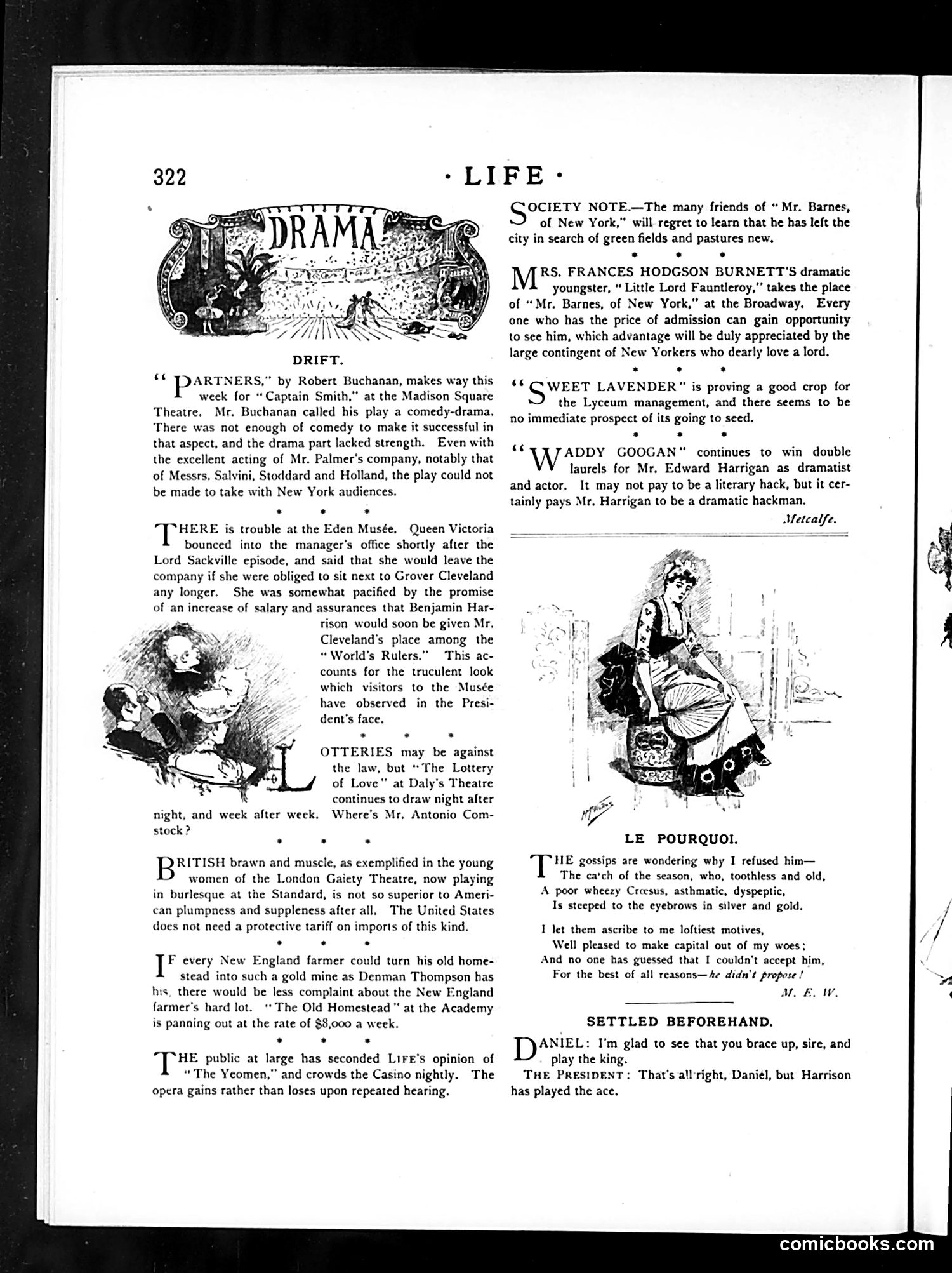
This page satirizes late 19th-century theater and politics through theatrical gossip and humor. **The Eden Musée satire** is the most pointed: Life jokes that Queen Victoria's wax figure at this museum demanded a raise and threatened to quit because she was positioned next to Grover Cleveland's figure. The text claims this explains Benjamin Harrison's "truculent look" among the "World's Rulers" exhibit—a dig at the 1888 presidential election where Harrison defeated the incumbent Cleveland. Life mocks both the absurdity of wax figures having workplace disputes and the political transition itself. **Other items** offer theater criticism: "Partners" lacks strength despite good acting; "The Lottery of Love" succeeds despite moral objections; British actresses aren't superior to American ones; and "The Old Homestead" is profitably running. **The final sketch, "Settled Beforehand,"** appears to reference a political figure (possibly Harrison) who "played the ace"—likely a veiled political comment about recent electoral maneuvering. The page exemplifies Life's blend of entertainment criticism with political mockery through theatrical metaphors.
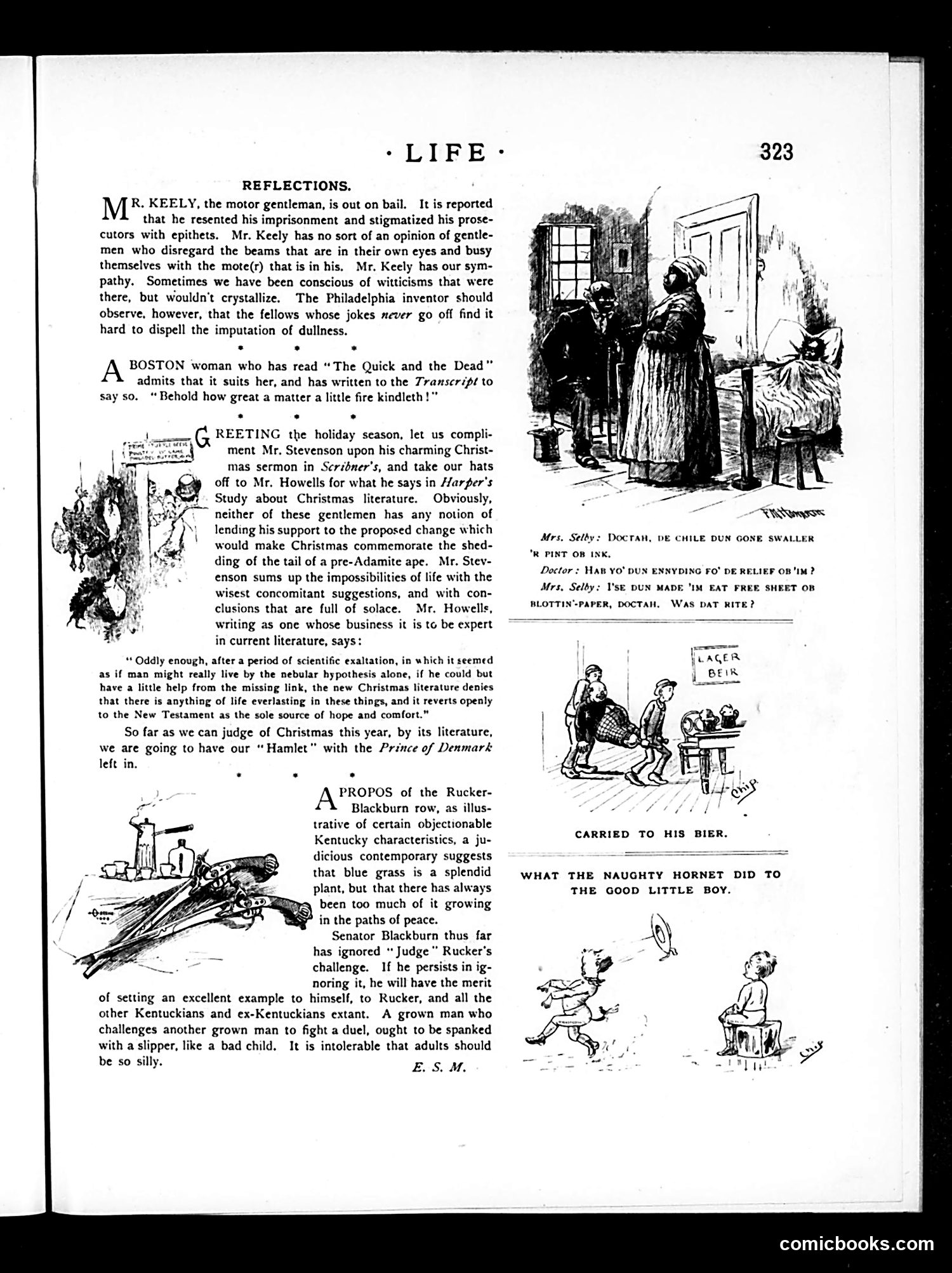
This page from *Life* magazine contains several brief satirical commentaries on contemporary figures and issues: **Keely**: A Philadelphia inventor/motorman recently released on bail. The satire mocks his indignation at prosecution while claiming others ignore their own faults—a play on "motes and beams" (biblical hypocrisy). **Christmas Literature Debate**: The piece sarcastically praises Robert Louis Stevenson and William Dean Howells for their Christmas writings, implying that contemporary literature (likely referencing evolutionary theory and the "missing link") denies spiritual meaning, forcing society back to traditional religious sources. **Rucker-Blackburn Duel**: A Kentucky political dispute where someone challenged another to a duel. The satire condemns dueling as absurdly childish behavior for grown men, criticizing the "objectionable Kentucky characteristics" that permitted such conduct. The cartoons appear to be humorous vignettes unrelated to the text—depicting domestic and childhood scenes rather than political commentary.
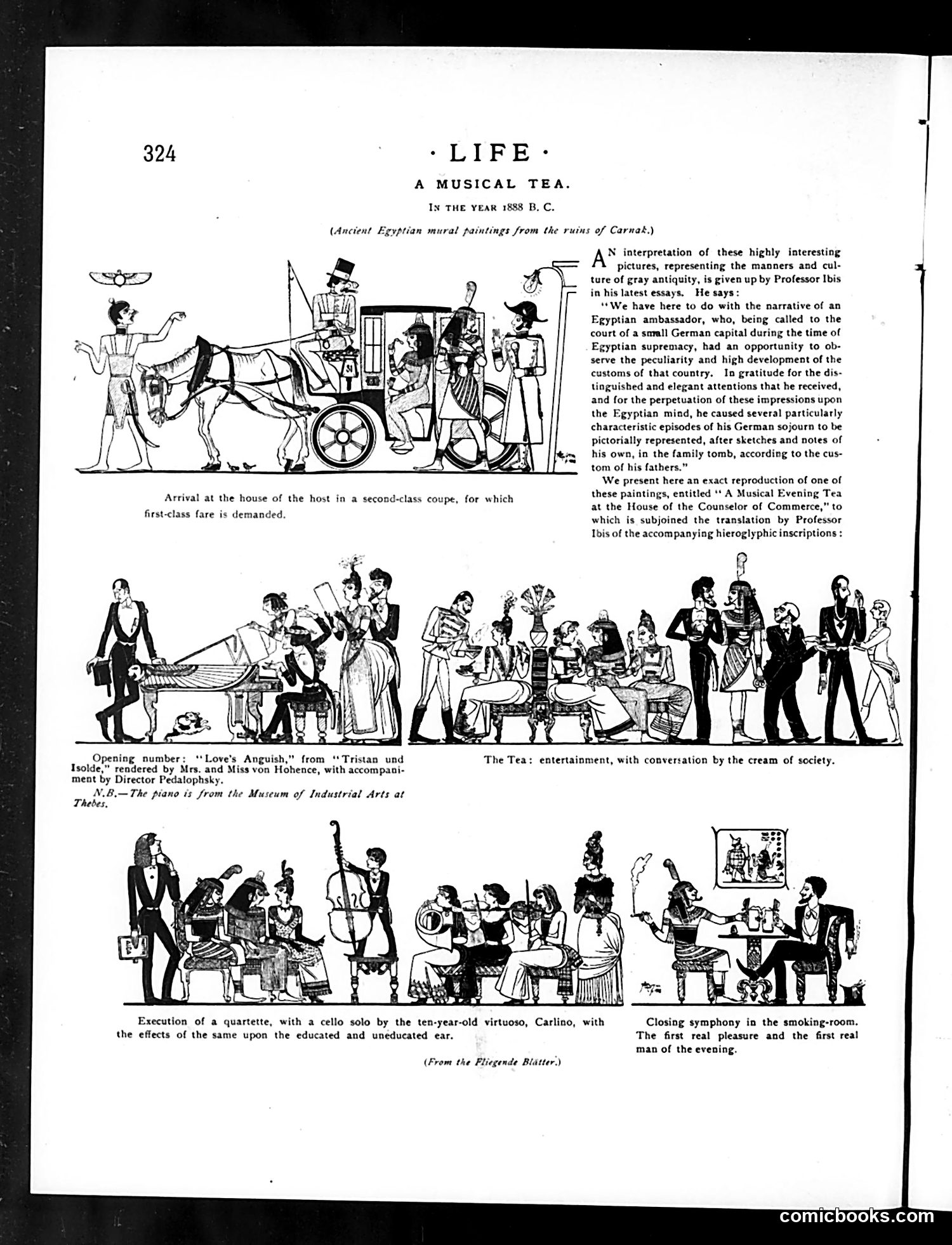
This satire mocks pretentious German social rituals by presenting them as if they were ancient Egyptian tomb paintings. The conceit is brilliant: a fictional "Egyptian ambassador" supposedly documented his observations of a small German court's customs, making their elaborate tea entertainment seem absurdly ceremonial and anachronistic. The humor targets several things: the forced formality of German bourgeois society (arrival by "second-class coupe," emphasis on "first-class fare"), the tedium of musical performances featuring child prodigies and operatic excerpts ("Tristan und Isolde"), and the class pretension distinguishing "educated and uneducated ears." The closing observation—that smoking and male company finally bring "the first real pleasure"—suggests the entire tea was unbearable social theater. By framing contemporary German manners as ancient history, Life ridicules their stuffiness and self-importance, suggesting future generations will find them as quaint as Egyptian tomb art.
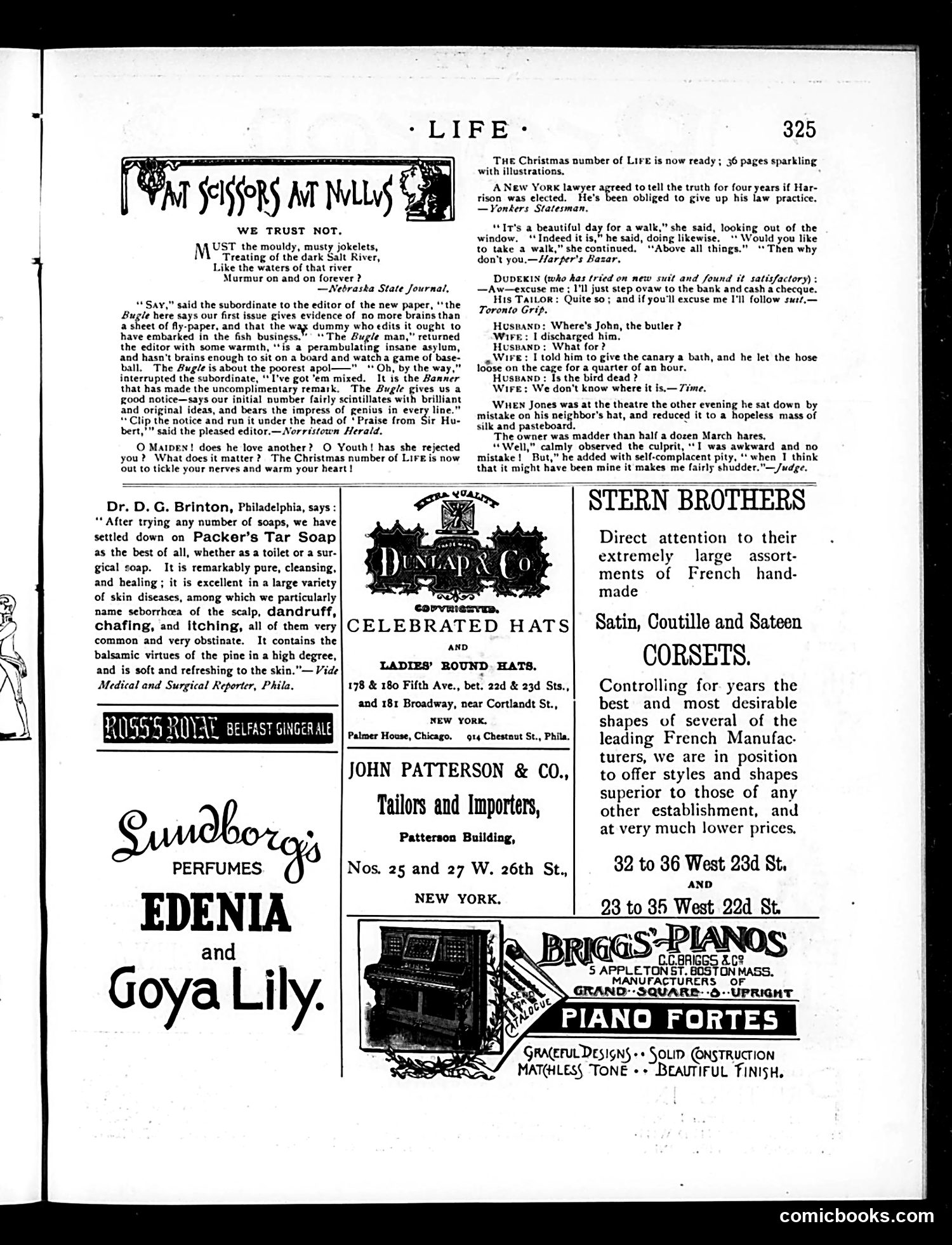
This page from *Life* (a 19th-century American satirical magazine) contains humorous anecdotes and advertisements rather than a political cartoon. The main jokes mock **newspaper rivalry and editorial hypocrisy**. One story describes rival editors insulting each other's papers—one calls the competitor's staff incompetent, then discovers he's criticizing the *wrong* newspaper and hastily reprints the insult anyway under "Praise." The satire targets journalistic dishonesty and editors' willingness to misrepresent criticism for self-promotion. Other brief anecdotes joke about **social awkwardness**: a lawyer who stops practicing law after Harrison's election (likely referencing President Harrison, 1889-1893), a dandy checking his bank account after buying a suit, and incidents involving destroyed property (a hat, a canary cage). The page is primarily filled with **Victorian-era advertisements** for hats, corsets, perfumes, pianos, and patent medicines—typical of the period's magazine format. The humor throughout reflects genteel, upper-class concerns about manners, fashion, and professional reputation.
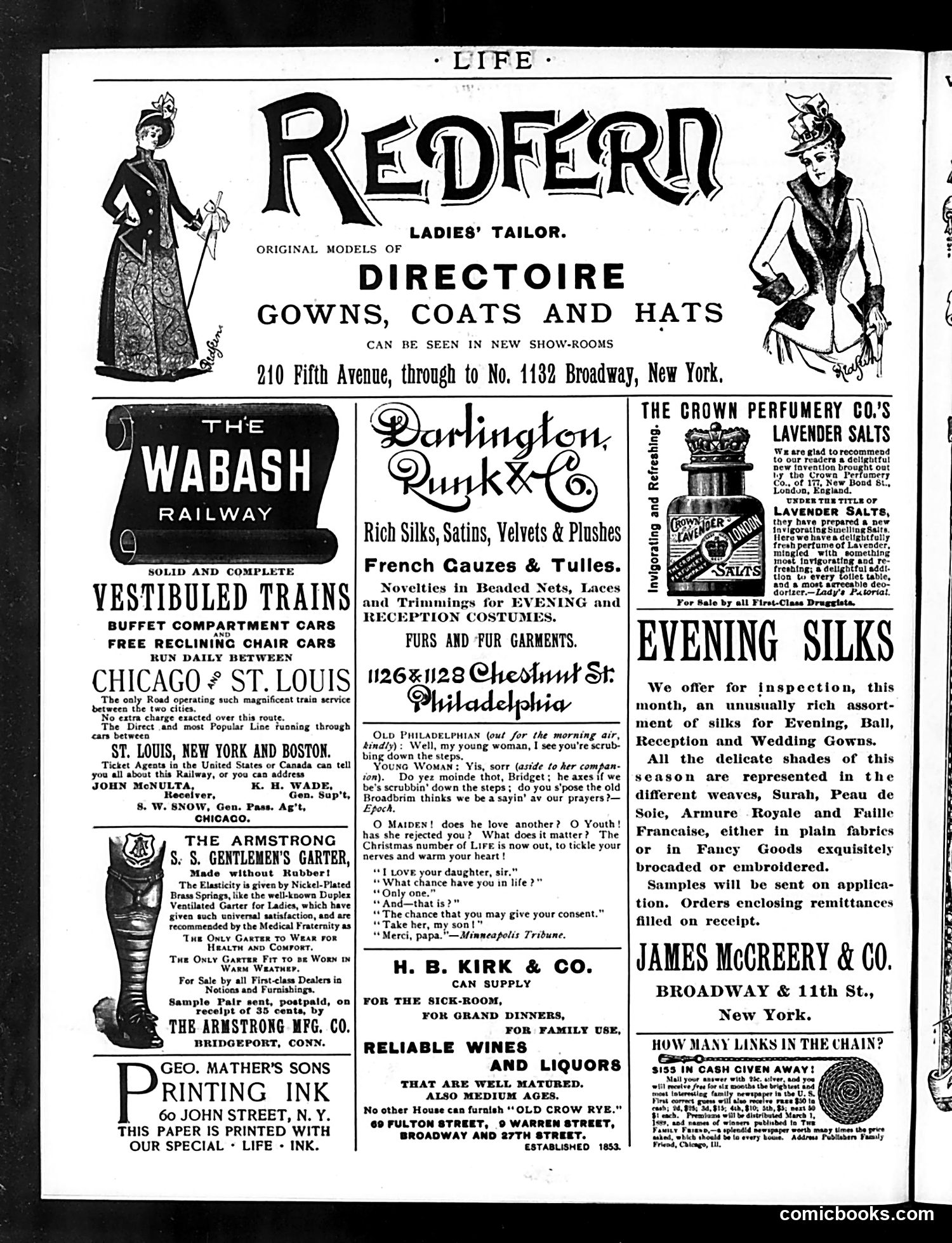
This page is primarily **advertisements** from a late 19th-century *Life* magazine, with minimal satirical content. The only cartoon/joke appears to be a brief Irish immigrant humor piece: an elderly Philadelphian observes a young woman scrubbing steps and asks if she's doing so, and she aside comments that he apparently thinks they're saying prayers—mocking his assumption that manual labor equals piety. The page otherwise consists of fashion, railroad, and luxury product advertisements (evening silks, ladies' tailoring, wines, garters, printing ink). One ad references the Christmas issue of *Life* as entertainment to "tickle your nerves." The humor is minimal and relies on period-specific class and ethnic stereotypes (the Irish maid's dialect, the wealthy gentleman's obliviousness). Without the satirical cartoon content the magazine was known for, this reads as a standard advertising section using light humor to sell goods to a wealthy readership.