
Life, 1888-12-06 · page 5 of 16
Life — December 6, 1888 — page 5: what you’re looking at
What you’re looking at
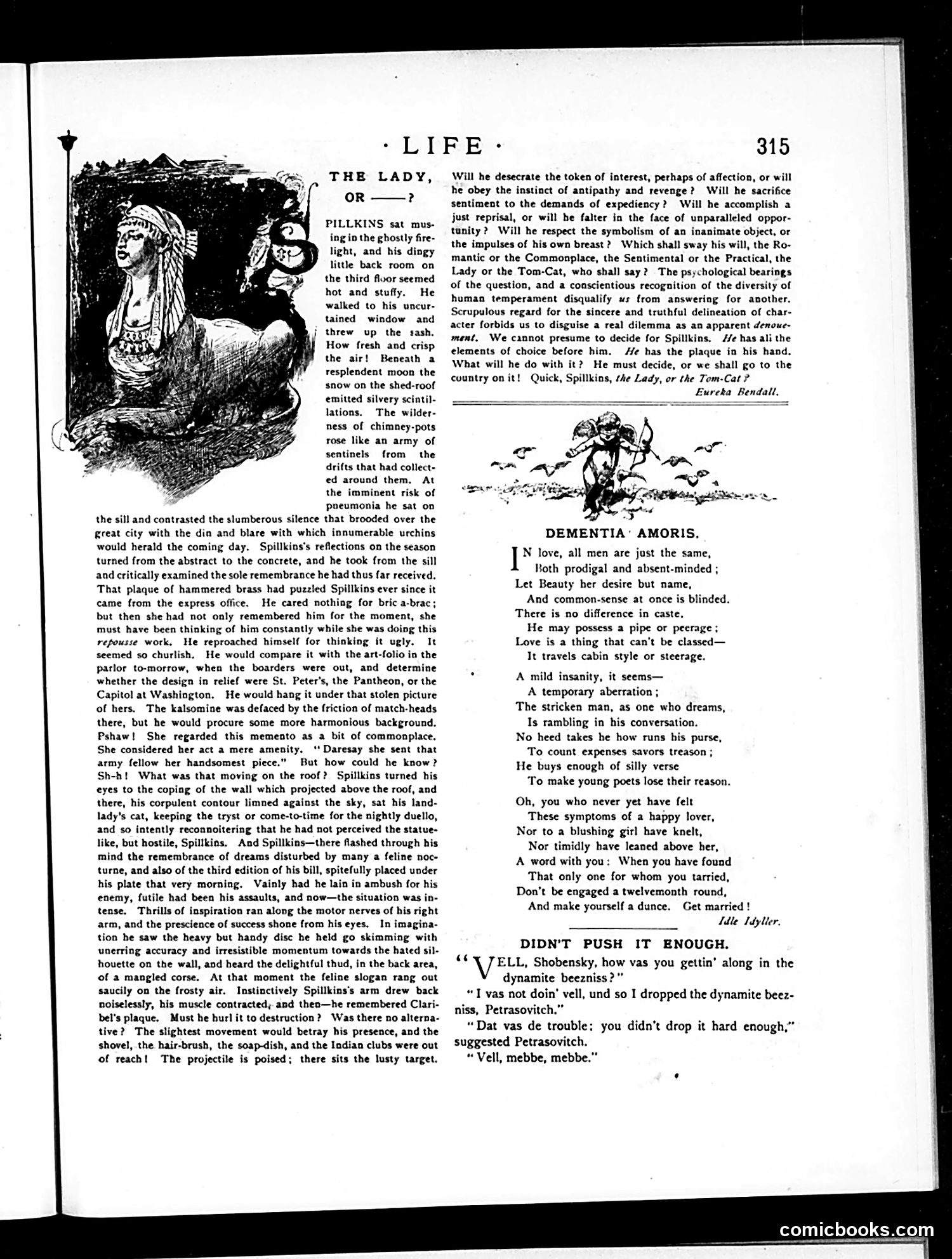
This page contains three distinct pieces rather than a unified political cartoon: 1. **"The Lady, or—?"** - A satirical column debating whether a gentleman named Spillkins should pursue a romantic relationship. The accompanying illustration shows a Victorian-era figure at a window. This is social satire about courtship decisions, not political commentary. 2. **"Dementia Amoris"** - A poem mocking lovesick behavior and absent-mindedness, with lines like "In love, all men are just the same, / Both prodigal and absent-minded." 3. **"Didn't Push It Enough"** - A brief comedic dialogue between Shobensky and Petrasovitch about dropping dynamite, suggesting satire about Russian politics or anarchist activities, though the specific reference is unclear. The page is primarily humorous social commentary rather than direct political satire.
📄 Transcribed text from this page (OCR, searchable)
Machine-transcribed from the original scan — historical spelling and the odd misread are preserved.
> LIFE: THE LADY, OR ? PILLKINS sat mus- ing in the ghostly fire- light, and his dingy little back room on the third floor seemed hot and stuffy. He walked to his uncur- tained window and j threw up the sash. How fresh and crisp the air! Beneath a resplendent moon the snow on the shed-roof emitted silvery scintil- lations. The wilder- ness of chimney-pots rose like an army of sentinels from the drifts that had collect- ed around them. At the imminent risk of pneumonia he sat on the sill and contrasted the slumberous silence that brooded over the great city with the din and blare with which innumerable urchins would herald the coming day. Spillkins’s reflections on the season turned from the abstract to the concrete, and he took from the sill and critically examined the sole remembrance he had thus far received, That plaque of hammered brass had puzzled Spillkins ever since it came from the express office. He cared nothing for bric a-brac; but then she had not only remembered him for the moment, she must have been thinking of him constantly while she was doing this repousse work, He reproached himself for thinking it ugly. It seemed so churlish, He would compare it with the art-folio in the parlor to-morrow, when the boarders were out, and determine whether the design in relief were St. Peter's, the Pantheon, or the Capitol at Washington. He would hang it under that stolen picture of hers. The kalsomine was defaced by the friction of match-heads there, but he would procure some more harmonious background. Pshaw! She regarded this memento as a bit of commonplace. She considered her act a mere amenity, ‘‘ Daresay she sent that army fellow her handsomest piece.” But how could he know? Sh-h! What was that moving on the roof? Spillkins turned his eyes to the coping of the wall which projected above the roof, and there, his corpulent contour limned against the sky, sat his land- lady's cat, keeping the tryst or come-to-time for the nightly duello, and so intently reconnoitering that he had not perceived the statue- like, but hostile, Spillkins. And Spillkins—there flashed through his mind the remembrance of dreams disturbed by many a feline noc- turne, and also of the third edition of his bill, spitefully placed under his plate that very morning. Vainly had he lain in ambush for his enemy, futile had been his assaults, and now—the situation was in- tense, Thrills of inspiration ran along the motor nerves of his right arm, and the prescience of success shone from his eyes. In imagina- tion he saw the heavy but handy disc he held go skimming with unerring accuracy and irresistible momentum towards the hated sil- houette on the wall, and heard the delightful thud, in the back area, of a mangled corse. At that moment the feline slogan rang out saucily on the frosty air, Instinctively Spillkins’s arm drew back noiselessly, his muscle contracted; and then—he remembered Clari- bel's plaque. Must he hurl it to destruction? Was there no alterna- tive? The slightest movement would betray his presence, and the shovel, the hair-brush, the soap-dish, and the Indian clubs were out of reach! The projectile is poised; there sits the lusty target. 315 Will he desecrate the token of interest, perhaps of affection, or will he obey the instinct of antipathy and revenge? Will he sacrifice sentiment to the demands of expediency? Will he accomplish a just reprisal, or will he falter in the face of unparalleled oppor- tunity? Will he respect the symbolism of an inanimate object, or the impulses of his own breast? Which shall sway his will, the Ro- mantic or the Commonplace, the Sentimental or the Practical, the Lady or the Tom-Cat, who shall say? The psychological bearings of the question, and a conscientious recognition of the diversity of human temperament disqualify us from answering for another. Scrupulous regard for the sincere and truthful delineation of char- acter forbids us to disguise a real dilemma as an apparent denoue- ment, We cannot presume to decide for Spillkins, //e has ali the elements of choice before him. Ae has the plaque in his hand, What will he do with it? He must decide, or we shall go to the country on it! Quick, Spillkins, “he Lady, or the Tom-Cat ? Eureka Bendall, DEMENTIA’ AMORIS. N love, all men are just the same, Roth prodigal and absent-minded ; Let Beauty her desire but name, And common-sense at once is blinded. There is no difference in caste, He may possess a pipe or peerage ; Love is a thing that can’t be classed— It travels cabin style or steerage, A mild insanity, it seems— A temporary aberration ; The stricken man, as one who dreams, Is rambling in his conversation. No heed takes he how runs his purse, To count expenses savors treason ; He buys enough of silly verse To make young poets lose their reason. Oh, you who never yet have felt These symptoms of a happy lover, Nor to a blushing girl have knelt, Nor timidly have leaned above her, A word with you: When you have found That only one for whom you tarried, Don’t be engaged a twelvemonth round, And make yourself a dunce. Get married ! Idle Idylter, DIDN'T PUSH IT ENOUGH. es ELL, Shobensky, how vas you gettin’ along in the dynamite beezniss?"” “T vas not doin’ vell, und so I dropped the dynamite beez- niss, Petrasovitch.” “Dat vas de trouble; you didn’t drop it hard enough,” suggested Petrasovitch. “Vell, mebbe, mebbe.””