
A complete issue · 14 pages · 1888
Life — August 23, 1888
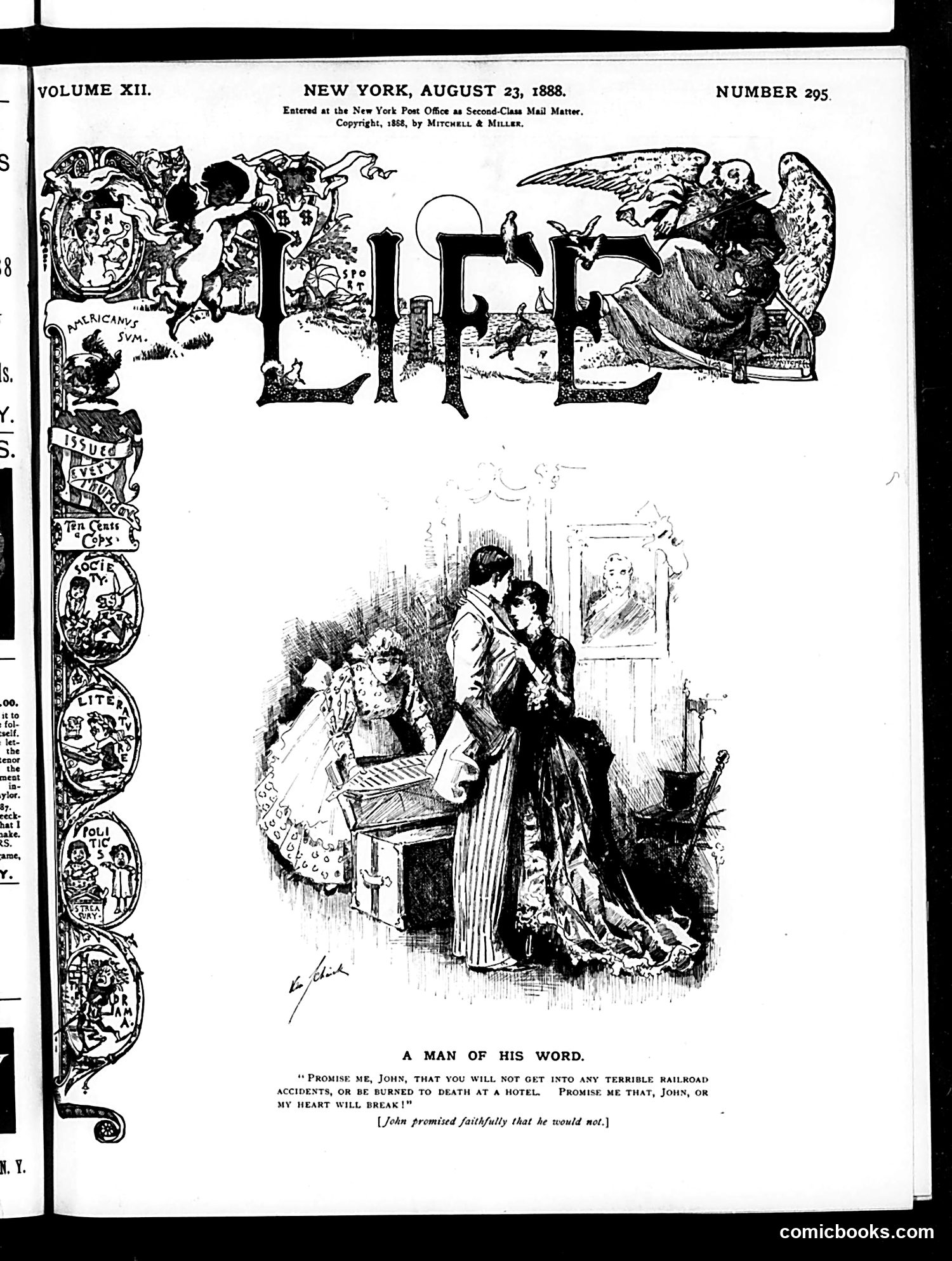
This cartoon illustrates a domestic scene where a man makes an exaggerated promise to a woman (likely his sweetheart or wife). The caption shows him pledging that "John" will not suffer railroad accidents, hotel fires, or heartbreak—promises that are obviously impossible to keep. The bracketed text "[John promised faithfully that he would not.]" adds ironic commentary: John's earnest vow is rendered absurd by its impossibility. The satire mocks the Victorian romantic convention of men making grand, unrealistic promises to reassure anxious women. The cartoon suggests the gap between romantic sentiment and practical reality—a man cannot actually guarantee his safety or her emotional security through mere promises, no matter how earnestly delivered.
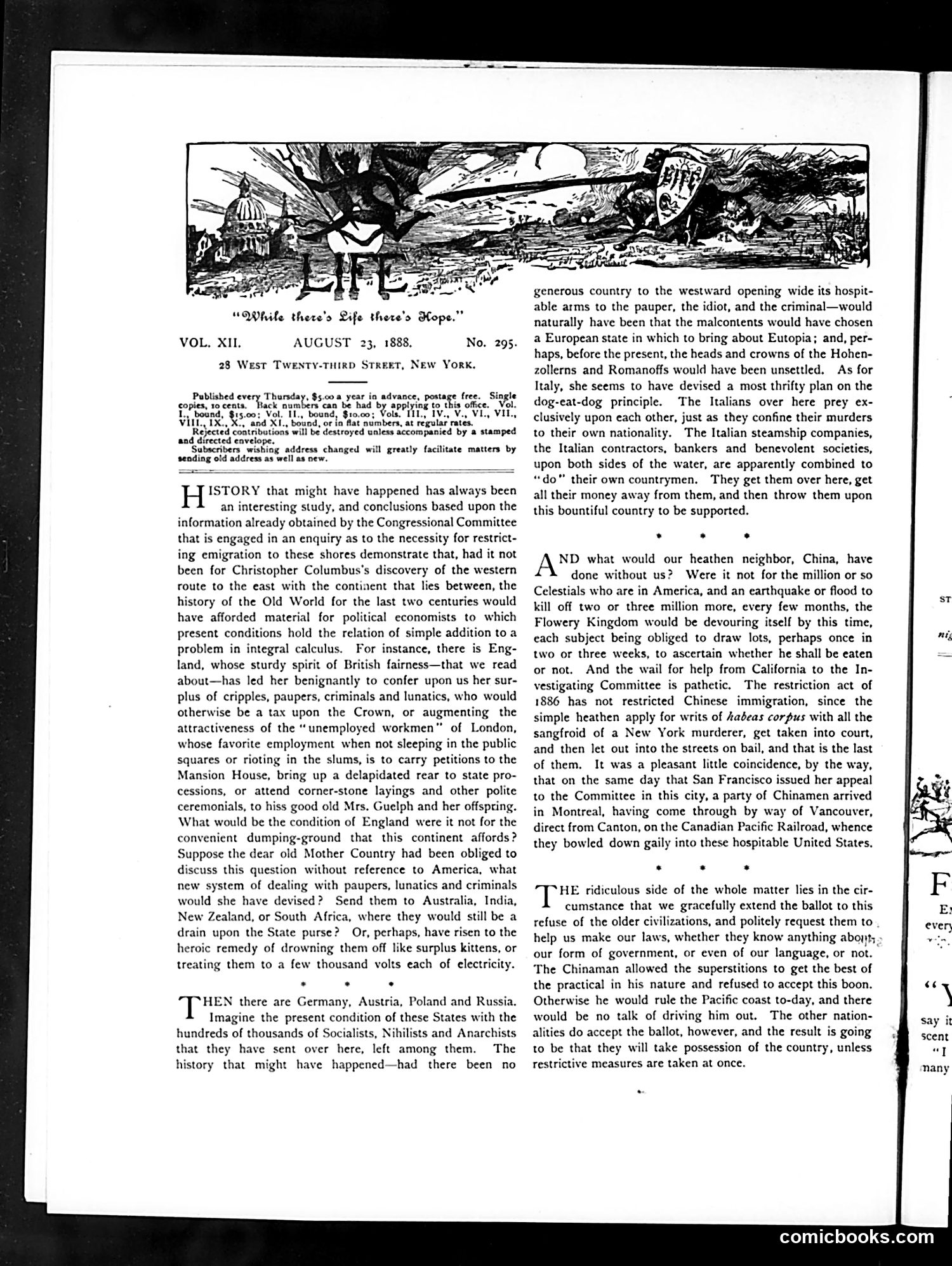
The page combines an editorial with a woodcut header image showing a barren landscape and dead tree, symbolizing desolation. The text argues against unrestricted immigration, particularly targeting Chinese and European arrivals. The author claims immigrants drain state resources and compete unfairly with native workers. The piece specifically criticizes the Chinese Exclusion Act (1886) as insufficient, suggesting immigrants exploit American generosity while failing to assimilate. The satire mocks American idealism about welcoming "paupers, idiots, and criminals," arguing that other nations would never accept such policies. The author advocates for stricter immigration restrictions "at once," portraying newcomers as threats to American prosperity and social order rather than contributors. This reflects late-19th-century nativist sentiment and xenophobia prevalent during periods of economic anxiety.
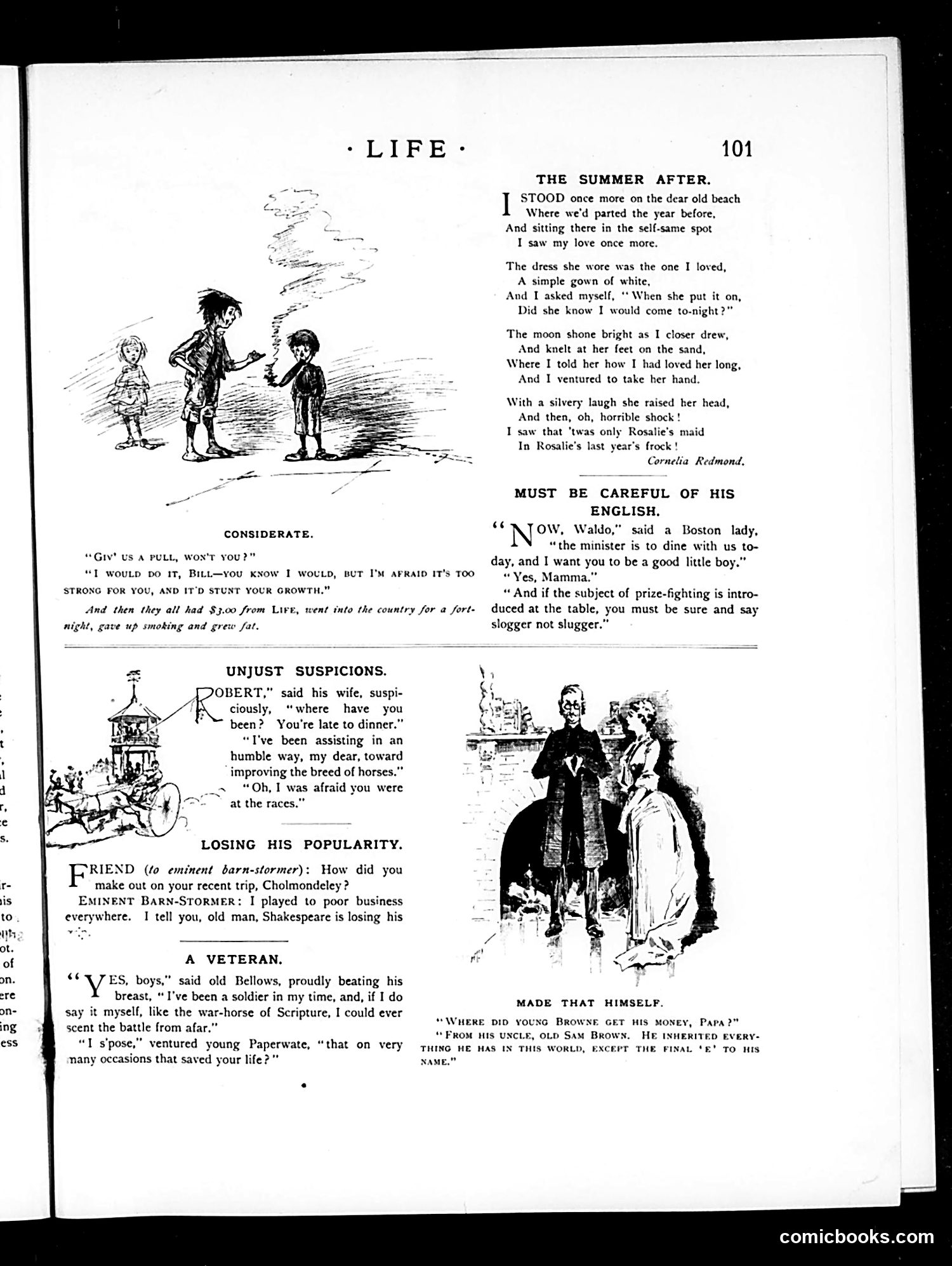
This page contains several short humorous sketches typical of Life's satirical style: **"The Summer After"** — A romantic poem about reuniting with a lost love at a beach, discovering she's become a maid to someone named Rosalie. **"Must Be Careful of His English"** — A Boston lady instructs a boy to avoid saying "slogger not slugger" when discussing prize-fighting, reflecting period anxieties about proper American English. **"Unjust Suspicions"** — A wife suspects her husband of attending horse races when he's late for dinner. **"Losing His Popularity"** — A joke about Shakespeare's declining fame, attributed to a barn-stormer. **"A Veteran"** — An old soldier boasts about his military service. These are gentle, domestic humor sketches typical of early 20th-century magazine satire, targeting social pretensions and marital misunderstandings rather than political issues.
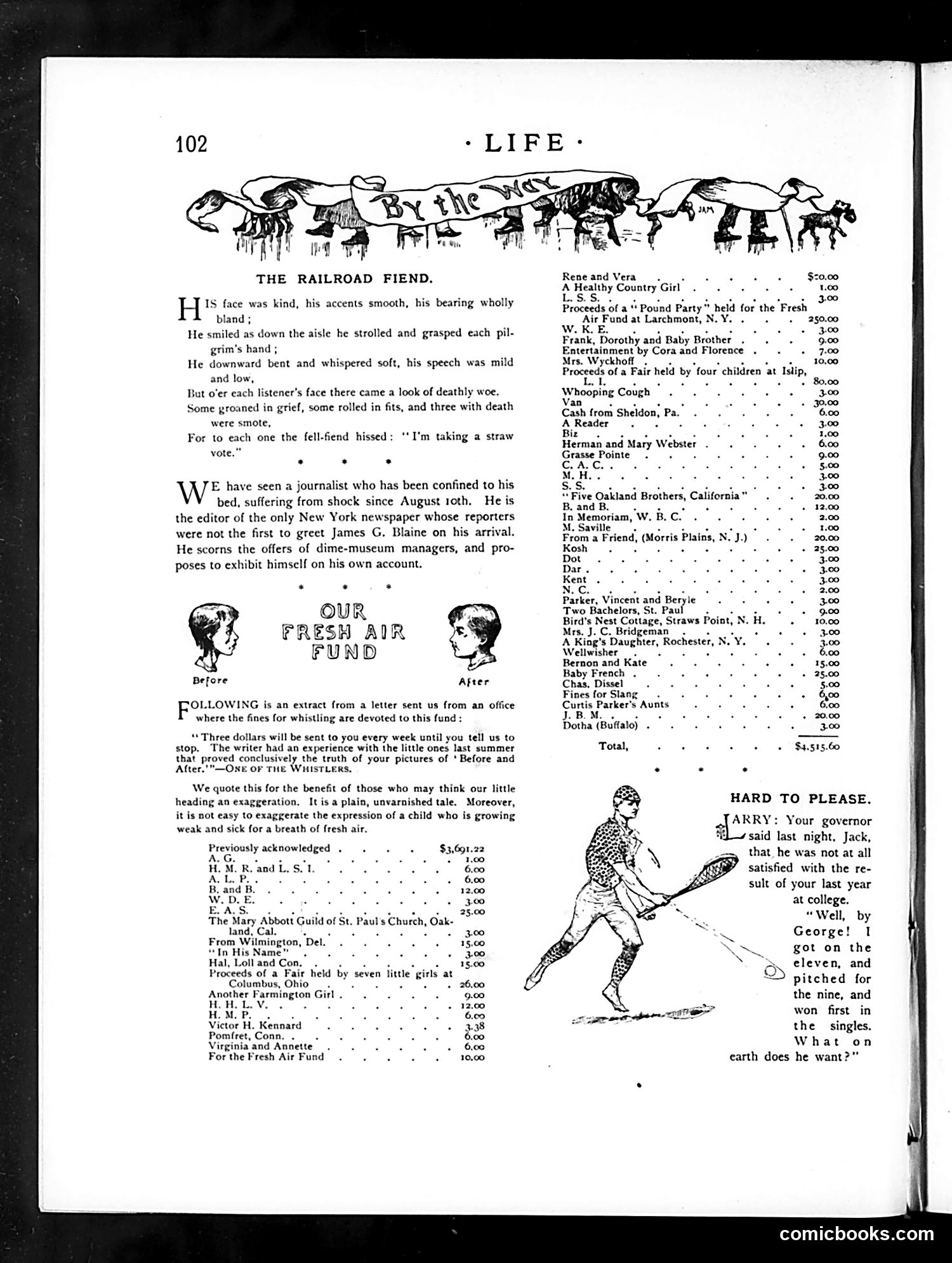
This page contains three distinct items: 1. **"The Railroad Fiend"** — A satirical poem depicting a man with a "kind, indifferent" face who systematically harasses train passengers by stealing their pillows, whispering threats, and extorting money ("I'm taking a straw vote"). This appears to be social satire about annoying passenger behavior on trains. 2. **"Our Fresh Air Fund"** — A charitable fundraising appeal with "Before and After" illustrations showing a sickly child versus a healthy one. The accompanying letter solicits donations for children's health initiatives, quoting donors' contributions. 3. **"Hard to Please"** — A brief comic dialogue about a governor disappointed with his son's college athletic performance, using baseball as the framing device. The page primarily functions as fundraising content mixed with light satirical humor.
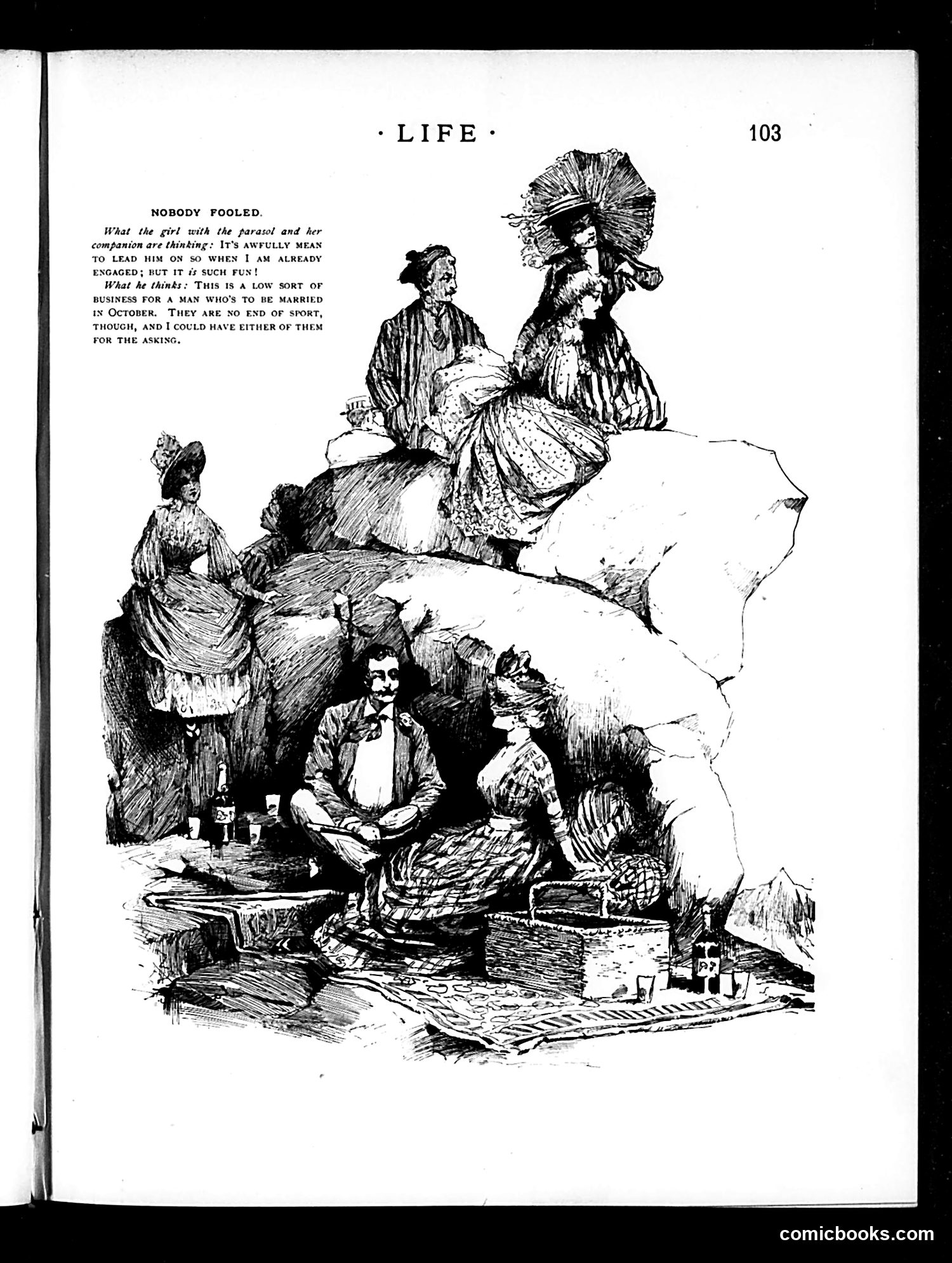
This page satirizes a marriage proposal scenario. The headline "Nobody Fooled" introduces a man's complaint about a woman who has already entangled him into marriage plans for October while he's still "engaged" elsewhere. The illustration shows a social scene where a young woman (left, standing) appears to be part of a couple's picnic or outing. The satirical point targets the woman's manipulation: she's using a parasol and companion as cover for her romantic scheming, leading the man toward matrimony against his will. The satire mocks both the predictability of courtship rituals and the woman's calculated tactics to secure marriage. The man considers this "low sort of business" for someone allegedly seeking fun rather than marriage—exposing the hypocrisy of Victorian-era romantic conventions.
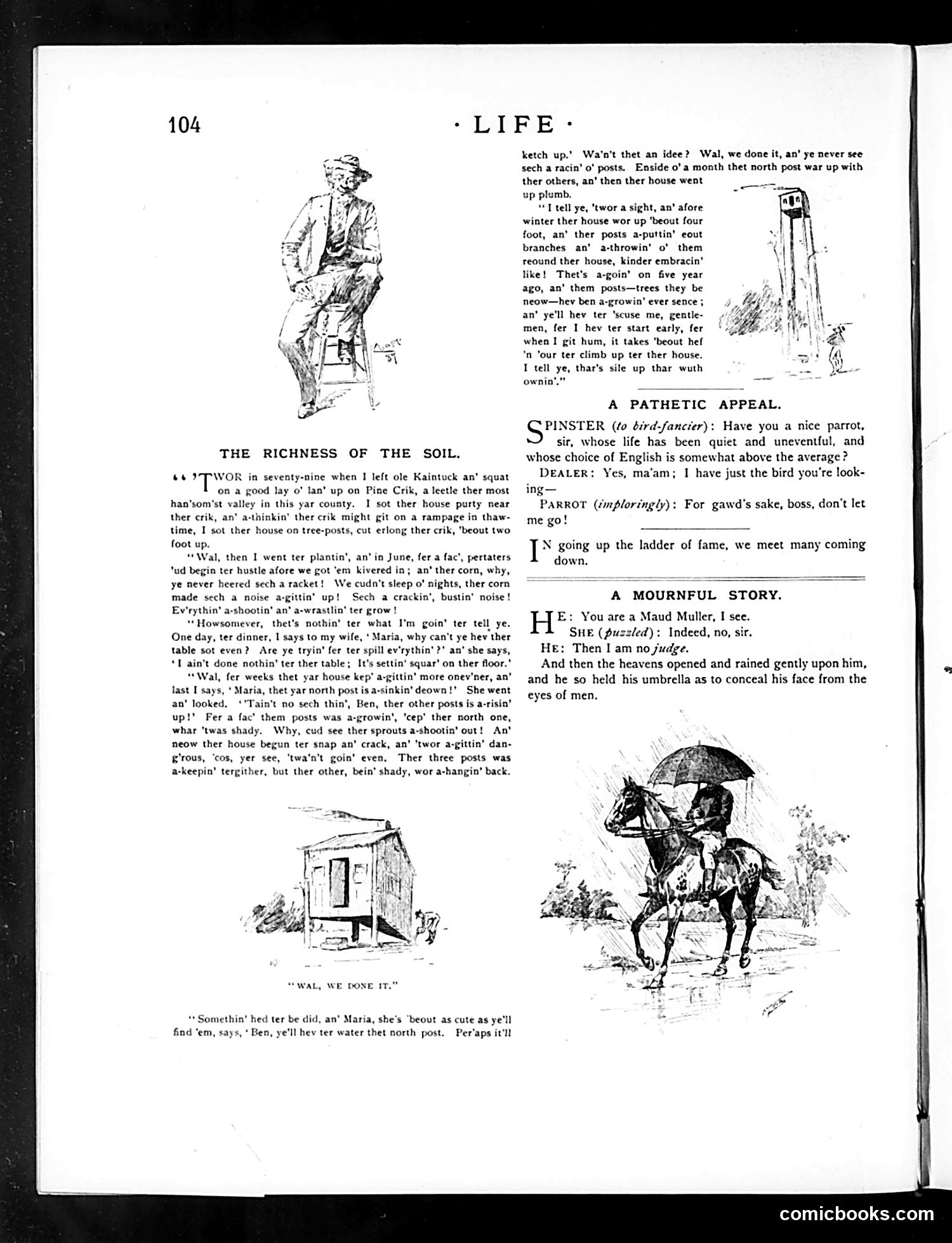
This page contains three separate humorous pieces rather than unified political cartoons: 1. **"The Richness of the Soil"**: A rural anecdote about a farmer describing his neighbor's land improvements and growing crops, illustrated with a simple sketch of a cabin. 2. **"A Pathetic Appeal"**: A brief dialogue between a bird-fancier and dealer about a parrot with superior English, presented as gentle humor about class and language pretension. 3. **"A Mournful Story"**: A sketch showing a gentleman on horseback with an umbrella, captioned with a melancholy exchange between characters named Maud Muller and a man named Judge. This appears to reference or parody the sentimental 1856 poem "Maud Muller." The page represents typical Life magazine humor: domestic vignettes and sentimental parodies rather than pointed political satire. The illustrations are simple pen sketches accompanying text-based jokes.
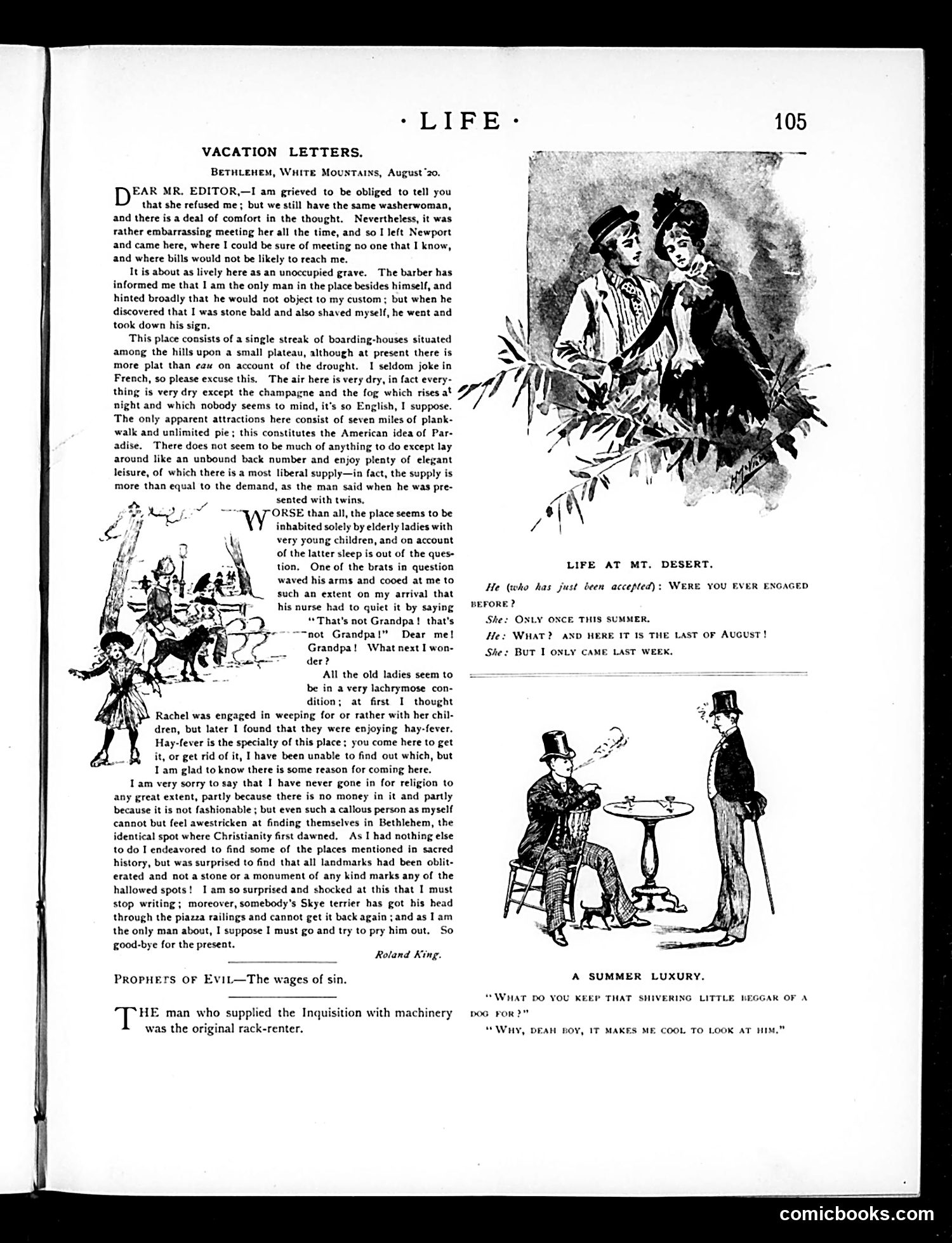
This page contains vacation correspondence and satirical illustrations rather than explicit political cartoons. The main content is a letter from "Bethlehem, White Mountains" describing a resort destination populated by elderly ladies with young children. The writer notes the area's dryness, limited attractions (seven miles of planks and a pig), and expresses surprise at finding no religious historical monuments despite the "sacred" place name. The two illustrations show genteel leisure activities: one depicts elderly people socializing outdoors, the other shows a gentleman with a small dog (captioned about keeping a "shivering little beggar of a dog"). The satire mocks bourgeois vacation culture, resort pretensions, and the gap between expectations (a biblically significant location) and reality (a dry, unremarkable plateau). The humor targets both the resort's false advertising and vacationers' gullibility.
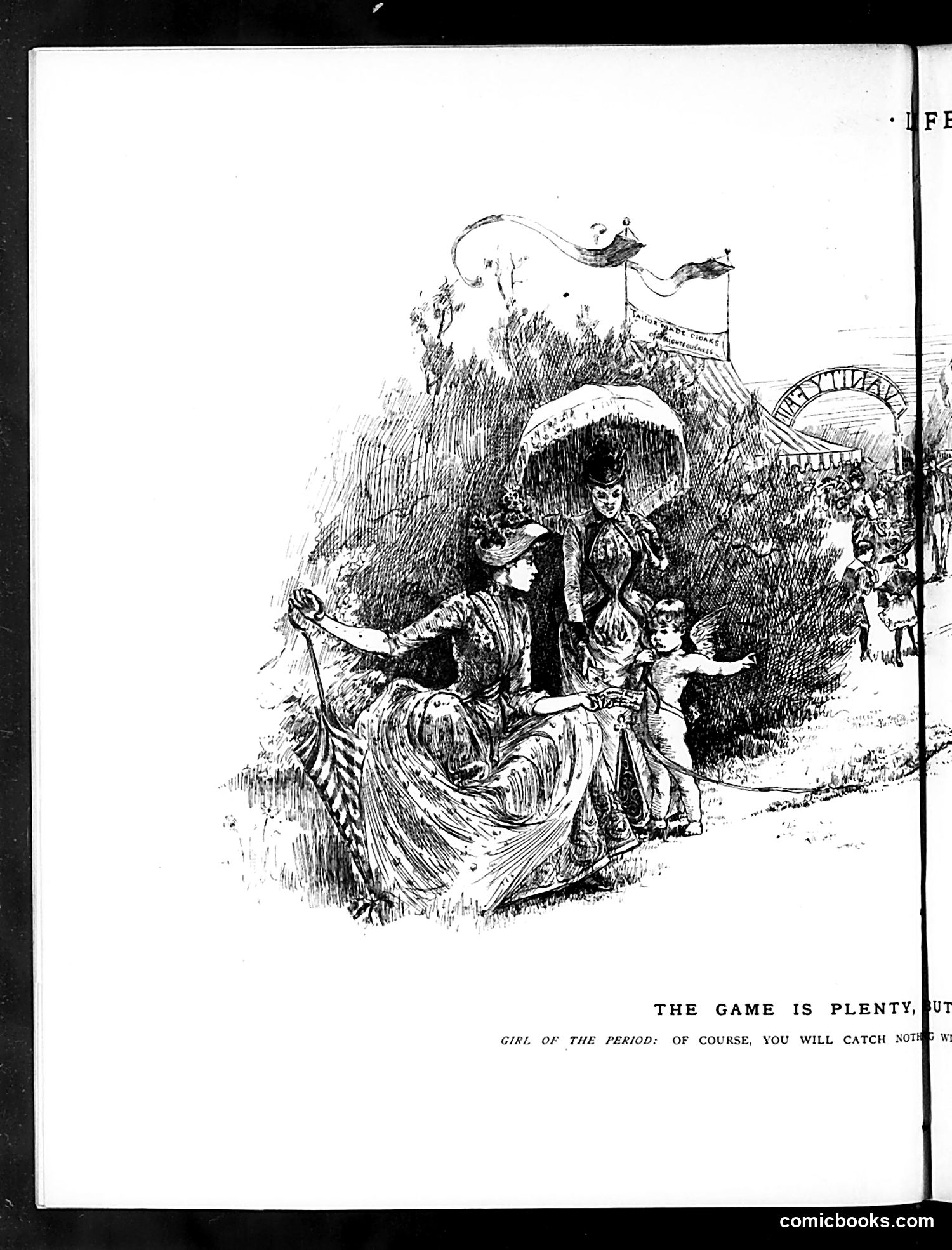
This illustration satirizes **"the New Woman"** of the late Victorian/Edwardian era—a social figure who challenged traditional gender roles. The scene shows a fashionably dressed woman with a parasol and elaborate hat, accompanied by children, apparently on an outing or hunt. The caption reads "THE GAME IS PLENTY, BUT / GIRL OF THE PERIOD: OF COURSE, YOU WILL CATCH NOTH[ING]"—a sardonic jab at the "Girl of the Period" (a contemporary phrase for modern women). The joke implies these independent, pleasure-seeking women are incompetent at practical pursuits, merely playing at activities men traditionally dominated. The satire mocks both their pretensions to equality and period anxieties about women abandoning domestic duties for leisure and autonomy.
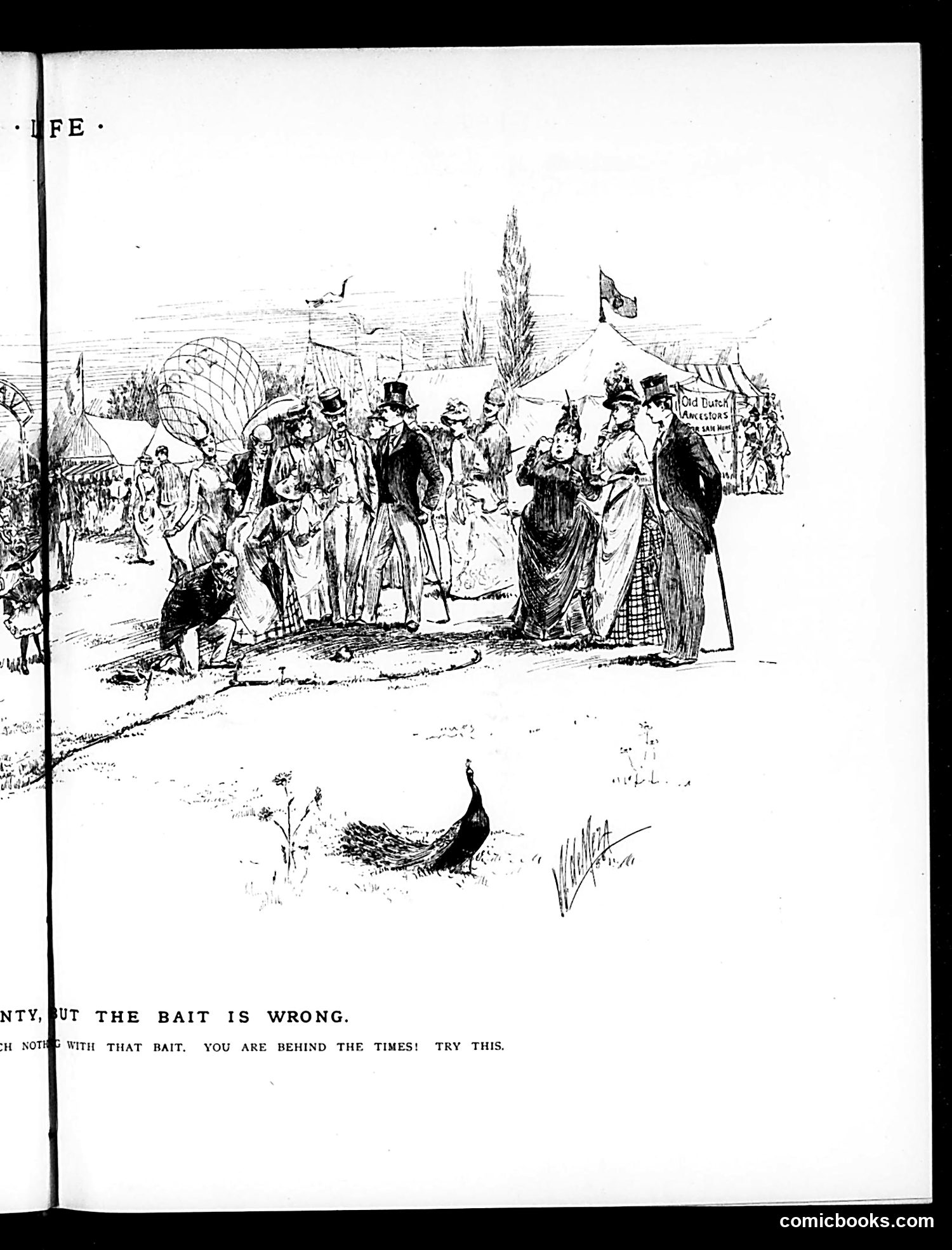
This illustration depicts a Victorian-era fair or carnival scene with well-dressed attendees in top hats and formal dress gathered around what appears to be a carnival booth or attraction. A peacock is prominently featured in the foreground. The visible text references "bait" being "wrong" and advises trying something different ("YOU ARE BEHIND THE TIMES! TRY THIS"), suggesting this is satirical commentary on outdated methods or ideas. The peacock likely symbolizes vanity or showy display. The cartoon appears to mock either: - Victorian social pretension at public gatherings - Outdated business or marketing practices - Fashion or social trends being abandoned Without clearer text or identifying captions, the specific satirical target remains unclear, though the "wrong bait" reference suggests criticism of ineffective or obsolete approaches.
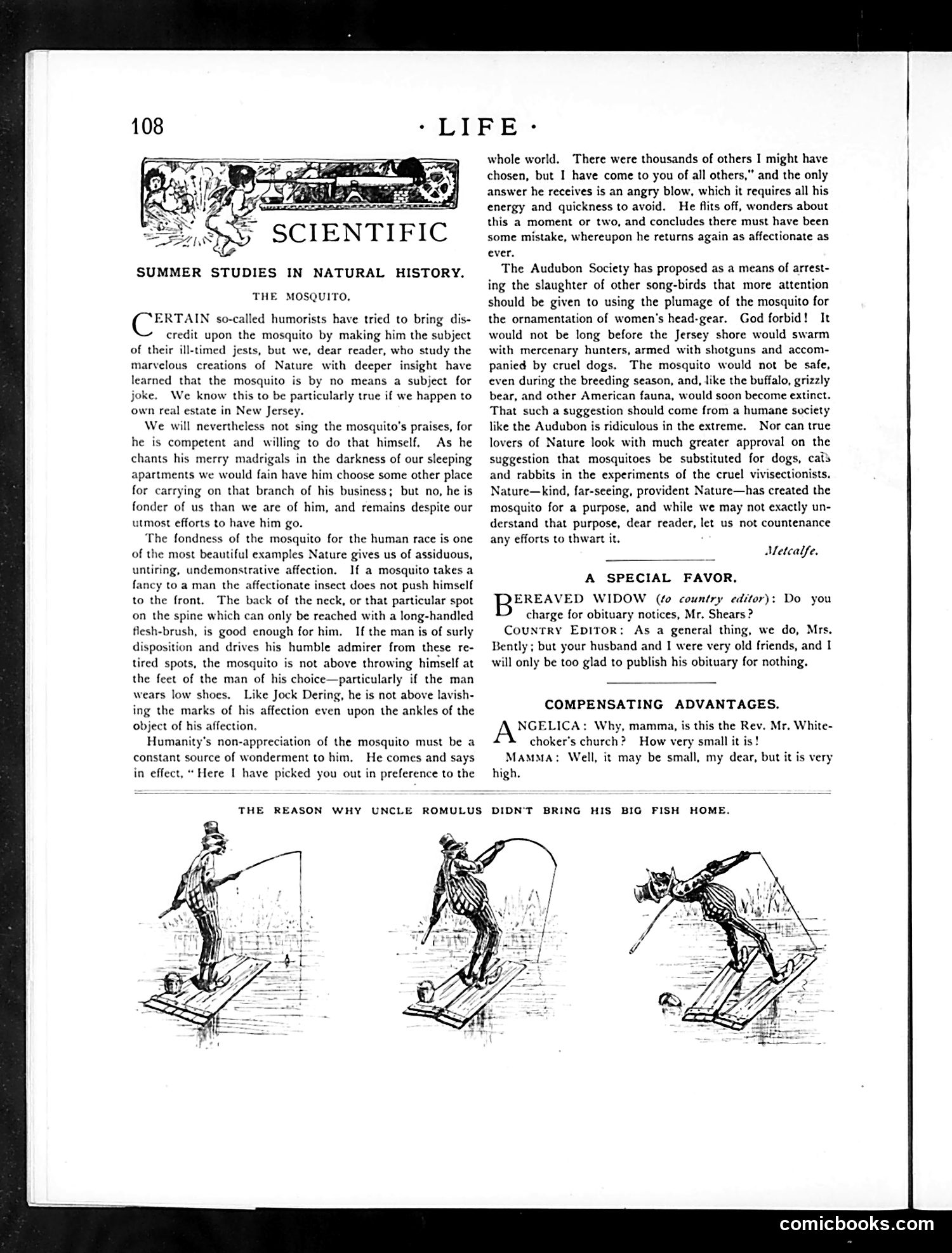
This page contains three main elements: 1. **"Scientific" article on mosquitoes**: A humorous essay defending mosquitoes against their poor reputation, arguing they're competent creatures worthy of respect—a tongue-in-cheek inversion of typical attitudes. 2. **"A Special Favor" and "Compensating Advantages"**: Two brief comedic exchanges. The first involves a widow requesting obituary publication; the second shows a mother and daughter discussing a small but "very high" church—likely poking fun at pretentious or cramped religious institutions. 3. **Three-panel cartoon**: "The Reason Why Uncle Romulus Didn't Bring His Big Fish Home" depicts a fisherman progressively losing his catch—first struggling to land it, then being pulled into the water, finally disappearing. The joke is a visual punchline about fishing gone comically wrong. All content reflects Life's satirical humor style targeting everyday situations and human folly.
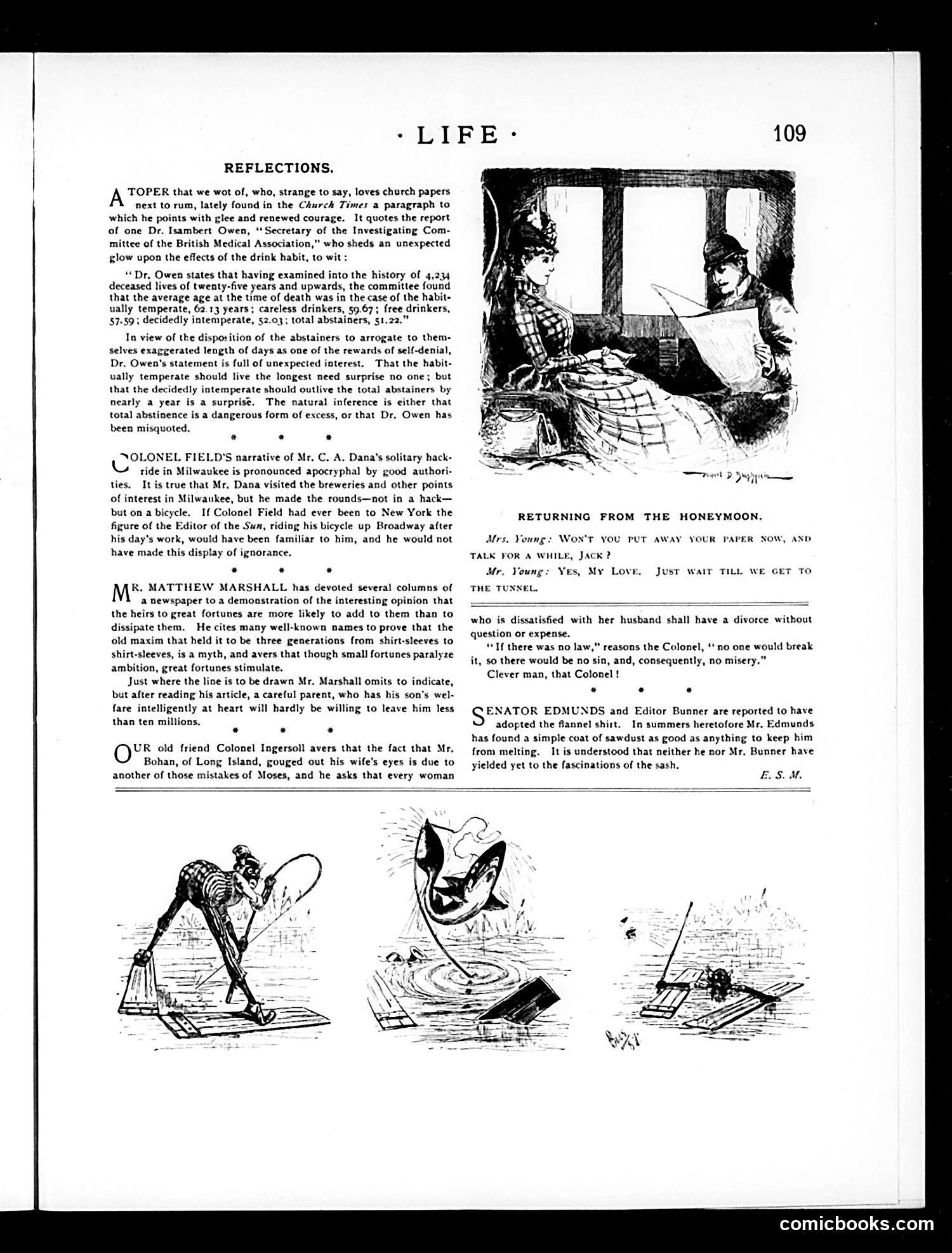
This page collects several brief satirical "reflections" on contemporary figures and issues: **The Drinking Study**: Life mocks a medical report showing habitual drinkers outlive total abstainers—sarcastically suggesting either total abstinence is "dangerous excess" or the doctor was misquoted. The joke targets temperance advocates' moral certainty. **Colonel Field's Error**: Life corrects Field's claim that newspaper editor C.A. Dana toured Milwaukee breweries by carriage; Dana actually used a bicycle, which Field should have known from seeing him bike around New York. **Matthew Marshall's Fortune Theory**: Marshall argued wealthy heirs grow fortunes rather than squander them (contradicting the "shirt-sleeves to shirt-sleeves" proverb). Life sarcastically suggests this means parents should leave sons at least ten million dollars. **Colonel Ingersoll's Logic**: Life ridicules Ingersoll's argument that a Long Island man's violence toward his wife resulted from biblical law—sardonically noting his conclusion that removing laws eliminates sin. **The Honeymoon Comic**: A three-panel cartoon shows a newlywed husband avoiding conversation by reading the paper through a tunnel.
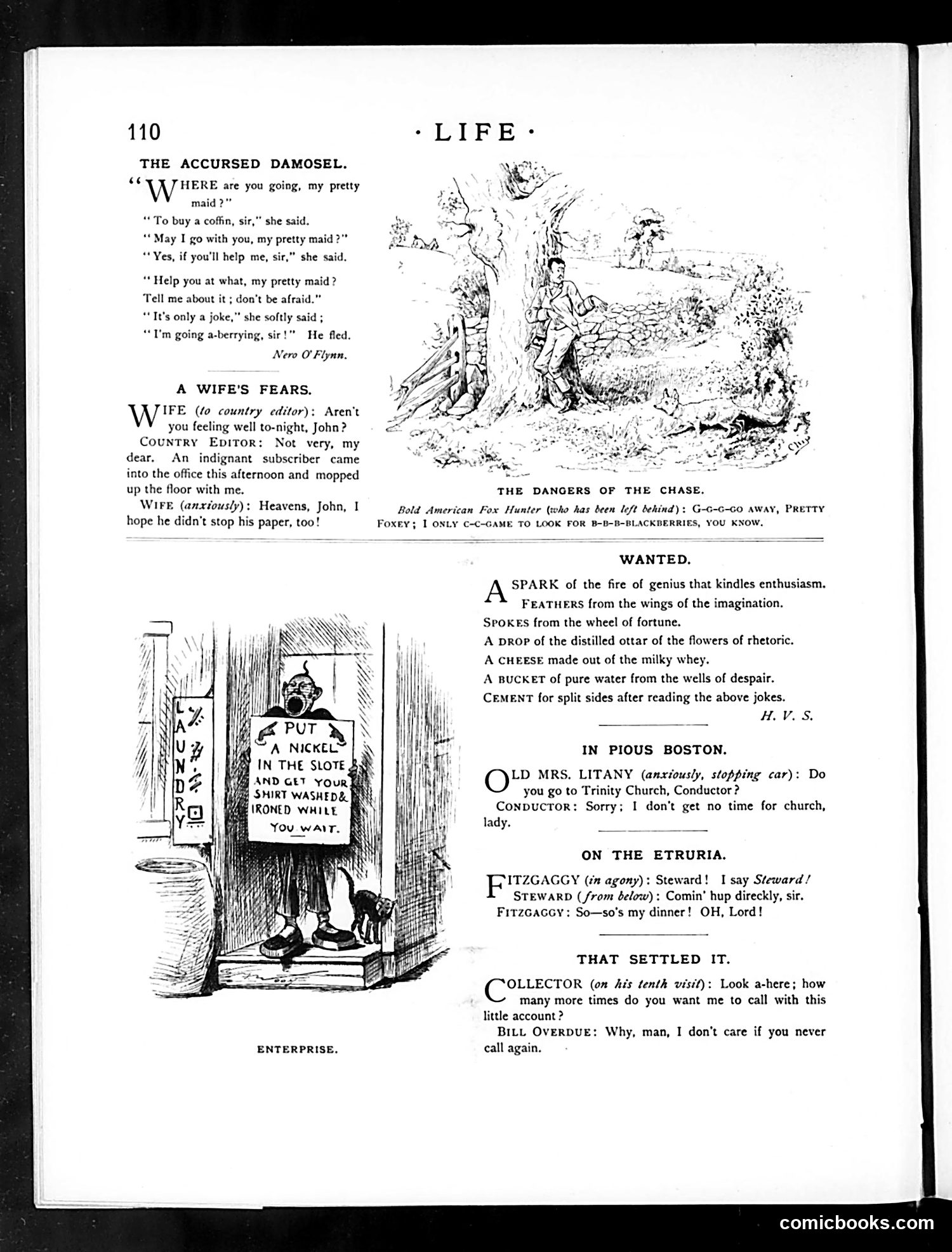
This page contains multiple brief satirical sketches typical of early Life magazine's humor format. **"The Accursed Damosel"** plays on the old nursery rhyme "Where Are You Going to My Pretty Maid?" by subverting expectations—the maid's dark mention of buying a coffin (framed as a "joke") frightens the suitor into fleeing. **"A Wife's Fears"** satirizes a country newspaper editor who's been physically beaten by an angry subscriber. The joke's point: the wife's only concern is whether the subscriber canceled his subscription—financial loss matters more than her husband's safety, reflecting newspaper economics of the era. **"The Dangers of the Chase"** shows a fox hunter separated from his party, stammering in fear while claiming he only came looking for blackberries—mocking hunters' pretended innocence when caught trespassing. The remaining sketches are brief joke exchanges satirizing domestic life, class dynamics (a conductor too busy working for church), and collection agencies' futility. The "Wanted" section parodies job postings with absurdist requirements for genius and rhetorical talent.
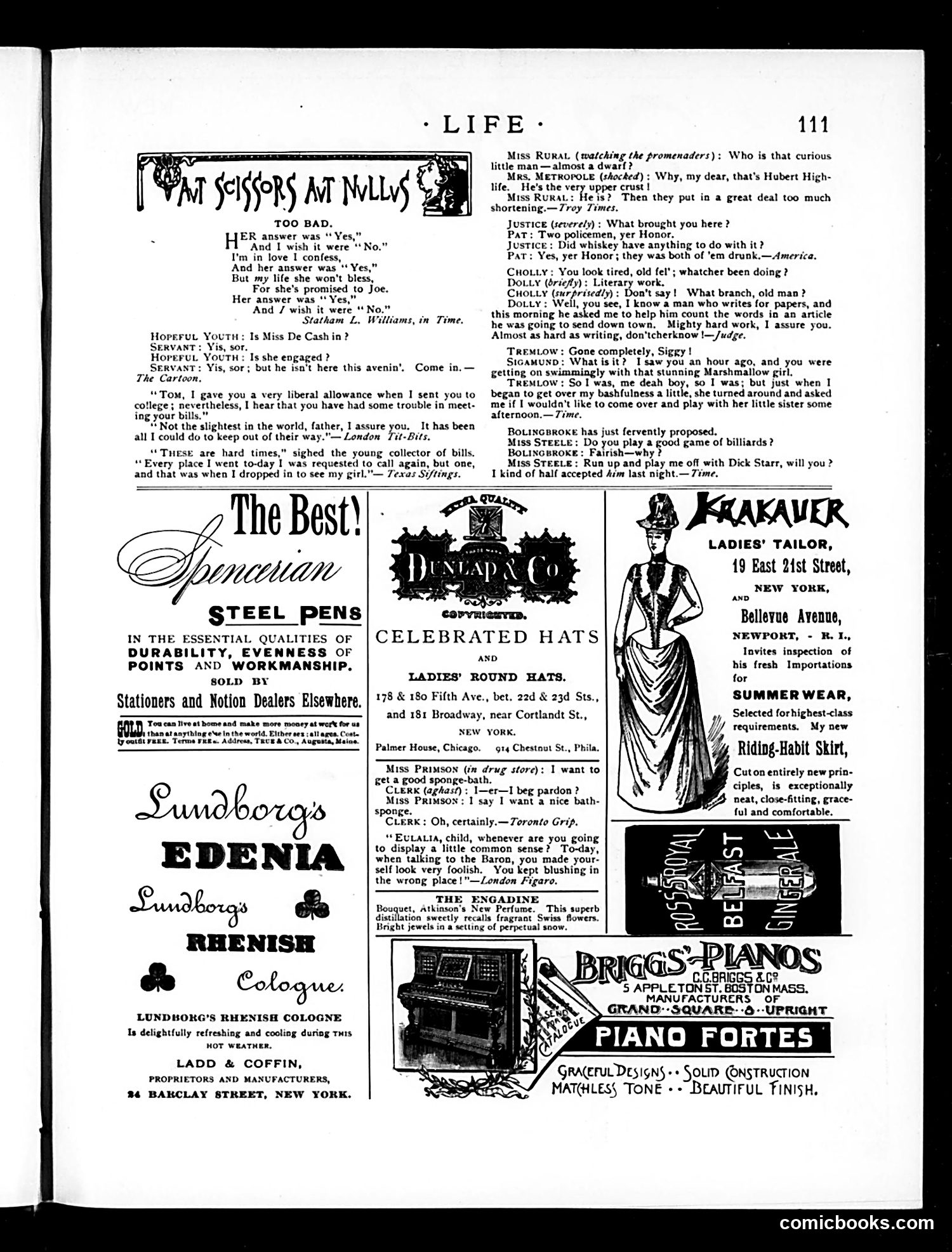
This page from Life magazine contains multiple brief satirical sketches—a format typical of the publication. The cartoons mock social conventions and romantic mishaps of the era: **"Too Bad"** depicts a man lamenting his beloved's affirmative answer to a marriage proposal, establishing the ironic premise that saying "yes" to love leads to misery. **Other sketches** ridicule various characters: a college student avoiding bill collectors, an Irish immigrant (Pat) blaming whiskey for his arrest, and a man exhausted from "literary work" that merely involved counting words in a newspaper article—mocking both intellectual pretension and journalistic labor. **Social satire** targets class consciousness (the "upper crust" Hubert Highlife), romantic awkwardness (Tremlow losing nerve when his date suggests playing with her sister), and gender dynamics (Miss Steele casually asking her new fiancé to play billiards with another man). The remainder of the page comprises period advertisements for steel pens, cologne, pianos, and women's fashion—typical of Life's revenue model.
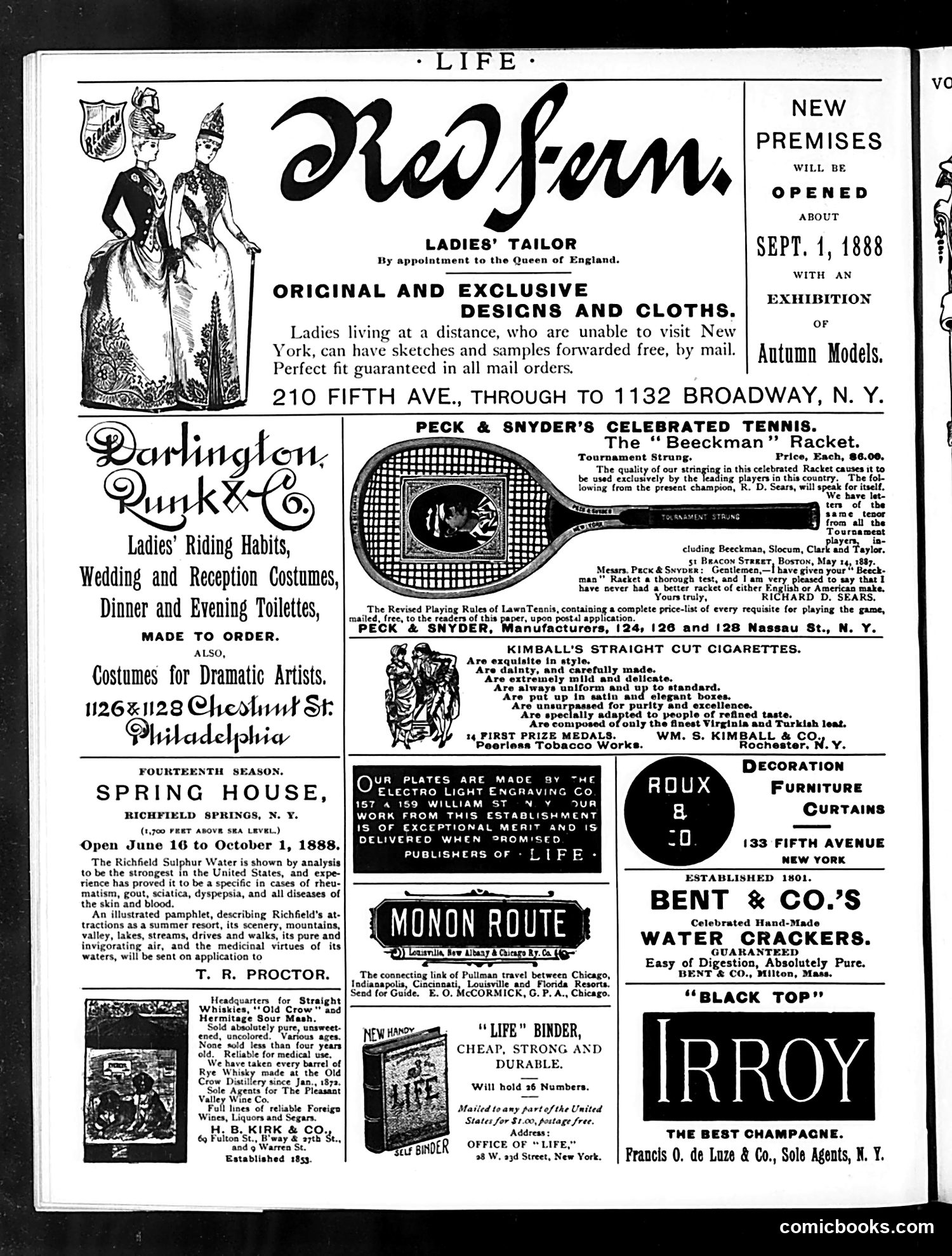
This is **primarily an advertisements page** with no political cartoons or satirical content. It's a commercial section from Life magazine, circa September 1888. The page features various luxury goods and services marketed to affluent readers: a ladies' tailor "by appointment to the Queen of England" (Red Fern), riding habits and dramatic costumes, a mineral springs resort promising cures for rheumatism and gout, whiskey distributors, tennis equipment endorsed by champion R.D. Sears, cigarettes, water crackers, champagne, and decorative furniture. The ads reflect **late-Victorian consumer culture**—targeting wealthy urbanites with imported goods, health remedies (common for the era), and leisure activities. The repeated emphasis on "quality," "purity," and "championship" endorsements reflects advertising strategies of the period. No satire or political content is evident; this is a straightforward commercial page showcasing products for the affluent readership Life cultivated.