
Life, 1888-08-23 · page 2 of 14
Life — August 23, 1888 — page 2: what you’re looking at
What you’re looking at
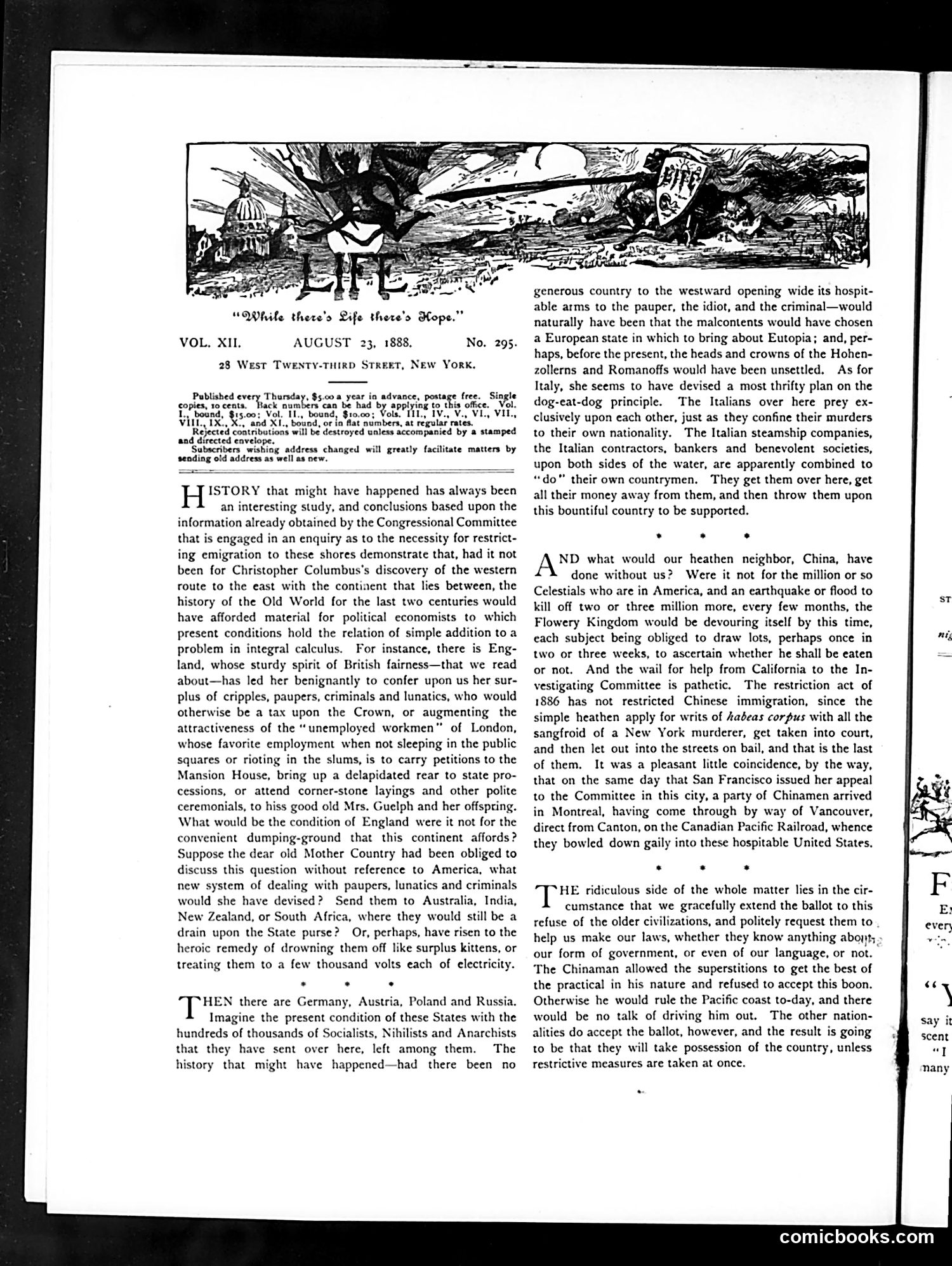
The page combines an editorial with a woodcut header image showing a barren landscape and dead tree, symbolizing desolation. The text argues against unrestricted immigration, particularly targeting Chinese and European arrivals. The author claims immigrants drain state resources and compete unfairly with native workers. The piece specifically criticizes the Chinese Exclusion Act (1886) as insufficient, suggesting immigrants exploit American generosity while failing to assimilate. The satire mocks American idealism about welcoming "paupers, idiots, and criminals," arguing that other nations would never accept such policies. The author advocates for stricter immigration restrictions "at once," portraying newcomers as threats to American prosperity and social order rather than contributors. This reflects late-19th-century nativist sentiment and xenophobia prevalent during periods of economic anxiety.
📄 Transcribed text from this page (OCR, searchable)
Machine-transcribed from the original scan — historical spelling and the odd misread are preserved.
“While there's Life there's WHope.” VOL. XII. AUGUST 23, 1888, 28 West Twenty-THIRD STREET, New York. No. 295. Published every Thursday, $5.00 a year ja advance, postage free. Single copies, ro cents. Back numbers can be had by applying to this office. Vol. Vol. I. bound, $10.00; Vols. TIL, 1V., V., VI, VIL, nd XI,, bound, or fa flat numbers, at regular rates. ec ributions will be destroyed unless accompanied by a stamped and directed envelope. Subscribers wishing address changed will greatly facilitate matters by sending old address as well as new. ISTORY that might have happened has always been an interesting study, and conclusions based upon the information already obtained by the Congressional Committee that is engaged in an enquiry as to the necessity for restrict- ing emigration to these shores demonstrate that, had it not been for Christopher Columbus's discovery of the western route to the east with the continent that lies between, the history of the Old World for the last two centuries would have afforded material for political economists to which present conditions hold the relation of simple addition to a problem in integral calculus. For instance, there is Eng- land, whose sturdy spirit of British fairness—that we read about—has led her benignantly to confer upon us her sur- plus of cripples, paupers, criminals and lunatics, who would otherwise be a tax upon the Crown, or augmenting the attractiveness of the “unemployed workmen" of London, whose favorite employment when not sleeping in the public squares or rioting in the slums, is to carry petitions to the Mansion House, bring up a delapidated rear to state pro- cessions, or attend corner-stone layings and other polite ceremonials, to hiss good old Mrs. Guelph and her offspring. What would be the condition of England were it not for the convenient dumping-ground that this continent affords? Suppose the dear old Mother Country had been obliged to discuss this question without reference to America, what new system of dealing with paupers, lunatics and criminals would she have devised? Send them to Australia, India, New Zealand, or South Africa, where they would still be a drain upon the State purse? Or, perhaps, have risen to the heroic remedy of drowning them off like surplus kittens, or treating them to a few thousand volts each of electricity. HEN there are Germany, Austria, Poland and Russia. Imagine the present condition of these States with the hundreds of thousands of Socialists, Nihilists and Anarchists that they have sent over here, left among them. The history that might have happened—had there been no generous country to the westward opening wide its hospit- able arms to the pauper, the idiot, and the criminal—would naturally have been that the malcontents would have chosen a European state in which to bring about Eutopia; and, per- haps, before the present, the heads and crowns of the Hohen- zollerns and Romanoffs would have been unsettled. As for Italy, she seems to have devised a most thrifty plan on the dog-eat-dog principle. The Italians over here prey ex- clusively upon each other, just as they confine their murders to their own nationality. The Italian steamship companies, the Italian contractors, bankers and benevolent societies, upon both sides of the water, are apparently combined to “do” their own countrymen. They get them over here, get all their money away from them, and then throw them upon this bountiful country to be supported. . . . A® what would our heathen neighbor, China, have done without us? Were it not for the million or so Celestials who are in America, and an earthquake or flood to kill off two or three million more, every few months, the Flowery Kingdom would be devouring itself by this time, each subject being obliged to draw lots, perhaps once in two or three weeks, to ascertain whether he shall be eaten or not. And the wail for help from California to the In- vestigating Committee is pathetic. The restriction act of 1886 has not restricted Chinese immigration, since the simple heathen apply for writs of Aabeas corpus with all the sangfroid of a New York murderer, get taken into court, and then let out into the streets on bail, and that is the last of them. It was a pleasant little coincidence, by the way, that on the same day that San Francisco issued her appeal to the Committee in this city, a party of Chinamen arrived in Montreal, having come through by way of Vancouver, direct from Canton, on the Canadian Pacific Railroad, whence they bowled down gaily into these hospitable United States. . . * HE ridiculous side of the whole matter lies in the cir- cumstance that we gracefully extend the ballot to this refuse of the older civilizations, and politely request them to help us make our laws, whether they know anything abont, our form of government, or even of our language, or not. The Chinaman allowed the superstitions to get the best of the practical in his nature and refused to accept this boon. Otherwise he would rule the Pacific coast to-day, and there would be no talk of driving him out. The other nation- alities do accept the ballot, however, and the result is going to be that they will take possession of the country, unless restrictive measures are taken at once. comicbooks.com